1
Organizing and Managing
Innovation at ActivoBank
Tomás Valbordo Carvalho
Dissertation submitted in partial fulfilment of requirements for the degree of MSc in Business Administration, at the Universidade Católica Portuguesa,
2
Abstract
Title: Organizing and managing Innovation at ActivoBank Author: Tomás Valbordo Carvalho
ActivoBank, a small Portuguese retail bank with digital focus, has been operating in the Portuguese market with its current structure for five years. As the model proves to be successful and allows the company to grow at a generous pace, some questions arise on the most adequate innovation strategy for the company, one of the bank’s strongest competitive advantages.
After hitting its breakeven point earlier than expected, in 2014, the bank is now at a critical point to check-up on the company’s structure and overall health status. It has a client base of around eighty thousand people (and growing).
The present case aims at tracking the history of the company, questioning the relevance of its strong innovation culture strategy and providing an overview on the Portuguese retail banking industry.
The reader will be in place of a top management decision-maker from inside ActivoBank, the Head of the Innovation Office. Its goals are to analyze the situation critically and propose with strong arguments possible answers to the upcoming challenges. Should the bank maintain its centralized innovation model, or shift to a different one more suited to its scalability and upcoming challenges? Effectively, is there a more suited model regarding the future of the company?
3
Resumo
Título: Organização e gestão de inovação no ActivoBank Autor: Tomás Valbordo Carvalho
O ActivoBank, um banco português de pequena dimensão com foco em canais de distribuição digitais, festeja em 2015 o seu quinto aniversário em operação (com a estrutura actual). Apesar de o modelo de negócio seguido ter dado provas de sucesso e permitido ao banco crescer a um ritmo considerável, surgem questões sobre a estratégia de inovação mais adequada para a empresa, uma das mais fortes vantagens competitivas do ActivoBank no seu mercado.
Depois de atingir o Break-even* em 2014 (antes do esperado aquando da criação do banco em 2010), o banco encontra-se num ponto crítico para revisão e análise da situação organizacional da empresa. Neste momento, serve cerca de setenta e dois mil clientes, número este que tende a crescer nos próximos anos.
O caso de estudo apresentado procura estudar a história da empresa, questionar a pertinência do seu modelo atual de inovação e analisar de forma breve o mercado bancário português no qual o banco opera.
O leitor estará na pele do responsável pela área de Inovação. Os seus objetivos serão refletir sobre a situação atual de forma crítica e apresentar a melhor solução, justificando com argumentos fortes e utilizando modelos de gestão existentes. Deverá o banco manter o seu modelo de inovação centralizado, ou alterar para se adaptar aos próximos desafios que surgem, entre outros fatores, da escalabilidade? Será que há algum modelo mais adequado ao futuro da empresa?
4
Contents
Abstract...2 Resumo ...3 Contents ...4 Acknowledge ments ...5 List of Exhibits ...6List of Figures and Tables ...7
Glossary & Acronyms ...8
Organizing and Managing Innovation at ActivoBank ...10
Introduction ... 10
Retail Banking ... 11
Overview...11
Setting up an innovation team ...13
Successful examples of innovation in the banking sector ...15
The Portuguese economic set ...16
Retail banking in Portugal ...17
Innovation in other service providing companies ... 22
Innovation at ActivoBank ... 24
History ...24
Mission and Values...25
Internal Model ...26
Main Achievements ...29
ActivoBank inside the Millennium Group ...30
Conclusion... 31
Exhibits ...32
Lite rature Review ...i
Case Analysis and Teaching Notes ...iv
Introduction ... iv
Case Summary... iv
Learning Objectives ... v
Suggested Assignment Q uestions ... v
5
Acknowledgements
This dissertation is the result of combined efforts not only of the author, but also of the remaining actors involved. First, I would like to thank ActivoBank S.A. as an institution, for providing an excellent environment and sharing the data required to create this dissertation; Special thanks to Carlos Pimenta Gomes and Filipe Abreu, whose constant guidance and feedback were determinant.
I would also like to thanks my thesis supervisor, João Simão Pires, for the regular advising and tracking of the work in progress, as well as for the very valuable insights for shaping ideas into a robust dissertation. Special thanks addressed to Diogo Fernandes for all the support and companionship in the thesis creation process.
Another special thanks to the companies who provided relevant information for benchmarking in the thesis: Vieira de Almeida & Associados, more specifically to Margarida Saragoça and Hugo Moredo Santos for sharing some of the company’s and personal insights on contemporary topics; and André Fonseca Ferreira, from Deloitte Consultores S.A. for the enlightenment about how the consulting top player structurally organizes its innovation processes.
As for last, but definitely not least, I would like to thank all my family and friends, especially my parents, Natália Carvalho and Manuel Carvalho, for giving the opportunity and the tools to accomplish my objectives and my girlfriend Sofia Mensurado for all the unconditional love and support not only on this dissertation but also in my whole path to get to this point; it would not have been possible without their help.
6
List of Exhibits
Exhibit 1 – Innovation Performance in banks (self-assessment, scale of 1 to 7) Exhibit 2 – Proportion of banks with an innovation strategy
Exhibit 3 – Proportion of Banks increasing innovation investment yearly Exhibit 4 – Portuguese Confidence Level Index levels
Exhibit 5 – Evolution of the GDP* variation rate (2011 constant prices), year-on-year basis
Exhibit 6 – Evolution of the unemployment rate in Portugal
Exhibit 7 – Balance Sheet (ActivoBank, BEST*, BiG*) – Dec. 2013 Exhibit 8 – Separate Income Statements (Dec. 2013) in thousands € Exhibit 9 – ActivoBank’s Client Type: Average & Heavy users
Exhibit 10 – Interview with Margarida Saragoça – Practice & Clients Director – and Hugo Moredo Santos – Managing Associate, Banking & Finance ate Vieira de Almeida & Associados.
Exhibit 11 – Interview with André Fonseca Ferreira, Innovation Manager at Deloitte Consultores S.A.
Exhibit 12 – Interview with Carlos Pimenta Gomes - Remote Channels & Innovation Director
7
List of Figures and Tables
Figure 1 – Preferred channels by type of service for different generation members Figure 2 – Ten types of innovation
Figure 3 – Percentage of banks with clearly defined innovation processes Figure 4 – Comparison of innovation indicators by country groups
Figure 5 – Main Players in the Portuguese Retail Banking Industry
Figure 6 – Commercial Indicators (ActivoBank, BEST*, BiG*) - Dec. 2013 Figure 7 – AB*, BEST* and BiG* comparison – Distribution channels Figure 8 – AB*, BEST* and BiG* comparison – Offerings
Figure 9 – AB*, BEST* and BiG* comparison – Conditions and business lines Figure 10 – ActivoBank’s Hierarchical structure
Figure 11 – Division of the ten types of Innovation inside ActivoBank Figure 12 – Process flowchart of the Innovation Office
8
Glossary & Acronyms
AB – ActivoBank S.A., Portuguese hybrid retail bank with digital focus.
APB – Associação Portuguesa de Bancos (Portuguese Banking Association) – counts most Portuguese banks and foreign banks operating in Portugal among its members. Its purpose is to represent its members in relations with the authorities responsible for regulating banking activities and for drafting economic policy in order to help improve the regulatory system and the quality of banking services and to reduce risk levels.
ATM – Automated Teller Machine.
BP – Banco de Portugal – Portuguese central bank. MBCP – Banco Comercial Português (Millenium BCP). BEST – Banco Eletrónico de Serviço Total.
BiG – Banco de Investimento Global.
Break-even – The point at which cost or expenses and revenue are equal: there is no net loss or gain.
CEO – Chief Executive Officer.
Deloitte Digital – A sub-section of Deloitte focusing on online and mobile strategy, design and development, offering world-class knowledge and resources from the leading global business and technology consultancy.
DNA – Deoxyribonucleic acid – Molecule containing hereditary characteristics passed on by parents to offspring. In the case, it is used figuratively to describe characteristics that are patent in the bank in most of its history.
Efma– Global not-for-profit organization; Efma brings together more than 3,300 retail financial services companies from over 130 countries. It provides members exclusive access to a multitude of resources, databases, studies, articles, news feeds and publications.
FinTech – Financial Technology. FTE – Full-time employee. GDP – Gross Domestic Product. IT – Information Technologies.
9 MIT – Massachusetts Institute of Technology.
MSc – Master of Science.
Self-directed – Prefers autonomy over constant guidance, does whatever possible individually rather than contacting a third party to accomplish its goals.
SIBS – Sociedade Interbancária de Serviços – Company that congregates all the banks operating in Portugal and manages the main payment systems, as well as the ATM* network.
Tech-savvy – Having substantial knowledge about modern technology. VdA – Vieira de Almeida & Associados, a Portuguese renowned law firm.
10
Organizing and Managing Innovation at ActivoBank
Introduction
Carlos Gomes found that morning darker than usual. Parking his car near the ActivoBank’s building, he heard the car’s parking sensor ‘beep’ and could not help but smile while remembering the contrast to his first car. How far could things go? As Head of the Innovation Department, that was a question considered to be unanswerable to Carlos. During the last 5 years, boundaries were consistently redefined and ActivoBank (AB*) was one of the state-of-the-art players in the heavily regulated and conservative Portuguese retail banking sector. From the moment of its creation (as Banco7) until today as ActivoBank, there is at least one characteristic that persisted in its DNA*: Innovation.
“[Innovation is] the intentional introduction and application within a role, group or organization of ideas, processes, products or procedures, new to the relevant unit of adoption, designed to significantly benefit the individual, the group, organization or wider society.”
- (1)
As the bank’s growth pace accelerates, questions about the innovation structure arise. Is the present model appropriate to tackle future challenges like managing a larger customer pool and supporting the company’s growth while increasing the quality of the service provided? Is it scalable? As Carlos enters the board meeting, his internal struggle to postpone this subject and focus on the meeting’s agenda seems to be doomed to fail. To question the present and face the future, never settling, that is what propelled ActivoBank to its current status and, as part of the company’s culture, it must be one of the drivers to project the future.
11
Retail Banking
Overview
The global retail banking market has been recently exposed to a change in customer’s expectations and needs. As the generation Y1 increases its proportion in the bank’s number of clients, there is a shift in the requirements of customers not only in terms of products offered but also (and mainly) in the type and delivery of the services provided (2). The customer has become more tech-savvy* and self-directed*.
To answer these new trends, players within the retail banking industry (a usually conservative and traditional one) urged to embrace innovation as a driver to differentiate products and enhance their market share, changing from a product-centered towards a customer-centered delivery: rather than selling what is best for the bank, selling what the customer actually consciously (or, in a more straightforward environment, unconsciously) needs.
With the generalization and increase of access to information technologies through powerful tools such as the Internet, banks needed not only to embed these tools in their everyday offerings but also to increase transparency and offer real value to customers.
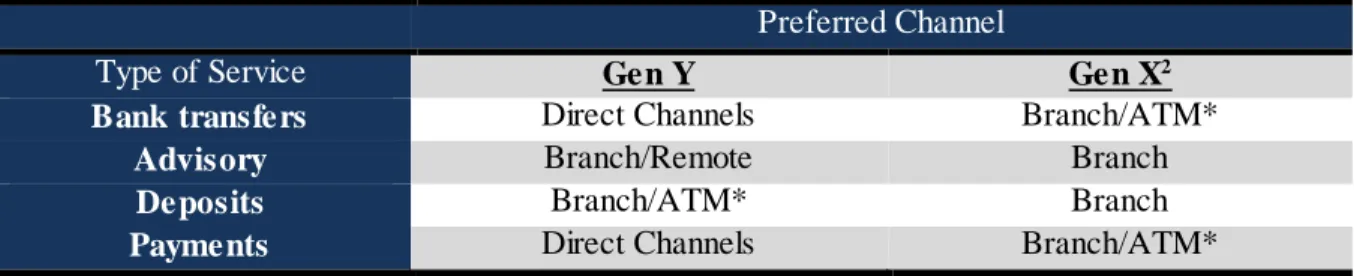
Figure 1 – Preferred channels by type of service for different generation members Preferred Channel
Type of Service Gen Y Gen X2
Bank transfers Direct Channels Branch/ATM*
Advisory Branch/Remote Branch
Deposits Branch/ATM* Branch
Payments Direct Channels Branch/ATM*
Despite the signaling and demand for change from the younger generation, not all banks are including innovation in their formal structure, nor investing enough in it. Only 63% of the banks have dedicated resources for innovation, and these range from a centralized unit to a distributed by business unit basis (3).
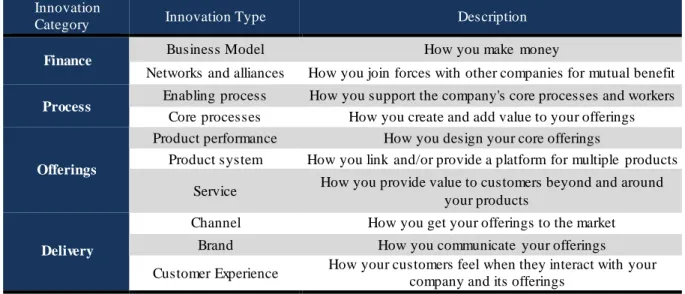
According to Larry Keeley in Ten types of Innovation, the broad concept of innovation can be divided into four different categories: Finance, Process, Offering and Delivery. These
1
Composed by people born between 1980 and 1995 (23); also known as the “M illennial” generation.
2Composed by people born in the early 1960s to 1980 (24).
12
four categories can be fragmented into ten different types. The table displayed below explains the questions addressed in these different types:
Figure 2 – Ten types of innovation Innovation
Category Innovation Type Description
Finance Business Model How you make money
Networks and alliances How you join forces with other companies for mutual benefit Process Enabling process How you support the company's core processes and workers
Core processes How you create and add value to your offerings
Offerings
Product performance How you design your core offerings
Product system How you link and/or provide a platform for multiple products Service How you provide value to customers beyond and around
your products
Delivery
Channel How you get your offerings to the market Brand How you communicate your offerings Customer Experience How your customers feel when they interact with your
company and its offerings Source: (4)
In the next sections of the case study, we will understand how different banks or even different providing companies address innovation in their sector or market.
13
Setting up an innovation team
Unlike what may seem at first sight, the innovation process requires not only creativity and inspiration but also great discipline, organization and focus to be successfully performed. There is not a single, perfect innovation strategy that fits best all of the banks. When including innovation into a bank’s structure, several variables have to be accounted for: the bank’s target, size, desired positioning and its value proposition. There is however general consensus about the need for a dedicated innovation team for it to be successful.
In setting up an innovation team, it is important to carefully manage expectations upfront, agree how success will be measured, start with some low risk ideas to show success, and to generate a mix of different types of innovation options for the bank to prioritize from. Another strong and successful measure to create innovation spirit within a company is the creation of innovation communication mechanisms such as regular workshops or forums for the staff to participate. The innovative efforts should be visible to every company member and the contribution of each should be taken into consideration (3).
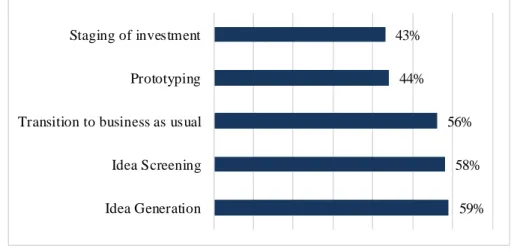
Figure 3 – Percentage of banks with clearly defined innovation processes
Source: (3)
Sample: “108 respondents to the survey in 2014, from 47 countries around the world. For example, leading banks in countries like France, Spain, M alaysia, United Arab Emirates, South Africa, Brazil and Turkey all participated. Overall, 43% of respondents were from high income countries and 57% were from middle or low income countries. We define a high income country as one with a GDP* per capita on a PPS basis of more than US$30,000.” (3)
“Idea generation” and “Idea screening” are the initial steps in the innovating process: the first consists in gathering all the ideas into a big idea pool to be selected later through the screening process, where a triage is made to check for the fit with the bank’s strategy.
59% 58% 56% 44% 43% Idea Generation Idea Screening Transition to business as usual Prototyping Staging of investment
14
“Transition to business as usual” is the formal process of linking the idea with the company’s everyday activities taking into consideration aspects such as operations and regulatory boundaries. Most banks have these three processes clearly defined within their formal structure, but the scenario is different regarding “Prototyping” and “Staging of investment”.
Analyzing a sample closer to the Portuguese banking environment, it is appropriate to separate different countries according to their characteristics.
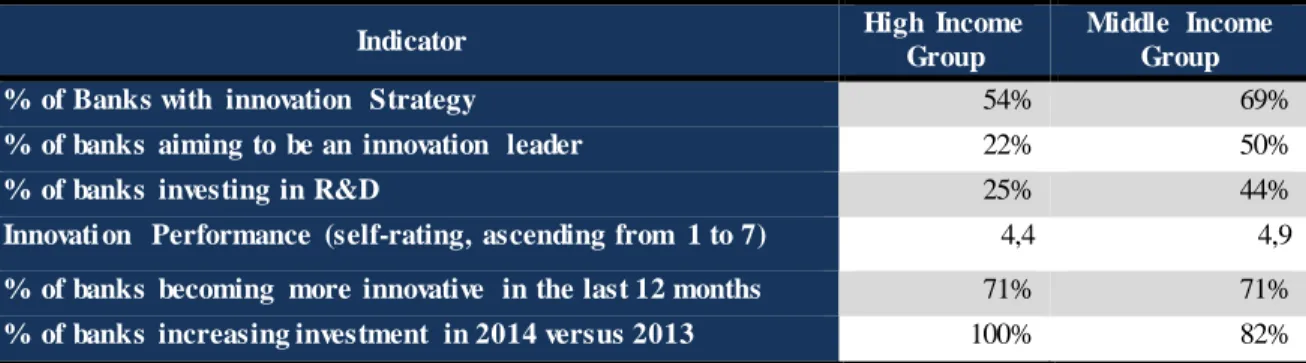
Figure 4 – Comparison of innovation indicators by country groups
Indicator High Income
Group
Middle Income Group
% of Banks with innovation Strategy 54% 69%
% of banks aiming to be an innovation leader 22% 50%
% of banks investing in R&D 25% 44%
Innovati on Performance (self-rating, ascending from 1 to 7) 4,4 4,9 % of banks becoming more innovative in the last 12 months 71% 71% % of banks increasing investment in 2014 versus 2013 100% 82% High Income Group: US, France, Italy, Sweden, Norway, Belgium, the Netherlands
Middle Income Group: Turkey, Poland, Malaysia, Russia, Brazil, South Africa Source: (3)
As it can be seen in the table displayed above, Middle Income countries’ banks are keener to have innovation present in their organization (69% vs. 54% in ‘High Income’ Countries). At first glance, these numbers seem quite counterintuitive. One would think that the countries where the cutting-edge research and latest technologies are discovered and available early will be the countries with the most innovative banking systems, but apparently not. It is a matter of mind-set and general acceptance, and currently, innovation does not fit in developed countries’ customers as great as in growing middle income ones.
“The most important factors for success [of innovating in organizations] are the extent to which innovation is integrated in corporate strategy and to which company leaders support and engage with innovation efforts.”
15
Successful examples of innovation in the banking sector
Rabobank (The Netherlands)
Rabobank, one of the largest retail banks in the Netherlands and operating in 48 countries, is a great benchmark concerning innovation strategy. It builds up its strategy around 3 distinct pillars: co-creation, autonomy and collaboration:
Co-creation is the inclusion of the customer in the product offerings and in the customer satisfaction directly. Either through continuous feedback or idea generation challenges using social media, Rabobank uses interaction with customers to create the best possible products to suit their needs. There are also forums for customers to help each other troubleshoot problems, and a user Experience Centre for customers to try-out new products, services and state-of-the-art technologies allowing them to provide direct feedback.
Autonomy is encouraged as part of the company’s culture. Central to this is the ability to carry out experiments without the fear of failure. Freedom is given in the creation process, employee’s leeway is assured.
Collaboration is promoted using tools such as an internal facilitator network and brainstorming facilities. Staff training includes innovation, through an e-coaching network or innovation courses sponsored by the company.
To involve the whole company in this innovation spirit, a weekly newsletter or video is shared among employees with the latest trends (3).
Leumi Bank (Israel)
Another great example of best practices and success in including innovation in the organizational structure is Leumi Bank, the second largest bank in Israel. It has been recently investing strongly in innovation, including the setup of a dedicated innovation strategy team. To strengthen this innovation culture, Leumi Bank has also been cooperating with Elevator Fund to work with and invest on Financial Technology (FinTech*) start-ups that may be of interest to the company. The support provided to the start-ups was not only in the form of financial support but also in giving conditions and providing products and services for the FinTech*s to use. Loyalty and first-access to cutting-edge innovation were
16
the main drivers of this support strategy, which was extremely successful, according to the bank’s Innovation Manager, Dorel Blitz (3).
IndusInd Bank (India)
IndusInd Bank, in India, is also an example of a company who believes in technology as the best way to add value to customers, describing their operations as a “technology backed customer centric bank”. The banks belief in innovation translates into an inclusion of it in its DNA*, not only as a top down management initiative. For that purpose, IndusInd Bank provides their staff of every organizational level the opportunity to post and discuss their ideas on an online idea sharing portal. It has also created an “Innovation Delivery Group” pinpointing strategic idea generation and digitization (3).
The Portuguese economic set
On April 2011, and after several years of overspending and poor budgeting, the Portuguese government was forced to ask for international help through a seventy eight billion euro loan from the IMF (International Monetary Fund) to maintain the balance in its public finances, which had reached precarious levels. The loan was conceded, but required the acceptance for paying high interest over the borrowed amount, to compensate Portuguese government’s risk of default.
In order to generate enough public surplus to pay for the interest while setting up the conditions to keep the economy running, heavy austerity procedures were implemented by the government through cuts in public expenditure and increase on tax revenues. Thus, Portuguese companies and overall population were put under intense pressure and led the country to a stagnant period of economic drawback. Confidence levels of the consumers dropped, unemployment rate sky-rocketed and Portugal was not attracting enough investors to stimulate its economy, nor being able to keep its products as competitive as before in the international market (6).
By the end of 2013 and after more than 2 years of a meandering recovery path through a harsh Economic and Financial Assistance Program (EFAP), indicators showed that the economic scenario was shyly improving. GDP* decline pace decreased and budgeting for
17
2014 already started to increase its focus on stimulating the economy rather than solely on generating income to pay back the loan (7).
The next legislative elections will be in September 2015, and candidates’ running against the current government strongest statement is to ease the austerity measures and focus on stimulating the economy. There is a strong generalized acceptance for this type of campaign, since the Portuguese society has been forced to reduce their overall spending on the previous years and are saturated with the high tax rates and decreasing support from the government (6).
Retail banking in Portugal
The EFAP also brought about boundaries for the Portuguese financial institutions. Not only were they suffering from the overall retraction of the Portuguese economy, but they also had to deal with industry specific structural changes, such as the penalties introduced by Banco de Portugal (BP*, the Portuguese Central Bank) on interest rates higher (by a predefined level controlled by BP*) than the market reference. Savings deposits are one of the Bank’s main revenue streams, and the interest rate is the key factor to shift demand by the overall population for these savings products. This regulation on interest rates together with the fall of individual available income was challenging to financial institutions seeking deposits.
Not only the hurdles on getting deposits from customers but also the decline of loans offered by banks due to the high perception of risk caused a downfall in the sector’s profitability. Even with this degraded environment around them, Portuguese banking institutions were able to subsist.
18
In the Portuguese Retail banking market, there are around 30 players, although it is a highly concentrated market in the top institutions:
Figure 5 – Main Players in the Portuguese Retail Banking Industry (Dec. 2013)
Bank Number of
Employees
Number of Branches
Caixa Geral de Depósitos (CGD) 9049 804
Millennium BCP* (Banco Comercial Português) 8323 758
Banco Português de Investimento (BPI) 6151 631
Novo Banco (former Banco Espírito Santo – BES) 5908 612
Santander Totta 5481 610
Montepio Geral – Associação Mutualista 3881 456
Caixa Central de Crédito Agrícola Mútuo (CCCAM) 3765 683
Banif 2258 276
Barclays Portugal 1570 147
Banco BIC 1365 216
Banco Popular 1300 174
Banco Bilbao Vizcaya Argentaria (BBVA) Portugal 734 85
Banque Nationale de Paris (BNP) Paribas SS 718 0
Banco Espírito Santo Investimento 240 1
Banif Mais 211 19
Banco de Investimento Global (BiG*) 176 14
Santander Consumer 171 4
Central Banco de Investimento (CBI) 161 2
Banco Electrónico de Serviço Total (BEST*) 156 14
ActivoBank 147 14
Finantia 135 2
Invest 120 17
Banco Espírito Santo dos Açores (BAC) 101 17
Banco do Brasil 96 5
Banif Investimento 58 2
Source: (8)
To approach the topic of this thesis it is important to subdivide the market into two different views, given ActivoBank’s positioning and to be able to identify its closer competitors: as a retail bank, but also as a digital and innovation top player, leading to an alternative view where the main players are Digital, less-tradition banks such as the Banco de Investimento Global (BiG*) and Banco Electrónico de Serviço Total (BEST*), which are smaller, more investment-oriented banking institutions (especially BiG*).
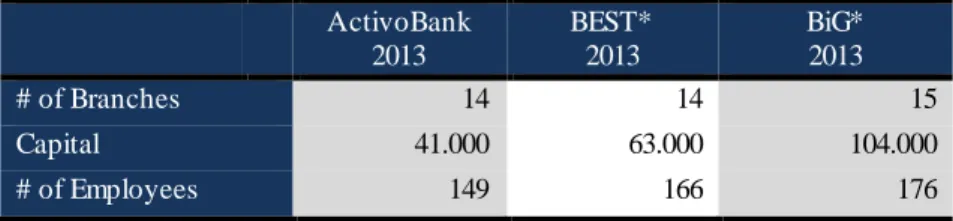
19 Figure 6 – Commercial Indicators (ActivoBank, BEST*, BiG*) - Dec. 2013
ActivoBank 2013 BEST* 2013 BiG* 2013 # of Branches 14 14 15 Capital 41.000 63.000 104.000 # of Employees 149 166 176 Source: (9) (10) (11)
Why this separation? Best and BIG position themselves in terms of channels and culture closer to ActivoBank than the traditional retail banks, as they have a hybrid channel strategy (few branches, mainly digital focus) and also because of their overall size, as it can be seen in figure 6 and supported by the income statements in exhibit 8.
In the tables displayed below, we can see the main difference between the functionality of different channels, offerings, conditions and business lines in the three biggest remote-oriented banks in Portugal (ActivoBank, BEST* and BiG*):
Figure 7 – AB*, BEST* and BiG* comparison – Distribution channels
ActivoBank BEST* BiG*
Website
Daily transactions
Investments (Stock/Funds)
Personal finance manager
Click to Chat
(Facebook)
Source: (12) (13) (14)
As their main distribution channels given their lack of branch locations, these three banks’ remote channels have to be tuned perfectly regarding their customers’ needs. The distribution channels of the three banks cover most of the functionality according to their
ActivoBank BEST* BiG*
Mobile
Daily transactions
Stock operations and checking
Investment Funds
Personal finance manager
20
specific target. BiG* Online is the one offering less functionality on its channels, possibly due to its focus on investment product transactions.
Figure 8 – AB*, BEST* and BiG* comparison – Offerings
ActivoBank BEST* BiG*
Cards
Point-based reward program
M ilhas Tap
Pre-paid cards
Commission-free accounts and cards Alway s
Cards only free if certain conditions are respected Cards have commissions
ActivoBank BEST* BiG*
Products
Partnerships with retailers
Deposits with pre-paid interest
Deposits by Auction
ActivoBank BEST* BiG*
Investments
Customer Support
Investment Credit
Trading Platform (CFDs)
Fund Platform
Discretionary M anagement Service
Source: (12) (13) (14)
One of the main differences between banks lies in the offerings. The target difference is crystal clear in this analysis: BiG* and BEST* offer more complete products and services in the Investment business line, while ActivoBank has the best conditions and diversity regarding day-to-day banking.
21 Figure 9 – AB*, BEST* and BiG* comparison – Conditions and business lines
ActivoBank BEST* BiG*
Account opening
Account opening in less than 20 minutes
Immediate card issue
Starting Deposit (250€) (500€) (250€)
Online account opening
ActivoBank BEST* BiG*
Business lines
Investment Fund M arket to corporate customers
Asset management to corporate customers
Treasury and Capital M arkets
Source: (12) (13) (14)
Regarding business lines and conditions, ActivoBank focuses its efforts on providing the best, fastest and simplest possible service to day-to-day individual customers, seeking transactional and straightforward products. BiG* and BEST* main difference in Business lines is the existence for offerings and products for corporate clients.
22
Innovation in other service providing companies
Vieira de Almeida & Associados – Legal Industry
Service Providing Companies, like product companies, have different degrees of innovation required, depending on the industry on which they operate. At Vieira de Almeida & Associados (VdA*), a prestigious Financial Times (FT) award winner Portuguese law firm, innovation is slowly slithering through the company’s branches. The process is slow, especially because many clients disregard innovation in this sector and look for the comfort and traditional model that law firms represent. Even so, the company built a humble yet efficient innovation formal structure: a forum of 6 people meet in a monthly basis to discuss the latest trends in foreign markets as well as possible new offerings for their customers, together with incremental and efficiency related improvements. According to Margarida Saragoça and Hugo Moredo Santos, both distinguished associates and members of the innovation forum, Vieira de Almeida & Associados is the only law firm operating in the Portuguese market with a formal approach to innovation.
Despite the demographic shift occurring in the whole world’s demand, towards a more technologically driven and informed customer, Law industry remains a quite conservative sector bound by strict regulations and deontological principles. “These regulations are not unbreakable hurdles to innovating but rather guidelines within which it can be explored” said Margarida, who believes that the difficulty imposed by these boundaries is a motivating challenge.
Another very important tool of the forum are the “lampiões”3. “Lampiões” are VdA* associates of all areas who report to the Innovation Forum. Their main goal is to address innovation suited to their practice areas’ specificities.
The example of the innovation area structure within VdA* is a valid alternative for retail banking, or at least feasible given the internal organization of most banks (15).
Deloitte Consultores, S.A. – Consulting Industry
“Deloitte Consultores, S.A.” is one of the top tier players within the Portuguese consulting industry. With more than 1.800 collaborators in Portugal and Angola, it is
23
considered by André Fonseca Ferreira – Innovation Manager for Financial Services Industry (FSI) at Deloitte Portugal – as one of the top innovators regarding knowledge, intelligence, offerings and innovative practices. “Other consulting firms are still giving their first steps in internal idea generation, not even the structure of innovation processes”.
Regarding the organizational structure, the innovation area is divided by two main divisions:
Innovation Advisory Services (IAS). This unit is transversal to all other areas in the company’s structure. Together with Marketing, it composes an informal unit called “Clients and Markets”, led by a partner (Jorge Marrão) who reports directly to the CEO* (Luís Magalhães). The IAS primary focus is the creation of mechanisms to capture idea generation by the company’s collaborators of different business units; the establishment of new work methodologies and the conception of new offerings based on market research and trends where Deloitte’s customers operate.
Financial Services Industries innovation group. This innovation group, inserted in the FSI, aims at innovating in the offerings of this specific sector. The innovation solutions are implemented via a two way solution: incorporation of new work methodologies in areas such as design thinking, customer experience and agility; and the creation of a specialized research group responsible for disruptive innovation, called Center for Disruption in Financial Services. The FSI innovation group is led by André Ferreira, and reports to the partner responsible for fit. (internal R&D program) and the partner responsible for the Consulting FSI area.
The main advantages of the current model are, according to André Ferreira, the autonomy and flexibility, contrasting with the major disadvantage of budgetary constraints and pressure for presenting positive results in the short-term.
Among the main achievements of the innovation area at Deloitte are the creation of “Deloitte Digital*” in Portugal and the completion of the first start up incubator created by a consulting company.
This is the example of a decentralized structure, where the innovation area is divided by two units rather than unifying all in a single group. The direct to CEO* reporting helps the company to keep its focus in innovating and differentiating its offerings from its competitors (16).
24
“The incremental innovations have been very well received and the customer support offerings in process transformation are having excellent results”
- André Ferreira, Innovation Manager at Deloitte
Innovation at ActivoBank
History
ActivoBank S. A. is a Portuguese Retail Bank known for its strong innovation culture since its early ages.
In 1994, Millennium BCP* Managers considered creating a new bank to test innovative and cost-efficient alternative distribution channels. Banco7 (“7” because it was available every day) was born from this desire, it was the perfect opportunity to minimize the risks of testing cutting-edge concepts such as, at that time, telephone banking. It was the first Portuguese bank to embrace the telephone as its core channel, and it targeted middle to high income clients.
In 2001, Banco7 was reinvented. It was then called ActivoBank7, and the shift occurred to explore the recently blooming Internet Channel. Not only did the channel focus broaden (from telephone to telephone and online), but also the customer focus: it targeted on investment seeking affluent clients. There was also the creation of some branches, merging from a fully remote channel model to a hybrid one, to enable direct contact to customers through relationship managers, an adequate comfort when dealing with investment. The shift was also geographical. It extended its operations temporarily to Spain, through a brief partnership with Sabadell bank. This partnership was soon terminated, in 2002, leading ActivoBank7 Portuguese operations back to MBCP*’s full control.
Despite having its own, independent dynamics, growth was never ActivoBank7’s main purpose. Self-sufficiency was the word in order, to test innovations in the market while generating enough revenues to finance its own operations; this was the bank’s mission from the perspective of the Millennium Group.
During the economic and financial crisis that struck some of the largest economies in the world in 2008, ActivoBank7 saw its mission compromised. Having not diversified its target and customer database (the majority of the bank’s customers were using the bank as a secondary bank, and composed by mid to high income families, the retail-investment bank
25
struggled along with its customers, who were composed by the classes that best reflected the effects of the crisis. When the confidence of the markets went down, along with the available income to invest and the overall asset valuation during the IMF intervention in Portugal, the scenario was looking gloomy. This was confirmed in ActivoBank7’s 2009 income statement: the positive result, self-sustaining operations were under jeopardy and the net income was negative. The lack of diversification and the drop of its core operations left ActivoBank7 in a difficult situation with few financial revenue alternatives to compensate losses.
Struggling with its own results, also under intense pressure due to the financial crisis, Millennium BCP* started assessing its own assets. With this inward focus in mind, among many others, two issues arose: the age structure of the MBCP*’s client database, with a high average age and lacking young individuals, who were critical to Millennium BCP*’s future; and the need to address ActivoBank7’s situation (17).
To attend to the first problem, a team was assembled to develop and carry out a new strategy: Blue Ocean Project team. This project’s goal was clear but challenging: to create the “bank of the future”, a new, innovative and contemporary bank, targeting younger generations. The concept was to make banking easy and simple, focusing on transactions and offering simple but complete products.
During the brainstorming and developing of the required concept, the team ended up bashing many times into ActivoBank7’s ideologies: the solution would be to provide a solution for clients desiring more autonomy and simplicity, a self-directed* experience driven mainly by technology4. Innovation was on the core of ActivoBank7’s and Blue Ocean Project team’s solution.
The creation of ActivoBank answered the two previously mentioned problems jointly: reshape ActivoBank7 into a young generation attractor as well as an innovation lab for the Millennium Group5 (18).
Mission and Values
Trust, Honesty (Transparency), Simplicity, Innovation and Accessibility are the bank’s core values. All the value proposition for ActivoBank’s customers revolve around these five
4 Exhibit 9 – ActivoBank’s Client Type: Average & Heavy users
26
concepts which, according to the bank’s belief, are becoming the most appreciated characteristics by the average client recurring to retail banking services.
Simplicity is one of the strongest values: every project is faced with a critical question before moving on: “Is this product/service simple enough?” The internal processes and external offerings need to qualify for this core value, to enable agile operations or to improve customer experience.
Internal Model
ActivoBank has a distributed model, working in an Omni-channel environment composed by: branches, mobile and online channels backed up by a vast amount of operators from customer support operators to dynamic remote account managers. The overall organization is structured as follows:
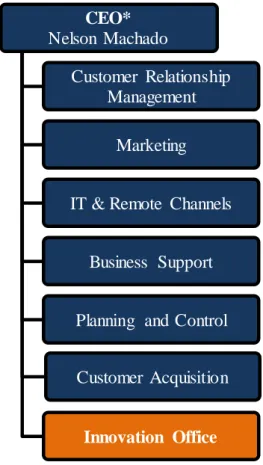
Figure 10 – ActivoBank’s Hierarchical structure
Source: (19) CEO* Nelson Machado Customer Relationship Management Marketing
IT & Remote Channels
Business Support
Planning and Control
Customer Acquisition
27
As stated in Figure 10, all departments and units report directly to the CEO*. It is part of the company’s strategy and commitment to delivering the best possible services, and it is the top management’s understanding that all decisions must pass through this ultimate filtering process. The Innovation Office is not considered specific departments. Despite this difference in category, this unit reports directly to the CEO*.
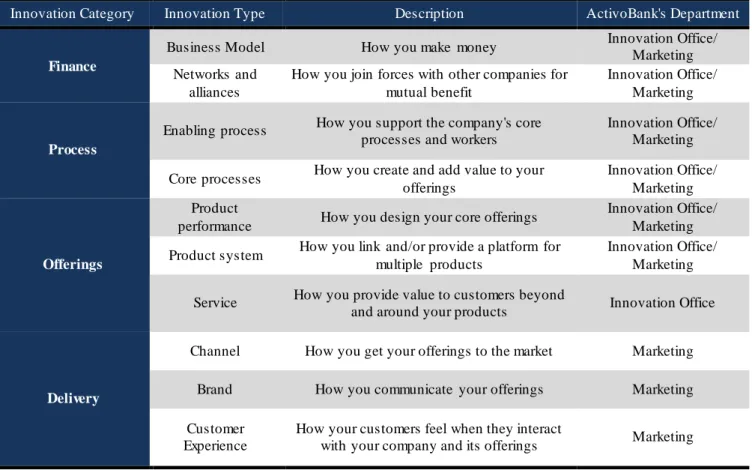
Following Ten types of Innovation (4), ActivoBank divides the responsibility of the different innovation types as follows:
Figure 11 – Division of the ten types of Innovation inside ActivoBank
Innovation Category Innovation Type Description ActivoBank's Department
Finance
Business Model How you make money Innovation Office/ Marketing Networks and
alliances
How you join forces with other companies for mutual benefit
Innovation Office/ Marketing
Process
Enabling process How you support the company's core processes and workers
Innovation Office/ Marketing Core processes How you create and add value to your
offerings
Innovation Office/ Marketing
Offerings
Product
performance How you design your core offerings
Innovation Office/ Marketing Product system How you link and/or provide a platform for
multiple products
Innovation Office/ Marketing Service How you provide value to customers beyond
and around your products Innovation Office
Delivery
Channel How you get your offerings to the market Marketing Brand How you communicate your offerings Marketing Customer
Experience
How your customers feel when they interact
with your company and its offerings Marketing
In general terms, and even though in some cases both cases look similar, the Innovation office handles disruptive innovation, while Marketing addresses incremental innovation.
The types of innovation generated from the Innovation Office follow a specific flow, usually very agile and straightforward. This agility is crucial for the bank to consolidate its position as an innovation leader and first-mover, since it allows the bank to launch successful innovations earlier into the market. This flow is usually as depicted in figure 12, although some projects do not require all the flow steps to be performed.
28 Figure 12 – Process flowchart of the Innovation Office
In any innovation launched into the market, there are three units that are always involved in the process: the Innovation Office, the Marketing department and the Remote Channels department. These units work together with the CEO* and with any other AB* departments that may contribute to the development of individual projects together to deliver solutions as soon and flawless as possible.
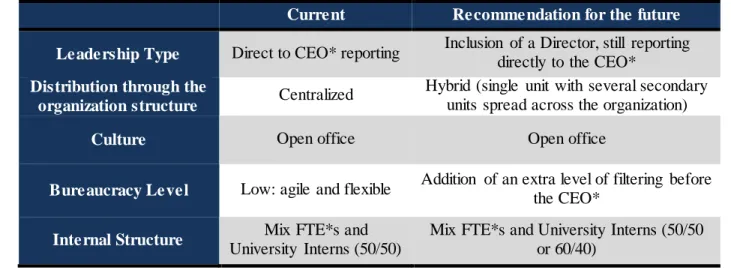
The main characteristics of ActivoBank’s Innovation Office’s model are (19):
Leadership type: Direct to CEO* reporting. There is a high level of autonomy of the Innovation Office, and it is where the disruptive innovation inside ActivoBank comes from. After formal reporting to the CEO* (where triage is made), the proposal returns to the Innovation Office to be developed as a final project. The project is usually led by a member of the Innovation Office, who assembles a team composed by employees from the required areas (depending on the project) and accompanies the project until its implementation phase.
Distribution through the organizational structure: Centralization. The innovation is an independent cell of the company, having full time members thinking about the future, applicability of new technology developments and exploring what the most developed banks are doing in their own markets.
29
Internal human resources structure: Mix between Full-time employees (FTE*) and interns. Right now, the Innovation Office is comprised of a combination between an
equal number of full-time employees and rotating intern positions. This strategy pinpoints at enriching the diversity pool of ideas to develop while keeping the planning and structure stable with the more experienced and static FTE*s.
Culture: Open office model. The innovation lab is opened for every bank employee to share their ideas for evaluation. There are two main possible ways to share insights available to all employees: either post it (for voting by other company members) in a dedicated idea generating platform; or simply walk in the innovation departments physical work space and discuss the ideas. It is a very transparent and accessible process, where all ideas are considered and only excluded (or adapted) after considerable analysis.
Bureaucracy level: Agility and Flat Structure. Overall, ActivoBank’s structure is very flexible and agile. There is a lot of communication and cooperation between different departments, creating a propitious environment to hastily incorporate upcoming innovations and transformations imposed. The most affected departments are in touch with (and most of the times even part of) the innovation projects, not only to contribute with their valuable inputs but also to start preparing the implementation.
Main Achievements
In its 5 years of existence, ActivoBank has already completed and surpassed all of the predefined milestones that were set upon the bank’s creation in 2010.
- ActivoBank attracted 16.000 new Customers in 2012, 18.000 new Customers in 2013 and more than 21.000 in 2014; it currently serves around 80.000 customers.
- In early 2016 ActivoBank is expected to escalate the number of Customers to over 100.000.
- Market share of 6% on self-directed* customer segment, 75% of them acquired on the last 3 years.
- Growth of 25 % in Customer’s Deposits between 2013 and 2014.
- Break even starting in the second quarter of 2014 (4 years after launch), earlier than the forecasted 5 year period.
30
- Positive commercial gap (deposits less loans) contributes to a better funding cost to Millennium BCP* group.
ActivoBank inside the Millennium Group
Inside the Millennium Group, ActivoBank has a determinant role: even more than at the time of its creation, it is the innovation lab. Now with a bigger client database and a broader target (any self-directed* person), its results represented a bigger sample of the overall market and, therefore, a clearer view of what innovations were worth merging to the Millennium Group. The only question hard to answer after implementation in ActivoBank for a fit in MBCP* is scalability: will it be possible for the Portuguese banking behemoth to apply the solutions that worked in ActivoBank? Are some of the steps of the whole process impossible to apply, or even to find alternatives to? The reverse applies as well: some projects are too costly to be conducted only by ActivoBank (due to the size of the company vs. investment required of the projects), so the two banks join efforts to benefit from economies of scale.
Examples of innovations passed from ActivoBank to MBCP* are:
- MBCP’s Mobile Banking was first developed in ActivoBank (Transactional and Investment App).
- AB’s Investments Web Site component was the base for MBCP*’s web site. - Remote Account Managers Model is now being implemented in MBCP*. - System availability during Saturdays.
- Social Media strategy with a constant and active presence started in ActivoBank. - Paperless Account Opening Process.
- Welcome Term Deposit and ActivoBank’s Flexible Term Deposit was passed on to MBCP*.
- Pre-paid thematic cards.
- Current Account “Product Box” (to approach a retail experience) was also adopted by MBCP*.
31
Conclusion
The board meeting was concluded, but only a small shred of its content was absorbed by Carlos Gomes. Not the case that the contents were insignificant but, unwittingly, greatest topics were in order. The company’s next steps? If innovation was one of the bank’s cornerstones and strongest values, then the future of the innovation department was directly correlated to ActivoBank’s future, magnifying the dimension and repercussions of this challenge.
Is scalability a deterrent to the actual model? As the bank expands its customer base and widens its target, should ActivoBank maintain its current innovation model, or should it change to one with other features in the categories highlighted in the case (Leadership type, distribution through the organizational structure, internal human resources structure, culture and bureaucracy level)?
32
Exhibits
Exhibit 1 – Innovation Performance in banks (self-assessment, scale of 1 to 7)
Source: Innovation in retail banking 2014 (EFMA*)
Sample: “108 respondents to the survey in 2014, from 47 countries around the world. For example, leading banks in countries like France, Spain, M alaysia, United Arab Emirates, South Africa, Brazil and Turkey all participated. Overall, 43% of respondents were from high income countries and 57% were from middle or low income countries. We define a high income country as one with a GDP* per capita on a PPS basis of more than US$30,000.” (3)
The graphic shows us the self-assessment of retail banks on innovation performance. As displayed, the self-assessment grade has increased from 2013 to 2014, in distribution channel offerings (Channels) and regarding the organization as a whole (Overall).
In 2013, the average grade attributed by banks to their own distribution channels and overall innovation was 4,4 and 4,2 respectively. These numbers increased moderately in the following year, 2014: the grade for channel innovation performance increased from 4,4 to 5 and the overall innovation performance self-rating incremented from 4,2 to a more expressive 4,7.
Although this is a self-assessment, the fact that the increase is registered in relative terms (meaning both years were based on self-assessment), we may concur that there was a positive variation in the self-perception in the company’s innovation.
4,4 4,2 5 4,7 0 1 2 3 4 5 6 7
Channels* Overall Channels* Overall
2013 2014
33 Exhibit 2 – Proportion of banks with an innovation strategy
Source: (3)
Sample: “108 respondents to the survey in 2014, from 47 countries around the world. For example, leading banks in countries like France, Spain, M alaysia, United Arab Emirates, South Africa, Brazil and Turkey all participated. Overall, 43% of respondents were from high income countries and 57% were from middle or low income countries. We define a high income country as one with a GDP* per capita on a PPS basis of more than US$30,000.” (3)
From 2009 until 2014, there has been a gradual and substantial increase in the proportion of banks with an innovation strategy. In 2009, only 37% had a formal strategy regarding innovation. Between 2009 and 2011, there was the biggest leap: from 37% to 50%, with an increase of 13 percentage points. In 2013, the majority of the banks already had integrated innovation in their strategic planning (60%); after this point, the growth pace regarding the number of banks with a defined innovation plan decreases.
From 2013 to 2014, the variation of this proportion was only 1 percentage point, from 60% to 61%. As innovation gains increasing importance in the banking sector, it is expected for this proportion to expand even further, until innovation is part of the activity of an expressive majority of the banks.
37% 50% 60% 61% 0% 50% 100% 2009 2011 2013 2014
34 Exhibit 3 – Proportion of Banks increasing innovation investment yearly
Source: (3)
Sample: “108 respondents to the survey in 2014, from 47 countries around the world. For example, leading banks in countries like France, Spain, M alaysia, United Arab Emirates, South Africa, Brazil and Turkey all participated. Overall, 43% of respondents were from high income countries and 57% were from middle or low income countries. We define a high income country as one with a GDP* per capita on a PPS basis of more than US$30,000.” (3)
Has in the case of the proportion of banks with an innovation strategy historically increases, this trend is also reflected in the total investment done by banks pinpointing innovation. From 2009, where only 13% of the banks increased their investment versus what they had invested in 2008 (drawback caused by the financial and economic crisis), we get to 2014 where 84% - a vast majority of the banks – increased their investment versus 2013.
This is an expressive response of the market to the increasing importance of innovation in their operations, not only in the products offered but also in the internal processes.
13% 70% 77% 84% 0% 50% 100% 2009 2011 2013 2014
35 Exhibit 4 – Portuguese Confidence Level Index levels
Source: (7)
Measure: Saldo de respostas extremas (Net extreme answers, calculated based on survey results directly to the Portuguese population) -60% -50% -40% -30% -20% -10% 0% 2004 2005 2006 2007 2008 2009 2010 2011 2012 2013 2014
36 Exhibit 5 – Evolution of the GDP* variation rate (2011 constant prices), year-on-year basis Source: (7) -6,0% -3,0% 0,0% 3,0% 6,0% 2004 2005 2006 2007 2008 2009 2010 2011 2012 2013 2014
37 Exhibit 6 – Evolution of the unemployment rate in Portugal
Source: (7) 0,0% 3,0% 6,0% 9,0% 12,0% 15,0% 18,0% 2004 2005 2006 2007 2008 2009 2010 2011 2012 2013 2014
38 Exhibit 7 – Balance Sheet (ActivoBank, BEST*, BiG*) – Dec. 2013
Activobank BiG BES T* Assets
Cash and deposits at central banks 100 14.560 95 Deposits at other credit institutions 24.632 30.024 49.527
Financial assets held for trading 0 21.900 3
Available-for-sale financial assets 184.047 874.881 25.942
Loans and advances to credit institutions 205.054 35.528 120.014
Loans and advances to customers 15.432 196.950 159.615
Non-current assets held for sale 0 204 0
Other tangible assets 2.545 16.409 1.378
Intangible assets 173 133 5
Investments in subsidiaries, associates and joint ventures 0 5.295 0
Current income tax assets 74 227 0
Deferred income tax assets 3.189 2.109 472
Other assets 5.826 16.162 3.094
Total Assets 441.072 1.214.382 360.145 Liabilities
Deposits from central banks 0 130.315 0
Financial liabilities held for trading 0 1.357 167
Deposits from other credit institutions 0 143.478 13.758
Deposits from customers 413.911 684.143 276.960
Hedging derivatives 0 7.353 34
Provisions 292 4.874 820
Current income tax liabilities 0 16.404 2.025
Other liabilities 3.217 19.872 4.147 Total Liabilities 417.420 1.007.796 297.911 Equity Share capital 41.000 104.000 63.000 Share premiums 0 1.362 0 Treasury stock 0 -1.084 0 Revaluation reserves 2.778 -2.261 154
Other reserves and retained earnings -17.192 58.590 -11.156
Net income -2.934 58.459 10.236
Interim dividends 0 -12.480 0
Total Equity 23.652 206.586 62.234
Total Liabilities + Equity 441.072 1.214.382 360.145 Source: (8)
The accounting structure reflects the similarities and differences among the 3 main Portuguese digital-focused banks. Financial assets and investment items are the ones with more weight in BiG*’s Balance sheet, while ActivoBank and BEST* have greater weight for items like ‘Deposits from customers’ (in the case of ActivoBank) or ‘Loans and Advances to customers’ (BEST*). Another observable trend from the Balance sheets is that BEST* and ActivoBank both are owned by other credit institutions (Novo Banco and MBCP*, respectively), via items such as ‘Loans and advances to credit institutions’.
39 Exhibit 8 - Separate Income Statements (Dec. 2013) in thousands €
M illennium
BCP
CGD Santander Totta
BEST* ActivoBank BiG Interest and similar income 2.616.769 2.994.444 1.254.782 6.614 6.212 43.994
Interest and similar expense 2.376.115 2.551.729 831.525 2.089 9.576 18.252
Net interest income 240.654 442.714 423.257 4.525 -3.364 25.742
Income from equity instruments 334.656 82.356 58.302 24 37 1.812
Fee and commission income 572.193 476.609 364.917 18.445 13.604 8.105
Fee and commission expenses -91.793 -111.679 -59.234 -5.800 -180 -1.586
Net gains from assets and liabilities at fair
value through profit or loss 73.390 -440 20.937 -135 - 7.018 Net gains from available-for-sale financial
assets 55.860 118.110 4.293 17 3 79.261
Net gains from foreign exchange differences 13.652 10.935 3.985 15.113 -8 -90
Net gains from sale of other assets -22.741 -49.972 -9.554 - - 5.041
Other operating income and expense -190.466 65.429 -16.356 -211 -129 -393
Operating income 985.405 1.034.062 790.548 31.978 9.963 124.910
Personnel costs 538.777 535.929 266.948 6.045 6.629 22.219
General administrative expenses 291.119 360.209 134.661 10.441 6.787 7.683
Depreciation and amortisation 27.970 93.077 59.835 422 732 1.135
Provisions net of reversals -7.637 -170.314 17.185 -157 116 1.824
Value adj. relating to loans and adv. to cust.
and receiv. from other debt 1.337.061 1.370.639 237.579 260 -14 35 Impairment on other financial assets net of
reversals 96.624 102.892 20.554 - - 125
Impairment on other assets net of reversals 1.129.763 186.278 35.703 - - 125
Net income before tax -2.428.272 -1.444.648 18.083 4.967 -4.287 91.764
Current tax 39.644 -40.309 29.217 4.614 59 33.219
Deferred tax -509.186 -313.824 -13.582 117 -1.412 86
Net income -1.958.730 -1.090.515 2.449 10.236 -2.934 58.459 Source: (8)
40 Exhibit 9 – ActivoBank’s Client Type: Average & Heavy users
Source: (17)
Main Characteristics Average User Heavy User
Gender All All
Age 24-40 24-35
Address Urban areas of Portugal City Centers
Education >High School >Bachelor
Preferred Channel Online Online and Mobile
Number of Operations (monthly) Up to 10 >10 Most Common Operations Check Account
Balance
Check Account Balance + Transfers
41 Exhibit 10 – Interview with Margarida Saragoça –
Practice & Clients Director – and Hugo Moredo Santos – Managing Associate, Banking & Finance ate Vieira de Almeida & Associados.
1. Regarding the legal industry, do you think that regulatory pressures are hurdles to innovation and negatively influence the player’s margin to offer clients more efficient solutions? Or they merely protect the consumer without harming the competitive environment of the market?
Regulations limit creativity, especially regarding pricing models and advertisements. Still, most of the rules are well received by lawyers, since they protect national lawyers and define the status and identity of law entities. These regulatory boundaries do not hold back innovation, they just impose adaptation to the rules.
2. How is innovation structured inside VdA*?
We have no FTE*s dedicated to innovation. Innovation is managed from a group of six associates, called “Innovation Forum”, who meet in a monthly basis. There is also a smaller unit dedicated to operations and innovation who meet in a weekly basis. The Innovation Forum reports directly to the administration.
There are also associates spread across the company called “lampiões”, whose mission is to report specific needs and problems in their own practice for the innovation forum to discuss and find ways to improve processes.
3. How would you describe the internal culture regarding innovation?
VdA* has a strong innovation and teamwork culture. Innovation is a generalized pride amongst company member, and is spread as something attractive to work on, counting with the acceptance and participation of several company members.