events: a research programme
Lúcia Gouveia PaisHigher Institute of Police Sciences and Internal Security, Lisbon, Portugal
Sérgio Felgueiras
Higher Institute of Police Sciences and Internal Security, Lisbon, Portugal
Abstract
The Major Events Laboratory (MEL) started functioning in 2011. Its primary objectives are to develop research in what concerns the security of major events and to contribute to modernising police activity and the definition of good practices. One of MEL’s research lines tackles decision-making in police activity. Police decision makers face the limits of the human mind when making choices or solving problems. Facing time pressure, lacking complete knowledge and with information processing capability, they are prone to attaining acceptable and satisficing solutions under challenging and uncertain scenarios. Descriptive studies have been conducted using the naturalistic decision-making approach: on the field — at major political and sports events — at MEL’s simulation room, during traffic control and during monitoring operations. The initial results are presented and implications for the learning and training process are discussed.
Keywords:
major events policing; police decision-making; naturalistic decision-making; learning and training. Acknowledgments
We would like to thank former master’s students in police sciences Andreia Gonçalves, Sónia Martins, Ângelo Afonso and Bruno Ratinho for their contribution to this work.
Introduction
Everybody makes decisions, constantly, all day long. In an uncertain world, with higher complexity and a greater amount and diversity of information flow, decision-making is even more demanding, whether it be simple or complex. The human being, unable to know everything about a certain subject and in order to process all the available information, permanently faces situations demanding urgent answers and time pressure, and is conditioned by stress, and political, institutional and social constraints. He therefore uses simplification strategies to achieve satisficing solutions (Simon, 1956), thus assuming non-optimised decisions because of the impossibility of predicting all the possibilities/ alternatives/courses of action (Gigerenzer and Selten, 2001).
Working in a complex, uncertain, demanding and changeable environment, which is at times hostile, the police officer is confronted with the same constraints, besides media scrutiny and social and organisational accountability (multilevel scrutiny).
In major events, security planning implies the anticipation of scenarios in order to design alternative solutions with regard to the changing of events on the field. So, any plan benefits from knowledge coming from different scientific areas, from available intelligence and from the decision makers’ experience.
On the other hand, major events are unique moments to develop new security solutions, regarding the quantity, complexity and singularity of identified problems, and the willingness of the host countries to invest important amounts of resources.
According to Todd and Gigerenzer (2000: 737), ‘if we want to understand how real human minds work, we must look not only at how our reasoning is ‘limited’ compared to that of supernatural beings, but also at how our minds are adapted to real-world environments’. It is therefore important to observe the human being in a naturalistic context and his behaviour in real-world situations, which are surrounded by inherent limitations (Gonçalves, 2014). Naturalistic decision-making theory appears to be an attempt to understand how people make decisions in the real world. Naturalistic decision-making (NDM) is acknowledged to be based on practical processes, aiming to explore the way people really make decisions, by learning about the strategies decision makers use, instead of using formal decision-making models (Nemeth and Klein, 2010).
The core aim of this theory is to investigate how people make complex decisions in front of instable situations, ill-defined tasks, time pressure, uncertainty, risk and major consequences in case of error (Lipshitz, Klein, Orasanu, and Salas, 2001; Nemeth and Klein, 2010). In many domains decision makers have to deal with high-risk situations. Having multiple available decision alternatives but being confronted with time pressure, they have to use their
experience to rapidly identify the typical solution (Schraagen, Klein and Hoffman, 2008). It should be noted that NDM also tries to evaluate the real environments and demands the decision maker faces when trying task-performing in an efficient and secure way. As Nemeth and Klein (2010) point out, Simon’s (1956) notion of ‘satisficing’ enables people and organisations in complex environments to find solutions that satisfy and suffice when better answers cannot be obtained. Simple options are evaluated sequentially by using the results of mental simulations and are taken into account if they lead to satisficing results instead of optimal ones (Orasanu and Connoly, 1995).
On the other hand, considering Klein’s (1989, 1999) research, it is known that decision makers do not behave accordingly with the traditional theories, because much effort is dedicated to the situation assessment or the discovery of the problem’s nature. So, NDM research: ‘is mainly distinguished from traditional decision-making research by its emphasis on studying experienced people such as fireground commanders, airline pilots and police officers, and using realistic task settings, such as traffic accidents, burning buildings and problems in airplane cockpits. The focus is on situation assessment rather than comparison of options. Traditional decision-making research has generally focused on static, well-defined tasks while NDM, on the contrary, focuses on more realistic dynamic, complex, ill-defined decision problems to be solved in real time and under time pressure’. (Rake and Njå, 2009, pp. 667-668).
Considering the decision maker experience and the environment characteristics, NDM is ‘the way people use their experience to make decisions in field settings’ (Zsambok, cit. in Lipshitz et al., 2001, p. 334), and aims to ‘specify the link between the nature of the task, person and environment on the one hand and the various psychological processes and strategies involved in naturalistic decisions on the other’ (Cannon-Bowers et al., cit. in Lipshitz et al., 2001, p. 347).
The question that arises is: which methods should be used to obtain this kind of knowledge? Lipshitz et al. (2001) indicate, besides real-time field observations (involving ethnographic techniques), the use of simulation and laboratory techniques.
Specifically, these authors mention: structured and unstructured interviews; retrospective analysis of critical incidents; expert drawing of domain maps; think-aloud protocols; videos of task performance; and cognitive task analysis. ‘The tasks and materials may be taken from the actual or simulated work environment, may be generated by the analyst or domain expert, and may be designed to be typical or anomalous, easy or challenging, constrained or unconstrained’ (Lipshitz et al., 2001, p. 343).
In short, moving away from the cognitive bias theories, NDM allows improved understanding of the decision makers’ cognitive performance under uncertain conditions in specific real
environments, because it understands the use of heuristics as a result of the evidenced experience of the decision makers (Nemeth and Klein, 2010).
At MEL we have been developing some research about experienced/expert police officers’ decision-making in different environments of police activity, tackling topics linked with major events policing with regard to different ranks and police specialities. Specifically, two kinds of studies have been developed. Some field studies were conducted, in real time, with accompanying commanders and team leaders involved in large police deployments. This enabled us to compare results between what happens in political and sports events (demonstrations and football matches). On the other hand, a specific branch of the overall security activity was explored — traffic control operations. A simulation study was developed by means of a multiple case study approach (Yin, 2001).
Using the MEL simulation room, some scenarios were presented to traffic patrol officers, allowing us to get some insight into the features involved in the decision-making process during traffic control operations.
Police decision-making at major events: field studies and
simulation room
The structure of the following presentation will make use of the above approach, in order to highlight the different typology of studies conducted in the research programme. First, the field studies (A) are presented, describing both sports and political events in terms of method, procedure and results. Then, the simulation study (B) will also be described, informing about the methodological approach, procedure and results.
A — Field studies
MethodThe field studies were conducted during large police deployments, at major sports events (football matches) and at major political events (demonstrations). The police commanders and team leaders involved were accompanied in order to collect data in real time, aiming to understand their decision-making process throughout all of the planning and operational work, and its outcome (final report).
Basically, the field studies have followed the same methodological procedure. In Table 1, the information about the method is presented in a comparative way, considering both major sports events and major political events.
Table 1
Field studies’ methodological description
Major events Sports Political
Events 10 football matches (Portuguese League and
UEFA Champions League) Three political demonstrations (two of them promoted by labour unions and the other one a university students’ protest) Participants Commanders and EIR chiefs (rapid intervention team with nine police officers and one chief) Corpus Commander’s strategy and tactical planning procedures
Final reports (before and after the events)
Naturalistic observation and think aloud written data (policing activities during the events) Operation orders Practical guidelines for public order
policing Instruments for
data collection Naturalistic observation and think aloud technique Instruments for
data analysis Content analysis
Procedure Before the events: accompanying the decision-maker — field recognition, information search and collection, preparation of meetings and briefings, and analysis of the operation orders (football matches) and of the practical guidelines for public order policing (demonstrations)
During the events: accompanying the decision-maker — direct observation and think aloud registering
After the events: analysis of final reports
All data content was analysed and codified in categories and subcategories which were designed especially for the purposes of this research, and derived directly from the collected data, following an open or exploratory content analysis procedure. Data was then submitted for a descriptive statistical analysis
Results: Police decision-making in sports versus political events
Results are presented using a comparative approach between major sports and political events, while considering two different sets of results: one derived from the documents’ analysis and the other from the analysis of the data collected on the field.In Figure 1 the results of the content analysis of documents are first presented. The documents were: the commander’s strategy and tactical planning procedures, the operation orders (football matches), the practical guidelines for public order policing (demonstrations) and the final reports.
Figure 1 — Content analysis results of documents: major sports events (A) and major political events (B)
Sports events — the emphasis is on policing (in the three types of documents), where the importance of setting goals in the commander’s strategy and tactical planning procedures, and their formalisation in the operation orders becomes evident. In addition, the information regarding the EIR (rapid intervention teams) is of major importance, specifically in the operation orders, where their modus operandi is established, mainly regarding the actions to be taken and respective locations. Also, the information about the fans deserves highlighting, particularly the information concerning their characterisation/description, the entrance procedures to adopt, the specific routes to be taken and policing procedures. The final reports only consider the fans’ behaviour, their localisation and the measures taken by the police to control or support the fans’ activities. In fact, the final reports are mainly centred on describing the policing goals and evaluation of results.
Political events — policing procedures are clearly the most relevant issue. It seems that everything has been defined in the practical guidelines for public order policing, as far as policing goals, expectations and resources are concerned. Specifically, policing goals assume a huge relevance. Also, the information about the EIR teams deserves some attention, particularly the tasks to be performed and their deployment, but everything seems to be planned in the public order terms of reference (Lisbon police). Finally, it must be stressed that final reports are mainly concerned with the political events themselves and with the operations’ results. Considering the data collected on the field, by means of naturalistic observation and the think aloud technique, the results are presented in Figure 2.
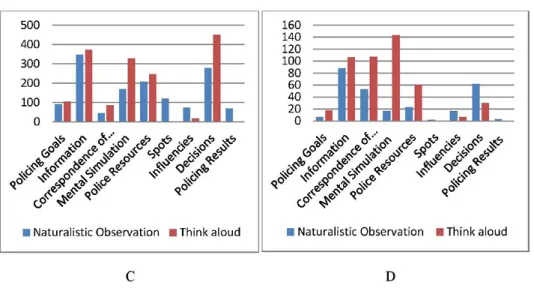
Figure 2 — Content analysis results of naturalistic observation and think aloud:
major sports events (C) and major political events (D)
Sports events — the focus is on the information flow, mainly its transmission, considering the available and searched information (though less so with the latter). Also, the mental simulation plays an important role, for the decision makers make systematic assessments of the field operations, with the support of expectations and effort coordination. Of course, the decisions are predominant on the field (mainly focused during the think aloud process). In addition, the police’s own resources are a matter of concern (with less worry about the police’s equipment). It must be mentioned that the focus on the policing goals is not so relevant on the field. In the opposite direction, information flow assumes a higher weight, which can be understood because of the situations’ dynamics.
Political events — the information flow is a major issue on the field, mainly the transmission of information, using searched and available information and also referring to previous knowledge. Additionally, emphasis is given to the correspondence/matching of patterns, where standard or typical situations are addressed. The mental simulation is also a relevant issue. A systematic assessment of field operations is made, also with the support of expectations and memory recalls. The fact that the political events studied occurred peacefully and/or according to the previously defined planning, may have led police to simply manage their course, thus explaining why decisions are less emphasised. Information about policing goals is not so relevant; instead, prominence is given to the information flow because of the situations’ dynamics.
Discussion: Comparison between police decision-making at sports versus political events
It is evident that sports events are more predictable. The space, the numbers of fan groups present, and the time, are predetermined. Besides, fan groups present at sports events are usually fewer than the groups present at political demonstrations. Also, it is possible to know how many people will be attending an event, for the sports venues have a specific capacity and there are security controls at entrances (body search and alcohol tests). Ticket policy is fundamental for distributing the different groups throughout the stadiums: preferably, fans should be zoned considering their group identity. Ticket policy itself may introduce individual fan identification mechanisms, thus reducing anonymity by the constraining of inadequate behaviours and facilitating the social formal control exercise (ticket selling by means of identification). These are the reasons that can be at the basis of a more detailed policing planning, which is found in this research.
For major political events there is an attempt to find an adaptive pattern based on the practical guidelines for public order policing, more so than on planning procedures. Comparing these with sports events, this search for patterns assumes another relevance, for it is mandatory that police officers stay more alert in less routinised and less predictable situations.
This is also reflected in the planning goals: at sports events predictability is higher (there is already a pattern). Apparently, it is easier to conceive policing planning for sports events. Furthermore, the fact that sports events are much more frequent than political ones allows for greater procedure automation and coordination. Space is also important. It matters to consider if the events are local, national or international.
The symbolic transformation of space and consequent attribution of specific characteristics by the different groups present at different occasions, in general, is not attended to by authorities. Policing typically stays focused on territory, with police deployment very much ‘attached’ to the space, and also being determined by it. However, public order policing does not consist in merely defending the space. It consists in warranting free exercise of democracy and individual rights in that particular space; so the behaviour of people present at the venues matters. Attention should then be focused on behaviours, not on specific individuals. Regarding sports events, fans feel like they belong to that space — ‘our’ stadium. And, if police just defend the space, they don’t focus on conduct. On the other hand, that symbolic liaison is reinforced by a physical one, through the specific ticket seat number. The problems emerge when clubs offer tickets without considering fan group identities, running the risk of mixing them up with home club fans and enhancing aggressive/violent behaviour in situations where they collide with other groups’ social identity (e.g. Stott and Reicher, 1998). Therefore, considering what learning and training is about, the observation of individual and collective behaviour should be highlighted, in addition to territorial and material aspects.
However, it should be noted that the law only imputes responsibility to individual and objective disruptive behaviours. Even if it applies to group behaviour, group dynamics and identity are given less importance in the face of the indictment processes undertaken regarding each group element. It would, then, be important to adopt a multilevel approach, both at individual and collective levels.
Another interesting finding regarding sports events is the amount of information concerning the fans, which is more prevalent when compared with the information regarding political demonstrations. In political demonstrations we are dealing with fundamental rights, which is different to what happens with sports events — they have a specific legal framework allowing for greater control measures. Before the events, during policing planning, the fans’ and demonstrators’ characteristics are taken into consideration in order to design the suitable police measures, and specifically to establish the main routes to take and design the entrance procedures of the fans in sports venues. This emphasis may have to do with the presence of the spotters and their information gathering functions, and so the need of spotters in political demonstrations should be thought about to foster the knowledge about the protesters and their action repertoire. Furthermore, there are some routines that allow greater predictability: fans are at the same stadiums, at the same gates, every 2 weeks, at least. As sports events occur in controlled environments, it seems to be easier to implement situational prevention measures.
On the other hand, fans’ and protestors’ behaviour is only mentioned in the final reports, besides other kinds of information like banners and slogans at political events, and streamers and chants at sports events. However, it should be mentioned that during the naturalistic observation and think aloud on the field, more information regarding the fans and the demonstrators enters. This happens when decision makers mentally simulate situations, access memories and mention expectancies as a result of past events, as they try to anticipate some occurrences (Klein, 1999), and also make patterns correspond or match (Klein and Calderwood, 1991) with events that present a certain similarity or are typical. This clearly demonstrates the importance of the decision makers’ experience (e.g. Rake and Njå, 2009; Zsambok, 1997) in planning and conducting policing operations, and, so, the need to embed that knowledge, which is more practical and life-experienced, in the learning and training curricula of police officers (and senior police officers). Finally, at sports events there is a command post room in the main stadiums, which allows the commanders to be present and manage a huge quantity of information in a designated environment. On the other hand, at Portuguese political demonstrations, commanders are on site with all the possible consequences: a greater quantity and diversity of stimulation, greater dispersion of information and greater requests from their subordinates, which makes them less protected and deprived of a calm environment where they can make decisions, and where they are subject to situation volatility.
B — Simulation room
Participants: 20 expert male police officers (more than 5 years of work experience in traffic control/surveillance; age range: 30-55 years old).
Corpus: First moment — Data collected with the stimulated retrospective think aloud technique (SRTA; Ericsson and Simon, 1984, 1987; Guan, Lee, Cuddihy, and Ramey, 2006). Second moment — Data collected by interviewing with a previously designed script for further information.
Instruments for data collection: three videos of city traffic in usual spots for traffic control/ surveillance, 5 minutes each, presented at the simulation room of the MEL; stimulated retrospective think aloud recording; interviews recording.
Instruments for data analysis: content analysis. Procedure
Each police officer accepted to participate in the study and gave their written consent. After a warm-up period they watched three videos, one at a time, and received SRTA technique training in order to understand the features that would lead them to refer to specific vehicles to be stopped for verification.
The presentation of videos was randomised for each participant so that contamination effects could be prevented. Then, an interview was conducted in order to clarify some content and cover issues that hadn’t been mentioned during the SRTA, and that could be complementary and pertinent to the widening of the diversity and thoroughness of the information. All of these procedures were voice recorded; the materials were transcribed verbatim and then submitted for a content analysis procedure. All data content was analysed and codified in categories and subcategories, which were designed especially for the purposes of the research, and derived directly from the collected data, following an open or exploratory content analysis procedure. Data was then submitted for a descriptive statistical analysis.
Results
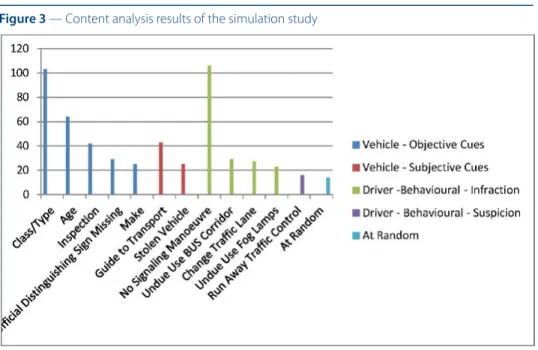
At a first glance, it can be said that in 26.83 % of the situations, two main cues are used by police officers in the decision-making process during a traffic control/surveillance operation. One regards the driver and the other regards the vehicle: a behavioural indicator of failure to comply with the traffic regulations (mainly the absence of manoeuvre signalling) and the characteristics of the vehicle, respectively. However, a deeper analysis of the data (Figure 3) gives some more insight into the information used during the decision-making process.
Figure 3 — Content analysis results of the simulation study
Police officers predominantly use information about the vehicle rather than information about the driver when making the decision to give an order to stop during a traffic control/ surveillance operation. Specifically, they tend to use objective cues like the vehicle’s characteristics, which are more obvious and easy to detect. So, the visual cues they typically use are those they can immediately see and, because of that, require less cognitive effort. And they are, for instance, and in this order: the type, age, registration plate date, official distinguishing sign and the vehicle make.
Subjective cues are also used, namely those that can be linked to illegal transportation of goods, or to vehicle makes that are typically stolen to enter illegal networks. These cues involve additional cognitive effort, as they appeal to memory storage of past events, revealing the major importance of the decision maker’s experience to detect them. As far as concerns the information about the driver, police officers tend to point to behavioural indications of failure to comply with traffic regulations, mainly the absence of manoeuvre signalling. It is, of course, important for other drivers to anticipate their own manoeuvres and therefore prevent crashes. Other behavioural indicators mentioned by police officers were, in this order: undue use of bus lanes, change of traffic lane and undue use of fog lamps. Again, the visual cues are those immediately seen and, because of that, require less cognitive effort. Other more cognitively demanding cues were less signalled and required the police officers to anticipate the real intentions of the drivers, such as the effort some drivers were making to avoid being stopped by driving very close to the next car.
Discussion
During traffic control/surveillance operations, police officers tend to make use of decision-making strategies that involve less estimation and thus try to simplify the selection process. Fast and frugal heuristics (Gigerenzer and Selten, 2001; Gigerenzer and Todd, 1999) have been employed. For instance, the availability heuristic (Tversky and Kahneman, 1974), which relies on how easily some information is recalled from memory, and the recognition heuristic (Goldstein and Gigerenzer, 2002), which allows you to infer that the recognised object, out of two, has the higher value regarding the criterion, seem to have been utilised as a shortcut to making the decision to stop a vehicle. Clearly, these shortcuts allowed you to make fast and frugal decisions, enabling decision makers to be more precise, without the need to use multiple mathematical equations.
On the other hand, specialised knowledge and experience stood out as important characteristics of the decision makers, as they used accumulated knowledge gathered from direct experience on the field to make fast categorisations of new situations (Klein, 2008). They used their memory repertoire of patterns to establish some correspondence with the simulated situations. The participants showed better memory regarding the specific knowledge domain and refined perceptive capacities (Glaser and Chi, in Elliot, 2005), which is also important to detect subjective cues for decision-making. And this has to do with the recognition-primed decision model (Klein, 1989, 2008), which says that decision makers use their past experience in order to rapidly categorise new situations.
Conclusion: some outcomes from MEL’s research programme
Decision-making is also a major issue for those working in police forces. MEL’s research programme was designed to gain better knowledge about the individual cognitive processes involved in police decision-making, specifically during major events policing. The different studies presented, and their initial results, clearly illustrate the centrality of the subject and the need to deepen the research. Having worked in different environments, with experienced police officers with different specialities, it became evident that experience and expertise are fundamental characteristics for decision-making when planning and conducting police operations. Also, the information structure of the environment plays an important role in what the decision mechanisms concerned are. Clearly, by exploiting the decision-making processes and the structure of the information in the environment, decisions can be better understood and evaluated. These results must also come into contact with those working in the field.
So, in practical terms and to sum up, the following should be taken into account as effective means of transferring research findings to professionals:
1. bringing police practitioners to simulated environments; 2. involving tutors during initial phases of police careers; 3. police operations should also be assessed by practitioners; 4. engaging police practitioners in change programmes;
5. experience-based knowledge instead of (just) academic-based knowledge.
References
• Elliot, T. (Defence Science and Technology Organisation) (2005), Expert decision- making in naturalistic environments: A summary of research, DSTO Systems Sciences Laboratory, Edinburgh, South Australia. • Ericsson, K. A. and Simon, H. A. (1984), Protocol analysis: Verbal reports as data, The MIT Press, Cambridge, MA. • Ericsson, K. A. and Simon, H. A. (1987), ‘Verbal reports on thinking’, in: Faerch, C. and Kasper, G. (eds.),
Introspection in second language research., Multilingual Matters, Clevedon, pp. 24-53.
• Gigerenzer, G. and Selten, R. (eds.) (2001), Bounded rationality: The adaptive toolbox, The MIT Press, Cambridge, MA.
• Gigerenzer, G. and Todd, P. M. (1999), ‘Fast and frugal heuristics: The adaptive toolbox’, in: Gigerenzer G., Todd P. M. and The ABC Research Group (eds.), Simple heuristics that make us smart, Oxford University Press, New York, pp. 3-36.
• Goldstein, D. G. and Gigerenzer, G. (2002), ‘Models of ecological rationality: The recognition heuristic’, Psychological Review, Vol. 109, No 1, pp. 75-90.
• Gonçalves, A. R. S. (2014), ‘A tomada de decisão policial nos grandes eventos desportivos’(Police decision-making in major sports events), unpublished master’s thesis, Higher Institute of Police Sciences and Internal Security, Lisbon, Portugal.
• Guan, Z., Lee, S., Cuddihy, E. and Ramey, J. (2006), ‘The validity of the stimulated retrospective think-aloud method as measured by eye tracking’, in: CHI ’06 Proceedings of the SIGCHI Conference on Human Factors in Computing Systems, ACM Press, New York, pp. 1253-1262.
• Klein, G. A. (1989), ‘Strategies of decision-making’, Military Review, Vol. 69, No 5, pp. 56-64. • Klein, G. A. (1999), Sources of power: How people make decisions, The MIT Press, Cambridge, MA. • Klein, G. (2008), ‘Naturalistic decision-making’, Human Forces, Vol. 50, No 3, pp. 456-460.
• Klein, G. A. and Calderwood, R. (1991), ‘Decision models: Some lessons from the field’, IEEE Transactions on Systems, Man, and Cybernetics, Vol. 21, No 5, pp. 1018-1026.
• Lipshitz, R., Klein, G., Orasanu, J. and Salas, E. (2001), ‘Focus article: Taking stock of naturalistic decision-making’, Journal of Behavioural Decision-making, Vol. 14, No 5, pp. 331-352.
• Nemeth, C. and Klein, G. (2010), ‘The naturalistic decision-making perspective’, Wiley encyclopedia of operations research and management science, Wiley, Hoboken, NJ, pp. 1-9.
• Orasanu, J. and Connoly, T. (1995), ‘The reinvention of decision-making’, in: Klein, G. A., Orasanu, J., Calderwood, R. and Zsambok, C. E. (eds.), Decision-making in action: Models and methods, Ablex, Norwood, NJ, pp. 3-20. • Rake, E. L. and Njå, O. (2009), ‘Perceptions and performances of experienced incident commanders’, Journal of
• Schraagen, J. M., Klein, G. and Hoffman, R. R. (2008), ‘The macrocognition framework of naturalistic decision-making’, in: Schraagen, J. M., Militello, L., Ormerod, T. and Lipshitz, R. (eds.), Naturalistic decision-making and macrocognition, Ashgate, Hampshire, UK, pp. 3-25.
• Simon, H. A. (1956), ‘Rational choice and the structure of the environment’, Psychological Review, Vol. 63, No 2, pp. 129-138.
• Stott, C. J. and Reicher, S. D. (1998), ‘Crowd action as intergroup process: Introducing the police perspective’, European Journal of Social Psychology, Vol. 28, No 4, pp. 509-529.
• Todd, P. M. and Gigerenzer, G. (2000), ‘Précis of simple heuristics that make us smart’, Behavioural and Brain Sciences, Vol. 23, No 5, pp. 727-780.
• Tversky, A. and Kahneman, D. (1974), ‘Judgment under uncertainty: Heuristics and biases’, Science, Vol. 185, No 4157, pp. 1124-1131.
• Yin, R. K. (2001), Estudo de caso: Planejamento e métodos, Bookman, Porto Alegre.
• Zsambok, C. E. (1997), ‘Naturalistic decision-making: Where are we now?’ in: Zsambok C. E. and Klein, G. A. (eds.), Naturalistic decision-making, Erlbaum, Mahwah, NJ, pp. 3-16.