INSTITUTO DE INVESTIGAÇÃO E FORMAÇÃO
Supervisors-
Doctor Mouhaydine Tlemçani
Doctor Mário Rui Melício da Conceição
Doctor Teresa Cristina de Freitas Goncalves
Thesis presented to the University of Évora for obtaining the
Doctor's degree in Earth and Space Sciences
Specialty: (Atmospheric and Climate Physics)
Évora, July 2018
MODELING PHOTOVOLTAIC PANELS
UNDER VARIABLE INTERNAL AND
ENVIRONMENTAL CONDITIONS WITH
NON-CONSTANT LOAD
MODELING PHOTOVOLTAIC PANELS UNDER VARIABLE INTERNAL AND ENVIRONMENTAL CONDITIONS WITH NON-CONSTANT LOAD
Masud Rana Rashel
Supervisors-
Doctor Mouhaydine Tlemçani
Doctor Mário Rui Melício da Conceição Doctor Teresa Cristina de Freitas Gonçalves
Respectfully, Assistant professor
Department of Physics, School of Science and Technology UNIVERSIDADE DE ÉVORA
Assistant Professor with Habilitation
Department of Physics, School of Science and Technology UNIVERSIDADE DE ÉVORA
Assistant professor
Department of Informatics, School of Science and Technology UNIVERSIDADE DE ÉVORA
Thesis presented to the University of Évora for obtaining the Doctor's degree in Earth and Space Sciences
Specialty: (Atmospheric and Climate Physics)
This thesis focuses on the modeling and simulation of photovoltaic electric energy conversion systems, that considering different internal and environmental parameters, important for the forecast of the electric energy production. For the cell or panel modeling, the single diode five-parameter model is used. The internal parameters considered are the photocurrent, the cell temperature, the ideality factor, the series resistance, the shunt resistance and the saturation current; and on the other hand the external parameters considered are solar irradiance, ambient temperature and wind speed. New contributions are presented in the context of the modeling and simulation of the error function that identifies the more and less sensitive internal parameters of the cell model and the sensitivity of the external parameters. In the context of obtaining the experimental results, a monocrystalline silicon photovoltaic panel is used. And a signal generator, data acquisition device, an anemometer, a pyranometer and a sensor for measuring the ambient temperature are used. In the context of internal relation between external parameters, correlation studies are performed in order to show the relationships between them; and the obstacle concept is presented as a generalization of shadow types, namely dust and elements that reduce solar irradiance on the surface of the cell or panel.
Photovoltaic Panel Internal Parameters Environmental Parameters
Error Function Correlation Modeling and Simulation Shadow of Obstacles
internas e ambientais variáveis com carga não
constante
Resumo
Esta tese incide sobre o tema da modelação e simulação de sistemas de conversão de energia elétrica fotovoltaica considerando diferentes parâmetros internos e ambientais, importantes para a previsão da produção de energia elétrica. Para a modelação da célula ou do painel é utilizado o modelo de cinco parâmetros de um díodo. Os parâmetros internos considerados são a corrente que atravessa o díodo, a temperatura interna da célula, o fator de idealidade, a resistência série da célula, a resistência paralela da célula e a corrente de saturação; os parâmetros externos considerados são a irradiância solar, a temperatura ambiente e a velocidade do vento. São apresentadas novas contribuições no contexto da modelação e simulação da função de erro que identifica os parâmetros internos mais e menos sensíveis do modelo da célula e a sensibilidade dos parâmetros externos. No contexto para a obtenção dos resultados experimentais foram utilizadas células e um painel fotovoltaico de silício monocristalino respetivamente, um gerador de sinais, dispositivos aquisição de dados, um anemómetro, um piranómetro e um sensor para medir a temperatura ambiente. Em ambos contextos, são realizados estudos de correlação entre os parâmetros externos no sentido de mostrar as relações entre eles; e é apresentado o conceito de obstáculo como uma generalização dos tipos de sombras, nomeadamente a poeira e elementos que reduzem a irradiância solar na superfície da célula ou do painel.
Painel Fotovoltaico Parâmetros Internos Parâmetros Ambientais Função de Erro Correlação Modelação e Simulação Sombra do Obstáculo
I like to dedicate this work to
I like to give thanks to Professor Mouhaydine Tlemcani, Assistant Professor of Department of Physics, School of Sciences and Technology,University of Évora, who is primarily responsible for scientific guidance and as supervisor. I like to express my deepest thanks for his guides and ideas that he has given me and helps me to generate new research articles during the journey of my doctoral work. Also like to thanks him for availability and the good advices and also for giving me rigor imposed of transmit important knowledge and for understanding the difficulties that emerged during the doctoral work.
I like to give thanks to Professor Mário Rui Melício da Conceição, Assistant Professor with Habilitation of Department of Physics, School of Sciences and Technology, University of Évora, who is responsible as co-supervisor and like to express my deep appreciation, for the good advices, the guidelines, and for transmitting knowledge in consistency imposed during doctoral studies. I like to give thanks to Professor Teresa Cristina de Freitas Gonçalves, Assistant Professor of Department of Informatics, School of Sciences and Technology, University of Évora, who is responsible as co-supervisor and like to expressed a deep gratitude for the assistance that has given during the doctoral work and specially for the guideline during writing period.
I like to thank the FUSION (Featured eUrope and South asIamObility Network) Erasmus Mundus project for funding the scholarship and to ICT of University of Évora for enabling this work. The work is also co-funded by the European Union through the European Regional Development Fund, included in the COMPETE 2020 (Operational Program Competitiveness and Internationalization) through the ICT project (UID /GEO/04683/2013) with the reference POCI-01-0145-FEDER-007690.
To the professors and colleagues, specially to Professor António Heitor Reis and Professor Maria João Costa of Department of Physics, University of Évora, I like to express my deep thankfulness for the vigorous conditions that has given and for the encouragement, that has given during the academic part of my 3rd cycle of studies in Higher Education, and in subsequent doctoral studies. Also like to give thanks to Professor Hasan Sawar and Professor Chowdhury Mofizur Rahman.
possible solutions, and also like to thanks Md. Tofael Ahmed and Ana Catarina Foles for their fellowship and support.
Special thanks to my friends Md. Sajib Ahmed and his wife Sharmin Sultana Prite for their assistance during the journey of the thesis writing. They helped me to forget about cooking by providing various delicious food during this crucial time. Also my special thanks to Md. Mujahidul Islam, Sakin Sarwar and Sk Md Obaidullah for their assistance during writing. I also like to thanks my childhood friends Moni, Zamil, Sumon, Sabber, Rashel, Kamrul and Sabuj for continue giving the encouragement and appreciation. I also like to thanks my fellow friends Moinul Islam Robin, Prakash, Miguel, Ricardo, Fahad, Vanda and Sara.
To my father, Md. Abdur Rahim, who spent his life to help to build my dreams and who always had given courage during his life. I like to express my deep appreciation to my mother, Monwara Begum for her support and the strength that help me to continue my work. And I wish to express my gratitude to my sisters, Sultana Akter, Mukta Begum, Hasna Hena Hawya, Nargis Surayia Khushi, Nadia Parven and Nusrat Shahara Bithi.
To my wife Ishrat Jahan Reme and my son Ahmed Abdullah Ibn Masud whom I deprived of many hours of deserved attention, I express deep appreciation for the support and the strength they have given me.
To others that I did not mention for reasons of space, since there are many who contributed directly or indirectly to the elaboration of this doctoral work, I wish to express my gratitude.
INTRODUCTION ... 1
1.1 PRELUDE ... 2
History of solar energy... 6
The sun ... 8
1.2 MOTIVATION ... 11
1.3 OBJECTIVES ... 13
1.4 STATE OF THE ART ... 15
1.5 ORGANIZATION OF THE DISSERTATION ... 26
1.6 NOTATIONS ... 27
FUNDAMENTAL THEORY ... 28
2.1 INTRODUCTION ... 29
2.2 SOLAR RADIATION SPECTRUM ... 30
2.3 SEMICONDUCTOR ... 32
Intrinsic semiconductor ... 34
Extrinsic semiconductor... 35
2.4 SEMICONDUCTOR DIODE ... 35
Real and ideal diode ... 36
Current-voltage characteristics of diode ... 37
2.5 PHOTOVOLTAICS ... 38
Working principle ... 39
Modeling of PV cell ... 41
2.6 SENSITIVITY ANALYSIS AND ERROR FUNCTION ... 48
2.7 INTERNAL PARAMETERS... 51
Photocurrent ... 52
Internal cell temperature ... 53
Ideality factor ... 53 Saturation current ... 53 Series resistance ... 54 Shunt resistance ... 54 2.8 ENVIRONMENTAL PARAMETERS ... 54 Irradiance ... 54
Ambient temperature and effects on cell temperature ... 56
Wind speed... 58
2.9 NON-CONSTANT LOAD ... 59
2.10 SHADOW OF OBSTACLE ON PVPANEL ... 60
Time-dependent obstacles ... 60
Time-independent obstacles... 61
Evaluation of obstacles ... 62
2.11 EXPERIMENT AND SIMULATION ... 63
Instrumentation and measurement ... 63
MATLAB and Simulink modeling ... 70
2.12 SUMMARY ... 71
Photocurrent ... 76
Internal cell temperature ... 77
Diode ideality factor ... 78
Series resistance ... 79
Shunt resistance ... 80
Saturation current ... 81
Simplified PV model... 82
3.3 CASE STUDY 2:SENSITIVITY ANALYSIS FOR ENVIRONMENTAL PARAMETERS ... 84
Irradiance ... 84
Ambient temperature ... 88
Wind speed... 91
Changing irradiance and ambient temperature ... 94
Changing ambient temperature and wind speed ... 95
Changing irradiance and wind speed ... 97
Correlation between environmental parameters ... 98
3.4 CASE STUDY 3:NON-CONSTANT LOAD ... 101
Different resistances as non-constant load ... 101
3.5 CASE STUDY 4:SHADOW OF OBSTACLE ON PVPANEL ... 107
PV cells under obstacle ... 107
3.5.1.1 Cells in series connection ... 107
3.5.1.2 Cells with parallel connection ... 108
PV panel under obstacle... 109
Different type obstacles on a PV panel ... 128
3.6 SUMMARY ... 130
CONCLUSION ... 131
4.1 CONTRIBUTIONS ... 132
4.2 PUBLICATIONS... 134
4.3 FUTURE RESEARCH DIRECTION ... 136
REFERENCES ... 137
APPENDIX... 153
APPENDIX –I ... 153
Figure 1.1 Future state of the world CO2 emission. ... 2
Figure 1.2 Decreasing price of PV module cost. ... 4
Figure 1.3 PV in remote area for improving life standard. ... 5
Figure 1.4 Increasing efficiency of different PV technologies in different time period. ... 6
Figure 1.5 PV installation growth around the world... 8
Figure 1.6 The burning Sun. ... 9
Figure 1.7 World map of insolation. ... 10
Figure 1.8 World energy consumption. ... 11
Figure 1.9 World energy consumption by energy source prediction till 2040. ... 12
Figure 2.1 Spectral irradiance of the solar radiation with different wavelengths. ... 31
Figure 2.2 Standard spectral irradiance with wavelengths. ... 32
Figure 2.3 Diagrams of different energy bands for conventional materials. (a)Insulator (b)conductor (c)semiconductor. ... 33
Figure 2.4 Different types of Silicon. ... 34
Figure 2.5 p-n junction diode. ... 36
Figure 2.6 Symbol for diode. ... 36
Figure 2.7 Voltage-current curve of real diode. ... 36
Figure 2.8 Voltage-current curve of ideal diode. ... 37
Figure 2.9 Different regions of a diode. ... 37
Figure 2.10 Different types of PV technologies. ... 39
Figure 2.11 Photovoltaic device working process. ... 40
Figure 2.14 Single diode five parameters PV cell model. ... 43
Figure 2.15 Typical structure of a c-Si PV cell. ... 46
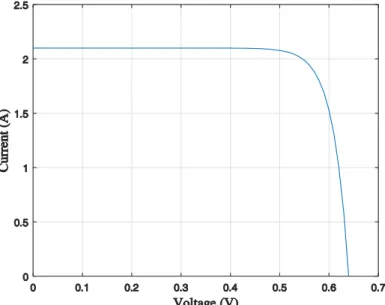
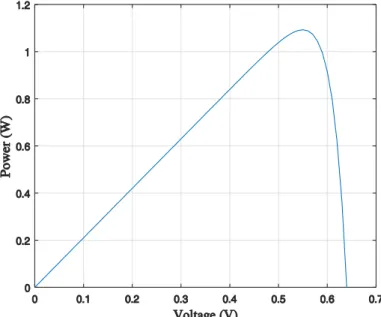
Figure 2.16 Voltage-current curve for single diode five parameters PV cell model. ... 46
Figure 2.17 Voltage-current curve for single diode five parameters PV cell model. ... 47
Figure 2.18 Flow chart of sensitivity analysis. ... 48
Figure 2.19 Parameter with error function for identify sensitiveness. ... 49
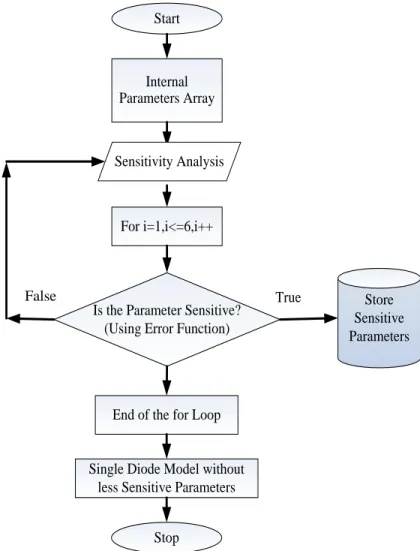
Figure 2.20 Flowchart describing the model to get sensitive parameters for internal model. ... 52
Figure 2.21 Sequential daily average irradiance of year 2017. ... 55
Figure 2.22 Pyranometer. ... 56
Figure 2.23 Sequential daily average temperature of year 2017. ... 57
Figure 2.24 Vaisala weather station with temperature sensor. ... 57
Figure 2.25 Sequential daily average wind speed of year 2017. ... 58
Figure 2.26 Anemometer. ... 59
Figure 2.27 Cloud shadow on PV panels as time-dependent obstacle. ... 61
Figure 2.28 Shadow of birds as time-dependent obstacle... 61
Figure 2.29 Dust on PV as time-independent obstacles. ... 62
Figure 2.30 Physical damage as time-independent obstacles. ... 62
Figure 2.31 Instrumentation interface with computer for controlling. ... 64
Figure 2.32 Data Acquisition interface with computer. ... 64
Figure 2.33 NI USB-6009 DAQ. ... 65
Figure 2.34 Signal description for NI USB-6009. ... 66
Figure 2.38 DAQ and signal generator connect to computer. ... 68
Figure 2.39 Circuit diagram for PV for measurement. ... 69
Figure 3.1 Smart Grid System. ... 74
Figure 3.2 Predict PV output to integrate with SG system. ... 75
Figure 3.3 Change of error function with different photocurrent. ... 76
Figure 3.4 Change of error function with different cell temperature. ... 78
Figure 3.5 Change of error function with different diode ideality factor. ... 79
Figure 3.6 Change of error function with different series resistance. ... 80
Figure 3.7 Change of error function with different shunt resistance. ... 81
Figure 3.8 Change of error function with different saturation current. ... 82
Figure 3.9 I-V curve for simple and single diode five parameters PV cell model. ... 83
Figure 3.10 P-V curve for simple and single diode five parameter PV cell model. ... 83
Figure 3.11 Irradiance with error function. ... 85
Figure 3.12 I-V curve under different irradiance. ... 86
Figure 3.13 P-V curve under different irradiance. ... 87
Figure 3.14 Maximum power points with increasing irradiance. ... 87
Figure 3.15 Ambient temperature with Error function to identify sensitivity. ... 88
Figure 3.16 Voltage-current curve under different ambient temperature. ... 89
Figure 3.17 Voltage-power curve under different ambient temperature. ... 90
Figure 3.18 Maximum power points with increasing ambient temperature. ... 91
Figure 3.19 Wind speed with error function. ... 92
Figure 3.20 Voltage-current curve under different wind speed. ... 92
Figure 3.23 Power with changing irradiance and ambient temperature. ... 95
Figure 3.24 Power with changing ambient temperature and wind speed. ... 96
Figure 3.25 Power with changing wind speed and irradiance. ... 97
Figure 3.26 Correlation matrix of irradiance and temperature. ... 98
Figure 3.27 Correlation matrix between irradiance and wind speed. ... 99
Figure 3.28 Correlation matrix between wind speed and temperature. ... 100
Figure 3.29 I-V curve with resistance load value of 100 Ω. ... 101
Figure 3.30 P-V curve with resistance load value of 100 Ω. ... 102
Figure 3.31 I-V curve with resistance as load value of 220 Ω. ... 102
Figure 3.32 P-V curve with resistance load value of 220 Ω. ... 103
Figure 3.33 I-V curve with resistance as the load value of 560 Ω. ... 103
Figure 3.34 P-V curve with resistance as the load value of 560 Ω. ... 104
Figure 3.35 I-V curve with resistance as load value of 1500 Ω. ... 104
Figure 3.36 P-V curve with resistance as load value of 1500 Ω. ... 105
Figure 3.37 I-V curve with resistance as load value of 4.7 kΩ. ... 105
Figure 3.38 P-V curve with resistance as load value of 4.7 kΩ. ... 106
Figure 3.39 P-V curves of two cells in series connection and one of them is under different level of obstacle. ... 108
Figure 3.40 P-V curves of two cells in parallel connection and one cell is under different level of obstacle. ... 109
Figure 3.41 I-V curve without obstacle and constant irradiance source. ... 110
Figure 3.42 P-V curve without obstacle and constant irradiance source. ... 110
Figure 3.46 P-V curve with time under rapid changing obstacles. ... 113 Figure 3.47 I-V curve with time, 48 cells get constant irradiance, and 24 cells are under obstacles and without diode between cells. ... 114 Figure 3.48 I-V curve with time, 48 cells get constant irradiance, and 24 cells are under obstacles and diode between the cells. ... 115 Figure 3.49 P-V curve with time and without diode between cell, 48 cells having constant
irradiance, and 24 cells get varying irradiance. ... 115 Figure 3.50 P-V curve with time, cells are connected with diode, and 48 cells get constant irradiance, and 24 cells get varying irradiance. ... 116 Figure 3.51 I-V curve with time, 36 cells having constant irradiance, and 36 cells get varying irradiance and no diode between cells. ... 117 Figure 3.52 I-V curve with time with connected diode cells, 36 cells having constant irradiance and 36 cells get varying irradiance. ... 117 Figure 3.53 P-V curve with time and cells are connected in series without diode, 36 cells get constant radiance, and 36 cells get varying irradiance. ... 118 Figure 3.54 P-V curve with time, 36 cells get irradiance, and 36 cells get varying irradiance with diode connection. ... 118 Figure 3.55 I-V curve with time without diode, 24 cells get irradiance, and 48 cells get various irradiance... 119 Figure 3.56 I-V curve with time, 24 cells having irradiance, and 48 cells get varying irradiance with diode connection. ... 120 Figure 3.57 P-V curve with time, 24 cells get irradiance, and 48 cells get varying irradiance and without diode between cells. ... 120 Figure 3.58 P-V curve with time, connected with diode, 24 cells having irradiance, and 48 cells having varying irradiance. ... 121 Figure 3.59 I-V curve under thin layer with uniform thickness dust on the surface of a PV panel. ... 122 Figure 3.60 P-V curve under thin layer with uniform thickness dust on the surface of a PV panel. ... 123
Figure 3.62 P-V curve for 54 cells of a 72 cells’ panel is under time-independent obstacle. .... 124
Figure 3.63 I-V curve when 4 cells is fully damaged of a PV panel. ... 125
Figure 3.64 P-V curve when 4 cells is fully damaged of a PV panel. ... 125
Figure 3.65 I-V curve having 54 cells under time-independent obstacle. ... 126
Figure 3.66 P-V curve with 54 cells under time-independent obstacle condition. ... 127
Figure 3.67 I-V curve with 18 cells under static obstacle condition and rest in healthy condition. ... 127
Figure 3.68 P-V curve with 18 cells under time-independent obstacle. ... 128
Figure 3.69 I-V curve with constant irradiance, time-independent obstacle, and time-dependent obstacle. ... 129
Figure 3.70 P-V curve with constant standard irradiance, independent obstacle, and time-dependent obstacle. ... 129
Table 1.1 Power generation from different renewable sources ... 4
Table 1.2 Population without electricity and with electrification rate ... 5
Table 2.1 Data for the c-Si PV cell at STC. ... 45
Table 2.2 Physical properties of a c-Si PV Cell ... 45
Table 3.1 Changing irradiance and ambient temperature with their maximum power point ... 95
Table 3.2 Changing wind speed and ambient temperature with their maximum power ... 96
Table 3.3 Changing wind speed and irradiance with their maximum power ... 97
AC Alternating Current
AFG Arbitrary Function Generator
AM Air Mass
c-Si Crystalline Silicon
DHI Direct Horizontal Irradiance
DNI Direct Normal Irradiance
DC Direct Current
DAQ Data Acquisition
ECMWF European Centre for Medium-Range Weather Forecasts
FF Fill Factor
GaAs Gallium arsenide
GHI Global Horizontal Irradiance
GPIB General Purpose Interface Bus
GW Giga Watt
HS High Speed
MPPT Maximum Power Point Tracking
OECD Organization for Economic Co-operation and Development
PV Photovoltaic
STC Standard Test Condition
SG Smart Grid
CO2 Carbon dioxide
C Speed of light
Ev Valence band
Ec Conduction band
Eg Energy band gap
Ep Photon energy
e Euler’s constant eV Electron Volt
G Irradiance
Gn Irradiance at standard condition
h Planck´s constant
I Current
I0 Saturation current
Ion Internal diode current
IL Photocurrent
Isc Short circuit current
NA Acceptor atoms ND Donor atoms ni Intrinsic semiconductor np Number of photon k Boltzmann constant Kl Temperature coefficient L Length
Lo Zenith path span at sea level
mh Effective mass of a hole
me Effective mass of an electron
Nc Effective density at conduction band
Nv Effective density at valance band
n Diode ideality factor
pi Hole density
q Electron charge
Rs Series Resistance
Rsh Shunt Resistance
Tair Ambient temperature
V Voltage
Voc Open circuit voltage
Vmp Voltage at maximum point
VT Thermal voltage
VD Voltage at diode
v Frequency
Z Zenith angle
CHAPTER
1
Introduction
In this chapter, the discussion is about the work’s fundamental aspects. It starts with an introduction about the chapter and describes the motivations of the proposed work. After that, the dissertation’s objectives and motivations are discussed to give an idea about the ground of the work. State of the art is included with all the related literature research done. Then, the proposed approach is briefly described and the main idea of this work is discussed in short to provide an idea about the findings. At the end of this chapter, the organization of the dissertation is given.
1.1 Prelude
The use of electricity is increasing all over the world with the increase of electronic equipment. All electronic devices run on this electrical energy. People use such devices in their daily life. To fulfil the power requirement from the consumers, enough sources of power are needed. Existing power plants cannot give enough electricity power, and the most part of the sources of energy is fossil fuel. Fossil fuel power plant generates massive amount of CO2 and lots of other gases which
are not suitable for the environment [COP2115]. This a major reason for global warming. It causes an increase in the temperature of the environment [IEA13, UNFCC15, UN16].
Figure 1.1 shows the future of the world for different scenarios where CO2 increases in different
ways [IEA15]. If the emission of CO2 and other harmful gases are controlled, then it will be
possible to reduce the temperature of the world. Observing the surrounding environment, it is possible to observe the effect of global warming. The icebergs are melting and causing an increase in the water level [IEA11, IEA14a, IEA14b]. This is an alarming situation for several countries those have the low height relative to sea level.
Figure 1.1 shows three predicted scenarios using different strategy of energy sources and their power conversion system. The first one, 6oC scenario, is the process what is going on now if there is no control over the situation of carbon emission. This will cause huge damage of atmosphere and increase the global temperature, thus melting the ice of the poles and increasing the water level. Many land will go under the water. The temperature of the earth will increase on average by 5.5oC in long period of time. The second scenario (4oC) is the process, which will happen if emission is controlled and efficiency of energy system is improved; it will cause an increase in temperature of 4oC temperature in the long term. In the third scenario (2oC) reports an ambitious strategy that needs huge effort to control the emission; this strategy will keep the atmospheric temperature within increase of 2oC. This should be aspiration for all the world policies [IEA15].
Renewable energy has a big role to play in the control CO2 emission. It is the energy source that
already got attention from scientists, businessmen and policymakers. This is a sustainable solution to protect the atmosphere by reducing the greenhouse effect and control the rising temperature. There are different kinds of renewable energy sources. They are wind, solar, hydro, biomass etc. Among these, solar is the most significant.
There are two types of system in solar energy: solar thermal and photovoltaic. Solar thermal had more economical efficiency than PV system, but for the last few years, the cost of PV panel has been kept to the minimum and on the other hand, the performance is increasing. Among these two types of technology, Photovoltaic is growing faster due to easy establishment. It is portable and very flexible to use. For the last few decades the cost of PV reduced dramatically. This cost reduction [Solarcellcentral11, Weforum15] is shown in Figure 1.2.
Figure 1.2 Decreasing price of PV module cost.
From Figure 1.2 it can be seen that the cost of PV module is decreasing in high rate in last few years (2010-2015), making it affordable to general people. During the year 2007 and 2008, due to shortage of polysilicon, PV module price was increased. Later on the price of the PV was decreased again and the trained is still remaining same. To establish a large power plant using PV module has now become cost effective than before [Graichen15, GTM17]. Moreover, maintenance cost is low for a PV plants. In the case of solar thermal, it is very expensive and lot of financial resources are needed to maintenance the plant.
The increasing usability and power generation from Photovoltaics and other renewable energy sources are shown in the Table 1.1 [REN16].
Table 1.1 Power generation from different renewable sources
Different Technology 2014 2015
Photovoltaics 177 GW 227 GW
Concentrating Solar Power 4.3 GW 4.8 GW
Wind Power 370 GW 433 GW
Bio Power 101 GW 106 GW
Table 1.2 presents different regions population all over the world without electricity and the electrification rate [IEA15].
Table 1.2 Population without electricity and with electrification rate
Region Population without Electricity(Millions) Rate of Electrification Rate of Urban Electrification Rate of Rural Electrification Developing Asia 526 86% 96% 78% Sub-Sahara Africa 634 32% 59% 17% Latin America 22 95% 98% 84% Middle East 17 92% 98% 78% World 1201 83% 95% 70%
PV panel now reaches rural and remote areas to make life over there more comfortable. The education system also gets pace due to portable PV systems; in villages, schools and houses are using them to get electricity. Electricity helps those people to improve their life quality. Figure 1.3 shows a PV in a remote area for improving life standard [Solar98].
Figure 1.3 PV in remote area for improving life standard.
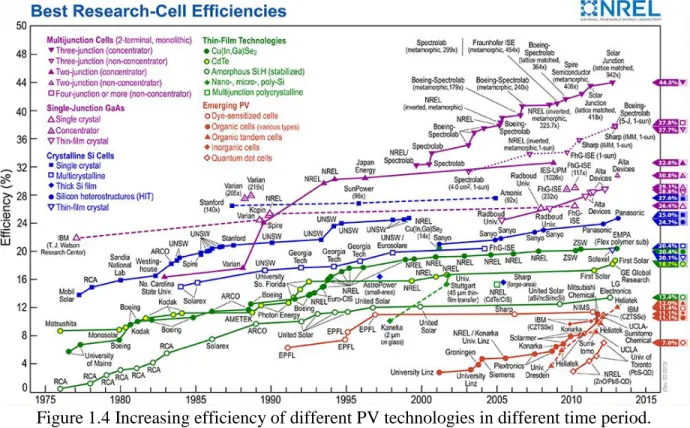
PV is a kind of energy conversion system that uses solar power to produce electrical directly. The working principle is very simple and this process of energy conversion does not produce any harmful gases. This makes it suitable to play a vital role to develop the sustainable future. Scientists all over the world are trying to increase the efficiency by using different types of materials with different kind of technologies. Figure 1.4 represents the present state of the research on
Photovoltaics and how much efficiency different technologies have achieved in different time period [NREL15].
Figure 1.4 Increasing efficiency of different PV technologies in different time period. Mainly five different technologies are shown; among them, multi-junction cells are in the leading position for the efficiency and has reached 44.4% efficiency in laboratory environment. After them the single-junction cells are in second position and reports 29.1% efficiency; then crystalline silicon technology has achieved 27.6% efficiency, thin-film technology comes at fourth position with 23.3% efficiency (cost is lower than other efficient technologies). At the bottom line the emerging PV technologies have less efficiency; among them Perovskite cell has 16.2% efficiency and are progressing very fast and promising.
History of solar energy
People from the early ages have been utilizing solar energy; from the beginning of mankind history, human and the sun have had a good relation. The sun is always the symbol of hope, after the darkness of night, the sun comes out as a symbol of hope. The sunlight is abundantly distributed all over the world. Depending on the geographical location the solar resource percentage varies.
Solar radiation itself is a primary resource for Photovoltaics system; it converts solar radiation into electricity following the law of photoelectric effect.
The History of using the solar energy is as old as the history of mankind. Human started to use the solar energy in different ways. In the early time, around 7th-century B.C. people have used magnifying glasses to concentrate the sun rays to make fire; in the 3rd century that Romans and Greeks used mirrors to light the torches. After that, Archimedes used reflection properties of light to fire wooden ships of the Roman Empire. At 20 A.D. Chinese people also used mirror to light up the torches. From the 1st to 4th century A.D., the Romans had south-facing windows to warm the bathhouses and in the 6th century A.D. Justinian people used sunrooms on houses. In 1767 the Solar collector was created by the Swiss scientist Horace de Saussure and in 1839 the French scientist Edmond Becquerel first saw the photovoltaic effect when he was doing experiments with two metal electrodes in a solution. In 1860 the French mathematician first come up with an idea to build a solar-powered steam engine. Willoughby Smith discovered the Selenium as photoconductivity in 1873 [Eere17].
In 1905 Albert Einstein described the photovoltaic effect in his paper [Einstein1905]. In 1916 Robert Millikan proved the photovoltaic effect and in the year of 1918 the Polish scientist Jan Czochralski built a way to grow single-crystal silicon. In 1932 Audobert and Stora identified the photovoltaic effect in Cadmium sulfide and in 1954 Daryl Chapin, Calvin Fuller and Gerald Pearson developed the first silicon photovoltaic cell at Bell labs which could convert sunlight to electricity; at first its efficiency was 4% which raised to 11% later on. After that, Western Electronic started to sell commercial licenses for silicon photovoltaic technologies in 1955. In 1959, PV was first used in satellite and in 1963, the Japanese built a lighthouse with array of photovoltaic which generated power value equivalent to 242 W. In 1970s Dr. Elliot Berman successfully designed a low cost solar cell and in 1976 David Carlon and Christopher Wronski prepared the first amorphous silicon PV cell. The first thin film solar cell was built at the University of Delaware in 1980 [ Eere17].
Later on, the PV technologies spread worldwide and it has come from industry level to household standalone systems. Different companies all around the world are producing PV panels; different
countries come forward to investigate more about these technologies, implemented them and connected them to a central grid. From 2001 to 2017 the investment on PV systems has grown very rapidly. This rapid growth of PV is shown in Figure 1.5 [Greentechmedia16].
Figure 1.5 PV installation growth around the world.
There has been an enormous amount of PV installations done in the last 10 years. Their energy production was linked with central electrical grid and distributed. This energy source is clean and sustainable.
The sun
Our solar system is built up with only with one star named Sun, the ultimate energy source. This source of energy is the main reason for life on this planet Earth. It is important to know about the sun and its internal energy to comprehend the precise knowledge of solar energy.
The mass of the Sun is 1.99 × 1030 kg, and its radius is 6.96 × 10⁸ m. Until now, it is not possible to access its internal information directly. Based on the theoretical information and analysis of the solar surface it is assumed that the interior temperature is about 15 million kelvins. Every moment it is producing energy by burning different elements it contains. It consists of hydrogen (~73%), helium (~25%) and rest of the part is oxygen, carbon, neon, and iron. The birth of the Sun is
another 5 billion years. The source of its fuel is hydrogen and helium gases [Chen11]. In the core, two isotopes, named Tritium and Deuterium, collide with each other under a massive amount of heat. In this process, a new molecule is formed, named Helium, and an enormous amount of energy is released in the form of heat and light. It travels from the core to the sun surface which is called photosphere. After the photosphere, there exists the Sun’s atmosphere, called chromosphere. This layer absorbs a few colors of the radiation emitted from the photosphere [Wieder92, Chen11].
The energy is produced and release every single moment. Because of relatively transparent nature of chromosphere, its effect is being ignored to calculate solar radiation. The spectrum of solar radiation is counting by the thermal and optical properties of the solar surface. Typically, it is considered that the Sun behaves like a black body whose temperature is consistent at around 6000 K [Wieder92, Chen11].
Solar energy comes to the Earth being the primary source of life of all living elements. Thermal energy keeps the planet warm and helps the plants to do photosynthesis. There is lots of fossil fuel because of the photosynthesis, where plants convert the solar energy to chemical energy. The flow of wind and water depends on the thermal energy of it. In the ecosystem, solar radiation is an essential part to continue the process. The burning Sun is shown in the Figure 1.6 [Sunnymorgan16, ESA17].
The radiation from the Sun travels to the Earth as electromagnetic waves without any medium. The power density of average solar radiation outside the atmosphere is 1366W/m2. The annual solar energy the Earth gets is around 5.46 × 1024J [Chen11].
Among the total solar radiation which comes to the Earth, 30% is reflected and back to space, 20% is absorbed by the clouds and air molecules and rest reaches the Earth’s surface. However, a majority part of the Earth consists of water, where only 10% radiation is utilizable. Even though only 0.1% percent of it is enough to supply the energy to entire world [Chen11], so a huge amount of solar resource is available all over the world.
On the Earth’s land, the solar radiation is not equally distributed. Someplace have a vast amount of solar power, and others have very less. Figure 1.7 presents the average distribution insolation of solar radiation through the Earth [Altestore17].
Figure 1.7 World map of insolation.
It is observed that Earth has been divided into six zones depending on the average amount of solar radiation over a year on a surface of 1 m2 (in kilojoules) [Chen11]. From the world map, there are some places which can generate a tremendous amount of energy from solar irradiation; in Europe,
for producing an enormous amount of energy from irradiation for its geographical position; it does not have very high temperatures but has sufficient amount of sun light. This situation makes Portugal a splendid place for utilizing solar energy.
1.2 Motivation
Imagining our life without energy is becoming quite impossible due to the reliance on technologies. Future development of technology and civilization is depending on the development of energy. This civilization is based on electrical and electronics equipment and without energy these components are useless. World energy consumption is shown in the Figure 1.8 [EIA17] It depicts the present state and future prediction till 2040 of energy. The red part represents the non-OECD (non-Organization for Economic Co-operation and Development) member countries and grey part represents OECD (Organization for Economic Co-operation and Development) member countries.
Figure 1.8 World energy consumption.
From the Figure 1.8, it is viewed that the non-OECD countries need more energy than OECD countries. Non-OECD countries include China and India; these two countries are using massive amounts of energy to grow their industries and its productions. All over the world the energy
demand is growing and, on the other side, people are trying to decrease the use of fossil fuel. Fossil fuel in power conversion systems is identified as a threat to the world atmosphere [EIA17, UN16]. Figure 1.9 presents the consumption prediction increase until 2040 for different energy sources. Energy sources like gas, oil, coal etc. will finish due to their limited quantity. On the other hand, renewable energy sources like wind, solar and hydro energy are abundant [EIA14a, EIA14b, EIA17].
Figure 1.9 World energy consumption by energy source prediction till 2040.
Fossil fuels have more consumption than any other sources. But it has critical impacts on atmosphere and generates CO2 and other harmful components. These gases have negative impact and cause global warming. People are willing to leave the sources of energy that have negative impacts. All are trying to develop sustainable energy.
Renewable sources are sustainable and helpful for developing sustainable system. According to working principle, PV is one of the technologies that utilize the solar energy and have not generated any damaging elements during lifetime working period. It is now cheap in production and maintaining cost is low.
1. Explore materials for improving of PV cell efficiency (Different kind of semiconductors and other materials);
2. Power conditioner technologies (DC/AC and DC/DC converters, MPPT Devices); 3. Healthy surrounding conditions for the system (Dust, human-created shadow).
Focusing on the increasing efficiency, researchers all over the world are working on these three vital areas. All kinds of photovoltaics technologies are operating with solar energy and have the same working principle. Due to lack of system knowledge, poor maintenance and environmental effect, the performance of a PV panel decreases a lot. If the system is not maintained properly, then the output quality will decline gradually.
Analysis through the present PV power conversion system, it is identified that due to lack of maintenance its performance declines [Rashel18b]. Also surrounding parameters have a noteworthy effect on it. Maintaining surrounding conditions improves the performance [Rashel18a]. Shadow of obstacles on PV surface like dust and shadow are two significant detrimental elements that decrease its efficiency. Classification and identification of the obstacles type and magnitude is important to identify the problem that occurs to PV panel and also acquire information about the fault in real-time.
Prediction of photovoltaics power conversion system’s output has full dependency on environmental parameters. Identification of the behavior under different environmental conditions assist to predict future production and that’s helpful to enrich knowledge of smart grid (SG) system.
These are the motivation for the dissertation, to get appropriately the maximum output from the PV system, predict system’s output in advance and also to identify the fault. This identified knowledge will enrich the SG to design a load balancing system that would more efficient than existing system.
1.3 Objectives
Important tasks of this work is to understand the single diode five parameters PV cell model, namely their sensitivity of internal and environmental parameters. Also environmental effects on
the PV power conversion rate. Another objective is to classify the obstacles of PV panel in real-time aiming to identify different types of fault. Precise modeling of the PV conversion system could give rise to prediction model with more accurate results. PV is nonlinear in nature with dependency on environmental parameters which shows complex behavior. These effects are observed and identified by computational simulation and experimental work. Also work has done to get results for non-constant load effect on it. Objectives of this work is given below:
The work’s first objective is to create an error function that analyses the sensitivity of different internal parameters. By constructing the error function, a computational model is created for understanding different internal parameters and simulated their behaviors. This model is observed under varying parameter values that simulate different conditions of the model. This is done to understand internal parameters’ sensitivity.
Secondly, the error function is used to identify the sensitivity of environmental parameters and a model can be built for the same PV model under different environmental conditions. Correlation between environmental parameters must also be analyzed to understand the affiliation between them.
Thirdly, to understand the non-constant load effect on PV power conversion, PV panels are put under different load experimentally. A signal generator is used to generate the desire signal (RAMP signal) and the Matlab environment is used to collect the data from the real-time system. This data is used to analyze voltage and current behavior that is acquire from the PV panel with other instrumentations (DAQ and GPIB).
At the end, the obstacles are classified and its influence on PV panels is analyzed. Obstacles are something that interrupt the sunlight to reach its surface; a simulation model is used to categorize and recognize different types of shadow of obstacles. This simulation gives valuable information about faults on the surface that reduce the panels’ performance. Identifying the problem enriches and helps to solve fault of the system and improve the productivity.
All these computational simulation and physical models are created to analyze PV under different conditions and its power conversion efficiency under different situations. This bottom-up approach
will give hints to create better PV models under distinctive situations that integrate with smart grid (SG).
1.4 State of the Art
Energy, renewable energy and climate
In December 2015, 195 countries gathered together in the Paris climate conference [COP2115] agreed to set a goal to limit the global warming below 20C. Almost all governments from all over the world were united in the decision to keep the temperature level low, reduce the emissions of harmful gases and help each other to reach the common goals using the available science and technology. Developing countries will get continuous support from the EU and other developed countries for tackling the climate change effects. It was a historical agreement for the world to save the environment and develop a sustainable climate. Renewable energy sources have a huge role to reach this goal [UN16].
Bozkurt et al. [Bozkurt10] states that there is no energy resource that is risk free. For choosing a source of energy, it is important to keep in mind environmental effects and cost issues. Renewable energies are the solution and can help reverse the global warming.
In [Omer11, Mitoula11] discuss renewable energy and sustainable development environmental issues from the perspectives of past, present and future. Different renewable energies like solar, biomass, wind, geothermal etc. are discussed from the economic and environmental point of view. At the end of this work concern is shown about temperature rising caused by different greenhouse gases.
The works of [Dresner08, Dincer12, Heshmati15] introduce the concept of sustainable engineering, a new type of engineering branch that designs, develops and encourages sustainable energy production systems. They discuss about different sources of energy like solar energy, geothermal energy, biomass, natural gases, petroleum, coal, nuclear energy etc. and briefly discuss the effect of energy efficiency.
Demirel et al. [Demirel16] divided the sources of energy between primary and secondary energy sources. Primary sources are available in environment and are fulfilled from the nature; secondary sources are derived from primary sources. This deriving processes generate harmful components, or the process itself could be harmful. It also briefly gives evidence of various implication of the energy effects on the environment.
In [Kverndokk94, Nada14, BP17], the details of the energy consumption are shown with latest status about oil, natural gas, coal, nuclear energy, hydroelectricity, renewable energy, electricity, carbon dioxide. The report shows world’s and regions carbon emission rate.
In [Shell97, Zeman14] the scenario for diversification of energy source is given for the 21st century and gives brief status of the electricity generation and consumption at different levels.
[IEA14a, IEA14b] report a brief overview of the present state of the energy and the total production from different sources of energy and the consumption; graphical and numerical data are availed on the reports.
[WEC16] reports details about technologies, economics and markets, socio-economics and environmental impacts about energy sources (coal, oil, natural gas, uranium and nuclear, hydropower, bioengineering, waste to energy, solar, geothermal, wind and marine). It also discusses carbon capture and storage, e-storage giving detailed status about different countries and their production related to different energy sources. The report shows the importance of solar energy: its growth, the cost-benefit analysis and the impact over the environment.
The future of renewable energy and their statistical analysis is given in [REN16] and the production of CO2 from fossil fuel and the importance of renewable energy to make sustainable world is also discussed in [Isoaho16].
Smart grid and PV system
In [Phuangpornpitaka13] a description of how renewable energy could connect with smart grid and an indication about the work that should have been done to make a stable smart grid connecting with renewable energy is presented. PV power conversion is nonlinear and to connect with SG an
improvement of computational tools and other hardware component like huge power storage is needed.
[Gomes16] describes how wind and PV system can integrate with central grid system. showing the reduction of risk factor when the two systems work together to supply electricity to SG. It also discusses about electricity marketplace.
Viegas et al. [Viegas15] tries to predict the electricity load profile mainly for residential areas. The outcome from this work helps market policy makers to get estimation about the total load of the consumers assisting to design load balance model integration of renewable energy power with central grid.
[Netl10, Gharavi11] describe how the society and world can benefit from the smart grid. This is important to make a balance between demand and supply; it also helps to reduce the price of the electricity and is one of the solutions to integrate all sources of electricity and make a good plan for an efficient supply and distribution process.
[Kaur15, Benabdallah17] give details about the challenges to integrate PV systems with SG. One important part is to make the prediction of PV power generation more precise; though lots of work is going on related to this, more work needs to be done to predict the PV power generation. They also suggest to improve and establish integrated energy storage system to efficient connection between PV plants and SG.
[Mekkaoui17, Shafiullah13] describe the model and simulation for integrating smart grid with solar plant and wind farm. The model is built with Simulink. Gives idea about smart house system. It shows the PV modeling and importance of a good modeling to predict the PV power for future. Prakesh et al. [Prakesh17] describe different methods for forecasting PV power in the ground for grid system. It gives details about why prediction of PV is needed for the SG for optimize the load and balancing system. Introduce prediction algorithm like; artificial neural network, hybrid models.
Saleem et al. [Saleem17] in one of the recent work, describes the SG integrate with internet of things (IoT) to make communication with energy sources and with energy consumer for efficient
energy distribution. IoT is combination of sensors that collect information from different end and then central SG system analyses the total scenario based on the information it gives.
Rauf et al. [Rauf17] gives detail method about PV generation integrates with SG introducing the DC-AC hybrid grid system and also describe battery storage system.
In [Meena14, Wan15] show the integrated system between the rooftop PV and SG. This system generates electricity in efficient way and it possible to financially benefited as a house owner. They also developed a forecasting system that predict solar power generation.
In [Kempener13, Elzinga15] is described the SG as solution for the future electric system. When renewable sources and distribute electricity is connected with central system and can efficiently do the load balancing. Forecasting is important for this system. In [IEA11] report describes the details about the deployment and structure of SG with renewable energies.
In [Fialho14a, Fialho14e, Fialho15a, Fialho15b, Fialho15c, Fialho15d] describe different methods for connecting PV with smart grid system and also about control method. These works describe method to integrate SG with PV plat through DC-DC boost converter and two-level converter. Also describe three level inverter. Fialho et al. [Fialho15c] shows the way to connect the Poly-Si PV system with the central grid. It introduces the fuzzy controller to control the converter and connected with SG in efficient way.
Batista et al. [Batista14] describe an architecture in secure and reliable method to connect with smart grid. It also introduces ZigBee technology for communication between renewable generation with SG in secure way.
Different technologies of PV
Gangopadhyay et al. [Gangopadhyay13] give the detail description about different existing technologies of PV materials. It shows that the price decreased very rapidly because of finding usability of using different cheap materials.
Zeman et al. [Zeman10] describe the thin film technology based on silicon materials. It includes description about the structure and characteristics of amorphous and crystalline silicon thin film and also the photon management inside cell to increase the performance.
Tamirat et al. [Tamirat17] describe the nanotechnology with semiconductor solar cells. The existing technology with nanotechnology, together they are improving the performance by using more solar radiation.
Parida et al. [Parida11] describe different PV technologies, named amorphous silicon, crystalline silicon, cadmium telluride, organic cell, polymer cell, hybrid cell, thin film PV cells.
Kalkman et al. [Kalkman18] state three promising technologies of PV named perovskite, quantum-dots and concentrated photovoltaics. It mentions that crystalline silicon PV is the dominant technology in the market, and it has high efficiency than maximum available technologies. In [Hudedmani17, Sharma15] describe different type of materials that are using to do research to find future materials for manufacturing efficient PV with low cost.
Rwenyagila et al. [Rwenyagila17] discuss about organics PV cell, their structure and working process. In [Chu11, Smets16] describe review for different type of solar energy technologies and their cons and pros.
Candelise et al. [Candelise11] describes the new type of PV technologies like; Cadmium Telluride, Copper Indium Gallium Selenide TF technologies. Mainly these materials are exploring because of low cost and availability.
Modeling of PV cell
Kalogirou et al. [Kalogirou09] discuss about the importance of solar energy at the introduction chapter. The book has total overview about the solar energy and its different technologies. It describes detail modeling and characteristics of PV cell and panel.
In [Vergura16] states a way to model a PV cell that only depend on manufacturer datasheet values. It describes two PV models; one is with five parameters in a standard one and another one is a simplified model that has not include the shunt resistance. Ahmed et al. [Ahmed16] describe
different parameters and their variation effect on PV model, that is important to get vital information about the parameters sensitivity.
Tayyan [Tayyan11, Tayyan13] describes to get I-V and P-V characteristics from five parameters single diode PV model based on the datasheet values. This work gets five parameters value after solving five equations and using datasheet. Different test condition is described under changing irradiation and temperature.
Aoun et al. [Aoun14] show a model using five parameters named; photocurrent, dark saturation current, series resistance, shunt resistance and diode ideality factor. This model also created based on datasheet parameters like [Tayyan13]. This model is tested under real environmental conditions and under simulation. Simulation value has very good accuracy with real scenarios.
Lineykin et al. [Lineykin12] describe a PV cell model building from single diode with seven parameters values, named; the photocurrent, the reverse bias saturation current, the ideality factor, the series resistance, the shunt resistance, the bandgap energy, and the temperature coefficient of the photo-generating current.
Chatterjee et al. [Chatterjee11] describe the PV model for a cell, string model, array model using the datasheet values provided by manufacturer. Matlab is used for simulation of different scenarios model.
Fialho et al. [Fialho14d, Fialho15d, Fialho15e] describes method of the five parameters of PV cell model. In [Fialho15d] describes the parameters extraction procedure using a heuristic method. It gives detail method that connects PV system with grid system. Its included the partial shading condition in the simulation model. In [Fialho15e] describes model that is built on the basis of monocrystalline PV cell’s characteristics.
Bikaneria et al. [Bikaneria13] describe one-diode model and simulate that using different values of different parameters of the model. Saraiva et al. [Saraiva12] describes monocrystalline PV cell model for equivalent circuit model. It introduces iteration process to find values of series resistance, shunt resistance and diode ideality factor.
Bonkoungou et al. [Bonkoungou13] find parameters value of a single diode five parameter model using Newton Raphson’s method. The values that they get from the iterative method is validated by the values provided from manufacturer datasheet.
Cubas et al. [Cubas13] describe an analytical method to get parameters’ value of five parameters circuit model. Pereira et al. [Pereira14] focus on five parameters PV model, consisting on a current controlled generator. They derive details PV Simulink model that is approximate model for the real seniors one.
Sera et al. [Sera07] describes a model, it is constructed from the given manufacturer datasheet values. This model includes the series and shunt resistance in the cell model. It is tested under different irradiance and temperature conditions.
Rodrigues et al. [Rodrigues11] derive the single diode PV cell model and has done simulation with temperature, solar irradiance, series resistance and ideality factor. It compares ideal diode model with their constructed model.
Masmoudi et al. [Masmoudi16] describe single diode and double diode models for mono-crystalline PV cell. Proposed model’s derived values are compared with datasheet values of the real PV cell. The simulation is created using Matlab environment. Ghani et al. [Ghani14] give a numerical process for calculating the values for single diode PV cell model.
Chenni et al. [Chenni07] describe details method for PV cell modeling and include irradiance, series resistance and temperature variation to see their effect on the model. Datasheet values are used to evaluated the model under changing irradiance and temperature. Also shows effect of parallel and series connections of cells.
Environmental effects on PV power conversion
In [Wieder92, Zeman10, Kalogirou09] give clear idea about the sun and its behavior with changing the Sun’s position and time. Position of the Sun is always changed with the seasons around the year. The irradiation varies region to region based on their geographical. In their text, they describe annual motion of the earth around the Sun.
Gokmen et al. [Gokmen16] show the wind speed effect on PV panels. It examines the relationship between wind speed and tilt angles to get maximum output. Wind speed cool the PV modules and increase the performance. The tilt angle is not similar during the whole year; it changes time to time to get better performance.
Dubey et al. [Dubey13] show that operating temperature is a key parameter of PV that is important to get maximum from the PV power conversion. They find temperature has linear relation with PV power conversion rate.
Arjyadhara et al. [Arjyadhara13] state a detail analysis about the PV cell performance under changing irradiance and temperature. They conclude that with increasing temperature the photon generation rate increases and reverse saturation current also increases fast that reduce the band gap. Katz et al. [Katz01] describe temperature and irradiance effect on polymer solar cell. They state temperature as a negative factor for the PV performance.
Salim et al. [Salim13] shows a practical simulation for irradiance effect to the PV performance. In their work, they test performance of Solara-130 PV module with different irradiance using solar model tester.
Bhattacharya et al. [Bhattacharya14] describe the effects of wind speed and ambient temperature on the performance of monocrystalline PV. They collect information from real environment and analysis them to get the effects from those factors.
Islam et al. [Islam14] show that different internal parameters of PV changes with changing value of irradiance. They show how series and shunt resistance change with changing irradiation. Singla et al. [Singla16] state that PV performance is not only dependent on the internal parameter of PV, it is also strongly connected with environmental variables. Shadow have great impact on PV and it decrease the performance of PV power generation.
Darwish et al. [Darwish13] describes about different environmental parameters named; humidity, irradiation, air population with dust in the ground of PV panel performance. The paper gives clear evidence that dust have significant effect on PV power conversion and decreases its performance.
In [Homadi16] show that the elevation has effect on PV performance with other environmental parameters named; irradiance and temperature. Huld et al. [Huld15] describe PV module performance under changing irradiance, air temperature and wind speed. This paper gives clear idea that PV power conversion dependent on these environmental factors.
Schwingshackla et al. [Schwingshackla13] show how wind effect the PV module’s cell temperature. It states different techniques to estimate the PV performance based on wind speed prediction. They use ECMWF for weather parameters prediction and get better performance in prediction than standard approach.
Nordmann et al. [Nordmann03] give data analysis for different PV plants and shows temperature is a significant factor for PV module performance. To make airflow through modules that decrease temperature of it and increase the performance.
Fesharak et al. [Fesharaki11] state temperature effects on the PV efficiency and it shows that the PV power generation efficiency and temperature has linear relationship. Lay-Ekuakille et al. [Lay-Ekuakille13] describe CdTe and CIS PV modules performance with different environmental parameters. It states the performance curve with temperature, ambient temperature, humidity and irradiance.
Load analysis with PV
Kuai et al. [Kuai05] state the load analysis for PV. Describes a method to quick scanning the load of a PV in field condition to get maximum power. It describes PV output as nonlinear nature and is needed for PV to scan the load fast to maximize the power conversion.
In [Hategekimana17] describes the load as an important factor for PV power management. In standalone system, during less load condition and high production of PV, has power loss. On the other hand, in the reverse situation the system needs power but PV has less generation. PV connected with grid is a balance system that is the way to reduce the power loss and also connected with battery storage could reduce the loss of the system.
Bataineh et al. [Bataineh12] describe a stand-alone PV system with converter and battery for a remote area in Jordan. It states that load analysis is important to design the PV system with controller and battery.
Zerhouni et al. [Zerhouni10] describe the optimized system for PV at processing state under changing weather situation. In changing weather condition load is changing depending on the environmental condition. In hot or cold weather people use air conditioner to control the air temperature and it increase the load. They state load as an important factor that needed to make an optimized system.
Shadow of obstacle effect on PV power conversion
In this work, different types of shadow effects, dust effect is given a generalized name obstacle. In this section, different obstacles reviews are given.
Mohamed et al. [Mohamed12] state PV performance under different types of dust in Libya. It gives details performance overview of PV under clean and dust environment. The dust on PV surface decreases performance a lot. Piazza et al. [Piazza10] design a simulator under partial and dynamic shadow condition, that simulates the shading effect of PV.
In [Saluos15] describe different types of shadow in form of dust. There are different types of dust in the environment and those are not clearly identified. Dust reduces the PV performance in rustically.
Wang et al. [Wang12] give details about shadow and partial shadowing condition and proposed an architecture for get better efficiency under these conditions. Develop a hybrid method to get better performance in such condition.
Wang et al. [Wang17] describe dust effect on PV modules. They got a relation between dust deposition on PV and the sunlight transmit in that condition. They also include the incident radiation with tilt angle.
Zaihidee et al. [Zaihidee16] show the deposition density of dust is related with PV power conversion rate. Low dense dust has low effect and high dense dust have high effect on the PV performance, it reduces more solar radiation to reach to the surface. For dust the PV module gets more temperature.
Haoyuan et al. [Haoyuan15] state the dynamic shadow simulation in Matlab environment. In lab it performs experiment for validate the model.
Casanova et al. [Casanova11] give details about the dust that became an obstacle on the PV surface that reduce the radiation and change the incident angle of the Sun ray. It shows due to dust on the module it loss 4.4% of energy in daily basis.
Fialho et al. [Fialho14b, Fialho14c] state the shadow effect on a series solar modules of monocrystalline silicon PV modules. In simulation it shows that this effect makes the performance low and gives several peaks in the voltage-power curves and in this way misguide the maximum power point tracking (MPPT) system to get the global maxima. Fialho et al. [Fialho14d] simulate partial shading with five parameters single diode PV model. They validate the simulation result with real-time data.
Anjos et al. [Anjos17] simulate the hot-spot using crystalline silicon PV module and it is under shadow on the module. It describes the conditions under fully shaded or some cells under shaded condition. They simulate hot-spot condition when the cells are without bypass diode. Ibrahim et al. [Ibrahim11] describe indoor measurement system for making experiment to understand the dust effect. They use silicon solar cells for the experiment.
In [Francisco15] state the solar PV cell’s performance under shadow effect. It describes that PV power conversion is strongly related with weather and ambient parameters and has strong relation with seasonal environment. Also states that shadow makes the PV output more uncertain to predict the power conversion rate.
Mani et al. [Mani10] describe the review about the dust impact on PV system. Regular cleaning of the PV is a way to improve the performance and it is the way to keep the efficiency high.
Alam et al. [Alam12] analyze the dynamic shadow effect for both diffuse and direct radiation. They observe the shadow from the aspect of city area and analyzes different kind of shadow on PV. 3D city model is used to analyze different type of properties that causes the shadow. Romano et al. [Romano13] discuss about shadow effect and introduced a switching matrix technique to make the system more efficient under shadowing condition.
Gao et al. [Gao09] discuss about portable PV power system and include the rapid change environmental condition, that includes the shadow condition also. Parallel connection of cells give better performance in rapidly changing condition for PV power conversion.
Nguyen et al. [Nguyen12] discuss potential of Photovoltaics in urban area and states the losses due to shading effect. They used GRASS and Scilab software for modeling the scenarios.
Menoufi [Menoufi17] give details about the dust accumulation on the surface of the PV and introduce photovoltaic soiling index, that states the health condition of PV under different type of situation. Storey et al. [Storey13] show the relation between number of cell of PV under shadow effect. They used Matlab for making simulation of the behavior.
1.5 Organization of the Dissertation
This dissertation is completed with four chapters, including this one. This section gives the organization of each chapter.
Chapter 1 describes the introductory literature with other important point ideas to make the dissertation. It contains motivations, objectives, state of the art and at the end, this section that gives the organization of the dissertation.
Chapter 2 introduces the fundamental theory and the mathematical formulation of PV model. It starts by describing the solar radiation spectrum that is the primary source of PV energy. Next, the photovoltaics (PV) working mechanism is introduced. It gives brief details about semiconductor and diode, then it describes the working principle of PV and the characterization of the PV using the single diode five parameters PV cell model and also its mathematical formulation is given. The
![Table 1.2 presents different regions population all over the world without electricity and the electrification rate [IEA15]](https://thumb-eu.123doks.com/thumbv2/123dok_br/15756883.1074344/31.918.107.832.232.375/table-presents-different-regions-population-world-electricity-electrification.webp)