Heart Surgery Is Associated With Lower
Early Mortality
Andrzej Kansy, MD, PhD, Christine zu Eulenburg, PhD, Georgios Sarris, MD, PhD,
Jeffrey P. Jacobs, MD, PhD, Jose Fragata, MD, PhD, Zdzislaw Tobota, MD,
Tjark Ebels, MD, PhD, and Bohdan Maruszewski, MD, PhD
Children’s Memorial Health Institute, Warsaw, Poland; Athens Heart Surgery Institute, Athens, Greece; University Medical Center Groningen, Groningen, Netherlands; Johns Hopkins All Children’s Heart Institute, St. Petersburg, Florida; Hospital de Santa Marta, Lisbon, Portugal; and Cardiothoracic Surgery, University of Amsterdam, Netherlands
Background. The early results of congenital heart sur-gery in neonates remain a challenge. We sought to determine the nature of the association between annual center volume of neonatal cardiac surgery and operative mortality using a multicenter cohort.
Methods. The dataset consists of 27,556 neonatal pro-cedures performed between 1999 and 2015 in 90 centers participating in the European Congenital Heart Surgeons Association database. Centers with mean annual volume load of six or more that submitted data for at least 3 consecutive years were included. World Bank annual gross national index per capita was utilized as an indi-cator of temporal national affluence. Multilevel logistic regression was used to create a model including the sig-nificant risk factors and to calculate odds ratios for operative mortality. Iterative modeling of the dataset incrementally excluding centers with lower annual case-load was used to identify the relationship between annual volume and mortality.
Results. In the model thus calculated including The Society of Thoracic Surgeons–European Association for Cardio-Thoracic Surgery (STAT) mortality score, opera-tive weight and age, noncardiac genetic anomalies, and annual volume of operations were independent risk fac-tors for operative mortality in the analysis of the entire cohort. In the model containing these variables, annual gross national index and year of surgery were not significantly associated with mortality. In the iterative process, annual volume ceased to be a risk factor when units operating on fewer than 60 neonates annually were excluded.
Conclusions. In neonatal congenital heart surgery, the risk of operative death decreased with the increase of volume load. The cutoff point in this cohort was a mean annual volume of 60 neonatal operations per year.
(Ann Thorac Surg 2018;105:1436–40) Ó 2018 by The Society of Thoracic Surgeons
A
n inverse relationship between surgical volumes and early mortality has been described in both cardio-thoracic surgical programs and general surgical programs[1]. In congenital cardiac surgery, this relationship was investigated and documented for overall programmatic outcomes involving the entire case mix, as well as for operations including the Norwood operation and the arterial switch operation [2–9]. In a multiinstitutional analysis using The Society of Thoracic Surgeons Congenital Heart Surgery Database, the investigators concluded: “There was an inverse association between pediatric cardiac surgical volume and mortality that became increasingly important as case complexity increased. Although volume was not associated with
mortality for low-complexity cases, lower-volume pro-grams underperformed larger programs as case complexity increased” [10]. In our previous studies, we analyzed the volume-outcome relationship using the verified and entire case-mix of the dataset of the Euro-pean Congenital Heart Surgeons Association (ECHSA) congenital database. Our analysis suggested that after adjustment for case mix, higher volume is associated with lower rate of mortality and morbidity. We also found that when complications occurred, the chance of rescue from these complications was higher in large-volume centers
[11, 12]. Unknown is how this relationship is for the children who underwent surgery at less than 1 month of age (neonates). This group is particularly important
Accepted for publication Nov 8, 2017.
Presented at the Fifty-third Annual Meeting of The Society of Thoracic Surgeons, Houston, TX, Jan 21–25, 2017.
Address correspondence to Dr Kansy, Children’s Memorial Health Institute, Department for Pediatric Cardiothoracic Surgery, Al. Dzieci Polskich 20, Warsaw 04-830, Poland; email:[email protected].
The Supplemental Tablecan be viewed in the online version of this article [https://doi.org/10.1016/j. athoracsur.2017.11.028] on http://www.annalsthoracic surgery.org.
Ó 2018 by The Society of Thoracic Surgeons 0003-4975/$36.00
Published by Elsevier Inc. https://doi.org/10.1016/j.athoracsur.2017.11.028
CONGEN
ITAL
H
because the operations performed are among the most challenging, which is reflected in high The Society of Thoracic Surgeons–European Association for Cardio-Thoracic Surgery (STAT) mortality scores.
The aim of this study was to use the multiinstitutional data from the ECHSA Congenital Database to determine the nature of the association between center volume and outcomes including inhospital mortality in neonates un-dergoing cardiac surgery.
Material and Methods
The study was carried out according to the ECHSA Congenital Database policy (available at: www. echsacongenitaldb.org, paragraph 2). Because the indi-vidual patients were not identified, the ECHSA Congen-ital Database Committee waived the need for parental consent. The ECHSA database director, according to the policy of the database, accepted the study.
Database
This study was designed as a retrospective cohort anal-ysis. We obtained data from the ECHSA congenital database [13]. The ECHSA congenital database collects procedure-related data on patients undergoing surgery for congenital heart defects. The ECHSA congenital database, established by ECHSA and the European As-sociation for Cardio-Thoracic Surgery in 1999, is the result of transformation of the European congenital heart defects database created by ECHSA in 1992. Data collected in the database include basic demographic in-formation, anatomic diagnoses, associated noncardiac abnormalities, preoperative risk factors, intraoperative data, type of surgical procedure, and postoperative com-plications, as well as hospital and 30-day mortality. The database is entirely anonymous regarding identifiable information of the patient, hospital, or surgeon and pre-cludes researchers from requesting centers for additional information not contained within the database.
Patients and Institution
The study population consists of neonates (age to 30 days) who underwent a cardiovascular operation as classified in the STAT risk stratification system at an ECHSA congenital database participating program, between January 1, 1999, and December 31, 2015. After batch submission, an inte-grated software module rejects all records that do not meet standard minimum criteria, and sends these data for correction of internally validated data. Patients weighing less than 2.5 kg undergoing patient ductus arteriosus ligation as their primary procedure were excluded.
Only centers with a mean annual volume load of six or more procedures that submitted data for at least 3 consecutive years were included. Isolated years of sub-mission (nonconsecutive) and years when the volume load was 20% or less of the center average were excluded. These criteria resulted in a dataset that had been submitted by 90 congenital cardiac surgical centers, several of which were subject to annual review on a voluntary basis by the ECHSA database staff. (Data fields verified: hospital
mortality, postoperative length of stay, intermittent positive-pressure ventilation time, date of birth, date of admission, date of surgery, date of discharge or mortality, body weight, case category, cardiopulmonary bypass time, aortic cross-clamp time, and circulatory arrest time.) In cases in which patients had more than one operation during the same admission, only thefirst operation (index cardiac operation) was analyzed. For all operations involving combinations of procedures, the operation was classified according to the component procedure with the highest STAT mortality score procedure.
Data collected included patient’s age, weight, any noncardiac abnormality/genetic syndrome or other pre-operative risk factors, as defined in the ECHSA congenital database. The STAT mortality score was assigned to each index cardiac operation. Center characteristics included annual surgical volume of STAT classified cases during the study timeframe, years of participation in the data-base, and continent. As a substantial number of countries only have one single center providing for pediatric car-diac surgery, that precludes naming of countries, for reasons of anonymity (ECHSA database charter available at: https://echsacongenitaldb.org/static/files/charter_of_
the_european_congenital_heart_surgeons_association_ congenital_database.pdf). However, we chose to analyze the influence of continent as a variable connected to the center, because that variable does not permit for identi-fication of a center. Six continents were recognized: Af-rica, Asia, Australia, Europe, North AmeAf-rica, and South America.
Because the annual volume of individual centers often changed considerably over the 17 years of this study, mean annual volume could not be used for grouping of centers (mean coefficient of dispersion 32.6%; range, 3.6% to 108.1%) as many centers would then be in more than one group, whichever way defined, during the study period. Instead of mean annual volume per center, we analyzed the number of operations per center-year, and we used center itself as a random effect, thus neutralizing the con-founding observation of varying volumes per center over the 17 years of the study. That means that the total number of observations (center-years) was the sum of all centers multiplied by the number of years participating.
Outcomes
The outcomes included the following: inhospital mortal-ity, which was defined as death during the same hospi-talization, regardless of timing; proportion of patients with one of eight main procedures (Norwood, arterial switch operation, arterial switch operation plus ventric-ular septal defect closure, interrupted aortic arch repair, total anomalous pulmonary veins connection repair, coarctation of the aorta repair, Blalock-Taussig shunt, pulmonary artery banding); and inhospital mortality of those patients after main procedures.
Statistics
Statistical analysis was performed using STATA 14 (Sta-taCorp, College Station, TX). Two-sided tests were per-formed considering alpha less than 0.05 as significant.
CONG
ENIT
AL
Multivariate analyses were performed on complete cases. The dichotomous endpoint mortality was analyzed on individual patient level. Center volume per year was analyzed as a continuous variable in steps of 5 patients. Additional confounders were presence of noncardiac/ genetic abnormality (yes/no), preoperative risk factors (yes/no), age (days), weight (kg), STAT mortality score, year of surgery, continent, and gross national index of country per year (per $1,000). Univariate analyses were performed with logistic regression. In multivariate ana-lyses, the performing operation center was considered as a random effect in addition to the other confounders in a multilevel logistic regression. With this technique, that different patients operated on in the same center may be more related than patients from different centers was
taken into account. To protect the anonymity of specific centers, results for different continents are not reported. In a secondary analysis, center-years were excluded stepwise by increasing the minimal number of operations of the center-years. With this analysis, the decreasing predictive importance of the annual volume of the center with increasing volume could be shown.
Results Centers
We identified 27,556 of 29,234 operations in the ECHSA congenital database from January 1, 1999, to December 31, 2015, from 90 centers that met our inclusion criteria. By definition, the minimal data set of these records are com-plete. These numbers were collected in a total of 722 center-years, making for an average of 8 years per center (SD 4.2; range, 3 to 17). The mean annual neonatal cardiac surgical volume was 1,628 operations per year for the entire cohort (SD 724; range, 116 to 2,414); that means an average of 37.7 operations per center per year with a range of 6 to 163 operations per year. These 90 centers were located onfive continents: Europe, 69; Asia, 8; Australia, 4; Africa, 5; and South America, 4. Centers were located in 35 countries with an average of 2.6 centers per country (range, 1 to 12 centers per country). Verification was done in 4,092 of 27,556 procedures (14.8%). Basic demographics are depicted inTable 1. The procedures performed are listed in theSupplemental Table.
Mortality was related to annual volume as shown in
Figure 1, which shows all 722 data points of center-years. Table 1. Preoperative Variables of 27,543 Neonatal Cardiac
Operations in 90 Centers Performed 1999 Through 2015 From the European Congenital Heart Surgeons Association Database
Variable n¼ 27,543
Age, days 11.5 (7.4)
Male 16,989 (62%)
Weight, kg 3.17 (0.61)
Any noncardiac/genetic abnormality 1,177 (4.1%) Any preoperative risk factor 3,621 (13.1%)
STAT mortality score 1.41 (1.07)
Weight<2.5 kg 3,787 (13.2%)
Values are mean (SD) or n (%).
STAT ¼ The Society of Thoracic Surgeons–European Association for Cardio-Thoracic Surgery.
Fig 1. Operative mortality by center volume. Scattergram of all 722 individual center-years of 90 participating centers. The number of operations per center-year is depicted on the horizontal axis (N). Operative mortality is defined as the number of deaths per center-year (p) divided by N and is depicted as p/N on the vertical axis. The data points arrange themselves in curved shapes owing to the discrete nature of the number of deaths (p: 1, 2, 3, etc.) per center-year. The curves are solutions for different values of p as indicated in the top left secondary horizontal axis. The lowest curve is actually a straight line coinciding with the horizontal (X) axis and indicates 0 deaths per center-year. The red curve defines the average operative mortality per center volume, calculated through logarithmic regression. (vs.¼ versus.)
CONGEN
ITAL
H
To retain clarity, center clustering is not applied in the graph, as 90 different clusters would render an unreadable graph. Logarithmic univariate regression analysis shows that the relationship between volume and mortality can be described as follows: operative mortality¼ e-0.947-0.383 x N.
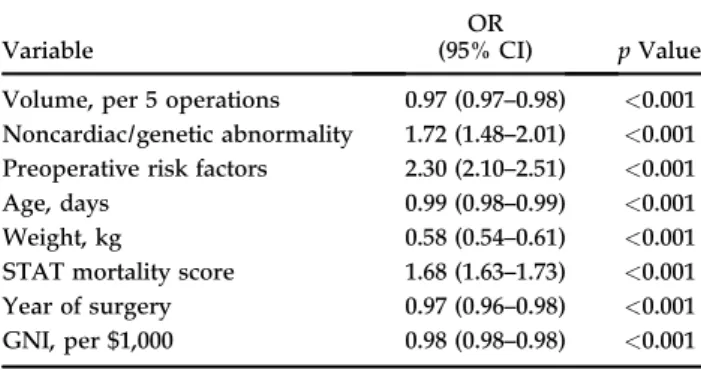
Univariate results show that all analyzed risk factors are significantly associated with mortality (Table 2). Regarding the volume, the results reveal a 3% decrease of mortality with every 5-patient increased volume per center-year (odds ratio 0.97, 95% confidence interval: 0.97 to 0.98). In multivariate analysis, this effect was decreased to 2% (odds ratio 0.98, 95% confidence interval: 0.97–0.99;
Table 3). Repeated multivariate multilevel analyses, selecting only center-years above the indicated threshold, revealed that this effect is further decreased gradually with increasing volume number. When analyzing center-years of at least 55 operations, the odds ratio was 0.9853, indicating a risk of 1.47% additional mortality per 5 op-erations difference. However, in analysis only including center-years of at least 60 operations, the odds ratio was 0.9981, indicating a risk of 0.19% additional mortality per five operations—so essentially no effect of additional operations (Table 4,Fig 2).
Comment
The risk-adjusted odds ratio of annual center volume of neonatal cardiac operations for operative mortality reached its maximum of 1 at 60 operations per center per Table 4. Effects for 5-Unit Volume Increasea
Selection Criteriab No. of Observations OR (95% CI) p Value All patients included 26,598 0.9781 (0.9653–0.9910) 0.001 >20 24,032 0.9748 (0.9607–0.9984) 0.001 >30 20,914 0.9773 (0.9617–0.9932) 0.005 >40 17,617 0.9814 (0.9634–0.9998) 0.047 >50 14,101 0.9826 (0.9617–1.0040) 0.222 >55 12,887 0.9853 (0.9633–1.0078) 0.198 >60 11,099 0.9981 (0.9737–1.0230) 0.877 >65 9,709 0.9998 (0.9733–1.0271) 0.989 >80 6,218 1.0075 (0.9674–1.0492) 0.719 >100 3,722 1.0249 (0.9867–1.0646) 0.205 a
Repeated multivariate analyses as inTable 3, but with different selection criteria of patients included. bPatients included from centers with at least“x” surgeries per year.
CI¼ confidence interval; No.¼ number; OR¼ odds ratio.
Table 3. Operative Mortality, Multivariate Model on Complete Casesa
Variable
OR
(95% CI) p Value Volume, per 5 operations 0.98 (0.97–0.99) 0.001 Noncardiac/genetic abnormality 1.60 (1.34–1.90) <0.001 Preoperative risk factors 2.44 (2.20–2.72) <0.001
Age, days 0.99 (0.99–1.00) 0.005
Weight, kg 0.59 (0.55–0.63) <0.001
STAT mortality score 1.84 (1.78–1.90) <0.001 Year of surgery 0.99 (0.98–1.01) 0.252
GNI, per $1,000 0.99 (0.99–1.00) 0.120
aFurther adjustment was done for the continent; the center was included
as a random effect.
CI¼ confidence interval; GNI¼ gross national income per capita per year; OR¼ odds ratio; STAT¼ The Society of Thoracic Sur-geons–European Association for Cardio-Thoracic Surgery.
Table 2. Risk Factors for Operative Mortality, Univariate Model
Variable
OR
(95% CI) p Value Volume, per 5 operations 0.97 (0.97–0.98) <0.001 Noncardiac/genetic abnormality 1.72 (1.48–2.01) <0.001 Preoperative risk factors 2.30 (2.10–2.51) <0.001
Age, days 0.99 (0.98–0.99) <0.001
Weight, kg 0.58 (0.54–0.61) <0.001
STAT mortality score 1.68 (1.63–1.73) <0.001 Year of surgery 0.97 (0.96–0.98) <0.001 GNI, per $1,000 0.98 (0.98–0.98) <0.001
CI¼ confidence interval; GNI¼ gross national income per capita per year; OR¼ odds ratio; STAT¼ The Society of Thoracic Sur-geons–European Association for Cardio-Thoracic Surgery.
Fig 2. Odds ratio for mortality per 5-operation change per center-year. Depicted are odds ratios for mortality per 5-operation increase of center-year volume, derived by multivariate analysis on the vertical axis. Displayed are the estimate (black) and the 95% confidence interval bounds (red). A value less than 1.0 represents a risk decrease with increasing number of operations, and a value greater than 1.0 means a risk increase with increasing number of operations. When the odds ratio becomes larger than 1, at a center-year volume larger than 60, the confidence interval bounds become wider, while the number of patients included drop below 11,000 and p values approach 1. On the horizontal axis are depicted groups of neonatal operations per center-year where the lower limit for inclusion increases from left to right. Group 0 comprises all 26,598 operations from 722 center-years included in the multivariate analysis. The next group marked as>20 includes all 24,032 operations performed in center-years of more than 20 operations, and so on. Thus, all data points indicate the results of repeated analyses including patients from centers with>20, >40, >50, >55, >60, >65, >80, and >100 patients per center-year. The secondary vertical axis on the right indicates the number of operations included.
CONG
ENIT
AL
year. Above 60 operations per center per year, the odds ratio did not change and remained 1, which corresponds to a flat line in the graph visualizing operative mortality and annual volume of neonatal cardiac operations (Fig 2). The power of thisfinding is substantial owing to the size of the dataset that could only be derived from the collaborative effort of all contributors to the ECHSA database (available at:www.echsacongenitaldb.org). The implications of this finding are considerable, because parents, health care managers, administrators, and gov-ernments will use this inference for the planning and organization of pediatric cardiac surgery and cardiology alike. Interestingly, only 142 of the 722 center-years was 60 operations or higher (19.7%).
By using each individual annual volume per center as a variable to calculate the relation with mortality, and by using center as a random effect variable, we dealt with the fact that many centers had considerable variation in their annual volume. Using this methodology, we did not have to rely on a mean volume per center per study period, which does not take the temporal variation per center into account.
Risk adjustment was done by using mixed-effects lo-gistic regression analysis in which we took along the usual risk factors, but in addition tried to take into ac-count the international nature of our database. Data in our database are derived from five continents in which various countries underwent a much more diverse development during the 17-year study period than, for instance, in North America. Continent was an indepen-dent significant risk factor, but gross national product per year per capita was not, to our surprise. Apparently, introduction of neonatal cardiac surgery in countries that underwent a remarkable development during the study period was generally done wisely and in proportion to the local and temporal resources.
Our results are partially in contrast with those reported by Karamlou and colleagues [7]. They found that insti-tution and surgeon experience are not the only factors influencing late outcomes in complex neonatal congenital heart defects and the power of this influence differs depending on the procedure. They also emphasized that experience cannot be singularly defined as volume. We also found considerable outcomes variation among stitutions within each testifying group, with most in-stitutions falling within 95% confidence intervals of predicted mortality.
Study Limitations
Limitations of our study include its retrospective nature. The data are derived from a large multicenter voluntary database and only 14.8% of the data were verified. The strength of the study, its size, also implies a limitation: owing to the enormous power of the study, almost all p values become significant. It is therefore important to differentiate between significance and clinical relevance in the interpretation and conclusion of the results.
Conclusion
Our study suggests that concentration of work in the large centers leads to circumstances in which the risk for pa-tients is most likely the lowest. Further studies are necessary to define the specific risk factors in different congenital cardiac conditions demanding rare and high-risk procedures.
Audio Discussion: Audio of the discussion that followed the presentation of this paper at the STS Annual Meeting can be accessed in the online version of this article [https://doi.org/10.1016/j.athoracsur.2017. 11.028] onhttp://www.annalsthoracicsurgery.org. References
1. Reames BN, Ghaferi AA, Birkmeyer JD, Dimick JB. Hospital
volume and operative mortality in the modern era. Ann Surg 2014;260:244–51.
2. Jenkins KJ, Newburger JW, Locke JE, Davis RB, Coffman GA,
Iezzoni LI. In-hospital mortality for surgical repair of congenital heart defects: preliminary observations of varia-tion by hospital caseload. Pediatrics 1995;95:323–30.
3. Hannan EL, Racz M, Kavey RE, Quaegbeur JM, Williams R.
Pediatric cardiac surgery: the effect of hospital and surgeon
volume on in-hospital mortality. Pediatrics 1998;101:963–9.
4. Sollano JA, Gelijns AC, Moskowitz AJ, et al. Volume-outcome
relationships in cardiovascular operations: New York State, 1990–1995. J Thorac Cardiovasc Surg 1999;117:419–28.
5. Hirsch JC, Gurney JG, Donohue JE, Gebremariam A,
Bove EL, Ohye RG. Hospital mortality for Norwood and arterial switch operations as a function of institutional
vol-ume. Pediatr Cardiol 2008;29:713–7.
6. Checchia PA, McCollegan J, Daher N, Kolovos N, Levy F,
Markovitz B. The effect of surgical case volume on outcome after the Norwood procedure. J Thorac Cardiovasc Surg
2005;129:754–9.
7. Karamlou T, McCrindle BW, Blackstone EH, et al.
Lesion-specific outcomes in neonates undergoing congenital heart surgery are related predominantly to patients and manage-ment factors rather than institution or surgeon experience: a Congenital Heart Surgeons Society study. J Thorac Car-diovasc Surg 2010;139:569–77.
8. Welke KF, Diggs BS, Karamlou T, Ungerleider RM. The
relationship between hospital surgical case volumes and mortality rates in pediatric cardiac surgery: a national sam-ple, 1988–2005. Ann Thorac Surg 2008;86:889–96.
9. Welke KF, O’Brien SM, Peterson ED, Ungerleider RM,
Jacobs ML, Jacobs JP. The complex relationship between pediatric cardiac surgical case volumes and mortality rates in a national clinical database. J Thorac Cardiovasc Surg 2009;137:1133–40.
10. Pasquali SK, Li JS, Burstein DS, et al. Association of center
volume with mortality and complications in pediatric heart
surgery. Pediatrics 2012;129:e370–6.
11. Kansy A, Ebels T, Schreiber C, Tobota Z, Maruszewski B.
As-sociation of center volume with outcomes: analysis of verified
data of European Association for Cardio-Thoracic Surgery congenital database. Ann Thorac Surg 2014;98:2159–64.
12. Kansy A, Ebels T, Schreiber C, Jacobs JP, Tobota Z,
Maruszewski B. Higher programmatic volume in paediatric heart surgery is associated with better early outcomes. Car-diol Young 2015;25:1572–8.
13. European Congenital Heart Surgeons Association congenital database. Available atwww.echsacongenitaldb.org. Accessed December 29, 2016.
CONGEN
ITAL
H