A Work Project, presented as part of the requirements for the Award of a Master Degree in Management from the NOVA – School of Business and Economics.
THE JOINT EFFECTS OF PRODUCT UNIQUENESS AND BRAND AWARENESS ON CONSUMERS’ ATTITUDES AND INTENTIONS
ANA RITA DUARTE TAPADINHAS, NUMBER 3333
A Project carried out on the Master in Management Program, under the supervision of: Professor Irene Consiglio
The Joint Effects Of Product Uniqueness And Brand Awareness On Consumers’
Attitudes And Intentions
Abstract
Brands often try to attract consumers with desire for uniqueness by offering customizable or one-of-a-kind items. However, brand awareness might decrease the perception of uniqueness associated to these items: a widespread brand may cause the products to seem less unique, while an unknown brand may enhance the consumers’ feeling of differentness. In this research, after verifying that consumers’ perceptions about an item’s uniqueness are influenced by its brand’s brand awareness, I investigate the effects of the interactions between a product’s uniqueness (or its perceived uniqueness), its brand and the consumers’ need for uniqueness on consumer-related variables.
Keywords
Consumers’ Need for Uniqueness; Uniqueness; Perceived Uniqueness, Brand Awareness
Introduction
Many companies claim that their products have unique attributes, in an attempt to leverage consumers’ desire for uniqueness. Frequent ways of inputting uniqueness into products include the usage of product-scarcity claims, uniqueness appeals and appeals to break the rules of an individual’s reference group (see Tian, Bearden and Hunter, 2001). In fact, a study of 2000 ads in North America randomly chosen from mass circulation magazines between 1900 and 1980, indicated that uniqueness appeals were used as a central topic in 10% of the ads and as a subordinate theme in 23% of them (Pollay, 1984).
Even so, uniqueness-appealing strategies are often associated with a paradox: marketers advertise that their offer will enhance an individual’s specialness, but the success
from the advertising campaign leads more consumers to buy that offer. The sales and the rise in popularity go directly against the uniqueness promise, turning the consumers’ expectation of uniqueness into something that is not achievable (Snyder 1992; Tian et al., 2001).
Companies can avoid this paradox and sustain their uniqueness promise if they offer strictly unique products. For example, Coach, the famous leather goods company, installed a
customization workshop in its New York store, and Josefinas, a Portuguese brand, allows its clients to personalize some products. These companies try to offer consumers the possibility of having something personalized, which is thus potentially unique. Furthermore, other brands have been offering one-of-a-kind items, such as Anthropologie, a lifestyle brand.
Despite this, it remains unclear whether, with the same type of offer, different brands can differently satisfy the consumers’ desire of uniqueness: will a personalized item by Josefinas satisfy a consumer’s need for uniqueness in the same way that a personalized item by Coach will? With a unique product from Josefinas, buyers are acquiring a less usual item, simply because the brand is less well-known. At the same time, by buying a unique item by Coach, consumers will still easily find another consumer with something from the same brand. It is thus important to analyze how the brands behind unique products affect these products’ ability to satisfy the consumers’ desire to be unique. Does a well-known brand decrease the perception of uniqueness associated to a unique item? Is it more valuable to have a unique item from a well-known brand, or will a brand with lower brand awareness enhance the consumer’s feeling of differentness, thus enhancing the value attributed to the product?
For the brands that offer unique products, the understanding of the link between brand awareness and the value attributed to these products has important implications on how they must be managed. It may be easier for less widespread brands to attract buyers with high desire for uniqueness, in the sense that other products from these brands are probably harder to find in the hands of someone else. At the same time, it seems reasonable to assume that
most brands want to be well-known. Thus, it is important to analyze how consumers see and value unique products offered by different brands, so as to understand the relationship between brand awareness and the value attributed to this type of products.
Literature Review and Hypotheses
According to Snyder and Fromkin’s Theory of Uniqueness (1980), all people seek some sense of differentness relative to others. This trait is called Need For Uniqueness. Need For Uniqueness varies across situations and persons (see Kao, 2013), with different persons exhibiting different degrees of uniqueness motivation (Snyder and Fromkin, 1977). Extreme levels of similarity or dissimilarity are unpleasant and reducers of self-esteem (Snyder and Fromkin, 1980; see Ruvio, Shoham and Brenčič, 2008), leading individuals to try to maintain moderate levels of uniqueness. Thus, Need For Uniqueness can be considered a universal trait (see Kao, 2013), because, to some degree, all people tend to aim for uniqueness (Snyder and Fromkin, 1977, 1980; see Tian et al., 2001). The degree to which a person seeks uniqueness depends on the strength of that person’s chronic Need For Uniqueness (Ruvio et al., 2008).
To maintain a certain level of uniqueness, persons look for reclaiming their self-esteem and decreasing negative affect via self-distinguishing behaviors, such as: display of possessions, interpersonal interaction style or the domains of knowledge in which they
establish expertise (see Tian et al., 2001). Given the variety of forms these behaviors can take, individuals’ tendency to fulfill their uniqueness motivation via consumer behaviors and possessions is likely to vary (see Tian et al., 2001). This expression of uniqueness seeking is related with the concept of Consumers’ Need for Uniqueness.
Consumers’ Need for Uniqueness is manifested through the acquisition, use and display of consumer goods (product categories, brands, versions or styles) with the aim of seeking differentness and reinforcing and improving a person’s personal and social identity
(Tian et al., 2001). This desire to feel different is called counterconformity motivation, arising when persons feel significantly alike others, and see that as a threat to their identity (see Tian et al., 2001). Consumers’ Need for Uniqueness is constituted by three dimensions: creative choice counterconformity, unpopular choice counterconformity and avoidance of similarity (Tian et al., 2001). Creative choice counterconformity is the pursuit of differentness via the acquisition, use and display of goods that will likely be seen by others as good choices and will likely cause positive social evaluations of the person as someone unique (see Tian et al., 2001; see Kao, 2013). Unpopular choice counterconformity is linked with the choice and use of brands and products that differ from social norms to some extent. If individuals cannot sufficiently differentiate themselves in a way accordingly to the dominant social norms, they may act in a way that negatively distinguishes them, facing the risk of social disapproval (see Tian et al., 2001). Avoidance of similarity is the loss of interest in, or the cease of use of, vastly used goods or brands in order to deviate from the ordinary and assure one’s differentness (Tian et al., 2001).
Consumers with higher Consumers’ Need for Uniqueness will have a higher tendency to choose new products and brands earlier than those with lower levels of this need (see Kao, 2013). The former will also tend to show higher brand-switching intentions than the latter (Kao, 2013). Moreover, persons with counterconformity motivation are less likely to purchase a unique offering that they perceive as having the potential to become popular or common than when they perceive it as less likely to become widespread (see Tian et al., 2001).
Although the term “unique” is many times used in literature to describe rare or uncommon offers, from here on, this term will be exclusively used to describe
personalized/customized or one-of-a-kind items.
Consumers often look for novelty, handcraft and personalized items to satisfy their need for originality (Tian et al., 2001). Many well-known brands offer personalized and
handcrafted items: Coach, building on its craftsmanship heritage, installed a customization workshop in its New York store; and Burberry, with its Burberry Bespoke service, lets consumers personalize some products (such as fragrances, ponchos and scarves). Less well-known brands also try to offer consumers the possibility of having something unique: Josefinas, a Portuguese handmade goods brand, allows customers to personalize some of its products by adding a piece of text of their choice, in the color they want. Furthermore, other brands go one step further and offer one-of-a-kind items: Anthropologie, a lifestyle brand, offers one-of-a-kind furniture. These offers can be seen as attractive to persons with high Consumers’ Need for Uniqueness, in the sense that personalized and one-of-a-kind items allow them to have something truly unique (Franke and Schreier, 2008).
Until now, there is not an understanding of the impacts that the brands behind unique products can have on these products’ attractiveness to persons looking for uniqueness. Although some studies show that widespread products and brands are avoided by individuals with high Consumers’ Need for Uniqueness, these two terms – brands and products – are usually used interchangeably. This does not allow for an understanding of whether brands and products can have distinct roles in satisfying Consumers’ Need for Uniqueness. More
specifically, there has not been exploration on whether, with the same type of offer – one that appeals to uniqueness seeking motivations – brands with different levels of brand awareness (the degree to which consumers are able to recall or to recognize a brand (Keller, 2013)) can differently satisfy consumers. In the case of brands that offer one-of-a-kind and personalized items, the uniqueness dimension will always be associated to the product but, if the brand behind this product has a high level of brand awareness, it is unclear whether this offer will still be attractive to persons with high Consumers’ Need for Uniqueness.
On the one hand, widespread brands may reduce the value of unique products for individuals with high Consumers’ Need for Uniqueness, reducing the feeling of
self-
differentiation, due to the brand being well-known. This would imply that brands with higher brand awareness that offer unique items would not be able to effectively attract this group of individuals: the high level of brand awareness would diminish the satisfaction coming from the feeling of differentness provided by the unique product. For instance, a personalized fragrance via Burberry Bespoke would not be particularly attractive to these consumers, in the sense that, although the fragrance would indeed be unique, the brand behind it would be well-known, and thus this would not satisfy these consumers’ need to be different. As referred by Escalas and Bettman (2005), consumers build their self-identity and present themselves to others via the brands they choose, based on the congruency between brand-user and self-image associations. This can mean that, if consumers with a high level of Consumers’ Need for Uniqueness associate a widespread brand to a big group of people, then it may act against their efforts to build the self as someone unique and, thus, they will prefer a less well-known brand. On the other hand, the value of unique products may be enhanced by brands with high brand awareness, with these brands both satisfying the individuals’ Consumers’ Need for Uniqueness and reducing the risks from social penalties that may arise from their self-distinguishing behaviors. Thus, for example, a personalized bag by Coach would be more valued than a personalized bag by Josefinas. In fact, Chan, Berger and Boven (2012)
suggested that individuals frequently converge to their in-group preferences in what regards to brand choices (these are often seen as a sign of social identity), while choosing less popular product options (such as product colors) to still differentiate themselves within their groups. Still, if other traits are more important in conveying group identity (such as the product type), brands can be one source of differentiation. This suggests that brands can be used as a way to signal social identity in certain cases, although it is limited to the analysis of in-group and out-group dimensions, and does not explore the impact that brands, and specifically widespread brands, can have on the feelings of differentness by consumers that look for uniqueness.
Given the lack of literature describing the connection between brand awareness, the individuals’ levels of Consumers’ Need For Uniqueness and the value attributed to unique items, it is important to understand this relationship. Customized goods can have a personal- -fit dimension, besides the uniqueness dimension. To isolate the uniqueness dimension, this study focuses on one-of-a-kind items. Hence, the following hypothesis will be tested:
H: Individuals with higher (lower) Consumers’ Need for Uniqueness have higher purchase intentions and attribute a higher value to a one-of-a-kind product if it is offered by a brand with lower (higher) brand awareness rather than a brand with higher (lower) brand awareness.
The hypothesis suggests that persons with higher Consumers’ Need for Uniqueness will be less sensitive to the social penalties that may arise from self-distinguishing behaviors. These individuals aim to achieve differentiation from others, looking to maintain showable levels of dissimilarity (Ruvio et al., 2007). It also suggests that individuals with lower Consumers’ Need For Uniqueness will try to balance the dissimilarity to others provided by the one-of-a-kind item with the similarity that comes from using a well-known brand.
The understanding of how the same type of offers – one-of-a-kind products – appeals differently to consumers, depending on the brand awareness of the brands behind those offers, will influence how these brands must be managed. While we may assume that, generally, a high brand awareness is desirable, persons with high Consumers’ Need for Uniqueness (the ones possibly more attracted to one-of-a-kind items) may be more attracted to unique items offered by relatively unknown brands. Well-known brands that offer one-of-a-kind and non-one-of-a-kind items and want to appeal to uniqueness-seeking buyers may develop specific lines for the unique products. This can be a way to detach these items from the widespread brand name. Another strategy may be to input an exclusivity aura around the items. Hermès, the luxury brand, uses an analogous strategy with its Birkin Bags. These bags are not sold to
everyone: only certain clients are invited to buy them or to join a waiting list for that. Even harder to acquire are the Horse Shoe Stamp Birkin Bags, which are customized and thus potentially unique. With this aura of exclusivity around the Birkin Bags, Hermès inputs an extra sense of uniqueness into the product, since, although the brand is well-known, the client is obtaining something not accessible to the majority. If the reality is the opposite – persons with high Consumers’ Need for Uniqueness prefer one-of-a-kind items offered by widespread brands, for instance to avoid social penalties for being different – brands must focus on highlighting the products’ uniqueness, while also focusing on having high levels of brand awareness. Furthermore, while it may seem that brands that offer unique products are
implicitly aiming to attract individuals with high Consumers’ Need for Uniqueness, it may as well be true that this type of offer is also attractive to persons with low levels of this need, at least in specific circumstances. Depending on the type of buyers each brand wants to target, they may have to adapt, so as to maximize their attractiveness to their prospects.
Methodology
Subjects: The subjects of this study were a convenience sample of 100 female
University students of a Business School in Lisbon, Portugal. The subjects were mainly Portuguese (87%) and were aged between 17 and 25 years old (M = 19,09; SD = 1,596).
Procedure: It was fundamental to use a stimulus material that was not associated to a
brand and that could either be said to be one-of-a-kind or mass-produced. The subjects were thus shown a coat, which did not have any tags or other features that could link it to any brand. Participants were randomly divided between four groups (each with 25 subjects), and each group received a different spoken introduction about the coat. The introductions differed in the Coat’s Uniqueness (one-of-a-kind or mass-produced) and in the brand associated to the coat (a brand with high awareness - Massimo Dutti - or a brand with low awareness -
Annunziata, a fictitious brand). Participants in the one-of-a-kind coat condition were told: “The brand Massimo Dutti (Annunziata), which I am almost sure you know (which I think you probably do not know), is launching a collection of one-of-a-kind high quality items, and this coat is part of it. This means that there is no coat equal to this one anywhere else.”
Participants in the mass-produced coat condition were told: “The brand Massimo Dutti (Annunziata), which I am almost sure you know (which I think you probably do not know), is launching a collection and this high quality coat is part of it. 220 000 coats equal to this one will be distributed nationally and internationally and will also be available online.”
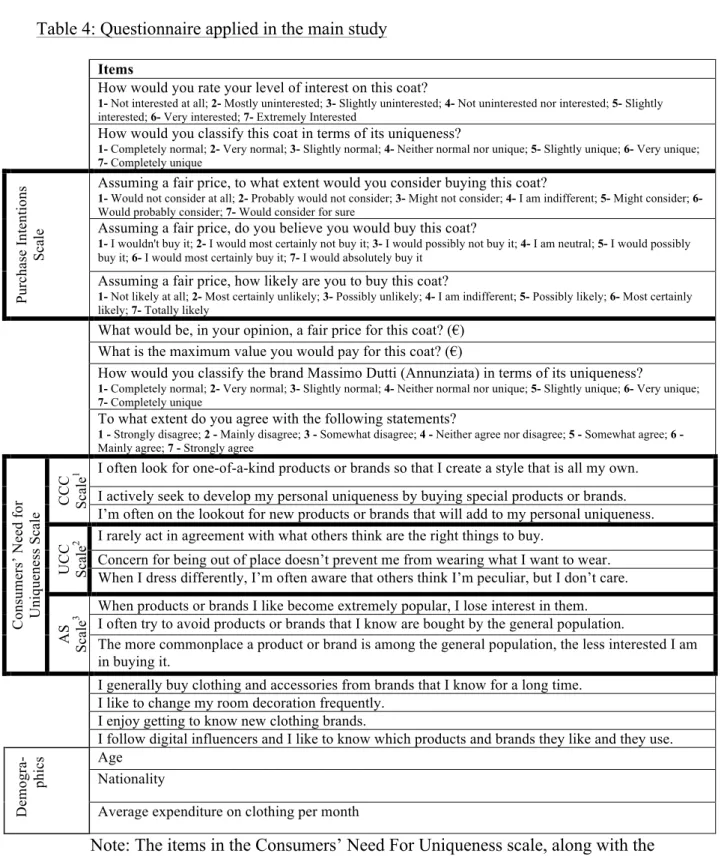
After this introduction, the subjects were asked to fill in a questionnaire, which
included questions related with their attitudes towards the coat, questions intended to measure their level of Consumers’ Need for Uniqueness and demographics questions - age, average monthly expenditure on clothing and nationality (see Table 4 for the complete questionnaire).
Measurements and scales: Regarding the subjects’ attitudes towards the coat, they
were asked, on a seven-point scale, about their Interest on the coat (1: “not interested at all”; 7: “extremely interested”), their Coat’s and Brand’s Perceived Uniqueness (1: “completely normal”; 7: “completely unique”) and their Purchase Intentions assuming a fair price (3 item-scale, see Table 4 for full scale). They also suggested a Fair Price for the coat and indicated their maximum Willingness to Pay for it (WTP). Subjects’ Consumers’ Need for Uniqueness was measured with a shorten version of Tian et al. (2001) Consumer’s Need For Uniqueness scale, a validated and commonly used scale. The original scale has 31 items divided between the three dimensions of Consumers’ Need For Uniqueness mentioned before. Due to its length and to ensure that respondents would not be discouraged by fatigue, the scale was reduced to 9 items. This shortened scale has 3 items per dimension of Consumers’ Need for Uniqueness, which is a suggested minimum number of items to ensure adequate internal consistency reliabilities (see Hinkin, 1995), (see Table 4 for full shortened scale).
Table 1: The study’s main variables
Coat’s Uniqueness One-of-a-kind or mass-produced coat
Brand Massimo Dutti (high brand awareness) or Annunziata (low brand awareness) Consumers’ Need for
Uniqueness
The level of each subject’s Consumers’ Need For Uniqueness, measured with the shortened version of Tian et. al (2001) Consumers’ Need for Uniqueness scale
Coat’s Perceived Uniqueness Level of uniqueness attributed by the subjects to the coat
Results and Discussion
Reliability of measures: The internal reliability of the scale of Purchase Intentions
and of the three sub-scales measuring each Consumers’ Need for Uniqueness dimension were evaluated using Cronbach’s alpha. The alpha values were as follows: 0,902 for the Purchase Intentions scale; 0,821 for the Creative Choice Counterconformity scale; 0,523 for the
Unpopular Choice Counterconformity scale; and 0,801 for the Avoidance of Similarity scale. Deleting items from any of the scales would not generate relevant improvements in the alpha, namely for the Unpopular Choice Counterconformity scale (which had the lowest value of alpha), which led to the decision of maintaining the scales with their original items.
Manipulation Check: The manipulations of the brand’s uniqueness and of the Coat’s
Uniqueness were assessed using independent-samples t-tests. In the case of the brands, Annunziata was perceived as more unique than Massimo Dutti, although this difference was not significant (MAnnunziata = 4,84, SD= 1,017; MMassimo Dutti = 4,62, SD =1,141; p =0,311). The
Coat’s Perceived Uniqueness was also not significantly different between coat conditions (Mone-of-a-kind = 4,76, SD= 1,222; Mmass-produced = 4,78, SD =0,910; p =0,926).
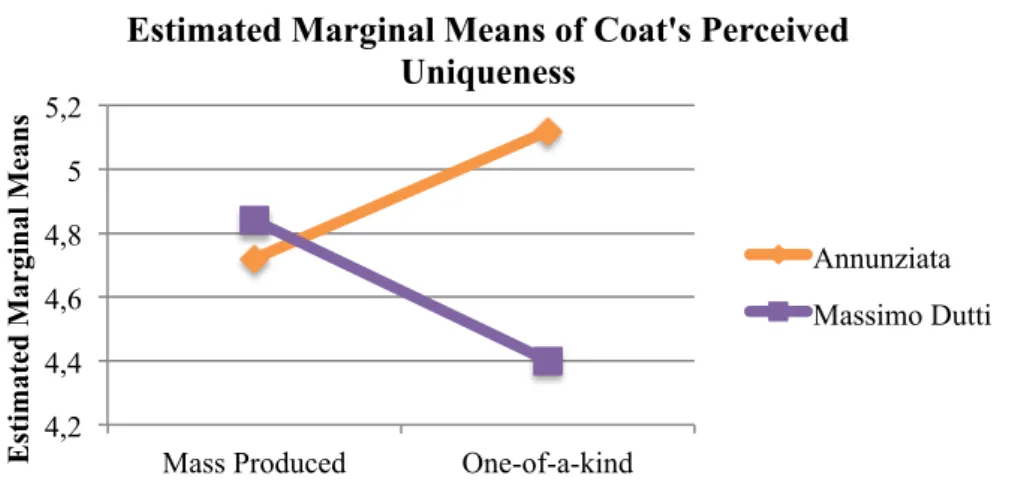
Additionally, a two-way ANOVA was run in order to test if the Brand (along with the Coat’s Uniqueness) can have an influence on the Coat’s Perceived Uniqueness. There was a significant interaction (F = 3,955; p = 0,050) between the Coat’s Uniqueness and the Brand:
Figure 1: Effects of the interaction between the Brand and the Coat’s Uniqueness on the Coat’s Perceived Uniqueness
This analysis showed that the Coat’s Perceived Uniqueness interacted with the Brand. When the coat was allegedly mass-produced, the Coat’s Perceived Uniqueness was similar between brands (MAnnunziata = 4,72; SD= 1,100; MMassimo Dutti = 4,84, SD= 0,688). However,
when the coat was allegedly one-of-a-kind, there was a significant difference between the brands (MAnnunziata = 5,12; SD= 1,236; MMassimo Dutti = 4,40, SD = 1,118). In this case, the
Coat’s Perceived Uniqueness was amplified when it was said to be from the brand with low brand awareness, and was diminished when it was said to be from the brand with high brand awareness. It can thus be said that, based on these results, brand awareness affects the perceived uniqueness of a one-of-a-kind item: a more well-known brand decreases this uniqueness perception, while a less well-known brand increases it.
I also tested whether there was a three-way interaction between the Brand, the Coat’s Uniqueness and the Consumers’ Need for Uniqueness, but this three-way interaction was not significant. Overall, this means that the brand of a product can affect its perceived uniqueness, and this perception is independent from the person’s Consumers’ Need for Uniqueness.
An additional study was done to further test the manipulations of the Coat’s Uniqueness
and of the brands’ awareness
4,2 4,4 4,6 4,8 5 5,2
Mass Produced One-of-a-kind
Es ti mate d M ar gi n al M ean s
Estimated Marginal Means of Coat's Perceived Uniqueness
Annunziata Massimo Dutti
Given that, as verified in the manipulation check, the Coat’s Perceived Uniqueness was not significantly different depending on its uniqueness (one-of-a-kind or mass-produced), it was important to further test this manipulation. The outcomes of this manipulation check could be due to the term “uniqueness” not being necessarily linked with something one-of-a-kind. In fact, the Cambridge Dictionary defines “unique” as “being the only existing one of its type or, more generally, unusual, or special in some way”. Thus, something one-of-a-kind may not necessarily be considered unique if, for example, it resembles something else. Moreover, for the purpose of this study, it was important to know if Annunziata was
perceived as a brand with lower brand awareness than Massimo Dutti. Until this point, only the brands’ perceived uniqueness had been tested, while, in fact, the information that was being sought was the perceived brand awareness. As such, I developed an additional study to further test the manipulations of the Coat’s Uniqueness and of the brands’ brand awareness.
Subjects and Procedure: The subjects of this additional study were a sample of 72
female students aged between 18 and 24 (M = 20,74; SD = 1,520), from the same Business School. Participants answered an online survey and were divided between two groups. Both groups were shown a photo of the same coat used in the main study, with the first group (37 participants) and the second group (35 participants) reading the following introductions, respectively: “This is a one-of-a-kind coat, which means that there is no coat equal to this one anywhere else.”; “There are 220 000 coats equal to this one, which will be distributed through national and international locations and will also be available online.”
Measurements and Scales: Participants were asked if they knew Massimo Dutti and
Annunziata (although Annunziata is a fictitious brand, some subjects could have the
perception that they knew it); if they perceived that Massimo Dutti and Annunziata were well-known brands, using a 6-point scale (1: “I am sure it is not”; 6: “I am sure it is”); and how unique they perceived the coat to be, using a 7-point semantic scale (1: “One-of-a-kind
(unique)”; 7: “Mass-produced”) (see Table 5 for the complete survey). This time, a semantic scale was used to simplify the interpretation of what was being asked, with the term “one-of-a-kind” being implicitly written. Moreover, no brand was associated to the coat to isolate the effect of the Coat’s Uniqueness (one-of-a-kind or mass-produced).
Results: The manipulations of the brand awareness and of the Coat’s Uniqueness
were evaluated using independent-samples t-tests. There was a clear distinction between the two brands’ perceived brand awareness, which confirmed that, in fact, Massimo Dutti was perceived has having a higher brand awareness than Annunziata: MAnnunziata = 2,50; SD=
0,839; MMassimo Dutti = 5,47; SD = 0,712; p = 0,000. Regarding the effectiveness of the
manipulation of the Coat’s Uniqueness, the results were more encouraging than on the main study, with the allegedly one-of-a-kind coat being perceived as more unique: Mone-of-a-kind =
3,11; SD= 1,712; Mmass-produced = 5,17; SD =1,294; p = 0,000. Additionally, the brand
awareness levels were 0% for Annunziata and 100% for Massimo Dutti.
Comparing the results of the main study with the ones of the additional study, it is possible to see that subjects do, in fact, understand the difference between the two Coat’s Uniquenesses (one-of-a-kind or mass-produced). Despite this, they do not classify the coat’s uniqueness only based on its condition, but rather based on a combination of factors (at least the Coat’s Uniqueness and its brand, as verified in the main study and described on Figure 1). Furthermore, it was also possible to check that the manipulation for the brand awareness was effective – Annuniziata was perceived as having lower brand awareness than Massimo Dutti.
Hypothesis Testing: To test the hypothesis, the interaction between the Coat’s
Uniqueness, the Brand and the Consumers’ Need for Uniqueness on the dependent variables was examined using three-way ANOVA’s. Furthermore, given that, in the main study, the Coat’s Perceived Uniqueness was affected by the two-way interaction between the Coat’s
Uniqueness and the Brand, the interaction between the Coat’s Perceived Uniqueness, the Brand and the Consumers’ Need for Uniqueness on the same dependent variables was also tested.
No significant three-way interactions were observed for the interactions related with the hypothesis – the interaction between the Coat’s Uniqueness, the Brand and the
Consumers’ Need for Uniqueness on the dependent variables –, as it can be seen below:
Table 2: Significances of the models including the variables Coat’s Uniqueness, Brand and Consumers’ Need for Uniqueness as independent variables
Dependent Variable Significance of the
regression model Significance of the 3-way interaction Fair Price 0,7776 0,1606 Interest 0,0380 0,9001 Purchase Intentions 0,0514 0,5429 Willingness to Pay (WTP) 0,8451 0,8179
Difference between Fair Price and WTP 0,4781 0,1288
When the Coat’s Uniqueness was substituted by the Coat’s Perceived Uniqueness, it was possible to observe a significant three-way interaction on the Fair Price (p = 0,0538). The regression model had a significance of 0,2146.
Table 3: Significances of the models including the variables Coat’s Perceived Uniqueness, Brand and Consumers’ Need for Uniqueness as independent variables
Dependent Variable Significance of the
regression model
Significance of the 3-way interaction
Fair Price 0,2146 0,0538
Interest 0,1193 0,9328
Purchase Intentions 0,0636 0,9976
Willingness to Pay (WTP) 0,2528 0,1364
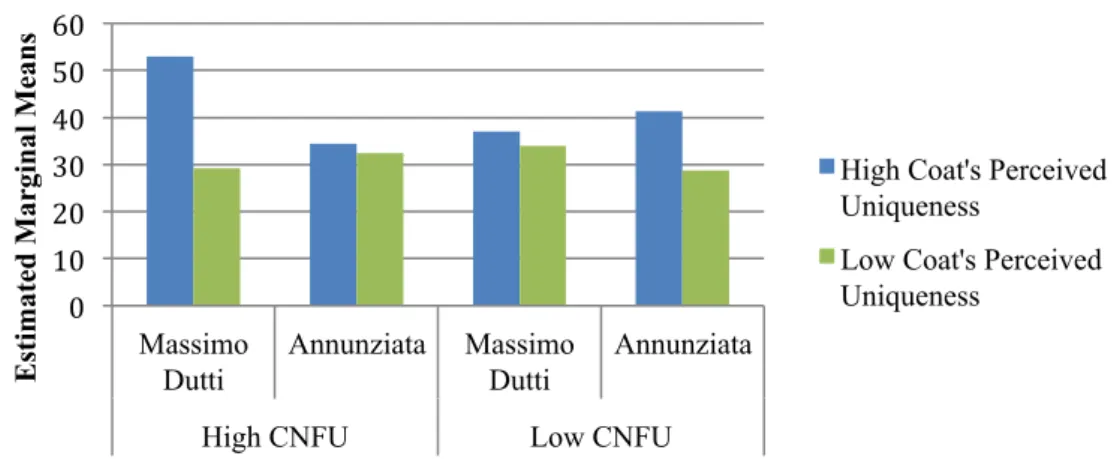
Figure 2: Effects of the interaction between the Coat’s Perceived Uniqueness, the Brand and the Consumers’ Need for Uniqueness (CNFU) on the Fair Price
As it can be observed on Figure 2, when the coat had a higher Coat’s Perceived Uniqueness, it was associated with a higher Fair Price, independently of the brand or of the subject’s level of Consumers’ Need for Uniqueness.
The three-way interaction was decomposed at high and low levels of Consumers’ Need for Uniqueness. When the Consumers’ Need for Uniqueness was high, the interaction between the Brand and the Coat’s Perceived Uniqueness was significant (p = 0,0698): when the coat had a high Coat’s Perceived Uniqueness, it was always attributed a higher Fair Price, with this relationship being more evident for the brand with the higher brand awareness – Massimo Dutti. In fact, for Annunziata the two Fair Prices were very similar for the two Coat’s Perceived Uniqueness. Overall, at high levels of Consumers’ Need for Uniqueness, the two extreme valuations for the Fair Price were attributed on the Massimo Dutti condition: the highest valuation was attributed when there was a high Coat’s Perceived Uniqueness, and the lowest valuation was attributed when there was a low Coat’s Perceived Uniqueness.
At low levels of Consumers’ Need for Uniqueness, the interaction between the Brand and the Coat’s Perceived Uniqueness was not significant (p = 0,4347). If anything, the pattern of the interaction between the Coat’s Perceived Uniqueness and the Brand was reversed.
0 10 20 30 40 50 60 Massimo Dutti Annunziata Massimo Dutti Annunziata
High CNFU Low CNFU
Es ti mate d M ar gi n al M ean s
Estimated Marginal Means for Fair Price
High Coat's Perceived Uniqueness
Low Coat's Perceived Uniqueness
Although in this case the Coat’s Perceived Uniqueness is being considered instead of the Coat’s Uniqueness, this result is not in line with what would be expected based on the hypothesis. It would be more expected that, at high levels of Consumers’ Need for
Uniqueness, the high Coat’s Perceived Uniqueness case would be attributed a higher Fair Price when combined with a brand with lower brand awareness. After deleting the outliers for the Fair Price variable, the significance of the three-way interaction increased to 0,2906.
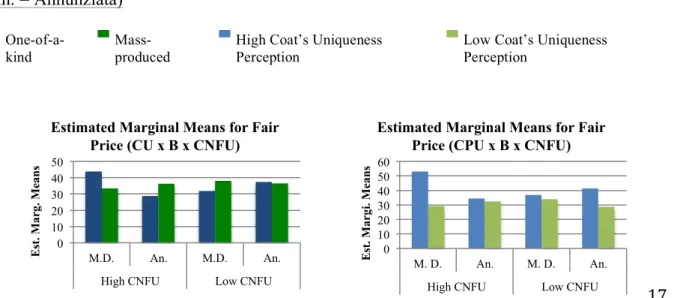
When comparing the effects that the two three-way interactions (the interaction between the Coat’s Uniqueness, the Brand and the Consumers’ Need for Uniqueness, and the interaction between the Coat’s Perceived Uniqueness, the Brand and the Consumers’ Need for Uniqueness) have on the dependent variables, no pattern was verified (i.e. the two interactions do not generate similar effects on each dependent variable). Although the majority of these three-way interactions lack statistical significance, this nonexistence of pattern (which can be seen below on Figure 3) may give some evidence that the Coat’s Uniqueness and the Coat’s Perceived Uniqueness have different connections with the consumers’ actions and opinions.
Figure 3: Effects of the interaction between the Coat’s Uniqueness, the Brand and the Consumers’ Need for Uniqueness (CU x B x CNFU) compared with the effects of the
interaction between the Coat’s Perceived Uniqueness, the Brand and the Consumers’ Need for Uniqueness (CPU x B x CNFU) on the dependent variables (with M.D.= Massimo Dutti and An. = Annunziata)
One-of-a-kind Mass-produced High Coat’s Uniqueness Perception Low Coat’s Uniqueness Perception
20 30 40 50 ar g. M ean s
Estimated Marginal Means for Fair Price (CU x B x CNFU)
20 30 40 50 60 ar gi . M ean s
Estimated Marginal Means for Fair Price (CPU x B x CNFU)
Additionally, I investigated if the average monthly expenditure on clothing could impact the dependent variables. For this, the expenditure values were divided into four quartiles. One-way ANOVA’s tested the expenditure’s impact on the dependent variables, and four-way ANOVA’s, similar to the ANOVA’s used in the hypothesis testing, but adding the expenditures values, tested the impacts of the four-way interactions on the dependent variables. The significance levels varied between 0,226 and 0,873, which does not allow for any inference regarding the average expenditure’s impact on the dependent variables.
-15 -10 -5 0 5 M.D. An. M.D. An.
High CNFU Low CNFU
Es t. M ar g. M ean s
Estimated Marginal Means for Difference (CU x B x CNFU)
-15 -10 -5 0 5 M.D. An. M.D. An.
High CNFU Low CNFU
Es t. M ar g. M ean s
Estimated Marginal Means for Difference (CPU x B x CNFU) 0 1 2 3 4 5 M.D. An. M.D. An.
High CNFU Low CNFU
Es t. M ar g. M ean s
Estimated Marginal Means for Purchase Intentions (Cu x B x
CNFU) 0 1 2 3 4 M.D. An. M.D. An.
High CNFU Low CNFU
Es t. M ar g. M ean s
Estimated Marginal Means for Purchase Intentions (CPU x B x
CNFU) 0 10 20 30 40 M.D. An. M.D. An.
High CNFU Low CNFU
Es t. M ar g. M ean s
Estimated Marginal Means for Willingness to Pay (CU x B x CNFU)
0 10 20 30 40 50 M.D. An. M.D. An.
High CNFU Low CNFU
Es t. M ar g. M ean s
Estimated Marginal Means for Willingness to Pay (CPU x B x
CNFU) 0 1 2 3 4 5 M.D. An. M.D. An.
High CNFU Low CNFU
Es t. M ar g. M ean s
Estimated Marginal Means for Interest (CU x B x CNFU)
0 1 2 3 4 5 M.D. An. M.D. An.
High CNFU Low CNFU
Es t. M ar g. M ean s
Estimated Marginal Means for Interest (CPU x B x CNFU)
Conclusion
This study provides evidence for the non-determining role of a product’s uniqueness (one-of-a-kind or mass produced) on the consumers’ perceptions about its uniqueness. Moreover, it showed that brand awareness might affect the perception of uniqueness associated to a one-of-a-kind item. The results indicated that, while when the coat was
allegedly mass-produced, the brands did not generate a substantial difference on its perceived uniqueness, when the coat was allegedly one-of-a-kind, there was a considerable difference on the effects of the two brands. This may mean that a product’s perceived uniqueness is specially affected by its brand when it is a-kind. When the coat was allegedly one-of-a-kind, the less well-known brand increased the Coat’s Perceived Uniqueness, while the more well-known brand decreased it. This study provides, thus, evidence that low levels of brand awareness enhance the perception of uniqueness associated to a one-of-a-kind product.
Participants consistently attributed a higher Fair Price to the coat when they perceived the item as more unique, independently of the brand and of the subjects’ degree of
Consumers’ Need For Uniqueness. This is in line with several studies, for instance the ones described by Lynn (1992) and is also in line with the Scarcity-Expensiveness-Desirability model proposed by this author, which suggests, among other things, that people associate scarcity with expensiveness.
It can be speculated that, for individuals with high Consumers’ Need For Uniqueness, the results presented on Figure 2 somewhat pinpoint their attempt to balance their need to be unique with the risks of social penalties for being different: the lowest Fair Price was
attributed to the combination of the coat with low perceived uniqueness with the brand with high awareness (it does not provide differentiation neither at the coat nor at the brand level), and the highest Fair Price was attributed to the combination of the coat with high perceived uniqueness with the brand with high awareness (it provides differentiation at the coat level,
while assuring similarity to others through the brand). It is not possible to further confirm this speculation when we also look at the low brand awareness case: the coat with high perceived uniqueness should have been given a lower valuation (it provides differentiation both at the coat and at the brand level) and the coat with low perceived uniqueness should have been given a higher valuation (it provides differentiation at the brand level, while assuring similarity to others at the coat level). This may indicate that more variables, besides the Coat’s Perceived Uniqueness and the brand awareness, affected the suggested Fair Price. Furthermore, qualitative research could explore the reasons underlying these results.
Managerial implications
The results of this study suggest that brands may be able to get consumers to evaluate their offers as worthy of a higher price if these individuals perceive the items as more unique. In this sense, many brands should benefit from inputting higher perceived uniqueness into their offers. Perceived uniqueness was affected by the product’s uniqueness (one-of-a-kind or mass-produced) and by its brand. For brands with low brand awareness, it may be useful to develop one-of-a-kind items, as this increases the items’ perceived uniqueness. Oppositely, brands with higher brand awareness may not benefit from developing this type of products as, based on this study, they will be perceived as less unique than if they are mass-produced.
Limitations and directions for future research
More research is necessary in order to generalize the results of this study. Firstly, just one product type (coats) was analyzed. Moreover, the samples’ characteristics (small and not representative of the general population) may lead the results not to be conclusive and/or generalizable. The subjects’ demographics may have been a cause for the scarcity of
and products’ valuations, students, who have little consumer experience and financial
autonomy, may have not been able to give reliable answers. In fact, 28 out of the 100 subjects suggested a Fair Price that was higher than their average monthly expenditure on clothing. This may be a reason why the only significant result in a three-way interaction was for the Fair Price variable: it was the only consumer-related variable that is not connected with the subjects’ budget constraints. Thus, future research could use a larger sample, with different demographics characteristics. Future studies could also use different stimulus materials.
As mentioned in the conclusions, it may have happened that consumers took into account more information than just the Coat’s Perceived Uniqueness and the brand awareness when they suggested a Fair Price for the item. It makes thus sense to wonder, for example, if pre-established ideas about each brand (for instance, subjects in the Massimo Dutti condition already knew the price ranges that the brand practices, while subjects in the Annunziata case were free to make inferences) may have interfered in the suggested Fair Price. As such, a future study could use just one brand, a fictitious one, with the brand awareness conditions being manipulated through the instructions given to the subjects. This would allow for a better isolation of the brand awareness conditions.
Future research could also explore which more variables affect a product’s perceived uniqueness, besides its uniqueness (one-of-a-kind or mass-produced) and its brand. This analysis would have relevant implications for brands, which would better know how to generate higher perceived uniqueness for their offers. Understanding how to manipulate the perceived uniqueness of an item would be valuable in the sense that, as it was verified, this perception may affect consumers’ attitudes towards the item. The design’s perceived
uniqueness could be one of the explored variables. Furthermore, another variable could be the self-uniqueness that consumers believe they will achieve by using the product (the existence of this variable would mean that it is different from the product’s perceived uniqueness).
In this study, the fact that the subjects answered based on their perceived Fair Price was useful given that it allowed them to reflect on this variable (which was the dependent variable in the significant three-way interaction found in this study). Despite this, future research could test the subjects’ responses depending on specific prices assigned to the stimulus material. In fact, Lynn (1992) states that specifying a price when market scarcity is manipulated should be useful in minimizing the interference that naïve economic theories (people’s expectations about the relationships between economic variables - in this case the belief that scarce products are more expensive) have on the processes subjacent to scarcity’s enhancement of desirability. Following this suggestion could be, thus, a path to find more of the interactions tested in this study to be statistically significant.
Summary
In this research, it was verified that brand awareness might affect the perception of uniqueness associated with a one-of-a-kind product: low levels of brand awareness enhanced this perception of uniqueness. Furthermore, it was possible to observe that, when a one-of-a-kind product is perceived as more unique, it is attributed a higher fair price. Overall, this research contributed to the knowledge about the effect that one-of-a-kind items and the brand’s brand awareness have on some consumers’ perceptions and attitudes.
Appendices
Table 4: Questionnaire applied in the main study
Items
How would you rate your level of interest on this coat?
1- Not interested at all; 2- Mostly uninterested; 3- Slightly uninterested; 4- Not uninterested nor interested; 5- Slightly
interested; 6- Very interested; 7- Extremely Interested
How would you classify this coat in terms of its uniqueness?
1- Completely normal; 2- Very normal; 3- Slightly normal; 4- Neither normal nor unique; 5- Slightly unique; 6- Very unique; 7- Completely unique Pu rc ha se I nt en ti ons Sc al e
Assuming a fair price, to what extent would you consider buying this coat?
1- Would not consider at all; 2- Probably would not consider; 3- Might not consider; 4- I am indifferent; 5- Might consider; 6-
Would probably consider; 7- Would consider for sure
Assuming a fair price, do you believe you would buy this coat?
1- I wouldn't buy it; 2- I would most certainly not buy it; 3- I would possibly not buy it; 4- I am neutral; 5- I would possibly
buy it; 6- I would most certainly buy it; 7- I would absolutely buy it
Assuming a fair price, how likely are you to buy this coat?
1- Not likely at all; 2- Most certainly unlikely; 3- Possibly unlikely; 4- I am indifferent; 5- Possibly likely; 6- Most certainly
likely; 7- Totally likely
What would be, in your opinion, a fair price for this coat? (€) What is the maximum value you would pay for this coat? (€)
How would you classify the brand Massimo Dutti (Annunziata) in terms of its uniqueness?
1- Completely normal; 2- Very normal; 3- Slightly normal; 4- Neither normal nor unique; 5- Slightly unique; 6- Very unique; 7- Completely unique
To what extent do you agree with the following statements?
1 - Strongly disagree; 2 - Mainly disagree; 3 - Somewhat disagree; 4 - Neither agree nor disagree; 5 - Somewhat agree; 6 -
Mainly agree; 7 - Strongly agree
Co ns um er s’ N ee d fo r Un iq ue ne ss Sc al e CCC Sc al e
1 I often look for one-of-a-kind products or brands so that I create a style that is all my own.
I actively seek to develop my personal uniqueness by buying special products or brands. I’m often on the lookout for new products or brands that will add to my personal uniqueness.
UC
C
Sc
al
e
2 I rarely act in agreement with what others think are the right things to buy.
Concern for being out of place doesn’t prevent me from wearing what I want to wear. When I dress differently, I’m often aware that others think I’m peculiar, but I don’t care.
AS
Sc
al
e
3 When products or brands I like become extremely popular, I lose interest in them. I often try to avoid products or brands that I know are bought by the general population.
The more commonplace a product or brand is among the general population, the less interested I am in buying it.
I generally buy clothing and accessories from brands that I know for a long time. I like to change my room decoration frequently.
I enjoy getting to know new clothing brands.
I follow digital influencers and I like to know which products and brands they like and they use.
De mo gr a-phi cs Age Nationality
Average expenditure on clothing per month
Note: The items in the Consumers’ Need For Uniqueness scale, along with the subsequent four questions, were presented in a different, random order.
Table 5: Survey applied in the additional study
Items
How would you classify this coat in terms of its uniqueness?
1- One-of-a-kind (unique); 2- Rare; 3- Uncommon; 4- Neither one-of-a-kind nor mass-produced; 5- Common; 6- Usual; 7- Mass-produced
Do you know the clothing brand Annunziata?
0- No; 1- Yes
Do you believe Annunziata is a well-known brand?
1- I am sure it is not; 2- I am almost sure it is not; 3- I think probably it is not; 4- I think probably it is; 5- I am almost sure it is; 6- I am sure
it is
Do you know the clothing brand Massimo Dutti?
0- No; 1- Yes
Do you believe Massimo Dutti is a well-known brand?
1- I am sure it is not; 2- I am almost sure it is not; 3- I think probably it is not; 4- I think probably it is; 5- I am almost sure it is; 6- I am sure
it is
Age
References
Anthropologie. 2017. “One of a kind.” Accessed October 19 2017. https://www.anthropologie.com/en-gb/furniture-one-of-a-kind.
Bags of Luxury. “Sealed With A Stamp: The Hermes Horseshoe”. Accessed November 14 2017. https://www.bagsofluxury.com/news/sealed-stamp-hermes-horseshoe/. Burberry. 2017. “Gift Monogramming.” Accessed October 20 2017.
https://us.burberry.com/monogramming-gifts/?_requestid=1463198.
Chan, Cindy, Jonah Berger, and Leaf Van Boven. 2012. “Identifiable but Not Identical: Combining Social Identity and Uniqueness Motives in Choice.” Journal of Consumer Research, 39: 561-573.
Escalas, Jennifer Edson, and James R. Bettman. 2005. “Self-Construal, Reference Groups and Brand Meaning.” Journal of Consumer Research, 32: 378-389.
Franke, Nikolaus and Martin Schreier. 2008. “Product uniqueness as a driver of customer utility in mass customization.” Marketing Letters, 19(2): 93-107.
Hinkin, Timothy R.. 1995. “A Review of Scale Development Practices in the Study of Organizations.” Journal of Management, 21(5): 967-988.
Josefinas. 2017. “Your Very Own Josefinas’ Ballet Flats.” Accessed October 19 2017. https://josefinas.com/your-very-own-josefinas-ballet-flats.
Kao, Danny Tengti. 2013. “The Impacts of Consumers’ Need for Uniqueness (CNFU) and Brand Personality on Brand Switching Intentions.” Journal of Business Theory and Practice, 1 (1): 83-94.
Keller, Kevin Lane. 2013. Strategic Brand Management. Essex: Pearson Education Limited. Lynn, Michael. 1992. “Scarcity’s Enhancement of Desirability: The Role of Naive Economic
Theories.” Basic and Applied Psychology, 13(1): 67-78.
New York Post. 2016. “Now you can get a personalized Coach bag.” Accessed October 20 2017. https://nypost.com/2016/12/02/now-you-can-get-a-personalized-coach-bag/. Pollay, Richard W.. 1984. “The Identification and Distribution of Values Manifest in Print
Advertising, 1900- 1980.” In Personal Values and Consumer Psychology, ed. Robert E. Pitts Jr. and Arch G. Woodside, 110-135. Toronto: Lexington Books.
Ruvio, Ayalla, Aviv Shoham, and Maja Makovec Brenčič. 2008. “Consumers’ need for uniqueness: short-form scale development and cross-cultural validation.” International Marketing Review, 25(1): 33-53.
Snyder, C. R.. 1992. “Product Scarcity by Need for Uniqueness Interaction: A Consumer Catch-22 Carousel?.” Basic and Applied Social Psychology, 13(1), 9-24.
Snyder, C. R., and Howard. L. Fromkin. 1977. “Abnormality as a Positive Characteristic: The Development and Validation of a Scale Measuring Need for Uniqueness.” Journal of Abnormal Psychology, 86(5), 518-527.
Snyder, C. R., and Howard. L. Fromkin. 1980. “Theory of Uniqueness.” In Uniqueness: The Human Pursuit of Difference, 31-55. New York: Springer US.
Tian, Kelly Tepper, William O. Bearden, and Gary L. Hunter. 2001. “Consumers’ Need for Uniqueness: Scale Development and Validation.” Journal of Consumer Research, 28: 50-66.