iii
Time series Forecasting on crime data in
Amsterdam for a Software Company
Prakash Singh
Internship report presented as partial requirement for
obtaining the master’s degree in Advanced Analytics
iii
Time series Forecasting on crime data in Amsterdam for a Software
Company PRAKASH SINGH
MAA
NOVA Information Management School
Instituto Superior de Estatística e Gestão de Informação
Universidade Nova de Lisboa
TIME SERIES FORECASTING ON CRIME DATA IN AMSTERDAM FOR A
SOFTWARE COMPANY
by
Prakash Singh
Internship report presented as partial requirement for obtaining the master’s degree in Advanced Analytics
Supervisor: Jorge Mendes
November 2018
DEDICATION
ACKNOWLEDGEMENTS
Firstly, I would like to thank the Sentient Information Systems for giving me the opportunity to work on this exciting project. I couldn’t have asked for a better company where I was given clean slate to explore different paths. My special thanks to Tim Den Uyl, CEO of Sentient, for his valuable time and feedback at each stage.
I feel indebted to my external supervisor, Vincent Hoekstra, for advising and mentoring me during the internship. His expertise and experience were very important in shaping this internship towards success. Also, Thank you Pieter Bison for your presence and insightful feedback in every status review meeting.
I am also thankful to my friend Amogh Gudi for always being there in case of any technical or conceptual difficulty in my internship. It was a pleasure to work with you and thank you for your knowledge, wit and code!
Finally, I am grateful to my Nova IMS advisor, Jorge Mendes, for his time and effort in reviewing my reports and ensuring I meet the requirements for this internship report.
ABSTRACT
In recent years, there have been many discussions of data mining technology implementation in the fight against terrorism and crime. Sentient as a software company has been supporting the police for years by applying data mining techniques in the DataDetective application (Sentient, 2017).
Experimenting with various types of predictive model solutions, selecting the most efficient and promising solution are the objectives of this internship.
Initially, extended literatures were reviewed in the field of data mining, crime analysis and crime data mining. Sentient provided 7 years of crime data which was aggregated on daily basis to create a univariate dataset. Also, an incidence type daily aggregation was done to create a multivariate dataset. The prediction length for each solution was 7 days. The experiments were divided into two major categories: Statistical models and neural network models. Neural networks outperformed statistical models for the crime data.
This paper provides the overview of statistical models and neural network models used. A
comparative study of all the models on similar dataset gives a clear picture of their performance on available data and generalization capability. Evidently, the experiments showed that Gated
Recurrent units (GRU) produced better prediction in comparison to other models. In conclusion, gated recurrent unit implementation could give benefit to police in predicting crime. Hence, time series analysis using GRU could be a prospective additional feature in DataDetective.
KEYWORDS
Time series analysis; Forecasting; ARIMA; Supervised learning; machine learning; predictive models; Neural networks; Recurrent Neural Networks; Convolutional neural networks
CONTENTS
1. Introduction ... 1
1.1 Problem and objective ... 1
2. Related Work ... 2
2.1 Crime analysis ... 2
2.2 Crime data mining ... 2
2.3 Time series mining ... 2
2.4 Crime data mining implementations ... 3
2.5 Crime data mining applications ... 3
3. Time Series Analysis ... 4
3.1 Introduction to time series ... 4
3.2 Time Series Classification types ... 4
3.3 Vision of time series analysis ... 5
3.4 Time Series Components ... 5
3.5 Types of time series model ... 6
3.6 Autocorrelation and Partial Autocorrelation ... 7
3.7 Time series forecasting ... 7
3.8 Forecast Accuracy ... 7 3.9 Data Pre-Processing ... 8 3.9.1 Smoothing ... 9 3.9.2 Differencing ... 9 3.9.3 Scaling ... 9 3.9.4 Normalization ... 9
3.9.5 Outlier Detection and Removal ... 9
4.Forecasting methods ... 10
4.1 Autoregressive and moving average models ... 10
4.2 ARIMA Models ... 11
4.3 Artificial neural networks ... 12
4.4 Recurrent Neural networks ... 12
4.5 Long Short-Term Memory Networks ... 13
4.6 Gated Recurrent Units ... 15
4.7 Convolutional Neural networks ... 15
5.1 Dataset Explanation ... 17
5.2 Data Exploration ... 18
5.3 Statistical Model experiment ... 18
5.3.1 Testing stationarity ... 18
5.3.2 Decomposition of time series data ... 20
5.3.3 ACF And PACF Plot for optimal parameter selection ... 21
5.3.4 statistical models Experiment & Discussion ... 22
5.4 Neural networks ... 23
5.4.1 Training Setup ... 23
5.4.2 1-Layer Linear Neural network experiment ... 24
5.4.3 Deep fully connected neural network ... 25
5.4.4 Recurrent neural network explanation ... 27
5.4.5 LSTM explanation ... 27
5.4.6 1-D Convolutional neural network explanation ... 29
5.4.7 Gated Recurrent Units ... 30
5.4.8 Comparison between different neural network models: ... 39
6.Conclusion and future work ... 40
LIST OF FIGURES
Figure 1 Trend Component of Time series ... 5
Figure 2 Cyclical Component of Time series ... 6
Figure 3 Seasonal Component of Time series ... 6
Figure 4 Recurrent Neural Network Loop ... 13
Figure 5 LSTM Memory Cell contains four interacting Neural network layers demonstrated by yellow squared boxes (Christopher, 2015) ... 14
Figure 6 Gated Recurrent Unit Cell, (Wikipedia)... 15
Figure 7 Convolutional Neural Network Layers ... 16
Figure 8 Univariate Dataset distribution of crime incidences ... 18
Figure 9 Rolling Mean and Standard Deviation over the univariate dataset... 19
Figure 10 Results of Dicky-Fuller Test ... 20
Figure 11 Time Series Component Decomposition ... 20
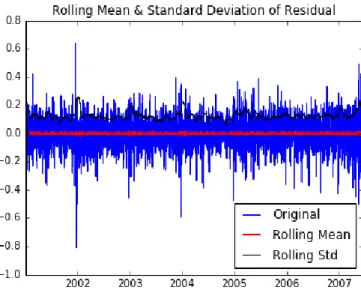
Figure 12 Rolling mean and standard deviation of error component ... 21
Figure 13 Autocorrelation and Partial Autocorrelation Function plots ... 21
Figure 14 Prediction plot of ARIMA model on the test data ... 22
Figure 15 SMAPE error value on different days prediction ... 22
Figure 16 Tensorboard visualization of Single layered NN implementation in Keras ... 24
Figure 17 Visualisation plot for Single Layered NN prediction over test data ... 24
Figure 19 Single Layered NN cumulative SMAPE over increasing prediction steps ... 25
Figure 18 Single Layer NN loss and SMAPE curve on training and test data over increasing number of epochs ... 25
Figure 20 Tensorboard visualisation of Fully Connected NN implementation in Keras ... 26
Figure 21 Visualisation plot for Fully connected NN prediction over test data ... 26
Figure 22 Fully Connected NN loss and SMAPE curve on training and test data over increasing number of epochs ... 26
Figure 23 Fully Connected NN cumulative SMAPE over increasing prediction steps ... 27
Figure 24 Tensorboard visualisation of LSTM Networks implementation in Keras ... 27
Figure 25 Visualisation plot for LSTM Networks prediction over test data ... 28
Figure 26 LSTM Networks loss and SMAPE curve on training and test data over increasing number of epochs ... 28
Figure 27 LSTM Networks cumulative SMAPE over increasing prediction steps ... 28
Figure 28 Tensorboard visualisation of 1D CNN implementation in Keras ... 29
Figure 29 Visualisation plot for 1D CNN prediction over test data ... 29
Figure 30 1D CNN loss and SMAPE curve on training and test data over increasing number of epochs ... 30
Figure 31 1D CNN cumulative SMAPE over increasing prediction steps ... 30
Figure 32 Tensorboard visualisation of GRU Networks implementation in Keras ... 31
Figure 33 Visualisation plot for GRU Networks prediction over test data ... 31
Figure 34 GRU Networks loss and SMAPE curve on training and test data over increasing number of epochs ... 31
Figure 36 Visualization plot: 1) univariate model prediction of test data, 2) date of the month
prediction, 3) Month Prediction, 4) day of the week prediction ... 33
Figure 37 Tensorboard visualisation of Univariate GRU Networks with date injection implementation in Keras ... 33
Figure 38 Visualisation plot for GRU Networks with date injection prediction over test data ... 34
Figure 39 GRU Networks with date injection model loss and SMAPE curve on training and test data over increasing number of epochs ... 34
Figure 40 Plot identifying the performance of GRU network on different number of input size ... 35
Figure 41 Training Curve for 1) Theft & Burglary, 2) Nuisance ... 36
Figure 42 Training Curve for 1) Pickpocketing on streets, 2) Theft of mopeds & bicycles ... 36
Figure 43 Tensorboard visualization of Multivariate GRU Network with date injection ... 36
Figure 44 Multivariate prediction plot GRU Network with date injection on test data ... 37
Figure 45 Heat Map to visualize the effect on SMAPE value by increasing prediction steps on different incidence types ... 38
Figure 46 Cumulative SMAPE error measure on increasing number of prediction steps ... 38
Figure 47 Multivariate GRU Networks with date injection model loss and SMAPE curve on training and test data over increasing number of epochs ... 38
1
1. Introduction
In recent years, Information Communication and Technology (ICT) have been widely used in facilitating human tasks, to increase efficiency and reduce errors. Data mining is an ICT service that explores large amounts of data, quickly and efficiently to find patterns, relationships or trends. The identified pattern is used to build a model. This model can be used to predict the future values.
Data mining has been widely used in the criminal domain (Chen et al., 2004) for instance to detect criminal identity deception; authorship in cybercrime, and criminal network. The development of crime data mining tools has increased rapidly in recent years. IALEIA1, COPLINK2, ATAC3, I2 Analyst’s Notebook4 and DataDetective5 are some examples of data mining tools.
Temporal analysis has increasingly attracted research and development. In 2008, I2 launched I2 Pattern Tracer that finds patterns in telephone data calls. It tries to detect the hierarchy of a criminal organization, identify potential targets and identify relationships between individuals, by analysing phone call patterns. Criminal career analysis is another example of sequence analysis that also attracts researchers’ attention. The goal is to detect career similarities between criminals.
DataDetective is Sentient’s own data mining platform. Sentient is a software company that was
founded in Amsterdam more than 20 years ago, which offers analytical tools and an associative memory engine. Its product has successfully been implemented by the police forces Midden en
West-Brabant, Brabant Noord and Amsterdam-Amstelland. DataDetective offers a complete data mining
solution for its customers, including fuzzy matching, profiling analysis, frequency analyses, cross table analysis, decision trees, segmentation, geographic visualization and modelling. However,
DataDetective has not provided any advanced sequence and time series analysis feature yet.
1.1 Problem and objective
As discussed above, DataDetective does not have any advanced sequence and time series analysis yet. This acts as a significant constraint to the clients if they want to see the number of incidences that might occur in next week. Until now, the application uses different data mining technique to analyse the patterns in data, but time was not used as a feature upon which the analysis could be performed.
This internship acts as the first attempt at introducing temporal behaviour to DataDetective, which means that this internship will act as the common ground on which furthermore advanced spatial-temporal work will be carried out. It is conducted within Sentient ICT Company to analyse the crime incidence data and develop multiple statistical and machine learning models to predict the number of incidences that would happen in next week (7 days). The internship result was expected to confirm
1. International Association of Law Enforcement Intelligent analyst, Journal 2017. https://www.ialeia.org/intelligence_library.php
2. Forensic logic’s COPLINK application. https://forensiclogic.com/
3. Automated Tactical Analysis of Crime, Bair Analytics Inc. https://risk.lexisnexis.com/law-enforcement-and-public-safety/crime-analytics-and-mapping
4. IBM i2 Analyst Notebook. https://www.ibm.com/us-en/marketplace/analysts-notebook/details 5. Sentient Information Systems. https://www.sentient.nl/datadetective-1
2 Sentient which model and type of model performs the best for the given data and whether adding advance temporal analysis tools into DataDetective would contribute a significant benefit into its clients or not. predicting crime time series was selected as the most promising challenge to be solved. Additionally, an objective of the internship is to diversify the search for most optimal model like, univariate and multivariate models, statistical models and neural networks, feedforward neural network and recurrent neural networks.
2. Related Work
2.1 Crime analysis
A brief research is conducted to understand the crime-analysis through the literature study (Elkblom, 1998). An analyst of Midden and West Brabant Police confirmed that criminal profiling (Oatley, Zeleznikow & Ewart, 2005) was one of the main issues in crime analysis. On the strategic level, the police try to identify persons who tend to commit more crimes, identify persons who tend to be victims and detect where crime will possibly take place. Police on the tactical level use the information to organize the police’s patrol route, which will be implemented by the operational police. Profile analysis, geographical analysis and frequency analysis features in the DataDetective application (Sentient, 2008) support these crime analysis approaches.
2.2 Crime data mining
Data mining has been assisting law-enforcements and intelligence-gathering organizations to analyse crime intelligently. Entity extraction, association, prediction and pattern visualization are parts of the crime analysis approaches, according to (Chen et al., 2004). Some of the implementations are deceptive-identity detection and criminal-network analysis. Many data mining techniques such as clustering, association, sequential pattern mining, classification and string comparator; have been implemented on data mining application such as Coplink (Chen et al., 2004) and DataDetective (Sentient, 2008). However, this research is focused on temporal analysis algorithms: sequence mining, temporal mining and time series analysis. Still in temporal analysis, change mining (Bottcher, Hoppner & Spiliopoulou, 2008), which analyses how models have changed and try to predict how it will change, is also an interesting topic but not necessarily applied in this research.
2.3 Time series mining
Time series analysis is mostly applied in economy analysis but also found in bio surveillance, crime mapping (Gorr & McKay, 2004) and geographysical sensor network (Granat, 2009). Time series clustering (Keogh, Lin & Truppel, 2003), time series anomaly and sequential detection (Nguyen, 2006) are examples of time series analysis implementations. However, we regarded the time series forecasting (Hyndman, 2006) as the most interesting implementation in the criminal domain. There were several algorithms that have been researched to extrapolate the time series, namely structural time series (Sridharan, Vujic & Koopman, p. 18, 2003), neural network (Rutka, 2008), C-L approach
3 (Greenberg, 2001) and ARIMA models (Harvey, 1993; Kapinos, 2006). However, ARIMA is commonly used in modelling time series, since numbers of time series analysis literatures in the Free University library applied the ARIMA method.
2.4 Crime data mining implementations
Sequence mining can be applied to find frequent criminal career patterns, and sequence alignment method can be used to check the similarity between patterns. An analyst who already did research on criminal career analysis with the Amsterdam Police confirmed the obstacles of this idea. This analysis will give more benefit to the Justice Department than for the police analysts, Sentient’s active customer. Criminal career analysis predicts the prospective criminals and Justice Department can arrange rehabilitation program for the potential offenders. In contrast, police can only act when a crime has been committed. In addition, there is lots of criminals’ career missing value, for examples: the police do not have information when criminals stop doing crime or stay in jail.
The literatures of the spatial-temporal mining is extensive. Many researchers interest with this area including a criminologist in Amsterdam. Geographical Information System (GIS) has successfully assisted police in profiling location with high crime rates. Many clustering methods are used to map the high-crime rate location. The spatial-temporal mining’s goal is not only to be more precise in predicting where the crime will take place, but also when it will possibly happen. These are some implementations of the spatial-temporal mining: to identify the mobility pattern of offenders, to predict when and how the crime will diffuse (Kim, 2008) and to predict the next crime location base on the offender social network activities (Furtado et al., 2007).
2.5 Crime data mining applications
To design and develop a state-of-the-art temporal application, we analysed other applications and their features, which provide data mining services to the law enforcement. These are some examples beside the examples on the introduction section: Law Enforcement Information System (Oatley, Ewart & Zelenikow, 2006) and Crimelibs (Kovachev, Reichert & Speck, 2008).
4
3. Time Series Analysis
3.1 Introduction to time series
The term “Time series”, signifies a data format, which consists of two main components – a time unit and value/values associated with that time unit. Unlike normal datasets, time isn’t just a metric, but a primary axis.
There are two fundamental ways we can store a time series. The first way of recording a time series is that the time intervals are treated as discrete points. These points can also represent values which are measured for just specific timestamps, which might occur in a periodic or an occasional manner. These time series are called discrete time series. A good example of discrete time series is the financial/economical time series where various attributes or indicators are recorded periodically. Another way of recording a time series is to store values continuously along a time axis. These series are called continuous time series. There are multiple examples of continuous time series like, sensor data coming out of various Internet Of Things (IOT) devices which record the data on a continuous time interval.
3.2 Time Series Classification types
One way to classify the types of time series is the dependency between a new recorded value and its past/historic values. There are mainly two types of values under this classification:
▪ Long-term memory time series: These series exhibit slow decrease in autocorrelation function. In other words, these types of series show that the current values in series have high correlations with relatively large set of lags in series. An example is the temperature change in the atmosphere where current day temperature can be exhibited by large chain of past date temperatures.
▪ Short-Term memory time series: These series have fast decrease in autocorrelation function and hence the correlation between current value decrease dramatically fast when compared with different lags in series. Typical examples contain processes from econometric sectors. Another way of classification is based on stationarity. Stationarity of time series is the feature which exhibits a change in statistical properties like mean, variance and time covariance. There are mainly two types of time series:
▪ Stationary Time series: stationary time series demonstrate constant stationarity over time. So, the mean, variance and time covariance are relatively constant over time.
▪ Non-stationary Time series: As the name suggests, the time series do not demonstrate the constant equilibrium of mean, variance and time covariance.
In practical world, time series are mostly categorised into non-stationary time series and hence when using stationary models, certain kinds of pre-processing needs to be done on these time series before we go into forecasting phase.
5
3.3 Vision of time series analysis
Time series analysis can be divided into two parts.
1. Analysing the historical time series to get insights and the patterns in those datasets. This can also be considered interpolating.
2. Forecasting the future values of time series based on current and past values. This can be considered as extrapolation.
This can be done by creation and identification of the optimized time series model. A good model can easily deliver good insights into the data like the trend and seasonality in the data. It can also predict future values by using information from previous steps.
3.4 Time Series Components
A key to analysing a time series is to understand the form of any underlying pattern of the data ordered over time. The underlying patterns are presented next. This pattern potentially consists of several different components, all of which combine to yield the observed values of the time series. A time series analysis can isolate each component and quantify the extent to which each component influences the form of the observed data. If one or more individual components of a time series are isolated and identified, a forecast can project the underlying pattern into the future.
The most basic time series component in the long-term growth or decline. This component is called long term trend or just trend. A trend can be linear or nonlinear. [David Gerbing, 2016]
Figure 1 Trend Component of Time series
Second component in time series is called cyclical component. This component is analysed long time intervals like years or even decades. It shows cyclical or long periodical swings on a typical trend line. Since this component is exhibited in long time intervals, it is usually not present in the practical time series.
6
Figure 2 Cyclical Component of Time series
Seasonal component is the next component in time series. This component shows short and repetitive fluctuations across a trend line. Usually, seasonal components of a sales time series data are divided into four quarters or seasons.
Figure 3 Seasonal Component of Time series
The trend, cyclical, and seasonal components combine to form the pattern underlying the time series data, the values of Y ordered over time, though not all components characterize every data set. An important purpose of time series analysis is to isolate each of these three components and demonstrate how each affects the value of Y over time, including forecasts for the future. The identification of this pattern, the predictable aspect of a time series, however, is complicated by the presence of random error.
Since, every time series contains random error, combinations of a trend, cyclical, and seasonal components are observed together with the error component.
3.5 Types of time series model
Type of time series model can be determined based on how the components of time series interact with each other. There are mainly two types of time series models:
▪ Additive models: In these models, cyclical, seasonal, and error components are added to the trend components. In other words, each component is discrete in in its effects and changes in one do not affect another component. This model is used where changes in values are measured in absolute quantity.
Time series = Trend + Seasonal Component + Cyclical Component + Error Component
▪ Multiplicative models: As the name suggests, all the components are multiplied in these models and hence effects of one component impact another model. This model is used where change is measured in percentage changes. Practically, data is usually
7
3.6 Autocorrelation and Partial Autocorrelation
Correlation signifies the strength in relationship between two variables. We can calculate the correlation of current observation of time series with the past observations of time series. Since instead of using two different variables, we are using different lags of same series, we call this correlation as serial correlation or autocorrelation.
Now let’s consider a scenario where a current observation is only correlated to its immediately prior observation. In this case, just using an autocorrelation will give a false insight of having strong correlation with greater lags which is attributed to the chaining effect of a time series. Here, partial autocorrelation is used to nullify this chaining effect of correlation. Partial autocorrelation can be thought as a correlation between two points that are separated by some number of periods, but with the effects of intervening correlation removed.
3.7 Time series forecasting
Time series forecasting refers to the process of predicting values in future time steps of time series based on previous time steps information. This process of extrapolation is carried out by a forecasting model which in turn is a set of algorithmic actions called forecasting method.
A time series could be just a univariate sequence of values in a variable indexed by time or it can be a multivariate sequence of values where many different external factors could be used to better explain the effects on the time series. For example, external factors of crime could be various indicators like locality, weather and population.
3.8 Forecast Accuracy
Forecasting accuracy as described in (Hyndmen et al, 2006) is a measure that determines performance of a forecasting model. This feature determines following points:
▪ Forecasting model’s bias ▪ Forecasting error
▪ Best performing forecasting model.
There are many kinds of functional accuracy measures. Each measure carries different kind of information to identify the accuracy. We tried to use these measures in terms of forecast error which is difference between the forecast and the actual value in series. Let’s classify these measures in two categories:
▪ Scale-Dependent errors: Here the forecasting errors are on same scales of the values in time series. There are mainly two types of scale dependent errors:
8 𝑀𝐴𝐸 = 1
𝑁∑|𝑍(𝑡) − 𝑍̂(𝑡)| 𝑁
𝑡=1 2. Root Mean Squared error
𝑅𝑀𝑆𝐸 = √1
𝑁∑ (𝑍(𝑡) − 𝑍̂(𝑡)) 2 𝑁
𝑡=1
Root mean squared errors penalize strong errors less than mean absolute errors.
▪ Percentage error: It provides information about the percentage of forecasting error against the actual observation. One of the major advantages is that since it is unit free, it can be used to measure forecasting error across different datasets as well.
Mean Absolute Percentage error (MAPE): It is one of most used forecasting accuracy measure in time series analysis. A major drawback of MAPE is that it can only be used when the values in series are significantly greater than 0.
𝑀𝐴𝑃𝐸 = 1 𝑁∑ |𝑍(𝑡) − 𝑍̂(𝑡)| 𝑍(𝑡) 𝑁 𝑡=1 ⋅ 100%
Another drawback is that it penalizes the negative forecasting errors more heavily than the positive forecasting errors. This observation led to the development and use of symmetric Mean absolute percentage error, SMAPE.
𝑆𝑀𝐴𝑃𝐸 = 1 𝑁∑ |𝑍(𝑡) − 𝑍̂(𝑡)| (𝑍(𝑡) + 𝑍̂(𝑡)) 𝑁 𝑡=1 ⋅ 200
However, its calculation involves division by zero, making the calculation unstable. Since the value can also be negative, SMAPE is not actually “Absolute”.
Hyndman & Koehler (2006) recommended against using SMAPE.
3.9 Data Pre-Processing
Data pre-processing is an integral step in the time series analysis and forecasting process. Using raw data into the forecasting model will lead to several undesirable problem including very low forecasting accuracy. We are going to discuss some of the common data pre-processing methods used in time series forecasting:
9
3.9.1 Smoothing
Every time series will have random error component. Smoothing is a process of local averaging, which helps in removal of unwanted noise signal. Smoothing helps in better understanding of the pattern and trends by removing irregular roughness in the time series. Few well known smoothing methods are moving average filter and linear filter.
Moving average filter replaces an observation as the weighted average of values in previous timestamps. Similarly, Linear filter replaces current observation with the smoothed value which is calculated as the linear combination of values at surrounding times.
3.9.2 Differencing
As discussed in the above topics, a time series in real lie scenario is not stationary i.e. its stationary features like mean, variance and covariance of time series are not constant but are functions of time. This non-stationary time series is not ideal since most of forecasting models work on stationary series. The most common way of removing non-stationarity is differencing the time series. Differencing is an iterative process and it is done until the time series is stationary.
𝑍(𝑡) = 𝑍(𝑡) − 𝑍(𝑡 − 1)
3.9.3 Scaling
This method is very commonly used in the machine learning and it transforms the data by adjusting the scale within some boundaries. This helps the forecasting model to better predict the next steps and increase the accuracy. Below, we can see a typical <0,1> boundary scaling of dataset.
𝑍̂(𝑡) = 𝑍(𝑡) − 𝑚𝑖𝑛𝑖𝑚𝑢𝑚 𝑚𝑎𝑥𝑖𝑚𝑢𝑚 − 𝑚𝑖𝑛𝑖𝑚𝑢𝑚
3.9.4 Normalization
Normalization is most used pre-processing step used currently. The aim of this step is to transform the dataset so that mean=0, variance=1. Post normalization the mean of the data is centred at 0 and variance of time series dataset is centred at 1.
3.9.5 Outlier Detection and Removal
Usually, outliers are the data points in time series which significantly different than other data points. An outlier can be a mistakenly recorded data, or it can be a correct data but their occurrence in the dataset will affect the model accuracy in a negative way. Therefore, outliers are eliminated. The
10 process of outlier detection is also called filtering. Outlier detection can be classified into six categories:
1. Classification based 2. Nearest neighbour based 3. Clustering based
4. Information theory based 5. Statistical based
6. Spectral theory based
One of the important thresholds to determine a data point as outlier is prediction confidence interval (PCI). It is calculated by the predicted value and the confidence threshold.
4.Forecasting methods
In this chapter, we are going to discuss various forecasting methods to analyse a time series and then extrapolate the series by forecasting values in future time indexes. Each forecasting method has its special use and care must be taken to select correct method for an application.
The selection of a method depends on many factors like context of forecast, the availability of historical data, degree of accuracy desired in application, number of steps ahead to be predicted and time available for the analysis.
The most basic time series forecasting method is called the naive forecast and sets the forecast to the last time series observation. Another simple method is the moving average, where the forecast is the arithmetic mean of the most recent values of the time series, discarding old and potentially inapplicable observations. Beyond these, the first more sophisticated methods date back to the 1950’s and 1960’s, with new approaches and extensions constantly being investigated until today. The choice of publications to cite has been difficult, as a vast majority of contributions are smaller case studies applied to a specific application area, which mostly provide results that contradict each other.
4.1 Autoregressive and moving average models
Autoregressive (AR) models are models in which the value of a variable in one period is related to its values in previous periods. In this model, the actual value of the process is expressed as the sum of finite linear combinations of previous values and the impulses, called white noise.
White noise put forth an assumption that each element in time series is a random draw from a population with zero mean and constant variance.
AR (p) is an autoregressive process of order where is the deviation from , . The autoregressive model may also be written as
11 With backshift operator as
The order and parameters and , which is variance of the white noise process , must be estimated from the data.
Moving average models are another kind of models, which represent the observed time series by
making linearly dependent on a finite number of the previous .
The moving average may also be written as
With moving average operator as
The order and parameters and , which is the variance of the white noise process, must be estimated from the data.
4.2 ARIMA Models
To achieve better prediction quality, two previous models are often merged into one model, autoregressive and moving average model. Common model is denoted as ARMA(p,q) and it unites a moving average filter of order q and autoregression of filtered values of order p. If the time series shows signs of non-stationarity, then the above-mentioned differencing step can be applied to remove non-stationarity. A post differencing ARMA model is called an ARIMA(p,d,q) model. The parameter d represents the degree of differencing, which is a fundamental part of this model.
One of the most influential publications in time series forecasting is Box & Jenkins (1970), having an extraordinary impact on forecasting theory and practice until today. The authors introduced the group of autoregressive integrated moving average (ARIMA) models, which can simulate the behaviour of diverse types of time series. An ARIMA model consists of an autoregressive and a moving average part whose orders must be estimated and involves a certain degree of differencing.
The performance and benefits of ARIMA models has been fiercely discussed in the aftermath of the M3-competition, whose results have been published in Makridakis & Hibon (2000). In this publication, the organisers criticise the approach of building statistically complex models like the ARIMA model,
12 disregarding all empirical evidence that simpler ones predict the future just as well or even better in real life situations, for example provided by their competition.
furthermore, add that the only advantage a sophisticated model has compared to a simple one is the ability to better fit historical data, which is no guarantee for a better out-of-sample performance.
4.3 Artificial neural networks
In the past few years, there can be observed a great interest in machine learning, especially in artificial neural networks domain. Artificial neural networks are tools, that are being used today for solving huge number of tasks from different areas. The most frequent examples are time series forecasting, pattern recognition, data clustering and classification. Such a great success is determined by several reasons.
1. Artificial neural networks represent exclusively powerful tool, that enables to reproduce very complex nonlinear dependencies. For many years linear models played the leading role in the most areas, as there were a lot of well-designed and optimized tools, which satisfactorily coped with assigned tasks, but problem was with tasks, for which the linear approximation is unsatisfactorily.
2. Artificial neural networks are learning from examples. Artificial neural networks receive a set of representative examples and then a learning process starts, which tries to find and extract the structure of data. Certainly, proper application of artificial neural network demands specific requirements for a correct formulation of representative data set and network's architecture. However, proper construction of a such artificial neural network allows to cope with tasks, which can be solved by the traditional algorithms only with the great difficulties. For example, pattern recognition task, practically used for face recognition, solving it in traditional way would result in a very complex problem.
An extensive summary of work done in multilayer perceptrons can be found in Zhang et al. (1998), which is somewhat outdated but still frequently cited and very relevant in terms of guidelines given. Not only reviewing many related publications, the authors also make recommendations concerning network architecture (number of hidden/input and output nodes and their interconnection), activation functions, training algorithms, data normalisation, training/testing sample size and performance measures. Another comprehensive literature survey, albeit limited to the application area of electrical load forecasting, can be found in Hippert et al. (2001), who motivated more rigorous research in the area by stating that many publications present seemingly mis-specified models that have not been sufficiently tested. [Juergen, 2014]
4.4 Recurrent Neural networks
One of the main features of time series data is the sequential pattern of the dataset. A time series data point carries information from past series of data points and hence if we train a neural network, it should not learn every information from the scratch but rather it should have a memory to retain sequential information which is passed through a model. For e.g. While watching a movie, every scene is a continuation of previous scenes and to understand that scene we need to have context of previous storyline. This calls out to have a persistence of thoughts in our mind.
13 A traditional neural network is unable to provide that context or storyline over the period of the movie and hence we needed an advancement which would persist information from past data. The limitation of NN is because of its fixed size of input and output vectors. This does not allow the model to save the growing context by reading the input over time.
Recurrent neural networks are an advancement over the conventional neural networks which saves information from previous steps. RNN have cyclical connections over time. Also, an internal state is maintained throughout the network and after each step, that state is updated with activations of each step, which provides a memory to the network. A recurrent neural network or RNN is a neural network that contains a cycle besides the general flow of a traditional NN. This cycle allows information to be passed from one step of the network to the next. The working of this process is such that
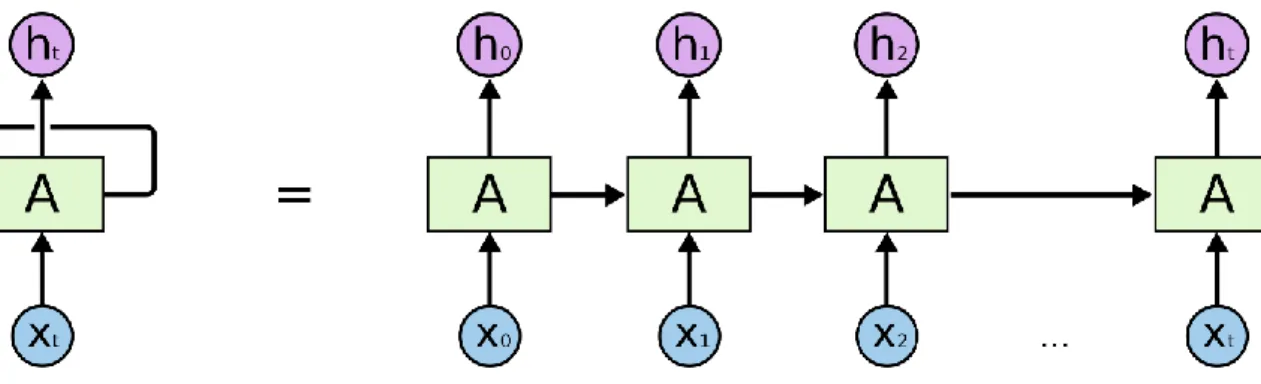
Figure 4 Recurrent Neural Network Loop (Christopher, 2015)
This cycling can also be considered as a chain of copies of same network with each step in the neural network(A) takes an input(X) and outputs an immediate output(h) as well as passes a message to next step. This chain like structure of neural network provides a very native or default architecture for the sequential or time series data. The simplest RNN can be considered as a fully connected neural network if we spread out or unroll the time axis. (Kondratenko et al, 2003)
One fundamental issue with RNN is that it can only handle short term memory and it renders itself ineffective if we have longer term dependency. RNN suffers from vanishing gradient problem. According to [Razvan et al, 2013], RNN face vanishing and exploding gradient problem which makes it hard to train RNN effectively. [Xavier et al 2011] showed that ReLU activation function survives this issue longer than sigmoid function.
4.5 Long Short-Term Memory Networks
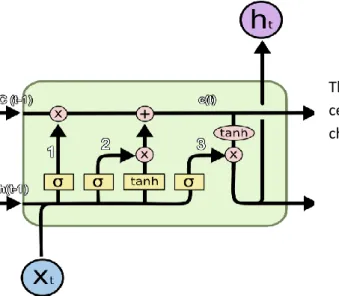
LSTM networks (Christopher, 2015) are an extension of Recurrent neural networks as they overcome the problem of vanishing gradient problem and help in remembering information for much longer period. A simple enhancement in design is that a node in RNN is replaced by a memory cell in LSTM. So rather than RNN where each node is a single node with a single activation function, an LSTM architecture replaces each node with a memory cell which stores its own information and maintains a cell state of its own. Each cell inputs the previous cell state and input, and outputs new cell state. The working of LSTM cell can be explained in three main steps:
14 1) We choose the what to remember from previous cell state and forget the information which
is not needed.
2) Control and selectively update the cell state based on new input that we have read. 3) We can control and selectively output the part of cell state as the new state.
Let’s discuss the architecture and how it achieves above mentioned steps. An LSTM cell consists of three gates: The forget gate, Input gate, and output gate.
The horizontal line going through the top of LSTM cell carries the LSTM cell state which is a common chain along the LSTM cell layer.
Forget Gate: This gate gives system a chance to select the information we want to remove from cell state. In this gate, a sigmoid function decides the amount of information to retain.
Input Gate:
Input gate is basically a hidden layer of sigmoid activated nodes, which outputs values between 0 and 1 and they determine amount of input to flow into the unit.
Output Gate:
The output has a sigmoid gating function which determine which values of the state are output from the cell.
The LSTM cell is very flexible, with gating functions controlling what is input, what is “remembered” in the internal state variable, and finally what is output from the LSTM cell. Due to the large number of parameters in the LSTM, it is assumed that LSTM networks have large computational complexity.
Figure 5 LSTM Memory Cell contains four interacting Neural network layers demonstrated by yellow squared boxes (Christopher, 2015)
15
4.6 Gated Recurrent Units
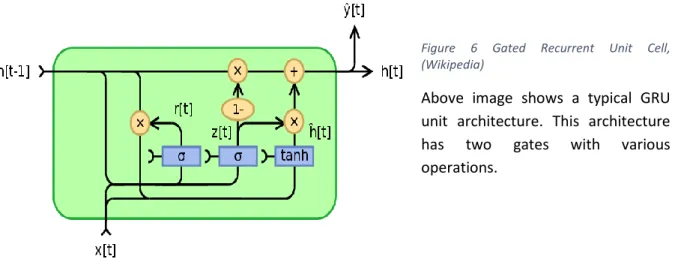
A gated recurrent unit (GRU) is a successful recurrent neural network architecture for time-series data. LSTM models were developed as an advancement from recurrent neural networks. However, the LSTM has the complex structures and numerous parameters with which to learn the long-term dependencies. As a way of reducing the number of parameters while avoiding the vanishing gradient problem, a gated recurrent unit (GRU) was proposed in (Cho et al, 2014); the GRU has only two gate functions that hold or update the state which summarizes the past information. In addition, (Tang et al. 2017) show that the GRU is more robust to noise than the LSTM is, and it outperforms the LSTM in several tasks.
Figure 6 Gated Recurrent Unit Cell, (Wikipedia)
Above image shows a typical GRU unit architecture. This architecture has two gates with various operations.
Update Gate
Update gate for the GRU helps the unit to decide and control how much amount of past information needs to be passed in the next timestamp.
Forget Gate
this gate is used from the model to decide how much of the past information to forget.
4.7 Convolutional Neural networks
Convolutional neural networks are another form of artificial neural networks. A convolutional neural network (CNNs) is a biologically-inspired type of deep neural network (DNN) that has recently gained popularity due to its success in classification problems (e.g. image recognition or time series classification). The CNN consists of a sequence of convolutional layers, the output of which is connected only to local regions in the input. This is achieved by sliding a filter (Yu et al, 2014), or weight matrix, over the input and at each point computing the dot product between the two (i.e. a convolution between the input and filter). This structure allows the model to learn filters that can recognize specific patterns in the input data. Recent advances in CNNs for time series forecasting where the authors propose an undecimated convolutional network for time series modelling based on the undecimated wavelet transform and one in which the authors propose to use an autoregressive-type weighting system for forecasting crime time series, where the weights can be
16 data-dependent by learning them through a CNN. In general literature on crime time series forecasting with convolutional architectures is still scarce, as these types of networks are much more commonly applied in classification problems.
Figure 7 Convolutional Neural Network Layers
Intuitively, the idea of applying CNNs to time series forecasting would be to learn filters that represent certain repeating patterns in the series and use these to forecast the future values. Due to the layered structure of CNNs, they might work well on noisy series, by discarding in each subsequent layer the noise and extracting only the meaningful patterns.
One of the main reasons of using convolutional layer instead of fully connected layer is that if we use fully connected layer to flatten the input, we will end up with massive number of parameters which would require great amount of resources. We can see this issue in LSTM where large number of parameters results in large computational complexity. So unlike LSTM, 1D CNN can be used on low resource environments. Also, lower parameters in the CNN will result in avoiding overfitting.
[R. Mittelman, 2015]
5. Experiments and Discussion
The main aim of this dissertation is: analysis of provided time series and then develop various time series forecasting model and then compare the models to find the most optimized model among them.
The approach is mainly divided into two major segments:
1. Box Jenkins Approach: this methodology includes AR, MA and ARIMA models. This approach uses linear prediction on the given data.
2. Artificial Neural network approach: This method includes various variants of artificial neural network to determine the adaptability and scalability of the models. We will start by exploring the simple fully connected neural network. Later we will move towards recurrent neural networks which have some theoretical scalability advantages over the fully connected neural networks. Then, we will go into Long- Short term memory networks, LSTM, which are specific form of recurrent neural networks. We will also explore one dimensional convolutional neural network to explore its advantages in sequential data processing and prediction. Finally, we will try to explore Gated recurrent units, GRU, which are again a part of neural networks. This model has less computational overload than LSTM.
17 Also, the first segment mainly deals with univariate time series and they do not have capability to handle multivariate dataset. Hence our approach will go towards analysing all the models from both segments on univariate time series to find their efficiency on given model and later we will use second approach to analyse the multivariate dataset to determine their predictive power.
Ideally, we would have liked to determine a model which has best predictive capability on both univariate and multivariate dataset. Also, we would have ideally liked to have a model which has the best linear and nonlinear capabilities. As we know from no free lunch theorem, there is no model that can perform exceedingly well on all factors. Hence, we explore all the models and try to determine their efficiency on various parameters. We expect that using a combination of these two segments will help us in addressing both linear and non-linear properties of forecasting models.
5.1 Dataset Explanation
The first and fundamental step is the access of data. This data is the incidence-based and hence each row of data indicates one incident and the description of that incident. The data is stored in the SQL server atmosphere and is divided into various relational schema designed tables. The first goal is to create a dataset which would be easily consumed by the model. The initial exploration showed that data is mainly distributed among three tables where each table had following information, a crime event description, type of crime, and severity of crime. Next step included creating a stored procedure in SQL server and export the data from the above-mentioned tables into the .csv file. The aim of exportation of data to a file is done to limit the creation of various database connection to fetch data that various forecasting models need.
We have been provided the crime incident dataset from year 2001 to 2007. One of the necessities of time series dataset is the uniformity of time index across the dataset. Hence, first step of importing the dataset from the client system through the stored procedure in SQL server is the aggregation of the incident on a uniform time index. The first dataset exported from system contains a series of daily aggregated incidence dataset. Similarly, a second stored procedure exports a multivariate incidence dataset where each row of dataset is daily aggregation of 4 types of crimes namely:
1. Theft / Burglary in house 2. Nuisance
3. Pickpocketing on streets
4. Theft of mopeds or bicycles on street.
At the end of this data import phase, we have two datasets of incidence. A univariate dataset which contains daily aggregation of all the incidences reported to the police. A multivariate dataset will contain daily aggregation of four selected types of incidence based on interest. Later, we will also try to see the effect of the models on the weekly and monthly aggregation of total incidences and type of incidence.
18
5.2 Data Exploration
We will initialize the process of data exploration to understand the hidden insights from the dataset imported from the client. This process includes visualizing the dataset to catch if we can just see some patterns in the data without any transformation in the dataset. Later, we will try to smoothen the dataset to remove the noise and find some patterns in the dataset.
Figure 8 Univariate Dataset distribution of crime incidences
Above raw visualization of data shows the distribution of total crime incidences over the year period of 2001-2007. The first insight we can hypothesize from looking at raw visualization is that data is evenly distributed over the years and there is a slight trend in the dataset along with the seasonal variations. To calculate the mentioned hypothesis on data, we can calculate if the mean, variance and time covariance of the dataset remains constant.
5.3 Statistical Model experiment
5.3.1 Testing stationarity
There are two different ways to test stationarity:
1. Plotting rolling statistics: This technique is also assumed as a visual technique. We tried to plot the moving average and variance and see if the moving average and its variance changes over time.
2. Dicky- Fuller Test – This test is a mathematical approach to determine if the time series is stationary or not. This test was developed by David Dicky and Wayne fuller in 1979 to test whether a series contain unit root feature, which can severely impact a statistical inference.
19 The intuition behind a unit root test is that it determines how strongly a time series is defined by a trend.
Dicky fuller test is based on linear regression. Dicky fuller test is the simplest approach to detect unit root but since many practical datasets are too complex to be captured by simple autoregressive model, hence we used augmented dicky-fuller test. The null hypothesis of the test is that the time series can be represented by a unit root, that it is not stationary (has some time-dependent structure). The alternate hypothesis (rejecting the null hypothesis) is that the time series is stationary.
The primary differentiator between the two tests is that the ADF is utilized for a larger and more complicated set of time series models. The augmented Dickey-Fuller statistic used in the ADF test is a negative number, and the more negative it is, the stronger the rejection of the hypothesis that there is a unit root.
Figure 9 Rolling Mean and Standard Deviation over the univariate dataset
We drew a rolling mean and rolling standard deviation for the univariate dataset to explore the trend in the dataset. Here, one has used a quarterly (120 days) window for rolling mean and rolling standard deviation. We can see that though the variation in standard deviation is almost non-existent, there is a slight decreasing trend in the rolling mean line. This shows that there is a small long-term trend in the univariate dataset.
20 Running the augmented dicky-fuller test shows that the test statistics is smaller than Critical values and the p-value is lower than threshold value (0.05) which says that the univariate dataset is stationary.
Though the dataset is identified as stationary by augmented dicky-fuller test, it is still better to log transform the dataset since the statistics of dataset is not significantly different than the critical values and hence a log transform will make the distribution smoother and better meet the expectation of the statistical test.
5.3.2 Decomposition of time series data
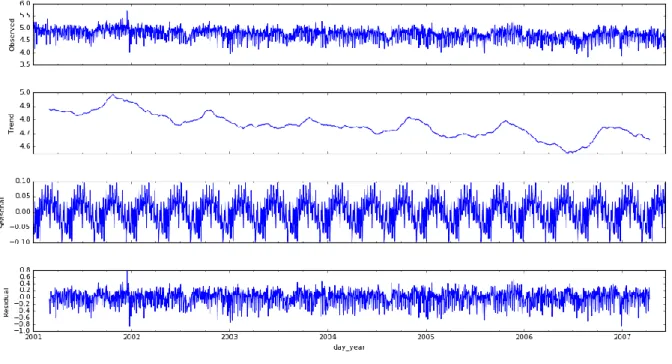
A time series is composed of four components: trend component, seasonal component, cyclical component and random error component. If the dataset is visually decomposed into these four components, it can give valuable insights on the components which are mainly impacting the series. Here, we have decided to decompose our univariate dataset into its individual component.
Figure 11 Time Series Component Decomposition
In above picture, we can easily see the small downward trend and a strong seasonal component in the dataset.
21 Also, the residual component is independent of time and is stochastic in nature. Desirably, the residual component is averaged around 0. This shows that error component is a random component and is not a function of time.
5.3.3 ACF And PACF Plot for optimal parameter selection
The ARIMA forecasting for a stationary time series is nothing but a linear (like a linear regression) equation. The predictors depend on the parameters (p,d,q) of the ARIMA model:
1. Number of AR (Auto-Regressive) terms (p): AR terms are just lags of dependent variable. For instance if p is 5, the predictors for x(t) will be x(t-1)….x(t-5).
2. Number of MA (Moving Average) terms (q): MA terms are lagged forecast errors in prediction equation. For instance if q is 5, the predictors for x(t) will be e(t-1)….e(t-5) where e(i) is the difference between the moving average at ith instant and actual value.
3. Number of Differences (d): These are the number of nonseasonal differences, i.e. in this case we took the first order difference. So, either we can pass that differenced variable and put d=0 or pass the original variable and put d=1. Both will generate same results.
Figure 13 Autocorrelation and Partial Autocorrelation Function plots Figure 12 Rolling mean and standard deviation of error component
22 As per the partial autocorrelation function, the value of p to be selected is the point when the upper threshold is crossed. This value is 7 as per the plot. Similarly, the value of q is 1. So, the Arima model used will have the parameters as (7,1,1).
5.3.4 statistical models Experiment & Discussion
5.3.4.1 ARIMA Model
Autoregressive integrated Moving average models are the most general class of models for forecasting time series. We used standard python library to run the model. The parameters of ARIMA models (p=7,d=1,q=1)are chosen from the previous steps. Firstly, the univariate dataset is scaled to (0,1) scale. This might help model to fight non-linearity of the dataset.
Figure 14 Prediction plot of ARIMA model on the test data
Because of linear property of ARIMA models, it is assumed that long term forecasting of ARIMA models will start turning insignificant quickly. Hence, we chose a 7-day prediction in one go. Again, this prediction will be used as ground truth in predicting next 7-day prediction. This iteration will help a model to predict entire test dataset.
Figure 15 SMAPE error value on different days prediction
This plot shows that prediction error percentage is low initially but when the prediction step is increased to 7 days, the error becomes very large (~41%). This error percentage too large for the practical application. The lowest error
percentage is on 2nd day prediction.
Clearly, ARIMA model’s predictive capability is very low on the existing dataset since model has been used to fit seasonal data. This is done as per internship requirement to use minimal data specific parameters. Also, as the size of dataset is increased, short-term predictability of ARIMA will result in multiple iterations of test data, which would further reduce the application of ARIMA. Hence, we will use ARIMA as a benchmark model for further explorations of neural networks. ARIMA models are the univariate class of statistical models
23
5.4 Neural networks
Apart from the statistical method, this internship also included exploring some prominent neural network methodologies to address the issues of Box-Jenkins approach. The classical methods used for time series prediction like Box-Jenkins, ARMA or ARIMA assumes that there is a linear relationship between inputs and outputs. Neural Networks have the advantage that can approximate any nonlinear functions without any apriori information about the properties of the data series.
5.4.1 Training Setup
We have tried to keep the training parameters of different variants of neural networks as uniform so that we can have a meaningful and fair comparison between them. Few of the training parameters are:
• We used Keras machine learning library in python (https://keras.io/) on top of TensorFlow. TensorFlow is an open-source machine learning framework.
• We used mean squared error (MSE) as the loss function. MSE has the tendency to penalize large errors more heavily in the training processes.
• We used ADAM optimizer for all the neural network variations in this internship. The learning rates are determined automatically, based on a moving estimate of the per-parameter gradient, and the per-parameter squared gradient. This is in huge contrast with stock vanilla Stochastic Gradient Descent. [Kingma et al, 2017]
• Dataset change: One of the major characteristic difference of Artificial neural networks with statistical models is that Artificial neural networks undergo supervised learning which means that the data for training an Artificial neural network model must have attributes as well as a target. So, we must change the dataset in a way that a series of attributes will also have target values which will act as output values. An input to Artificial neural network can be a single attribute or a group of attributes entering an Artificial neural network unit and the output can be a single output or a collection of variables as an output. Since our desired efficiency will be that a model should predict a week-long forecast by training on existing data. Here, we have hypothesized that will use a 30-day historical data to predict 7 days of forecast. Hence an input into a model will be 30 days of historical incidence data and the output will 7 days of forecast. • Batch size has been fixed on 100. A batch size determines the amount of training sample used
to compute a loss function.
• Maximum epoch has been set to 1000. In case of reaching an optimum, we have set an early stopping criterion where if the SMAPE value does not change for 15 epochs, the fitting will stop.
• We have used 70-30 partition of the dataset. Hence, 70% of the dataset is used to train the model and 30% is used to validate the generalization of the model.
• For better predictability of the model, the dataset is scaled to an interval of (0,1). This helps model to learn the dataset more efficiently.
24
5.4.2 1-Layer Linear Neural network experiment
Introduction
The first step towards using neural network is the 1-layer linear neural networks. These networks are the most basic and simplest type of feed-forward neural network. Generally, this network mainly acts as a linear regressor where an output can be considered as linear regression of the input provided into the network. The weight of the input is updated based on the difference between the actual output and the predicted output.
Figure 16 Tensorboard visualization of Single layered NN implementation in Keras
As demonstrated from above pic, we are using a sequential layered model from keras where the Dense layer acts as a simple 1-layer neural network. A flattened input from flatten layer is provided to Dense layer which outputs 7 days forecast which reshaped in last layer.
Experiment
By running the above-mentioned trained model on test dataset, we have plotted the prediction against the ground truth.
Figure 17 Visualisation plot for Single Layered NN prediction over test data
As we can see that the model is able to predict the low points (dips) in the in incidence relatively better than the high points (peaks) in the crime incidence. The reason is that the dips in the crime data is seasonally repetitive and hence, model has learnt the pattern and thus it is easier to predict. Also, single layered neural networks prediction for initial 100 test data points is not satisfactory and it fails to understand the dips in the data due to the linear predictive capability of the model. Since random error component in a time series are stochastic in nature and do not have a clear pattern, linear models have tough time in predicting this component. This limitation of the model makes it incompatible for the practical dataset since crime dataset will always have non-linear property.
25 It shows that it took a lot of epochs (456) for SMAPE to converge to an optima. Also, loss curve shows very quick convergence to a value around 0.01 and there is no significant improvement in the loss value after 100 epochs. This shows that the model has reached and stuck on local optima and is unable to go beyond due to its linear property. Clearly, we need some improvement in the configuration of model to provide model enough support to come out of its local optima and reach toward global optima.
Above plot shows the Variation of cumulative SMAPE over the course of a week ahead forecast. For this model, Symmetric mean absolute percentage error (SMAPE) is lowest on third day prediction. It reaches its worst prediction capability on 5th day prediction and then its decreases for next two days prediction. This plot is strangely unpredictive and doesn’t show an expected prediction degradation when increasing number of steps. This needs to be investigated further.
5.4.3 Deep fully connected neural network
Introduction
Deep fully connected neural network is an extension of simple 1 layered neural network. Unlike the former neural network example, this network has 3 hidden layers to provide additional scrutiny of input data. Also, this neural network variation will have non-linearity which in turn will provide additional predictive capability to the model.
Deep fully connected networks provide more complexity by incorporating 3 hidden layers. Each hidden layer is a 1 Layered non-linear neural network. One of the disadvantages of this model could be a problem of overfitting. Unlike single layered linear neural network, this network has large number of parameters and it is non-linear in nature. These properties will mean that model will try to learn the training data patterns and noise to the extent that it will impact its performance on new data.
Figure 18 Single Layer NN loss and SMAPE curve on training and test data over increasing number of epochs
Figure 19 Single Layered NN cumulative SMAPE over increasing prediction steps
26
Figure 20 Tensorboard visualisation of Fully Connected NN implementation in Keras
Above picture shows the Keras sequential layered structure of the experiment. This architecture contains 3 dense layers. A non-linear activation function, ReLU, is attached after every layer to provide non-linearity to the model. Here, an input layer inserts the flattened data into the first dense layer and then in third layer the data is transformed into the output shape of 7 days.
Figure 21 Visualisation plot for Fully connected NN prediction over test data
Comparing this plot of test data prediction with the one layered linear neural network output, we can assume that since this model is non-linear in nature, it tries to learn the patterns of the initial 100 test data better than previous experiment. Also, the peaks and dips in the incidence are better predicted by this model than the previous model.
Figure 22 Fully Connected NN loss and SMAPE curve on training and test data over increasing number of epochs
In above pic, we can see that the unlike previous model, SMAPE of the test data start converging after 20 epochs. Also, the validation SMAPE converged after 55 epochs. It’s evident from the plot that loss value converges at much lower level (0.005) than the previous model. The noise in the validation SMAPE is a reason of non-linearity of the model and the model tries to search towards the minimum optima. The quality criteria of validation SMAPE is 25.32 which is better than linear neural network.
27
Figure 23 Fully Connected NN cumulative SMAPE over increasing prediction steps
From the above plot of Cumulative SMAPE verses prediction time step, we can infer that the cumulative SMAPE value decreases till 3rd day and it starts going worse with increment of following day. This helps us in defining a restriction on number of days a model can effectively predict in future.
Hence, deep learning neural networks are better at fitting even complex training data due to its higher complexity and non-linearity but there is a chance of higher overfitting. In our case, it performed better than linear neural networks.
5.4.4 Recurrent neural network explanation
As discussed in previous chapter, recurrent neural networks are an extension of feed forward neural networks. These networks have a loop structure for its data flow which creates a short-term memory for the network which gives RNNs to identify longer patterns in data. Also, with loop like structure, the computational complexity of RNNs are significantly higher than the conventional feed forward neural networks. We mainly used two types of recurrent neural networks in this internship:
5.4.5 LSTM explanation
Introduction
Long short-term memory networks are specific types of recurrent neural networks which solved a major drawback of recurrent neural networks, vanishing gradient problem. This problem is caused when the input is transformed repeatedly in a loop, after a while the rate of change of weight vector becomes so small that it becomes negligible and hence the learning stops. This is handled in LSTMS by a very specific architecture of LSTM memory units involving various gates. LSTM have been widely used in the time series forecasting because of its ease of handling non-linear datasets with large patterns.
28 The model architecture has 2 LSTM layers where first has 256 LSTM units and second has 128 LSTM units. This model takes input of 30 days of data and predict the next 7 days of data.
Figure 25 Visualisation plot for LSTM Networks prediction over test data
In above picture, we can see the fitting of 7-day predictions on the test dataset. For our current dataset, this LSTM model performs relatively equivalent to deep learning fully connected neural network. Clearly, the LSTM model can catch the highs and lows of the incidence datasets well.
Figure 26 LSTM Networks loss and SMAPE curve on training and test data over increasing number of epochs
We can see from the above plot of loss and SMAPE over different epochs that though validation SMAPE decreases continuously, it doesn’t converge to a minimum optimum until 107 epochs. Also, the value of validation SMAPE on test dataset is nearly same as deep learning fully connected neural network. The main reason of comparable performance of deep fully connected neural network with LSTM is the limited amount of data available for the analysis. It can be hypothesized that if the LSTM has large amount of data to learn the long-range patterns, it will outperform the conventional deep learning networks.
Figure 27 LSTM Networks cumulative SMAPE over increasing prediction steps
We can infer from the above plot that for LSTM networks on this dataset, the prediction capability decreases with increasing number of days of prediction. There is a significantly higher increased cumulation of error (SMAPE) from 6th to 7th day prediction. We can infer from this plot that increasing number of days of prediction from 7 days will result in significantly lower quality of prediction.