Universidade de Aveiro 2016-2017
Departamento de Química
Liliana da Costa
Duarte
Avaliação de elementos potencialmente tóxicos em
macroalgas
cultivadas
num
Sistema
de
Aqualcultura Multitrófica Integrada
Assessment of potentially toxic elements in
macroalgae grown in an Integrated Multi Trophic
Aquaculture system
Dissertação apresentada à Universidade de Aveiro para cumprimento dos requisitos necessários à obtenção do grau de Mestre em Biotecnologia, ramo de Industrial e Ambiental, sob a orientação científica do Doutor Bruno Henriques, Investigador de Pós-Doutoramento do Departamento de Química, da Professora Doutora Eduarda Pereira, Professora Associada do Departamento de Química da Universidade de Aveiro e da Doutora Helena Abreu, co-fundadora da empresa ALGAplus. Universidade de Aveiro 2016-2017 Departamento de Química
Liliana da Costa
Duarte
Avaliação de elementos potencialmente tóxicos em
macroalgas
cultivadas
num
Sistema
de
Aqualcultura Multitrófica Integrada
Assessment of potentially toxic elements in
macroalgae grown in an Integrated Multi Trophic
Aquaculture system
o júri
Presidente Professor Doutor João Manuel da Costa e Araújo Pereira Coutinho, Professor Catedrático, Universidade de Aveiro
Doutor Carlos Alberto Garcia do Vale, Investigador Principal, Ciimar-Centro Interdisciplinar de Investigação Marinha e Ambiental Professora Doutora Maria Eduarda da Cunha Pereira, Professora Associada, Universidade de Aveiro
agradecimentos É com um misto de emoções inexplicável que concluo esta etapa tão importante da minha vida. Foi um ano desafiante a vários níveis, pessoais e profissionais, no entanto termino este ciclo com a certeza de que foram estes desafios que me ajudaram a ingressar no mercado de trabalho com a confiança e atitude necessárias para construir um percurso que corresponda às minhas expectativas.
Um agradecimento profundo ao Bruno e à Professora Eduarda por toda a paciência que tiveram comigo dado o menor conhecimento que tinha na vertente da Química Analítica mas acima de tudo por me terem feito ter a certeza de que uma Dissertação não desenvolve alunos mas, acima de tudo, pessoas. Por todos os momentos em que o ICP-MS deixava de funcionar e os técnicos diziam que dificilmente haveria remédio, e por me terem dito sempre que havia solução. Sem dúvida alguma que o que mais admiro nesta vida é a persistência em não desistir daquilo que são os nossos objetivos, e neste caso a persistência em não desistir daquilo que são os objetivos de tantos alunos e investigadores.
A toda a equipa do LCA, em especial ao Rui por tanto apoio me ter dado nos procedimentos de digestões, e ao Dr. Eugénio pelas incontáveis folhas de excel que teve de extrair por minha causa.
Aos amigos que me acompanharam neste percurso e me deram força para continuar, em especial à Jéssica, ao João, ao Tiago, à Margarida, à Joana, à Ana, à Diana, à Inês, ao Ricardo, à Carla, ao Daniel, à Beatriz. Aos meus pais por todas as lágrimas de orgulho que já lhes escorreram por minha causa, por todos os momentos em que me ensinaram o verdadeiro sentido da palavra desenrasque, e por me darem a certeza de que sou o melhor que têm nas suas vidas.
Por fim, e não de todo menos importante, não poderia deixar de dedicar este trabalho ao meu sempre herói Carlos. A promessa de que o nosso percurso iniciava lado a lado e lado a lado seria concluído foi quebrada, e isso ensinou-me o quão as injustiças da vida podem ganhar forma, mas que seja tomado como mais uma razão para continuar em frente.
palavras-chave
resumo
Elementos potencialmente tóxicos, bioacumulação, condições de cultivo, indústria alimentar, sistema integrado multitrófico de aquacultura.
O consumo de macroalgas pelos seres humanos tem vindo a aumentar nos últimos anos, o que está relacionado, para além do valor nutricional que lhes é reconhecido, com os seus compostos biofuncionais benéficos para a saúde. Assim, há a necessidade de aumentar sua produção de forma sustentável, onde os sistemas de Aquacultura Multitrópica Integrado (IMTA) surgem como uma alternativa promissora à aquacultura convencional, envolvendo mais de um nível trófico. No âmbito do controlo de qualidade deste novo tipo de alimento, surge um desafio: as macroalgas são organismos que tendem a bioacumular elementos potencialmente tóxicos (PTEs). O objetivo deste estudo foi monitorar a concentração de Cd, Pb, Hg e Al na macroalga Ulva rigida cultivada na empresa ALGAplus num sistema IMTA implementado pela empresa na Ria de Aveiro e inferir de um possível impacto dos factores de produção na concentração destes elementos nas algas. Avaliaram-ase três diferentes situações que poderiam influenciar a acumulação de PTEs nas algas: densidade de cultivo, taxa de renovação da água e época do ano (sazonalidade). Foi ainda feita uma comparação entre espécies cultivadas na empresa e pertencentes a outras classes: Fucus vesiculosus e Gracilaria sp. O teor de Cd, Pb e Al na biomassa de macroalgas foi determinado por atomização com plasma associada a deteção com espectroscopia de massa (ICP-MS), após digestão com ácido e microondas. O teor de Hg foi determinado por absorção atómica após combustão da amostra em atmosfera de oxigénio. As concentrações de Pb, Cd, Hg e Al para a Ulva rigida foram 0.3-3.1, <0.05, 0.01-0.03, e 121-3178 µg/g (peso seco – DW), respetivamente. A variabilidade sazonal não foi significativa (ρ > 0.05), e as condições de cultivo apenas influenciaram estatisticamente o teor de Pb (ρ < 0.05). Todos os valores obtidos para os PTEs quantificados estão abaixo do valor limite indicado na legislação que regula a qualidade das algas para consumo humano, o que evidencia que neste sistema IMTA não ocorrem
keywords Potentially toxic elements, macroalgae, bioaccumulation, cultive conditions, food industry, land-based IMTA system.
abstract Macroalgae consumption by humans has been increasing in the last years, which is related with their biofunctional compounds with health benefits. Therefore, there is the need to increase their production in a sustainable way where Integrated Multi Trophic Aquaculture (IMTA) emerges as a promising alternative to conventional aquaculture that involves more than one trophic level. Quality assurance of this new aliment is crucial and that is why this study is so important: macroalgae are known to be high bioaccumulators of potentially toxic elements. The objective of this study is to monitor the concentration of Cd, Al, Pb, and Hg in Ulva rigida during the year, assessing possible correlations with the cultive conditions and seasonality. There were evaluated three situations that could influence PTEs accumulation in macroalgae: cultivation density, water renewal rate and season. A comparison was made with other species also cultivated in the company and belonging to other classes: Fucus vesiculosus and Gracilaria sp. Cd, Hg, Pb and Al content in macroalgal biomass was determined through plasma atomization and mass spectrometry detection (ICP-MS), after acid and microwave digestion. Hg content was determined through atomic absortion after oxygen-rich combustion of the sample. Concentrations of Pb, Cd, Hg e Al in Ulva rigida ranged as it follows: 0.3-3.1, <0.05, 0.01-0.03, e 121-3178 µg/g dry weight (DW), respectively. Seasonal variability was not significant (p >0.05), and cultivation conditions were significant only for Pb (p< 0.05). All values obtained are below the limit of legislation which proves that in the IMTA system there are no relevant problems related with potential toxic elements accumulation in macroalgae..
Contents
CONTEXTUALIZATION AND OBJECTIVES ... 1
1. ALGAplus: a brief description ... 3
2. IMTA as a solution to overcome aquaculture limitations ... 5
2.1. Challenges facing aquaculture ... 5
2.2. IMTA mechanism ... 6
2.3. Seaweeds as the main product and also natural biofilters... 7
2.4. IMTA implications ... 8
3. Seaweeds ... 9
3.1. Division, composition and nutritional value ... 9
3.2. Bioaccumulation vs biosorption of potential toxic elements ... 11
3.3. Factors that influence bioaccumulation ... 13
4. Seaweeds: potential applications in food industry ... 14
4.1. Control of food safety ... 16
4.2. PTEs impact in human health ... 18
5. IMTA and macroalgae production: future actions needed ... 19
6. Objectives ... 20
MATERIALS AND METHODS ... 21
1. Materials, reagents and equipment ... 23
1.1. Inductively coupled plasma mass spectrometry ... 24
1.2. Cold Vapor Atomic Fluorescence Spectroscopy ... 26
1.3. Atomic absorption spectrometry with thermal atomization ... 26
3.1. Ulva rigida ... 28
3.2. Gracilaria sp. ... 28
3.3. Fucus vesiculosus ... 29
4. Water collection and preservation ... 29
5. Seaweed collection and treatment ... 29
6. Water analysis ... 30
7. Macroalgae analysis ... 31
7.1. Quality control ... 31
8. Statistical analysis ... 33
RESULTS AND DISCUSSION ... 35
1. Quality control... 37
1.1. Analytical variability ... 37
1.2. Effect of in situ processing ... 38
2. Temperature, water salinity and tides during algae collection period... 39
3. Water analysis ... 41
4. Elements quantification in the seaweed biomass ... 42
4.1. Lead ... 42
4.2. Cadmium ... 51
4.3. Mercury ... 54
4.4. Alumminium ... 61
CONCLUSION AND FUTURE PERSPECTIVES ... 69
List of Figures
FIGURE 1- ALGAPLUS LAND-BASED IMTA TANK SYSTEM (ALGAPLUS WEBSITE)... 3 FIGURE 2- ALGAPLUS SEAWEED-BASED PRODUCTS (ALGAPLUS WEBSITE). ... 5 FIGURE 3- CONCEPTUAL DIAGRAM OF AN IMTA (ADAPTED FROM CHOPIN ET AL.2006). ... 6 FIGURE 4-(A) FUCOIDAN AND (B) ALGINATE PRESENTED IN FUCUS VESICULOSUS (HURD ET AL.,
2014)... 10 FIGURE 5- AGAR PRESENTED IN GRACILARIA SP.(HURD ET AL.,2014). ... 10 FIGURE 6-(A) ULVANE AND (B) CARRAGHENATE PRESENTED IN ULVA RÍGIDA (HURD ET AL.,
2014)... 10 FIGURE 7 - THE MECHANISM OF BIOSORPTION AND BIOACCUMULATION (ADAPTED FROM CHOJNACKA ET AL.2007). ... 12 FIGURE 8-SCHEME OF AN ICP-MS EQUIPMENT (CROUAU ET AL.,2005). ... 24 FIGURE 9- SCHEME OF THE MASS ANALYSER OF AN ICP-MS – QUADRUPOLE (CROUAU ET AL.,
2005)... 25 FIGURE 10- SCHEME OF A CV-AFS EQUIPMENT. ... 26 FIGURE 11 - SCHEMATIC DIAGRAM OF THE AMA-254 PYROLYSIS ATOMIC ABSORPTION SPECTROMETER (COSTLEY ET AL.,2000). ... 27 FIGURE 12- EXPERIMENTAL DESIGN APPLIED IN THE LAND BASED IMTA EXPERIMENT WITH
ULVA RIGIDA. THE INFLUENCE OF TIME (TI — 8 LEVELS), STOCKING DENSITY (SD — 2
LEVELS) AND WATER FLOW (WF —2 LEVELS) IN PTES CONCENTRATION IN THE SEAWEED WAS MEASURED IN 3 REPLICATE TANKS PER CONDITION. ... 30 FIGURE 13- VARIATION OF PB CONCENTRATIONS FOR DIFFERENT CONDITIONS DURING (A)1ST
SUMMER CAMPAIGN, (B) 2ND SUMMER CAMPAIGN, (C) 1ST AUTUMN CAMPAIGN,(D) 2ND
AUTUMN CAMPAIGN, (E) 1ST WINTER CAMPAIGN AND (F) 2ND WINTER CAMPAIGN. RED LINES REPRESENT LEGISLATION LIMIT STATED FOR PB IN ALGAE. ERROR BARS CORRESPOND TO STANDARD DEVIATION. ... 44 FIGURE 14- COMPARISON OF PB CONCENTRATIONS IN ULVA RIGIDA, FUCUS VESICULOSUS AND
GRACILARIA SP. ... 50 FIGURE 15- CD CONCENTRATIONS IN FUCUS VESICULOSUS FOR 3 OUT OF 6 CAMPAIGNS.RED
FIGURE 16- VARIATION OF HG CONCENTRATIONS FOR DIFFERENT CONDITIONS DURING (A)1ST
SUMMER CAMPAIGN, (B) 2ND
SUMMER CAMPAIGN, (C) 1ST
AUTUMN CAMPAIGN,(D) 2ND
AUTUMN CAMPAIGN, (E) 1ST WINTER CAMPAIGN AND (F) 2ND WINTER CAMPAIGN. RED
LINES REPRESENT LEGISLATION LIMIT STATED FOR HG IN ALGAE. ERROR BARS CORRESPOND TO STANDARD DEVIATION. ... 56 FIGURE 17- RIA DE AVEIRO AND THE CROSS-SECTION SAMPLED AT THE CHEGADO CHANNEL
(HALL ET AL.,1985). ... 57 FIGURE 18- COMPARISON OF HG CONCENTRATIONS IN ULVA RIGIDA, FUCUS VESICULOSUS AND
GRACILARIA SP. ... 61 FIGURE 19- VARIATION OF AL CONCENTRATIONS FOR DIFFERENT CONDITIONS DURING (A)1ST
SUMMER CAMPAIGN, (B) 2ND SUMMER CAMPAIGN, (C) 1ST AUTUMN CAMPAIGN,(D) 2ND AUTUMN CAMPAIGN,(E)1ST WINTER CAMPAIGN AND (F)2ND WINTER CAMPAIGN.ERROR BARS CORRESPOND TO STANDARD DEVIATION. ... 63 FIGURE 20- COMPARISON OF AL CONCENTRATIONS IN ULVA RIGIDA, FUCUS VESICULOSUS AND
List of Tables
TABLE 1- PRODUCTION OF FARMED AQUATIC PLANTS IN THE WORLD (FAO 2016). ... 8
TABLE 2- SEAWEED IN FOOD APPLICATIONS (ADAPTED FROM CORDERO AND NISIZAWA,2006). ... 15
TABLE 3- EUROPEAN LIST OF EDIBLE SEAWEEDS FOR VEGETABLES AND FOOD SUPPLEMENTS (ADAPTED FROM CEVA,2002). ... 17
TABLE 4- MCLS OF METALS AND IODINE AUTHORIZED IN SEAWEEDS (MG/KG DRY WEIGHT) (CEVA 2002). ... 18
TABLE 5- MATERIALS, REAGENTS AND EQUIPMENT USED IN THIS WORK. ... 23
TABLE 6- DATES OF EACH CAMPAIGN. ... 30
TABLE 7- CONCENTRATIONS OF ELEMENTS TO WHICH ERM-CD200 IS CERTIFIED. ... 32
TABLE 8- (RANGE OF) CRM’S RECOVERY PERCENTAGE AND ASSOCIATED COEFFICIENT OF VARIATION. ... 37
TABLE 9 - MAXIMUM, MINIMUM AND MEAN TEMPERATURE (T IN ºC) AND COEFFICIENT OF VARIATION (CV IN %) DURING THE PERIOD OF THIS STUDY. ... 39
TABLE 10- MAXIMUM, MINIMUM AND MEDIUM SALINITY (S) AND COEFFICIENT OF VARIATION (CV IN %) DURING THE PERIOD OF THIS STUDY. ... 40
TABLE 11 - MAXIMUM, MINIMUM AND MEDIUM TIDE HEIGHT (M) AND COEFFICIENT OF VARIATION (CV IN %) AMONG TIME. ... 41
TABLE 12- CONCENTRATIONS (µG/L) OF PTES IN INLET AND OUTLET WATER OF THREE TANKS WITH CONTAIN SPECIES IN THE STUDY. ... 42
List of Abbreviations
ATSDR (Agency for Toxic Substances and Disease Registry) BCF (Bio-concentration factor)
CV (Coeficient of variation)
CRM (Certified reference material)
CV-AFS (Cold vapor atomic fluorescence spectroscopy) DW (Dry weight)
F-AAS (Flame atomic absorption spectroscopy) FAO (Food and Agriculture Organisation) FBO (Food Business Operator)
FW (Fresh weight)
FSAI (Food Safety Authority of Ireland)
ICP-MS (Inductively coupled plasma mass spectrometry)
ICP-OES (Inductively coupled plasma optical emission spectroscopy) IMTA (Integrated multi trophic aquaculture)
IPMA (Instituto Português do Mar e da Atmosfera) LQ (Quantification limit)
MCLs (Maximum contaminant levels) PTE (Potentially toxic element)
PTWI (Provisional tolerable weekly intake) ROS (Reactive oxygen species)
USEPA (U.S. Environmental Protection Agency) WHO (World Health Organisation)
Contextualization and
objectives
This dissertation arises from a self-proposal based on the need of ALGAplus to monitor some potentially toxic elements (PTEs) concentration in their macroalgae produced throughout IMTA system. Food industry market is increasing the exigence level constantly and once macroalgae as raw food or incorporated in other aliments is quite recent in Europe, quality assurance as a way to avoid health problems is crucial.
1. ALGAplus: a brief description
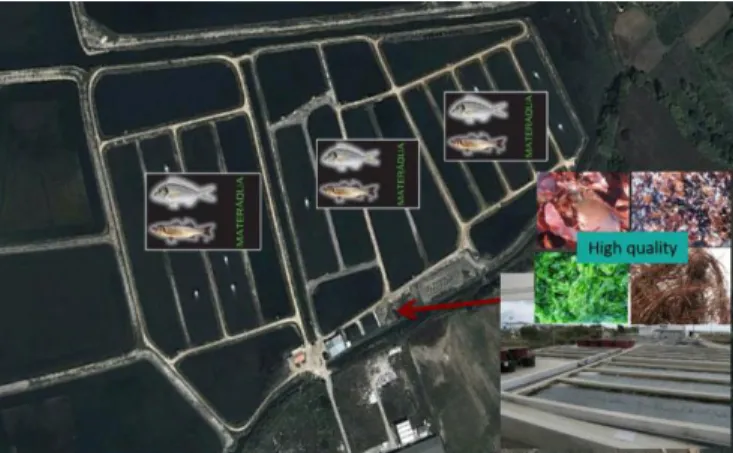
Doctor Helena Abreu and Doctor Rui Pereira are two biologists with some years of experience in marine algae research. During the beginning of the century both handled a wide range of studies in this field, involving several species and production systems in parallel with a strong presence in international conferences. On 2011 this solid background and experience made them scale up successfully the first land-based Integrated Multi Trophic Aquaculture (IMTA) tank system (Figure 1) with macroalgae in Portugal: ALGAplus was then founded.
ALGAplus produces and commercializes Atlantic seaweeds and seaweed-based products mainly for food, cosmetic and feed additives companies but also with its own brand to the HORECA channel and specialized retail stores. They also provide technical services as the domestication of novel species and customisation of specific biomass traits.
With approximately 9 ha available the seaweed, production occurs integrated with a semi-intensive seabream and seabass farm. There are outdoor and indoor cultures and the processing system is on site.
The company produces throughout the year 4 species: Ulva rigida (DNA confirmed), which is their main product; Gracilaria gracilis/vermiculophylla (pending DNA confirmation); 2 species of Porphyra; and Codium tormentosum. Besides this, they maintain in culture Fucus vesiculosus, which is obtained from Ria de Aveiro. They also produce other species upon request. The security of supply is assured by managing stocks and harvest frequencies and also due to the fact of the system being adapted to several species, revealing versatility.
ALGAplus bases its process in three main steps:
1. Biomass production – biomass is obtained from tanks or indoor cultivations, mainly by vegetative propagation. In general, the tailor-made biomass is obtained with high yields, quality, safety and traceability.
2. Processing – biomass is washed with seawater, salted with locally sourced marine salt, dried at 25ºC, and milled.
3. Packaging – the final product might be fresh or dried, depending on the destination.
In order to control morphology (shapes, size, colour, etc.) and chemical composition (glucose, protein, pigments, etc.) of seaweeds, the company manipulates some production factors: stocking density, water renewal, harvest time and aeration. This is of great interest, for example, to obtain biologically active compounds.
As it will be further discussed, IMTA systems have a crucial advantage connected with bioremediation, which this company is fully exploring: removal of nitrate, ammonia and carbon dioxide from water while macroalgae grow. Besides this, they have also other environmental sustainable practices: preservation of wild stocks and no use of additives.
Besides economic and environmental sustainability, all the products in food industry must reveal a high level with regart to quality assurance. Due to this fact, the water quality is monitored and all the infra-structures are of easy access, as well as the production fully traceable.
ALGAplus is not only focused in raw seaweed. The company also have seaweed-based food products designed to a niche market of retail industry, represented by the exclusive brand Tok de Mar™ and the shared brand Pão d’Algas™. SPAs. Pharmacies and natural products shops are also targeted with products branded by SeaOriginals. An illustrative picture of these products can be found in Figure 2.
2. IMTA as a solution to overcome aquaculture limitations
2.1. Challenges facing aquaculture
Aquaculture has increased worldwide in recent decades, and aquatic farming has been projected to provide 93 million tonnes of the world's seafood supply by 2030 (The World Bank, 2013). In some cases, its rapid expansion has been detrimental to the environment (Grigorakis and Rigos, 2011) since aquaculture can contribute to environmental degradation in several ways depending on location, species cultivated and method of farming.
Dissolved inorganic and particulate organic matter, resulting from uneaten food, faeces, dead fish, and excretion products cause some of the main negative effects of intensive aquaculture (e.g., finfish and shrimp) (Troell et al., 1999; Neori et al. 2000; Neori and Shpigel, 2003). It has been shown that 30% of the feed supplied is retained by the cultured species and more than 70% is discharged into the environment (Porter et al., 1987; Troell et al., 1999; Schuenhoff et al., 2003). Aquaculture discharges may cause environmental and socio-economic problems and it may also affect aquaculture activity itself (Troell et al., 1999). The future of aquaculture must be based on the development of sustainable environmentally production techniques (Neori et al., 2004). In this context, several studies have assessed the efficiency of different seaweeds as an extractive component of integrated multi-trophic aquaculture (IMTA) (Buschmann et al., 2001; Chopin et al., 2001; Troell et al., 2003; Neori et al., 2004; Matos et al., 2007; Abreu et al., 2009).
2.2. IMTA process
IMTA combines the cultivation of fed aquaculture species (e.g. finfish) with organic extractive aquaculture species (e.g. shellfish) and inorganic extractive aquaculture species (e.g. seaweed) for a balanced ecosystem management approach that takes into consideration the specificity, operational limits, and food safety guidelines and regulations. An illustrative picture can be found in Figure 3.
Figure 3 - Conceptual diagram of an IMTA (Adapted from Chopin et al. 2006).
Multi-trophic refers to the incorporation of species from different trophic or nutritional levels in the same system (Chopin and Robinson, 2004; Chopin, 2006). This is one difference when comparing to conventional aquatic polyculture, which could be the co-culture of different fish species from the same trophic level. In this case, the organisms may all share the same biological and chemical processes, with few synergistic benefits, which can potentially lead to significant shifts in the ecosystem. IMTA is also an integrated system because it refers to more intensive cultivation of the different species that are next to each other (not necessarily at the same location), connected by nutrient and energy transfer through water. From an idealistic point of view, the biological and chemical processes in an IMTA system should balance. This is achieved through the appropriate selection and proportions of different species providing different ecosystem functions (Neori et al., 2004).
The aim of IMTA is, thus, to increase long-term sustainability and profitability per cultivation unit, as some of the uneaten feed and wastes, nutrients, and by-products of one crop (fed animals) are not lost but recaptured and converted into fertilizer, feed, and energy for the other crops (extractive plants and animals). These, in turn, can be harvested and marketed as healthy seafood (Hall et al., 1999). Therefore, IMTA is recreating a simplified, cultivated ecosystem in balance with its surrounding instead of introducing a biomass of a
certain type cultivated in isolation of everything else. With an appropriate composition of co-cultured species, IMTA has the potential to reduce the amounts of dissolved (inorganic) and solid (organic) forms of nitrogen, carbon, phosphorous (Chopin et al., 2008). Besides this, more than being a form of ecologically balanced aquaculture management, it diminishes possible environmental impacts from aquaculture (Edwards, 2004). It also allows the development of cultivation of native species of marketable value that will be fast growing at different times of the year in diverse habitats.
2.3. Seaweeds as the main product and also natural biofilters
Apart from solving some of the main aquaculture related problems (Edwards, 2004¸ Gowen and Bradbury, 1987; Cromey, Nickell and Black, 2000), co-cultured species might also have commercial value (Hall et al., 1999) and are natural biofilters (Chopin, 2006). Among these species, seaweeds are of great potential (Buschmann et al., 2001; Troell et al., 2003; Neori et al., 2004; Matos et al., 2007; Abreu et al., 2011; Hernandez et al., 1997; Bodvin et al., 1996; Ryther et al., 1975, Jimenez del Río et al., 1994). Their advantages came to light more than 30 years ago (Ryther et al., 1981), however are now becoming widely accepted (Neori et al., 2007).
In IMTA, seaweeds assimilate the fish-excreted ammonia, phosphate and CO2, converting them into potentially valuable biomass. With this treatment, effluents can recirculate back to the fish ponds or be discharged without endangering the environment (Chopin et al., 2001; Neori et al., 2004).
Ecophysiology of seaweeds should be integrally understood in order to assess an effective implementation and optimal scale-up of a biofiltering system. The optimization of the overall biofiltration efficiency requires a compromise between apparently conflicting aims: water flow, biomass production, nutrient uptake or reduction efficiency (Chopin et al., 2001; Troell et al., 2003).
The viability of seaweed industries, and the culture of seaweed has been demonstrated in many countries, and globally, seaweed cultivation represents the largest marine aquaculture industry (by weight) with close to 14 million tons (Winberg et al., 2009).
from 6.2 percent in the previous decade, with output more than doubling in this period (Table 1).
2.4. IMTA implications
In the last 30 years, many authors have shown that exogenous sources of energy such as fish food can have a substantial impact on organic matter and nutrient loading in marine coastal areas (Gowen and Bradbury, 1987; Cromey, Nickell and Black, 2002), affecting the sediments beneath the culture sites and producing variations in the nutrient composition of the water column (Chopin et al., 2001).
Many economic-related studies and profitable scale ups have been done since a long time ago (Wowchuck et al., 2005; Whitmarsh et al., 2006; Ridler et al., 2007; Chopin and Bastarache, 2004; Buschmann et al., 2005; Stirling and Okumuş, 1995; Chopin et al., 2001; Cook and Black, 2006; Ridler et al., 2007 and the social perception was evaluated in many surveys (Kaiser and Stead, 2002; Seafood Choices Alliance, 2003; DFO, 2005). In general it seems that IMTA emerges as an improvement over current aquaculture practices and it is welcome to the worldwide market, even knowing that sustainable seafood represents a market niche.
Biosecurity is of extreme importance with regard to health impact of conventional aquaculture, being thus one of the main challenges that it faces. There are not, although, evidences that IMTA is able to overcome biosecurity related problems in aquaculture.
Table 1 - Production of farmed aquatic plants in the world (FAO 2016).
2005 2010 2013 2014 Thousands of tonnes Kappaphycus alvarezil and Euchema spp. 2 444 5 629 10 394 10 922 Laminaria japonica 4 371 5 147 5 942 7 655 Gracilaria spp. 936 1 696 3 463 3 752 Undaria pinnatifida 2 440 1 537 2 079 2 359 Porphyra spp. 1 287 1 637 1 861 1 806 Sargassum fusiforme 86 78 152 175 Spirulina spp. 48 97 82 86
Other aquatic plants 1 892 3 172 2 895 482 Total 13 504 18 993 26 868 27 307
Mortensen et al., 2007 suggest that mussels are not a reservoir host or vector of Infectious Salmon Anemia Virus (which is a viral disease of Atlantic salmon), being acting as kind of biosecurity cordon around salmon culture. Pang et al., 2006 showed that blue mussels were shown to accumulate Vibrio anguillarum in their digestive glands, which indicated that in the co-culture of mussels and fin-fish, mussels may act as a reservoir of infections for V. angillarium. Pang et al., 2006 also reported reduced total bacteria and Vibrio counts in a seaweed-abalone IMTA system. Canadian IMTA Network is conducting studies on this field as well (Chopin, 2013). However, there is the need for further studies showing interactions between pathogens and different co-cultured species in the wide range of integrated systems we have so far and that are expected to grow exponentially.
3. Seaweeds
3.1. Division, composition and nutritional value
The term “seaweeds” generally includes only macroscopic, multicellular marine red, green and brown algae. However, each of these groups has microscopic representatives. All seaweeds at some stage in their life cycles are unicellular, as spores or zygotes, and may be temporarily planktonic (Amsler & Searles, 1980).
Since a long time ago, seaweeds are a direct food source for humans, especially in East Asia (Japan), Indo-Pacific (China, Indochina) and Pacific (Hawaii). In China and Japan, more than 70 species of marine algae are consumed. With more than 400 000 tonnes annual production, today they still provide about 10% of local food consumption in Japan and are served worldwide in restaurants (Braune and Guiry, 2011).
Macroalgae have high ability to bind potentially toxic elements (PTEs) since their cellular wall, mainly its fibril matrix, is rich in sulphated polysaccharides. Hydroxyl, sulphate and carboxyl groups of the polysaccharides are strong ion-exchangers, and, therefore, important complexation sites for metals (Manley, 1984; Crist et al., 1990).
Macroalgae can be classified according a variety of characteristics, including the nature of the chlorophyll(s), the cell wall chemistry, and flagellation. It is being said that all types of macroalgae contain chlorophyll a, which includes brown and read macroalgae. Class
division is: brown algae (Phaeophyta), red algae (Rhodophyta) and green algae (Chlorophyta).
In brown algae, the cell wall consists mainly of alginates and fucoidans; the alginic acid is composed by mannuronic and guluronic acid units and can constitute between 10 and 40% of the algae dry weight (DW). Both mannuronic and guluronic acids contain carboxylic acid in their structures, which is connected to the high capacity of them to retain metals (Henriques et al., 2015).
Red algae contain agar as well as green algae contain ulvanes and carraghenates, rich in sulphated polysaccharides, and glycoproteins, which comprise amino, carboxyl, sulphate and hydroxyl groups (Davis et al., 2003).
Polysaccharides that are present in the structure of each macroalgae class and might have interference in bioaccumulation capacity are presented in Figures 4, 5 and 6.
Figure 4 - (a) Fucoidan and (b) alginate presented in Fucus vesiculosus (Hurd et al., 2014).
Figure 5 -Agar presented in Gracilaria sp. (Hurd et al., 2014).
Both the Phaeophyta and Rhodophyta divisions contain the largest amount of amorphous embedding matrix polysaccharides. This characteristic makes them potentially PTEs biosorbents (Davis et al., 2003). This information might lead us to think that they have higher PTEs uptake capacity when compared to green algae, which can actually be truth in case the macroalgae is not alive anymore. PTEs uptake capacity will be, although, explored with further details in the next sections.
Proteins, lipids and nucleic acids may also exist on the surface of the macroalgae cellular wall, but occur preferentially in the cytoplasmatic membrane and in the cytoplasm of the cells, facilitating bioaccumulation. The amine, carboxyl, imidazole, thiol, thioester, nitrogen and oxygen of the peptidic bindings are thought to be responsible for the metal ions coordination in the cell. As a result of their metal-binding properties, macroalgae have been considered suitable for use as biomonitors of PTEs contamination (Majidi et al., 1990).
Even if this is information almost worldwide known, it is important to recap seaweeds nutritional value: many reviews have been done so far (MacArtain, 2007; Holdt and Kraan, 2011; Pereira, 2011), providing an exhaustive nutritional characterization of the most consumed seaweeds worldwide. General conclusions are that they are low-calorie foods, with a high concentration of minerals (Mg, Ca, P, K and Na), vitamins, proteins and indigestible carbohydrates and a low lipid content. They also contain more vitamin A, B-12, and C, β-carotene, pantothenate, folate, riboflavin, and niacin than fruits and vegetables. Dietary fibre content ranges from 33 to 75% of dry weight, and mainly consists of soluble polysaccharides. Also iodine is generally found in all seaweeds at high levels (Garcia Casal et al., 2007).
3.2. Bioaccumulation vs biosorption of potential toxic elements
Biosorption can be defined as the removal of PTEs from aqueous solution (compounds, metal ions, etc.) by inactive, non-living biomass, which happens because of the ‘‘high attractive forces” that exists between both parts (Farooq et al., 2010). Metal biosorption can be associated, among others, with an ionic exchange mechanism, where metal divalent cations replace other ions bound to the functional groups (i.e. carboxylic groups) on the material surface (Carro et al., 2015).
Bioaccumulation involves the transfer of adsorbed PTEs into the interior of living cells and their retention. During this process, nutrients such as nitrates, phosphates, sulphates, organic and inorganic carbon compounds can also be removed from the effluents (Barron et al., 1995). The first step of bioaccumulation is actually biosorption, however, afterwards the PTE is transported into the cells (mainly via energy-consuming active transport systems), leading to an internal concentration increase. Binding sites on the surface are released and an additional amount of contaminant can be bound (according to the course of the equilibrium biosorption dependence). Besides that, organism growth, i.e., increase of biomass enables to bind even more contaminant (Chojnacka et al., 2010). These mechanisms are illustrated in Figure 7: on the right side it possible to see biosorption which represents steps 1, 2 and 3. If the process goes further it will conduce to bioaccumulation that sums the steps 4 and 5.
Figure 7 -The mechanism of biosorption and bioaccumulation (Adapted from Chojnacka et al. 2007).
For an efficient bioaccumulation process, the biosorbent should have a mechanism of intracellular binding such as special proteins rich in thiol groups – metallothioneins, or phytochelatins, which are not involved in normal metabolic processes. They should be synthesized as a response to the presence of toxic metal ions in their living environment with the functionality of forming a complex with the PTE (Chojnacka et al., 2007).
Among various biosorbents reported in the literature, marine algal biomass is identified as a promising biosorbent, which is connected to its high uptake capacity, low cost, renewability and worldwide distribution (He & Chen, 2014).
On the other hand, some papers report that at higher level of PTEs, macroalgae activate systems which protect from excessive accumulation (Chojnacka et al., 2007).
3.3. Factors that influence PTEs accumulation
There are numerous biotic and abiotic parameters that influence PTEs uptake and accumulation. The abiotic factors (salinity, temperature, light, pH, and ligand concentration) influence the relationship between PTEs’ species distribution and organisms.
Temperature has a significant effect on the rate of chemical and biological processes in water, which has a direct influence on PTE toxicity and their bioavailability to organisms (Fritioff et al., 2005). However, still very little is known about the influence of temperature on the PTE uptake by macroalgae. The study of Rai et al., 1981showed variability among species regarding temperature effects: in some species there was an increasing element concentration with the decrease of temperature; in other species, the opposite was observed. Another important factor influencing the bioavailability of PTEs is the abundance of nutrients in surrounding waters. Adsorption to particles in the water or complexation with dissolved organics generally reduces toxicity of the PTE (Haglund et al., 1996).
The physicochemical state of the PTE also deserves attention (Langston, 1990). Once the form in which the PTE exists is often difficult or even impossible to characterize, most studies have measured the total concentration of the PTE, which does not correlate well with toxicity (Florence et al., 1984).
Some conditions such as temperature vary naturally among the year while others might be inductively modified among the year by human action (e.g. in companies that establish the relation between production parameters and productivity), however few studies are available in the literature regarding bioaccumulation processes by macroalgae during the year and that reflect the variability among different growing conditions. Since they have the capability of controlling, at least, some of the mentioned parameters, there is the possibility of manipulating the bioaccumulation ability of their macroalgae with regard to PTEs, diminishing it to the lowest level possible. This study might be an important step towards the achievement of future manipulation techniques.
At a low pH, PTEs generally exist as free cations, however at under alkaline pH, like that of seawater, they tend to precipitate as insoluble hydroxides, oxides, carbonates or phosphates (Florence et al., 1984).
It is also impossible to ignore the importance of physiological changes and growth rate (Huerta-Diaz et al., 2007). It has been reported that concentrations are generally low in summer when growth rates are high and the accumulated PTEs are diluted, and high in winter when the metabolic processes slow down (Brix and Lyngby, 1983; Hou and Yan, 1998; Villares et al., 2002). Although these studies correlate the macroalgae growth rates with metals uptake, they are not related with an IMTA, which is a challenge.
4. Seaweeds: potential applications in food industry
Due to their potential, seaweeds are used in a wide range of areas. They contain various inorganic and organic compounds that are beneficial for human health because of their high nutritional value and their curative properties for many diseases such as tuberculosis, arthritis, colds and influenza, worm infestations, and tumours (Frikha et al., 2011). They are applied in human food, cosmetics, fertilizers, etc., while the industrial utilization is mainly confined to the extraction of phycocolloids (agar, alginate, and carrageenan) that have attained commercial significance. They are able to produce many secondary metabolites, possessing a large spectrum of interesting biological activities, including antibacterial, antifungal, antiviral, and antioxidant properties (Shanab, 2007).
Seaweeds are widely used for human food in China, Japan, and Korea (Critchley and Ohno, 2001; FAO, 2003). Although this is still not the case for most western countries, in some specific locations (e.g. France, UK, Ireland, Canada, USA, Australia) it has been increasing in the last years (Abreu et al., 2014). Approximately 500 species are eaten by humans and among these, some of them are commercially important such as Porphyra dioica and Ulva rígida. Main applications in food can be found on Table 2.
Table 2 -Seaweed in food applications (Adapted from Cordero and Nisizawa, 2006).
Food use Seaweeds type Seaweeds used
Main dishes Brown Sargassum spp.
Main dishes Green Ulva spp.
Salads Green Ulva spp.
Salads Red Gracilaria spp.
Porphyra spp.
Soups Green Ulva spp.
Soups Red Gracilaria spp.
Porphyra spp.
Dessert Red Gracilaria spp.
Porphyra spp.
Powders for flavourings All Various
Food supplements Red Asparagopsis, Grateloupi (Limu spp.)
Food supplements Green Ulva (Limu spp.)
Ritual foods Red Gracilaria spp.
For people from western countries, the consumption of seaweed is mostly associated with sushi, a habitude that has been increased in the past years.Besides that, the nutritional richness and range of applications of the “sea veggies” is becoming increasingly recognized, which might be supported, for example, by the new culinary books published in recent years (Abreu et al., 2014).
Indeed, the most common uses for seaweed is still in salads, sushi and soups. Seaweed products originated from Asian large suppliers can be easily found in most food retailers, usually dried Wakame (U. pinnatifida), Nori (Porphyra/Pyropia sp.), Kombu (Saccharina/Laminaria), Arame (Eisenia Areschoug sp.) and Hijiki (S. fusiforme) in the whole or sheets format (Abreu et al., 2014).
The consumption of snacks is increasing worldwide, which might be explained by the correlation established between quick and functional foods. For this reason, seaweeds are on the spot of the lights in what respects to the healthy snacks market, becoming more popular every day in the western countries, with several brands launching new products. Snack bars, crackers or stripes of nori sheets are becoming widely used. Even large western
brands like “Lays” and “Pringles” are now producing seaweed chips for the Asian consumers (Abreu et al., 2014).
Another way of consuming seaweed and benefit from their nutraceutical properties is by taking food supplements. The definitions of these products given by the US Food and Drug Administration (USFDA) or the EFSA are similar and basically state that a food supplement is a concentrated source of nutrients or dietary ingredients intended to supplement a normal diet and taken by mouth (pills, tablets, softgels, liquids, powders, etc.). As for snacks, the supplements’ market is growing largely in the US and Europe (SIA, 2013).
4.1. Control of food safety
Regulation is an important consideration in functional food innovation because it governs the means by which health benefits can be communicated to the consumer. Food regulations and standards differ significantly between countries and also across larger jurisdictional organizations, such as Codex Alimentarius and USA FDA.
The Commission Regulation No 1881/2006 sets Maximum Levels (MLs) for chemical contaminants in a wide range of foodstuffs including milk, meat, fish, cereals, vegetables, fruit and fruit juices, and also sets MLs for mercury in fish and fish products (FSA, 2009). This regulation states the following:
In the framework of Directive 93/5/EEC 2004 the SCOOP-task 3.2.11 ‘Assessment of the dietary exposure to arsenic, cadmium, lead and mercury of the population of the EU Member States’ was performed. In view of this assessment and the opinion delivered by the Sustainable Food Center, it is appropriate to take measures to reduce the presence of lead in food as much as possible. Commission Regulation 333/2007 lays down the sampling and analysis methods for these PTEs.
Also, theFood Safety Authority of Ireland (FSAI), in collaboration with its agencies, including the Public Analyst Laboratories and the Department of Agriculture, Fisheries and Food, carries out regular checks on levels of mercury, lead and cadmium in the food chain. All these regulations are an evidence of the special attention given worldwide to the toxic triad (Hg, Pb and Cd) which is part of this study and will be discussed in a further detail in the next sections.
Food industries must never lose their focus regarding the conditions required to sell a product which are stated in Commission Regulations (EC) No 1881/2006 and 629/2008. It is the responsibility of the Food Business Operator to test his products for content of mercury, lead, cadmium, tin or arsenic at the point of sale. Laboratories selected by the FBO should be accredited and should be able to comply with the requirements of Regulation 333/2007.
In France, since 1990, some species of seaweed have been authorized for food consumption. It was the first European country to establish a specific regulation concerning the use of seaweeds for human consumption as non-traditional food substances.
The edible seaweeds considered in the French regulation – 21 macroalgae and 3 microalgae, as well as maximum levels of metals and iodine in seaweed are presented in Tables 3 and 4. However, these limits are for food products derived from seaweed used as additives in the food industry, which means there are no stated limits for raw seaweed (He and Chen, 2014).
Table 3 -European list of edible seaweeds for vegetables and food supplements (Adapted from Ceva, 2002).
Class Specie
Brown seaweed
Ascophyllum nodosum, Fucus vesiculosus, Fucus serratus, Himanthalia elongata, Undaria pinnatifida, Laminaria digitata, Laminaria sacharina, Laminaria japónica, Alaria esculenta Red
seaweed
Palmaria palmata, Porphyra umbilicalis, Porphyra tenera, Porphyra yezoensis, Porphyra dioica, Porphyra purpúrea, Porphyra laciniata, Porphyra leucostica, Chondus crispus, Gracilaria verrucosa, Lithothamnium calcareum
Green seaweed
Ulva sp., Enteromorpha sp.
Table 4 –Maximum concentration levels (MCLs) of metals and iodine authorized in seaweeds (mg/kg dry weight) (Ceva 2002). Metal MCLs Inorganic Arsenic 3 Cadmium 0.5 Lead 5 Mercury 0.1 Tin 5
4.2. PTEs impact in human health
Millenium Ecosystem Assessment’s Report (2005) revealed that natural ecosystems have changed more rapidly in the last half century than in any period of human history. Industrial effluents contain large amounts of PTEs that are discharged into the environment. Due to their toxicity and mobility, contamination of aqueous environments with metals is a worldwide problem with serious ecological and human health consequences (Bulgariu, 2014; Abdel-Baki et al., 2011). It causes many trophic problems and influences the stability of the aquatic ecosystem (Rybak et al., 2011) because PTEs are accumulated in the organisms and their concentrations increases from lower to higher trophic levels, a phenomenon known as biomagnification (Ali et al., 2013).
PTEs have been widely used in many fields such as construction, ceramics, pigments and petrol additives, fishing lures, cables, sail boat keels, cars, batteries/accumulators, plastics, paints and sand blasting, pesticide and biocide, and in paper industry (Okland et al., 2005).
Food contains a wide range of elements, including PTEs. Even knowing that some of those elements, such as sodium, potassium, iron, calcium, boron, magnesium, selenium, copper and zinc are indispensable for biological processes, all of them become toxic at high concentrations (FSA, 2009). Non-essential elements tend to accumulate in organisms, which make them toxic even at low concentrations in food. They induce oxidative stress in cells and have the ability to replace essential elements in enzymes, interrupting their normal activity (Ali et al., 2013). Mercury, chromium, lead, arsenic, copper, cadmium, cobalt, zinc, nickel, beryllium, manganese and tin are the most potentially toxic elements according U.S. Environmental Protection Agency (USEPA) (Velásquez et al., 2014).
In Humans, bioaccumulation of PTEs brings severe negative effects on gastrointestinal, neurological and immunological systems (Chojnacka et al., 2010). These effects were extensively reviewed by Nylander et al., 1987; WHO, 1992; EPA, 1997; and ATSDR, 1998. It has proved to have impact on carcinogenic, renal disturbances, lung insufficiency, bone lesions, cancer, hypertension, Itai-Itai disease, diminishing IQ, and also weight loss.
If it is inevitable that PTEs are associated with toxicity levels, which should be the safety margins and which ones are available? These questions are not easy to answer because of lack of adequate data. Riihimäki et al., 2016 state that health criteria for exposure standards is difficult, however it is totally required and it has been increasingly recognized at national and international levels. Risk assessment in human health has been improved by the development and implementations of new methods such as assessing benchmark dose and identifying new biomarkers (Nordberg et al., 2014).
The methodologies available to determine PTEs in seaweeds usually involve a microwave-assisted acid digestion (Kim, 2011), followed by quantification through Inductively coupled plasma mass spectrometry (ICP-MS) and Inductively coupled Plasma Optical Emission Spectroscopy (ICP-OES), which have ability to perform simultaneous multielement analysis, with ICP-MS providing the lowest detection limits (Kim, 2011).
5. IMTA and macroalgae production: future actions needed
Troell, 2003 performed a variety of questions that might be answered before considering to scale-up an IMTA system. This is a review with more than ten years and provides explanations and considerations that seem to make a lot of sense nowadays after so many studies and scale-ups regarding IMTA. The whole content of the review seems to have a huge contribute in order to inspire many future studies that were hold in this field. However, there is a crucial point which was not highlighted: toxicology. Which are the safety margins regarding bioaccumulation of seaweeds that are able to produce, not only valuable, but also safety biomass?
Adam et al., 2016 report facts and numbers that supports IMTA practice adoption at commercial scale and appeal to European companies to start adopting this strategy, using as
conditions. Therefore, this paper attempts to better understand the commercial motivation for the adoption of IMTA. Ten years later the situation seems changed and many advices gave by Troell (2003) seem to have adaptability to the current reality. However, not even in a review that is supposed to merge all the important information to take into consideration before scaling up an IMTA system, toxicological related issues are referred.
There are many further steps required to fully assess the usage of seaweed for food industry as well as the toxicological impact of its use. The possibility of toxicological risks associated with seaweeds incorporation into food related products should be constantly evaluated.
6. Objectives
The aim of this dissertation will be focused on the following metrics:
Quantification of the concentration of PTEs in macroalgae produced at ALGAplus land-based IMTA system set in Ria de Aveiro, Portugal;
Evaluate the influence of specific production factors, like flow rate and stocking density, in the concentrations of the considered PTEs in macroalgae;
Analyse the seasonal variability of PTEs concentration in macroalgae (among species and throughout each specie);
Assess the risk to humans associated to the consumption of macroalgae from ALGAplus.
This study will be focused in the current toxic triad (Cd, Hg and Pb) due to the fact these elements are taken into special consideration by regulatory organisations. As a complement, it will be studied an interpretative element: aluminium. It has a special importance in biomedical devices due to the fact that it is one of the PTEs with more concerns with regard to health problems. Alginate, extracted from Fucus vesiculosus, has a potential application in biomedical devices which allowed to establish a connection between a potential new business area for ALGAplus and its toxicological impact with respect to PTEs bioaccumulation monitoring and emerge as a complement of this study.
1. Materials, reagents and equipment
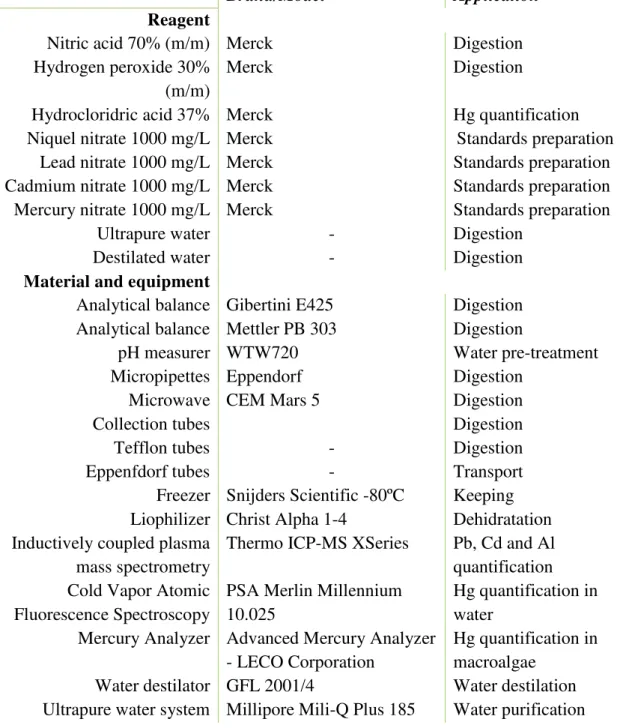
Materials, reagents and equipment used for the experimental work are summarized on Table 5.
Table 5 - Materials, reagents and equipment used in this work.
Brand/Model Application
Reagent
Nitric acid 70% (m/m) Merck Digestion
Hydrogen peroxide 30% (m/m)
Merck Digestion
Hydrocloridric acid 37% Merck Hg quantification
Niquel nitrate 1000 mg/L Merck Standards preparation Lead nitrate 1000 mg/L Merck Standards preparation Cadmium nitrate 1000 mg/L Merck Standards preparation Mercury nitrate 1000 mg/L Merck Standards preparation
Ultrapure water - Digestion
Destilated water - Digestion
Material and equipment
Analytical balance Gibertini E425 Digestion Analytical balance Mettler PB 303 Digestion
pH measurer WTW720 Water pre-treatment
Micropipettes Eppendorf Digestion
Microwave CEM Mars 5 Digestion
Collection tubes Digestion
Tefflon tubes - Digestion
Eppenfdorf tubes - Transport
Freezer Snijders Scientific -80ºC Keeping Liophilizer Christ Alpha 1-4 Dehidratation Inductively coupled plasma
mass spectrometry
Thermo ICP-MS XSeries Pb, Cd and Al quantification Cold Vapor Atomic
Fluorescence Spectroscopy
PSA Merlin Millennium 10.025
Hg quantification in water
Mercury Analyzer Advanced Mercury Analyzer - LECO Corporation
Hg quantification in macroalgae
Water destilator GFL 2001/4 Water destilation Ultrapure water system Millipore Mili-Q Plus 185 Water purification
A brief explanation about the three equipment used in this work will be given in the next sections.
1.1.Inductively coupled plasma mass spectrometry
With inductively coupled plasma mass spectrometry (ICP-MS), ions are separated and the elements quantified according to their mass/charge (m/z) relation, being the element concentration proportional to the number of ions. Ions separation is provided by a quadrupole and the detection by a multiplier of electrons with discrete dynamos. The proportionality factor between response and analyte concentration concerns only a fraction of the analyte atoms that are aspirated up to the detector in the form of ions (Pearce, 2007).
In Figure 8 is represented a scheme of an ICP-MS equipment. It has a plasma, argon (gas), torch, chamber, nebulizer, interface, quadrupole, detector and ion lens (Skoog et al., 2013).
Figure 8 - Scheme of an ICP-MS equipment (Crouau et al., 2005).
In ICP-MS, the formed ions are drawn from the plasma into the mass spectrometer by traversing an analyser which separates them according to their mass / charge ratios. The zone between the plasma and the analyser is called the interface and its main function is to ensure that a substantial fraction of the ions produced in the plasma is transported to the mass analyser. The interface consists of two metal cones, called the sampler and skimmer. The plasma is directed toward the sampler, where a fraction of the plasma can pass. An extractor lens, posterior to the skimmer, has a high negative electrical potential, which attracts the cations towards the ion analyser.
The pressure is successively reduced along the interface, practically reaching the vacuum at the input of the ion analyser (Crouau et al., 2005; Skoog et al., 2013). The role of the ion focusing system is, therefore, to carry the maximum number of analyte ions from the interface region to the mass analyser. This focusing is done through electrostatic (ionic) lenses, thus collimating the ion beam and focusing it on the mass spectrometer input aperture. In most ICP-MS, the separation of the ions is performed in a quadrupole. The quadrupole mass analyser (Figure 9) consists of four electrodes in a circle or hyperbole, two to two parallel, where a direct current potential difference and a potential difference of radio frequency exist. The combination of these potentials will determine the trajectories of the ions within the analyser.
Figure 9 - Scheme of the mass analyser of an ICP-MS – quadrupole (Crouau et al., 2005).
Ions with a given mass / charge ratio have stable trajectories inside the quadrupole and reach the detector. Ions with a mass / charge ratio higher or lower than those that describe a stable trajectory within the quadrupole have an unstable trajectory and collide with the electrodes, not reaching the end of this path (Crouau et al., 2005, Skoog et al., 2013). Therefore, the ions reach the detector and a signal is produced, whose amplitude will be related to the number of ions.
The principle of operation of this detector is based on the multiplication of electrons. When an ion falls on the first dynode causes a secondary emission of electrons that are accelerated to a second dynode, causing new emission of electrons and so on through all the dynodes. This cascade effect produces a current amplification, which can still be amplified electronically (Pearson et al., 2007).
the time at which sample wash solution is being aspirated (ultra-pure water at 1% sub-boiling nitric acid). In this work, the gas used was argon with a flow of 13 L/min. Power rating was 1400W and nebulization flow was 1L/min.
1.2. Cold Vapor Atomic Fluorescence Spectroscopy
Cold Vapor Atomic Fluorescence Spectroscopy (CV-AFS) is used in the measurement of trace amounts of volatile metals such as mercury, allowing vapour measurement at room temperature. Free mercury atoms in a carrier gas are excited by a collimated ultraviolet light source. The excited atoms re-radiate their absorbed energy (fluorescence) at this same wavelength. Unlike the directional excitation source, the fluorescence is omnidirectional and may thus be detected using a photomultiplier tube or UV photodiode. An experimental design can be found in Figure 10.
1.3. Atomic absorption spectrometry with thermal atomization
LECO’s AMA254 Advanced Mercury Analyser is specifically designed for fast, safe, and accurate determination of trace amounts of mercury in various materials. This system combusts various matrices without sample pre-treatment or concentration steps - saving valuable time.
It consists of a nickel boat in a quartz combustion tube containing a catalyst (cobalt oxalate and a mixture of manganese oxide, cobalt and calcium acetate) in which the solid sample is initially dried prior to combustion at 750ºC in an oxygen atmosphere. The mercury
vapour which is produced is trapped on the surface of a gold amalgamator. After a pre-specified time interval (120–150 s), the amalgamator is heated to 900ºC to quantitatively release the mercury which is transported to a heated cuvette (120ºC) prior to analysis by AAS using a silicon diode detector at 253.6 nm. Typical operating conditions are drying time, 30 s; decomposition time, 150 s; waiting time, 40 s. The total analysis time is 5 min (Costley et al., 2000). A scheme with an illustration of the functioning can be found on Figure 11.
Figure 11 - Schematic diagram of the AMA-254 pyrolysis atomic absorption spectrometer (Costley et al., 2000).
2. Labware washing
All the material used in this experimental work was submitted to a rigorous washing process to avoid contamination, or PTEs loss due to adsorption to material surface. Teflon tubes were firstly washed with Derquim 5%, and abundantly rinsed with tap water before being submitted to a microwave cycle (150ºC) of 10 minutes with HNO3 (40%) + HF (20%). Afterwards, they were washed with distilled water and ultrapure water. The remaining material was washed with tap water, followed by HNO3 (25%) for at least 24 hours, and finally with distilled water.
3. Seaweeds: species in the study
For this study, a green, a red and a brown macroalgae were selected, according to the company’s collection availability: Ulva rígida (Chlorophyta), Gracilaria sp. (Rhodophyta)
3.1.Ulva rigida
Ulva rigida is a green marine macroalgae that belongs to the class Chlorophyta, with its size comprised between 30 cm – 1 m, thallus a flat lamina, irregularly lacerated or deeply divided, with folded margins, surface crinkled; lamina of firm consistency in texture, almost cartilaginous, especially near the base where rhizoid-bundles form longitudinally oriented ribs. Thallus margins with microscopic teeth near the base. They are also attacked by a discoid holdfast (Braune et al., 2011).
This species is widely distributed: European and African coasts of the Atlantic; Mediterranean, Indian Ocean, Philippines; Australia and New Zealand, pacific islands; West and South Africa; Caribbean; from Alaska to California; Chile and Antarctica (Braune et al., 2011).
The taxon Ulva seems to have potential as a bioindicator due to their large size, their wide distribution, ease of collection, and bioaccumulation of PTEs capability (Haritonidis and Malea, 1999; Lee and Wang, 2001). It is considered a natural source of algal protein, carbohydrate, minerals and vitamins, while maintaining a low level of lipids. The main sterols in this group are cholesterol and isofucosterol (Kapetanovic et al., 2005).
Ulva rigida is perfectly adapted to the salinity variations occurring in estuaries due to tides, growing in a wide range of salinity (Yamashita Tomita-Yokotani et al., 2009; Costa, Crespo et al., 2011).
3.2.Gracilaria sp.
Gralilaria sp., red drift algae that resembles matted hair are considered good natural sources of carbohydrates and fibre. They have moderate levels of proteins, minerals and vitamins when compared to other varieties. In a Brazilian study (Marinho-Soriano et al., 2006), several species of Gracilaria were shown to have a high carbohydrate content (631 g kg-1) and moderate levels of protein (197 g kg-1). Jones et al., 1996 have shown that the amino acid composition appeared to be a sensitive parameter for detection of bioavailable N concentration in G. edulis.
3.3.Fucus vesiculosus
Fucus vesiculosus is a brown macroalga that has a thallus flat, strap-like, smooth or punctuated by hair pits. With a characteristic of paired float bladders, generally present but not always, on both sides of the midrib and single at the bifurcations, it is almost spherical. It has also fertile terminal sections (receptacles) bloated, rounded-oval to cushion-shaped. The discoid holdfast is basal (Braune and Guiry, 2011).
Its distribution respects to: Northern and Northeast Atlantic (Greenland to Canary Is); Northwest Atlantic (Canadian Arctic to Caribbean), and West Mediterranean (Spain) (Braune and Guiry, 2011).
Since it belongs to the class of brown algae, its cellular wall is composed by alginate, an interesting polysaccharide with many applications such as biomedical devices. This might be useful as an additional application of macroalgae apart from the food industry field.
4. Water collection and preservation
Water samples at the inlet and outlet of the tanks (n=3) containing the macroalgae included in this study were collected, immediately transported to laboratory, acidified with HNO3 (65%) to pH ≤ 2 and stored at 4ºC until analysis.
5. Seaweed collection and treatment
Samples of each seaweed species were collect from the tanks (3 replicates=3 different tanks) during the summer to winter period, making a total of 6 sampling campaigns (Table 6). Additionally, for the Ulva rigida, it was studied the effect of stocking density (high and low) and water renewal rate (high and low) in the bioaccumulation of PTEs, which results in 12 tanks monitored per sampling campaign (Figure 12). The growing period for the Ulva rigida was constant in all trials, 15 days, while Gracilaria sp. and Fucus vesiculosus were kept in the tanks for a variable periods.
Table 6 - Dates of each campaign.
Campaign Start date End date
Summer 1 28/07/2016 09/08/2016 Summer 2 08/09/2016 20/09/2016 Autumn 1 07/10/2016 19/10/2016 Autumn 2 02/11/2016 16/11/2016 Winter 1 04/01/2017 18/01/2017 Winter 2 15/03/2017 01/04/2017
Seaweed samples were washed with clean seawater, salted with locally sourced marine salt, and dehydrated at 25ºC, following the company processing methodology.
To assess the uncertainty in the analytical results related to the type of processing done by the company, fresh seaweed of the three species were also collected in each campaign and immediately frozen with liquid nitrogen.
At the laboratory, all samples were lyophilized and manually homogenized with a glass rod before analysis.
6. Water analysis
Mercury content in inlet and outlet water was determined by CV-AFS. Other elements were quantified by ICP-MS. In order to avoid matrix interferences on PTEs
TI: Aug-Apr
SD High Low
Low
High High Low
WF
(HH) (HL) (LH) (LL)
Figure 12 - Experimental design applied in the land based IMTA experiment with Ulva rigida. The influence of time (Ti — 6 levels), stocking density (SD — 2 levels) and water flow (WF — 2 levels) in
quantification by ICP-MS due to seawater high salinity, all samples, after salinity measurement, were diluted 20-fold prior analysis (in HNO3 2% v/v).
7. Macroalgae analysis
Cd, Pb and Al content in macroalgae biomass were determined by ICP-MS, after microwave-assisted acid digestion (Henriques et al., 2013; Romarís-Hortas et al., 2010; Rodénas de la Rocha et al., 2010). Acid digestion of the seaweed samples was performed using a commercial high-pressure laboratory microwave, with an energy output of 1600 W. This microwave digestion system was equipped with twelve Teflon closed vessels where the freeze-dried biomass samples (200-220 mg) were weighed into. Afterwards, 2 mL HNO3 (70%) were added and a first microwave cycle (5 min raising temperature up to 170ºC and then held at 170°C for 10 min) was run. After 20 minutes of cooling, vessels were carefully opened and 0.25 mL of H2O2 (30%) were added. The mixture was left to sit for 20 minutes in order to allow any vigorous oxidation to vent before the reaction vessels were tightened and placed in the microwave for a second similar microwave cycle. After 20 minutes of cooling, the obtained solution samples were collected into 25 mL polyethylene vessels and the volume made up with ultrapure water, being therefore weighted.
Hg content was determined by using an AMA254 Advanced Mercury Analyser - LECO Corporation (Henriques et al., 2013; Henriques et al., 2015), where analysis were performed directly in the samples, which were weighed (50-100 mg) into a nickel boat and covered with alumina in order to control the flame (and preserve the catalyst lifetime) during the decomposition of the sample.
7.1. Quality control
Procedural blanks and Certified Reference Material (CRM), ERM-CD200 (Fucus vesiculosus) were carried out in parallel with the samples, at least in duplicated, in order to ensure the quality of results, complying with ISO Guide 33:2015. ERCM-CD200 is certified for As, Cd, Cu, Pb, Hg and Zn. Values can be found on Table 7.
Table 7 - Concentrations of elements to which ERM-CD200 is certified. Analyte Concentration (mg/kg, DW) ± uncertainty As 55 ± 4 Cd 0.95 ± 0.06 Cu 1.71 ± 0.18 Pb 0.51 ± 0.06 Hg 0.0186 ± 0.0016 Zn 25.3 ± 1.7
For ICP-MS, there were prepared at least 5 standards for each element, ranging from 0.1 to 20 µg/L for Pb, 0.1 to 10 µg/L for Cd, and 1 to 250 µg/L for Al. The LQ for each element corresponded to the lowest standard concentration used.
Regarding Hg quantification in water by CV-AFS, two standards were analysed every 4 samples analysis to ensure the validity of the calibration throughout the working period. A calibration curve composed of 5 standard solutions was done. Standards were prepared in 100 mL volumetric flasks by diluting a standard solution of Hg of 1000 μg/L and using a solution of dilute nitric acid (2% v/v) as the solvent. The calibration curve was obtained by a double reading of each standard. After a good correlation between signal intensity and standard concentration (r> 0.999) being ensured, samples analysis was held. LQ was determined through the sum of mean of 10 blanks measurements and 3 x Standard deviation. Samples were always read in triplicate, and blanks were measured between each sample. LQ of this equipment slightly varied between days, however, calculated values in this work were always less than 0.05 μg/L.
For Hg macroalgae samples, at least two replicate measurements were carried out for each sample, and a maximum coefficient of variation of 10% was adopted as acceptance criteria. LQ obtained through blank measurements was 0.03 ng of Hg. Blanks were performed between all samples analysis (to guarantee that mercury was not being accumulated between samples) and certified reference material ERM-CD200 was analysed (6-10 mg) in the beginning and ending of each day in order to also ensure the quality of results.