Online Coverage of the 2010 Brazilian Presidential
Elections
Heloiza G. Herscovitz
California State University, United States of America
E-mail: [email protected]
Abstract A framing analysis of mainstream on-line organizations and their bloggers and columnists on the 2010 Brazilian Pres-idential Elections revealed that framing do have the potential to expose ideo-logical elements on how the media po-sition themselves in the public sphere. Thematic and episodic frames dominated the news with a special focus on press freedom, social and economic problems, corruption and abortion. The main-stream media focused their coverage on the Workers’ Party employing primarily a critical/ adversarial tone as opposed to an interpretive analysis tone. Profes-sional ideology mixed with political pref-erences both by journalists and media
owners marked the Brazilian online cov-erage blurring the lines between the pri-vate and the public, exactly in the same way that outgoing President Lula da Silva acted during the presidential campaign. Journalism status quo emerged as a main topic in the coverage as a free press un-der attack quickly reacted with rage caus-ing a rift between news organizations that criticized the outgoing president and those that supported him. Furthermore, a popular president apparently unaffected by corruption scandals and the country’s most powerful media groups confronted each other in an exhaustive and unfin-ished battle.
Keywords: framing, professional ideology, press freedom, election coverage, critical/adversarial tone.
B
RAZILheld general elections on Oct. 3, 2010, followed by a presidential run-off 28 days later as the country celebrated 25 years of democracy and over 15 years of Internet. During the campaign, the media produced a highly polarized and contentious coverage of the two major political parties, sometimes offering conflicting versions of events, issues and the candidates’ views depending on both the media groups and on the journalists’ political preferences. The coverage took place amid a wave of rumors and scandals ofcorruption and nepotism involving the govern of the outgoing president Lula da Silva, who left power after eight years with an 87 percent rate of popular approval – the highest in Brazilian history (Baiocchi, Braathen & Teixeira, 2012). On October 3, 136 million people voted for the three major candidates: Dilma Rousseff, of the Workers’ Party (PT), received 35.2 percent of the votes (48 million); Jose Serra, of the Party of Brazilian Social Democracy (PSDB), received 24.2 percent (33 million), and Marina Silva, of the Green Party (PV), 14.7 percent (20 million). On the second round, Brazil elected its first female president, Dilma Rousseff, with 56 percent of the votes (55.7 million) while her runner -up, Jose Serra of PSDB, received 43.9 percent (43.7 million).
Known as the “land of the future” since Austrian journalist and novelist Stefan Zweig (1941) published his book on Brazil, the country has pursued an ambiguous path toward democracy with relative success helped by an upward economic development trend since the country’s redemocratization with the end of the military rule (1964-1985). Despite the entrenched social inequali-ties, poverty, corruption and lack of urban infrastructure, Brazil has invested heavily on telecommunication services to become the fifth country in Internet use in 2011. The quick adoption of new technologies favored the expansion of online journalism, which has attracted the attention of a new generation of young readers and voters who are avid users of social media websites as well. Taking advantage of this extraordinary context and hoping to fill a gap on the empirical research field about Brazil’s political coverage characteristics, this study analyzes the general patterns of the online coverage of the 2010 presi-dential elections with a goal in mind: to explore the presence or absence of a fair, balanced journalistic style versus a contentious, partisan style of online political coverage.
Background of the problem
The current social and political Brazilian environment is a product of his-torical developments and particular characteristics that define its functioning democracy. After the 1964 military coup, supported by part of the media, the Brazilian media experienced direct censorship in the 1970s with govern-ment censors stationed in the newsrooms of the newspapers O Estado De S. Paulo, Jornal da Tarde and Tribuna da Imprensa as well as the newsweekly
magazine Veja. Self-censorship became a norm and several journalists faced torture or harassment. The most dramatic attack against media professionals was the murder of Vladimir Herzog, editor- in -chief of a state TV channel in São Paulo whose death caused a national commotion when the political police claimed that he hanged himself in a prison cell (Jorge, 1987). Only in Septem-ber 2012, a São Paulo Court finally removed the word suicide from Herzog’s death certificate, after a request endorsed by the Brazilian Truth Commission (McCoy, October 5, 2012).
After emerging in 1985 from the military dictatorship that lasted 21 years, Brazil took a solid democratic path praised by the media. However, rela-tions among media owners, journalists, politicians and government remained tense. Somewhat intoxicated by the new democratic environment in the early 1990s, the media turned into a huge political force and adopted an adversarial role by denouncing wrongdoings and producing exposés about kickbacks in the public administration, which culminated with the impeachment of former President Collor de Mello in 1992, two years after being elected by popular vote. Investigative reports published by the newspaper Folha de S. Paulo and the newsmagazines Isto É and Veja fuelled the “Collorgate“ scandal reaffirm-ing Brazilian’s media intention to act as a watchdog of government actions (Waisbord, 2000; Herscovitz, 2003). Political news in Brazil became then the product of clashes and negotiations among journalists, media owners and political parties (Herscovitz, 2003, p.120). In Matos (2008, p. 207) words, “ journalists in the last two decades. . . switched in sometimes contradictory ways between different journalism identities, assuming either a militant, de-tached and objective stance, whilst others opted for a more libertarian view and others still for a more socially responsible one.”
The absence of well-defined journalistic roles reflects the ambiguities of the Brazilian democracy and that of the Brazilian journalists themselves, who do not easily digest the American idealistic notion of objectivity. For many Brazilian professionals objectivity is a distant ideal – a position also debated by many American professionals. Because of the problematic definition of ob-jectivity, the concept was left aside in this study. However, accountability and responsibility are in the minds of Brazilian professionals and they frequently appear in responses to surveys and personal interviews. An online survey answered by 506 journalists in 2009 indicated that 79% fully embraced an investigative/interpretive media role (as they did in previous surveys in 1998
and 1994), and almost 42 percent preferred to avoid stories with unverified content. Their position indicated they favored an interpretive/analytical role as opposed to a critical/adversarial role. Furthermore, only 14.6 percent of the journalists surveyed in 2009 favored serving as an adversary of government (Herscovitz, 2012).
Moving ahead amid unresolved professional issues, in the last two decades the news media realigned its priorities in synch with global trends and launched a full-blown media convergence process sustained by a highly concentrated media marketplace. Aiming for a strong online presence, the nation’s largest news organizations have developed a strong online presence that helps to give visibility to their sister companies in broadcast and in print media. Traditional family-owned companies, for example, have replaced family members by pro-fessional management and, in many cases, have combined their business in one holding company with stock options. In essence, old family-owned me-dia businesses have turned into corporations with multiple interests, attending stockholders interests by keeping up with economic goals but neglecting jour-nalism’s public service commitments (Herscovitz, 2009). In this sense, media companies have embraced Brazil’s neoliberal economic policies, which in the last few years contributed to the rise of a stronger middle class, an online population of 78 million people, which is larger than the total population of Spain, France or UK, the world’s third-largest market for PCs, and the world’s fifth-largest market for mobile phones (Geromel, March 29, 2012).
In December 2011, for example, about 39 percent of the population were Internet users, mostly between 16 and 24 years old (81 percent), spending an average of 26.7 hours online by mostly visiting portals (39% of total online minutes), followed by social media (23 percent), according to the 2012 Brazil Digital Future in Focus Report publishd by ComScore and IBOPE Nielsen Online. Also remarkable is the fact that the Internet has surpassed newspapers as the second-most preferred medium for advertising investments in Brazil during the first quarter of 2012, after television, of course, although newspaper circulation continues to grow driven by popular newspapers – just the opposite of what is happening in several developed nations (Mazotte, July 16, 2012).
Currently, the largest news organizations in Brazil have a strong online presence and almost all are key players of national media conglomerates. Ac-cording to the independent database Donos da Midia (Media Owners), Brazil has 41 national media groups, which own a total of 551 outlets. There are
an-other 142 regional media groups, which control 688 smaller outlets. Nonethe-less, the direct relationship between the media and politics is still present: a total of 271 politicians, from house representatives to senators, are partners or directors of 324 media outlets (Donos da Midia, 2012).
The modernization of the Brazilian media industry has stimulated the rise of professionalism in Brazilian newsrooms as in the case of the daily news-paper Folha de S. Paulo, which in the 1980s promoted an internal reform to offer “ a critical, nonpartisan and plural form of journalism” with the goal to address the reader “more as a consumer than a citizen” (Mattos, 2008, p.68). Similarly, other major media companies moved in the same direction as the Globo Organizations, owner of the country’s largest television network with 122 broadcasting stations - 117 of which are affiliates - and a total of 28 com-munications companies, and as the Abril Group, publisher of over 60 print magazines “committed to contributing to the dissemination of information, culture and entertainment, the progress of education, the improvement of qual-ity of life, the development of free enterprise and the strengthening Brazil’s democratic institution” (April Group institutional homepage, 2012).
This liberal view embraced by some Brazilian media companies inspired by the American market economy work well in their business and marketing divisions, but face problems in their newsrooms, where news are engendered several times a day as a result of many uncontrollable variables. In this sense, Brazilian journalism matches Waisbord’s view that “South American journal-ism looks northward for inspiration but finds the orthodoxy of U.S. investiga-tive journalism impossible” (Waisbord, 2000). The world where American journalism operates is distant to the Brazilian world, plagued by corruption and nepotism, lack of safety and proper work conditions. In the latter, media professionals work under all kinds of pressures and frequently gather informa-tion about wrongdoings by using unorthodox methods, sometimes following their own political interests or the political interests of their employers and as-sociates. Moreover, media professionals and media owners tend to share very distinct political views.
Contentious journalistic practices have its roots in the past, when the old French model of journalism made a huge impact in Brazilian newsrooms. In the 19thcentury, French liberal ideals inspired Brazilian newspapers to adopt
an advocacy model, and French immigrants owned many of these newspa-pers for several decades (Bahia, 1990, p. 41). By the end of the 19thcentury,
Brazilian newspapers were modeled after The Times of London and Les Temps of Paris. The larger newspapers of São Paulo and Rio de Janeiro filled their pages with political topics employing a virulent language. The focus on pol-itics neutralized the literary influence, but the journalistic language as it is known today was absent (Sodré, 1983). The first signs of the American influ-ence on Brazilian newspapers appeared in the 1920s, once economic and polit-ical interests held by the United States replaced traditional European interests in the country at the end of the World War I. In 1926, American publishers laid the ground for the creation of the Inter American Press Association in a meeting in Washington. According to Lins da Silva (1991), 14 Brazilian del-egates went to the meeting. Such proximity translated into a strong economic and cultural American influence in Brazil. After the 1940s, Brazilians became more familiar with American film, music and literature. Yet the European cul-tural influence was very strong in the academic field. Between the 1930s and the 1940s, local elites financed the establishment of French and Italian cultural missions in São Paulo, which brought scholars such as Braudel, Lévi-Strauss, Bastide and Ungaretti to teach sociology, anthropology and philosophy at the University of São Paulo (Motta, 1977). The French model was reactivated in an organized fashion to agree with the expectations of the traditional oligarchy of São Paulo (Motta, 1977, p.33).
The flow of Brazilian journalists and writers to the United States increased in the next decades as many of these journalists sought the application of el-ements of the American style to Brazilian papers. Nóbrega da Cunha (1941) noted that American newspapers influenced the substitution of what was called artigo de fundo (long analytical article) by editorials and columns. Those long analytical articles had an introduction known as nariz de cera (nose wax), which preceded the core of the story (Jobim, 1954; Lins da Silva, 1991). A more radical influence took place in 1943, when journalist Pompeu de Souza returned from a trip to the United States, where he worked for Voice of Amer-ica, and introduced a more homogeneous and objective writing technique at the Diário Carioca through the use of the inverted pyramid and the creation of the first newspaper stylebook. Also, Samuel Wainer (1987), another famous Brazilian journalist, adapted American concepts on format and content to his paper Ultima Hora in the same decade. The old French model left strong roots in Brazil. In a seminar at the University of Texas in 1953, journalist Danton Jobim, then editor-in-chief of Diário Carioca, explained to
Ameri-cans why Brazilians and other Latin AmeriAmeri-cans identified themselves more with the French model of press than with the American model:
The French, like the Brazilians or the Argentines, prefer improvisation. . . This is at the same time a good quality and a defect. As a good quality, it permits a greater expression of the journalist’s personality, more originality in the daily production of the paper. As a defect, it carries the disadvantage of not considering conditions created by mass circulation and the industrializa-tion of the press. The French paper tells its news in a predominantly literary tone...No marked frontier exists between journalistic and literary work in France. And Brazilian papers reflect this effort to emphasize literary style. (Jobim, 1954, p. 62)
Jobim argued that the French and the Latin Americans disliked calling journalism a business; they preferred to see it as a craft or a priesthood. Even though he admitted that Brazilian papers had started to adopt a more concise and factual style, he claimed that the very core of local journalism was in its political flavor. To Jobim, the Brazilian readers of the 1950s demanded far more than news. They liked political crusades and expected from the edi-tor a combative attitude. Furthermore, Jobim stressed the difference between the style of American democracy, in which people respect their form of gov-ernment and there are only two political parties, and that of France and of Latin American countries, which offer a variety of concepts of democracy and many political parties. Such political unrest, he argued, translated into an active press. Today, the old French tradition is gone, new generations of jour-nalists ignore this part of Brazilian media history, and even the French media is distinct from that of the past. But the Brazilian democracy works in mys-terious, contradictory ways ways and its media seem to function accordingly. As Merryll (1989) once said, “the journalism of a nation cannot lag behind the general development and values of the society, nor can it exceed the limits permitted by the society.”
Theoretical Framework
This study explores how Brazilian online news organizations and their columnists and bloggers framed the 2010 presidential elections. It employs a rather qualitative framing analysis. Reese (2003, p. 7) says that framing helps to understand the media’s role in political life. Claiming that framing offers a
more “nuanced approach than traditional content analysis”, Reese also states that frames are a result of social and institutional interests, even if not inten-tionally, and they reflect the ideological character of news. Framing, there-fore, is an “exercise in power, concerned with the way interests, communi-cators, sources, and culture combine to yield coherent ways of understanding the world” (Reese, 2003, pp. 10-11). Elite sources and professional ideology influence the framing judgments produced by journalists, but the list of influ-ences on media content is a long one. Individual preferinflu-ences by reporters and editors, newsrooms routines, news organizations policies, a variety of extra media aspects (advertising, PR efforts, political lobby and government pres-sures) and ideology also play a role on how the news help to shape popular perceptions (Shoemaker & Reese, 1996). Open to so many sources of in-fluence, the news turn into simplifications about the nature of politics. And, as Bennett (1997, p. 108) explains, the news end up being a daily negotia-tion among various actors involved in the process: “Political actors seeking to control news content, journalists who operate simultaneously within a pro-fession dedicated to informing citizens and a business that sells a product to audiences, and those citizens and audiences who are also members of a culture for whom the news must ring true with what they believe about themselves as people.”
There are many definitions for frames. A traditional one states that a frame is “a central organizing idea for news content that supplies a content and sug-gests what the issue is through the use of selection, emphasis, exclusion and elaboration” (Tankard et al, 1991). Entman (2004) views frames as part of the reporting process of political events, issues and actors often appearing together in the same set of news stories. Framing, he claims, “ promotes in-terpretations that lead to evaluations” (2004, p. 26).
Understanding how journalists frame political campaigns and, in this par-ticular case, how they framed a presidential election in a country with a recent democratic tradition, is important because voters have no escape from fram-ing, even though they carry their own interpretations of political events, issues and candidates based on their prior beliefs and interpretations (Entman, 2004). This paper uncovers the frames used by online news organizations to define the 2010 Brazilian presidential elections employing a framing analysis.
RQ1: What were the main frames present on the online coverage of the 2010 Brazilian presidential elections?
RQ2: What were the main issues discussed by the online coverage during the campaign?
RQ3: Did the online coverage offer a more a critical/adversarial view or a more interpretive/analytical view of the presidential elections? RQ4: Did the online coverage tilt toward a more professional and
bal-anced coverage or toward a less professional and balbal-anced coverage?
Methodology
A total of 650 news items (news stories, columns and posts from blogs) were collected during a 30-day period, two weeks before election day (from September 19 to October 2), one week after the first round (October 3, elec-tion day, to October 10), one week before the second round (October 25 to October 31), and two extra days after that (November 1st and 2nd). News items were collected online once a day directly from the websites of the fol-lowing Brazilian websites: three news portals (UOL, Estadão and G1), two newsweekly magazines (Veja and Isto É), seven columnists and bloggers pub-lished by these news organizations, and two well-known traditional political columnists of Jornal do Brasil and Tribuna da Imprensa.
News portals UOL, Estadão and G1 are affiliated with the largest media companies in Brazil. UOL (Universo Online), the largest Internet news service in Brazil, belongs to Grupo Folha, one of the main national conglomerates in the country, owner of the daily newspaper Folha de S. Paulo and many other business. Created in 1996, the company that pioneered the development of the Internet in Brazil resulted from a partnership between two large and pres-tigious Brazilian family-owned media corporations: Grupo Folha and Editora Abril. Its interactive platform offers communications products, VoIP, Internet communities, security and search engine, among others. Estadão belongs to Grupo Estado, a traditional family–owned media corporation and publishing group that includes a national news agency, two daily newspapers, a radio station and several other businesses. Estadao is the electronic version of the company’s news agency, created in 1970, but its newspaper O Estado de S. Paulo appeared in 1875. G1 is a news portal owned by Globo Organizations,
the largest media conglomerate in South America and one of the top media companies in the world. Globo Organizations owns Globo TV Network, a major television company with hundreds of affiliated stations, several radio stations, cable and telecommunications interests, major newspapers such as O Globo and Valor Economico, magazines, record and film companies. The newsweekly magazine Veja, the third largest weekly information magazine in the world and the largest outside the United States, belongs to the Abril Group, publisher of 52 titles in the country and owner of the MTV Brazil. The newsweekly magazine Isto É belongs to Editora Três, which owns other several other weekly and monthly magazines. The other two publications, Jornal do Brasil and Tribuna da Imprensa – currently available only online --had an important role in the history of the print media in Brazil either because of its editorial innovations, as in the case of JB, or because of its political positions, as in the case of Tribuna. Only their major political analysts were included in this study.
Bloggers and columnists analyzed in this study included Josias de Souza and Fernando Rodrigues (UOL); Rolf Kuntz (Estadão); Ricardo Noblat (G1-Globo); Reynaldo Azevedo and Augusto Nunes (Veja); Paulo Moreira Leite and Leo Attuch (Isto É); the daily columns Estadao Radar Politico and Veja Radar Online; and the two most traditional political columnists in Brazil, Vil-las Boas Correa, the oldest political commentator in the Brazilian media, then writing for Jornal do Brasil, and Carlos Chagas, then writing for Tribuna da Imprensa (his column is reproduced by several newspapers and websites in Brazil); and, finally, Arnaldo Jabor, a commentator for CBN AM satellite ra-dio system/website, which belongs to Globo Organizations. CBN, known for its popular slogan “the radio that plays news”, has 184 affiliated stations. It is the largest radio system in Brazil.
The analysis of the 650 news items resulted in the coding of 1,300 frame units (some of the news items had more than one frame). Of those 1,300 frame units, 40 percent came from regular, medium size news items published by news portals and online pages of magazines, while 60% came from short posts published by bloggers and full pieces written by columnists. All units were coded according to the following major frames: episodic, thematic, horse-race, and personality-centered. These four major frames have been employed in the past by researchers in the United States and in Brazil (Bennett, 1988; Iyengar, 1991; Patterson, 1993; Hallin, 1994; Porto, 2001). Episodic frames
referred to campaign events and strategies, facts or actors’ statements (Porto, 2001), their public appearances, their use of social media, and their exchange of accusations. Thematic frames included news items focused on candidates’ positions on issues, policies and proposals. The horse-race frame centered on polls and candidates’ performances (“who is winning the game”), while the personality-centered frame centered on news stories that focused on the per-sonal characteristics of the candidates, their lifestyle, attitudes and behavior. In addition, the sample was coded according to a critical/adversarial tone or an analytical/ interpretive tone. The study also measured the frequency of posi-tive/negative/neutral references to candidates’ personalities and their political parties.
Findings
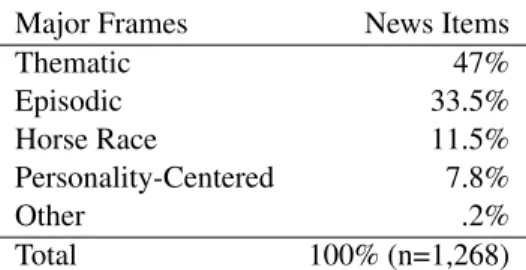
This study collected a total of 1,300 frame units from 17 online sources among news portals, newsweekly magazines (updated daily), bloggers and columnists during a 30-day period from September 19 to November 2, 2010. Overall, thematic frames dominated the news by 47 percent, followed by episodic frames with 33.5 percent, horse race frames with 11.5 percent and personality-centered frames with 7.8 percent. There were no significant dif-ferences in frequencies on the four major frames between news published by portals and online magazines in their regular political sessions and posts or columns by their bloggers and columnists. However, more differences ap-peared on how news portals/magazines and bloggers/columnists treated each issue in the thematic frame.
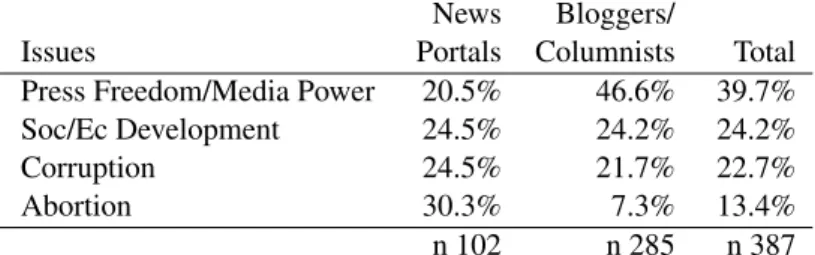
The thematic frame focused in four major issues: press freedom (39.7 per-cent), social/economic development/infrastructure problems (24.2 perper-cent), corruption (22.7 percent), and abortion (13.6 percent). Other issues such as environment, religion, history, and national values appeared at a very low per-centage so they were dropped from the final calculations. Corruption was ex-pected to be the main issue discussed by the media during the campaign and it was up to a point where outgoing President Lula da Silva complained about the media’s tone against his party and himself when referring to the many corruption cases registered in the country between 2004 and 2010 related to money laundering and manipulation of large government contracts, including
Table 1: Classification of news items according to major frames
Major Frames News Items
Thematic 47% Episodic 33.5% Horse Race 11.5% Personality-Centered 7.8% Other .2% Total 100% (n=1,268)
the 2005 Mensalão scandal. The latter involved high-ranking members of the government accused of making monthly payments to opposition politicians and lawmakers in exchange for political support. In addition, the Workers’ Party was accused of using illicit funds to finance the election campaigns of members and allies. The investigation moved on quietly, especially because the media were busy with other scandals. Finally, the Supreme Court tried the biggest corruption trial in Brazilian history in 2012. It did not implicate President Lula, but has sentenced 25 politicians, bankers and business people, including President Lula’s former chief of staff, José Dirceu, and the party’s former president, Jose Genoino.
Corruption is considered an endemic problem in Brazil since colonial times. According to Transparency International, an organization dedicated to fight corruption worldwide, on a scale from 10 (very clean) to 0 (highly corrupt) Brazil had a level of corruption of 3.7 in 2010. By 2011, Trans-parency International Global Corruption Barometer announced that 64 percent of Brazilian respondents to its international survey believed that corruption had increased in Brazil in the past three years, with political parties, the police and judges seen as the worst offenders. Several organizations have discussed the problem, but the country lacks an accountability system. In October 2011, the Congress passed a comprehensive Freedom of Information Law, requiring authorities to publish information on spending and forcing them to respond to citizen requests for information, but media reports did not show much en-thusiasm toward it neither the NGO Transparência Brasil, which monitors the nation’s accountability sources.
The emergence of press freedom as a major topic discussed by the media during the campaign turned into a war between the news organizations that supported the Workers’ Party and those that supported the PSDB but, above all, a war was declared between the larger media and the government. Sev-eral media critics claimed that news organizations acted as political parties, did not operate freely neither produced a high -quality coverage during the campaign. However, it was a common belief that the president did not mea-sure his words as well. During a rally on September 9, 2010 President Lula said that besides defeating his adversaries, “he would defeat newspapers and magazines that behaved as political parties.” In addition, he promised to “de-stroy the news organizations that denounced the recent corruption scandals”. He said he would not apply any censorship to them but that the public opin-ion would do so (Dines, September 9, 2010). In his column for Observatório da Imprensa, Brazil’s number one online publication dedicated to media crit-icism, journalist Alberto Dines (September 20, 2010) wrote that “President Lula attacked the media and as payback the media adopted a vicious behav-ior”. In Dines’ view, the media turned in to opposition, which is incorrect, but at the same time the media reacted to the president’s intervention favoring his candidate Dilma Rousseff.” President Lula lost control when the newsweekly magazine Veja and the daily newspaper Folha de S. Paulo published details about the Erenice Guerra scandal described below, and also when the media complained that he stopped working as a president to campaign for his candi-date Dilma Rousseff. “The media’s accusations were consistent to the point that the government quickly reacted. However, the media disrespected the ba-sic journalistic canons for relying too much on suppositions and speculations” (Dines, September 24, 2010).
The coverage moved on centered on threats to press freedom. The Work-ers’ Party referred to the topic as media power. It became a major topic for bloggers and columnists (47.8 percent) while news portals and magazines con-tinued to focus mostly on corruption (24.5%). Headlines on threats against press freedom became virulent. Veja wrote: “President Lula is obsessed with fighting media freedom. . . security does not allow journalists to speak freely to Dilma.” President Lula argued that Veja “distilled hatred and spread lies.” G1 published that Serra, of PDSB, contrary to President Lula, “would not court countries that suppress press freedom and that stone women as Iran.” President Lula claimed that press freedom “did not mean freedom to lie,”
Table 2: Frequencies of main issues discussed by the media during the campaign
News Bloggers/
Issues Portals Columnists Total
Press Freedom/Media Power 20.5% 46.6% 39.7%
Soc/Ec Development 24.5% 24.2% 24.2%
Corruption 24.5% 21.7% 22.7%
Abortion 30.3% 7.3% 13.4%
n 102 n 285 n 387
while the National Association of Newspapers regretted the President’s com-ments against the media. The tone of posts by bloggers became fully antago-nistic as the election got closer to the second round. Here are some examples: – Estadão Radar Online: “Jose Dirceu defends media regulation and
com-plains being called a political gangster.”
– Josias de Souza of UOL: “Journalists Union support PT and say the media are biased. “ This particular blogger in one of his posts admitted that a few groups and politicians controlled the media.
– Reinaldo Azevedo of Veja: “Government wants a lapdog media instead of a watchdog media”; and “The media is a scape goat.”
Folha de S. Paulo’s journalist Fernando Rodrigues has kept track of every corruption accusation case in the political system since 2009. In 2010, his monitor of political scandals registered 42 cases involving different political parties in the Congress. One particular scandal made headlines a few days before the election’s first round: the alleged accusation that President Lula’s chief of staff, Erenice Guerra, and her son were involved in a scheme to obtain public works contracts between government agencies and private companies in exchange for a 6 percent fee plus special payments. Erenice Guerra, who took over the role after her predecessor, Dilma Rousseff stepped down to run for president, resigned quickly. Erenice Guerra was succeeded by Antonio Palocci, who later resigned due to corruption accusations as well along with several other ministers during Dilma Rousseff’s first two years in power. Ex-perts believe that president Dilma Rousseff did not get elected in the first turn because of the Erenice Guerra’s scandal. In July of 2012, a federal court
dis-missed the case, and the media reported that Erenice Guerra was back to work as a lobbyist for private companies at government agencies.
It is in this context that the either gloomy or virulent headlines published by the online media analyzed here must be understood. Estadão, for example, offered headlines such as “Candidates are populists and demagogues”, “Vot-ers are misinformed and accept impunity”, “Lula sold his soul to the devil to stay in power”. UOL had headlines such as: “Lula says the media lie about corruption cases.” G1 had headlines such as “Dilma says that those engaged in illegal practices should be punished,” and “Dilma denies she knew any illegal activities at the Chief of Staff Office.” Veja, whose virulent language topped all other news organizations’ headlines, published: “Chief of Staff operated a business desk dealing with bribes to influence illegal activities and wrong-doing”; “If elected, Dilma will have to deal with government scandals and corruption”. Less belligerents news organizations such as Isto É published, “Erenice says she cannot control her son’s work;” “Erenice says she as victim of a defamation campaign.” Isto É reminded readers of problems faced by the opposition candidate: “Serra does not explain accusation of nepotism”; and “Serra suspected of giving preferential treatment while Sao Paulo’s governor.” Bloggers and columnists frequently published raw statements about the topic:
Ricardo Noblat of IG-Globo: “Lower moral standards and repetition of scandals cause citizens to doubt the system. By firing those accused of corrup-tion, the government confirms media’s accusations of corruption”; “Scandal involving President Lula’s former minister Antonio Palocci is back to news”; “14 of Erenice’s family members had jobs in the government over 15 years”; “Dilma’s victory will be associated to illegitimacy, manipulation and dirty game;” and “Government uses public television to campaign for Dilma.” Oth-ers followed similar steps such as Augusto Nunes of Veja: “Government lacks ethics; crooks, authoritarians and scumbags control the government; ” Dilma calls corruption cases factoids." Villas Boas Correa, of JB: “Brazilian politics are a circus,” “No doubt Erenice Guerra was unethical.” Carlos Chagas of Tri-buna da Imprensa: “Kick back schemes for public work contracts have hap-pened because of former President Fernando Cardoso’s privatizations.” Ar-naldo Jabor of CBN Radio Network: “Corruption is open and growing, but the govern deconstructs corruption crimes.” Josias de Souza of UOL wrote: “Voters enjoy economic development, don’t pay attention to corruption.”
And Arnado Jabor of CBN explained: “Corruption is open and growing, but the government deconstructs corruption crimes.”
Interestingly, frames on socio-economic development and infrastructure were slightly more frequent than corruption, but no so loud. Most news items complained that candidates did not present their plans on social and economic development. Josias de Souza of UOL wrote that both Dilma Rousseff and Jose Serra lacked a government plan and only made vague promises. He lamented that “ the major candidates are economists but do not discuss eco-nomic problems.”
Rolf Kuntz of Estadão stated that the Brazilian economy was “an ab-stract topic for voters and candidates.” Augusto Nunes of Veja used an ironic tone: “Candidates pretend they live in Norway during debate.” He wrote that Dilma Rousseff knew nothing about culture and had “grotesque ideas” about it. The sample reflected a general sense that the presidential campaign lacked a real debate on important issues such as poverty, education, public health and safety. Other columnists wished Dilma Rousseff explained her position on privatizations and clarified whether she would embrace or reject neoliberal policies such as Carlos Chagas.
The campaign took a dull, flat course, and so did the media coverage un-til new headlines popped everywhere about a new issue or, as most bloggers agreed, a non- issue called abortion. Although abortion is illegal in Brazil except in cases of rape or if the mother’s life is at risk, it is a common prac-tice estimated to cause the death of thousands of women per year. The de-criminalization of abortion suddenly became news mostly on news portals and magazines brought by contradictions picked by the media on opinions voiced by Dilma Rousseff in the past (she favored the decriminalization of abortion once), and by Jose Serra against it as a strategy to gain the support of undecided Catholic and Evangelical voters. The media discussed the topic exhaustively and employed a sensationalistic style. The two major candidates publicly clashed on the controversial topic and both denied their support to the free practice of abortion. A few bloggers that mentioned the topic considered that Brazil went back to the past when discussed God, family and abortion. An expert interviewed by the newspaper O Estado de S. Paulo nailed the subject when she reminded journalists and voters that abortion was a public health matter (Martins de Almeida, December 10, 2010).
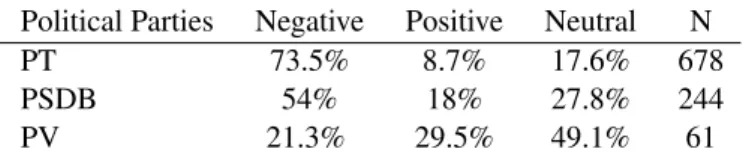
Table 3: Frequencies on Positive, Negative and Neutral Perceptions about Political Parties
Political Parties Negative Positive Neutral N
PT 73.5% 8.7% 17.6% 678
PSDB 54% 18% 27.8% 244
PV 21.3% 29.5% 49.1% 61
Episodic frames were the bread and butter of the presidential coverage dominating 33.5 percent of the news. Campaign strategies, rallies, candi-dates’ use of social media, exchange of accusations among the two top can-didates and information on who support who received a superficial treatment and filled the online coverage with pictures and videos. Personality-centered frames were the least employed by all publications but they carried mostly a negative tone. Eighty percent of the personality-centered frames were nega-tive and only 19 percent were posinega-tive. President Lula was frequently called unethical and demagogue by Veja, Estadão and UOL. G1 repeated the same accusations but cited other media as sources. Bloggers and columnists work-ing for these media companies followed the same pattern. Isto É frequently sided with President Lula while one of its bloggers took a favorable approach to President Lula/ candidate Dilma Rousseff and an unfavorable approach to candidate Jose Serra while the other blogger was critical of both candidates. Political analyst Villas Boas Correa noted that “ big papers tried to demolish Dilma’s candidacy,” but criticized candidates of both major parties. Political analyst Carlos Chagas considered Dilma’s candidacy artificial (she had never run for public office before), and wrote that President Lula “behaved as a king.” Chagas harshly criticized Jose Serra as well: “A demagogue that does too many swift promises.”
Contrary to a common trend in American political coverage, the Brazilian coverage paid little attention to the frame horse race (11.5 percent). Refer-ences to the horse race centered on the media’s distrust on polls, the differ-ences in poll measurements, and on how research institutes needed to correct their errors. Special attention was given to how research institutes feared men-tioning vote abstentions.
Table 4: Frequencies of Critical/Adversarial, Interpretive/Analytical and Neutral Tones in connection to Thematic and Episodic Frames
Frames Critical/Adversarial Interpretive/Analytical Neutral N
Thematic 72.8% 19.6% 7.5% 586
Episodic 52% 16.8% 31% 438
The data reveals that the Workers’ Party of President Lula and Dilma Rousseff received most of the criticism during the presidential campaign (73.5 percent) with 17.6 percent of neutral references and only 8.7 percent of posi-tive ones. In contrast, the media spared the PSDB of Jose Serra: his criticism topped 54 percent but he also received almost a third of neutral frames. The Workers’ Party dominated the news (68.9 percent) while PSDB was men-tioned in only 24.8 percent of the frames. At the end of the presidential campaign, the newspaper O Estado de S. Paulo of Grupo Estado supported Jose Serra’s candidacy in an editorial; and columnist Augusto Nunes of Veja suggested that Jose Serra was the least-worse candidate. Although indirectly, Isto É ‘s coverage supported the Workers’ Party. The most balanced coverage based on the analysis of this sample came from G1 of Globo Organizations and UOL of Grupo Folha. The third candidate, Marina Silva of the Green Party, received little coverage (6.2%) but the media treated her with respect and curiosity. Almost half of the frames that included Marina Silva had a neutral tone and almost a third had a positive one. In many news items, how-ever, she was referred only as “the third candidate.” Blogger Ricardo Noblat of Globo Organizations wrote that “Marina Silva gave Brazil a chance to think”, and Arnaldo Jabor of CBN said, “Marina brought humanity back to campaign.” Marina Silva left the political scene quietly after conquering 20 million votes on the first round. She did not support Dilma Rousseff neither Jose Serra on the second round.
Finally, this study analyzed whether the media coverage of the 2010 Brazil-ian presidential elections employed a more critical/adversarial tone or a more interpretive/analytical tone in connection to thematic and episodic frames.
The data indicates that the tone of the thematic frames, which involved commentaries and news about press freedom, corruption, social and economic development and abortion, was mostly a critical/adversarial one (72.8%). In
addition, half of the episodic frames centered on campaign strategies, ral-lies, candidates’ use of social media, exchange of accusations among the two top candidates and information on who support who had a critical/adversarial tone as well. Percentages of interpretive/analytical tones on both thematic and episodic frames covered less than 20 percent of each of these frames. The presence of a neutral tone on thematic frames was marginal (7.5 percent) while about one third of the episodic frames carried a neutral tone (31 percent).
Conclusion
An analysis of the online coverage of the 2010 Brazilian presidential elec-tions indicated that framing do have the potential to reveal ideological ele-ments on how the media position themselves in the public sphere. Profes-sional ideology mixed with political preferences both by journalists and media owners marked the Brazilian online coverage blurring the lines between the private and the public, exactly in the same way that President Lula acted dur-ing the presidential campaign. Journalism status quo emerged as a main topic in the coverage as a free press under attack quickly reacted with rage causing a rift between news organizations that criticized the outgoing president and those that supported him. Furthermore, a popular president apparently unaf-fected by corruption scandals and the country’s most powerful media groups confronted each other in an exhaustive and unfinished battle. The current President Dilma Rousseff, considered by the media as President’s Lula third term, has promised to respect press freedom and basically avoided direct con-frontations. However, her Worker’s Party has discussed a program to regulate the media supported by Fenaj, the National Federation of Journalists, and by other left-wing sectors and criticized by the mainstream news organizations. Meanwhile, international institutions such as Freedom House (2012) consider that Brazil has a free Internet but its media are only partially free. This index has remained in the same position for several years although Brazil is now considered a full democracy. Violence against journalists is a frequent issue as well.
A core problem unveiled by this study lies in the behavior of news orga-nizations and their professionals. Still searching for their true identity under the country’s current level of democracy, journalists act as hard core
watch-dogs using unorthodox methods seasoned by a strong political flavor, the one praised by Jobim in the 1950s. They miss, however, the restraint, the poise, and their ability to offer proofs as opposed to suppositions and speculations as explained by Dines (2010). This is probably why the political coverage fa-vored a critical/adversarial tone instead of an interpretive/analytical one. One last detail deserves attention: the online mainstream media was so entrenched on its political battle against President Lula that they overlooked the fact that Brazil had elected its first female president. The significance of electing a female president in a male-dominated culture is certainly a theme for further research.
This study had several limitations. A complimentary online survey con-ducted a couple of months after the elections with online journalists, mostly bloggers and columnists, did not enter this analysis. The researcher con-sidered that the survey received a low response and that the most appropri-ated method would had been personal interviews conducted in the newsrooms where these professionals spend most of their time. Furthermore, one key ingredient would have given further insights on the framing of the 2010 pres-idential elections: the perceptions of the readers, the Internet users who cer-tainly had their own opinions on what really went on in Brazil in the spring 2010.
References
Abramo. C. (Feb 2, 2012) Interview to Conexão Jornalismo. Retrieved from
http://www.conexaojornalismo.com.br/colunas/entrevista/ personalidade/conexao%09-jornalismo-claudio-abramo-alerj-e-seus-26-acusados--60-85.
Abril Group Institutional Homepage website. Retrieved fromhttp://www. grupoabril.com.br/IN/institucional/sobre-abril-in.shtml.
Baiocchi, G., E. Braathen, and A. C. Teixeira (2012) Transformation Institu-tionalized? Making Sense of Participatory Democracy in the Lula Era.” In Stokke C. and O. Thornquist (eds.), Democratization in the Global South: The Importance of Transformative Politics. London, UK: Pal-grave McMillan.
Bennett, W. L. (1997). Cracking the news code: Some rules that journal-ists live by. In S. Iyengar & R. Reeves (Eds.). Do the media gov-ern? (ComScore and the IBOPE Nielsen Online (November 1st, 2012). Brazil Digital Future in Focus Report. Retrieved from http://www.
newmediatrendwatch.com/markets-%09by-country/11-long-haul/42-brazil.
Costa, F. (July 7, 2012). Justiça Federal arquiva inquerito contra ex-chefe
da casa Civil. Retrieved from http://g1.globo.com/politica/
noticia/2012/07/justica-federal-%09arquiva-inquerito-contra-ex-chefe-da-casa-civil.html.
Dines, A. (September 9, 2010). Mais jornalismo, menos panfletagem. Re-trieved from http://www.observatoriodaimprensa.com.br/ news/view/mais_jornalismo_menos_%09panfletagem. Edi-tion 607.
Dines, A. (September 20, 2010). Presidente enfrenta a imprensa. http:// www.observatoriodaimprensa.com.br/news/view/presidente-enfrenta-a-imprensa.Edition 607.
Donos da Midia (Media Owners). Retrieved from
http://www.donosdamidia.com.br/.
Entman, R.M. (2004). Projections of Power, Framing news, Public Opinion, and U.S. Foreign Policy. Chicago: The University of Chicago Press. Herscovitz, H. G. (2003). Social and Institutional Influences on News Values
and Routines in Brazil: from Military Rule to Democracy. M. Salwen, K. Anokwa & C. J. Lin (Eds.) In International Communication: Concepts and Cases, pp. 110-128.
Herscovitz, H. G. (2005) “Media roles and ethics: perceptions of Brazil-ian, American and French journalists.” Brazilian Journalism Research, Brazil, vol. 1, no. 1, pp. 87-109.
Herscovitz, Heloiza G. (2009) Brazilian News Portals Characteristics. Brazil-ian Journalism Research, Brazil, 5 (1), 99-122.
Jobim, D. (1954). French and U.S. influences upon the Latin American press. Journalism Quarterly, 31, 61-66.
Lins da Silva, C. E. (1991). O adiantado da hora, a influência Americana sobre o sociologia da imprensa Brasileira. São Paulo: Vozes.
Martins de Almeida, L. (December 10, 2010). Aborto na campanha e na
pauta. Retrieved fromhttp://www.observatoriodaimprensa.com.
br/news/view/aborto-na-campanha-e-%09na-pauta.
McCoy, D. (October 5, 2012). In the news. Transitional Justice in Brazil (Memory Politics and and the Brazilian Military Dicratorship). Retrieved fromhttp://transitionaljusticeinbrazil.com/2012/10/05/ in-the-news-since-weve-been-out/.
Matos, C. (2008). Journalism and political democracy in Brazil. Plymouth, UK: Lexington Books.
Mazotte, N. (July 17, 2012). Knight Center Bulletin for Journalism in the
Americas. Retrieved fromhttp://knightcenter.utexas.edu/blog/
00-10485-brazil-internet-surpasses-newspapers-becoming-second-most-preferred-medium-advertising.
Merrill, J. C. (1989). The dialectic in journalism: Towards a responsible use of the press freedom. Baton Rouge, LA: Louisiana University Press. [2028?].
Motta, C. G. (1977). Ideologia da cultura brasileira. São Paulo: Ática. Nobrega da Cunha, C. A. (1941). A imprensa Americana e seus reflexos no
Brasil. Rio de Janeiro: Instituto Cultural Brasil-Estados Unidos.
Geromel, R. (March, 29, 2012). What’s Brazil’s most promising sector.
Re-trieved from http://www.forbes.com/sites/ricardogeromel/
2012/03/29/what-is-brazils-most-promising-sector/.
Patterson, T. E.[2028?](1993). Out of order. New York: Vintage Books. Reese, S.D. (2003). Framing public life: A bridging model for media
re-search. In S D. Reese, O.H. Gandy, Jr. & A.E. Grant (Eds.) Framing public life (pp. 7- 31). Lawrence Erlbaum: Mahwah. NJ.
Rosa, D. M., & Fajardo, C. (August 7, 1997). Projeto editorial 1997. Re-trieved from http://www1.folha.uol.com.br/fsp/brasil/ fc170805.htm
Sodré, M. (1983) A Verdade seduzida. Por um conceito de cultura no Brasil. RJ: Codecri.
Shoemaker, P. J., & Reese, S. D. (1996). Mediating the message: theories of influences on mass media content. White Plains, NY: Longman.
Tankard , J., Hendrickson, L., Silberman, J. & Ghanem, S. (1991) Media frames: Approaches to conceptualization and measurement. Paper pre-sented to the AEJMC, Boston. Transparency International (2011) Sur-vey with Brazilians. Retrieved from http://gcb.transparency. org/gcb201011/results/.
Wainer, S. (1987). Minha razão de viver--Memórias de um repórter. Rio de Janeiro: Record.
Waisbord, S. (1983). Watchdog journalism in South America. New York: Columbia. University Press.