REF: A1030.1005
DESIGN EPOXY RESINS BASED COMPOSITES FOR RAPID
TOOLING APPLICATIONS
Pedro V. Vasconcelos1, F. Jorge Lino2, R. J. Neto3, and Ricardo Paiva3 1UIDM, ESTG, Instituto Politécnico de Viana do Castelo, Portugal
2FEUP, Faculdade de Engenharia da Universidade do Porto, DEMEGI, Porto, Portugal 3INEGI, Instituto de Engenharia Mecânica e Gestão Industrial, Leça do Balio, Porto, Portugal
Email: (1)[email protected]
SYNOPSIS
The objective of this work was the development of epoxy-based composites moulds to inject functional polymer prototypes and pre-series. This indirect rapid tooling (RT) process (“firm tooling”) offers a high potential for a faster response to the continuous more demanding market needs, creating in this way a new competitive edge.
The moulds developed are composed by an epoxy resin and aluminium particles, which were added to improve the thermal conductivity of the tool, which is an essential parameter for plastic injection moulding. However, this procedure also lowers the mechanical properties of the tool. In order to overcome this problem, fibres were added to the composite.
The influence of the particle/resin and fibre/resin interfaces in the mechanical behaviour is analysed. Quantitative metallography was used to determine the interface extension of the aluminium particles with the resin. The quality of the glass and carbon fibre/resin interface was evaluated by the determination of the interfacial shear strength based on Kelly Tyson's model, in order to tailor the composite for RT applications.
INTRODUCTION
The relationship between the macrostructural and the microstructural properties of the composite moulds is closely related with the nature and the quality of the interface between the resin and the dispersed materials (Pisanova, 2000). Biphasic (epoxy/aluminium particles) and triphasic composites (epoxy/aluminium particles/carbon or glass milled fibres) were produced with the intent to evaluate the effect of the interface quality on the respective mechanical and thermal behaviour. The best composites were selected for RT applications, and details about this manufacturing process can be found in references (Vasconcelos, 2005) and (Lino, 2004 and 2005).
The study of the resin/aluminium particles interface was based on the interface extension given by the interfacial specific area Sv (interface area per unit composite volume), determined by quantitative metallographic analysis. Four different biphasic epoxy based composites were prepared with mixtures of two different aluminium classes, which were added in high concentrations (Vasconcelos, 2004).
The study of the resin/fibre interface (in different samples) was based on the physical and mechanical characterization of the fibres (monofilament tensile tests with Weibull analysis) and on micromechanical fragmentation tests using Kelly Tyson's model (Vasconcelos, 2005).
EXPERIMENTAL
The resin system components employed comprise a high temperature epoxy resin and a curing agent based in a cycloaliphatic polyamine. The main epoxide component is N, N, N´, N´- tetraglycidyl – 4, 4´- diaminodifenylmethane (TGDDM), a tetraepoxide based in aromatic glycidyl amine with a high molecular weight (Matejka, 2000; Rozenberg, 1986). The other component is a diepoxide with a diluent function. The small viscosity and the subsequent good wettability that ensure high additive and reinforced materials loadings is due to the curing agent, that exhibits a reduced viscosity and a high mixture ratio (50% of the epoxide components). The 200ºC glass transition temperature (Tg) and the extended pot life of this epoxy system allow diversified and complex processing techniques.
Interface Study
Based on the assumption that the properties of the composite for high particles and milled fibres concentrations depend predominantly on the interface, it was decided to adopt the following methodology.
In the case of the particle filled composites, it was intended to relate the interface extension with the composite mechanical properties, determined in flexural and impact tests. The interface extension was obtained by quantitative metallography.
To study the influence of aluminium/resin interface, the epoxy system for high temperature was mixed with aluminium particles of two different classes, fine (F) and coarse, with an average equivalent diameter of 45.5 µm (PD 200 grade) and 1400 µm (size distribution from 500 to 2000 µm), respectively (Vasconcelos, 2004). Eight composites were manufactured with different interfacial specific area Sv (Vasconcelos, 2004). Image processing and quantitative analysis allowed the determination of the total particles perimeter divided by the total test area, LA, and relate it with the interfacial specific area, Sv, using the following equation (Underwood, 1985):
Sv = 4 LA / π. (1) The Sv parameter can be used as a measure of the aluminium-resin interface area. This parameter depends on the aluminium concentration, particle shape and size distribution.
The flexural strength and Charpy impact tests were performed according to ASTM D790-02 and D5942-98 standards, respectively.
For fibres reinforced composites, the interface resistance was determined through the micromechanical fragmentation test. The glass and carbon fibres strength and elastic modulus were obtained with the monofilament tensile test performed in specific equipment, Tira 2705 (Germany), according to ASTM D3379 standard. The Weibull analysis of the monofilament tensile tests results was conducted with a Fortran program, written by Stoner and modified by Paiva (Stoner, 1998; Paiva, 2000).
The dimensional characterization of the milled fibres and the respective size distribution was also obtained. The micromechanical fragmentation tests were accomplished in an Instron 4208 (USA) test machine. The Kelly Tyson's model was used to determine the interfacial shear strength; details of this work can be seen elsewhere (Vasconcelos, 2005).
To avoid difficulties in the materials processing and significant reductions in the aluminium concentrations in the composites, glass and carbon fibres were added in a milled state. Table 1
Table 1. Technical characteristics of the milled fibres.
Fibre Type Manufacturer Size Ratio L/D* (µm)
Sizing Thermal Conductivity
Milled E-glass V-PPG 3313
(PPG-EUA) 150/14 = 10.7 Polyvinyl acetate with silane 1 (W/mºK) Milled Carbon C-Torayca T300
(Toray-Japan) 130/7 = 18.5 1 wt% epoxy 7 (W/mºK)
* L/D – fibre length/diameter.
Mechanical and Thermal Performance
After studying the interface influence on the composites behaviour, the investigation was focused on the comparative study of the mechanical and thermal performance among epoxy resin (A), aluminium filled composite (AF) and hybrid composites (AFG and AFC). The dispersed materials for the composites formulation were fine aluminium particles (PD 200 grade), milled glass and carbon fibres (see Table 2). Flexural strength, dynamic mechanical thermal analysis (DMTA) and the specific wear rate tests were performed in sample tests produced with these materials (Vasconcelos, 2004).
Table 2. Designation and composition of the test materials.
Epoxy resin (A) Aluminium filled composite (AF) Hybrid Composite (AFG) Hybrid Composite (AFC) A – 100% A – 59 % F – 41 % A – 57.5 % F – 38.5 % G – 4 % A – 57.5 % F – 38.5 % C – 4 %
A – Epoxy resin; F - Fine Aluminium particles; G – Glass milled fibres; C- Carbon milled fibres
The influence of the temperature in the mechanical behaviour of polymeric based systems was evaluated in a DMTA PL device (Polymer Laboratories, UK) in flexural mode at 1 Hz frequency.
To determine the influence of the temperature on the friction and wear behaviour (dry conditions), tests were performed, at room temperature and at 160º C, in each material type. A pin on disk reciprocating tribometer Cameron Plint TE67 (Budenberg, United Kingdom) was used. The wear test details can be seen in the reference (Vasconcelos, 2006).
RESULTS Interface Study
When the Sv results of different composites are compared, one can figure out that there is a relation of the flexural strength and the impact strength with the interfacial specific area (Fig. 1). The mechanical behaviour exhibited by the impact and flexural curves is very similar. Table 3 presents the critical length of the epoxy resin/glass and carbon fibre interfaces and the relative interfacial shear strength, determined by the Kelly Tyson model.
10 30 50 70
0 10 20 30 40 50 60 70 Particle Specific Area (mm-1)
Im p a ct st re n g th (KJ .m -2 ) 0 5 10 15 Fl e x u ra l S tr e ngt h (M P a ) Flexion Impact
Fig. 1. Flexural strength and impact strength vs particle interfacial specific area - Sv in epoxy-based composites. Table 3 Critical length and interfacial shear strength of the epoxy resin/glass and carbon fibres.
Fragments medium length* (µm) Critical length* (µm) Fibres medium diameter (µm) Tensile strength of fibres with critical
length (MPa) Interfacial shear strength (MPa) Epoxy/glass f. 615±15.5 852 10.8±0.08 3210±173 20.7±1.1 Epoxy/carbon f. 442±7.5 596 6.9±0.07 6650±388 42.9±2.3
* Data obtained with the fragmentation tests.
The fragmentation tests micrographs (Fig. 2a) and b)) show that the different flaw mechanisms observed in the fibres agree with the interfacial shear stresses results of the fragmentation test, which revealed that the carbon fibres exhibit double resistance of the glass fibres.
(a) (b)
Fig. 2. Photoelastic stress patterns obtained with polarized light in fragmentation test of: (a) carbon fibres, and (b) glass fibres.
Mechanical and Thermal Performance
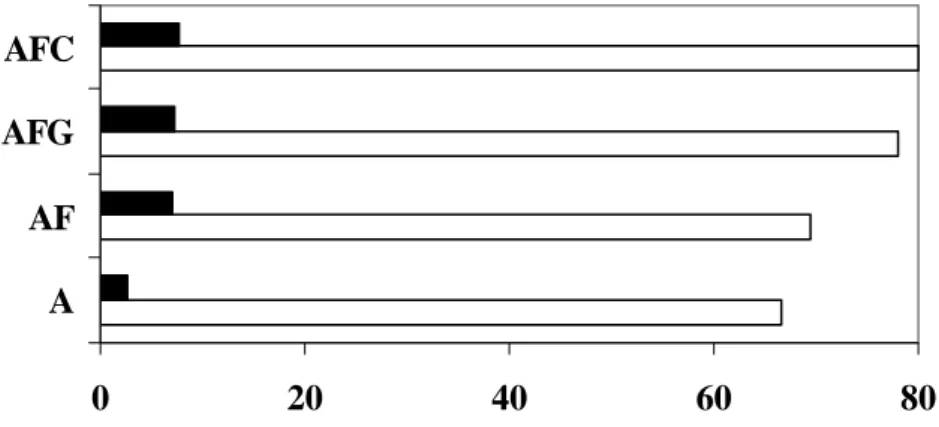
Flexural tests show that aluminium particles addition improves significantly the elastic modulus. The addition of milled fibres to these composites contributes to a small increase on the flexural strength, as shown in the graph of Fig. 3.
AFC composite results exhibit weak reprodubility due to processing difficulties.
0 20 40 60 80
A AF AFG AFC
Flexural Stregth (MPa) Elastic Modulus (GPa)
Fig. 3. Flexural strtength and elastic modulus of the A, AF and AFG and AFC materials.
Figure 4 presents the DMTA results, showing that the addition of metallic particles improves the material stiffness, at both, room temperature and high temperatures. At around 200º C, the elastic modulus is abruptly reduced due to the glass transition temperature. The graph only shows AF curve because AFG and AFC exhibit a similar behaviour (Lino, 2005).
0 1000 2000 3000 4000 5000 0 50 100 150 200 250 300 Temperature (ºC) El a stic m o d u lu s (M P a ) A AF
Fig. 4. Elastic modulus as a function of temperature, obtained in DMTA tests, for the neat resin (A) and aluminium filled epoxy composite (AF).
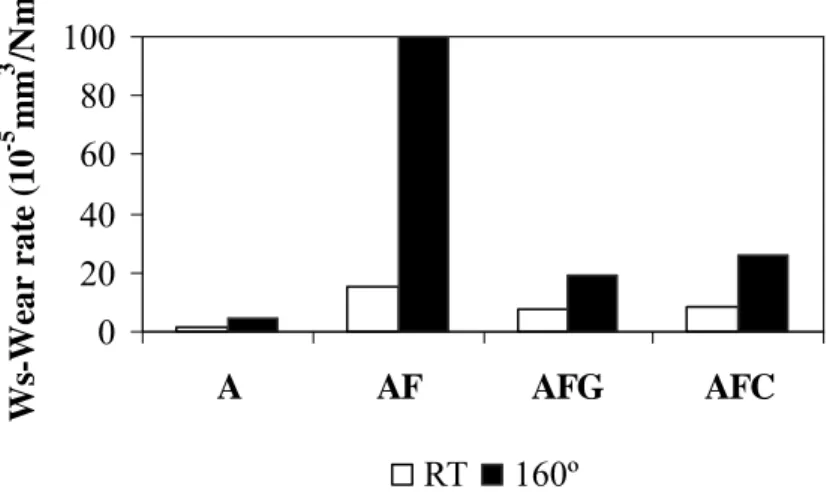
The specific wear rate results for the A, AF, AFG and AFC materials, at room temperature and at 160ºC, determined in a reciprocating tribometer, is presented in Figure 5. AF composite suffered a severe wear rate. The AFG and AFC hybrid composites exhibit a significantly better wear behaviour than the conventional AF composite. As expected, the
temperature rise deteriorates significantly the wear behaviour of all materials, although more pronounced in AF composite. 0 20 40 60 80 100 A AF AFG AFC Ws -W ear rat e ( 1 0 -5 mm 3 /N m ) RT 160º
Fig. 5. Specific wear rate of epoxy (A), epoxy with aluminium (AF) and epoxy with aluminium and fibres (AFG and AFC) systems at room temperature and at 160ºC, determined in the reciprocating tribometer.
When compared with the neat epoxy resin, the composites produced also exhibit significantly better performance relatively to thermal conductivity (injection cycle time and mould life), elastic modulus and coefficient of thermal expansion (Vasconcelos 2005), making them promising materials for rapid tooling applications.
CONCLUSIONS
The composite interfacial specific area, Sv, assesses the degree of interaction in the interface and the respective contribution to the aluminium filled epoxy composite mechanical behaviour.
It was verified that the milled fibres (triphasic composites), in small concentrations (4%), improve significantly the wear resistance of the epoxy/aluminium composites. However, the mechanical resistance is little affected, despite the differences observed in the fragmentation tests.
In hybrid composites, with aluminium particles and milled fibres, the complex stress concentrations generated by the addition of particles and milled fibres can overlap the good characteristics of the fibre-matrix interface, inhibiting the predictable improvement of the composite mechanical performance.
REFERENCES
Lino, F. J., Vasconcelos, P. V., and Neto, R., Rapid tooling for plastic injection moulding using
indirect rapid tooling processes, Proceedings of the 13th International Conference on Processing and
fabrication of Advanced Materials, PFAM XIII, Singapore, 6-8 December 2004.
Lino, F. J., Vasconcelos, P. V., and Neto, R., Indirect rapid tooling with aluminium and milled fibre
Matejka, L., Amine cured epoxide networks: formation, structure and properties, Macromolecules, 33, 2000, p. 3611–3619.
Paiva, M. C., Bernardo, C. A. and Nardin, M., Mechanical surface and interfacial characterization of pitch and PAN-based carbon fibres, Carbon, 38, 2000, p. 1323-1337.
Pisanova, E., and Mader, E., Acid-base interactions and covalent bonding at a fiber-matrix interface: contribution to the work of adhesion and measured adhesion strength, Journal of Adhesion Science Technology, 14, 3, 2000, p. 415-436.
Rozenberg, B. A., Kinetics, thermodynamics and mechanism of reactions of epoxy oligomers with amines, Adv. Polym. Sci., 75, 1986, p. 113-165.
Stoner, E. G., The effect of shape on the tensile strength of pitch-based carbon fibres, PhD thesis, Clemson University, USA, 1998.
Underwood, E., Metallography and Microstructures, Vol.9, ASM Handbook, 1985.
Vasconcelos, P.V., Lino, F.J., Neto, R., and Henrique, P., Contribution of the phase-matrix interface in the behaviour of aluminium filled epoxies, Advanced Materials Forum II, 2004, p. 635-638.
Vasconcelos, P.V., Fabrico rápido indirecto de ferramentas compósitas a partir de modelos de prototipagem rápida, PhD thesis, Faculdade de Engenharia da Universidade do Porto, Portugal, 2005. Vasconcelos, P.V., Lino, F.J., Baptista, A. M., and Neto, R., Tribological study of epoxy based composites for Rapid Tooling, Wear, 260, 1-2, 2006, p. 30-39.