EUROPEAN ORGANIZATION FOR NUCLEAR RESEARCH (CERN)
CERN-EP-2017-025 2017/08/08
CMS-EXO-16-023
Search for third-generation scalar leptoquarks and heavy
right-handed neutrinos in final states with two tau leptons
and two jets in proton-proton collisions at
√
s
=
13 TeV
The CMS Collaboration
∗Abstract
A search is performed for third-generation scalar leptoquarks and heavy right-handed neutrinos in events containing one electron or muon, one hadronically de-caying τ lepton, and at least two jets, using a√s = 13 TeV pp collision data sample corresponding to an integrated luminosity of 12.9 fb−1collected with the CMS detec-tor at the LHC in 2016. The number of observed events is found to be in agreement with the standard model prediction. A limit is set at 95% confidence level on the prod-uct of the leptoquark pair prodprod-uction cross section and β2, where β is the branching fraction of leptoquark decay to a τ lepton and a bottom quark. Assuming β = 1, third-generation leptoquarks with masses below 850 GeV are excluded at 95% confi-dence level. An additional search based on the same event topology involves heavy right-handed neutrinos, NR, and right-handed W bosons, WR, arising in a left-right
symmetric extension of the standard model. In this search, WR bosons are assumed
to decay to a tau lepton and NRfollowed by the decay of the NRto a tau lepton and
an off-shell WRboson. Assuming the mass of the right-handed neutrino to be half of
the mass of the right-handed W boson, WRboson masses below 2.9 TeV are excluded
at 95% confidence level. These results improve on the limits from previous searches for third-generation leptoquarks and heavy right-handed neutrinos with τ leptons in the final state.
Published in the Journal of High Energy Physics as doi:10.1007/JHEP07(2017)121.
c
2017 CERN for the benefit of the CMS Collaboration. CC-BY-3.0 license ∗See Appendix A for the list of collaboration members
1
1
Introduction
A number of extensions of the standard model (SM) have been proposed that predict an en-hanced production rate for events containing pairs of quarks and pairs of third-generation leptons. One such theoretical proposal involves the existence of particles called leptoquarks (LQs), which carry color charge, fractional electric charge, and both lepton and baryon quan-tum numbers. The LQs arise in many models, including grand unified theories [1], composite-ness models [2, 3], and superstring theories [4]. If LQs exist, they will decay into a lepton and a quark. At the CERN LHC, LQ pairs are predominantly produced via gluon-gluon fusion and quark-antiquark annihilation. Based on the latest experimental constraints reviewed in [5], we assume that contribution of t-channel production of LQ pairs involving Yukawa coupling of a LQ, a lepton, and a quark, is small and neglected in this analysis and the main free parameter is the mass of LQ. However, the branching fraction for the decay of a LQ into a quark and a charged lepton, β, depends on the details of the model under consideration. In this analysis we focus on the decay of a pair of third-generation LQs resulting in two τ leptons and two jets originating from b quark fragmentation.
A similar final state is expected in theories that postulate that the masses of the familiar left-handed neutrinos arise not from the Higgs field, but from a mechanism that involves the ex-istence of right-handed neutrinos. One of the appealing features of left-right (L-R) symmetric extensions [6] of the SM is that these models predict the existence of new heavy charged (WR)
and neutral (ZR) gauge bosons that could be produced at LHC energies. Heavy neutrinos
(Ne, Nµ, Nτ) naturally arise as the right-handed (RH) partners of the SM neutrinos in these L-R
extensions through the see-saw mechanism [7].
In this paper, we search for these two processes by selecting final states containing two τ lep-tons and two jets originating from the hadronization of quarks. A search for pair production of third-generation scalar LQs is pursued by looking for events containing two τ leptons and two b quarks. We also search for the production of a WR boson from quark-antiquark
annihi-lation. A heavy right-handed neutrino is produced from the decay of the WRboson following
the decay chain WR → τ+Nτ, where Nτ → τ+W∗R → τ+qq. In both searches, we focus
on signatures with one of the τ leptons decaying into an electron or a muon, referred to as a leptonic decay τ`in the following, and the other τ lepton decaying hadronically, denoted by τh.
Previous searches for third-generation LQs have been carried out at pp, pp, e+e−, and ep col-liders and the most recent results are given in [8, 9] and references therein. The most stringent lower limit on the mass of scalar third-generation LQs to date, based on the final state with two τ leptons and two b jets and assuming β = 1, is 740 GeV at 95% confidence level (CL), from the CMS experiment [10, 11]. Previous searches for heavy neutrinos have been performed at LEP [12, 13], excluding heavy neutrino masses below approximately 100 GeV. Further searches at LHC have been performed in the dielectron and dimuon channels and have excluded WR
bosons with mass up to 3 TeV using data taken at 7 TeV [14] and at 8 TeV [15]. Using 2.1 fb−1 of data of 13 TeV pp collisions collected in 2015, the CMS experiment searched for heavy neu-trinos and right-handed charged bosons using events in which both τ leptons decay hadroni-cally. That analysis excluded WRbosons with masses below 2.35 (1.63) TeV at 95% CL,
assum-ing the Nτ mass is 0.8 (0.2) times the mass of WR boson [11]. In the present search, we use a
√
s = 13 TeV pp collision data sample corresponding to an integrated luminosity of 12.9 fb−1 collected with the CMS detector in 2016.
2
The CMS detector and Monte Carlo event samples
The central feature of the CMS apparatus is a superconducting solenoid of 6 m internal diam-eter, providing a magnetic field of 3.8 T. Within the solenoid volume are a silicon pixel and strip tracker, a lead tungstate crystal electromagnetic calorimeter (ECAL), and a brass and scin-tillator hadron calorimeter, each composed of a barrel and two endcap sections. Extensive forward calorimetry complements the coverage provided by the barrel and endcap detectors. Muons are detected in gas-ionisation detectors embedded in the steel flux-return yoke outside the solenoid. A detailed description of the CMS detector, together with a definition of the coordinate system used and the relevant kinematic variables, can be found in Ref. [16].
The first level of the CMS triggering system, composed of custom hardware processors, uses information from the calorimeters and the muon detectors to select the most interesting events in a fixed time interval of less than 4 µs. The high-level trigger processor farm further decreases the event rate from around 100 kHz to less than 1 kHz.
Background and signal processes are modeled using the following simulated samples. The PYTHIAv8.205 generator [17] is used to model the signal and diboson (WW, WZ, and ZZ) pro-cesses. The LQ signal samples are generated with LQ masses ranging from 250 to 1500 GeV in steps of 50 GeV. The branching fraction of the LQ to a τ lepton and a bottom quark is assumed to be 100%. The signal samples are normalized to the next-to-next-to-leading order [18, 19]. The WRsignal samples are generated with WRboson masses ranging from 1000 to 4000 GeV in
steps of 500 GeV and the cross sections are computed in Ref. [20]. The MADGRAPHv5.1.5 gen-erator [21] is used to model W+jets and Z+jets processes. Single top production and tt process are modelled with the POWHEG 2.0 [22–24] generator. The NNPDF 3.0 [25] Parton Distribu-tion FuncDistribu-tions (PDF) are used, and all simulated samples are interfaced withPYTHIAwith the CUETP8M1 tune [26] to describe parton showering and hadronization. Additional inelastic pp interactions (pileup) generated byPYTHIAare overlaid on all simulated events, according to the luminosity profile of the analyzed data. All the generated signal and background samples are processed with the simulation of the CMS detector based on GEANT4 [27]. Small differences between data and simulation in trigger, in particle identification and isolation efficiencies, and in the resolution of the pTof jets and missing transverse momentum are corrected by applying
scale factors to simulated events, as detailed below.
3
Event reconstruction and selection
The particle-flow (PF) algorithm [28, 29], which exploits information from all subdetectors, is used to identify individual particles, such as charged and neutral hadrons, muons, electrons, and photons. These reconstructed particles are used as input for reconstructing more complex objects such as τhcandidates, jets, and variables like missing transverse momentum.
The reconstructed interaction vertex with the largest value of∑i(piT)2, where piT is the
trans-verse momentum of the ith track associated with the vertex, is selected as the primary vertex of the event. This vertex is used as the reference vertex for all the objects reconstructed using the PF algorithm.
Electrons are reconstructed by matching the energy deposits in the ECAL to tracks recon-structed in the silicon pixel and strip detectors. The electrons selected in this analysis are required to have transverse momenta pT > 50 GeV and pseudorapidity |η| < 2.1 [30]. The
identification and isolation of electrons are based on a multivariate technique [31] and selected electrons must satisfy tight electron identification and isolation criteria.
3
Muon reconstruction starts by matching tracks in the silicon tracker with tracks in the outer muon spectrometer [32]. A global muon track is fitted to the hits from both tracks. Muons are required to have pT > 50 GeV and |η| < 2.1. Quality selection criteria are applied to
the muon tracks to distinguish muons originating from particle collisions with those muons coming from cosmic rays. In addition, muons are required to pass isolation criteria to separate prompt muons from those associated with a jet, usually from the semileptonic decays of heavy quarks.
The hadron-plus-strips algorithm [33, 34] is used to reconstruct τh candidates. It starts from
a jet and searches for candidates produced by the main hadronic decay modes of a τ lepton: either directly to one charged hadron, or via intermediate ρ(770)and a1(1280)mesons to one
charged hadron plus one or two neutral pions, or three charged hadrons. The reconstructed τh is required to have|η| <2.3 and pT >50 (pT >60)GeV in the LQ (heavy RH neutrino) search.
Hadronic tau lepton decays are identified by a multivariate technique that uses as inputs the isolation of the τh and variables that are sensitive to its lifetime. A selection criterion is used
that has an efficiency of approximately 65% for identifying hadronically decaying tau leptons and a probability of less than 1% for misidentifying jets as hadronic tau decays. Additional criteria are applied to remove electrons and muons reconstructed as τhcandidates.
The identified electron or muon and the τhare required to originate from the same vertex and be spatially separated by ∆R ≡ √∆φ2+∆η2 > 0.5. To suppress background events such
as diboson and Z+jets with bosons decay giving a final state with a pair of leptons, events containing additional electron or muon candidates with pT > 15 GeV, and which pass loose
identification and isolation criteria, are rejected.
Jets are reconstructed using the anti-kTalgorithm with a distance parameter of R=0.4 [35, 36]
using PF candidates. The jet energy is corrected for the average contribution from particles from other proton-proton collisions in the same or neighbouring bunch crossings (pileup) [37]. Additional corrections are applied to better reflect the true total momentum of the particles in the jet [38]. Selected jets are required to be within|η| <2.4 and have pT > 50 GeV, and to be
separated from the selected electron or muon and the τh by∆R > 0.5. Further identification
requirements are applied to distinguish genuine jets from those coming from pileup [39]. The transverse momentum imbalance, (~pTmiss), is calculated as the negative vectorial sum of transverse momenta of all PF candidates, and corrected by propagating the corrections applied to identified jets [40]. A correction is applied to account for the effect of additional pileup interactions. In addition, several filters are employed to veto events with large~pmiss
T caused by
detector effects.
Candidate events were collected using a set of triggers requiring the presence of either an elec-tron or a muon candidate with pT >45 GeV.
The search for LQs is based on a sample of events containing one light lepton, one τhcandidate, and at least two jets. At least one of the two leading jets is identified as originating from b quark hadronization (b-tagged) using the combined secondary vertex algorithm [41]. The chosen b tagging working point corresponds to an identification efficiency of approximately 70% with about 1% misidentification rate from light quarks. The lepton and τhcandidate are required to
have opposite electric charge. There are two possible combinations of two tau candidates, with two jets, and the combination that minimises the difference in masses between the two resulting tau candidate-jet systems is chosen. Additionally, the invariant mass of the system formed by the visible particles of the τhcandidate and a jet is required to be greater than 250 GeV.
by the LQ search. The~pTmiss is required to be above 50 GeV and the invariant mass of the light lepton and the τhis required to be greater than 150 GeV.
In the LQ analysis, the fraction of signal events passing all selection cuts ranges between 1 and 5% for masses between 300 and 1500 GeV, and in the WRanalysis the fraction varies between 2
and 7% for masses between 1 and 4 TeV.
The presence of a signal is investigated by analysing the distribution of ST. This is defined as
the scalar sum of the pTof the electron or muon, the τhcandidate, the two jets, and the missing
transverse energy.
4
Background estimation
Several SM processes can mimic the signatures explored in this search. Production of tt pairs is the dominant background because of the presence of genuine leptons,~pTmiss, and both light-and heavy-flavour jets. Additionally, the production of a W or Z boson in association with jets, production of a diboson or a single top quark, and Quantum ChromoDynamics (QCD) multijet processes can also contribute to the SM background contributions.
Simulated tt events are reweighted according to the top quark pT distribution measured in
data [42, 43]. The normalization and shape of the tt background is then verified by comparing to a data sample that consists of events containing an electron, a muon, and at least two jets and including all final selection requirements. The purity of tt events in this sample exceeds 95%. Signal contamination in this control region is found to be negligible and does not affect the comparison of data with simulation even in the tail of the STdistribution. The
normaliza-tion and shape of the tt simulated sample agree well with those observed in data. Thus, the simulation is used to predict the tt background in the signal region.
The W+jets background arises mainly from events with a genuine electron or muon originating from the leptonic decay of a W boson and an initial- or final-state radiation jet misidentified as a
τhcandidate. The normalization and shape of the W background are obtained from simulation
and a correction factor is applied to the normalization to take into account differences between data and simulation. The W background correction factor is estimated in a data sample that consists of W → µνevents with three or more jets. One of the jets is required to pass the τh
identification criteria. To reduce the contamination from tt background, events containing jets that pass the b tagging criteria are rejected. The expected signal contamination in this sample is negligible. A binned maximum likelihood fit to the transverse mass distribution of the muon and~pTmiss is then performed to derive the W background normalization correction factor. The transverse mass distribution is found to have the most discriminating power for separating the W background from the other backgrounds. As an input to the fit, the normalization and shape of all other contributions are estimated from simulation. The uncertainties in the cross sections of all backgrounds are included as nuisance parameters in the fit. The contamination from QCD multijet events is small and derived from simulation. The best fit value for the W normalization correction factor is found to be 1.0±0.2, with the uncertainty including both statistical and systematic components.
A similar procedure is repeated for the eτhchannel in a control region containing events with
an electron and three or more jets. The W+jets normalization factor measured in W → eν events is found to be consistent with the normalization factor derived in W→µνevents, albeit
with a slightly larger uncertainty.
5
channels is estimated from data. Events in the multijet control region are selected by inverting the τhidentification criteria: the τhcandidate is required to pass looser, but to fail tighter,
iden-tification criteria. The events are weighted by the pT-dependent probability for a jet satisfying
loose isolation criteria to pass the tight τh isolation criteria. This probability is measured as a function of jet pT for eτh and µτhchannels separately, in independent data samples that are
composed of events in which the lepton fails the isolation criteria and has the same charge as τh
candidate. This probability varies from 20% for a jet pTof 50 GeV to 2% for a jet pTof 400 GeV
and is similar for both final states.
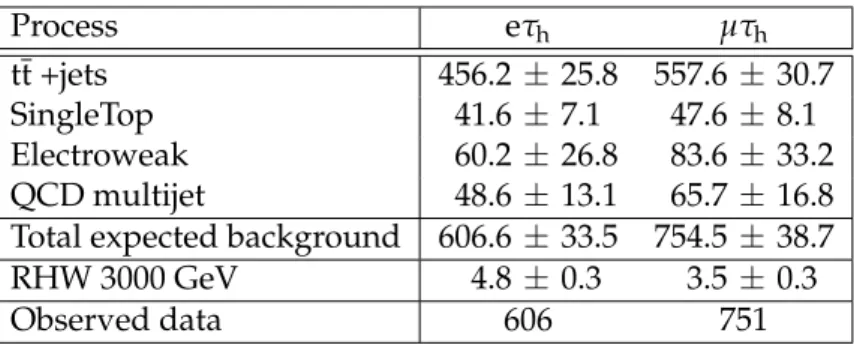
In addition to the principal backgrounds, which are estimated as discussed above, other minor backgrounds, arising from single top quark, Z boson, and diboson production, are estimated from simulation. The relative contributions of all these backgrounds are given in Tables 1 and 2, in Section 6. In these tables, the electroweak background represents the sum of the back-grounds from W+jets, Z boson, and diboson production. Additionally, for each channel the background estimation is compared with the observed data and with an estimated representa-tive signal.
5
Systematic uncertainties
The results of the analysis are obtained from a binned fit to the STdistributions in the eτh and
µτhchannels. Systematic uncertainties may affect the normalization and/or the shape of the
ST distribution of the signal and background processes.
The uncertainty in the integrated luminosity of the analysed dataset amounts to 6.2% [44]. Un-certainties in the muon and electron identification and trigger efficiency are determined using the “tag-and-probe” technique [45] and amount to 2% for identification and 5% for trigger ef-ficiencies. The τh identification efficiency [33, 46] is measured in bins of τh candidate pT in
Z→ττand W→τνevents and fitted by a linear function within the range 20 to 200 GeV. The
uncertainty in the τhidentification efficiency measurement is 6% for τ leptons from the decay
of Z bosons. The extrapolation to higher transverse momenta is taken into account by adding an uncertainty that increases linearly with pTand has a value of 20% for a pTof 200 GeV. This
uncertainty has a direct effect on the ST distribution and hence is considered as a shape
uncer-tainty. Changes in the acceptance due to the uncertainty in the b tagging efficiency and in the mistag rate are measured to be between 3 and 5%, depending on the process. The uncertainty in the normalization of the tt background due to the PDF and scale uncertainties amounts to 5% [47, 48]. A 10% uncertainty is attributed to the Z boson background estimate, while the uncertainty in both the diboson and single top background estimates amounts to 15% [49]. The uncertainty in the yield of QCD multijet and W+jet backgrounds amounts to 30%. The un-certainty in the signal acceptance due to the choice of the PDF set in the simulated sample is evaluated in accordance to the PDF4LHC recommendations [48, 50], by comparing the results obtained using the CTEQ6.6L, MSTW08, and NNPDF10 PDF sets [51–53] with those from the default PDF set (CTEQ6L1). This uncertainty amounts to 5% [11].
The energy scales (ES) of the τhcandidate and the associated jet affect the shape of the ST
dis-tribution and normalization of the signal and background processes. The effects of ES uncer-tainties on the analysis are estimated by varying the τhand jet energies within their respective
uncertainties and recomputing STafter the final selection. The uncertainty in the τhES amounts
to 3% [33]. The uncertainty in the jet ES affects the pT spectrum of the jets and consequently
~pmiss
T , and is applied to signal and all backgrounds that are estimated with MC simulation [54].
The uncertainties in the electron, muon, and~pTmissES have a negligible effect on the ST
event weight between zero and twice the nominal reweighting correction value [42, 43]. All these three uncertainties are treated as correlated between the eτhand µτhchannels.
Finally, the effects of statistical uncertainties associated with the signal and background shapes or with the numbers of events in the data control regions are included in the analysis. The statistical uncertainties are uncorrelated across the bins in each background distribution [55]. Systematic and statistical uncertainties are represented by nuisance parameters in the fit. A log-normal probability distribution function is assumed for the nuisance parameters that affect the event yields of the various background contributions. Systematic uncertainties affecting the ST
distributions are assumed to have a Gaussian probability distribution function. Among those uncertainties, the τh ES and high pT τh extrapolation uncertainties are uncorrelated between
the eτh and µτh channels, because of the different τh identification criteria used to reduce the
electron and muon mis-identification rate in each channel. The jet ES is treated as correlated across the two channels.
6
Results
A binned maximum likelihood fit to the ST distribution has been applied to the eτh and µτh
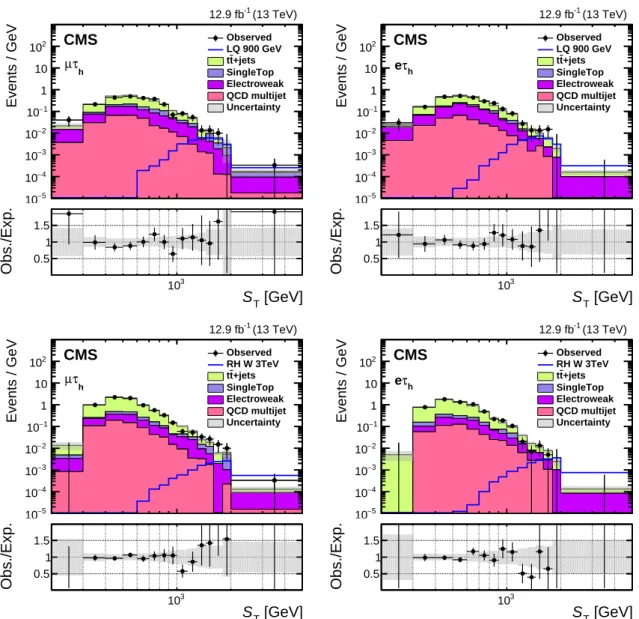
channels simultaneously. The signal production rate is constrained to the same value in the two channels. The STdistributions for both the LQ and WRanalyses are shown in Fig. 1. Shape,
normalization and uncertainty are shown for the values of nuisances parameters obtained from the fit. No excess is seen above the SM expectation within the statistical and systematic uncer-tainties in both searches. The event yields observed in the leptoquark analysis and in the heavy right-handed W boson analysis are shown in Tables 1 and 2, respectively, and compared to background expectations and to the estimated event yields for representative signals.
Upper limits on the product of the cross section and branching fractions are set at 95% CL using a modified frequentist criterion CLs[56, 57], based on the binned distribution of the STvariable.
Figure 2 (left) shows the observed and expected 95% CL upper limit on the product of cross section and branching fraction in the LQ analysis. The observed (expected) 95% CL mass limit for third-generation scalar LQ is determined to be 850 (900) GeV, respectively, assuming β=1, namely a 100% branching fraction for the LQ to decay into a τ lepton and a bottom quark. Figure 2 (right) shows the 95% CL observed and expected exclusion limits on the LQ mass, as a function of β.
Figure 3 (left) shows the observed and expected upper limits at 95% CL on the product of cross section and branching fraction for the WR → τNτ analysis. Assuming the mass of the
neutrino to be half the mass of the WRboson, the observed (expected) limit at 95% CL on the
mass of heavy right-handed WRbosons is determined to be 2.9 (3.0) TeV, respectively. Figure 3
(right) shows the observed and expected 95% CL upper limits on the production cross section as functions of MWR and MNτ. The blue curve in the left plot represent the theoretical production
cross section of WR boson times branching fraction of the WR boson to a τ lepton and RH
neutrino, assuming mass of RH neutrino to be half the mass of WRboson.
7
Summary
Searches have been performed for third-generation scalar leptoquarks and for heavy right-handed neutrinos in events containing one electron or muon, one hadronically decaying τ lepton, and two or more jets, using pp collision data at √s = 13 TeV, recorded by the CMS detector at the LHC and corresponding to an integrated luminosity of 12.9 fb−1. The data are
7 Events / GeV 5 − 10 4 − 10 3 − 10 2 − 10 1 − 10 1 10 2 10 ObservedLQ 900 GeV +jets t t SingleTop Electroweak QCD multijet Uncertainty (13 TeV) -1 12.9 fb CMS h τ µ [GeV] T S 3 10 Obs./Exp. 0.5 1 1.5 Events / GeV 5 − 10 4 − 10 3 − 10 2 − 10 1 − 10 1 10 2 10 ObservedLQ 900 GeV +jets t t SingleTop Electroweak QCD multijet Uncertainty (13 TeV) -1 12.9 fb CMS h τ e [GeV] T S 3 10 Obs./Exp. 0.5 1 1.5 Events / GeV 5 − 10 4 − 10 3 − 10 2 − 10 1 − 10 1 10 2 10 Observed RH W 3TeV +jets t t SingleTop Electroweak QCD multijet Uncertainty (13 TeV) -1 12.9 fb CMS h τ µ [GeV] T S 3 10 Obs./Exp. 0.5 1 1.5 Events / GeV 5 − 10 4 − 10 3 − 10 2 − 10 1 − 10 1 10 2 10 Observed RH W 3TeV +jets t t SingleTop Electroweak QCD multijet Uncertainty (13 TeV) -1 12.9 fb CMS h τ e [GeV] T S 3 10 Obs./Exp. 0.5 1 1.5
Figure 1: Measured STdistribution in the µτh (left) and eτh(right) channels of the LQ (upper)
and heavy RH neutrino (lower) analyses, compared to the expected SM background contribu-tion. A hypothetical LQ signal of mass MLQ=900 GeV and a hypothetical heavy WRsignal of
mass MWR =3 TeV are overlaid to illustrate the sensitivity. The electroweak background repre-sents the sum of W boson, Z boson, and diboson production. The last bin of each plot contains overflow events. A binned maximum likelihood fit is performed on the ST distribution. The
uncertainty bands represent the sum in quadrature of statistical and systematic uncertainties, obtained from the fit. The lower panels in all plots compare the observed and expected events in each bin.
Table 1: Number of events observed in the eτhand µτhchannels of the LQ analysis compared
to the background expectations and to the event yield expected for a representative LQ signal of mass 900 GeV. The quoted uncertainties represent the sum of statistical and systematic un-certainties and are obtained by the binned maximum likelihood fit of the distribution in ST, as
described in the text.
Process eτh µτh
tt +jets 136.8± 13.2 145.6± 14.6
SingleTop 15.7± 3.1 27.6± 4.5
Electroweak 69.6± 10.5 53.3± 9.0 QCD multijet 25.0± 6.8 28.9± 7.4 Total expected background 247.1± 16.8 255.4± 16.1
LQ 900 GeV 6.0± 0.3 5.7± 0.2
Observed data 249 250
Table 2: Number of events observed in the eτh and µτh channels of the heavy right-handed W analysis compared to the background expectations and to the event yield expected for a representative right-handed W boson signal of mass 3 TeV. The quoted uncertainties represent the sum of statistical and systematic uncertainties and are obtained by the binned maximum likelihood fit of the distribution in ST, as described in the text.
Process eτh µτh
tt +jets 456.2 ± 25.8 557.6 ±30.7
SingleTop 41.6 ± 7.1 47.6 ±8.1
Electroweak 60.2 ± 26.8 83.6 ±33.2
QCD multijet 48.6 ± 13.1 65.7 ±16.8
Total expected background 606.6 ± 33.5 754.5 ±38.7
RHW 3000 GeV 4.8 ± 0.3 3.5 ±0.3
9 =1) β Theory ( Observed Expected 68% expected 95% expected [GeV] LQ M 200 400 600 800 1000 1200 1400 [pb] 2 β⋅ σ 4 − 10 3 − 10 2 − 10 1 − 10 1 10 2 10 3 10 (13 TeV) -1 12.9 fb CMS [GeV] LQ M 200 300 400 500 600 700 800 900 1000 β 0 0.2 0.4 0.6 0.8 1 (13 TeV) -1 12.9 fb CMS Observed exclusion Median expected limit 68% expected limit
Figure 2: Observed and expected limits at 95% CL on the product of cross section and branch-ing fraction squared, obtained from the combination of the eτh and µτh channels, in the LQ
analysis (left) and 95% CL observed and expected exclusion limits on the LQ mass, as a func-tion of β(right). In the left plot, the green and yellow bands represent the one and two standard deviation uncertainties in the expected limits. The dashed dark blue curve represents the theo-retical LQ pair production cross section, assuming β=100% [18, 19]. In the right plot, the grey band represents the one standard deviation uncertainty in the expected limit.
/2) W = M N Theory (M Observed Expected 68% expected 95% expected [GeV] R W M 1000 1500 2000 2500 3000 3500 4000 jj)[pb] ττ → R (W Β× ) R W → (pp σ 3 − 10 2 − 10 1 − 10 1 10 (13 TeV) -1 12.9 fb CMS 10 [GeV] R W M 2000 3000 4000 [GeV] τ N M 1000 2000 3000 Observed Expected (13 TeV) -1 12.9 fb CMS
Cross section upper limit at 95% CL [fb]
Figure 3: Observed and expected limits at 95% CL on the product of cross section and branching fraction, obtained from the combination of the eτhand µτhchannels in the heavy right-handed
neutrino analysis (left) and the observed and expected limits at 95% CL on the production cross section as a function of MWR and MNR (right). The green and yellow bands represent the one and two standard deviation uncertainties in the expected limits. The dashed dark blue curve represents the theoretical prediction for the product of the WRboson production cross section
and the branching fraction for decay to a τ lepton and RH neutrino, assuming the mass of the RH neutrino to be half the mass of the WRboson [20].
found to be in good agreement with the standard model prediction in both analyses. A limit at 95% confidence level is set on the product of the leptoquark pair production cross section and
β2, where β denotes the branching fraction for the decay of the leptoquark into a τ lepton and
a bottom quark. Assuming β = 1, third-generation leptoquarks with masses below 850 GeV are excluded at 95% confidence level. In the heavy RH neutrino analysis, considering the de-cay WR → τNR and assuming the mass of the heavy neutrino to be half the mass of the WR
boson, we exclude WRboson masses below 2.9 TeV at 95% confidence level. These are the best
mass limits to date for third-generation leptoquarks and heavy right-handed neutrinos with τ leptons in the final state.
Acknowledgments
We congratulate our colleagues in the CERN accelerator departments for the excellent perfor-mance of the LHC and thank the technical and administrative staffs at CERN and at other CMS institutes for their contributions to the success of the CMS effort. In addition, we grate-fully acknowledge the computing centres and personnel of the Worldwide LHC Computing Grid for delivering so effectively the computing infrastructure essential to our analyses. Fi-nally, we acknowledge the enduring support for the construction and operation of the LHC and the CMS detector provided by the following funding agencies: BMWFW and FWF (Aus-tria); FNRS and FWO (Belgium); CNPq, CAPES, FAPERJ, and FAPESP (Brazil); MES (Bulgaria); CERN; CAS, MoST, and NSFC (China); COLCIENCIAS (Colombia); MSES and CSF (Croatia); RPF (Cyprus); SENESCYT (Ecuador); MoER, ERC IUT, and ERDF (Estonia); Academy of Fin-land, MEC, and HIP (Finland); CEA and CNRS/IN2P3 (France); BMBF, DFG, and HGF (Ger-many); GSRT (Greece); OTKA and NIH (Hungary); DAE and DST (India); IPM (Iran); SFI (Ireland); INFN (Italy); MSIP and NRF (Republic of Korea); LAS (Lithuania); MOE and UM (Malaysia); BUAP, CINVESTAV, CONACYT, LNS, SEP, and UASLP-FAI (Mexico); MBIE (New Zealand); PAEC (Pakistan); MSHE and NSC (Poland); FCT (Portugal); JINR (Dubna); MON, RosAtom, RAS, RFBR and RAEP (Russia); MESTD (Serbia); SEIDI, CPAN, PCTI and FEDER (Spain); Swiss Funding Agencies (Switzerland); MST (Taipei); ThEPCenter, IPST, STAR, and NSTDA (Thailand); TUBITAK and TAEK (Turkey); NASU and SFFR (Ukraine); STFC (United Kingdom); DOE and NSF (USA).
Individuals have received support from the Marie-Curie programme and the European Re-search Council and EPLANET (European Union); the Leventis Foundation; the A. P. Sloan Foundation; the Alexander von Humboldt Foundation; the Belgian Federal Science Policy Of-fice; the Fonds pour la Formation `a la Recherche dans l’Industrie et dans l’Agriculture (FRIA-Belgium); the Agentschap voor Innovatie door Wetenschap en Technologie (IWT-(FRIA-Belgium); the Ministry of Education, Youth and Sports (MEYS) of the Czech Republic; the Council of Sci-ence and Industrial Research, India; the HOMING PLUS programme of the Foundation for Polish Science, cofinanced from European Union, Regional Development Fund, the Mobil-ity Plus programme of the Ministry of Science and Higher Education, the National Science Center (Poland), contracts Harmonia 2014/14/M/ST2/00428, Opus 2014/13/B/ST2/02543, 2014/15/B/ST2/03998, and 2015/19/B/ST2/02861, Sonata-bis 2012/07/E/ST2/01406; the Na-tional Priorities Research Program by Qatar NaNa-tional Research Fund; the Programa Clar´ın-COFUND del Principado de Asturias; the Thalis and Aristeia programmes cofinanced by EU-ESF and the Greek NSRF; the Rachadapisek Sompot Fund for Postdoctoral Fellowship, Chula-longkorn University and the ChulaChula-longkorn Academic into Its 2nd Century Project Advance-ment Project (Thailand); and the Welch Foundation, contract C-1845.
References 11
References
[1] H. Georgi and S. L. Glashow, “Unity of All Elementary Particle Forces”, Phys. Rev. Lett.
32(1974) 438, doi:10.1103/PhysRevLett.32.438.
[2] B. Schrempp and F. Schrempp, “Light leptoquarks”, Phys. Lett. B 153 (1985) 101, doi:10.1016/0370-2693(85)91450-9.
[3] W. Buchm ¨uller, R. R ¨uckl, and D. Wyler, “Leptoquarks in lepton-quark collisions”, Phys. Lett. B 191 (1987) 442, doi:10.1016/0370-2693(87)90637-X.
[4] J. L. Hewett and T. G. Rizzo, “Low-energy phenomenology of superstring-inspired e6 models”, Phys. Rep. 183 (1989) 193, doi:10.1016/0370-1573(89)90071-9. [5] I. Dorsner et al., “Physics of leptoquarks in precision experiments and at particle colliders”, Phys. Rept. 641 (2016) 1, doi:10.1016/j.physrep.2016.06.001,
arXiv:1603.04993.
[6] R. N. Mohapatra and J. C. Pati, “Natural left-right symmetry”, Phys. Rev. D 11 (1975) 2558, doi:10.1103/PhysRevD.11.2558.
[7] W.-Y. Keung and G. Senjanovic, “Majorana Neutrinos and the Production of the Right-handed Charged Gauge Boson”, Phys. Rev. Lett. 50 (1983) 1427,
doi:10.1103/PhysRevLett.50.1427.
[8] ATLAS Collaboration, “Search for third generation scalar leptoquarks in pp collisions at√ s = 7 TeV with the ATLAS detector”, JHEP 06 (2013) 033,
doi:10.1007/JHEP06(2013)033, arXiv:1303.0526.
[9] CMS Collaboration, “Search for pair production of third-generation scalar leptoquarks and top squarks in proton-proton collisions at√s=8 TeV”, Phys. Lett. B 739 (2014) 229,
doi:10.1016/j.physletb.2014.10.063, arXiv:1408.0806.
[10] CMS Collaboration, “Search for pair production of third-generation leptoquarks and top squarks in pp collisions at√s=7 eV”, Phys. Rev. Lett. 110 (2013) 081801,
doi:10.1103/PhysRevLett.110.081801, arXiv:1210.5629.
[11] CMS Collaboration, “Search for heavy neutrinos or third-generation leptoquarks in final states with two hadronically decaying τ leptons and two jets in proton-proton collisions
at√s=13 TeV”, JHEP 03 (2017) 077, doi:10.1007/JHEP03(2017)077,
arXiv:1612.01190.
[12] DELPHI Collaboration, “Search for neutral heavy leptons produced in Z decays”, Z. Phys. C 74 (1997) 57, doi:10.1007/s002880050370. [Erratum: Z.
Phys.C75,580(1997)].
[13] L3 Collaboration, “Search for isosinglet neutral heavy leptons in Z0 decays”, Phys. Lett. B
295(1992) 371, doi:10.1016/0370-2693(92)91579-X.
[14] ATLAS Collaboration, “Search for heavy neutrinos and right-handed W bosons in events with two leptons and jets in pp collisions at√s =7 TeV with the ATLAS detector”, Eur. Phys. J. C 72 (2012) 2056, doi:10.1140/epjc/s10052-012-2056-4,
[15] CMS Collaboration, “Search for heavy neutrinos and W bosons with right-handed couplings in proton-proton collisions at√s=8 TeV”, Eur. Phys. J. C 74 (2014) 3149, doi:10.1140/epjc/s10052-014-3149-z, arXiv:1407.3683.
[16] CMS Collaboration, “The CMS experiment at the CERN LHC”, JINST 3 (2008) S08004,
doi:10.1088/1748-0221/3/08/S08004.
[17] T. Sj ¨ostrand et al., “An introduction to PYTHIA 8.2”, Comput. Phys. Commun. 191 (2015) 159, doi:10.1016/j.cpc.2015.01.024, arXiv:1410.3012.
[18] M. Kr¨amer, T. Plehn, M. Spira, and P. M. Zerwas, “Pair production of scalar leptoquarks at the CERN LHC”, Phys. Rev. D 71 (2005) 057503,
doi:10.1103/PhysRevD.71.057503, arXiv:hep-ph/0411038.
[19] M. Kr¨amer, T. Plehn, M. Spira, and P. M. Zerwas, “Pair production of scalar leptoquarks at the Tevatron”, Phys. Rev. Lett. 79 (1997) 341, doi:10.1103/PhysRevLett.79.341, arXiv:hep-ph/9704322.
[20] F. del Aguila, J. A. Aguilar-Saavedra, and R. Pittau, “Heavy neutrino signals at large hadron colliders”, JHEP 10 (2007) 047, doi:10.1088/1126-6708/2007/10/047, arXiv:hep-ph/0703261.
[21] F. Maltoni and T. Stelzer, “MadEvent: automatic event generation with MadGraph”, JHEP 02 (2003) 027, doi:10.1088/1126-6708/2003/02/027,
arXiv:hep-ph/0208156.
[22] P. Nason, “A new method for combining NLO QCD with shower Monte Carlo algorithms”, JHEP 11 (2004) 040, doi:10.1088/1126-6708/2004/11/040,
arXiv:hep-ph/0409146.
[23] S. Frixione, P. Nason, and C. Oleari, “Matching NLO QCD computations with Parton Shower simulations: the POWHEG method”, JHEP 11 (2007) 070,
doi:10.1088/1126-6708/2007/11/070, arXiv:0709.2092.
[24] S. Alioli, P. Nason, C. Oleari, and E. Re, “A general framework for implementing NLO calculations in shower Monte Carlo programs: the POWHEG BOX”, JHEP 06 (2010) 043, doi:10.1007/JHEP06(2010)043, arXiv:1002.2581.
[25] NNPDF Collaboration, “Parton distributions for the LHC Run II”, JHEP 04 (2015) 040,
doi:10.1007/JHEP04(2015)040, arXiv:1410.8849.
[26] CMS Collaboration, “Event generator tunes obtained from underlying event and multiparton scattering measurements”, Eur. Phys. J. C 76 (2016), no. 3, 155,
doi:10.1140/epjc/s10052-016-3988-x, arXiv:1512.00815.
[27] GEANT4 Collaboration, “GEANT4—a simulation toolkit”, Nucl. Instrum. Meth. A 506 (2003) 250, doi:10.1016/S0168-9002(03)01368-8.
[28] CMS Collaboration, “Particle–flow event reconstruction in CMS and performance for jets, taus, and EmissT ”, CMS Physics Analysis Summary CMS-PAS-PFT-09-001, 2009.
[29] CMS Collaboration, “Commissioning of the particle–flow event reconstruction with the first lhc collisions recorded in the cms detector”, CMS Physics Analysis Summary CMS-PAS-PFT-10-001, 2010.
References 13
[30] CMS Collaboration, “Performance of electron reconstruction and selection with the CMS detector in proton-proton collisions at√s=8 TeV”, JINST 10 (2015), no. 06, P06005, doi:10.1088/1748-0221/10/06/P06005, arXiv:1502.02701.
[31] H. Voss, A. H ¨ocker, J. Stelzer, and F. Tegenfeldt, “TMVA, the toolkit for multivariate data analysis with ROOT”, PoS(ACAT) (2007) 040, arXiv:physics/0703039.
[32] CMS Collaboration, “Performance of CMS muon reconstruction in pp collision events at√
s =7 TeV”, JINST 7 (2012) P10002, doi:10.1088/1748-0221/7/10/P10002,
arXiv:1206.4071.
[33] CMS Collaboration, “Reconstruction and identification of τ lepton decays to hadrons and
ντ at CMS”, JINST 11 (2016) P01019, doi:10.1088/1748-0221/11/01/P01019,
arXiv:1510.07488.
[34] CMS Collaboration, “Tau ID Performance at CMS in Run 2”, CMS Physics Analysis Summary CMS-PAS-TAU-16-002, 2016.
[35] G. P. Salam, “Towards Jetography”, Eur. Phys. J. C 67 (2010) 637,
doi:10.1140/epjc/s10052-010-1314-6, arXiv:0906.1833.
[36] M. Cacciari, G. P. Salam, and G. Soyez, “The anti-ktjet clustering algorithm”, JHEP 04
(2008) 063, doi:10.1088/1126-6708/2008/04/063, arXiv:0802.1189. [37] CMS Collaboration, “Pileup removal algorithms”, CMS Physics Analysis Summary
CMS-PAS-JME-14-001, 2014.
[38] CMS Collaboration, “Jet energy scale and resolution in the CMS experiment in pp collisions at 8 TeV”, JINST 12 (2017) P02014,
doi:10.1088/1748-0221/12/02/P02014, arXiv:1607.03663.
[39] CMS Collaboration, “Pileup jet identification”, CMS Physics Analysis Summary CMS-PAS-JME-13-005, 2013.
[40] CMS Collaboration, “Performance of missing energy reconstruction in 13 TeV pp collision data using the CMS detector”, CMS Physics Analysis Summary
CMS-PAS-JME-16-004, 2016.
[41] CMS Collaboration, “Identification of b quark jets at the CMS Experiment in the LHC Run 2”, Technical Report CMS-PAS-BTV-15-001, 2016.
[42] CMS Collaboration, “Measurement of the differential cross section for top quark pair production in pp collisions at√s =8 TeV”, Eur. Phys. J. C 75 (2015) 542,
doi:10.1140/epjc/s10052-015-3709-x, arXiv:1505.04480.
[43] CMS Collaboration, “Measurement of differential top-quark pair production cross sections in pp collisions at√s =7 TeV”, Eur. Phys. J. C 73 (2013) 2339,
doi:10.1140/epjc/s10052-013-2339-4, arXiv:1211.2220.
[44] CMS Collaboration, “CMS luminosity measurement for the 2015 data taking period”, CMS Physics Analysis Summary CMS-PAS-LUM-15-001, 2016.
[45] CMS Collaboration, “Measurement of the inclusive W and Z production cross sections in pp collisions at√s =7 TeV with the CMS experiment ”, JHEP 10 (2011) 132,
[46] CMS Collaboration, “Performance of tau-lepton reconstruction and identification in CMS”, JINST 7 (2012) P01001, doi:10.1088/1748-0221/7/01/P01001, arXiv:1109.6034.
[47] M. Czakon and A. Mitov, “Top++: a program for the calculation of the top-pair cross-section at hadron colliders”, Comput. Phys. Commun. 185 (2014) 2930, doi:10.1016/j.cpc.2014.06.021, arXiv:1112.5675.
[48] M. Botje et al., “The PDF4LHC Working Group Interim Recommendations”, (2011).
arXiv:1101.0538.
[49] CMS Collaboration, “Measurement of W+W−and ZZ production cross sections in pp collisions at√s=8 TeV”, Phys. Lett. B 721 (2013) 190,
doi:10.1016/j.physletb.2013.03.027, arXiv:1301.4698.
[50] S. Alekhin et al., “The PDF4LHC Working Group Interim Report”, (2011). arXiv:1101.0536.
[51] P. M. Nadolsky et al., “Implications of CTEQ global analysis for collider observables”, Phys. Rev. D 78 (2008) 013004, doi:10.1103/PhysRevD.78.013004,
arXiv:0802.0007.
[52] A. D. Martin, W. J. Stirling, R. S. Thorne, and G. Watt, “Update of parton distributions at NNLO”, Phys. Lett. B 652 (2007) 292, doi:10.1016/j.physletb.2007.07.040,
arXiv:0706.0459.
[53] M. Ubiali, “NNPDF1.0 parton set for the LHC”, in Proceedings, 14th High-Energy Physics International Conference on Quantum Chromodynamics (QCD 08): Montpellier, France, 7-12 July 2008, p. 62. 2009. arXiv:0809.3716. Nucl. Phys. Proc. Suppl. 186 (2009) 62.
doi:10.1016/j.nuclphysbps.2008.12.020.
[54] CMS Collaboration, “Determination of jet energy calibration and transverse momentum resolution in CMS”, JINST 6 (2011) P11002,
doi:10.1088/1748-0221/6/11/P11002, arXiv:1107.4277.
[55] R. Barlow and C. Beeston, “Fitting using finite Monte Carlo samples”, Comp. Phys. Comm. 77 (1993) 219, doi:10.1016/0010-4655(93)90005-W.
[56] T. Junk, “Confidence level computation for combining searches with small statistics”, Nucl. Instrum. Meth. A 434 (1999) 435, doi:10.1016/S0168-9002(99)00498-2, arXiv:hep-ex/9902006.
[57] A. L. Read, “Presentation of search results: the CLstechnique”, J. Phys. G 28 (2002) 2693,
15
A
The CMS Collaboration
Yerevan Physics Institute, Yerevan, Armenia
A.M. Sirunyan, A. Tumasyan
Institut f ¨ur Hochenergiephysik, Wien, Austria
W. Adam, E. Asilar, T. Bergauer, J. Brandstetter, E. Brondolin, M. Dragicevic, J. Er ¨o, M. Flechl, M. Friedl, R. Fr ¨uhwirth1, V.M. Ghete, C. Hartl, N. H ¨ormann, J. Hrubec, M. Jeitler1, A. K ¨onig, I. Kr¨atschmer, D. Liko, T. Matsushita, I. Mikulec, D. Rabady, N. Rad, B. Rahbaran, H. Rohringer, J. Schieck1, J. Strauss, W. Waltenberger, C.-E. Wulz1
Institute for Nuclear Problems, Minsk, Belarus
O. Dvornikov, V. Makarenko, V. Mossolov, J. Suarez Gonzalez, V. Zykunov
National Centre for Particle and High Energy Physics, Minsk, Belarus
N. Shumeiko
Universiteit Antwerpen, Antwerpen, Belgium
S. Alderweireldt, E.A. De Wolf, X. Janssen, J. Lauwers, M. Van De Klundert, H. Van Haevermaet, P. Van Mechelen, N. Van Remortel, A. Van Spilbeeck
Vrije Universiteit Brussel, Brussel, Belgium
S. Abu Zeid, F. Blekman, J. D’Hondt, N. Daci, I. De Bruyn, K. Deroover, S. Lowette, S. Moortgat, L. Moreels, A. Olbrechts, Q. Python, K. Skovpen, S. Tavernier, W. Van Doninck, P. Van Mulders, I. Van Parijs
Universit´e Libre de Bruxelles, Bruxelles, Belgium
H. Brun, B. Clerbaux, G. De Lentdecker, H. Delannoy, G. Fasanella, L. Favart, R. Goldouzian, A. Grebenyuk, G. Karapostoli, T. Lenzi, A. L´eonard, J. Luetic, T. Maerschalk, A. Marinov, A. Randle-conde, T. Seva, C. Vander Velde, P. Vanlaer, D. Vannerom, R. Yonamine, F. Zenoni, F. Zhang2
Ghent University, Ghent, Belgium
T. Cornelis, D. Dobur, A. Fagot, M. Gul, I. Khvastunov, D. Poyraz, S. Salva, R. Sch ¨ofbeck, M. Tytgat, W. Van Driessche, E. Yazgan, N. Zaganidis
Universit´e Catholique de Louvain, Louvain-la-Neuve, Belgium
H. Bakhshiansohi, C. Beluffi3, O. Bondu, S. Brochet, G. Bruno, A. Caudron, S. De Visscher, C. Delaere, M. Delcourt, B. Francois, A. Giammanco, A. Jafari, M. Komm, G. Krintiras, V. Lemaitre, A. Magitteri, A. Mertens, M. Musich, K. Piotrzkowski, L. Quertenmont, M. Selvaggi, M. Vidal Marono, S. Wertz
Universit´e de Mons, Mons, Belgium
N. Beliy
Centro Brasileiro de Pesquisas Fisicas, Rio de Janeiro, Brazil
W.L. Ald´a J ´unior, F.L. Alves, G.A. Alves, L. Brito, C. Hensel, A. Moraes, M.E. Pol, P. Rebello Teles
Universidade do Estado do Rio de Janeiro, Rio de Janeiro, Brazil
E. Belchior Batista Das Chagas, W. Carvalho, J. Chinellato4, A. Cust ´odio, E.M. Da Costa,
G.G. Da Silveira5, D. De Jesus Damiao, C. De Oliveira Martins, S. Fonseca De Souza,
L.M. Huertas Guativa, H. Malbouisson, D. Matos Figueiredo, C. Mora Herrera, L. Mundim, H. Nogima, W.L. Prado Da Silva, A. Santoro, A. Sznajder, E.J. Tonelli Manganote4, F. Torres Da Silva De Araujo, A. Vilela Pereira
Universidade Estadual Paulistaa, Universidade Federal do ABCb, S˜ao Paulo, Brazil
S. Ahujaa, C.A. Bernardesa, S. Dograa, T.R. Fernandez Perez Tomeia, E.M. Gregoresb, P.G. Mercadanteb, C.S. Moona, S.F. Novaesa, Sandra S. Padulaa, D. Romero Abadb, J.C. Ruiz Vargasa
Institute for Nuclear Research and Nuclear Energy, Sofia, Bulgaria
A. Aleksandrov, R. Hadjiiska, P. Iaydjiev, M. Rodozov, S. Stoykova, G. Sultanov, M. Vutova
University of Sofia, Sofia, Bulgaria
A. Dimitrov, I. Glushkov, L. Litov, B. Pavlov, P. Petkov
Beihang University, Beijing, China
W. Fang6
Institute of High Energy Physics, Beijing, China
M. Ahmad, J.G. Bian, G.M. Chen, H.S. Chen, M. Chen, Y. Chen7, T. Cheng, C.H. Jiang,
D. Leggat, Z. Liu, F. Romeo, M. Ruan, S.M. Shaheen, A. Spiezia, J. Tao, C. Wang, Z. Wang, H. Zhang, J. Zhao
State Key Laboratory of Nuclear Physics and Technology, Peking University, Beijing, China
Y. Ban, G. Chen, Q. Li, S. Liu, Y. Mao, S.J. Qian, D. Wang, Z. Xu
Universidad de Los Andes, Bogota, Colombia
C. Avila, A. Cabrera, L.F. Chaparro Sierra, C. Florez, J.P. Gomez, C.F. Gonz´alez Hern´andez, J.D. Ruiz Alvarez8, J.C. Sanabria
University of Split, Faculty of Electrical Engineering, Mechanical Engineering and Naval Architecture, Split, Croatia
N. Godinovic, D. Lelas, I. Puljak, P.M. Ribeiro Cipriano, T. Sculac
University of Split, Faculty of Science, Split, Croatia
Z. Antunovic, M. Kovac
Institute Rudjer Boskovic, Zagreb, Croatia
V. Brigljevic, D. Ferencek, K. Kadija, B. Mesic, T. Susa
University of Cyprus, Nicosia, Cyprus
M.W. Ather, A. Attikis, G. Mavromanolakis, J. Mousa, C. Nicolaou, F. Ptochos, P.A. Razis, H. Rykaczewski
Charles University, Prague, Czech Republic
M. Finger9, M. Finger Jr.9
Universidad San Francisco de Quito, Quito, Ecuador
E. Carrera Jarrin
Academy of Scientific Research and Technology of the Arab Republic of Egypt, Egyptian Network of High Energy Physics, Cairo, Egypt
A. Ellithi Kamel10, M.A. Mahmoud11,12, A. Radi12,13
National Institute of Chemical Physics and Biophysics, Tallinn, Estonia
M. Kadastik, L. Perrini, M. Raidal, A. Tiko, C. Veelken
Department of Physics, University of Helsinki, Helsinki, Finland
17
Helsinki Institute of Physics, Helsinki, Finland
J. H¨ark ¨onen, T. J¨arvinen, V. Karim¨aki, R. Kinnunen, T. Lamp´en, K. Lassila-Perini, S. Lehti, T. Lind´en, P. Luukka, J. Tuominiemi, E. Tuovinen, L. Wendland
Lappeenranta University of Technology, Lappeenranta, Finland
J. Talvitie, T. Tuuva
IRFU, CEA, Universit´e Paris-Saclay, Gif-sur-Yvette, France
M. Besancon, F. Couderc, M. Dejardin, D. Denegri, B. Fabbro, J.L. Faure, C. Favaro, F. Ferri, S. Ganjour, S. Ghosh, A. Givernaud, P. Gras, G. Hamel de Monchenault, P. Jarry, I. Kucher, E. Locci, M. Machet, J. Malcles, J. Rander, A. Rosowsky, M. Titov
Laboratoire Leprince-Ringuet, Ecole Polytechnique, IN2P3-CNRS, Palaiseau, France
A. Abdulsalam, I. Antropov, S. Baffioni, F. Beaudette, P. Busson, L. Cadamuro, E. Chapon, C. Charlot, O. Davignon, R. Granier de Cassagnac, M. Jo, S. Lisniak, P. Min´e, M. Nguyen, C. Ochando, G. Ortona, P. Paganini, P. Pigard, S. Regnard, R. Salerno, Y. Sirois, A.G. Stahl Leiton, T. Strebler, Y. Yilmaz, A. Zabi, A. Zghiche
Institut Pluridisciplinaire Hubert Curien (IPHC), Universit´e de Strasbourg, CNRS-IN2P3
J.-L. Agram14, J. Andrea, D. Bloch, J.-M. Brom, M. Buttignol, E.C. Chabert, N. Chanon,
C. Collard, E. Conte14, X. Coubez, J.-C. Fontaine14, D. Gel´e, U. Goerlach, A.-C. Le Bihan, P. Van Hove
Centre de Calcul de l’Institut National de Physique Nucleaire et de Physique des Particules, CNRS/IN2P3, Villeurbanne, France
S. Gadrat
Universit´e de Lyon, Universit´e Claude Bernard Lyon 1, CNRS-IN2P3, Institut de Physique Nucl´eaire de Lyon, Villeurbanne, France
S. Beauceron, C. Bernet, G. Boudoul, C.A. Carrillo Montoya, R. Chierici, D. Contardo, B. Courbon, P. Depasse, H. El Mamouni, J. Fay, S. Gascon, M. Gouzevitch, G. Grenier, B. Ille, F. Lagarde, I.B. Laktineh, M. Lethuillier, L. Mirabito, A.L. Pequegnot, S. Perries, A. Popov15, V. Sordini, M. Vander Donckt, P. Verdier, S. Viret
Georgian Technical University, Tbilisi, Georgia
A. Khvedelidze9
Tbilisi State University, Tbilisi, Georgia
Z. Tsamalaidze9
RWTH Aachen University, I. Physikalisches Institut, Aachen, Germany
C. Autermann, S. Beranek, L. Feld, M.K. Kiesel, K. Klein, M. Lipinski, M. Preuten, C. Schomakers, J. Schulz, T. Verlage
RWTH Aachen University, III. Physikalisches Institut A, Aachen, Germany
A. Albert, M. Brodski, E. Dietz-Laursonn, D. Duchardt, M. Endres, M. Erdmann, S. Erdweg, T. Esch, R. Fischer, A. G ¨uth, M. Hamer, T. Hebbeker, C. Heidemann, K. Hoepfner, S. Knutzen, M. Merschmeyer, A. Meyer, P. Millet, S. Mukherjee, M. Olschewski, K. Padeken, T. Pook, M. Radziej, H. Reithler, M. Rieger, F. Scheuch, L. Sonnenschein, D. Teyssier, S. Th ¨uer
RWTH Aachen University, III. Physikalisches Institut B, Aachen, Germany
V. Cherepanov, G. Fl ¨ugge, B. Kargoll, T. Kress, A. K ¨unsken, J. Lingemann, T. M ¨uller, A. Nehrkorn, A. Nowack, C. Pistone, O. Pooth, A. Stahl16
Deutsches Elektronen-Synchrotron, Hamburg, Germany
M. Aldaya Martin, T. Arndt, C. Asawatangtrakuldee, K. Beernaert, O. Behnke, U. Behrens, A.A. Bin Anuar, K. Borras17, A. Campbell, P. Connor, C. Contreras-Campana, F. Costanza, C. Diez Pardos, G. Dolinska, G. Eckerlin, D. Eckstein, T. Eichhorn, E. Eren, E. Gallo18,
J. Garay Garcia, A. Geiser, A. Gizhko, J.M. Grados Luyando, A. Grohsjean, P. Gunnellini, A. Harb, J. Hauk, M. Hempel19, H. Jung, A. Kalogeropoulos, O. Karacheban19, M. Kasemann, J. Keaveney, C. Kleinwort, I. Korol, D. Kr ¨ucker, W. Lange, A. Lelek, T. Lenz, J. Leonard, K. Lipka, A. Lobanov, W. Lohmann19, R. Mankel, I.-A. Melzer-Pellmann, A.B. Meyer, G. Mittag, J. Mnich, A. Mussgiller, D. Pitzl, R. Placakyte, A. Raspereza, B. Roland, M. ¨O. Sahin, P. Saxena, T. Schoerner-Sadenius, S. Spannagel, N. Stefaniuk, G.P. Van Onsem, R. Walsh, C. Wissing
University of Hamburg, Hamburg, Germany
V. Blobel, M. Centis Vignali, A.R. Draeger, T. Dreyer, E. Garutti, D. Gonzalez, J. Haller, M. Hoffmann, A. Junkes, R. Klanner, R. Kogler, N. Kovalchuk, T. Lapsien, I. Marchesini, D. Marconi, M. Meyer, M. Niedziela, D. Nowatschin, F. Pantaleo16, T. Peiffer, A. Perieanu, C. Scharf, P. Schleper, A. Schmidt, S. Schumann, J. Schwandt, H. Stadie, G. Steinbr ¨uck, F.M. Stober, M. St ¨over, H. Tholen, D. Troendle, E. Usai, L. Vanelderen, A. Vanhoefer, B. Vormwald
Institut f ¨ur Experimentelle Kernphysik, Karlsruhe, Germany
M. Akbiyik, C. Barth, S. Baur, C. Baus, J. Berger, E. Butz, R. Caspart, T. Chwalek, F. Colombo, W. De Boer, A. Dierlamm, S. Fink, B. Freund, R. Friese, M. Giffels, A. Gilbert, P. Goldenzweig, D. Haitz, F. Hartmann16, S.M. Heindl, U. Husemann, F. Kassel16, I. Katkov15, S. Kudella, H. Mildner, M.U. Mozer, Th. M ¨uller, M. Plagge, G. Quast, K. Rabbertz, S. R ¨ocker, F. Roscher, M. Schr ¨oder, I. Shvetsov, G. Sieber, H.J. Simonis, R. Ulrich, S. Wayand, M. Weber, T. Weiler, S. Williamson, C. W ¨ohrmann, R. Wolf
Institute of Nuclear and Particle Physics (INPP), NCSR Demokritos, Aghia Paraskevi, Greece
G. Anagnostou, G. Daskalakis, T. Geralis, V.A. Giakoumopoulou, A. Kyriakis, D. Loukas, I. Topsis-Giotis
National and Kapodistrian University of Athens, Athens, Greece
S. Kesisoglou, A. Panagiotou, N. Saoulidou, E. Tziaferi
University of Io´annina, Io´annina, Greece
I. Evangelou, G. Flouris, C. Foudas, P. Kokkas, N. Loukas, N. Manthos, I. Papadopoulos, E. Paradas
MTA-ELTE Lend ¨ulet CMS Particle and Nuclear Physics Group, E ¨otv ¨os Lor´and University, Budapest, Hungary
N. Filipovic, G. Pasztor
Wigner Research Centre for Physics, Budapest, Hungary
G. Bencze, C. Hajdu, D. Horvath20, F. Sikler, V. Veszpremi, G. Vesztergombi21, A.J. Zsigmond
Institute of Nuclear Research ATOMKI, Debrecen, Hungary
N. Beni, S. Czellar, J. Karancsi22, A. Makovec, J. Molnar, Z. Szillasi
Institute of Physics, University of Debrecen
M. Bart ´ok21, P. Raics, Z.L. Trocsanyi, B. Ujvari
Indian Institute of Science (IISc)
19
National Institute of Science Education and Research, Bhubaneswar, India
S. Bahinipati23, S. Bhowmik24, S. Choudhury25, P. Mal, K. Mandal, A. Nayak26, D.K. Sahoo23, N. Sahoo, S.K. Swain
Panjab University, Chandigarh, India
S. Bansal, S.B. Beri, V. Bhatnagar, R. Chawla, U.Bhawandeep, A.K. Kalsi, A. Kaur, M. Kaur, R. Kumar, P. Kumari, A. Mehta, M. Mittal, J.B. Singh, G. Walia
University of Delhi, Delhi, India
Ashok Kumar, A. Bhardwaj, B.C. Choudhary, R.B. Garg, S. Keshri, S. Malhotra, M. Naimuddin, K. Ranjan, R. Sharma, V. Sharma
Saha Institute of Nuclear Physics, Kolkata, India
R. Bhattacharya, S. Bhattacharya, K. Chatterjee, S. Dey, S. Dutt, S. Dutta, S. Ghosh, N. Majumdar, A. Modak, K. Mondal, S. Mukhopadhyay, S. Nandan, A. Purohit, A. Roy, D. Roy, S. Roy Chowdhury, S. Sarkar, M. Sharan, S. Thakur
Indian Institute of Technology Madras, Madras, India
P.K. Behera
Bhabha Atomic Research Centre, Mumbai, India
R. Chudasama, D. Dutta, V. Jha, V. Kumar, A.K. Mohanty16, P.K. Netrakanti, L.M. Pant, P. Shukla, A. Topkar
Tata Institute of Fundamental Research-A, Mumbai, India
T. Aziz, S. Dugad, G. Kole, B. Mahakud, S. Mitra, G.B. Mohanty, B. Parida, N. Sur, B. Sutar
Tata Institute of Fundamental Research-B, Mumbai, India
S. Banerjee, R.K. Dewanjee, S. Ganguly, M. Guchait, Sa. Jain, S. Kumar, M. Maity24,
G. Majumder, K. Mazumdar, T. Sarkar24, N. Wickramage27
Indian Institute of Science Education and Research (IISER), Pune, India
S. Chauhan, S. Dube, V. Hegde, A. Kapoor, K. Kothekar, S. Pandey, A. Rane, S. Sharma
Institute for Research in Fundamental Sciences (IPM), Tehran, Iran
S. Chenarani28, E. Eskandari Tadavani, S.M. Etesami28, M. Khakzad, M. Mohammadi
Najafabadi, M. Naseri, S. Paktinat Mehdiabadi29, F. Rezaei Hosseinabadi, B. Safarzadeh30, M. Zeinali
University College Dublin, Dublin, Ireland
M. Felcini, M. Grunewald
INFN Sezione di Baria, Universit`a di Barib, Politecnico di Baric, Bari, Italy
M. Abbresciaa,b, C. Calabriaa,b, C. Caputoa,b, A. Colaleoa, D. Creanzaa,c, L. Cristellaa,b, N. De Filippisa,c, M. De Palmaa,b, L. Fiorea, G. Iasellia,c, G. Maggia,c, M. Maggia, G. Minielloa,b, S. Mya,b, S. Nuzzoa,b, A. Pompilia,b, G. Pugliesea,c, R. Radognaa,b, A. Ranieria, G. Selvaggia,b, A. Sharmaa, L. Silvestrisa,16, R. Vendittia,b, P. Verwilligena
INFN Sezione di Bolognaa, Universit`a di Bolognab, Bologna, Italy
G. Abbiendia, C. Battilana, D. Bonacorsia,b, S. Braibant-Giacomellia,b, L. Brigliadoria,b,
R. Campaninia,b, P. Capiluppia,b, A. Castroa,b, F.R. Cavalloa, S.S. Chhibraa,b, G. Codispotia,b, M. Cuffiania,b, G.M. Dallavallea, F. Fabbria, A. Fanfania,b, D. Fasanellaa,b, P. Giacomellia, C. Grandia, L. Guiduccia,b, S. Marcellinia, G. Masettia, A. Montanaria, F.L. Navarriaa,b, A. Perrottaa, A.M. Rossia,b, T. Rovellia,b, G.P. Sirolia,b, N. Tosia,b,16
INFN Sezione di Cataniaa, Universit`a di Cataniab, Catania, Italy
S. Albergoa,b, S. Costaa,b, A. Di Mattiaa, F. Giordanoa,b, R. Potenzaa,b, A. Tricomia,b, C. Tuvea,b
INFN Sezione di Firenzea, Universit`a di Firenzeb, Firenze, Italy
G. Barbaglia, V. Ciullia,b, C. Civininia, R. D’Alessandroa,b, E. Focardia,b, P. Lenzia,b, M. Meschinia, S. Paolettia, L. Russoa,31, G. Sguazzonia, D. Stroma, L. Viliania,b,16
INFN Laboratori Nazionali di Frascati, Frascati, Italy
L. Benussi, S. Bianco, F. Fabbri, D. Piccolo, F. Primavera16
INFN Sezione di Genovaa, Universit`a di Genovab, Genova, Italy
V. Calvellia,b, F. Ferroa, M.R. Mongea,b, E. Robuttia, S. Tosia,b
INFN Sezione di Milano-Bicoccaa, Universit`a di Milano-Bicoccab, Milano, Italy
L. Brianzaa,b,16, F. Brivioa,b, V. Ciriolo, M.E. Dinardoa,b, S. Fiorendia,b,16, S. Gennaia, A. Ghezzia,b, P. Govonia,b, M. Malbertia,b, S. Malvezzia, R.A. Manzonia,b, D. Menascea, L. Moronia, M. Paganonia,b, D. Pedrinia, S. Pigazzinia,b, S. Ragazzia,b, T. Tabarelli de Fatisa,b
INFN Sezione di Napolia, Universit`a di Napoli ’Federico II’b, Napoli, Italy, Universit`a della Basilicatac, Potenza, Italy, Universit`a G. Marconid, Roma, Italy
S. Buontempoa, N. Cavalloa,c, G. De Nardo, S. Di Guidaa,d,16, M. Espositoa,b, F. Fabozzia,c, F. Fiengaa,b, A.O.M. Iorioa,b, G. Lanzaa, L. Listaa, S. Meolaa,d,16, P. Paoluccia,16, C. Sciaccaa,b, F. Thyssena
INFN Sezione di Padova a, Universit`a di Padova b, Padova, Italy, Universit`a di Trento c, Trento, Italy
P. Azzia,16, N. Bacchettaa, L. Benatoa,b, A. Bolettia,b, A. Carvalho Antunes De Oliveiraa,b,
P. Checchiaa, M. Dall’Ossoa,b, P. De Castro Manzanoa, T. Dorigoa, U. Dossellia, S. Fantinela, F. Fanzagoa, F. Gasparinia,b, U. Gasparinia,b, A. Gozzelinoa, S. Lacapraraa, M. Margonia,b, A.T. Meneguzzoa,b, J. Pazzinia,b, N. Pozzobona,b, P. Ronchesea,b, F. Simonettoa,b, E. Torassaa, S. Venturaa, M. Zanettia,b, P. Zottoa,b
INFN Sezione di Paviaa, Universit`a di Paviab, Pavia, Italy
A. Braghieria, F. Fallavollitaa,b, A. Magnania,b, P. Montagnaa,b, S.P. Rattia,b, V. Rea, C. Riccardia,b, P. Salvinia, I. Vaia,b, P. Vituloa,b
INFN Sezione di Perugiaa, Universit`a di Perugiab, Perugia, Italy
L. Alunni Solestizia,b, G.M. Bileia, D. Ciangottinia,b, L. Fan `oa,b, P. Laricciaa,b, R. Leonardia,b, G. Mantovania,b, V. Mariania,b, M. Menichellia, A. Sahaa, A. Santocchiaa,b
INFN Sezione di Pisaa, Universit`a di Pisab, Scuola Normale Superiore di Pisac, Pisa, Italy
K. Androsova,31, P. Azzurria,16, G. Bagliesia, J. Bernardinia, T. Boccalia, R. Castaldia, M.A. Cioccia,31, R. Dell’Orsoa, S. Donatoa,c, G. Fedi, A. Giassia, M.T. Grippoa,31, F. Ligabuea,c,
T. Lomtadzea, L. Martinia,b, A. Messineoa,b, F. Pallaa, A. Rizzia,b, A. Savoy-Navarroa,32, P. Spagnoloa, R. Tenchinia, G. Tonellia,b, A. Venturia, P.G. Verdinia
INFN Sezione di Romaa, Universit`a di Romab, Roma, Italy
L. Baronea,b, F. Cavallaria, M. Cipriania,b, D. Del Rea,b,16, M. Diemoza, S. Gellia,b, E. Longoa,b, F. Margarolia,b, B. Marzocchia,b, P. Meridiania, G. Organtinia,b, R. Paramattia,b, F. Preiatoa,b, S. Rahatloua,b, C. Rovellia, F. Santanastasioa,b
INFN Sezione di Torino a, Universit`a di Torino b, Torino, Italy, Universit`a del Piemonte Orientalec, Novara, Italy
N. Amapanea,b, R. Arcidiaconoa,c,16, S. Argiroa,b, M. Arneodoa,c, N. Bartosika, R. Bellana,b, C. Biinoa, N. Cartigliaa, F. Cennaa,b, M. Costaa,b, R. Covarellia,b, A. Deganoa,b, N. Demariaa,
21
L. Fincoa,b, B. Kiania,b, C. Mariottia, S. Masellia, E. Migliorea,b, V. Monacoa,b, E. Monteila,b, M. Montenoa, M.M. Obertinoa,b, L. Pachera,b, N. Pastronea, M. Pelliccionia, G.L. Pinna Angionia,b, F. Raveraa,b, A. Romeroa,b, M. Ruspaa,c, R. Sacchia,b, K. Shchelinaa,b, V. Solaa, A. Solanoa,b, A. Staianoa, P. Traczyka,b
INFN Sezione di Triestea, Universit`a di Triesteb, Trieste, Italy
S. Belfortea, M. Casarsaa, F. Cossuttia, G. Della Riccaa,b, A. Zanettia
Kyungpook National University, Daegu, Korea
D.H. Kim, G.N. Kim, M.S. Kim, S. Lee, S.W. Lee, Y.D. Oh, S. Sekmen, D.C. Son, Y.C. Yang
Chonbuk National University, Jeonju, Korea
A. Lee
Chonnam National University, Institute for Universe and Elementary Particles, Kwangju, Korea
H. Kim
Hanyang University, Seoul, Korea
J.A. Brochero Cifuentes, T.J. Kim
Korea University, Seoul, Korea
S. Cho, S. Choi, Y. Go, D. Gyun, S. Ha, B. Hong, Y. Jo, Y. Kim, K. Lee, K.S. Lee, S. Lee, J. Lim, S.K. Park, Y. Roh
Seoul National University, Seoul, Korea
J. Almond, J. Kim, H. Lee, S.B. Oh, B.C. Radburn-Smith, S.h. Seo, U.K. Yang, H.D. Yoo, G.B. Yu
University of Seoul, Seoul, Korea
M. Choi, H. Kim, J.H. Kim, J.S.H. Lee, I.C. Park, G. Ryu, M.S. Ryu
Sungkyunkwan University, Suwon, Korea
Y. Choi, J. Goh, C. Hwang, J. Lee, I. Yu
Vilnius University, Vilnius, Lithuania
V. Dudenas, A. Juodagalvis, J. Vaitkus
National Centre for Particle Physics, Universiti Malaya, Kuala Lumpur, Malaysia
I. Ahmed, Z.A. Ibrahim, M.A.B. Md Ali33, F. Mohamad Idris34, W.A.T. Wan Abdullah,
M.N. Yusli, Z. Zolkapli
Centro de Investigacion y de Estudios Avanzados del IPN, Mexico City, Mexico
H. Castilla-Valdez, E. De La Cruz-Burelo, I. Heredia-De La Cruz35, A. Hernandez-Almada, R. Lopez-Fernandez, R. Maga ˜na Villalba, J. Mejia Guisao, A. Sanchez-Hernandez
Universidad Iberoamericana, Mexico City, Mexico
S. Carrillo Moreno, C. Oropeza Barrera, F. Vazquez Valencia
Benemerita Universidad Autonoma de Puebla, Puebla, Mexico
S. Carpinteyro, I. Pedraza, H.A. Salazar Ibarguen, C. Uribe Estrada
Universidad Aut ´onoma de San Luis Potos´ı, San Luis Potos´ı, Mexico
A. Morelos Pineda
University of Auckland, Auckland, New Zealand
University of Canterbury, Christchurch, New Zealand
P.H. Butler
National Centre for Physics, Quaid-I-Azam University, Islamabad, Pakistan
A. Ahmad, M. Ahmad, Q. Hassan, H.R. Hoorani, W.A. Khan, A. Saddique, M.A. Shah, M. Shoaib, M. Waqas
National Centre for Nuclear Research, Swierk, Poland
H. Bialkowska, M. Bluj, B. Boimska, T. Frueboes, M. G ´orski, M. Kazana, K. Nawrocki, K. Romanowska-Rybinska, M. Szleper, P. Zalewski
Institute of Experimental Physics, Faculty of Physics, University of Warsaw, Warsaw, Poland
K. Bunkowski, A. Byszuk36, K. Doroba, A. Kalinowski, M. Konecki, J. Krolikowski, M. Misiura, M. Olszewski, M. Walczak
Laborat ´orio de Instrumenta¸c˜ao e F´ısica Experimental de Part´ıculas, Lisboa, Portugal
P. Bargassa, C. Beir˜ao Da Cruz E Silva, B. Calpas, A. Di Francesco, P. Faccioli, M. Gallinaro, J. Hollar, N. Leonardo, L. Lloret Iglesias, M.V. Nemallapudi, J. Seixas, O. Toldaiev, D. Vadruccio, J. Varela
Joint Institute for Nuclear Research, Dubna, Russia
S. Afanasiev, P. Bunin, M. Gavrilenko, I. Golutvin, I. Gorbunov, A. Kamenev, V. Karjavin, A. Lanev, A. Malakhov, V. Matveev37,38, V. Palichik, V. Perelygin, S. Shmatov, S. Shulha, N. Skatchkov, V. Smirnov, N. Voytishin, A. Zarubin
Petersburg Nuclear Physics Institute, Gatchina (St. Petersburg), Russia
L. Chtchipounov, V. Golovtsov, Y. Ivanov, V. Kim39, E. Kuznetsova40, V. Murzin, V. Oreshkin,
V. Sulimov, A. Vorobyev
Institute for Nuclear Research, Moscow, Russia
Yu. Andreev, A. Dermenev, S. Gninenko, N. Golubev, A. Karneyeu, M. Kirsanov, N. Krasnikov, A. Pashenkov, D. Tlisov, A. Toropin
Institute for Theoretical and Experimental Physics, Moscow, Russia
V. Epshteyn, V. Gavrilov, N. Lychkovskaya, V. Popov, I. Pozdnyakov, G. Safronov, A. Spiridonov, M. Toms, E. Vlasov, A. Zhokin
Moscow Institute of Physics and Technology, Moscow, Russia
T. Aushev, A. Bylinkin38
National Research Nuclear University ’Moscow Engineering Physics Institute’ (MEPhI), Moscow, Russia
M. Chadeeva41, O. Markin, V. Rusinov
P.N. Lebedev Physical Institute, Moscow, Russia
V. Andreev, M. Azarkin38, I. Dremin38, M. Kirakosyan, A. Leonidov38, A. Terkulov
Skobeltsyn Institute of Nuclear Physics, Lomonosov Moscow State University, Moscow, Russia
A. Baskakov, A. Belyaev, E. Boos, V. Bunichev, M. Dubinin42, L. Dudko, A. Ershov, V. Klyukhin,
O. Kodolova, I. Lokhtin, I. Miagkov, S. Obraztsov, M. Perfilov, S. Petrushanko, V. Savrin
Novosibirsk State University (NSU), Novosibirsk, Russia
23
State Research Center of Russian Federation, Institute for High Energy Physics, Protvino, Russia
I. Azhgirey, I. Bayshev, S. Bitioukov, D. Elumakhov, V. Kachanov, A. Kalinin, D. Konstantinov, V. Krychkine, V. Petrov, R. Ryutin, A. Sobol, S. Troshin, N. Tyurin, A. Uzunian, A. Volkov
University of Belgrade, Faculty of Physics and Vinca Institute of Nuclear Sciences, Belgrade, Serbia
P. Adzic44, P. Cirkovic, D. Devetak, M. Dordevic, J. Milosevic, V. Rekovic
Centro de Investigaciones Energ´eticas Medioambientales y Tecnol ´ogicas (CIEMAT), Madrid, Spain
J. Alcaraz Maestre, M. Barrio Luna, E. Calvo, M. Cerrada, M. Chamizo Llatas, N. Colino, B. De La Cruz, A. Delgado Peris, A. Escalante Del Valle, C. Fernandez Bedoya, J.P. Fern´andez Ramos, J. Flix, M.C. Fouz, P. Garcia-Abia, O. Gonzalez Lopez, S. Goy Lopez, J.M. Hernandez, M.I. Josa, E. Navarro De Martino, A. P´erez-Calero Yzquierdo, J. Puerta Pelayo, A. Quintario Olmeda, I. Redondo, L. Romero, M.S. Soares
Universidad Aut ´onoma de Madrid, Madrid, Spain
J.F. de Troc ´oniz, M. Missiroli, D. Moran
Universidad de Oviedo, Oviedo, Spain
J. Cuevas, J. Fernandez Menendez, I. Gonzalez Caballero, J.R. Gonz´alez Fern´andez, E. Palencia Cortezon, S. Sanchez Cruz, I. Su´arez Andr´es, P. Vischia, J.M. Vizan Garcia
Instituto de F´ısica de Cantabria (IFCA), CSIC-Universidad de Cantabria, Santander, Spain
I.J. Cabrillo, A. Calderon, E. Curras, M. Fernandez, J. Garcia-Ferrero, G. Gomez, A. Lopez Virto, J. Marco, C. Martinez Rivero, F. Matorras, J. Piedra Gomez, T. Rodrigo, A. Ruiz-Jimeno, L. Scodellaro, N. Trevisani, I. Vila, R. Vilar Cortabitarte
CERN, European Organization for Nuclear Research, Geneva, Switzerland
D. Abbaneo, E. Auffray, G. Auzinger, P. Baillon, A.H. Ball, D. Barney, P. Bloch, A. Bocci, C. Botta, T. Camporesi, R. Castello, M. Cepeda, G. Cerminara, Y. Chen, A. Cimmino, D. d’Enterria, A. Dabrowski, V. Daponte, A. David, M. De Gruttola, A. De Roeck, E. Di Marco45, M. Dobson, B. Dorney, T. du Pree, D. Duggan, M. D ¨unser, N. Dupont, A. Elliott-Peisert, P. Everaerts, S. Fartoukh, G. Franzoni, J. Fulcher, W. Funk, D. Gigi, K. Gill, M. Girone, F. Glege, D. Gulhan, S. Gundacker, M. Guthoff, P. Harris, J. Hegeman, V. Innocente, P. Janot, J. Kieseler, H. Kirschenmann, V. Kn ¨unz, A. Kornmayer16, M.J. Kortelainen, K. Kousouris, M. Krammer1, C. Lange, P. Lecoq, C. Lourenc¸o, M.T. Lucchini, L. Malgeri, M. Mannelli, A. Martelli, F. Meijers, J.A. Merlin, S. Mersi, E. Meschi, P. Milenovic46, F. Moortgat, S. Morovic, M. Mulders, H. Neugebauer, S. Orfanelli, L. Orsini, L. Pape, E. Perez, M. Peruzzi, A. Petrilli, G. Petrucciani, A. Pfeiffer, M. Pierini, A. Racz, T. Reis, G. Rolandi47, M. Rovere, H. Sakulin, J.B. Sauvan, C. Sch¨afer, C. Schwick, M. Seidel, A. Sharma, P. Silva, P. Sphicas48, J. Steggemann, M. Stoye, Y. Takahashi, M. Tosi, D. Treille, A. Triossi, A. Tsirou, V. Veckalns49, G.I. Veres21,
M. Verweij, N. Wardle, H.K. W ¨ohri, A. Zagozdzinska36, W.D. Zeuner
Paul Scherrer Institut, Villigen, Switzerland
W. Bertl, K. Deiters, W. Erdmann, R. Horisberger, Q. Ingram, H.C. Kaestli, D. Kotlinski, U. Langenegger, T. Rohe, S.A. Wiederkehr
Institute for Particle Physics, ETH Zurich, Zurich, Switzerland
F. Bachmair, L. B¨ani, L. Bianchini, B. Casal, G. Dissertori, M. Dittmar, M. Doneg`a, C. Grab, C. Heidegger, D. Hits, J. Hoss, G. Kasieczka, W. Lustermann, B. Mangano, M. Marionneau, P. Martinez Ruiz del Arbol, M. Masciovecchio, M.T. Meinhard, D. Meister, F. Micheli,