CERN-PH-EP/2012-024 2013/02/19
CMS-HIG-11-033
Search for the standard model Higgs boson decaying into
two photons in pp collisions at
√
s
=
7 TeV
The CMS Collaboration
∗Abstract
A search for a Higgs boson decaying into two photons is described. The analysis is performed using a dataset recorded by the CMS experiment at the LHC from pp collisions at a centre-of-mass energy of 7 TeV, which corresponds to an integrated lu-minosity of 4.8 fb−1. Limits are set on the cross section of the standard model Higgs boson decaying to two photons. The expected exclusion limit at 95% confidence level is between 1.4 and 2.4 times the standard model cross section in the mass range be-tween 110 and 150 GeV. The analysis of the data excludes, at 95% confidence level, the standard model Higgs boson decaying into two photons in the mass range 128 to 132 GeV. The largest excess of events above the expected standard model background is observed for a Higgs boson mass hypothesis of 124 GeV with a local significance of 3.1 σ. The global significance of observing an excess with a local significance≥3.1 σ anywhere in the search range 110–150 GeV is estimated to be 1.8 σ. More data are required to ascertain the origin of this excess.
Submitted to Physics Letters B
∗See Appendix A for the list of collaboration members
1
Introduction
The standard model (SM) [1–3] of particle physics has been very successful in explaining ex-perimental data. The origin of the masses of the W and Z bosons that arise from electroweak symmetry breaking remains to be identified. In the SM the Higgs mechanism is postulated, which leads to an additional scalar field whose quantum, the Higgs boson, should be experi-mentally observable [4–9].
Direct searches at the LEP experiments ruled out a SM Higgs boson lighter than 114.4 GeV at 95% confidence level (CL) [10]. Limits at 95% CL on the SM Higgs boson mass have also been placed by experiments at the Tevatron, excluding 162–166 GeV [11], and by the ATLAS collaboration at the Large Hadron Collider (LHC), excluding the ranges 145–206, 214–224, and 340–450 GeV [12–14]. Precision electroweak measurements indirectly constrain the mass of the SM Higgs boson to be less than 158 GeV at 95% CL [15].
The H → γγ decay channel provides a clean final-state topology with a mass peak that can be reconstructed with high precision. In the mass range 110 < mH < 150 GeV, H → γγ is one of the more promising channels for a Higgs search at the LHC. The primary production mechanism of the Higgs boson at the LHC is gluon fusion with additional small contributions from vector boson fusion (VBF) and production in association with a W or Z boson, or a tt pair [16–27]. In the mass range 110<mH <150 GeV the SM H→γγbranching fraction varies between 0.14% and 0.23% [28]. Previous searches in this channel have been conducted by the CDF and D0 experiments [29, 30], and also at the LHC by ATLAS [31].
This paper describes a search for a Higgs boson decaying into two photons in pp collisions at a centre-of-mass energy of 7 TeV, using data taken in 2011 and corresponding to an integrated luminosity of 4.8 fb−1. To improve the sensitivity of the search, selected diphoton events are subdivided into classes according to indicators of mass resolution and signal-to-background ratio. Five mutually exclusive event classes are defined: four in terms of the pseudorapidity and the shower shapes of the photons, and a fifth class into which are put all events containing a pair of jets passing selection requirements which are designed to select Higgs bosons produced by the VBF process.
2
The CMS detector
A detailed description of the CMS detector can be found elsewhere [32]. The main features and those most pertinent to this analysis are described below. The central feature is a supercon-ducting solenoid, 13 m in length and 6 m in diameter, which provides an axial magnetic field of 3.8 T. The bore of the solenoid is instrumented with particle detection systems. The steel return yoke outside the solenoid is instrumented with gas detectors used to identify muons. Charged particle trajectories are measured by the silicon pixel and strip tracker, with full azimuthal cov-erage within |η| < 2.5, where the pseudorapidity η is defined as η = −ln[tan(θ/2)], with θ being the polar angle of the trajectory of the particle with respect to the counterclockwise beam direction. A lead-tungstate crystal electromagnetic calorimeter (ECAL) and a brass/scintillator hadron calorimeter (HCAL) surround the tracking volume and cover the region|η| < 3. The ECAL barrel extends to|η| ≈1.48. A lead/silicon-strip preshower detector is located in front of the ECAL endcap. A steel/quartz-fibre Cherenkov forward calorimeter extends the calori-metric coverage to|η| <5.0. In the region|η| < 1.74, the HCAL cells have widths of 0.087 in both pseudorapidity and azimuth (φ). In the(η, φ)plane, and for|η| < 1.48, the HCAL cells map on to 5×5 ECAL crystal arrays to form calorimeter towers projecting radially outwards from points slightly offset from the nominal interaction point. In the endcap, the ECAL arrays
2 3 Data sample and reconstruction
matching the HCAL cells contain fewer crystals. Calibration of the ECAL uses π0s, W → eν, and Z →ee. Deterioration of transparency of the ECAL crystals due to irradiation during the LHC running periods and their subsequent recovery is monitored continuously and corrected for using light injected from a laser and LED system.
3
Data sample and reconstruction
The dataset consists of events collected with diphoton triggers and corresponds to an inte-grated luminosity of 4.8 fb−1. Diphoton triggers with asymmetric transverse energy, ET,
thresh-olds and complementary photon selections were used. One selection required a loose calori-metric identification using the shower shape and very loose isolation requirements on photon candidates, and the other required only that the photon candidate had a high value of the R9
variable. This variable is defined as the energy sum of 3×3 crystals centred on the most ener-getic crystal in the supercluster (described below) divided by the energy of the supercluster. Its value is used in the analysis to identify photons undergoing a conversion. The ET thresholds
used were at least 10% lower than the final selection thresholds. As the instantaneous luminos-ity delivered by the LHC increased, it became necessary to tighten the isolation cut applied in the trigger. To maintain high trigger efficiency, all four possible combinations of threshold and selection criterion were deployed (i.e., with both photon candidates having the R9 condition,
with the high threshold candidate having the R9condition applied and the low threshold
can-didate having the loose ID and isolation, and so on). Accepting events that satisfy any of these triggers results in a>99% trigger efficiency for events passing the offline selection.
Photon candidates are reconstructed from clusters of ECAL channels around significant energy deposits, which are merged into superclusters. The clustering algorithms result in almost com-plete recovery of the energy of photons that convert in the material in front of the ECAL. In the barrel region, superclusters are formed from five-crystal-wide strips in η centred on the locally most energetic crystal (seed) and have a variable extension in φ. In the endcaps, where the ECAL crystals do not have an η×φgeometry, matrices of 5×5 crystals (which may partially overlap) around the most energetic crystals are merged if they lie within a narrow road in η. The photon energy is computed starting from the raw supercluster energy. In the endcaps the preshower energy is added where the preshower is present (|η| >1.65). In order to obtain the best resolution, the raw energy is corrected for the containment of the shower in the clustered crystals, and the shower losses for photons which convert in material upstream of the calori-meter. These corrections are computed using a multivariate regression technique based on the TMVA boosted decision tree implementation [33]. The regression is trained on photons in a sample of simulated events using the ratio of the true photon energy to the raw energy as the target variable. The input variables are the global η and φ coordinates of the supercluster, a collection of shower-shape variables, and a set of local cluster coordinates.
Jets, used in the dijet tag, are reconstructed using a particle-flow algorithm [34, 35], which uses the information from all CMS sub-detectors to reconstruct different types of particles produced in the event. The basic objects of the particle-flow reconstruction are the tracks of charged par-ticles reconstructed in the central tracker, and energy deposits reconstructed in the calorimetry. These objects are clustered with the anti-kT algorithm [36] using a distance parameter ∆R=
0.5. The jet energy measurement is calibrated to correct for detector effects using samples of dijet, γ+jet, and Z+jet events [37]. Energy from overlapping pp interactions other than that which produced the diphoton (pile-up), and from the underlying event, is also included in the reconstructed jets. This energy is subtracted using the FASTJET technique [38–40], which
is based on the calculation of the η-dependent transverse momentum density, evaluated on an event-by-event basis.
Samples of Monte Carlo (MC) events used in the analysis are fully simulated usingGEANT4 [41]. The simulated events are reweighted to reproduce the distribution of the number of interac-tions taking place in each bunch crossing.
4
Vertex location
The mean number of pp interactions per bunch crossing over the full dataset is 9.5. The inter-action vertices reconstructed using the tracks of charged particles are distributed in the longi-tudinal direction, z, with an RMS spread of 6 cm. If the interaction point is known to better than about 10 mm, then the resolution on the opening angle between the photons makes a neg-ligible contribution to the mass resolution, as compared to the ECAL energy resolution. Thus the mass resolution can be preserved by correctly assigning the reconstructed photons to one of the interaction vertices reconstructed from the tracks. The techniques used to achieve this are described below.
The reconstructed primary vertex which most probably corresponds to the interaction vertex of the diphoton event can be identified using the kinematic properties of the tracks associated with the vertex and their correlation with the diphoton kinematics. In addition, if either of the photons converts and the tracks from the conversion are reconstructed and identified, the direction of the converted photon, determined by combining the conversion vertex position and the position of the ECAL supercluster, can be used to point to and so identify the diphoton interaction vertex.
For the determination of the primary vertex position using kinematic properties, three discrim-inating variables are constructed from the measured scalar, pT, or vector,~pT, transverse
mo-menta of the tracks associated with each vertex, and the transverse momentum of the diphoton system, pγγT . These three variables are: ∑ p2T, and two variables which quantify the pT balance
with respect to the diphoton system: -∑(~pT· ~pγγ T |~pγγ T | )and(∑ pT−pγγ T )/(∑ pT+p γγ T ). An estimate
of the pull to each vertex from the longitudinal location on the beam axis pointed to by any re-constructed tracks (from a photon conversion) associated with the two photon candidates is also computed: |zconversion−zvertex|/σconversion. These variables are used in a multivariate
sys-tem based on boosted decision trees (BDT) to choose the reconstructed vertex to associate with the photons.
The vertex-finding efficiency, defined as the efficiency to locate the vertex to within 10 mm of its true position, has been studied with Z → µµ events where the algorithm is run after the removal of the muon tracks. The use of tracks from a converted photon to locate the vertex is studied with γ+jet events. In both cases the ratio of the efficiency measured in data to that in MC simulation is close to unity. The value is measured as a function of the boson pT, as
measured by the reconstructed muons, and is used as a correction to the Higgs boson signal model. An uncertainty of 0.4% is ascribed to the knowledge of the vertex finding efficiency coming from the statistical uncertainty in the efficiency measurement from Z→µµ(0.2%) and the uncertainty related to the Higgs boson pT spectrum description, which is estimated to be
0.3%. The overall vertex-finding efficiency for a Higgs boson of mass 120 GeV, integrated over its pTspectrum, is computed to be 83.0±0.2(stat)±0.4(syst)%.
4 5 Photon selection
5
Photon selection
The event selection requires two photon candidates with pTγ(1) > mγγ/3 and pγT(2) > mγγ/4 within the ECAL fiducial region,|η| < 2.5, and excluding the barrel-endcap transition region 1.44< |η| <1.57. The fiducial region requirement is applied to the supercluster position in the ECAL, and the pTthreshold is applied after the vertex assignment. The excluded barrel-endcap
transition region removes from the acceptance the last two rings of crystals in the barrel, to en-sure complete containment of accepted showers, and the first ring of trigger towers in the end-cap which is obscured by cables and services exiting between the barrel and endend-cap. In the rare case where the event contains more than two photons passing all the selection requirements, the pair with the highest summed (scalar) pTis chosen.
The dominant backgrounds to H → γγ consist of 1) the irreducible background from the prompt diphoton production, and 2) the reducible backgrounds from pp →γ+jet and pp→ jet+jet where one or more of the “photons” is not a prompt photon. Photon identification re-quirements are used to greatly reduce the contributions from non-prompt photon background. Isolation is a powerful tool to reject the non-prompt background due to electromagnetic show-ers originating in jets – mainly due to single and multiple π0s. The isolation of the photon can-didates is measured by summing the transverse momentum (or energy) found in the tracker, ECAL or HCAL within a distance∆R = p∆η2+∆φ2of the candidate (values of∆R = 0.3 and
∆R = 0.4 are used). The tracks or calorimeter energy deposits very close to the candidates, which might originate from the candidate itself, are excluded from the sum. Pile-up results in two complications. First, the ETsummed in the isolation region in the ECAL and in the HCAL
includes a contribution from other collisions in the same bunch crossing. The isolation sums in the ECAL and HCAL, and hence both the efficiency and rejection power of selection based on the sums, are thus dependent on the number of interactions in the bunch crossing. Second, the track isolation requires that the tracks used in the isolation sum are matched to the chosen vertex (so that the sum does not suffer from pile-up). If the vertex is incorrectly assigned, the isolation sum will be unrelated to the true isolation of the candidate. This allows non-prompt candidates which are not, in fact, isolated from tracks originating from their interaction point, to appear isolated.
The first issue is dealt with by calculating the median transverse energy density in the event, ρ, in regions of the detector separated from the jets and photons, and subtracting an appropriate amount, proportional to ρ, from the isolation sums. The second problem is dealt with by apply-ing a selection requirement not only on the isolation sum calculated usapply-ing the chosen diphoton vertex, but also on the isolation sum calculated using the vertex hypothesis which maximises the sum. The isolation requirements are applied as a constant fraction of the candidate photon pT, effectively cutting harder on low pT photons. It has been shown with Z → ee events that
the resulting variation of selection efficiency with pTis well modelled in the simulation.
In addition to isolation variables, the following observables are also used for photon selection: the ratio of hadronic energy behind the photon to the photon energy, the transverse width of the electromagnetic shower, and an electron track veto.
Photon candidates with high values of R9 are mostly unconverted and have less background
than those with lower values. Photon candidates in the barrel have less background than those in the endcap. For this reason it has been found useful to divide photon candidates into four categories and apply a different selection in each category, using more stringent requirements in categories with higher background and worse resolution.
Table 1: Photon identification efficiencies measured in the four photon categories using a tag and probe technique applied to Z → ee events (for all requirements except the electron veto). Both statistical and systematic errors are given for the data measurement (in that order), and these are combined quadratically to calculate error on the ratio edata/eMC.
Category edata(%) eMC(%) edata/eMC
Barrel, R9>0.94 89.26±0.06±0.04 90.61±0.05 0.985±0.001
Barrel, R9<0.94 68.31±0.06±0.55 68.16±0.05 1.002±0.008
Endcap, R9>0.94 73.65±0.14±0.39 73.45±0.12 1.002±0.006
Endcap, R9<0.94 51.25±0.11±1.25 48.70±0.08 1.052±0.026
The efficiency of the complete selection excluding the electron veto requirement is determined using Z → ee events. Table 1 shows the results for data and MC simulation, and the ratio of efficiency in data to that in the simulation, edata/eMC. The efficiency for photons to pass the
electron veto has been measured using Z → µµγevents, where the photon is produced by final-state radiation, which provide a rather pure source of prompt photons. The efficiency ap-proaches 100% in all except the fourth category, where it is 92.6±0.7%, due to imperfect pixel detector coverage at large η. The ratio edata/eMC for the electron veto is close to unity in all
categories. The quadratic sum of the statistical and systematic uncertainties for the measure-ments of efficiencies using data are propagated to the uncertainties on the ratios. The ratios are used as corrections to the signal efficiency simulated in the MC model of the signal. The uncertainties on the ratios are taken as a systematic uncertainties in the limit setting.
The efficiency of the trigger has also been measured using Z → ee events, with the events classified as described below. For events passing the analysis selection the trigger efficiency is found to be 100% in the high R9event classes, and about 99% in the other two classes.
6
Event classes
The sensitivity of the search can be enhanced by subdividing the selected events into classes according to indicators of mass resolution and signal-to-background ratio and combining the results of a search in each class.
Two photon classifiers are used: the minimum R9of the two photons, Rmin9 , and the maximum
pseudorapidity (absolute value) of the two photons, giving four classes based on photon prop-erties. The class boundary values for R9 and pseudorapidity are the same as those used to
categorize photon candidates for the photon identification cuts. These photon classifiers are effective in separating diphotons whose mass is reconstructed with good resolution from those whose mass is less well measured and in separating events for which the signal-to-background probability is higher from those for which it is lower.
A further class of events includes any event passing a dijet tag defined to select Higgs bosons produced by the VBF process. Events in which a Higgs boson is produced by VBF have two forward jets, originating from the two scattered quarks. Higgs bosons produced by this mech-anism have a harder transverse momentum spectrum than those produced by the gluon-gluon fusion process or the photon pairs produced by the background processes [43]. By using a dijet tag it is possible to define a small class of events which have an expected signal-to-background ratio more than an order of magnitude greater than events in the four classes defined by pho-ton properties. The additional classification of events into a dijet-tagged class improves the sensitivity of the analysis by about 10%.
6 6 Event classes
Candidate diphoton events for the dijet-tagged class have the same selection requirements im-posed on the photons as for the other classes with the exception of the pTthresholds, which are
modified to increase signal acceptance. The threshold requirements for this class are pγ
T(1) >
55×mγγ/120, and p γ
T(2) >25 GeV.
The selection variables for the jets use the two highest transverse energy (ET) jets in the event
with pseudorapidity|η| <4.7. The pseudorapidity restriction with respect to the full calorime-ter acceptance (|η| <5), avoids the use of jets for which the energy corrections are less reliable and is found to have only a small effect (<2% change) on the signal efficiency. The following selection requirements have been optimized using simulated events, of VBF signal and dipho-ton background, to improve the expected limit at 95% CL on the VBF signal cross section, using this class of events alone. The ET thresholds for the two jets are 30 and 20 GeV, and the
pseu-dorapidity separation between them is required to be greater than 3.5. Their invariant mass is required to be greater than 350 GeV. Two additional selection criteria, relating the dijet to the diphoton system, have been applied: the difference between the average pseudorapidity of the two jets and the pseudorapidity of the diphoton system is required to be less than 2.5 [44], and the difference in azimuthal angle between the diphoton system and the dijet system is required to be greater than 2.6 radians (≈150◦).
For a Higgs boson having a mass, mH, of 120 GeV the overall acceptance times selection
effi-ciency of the dijet tag for Higgs boson events is 15% (0.5%) for those produced by VBF (gluon-gluon fusion). This corresponds to about 2.01 (0.76) expected events. Events passing this tag are excluded from the four classes defined by R9and pseudorapidity, but enter the fifth class.
About 3% of Higgs boson signal events are expected to be removed from the four classes de-fined by diphoton properties. In the mass range 100<mγγ <180 GeV the fractions of diphoton events in the selected data, which pass the dijet VBF tag and enter the fifth class, and which would otherwise have entered one of the four classes defined in Table 2, are 0.8%, 0.5%, 0.3% and 0.4%, respectively.
Table 2: Number of selected events in different event classes, for a SM Higgs boson signal (mH = 120 GeV), and for data at 120 GeV. The value given for data, expressed as events/GeV,
is obtained by dividing the number of events in a bin of ± 10 GeV, centred at 120 GeV, by 20 GeV. The mass resolution for a SM Higgs boson signal in each event class, is also given.
Both photons in barrel One or both in endcap Dijet Rmin9 >0.94 Rmin9 <0.94 Rmin9 >0.94 Rmin9 <0.94 tag SM signal expected 25.2 (33.5%) 26.6 (35.3%) 9.5 (12.6%) 11.4 (14.9%) 2.8 (3.7%) Data (events/GeV) 97.5 (22.8%) 143.4 (33.6%) 76.7 (17.9%) 107.4 (25.1%) 2.3 (0.5%)
σeff(GeV) 1.39 1.84 2.76 3.19 1.71
FWHM/2.35 (GeV) 1.19 1.53 2.81 3.18 1.37
The number of events in each of the five classes is shown in Table 2, for signal events from all Higgs boson production processes (as predicted by MC simulation), and for data. A Higgs boson with mH=120 GeV is chosen for the signal, and the data are counted in a bin (±10 GeV)
centred at 120 GeV. The table also shows the mass resolution, parameterized both as σeff,
half-the-width of the narrowest window containing 68.3% of the distribution, and as the full width at half maximum (FWHM) of the invariant mass distribution divided by 2.35. The resolution in the endcaps is noticeably worse than in the barrel due to several factors, which include the amount of material in front of the calorimeter and less precise single channel calibration. Significant systematic uncertainties on the efficiency of dijet tagging of signal events arise from
the uncertainty on the MC modelling of jet-energy corrections and jet-energy resolution, and from uncertainties in predicting the presence of the jets and their kinematics. These uncertain-ties arise from the effect of different underlying event tunes, and from the uncertainty on parton distribution functions and QCD scale factor. Overall, an uncertainty of 10% is assigned to the efficiency for VBF signal events to enter the dijet tag class, and an uncertainty of 70%, which is dominated by the uncertainty on the underlying event tune is assigned to the efficiency for signal events produced by gluon-gluon fusion to enter the dijet-tag class. The uncertainty on the underlying event tunes was investigated by comparing theDT6 [45], P0 [46], ProPT0 and ProQ20 [47] tunes to theZ2 tune [48] inPYTHIA[49].
7
Background and signal modelling
The MC simulation of the background processes is not used in the analysis. However, the diphoton mass spectrum that is observed after the full event selection is found to agree with the distribution predicted by MC simulation, within the uncertainties on the cross sections of the contributing processes which is estimated to be about 15%. The background components have been scaled by K-factors obtained from CMS measurements [50–52]. The contribution to the background in the diphoton mass range 110 < mγγ < 150 GeV from processes giving non-prompt photons is about 30%.
The background model is obtained by fitting the observed diphoton mass distributions in each of the five event classes over the range 100 < mγγ < 180 GeV. The choice of function used to fit the background, and the choice of the range, was made based on a study of the possible bias introduced by the choice on both the limit, in the case of no signal, and the measured signal strength, in the case of a signal.
The bias studies were performed using background-only and signal-plus-background MC sim-ulation samples and showed that for the first four classes, the bias in either excluding or find-ing a Higgs boson signal in the mass range 110<mγγ <150 GeV can be ignored, if a 5thorder polynomial fit to the range 100 < mγγ < 180 GeV is used. In both cases the maximum bias was found to be at least five times smaller than the statistical uncertainties of the fit. For the dijet-tagged event class, which contains much fewer events, the use of a 2ndorder polynomial was shown to be sufficient and unbiased.
The description of the Higgs boson signal used in the search is obtained from MC simulation using the next-to-leading order (NLO) matrix-element generator POWHEG [53, 54] interfaced with PYTHIA[49], using the Z2 underlying event tune. For the dominant gluon-gluon fusion process, the Higgs boson transverse momentum spectrum has been reweighted to the next-to-next-to-leading logarithmic (NNLL) + NLO distribution computed by the HqT program [55– 57]. The uncertainty on the signal cross section due to PDF uncertainties has been determined using the PDF4LHC prescription [58–62]. The uncertainty on the cross section due to scale un-certainty has been estimated by varying independently the renormalization and factorization scales used byHqT, between mH/2 and 2mH. We have verified that the effect of this variation
on the rapidity of the Higgs boson is very small and can be neglected.
Corrections are made to the measured energy of the photons based on detailed study of the mass distribution of Z→ee events and comparison with MC simulation. After the application of these corrections the Z→ee events are re-examined and values are derived for the random smearing that needs to be made to the MC simulation to account for the energy resolution observed in the data. These smearings are derived for photons separated into four η regions (two in the barrel and two in the endcap) and two categories of R9. The uncertainties on the
8 8 Results
measurements of the photon scale and resolution are taken as systematic uncertainties in the limit setting. The overall uncertainty on the diphoton mass scale is less than 1%.
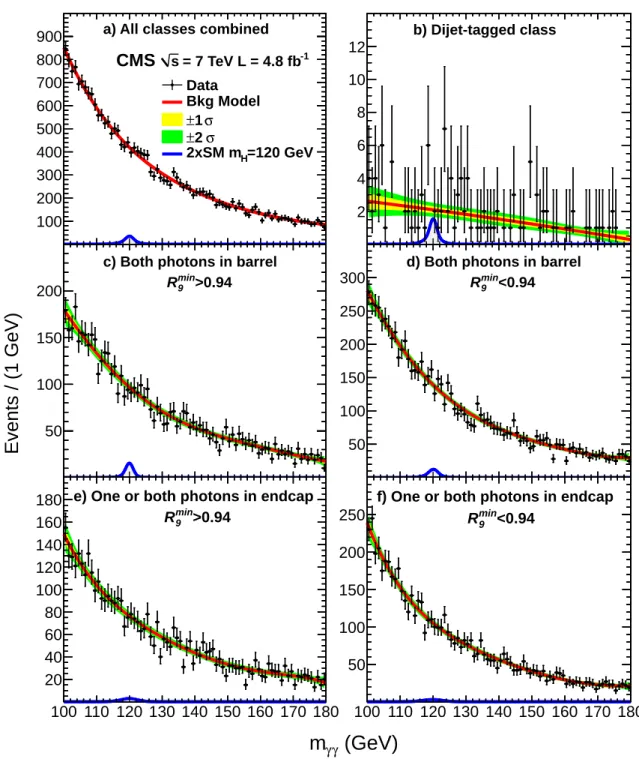
The mγγ distributions for the data in the five event classes, together with the background fits, are shown in Fig. 1. The uncertainty bands shown are computed from the fit uncertainty on the background yield within each bin used for the data points. The expected signal shapes for mH = 120 GeV are also shown. The magnitude of the simulated signal is what would be
expected if its cross section were twice the SM expectation. The sum of the five event classes is also shown, where the line representing the background model is the sum of the five fits to the individual event classes.
8
Results
The confidence level for exclusion or discovery of a SM Higgs boson signal is evaluated using the diphoton invariant mass distribution for each of the event classes. The results in the five classes are combined in the CL calculation to obtain the final result.
The limits are evaluated using a modified frequentist approach, CLs, taking the profile
likeli-hood as a test statistic [63–65]. Both a binned and an unbinned evaluation of the likelilikeli-hood are considered. While most of the analysis and determination of systematic uncertainties are common for these two approaches, there are differences at the final stages which make a com-parison useful. The signal model is taken from MC simulation after applying the corrections determined from data/simulation comparisons of Z → ee and Z → µµγ events mentioned above, and the reweighting of the Higgs boson transverse momentum spectrum. The back-ground is evaluated from a fit to the data without reference to the MC simulation.
Since a Higgs boson signal would be reconstructed with a mass resolution approaching 1 GeV in the classes with best resolution, the limit and signal significance evaluation is carried out in steps of 0.5 GeV. The SM Higgs boson cross sections and branchings ratios used are taken from ref. [66].
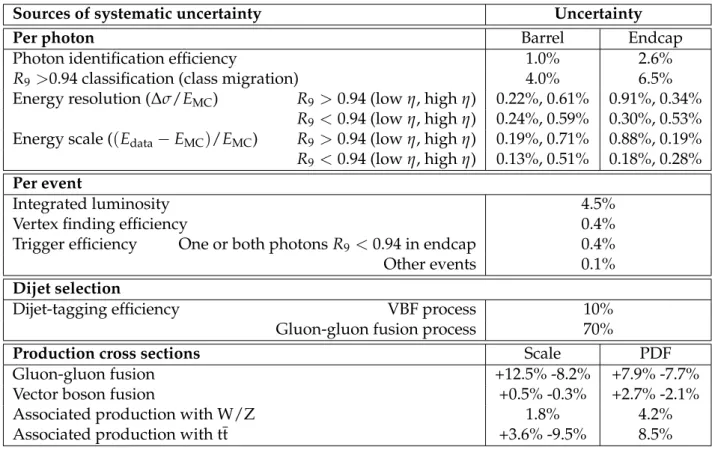
Table 3 lists the sources of systematic uncertainty considered in the analysis, together with the magnitude of the variation of the source that has been applied.
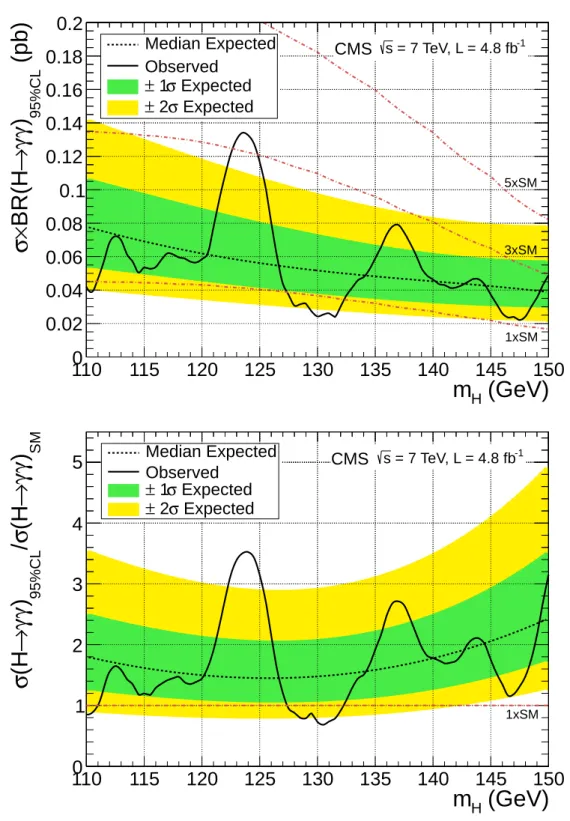
The limit set on the cross section of a Higgs boson decaying to two photons using the frequen-tist CLS computation and an unbinned evaluation of the likelihood, is shown in Fig. 2. Also
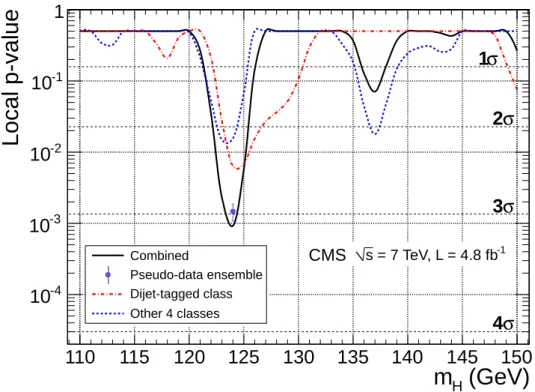
shown is the limit relative to the SM expectation, where the theoretical uncertainties on the expected cross sections from the different production mechanisms are individually included as systematic uncertainties in the limit setting procedure. The observed limit excludes at 95% CL the standard model Higgs boson decaying into two photons in the mass range 128 to 132 GeV. The fluctuations of the observed limit about the expected limit are consistent with statistical fluctuations to be expected in scanning the mass range. The largest deviation, at mγγ=124 GeV, is discussed in more detail below. It has also been verified that the shape of the observed limit is insensitive to the choice of background model fitting function. The results obtained from the binned evaluation of the likelihood are in excellent agreement with the results shown in Fig. 2. Figure 3 shows the local p-value calculated, using the asymptotic approximation [67], at 0.5 GeV intervals in the mass range 110 < mH < 150 GeV. The local p-values for the dijet-tag event
class, and for the combination of the four other classes, are also shown (dash-dotted and dashed lines respectively). The local p-value quantifies the probability for the background to produce a fluctuation at least as large as observed, and assumes that the relative signal strength between the event classes follows the MC signal model for the standard model Higgs
100 110 120 130 140 150 160 170 180 100 200 300 400 500 600 700 800 900 Data Bkg Model σ 1 ± σ 2 ± =120 GeV H 2xSM m -1 = 7 TeV L = 4.8 fb s CMS
a) All classes combined
100 110 120 130 140 150 160 170 180 2 4 6 8 10 12 b) Dijet-tagged class 100 110 120 130 140 150 160 170 180 50 100 150 200 >0.94 min 9 R
c) Both photons in barrel
100 110 120 130 140 150 160 170 180 50 100 150 200 250 300 min<0.94 9 R
d) Both photons in barrel
100 110 120 130 140 150 160 170 180 20 40 60 80 100 120 140 160 180 >0.94 min 9 R
e) One or both photons in endcap
100 110 120 130 140 150 160 170 180 50 100 150 200 250 Rmin9 <0.94
f) One or both photons in endcap
(GeV)
γ γ
m
Events / (1 GeV)
Figure 1: Background model fit to the mγγdistribution for the five event classes, together with a simulated signal (mH=120 GeV). The magnitude of the simulated signal is what would be
ex-pected if its cross section were twice the SM expectation. The sum of the event classes together with the sum of the five fits is also shown. a) The sum of the five event classes. b) the dijet-tagged class, c) both photons in the barrel, Rmin9 >0.94, d) both photons in the barrel, Rmin9 <
0.94, e) at least one photon in the endcaps, Rmin
9 > 0.94, f) at least one photon in the endcaps,
Rmin
10 8 Results
Table 3: Separate sources of systematic uncertainties accounted for in this analysis. The mag-nitude of the variation of the source that has been applied to the signal model is shown in the second column.
Sources of systematic uncertainty Uncertainty
Per photon Barrel Endcap
Photon identification efficiency 1.0% 2.6%
R9 >0.94 classification (class migration) 4.0% 6.5%
Energy resolution (∆σ/EMC) R9>0.94 (low η, high η) 0.22%, 0.61% 0.91%, 0.34%
R9<0.94 (low η, high η) 0.24%, 0.59% 0.30%, 0.53%
Energy scale ((Edata−EMC)/EMC) R9>0.94 (low η, high η) 0.19%, 0.71% 0.88%, 0.19%
R9<0.94 (low η, high η) 0.13%, 0.51% 0.18%, 0.28%
Per event
Integrated luminosity 4.5%
Vertex finding efficiency 0.4%
Trigger efficiency One or both photons R9 <0.94 in endcap 0.4%
Other events 0.1%
Dijet selection
Dijet-tagging efficiency VBF process 10%
Gluon-gluon fusion process 70%
Production cross sections Scale PDF
Gluon-gluon fusion +12.5% -8.2% +7.9% -7.7%
Vector boson fusion +0.5% -0.3% +2.7% -2.1%
Associated production with W/Z 1.8% 4.2%
(GeV)
Hm
110
115
120
125
130
135
140
145
150
(pb)
95%CL)
γγ
→
BR(H
×σ
0
0.02
0.04
0.06
0.08
0.1
0.12
0.14
0.16
0.18
0.2
Median Expected Observed Expected σ 1 ± Expected σ 2 ± CMS s = 7 TeV, L = 4.8 fb-1 1xSM 3xSM 5xSM(GeV)
Hm
110
115
120
125
130
135
140
145
150
SM)
γγ
→
(H
σ
/
95%CL)
γγ
→
(H
σ
0
1
2
3
4
5
Median Expected Observed Expected σ 1 ± Expected σ 2 ± CMS s = 7 TeV, L = 4.8 fb-1 1xSMFigure 2: Exclusion limit on the cross section of a SM Higgs boson decaying into two photons as a function of the boson mass (upper plot). Below is the same exclusion limit relative to the SM Higgs boson cross section, where the theoretical uncertainties on the cross section have been included in the limit setting.
12 9 Conclusions
(GeV)
Hm
110
115
120
125
130
135
140
145
150
Local p-value
-410
-310
-210
-110
1
Combined Pseudo-data ensemble Dijet-tagged class Other 4 classes CMS s = 7 TeV, L = 4.8 fb-1σ
1
σ
2
σ
3
σ
4
Figure 3: The local p-value as a function of Higgs boson mass, calculated in the asymptotic approximation. The point at 124 GeV shows the value obtained with a pseudo-data ensemble.
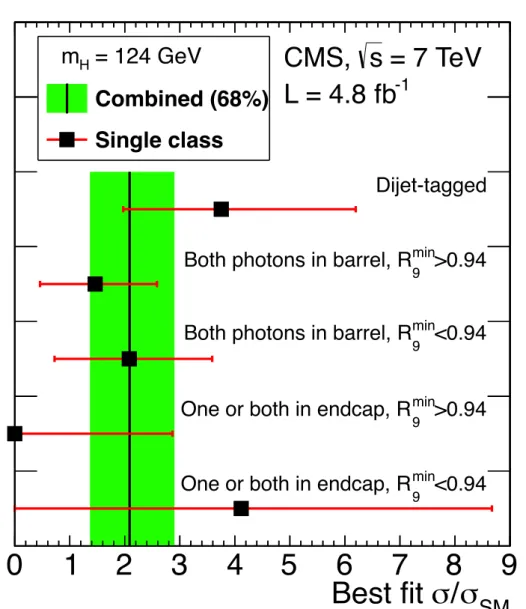
boson. The local p-value corresponding to the largest upwards fluctuation of the observed limit, at 124 GeV, has been computed to be 9.2×10⁻⁴ (3.1 σ) in the asymptotic approximation, and 1.5±0.4×10⁻³(3.0 σ) when the calculation uses pseudo-data (the value for the pseudo-data ensemble at 124 GeV is shown in Fig. 3). The combined best fit signal strength, for a SM Higgs boson mass hypothesis of 124 GeV, is 2.1±0.6 times the SM Higgs boson cross section. In Fig. 4 this combined best fit signal strength is compared to the best fit signal strengths in each of the event classes. Since a fluctuation of the background could occur at any point in the mass range there is a look-elsewhere effect [68]. When this is taken into account the probability, under the background only hypothesis, of observing a similar or larger excess in the full analysis mass range (110<mH <150 GeV) is 3.9×10⁻², corresponding to a global significance of 1.8 σ.
9
Conclusions
A search has been performed for the standard model Higgs boson decaying into two photons using data obtained from pp collisions at √s = 7 TeV corresponding to an integrated lumi-nosity of 4.8 fb−1. The selected events are subdivided into classes according to indicators of mass resolution and signal-to-background ratio, and the results of a search in each class are combined. The expected exclusion limit at 95% confidence level is between 1.4 and 2.4 times the standard model cross section in the mass range between 110 and 150 GeV. The analysis of the data excludes at 95% confidence level the standard model Higgs boson decaying into two photons in the mass range 128 to 132 GeV. The largest excess of events above the expected standard model background is observed for a Higgs boson mass hypothesis of 124 GeV with a local significance of 3.1 σ. The global significance of observing an excess with a local signifi-cance≥3.1 σ anywhere in the search range 110–150 GeV is estimated to be 1.8 σ. More data are required to ascertain the origin of this excess.
SM
σ
/
σ
Best fit
0
1
2
3
4
5
6
7
8
9
= 124 GeV
Hm
Combined (68%)
Single class
-1L = 4.8 fb
= 7 TeV
s
CMS,
>0.94
min 9Both photons in barrel, R
<0.94
min 9
Both photons in barrel, R
>0.94
min 9
One or both in endcap, R
<0.94
min 9
One or both in endcap, R
Dijet-tagged
Figure 4: The best fit signal strength, in terms of the standard model Higgs boson cross section, for the combined fit to the five classes (vertical line) and for the individual contributing classes (points) for the hypothesis of a SM Higgs boson mass of 124 GeV. The band corresponds to
±1 σ uncertainties on the overall value. The horizontal bars indicate±1 σ uncertainties on the values for individual classes.
14 9 Conclusions
Acknowledgements
We wish to congratulate our colleagues in the CERN accelerator departments for the excellent performance of the LHC machine. We thank the technical and administrative staff at CERN and other CMS institutes, and acknowledge support from: FMSR (Austria); FNRS and FWO (Bel-gium); CNPq, CAPES, FAPERJ, and FAPESP (Brazil); MES (Bulgaria); CERN; CAS, MoST, and NSFC (China); COLCIENCIAS (Colombia); MSES (Croatia); RPF (Cyprus); Academy of Sci-ences and NICPB (Estonia); Academy of Finland, MEC, and HIP (Finland); CEA and CNRS/IN2P3 (France); BMBF, DFG, and HGF (Germany); GSRT (Greece); OTKA and NKTH (Hungary); DAE and DST (India); IPM (Iran); SFI (Ireland); INFN (Italy); NRF and WCU (Korea); LAS (Lithuania); CINVESTAV, CONACYT, SEP, and UASLP-FAI (Mexico); MSI (New Zealand); PAEC (Pakistan); SCSR (Poland); FCT (Portugal); JINR (Armenia, Belarus, Georgia, Ukraine, Uzbekistan); MON, RosAtom, RAS and RFBR (Russia); MSTD (Serbia); MICINN and CPAN (Spain); Swiss Funding Agencies (Switzerland); NSC (Taipei); TUBITAK and TAEK (Turkey); STFC (United Kingdom); DOE and NSF (USA). Individuals have received support from the Marie-Curie programme and the European Research Council (European Union); the Leventis Foundation; the A. P. Sloan Foundation; the Alexander von Humboldt Foundation; the Belgian Federal Science Policy Office; the Fonds pour la Formation `a la Recherche dans l’Industrie et dans l’Agriculture (FRIA-Belgium); the Agentschap voor Innovatie door Wetenschap en Tech-nologie (IWT-Belgium); and the Council of Science and Industrial Research, India.
References
[1] S. L. Glashow, “Partial-symmetries of weak interactions”, Nucl. Phys. 22 (1961) 579. doi:10.1016/0029-5582(61)90469-2.
[2] S. Weinberg, “A model of leptons”, Phys. Rev. Lett. 19 (1967) 1264. doi:10.1103/PhysRevLett.19.1264.
[3] A. Salam, “Weak and electromagnetic interactions”, in Elementary particle physics: relativistic groups and analyticity, N. Svartholm, ed., p. 367. Almquvist & Wiskell, 1968. Proceedings of the eighth Nobel symposium.
[4] F. Englert and R. Brout, “Broken symmetry and the mass of gauge vector mesons”, Phys. Rev. Lett. 13 (1964) 321. doi:10.1103/PhysRevLett.13.321.
[5] P. W. Higgs, “Broken symmetries, massless particles and gauge fields”, Phys. Lett. 12 (1964) 132. doi:10.1016/0031-9163(64)91136-9.
[6] P. W. Higgs, “Broken symmetries and the masses of gauge bosons”, Phys. Rev. Lett. 13 (1964) 508. doi:10.1103/PhysRevLett.13.508.
[7] G. S. Guralnik, C. R. Hagen, and T. W. B. Kibble, “Global conservation laws and massless particles”, Phys. Rev. Lett. 13 (1964) 585. doi:10.1103/PhysRevLett.13.585. [8] P. W. Higgs, “Spontaneous symmetry breakdown without massless bosons”, Phys. Rev.
145(1966) 1156. doi:10.1103/PhysRev.145.1156.
[9] T. W. B. Kibble, “Symmetry breaking in non-Abelian gauge theories”, Phys. Rev. 155 (1967) 1554. doi:10.1103/PhysRev.155.1554.
[10] ALEPH, DELPHI, L3, OPAL Collaborations, and The LEP Working Group for Higgs Boson Searches, “Search for the Standard Model Higgs boson at LEP”, Phys. Lett. B 565 (2003) 61. doi:10.1016/S0370-2693(03)00614-2.
[11] CDF and D0 Collaborations, “Combination of Tevatron Searches for the Standard Model Higgs Boson in the W+S−Decay Mode”, Phys. Rev. Lett. 104 (2010) 061802. A more recent, unpublished, limit is given in preprint arXiv:1103.3233.
doi:10.1103/PhysRevLett.104.061802.
[12] ATLAS Collaboration, “Search for the Higgs boson in the H →WW(*)→ `+
ν`−¯ν decay channel in pp collisions at√s = 7 TeV with the ATLAS detector”, (2011).
arXiv:1112.2577. Submitted to Phys. Rev. Lett.
[13] ATLAS Collaboration, “Search for the Standard Model Higgs boson in the decay channel H→ ZZ(∗) →4`with the ATLAS detector”, Phys. Lett. B 705 (2011) 435,
arXiv:1109.5945. doi:10.1016/j.physletb.2011.10.034. [14] ATLAS Collaboration, “Search for a Standard Model Higgs Boson in the
H→ ZZ→ `+`−
ν ¯νdecay channel with the ATLAS detector”, Phys. Rev. Lett. 107 (2011) 221802, arXiv:1109.3357. doi:10.1103/PhysRevLett.107.221802.
[15] ALEPH, CDF, D0, DELPHI, L3, OPAL, SLD Collaborations, the LEP Electroweak Working Group, the Tevatron Electroweak Working Group, and the SLD Electroweak and heavy flavour groups, “Precision electroweak measurements and constraints on the Standard Model”, (2010). arXiv:1012.2367.
[16] S. Dawson, “Radiative corrections to Higgs boson production”, Nucl. Phys. B 359 (1991) 283. doi:10.1016/0550-3213(91)90061-2.
[17] M. Spira, A. Djouadi, D. Graudenz et al., “Higgs boson production at the LHC”, Nucl. Phys. B 453 (1995) 17. doi:10.1016/0550-3213(95)00379-7.
[18] R. V. Harlander and W. B. Kilgore, “Next-to-next-to-leading order Higgs production at hadron colliders”, Phys. Rev. Lett. 88 (2002) 201801.
doi:10.1103/PhysRevLett.88.201801.
[19] C. Anastasiou and K. Melnikov, “Higgs boson production at hadron colliders in NNLO QCD”, Nucl. Phys. B 646 (2002) 220. doi:10.1016/S0550-3213(02)00837-4. [20] V. Ravindran, J. Smith and W.L. van Neerven, “NNLO corrections to the total cross
section for Higgs boson production in hadron hadron collisions”, Nucl. Phys. B 665 (2003) 325. doi:10.1016/S0550-3213(03)00457-7.
[21] S. Actis, G. Passarino, C. Sturm et al., “NLO Electroweak Corrections to Higgs Boson Production at Hadron Colliders”, Phys. Lett. B 670 (2008) 12.
doi:10.1016/j.physletb.2008.10.018.
[22] C. Anastasiou, R. Boughezal, and F. Petriello, “Mixed QCD-electroweak corrections to Higgs boson production in gluon fusion”, JHEP 04 (2009) 003.
doi:10.1088/1126-6708/2009/04/003.
[23] P. Bolzoni, F. Maltoni, S.-O. Moch et al., “Higgs production via vector-boson fusion at NNLO in QCD”, Phys. Rev. Lett. 105 (2010) 011801.
doi:10.1103/PhysRevLett.105.011801.
[24] D. de Florian and M. Grazzini, “Higgs production through gluon fusion: updated cross sections at the Tevatron and the LHC”, Phys. Lett. B 674 (2009) 291.
16 9 Conclusions
[25] M. Ciccolini, A. Denner, and S. Dittmaier, “Strong and electroweak corrections to the production of Higgs + 2-jets via weak interactions at the LHC”, Phys. Rev. Lett. 99 (2007) 161803. doi:10.1103/PhysRevLett.99.161803.
[26] M. Ciccolini, A. Denner, and S. Dittmaier, “Electroweak and QCD corrections to Higgs production via vector-boson fusion at the LHC”, Phys. Rev. D 77 (2008) 013002. doi:10.1103/PhysRevD.77.013002.
[27] T. Han and S. Willenbrock, “QCD correction to the pp→W H and ZH total cross-sections”, Phys. Lett. B 273 (1991) 167.
doi:10.1016/0370-2693(91)90572-8.
[28] S. Actis, G. Passarino, C. Sturm et al., “NNLO Computational Techniques: the Cases H→γγand H →gg”, Nucl. Phys. B 811 (2009) 182, arXiv:0809.3667.
doi:10.1016/j.nuclphysb.2008.11.024.
[29] CDF Collaboration, “Search for a Fermiophobic Higgs Boson Decaying into Diphotons in p p-bar Collisions at sqrts = 1.96 TeV”, Phys. Rev. Lett. 103 (2009) 061803.
doi:10.1103/PhysRevLett.103.061803.
[30] D0 Collaboration, “Search for Resonant Diphoton Production with the D0 Detector”, Phys. Rev. Lett. 102 (2009) 231801. doi:10.1103/PhysRevLett.102.231801. [31] ATLAS Collaboration, “Search for the Standard Model Higgs boson in the two photon
decay channel with the ATLAS detector at the LHC”, Phys. Lett. B 705 (2011) 452. doi:10.1016/j.physletb.2011.10.051.
[32] CMS Collaboration, “The CMS experiment at the CERN LHC”, JINST 3 (2008) S08004. doi:10.1088/1748-0221/3/08/S08004.
[33] A. Hoecker, P. Speckmayer, J. Stelzer et al., “TMVA: Toolkit for Multivariate Data Analysis”, PoS ACAT (2007) 040, arXiv:physics/0703039.
[34] CMS Collaboration, “Particle–Flow Event Reconstruction in CMS and Performance for Jets, Taus, and EmissT ”, CMS Physics Analysis Summary CMS-PAS-PFT-09-001, (2009). [35] CMS Collaboration, “Commissioning of the Particle-Flow Reconstruction in
Minimum-Bias and Jet Events from pp Collisions at 7 TeV”, CMS Physics Analysis Summary CMS-PAS-PFT-10-002, (2010).
[36] M. Cacciari, G. P. Salam, and G. Soyez, “The anti-ktjet clustering algorithm”, JHEP 04
(2008) 063. doi:10.1088/1126-6708/2008/04/063.
[37] CMS Collaboration, “Determination of Jet Energy Calibration and Transverse Momentum Resolution in CMS”, JINST 06 (2011) P11002.
doi:10.1088/1748-0221/6/11/P11002.
[38] M. Cacciari and G. P. Salam, “Pileup subtraction using jet areas”, Phys. Lett. B659 (2008) 119. doi:10.1016/j.physletb.2007.09.077.
[39] M. Cacciari, G. P. Salam, and G. Soyez, “The Catchment Area of Jets”, JHEP 04 (2008) 005. doi:10.1088/1126-6708/2008/04/005.
[41] GEANT4 Collaboration, “GEANT4: A Simulation toolkit”, Nucl. Instrum. Meth. A 506 (2003) 250. doi:10.1016/S0168-9002(03)01368-8.
[42] CMS Collaboration, “Measurement of the inclusive W and Z production cross sections in pp collisions at√s =7 TeV with the CMS experiment”, JHEP 2011 (2011) 132.
doi:10.1007/JHEP10(2011)132.
[43] A. Ballestrero, G. Bevilacqua, and E. Maina, “A complete parton level analysis of
boson-boson scattering and ElectroWeak Symmetry Breaking in lv + four jets production at the LHC”, JHEP 05 (2009) 015. doi:10.1088/1126-6708/2009/05/015.
[44] D. L. Rainwater, R. Szalapski, and D. Zeppenfeld, “Probing color singlet exchange in Z + two jet events at the CERN LHC”, Phys. Rev. D 54 (1996) 6680.
doi:10.1103/PhysRevD.54.6680.
[45] e. Bartalini, Paolo, R. Field, R. Chierici et al., “Multiple partonic interactions at the LHC. Proceedings, 1st International Workshop, MPI’08, Perugia, Italy, October 27-31, 2008”, arXiv:1003.4220.
[46] P. Z. Skands, “Tuning Monte Carlo Generators: The Perugia Tunes”, Phys.Rev. D82 (2010) 074018, arXiv:1005.3457. doi:10.1103/PhysRevD.82.074018.
[47] A. Buckley, H. Hoeth, H. Lacker et al., “Systematic event generator tuning for the LHC”, Eur. Phys. J. C 65 (2010) 331–357, arXiv:0907.2973.
doi:10.1140/epjc/s10052-009-1196-7.
[48] R. Field, “Early LHC Underlying Event Data - Findings and Surprises”, arXiv:1010.3558.
[49] T. Sj ¨ostrand, S. Mrenna, and P. Z. Skands, “PYTHIA 6.4 Physics and Manual”, JHEP 0605 (2006) 026. doi:10.1088/1126-6708/2006/05/026.
[50] CMS Collaboration, “Measurement of the Drell-Yan Cross Section in pp Collisions at√ s =7 TeV”, JHEP 10 (2011) 7. doi:10.1007/JHEP10(2011)007.
[51] CMS Collaboration, “Measurement of the Production Cross Section for Pairs of Isolated Photons in pp collisions at√s=7 TeV”, (2011). arXiv:1110.6461. Submitted to JHEP.
[52] CMS Collaboration, “Measurement of the differential dijet production cross section in proton-proton collisions at√s=7 TeV”, Phys. Lett. B 700 (2011) 187.
doi:10.1016/j.physletb.2011.05.027.
[53] S. Alioli, P. Nason, C. Oleari et al., “NLO Higgs boson production via gluon fusion matched with shower in POWHEG”, JHEP 04 (2009) 002.
doi:10.1088/1126-6708/2009/04/002.
[54] P. Nason and C. Oleari, “NLO Higgs boson production via vector-boson fusion matched with shower in POWHEG”, JHEP 02 (2010) 037. doi:10.1007/JHEP02(2010)037. [55] G. Bozzi, S. Catani, D. de Florian et al., “The q(T) spectrum of the Higgs boson at the
LHC in QCD perturbation theory”, Phys. Lett. B 564 (2003) 65. doi:10.1016/S0370-2693(03)00656-7.
18 9 Conclusions
[56] G. Bozzi, S. Catani, D. de Florian et al., “Transverse-momentum resummation and the spectrum of the Higgs boson at the LHC”, Nucl. Phys. B 737 (2006) 73.
doi:10.1016/j.nuclphysb.2005.12.022.
[57] D. de Florian, G. Ferrera, M. Grazzini et al., “Transverse-momentum resummation: Higgs boson production at the Tevatron and the LHC”, JHEP 1111 (2011) 064.
doi:10.1007/JHEP11(2011)064.
[58] M. Botje, J. Butterworth, A. Cooper-Sarkar et al., “The PDF4LHC Working Group Interim Recommendations”, (2011). arXiv:1101.0538.
[59] S. Alekhin, S. Alioli, R. D. Ball et al., “The PDF4LHC Working Group Interim Report”, (2011). arXiv:1101.0536.
[60] H.-L. Lai, M. Guzzi, J. Huston et al., “New parton distributions for collider physics”, Phys. Rev. D 82 (2010) 074024. doi:10.1103/PhysRevD.82.074024.
[61] A. Martin, W. Stirling, R. Thorne et al., “Parton distributions for the LHC”, Eur. Phys. J. C 63(2009) 189. doi:10.1140/epjc/s10052-009-1072-5.
[62] NNPDF Collaboration, “Impact of Heavy Quark Masses on Parton Distributions and LHC Phenomenology”, Nucl. Phys. B 849 (2011) arXiv:1101.1300.
doi:10.1016/j.nuclphysb.2011.03.021.
[63] T. Junk, “Confidence level computation for combining searches with small statistics”, Nucl. Instrum. Meth. A 434 (1999) 435, arXiv:hep-ex/9902006.
doi:10.1016/S0168-9002(99)00498-2.
[64] A. Read, “Modified frequentist analysis of search results (the CLsmethod)”, Technical
Report CERN-OPEN-2000-005, CERN, (2000).
[65] ATLAS and CMS Collaborations, LHC Higgs Combination Group, “Procedure for the LHC Higgs boson search combination in Summer 2011”, ATL-PHYS-PUB/CMS NOTE 2011-11, 2011/005, (2011).
[66] LHC Higgs Cross Section Working Group Collaboration, “Handbook of LHC Higgs Cross Sections: 1. Inclusive Observables”, CERN Report CERN-2011-002, (2011).
[67] G. Cowan et al., “Asymptotic formulae for likelihood-based tests of new physics”, Eur. Phys. J. C 71 (2011) 1, arXiv:1007.1727.
doi:10.1140/epjc/s10052-011-1554-0.
[68] E. Gross and O. Vitells, “Trial factors for the look elsewhere effect in high energy physics”, Eur. Phys. J. C 70 (2010) 525, arXiv:1005.1891.
A
The CMS Collaboration
Yerevan Physics Institute, Yerevan, Armenia
S. Chatrchyan, V. Khachatryan, A.M. Sirunyan, A. Tumasyan Institut f ¨ur Hochenergiephysik der OeAW, Wien, Austria
W. Adam, T. Bergauer, M. Dragicevic, J. Er ¨o, C. Fabjan, M. Friedl, R. Fr ¨uhwirth, V.M. Ghete, J. Hammer1, M. Hoch, N. H ¨ormann, J. Hrubec, M. Jeitler, W. Kiesenhofer, M. Krammer, D. Liko, I. Mikulec, M. Pernicka†, B. Rahbaran, C. Rohringer, H. Rohringer, R. Sch ¨ofbeck, J. Strauss, A. Taurok, F. Teischinger, P. Wagner, W. Waltenberger, G. Walzel, E. Widl, C.-E. Wulz
National Centre for Particle and High Energy Physics, Minsk, Belarus N. Shumeiko, J. Suarez Gonzalez
Research Institute for Nuclear Problems, Minsk, Belarus M. Korzhik
Universiteit Antwerpen, Antwerpen, Belgium
S. Bansal, L. Benucci, T. Cornelis, E.A. De Wolf, X. Janssen, S. Luyckx, T. Maes, L. Mucibello, S. Ochesanu, B. Roland, R. Rougny, M. Selvaggi, H. Van Haevermaet, P. Van Mechelen, N. Van Remortel, A. Van Spilbeeck
Vrije Universiteit Brussel, Brussel, Belgium
F. Blekman, S. Blyweert, J. D’Hondt, R. Gonzalez Suarez, A. Kalogeropoulos, M. Maes, A. Olbrechts, W. Van Doninck, P. Van Mulders, G.P. Van Onsem, I. Villella
Universit´e Libre de Bruxelles, Bruxelles, Belgium
O. Charaf, B. Clerbaux, G. De Lentdecker, V. Dero, A.P.R. Gay, G.H. Hammad, T. Hreus, A. L´eonard, P.E. Marage, L. Thomas, C. Vander Velde, P. Vanlaer, J. Wickens
Ghent University, Ghent, Belgium
V. Adler, K. Beernaert, A. Cimmino, S. Costantini, G. Garcia, M. Grunewald, B. Klein, J. Lellouch, A. Marinov, J. Mccartin, A.A. Ocampo Rios, D. Ryckbosch, N. Strobbe, F. Thyssen, M. Tytgat, L. Vanelderen, P. Verwilligen, S. Walsh, E. Yazgan, N. Zaganidis
Universit´e Catholique de Louvain, Louvain-la-Neuve, Belgium
S. Basegmez, G. Bruno, L. Ceard, J. De Favereau De Jeneret, C. Delaere, T. du Pree, D. Favart, L. Forthomme, A. Giammanco2, G. Gr´egoire, J. Hollar, V. Lemaitre, J. Liao, O. Militaru, C. Nuttens, D. Pagano, A. Pin, K. Piotrzkowski, N. Schul
Universit´e de Mons, Mons, Belgium N. Beliy, T. Caebergs, E. Daubie
Centro Brasileiro de Pesquisas Fisicas, Rio de Janeiro, Brazil
G.A. Alves, M. Correa Martins Junior, D. De Jesus Damiao, T. Martins, M.E. Pol, M.H.G. Souza Universidade do Estado do Rio de Janeiro, Rio de Janeiro, Brazil
W.L. Ald´a J ´unior, W. Carvalho, A. Cust ´odio, E.M. Da Costa, C. De Oliveira Martins, S. Fonseca De Souza, D. Matos Figueiredo, L. Mundim, H. Nogima, V. Oguri, W.L. Prado Da Silva, A. Santoro, S.M. Silva Do Amaral, L. Soares Jorge, A. Sznajder
Instituto de Fisica Teorica, Universidade Estadual Paulista, Sao Paulo, Brazil
T.S. Anjos3, C.A. Bernardes3, F.A. Dias4, T.R. Fernandez Perez Tomei, E. M. Gregores3, C. Lagana, F. Marinho, P.G. Mercadante3, S.F. Novaes, Sandra S. Padula
20 A The CMS Collaboration
Institute for Nuclear Research and Nuclear Energy, Sofia, Bulgaria
V. Genchev1, P. Iaydjiev1, S. Piperov, M. Rodozov, S. Stoykova, G. Sultanov, V. Tcholakov, R. Trayanov, M. Vutova
University of Sofia, Sofia, Bulgaria
A. Dimitrov, R. Hadjiiska, A. Karadzhinova, V. Kozhuharov, L. Litov, B. Pavlov, P. Petkov Institute of High Energy Physics, Beijing, China
J.G. Bian, G.M. Chen, H.S. Chen, C.H. Jiang, D. Liang, S. Liang, X. Meng, J. Tao, J. Wang, J. Wang, X. Wang, Z. Wang, H. Xiao, M. Xu, J. Zang, Z. Zhang
State Key Lab. of Nucl. Phys. and Tech., Peking University, Beijing, China
C. Asawatangtrakuldee, Y. Ban, S. Guo, Y. Guo, W. Li, S. Liu, Y. Mao, S.J. Qian, H. Teng, S. Wang, B. Zhu, W. Zou
Universidad de Los Andes, Bogota, Colombia
A. Cabrera, B. Gomez Moreno, A.F. Osorio Oliveros, J.C. Sanabria Technical University of Split, Split, Croatia
N. Godinovic, D. Lelas, R. Plestina5, D. Polic, I. Puljak1 University of Split, Split, Croatia
Z. Antunovic, M. Dzelalija, M. Kovac Institute Rudjer Boskovic, Zagreb, Croatia
V. Brigljevic, S. Duric, K. Kadija, J. Luetic, S. Morovic University of Cyprus, Nicosia, Cyprus
A. Attikis, M. Galanti, J. Mousa, C. Nicolaou, F. Ptochos, P.A. Razis Charles University, Prague, Czech Republic
M. Finger, M. Finger Jr.
Academy of Scientific Research and Technology of the Arab Republic of Egypt, Egyptian Network of High Energy Physics, Cairo, Egypt
Y. Assran6, A. Ellithi Kamel7, S. Khalil8, M.A. Mahmoud9, A. Radi10 National Institute of Chemical Physics and Biophysics, Tallinn, Estonia A. Hektor, M. Kadastik, M. M ¨untel, M. Raidal, L. Rebane, A. Tiko
Department of Physics, University of Helsinki, Helsinki, Finland V. Azzolini, P. Eerola, G. Fedi, M. Voutilainen
Helsinki Institute of Physics, Helsinki, Finland
S. Czellar, J. H¨ark ¨onen, A. Heikkinen, V. Karim¨aki, R. Kinnunen, M.J. Kortelainen, T. Lamp´en, K. Lassila-Perini, S. Lehti, T. Lind´en, P. Luukka, T. M¨aenp¨a¨a, T. Peltola, E. Tuominen, J. Tuominiemi, E. Tuovinen, D. Ungaro, L. Wendland
Lappeenranta University of Technology, Lappeenranta, Finland K. Banzuzi, A. Korpela, T. Tuuva
Laboratoire d’Annecy-le-Vieux de Physique des Particules, IN2P3-CNRS, Annecy-le-Vieux, France
D. Sillou
DSM/IRFU, CEA/Saclay, Gif-sur-Yvette, France
A. Givernaud, P. Gras, G. Hamel de Monchenault, P. Jarry, E. Locci, J. Malcles, L. Millischer, J. Rander, A. Rosowsky, I. Shreyber, M. Titov
Laboratoire Leprince-Ringuet, Ecole Polytechnique, IN2P3-CNRS, Palaiseau, France
S. Baffioni, F. Beaudette, L. Benhabib, L. Bianchini, M. Bluj11, C. Broutin, P. Busson, C. Charlot, N. Daci, T. Dahms, L. Dobrzynski, S. Elgammal, R. Granier de Cassagnac, M. Haguenauer, P. Min´e, C. Mironov, C. Ochando, P. Paganini, D. Sabes, R. Salerno, Y. Sirois, C. Thiebaux, C. Veelken, A. Zabi
Institut Pluridisciplinaire Hubert Curien, Universit´e de Strasbourg, Universit´e de Haute Alsace Mulhouse, CNRS/IN2P3, Strasbourg, France
J.-L. Agram12, J. Andrea, D. Bloch, D. Bodin, J.-M. Brom, M. Cardaci, E.C. Chabert, C. Collard,
E. Conte12, F. Drouhin12, C. Ferro, J.-C. Fontaine12, D. Gel´e, U. Goerlach, P. Juillot, M. Karim12, A.-C. Le Bihan, P. Van Hove
Centre de Calcul de l’Institut National de Physique Nucleaire et de Physique des Particules (IN2P3), Villeurbanne, France
F. Fassi, D. Mercier
Universit´e de Lyon, Universit´e Claude Bernard Lyon 1, CNRS-IN2P3, Institut de Physique Nucl´eaire de Lyon, Villeurbanne, France
C. Baty, S. Beauceron, N. Beaupere, M. Bedjidian, O. Bondu, G. Boudoul, D. Boumediene, H. Brun, J. Chasserat, R. Chierici1, D. Contardo, P. Depasse, H. El Mamouni, A. Falkiewicz, J. Fay, S. Gascon, M. Gouzevitch, B. Ille, T. Kurca, T. Le Grand, M. Lethuillier, L. Mirabito, S. Perries, V. Sordini, S. Tosi, Y. Tschudi, P. Verdier, S. Viret
Institute of High Energy Physics and Informatization, Tbilisi State University, Tbilisi, Georgia
D. Lomidze
RWTH Aachen University, I. Physikalisches Institut, Aachen, Germany
G. Anagnostou, S. Beranek, M. Edelhoff, L. Feld, N. Heracleous, O. Hindrichs, R. Jussen, K. Klein, J. Merz, A. Ostapchuk, A. Perieanu, F. Raupach, J. Sammet, S. Schael, D. Sprenger, H. Weber, B. Wittmer, V. Zhukov13
RWTH Aachen University, III. Physikalisches Institut A, Aachen, Germany
M. Ata, J. Caudron, E. Dietz-Laursonn, M. Erdmann, A. G ¨uth, T. Hebbeker, C. Heidemann, K. Hoepfner, T. Klimkovich, D. Klingebiel, P. Kreuzer, D. Lanske†, J. Lingemann, C. Magass, M. Merschmeyer, A. Meyer, M. Olschewski, P. Papacz, H. Pieta, H. Reithler, S.A. Schmitz, L. Sonnenschein, J. Steggemann, D. Teyssier, M. Weber
RWTH Aachen University, III. Physikalisches Institut B, Aachen, Germany
M. Bontenackels, V. Cherepanov, M. Davids, G. Fl ¨ugge, H. Geenen, M. Geisler, W. Haj Ahmad, F. Hoehle, B. Kargoll, T. Kress, Y. Kuessel, A. Linn, A. Nowack, L. Perchalla, O. Pooth, J. Rennefeld, P. Sauerland, A. Stahl, M.H. Zoeller
Deutsches Elektronen-Synchrotron, Hamburg, Germany
M. Aldaya Martin, W. Behrenhoff, U. Behrens, M. Bergholz14, A. Bethani, K. Borras, A. Burgmeier, A. Cakir, L. Calligaris, A. Campbell, E. Castro, D. Dammann, G. Eckerlin, D. Eckstein, A. Flossdorf, G. Flucke, A. Geiser, J. Hauk, H. Jung1, M. Kasemann, P. Katsas,
C. Kleinwort, H. Kluge, A. Knutsson, M. Kr¨amer, D. Kr ¨ucker, E. Kuznetsova, W. Lange, W. Lohmann14, B. Lutz, R. Mankel, I. Marfin, M. Marienfeld, I.-A. Melzer-Pellmann, A.B. Meyer, J. Mnich, A. Mussgiller, S. Naumann-Emme, J. Olzem, A. Petrukhin, D. Pitzl,
22 A The CMS Collaboration
A. Raspereza, P.M. Ribeiro Cipriano, M. Rosin, J. Salfeld-Nebgen, R. Schmidt14, T. Schoerner-Sadenius, N. Sen, A. Spiridonov, M. Stein, J. Tomaszewska, R. Walsh, C. Wissing
University of Hamburg, Hamburg, Germany
C. Autermann, V. Blobel, S. Bobrovskyi, J. Draeger, H. Enderle, J. Erfle, U. Gebbert, M. G ¨orner, T. Hermanns, R.S. H ¨oing, K. Kaschube, G. Kaussen, H. Kirschenmann, R. Klanner, J. Lange, B. Mura, F. Nowak, N. Pietsch, C. Sander, H. Schettler, P. Schleper, E. Schlieckau, A. Schmidt, M. Schr ¨oder, T. Schum, H. Stadie, G. Steinbr ¨uck, J. Thomsen
Institut f ¨ur Experimentelle Kernphysik, Karlsruhe, Germany
C. Barth, J. Berger, T. Chwalek, W. De Boer, A. Dierlamm, G. Dirkes, M. Feindt, J. Gruschke, M. Guthoff1, C. Hackstein, F. Hartmann, M. Heinrich, H. Held, K.H. Hoffmann, S. Honc,
I. Katkov13, J.R. Komaragiri, T. Kuhr, D. Martschei, S. Mueller, Th. M ¨uller, M. Niegel, A. N ¨urnberg, O. Oberst, A. Oehler, J. Ott, T. Peiffer, G. Quast, K. Rabbertz, F. Ratnikov, N. Ratnikova, M. Renz, S. R ¨ocker, C. Saout, A. Scheurer, P. Schieferdecker, F.-P. Schilling, M. Schmanau, G. Schott, H.J. Simonis, F.M. Stober, D. Troendle, J. Wagner-Kuhr, T. Weiler, M. Zeise, E.B. Ziebarth
Institute of Nuclear Physics ”Demokritos”, Aghia Paraskevi, Greece
G. Daskalakis, T. Geralis, S. Kesisoglou, A. Kyriakis, D. Loukas, I. Manolakos, A. Markou, C. Markou, C. Mavrommatis, E. Ntomari
University of Athens, Athens, Greece
L. Gouskos, T.J. Mertzimekis, A. Panagiotou, N. Saoulidou, E. Stiliaris University of Io´annina, Io´annina, Greece
I. Evangelou, C. Foudas1, P. Kokkas, N. Manthos, I. Papadopoulos, V. Patras, F.A. Triantis
KFKI Research Institute for Particle and Nuclear Physics, Budapest, Hungary
A. Aranyi, G. Bencze, L. Boldizsar, C. Hajdu1, P. Hidas, D. Horvath15, A. Kapusi, K. Krajczar16, F. Sikler1, V. Veszpremi, G. Vesztergombi16
Institute of Nuclear Research ATOMKI, Debrecen, Hungary N. Beni, J. Molnar, J. Palinkas, Z. Szillasi
University of Debrecen, Debrecen, Hungary J. Karancsi, P. Raics, Z.L. Trocsanyi, B. Ujvari Panjab University, Chandigarh, India
S.B. Beri, V. Bhatnagar, N. Dhingra, R. Gupta, M. Jindal, M. Kaur, J.M. Kohli, M.Z. Mehta, N. Nishu, L.K. Saini, A. Sharma, A.P. Singh, J. Singh, S.P. Singh
University of Delhi, Delhi, India
S. Ahuja, B.C. Choudhary, A. Kumar, A. Kumar, S. Malhotra, M. Naimuddin, K. Ranjan, V. Sharma, R.K. Shivpuri
Saha Institute of Nuclear Physics, Kolkata, India
S. Banerjee, S. Bhattacharya, S. Dutta, B. Gomber, S. Jain, S. Jain, R. Khurana, S. Sarkar Bhabha Atomic Research Centre, Mumbai, India
R.K. Choudhury, D. Dutta, S. Kailas, V. Kumar, A.K. Mohanty1, L.M. Pant, P. Shukla Tata Institute of Fundamental Research - EHEP, Mumbai, India
T. Aziz, S. Ganguly, M. Guchait17, A. Gurtu18, M. Maity19, G. Majumder, K. Mazumdar, G.B. Mohanty, B. Parida, A. Saha, K. Sudhakar, N. Wickramage
Tata Institute of Fundamental Research - HECR, Mumbai, India S. Banerjee, S. Dugad, N.K. Mondal
Institute for Research in Fundamental Sciences (IPM), Tehran, Iran
H. Arfaei, H. Bakhshiansohi20, S.M. Etesami21, A. Fahim20, M. Hashemi, H. Hesari, A. Jafari20, M. Khakzad, A. Mohammadi22, M. Mohammadi Najafabadi, S. Paktinat Mehdiabadi, B. Safarzadeh23, M. Zeinali21
INFN Sezione di Baria, Universit`a di Barib, Politecnico di Baric, Bari, Italy
M. Abbresciaa,b, L. Barbonea,b, C. Calabriaa,b, S.S. Chhibraa,b, A. Colaleoa, D. Creanzaa,c, N. De Filippisa,c,1, M. De Palmaa,b, L. Fiorea, G. Iasellia,c, L. Lusitoa,b, G. Maggia,c, M. Maggia, N. Mannaa,b, B. Marangellia,b, S. Mya,c, S. Nuzzoa,b, N. Pacificoa,b, A. Pompilia,b, G. Pugliesea,c,
F. Romanoa,c, G. Selvaggia,b, L. Silvestrisa, G. Singha,b, S. Tupputia,b, G. Zitoa INFN Sezione di Bolognaa, Universit`a di Bolognab, Bologna, Italy
G. Abbiendia, A.C. Benvenutia, D. Bonacorsia, S. Braibant-Giacomellia,b, L. Brigliadoria, P. Capiluppia,b, A. Castroa,b, F.R. Cavalloa, M. Cuffiania,b, G.M. Dallavallea, F. Fabbria, A. Fanfania,b, D. Fasanellaa,1, P. Giacomellia, C. Grandia, S. Marcellinia, G. Masettia, M. Meneghellia,b, A. Montanaria, F.L. Navarriaa,b, F. Odoricia, A. Perrottaa, F. Primaveraa, A.M. Rossia,b, T. Rovellia,b, G. Sirolia,b, R. Travaglinia,b
INFN Sezione di Cataniaa, Universit`a di Cataniab, Catania, Italy
S. Albergoa,b, G. Cappelloa,b, M. Chiorbolia,b, S. Costaa,b, R. Potenzaa,b, A. Tricomia,b, C. Tuvea,b INFN Sezione di Firenzea, Universit`a di Firenzeb, Firenze, Italy
G. Barbaglia, V. Ciullia,b, C. Civininia, R. D’Alessandroa,b, E. Focardia,b, S. Frosalia,b, E. Galloa, S. Gonzia,b, M. Meschinia, S. Paolettia, G. Sguazzonia, A. Tropianoa,1
INFN Laboratori Nazionali di Frascati, Frascati, Italy
L. Benussi, S. Bianco, S. Colafranceschi24, F. Fabbri, D. Piccolo INFN Sezione di Genova, Genova, Italy
P. Fabbricatore, R. Musenich
INFN Sezione di Milano-Bicoccaa, Universit`a di Milano-Bicoccab, Milano, Italy
A. Benagliaa,b,1, F. De Guioa,b, L. Di Matteoa,b, S. Fiorendia,b, S. Gennaia,1, A. Ghezzia,b, S. Malvezzia, R.A. Manzonia,b, A. Martellia,b, A. Massironia,b,1, D. Menascea, L. Moronia, M. Paganonia,b, D. Pedrinia, S. Ragazzia,b, N. Redaellia, S. Salaa, T. Tabarelli de Fatisa,b
INFN Sezione di Napolia, Universit`a di Napoli ”Federico II”b, Napoli, Italy
S. Buontempoa, C.A. Carrillo Montoyaa,1, N. Cavalloa,25, A. De Cosaa,b, O. Doganguna,b, F. Fabozzia,25, A.O.M. Iorioa,1, L. Listaa, M. Merolaa,b, P. Paoluccia
INFN Sezione di Padovaa, Universit`a di Padovab, Universit`a di Trento (Trento)c, Padova, Italy
P. Azzia, N. Bacchettaa,1, P. Bellana,b, D. Biselloa,b, A. Brancaa, R. Carlina,b, P. Checchiaa, T. Dorigoa, U. Dossellia, F. Fanzagoa, F. Gasparinia,b, U. Gasparinia,b, A. Gozzelinoa, K. Kan-ishchev, S. Lacapraraa,26, I. Lazzizzeraa,c, M. Margonia,b, M. Mazzucatoa, A.T. Meneguzzoa,b, M. Nespoloa,1, L. Perrozzia, N. Pozzobona,b, P. Ronchesea,b, F. Simonettoa,b, E. Torassaa, M. Tosia,b,1, S. Vaninia,b, P. Zottoa,b, G. Zumerlea,b
INFN Sezione di Paviaa, Universit`a di Paviab, Pavia, Italy
24 A The CMS Collaboration
INFN Sezione di Perugiaa, Universit`a di Perugiab, Perugia, Italy
M. Biasinia,b, G.M. Bileia, B. Caponeria,b, L. Fan `oa,b, P. Laricciaa,b, A. Lucaronia,b,1, G. Mantovania,b, M. Menichellia, A. Nappia,b, F. Romeoa,b, A. Santocchiaa,b, S. Taronia,b,1, M. Valdataa,b
INFN Sezione di Pisaa, Universit`a di Pisab, Scuola Normale Superiore di Pisac, Pisa, Italy P. Azzurria,c, G. Bagliesia, T. Boccalia, G. Broccoloa,c, R. Castaldia, R.T. D’Agnoloa,c, R. Dell’Orsoa, F. Fioria,b, L. Fo`aa,c, A. Giassia, A. Kraana, F. Ligabuea,c, T. Lomtadzea, L. Martinia,27, A. Messineoa,b, F. Pallaa, F. Palmonaria, A. Rizzi, A.T. Serbana, P. Spagnoloa, R. Tenchinia, G. Tonellia,b,1, A. Venturia,1, P.G. Verdinia
INFN Sezione di Romaa, Universit`a di Roma ”La Sapienza”b, Roma, Italy
S. Baccaroa,28, L. Baronea,b, F. Cavallaria, I. Dafineia, D. Del Rea,b,1, M. Diemoza, C. Fanelli, M. Grassia,1, E. Longoa,b, P. Meridiania, F. Micheli, S. Nourbakhsha, G. Organtinia,b, F. Pandolfia,b, R. Paramattia, S. Rahatloua,b, M. Sigamania, L. Soffi
INFN Sezione di Torino a, Universit`a di Torino b, Universit`a del Piemonte Orientale (No-vara)c, Torino, Italy
N. Amapanea,b, R. Arcidiaconoa,c, S. Argiroa,b, M. Arneodoa,c, C. Biinoa, C. Bottaa,b, N. Cartigliaa, R. Castelloa,b, M. Costaa,b, N. Demariaa, A. Grazianoa,b, C. Mariottia,1, S. Masellia,
E. Migliorea,b, V. Monacoa,b, M. Musicha, M.M. Obertinoa,c, N. Pastronea, M. Pelliccionia, A. Potenzaa,b, A. Romeroa,b, M. Ruspaa,c, R. Sacchia,b, V. Solaa,b, A. Solanoa,b, A. Staianoa, A. Vilela Pereiraa
INFN Sezione di Triestea, Universit`a di Triesteb, Trieste, Italy
S. Belfortea, F. Cossuttia, G. Della Riccaa,b, B. Gobboa, M. Maronea,b, D. Montaninoa,b,1, A. Penzoa
Kangwon National University, Chunchon, Korea S.G. Heo, S.K. Nam
Kyungpook National University, Daegu, Korea
S. Chang, J. Chung, D.H. Kim, G.N. Kim, J.E. Kim, D.J. Kong, H. Park, S.R. Ro, D.C. Son Chonnam National University, Institute for Universe and Elementary Particles, Kwangju, Korea
J.Y. Kim, Zero J. Kim, S. Song Konkuk University, Seoul, Korea H.Y. Jo
Korea University, Seoul, Korea
S. Choi, D. Gyun, B. Hong, M. Jo, H. Kim, T.J. Kim, K.S. Lee, D.H. Moon, S.K. Park, E. Seo, K.S. Sim
University of Seoul, Seoul, Korea
M. Choi, S. Kang, H. Kim, J.H. Kim, C. Park, I.C. Park, S. Park, G. Ryu Sungkyunkwan University, Suwon, Korea
Y. Cho, Y. Choi, Y.K. Choi, J. Goh, M.S. Kim, B. Lee, J. Lee, S. Lee, H. Seo, I. Yu Vilnius University, Vilnius, Lithuania