Diversity and distribution of riffle beetle assemblages (Coleoptera, Elmidae) in montane
rivers of Southern Brazil
Bruna Marmitt Braun1, Andrea Vanesa Batalla Salvarrey1, Carla Bender Kotzian2, Marcia Regina Spies3&
Mateus Marques Pires4,5
1Programa de Po´s-Graduac¸a˜o em Biodiversidade Animal, Centro de Cieˆncias Naturais e Exatas, Universidade Federal de Santa Maria, Faixa de Camobi km 9, CEP 97105-900, Santa Maria, RS, Brazil.
2
Departamento de Biologia e Programa de Po´s-graduac¸a˜o em Biodiversidade Animal, Centro de Cieˆncias Naturais e Exatas, Universidade Federal de Santa Maria, Faixa de Camobi km 9, CEP 97105-900, Santa
Maria, RS, Brazil. 3
Universidade Federal do Pampa, Av. Antoˆnio Trilha, 1847, CEP 97300-000, Sa˜o Gabriel, RS, Brazil. 4
Programa de Po´s-Graduac¸a˜o em Biologia, Centro de Cieˆncias da Sau´de, Universidade do Vale do Rio dos Sinos, Avenida Unisinos, 950, CEP 93022-000, Sa˜o Leopoldo, RS, Brazil.
5
Corresponding author: Mateus Marques Pires, e-mail:[email protected]
BRAUN, B.M., SALVARREY, A.V.B., KOTZIAN, C.B., SPIES, M.R., PIRES, M.M.Diversity and distribution of riffle beetle assemblages (Coleoptera, Elmidae) in montane rivers of Southern Brazil.Biota
http://dx.doi.org/10.1590/1676-060320140615183046
Abstract: The diversity and spatio-temporal distribution of Elmidae (Coleoptera) assemblages in montane rivers and streams of southernmost Brazil (Rio Grande do Sul state) were studied. Six genera were found, represented mostly by larval specimens.AustrolimniusandMacrelmisare new occurrences in the region. Assemblages’ genera composition and dominance were related to the presence of the macrophyte Podostemum. Also, water temperature and stream depth and velocity were the most important drivers related to the assemblages’ distribution. Richness and abundance were positively related to high water velocity and negatively to stream depth. Temporal patterns were detected especially in assemblage abundance, yet a slight pattern in richness was also observed. The seasonal structure was related to warm temperatures, but temporal distribution of Elmidae assemblages appears to be related to the dominant genera life cycles. The studied area shows an overall Elmidae richness similar to that found in some tropical areas and the role of mountainous environments in sustaining high rates of regional diversity in the Neotropics is stated.
Keywords:aquatic insects, streams, Neotropical region.
BRAUN, B.M., SALVARREY, A.V.B., KOTZIAN, C.B., SPIES, M.R., PIRES, M.M. Diversidade e distribuic¸a˜o de comunidades de Elmidae (Coleoptera) em rios montanhosos do sul do Brasil. Biota
http://dx.doi.org/10.1590/1676-060320140615183046
Resumo: A diversidade e a distribuic¸a˜o espac¸o-temporal de comunidades de Elmidae (Coleoptera) em rios e riachos de uma a´rea montanhosa no sul do Brasil (estado do Rio Grande do Sul) foram estudadas. Sete geˆneros foram encontrados, representados principalmente pelo esta´gio larval. Austrolimnius e
Macrelmis sa˜o novas ocorreˆncias no estado. A composic¸a˜o e a dominaˆncia dos geˆneros estiveram relacionadas com a presenc¸a da macro´fitaPodostemum. Ale´m disso, a temperatura da a´gua, a velocidade da corrente e a profundidade dos riachos foram os fatores mais importantes relacionados a` distribuic¸a˜o das comunidades. A riqueza e a abundaˆncia foram positivamente relacionadas com a velocidade da corrente e negativamente com a profundidade. Na˜o foram detectados fortes padro˜es temporais na riqueza, mas certa sazonalidade na abundaˆncia das comunidades foi observada. A distribuic¸a˜o temporal na˜o esteve relacionada a um fator abio´tico especı´fico. Assim, a distribuic¸a˜o temporal das comunidades de Elmidae parece estar relacionada aos ciclos de vida dos geˆneros dominantes. Por fim, ressalta-se que a a´rea de estudo apresenta uma riqueza total Elmidae semelhante a` de algumas a´reas tropicais e o importante papel dos riachos montanhosos na manutenc¸a˜o de altas taxas de diversidade regional na regia˜o Neotropical.
Keywords:insetos aqua´ticos, riachos, regia˜o Neotropical.
article
Neotropica. 14(2): e20130001.
Introduction
Riffle beetles (Elmidae Curtis 1830) are coleopterans whose larvae and adults live especially in lotic environments with high oxygen concentration (Merritt & Cummins 1996, Domı´nguez & Ferna´ndez 2009) and strong water current, in stony bottoms containing leaves (Passos et al. 2003a, b, Elliot 2008, Fernandes 2010). Although abundant in rivers and streams, riffle beetles can also be found in ponds and lakes (Passos et al. 2003a). Their feeding habit is herbivorous (Cummins 1973, White & Brigtam 1996) or herbivorous-detritivorous (Seagle Jr. 1982). Functionally, they are considered scrapers, collectors or shredders (Cummins 1973, White & Brigham 1996), and adults and larvae obtain food scraping rocks, roots, leaves, and woods, or consuming detritus and periphyton (Seagle Jr. 1982). Elmids are also considered important environmental indicators, because they are sensible to physical and chemical changes in the aquatic environment (Ja¨ch & Balke 2008) and, conse-quently, have low tolerance to pollutants (Brown 1987). Thus, anthropic activities, such as agriculture and domestic and industrial waste, influence their occurrence (Merritt & Cummins 1996). The temporal distribution is associated to life cycle, which is few studied in the adult stage, but better known for the larvae (Kodada & Ja¨ck 2003). The larval stage lasts from six to 36 months, and is affected by temperature and food availability (Brown 1987). Periods of low precipitation also drive the temporal distribution because water depth and velocity become stable (Passos et al. 2003a).
Until now, 1,330 species of Elmidae were described in the world, but estimates indicate that almost 520 species remain unknown (Ja¨ch & Balke 2008). Their diversity is higher in tropical regions (Ja¨ch & Balke 2008), but in South America the family is little studied. Approximately 350 species have been assigned to the Neotropics, and in Brazil, which comprehends ca 40% of the Neotropical region, only ca. 150 species were recorded (Segura et al. 2013). Besides, the knowledge about riffle beetles is restricted to few Brazilian regions. Most taxonomic studies deal with species of Southeastern and Northern regions (e.g., Passos & Felix 2004a,b, Passos et al. 2007, Passos et al. 2009, Passos et al. 2010, Fernandes 2010, Fernandes et al. 2011, Sampaio et al. 2011, Miranda et al. 2012, Sampaio et al. 2012, Segura et al. 2012). Ecological aspects such as spatial distribution, substrate influence and life cycles were studied especially in Southeastern region (Passos et al. 2003a, b, Segura et al. 2007).
The Southernmost Brazil (Rio Grande do Sul state, RS) has environmental characteristics that favor the occurrence of riffle beetles. The escarpment of the Serra Geral Formation is ca. 450 km east-west extension (Pedro´n & Dalmolin 2011), and presents numerous rivers and streams with stony substrate (Simo˜es 2002). The humid temperate climate (Maluf 2000) allows the occurrence of a rich drainage net, with well oxygenated waters. However, the diversity and ecology of elmids in Rio Grande do Sul remains poorly known (Hinton 1972, Benetti et al. 1998, Salvarrey 2011). In general, the spatial distribution of these beetles has been registered especially at family level, in studies of freshwater macroinvertebrates (e.g., Wiedenbrug et al. 1997, Bueno et al. 2003, Pereira & De Luca 2003). The occurrence of 14 genera in Santa Catarina state (Segura et al. 2013) and of 19 genera in Argentina (Archangelsky & Manzo 2006) suggests that the diversity of elmids genera in Rio Grande do Sul could be greater than it is known so far.
This study presents an inventory of the Elmidae genera in the middle course of the Jacuı´ River. Previous studies show that this region contains a very diversified macroinvertebrate assemblage (Neri et al. 2005, Spies et al. 2006, Siegloch et al. 2008, Floss et al. 2012), due to its location in a transitional relief area, and also to the occurrence of the incrusting aquatic macrophytePodostemumA. Michaux, 1803 (Floss et al. 2012). Besides, the middle Jacuı´ course has part of its marginal areas protected by a state park, Parque Estadual da Quarta Coloˆnia (PEQC). An analysis of the spatial and temporal distribution of the assemblages, according to some environmental factors along one year is also presented. These data will contribute to future preservation programs of the PEQC, as well as to the knowledge of the RS biodiversity.
Material and methods
1. Study Area
The Jacuı´ River basin is one of the largest watersheds of the Rio Grande do Sul state, presenting 800 km of extension and 71.600 km2of drainage area (Zamanillo et al. 1989). The middle course, where this study was conducted, is located in altitudes ranging from 50 to 500 m (Marchiori et al. 1982), showing a rugged landscape. Rivers are of 1st to 7th order, according to Strahler (1952) classification, and their beds are constituted mainly by gravels, cobbles and boulders (Neri et al. 2005). Aquatic vegetation is scarce, butPodostemumcan be common in certain stretches (Spies et al. 2006, Floss et al. 2012). Lentic environments are rare, represented by few backwaters located near the beginning of the lower Jacuı´ (Spies et al. 2006).
The climate of the region is subtropical humid, according to Ko¨ppen’s classification, showing mean annual temperature varying from 136C in winter to 18-226C in summer, and mean annual precipitation of 1708 mm. Thus, clime can be consider temperate (Maluf 2000). The vegetation belongs to the Seasonal Deciduous Forest, integrating the Atlantic Forest biome (Quadros & Pillar 2002). Present day, it is represented by small fragments of secondary growth and by sparse riparian vegetation (Marchiori et al. 1982), protected near the rivers banks by the PEQC (SEMA, 2005).
2. Sampling and data analysis
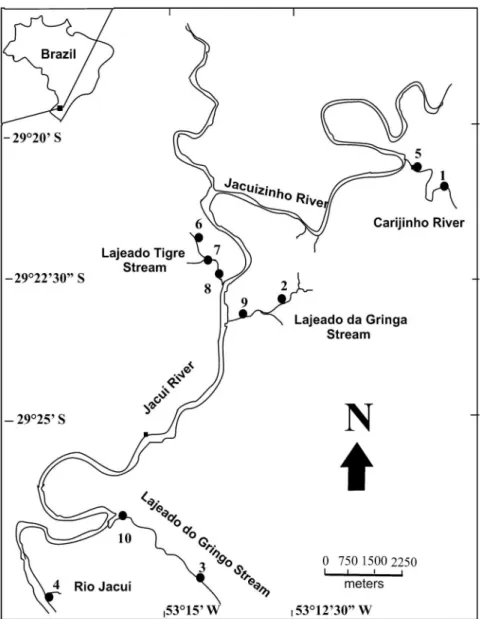
For the spatial and temporal distribution analyses, samplings were conducted between June 2001 and May 2002 on a monthly basis in four sites (Table 1, Fig. 1). Larvae and adults were collected in areas with running water and stony substrate, with Surber sampler (area = 0.36 m2, mesh = 1 mm). The margins and
the center of the streams were sampled, except in Site 4, in which only the left bank was sampled. When the macrophyte
Podostemumwas found, it was scraped off and included in the samples. The specimens were preserved with 80% ethyl alcohol. For the identification to genus level the keys of Benetti et al. (2006), Manzo & Archangelsky (2008), Domı´nguez & Ferna´ndez (2009) and Segura et al. (2011) were used.
In each sampling site, the data of air and water temperature (AT and WT), dissolved oxygen (DO), pH, depth (WD), and water velocity (WV) were taken. Data on monthly accumulated rainfall (mm) and average monthly regional temperature (TMM,6C) were taken from the Departamento de Fitotecnia of the UFSM.
Differences in abiotic data among sites and months were analyzed by means of variance analysis (ANOVA one-way), followed by Tukey test. The significance level used was 5% (Zar 1999).
The diversity in the study area was assessed considering absolute (N) and relative (%) abundance, richness (S) and taxonomic composition. The cumulative richness of genera considered monthly (2001 and 2002) and additional samples was estimated using the collector curve, based on the generation of 500 curves through random addition of samples, using EstimateS 8.2 software (Colwell 2006).
The richness of the genera of the four sampling sites used for studying temporal and spatial distribution was compared using the rarefaction technique (1,000 permutations) (Simberloff 1972). The comparison of richness by means of the rarefaction technique must be done to the highest level of
comparison between communities (Gotelli & Entsminger 2006). The curves were generated by EcoSim 700 software (Gotelli & Entsminger 2006). Site 4 was excluded from the analysis due to its very low number of individuals (five specimens).
Seasonal patterns in the temporal distribution of the abun-dance and richness of Elmidae assemblages were verified by means of Statistical Circular Analysis (Zar 1999). In this analysis, the sampling months were transformed into 306- angle intervals (May/2002 = 06; June/2001 = 306). For each site, the following parameters were estimated: i) mean vector angle (m), which represents the time of the year during which the greatest abundance and richness was registered; ii) circular standard deviation (SD); and iii) length of the vector (r), a measure of the concentration of the data along the cycle analyzed (year), of which the value varies from 0 (maximum dispersion of data) to 1 (maximum concentra-tion of data). The significance of the mean angle was determined using Rayleigh’s Test (Z) (Zar 1999). The circular analysis was performed using Oriana 4.01 software (Kovach 2012).
The influence of the environmental variables in the spatial and temporal distributions of assemblages was analyzed by means of Canonical Correspondence Analysis (CCA) (Legendre & Legendre 1998), using the software CANOCO
Table 1. Description of the sampling sites of the Elmidae larvae and adults assemblages sampled between April 2000 and May 2002 in the middle course of the Jacuı´ River, Rio Grande do Sul, Brazil.
Sites Rivers Altitude (m) Order Width (m) Grain Size (%) Site description
1 Rio
Carijinho
92 4th 8 Boulder: 54.9
Cobble: 33.9 Gravel: 7.8
arboreous vegetation in one bank; little shading;Podostemumsp. present
2 Lajeado da
Gringa
107 3rd 6 Boulder: 48
Cobble: 49 Gravel: 1.1
shrubby vegetation in one bank; no shading;Podostemumsp. present
3 Lajeado do
Gringo
140 4th 5 Boulder: 35.8
Cobble: 49.5 Gravel: 6.8
arboreous vegetation in one bank; little shading
4 Rio Jacuı´ 57 7th 200 Boulder: 30.1
Cobble: 66.6 Gravel: 2.1
little arboreous vegetation; little shading; stony bottom; anthropo-genic influence
5 Rio
Carijinho
95 4th 8 Boulder: 15.8
Cobble: 57.1 Gravel: 22.2
arboreous vegetation in one bank
6 Lajeado do
Tigre
140 1st 3 Boulder: 44.7
Cobble: 52.1 Gravel: 0.62
well preserved riparian; much shading
7 Lajeado do
Tigre
107 2nd 6 Boulder: 0
Cobble: 68.1 Gravel: 20.7
arboreous vegetation in one bank; one bank shaded
8 Lajeado do
Tigre
107 2nd 5 Boulder: 50
Cobble: 36.8 Gravel: 7.8
arboreous vegetation in one bank; onde bank shaded
9 Lajeado da
Gringa
152 3rd 13,5 Boulder: 66.8
Cobble: 30.6 Gravel: 0.4
arboreous vegetation in one bank; no shading
10 Lajeado do
Gringo
140 4th 9 Boulder: 26.3
Cobble: 56.1 Gravel: 10.5
4.5 (Ter Braak & Sˇmilauer 2002). Due to the spatially structured character of the samplings (Legendre & Legendre 1998), a possible relationship between spatially correlated samples was checked out by a Principal Coordinates Matrix Neighboring (PCNM) analysis. In the CCA, the following
environmental variables were tested in addition to the model through themanual forward stepwiseselection procedure (p, 0.05 according to Monte Carlo’s permutation test with 999 randomizations): pH, DO, WT, AT, WD, WV, altitude, and rainfall. Only three of these variables — WT, WD, WV — were
Figure 1.Map of the study area, indicating the ten sampling sites in the middle course of the Jacuı´ River Basin, Brazil. (Sites 1 –– 4 = sampled between June 2001 and May 2002; Sites 1––10 = sampled between April 2000 and May 2002).
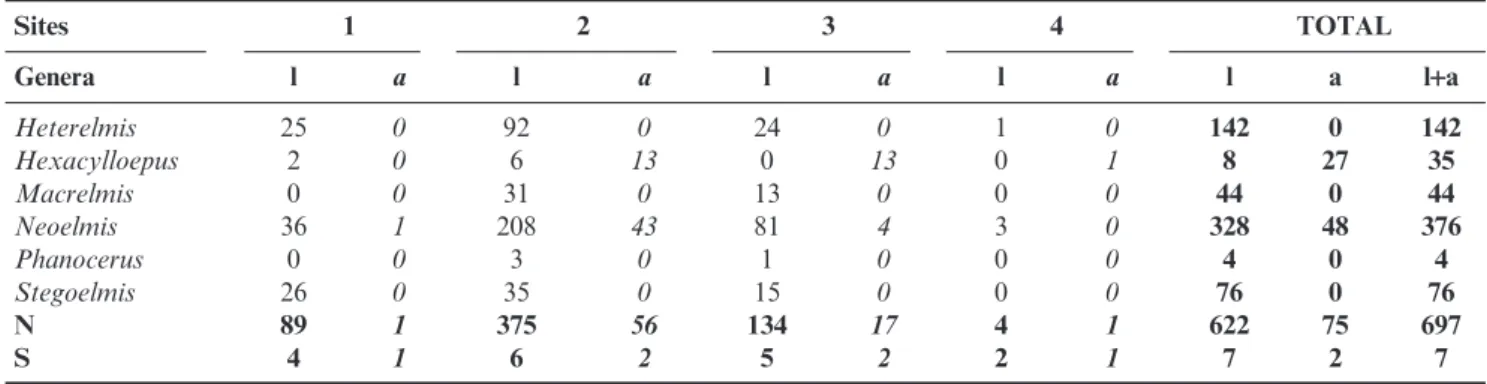
Table 2.Diversity ;larvae and adults of Elmidae found at the ten sampling sites, in the middle course of the Jacuı´ River basin, Rio Grande do Sul, Brazil ( l = larvae; a = adults).
Sites 1 2 3 4 5 6 7 8 9 10
Genera l (a) l (a) l (a) l (a) l (a) l (a) l (a) l (a) l (a) l (a)
Austrolimnius (x)
Heterelmis x x x x x x x
Hexacyl-loepus x (x) x (x) x x (x) (x) (x) x (x) x
Macrelmis x x (x) x x
Neoelmis x (x) x (x) x (x) x x x (x) x (x)
Phanocerus x x
included. This method was also efficient in removing the multicollinearity among the explaining variables, since none has showed a high variance inflation factor (VIF) (sensu Ter Braak & Sˇmilauer 2002). Monte Carlo’s test (999 randomiza-tions) was used to test the significance of the canonical axes (Ter Braak & Sˇmilauer 2002). The abundance matrix was log transformed (log X+1).
Results
Among the abiotic data, Site 3 had higher pH values than Sites 1 and 2 (F=7.03;p,0.05); Site 4 had lower DO than Site 2 (F= 2.88;p,0.05); Site 1 had higher WD than others (F=5.235;
p,0.05); Site 3 had higher WV than Site 4 (F=3.774;p,0.05). Monthly differences between variables were recorded for TMM (F=18.25; p,0.05), WT (F=25.01;p,0.05) (winter-spring and winter-summer months), and DO (F=2.339; p,0.05) (winter-summer months). The higher monthly precipitations were recorded in September 2001 (237.1 mm) and March 2002 (252.1 mm).
Considering both samplings, i.e., those used for the spatial and temporal distribution analyses and the additional sam-plings, 1,433 specimens, represented by 119 adults and 1,314 larvae, were found in the middle course of the Jacuı´ River (Table 3). Larvae were identified in seven genera (Table 3). Only Elminae genera were recorded in adult stage.
Hexacylloepus Hinton, 1940 was the best distributed genera, occurring in nine of the ten sampling sites (Table 3). The cumulative curve of genera, for the ten sampling sites, showed stabilization, indicating that the asymptote was reached (Fig. 2).
From June 2001 to May 2002, 697 specimens (662 larvae and 75 adults) were found in the four sites sampled for the community structures analysis. They were represented by the genera Heterelmis Sharp, 1882, Hexacylloepus, Macrelmis
Mostchulsky, 1859, Neoelmis Musgrave, 1935, Phanocerus
Sharp, 1882, andStegoelmisHinton, 1939 (Table 5).Neoelmis
was the dominant genus (64%), and together with
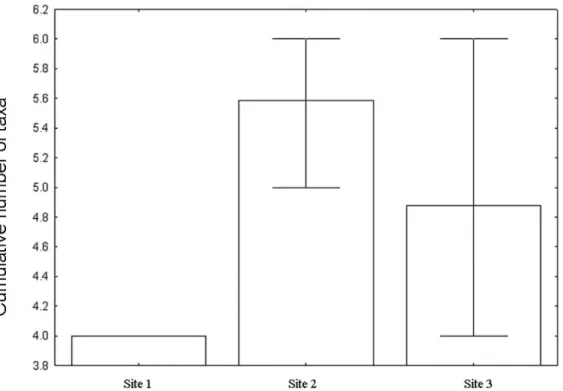
Hexacylloepus and Heterelmis, was recorded in all sampling sites.Phanoceruswas the rarest genus (0.2%), occurring only in two sites (Table 5). The rarefaction graphic, based on 90 specimens, showed overlapping estimated richness for Sites 2 and 3, which had both higher values than Site 1 (Fig. 3).
No specimens of Elmidae were found in February, March and April 2002. Excluding these months, the lowest abundance was found in December 2001, with five specimens collected. The highest abundance was recorded in November 2001, when
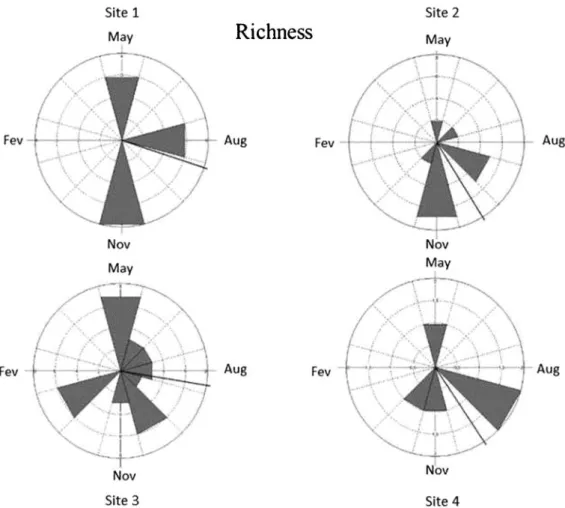
148 specimens were collected. Temporal structure was detected by the Circular Analysis, indicating seasonality in elmid assemblages, with most of abundance concentrations in spring periods. Abundance data showed significant Rayleigh test statistics in all sites (Table 4), with mean vector concentrated between August and November (i.e., end of winter and through spring), except for Site 3, in which the mean vector concentrated in the end of fall (Fig. 4). However, richness data in Rayleigh test did not show statistical significance for all sites but Site 3, which concentrated in the end of fall, although the angle of mean vector had indicated spring periods in all sites (excluding Site 4, Fig. 5).
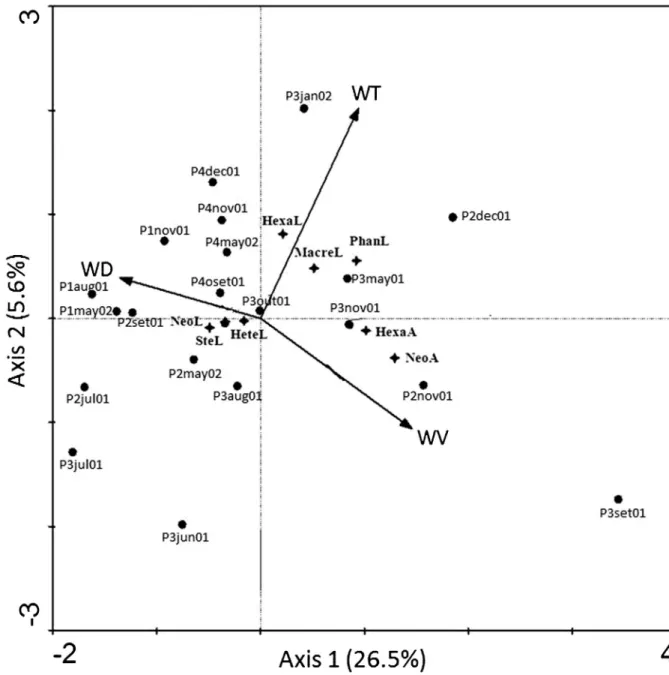
No spatial dependence was detected by the PCNM (p = 0.16) among the sampling sites. Thus, the influence of space was not considered in the following analyses. In the CCA, all axes were significantly different from chance (F = 2.782,p= 0.006). The two first axes together resumed 32.1% of the variability of the Elmidae abundance data, and 97.6% of these data were explained by the relationship with the environmental data (Table 5). The first axis of the CCA evidenced positive correlation with the WT and WV, and negative with WD (Table 6, Fig. 6). The second axis showed strong positive correlation with WT and weak with WD, and negative with WV. In general, Axis 1, resumed the temporal structure, segregating autumn and winter samples from spring and summer ones (Fig. 6). Some genera and their respective life stages were influenced by environmental factors (Fig. 6).
Table 3. Abundance (N) and richness (S) of Elmidae assemblages found in the middle course of the Jacuı´ River, Rio Grande do Sul, Brazil ( l = larvae, a = adults; l+a = sum of larvae and adults).
Sites 1 2 3 4 TOTAL
Genera l a l a l a l a l a l+a
Heterelmis 25 0 92 0 24 0 1 0 142 0 142
Hexacylloepus 2 0 6 13 0 13 0 1 8 27 35
Macrelmis 0 0 31 0 13 0 0 0 44 0 44
Neoelmis 36 1 208 43 81 4 3 0 328 48 376
Phanocerus 0 0 3 0 1 0 0 0 4 0 4
Stegoelmis 26 0 35 0 15 0 0 0 76 0 76
N 89 1 375 56 134 17 4 1 622 75 697
S 4 1 6 2 5 2 2 1 7 2 7
NeoelmisandHexacylloepus adults were negatively related to WD and positively to WV, while larvae, like those from
Heterelmis and Stegoelmis, were more related to lower WV.
Macrelmis,HexacylloepusandPhanoceruslarvae were slightly related to higher WT.
Discussion
The stabilization of the collector curve (Fig. 2) suggests that a small enhancement in richness should be expected for the riffle beetle genera of the middle Jacuı´ River, if sampling effort was increased. Richness of elmid genera usually varies from six to eight in southeastern Brazilian rivers (Passos et al. 2003a,
Buss et al. 2004, Paula & Fonseca-Gessner 2010), and increases towards northern Brazilian region, according to Fernandes (2010) and Barbosa et al. (2013) information. Thus, southern-most Brazil should sustain a lower richness of riffle beetles than northern and tropical areas, but higher than recorded in this study here (seven genera), because other southern Brazilian regions (e.g., Santa Catarina state) have ca. 13 elmid genera (Segura et al. 2013).
The first record of Austrolimnius and Macrelmis in Rio Grande do Sul is not a surprise. These genera have been found in others southernmost countries of South America, such as Argentina (Ferna´ndez et al. 2008) and Chile (Jerez & Moroni 2006). Besides, all genera recorded in this study have been
Figure 3.Comparison of the estimated richness of genera of the Elmidae assemblages among the sampled sites in the middle course of the Jacuı´ River basin, Rio Grande do Sul, Brazil.
Table 4.Circular Analysis of the abundance (N.) and richness (S.) of the larvae and adults Elmidae assemblages in the middle course of the Jacuı´ River Basin, Rio Grande do Sul, Brazil.
Sites 1 2
Descriptor N S N S
Mean vector (m) 134.056 78.436 90.626 69.406
Circular standard deviation 52.756 86.516 98.196 101.836
Average vector length (r) 0.65 0.32 0.23 0.21
Rayleigh Test (Z) 38.56 1.02 23.91 1.40
Rayleigh Test (p) ,0.01 0.37 ,0.01 0.25
Sites 3 4
Descriptor N S N S
Mean vector (m) 109.206 118.416 116.566 281.566
Circular standard deviation 48.066 63.316 72.176 72.176
Average vector length (r) 0.70 0.54 0.45 0.45
Rayleigh Test (Z) 74.21 5.31 1.02 1.02
previously found in other Brazilian states (Spangler & Santiago-Fragoso 1992, Passos et al. 2007, Paula & Fonseca-Gessner 2010, Fernandes 2010, Segura et al. 2012, Segura et al. 2013). On the other hand, Stegoelmis had its distribution extended southwards in the Neotropical region, because until now it had only been recorded below northwards (026S) (Fernandes 2010, Segura et al. 2013). Additionally, the elmid community composition found in the Jacuı´ River is similar to those recorded in tropical rivers also showing stony bottoms and strong water current (Passos et al. 2003a, Buss et al. 2004, Mugnai et al. 2008, Fernandes 2010).
The higher abundance and richness registered in Sites 2 and 3 (Figs. 3 and 4) should be associated to the lower WD of both sites, as well as to the expressive presence of the macrophyte
Podostemum. Aquatic vegetation usually favors the occurrence of high diversity of macroinvertebrates, because it increases the habitat heterogeneity (Taniguchi & Tokeshi 2004). Besides, great macrophyte biomass also represents shelter for larvae and a local for retention of their food (Connel 1978).
Site 1 showed higher WD than Sites 2 and 3, conditions not suitable to Elmidae, especially to Macrelmis and Neoelmis
(Spangler 1997, Passos et al. 2007, Fernandes, 2010). Site 4 is of 7th order, and had the lowest DO and WC mean values,
accounting for the lowest richness and abundance. However, the strong water level fluctuation determined by the operation of the Hydroelectric Power Station Dona Francisca (only 2 km upstream), as well as the absence of riparian vegetation and of
Podostemum(Spies et al. 2006, Floss et al. 2012), are possibly the most important factors avoiding the Elmidae assemblages establishment.
In the end of spring (November 2001), when the highest mean TMM was registered, the highest Elmidae abundance and richness were observed. Similar TMM value was also recorded in October 2001. Previous studies conducted in other temperate regions of the world showed that high WT values favor the occurrence of these coleopterans, because determine faster growth rates (Brown 1987). But riffle beetles are also usually associated to high DO concentrations (Brown 1987). Thus, in March 2002 (summer), when the lowest DO value was registered, no individuals were found. The absence of Elmidae in February and April 2002 can be related to the heavy rainfall that concentrated days before collections of February (100 mm) and along March 2002 (252.1 mm). Rain can exert high influence on the aquatic fauna, washing out the substrate, causing organisms to drift, and altering habitat characteristics (Nessimian and Sanseverino 1998).
The relationships of WT and DO with abundance and richness of the communities were not clear. During the sampling period, months with low DO (September 2001 and May 2002), had regular abundance and richness, and months with high temperature (e.g., December 2001), showed low abundance and richness. Thus, it is possible that these factors affect the genera differently. The Circular Analysis and the Rayleigh Test corroborated seasonality concerning Elmidae
abundance in spring, but only suggests similar relationship concerning richness (no statistical significance). These results are probably related to life cycle particularities of
the most abundant genera in each sampling site, as will be discussed.
Temperature is one of the main factors that affect elmids development, because their life cycle usually synchronizes with warmer temperatures (Brown 1987). In North America, adults emerge mainly in summer, and females wait until the next summer to lay eggs (Elliot 2008). In Brazil, no studies concerning elmid life cycle have been conducted, but some larvae were observed pupating by spring (for one to two weeks), when adults emerge (M. O. Segura pers. comm.). Thus, the data obtained here suggest that warmer temperatures may also influence Neotropical elmids life cycle, favoring the finding of diversified assemblages.
In the middle course of the Jacuı´ River, DO, WT and WV were the most important factors related to the structure of the
Table 5.Eigenvalues, taxon-environment coefficients of correlation and explained cumulative percentage of the four first axes of the Canonical Correspondence Analysis of the Elmidae assemblages of the middle course of the Jacuı´ River basin, Rio Grande do Sul, Brazil.
Axis 1 Axis 2 Axis 3 Axis 4 Total variance
Eigenvalues 0.25 0.05 0.01 0.25 0.94
Taxon-environment relation 0.75 0.56 0.28 0
Cumulative variance percentage of the data of taxa 26.5 32.1 32.9 59.8
Taxon-environment relationship 80.5 97.6 100 0
Total sum of the eigenvalues 0.94
Total sum of canonical eigenvalues 0.31
Figure 5.Temporal distribution of the richness of the Elmidae larvae and adults assemblages in the middle course of the Jacuı´ River basin, Rio Grande do Sul, Brazil.
Table 6.Inter-set correlations between the first two axes of the Canonical Correspondence Analysis and the environmental variables (water temperature = WT, water depth = WD, water velocity = WV) of the Elmidae assemblages in the middle course of the Jacuı´ River basin, Rio Grande do Sul, Brazil, between June 2011 and May 2002.
Environmental factors Axis 1 Axis 2
WT 0.3425 0.4841
WD -0.4914 0.0933
communities of the riffle beetles in a spatial and temporal perspective. In fact, Sites 1 and 4, which tended to segregate according high WD and low WV, exhibited the lowest richness. On the other hand, in months with warmer WT, and when the WV diminished, a relationship of these factors with certain genera were observed.Neoelmis, which was abundant in Sites 2 and 3, are typical dwellers of habitats with stony substrate with stems and leaves, and also occur in shallow areas with strong water current (Passos et al. 2003a, b, Passos et al. 2007, Ferna´ndez et al. 2008, Fernandes 2010). Thus, the predominance of this genus in the studied area reflects the general environmental conditions of the middle Jacuı´ River. Habitat preferences of
Hexacylloepusare not mentioned in literature, but it is probably
similar to those ofNeoelmis, because their larvae have been found together with Heterelmis in leaf packs (Spangler & Santiago-Fragoso 1992).Heterelmisare found in shallow waters with in running waters, and in warmer temperatures sites (Fernandes 2010). In this study, their larvae were associated to lower WV, as well as those ofStegoelmis.Macrelmis andPhanoceruslarvae, which were slightly related to higher WT in the studied area, have been found in riverine habitats containing submerse stems and roots (Spangler & Santiago-Fragoso 1992, Spangler 1997, Fernandes 2010). The genus Phanocerus was very rare in the middle Jacuı´. Members of this genus were found above the water line (Spangler & Santiago-Fragoso 1992), living in streams with fast and clear waters (Hinton 1940).
Figure 6.Diagram of ordination of the samples and taxa for the first two axes of the Canonical Correspondence Analysis of Elmidae larvae and adults assemblages in the middle course of the Jacuı´ River basin, Rio Grande do Sul, Brazil, and environmental variables, surveyed between June 2001 and May 2002. Abbreviations of the taxa: NeoA= Neoelmis adult, NeoL= Neoelmis larva, HexaA= Hexacylloepus adult, HexaL=
Final remarks
River basins located in the escarpment of the Serra Geral Formation, in southernmost Brazil, can sustain Elmidae assemblages with similar richness of genera to that recorded in basins of tropical/warmer climate regions of Brazil. Shallow streams, stony substrate, presence of aquatic macrophytes and especially the occurrence of periods of low rainfall and warm water temperature are important drivers of the spatial and temporal distribution of elmids. Thus, the presence of these environmental conditions in the middle course of the Jacuı´ River basin is important for the diversity of this family in the escarpment region of RS. This study, as well others previously conducted in the Jacuı´ River, reinforces the role of the middle course as a hotspot of riverine macroinvertebrate diversity in RS.
Acknowledgments
The authors thank Drs. Melissa Ottoboni Segura (UFSCar) and Ana Emilia Siegloch (UNIPLAC) for reviewing the manuscript.
References
ARCHANGELSKY, M. & MANZO, V. 2006. The larva of Hydora annectens Spangler & Brown (Coleoptera: Elmidae, Larainae) and a key to New World Larainae larvae. Zootaxa 1204:41-52. BENETII, J.C., FIORENTINI, G.L., CUETO, J.A.R & MIGUEL,
R.R.P. 1998. Coleopterofauna Aqua´tica na Floresta Estacional de Sa˜o Francisco de Paula, RS, Brasil. Acta Biol. Leopold. 20:91-101. BENETTI, J.C., FIORENTINI, G.L., CUETO, J.A.R.& NEISS, U.G.
2006. Chaves de identificac¸a˜o para famı´lias de coleo´ pteros aqua´ticos ocorrentes no Rio Grande do Sul, Brasil. Neotrop. Biol. Cons. 1:24-28. BROWN, H.P. 1987. Biology of Riffle Beetles. Annu Rev Entomol 32:253-273, doi: http://dx.doi.org/10.1146/annurev.en.32.010187. 001345
BUENO, A.A.P., BOND-BUCKUP, G. & FERREIRA, B.D.P. 2003. Estrutura da comunidade de invertebrados bentoˆnicos em dois cursos d’a´gua do Rio Grande do Sul, Brasil. Rev. Bras de Zool. 20:115-125, doi:http://dx.doi.org/10.1590/S0101-81752003000100014
BUSS, D.F, BAPTISTA, D.F., NESSIMIAN, J.L. & EGLER, M. 2004. Substrate specificity, environmental degradation and dis-turbance structuring macroinvertebrate assemblages in neotropical streams. Hydrobiologia 518:179-188, doi:http://dx.doi.org/10.1023/ B:HYDR.0000025067.66126.1c
CONNELL, J.H. 1978. Diversity in tropical rain forests and coral reefs. Science 199:1302-1310, doi: http://dx.doi.org/10.1126/science.199. 4335.1302
COLWELL, R.K. 2006. EstimateS: Statistical estimation of species richness and shared species from samples. Version 8. User’s Guide and application published at: http://viceroy.eeb.uconn.edu/esti-mates (u´ltimo acesso em 30.10.2012).
CUMMINS, K.W. 1973. Trophic relations of aquatic insects. Annu Rev Entomol. 18:183-206, doi:http://dx.doi.org/10.1146/annurev. en.18.010173.001151
DOMI´NGUEZ, E. & FERNA´ NDEZ, H.R. 2009. Macroinvertebrados Bentoˆnicos Sudamericanos. Sistema´tica y Biologia. Fundacion Miguel Lillo, San Miguel de Tucuma´n.
ELLIOT, J.M. 2008. The ecology of riffle beetles (Coleoptera: Elmidae). Freshwater Reviews 1:189-203.
FERNANDES, A.S. 2010. Taxonomia de Elmidae (Insecta, Coleoptera) no Municı´pio de Presidente Figueiredo, Amazonas. Dissertac¸a˜o de Mestrado, Instituto Nacional de Pesquisas da Amazoˆnia, Amazonas.
FERNANDES, A.S. PASSOS, M.I., HAMADA, N. 2011. STEGOELMIS HINTON, 1939 (Coleoptera: Elmidae: Elminae)
in Brazil: two new species and a key to the Brazilian species. Zootaxa 2921:56-64.
FERNA´ NDEZ, L.A., ARCHANGELSKY, M. & MANZO, V. 2008. Coleo´pteros acua´ticos y semiacua´ticos del Parque Provincial Salto Encantado y Valle del Cun˜a´ Piru´ (Misiones, Argentina). Rev. Soc. Entomol. Argent. 67:87-98.
FLOSS, E.C.S., KOTZIAN, C.B., SPIES, M.R., & SECRETTI, E. 2012. Diversity of non-biting midge larvae assemblages in the Jacuı´ River basin, Brazil. J Insect Sci. 12, doi:http://dx.doi.org/10.1673/ 031.012.12101
GOTELLI, N.J. & ENTSMINGER, G.L. 2006. EcoSim: Null models software for ecology. Version 7.72. Acquired Intelligence Inc. & Kesey-Bear. Jericho, VT 05465.
HINTON, H.E. 1940. A monographic revision of the mexican water beetles of the family Elmidae. Novitates Zoologicae 42:217-396. HINTON, H.E. 1972 Two new genera of South American Elmidae
(Coleoptera). Coleopts. Bull. 26:37-41.
JA¨ CH, M.A. & BALKE, M. 2008. Global diversity of water Beetles (Coleoptera) in freshwater. Hydrobiologia 595:419-442, doi:http:// dx.doi.org/10.1007/s10750-007-9117-y
JEREZ, V. & MORONI, J. 2006. Diversidad de Coleopteros Acuaticos en Chile. Gayana 70:72-81.
KODADA, J.& JA¨ CK, M.A. 2003. Elmidae Curtis, 1830, p. 471-496. In: Beutel, R.G. & R.A.B. Leschen (eds.) Handbook of Zoology. Volume IV. Arthropoda: Insecta. Part 38. Coleoptera, Beetles: Morphology and Systematics, 1., Walter de Gruyter, New York.
KOVACH, W. 2012. Oriana v. 4.01. Anglesey Wales: Kovach Computing Services.
LEECH, H.B. & Chandler, H.P. 1956 Aquatic Coleoptera. In: Usinger, R.L. (Ed), Aquatic Insects of California. University of California Press, Berkeley.
LEGENDRE, P. & LEGENDRE, L. 1998. Numerical ecology. Elsevier, Amsterdam.
MALUF, J.M.T. 2000. Nova classificac¸a˜o clima´tica do Estado do Rio Grande do Sul. Rev. Bras. Agrometerologia 8:141-150.
MANZO, V. & ARCHANGELSKY, M. 2008. A key to the known larvae of South American Elmidae (Coleoptera: Byrrhoidea), with a description of the mature larva ofMacrelmis saltensisManzo. Int. J. Lim. 44:63-74, doi:http://dx.doi.org/10.1051/limn:2008023
MARCHIORI, J.N.C., LONGUI, S.J. & DURLO, M A. 1982. A vegetac¸a˜o de capoeira na regia˜o do curso me´dio do rio Jacuı´, RS. CeN 4:141-150.
MERRITT, R.W.& CUMMINS, K.W. 1996. An introduction to the aquatic insects of North America. Kendall/Hunt, Iowa.
MIRANDA, G.S., SAMPAIO, B.H.L. & PASSOS, M.I.S. 2012. Two new species ofAustrolimniusCarter & Zeck (Insecta: Coleoptera: Elmidae) from Southeastern Brazil. Zootaxa 3389:14-24.
MUGNAI R., R.B., OLIVEIRA, R.B., DO LAGO CARVALHO, A. & BAPTISTA, D.F. 2008. Adaptation of the Indice Biotico Esteso (IBE) for water quality assessment in rivers of Serra do Mar, Rio de Janeiro State, Brazil. Trop. Zool. 21:57-74.
NERI, D.B., KOTZIAN, C.B. & SIEGLOCH, A.E. 2005. Composic¸a˜o de Heteroptera aqua´ticos e semi-aqua´ticos na a´rea de abrangeˆncia da U.H.E. Dona Francisca, RS, Brasil: fase de preenchimento. Iheringia Se´r. Zool. 95:421-429, doi: http://dx.doi.org/10.1590/ S0073-47212005000400013
NESSIMIAN, J.L. & SANSEVERINO, A.M. 1998. Trophic functional characterization of Chironomidae larvae (Diptera: Chironomidae) in a first order stream at the mountain region of Rio de Janeiro State, Brazil. Int. J. Lim. 26:2115-2119.
PASSOS, M.I.S. & FELIX, M. 2004. Description of a new species of
Cylloepus Erichson from southeastern Brazil (Coleoptera, Elmidae). Rev. Bras. Entomol. 48:181-183, doi: http://dx.doi.org/ 10.1590/S0085-56262004000200004
PASSOS, M.I.S., NESSIMIAN, J.L. & DORVILLE´ , L.F.M. 2003b. Life strategies in an Elmidae (Insecta: Coleoptera: Elmidae) community from a first order stream in the Atlantic Forest, southeasteam Brazil. Acta Limnol. Bras. 15:29-36.
PASSOS, M.I.S., NESSIMIAN, J.L. & FERREIRA JR, N. 2007. Chaves para identificac¸a˜o para geˆneros de Elmidae (Coleoptera) ocorrentes no Estado do Rio de Janeiro, Brasil. Rev. Bras. Entomol. 51:42-53, doi:http://dx.doi.org/10.1590/S0085-56262007000100008
PASSOS, M.I.S., SAMPAIO, B.H.L NESSIMIAN, J.L. & FERREIRA JR, N. 2009. Elmidae (insecta: coleoptera) do Estado do Rio de Janeiro: lista de espe´cies e novos registros. Arq. Mus. Nac. 67:377-382.
PASSOS, M.I.S, FERNANDES, A.S., HAMADA, N & NESSIMIAN, J.L. 2010. Insecta, Coleoptera, Elmidae, Amazon region. Check List 6:538-545.
PAULA, M.C. & FONSECA-GESSNER, A.A. 2010. Macroinvertebrates in low-order streams in two fragments of Atlantic Forest in different states of conservation, in the State of Sa˜o Paulo (Brazil). Braz. J. Biol. 70:899-909, doi:http://dx.doi.org/10.1590/S1519-69842010000400021
PEDRO´ N, FA. & DALMOLIN, R.S.D. 2011. Solos da regia˜o do rebordo do Planalto Meridional no Rio Grande do Sul. In: SCHUMACHER, M.V. et al (Eds.) A Floresta Estacional Subtropical - Caracterizac¸a˜o e Ecologia no Rebordo do Planalto Meridional. Editora Pallotti, Santa Maria.
PEREIRA, D. & DE LUCA, S.J. 2003. Benthic macroinvertebrates and the quality of the hydric resources in Marata´ Creek basin (Rio Grande do Sul, Brazil). Acta Limnol. Bras. 15:57-68.
QUADROS, F.L.F. & PILLAR, V P. 2002. Transic¸o˜es floresta- campo no Rio Grande do Sul. Fitogeografia do Sul da America. Cieˆnc. Ambient. 24:109-118.
SALVARREY, A.V.B. 2010. Distribuic¸a˜o espacial de Macroinvertebrados Bentoˆnicos em riachos da regia˜o central do Rio Grande do Sul, Brasil. Dissertac¸a˜o de Mestrado Universidade Federal de Santa Maria, Rio Grande do Sul.
SAMPAIO, B.H.L., PASSOS, M.I.S. & FERREIRA-JR, N. 2011. Three new species of Cylloepus Erichson (Insecta: Coleoptera: Elmidae) from Southeastern Brazil. Zootaxa 2797:57-64. SAMPAIO, B.H.L., PASSOS, M.I.S. & FERREIRA-JR, N. 2012. Two
new species of Macrelmis Motschulsky (Coleoptera: Elmidae) and a new record ofMacrelmis isis(Hinton) from Southeastern Brazil. Zootaxa 3478:164-168.
SEGURA, M.O., FONSECA-GESSNER, A.A. & TANAKA, M.O. 2007. Composition and distribution of aquatic Coleoptera (Insecta) in loworder streams in the state of Sa˜o Paulo, Brazil: influence of environmental factors. Acta Limnol. Bras. 19(3):247-256. SEGURA, M.O., VALENTE-NETO, F. & FONSECA-GESSNER,
A.A. 2011. Chave de famı´lias de Coleoptera aqua´ticos (Insecta) do Estado de Sa˜o Paulo, Brasil. Biota Neotropica 11(1):393-412, doi:
http://dx.doi.org/10.1590/S1676-06032011000100037
SEGURA, M.O., VALENTE-NETO, F. & FONSECA-GESSNER, A.A. 2012. Checklist of the Elmidae (Coleoptera: Byrrhoidea) of Brazil. Zootaxa 3260:1-18.
SEGURA, M.O., PASSOS, M.I.S., FONSECA-GESSNER, A.A. & FROEHLICH, C.G. 2013. Elmidae Curtis, 1830 (Coleoptera,
Polyphaga, Byrrhoidea) of the Neotropical region. Zootaxa 3731(1): 1-57, doi:http://dx.doi.org/10.11646/zootaxa.3731.1.1
SEMA. Secretaria Estadual do Meio Ambiente 2005. Available at:
,http://www.sema.rs.gov.br.. (u´ltimo acesso em: 06/06/2013) SEAGLE Jr, H.H. 1982. Comparison of the food habitats of three
species of riffle beetles, Stenelmis crenata, Stenelmis mera, and
Optioservus trivittatus (Coleoptera, Dryopoidea, Elmidae). Freshwat. Invertebr. Biol. 1:33-38, doi: http://dx.doi.org/10.2307/ 3259452
SIEGLOCH, A.E., FROEHLICH, C.G. & KOTZIAN, C.B. 2008. Composition and diversity of Ephemeroptera (Insecta) nymph communities in the middle section of the Jacuı´ River and some tributaries, southern Brazil. Iheringia 98:425-432, doi:http://dx.doi. org/10.1590/S0073-47212008000400002
SIMBERLOFF, D. 1972. Properties of the rarefaction diversity measurement. American Naturalist 106:414-418, doi: http://dx. doi.org/10.1086/282781
SIMO˜ ES, R.I. 2002. Avaliac¸a˜o da comunidade de moluscos lı´mnicos na a´rea da usina hidrele´trica Dona Francisca, Rio Jacuı´, RS, BR: fase de pre´-enchimento do reservato´rio. Dissertac¸a˜o de Mestrado, Universidade Federal do Rio Grande do Sul, Rio grande do Sul. SPANGLER, P.J. & SANTIAGO-FRAGOSO, S. 1992. The Aquatic
Beetle Subfamily Laraine (Coleoptera: Elmidae) in Me´xico, Central Ame´rica, and the West Indies. Sm. C. Zool. 528:1-74, doi:http://dx. doi.org/10.5479/si.00810282.528
SPANGLER, P.J. 1997. Two new species of the aquatic beetle genus
Macrelmis Motschulsky from Venezuela (Coleoptera: Elmidae: Elminae). Insecta Mundi 11:1-8.
SPIES, M.R., FROEHLICH, C.G. & KOTZIAN, C.B. 2006 Composition and diversity of Trichoptera (Insecta) larvae commu-nities in the middle section of the Jacuı´ River and some tributaries, State of Rio Grande do Sul, Brazil. Iheringia Ser. Zool. 96:389-398, doi:http://dx.doi.org/10.1590/S0073-47212006000400001
STRAHLER, A.N. 1952. Hypsometric (area-altitude) - analysis of erosion al topography. Geol. Soc. Am. Bull. 63:1117-1142, doi:http://dx.doi. org/10.1130/0016-7606(1952)63[1117:HAAOET]2.0.CO;2
TANIGUCHI, H., TORESHI, M. 2004. Effects of habitat complexity on benthic assemblages in a variable environment. Fresh. Biol. 49:1164-1178, doi:http://dx.doi.org/10.1111/j.1365-2427.2004.01257.x
TER BRAAK, C.J.F & SMILAUER, P. 2002. CANOCO: reference manual and CanoDraw for Windows. User’s guide: Software for Canonical Community Ordination (version 4.5). Microcomputer Power, Ithaca.
WHITE, D.S. & BRIGHAM, W.U. 1996. Aquatic Coleoptera. In: Merritt, R.W. & Cummins, K.W. (Eds), Introduction to the Aquatic Insects of North America Kendall/Hunt Publ. Co., Iowa, p. 399-473
WIEDENBRUG, F., NOLTE, U. & WU¨ RDIG, N.L. 1997. Macrozoobenthos of a costal lake in the southern Brazil. Arch. Hydrobiol. 140:533-548.
ZAMANILLO, E.A., TUCCI, C.E.M., SIMO˜ ES-LOPES, M.O. & LANNA, A.E., 1989. Management of navigation in the Jacuı´ River. Water Int., 14:181-192, doi: http://dx.doi.org/10.1080/ 02508068908692103
ZAR, J.H. 1999. Biostatistical analysis. Prentice-Hall, New Jersey.