1 Part of the fi rst author’s Master’s Dissertation
2 Instituto de Botânica, Núcleo de Pesquisa em Anatomia, São Paulo, SP, Brazil 3 Author for correspondence: ft [email protected]
Structural changes in
Psidium
guajava
‘Paluma’
leaves exposed to tropospheric ozone
1RESUMO
(Alterações anatômicas em folhas de Psidium guajava ‘Paluma’ expostas ao ozônio troposférico). Psidium guajava ‘Paluma’ vem sendo testada como bioindicadora de ozônio (O3) e responde com pigmentações, entre as nervuras, na superfície adaxial, decorrente do acúmulo de compostos fenólicos. Tais compostos atuam como antioxidantes não enzimáticos que neutralizam espécies reativas de oxigênio (ROS), formadas a partir do O3. O estudo objetivou
comparar a estrutura foliar de plantas com e sem sintomas visíveis para estabelecer como esses sintomas se apresen-tam em nível celular. Para tanto, avaliaram-se acúmulo de substâncias fenólicas, densidade estomática e alterações estruturais nos tecidos foliares de P. guajava ‘Paluma’, exposta durante as quatro estações do ano, no Parque Estadual das Fontes do Ipiranga (PEFI), área verde da cidade de São Paulo, com altos índices de O3. Folhas com sintomas
apresentaram, na superfície adaxial, antocianina nos vacúolos das células da epiderme, da hipoderme e, quando o sintoma foi mais intenso, em até três primeiras camadas do parênquima paliçádico, além de maior acúmulo de outros compostos fenólicos, em comparação com folhas assintomáticas. Algumas células parenquimáticas contíguas à câmara subestomática mostraram crescimento intrusivo em sua direção, promovendo a oclusão da câmara, o que pode contribuir para reduzir a entrada de O3 na folha. O acúmulo de antocianina e outros compostos fenólicos, além
da oclusão da câmara subestomática são características que podem conferir proteção à planta contra efeitos do O3. Tais características, somadas à compactação do mesofi lo, contribuem para que Psidium guajava ‘Paluma’ não apresente morte celular, sintoma frequente em espécies sensíveis ao O3.
Palavras-chave: Anatomia foliar, bioindicador, compostos fenólicos, densidade estomática, estresse oxidativo Fernanda Tresmondi2,3 and Edenise Segala Alves2
ABSTRACT
(Structural changes in Psidium guajava ‘Paluma’ leaves exposed to tropospheric ozone). Psidium guajava ‘Paluma’ has being tested as an ozone (O3) bioindicator and responds with pigmentation between the veins on the adaxial
surface, due to the accumulation of phenolic compounds. Th ese compounds act as non-enzymatic antioxidants that neutralize reactive oxygen species (ROS), formed from O3. Th is study aimed to evaluate the leaf structure of plants with and without visible symptoms and to establish these symptoms at the cellular level. Beside this we also aimed to detect structural changes that can minimize the eff ects of the O3 on the plant. Th e accumulation of phenolic
subs-tances, stomatal density and structural changes in P. guajava ‘Paluma’ leaf tissues exposed during the four seasons of the year were evaluated. Th e study was conducted at the Parque Estadual das Fontes do Ipiranga ( PEFI), which is a park in the city of São Paulo that has high levels of O3. Leaves with symptoms showed, on the adaxial surface,
anthocyanin accumulation in the vacuoles of epidermal cells and hypodermis. When the symptoms were more in-tense this accumulation was observed even in the fi rst three layers of palisade parenchyma. Comparing symptomatic and asymptomatic leaves, there was higher accumulation of phenolic compounds in the symptomatic leaves. Some parenchyma cells adjacent to substomatal chambers showed intrusive growth towards the stomatal pore, promoting its occlusion, which could reduce the entry of O3 in the leaf. Th e accumulation of anthocyanins and other phenolic
compounds, in addition to the occlusion of the chamber, protect the plant against O3 eff ects. Th ese features and the compact arrangement of the mesophyll contribute to why Psidium guajava ‘Paluma’ does not present cell death, a symptom usually observed in species sensitive to O3.
Introduction
Great urban centers worldwide have air pollution as a common characteristic. Th is is mostly due to an increase in the number of cars and industrialization, which are essential to support the population growth in these re-gions. São Paulo’s metropolitan region, with a population of more than 17 million inhabitants, faces this problem. This city has a great amount and diversity of air pollut-ants as tropospheric ozone (O3) and its precursors, and concentrations of these gases reach high levels in diff erent locations (Cetesb 2009).
Some plants can be used as O3 bioindicators because they show characteristic responses when exposed to this pollutant (De Temmerman et al. 2004; Klumpp et al. 2001). Th ese responses are initiated when the O3 enters the leaf through stomata and reacts with the intercellular water forming reactive oxygen species (ROS). Th ese ROS initially act on the plasma membrane and, depending on the capacity of the plant to neutralize them, can cause oxidative stress (Iriti & Faoro 2009; Roschina & Roschina 2003; Bray et al. 2000). Th e ROS neutralization is done by enzymatic and non-enzymatic antioxidants, such as phenolic compounds (Soares & Machado 2007).
Some macroscopic leaf symptoms are described for O3 bioindicator plants, such as chlorosis, necrosis, and leaf pigmentation. Th ese symptoms must be present between the veins, and only on the adaxial surface of the leaf; be-sides this, microscopic analysis must assure the absence of pathogens. However, for each species, symptoms observed in the fi eld must be compared to those exhibited by the plant when exposed to known O3 concentrations inside a fumigation chamber (Günthardt-Goerg & Vollenweider 2007; Novak et al. 2003).
Psidium guajava ‘Paluma’ has been studied as an O3 bioindicator plant (Furlan et al. 2007; Pina et al. 2007; Pina & Moares 2007; Dias et al. 2007). Controlled studies inside fumigation chambers were done by Furlan et al. (2007) that described phenolic compound accumulation as a symptom resulting from O3, which causes a reddish pigmentation.
Considering that P. guajava ‘Paluma’ shows charac-teristic macroscopic symptoms when exposed to O3, this study aimed to evaluate the leaf structure of plants with and without visible symptoms to establish how these symptoms are expressed at the cellular level.
Methods
Plant exposure and environmental characterization
About 110 cloned Psidium guajava ‘Paluma’ seedlings, obtained from a specialized producer, were exposed in 2008 at the Instituto de Botânica located in Parque Estadual das Fontes do Ipiranga (PEFI) (23o38’08’’S, 46o38’00’’W). As a control group, ten seedlings were kept, for each season of the
year, inside a greenhouse equipped with a Purafi l® air fi lter (for particles and gases) and temperature control, which was next to the location of the plants exposition.
Th e plants were kept on holders with plastic boxes with water inside, covered by galvanized wire grilles. Th e plants were continuously watered by capillarity using nylon strings with one of the ends inserted in the pot near the roots and the other in contact with the water inside the box (VDI 2003). Th e seedlings were fertilized weekly with Peters (10:10:10 N:P:K) and were exposed side by side, under the same conditions of temperature, precipitation, wind speed, and irradiance. Th e plants kept in the greenhouse received the same irrigation and fertilization of those kept outside, and they were used as a control in relation to the appearance of visible damage and stomata density.
Continuous measurements of ozone were taken by HORIBA monitors (APOA-360CE and APNA-360CE) and IDA-2000 soft ware, and the data were used to calculate AOT40 (Accumulated Ozone Exposure over a threshold of 40 ppb) and AOTzero, which refers to the total value of accumulated O3 during the exposure of the plants. Meteoro-logical data were provided by the Instituto Astronômico e Geofísico da USP (IAG) localized inside PEFI.
Anatomy and Histochemical tests
To analyze the phenolic compounds, plant tissue was collected by the end of each season of the year for each of the six plants sampled, with and without visible symptoms, from leaves of the fi rst and second nodes (from base to apex). Transversal sections of fresh material were used to lo-calize phenolic compounds and condensed tannins, using ferric chloride (Johansen 1940) and acid vanillin (Gardner 1975), respectively, which was seen as intense colored ag-glomerates. Anthocyanin detection in mesophyll cells was observed in transversal sections of fresh material, without using dyes or reagents. For those analyses, about twelve samples from each season of the year were mounted in 50% glycerin and were observed using light microscopy.
Leaf fragments up to 1 cm2 taken from the middle of leaves on the third node, of three plants, were fortnightly collected during each season. Th ese fragments were fi xed in Karnovsky solution (Karnovsky 1965), remaining under vacuum for about thirty minutes, in fi xer for forty-eight hours, and then the samples were washed with phosphate buff er and stored in 70% alcohol. Th e samples were em-bedded in glycol methacrylate (GMA) (Leica historesin), according to the manufacturer recommendations, and were transversally sectioned with a rotary microtome (Olympus Cut 4055). Sections about 5 μm thick were dyed with 0.05 toluidine blue in 0.1M, acetate buff er at pH 4.7 (O’Brien & McCully 1965), and analyzed using a Olympus BX41 light microscope.
season. For this study, leaf fragments with 1cm from leaves of the fi ft h and sixth nodes (from base to apex), were fi xed in Karnovsky solution (Karnovsky 1965), diaphanized ac-cording to Arnott (1959) apud Kraus & Arduin (1997), dyed with astra blue and safranin (9:1), submitted to a crescent alcohol series, and mounted in synthetic Permount™resin. Stomatal density was determined by observing a 200 μm2 area of the leaf surface at 400 times magnifi cation (n=30 per season) using a microscope equipped with an image capture system, and a semi-automatic measurement system (Pro-Express 4.0.1, Media Cybernetics). Th is quantifi cation was not done for plants kept inside the greenhouse during the autumn once this material was lost.
For the statistical analysis that correlated stomatal den-sity with O3 concentration, the Pearson correlation method was used. Th e comparison between stomatal density of plants kept inside the greenhouse with those outside the greenhouse was done through variance analysis (Anova on Ranks); when these analysis showed signifi cant diff erences with p≤ 0,05, a multiple comparison analysis was done (Kruskal-Wallis).
Results
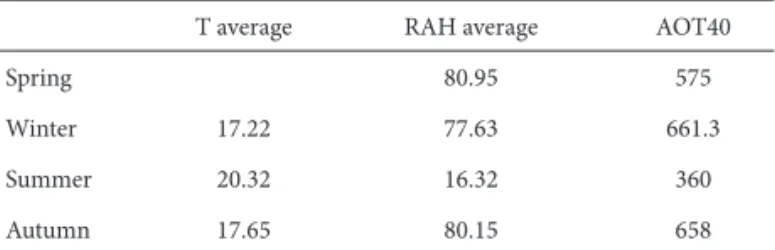
Th e highest AOTzero values occurred during the winter, followed by autumn and spring, while in the summer the concentration was the lowest. Average temperature values were higher during the summer and equal during the au-tumn and winter. Temperature data during the spring were not provided by IAG-USP. Average air humidity values did not conspicuously vary during spring, autumn and winter, but the average was comparatively lower in summer (Tab. 1).
Table 1. Data related to average temperature (T - ºC), relative air humidity (RAH - %), ozone concentrations values above 40ppb to the end of seasons (AOT40 – ppb).
T average RAH average AOT40
Spring 80.95 575
Winter 17.22 77.63 661.3
Summer 20.32 16.32 360
Autumn 17.65 80.15 658
In relation to the location of phenolic compound ac-cumulation, leaves without visible symptoms, here called asymptomatics (Fig. 1A), showed diff erences in cellular content when compared to symptomatic leaves (Fig. 1B). Th e presence of anthocyanins in the vacuole of the leaves was registered in epidermal cells on the adaxial surface and hypodermis. When symptoms were more intense, a very intense accumulation of anthocyanin in the upper layers of the palisade cells was registered.
Histochemical analysis using acid vanillin (Fig. 1C and D) and ferric chloride (Fig. 1E and F) on fresh material of asymptomatic (Fig. 1C and E) and symptomatic (Fig. 1D
and F) leaves showed the presence of phenolic compounds in both types; however, when symptoms appeared, the oc-currence of phenolic compounds, highlighted by intense colored agglomerates, visibly increased.
Stomatal density on leaves from the second node, that had expanded during exposure, in plants kept in and out-side the greenhouse during diff erent seasons of the year are indicated in fi gure 2.
Results obtained were compared through analysis of variance (Anova on Ranks - Kruskal Wallis), and showed that the plants that remained outside the greenhouse during the winter showed the highest stomatal density values. Th ese values were higher than those from plants kept inside the greenhouse during the winter. Also, they were higher than those from plants kept outside the greenhouse during other seasons of the year that did not diff er between each other. In the spring, the plants exposed to the environment did not statistically diff er from those kept inside the greenhouse, while in those exposed during the summer a variation was observed, and the stomatal density of the plants outside the greenhouse was higher. Th e stomatal density of the plants exposed during the autumn that remained inside the greenhouse could not be analyzed aft er they were con-taminated by fungi.
For the plants exposed to the environment, we correlated stomatal density with O3 concentration, obtaining through the Pearson method a regular positive correlation with r = 0.579 and signifi cant p = 0.00279 in all seasons of the year. With the progression of visible symptoms, a conspicu-ous increase in the phenolic content in the epidermal cells on both surfaces was observed (Fig. 3A and 3B). In the hypodermis, besides this increase, it was possible to ob-serve the membrane cell invagination in symptomatic leaves (Fig. 3C).
In the palisade cells there was a conspicuous increase in the content of phenolic compounds, in all layers of this tissue (Fig. 3D-F). A visible reduction in chloroplasts was also observed in symptomatic leaves in comparison to the asymptomatic leaves (Fig. 3A and 3D). Parenchyma cells showed changes, especially those closer to the abaxial surface of the leaf, which were smaller when compared to those from the upper layers (Fig. 3 A-F). Some parenchyma cells contiguous to the substomatal chamber showed an in-trusive growth in the direction of the substomatal chamber, promoting its occlusion (Fig. 3F).
Discussion
shows when exposed to O3; these symptoms were character-ized by reddish pigmentation between the veins, only on the upper surface of older leaves as described by Furlan et al. (2007) and Pina & Moraes (2007) as stippling. Indeed, the P. guajava ‘Paluma’ symptom is reddening since there is no cell death. According to Vollenweider & Günthardt-Goerg (2003), the term reddening is the most correct in this case, when there is an increase in vacuolar phenolics associated with the absence of cell death.
In general, phenolic compounds and especially an-thocyanins act as antioxidants, neutralizing the ROS and minimizing its eff ects on cell membranes (Gould et al. 2002). Besides the direct action of the antioxidant, anthocyanins protect the chloroplasts from excess excitation by activat-ing a controlled energy dissipation process and, hence, the potential for oxidative damage (Gravano et al. 2004).
Figure 1. Transversal sections of Psidium guajava ‘Paluma’ leaves. A, C and E. Asymptomatic leaves. A. Control from histochemical analyses (material without dye or reagents). B, D and F. Symptomatic leaves. B. Anthocyanin (arrows). D. Condensed tannins (arrows). F. Total phenolic compounds (arrows). epd = adaxial epidermis; hp = hypodermis; pp = palisade parenchyma; epb = abaxial epidermis. Bars = 50 µm.
Figure 2. Comparative values of stomata density between plants of Psidium guajava
It is known that the over absorbed light can cause ROS production, that will damage nucleic acids, proteins, and membrane lipids (Foyer et al. 1994). Th is way, the photo-protector factor, plus the direct antioxidant action, indicates that anthocyanins protect the plant from diff erent stress-causing agents (Neill & Gould 2003).
Unlike other O3 bioindicator species, such as Nicotiana tabacum ‘Bel-W3’, a sensitive cultivar that responds to the appearance of leaf necrosis due to cell death (Vergé et al. 2002), Psidium guajava ‘Paluma’ exhibits pigmentations
instead of cell death, so it is more O3 tolerant than sensitive species like N. tabacum, for example. Th is tolerance can also be associated to the compact arrangement of the leaf tissues of P. guajava. Compact arranged mesophyll, a xeromorphic feature (Fahn 1990), makes ROS diff usion into intercellular spaces more diffi cult and can help avoid large amounts of damage to cells further from the substomatal chamber. Th e relationship between compactly arranged mesophyll and O3 sensitivity in plants has already been confi rmed by some authors. Ferdinand et al. (2000), analyzing two Prunus
serotina genotypes, found a higher compact arrangement of the parenchyma cells within the tolerant genotype. Th e same was verifi ed by Pedroso & Alves (2008) in two tobacco cultivars, one sensitive (Nicotiana tabacum ‘Bel-W3’) and the other tolerant (N. tabacum ‘Bel-B’), the last with meso-phyll comparatively more compact.
Besides the compact arrangement of the tissues, stomata characteristics can limit air pollutant entrance into the leaf. In P. guajava ‘Paluma’ substomatal chamber occlusion was observed due to the growth of parenchyma cells. Th is fact indicates that the species has mechanisms to effi ciently control gas entrance, and the loss of water by transpiration as well. Th is change was observed in symptomatic and asymptomatic plants kept outside the greenhouse.
In P. guajava ‘Paluma’ seedlings exposed to the envi-ronment the tendency for an increase in stomatal density was observed when compared to plants kept away from pollutants (inside the greenhouse with an air fi lter). Plants exposed during the winter, a period with higher values of AOT, showed a higher stomatal density, while those from the summer (lower AOT) showed a lower density. On plants exposed during spring and autumn, a positive correlation between stomatal density and AOT was veri-fi ed as well.
On the studied species, the increase of stomatal density can be related to a higher effi ciency on the stomata opening-closure mechanism. Relations between O3 sensitivity, sto-mata aspects, and stosto-matal conductance were pointed out by some authors, sometimes, however, with contradictory results. Alves et al. (2008) observed an increase of stomatal density in Eugenia unifl ora exposed to the same local of our study, in comparison to control plants kept in a place little aff ected by air pollutants. Paoletti et al. (2009) evaluating physiological and structural parameters in symptomatic leaves of Fraxinus ornus, observed a stomatal conductance reduction due to the changes in stomata or in other epider-mal cells. Saitanis & Karandinos (2002) comparing the most sensitive cultivar of Nicotiana tabacum ‘Bel-W3’ with the most tolerant (K63) did not observe signifi cant diff erences in stomatal density. While Pedroso & Alves (2008), also comparing tobacco cultivars, ‘Bel-W3’ (O3 sensitive) and ‘Bel-B’ (O3 tolerant), registered a higher stomatal density in the tolerant cultivar.
Th erefore we conclude that the anatomical changes found in P. guajava ‘Paluma’ seedlings exposed to an O3 contaminated environment were more intense in sympto-matic leaves, which indicates that these will refl ect in visible symptoms. Th e most evident changes were an increase in phenolic compound content, ROS neutralizers, and the occlusion of the substomatal chamber, characteristics that protect the plant against the eff ects of O3. Th ese characte-ristics and the compactly arranged mesophyll, contribute to why Psidium guajava ‘Paluma’ did not present cell death, a symptom that is usually observed in species sensitive to O3.
Acknowledgments
We gratefully acknowledge the Instituto de Botânica Post-Graduation Program; CNPq for the scholarship to F. Tresmondi and research fellow to E.S. Alves (Proc. 303132/2009-4); FAPESP for the fi nancial support; and IAG-USP for furnishing the meteorological data. We are also grateful to Dr. Marisa Domingos, coordinator of the FAPESP project (Proc. 05/51169-9), and Dr. Silvia Ribeiro de Souza for the ozone data.
References
Alves, E.S.; Tresmondi, F. & Longui, E.L. 2008. Análise estrutural de folhas de Eugenia unifl ora L. (Myrtaceae) coletadas em ambientes rural e urbano, SP, Brasil. Acta Botanica Brasilica22: 241-248.
Bray, E.A.; Bailey-Serres, J. & Weretilnyk, E. 2000. Responses to abiotic stresses. Pp. 1158-1203. In: Buchanan, B.B.; Gruissen, W. & Jones, R.L. (Eds.) Biochemistry & Molecular Biology of Plants. New York, American Society of Plant Physiologists.
Cetesb. 2009. Relatório de qualidade do ar do Estado de São Paulo de 2008. São Paulo, Série Relatórios.
De Temmerman, L.; Bell, J.N.B.; Garrec, J.P.; Klumpp, A.; Krause, G.H.M. & Tonneijck, A.E.G. 2004. Biomonitoring of air pollutants with plants – considerations for the future. Pp. 337-373. In: Klumpp, A. Ansel. W. & Klumpp, G. (Eds). Urban air pollution, bioindication and environmental awareness. Göttingen, Cuvillier Verlag.
Dias, A.P.S.; Rinaldi, M.C.S. & Moraes, R.M. 2007. Alterações bioquímicas associadas a injúrias foliares visíveis em plantas jovens de Psidium guajava ‘Paluma’ mantidas em ambiente contaminado por ozônio.
Hoehnea 34: 231-238.
Fahn, A. 1990. Plant Anatomy. 4 ed. Oxford, Pergamon Press.
Ferdinand, J.A.; Fredericksen,T.S.; Kouterick, K.B. &. Skelly, J.M. 2000. Leaf morphology and ozone sensitivity of two open pollinated genotypes of black cherry (Prunus serotina) seedlings. Environmental Pollution 108: 297-302.
Foyer, C.H.; Lescure, J.C.; Lefebvre, C.; Morot-Gaudry, J.F.; Vincentz, M. & Vaucheret, H. 1994. Adaptations of photosynthetic electron transport, carbon assimilation, and carbon partitioning in transgenic Nicotiana plumbaginifolia plants to changes in nitrate reductase activity. Plant Physiology104: 171-178.
Furlan, C.M.; Moraes, R.M.; Bulbovas, P.; Domingos, M.; Salatino, A. & Sanz, M.J. 2007. Psidium guajava ‘Paluma’ (the guava plant) as a new bio-indicator of ozone in the tropics. Environmental Pollution174: 691-695.
Gardner, R.O. 1975. Vanillin-hydrochloric acid as histochemical test for tannin. Stain Technology50: 315-317.
Gould, K.S.; McKelvie, J. & Markham, K.R. 2002. Do anthocyanins function as antioxidants in leaves? Imaging of H2O2 in red and
green leaves aft er mechanical injury. Plant, Cell & Environment 25: 1261-1269.
Gravano, E.; Bussotti, F.; Strasser, R.J.; Schaub, M.; Novak, K.; Skelly, J. & Tani, C.2004. Ozone symptom in leaves of woody plants in open-top chambers: ultrastructural and physiological characteristics.
Physiologia Plantarum 121: 620-633.
Günthardt-Goerg, M.S. & Vollenweider, P. 2007. Linking stress with macroscopic and microscopic leaf response in trees: new diagnostic perspectives. Environmental Pollution147: 467-488.
Iriti, M. & Faoro, F. 2009. Oxidative stress, the paradigm of ozone toxicity in plants and animals. Water Air Soil Pollution 187: 285-301. Johansen, D.A. 1940. Plant microtechique. New York, McGraw-Hill Book
Co. Inc.
Kraus, J.E. & Arduin, M. 1997. Manual básico de métodos em morfologia vegetal. Rio de Janeiro, Editora Universidade Rural.
Klumpp, A.; Ansel, W.; Klumpp, G. & Fomin, A. 2001. Um novo conceito de monitoramento e comunicação ambiental: a rede européia para a avaliação da qualidade do ar usando plantas bioindicadoras (EuroBionet). Revista Brasileira de Botânica 24: 511-518. Neill S.O. & Gould K.S. 2003. Anthocyanins in leaves: light attenuators or
antioxidants? Functional Plant Biology30: 865-873.
Novak, K.; Skelly, J.M.; Schaub, M.; Kraüchi, N.; Hug, C.; Landolt, W. & Bleuler, Pp. 2003. Ozone air pollution and foliar injury development on native plants of Switzerland. Environmental Pollution125: 41-52. O’Brien, T.P. & McCully, M.E. 1965. Polychromatic staining of plant cell
walls by toluidine blue. Protoplasma 59: 368-373.
Paoletti, E.; Contran, N.; Bernasconi, P.; Günthardt-Goerg, M. & Vollenweider, P. 2009. Structural and physiological responses to ozone in Manna ash (Fraxinus ornus L.) leaves of seedlings and mature trees under controlled and ambient conditions. Science of the Total Environment407: 1631-1643.
Pedroso, A.N.V. & Alves, E.S. 2008. Anatomia foliar comparativa das cultivares de Nicotiana tabacum L. (Solanaceae) sensível e tolerante ao ozônio. Acta Botanica Brasilica 22: 21-28.
Pina, J.M. & Moraes, R.M. 2007. Ozone-induced foliar injury in saplings of Psidium guajava‘Paluma’ in São Paulo, Brazil. Chemosphere66: 1310-1314.
Pina, J.M.; Dias, A.P.S.; Rinaldi, M.C.S. & Moraes, R.M. 2007. Psidium guajava ‘Paluma’ é sensível às concentrações de ozônio verifi cadas em São Paulo. Revista Brasileira de Biociências5: 42-44.
Roschina, V.V. & Roschina, V.D. 2003. Ozone and plant cell. Dordrecht, Kluwer Academic Publishers.
Saitanis, C.J. & Karandinos, M.G. 2002 . Eff ects of ozone on tobacco (Nicotiana tabacum L.) varieties. Journal of Agronomy and Crop Science188: 51-58.
Soares, A.M.S. & Machado, O.L.T.2007. Defesa de plantas: Sinalização química e espécies reativas de oxigênio. Revista Trópica1: 9-19. VDI - Verein Deutscher Ingenieure.2003. Biological measuring
techniques for the determination and evaluation of eff ects of air pollutants on plants (bioindication). Determination and evaluation of the phytotoxic eff ects of photooxidants. Method of the standardized tobacco exposure. VDI 3957/6. VDI/DIN Handbuch Reinhaltung der Luft , Vol. 1a. Berlin, Beuth.
Vergé, X.; Chapuis, A. & Delpoux, M. 2002. Bioindicator reliability: the example of Bel W3 tobacco (Nicotiana tabacum L.). Environmental Pollution118: 337-349.
Vollenweider, P., Ottiger, M. & Günthard-Goerg, M.S. 2003. Validation of leaf ozone symptoms in natural vegetation using microscopical methods. Environmental Pollution 124: 101-118.