RESEARCH ARTICLE / ARTIGO
Host status of different crops for
Meloidogyne ethiopica
control
Edriana A. Lima1, Jean K. Mattos1, Antônio W. Moita2, Rui Gomes Carneiro3 & Regina M.D.G. Carneiro4
1Departamento de Agronomia, Universidade de Brasília, 79919-970, Brasília, DF, Brazil; 2EMBRAPA Hortaliças, 70359-970, Brasília, DF, Brazil; 3Instituto Agronômico do Paraná - IAPAR, 860001-970, Londrina, PR, Brazil; 4EMBRAPA Recursos Genéticos e Biotecnologia, 70849-979, Brasília, DF, Brazil
Author for correspondence: Regina M.D.G. Carneiro, e-mail:[email protected]
ABSTRACT
Two greenhouse experiments were carried out to characterize the resistance or susceptibility reactions of 52 species of plants to Meloidogyne ethiopica and their possible adverse effect on nematode population under greenhouse conditions. Tested plants with Reproduction Factor less than one (RF<1.0) were rated as non-hosts or resistant, including: peanut (Arachis hypogaea) ‘Cavalo Vermelho’, forage pigeon peas (Cajanus cajan) ‘IAPAR 43’and ‘PPI 832’, Crotalaria grantiana, C. apioclice, C. spectabilis, dwarf velvet bean (Mucuna deeringiana), castor bean (Ricinus communis) ‘IAC 80’, sorghum (Sorghum bicolor) ‘SARA’, cowpea (Vigna unguiculata) ‘Espace 10’ and ‘Australian’, black oat (Avena strigosa) ‘IAPAR’ 61’, ryegrass (Lolium multiflorum) ‘Italian’, forage radish (Raphanus sativus var. oleiferus) IPR116’ and rye (Secale cereale) ‘IPR 69’. The first 11 are summer plants and the last four winter plants. The other 37 species/cultivars tested were good hosts or susceptible. Some crop succession systems alternating summer and winter non-host plants are suggested for field experiments to validate these greenhouse results.
Keywords: antagonistic plants, crop rotation, nematode management, root-knot nematode. RESUMO
Reação de diferentes culturas para controlar Meloidogyne ethiopica
Dois experimentos foram realizados em casa de vegetação, visando a caracterização de resistência ou suscetibilidade de 52 espécies vegetais a Meloidogyne ethiopica e os seus possíveis efeitos adversos sobre a população do nematóide, em condições de casa de vegetação. As plantas que apresentaram o Fator de Reprodução menor que um (FR<1,0), consideradas não hospedeiras ou resistentes foram: amendoim (Arachis hypogaea) ‘Cavalo Vermelho’, guandus (Cajanus cajan) ‘IAPAR 43’ e ‘PPI 832’, Crotalaria grantiana, C.
apioclice, C. spectabilis, mucuna anã (Mucuna deeringiana), mamona (Ricinus communis) ‘IAC 80’, sorgo (Sorghum bicolor) ‘SARA’, caupi (Vigna unguiculata) ‘Espace 10’ e ‘Australiano’, aveia preta (Avena strigosa) ‘IAPAR 61’, azevém (Lolium multiflorum) ‘Italiano’, nabo forrageiro (Raphanus sativus var. oleiferus ) ‘IPR116’ e centeio (Secale cereale) ‘IPR 69’. As 11 primeiras são espécies de verão e as quatro últimas de inverno. As outras 37 espécies de plantas testadas foram boas hospedeiras ou susceptíveis (FR≥1.0). Alguns sistemas de rotação de culturas alternando plantas de verão e de inverno não hospedeiras foram sugeridos para realização de experimentos a campo para validar os resultados de casa de vegetação.
Palavras chave: plantas antagônicas, rotação de culturas, manejo de nematóides, nematóide de galhas.
INTRODUCTION
Meloidogyne ethiopica Whitehead 1968 was described from a single egg mass culture on tomato (Lycopersicon esculentum) from the Mlalo region, Lushoto District, Tanga Province, Tanzania, where cowpea (Vigna unguiculata), was given as a host. At the same time, Whitehead (1968) studied specimens of this species sent from Zimbabwe and from South Africa. Later on, it was re-collected from the Mlalo region of Tanzania on bean (Vicia faba), black wattle (Acacia mearnsii), cabbage (Brassica oleracea) cv. Capitata, pepper (Capsicum frutescens), potato (Solanum tuberosum), pumpkin (Cucurbita sp.) and tobacco (Nicotiana tabacum) (Whitehead, 1969). O’Bannon
(1975) found M. ethiopica in two locations in Ethiopia on lettuce (Lactuca sativa), soybean (Glycine max), sisal (Agave sisalana) and the weeds Ageratum conyzoides,
Datura stramonium and Solanum nigrum. Carneiro et al. (2003) detected M. ethiopica in Brazil parasitizing kiwi plants (Actinidia deliciosa) in Rio Grande do Sul state, and grapevine (Vitis vinifera) in Casablanca, Chile. The species was re-described from this new material and compared with the type description and with another population from Kenya (Carneiro et al., 2004). Biochemically, the esterase phenotype E3 (Rm: 0.9, 1.15, 1.35) is species-specific and it is the most useful character for differentiating M. ethiopica
Tomato cv. Rutgers, tobacco cv. NC95, pepper cv.Rutgers, tobacco cv. NC95, pepper cv.NC95, pepper cv. California Wonder, watermelon (Citrullus vulgaris) cv. Charleston Gray are good hosts, whereas cotton (Gossypium hirsutum) cv. Deltapine 61 and peanut (Arachis hypogaea) cv. Florunner are non-hosts, which makes M. ethiopica
present the same reaction in differential host plants as M. incognita race 2 (Carneiro et al., 2004). Glasshouse tests with important crops for Brazil’s Rio Grande do Sul state revealed that rice (Oryza sativa) cv. BR 410, soybean cv. Cristalina, peach (Prunus persica) cv. Capdebosq and grapevine (Vitis labrusca) cv. Niágara Rosa are good hosts, whereas wheat (Triticum aestivum) cv. BR4, apple (Malus domestica) rootstocks cvs Maruba and M7, pear (Pyrus calleryana) rootstock, strawberry (Fragaria ananassa) cvs Dover and Vila Nova, raspberry (Rubus idaeus) cv. Tupi, mulberry (Morus nigra) cv. Batu, blueberry (Vaccinium myrtillus) cv. Powderblue and grapevine (Vitis rupestris) cv. Rupestris du Lot are non-hosts (Carneiro et al., 2003).
M. ethiopica was detected also on soybean in São Paulo state, and on tomato and yacon (Polymnia sonchifolia) in the Federal District, Brazil (Carneiro & Almeida, 2005). The species was probably introduced in Brazil through Chile, where it has caused serious economic problems to grapevine (Carneiro et al., 2007). Brazil has 67,800 ha of grapevine areas, located mainly in the South, Southeast and Northeast regions, which have brought in increasing amounts of foreign currency (Agrianual, 2004). The presence of this nematode in Brazil can represent a serious risk to local grapevine production. In Chile, control has been done exclusively with chemicals (Carneiro et al., 2007), which are often associated with environmental problems (Ferraz &Freitas, 2004).
Crop rotation with antagonistic resistant or non-host plants is an important and efficient method to control root-knot nematodes, allowing the use of nematicides to be kept to a minimum. It improves physical, chemical and biological conditions of soils, the control of weeds, pests and diseases and also brings additional benefits by avoiding exposure to climatic agents that cause soil erosion (Derpsch & Calegari, 1992). As no information is available about M. ethiopica
control using management techniques, in this work we aimed to characterize the reaction of 52 crops in relation to M. ethiopica under greenhouse conditions. It is expected that our results may support future recommendation of crop succession schemes designed to provide effective control of the nematode without nematicide applications.
MATERIALS AND METHODS
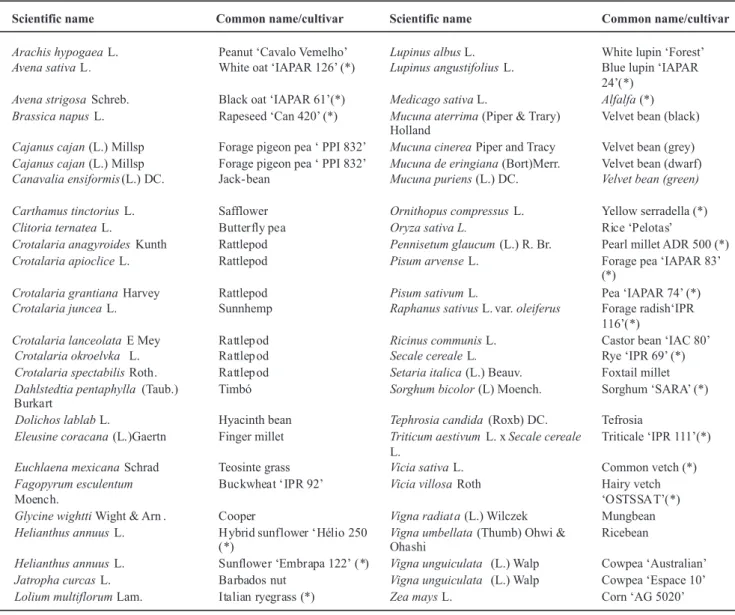
The summer and winter plant species/cultivars evaluated in greenhouse experiments are listed in Table 1. Seeds of each plant species were sown in 300 cm3 plastic pots containing a mixture of sterilized (120°C) substrate (58.5% sand, 7% silt and 34.5% clay) and the seedlings were thinned to one per pot prior to nematode inoculation.
Jatropha curcas was sown pre-germinated.
Nematode inoculum used in the experiment was originally collected from kiwi from Farroupilha, Rio Grande do Sul State, identified by esterase phenotype (Carneiro et al., 2003, 2004) and multiplied for 90 days on tomato plants cv. Santa Cruz. Eggs and second-stage juveniles (J2) were extracted using the 0.5% Na OCl method (Boneti & Ferraz, 1981). A suspension (5mL) containing 5,000 eggs/ J2 (initial nematode density, IP), was poured into 5 small 3.5-4.5 cm-deep holes surrounding the root system. Sixty days after plant inoculation, the roots were removed from the pots and carefully washed, weighed and colored (B- phloxin; 0.015mg/L) for 20min and rated for root galling and egg mass on a 0-5 scale (Taylor & Sasser, 1978). Eggs were then extracted with 1% NaOCl as described previously. Final number of eggs (FP) for each plant was calculated and the reproductive factor (RF = FP/IP) determined. Host suitability was designated as follows: RF ≥ 1.0, good host or susceptible, RF < 1.0, poor host or resistant and RF = 0, immune (Oostenbrink, 1966). The experiments were arranged in a randomized block design with 32 (summer plants) and 20 (winter plants) treatments, tomato plants used as controls and eight replications. Data were transformed in Log10 (x+1) prior to analysis of variance and treatments were compared using Scott-Knott test (1974). The statistical analysis was used to differentiate the host status of different plants: immune, resistant, moderately resistant, susceptible and highly susceptible.
RESULTS
Differences were observed among summer and winter plants to M. ethiopica evaluated in terms of root galling and egg mass index numbers (Tables 2 and 3). But galls and egg masses were not correlated on all good or poor hosts based on RF. Sometimes plants with RF ≥ 1.00 showed no galls or egg masses. Then, the galling and egg-mass indexes were not a reliable indicator of nematode multiplication rates because the root symptoms caused by M. ethiopica on different plants were sometimes variable and difficulty to quantify. Based on these findings, the best variables are the number of eggs/g of roots and the reproductive factor (RF) (Tables 2 and 3).
Eleven of the 32 summer plants evaluated were poor hosts (resistant): Arachis hypogaea (peanut ‘Cavalo Vermelho’), Cajanus cajan (forage pigeon pea ‘PPI 832’ and ‘Dwarf’ pigeon pea ‘IAPAR 43’), Crotalaria apioclice,
C. grantiana, C. spectabilis, Mucuna deeringiana (‘Dwarf’ velvet bean) and Vigna unguiculata (‘Australian’ and ‘Espace 10’cowpeas). Ricinus communis (castor bean ‘IAC 80’) and Sorghum bicolor (Sorghum ‘SARA’) were considered non-hosts (immune) to M. ethiopica (RF =0.0) (Table 2).
Carthamus tinctorius (safflower), Clitoria ternatea (butterfly pea), Crotalaria juncea, C. lanceolata, C. okoelvka (rattlepods),
Among 20 winter plants, only four were considered poor hosts (resistant): Avena strigosa (black oat ‘IAPAR 61’),
Lolium multiflorum (‘Italian’ ryegrass), Raphanus sativus var.
oleiferus (forage radish ‘IPR 116’) and Secale cereale (rye ‘IPR 69’) (Table 3). Other four plants were considered to be moderately resistant: Fagopyrum esculentum (buckwheat ‘IPR 92’), Medicago sativa (alfalfa), Ornithopus compressus
(‘Yellow’ serradella) and Pennisetum glaucum (pearl millet ‘ADR 500’).
DISCUSSION
Since there is little reported research on non-host plants related to control of M. ethiopica in cropping sequences or crop rotation, the discussion was based on data about other root-knot nematode species and races. In
this work, sorghum cv. SARA was immune to M. ethiopica. Similar results were observed by Carneiro et al. (1998) for M. javanica and M. incognita. In field conditions, Rodriguez-Kábana et al. (1991) observed that rotation of soybean with sorghum increased productivity and was effective in controlling various nematodes, among them M. arenaria. Castor bean was also immune to M. ethiopica. This plant was used as an organic amendment in some experiments, and it was effective in improving plant growth and reducing nematode population levels (Ritzinger & McSorley, 1998).
Crotalaria apioclice,C. grantiana and C. spectabilis
were efficient to reduce M. ethiopica populations. Several research works using Crotalaria spp. (rattlepods) to control
Meloidogyne spp. have been published (Ferraz & Freitas, 2004). C. grantiana is also resistant to M. incognita races 1, 2 and 4 (Silva & Carneiro, 1992). C. spectabilis was resistant (*) Winter species/cultivars.
Scientific name Common name/cultivar Scientific name Common name/cultivar
Arachis hypogaeaL. Peanut ‘Cavalo Vemelho’ Lupinus albusL. White lupin ‘Forest’ Avena sativaL. White oat ‘IAPAR 126’ (*) Lupinus angustifoliusL. Blue lupin ‘IAPAR
Avena strigosaSchreb. Black oat ‘IAPAR 61’(*) Medicago sativaL. Alfalfa(*) Brassica napusL. Rapeseed ‘Can 420’ (*) Mucuna aterrima(Piper & Trary)
Holland
Velvet bean (black)
Cajanus cajan(L.) Millsp Forage pigeon pea ‘ PPI 832’ Mucuna cinereaPiper and Tracy Velvet bean (grey) Cajanus cajan(L.) Millsp Forage pigeon pea ‘ PPI 832’ Mucuna de eringiana(Bort)Merr. Velvet bean (dwarf) Canavalia ensiformis(L.) DC. Jack-bean Mucuna puriens(L.) DC. Velvet bean (green)
Carthamus tinctoriusL. Safflower Ornithopus compressusL. Yellow serradella (*)
Clitoria ternateaL. Oryza sativa L.
Crotalaria anagyroidesKunth Rattlepod Pennisetum glaucum(L.) R. Br. Pearl millet ADR 500 (*)
Crotalaria apiocliceL. Rattlepod Pisum arvenseL. Forage pea ‘IAPAR 83’
Crotalaria grantianaHarvey Rattlepod Pisum sativumL. Pea ‘IAPAR 74’ (*) Crotalaria junceaL. Sunnhemp Raphanus sativusL. var.oleiferus Forage radish‘IPR
Crotalaria lanceolataE Mey Ricinus communisL. Castor bean ‘IAC 80’
Crotalaria okroelvka L. Secale cerealeL. Rye ‘IPR 69’ (*)
Crotalaria spectabilisRoth. Setaria italica(L.) Beauv. Foxtail millet Dahlstedtia pentaphylla (Taub.) Timbó Sorghum bicolor(L) Moench. Sorghum ‘SARA’ (*)
Hyacinth bean Tephrosia candida (Roxb) DC. Tefrosia
Finger millet Triticum aestivumL. xSecale cereale Triticale ‘IPR 111’(*)
Teosinte grass Vicia sativaL. Common vetch (*) Vicia villosaRoth Hairy vetch
Vigna radiat a(L.) Wilczek Mungbean Vigna umbellata(Thumb) Ohwi & Ricebean
Vigna unguiculata (L.) Walp Cowpea ‘Australian’ Vigna unguiculata (L.) Walp Cowpea ‘Espace 10’ Dolichos lablabL.
Eleusine coracana(L.)Gaertn
Euchlaena mexicanaSchrad Fagopyrum esculentum
Glycine wighttiWight & Arn . Helianthus annuusL.
Helianthus annuusL. Jatropha curcasL.
Lolium multiflorumLam. Zea maysL. Corn ‘AG 5020’
to M. javanica, M. incognita (race 1, 2, 3, 4) and M. exigua
(Asmus & Ferraz, 1988; Silva et al., 1990; Silva & Carneiro, 1992 and Inomoto et al., 2006).
Among the four Mucuna species tested in this work, only dwarf velvet bean (Mucuna deeringiana) was a poor host of M. ethiopica. Similar results were observed for M. incognita (Resende et al., 1987) and M. arenaria (Ritzinger & McSorley, 1998). Velvet bean has a good antagonistic response, whether aerial parts were incorporated in the soil or not, due to release of toxic substances during
decomposition (Moraes et al., 2006; Inomotoet al.,2006; Asmus & Ferraz, 1988). Without soil incorporation mass, green and black mucunas and velvet bean were not effective in controlling M. javanica and M. incognita (Resende et al., 1987; Asmus & Ferraz, 1988; Lopes et al., 2005).
Resistance to M. ethiopica was observed in both cultivars of pigeon pea (Cajanus cajan) tested, and similar results were observed for M. javanica and M. incognita
races 1, 2 and 3 (Costa et al., 1998, Silva & Carneiro, 1992; Costa & Ferraz, 1990; Inomoto et al., 2006). Cowpea (Vigna
Name Number of Gall index Egg mass index Reproduction factor Status***
Arachis hypogaea ‘Cavalo 356.97b 0.00 0.00 0.32a ** R
Cajanus cajan ‘IAPAR 43’ 0.00
Cajanus cajan PPI 832 1.00
Canavalia ensiformis 3.37
Carthamus tinctorius 5.00
Clitoria ternatea 3.62
Crotalaria. anaguroides 1.25
C. apioclice 0.00
C. grantiana 0.00
Crotalaria juncea 1.37
C. lanceolada 1.37
C. okroelvka 1.50
C. spectabilis 1.25
Dahlstedtia pentaphylla 2.75
Dolichos lablab 1.87
Eleusine coracana 1.75
Euchlaena mexicana 3.0
Glycine wightti 1.00
Jatropha curcas 0.13
Mucuna aterrima 0.00
Mucuna cinerea 0.00
M. deeringiana 0.00
Mucuna puriens 2.12
Oryza sativa ‘Pelotas’ 2.75
Ricinus communis IAC 80 0.00
Sorghum bicolor ‘SARA’’ 0.00
Tephrosia candida 4.50
Vigna umbellata 4.13
Vigna unguiculata 0.00
Vigna unguiculata‘Espace 0.75
Vigna radiata 4.50
Zea maysAG 50 20 2.62
Lycopersicon esculentum 1.42a 6.00a 709.61c 198.13b 370.02b 167.01b 2.68 a 73.05 a 620.37c 603.81c 86.79a 134.28b 1679.97d 239.98b 1539.30d 56.25a 247.78b 794.76c 216.77b 414.50c 21.89a 475.27c 107.69b 0.00a 0.00a 12229.37d 7289.60d 166.81b 164.79b 12897.02d 392.72b 527.30c 5.00 0.03a 0.03a 6.22c 2.67b 1.36b 6.40c 0.02a 0.28a 3.71b 3.50b 2.70b 0.35a 1.54 b 5.06c 12.84c 1.00b 2.02b 4.34c 1.95b 4.73c 0.19a 6.96c 2.06b 0.00a 0.00a 74.19e 43.28e 0.85a 0.76a 73.97e 11.70c 34.99 e 0.0 0.38 1.00 1.75 0.00 2.00 0.00 0.00 1.75 2.12 2.00 0.00 0.0 1.74 3.87 1.17 0.00 2.00 0.00 0.00 0.00 1.75 2.25 0.00 0.00 3.25 4.25 1.37 1.12 4.75 3.00 5.00 R R S MR MR S R R MR MR MR R MR S S MR MR S MR S R S MR I I HS HS R R HS S HS ‘Australian’ 10’ Vermelho’
TABLE 2 - Host status of different summer plants/cultivars for Meloidogyne ethiopica
(*) Gall or egg-mass index: 0 = no gall or egg mass, 1 = 1-2 galls or egg masses, 2 = 3-10, 3 = 11-30, 4 = 31-100, 5 > 100 (Taylor & Sasser, 1978).
(**) Distinct letters indicate significant difference by Scott-Knott test (1974), with data transformed to log 10 (x+1).
unguiculata) ‘Australian’ and ‘Espace’ were both resistant to M. ethiopica. The same results were observed in four major Meloidogyne species in cowpea ‘Mississipi Silver’ (Hare, 1967). The resistance in this cultivar was shown to be inherited as a single dominant gene. The same gene was also found in the cultivars Iron and Colossus (Fery & Dukes, 1980). Cowpea resistance to root knot may vary with the
Meloidogyne species, race, and host cultivar (Swanson & Gundy, 1984). Peanut (Arachis hypogaea) ‘Cavalo’ was also a poor host of M. ethiopica. Peanut is resistant to several species of Meloidogyne and, when included in a crop rotation system, provides farmers with more revenue, as well as side-effects such as improvements in physical, chemical and biological soil conditions (Ferraz & Freitas, 2004).
Among winter plants, the forage turnip ‘IPR’(Raphanus sativus var. oleiferus), black oat (Avena strigosa), ‘Italian’ ryegrass (Lolium multiflorum) and rye (Secale cereale) were resistant. Similar results were found with forage turnip for M. javanica and M. incognita
(Carneiro et al., 1998). The black oat was resistant to M. incognita race 1 and 3 and M. paranaensis (Carneiro et al,
2006a). ‘Italian’ ryegrass were also resistant to race 1 and 3 of M. incognita, M. javanica and M. paranaensis (Carneiro et al., 2006b). Timper et al. (2006) concluded that rye was a poor host for M. incognita and when used as a cover crop did not increase root galling on cotton.
Considering the results obtained in these experiments, we can suggest field experiments, planting successions of different summer and winter plants: A. Mucuna deeringiana, Avena strigosa, Arachis hypogaea;B. Crotalaria spectabilis, Lolium multiflorum, Cajanus cajan ‘PPI 832’; C. Vigna unguiculata, Secale cereale ‘IPR 69’, Cotralaria apioclice; D. Ricinus communis ‘IAC 80’, Raphanus sativus ‘IPR 116’, Crotalaria grantiana; E. Crotalaria grantiana, Secale cereale ‘IPR 69’, Cajanus cajan ‘PPI 832’; F. Crotalaria grantiana, Lolium multiflorum, Mucuna deeringiana; G.
Vigna unguiculata, Avena strigosa, Arachis hypogaea. These plant sequences should be adapted to different regions and areas where M. ethiopica is a major agricultural problem. Since different regions have different agronomic realities, field experiments should be undertaken to show how these successions will be established to maintain M. ethiopica
below the threshold population in the field.
Common name Number of eggs/g of Gall Egg mass Reproduction Status
Avena sativa‘IAPAR 126’
Avena strigosa ‘IAPAR 61’
Brassica napus ‘Can 420’ Fagopyrum esculentum‘IPR 92’
Helianthus annuus ‘EMBRAPA 122’ Helianthus annuus ‘Hélio 250’
Lolium multiflorum ‘Italian’ Lupinus albus ‘Forest’ Lupinus angustifolius IAPAR 24 Medicago sativa
Ornithopus compressus Pennisetum glaucum ‘ADR 500’
Pisum arvenseIAPAR 83
Pisum sativum‘ IAPAR 74’
Raphanus sativus var.
Secale cereale‘IPR 69’
Setaria italica
Triticum aestivumxSecale
Vicia sativa
Vicia villosa‘OSTSSAT’
Lycopersicon esculentum 235.35b 98.24a 1442.72d 593.75c 2466.67d 2912.52d 12.29a 12312.84e 2715.46d 156.68b 135.69b 208.69b 7989.34d 20315.96a 5.10a 91.99a 4220.70d 551.64c 3325.67d 464.02b 423.28c 3.25 2.37 2.12 2.87 4.50 4.00 1.00 5.00 3.87 0.00 0.00 0.00 3.62 4.62 0.00 3.62 1.12 3.50 4.75 1.34 5.00 3.13 2.50 3.50 1.13 3.75 4.24 1.12 4.87 3.87 0.00 0.00 2.00 4.12 4.87 0.00 2.62 2.50 2.50 4.37 4.25 5.00 6.16c 0.28a 12.06c 3.90b 20.68d 25.49d 0.37a 43.30e 25.44d 2.30 b * 1.09b 1.03b 25.97d 45.22e 0.09a 0.63a 15.13c 6.32c 36.58e 7.16c 28.00d S R S MR HS HS R S S MR MR MR HS HS R R S S HS S HS
oleiferusIPR 116
TABLE 3 - Host status of different winter plants/cultivars for Meloidogyne ethiopica
(*) Gall or egg-mass index: 0 = no gall or egg mass, 1 = 1-2 galls or egg masses, 2 = 3-10, 3 = 11-30, 4 = 31-100, 5 > 100 (Taylor & Sasser, 1978).
REFERENCES
Agrianual (2004). São Paulo SP. FNP.
Asmus RMF, Ferraz S (1988) Antagonismo de algumas espécies vegetais, principalmente leguminosas a Meloidogyne javanica. Fitopatologia Brasileira 13:20-24.
Boneti JIS & Ferraz S (1981) Modificação do método de Hussey & Barker para extração de ovos de Meloidogyne exigua de raízes de cafeeiros. Fitopatologia Brasileira 6:553.
Carneiro RMDG, Carvalho FLC, Kulczynski SM (1998) Seleção de plantas para o controle de Mesocriconema xenoplax
e Meloidogyne spp. através de rotação de culturas. Nematologia Brasileira 22:41-48.
Carneiro RMDG, Gomes CB, Almeida, MRA, Gomes ACMM, Martins I (2003) Primeiro registro de Meloidogyne ethiopica
Whitehead, 1968, em plantas de quivi no Brasil e reação a diferentes plantas cultivadas. Nematologia Brasileira 27:151-158. Carneiro RMDG, Randing O, Almeida MRA, Gomes ACMM (2004) Additional information on Meloidogyne ethiopica
Whitehead, 1968 (Thylenchida: Meloidogynidae) a root-knot nematode parasitising kiwi fruit and grape-vine from Brazil and Chile. Nematology 6:109-123.Nematology 6:109-123.
Carneiro RMDG, Almeida MRA (2005) Registro de Meloidogyne ethiopica em plantas de yacon e tomate no Distrito Federal do Brasil. Nematologia Brasileira 29:285-287.
Carneiro RG, Moritz MP, Mônaco APA, Lima, ACC, Santiago DC (2006a) Reação de cultivares de aveia às raças 1 e 3 de Meloidogyne incognita e a M. paranaensis.. Nematologia Brasileira 30:281-285.
Carneiro RG, Mônaco APA, Lima, ACC, Nakamura KC, Moritz MP, Scherer A, Santiago DC (2006b) Reação de gramíneas a Meloidogyne incognita, a M. paranaensis e a M. javanica. Nematologia Brasileira30:287-291.
Carneiro RMDG, Almeida MRA, Cofcewicz ET, Magunacelaya JC, Aballay E (2007)Meloidogyne ethiopica, a major root-knot
nematode parasitising Vitis vinifera and other crops in Chile. Nematology 9:635-641.
Costa DC, Ferraz S (1990) Avaliação do efeito antagônico de algumas espécies de plantas, principalmente de inverno, a
Meloidogyne javanica. Nematologia Brasileira 15:61-69. Costa DC, Ferraz S, Caldas RC (1998) Estudo comparativo da penetração e desenvolvimento de Meloidogyne javanica em raízes de guandu e tomateiro. Nematologia Brasileira 22:80-86.
Derpsch R, Calegari A (1992) Guia de plantas para adubação verde
de inverno. Londrina PR. IAPAR. Documentos 9.Londrina PR. IAPAR. Documentos 9.
Ferraz S, Freitas LG (2004) Use of antagonistic plants and
natural products. In: Chen ZX, Chen, SY, Dickson, DW (Eds.) Nematology - Advances and perspectives. Volume II: Nematode management and utilization. Beijing, China and Wallingford UK. Tsinghua University Press, CABI Publishing. pp. 931-977. Fery RL, Dukes PD (1980) Inheritance of root-knot resistance in the cowpea (Vigna unguiculata (L.) Walp. Journal of American
Society of Horticultural Science 105:671-674.
Hare WW (1967) A combination of disease resistance in a new cowpea Mississippi Silver Phytopathology 57:460. (Abstract)(Abstract) Inomoto MM, Motta LCC, Beluti BD, Machado ACZ (2006) Reação de seis adubos verdes a Meloidogyne javanica e
Pratylenchus brachyurus. Nematologia Brasileira 30:39-44. Lopes EA, Ferraz S, Freitas LG, Ferreira PA, Amora DX (2005)
Efeito dos extratos aquosos de mucuna preta e de manjericão sobre
Meloidogyne incognita e M. javanica. Nematologia Brasileira 29:67-74.
Moraes SRG, Campos VP, Pozza EA, Fontaneti A., Carvalho GJ, Maximiniano C (2006) Influência de leguminosas no controle de fitonematóides no cultivo orgânico de alface americana e de repolho.Fitopatologia Brasileira 31:188-191.
O’Bannon JH (1975) Nematode survey in Ethiopia. Institute of Agricultural Research of Adis Ababa, Ethiopia and FAO. Rome. Oostenbrink M (1966) Major characteristics of the relation between nematodes and plants. Mededelingen LandbouwhogeschoolMededelingen Landbouwhogeschool Wageningen 66:1-46.
Resende LC, Ferraz S, Condé AR(1987) Efeito de seis variedades de mucuna (Stizolobium spp.) sobre Meloidogyne incognita raça 3 e M. javanica. Fitopatologia Brasileira 12:310-313.Fitopatologia Brasileira 12:310-313.
Ritzinger CHSP, McSorley R (1998) Effect of castor and velvetbean organic ammendements on Meloidogyne arenaria in greenhouse experiments. Journal of Nematology 30:624-631. Rodríguez-Kábana R, Robertson DG, Weaver CF, Wells L (1991) Rotations of bahiagrass and castorbean with peanut for the management of Meloidogyne arenaria. Journal of Nematology 23:658-661.
Scott AJ, Knott M (1974) A cluster analysis method for grouping means in the analysis of variance. Biometrics 30:507-512.Biometrics 30:507-512. Silva GS, Ferraz S, Santos JM (1990) Efeito de Crotalaria spp. sobre Meloidogyne javanica, M. incognita raça 3 e M. exigua.
Fitopatologia Brasileira 15:94-96.
Silva JFV & Carneiro RG (1992) Reação de adubos verdes de verão e de inverno às raças 1, 2 e 4 de Meloidogyne incognita.
Nematologia Brasileira 16:11-18.
Swanson TA, van Gundy SD (1984). Cowpea resistance to root knot caused by Meloidogyne incognita and M. javanica. Plant Disease 68:961-964.
Taylor AL, Sasser JN (1978) Biology, identification and control of root-knot nematodes (Meloidogyne spp.). Fundamental and Applied Nematology 20:261-268.
Timper P, Davis RF, Tillman PG (2006) Reproduction of
Meloidogyne incognita on winter cover crop used in cotton production. Journal of Nematology 38:83-89.
Whitehead AG (1968) Taxonomy of Meloidogyne (Nematoda: Heteroderidae) with descriptions of four new species. Transactions of the Zoological Society of London 31:263-401.
Whitehead AG (1969) The distribution of root-knot nematodes (Meloidogyne spp.) in tropical Africa. Nematologica 15:315-333.