Paulo FrazãoI
Débora MarquesII
I Universidade Católica de Santos. Santos, SP, Brasil
II Programa de Pós-Graduação em Saúde Coletiva. Universidade Católica de Santos. Santos, SP, Brasil
Correspondence: Paulo Frazão
R. Dr. Cícero de Alencar, 48 – Butantã 05580-080 São Paulo, SP, Brasil E-mail: [email protected] Received: 03/14/2008 Revised: 08/04/2008 Approved: 09/07/2008
Effectiveness of a community
health worker program on oral
health promotion
ABSTRACT
OBJECTIVE: To assess changes of knowledge and attitudes and health service access and utilization after the implementation of a community health worker program for oral health promotion.
METHODS: A capacity building project including learning, support, and supervision activities was developed between July 2003 and August 2004. A study to assess changes was conducted including 36 community health workers and a representative sample of homemaker literate women and mothers aged 25 to 39 years living in 3- to 6-room dwelling in the city of Rio Grande da Serra, southeastern Brazil. Data on oral health knowledge, self-reported practices, and personal skills regarding self-examination, oral hygiene, number of people living in the same household, number of individual and collective toothbrushes, and dental service access and utilization were collected using structured interviews. Mean scores measured pre- and post-intervention program were compared for each group studied using Student’s t-test. A 5% signifi cance level was set for the analysis.
RESULTS: Statistically significant differences between pre- and post-intervention program were seen regarding oral health knowledge among both health workers and women (p<0.05). The number of shared toothbrushes per family decreased. Frequency of toothbrushing and fl ossing increased. Self-assessment of oral hygiene effi cacy increased. Changes in practices and personal skills improved self-effi cacy. Women had more access to services (p<0.000) and used them more regularly (p<0.000).
CONCLUSIONS: There were seen signifi cant changes of perception regarding oral health, self-effi cacy, and health service access and utilization. These changes may show that community health workers play a key role in oral health promotion.
DESCRIPTORS: Community Networks. Oral Health. Community Dentistry. Community Health Services. Health Knowledge, Attitudes, Practice.
INTRODUCTION
Since 1991 the Brazilian Ministry of Heath has been promoting the inclusion of community health workers (CHWs) in primary care services to contribute to health promotion and disease prevention actions.a In 2004 more than 176,000
CHWs were working in different communities covering around 35.2 million
families. In the ABC region of Greater São Paulo, an area comprising seven cities (Santo André, Mauá, Diadema, São Bernardo, São Caetano, Ribeirão Pires, and Rio Grande da Serra) with more than two million inhabitants, more than 800 CHWs were carrying out health promotion activities.
To address their need for capacity building, it was held in 2001 a 36-hour workshop for CHWs undertaking activities at least one year in the area with the purpose of developing a training manual. The manual was developed through the following steps: identifi cation of common oral health conditions in the community; formulation of questions about relevant issues to the community; question selection and grouping into thematic blocks; general design of the manual; and CHW evaluation of proposed reading materials and illustrations.a There were discussed 164 issues that were
grouped into 29 thematic blocks. Reading materials proposed to address these issues were organized into a publication entitled “Promoting collective oral health: a manual for community health workers.”6
CHW activities have focused on strengthening the re-lationship between the community and health services as it is believed they can contribute to more effective health promotion, disease prevention, and individual care actions. Studies investigating CHW job charac-teristics, impact of their work and specifi c roles played both as an institutional agent and a community workera
have been published.14 However, little is known on the
different scopes of their work.1,14 According to Costa
et al,2 Family Health Program (FHP) and Community
Health Worker Program (CHWP) that have included oral health actions have showed defi cient team capacity building and have not either been able to involve their communities or to effectively evaluate their actions.2
CHWs can disseminate information and knowledge through health education activities and contribute to strengthen people’s ability to deal with health
problems.18,23 Their work may also: provide more
information and broaden people’s health knowledge; contribute to improve people’s ability to manage health determinants; help oral health team to identify the most vulnerable families in need of more specifi c oral health actions; and improve access and utilization of primary care services preventing thus delayed dental care and reducing the need for urgent consultations.b
The objective of the present study was to assess changes of knowledge and attitudes and health service access and utilization after the implementation of a community health worker program for oral health promotion.
a Brizolara RV, Oliveira AC, Frazão P. Problemas de saúde bucal coletiva: percepções de agentes comunitários de saúde da região do ABC, Estado de São Paulo, Brasil [summary]. Cien Saude Coletiva. 2003;8(S-2):104. [Presented at 7th Brazilian Public Health Congress; 2003; Brasília, Brazil]
METHODS
The study was conducted in the city of Rio Grande da Serra in the metropolitan area of Greater São Paulo. Rio Grande da Serra has around 43,000 inhabitants (2007) and has autonomously managed primary care services since 1998. In 2003 the Local Health Depart-ment, through the Oral Health Unit, developed as a CHWP component a project focusing on CHW capac-ity building to manage information about common oral health conditions and self-care practices among others. The Local Health Department team comprised seven dentists, three dental assistants, and 36 CHWs assigned to work in six different areas and fi ve family care units. The family care team included a doctor, a nurse, and a nursing aid. Dental care providers were not part of the Family Health Program and their level of involvement varied depending on professional interests and local management decisions. The capacity building project included learning, support, and supervision activities and was developed between July 2003 and August 2004. During a 12-month period, CHWs were involved in various campaigns (vaccination, dengue fever, dog castration) and trainings on epidemiological and health surveillance, children and women health, among oth-ers. The oral health component training had 18- hour duration: 12 hours in the fi rst month, three hours in the second and three hours in the seventh month. Additional resources used were the previously mentioned manual,6
an education movie produced by the Brazilian Ministry of Health, and oral hygiene products. To assess changes in the oral health component, a pre- and post-intervention social survey was carried out based on interview data.
Data were obtained from Primary Care Information System regarding characteristics of the population reg-istered in three out of the fi ve areas with Family Health Program units. The study sample comprised all CHWs and a random sample of local resident women. They were all interviewed before and after the oral health capacity building program.
The sample size estimation is described elsewhere.7
There were drawn 120 women. After their family and address were identifi ed, data collection was scheduled. The sample of women was larger than that required for allowing comparison between two means using Student’s t-test for correlated samples with an estimated standard deviation of 1.2 – a minimum mean difference of 0.5 (alpha error=5% and beta error=5%) supporting the study analysis.
brick and block houses, and 72.5% lived in three- to six-room dwellings. As for sanitation conditions, 95.1% lived in areas with public garbage collection; 37% lived in areas with adequate sewage systems; 14.8% with septic tank systems; and almost half of them (48.2%) lived in areas with open-air sewage discharge. In regard to transportation, 47.8% reported using public transportation (buses), 10.4% cars, and 19.1% others. A total of 94.7% had access to radio/TV. In the event of disease, families more often reported seeking care in health units (58.9%) than hospitals (28.5%).
In regard to women living in three- to six-room dwell-ings (N=2435), 29.5% were younger than 25 years; 35.7% were 25 to 39 years and 34.8% 40 years or more. Of all, 93.3% reported being literate. More than two-thirds were homemakers (50.4%), students (10.4%), unemployed (5.9%), retired (1.9%), and day cleaning workers (1.4%). The remaining was distributed over more than 200 different occupations.
To prevent an extremely heterogeneous microsocial background that could confound the effects associated with CHW activities, women in the same life stage and from families with similar characteristics to those of people attending the CHWP were drawn. Hence the reference group comprised literate homemaker women aged 25 to 39 years living in 3- to 6-room brick and block dwellings in two registered areas. No specifi c action (e.g., training) was taken to change practices of oral health providers (dentists and dental assistants) in the two health units pre- and post-intervention assessments.
A questionnaire was developed to guide individual interviews conducted by the researcher with CHWs and women.
The study questionnaire consisted of two parts: ques-tions regarding subjects’ sociodemographic character-istics; and items about subjects’ perception organized in three indicator domains: 1 – life cycles and oral health-disease: 14 items developed to assess oral health knowledge in different life stages and conditions (child-hood, adolescence, adult life, old age, and pregnancy); 2 – self-referred practices and skills: seven items address-ing individual or collective toothbrush use, frequency of toothbrushing and fl ossing, dental self-effi cacy, and self-examination skills; and 3 – dental service access and utilization: two items.
The procedures to assure face and content validity of the instrument and other strategies followed are described elsewhere.7
For the measurement of attitude changes, most ques-tions were formulated to be answered based on Likert scale. For a question about knowledge on dental hy-giene, a visual analog scale (0 to 10) was used for more sensitive measures of changes in subjects’ perception levels.22
The instrument was tested in individuals with similar characteristics to the target population. Some questions were then revised to make the instrument’s language ad-equate to respondents.20. Each interview lasted at most
20 to 30 minutes to avoid overwhelming respondents.
The questionnaire was administered twice: pre- and post-CHWP in July 2003 and July 2004, respectively. Schooling and income information and individual nominal scale analysis of answers regarding oral health knowledge are presented elsewhere.7
It was opted for visual representations for identifying answer categories in the analysis of many items. For those items based on Likert scale a mean score of an-swer categories was estimated. Anan-swers were scored 1 to 5 points corresponding to the semantic differential and interval timing and then converted into a percent scale representing semantic poles. Relative frequencies of events were weighed based on the meaning of answer categories and a summary measure ranging between –100 and +100 (200 points) was obtained. This scale provides a better assessment of the event itself rather than its categories of expression. It was considered that the best strategy was to narrow the measurement down to the category of most common event expression ob-taining mean estimates.19 A comparison of mean scores
pre- and post-intervention program for each group studied was conducted using the paired Student’s t-test. All analyses were carried out using Statistical Package for Social Sciences (SPSS) 11.0, 2001.
The study was approved by the Research Ethics Com-mittee of Guilherme Álvaro Hospital, State Health Department of São Paulo.
RESULTS
Four CHWs did not answer the post-intervention ques-tionnaire as they withdrew from the program and 29 women did not answer it due to various reasons (address change, hospitalization, death, among others). As most women (86.8%) had children they are henceforth referred as women and mothers. Most CHWs (93.7%) and women (83.5%) lived in the area for at least fi ve years. The fi nal study sample included 32 CHWs and 91 women.
The fi rst assessment showed that virtually all women used toothbrushes for their oral hygiene, though not on a daily basis, and that the number of toothbrushes were smaller than the number of people in the family. The second assessment showed an even number of people and toothbrushes.
Toothbrushing and fl ossing increased post-intervention among both CHWs and women (Figure 1).
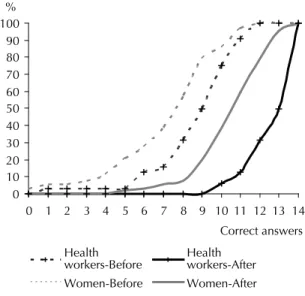
among CHWs increased from 9.09 ±0.76 to 13.00 ±0.42 (p<0.000) while among women they increased from 7.62 ±0.56 to 10.89 ±-0.39 (p<0.000). Figure 2 shows the cumulative frequency of percent scores of correct answers pre- and post-intervention in each group studied. Changes can be visually identifi ed by comparing areas.
As for oral hygiene self-assessment (Figure 3), in-creased self-suffi ciency was seen. Mean score among CHWs increased from 6.22 ±0.51 to 8.44 ±0.42 (p<0.000) while among women it increased from 6.63 ±0.48 to 8.34 ±0.30 (p<0.000). With respect to self-examination skills, the Table shows a mean score shift post-intervention. Perception improved from 25.0 to 48.5 among CHW and from 20.5 to 37.0 among women. The paired Student’s t-test showed that the probability of the average difference of pairs to be zero was very low (p=0.001).
As for dental service access, scale scores ranged in both groups: from –6.0 to –14.0 among CHWs and from –44.5 to 13.5 among women, with statistically signifi -cant difference only for the women group (p<0,000). As for dental service use, while the mean remained practically the same in CHWs (p=0.712), signifi cant improvement was seen among women, from –34.5 to 12.0 in a 200-point scale (p<0.000).
DISCUSSION
Women are considered primary family caretakers and they can provide strong leadership under adverse conditions. When women are empowered, i.e., develop skills to make decisions and have control over the health-disease process, they can play an effective role for health promotion and are recognizably key agents in the change process.13 Household and interfamily
relationships are usually the heart of a woman and
Figure 1. Self-referred practices of community health workers and women pre- and post-intervention program. City of Rio Grande da Serra, Southeastern Brazil, 2003–2004.
Dental floss use Frequency of daily toothbrushing
0 20
40 60
80
100 0 20 40 60 80 100
0 - 1 2 and +
Community health workers Women
Community health workers Women
Before After
Before After 0
10 20 30 40 50 60
Use toothpick
0 10 20 30 40 50 60
interventions can produce positive effects on distinct areas of women’s life as well as on families and the community.10 Women’s social interactions help
promot-ing health practices either durpromot-ing health consultations or by information exchange between mothers and women at the family and community levels.11
Age groups were chosen based on family life cycle, which follows a course of development with predomi-nant roles and specifi c tasks. Diffi culties in fulfi lling their roles will make certain health conditions more likely to develop. For more effective performance,
health providers have to be able to identify each one of these cycles. They are characterized by movements toward “gaining autonomy” in which new young family growth is followed by contraction of a mature family that is aging. Each cycle has specifi c tasks family members are supposed to fulfi ll. The family life cycle is a powerful instrument to help understanding tasks, roles, and behaviors of family members.16
As reported in other studies,3,5,24 the administration of a
questionnaire with closed-ended questions addressing the content of the capacity building program allowed to collecting a great deal of observations, and better consistency of data interpretation according to estab-lished criteria, and therefore well-managed application pre- and post-intervention.
The present study has some limitations. We did not manage to set a control group for comparison purposes. During the study, CHW activities specifi cally targeting oral health were carried out together with other training activities and home visits.
Despite that, major changes were seen. In regard to self-reported practices and skills, estimates were consistent in both CHWs and women and mothers in the following items: frequency of toothbrushing, fl ossing, and oral hygiene self-assessment. When analyzed together, these fi ndings can be suggestive of successful learning and increased self-effi cacy in both groups regarding management of proximal determinants and risk factors associated to the health-disease process. Nearly all women interviewed used to brush their teeth, though not on a daily basis, before the intervention program. Assuming that the whole family had the same habit, the gap between the number of toothbrushes and fam-ily members may indicate shared toothbrush use. The narrower gap evidenced in the second assessment may be attributed to the inclusion of this resource in working materials made available by CHWP.
With respect to oral hygiene self-assessment, there was a signifi cant increase in both groups suggesting informa-tion exchange on this topic. During home visits, CHWs provided information on oral self-care, which may have contributed to develop people’s confi dence and skills.
Studies on health workers and promoters in different countries such as Brazil, Mexico, Bangladesh, and
Nigeria described several successful experiences.9
Giugliani9 reported increased rates of breastfeeding and
exclusive breastfeeding and changes in traditional child feeding practices suggesting that community education by CHWs is an extremely valuable action.
As for dental service access and utilization, signifi cant changes were seen among women and mothers. It may be associated to CHW activities which focus on strengthening the relationship between the community and health services.
Figure 2. Cumulative frequency of correct answers to oral health questions among community health workers and wo-men pre- and post-intervention program. City of Rio Grande da Serra, Brazil, Southeastern 2003–2004.
0 10 20 30 40 50 60 70 80 90 100
0 1 2 3 4 5 6 7 8 9 10 11 12 13 14 Correct answers %
Health
workers-Before Healthworkers-After Women-Before Women-After
Figure 3. Cumulative frequency of oral hygiene self-asses-sment among community health workers and women pre- and post-intervention program. City of Rio Grande da Serra, Southeastern Brazil, 2003–2004.
0 20 40 60 80 100
0 1 2 3 4 5 6 7 8 9 10 11 Self-assessment %
Health
A study assessing health indicators in the state of Bahia, Northeastern Brazil, found an impact on vaccine cover-age in CHWP areas.21 Education activities performed by
CHWs seem to make people more familiar with aspects associated to health conditions and its determinants and to increase opportunities and service access, producing a major effect on the relationship between community and health services as well as users’ behavior change regarding care.15
The present study results were obtained in a context of individual care based on a traditional model of dental care centered on dentists as exclusive providers in the
work process. According to Narvai,17 dentist training
programs do not acknowledge the needs of Brazilian people as these providers are trained to provide care relying on imported technology that are incompatible with Brazil’s reality. In addition to preventive and care practices, providers should be required to have a wider perception of social needs. Fernandes4 claims
that the involvement of CHWs should not entail the development of programs perpetuating an unequal discriminatory model of care that at one level attends well-off populations with highly specialized providers and sophisticated technology and the other provides care to poor people using limited resources.
Table. Distribution of the study population according to questions on self-examination ability, and dental service access and utilization pre- and post-intervention program. City of Rio Grande da Serra, Southeastern Brazil, 2003–2004.
Question
Community health workers Women
Before After Before After
n % n % n % n %
You would say that your ability to identify mouth lesions (wounds) is:
Very poor (1) – – – – 8 8.8 5 5.5
Poor (2) – – – – 10 11.0 9 9.9
Satisfactory (3) 15 46.9 6 18.8 17 18.7 13 14.3
Good (4) 15 46.9 22 68.8 39 42.8 48 52.7
Excellent (5) 2 6.2 4 12.4 11 12.1 16 17.6
Do not know/ missing – – – – 6 6.6 – –
Mean 3.50 3.97 3.41 3.74
–100 to +100 scale 25.0 48.5 20.5 37.0
Paired Student’s t-test p = 0.001 p = 0.001
You would say that your family access to public dental services is:
Very diffi cult (1) 4 12.5 4 12.5 30 33.0 13 14.3
Diffi cult (2) 2 6.3 10 31.3 32 35.2 10 11.0
Sometimes easy, sometimes diffi cult (3) 21 65.6 10 31.3 15 16.5 20 22.0
Easy (4) 4 12.5 7 21.9 11 12.1 39 42.9
Very easy (5) 1 3.1 1 3.1 1 1.1 9 9.9
Do not know / missing – – – – 2 2.2 – –
Mean 2.88 2.72 2.11 3.27
–100 to +100 scale –6.0 –14.0 –44.5 13.5
Paired Student’s t-test p = 0.378 p = 0.000
Indicate your perception on your family use of dental services. You would say they use dental services:
Very often (5) – – – – 1 1.1 2 2.2
Often (4) 10 31.3 11 34.4 22 24.2 50 54.9
Irregularly (3) 12 37.5 9 28.1 10 11.0 11 12.1
Rarely (2) 8 25.0 9 28.1 28 30.8 22 24.2
Very rarely (1) 2 6.3 3 9.4 29 31.9 6 6.6
Do not know / missing – – – – 1 1.1 – –
Mean 2.98 2.88 2.31 3.24
–100 to +100 scale –1.0 –6.0 –34.5 12.0
Paired Student’s t-test p = 0.712 p = 0.000
More effective results could be achieved by implement-ing the CHWP oral component together with changes in the model of care. These changes have been strongly supported and many cities have restructured primary care following a family care strategy.a Breaking off
with the current dental care model implies providing comprehensive care8 at its different levels as part of
routine of tasks of the health team (including doctors, nurses, dental nursing assistants, dental assistants, den-tal hygienists, community health workers, and others) and different community organizations.
As part of the health team, CHWs are required to undergo regular capacity building and have access to specialized information for broadening their knowledge on the local reality and improving interventions for promoting better quality of life.12 CHWs want to be
involved in projects of oral health capacity building. Capacity building is required and should be comple-mented with continuous education activities for the improvement people’s oral health.b
Besides contributing for the improvement of the com-munity’s oral health, it is reasonable to suppose that the CHWP has also an impact on other health areas and domains and on people’s knowledge by strengthening their self-effi cacy and ability to manage determinants of health and disease.
The present study showed the role of CHWs not only in promoting changes but also in increasing women’s and mothers’ self-effi cacy through actions involving commu-nication, trust, respect, and commitment.c They develop
a stronger relationship with the community, which help people abandon old beliefs and learn new values.
Some experts advocate that having higher “health literacy,” i.e., health information and knowledge, may promote attitude and motivation changes in health behaviors, increasing self-effi cacy and personal skills for certain tasks, and thus yielding more effective re-sults in health promotion interventions.18 Changes in
knowledge and practices and self-reported skills seen in the present study support this model evidencing the key role of CHWs for oral health promotion.
a Ministério da Saúde. Secretaria de Políticas de Saúde. Departamento de Atenção Básica. Área Técnica de Saúde Bucal. A reorganização da saúde bucal na atenção básica. Divulg Saude Debate 2000;(21):68-73.
b Fajardo AP. Agentes comunitários de saúde: discurso e prática em saúde bucal coletiva [master’s dissertation]. Porto Alegre: Universidade Federal do Rio Grande do Sul; 2001.
1. Bornstein VJ, Stotz EN. Concepções que integram a formação e o processo de trabalho dos agentes comunitários de saúde: uma revisão da literatura.
Cienc Saude Coletiva. 2008;13(1):259-68. DOI:
10.1590/S1413-81232008000100029
2. Costa ICC, Unfer B, Oliveira AGRC, Arcieri RM, Moraes E, Saliba NA. Investindo na promoção de saúde: PSF e PACS, uma análise de suas performances em oito
municípios brasileiros. Rev Aboprev. 1998;1(1):30-7.
3. Faustini DMT, Novo NF, Cury MCFS, Juliano Y. Programa de orientação desenvolvido com adolescentes em centro de saúde: conhecimentos adquiridos sobre os temas abordados por uma equipe
multidisciplinar. Cienc Saude Coletiva.
2003;8(3):783-90. DOI: 10.1590/S1413-81232003000300012 4. Fernandes JCL. Agentes de saúde em comunidades
urbanas. Cad Saude Publica. 1992;8(2):134-9. DOI:
10.1590/S0102-311X1992000200004 5. Flores EMTL, Drehmer TM. Conhecimentos,
percepções, comportamentos e representações de saúde e doença bucal dos adolescentes de escolas
públicas de dois bairros de Porto Alegre. Cienc Saude
Coletiva. 2003;8(3):743-52. DOI:
10.1590/S1413-81232003000300008
6. Frazão P. Promovendo a saúde bucal coletiva: manual para agentes comunitários de saúde. São Bernardo do Campo: Universidade Metodista de São Paulo; 2001. 7. Frazão P, Marques DSC. Infl uência de agentes
comunitários de saúde na percepção de mulheres e
mães sobre conhecimentos de saúde bucal. Cienc
Saude Coletiva. 2006;11(1):131-44.
8. Garcia DV. Novos rumos da saúde bucal: os caminhos da integralidade. Rio de Janeiro: ABO-RJ/ANS; 2005. 9. Giugliani ERJ. Amamentação exclusiva e sua promoção.
In: Carvalho MR, Tamez RN. Amamentação: bases científi cas para a prática profi ssional. Rio de Janeiro: Guanabara Koogan; 2002. p.11-24.
10. Gollub EL. The female condom: tool for women’s
empowerment. Am J Public Health.
2000;90(9):1377-81. DOI: 10.2105/AJPH.90.9.1377
11. Hernandez Tezoquipa I, Arenas Monreal ML, Valde Santiago R. El cuidado a la salud en el ámbito
domestico: interación social y vida cotidiana. Rev
Saude Publica. 2001;35(5):443-50. DOI: 10.1590/
S0034-89102001000500006
12. Kadt E, Tasca R. Promovendo a eqüidade: um novo enfoque com base no setor saúde. São Paulo: Hucitec; 1993.
13. Kar SB, Pascual CA, Chickering KL. Empowerment of
women for health promotion: a meta-analysis. Soc Sci
Med. 1999;49(11):1431-60. DOI:
10.1016/S0277-9536(99)00200-2
14. Kluthcovsky ACGC, Takayanagui AMM. Community
health agent: a literature review. Rev Lat Am
Enfermagem. 2006;14(6):957-63. DOI: 10.1590/
S0104-11692006000600019
15. Levy FM, Matos PES, Tomita NE. Programa de agentes comunitários de saúde: a percepção de
usuários e trabalhadores da saúde. Cad Saude
Publica. 2004;20(1):197-203. DOI:
10.1590/S0102-311X2004000100036
16. Moysés ST, Kriger L, Moysés SJ. Saúde bucal das famílias: trabalhando com evidências. São Paulo: Artes Médicas; 2008.
17. Narvai PC. Odontologia e saúde bucal coletiva. São Paulo: Hucitec; 1994.
18. Nutbeam D. Health literacy as a public health goal: a challenge for contemporary health education and
communication strategies into the 21st century. Health
Promotion Int. 2000;15(3):259-67. DOI: 10.1093/
heapro/15.3.259
19. Pereira JCR. Análise de dados qualitativos: estratégias metodológicas para as ciências da saúde humanas e sociais. São Paulo: Edusp; 2001.
20. Piovesan A, Temporini ER. Pesquisa exploratória: procedimento metodológico para o estudo de fatores
humanos no campo da saúde pública. Rev Saude
Publica. 1995;29(4):318-25. DOI:
10.1590/S0034-89101995000400010
21. Solla JJSP, Medina MG, Dantas MBP. O PACS na Bahia: avaliação do trabalho dos agentes comunitários de
saúde. Saude Debate. 1996;51:4-15.
22. Streiner DL, Norman GR. Health measurement scales: a practical guide to their development and use. New York: Oxford University Press; 2001.
23. Trad LAB, Bastos ACS. O impacto sociocultural do Programa de Saúde da Família (PSF): uma proposta
de avaliação. Cad Saude Publica. 1998;14(2):429-35.
DOI: 10.1590/S0102-311X1998000200028
24. Valentini W, Levav I, Kohn R, Miranda CT, Mello AAF, Mello MF, Ramos CP. Treinamento de clínicos para
o diagnóstico e tratamento da depressão. Rev Saude
Publica. 2004;38(4)523-8. DOI:
10.1590/S0034-89102004000400007