Submitted21 July 2014 Accepted 24 February 2015 Published26 March 2015 Corresponding author
Fred Hasselman, [email protected]
Academic editor
Alessandro Tavano
Additional Information and Declarations can be found on page 38
DOI10.7717/peerj.837 Copyright
2015 Hasselman
Distributed under
Creative Commons CC-BY 4.0 OPEN ACCESS
Classifying acoustic signals into
phoneme categories: average and dyslexic
readers make use of complex dynamical
patterns and multifractal scaling
properties of the speech signal
Fred Hasselman
School of Pedagogical and Educational Science, Radboud University Nijmegen, The Netherlands
Behavioural Science Institute: Learning and Plasticity, Radboud University Nijmegen, The Netherlands
ABSTRACT
Subjects Biophysics, Developmental Biology, Neuroscience, Cognitive Disorders, Psychiatry and Psychology
Keywords Speech perception, Developmental dyslexia, Recurrence quantification analysis, Theory evaluation, Rise time perception deficit, Strong inference, Auditory temporal processing deficit, Complexity science, Aetiology, Complexity matching
INTRODUCTION
Many aetiologies of developmental dyslexia assume some deficit in auditory processing may be causally entailed in the difficulty with acquiring proficient levels of reading and spelling ability experienced by a small percentage of the population (see e.g.,Ramus, 2004). The nature of the features of the acoustic signal that are assumed to be able to evidence such deficient components (e.g., phoneme representations, allophones) or component processes (e.g., frequency sweep detection, rise time perception) varies greatly between aetiologies (cf.Serniclaes & Sprenger-Charolles, 2003). The purpose of this study is to compare a number of such features under conditions of strong inference (cf.Platt, 1964). The goal is to examine whether average and dyslexic readers actually use these features to arrive at a particular classification of a speech stimulus, a first and necessary step to take before their causal entailment in dyslexic reading can be claimed. Three types of measures will be examined that represent different distinguishing features of the speech signal: however, this will not be accomplished by constructing stimuli that exclusively represent these measures as is common in auditory and speech perception studies (see e.g.,Boets et al., 2007;Pasquini, Corriveau & Goswami, 2007). Instead, all measures will be extracted from one and the same set of stimuli and measures will be evaluated on their ability to enable a simple classifier to yield a response that is similar to classification responses by participants.
of such complex dynamical patterns to coordinate their behaviour in ways that are comparable to principles for optimal and maximal information transport between complex systems as posited by formal fluctuation dissipation theorems (e.g., the ‘1/f resonance hypothesis’Aquino et al., 2011). Complexity science has developed a number of analyses that allow a quantification of complex temporal patterns and self-affine structure in empirical time-series. Such measures often concern a quantification of dynamics in a phase-space representation of the signal, reconstructed by means of delay embedding methods (cf.Kantz & Schreiber, 2003), or, the assessments of scaling relations between signal variability and the temporal resolution at which the variability is assessed (cf.
Kantelhardt, 2011). The techniques used in this article to quantify phase-space dynamics and scaling relations in the speech signal are Recurrence Quantification analysis (RQA, cf.Marwan et al., 2007) and Multifractal Detrended Fluctuation Analysis (MF-DFA, see
Kantelhardt et al., 2002;Ihlen, 2012).
The latter two types of measure (Periodicity and Complex Dynamic Pattern measures) have not been the focus of studies on dyslexia and speech perception, even though these measures seem tailor made to test claims of deficits in detecting complex dynamic frequency or amplitude patterns present in the speech signal. The association between speech perception and non-linear behavioural phenomena (e.g., hysteresis, enhanced contrasts) has been established in a number of studies (see e.g.,Case et al., 1995;Porter & Hogue, 1998;Tuller et al., 1994;Van Lieshout et al., 2004;Hasselman, 2014a). Recent studies have shown that quantification of recurrent patterns (RQA) and the presence of power-law scaling in trial series of word-naming latencies of dyslexic readers are different (more random, less fluent) from average readers and are correlated to reading performance on standardised tests. The correlation only appears in dyslexic readers (Wijnants et al., 2012b). A comparison of response latency distributions in different tasks (word-naming, colour-naming, arithmetic, flanker tasks), suggests dyslexic readers’ response distributions are a scaled versions of average readers, in which the relatively larger ‘heavy tails’ account for more variable, more random behaviour (Holden et al., 2014). This would indicate a general scaled continuum account of dyslexia and not, as component dominant aetiology suggests, a localised specific deficit. This is reflected in how the temporal evolution and change processes (i.e., continuous dynamics) are studied: component process measures quantify change over time as a nominal variable that can be ‘on’ or ‘off’ in a stimulus (F2 rate of frequency change is high or low; rate of change of envelope modulation is high or low). This is not the same as quantifying the dynamics of a continuous signal (RQA), or the full range of temporal correlations present in a signal (multifractal spectrum).
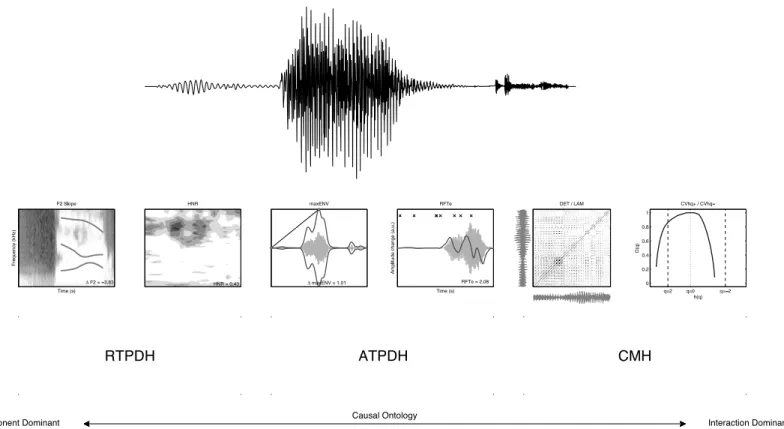
Figure 1 Six representations of a signal.Six representations of stimulus 1 used to extract the features for classification by Quadratic Discriminant Analysis.
features that enable classification of speech stimuli as observed in the performance of average and dyslexic readers in simple labelling experiments of those stimuli.
Component process measures: what does temporal refer to?
The “temporal” auditory processing deficit hypotheses concern properties or information content in auditory stimuli that cannot, due to the rate with which the information changes over time, be properly perceived by the person afflicted with the deficit. There are two major deficit hypotheses of this kind: the auditory temporal processing deficit hypothesis (ATPDH:Farmer & Klein, 1995;Tallal, 2004) and the rise time perception deficit hypothesis (RTPDH) proposed by Goswami and colleagues (see e.g.,Goswami et al., 2011;Goswami et al., 2002).
The ATPDHstates that speech stimuli with rapid transient spectral elements are processed less accurately because such elements occur too fast to be perceived by people with the processing impairment. In fact, the claim is not limited to spectral features, but pertains to any sequence of auditory stimuli presented in rapid succession.
auditory stimuli (Temple et al., 2000) or an “asynchrony” in the speed of processing between auditory and visual modalities (Breznitz, 2003). Note that essentially, these are two different deficits:
1. An auditory stimulus with rapidly changing elements is not detected/processed adequately.
2. The speed with which processing of auditory stimuli takes place is not adequate (out of sync).
From the literature it is unclear which of these two temporal deficits the ATPDH actually refers to, in fact both can be true at the same time. The early work by Tallal and co-workers suggests the first option (see e.g.,Tallal, 1976;Tallal, Miller & Fitch, 1993;Tallal & Piercy, 1974). However, since the ATPDH has been “adopted” by the magnocellular theory of dyslexia (Stein, 2001;Stein & Walsh, 1997), option seems more appropriate. This magnocellular theory states that the sensorimotor deficits observed in dyslexic readers may be explained by the anomalies found in the magnocellular neural pathways responsible for fast information transferral. It is thus not exactly clear what the “temporal” in temporal processing refers to. A similar problem plays a role in the rise time perception deficit (e.g.,
Livingstone et al., 1991).
The RTPDHstates that there are problems with the perception of the slow changing amplitude modulation cues, or rise times of the amplitude envelope of the speech signal. Temporal here thus refers to the opposite of ATPDH in terms of the rate of change involved.
phoneme-like structure due to poor beat perception. This is why the hypothesis belongs in the arena of the component dominant ontology.
The question remains: What exactly is the process that is deficient here? The au-thors (Goswami et al., 2002;Goswami, 2006;Goswami et al., 2011;Goswami, 2011) use “rise time perception deficit,” “envelope amplitude onset detection deficit,” “perceptual insensitivity to amplitude modulation,” “beat perception deficit” and “p-centre detection deficit.” Recently, the perception of fast spectral changes in formants was directly compared to rise time perception in a /bA/-/wA/ continuum on which stimuli differed either by frequency rate of change or envelope rate of change (Goswami et al., 2011). The frequency onsets of the formants were kept equal in both conditions. It was concluded that dyslexic children were poor at discriminating between sounds based on the rate of change of the envelope, whereas discrimination based on formant transition duration (the rate of change of frequency) yielded normal performance. The authors interpreted the results as a failure to detect envelope cues by dyslexic readers, not rapid frequency changes. What does this imply? Are there too many, or too few rise time onsets in the signal to be perceived? Or, if the deficit is indeed also responsible for anomalous rhythm production, is it a matter of a deficient coupling between an internal clock and an externally perceived rhythm as suggested in the temporal sampling framework (Goswami, 2011)? If those rise time onsets were made more salient, would they lead to better beat perception? Is it a deficit in perceiving the rate with which the amplitude envelope changes in the signal instead of the actual detection of the onset of the envelope? This is what is suggested by the stimuli used inGoswami et al. (2011)and it seems a different, more specific auditory processing deficit than the more general deficit the same authors proposed to detect the occurrence of envelope onsets as a beat or rhythm.
longer rise time (up to 192 ms). The study showed that performance on discrimination tasks with these stimuli was correlated with rhyme detection and reading and had a unique contribution to explained variance in these variables in a regression model. A sensible measure then seems to be the time it takes for the amplitude envelope to rise to its maximal value, which also marks the onset of the rhyme (b-Ak). To obtain the measure, first the absolute value of the Hilbert transform of the signal is taken (c.f.Feldman, 2008;Smith, Delgutte & Oxenham, 2002), which yields the immediate envelope. The slope of the line one can draw from the amplitude envelope at the start of the signal to its maximum value is considered an estimate of the most important slow rise time that needs to be detected in order to distinguish between speech stimuli.
Acoustic manipulations of the speech signal, based on the ATPDH refer to amplification or slowing down (or both) of the fast spectral changes present in the speech signal. These manipulations are expected to also affect the amplitude envelope, which is important for RTPDH. Amplification may lead to steeper rise time slopes whereas slowing down the signal is expected to lead to (relatively) slower rise times.Been & Zwarts (2003)presented simulations of the effect of amplification of the fast formant transitions using their SWEEP model. The SWEEP model is a dynamical model built around the assumption that speech perception involves detection of frequency sweeps. They predicted that the amplification manipulation would indeed lead to a better performance on behalf of the dyslexic readers. Following this line of reasoning, we may expect a measure that indexes the rate of change of a formant transition in a speech signal to be a measure of which ATPDH would agree dyslexic readers cannot maximally exploit to identify and discriminate between speech sounds.
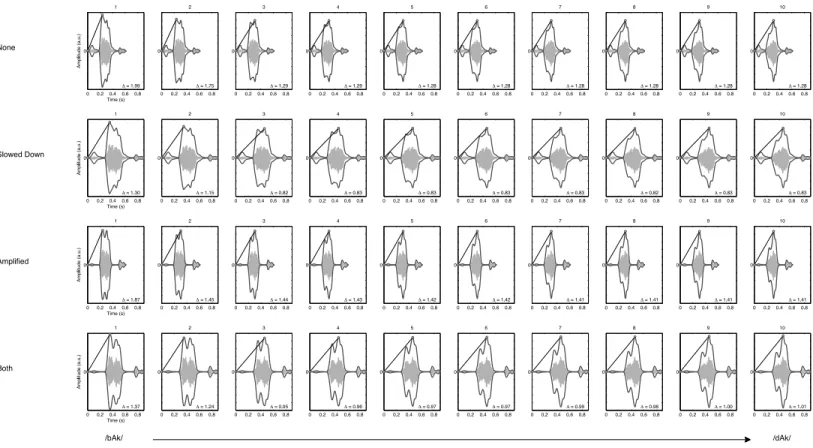
InFig. 2the spectrograms of the stimuli used in the present study are plotted. The rate of change of the formant transition calculated as the slope of F2 in the spectrum is given for each of the 40 stimuli.Figure 3shows the smoothed amplitude envelopes of all the stimuli and the rise time is calculated as the slope from the start of the stimulus to the maximum amplitude. As shown in the figure, these measures differ between the stimuli and are thus candidate features that may actually be used by participants.
Periodicity measures: harmony of frequency and amplitude
Figure 2 Formant sweep.Figures represent spectrograms of the stimuli used in the experiment. There are four manipulations of the 10-step continuum. Formant Sweeps (ΔF2) are calculated as the slope of the second formant transition (the second white line).
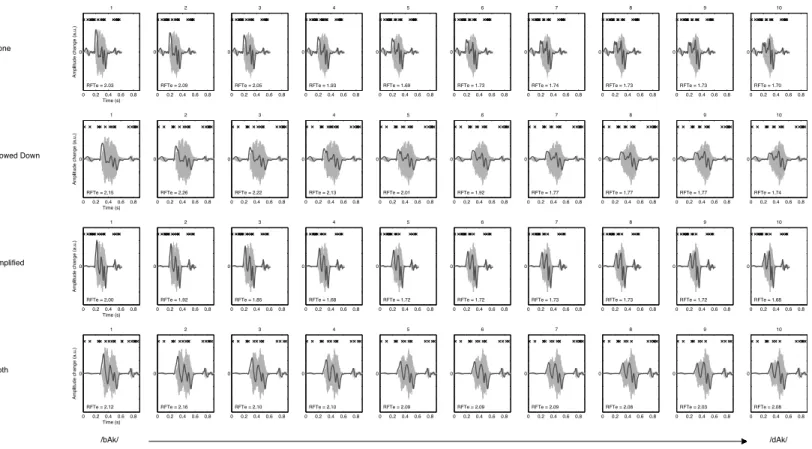
zero-crossings in the derivative thus yields a distribution of durations; the time it takes for the amplitude to rise or fall. The entropy of this distribution of discrete durations of size n can be calculated as the chance of observing a particular rise or fall timepRFTi(Eq. (1)) and inserting it into the regular formula for Shannon entropy (Eq. (2)).
pRFTi= RTFi n
i=1 RFTi
(1)
RFTe= −
n
i=1
pRFTi∗log2(pRFTi) (2)
Figure 3 Envelope rise time.Figures represent the smoothed envelope (exaggerated for clarity of presentation) of the amplitude waveform (smaller ghost image) of the stimuli used in the experiment. There are four manipulations of the 10-step continuum from /bAk/ to /dAk/. Envelope rise times (Δ) are calculated as the slope of the line connecting the start of the stimulus onset amplitude to the maximum amplitude.
Figure 4 Rise- and fall-time entropy.Figures represent the derivative of the smoothed envelope (exaggerated for clarity of presentation) of the amplitude waveform (smaller ghost image). There are four manipulations of the 10-step continuum from /bAk/ to /dAk/. The derivative represents the rate of change of the envelope. The X markers in the top represent the zero-crossings of the derivative. The time between consecutive markers represents a rise or fall time. See text for details on calculating RFTe values.
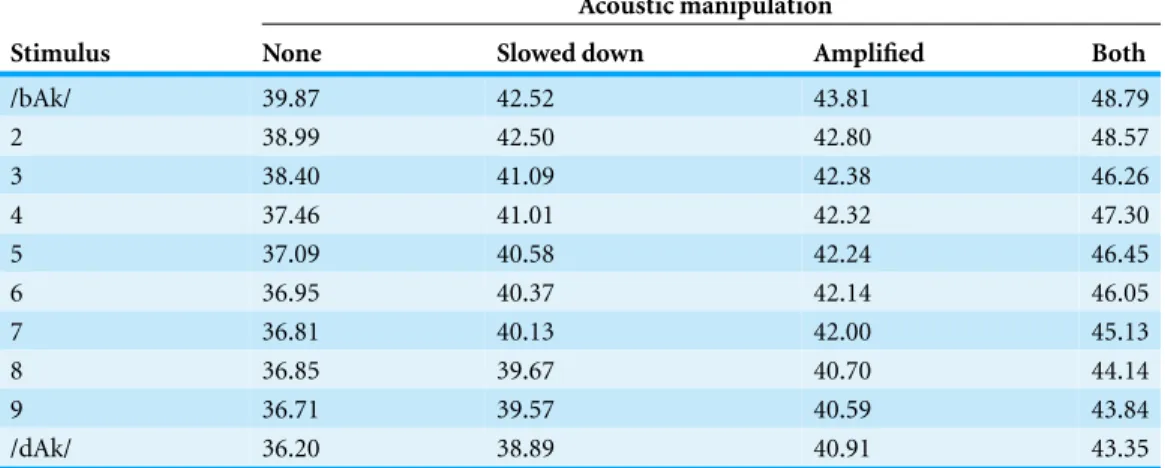
constant at 1,100 Hz in /bAk/ but the onset increases in ten steps to 1,800 Hz in /dAk/. In the table it can be seen that /bAk/ is more inharmonious than /dAk/, which might seem counter-intuitive since in /bAk/ there is no change in F2 onset. However the fundamental frequency F0 of most of the stimuli is about 220 Hz, which yields about 1,800 Hz with n=3. The closest harmonic partial to 1,100 Hz is 880 withn=2.
Complex dynamic pattern measures: a complexity matching hypothesis
Table 1 Inharmonicity of the 40 stimuli used in the experiment.The numbers represent percentage of energy in the signal that is outside of the harmonic sequence.
Acoustic manipulation
Stimulus None Slowed down Amplified Both
/bAk/ 39.87 42.52 43.81 48.79
2 38.99 42.50 42.80 48.57
3 38.40 41.09 42.38 46.26
4 37.46 41.01 42.32 47.30
5 37.09 40.58 42.24 46.45
6 36.95 40.37 42.14 46.05
7 36.81 40.13 42.00 45.13
8 36.85 39.67 40.70 44.14
9 36.71 39.57 40.59 43.84
/dAk/ 36.20 38.89 40.91 43.35
very much a matter of sophisticated aerodynamic control by changing the shape of cavities air is forced to flow through (Porter & Hogue, 1998). The speech signal indeed appears to resemble the most complex dynamic motion known to physics, spatio-temporal chaos, or, turbulence: Models of human aspiration have been successfully validated against real turbulent airflow induced sounds generated in acoustic duct experiments (cf.Little et al., 2007).
Perhaps the words of Horace Lamb, the author of the 1910 bookThe Dynamic Theory of Sound, which is still in print today as an exact copy of the 1925 2nd edition (Lamb, 2004), should carry some weight. He was more famous for his work in hydrodynamics and is reported to have said: “I am an old man now, and when I die and go to heaven there are two matters on which I hope for enlightenment. One is quantum electrodynamics, and the other is the turbulent motion of fluids. And about the former I am rather optimistic.” (Moin & Kim, 1997). Indeed, the scientist who brought enlightenment on the subject of quantum electrodynamics, Richard Feynman, called turbulence: “the most important unsolved problem of classical physics” (cf.Moin & Kim, 1997). Lamb’s dynamic theory of sound makes clear that a speech signal cannot be regarded as the vibration of a violin string propagating harmonic waves through the air (seeTable 1). A substantial part of the signal cannot be described as a harmonic sequence. The sound wave produced by a string is to the sound wave produced by a human speaker as a gentle summer breeze is to a hurricane.
whole (e.g.,Chemero, 2009;Chemero & Turvey, 2007;Gibson, 1979;Michaels & Carello, 1981;Schoner & Kelso, 1988). Evidence is accumulating that humans are able to coordinate their behaviour by exploiting specific invariant properties of complex dynamical patterns either due to ‘attraction to criticality’ or ‘complexity matching.’ Attraction to criticality refers to the ubiquitous observation of 1/f scaling (pink noise) in time-series of human physiology and performance, which is associated with health and well being (cf.Goldberger et al., 2002), proficiency and fluency of performance (for example in motor learning ( Wi-jnants et al., 2009), or as nested constraints on performance (Wijnants et al., 2012a)). Complexity matching is a remarkable synchronisation and coordination phenomenon in which participants are able match the complex scaling properties of an external stimulus in a record of their responses (e.g., finger tapping to a ‘fractal’ metronomeCoey, Washburn & Richardson, 2014).
Formally, the terms fractal, power-law and scaling refer to different, related properties of mathematical objects, but in general fractal dynamics, power-law or 1/f scaling all refer to the observation of self-affine structure in empirical time series (cf.Van Orden, Holden & Turvey, 2003;Kantelhardt, 2011). As shown inEq. (3), self-affinity is different from self-similarity in that the similarity between small and large scale structures in time-series can only be observed by asymmetric scaling of the time axistand value axisx(t)by a factor aH(cf.Kantelhardt, 2011). The scaling exponent H (or Hurst exponent) indicates factor that allows the self-affine structure to be observed as self-similar structure:
x(t)→aHx(at) (3)
The scaling exponent can be associated to the fractal dimension of the signal or its generating process (seeHasselman, 2013, for a discussion of different scaling exponents and how they are related to fractal dimension). It is the invariant structure that is hypothesised to be exploited as a ‘global’ control variable, as if it were a complex resonance frequency (Aquino et al., 2011; F Hasselman, unpublished data). Evidence of selective matching of dynamical behaviour to scaling exponents in different observables measured simultaneously throughout the body, suggests a complex multi-scale coupling relationship between physiological and psychological processes may exist (Rigoli et al., 2014). Complexity matching has also been reported for dyadic interactions; for example, interpersonal coordination of coupled movements (Marmelat & Deligni`eres, 2012) and overt behaviour during joint problem solving (Abney et al., 2014).
The important question for the present context of speech perception in average and dyslexic readers is whether the speech signal can be considered to reveal the invariant patterns and temporal complexity of which it is hypothesised listeners could exploit. The methods used in the studies that evidenced complexity matching as a phenomenon of perception, action and behaviour coordination were (Cross-) Recurrence Quantification Analysis (see e.g.,Coey, Washburn & Richardson, 2014;Abney et al., 2014) and fractal analyses such as Detrended Fluctuation Analysis (see e.g.,Marmelat & Deligni`eres, 2012;
pathology or disease (Little et al., 2007). These measures were successful in distinguishing between pathological and healthy origins of the recorded signal and were hypothesised to represent information at the level of non-linear and turbulent airflows generated by complex gestures of the human speech apparatus. Naturally produced speech sounds have also been shown to reveal ‘attraction to criticality’ at different levels of analysis and across many repeated productions of the same sound (Kello et al., 2008). As indicated in the introduction, studies have shown that a characterisation of response latencies is associated to dyslexic reading, Moreover, multifractal spectrum of reading times in connected text reading has been found to distinguish between reading fluency and proficiency in literate adults (see, e.g.,Wallot, Hollis and Van Rooij, 2013). Based on these studies a Complexity Matching Hypothesis (CMH) can be formulated with regard to speech perception and reading ability.
Given few studies on scaling and fluency in developmental dyslexia have been conducted so far (Wijnants et al., 2012a;Holden et al., 2014), it would be premature to attempt to formulate a ‘complexity matching’ aetiology sufficient for explaining the many empirical phenomena associated with developmental dyslexia. Moreover, in the present study, the objects of complex signal analyses are not trial series of response latencies generated by participants, but the stimuli used in the experiment. Another difference is the difference in constraint on available response options, a binary choice versus pronunciation of a word. A modest conjecture would be to adopt the ‘proportional continuum’ assumption and suggest that any differences between dyslexic and average readers in labelling the stimuli should be the result of less stable, more variable continuous processes that lead up to the choice for one of the two options. From that perspective one would assume differences on labelling to be small, rather than large, but that is a common expectation of many competing claims (cf.Serniclaes & Sprenger-Charolles, 2003). One specification.
The CMHstates that listeners will use the dynamically invariant, self-affine structure of the speech signal to categorise and label speech sounds.
The relative novelty of employing these techniques to study the role of speech perception in proficient and impaired reading warrants a more elaborate explanation and discussion of the analyses used in this study.
Phase space reconstruction and recurrence quantification analysis
delayed copies of the observed time series as surrogate dimensions, one can reconstruct the phase space of the system and analyse an approximation of the attractor dynamics of the entire system. Takens’ theorem ensures that the reconstructed attractor is topologically equivalent to the original attractor when all of themdimensions of the system would have been observed (seeMarwan et al., 2007, for a detailed explanation).
After phase space reconstruction, analyses usually focus on quantification of the dynamics of the reconstructed attractor. A method commonly used for this purpose is Recurrence Quantification Analysis, (RQA,Marwan et al., 2007;Webber Jr et al., 2009;
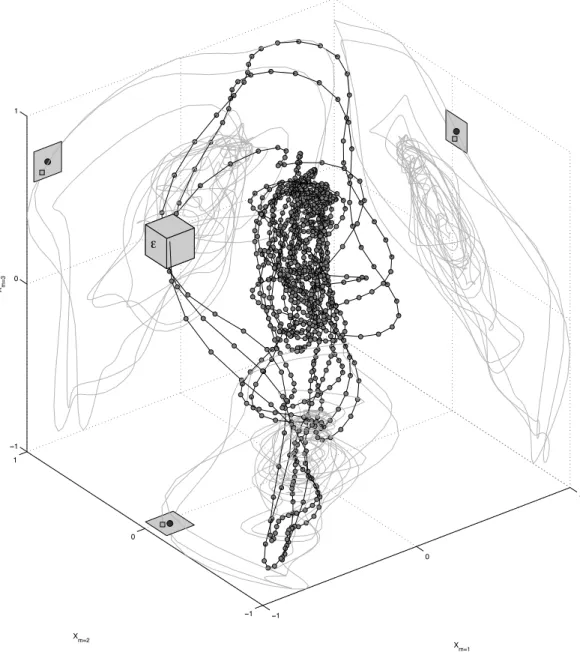
Zbilut, Giuliani & Webber Jr, 1998;Webber Jr, & Zbilut, 2005). RQA is a non-linear time series analysis technique that can quantify complex temporal patterns by means of analysing trajectories through state space and noting when trajectory coordinates are in each other’s vicinity, when they can be said to be a state that isrecurrent. InFig. 5, the attractor of the first 1024 samples of the transition part of the amplitude time series of stimulus 10 (/dAk/) is reconstructed in three dimensions. The time series for surrogate dimensionmis shifted byτ samples for each extra surrogate dimensionm. The values forτ
andmare chosen so that the reconstructed attractor will represent maximal information in the measured series, but its exact value is in principle not relevant (mutual information is used to chooseτ and a false nearest neighbour analysis to choosem, seeRiley & Van Orden, 2005, for details). The coordinates in reconstructed state space inFig. 5are not randomly jumping from one region to another, but trace periodic orbits through specific locations in the state space. When two coordinates fall within a radiusε, the two coordinates are said to be recurrent. Sequences of multiple coordinates that are recurrent signify a trajectory in phase space that is being revisited by the system. It is a trajectory or a location in the state space the system is attracted to and these recurrent coordinates and the structures they form are the objects of analysis in RQA.
Figure 5 Phase space reconstruction.A reconstruction of the 3D phase space of stimulus 10 (first 1,096 samples) by the method of delay embedding. The planes show 2D projections of the time course of the surrogate dimensions created with an embedding delayτ =6. Points that fall within a distance ϵ(represented by the grey box for presentation purposes) will be plotted as recurrent points in the recurrence plot.
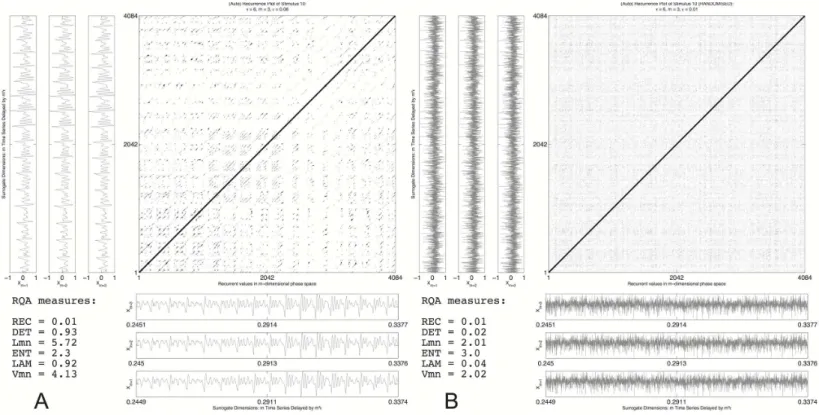
Figure 6 Recurrence plot: original vs. randomised signal.A recurrence plot of the transition part of stimulus 10 (A) and a randomly shuffled version (B). Next to the recurrence plot axes are the surrogate dimensionsmthat span the phase space in which recurrent points are evaluated. They are offset by just(m−1)∗6 samples.
The different line structures are clearly visible in the left pane ofFig. 6that is the recurrence plot of the entire reconstructed phase space of the transition part of stimulus 10, resampled to a length of 4,096 datapoints of which the first 1,096 are shown as a 3D reconstruction inFig. 5.Figure 6Bis a randomised version of stimulus 10, the temporal order of the samples was randomised, destroying all the correlations that are in the data but retaining the same distributional properties (mean, variance, etc.). From the recurrence measures it can be seen that the recurrence rate in both panes (the number of recurrent points) is exactly the same. However, the measures that are calculated from the line structures that quantify the higher order recurrent patterns are very different. In the randomised plot all the DET and LAM disappeared, the temporal structure was destroyed even though the central tendency measures are exactly the same. This is a very basic test of whether the line structures are just accidental temporal alignments. A more sophisticated test would be to create spectral surrogates of the speech stimuli, or to do a bootstrap resampling on all the recurrence measures in order to create a confidence interval (cf.
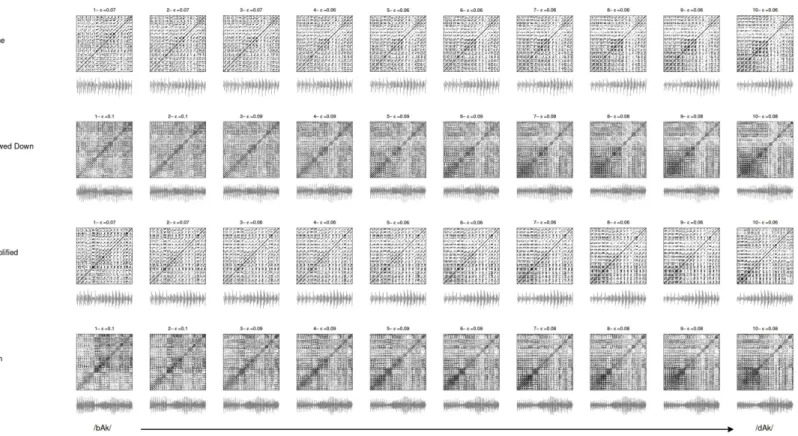
Figure 7 Recurrence plots.Figures represent the recurrence plots of the amplitude waveform of the transition part of the stimulus (grey image below the plot). There are four manipulations of the 10-step continuum from /bAk/ to /dAk/. The plots were generated using embedding dimension (m) of 3 and an embedding delay (τ) of 6. The recurrence rate for each plot was kept constant by varying the radius (ε). This way the recurrence measures extracted from the plot are comparable across stimuli. See text for details.
RQA is used in an increasing number of studies across the different sub-disciplines the social and life sciences, such as motor development in infants (Aßmann et al., 2007), parent–child interaction (de Graag et al., 2012;Lichtwarck-Aschoffet al., 2012), syntactic coordination between child and caregiver (Dale & Spivey, 2006), dynamics of motor control (Wijnants et al., 2009;Wijnants et al., 2012a), cognitive constraints on postural stability (Shockley, Santana & Fowler, 2003;Shockley et al., 2007), eye-movements during conversation (Richardson, Dale & Kirkham, 2007), insight in problem solving (Stephen, Dixon & Isenhower, 2009), and as a novel analysis tool in cognitive neuroscience (Bianciardi et al., 2007;Schinkel, Marwan & Kurths, 2007;Schinkel, Marwan & Kurths, 2009).
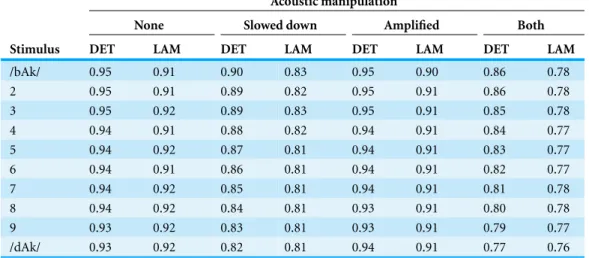
Table 2 RQA.Determinism and laminarity of the 40 stimuli used in the experiment. The numbers represent proportion of recurrent points that lie on diagonal lines (DET) or on vertical lines (LAM).
Acoustic manipulation
None Slowed down Amplified Both Stimulus DET LAM DET LAM DET LAM DET LAM
/bAk/ 0.95 0.91 0.90 0.83 0.95 0.90 0.86 0.78
2 0.95 0.91 0.89 0.82 0.95 0.91 0.86 0.78
3 0.95 0.92 0.89 0.83 0.95 0.91 0.85 0.78
4 0.94 0.91 0.88 0.82 0.94 0.91 0.84 0.77
5 0.94 0.92 0.87 0.81 0.94 0.91 0.83 0.77
6 0.94 0.91 0.86 0.81 0.94 0.91 0.82 0.77
7 0.94 0.92 0.85 0.81 0.94 0.91 0.81 0.78
8 0.94 0.92 0.84 0.81 0.93 0.91 0.80 0.78
9 0.93 0.92 0.83 0.81 0.93 0.91 0.79 0.77
/dAk/ 0.93 0.92 0.82 0.81 0.94 0.91 0.77 0.76
structures (e.g., maximum diagonal line length or average diagonal or vertical line lengths) and were considered too homogeneous to characterise the individual stimuli.
Values used for reconstruction werem=3 andτ =6 and the recurrence rate was kept constant at 0.1 (10%) by varying the radiusε(radius values are shown inFig. 7; DET and LAM values are shown inTable 2). As explained above, DET quantifies recurring trajectories through phase space and a high DET signifies a system that behaves very periodic and predictable. LAM quantifies recurrences of the system displaying the same type of behaviour, visiting the same region in phase space and staying there for a while. Some portion of the recurrent points quantified by DET will be representing laminar behaviour, so using a combination of these two measures in a classification analysis yields a description of the stimulus in terms of whether the dynamics are characterised by changing temporal patterns or patterns that stay relatively constant for some time.
The multifractal spectrum
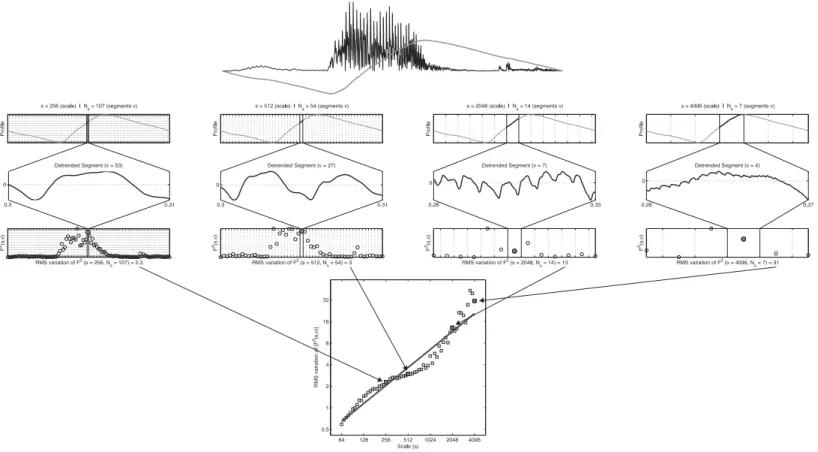
Fractal analyses are so-called variability analyses (cf.Bravi, Longtin & Seely, 2011) that assess a scaling of ‘bulk’ with ‘size’ (Theiler, 1990). Expressed in terms of time-series it concerns the ‘amount of fluctuation in a signal’≈‘scale at which fluctuation is quantified.’ Figure 8displays the steps in Detrended Fluctuation Analysis (DFA) in which the Hurst exponent is estimated by assessing a scaling of residual fluctuation (Root Mean Square variation) with bin size after detrending the binned signal. The top row ofFig. 8shows the envelope of the signal (black) and its ‘profile’ (grey). The profile is the cumulative sum of the signal after the mean has been subtracted. The following steps are applied to the profile (numbers refer toFig. 8):
1. Divide the profile of lengthNintoNsnon-overlapping segmentsvof sizes(scale). 2. For each segmentvof sizes: Remove linear (or higher order) trend and calculate the
Figure 8 Steps in detrended fluctuation analysis.The profile of stimulus 1 is divided into nonoverlapping segmentsvof sizes; the signal is detrended and the mean RMS deviation of the RMS variation in each segment is calculated; this is repeated for different scales and results in the fluctuation function:F2(s,v). The slope of the best fitting line through these points is an estimate of the Hurst exponent. See text for details.
3. The RMS variation of the variances calculated in step 2 represents a value of the fluctuation functionF2(s,v)for the scale of sizes.
4. Repeat 1–3 for increasing values ofs(up toN/4). The slope of the fluctuation function F2(s,v)is the global scaling exponentH.
Figure 9 MF-DFA.Multifractal Detrended Fluctuation Analysis of the 40 stimuli.
root mean squared deviation:σ1= 2
1 N N
i=1
(xi− ¯x)2 → F1(s,v)=
1 Ns
Ns
v=1 σv2
12
(4)
mean squared deviation:σ2= 1
1 N N
i=1
(xi− ¯x)2→F2(s,v)=
1 Ns
Ns
v=1 σv2
22
(5)
q-order deviation:σq= q
1 N N
i=1
(xi− ¯x)2→Fq(s,v)=F2(s,v)
q
2 (6)
q-order fluctuation:Fq(s)=
1 Ns
Ns
v=1
F2(s,v)
q
2
1q
(7)
Usingq=2 inEq. (7), will yield the RMS deviation of the variance. Theq-order takes on the role of a zoom-lens for fluctuations: By increasingqto more positive values, large residual variances will be given more weight than smaller ones when establishing the scale dependency of the fluctuations in the signal. On the other hand, decreasingqto lower negative values has the opposite effect and will zoom in on the scale dependency of small residual variances.
Fig. 9shows for the 4×10 stimuli their fluctuation functions of orderq= [−5,−2,0,2,5]. The black dotted power law atq=2 represent the fluctuation function of stimulus 1 that is show in the bottom row ofFig. 9. For each of the 40 stimuli, a 101 stepq-continuum was estimated ranging fromq= −10 toq=10 (includingq=0). The scaling exponents H(q)are the slopes of those 101 fluctuation functions (Table S1lists for each stimulus the average and SD of the norm of the residual after regression). Those slopes are plotted againstqin the middle column ofFig. 9. If the stimuli were monofractals, there would have been no dependence of the scaling exponentH(q)on theq-order for which it was calculated. The plots in the middle column ofFig. 9would all have been horizontal lines (see e.g., Fig. 1D inKantelhardt et al., 2002, p. 94). Here, it is clearly the case that all the stimuli used in the study should be considered multifractal signals. The multifractal spectrum (right column ofFig. 9) is a representation of the generalized scaling exponents (now called singularity, H¨older, or generalized Hurst exponents) againstD(q), theq-order singularity dimension (the calculation ofD(q)is not shown here, seeIhlen, 2012, for details).
The multifractal spectrum does not need to be symmetrical andFig. 9reveals that the discrepancy between stimuli may be revealed by considering the dispersion ofh(q)
separately forq-orders<0 andq-orders>0. As noted byKuznetsov & Wallot (2011), each half of the singularity spectrum conveys different information about scaling properties of the signal. The measures of interest will be for the Coefficient of Variation for each half-spectrum:
CVhq+ = sh(q>0) h
q>0 (8)
CVhq− = sh(q<0) h
q<0. (9)
Forq<0 (CVhq−) andq>0 (CVhq+).Table 3shows the values of the multifractal CV for each stimulus.
Which measure do participants use to identify /bAk/ and /dAk/?
Table 3 Coefficient of variation MF-spectrum.Coefficient of variation of local scaling exponents calu-lated forq<0 (zooming in on the scale dependency of smaller residual variation) andq>0 (zooming in on scale dependency of larger residual variation).
Acoustic manipulation
None Slowed down Amplified Both Stimulus CVhq− CVhq+ CVhq− CVhq+ CVhq− CVhq+ CVhq− CVhq+
bAk/ 0.118 0.308 0.112 0.385 0.135 0.170 0.116 0.124
2 0.131 0.330 0.135 0.387 0.149 0.180 0.144 0.142
3 0.142 0.341 0.146 0.421 0.165 0.184 0.161 0.162
4 0.152 0.348 0.156 0.441 0.179 0.192 0.176 0.192
5 0.162 0.354 0.164 0.452 0.190 0.211 0.191 0.204
6 0.170 0.359 0.170 0.434 0.200 0.208 0.194 0.204
7 0.176 0.363 0.172 0.449 0.205 0.212 0.195 0.199
8 0.182 0.365 0.174 0.417 0.208 0.226 0.195 0.161
9 0.185 0.366 0.176 0.449 0.210 0.220 0.189 0.166
/dAk/ 0.185 0.366 0.176 0.399 0.210 0.218 0.188 0.182
In this study I will use a similar approach to categorise the speech signals asLittle et al. (2007)did, but the targets for the quadratic discriminant analysis (QDA) will not be disordered speech vs. healthy speech, but the observed labelling of the stimuli by average and dyslexic readers as either /bAk/ or /dAk/. The labelling patterns will be experimentally assessed by administering a labelling task of four versions of a 10 step /bAk/ to /dAk/ continuum (None, Slowed Down, Amplified and Both). A first research question is whether there are differences in labelling between experimental groups and stimulus types. This could potentially yield eight different labelling patterns. If there is a difference between experimental groups, QDA will be performed for each group separately. The features used by QDA to classify the stimuli will be the measures discussed above. These measures are extracted from one and the same set of stimuli, but represent different theoretical perspectives on (impaired) speech perception.Figure 1andTable 4summarise the different hypotheses (ATPDH, RTPDH, CMH) and associated measures extracted from different representations and quantifications of the temporal patterns in the speech signal. The simple main hypothesis is that the combination of measures that yield the best classification performance is the most likely source of information used by the participants in this study to label the stimuli.
METHOD
Data sharing and reproducibility of results
Table 4 Strong inference.A summary of the hypotheses competing to explain which features of the acoustic signal are used in speech perception.
Signal Measure QDA
Hypothesis Representation Transform Name Type Acronym
RTPDH Time-frequency Short-time Fourier 2nd formant slope Component process F2
Short-time Fourier Inharmonicity Periodicity NHR
ATPDH Analytic signal Hilbert transform Slope to max. envelope Component process maxENV Hilbert transform Rise & fall time entropy Periodicity RFTe CMH State space Delay embedding Recurrent trajectory Complex pattern LAM / DET
Scale space Multifractal spectrum Multifractal CV Complex pattern CVhq+/CVhq−
Table 5 Word reading results.Results for the two groups of children participating in the experiment. The DMT scores represent words read correctly in one minute. Level of difficulty increases from DMT1 to DMT3. KLEPEL represent correctly read pseudowords in two minutes.
Average readers Dyslexic readers
Mean SD Mean SD
Age (months) 127.2 12.3 133.5 14.9
DMT1 100.0 15.5 72.1 15.7
DMT2 94.6 18.2 60.05 15.7
DMT3 84.3 16.7 48.0 16.2
KLEPEL 74.1 17.4 32.4 12.7
Gender 22 boys 18 girls 19 boys 20
girls
N 40 39
Participants
Children could enter the study as participants after their caregivers signed an informed consent form (equivalent to “Consent Form 4 - Under 12” issued by the Ethics Committee of the Faculty of Social Sciences of the Radboud University Nijmegen. An English translation is available in theSupplemental Information 1andSupplemental Information 2). There were 80 participants (age range 101.2 to 159.3 months) from 9 different schools in the southeast of the Netherlands. Half of the subjects (40) were dyslexic readers as indi-cated by two reading tests: A timed-reading task for regular words “Drie-Minuten-Toets”;
Verhoeven, 1995and a timed pseudo-word reading task (“KLEPEL”;Van den Bos et al., 1994). When the child’s scores on both tests were within the 25th percentile (norm score by age), the child was considered to have severe reading problems. For one participant who completed the study, no data was recorded in the output file and could not be included. Table 5displays the information for the participants whose data were analysed.
Stimuli and acoustic manipulations
Table 6 Multilevel logistic model.Model evaluation with identification label (idL) as dependent variable. The bayesian deviance information criterion was used for all consecutive models estimated with MCMC (150,000 iterations).D, Posterior Mean Deviance;D(φ), Deviance of Posterior Means;pD(D−D(φ)), Effective Number of Parameters;DIC, Deviance Information Criterion. See text for an explanation of the modelling steps.
Msingle M0 M1 M2 M3 M4
idLij= β S.E. β S.E. β S.E. β S.E. β S.E. β S.E.
Fixed part
Intercept 0.51 0.03 0.53 0.04 −2.04 0.10 −2.39 0.15 −2.77 0.19 −2.59 0.20
stimulus 0.66 0.02 0.77 0.04 0.8 0.05 0.78 0.04
Slowed Down (D1) 0.29 0.10 0.16 0.14
Amplified (D1) 0.63 0.10 0.37 0.14
Both (D1) 0.36 0.10 0.01 0.14
Dyslexic (D2) −0.33 0.20
Slowed down×dyslexic 0.25 0.21
Amplified×dyslexic 0.53 0.21
Both×dyslexic 0.73 0.20
Random part
Level 2
Intercept variance 0.11 0.03 0.36 0.08 1.79 0.38 1.81 0.39 1.83 0.38
Slope variance 0.42 0.09 0.42 0.10 0.42 0.09
Intercept-Slope covariance 0.12 0.03 0.12 0.03 0.12 0.03
Level 1
Binomial variance var(idLij|πij)=πij(11−πij)
D 8360.07 8220.42 5335.96 4958.18 4920.15 4907.22
D(φ) 8359.09 8167.94 5271.46 4835.14 4793.9 4777.51
pD(D−D(φ)) 0.98 52.47 64.5 123.04 126.24 129.71
DIC 8361.06 8272.89 5400.45 5081.22 5046.39 5036.93
PROCEDURE
Speech perception experiments
The speech identification task (labelling task) was presented on a laptop computer in a quiet room at the children’s school. There were two tasks conducted in two sessions: an identification task (reported in this article) and a discrimination task (reported in
Hasselman, 2014b). In the identification task, the participants were asked to rest their left and right index fingers on a coloured key on the left side [z] and right side [/] of the keyboard. After an attentional beep and fixation cross a smiley face appeared on the screen, which then uttered a word, one of the stimuli. The cover story was that the smiley face could not speak very well and the child had to help find out which out of two possible words (/bAk/ [roof] or /dAk/ [container]) it had just said. After the utterance of the word two frames appeared on the screen, one on the left, one on the right with either a picture of a roof or a container inside (positions were randomised). The child had to press the button corresponding to the position of the picture named by the smiley face. Prior to the experimental trials, 10 practice trials were presented using different pictures and pronunciations that were all clear exemplars. Feedback was given on the responses during these practice trials and no child made more than 3 errors during practice. During the experimental condition, the unmanipulated and the three types of manipulated /bAk/ and /dAk/ stimuli were presented in a random order. Each stimulus was presented twice resulting in 80 stimulus presentations (2×4 manipulations×10 stimuli).1
1The stimulus materials (audio files and
pictures) are available here:https://osf. io/a8g32/files.
Extracting the stimulus characteristics
The 40 stimuli were 16 bit digital audio files in .WAV format, with a sample rate of 44.1 kHz. These were always used as the basis for extracting the following measures2:
2Extraction of these measures is described
in detail in the file Hasselman2014-extractmeasures.mavailable here:https:// osf.io/a8g32/files.
The slope of the second formant transition (F2 slope,Fig. 2), the time it took for the envelope to reach its maximal value (mxENV Slope,Fig. 3), the entropy of rise and fall times (RFTe,Fig. 4). Settings were used in Matlab that mimic the default behaviour of the Praat program (Boersma & Weenink, 2002) so the output of this script should be similar to output generated by Praat. For the Inharmonicity measure (HNR;Table 1) and the measures obtained from recurrence quantification analysis (Fig. 7) only the transition part of the stimulus was considered. FollowingLittle et al. (2007), to assure that the RQA is performed on time series of equal length, all files were resampled to 4,096 samples (waveforms shown under the RP plots inFig. 7). The Multifractal spectrum was obtained by Multifractal Detrended Fluctuation Analysis based on the entire stimulus signal, using Matlab code byIhlen (2012).
Statistical analysis
The repeated measurements can be thought of as clustered within the participant, who represent a second level of random variation in the model (level2). The modelling strategy was as follows: First it was examined whether the multilevel model gave a better fit than a single level model with just measurement occasion defined as a level; then, the empty multilevel model for change was fitted (M0), which in the present case means that a zero
inflated fixed effect predictor was added representing the stimulus rank order on the continuum (0–9). In a subsequent model (M2) it was examined whether stimulus rank
could explain random variation in the slopes of the curve at the level of the participants (level2). If so, this means the variation in labelling of the continuum between participants can be understood as random variation with respect to the average labelling curve of the entire sample. In the next step (M3) level1 and level2 covariates were added: A
dummy variable that represents the four stimulus types (level1), and a dummy variable that represents whether subjects are dyslexic or average readers (level2). In the final modelling step (M4) various interactions were tested including cross-level interactions
between participant type and stimulus type. The models were fitted using a Monte Carlo Markov Chain simulation with 150,000 iterations (Browne et al., 2009). This number was chosen after inspecting the Raferty-Lewis diagnostic for each parameter estimate at each modelling step and was found to yield a very safe margin for all predicted parameters.
The predictions of the logistic multilevel model for each stimulus were used as targets for the quadratic discriminant analysis (QDA). If the lower 95% confidence bound predicted by the logistic multilevel model exceeded the chance level of 0.5 it was noted for that stimulus that /dAk/ was perceived. Otherwise the target for the discriminant analysis was /bAk/ for that stimulus. This resulted in a string of 40 zeroes and ones. The objective of the discriminant analysis was to replicate the classification in zeroes and ones based on pairs of the measures discussed above. The following pairs were tested mxENV Slope / F2 Slope; HNR / F2 Slope; RFTe / mxENV Slope; RFTe / HNR; LAM / DET. The pairs were all converted to the unit scale before analysis. The algorithm used to perform QDA was the same as described inLittle et al. (2007). This procedure allows for calculation of 95% Confidence Intervals around the percentage correctly classified stimuli by bootstrap resampling. All QDA analyses were based on 15,000 bootstrap replications.
RESULTS
Multilevel logistic model
Figure 10 Predicted labelling curves. Predicted probability of perceiving /dAk/ with 95% CI for each stimulus on the artificial continuum (predictions based on 150,000 MCMC replications of model M4inTable 5). The lines summarise average and dyslexic readers and panels represent
each type of manipulation: (A)None; (B)Slowed Down; (C)Amplified; (D)Both. The points are offset around the stimulus number on thex-axis to increase readability. There are two clear instances of non-overlapping confidence intervals (C, stimulus 6; D, stimulus 5). Values for the entire sample (Model M3) are given inTable 7.
In both cases the dyslexic readers have a higher odds for perceiving /dAk/. Another difference between the groups may be observed when evaluating at which stimuli the lower confidence bound of the odds for perceiving /dAk/ exceeds the chance level of 0.5. Again the difference between the groups is observed with stimuli of category Amplified and Both (CandDinFig. 10). The dyslexic readers’ odds for perceiving /dAk/ is with 95% certainty higher than chance at stimulus 4 for these manipulations, whereas for normal and Slowed Down manipulations it is at stimulus 5. For average readers this boundary is always at stimulus 5 irrespective of the acoustic manipulation. InTable 7the significant parameter estimates of the final model (M4) corroborate this: At each unit step increase
Table 7 Model predictions.Predicted Probability (Π) for perceiving /dAk/ for all participants from MCMC Model estimation (median of 150,000 iterations yielding 95% CI) for each stimulus and acoustic manipulation (M3ofTable 6). When the lower CI limit exceeded 0.5, the target for QDA
was /dAk/; otherwise, it was /bAk/.
Formant onset (Hz) Predicted Probability (π) for Perceiving /dAk/ per Acoustic Manipulation Stimulus F1 F2 F3 None 95% CI Slowed 95% CI Amplified 95% CI Both 95% CI
/bAk/ 440 1,100 2,700 0.06 (0.04, 0.08) 0.08 (0.05, 0.12) 0.13 (0.07, 0.24) 0.18 (0.08, 0.35) 2 | 1,178 | 0.12 (0.08, 0.17) 0.15 (0.09, 0.25) 0.25 (0.13, 0.43) 0.32 (0.15, 0.57)c 3 | 1,255 | 0.23 (0.16, 0.33) 0.28 (0.17, 0.44) 0.43 (0.24, 0.64)c 0.51 (0.27, 0.76)b 4 | 1333 | 0.40 (0.28, 0.54)c 0.47 (0.29, 0.66 )c 0.62 (0.38, 0.81)b 0.70 (0.42, 0.88) 5 | 1,411 | 0.60 (0.44, 0.74)b 0.66 (0.45, 0.82)b 0.78 (0.56, 0.91)a 0.84 (0.60, 0.95)a 6 | 1489 | 0.77 (0.61, 0.87)a 0.81 (0.63 , 0.92)a 0.89 (0.72, 0.96) 0.92 (0.75, 0.98) 7 | 1,567 | 0.88 (0.76, 0.94) 0.91 (0.77, 0.96) 0.95 (0.84, 0.98) 0.96 (0.86, 0.99) 8 | 1,644 | 0.94 (0.86, 0.98) 0.95 (0.87, 0.98) 0.98 (0.91, 0.99) 0.98 (0.92, 1.00) 9 | 1,722 | 0.97 (0.93, 0.99) 0.98 (0.93, 0.99) 0.99 (0.96, 1.00) 0.99 (0.96, 1.00) /dAk/ 440 1,800 2,700 0.99 (0.96, 1.00) 0.99 (0.97, 1.00) 0.99 (0.98, 1.00) 1.00 (0.98, 1.00)
Notes.
aLower CI limit≥0.5 threshold (used as observed classification boundary). bPredicted median probability≥0.5 threshold.
cUpper CI limit≥0.5 threshold.
this variance (changes are in 3rd decimal of estimated parameters). TheDICstatistic did decrease with each consecutive model indicating a better model fit.
Quadratic discriminant analysis
Because the outcomes of the multilevel logistic model yield different boundaries at which dyslexic and average readers switch from /bAk/ to /dAk/ for stimuli of type Amplified and Both, the QDA was performed for each group separately using these labels as the target for the classification. At the same time, there was no significant main effect of group and the boundaries for the entire sample as predicted by M3(seeTable 6) deviated from the
boundaries predicted by M4for each group. To investigate the impact of these differences,
an additional QDA classification was performed using the predicted labels on the level of the sample. The results for the sample are shown inFig. 11andTable 8and also include the results for the predicted labels of M4for each group of participants. What becomes
apparent is that the Complexity measures outperform the other measures no matter which sequence of target labels is used.
CONCLUSION AND DISCUSSION
There are three clear and novel results to be discussed:
1. A difference between dyslexic and average readers in labelling some of the manipulated stimuli on the continuum is observed.
Figure 11 QDA classification results.Results of the classification of the stimuli used in the experiment by Quadratic Discriminant Analysis. Targets of the classification were the labels predicted for the sample (M3,Table 6). The panels show how the stimuli were observed (outer marker) and how
they were categorised by QDA based on different pairs of measures (inner marker).
though the sequences of target labels differ between the groups for two sets of acoustically manipulated stimuli (Amplified and Both).
3. The accuracy of stimulus classification by measures derived from different theoretical positions on the relationship between speech perception and reading appears to be ordered along a continuum (seeFig. 1andTable 4). On one extreme, causal primacy is attributed to component processes (lower classification accuracy), on the other extreme, causal primacy is attributed to the interactions between component processes (higher classification accuracy).
Table 8 QDA classification results.Quadratic discriminant analysis for different stimulus feature com-binations based on average labelling by the entire sample, the average readers group and the dyslexic readers group. numbers represent percentage correctly classified with 95% CI obtained from 15,000 bootstrap replications.
Group Feature combination Correct as /bAk/ Correct as /dAk/ Overall correct Median CI.95 Median CI.95 Median CI.95
CVhq+/CVhq− 94.5% 6.2% 98.2% 8.1% 96.6% 4.5%
LAM / DET 96.1% 10.8% 85.4% 13.6% 90.2% 6.8%
HNR / RFTe 70.8% 19.0% 74.2% 15.3% 72.7% 8.1% maxENV / RFTe 76.8% 17.0% 77.8% 19.4% 77.4% 7.1%
F2 / HNR 72.4% 17.6% 88.0% 15.2% 81.0% 9.7%
Sample
F2 / maxENV 74.8% 18.2% 81.8% 20.9% 78.6% 8.9% CVhq+/ CVhq− 96.0% 8.6% 95.5% 5.2% 95.7% 4.0%
LAM / DET 96.2% 13.4% 88.2% 13.8% 91.4% 8.8%
HNR / RFTe 75.8% 17.8% 72.1% 11.2% 73.6% 6.2% maxENV / RFTe 84.3% 18.7% 81.2% 17.5% 82.4% 6.5%
F2 / HNR 66.8% 19.4% 86.1% 16.4% 78.3% 9.7%
Average readers
F2 / maxENV 69.4% 22.2% 75.8% 25.4% 73.2% 11.3% CVhq+/ CVhq− 97.4% 7.1% 96.0% 6.7% 96.5% 4.3%
LAM / DET 94.9% 15.4% 87.4% 13.6% 90.1% 9.0%
HNR / RFTe 77.2% 19.2% 72.1% 11.9% 73.9% 4.4% maxENV / RFTe 84.4% 18.0% 80.9% 18.9% 82.1% 8.7%
F2 / HNR 64.1% 17.7% 86.6% 14.4% 78.7% 9.1%
Dyslexic readers
F2 / maxENV 73.5% 20.0% 78.5% 23.1% 76.8% 11.3%
effects between stimulus type and experimental group: the confidence intervals of the groups overlapped at these stimuli. Significant differences in odds for perceiving /dAk/ between the groups were observed for stimulus 6 (Amplified) and stimulus 5 (Both). This interaction is not likely to influence the actual labelling of the stimulus since both groups would label it /dAk/ above chance with 95% confidence. This difference would be noticed when the stimuli were presented to the same person many times, in which case a dyslexic reader would label stimulus 5 (Both) about 9/10 times as /dAk/ and an average reader about 7/10 times. A similar result was found inHasselman (2014b), where it was suggested that applying some manipulations may actually reduce the accuracy of identification and discrimination of stimuli because it biases perception towards /dAk/.
lie on the perceptual boundary (Stimulus 4–6) where the target label changes from 0 to 1. Misclassification may be expected for these stimuli, but classification should be relatively accurate outside of this transition region. However, this expected pattern is not what is observed for the other feature combinations. There were many additional misclassification outside the region of the label transition yielding classification curves that are clearly false (seeFigs. 12and13).
Thethirdresult concerns the condition of strong inference: What is the implication of these findings for the two deficit hypotheses associated with the F2 Slope / HNR measures (ATPDH) and mxENV Slope / RFTe measures (RTPDH)? First, all measures yield different values that appear to differentiate the stimuli in a sensible way (seeFigs. 2–4andTable 2). In other words they have the potential to be used for identification by a classifier. In fact, the classification results, expressed as % correct are not disastrous when these measures are used and at the sample level many stimuli are indeed labelled as human participants would label them. Some of these correct classifications may be expected from the way the stimuli are constructed. After all, this was done by manipulating the onset of the F2 while keeping everything else constant. Relative to that fact, their low rank in the accuracy results is surprising and should have consequences for the perceived validity of the role these features play in speech perception in general and developmental dyslexia in specific.
The measures used in this study to reveal invariant structure across scales of fluctuation, were inspired byLittle et al. (2007)who showed RQA and scaling exponent based measures yielded the best classification of healthy and disordered speech. In such a clinical context, the benefit of roughly 10% more accurate detection of disordered speech is immediately apparent. In the present study, stimuli were classified but not participants; it is unlikely that the current difference in labelling between average and dyslexic readers would provide a gain in diagnostic capabilities over standardised reading tests. The difference between the groups of readers observed inFig. 10are reflected in the QDA analysis by an earlier label change (at stimulus 4) for dyslexic readers labelling the Amplified and Both stimulus manipulations. The multifractal spectrum measures enable the classifier to model this early jump correctly, the RQA measures fail for the Amplified stimuli (but also in the Average Readers group). The other measures fail for both stimulus types producing earlier jumps (Stimulus 3 or earlier) or later jumps (Stimulus 5 or later) in dyslexic readers, for average readers these patterns are shifted up the continuum (Stimulus 4 or earlier and Stimulus 6 or later). Apparently, there are invariant temporal structures in all the audio files that are insensitive to any disruption (e.g., the acoustic manipulations) or absolute differences in physical characteristics associated with articulatory cues (e.g., due to the changing F2 onset): Their relative rank order on the labelling curve remains approximately the same.
Figure 12 QDA classification curves (average readers).Figures represent for each feature combination (columns) and manipulation (rows) the QDA estimated class membership probabilities (black lines), the target label for classification (grey lines) and the confidence band (grey area) predicted for Average Readers by model M4(seeFig. 10andTable 7). If the lower confidence band crosses the 0.5 threshold the target label changes
from /bAk/ to /dAk/. The red crosses mark misclassified stimuli.
Deficit Hypothesis of dyslexia (cf.Goswami et al., 2002) is partially based on these findings. However, the fact that the speech signal is the product (i.e., multiplicative temporal interactions) of the fast analytic signal and the slow changing envelope is not considered by the theory. In any case, the claim that speech sounds are being stored in memory as strings of abstract symbols that represent speech components such as formants and phonemes, becomes untenable when they are directly compared to features that quantify dynamical invariants presents in the signal (seePort, 2007, for a review of arguments against positing ‘phone’ components). Many of the traditional problems with the scientific explanation of speech perception and production appear to be related to the use of a causal ontology that posits independent components whose additive interactions generate complex behaviour such as communication by means of spoken language.
Figure 13 QDA classification curves (dyslexic readers).Figures represent for each feature combination (columns) and manipulation (rows) the QDA estimated class membership probabilities (black lines), the target label for classification (grey lines) and the confidence band (grey area) predicted for Dyslexic Readers by model M4(seeFig. 10andTable 7). If the lower confidence band crosses the 0.5 threshold the target label changes
from /bAk/ to /dAk/. The red crosses mark misclassified stimuli.
the complexity measures, QDA assigns a correct classification curve to each experimental group, even when the curves differ between the groups. Compared to average readers, the category switches are ‘early’ for dyslexic readers which could indicate a lower threshold for perceiving /dAk/ or an enhanced contrast (see e.g.,Case et al., 1995;Tuller et al., 1994) compared to the average readers. A comparison of the classification curves inFigs. 12and 13reveals that the multifractal and RQA measures which does not appear in any systematic way for other measures. This suggests that the processes underlying the small observed labelling differences between average and dyslexic readers may indeed reflect a scaled continuum rather than a specific impairment, a deficient component.
The classical information processing problems: lack of invariance?
characteristics of the produced signal (Liberman et al., 1967). The F2 manipulation in combination with the acoustic manipulations applied in this article can be considered a modest example of such variants, in reality the differences between speakers in the production of an F2 onset may be much more extreme than represented by the stimulus set used in the current study (see e.g.,Kleinschmidt & Jaeger, in press). Thesimilarity recognition problems(point 1 and 2 above) emerge due to the conception of perception and recognition memory as a database search prompted by an ‘incoming’ query (the signal). Specific values of perceptual cues are hypothesized to lay dormant, stored inside the brain, waiting to be constructed into a larger whole by accumulating matching stimulus features. Due to the lack of invariance, these features must somehow be collected into aggregate sets of features that overlap considerably between different categories.
To illustrate how the similarity recognition problem arises from its conception of a search and match operation, consider the mechanism behind a popular application for smartphones called Shazam (Wang & Chen, 2003). It is capable of analysing music being played in the environment, and after a few seconds it provides the name of the song and the artist who performed it. One of its interesting features is that it does not matter which part of the song is analysed, and that as long as the recording being played exceeds background noise and is in the Shazam database, a few seconds of analysis are enough to yield almost 100% accuracy. The search and match time is reported to be between 5–500 ms. Based on a sound recording a unique time-coded fingerprint is extracted from the spectrum and is stored in a database. If a song needs to be recognised, a smart search algorithm can quickly find likely candidates for the origin of the small sample of the fingerprint (Wang & Chen, 2003). The fingerprints are so unique that any song in the database can be quickly identified, irrespective of the sample being taken from the begin, middle or end of the song. This is exactly the reason why the database query metaphor is an unlikely model for speech perception: Humans are generally not very good at accurately reconstructing a word or sentence when just one or two parts (phones, words) are presented. The requirement of uniqueness in this type of database search is the main cause of the apparent similarity recognition problem in speech perception. A song of which the original studio recording is in the database will not be recognised when a sample of a live recording of the same song performed by the same artist is the source of the query. This is a failure to recognize the familiar, because the system cannot generalize to the similar. Even a studio recording of the same song by the same artist, but with a different audio mix (e.g., older recordings that were ‘remastered’) will not be recognised if the actual recording is not stored in the database.
into a database the fingerprint of his or her utterances, using different speaking voices! Merleau-Ponty described it as follows: “An impression can never by itself be associated with another impression. Nor has it the power to arouse others. It does so only provided that it is already understood in the light of the past experience in which it co-existed with those which we are concerned to arouse.” (Merleau-Ponty, 1962, p. 14). The internal representation of experienced reality is an unnecessary assumption in understanding intelligent behaviour when one examines how human perception and action is constrained by the physical features of the body and the environment (Dreyfus, 2002).
Biological information processing: abundant self-affine invariance?
The interaction dynamics that give rise to a constraining of the degrees of freedom in hu-man speech perception and production were lucidly described byStetson (1951): “Speech is rather a set of movements made audible than a set of sounds produced by movements.” So the ‘set of features’ that should reveal the invariance used in categorical perception should be related to the complex system that produces the speech signal. There is evidence that a close bi-directional perception-action coupling exists when speech perception and production are concerned. In a series of experimentsPerkell et al. (2004b)andPerkell et al. (2004a)have shown that the distinctness, or quality of a produced vowel contrast by a speaker, is related to the quality of the perception of that contrast by the same speaker. In other words, speech production will constrain speech perception and vice versa. Some of these notions have been incorporated in the DIVA (Directions Into Velocities of Articulators) model of speech production (Guenther & Perkell, 2004). In short, this model learns to produce speech by tuning, or constraining its motor output to auditory targets it is presented with (like an infant would attune to the often very repetitive speech-like utterances produced by its parents). This is in principle the same ‘mechanism’ suggested by the complexity matching hypothesis.
Figure 14 Self-affine resonance?A scaleogram representing a Continuous Wavelet Transform of the amplitude envelope of Stimulus 1 (grey line). The figure in panel B displays the wavelet singularity extrema as coloured traces that connect the different scales at which the wavelet is associated. Panel C is the singularity spectrum obtained from MF-DFA. See text for details.
structures that extend across many scales reveal how patterns recorded at the smallest scales are nested as self-affine scaled copies within the larger structures.
By following the vertical extrema of cross-scale associations (the vertical line structures), so called temporal singularities can be found, that occur when the structure at a larger scales branches into two smaller vertical structures (seeFig. 14, inset on the right). These singularities constitute a spectrum that is equal to the generalized Hurst spectrum. The coloured lines inFig. 14trace a path that provides information about the signal that is invariant across many scales. Some paths yield predictive information (a larger scale version of the current waveform is yet to come), others constrain (or confirm) what has already occurred (the current waveform is a scaled version of larger wave form that just occurred). The entire spectrum can be considered a complex resonance frequency for self-affine structure. The adaptation to novelty achieved by QDA (i.e., adaptation of the classification solution based on slightly different empirical curves) is ‘simple’ enough to consider physically realizable in a biological system. A self-tuning resonator (Collins, Chow & Imhoff, 1995;Gammaitoni, 1995) could be an interesting metaphor.