ORIGINAL
AR
TICLE
quality of life in individuals with Parkinson’s disease
Inluência do fortalecimento muscular no equilíbrio e qualidade de vida em indivíduos
com doença de Parkinson
Inluencia del fortalecimiento muscular en el equilibrio y calidad de vida en individuos
con enfermedad de Parkinson
Flavia Cristina Bertoldi¹, José Adolfo Menezes Garcia Silva², Flávia Roberta Faganello-Navega³
Study conducted at the Department of Physical Therapy and Occupational Therapy, Faculdade de Filosofia e Ciências, Universidade Estadual Paulista “Júlio de Mesquita Filho” (UNESP) – Marília (SP), Brazil.
1Undergraduate student in the Physical Therapy course; Department of Special Education, UNESP Marília – Marília (SP), Brazil. 2Master’s degree in the Human Development and Technology program; Department of Physical Education, UNESP Rio Claro –
Rio Claro (SP), Brazil.
3Professor in the Physiotherapy and Occupational Therapy program; Department of Physical Therapy and Occupational Therapy,
UNESP Marília – Marília (SP), Brazil.
Correspondence to:Flávia Roberta Faganello-Navega –Universidade Estadual Paulista, Campus Marília – Avenida Hygino Muzzi Filho, 737 – Caixa Postal 181 – CEP: 17525-900 – Marília (SP), Brazil – E-mail: [email protected]
Presentation: Jul. 2012 – Accepted for publication: May. 2013 – Financing source: FAPESP (protocol no. 2011/00320-0) – Conflict of interest: nothing to declare – Approval at the Ethics Committee n. 0052/2011.
ABSTRACT | This study aimed to evaluate the effect of muscle strengthening in the balance, mobility and quality of life (QoL) in individuals with Parkinson’s disease (PD), and to check the correlation between muscle strengthening and QoL. Nine subjects belonging to both sexes, diagnosed with PD, participated in this study. Initially, they went through an evaluation of their balance and functional mobility through the Berg Balance Scale (BBS), the Timed Up and Go (TUG) test, and a QoL test through the Parkinson’s Disease Questionnaire (PDQ-39). The subjects also performed a test for determining the maximum load (one-repetition maximum) for the muscle groups trained. After the normality and homogeneity of the data were verified, the Student’s t-test and Spearman correla-tion test were carried out. A significance level of p<0.05 was considered. We verified an improvement in balance (p=0.008) and QoL (p=0.013), and a negative correlation between bal-ance and QoL (evaluation: r=−0.65 and p=0.05, revaluation: r=−0.82 and p=0.005). It was concluded that muscle strength-ening was efficient in the improvement of balance and QoL in individuals with PD.
Keywords | Parkinson disease; quality of life; balance.
RESUMO | Esse estudo teve como objetivo avaliar o efeito do fortalecimento muscular no equilíbrio, mobilidade e na qualidade de vida (QV) de indivíduos com doença de Parkinson (DP), e verificar a correlação entre fortalecimento muscular e qualidade de vida. Participaram do estudo nove
sujeitos, de ambos os sexos, com diagnóstico médico de DP. Eles, inicialmente, passaram por avaliação do equilíbrio e da mobilidade funcional por meio da Escala de Equilíbrio de Berg (EEB) e teste Timed Up and Go (TUG) e da QV pelo questionário Parkinson’s Disease Questionnaire (PDQ-39). Os sujeitos realizaram ainda o teste de determinação de carga máxima (1 RM) para os grupos musculares treinados. Depois de verificadas a normalidade e homogeneidade dos dados, foram realizados o teste t de Student e o teste de correla-ção de Spearman. Foi considerado nível de significância de p<0,05. Foi verificada melhora no equilíbrio (p=0,008) e na QV (p=0,013), e correlação negativa entre equilíbrio e QV (ava-liação r=-0,65 e p=0,05; e na reava(ava-liação r=-0,82 e p=0,005). O fortalecimento muscular foi eficaz na melhora no equilí-brio e na qualidade de vida de indivíduos com doença de Parkinson.
Descritores | doença de Parkinson; qualidade de vida; equilíbrio.
INTRODUCTION
Parkinson’s disease (PD) is the second most common neu-rodegenerative disease1 and afects people mainly starting
from their ifth decade of life, with an exponential increase in the elderly between 65 years and 90 years of age2,3. With the
progression of PD, individuals show progressive disturbanc-es in balance, posture and gait4, mobility, as well as losses in
the performance of daily activities5,6. According to Nocera
et al.7, individuals often show reduced muscle strength and
postural instability, which increases their risk of falls.
Such functional compromises generate losses in the quality of life (QoL), limit functional independence, and cause isolation or lack of participation in social life4-6.
Sches-tatsky et al.8 reported in their study that the decrease in the
QoL of PD patients is related to the duration and severity of the disease, so those who are in the later stages of the disease have a worse QoL.
Physical therapy becomes necessary at the initial stages of the disease, minimizing and delaying its evolution, and hence seeks to provide a better QoL and functionality to patients9,10. Pereira et al.11 conducted a study with a group
of PD patients and found signiicant improvement in func-tional mobility, balance, and funcfunc-tionality after 35 sessions of physical therapy. Brichetto et al.12 observed an improvement
in gait and QoL in PD patients after six weeks of treatment. Several studies have demonstrated the relationship between muscle strength, postural stability, and perfor-mance in functional tasks, in the elderly and in people with disabilities13,14. here are studies in the literature
that indicate beneits of resistance training in gait15 and
balance7 in patients with PD. Studies also suggest
ben-eicial efects on functional performance16 and QoL17
through strengthening programs associated with aer-obic exercise, in individuals with PD. However, the efects of the exclusive use of muscular strengthening in functionality and mobility, as well as their inluence on the QoL of individuals with PD, remain unclear.
his study aims to determine the efect of muscle strengthening on balance, functional mobility, and QoL in individuals with PD and verify the correlation between muscle strength and QoL.
movilidad funcional por medio de la Escala de Equilibrio de
Berg (EEB) y el test Timed “Up and Go” (TUG), y de la CV por el cuestionario Parkinson’s Disease Questionnaire (PDQ-39).
Los sujetos realizaron también el test de determinación de carga máxima (1 RM) para los grupos musculares entrenados.
Después de verificar la normalidad y homogeneidad de los datos fue realizado el Test t de student y el test de correla-ción de Spearman. Fue considerado nivel de significancia de
p<0,05. Fue verificada una mejora en el Equilibrio (p=0,008)y en la CV (p=0,013), y correlación negativa entre el equilibrio y CV (evaluación r= -0,65 y p=0,05; y en la reevaluación r=-0,82 p=0,005). El fortalecimiento muscular fue eficaz en la mejora del equilibrio y en la calidad de vida de individuos con enfer-medad de Parkinson
Palabras clave | enfermedad de Parkinson; calidad de vida; equilibrio.
METHODOLOGY
Participants
Participants were individuals diagnosed with PD, clas-siied between stages 1 and 3 of the Hoehn & Yahr Modiied Scale, which describes mild to moderate disability18. Individuals were capable of walking
inde-pendently, had no other associated neurological disease, and did not undergo modiications in drug treatment during their participation in the study.
To analyze the results, it was necessary for the volun-teer to attend at least 75% of the sessions. In the present study, all volunteers had a greater attendance rate than the established.
his study was approved by the Ethics Commit-tee of the Institution where this study was performed (CEP-0052/2011).
PROCEDURES
Evaluation
Initially, an interview was conducted individually with each participant to characterize the sample, obtain per-sonal data, and identify the inclusion criteria.
Before and after the end of the strengthening program proposed, subjects underwent an evaluation of balance, functional mobility, and QoL.
Evaluation of balance
For the evaluation of balance, the Berg Balance Scale (BBS) was used. BBS is an instrument validated by Berg et al.19 and culturally adapted to Brazil20.
in the range of 56 to 54, one point less is associated with an increase of 3% to 4% below the risk of falls, from points 54 to 46, the change in one point is associ-ated with an increase of 6% to 8% chance, and below 36 points, the risk of falling is almost 100%.
Evaluation of functional mobility
For the evaluation of functional mobility, the Timed Up and Go (TUG) test was used. Factors analyzed were the time spent by the individual to rise from a chair with arms, walk a distance of three meters (approxi-mately 10 ft), and return to the chair. Larger time values represented a greater risk of falls22.
What authors consider a normal performance for healthy adults is an interval of up to 10 s; for the frail elderly and the disabled who tend to be independent for most daily activities, an interval between 10.01 s and 20 s is considered normal. However, when an interval above 20.01 s is spent to perform the task, a more detailed evaluation of the individual is required to assess the degree of functional impairment23.
Evaluation of the QoL
he evaluation of the QoL was obtained through the Parkinson’s Disease Questionnaire (PDQ-39) from the Health Services Research Unit of the University of Oxford, validated to English24 and adapted to Brazilian
Portuguese (Health Services Research Unit) in 2005. he PDQ-39 consists of 39 items that can be answered with one of ive diferent options: “never”, “occasionally”, “sometimes”, “often”, and “always” or “cannot do it at all” 25. Scores on each item range from
0 (never) to 4 (always or cannot do it at all). he total score on the PDQ-39 ranges from 0 (no problem) to 100 (highest level of problem), i.e. the higher the score, the worse the person’s perception of their QoL.
Test for determining maximum load
All volunteers underwent a one-day adaptation to the exercises the day before the beginning of the test to de-termine the maximum load or one-repetition maximum (1 RM). he exercises were conducted for the following muscle groups: knee lexors, quadriceps, hip adductors, hip abductors, pectorals, biceps, and triceps.
Prior to the beginning of the attempts to determine the 1 RM, volunteers performed a series of 20 repeti-tions of speciic warm-ups, with a rather low load. After a ive-minute resting interval, a load presumably close to the maximum capacity of the individual was added.
If the irst load was lower than the maximum and the voluntary would perform more than one repeat, a load higher than the previous one was added, and a ive-min-ute resting interval was provided before the next attempt. On the other hand, if the volunteers could not perform a full repetition, a new attempt was given with a load lower than the previous one, after a ive-minute resting interval. his test was continued until the volun-teer could perform one single full repetition.
For each volunteer, the test to determine 1 RM was carried out for two muscle groups in alternate limbs (upper and lower) on each side of the body (left and right), per day, with a 30-minute resting interval.
Muscle strengthening program
he physical activity program was conducted twice a week for 12 weeks, with one-hour sessions, in a proper place for physical activity. For each muscle group, there were three sets of 10 repetitions. he exercises were performed in open kinetic chain using the following mechanotherapy appliances:
• Knee lexors and extensors – Leg extension/Leg curl bench
• Hip abductors and adductors – Hip adductor/ab-ductor bench
• Horizontal shoulder adduction – Shoulder press bench
• Forearm lexors – Biceps curl machine
• Forearm extensors – Dumbbells
In the irst, second, and third fortnights, volunteers trained with 30%, 40%, and 50% of the load reached during the test of 1 RM, respectively. In subsequent weeks, the load used was 60% of 1 RM.
For the inal revaluation of each volunteer’s muscle strength after the training program, we performed the 1 RM test. At the end of each month, the volunteers were tested again for 1 RM, and the absolute value of the training load was adjusted.
Blood pressure was monitored at the beginning and end of each session.
he evaluations and the muscle strengthening program were performed in the same period of the day for each participant, so that, during all procedures, individuals were on the same medication stage.
Statistical analysis
homo-geneity of data, Student’s t-test and Spearman correla-tion test (signiicance level of p<0.05.) were performed. he signiicance level was set at α=0.05.
RESULTS
Nine subjects (three men and six women) with a mean age of 69.5±9.1 years and mean disease progression time of 7.54±3.6 years, participated in the training.
Table 1 indicates the values obtained by the partici-pants in the Berg, TUG, and PDQ-39 tests before and after muscular strength training.
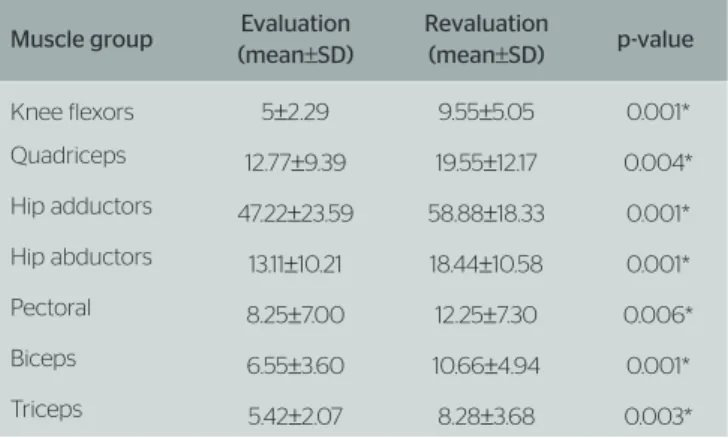
Table 2 shows the results of the 1 RM test from the initial evaluation and from the inal revaluation. It is possible to observe that there was a signiicant increase in strength for all muscle groups exercised.
After the muscle strengthening program, subjects showed improvement in balance (p=0.008) and QoL (p=0.013). Functional mobility was not afected by the proposed training (p=0.19).
he correlation analysis showed a signiicant correla-tion between balance and QoL (evaluacorrela-tion: r=−0.65 and p=0.05, revaluation: r=−0.82 and p=0.005). he other variables showed no signiicant correlation.
DISCUSSION
In our study, we observed a deicit in balance in the ini-tial evaluation (BBS=45.77±5.2), which indicates that the participants presented an elevated 6–8% chance of falling21. With muscle strength training, there was a
signiicant improvement in the balance of individuals (BBS=48.44±4.1, p=0.008).
Studies show that there is a positive correlation between changes in balance and decreased muscle strength26-28.
According to Shepherd29,the muscle strengthening
exer-cises work on increasing the recruitment of motor units, improving the body balance, ability and timing to gen-erate force, reducing muscle stifness and relex hyper-activity, and preserving functional muscle extensibility. Rodrigues-de-Paula et al.16 reported that gaining muscle
strength through an adequate training program is efec-tive in conditioning and maintaining balance, preventing falls that are, when aggravated by balance disorders, com-mon in these individuals.
In the TUG test, the results obtained in the evalu-ation (19.81±4.4 s) are considered normal for the frail
elderly and the disabled who tend to be independent for most daily activities23. With the increase in
mus-cle strength, the test showed no signiicant diference (17.88±7.4 s, p=0.19). his could be due to the fact that one of the main features of PD is the slowness of movements11, and the proposed training program
emphasized just muscle strengthening, and not move-ment speed. In the study conducted by Morris et al.30,
the primary deicit related to the slowness of gait in PD was a disorder in the regulation of step length as the regulation was in preserved cadence (number of steps per minute).
Regarding QoL, significant improvement was ob-served after the proposed training (p=0.008). Stud-ies by Reuter et al.31 and Baatile et al.32
showed sig-nificant improvements in QoL for PD patients with mild to moderate severity after undergoing physical activity programs. Reuter et al.31 conducted an
exer-cise program twice a week for 14 weeks, aiming at muscle strengthening, in addition to decreased stiff-ness of the torso and the improvement of movement initiation, and observed significant differences after
Table 2. Values of muscular fitness in the one-repetition maximum test (in kg)
Muscle group Evaluation (mean±SD)
Revaluation
(mean±SD) p-value
Knee flexors 5±2.29 9.55±5.05 0.001*
Quadriceps 12.77±9.39 19.55±12.17 0.004*
Hip adductors 47.22±23.59 58.88±18.33 0.001*
Hip abductors 13.11±10.21 18.44±10.58 0.001*
Pectoral 8.25±7.00 12.25±7.30 0.006*
Biceps 6.55±3.60 10.66±4.94 0.001*
Triceps 5.42±2.07 8.28±3.68 0.003*
SD: standard deviation; *Student’s t-test: p≤0.005
Table 1. Values obtained in the Berg, Time Up and Go, and Parkinson’s Disease Questionnaire-39 tests in the initial evaluation and in revaluation
Evaluation (mean±SD)
Revaluation
(mean±SD) p-value
BBS (points) 45.77±5.2 48.44±4.1* 0.01*
TUG (seconds) 19.81±4.4 17.88±7.4 0.19
PDQ-39 51.15±19.6 32.98±15.7* 0.008*
the training period. The results were followed-up for up to six weeks after the end of the program.
In our study, we analyzed the correlation between the scores obtained in the PDQ-39 and the result of the BBS, in both the evaluation and the revaluation. An inversely proportional correlation was observed in the tests, suggesting that the lower the score on the PDQ-39, which indicates a better QoL, the higher the score in BBS, which indicates a better balance. hus, we can infer that the better the balance, the better the QoL (evaluation: r=−0.65 and p=0.05, revaluation r=−0.82 and p=0.005).
According to Mak and Pang33, the
consequenc-es caused by the incidence of falls, which reachconsequenc-es 68% in these patients, due to the deicit in their balance, increase the risk of immobility, social isolation, and depression, and thus decrease their QoL. Another importance of preventing falls is the fact that femur fracture is one of the main results of these falls, con-tributing to a greater restriction of activity and loss of independence in daily activities34.
he proposed training program is eicient as it was capable of increasing strength in all muscle groups trained. It is of utmost importance to maintain and/or increase muscle strength in individuals with PD since, according to Scandalis, Bosak e Beliner15,decreased
muscle strength occurs efectively in PD patients. he weakness resulting from the disease leads individuals to feel insecure in carrying out daily activities, limit-ing them to the strictly necessary activities, generat-ing greater muscle atrophy and consequent decrease in strength.
Despite the important findings, this study pres-ents limitations, such as the small number of sub-jects and the lack of a control group. Moreover, we suggest new studies that will conduct evaluations after a period of detraining as it would provide in-formation with regard to the maintenance time and the benefits of muscle strengthening after the end of the program. Still, it would be relevant to exam-ine the subjects’ history of falls before and after the treatment since individuals with PD have an in-creased risk of falls.
he results of this study showed that the phys-ical activity program based on a muscle strength-ening program was efective in improving muscle strength, balance, and QoL in individuals with PD. he score on the QoL scale had an inversely propor-tional correlation to the result obtained in the BBS, showing that the better the balance, the better the QoL of these individuals.
REFERENCES
1. Lang A, Lozano AM. Parkinson’s disease: first of two parts. N Engl J Med. 1998;339(15):1044-53.
2. Lim I, Van Wegen E, De Goede C, Deutekom M, Nieuwboer A, Willems A, et al. Efects of external rhythmical cueing on gait in patients with Parkinson’s disease: a systematic review. Clin Rehabil. 2005;19(7):695-713.
3. Calne D. A definition of Parkinson’s disease. Parkinsonism Relat Disord. 2005;11(Suppl 1):S39-40.
4. Morris ME. Movement disorders in people with Parkinson disease: a model for physical therapy. Phys Ther. 2000;80(6):578-97.
5. Christofoletti G, Freitas RT, Cândido ER, Cardoso CS. Eficácia de tratamento fisioterapêutico no equilíbrio estático e dinâmico de pacientes com doença de Parkinson. Fisioter Pesq. 2010;17(3):259-63.
6. Souza RG, Borges V, Silva SM, Ferraz HB. Quality of life scale in Parkinson’s disease PDQ-39 - (Brazilian Portuguese version) to assess patients with and without levodopa motor fluctuation. Arq Neuropsiquiatr. 2007;65(3B):787-91.
7. Nocera JR, Buckley T, Waddell D, Okun MS, Hass CJ. Knee extensor strength, dynamic stability, and functional ambulation: are they related in Parkinson’s disease? Arch Phys Med Rehabil. 2010;91(4):589-95.
8. Schestatsky P, Zanatto VC, Margis R, Chachamovich E. Quality of life in a Brazilian sample of patients with Parkinson’s disease and their caregivers. Rev Bras Psiquiatr. 2006;28(3):209-11.
9. Haase DCBV, Machado DC, Oliveira JGD. Atuação da fisioterapia no paciente com doença de Parkinson. Rev Fisioter Mov. 2008;21(1):79-85.
10. Cuerda RCL. Transtornos de la postura y de la marcha e incidência de caídas en pacientes com enfermedad de Parkinson. Rev Neurol. 2004;38(12):1128-32.
11. Pereira DDC, Siqueira SA, Alvisi TC, Vasconcelos LAD. Group physical therapy program for patients with Parkinson disease: alternative rehabilitation. Rev Fisioter Mov. 2009;22(2):229-37.
12. Brichetto G, Pelosin E, Marchese R, Abbruzzese G. Evaluation of physical therapy in parkinsonian patients with freezing of gait: a pilot study. Clin Rehabil. 2006;20(1):31-5.
13. Kuh D, Bassey J, Butterworth S, Hardy R, Wadsworth ME, Team TM. Grip strength, postural control, and functional leg power in a representative cohort of British men and women: associations with physical activity, health status, and socioeconomic conditions. J Gerontol A Biol Sci Med Sci. 2005;60(2):224-31.
14. Kligyte I, Lundy-Ekman L, Medeiros JM. Relationship between lower extremity muscle strength and dynamic balance in people post-stroke. Medicina. 2003;39(2):122-8.
15. Scandalis TA, Bosak A, Berliner JC. Resistance training and gait function in patients with Parkinson’s disease. Am J Phys Med Rehabil. 2001;1(80):38-43.
16. Rodrigues-de-Paula F, Lima LO, Teixeira-Salmela LF, Cardoso F. Exercício aeróbio e fortalecimento muscular melhoram o desempenho funcional na doença de Parkinson. Fisioter. Mov. 2011;24(3):379-88.
18. Rodrigues PGF, Barbosa CM, Silva CM, Teixeira-Salmela L, Cardoso F. O impacto de um programa de atividade física na qualidade de vida de pacientes com doença de Parkinson. Rev Bras Fisioter. 2005;9(1):49-55.
19. Berg KO, Wood-Dauphinée SL, Williams JI, Maki B. Measuring balance in the elderly: validation of an instrument. Can J Public Health. 1992;83(Suppl 2):S7-11.
20. Myiamoto ST, Lombardi JI, Berg KO, Ramos IR, Natour J Braziliam version of the Berg Balance Scale. Braz J Med Biol Res. 2004;37(8):1411-21.
21. Shumway-Cook A, Woollacott. Controle motor: teoria e aplicações práticas (2a ed.). São Paulo: Manole; 2003.
22. Christofoletti G, Oliani MM, Gobbi LTB, Gobbi S, Estella F. Risk of falls among elderly people with Parkinson’s disease and Alzheimer’s dementia: a cross-sectional study. Rev. Bras. Fisioter. 2006;10(4):429-33.
23. Perracini MR, Gazzola J, Okuma L, Medeiros prs. Levantar e Caminhar Cronometrado (Timed Up and Go). [Cited 2009 Sep 4]. Available from: http://pequi.incubadora.fapesp.br/portal/testes/TimedUpAndGo.
24. Marinus J, Ramaker C, Van Hilten JJ, Stigg elb, out AM. Health related quality of life in Parkinson´s disease: a systematic review of disease specific instruments. J Neurol Neurosurg Psychiatry. 2001;72(2):241-8.
25. Schrag A, Jahanshahi M, Quinn N. What contributes to quality of life in patients with Parkinson’s disease? J Neurol Neurosurg Psychiatry. 2000;69(3):308-12.
26. Au-Yeung SS, Ng JT, Lo SK. Does balance or motor impairment of limbs discriminate of ambulatory status of stroke survivors? Am J Phys Med Rehabil. 2003;82(4):279-83.
27. Tyson SF, Hanley M, Chillala J, Selley A, Tallis RC. Balance disability after stroke. Phys Ther. 2006;86(1):30-8.
28. Belgen B, Bebinato M, Sullivan PE, Narielwalla K. The association of balance capacity and fall self eficacy with history of falling in community dwelling people with chronic stroke. Arch Phys Med Rehabil. 2006;87(4):554-61.
29. Shepherd RB. Exercise and training to optimize functional motor performance in stroke: driving neural reorganization? Neural Plast. 2001;8(1-2):121-9.
30. Morris ME, Iansek R, Matyas TA, Summers JJ. Ability to modulate walking cadence remains intact in Parkinson’s disease. J Neurol Neurosurg Psychiatry. 1994;57(12):1532-4.
31. Reuter L, Engelhardt M, Stecker K, Baas H. Therapeutic value of exercise training in Parkinson’s disease. Med Sci Sports Exerc. 1999;31(11):1544-9.
32. Baatile J, Langbein WE, Weaver F, Maloney C, Jost MB. Efect of exercise on perceived quality of life of individuals with Parkinson’s disease. J Rehabil Res Dev. 2000;37(5):529-34.
33. Mak MK, Pang MY. Balance confidence and functional mobility are independently associated with falls in people with Parkinson’s disease. J Neurol. 2009:256(5);742-9.