of schizophrenia: a systematic review
Realidade virtual na avaliação e no tratamento da
esquizofrenia: uma revisão sistemática
Mônica Macedo
1,2, António Marques
3, Cristina Queirós
1ABSTRACT
Objective: To conduct a systematic review about the use of virtual reality (VR) for evalua-tion, treatment and/or rehabilitation of patients with schizophrenia, focused on: areas, ields and objectives; methodological issues; features of the VR used; viability and eiciency of this
resource. Methods: Searches were performed about schizophrenia and virtual reality in
Psy-cINFO, Academic Search Complete, MEDLINE Complete, CINAHL with Full Text, Web of Scien-ce and Business SourScien-ce Premier databases, using the following keywords: [“schizophrenia”] AND [“virtual reality” OR “serious game”] AND [“treatment” OR “therapy” OR “rehabilitation”]. The search was carried out between November 2013 and June 2014 without using any search
limiters. Results: A total of 101 papers were identiied, and after the application of exclusion
criteria, 33 papers remained. The studies analysed focused on the use of VR for the evaluation of cognitive, social, perceptual and sensory skills, and the vast majority were experimental studies, with virtual reality speciically created for them. All the reviewed papers point to-wards a reliable and safe use of VR for evaluating and treating cognitive and social deicits in patients with schizophrenia, with diferent results in terms of generalisation, motivation, as-sertiveness and task participation rate. Some problems were highlighted, such as its high cost
and a constant need for software maintenance. Conclusion: The studies show that using
the virtual reality may streamline traditional evaluation/rehabilitation programmes, allowing to enhance the results achieved, both in the cognitive and in the social ield, helping for the legitimisation of this population’s psycho-social inclusion.
RESUMO
Objetivo: Realizar uma revisão sistemática sobre a utilização da realidade virtual (RV) na avaliação, tratamento e/ou reabilitação de pessoas com esquizofrenia, enfocando: as áreas, domínios e objetivos; as questões metodológicas; as características da RV utilizada; a
viabili-dade e eicácia desse recurso. Métodos: Foram realizadas buscas por artigos sobre
esquizo-frenia e realidade virtual nas bases de dados PsycINFO, Academic Search Complete, MEDLINE Complete, CINAHL with Full Text, Web of Science e Business Source Premier, utilizando as palavras-chave: [“schizophrenia”] AND [“virtual reality” OR “serious game”] AND [“treatment” OR “therapy” OR “rehabilitation”]. A busca foi realizada entre novembro de 2013 e junho de
1 University of Porto, Faculty of Psychology and Educational Sciences, Psychosocial Rehabilitation Laboratory, Portugal. 2 Federal University of Paraná (UFPR), Department of Occupational Therapy, Brazil.
3 Polytechnic Institute of Porto, School of Allied Health Sciences, Psychosocial Rehabilitation Laboratory, Portugal.
Correspondence address to: António Marques E-mail: [email protected]
Received in 9/18/2014 Approved in
12/8/2014
Keywords
Schizophrenia, virtual reali-ty, evaluation, rehabilitation, review.
2014, sem a utilização de limitadores de pesquisa. Resultados: Foram identiicadas 101 pu-blicações e, depois de aplicados critérios de exclusão, permaneceram 33 artigos. Os estudos analisados concentram-se no uso da RV para a avaliação de habilidades cognitivas, sociais e perceptossensoriais, sendo na ampla maioria estudos experimentais, com ambientes virtu-ais criados especiicamente para os estudos. Todos os artigos revisados apontam para o uso iável e seguro da RV na avaliação e tratamento de pessoas com esquizofrenia, com resulta-dos diferenciaresulta-dos relativamente a generalização, motivação, assertividade e taxa de parti-cipação na realização de tarefas. Foram assinaladas diiculdades como alto custo e
necessi-dade constante de manutenção de software. Conclusão: Ficou evidenciado que o recurso
do ambiente virtual pode potencializar os programas de avaliação/reabilitação tradicionais, permitindo ampliar as dimensões dos resultados obtidos, tanto no âmbito cognitivo quanto no social, iluminando o caminho da legitimação da reinserção psicossocial dessa população.
Palavras-chave
Esquizofrenia, realidade virtual, avaliação, reabilitação, revisão.
INTRODUCTION
Sixty years ago, the only treatment alternative for patients with schizophrenia was coninement in mental hospitals, where most of them would remain for the rest of their lives. In 1952, the experimental use of chlorpromazine in psychia-tric patients had excellent results in the remission of the psychotic symptoms of those patients, leading to the intro-duction of pharmacology applied to schizophrenia. Curren-tly, second-generation or atypical anti-psychotic drugs are available which, apart from acting on the positive efects of schizophrenia, also have positive results in decreasing the negative symptoms of this pathology. This result had a
di-rect impact on the optimisation of other interventions (e.g.
psycho-social, cognitive), as well as on the reduction of the number of hospitalisations. However, for the inclusion and maintenance of this population in society, there was a need to improve the treatment techniques in order to solve some of the remaining negative symptoms (avolia, apathy, social isolation, disorganisation) which hinder the integration of patients with schizophrenia into the diferent occupational
performance contexts (e.g. family, study, work)1-4. Therefore,
in addition to symptom control, the treatment of schizophre-nia started focusing on the improvement of this population’s social participation through competent performance in daily activities.
Studies point out that the low occupational and social performance of these people is related to deicits in their
cognitive (e.g. executive functions) and social skills (e.g.
emo-tional recognition)5,6. Currently, cognitive impairment has
been pointed out as a core characteristic of schizophrenia, which may be related to poor social relationships and to the inability to manage an independent life. Treatment and rehabilitation programmes for these skills have been develo-ped, preferably through tasks in a lab environment, focusing on attaining some improvement in terms of psycho-social functioning and mood, and, to a larger extend, on the
op-timisation of psychiatric treatment7,8. Meanwhile, the
thera-peutic approach to schizophrenia has evolved in terms of
the shape and contents of evaluation, treatment and reha-bilitation programmes, as new techniques and technologies emerge. With the advent of information technology, softwa-re programs have been csoftwa-reated and adapted to the evalua-tion and treatment of these people’s symptoms and skills. Recently, studies reported the inclusion of virtual reality (VR) in programmes using for evaluating and training cognitive
and social skills with promising results9-13.
VR is a computer technology which enables immer-sion in complex environments that refer to reality through devices that transmit diferent types of stimuli, which are
perceived by one or more senses of the user14. VR has three
basic features: sense of presence, immersion and interaction. The sense of presence is the feeling of being present, as be a part of the virtual environment. Integrating the sense of presence, the immersion is the existence of sensory context, meaning that reality is experienced also by the sensory
sys-tem (e.g. vision and hearing), creating the illusion of being
in another place. VR can be classiied as immersive or non-immersive due the sense of presence that provides. Multi-sensory devices like head-mounted display (HMD), trackers or electronic gloves are needed to capture the movements and behaviours to transport the user to the application do-main, in an immersive experience. When shipping to the
vir-tual world is in part provided through a window (e.g. a
moni-tor), set up a non-immersive experience. This set generates the third central aspect of the RV, the interaction. It is related to the computer’s ability to detect user actions and react in real time, responding to commands given by the user and altering the landscape. The creative possibilities are limitless, similar to the real world or merely synthetics, the virtual en-vironments provide situations that are handled and safe for
achieving results often impossible in a real context14,15.
Since the irst description of the use of VR applied to
psychiatric disorders (acrophobia)16, the results of the use of
this resource have proven favourable and eicient for the treatment of the symptoms of some pathologies, such as
an-xiety disorders17,18, eating disorders19,20 and attention deicit
hi-ghlight the eicacy of this resource, showing positive results
in the evaluation and training of cognitive and social skills22-29.
Recently, two literature review studies were published30,31
regarding research performed using VR for evaluating and treating patients with schizophrenia, and the results point towards the use of VR in schizophrenia in three areas of in-tervention: cognitive, social, and perception/sensory deicits. They also reported the use of VR for creating symptom
mo-dels (e.g. paranoia) with the aim of understanding the
me-chanisms of such manifestations in schizophrenia and also of contributing to creating safer and more eicient virtual realities speciically for this population. As a limitation of this
resource, La Barbera et al.31 point out the high cost of the
technology and suggest that this barrier will be overcome as the price of materials and products for the use of VR tends to decrease with the growth of the information technology (IT) market.
When faced with a promising tool for the treatment of schizophrenia deicits, there is a need to summarise the know ledge obtained on the viability and reliability of the use of VR for the treatment of this population. This paper pre-sents a systematic review on the use of VR for evaluating, treating and/or rehabilitating patients with schizophrenia, analysing: (1) areas, ields and objectives; (2) methodological issues; (3) characteristics of the VR used; (4) viability and ei-ciency of this tool.
METHODS
This study follows the guidelines of the Preferred Reporting
Items for Systematic Reviews and Meta-analyses (PRISMA)32.
Inclusion criteria
The inclusion criteria were the following: (1) the use of virtual reality for evaluating or treating schizophrenia symptoms, (2) with adult participants, (3) diagnosed with schizophrenia or schizoafective disorder, (4) published in English.
Search method
The search was conducted on the papers indexed in the PsycINFO, Academic Search Complete, MEDLINE Complete, CINAHL with Full Text, Web of Science and Business Sour-ce Premier databases, using the following key words: [“schi-zophrenia”] AND [“virtual reality” OR “serious game”] AND [“treatment” OR “therapy” OR “rehabilitation”]. The search was carried out between November 2013 and June 2014, without using any search limiters. The references to each se-lected paper were checked for additional studies that could have been overlooked during the database search.
The eligibility of the studies was analysed independently by two reviewers and, whenever there was lack of consen-sus, a third author was consulted.
Data extraction
A table was created in order to extract the data, and a pilot test was conducted with 10 randomly selected studies, for stablish common criteria among reviewers. One author extracted the data included in the form: nature of the study; area, ields, ob-jectives and focus; country of origin; demographic data, sam-ple size, control group and evaluation tools; VR characteristics; evidence of VR viability and eiciency. The second author veriied the extracted data. Potential discrepancies were dis-cussed among the authors, who reviewed the papers toge-ther, and whenever consensus could not be reached, a third reviewer was consulted to analyse and clarify the issue.
RESULTS
Database search
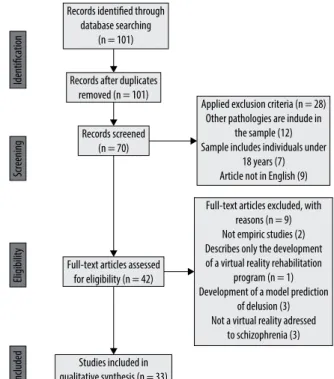
A total of 101 papers were identiied and, after excluding duplicate studies, 70 potentially relevant papers remained. Upon analysing the abstracts, 28 did not meet the inclusion criteria. After reading the 42 selected papers in full, nine
stu-dies were excluded, as shown in igure 1. One study33, which
used a sample of patients with early psychosis (50% diagno-sed with schizophrenia and 50% with non-speciic psychosis) was included by the reviewers since it covered important as-pects related to the acceptability and safety of the use of VR. In total, 33 papers were analysed in this systematic review.
Records identified through database searching
(n = 101)
Records after duplicates removed (n = 101)
Identification
Screening
Eligibility
Included
Records screened (n = 70)
Full-text articles assessed for eligibility (n = 42)
Studies included in qualitative synthesis (n = 33)
Applied exclusion criteria (n = 28) Other pathologies are indude in
the sample (12) Sample includes individuals under
18 years (7) Article not in English (9)
Full-text articles excluded, with reasons (n = 9) Not empiric studies (2) Describes only the development of a virtual reality rehabilitation
program (n = 1) Development of a model prediction
of delusion (3) Not a virtual reality adressed
to schizophrenia (3)
16 14 12 10 8 6 4 2 0
Number of publications
Brazil Canada China France
Germany Israel Korea Spain United Kingdom
USA
Country
7
6
5
4
3
2
1
0
2003 2004 2005 2006 2007 2008 2009 2010 2011 2012 2013 2014 (June)
Number of publications
Figure 2. Publications by country.
Figure 3. Number of publications by year.
Country of origin and number of papers per year Regarding the country of origin, from the 33 studies analy-sed, 19 came from Asia, eight from Europe, ive from North America and one from South America (Figure 2). The tempo-ral distribution of papers is summarised in igure 3, where it can be seen that the irst reported study dates back to 2003.
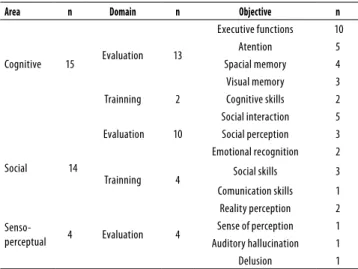
Areas, ields and objectives
The studies reveal three areas (Table 1): cognitive, social, and perceptual/sensory areas, classiied into two main ields, na-mely evaluation of skills and symptoms (n = 27) and skill trai-ning (n = 6).
Table 1. Summary of areas, domains and objectives of selected studies
Area n Domain n Objective n
Cognitive 15 Evaluation 13
Executive functions 10
Atention 5
Spacial memory 4
Visual memory 3
Trainning 2 Cognitive skills 2
Social
14
Evaluation 10
Social interaction 5
Social perception 3
Emotional recognition 2
Trainning 4 Social skills 3
Comunication skills 1
Senso-perceptual 4 Evaluation 4
Reality perception 2
Sense of perception 1
Auditory hallucination 1
Delusion 1
Characteristics of the sample and procedures
Participants were recruited at psychiatric units (outpatient and inpatient units), and the average number of participants in the experiments is 22 (SD = 10). A total of 24 studies inclu-ded a control group, usually using a paired group with cor-responding genders and ages. Considering all the studies, the age of the participants ranged from 28 to 66 years, which resulted in an average age of 31.5 years.
Regarding procedures, 26 were experimental studies and two were randomised controlled trials (RCT).
Evaluations and measurements
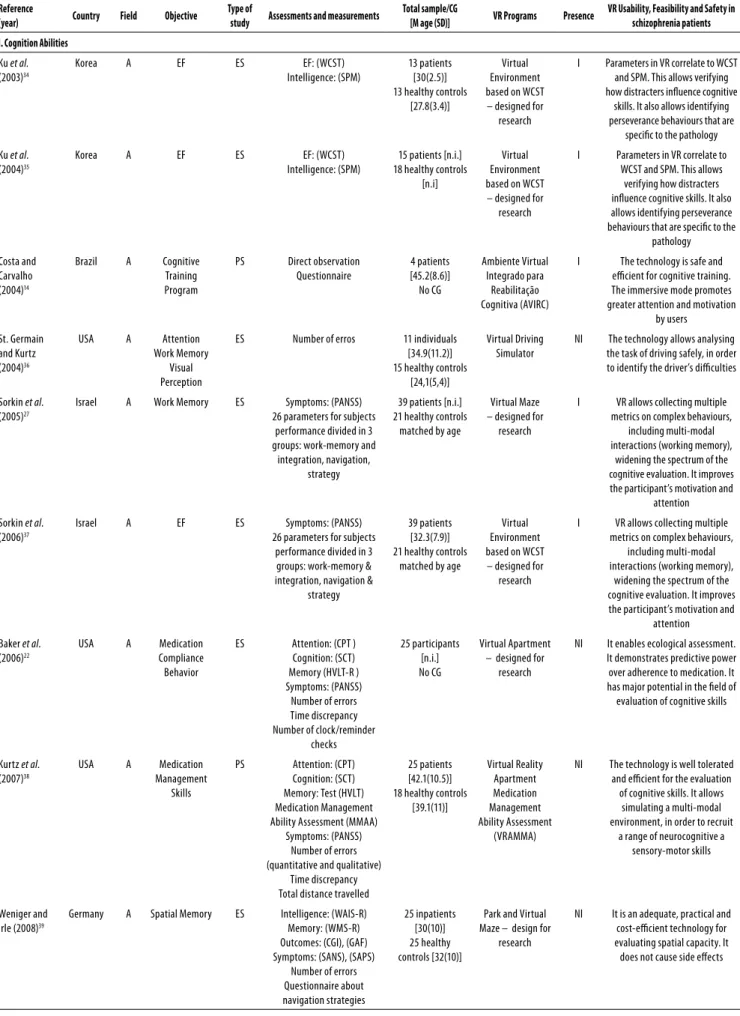
Positive and negative symptoms of schizophrenia were eva-luated in 29 studies, and in 23 studies, these were evaeva-luated with The Positive and Negative Syndrome Scale (PANSS), as listed in table 2. The feeling of presence was veriied in ive papers, using the Presence Questionnaire, and side efects related to the use of VR were evaluated in three studies using the Simulator Sickness Questionnaire (SSQ).
Characteristics of the virtual reality used
Most studies (62%) used virtual realities speciically designed for the experiments. The remaining studies resorted to com-mercially available programs or programs developed origi-nally for other studies. Regarding the feeling of presence, 55% of the studies used a non-immersive interface.
VR viability and eiciency
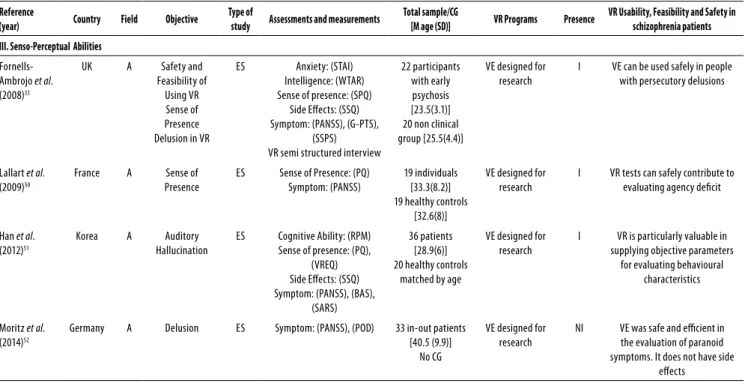
The conclusions of all (100%) studies indicate that VR is a useful tool to evaluate and treat patients with schizophre-nia, as shown in table 2. The results from the evaluations of cognitive, social, and perceptual and sensory skills suppor-ted by VR show signiicant correlations with the results
ob-tained from evaluations with classic tools (e.g. WCST, SBS). In
the six studies that used VR for training cognitive and social skills, there was an improvement in results and performance,
when compared to training with classic programs (e.g. CRTT,
RBANS, SSKT). Out of these six studies, four measured, from a subjective perspective, the usability of VR in the training program (Table 3).
Table 2. Results by area: I. Cognition; II. Social; III. Senso-perceptual abilities
Reference
(year) Country Field Objective
Type of
study Assessments and measurements
Total sample/CG
[M age (SD)] VR Programs Presence
VR Usability, Feasibility and Safety in schizophrenia patients I. Cognition Abilities
Ku et al.
(2003)34
Korea A EF ES EF: (WCST)
Intelligence: (SPM)
13 patients [30(2.5)] 13 healthy controls
[27.8(3.4)]
Virtual Environment based on WCST – designed for
research
I Parameters in VR correlate to WCST
and SPM. This allows verifying how distracters inluence cognitive
skills. It also allows identifying perseverance behaviours that are
speciic to the pathology
Ku et al.
(2004)35
Korea A EF ES EF: (WCST)
Intelligence: (SPM)
15 patients [n.i.] 18 healthy controls
[n.i]
Virtual Environment based on WCST – designed for
research
I Parameters in VR correlate to
WCST and SPM. This allows verifying how distracters inluence cognitive skills. It also allows identifying perseverance behaviours that are speciic to the
pathology
Costa and Carvalho (2004)14
Brazil A Cognitive
Training Program
PS Direct observation
Questionnaire 4 patients [45.2(8.6)] No CG Ambiente Virtual Integrado para Reabilitação Cognitiva (AVIRC)
I The technology is safe and
eicient for cognitive training. The immersive mode promotes greater attention and motivation
by users
St. Germain and Kurtz (2004)36
USA A Attention
Work Memory Visual Perception
ES Number of erros 11 individuals
[34.9(11.2)] 15 healthy controls
[24,1(5,4)]
Virtual Driving Simulator
NI The technology allows analysing
the task of driving safely, in order to identify the driver’s diiculties
Sorkin et al. (2005)27
Israel A Work Memory ES Symptoms: (PANSS)
26 parameters for subjects performance divided in 3 groups: work-memory and
integration, navigation, strategy
39 patients [n.i.] 21 healthy controls
matched by age
Virtual Maze – designed for
research
I VR allows collecting multiple
metrics on complex behaviours, including multi-modal interactions (working memory),
widening the spectrum of the cognitive evaluation. It improves the participant’s motivation and
attention
Sorkin et al. (2006)37
Israel A EF ES Symptoms: (PANSS)
26 parameters for subjects performance divided in 3
groups: work-memory & integration, navigation &
strategy
39 patients [32.3(7.9)] 21 healthy controls
matched by age
Virtual Environment based on WCST – designed for
research
I VR allows collecting multiple
metrics on complex behaviours, including multi-modal interactions (working memory),
widening the spectrum of the cognitive evaluation. It improves the participant’s motivation and
attention
Baker et al. (2006)22
USA A Medication
Compliance Behavior
ES Attention: (CPT )
Cognition: (SCT) Memory (HVLT-R ) Symptoms: (PANSS)
Number of errors Time discrepancy Number of clock/reminder
checks
25 participants [n.i.] No CG
Virtual Apartment – designed for
research
NI It enables ecological assessment.
It demonstrates predictive power over adherence to medication. It has major potential in the ield of evaluation of cognitive skills
Kurtz et al. (2007)38
USA A Medication
Management Skills
PS Attention: (CPT)
Cognition: (SCT) Memory: Test (HVLT) Medication Management Ability Assessment (MMAA)
Symptoms: (PANSS) Number of errors (quantitative and qualitative)
Time discrepancy Total distance travelled
25 patients [42.1(10.5)] 18 healthy controls
[39.1(11)] Virtual Reality Apartment Medication Management Ability Assessment (VRAMMA)
NI The technology is well tolerated
and eicient for the evaluation of cognitive skills. It allows
simulating a multi-modal environment, in order to recruit
a range of neurocognitive a sensory-motor skills
Weniger and Irle (2008)39
Germany A Spatial Memory ES Intelligence: (WAIS-R)
Memory: (WMS-R) Outcomes: (CGI), (GAF) Symptoms: (SANS), (SAPS)
Number of errors Questionnaire about navigation strategies 25 inpatients [30(10)] 25 healthy controls [32(10)]
Park and Virtual Maze – design for
research
NI It is an adequate, practical and
Reference
(year) Country Field Objective
Type of
study Assessments and measurements
Total sample/CG
[M age (SD)] VR Programs Presence
VR Usability, Feasibility and Safety in schizophrenia patients
Josman et al. (2009)40
Israel A EF ES EF: (BADS)
Symptoms: (PANSS)
30 individuals [46.7(10.5)] 30 healthy controls
[47.7(12.4)]
Virtual Action Plan-Supermarket
(VAP-S)
NI It is an ecologically valid
technology for EF evaluation tools. It enables the inclusion of independence and participation measurements, according to WHO
recommendations
Chan et al. (2009)23
China T Attention
Memory Orientation
ES Cognition: (Cognistat)
Side efects: (SSQ) Volition: (VQ) 12 individuals [66.4(6.2)] 15 individuals schizophrenia disorder [65.8(5.5)] VR Program adapted from IREX® - Interactive
Rehabilitation Exercise System
NI It is eicient in cognitive
functioning and volition training. It does not cause side efects
Han et al.
(2012)41
Korea A EF
– Cognitive lexibility
ES Intelligence: (K-WAIS)
Sense of Presence: (ITQ), (PQ), (VRQ) Social Problem Solving: (SPSI)
Symptoms: (PANSS)
30 patients [30(4.9)] 30 healthy controls
[29.5(4.9)]
Virtual Environment designed for research
NI It allows for safe evaluation,
through stimuli, in environments similar to reality, with the advantage of not being limited
time or space
Spieker et al. (2012)10
USA A Spatial Learning
Spatial Memory
ES Cognition: (RBANS)
Symptoms: (BPRS), (SANS)
33 outpatients [40 (11.9)] 39 healthy controls
[40.5(11.4)]
Radial Arm Maze (RAM) adapted
for a virtual environment
NI The VR paradigm can provide
information on the efects of cognitive training on the improvement of the pre-frontal
cortex and hippocampus functions
Tsang and Man (2013)26
China T Attention
Memory EF
RCT Attention: (DVT)
Cognition: (BNCE), (VCRS) EF: (WCST) Memory: (RBMT) Self-designed checklist -
sales performance Self-eicacy performance scale 25 inpatients [39.6(7.9)] 50 inpatients TAG (n=25) [40.7(9.1)]; CG (n=25) [41.56(9.9)] Virtual Reality-Based Vocational Training System (VRVTS)
NI It enables the restoration of
cognitive skills and enhances vocational training. The technology requires constant technical support and side efect
monitoring
Zawadzki et al. (2013)42
Canada A Spatial Learning
Spatial Memory
ES Cognition: (RBANS)
Intelligence: (K-WAIS) Quality of life: (QLS)
Symptoms: (SAPS)
33 outpatients [40 (10.9)] 39 healthy controls
[43 (11.3)]
Virtual Environment designed for research
NI The results obtained at VR
environment are correlated with classical assessments
(e.g. Repeatable Battery
for the Assessment of Neuropsychological Status). The using of naturalistic virtual
environment is supported as a measure of cognitive functioning
II. Social Abilities
Kim et al.
(2005)43
Korea A Social
Perception
ES Intelligence: (K-WAIS)
Sense of Presence: (ITQ), (PQ), (VRQ) Symptoms: (PANSS) Verbal/non-verbal social cue
Happy/sad/angry situation Emotional recognition Interpretation of relevant cue
17 inpatients [30.4(5.3)] 17 healthy controls
[30.05(6)]
Virtual Reality Behavior & Facial Data Base
(VRBFDB)
NI The application of the evaluation
in virtual mode is faster and easier, and it also allows to quickly change facial parameters, thereby creating variability in the
interactions proposed
Jang (2005)44 Korea A Social
Interaction Social Anxiety
ES Anxiety: (SAQ) 15 inpatients
[28.6(7)] 15 healthy controls
[25.1(1.5)]
Virtual environment designed for research
I VR technology (ecological model)
is a safe option for experimenting emotions in induced social situations and can be used for coping training in a safe
environment
Ku et al.
(2005)45
Korea A Social
Interaction
ES Symptoms: (PANSS)
Interpersonal distance Verbal response time
11 inpatients [29.5(8.9)] No CG Virtual environment designed for research
NI The technology allows social
interaction responses that are similar to those of a real context
Ku et al.
(2006)46
Korea A Social
Interaction
PS Symptoms: (PANSS)
Interpersonal distance Verbal response time
11 inpatients [29.5(8.9)] No CG Virtual environment designed for research
NI The technology allows social
interaction responses that are similar to those of a real context
Reference
(year) Country Field Objective
Type of
study Assessments and measurements
Total sample/CG
[M age (SD)] VR Programs Presence
VR Usability, Feasibility and Safety in schizophrenia patients
Kim et al.
(2007)47
Korea A Social
Perception
ES Intelligence: (K-WAIS)
Sense of Presence: (ITQ), (PQ), (VRQ) Symptoms: (PANSS) Verbal/non-verbal social cue
Happy/sad/angry situation Emotional recognition Interpretation of relevant cue
30 inpatients [29.6(4.9)] 30 healthy controls
[29.5(5.3)]
Virtual environment designed for research
NI It is a potential tool for evaluating
social perception, problem solving ability and assertiveness
skills, as well as for training social skills
Ku et al.
(2007)28
Korea T Conversational
Skills
ES Symptoms: (PANSS)
Verbal response time Questionnaire about general
options, usability and presence 10 patients [28.8(9)] No CG Virtual environment designed for research
I It is an eicient technique for
conversation training. It provides objective clinical metrics. Its application can be limited by pathology-speciic conditions
(negative symptoms)
Park et al. (2009)11
Korea A Emotional
Perception Emotional Response
ES Anxiety: (STAI-Y)
Intelligence: (RPM) Symptoms: (PANAS), (PANSS),
(PSAS), (SAS)
27 individuals [28.5(5.7)] 27 healthy controls
[26.5(4.4)]
Virtual environment designed for research
I It is an eicient technique for
evaluating social cognition. The experience causes joy, interest
and emotional confrontation
Park et al. (2009)48
Korea A Social
Interaction – Spatial Behavior
ES Symptoms: (PANSS)
Distance from a virtual person Orientation head angle
30 individuals [28.7(5.5)] 30 healthy controls
[26.3(4.3)]
Virtual environment designed for research
I It is a safe alternative for
verifying interpersonal space
Park et al. (2009)49
Korea A Social
Interaction
PS Clinical: (BARS), (SARS)
Social Functioning: (SBS), (RCS) Symptoms: (PANAS) (PANSS)
18 female Aripiprazole group (n = 10)
[30.2(7.7)]; Risperidone group (n = 8) [29.3(6.8)] 15 healthy female
[28.1(8)]
Virtual Reality Functional Skills
Assessment (VRFSA)
I It is a valid tool to measure
functional skills
Dyck et al. (2010)6
Germany A Emotional
Recognition
ES Intelligence: (MWT-B)
Symptoms: (PANAS), (PANSS) Questionnaire of computer
game experience
20 patients [36.7(1.9)] 20 healthy controls
[36.9(2.2)]
Virtual faces I It allows controlling animation
and changing parameters in real time, which increases the number of observation/research options
Park et al. (2011)24
Korea T Social Skills RCT Symptoms: (PANSS)
Social Functioning: (AI),(SBS), (RAS), (RCS), (SPSI-R), (SST)
Questionnaire of VR experience
33 inpatients [28.1(7.7)] 31 inpatients with
schizophrenia disorder [31.2(7.7)]
VR role-playing (SST-VR)
I It can be applied to conversation
and assertiveness skill training; however, it is less efective for non-verbal skills. It allows enhancing motivation. Its usage is limited, due to the fact that it
is expensive
Gutiérrez-Maldonado et
al. (2012)29
Spain A Facial
Recognition
ES Attention: (CPT),
Symptom: (PANSS), (SCIP), (TAS-20)
30 outpatients [n.i.] No CG
Virtual faces NI It is a useful tool for evaluating
emotion recognition. Its dynamic nature improves accuracy in recognising facial expressions
Rus-Calafell
et al. (2012)25
Spain T Social Skills CS Anxiety: (SADS)
Social Functioning: (AI), (SFS) Symptom: (PANSS)
1 woman [30 year old]
No CG
SOSKITRAIN - VR NI It allows strengthening other
treatment approaches in an individualised manner and it presents a larger degree of generalisation of the gains
obtained
Rus-Calafell
et al. (2014)8
Spain T Social Skills PS Anxiety: (SADS)
Social Functioning: (AI), (SFS), (SSIT) Symptom: (PANSS)
12 participants [36.5(6)]
No CG
SOSKITRAIN - VR NI It enables treating patients who
refuse to participate in group therapy; it is an ecological tool; it allows practising skills in speciic social interactions; it allows for direct, real-time observation of
Table 3. VR Usability in training abilities (subjective perspective)
Study VR issue Assessment/Measuremnt Results
Mean (Standard Deviation) [Range]
Ku et al. (2007)28 Usefulness Questionnaire 6.3 (±1.6) [0-10]
Ku et al. (2007)28 Interest Questionnaire 7.3 (±2) [0-10]
Park et al. (2011)24 Interest Interest-in-Participation Questionnaire 81.5 (±10) [0-100]
Ku et al. (2007)28 Volition Questionnaire 7.5 (±2.7) [0-10]
Chan et al. (2009)23 Volition Volition Questionnaire 26.8 (±4.8) [15-56]
Russ-Callafel et al. (2014)8 Satisfaction Satisfaction Questionnaire 8.7 (±0.3) [0-10]
Russ-Callafel et al. (2014)8 Acceptance Satisfaction Questionnaire 9.2 (±0.7) [0-10]
Reference
(year) Country Field Objective
Type of
study Assessments and measurements
Total sample/CG
[M age (SD)] VR Programs Presence
VR Usability, Feasibility and Safety in schizophrenia patients III. Senso-Perceptual Abilities
Fornells-Ambrojo et al. (2008)33
UK A Safety and
Feasibility of Using VR Sense of Presence Delusion in VR
ES Anxiety: (STAI)
Intelligence: (WTAR) Sense of presence: (SPQ)
Side Efects: (SSQ) Symptom: (PANSS), (G-PTS),
(SSPS) VR semi structured interview
22 participants with early psychosis [23.5(3.1)] 20 non clinical group [25.5(4.4)]
VE designed for research
I VE can be used safely in people
with persecutory delusions
Lallart et al. (2009)50
France A Sense of
Presence
ES Sense of Presence: (PQ)
Symptom: (PANSS)
19 individuals [33.3(8.2)] 19 healthy controls
[32.6(8)]
VE designed for research
I VR tests can safely contribute to
evaluating agency deicit
Han et al.
(2012)51
Korea A Auditory
Hallucination
ES Cognitive Ability: (RPM)
Sense of presence: (PQ), (VREQ) Side Efects: (SSQ) Symptom: (PANSS), (BAS),
(SARS)
36 patients [28.9(6)] 20 healthy controls
matched by age
VE designed for research
I VR is particularly valuable in
supplying objective parameters for evaluating behavioural
characteristics
Moritz et al. (2014)52
Germany A Delusion ES Symptom: (PANSS), (POD) 33 in-out patients
[40.5 (9.9)] No CG
VE designed for research
NI VE was safe and eicient in
the evaluation of paranoid symptoms. It does not have side
efects
Note 1: ID: Identiication; A: Assessment; T: Training; CS: Case Study; ES: Experimental Study; PS: Pilot Study; RCT: Randomized Control Trial; I: Immersive; NI: No Immersive; CG: Control Group.
EF: Executive Functions; (AI): Assertion Inventory; (BARS): Barnes Akathisia Rating Scale; (BAS): Barnes Akathisia Scale; (BADS): Behavioral Assessment of Dysexecutive Syndrome; (BNCE): Brief Neuropsychological Cognitive Examination; (BPRS): Brief Psychiatric Rating Scale; (CGI): Clinical Global Impression Scale; (CPT): Continuous Performance Test; (DVT): Digit Vigilance Test; (GAF): Global Assessment of Functioning Scale; (G-PTS): Green et al. Paranoid Thoughts Scales; (HVLT-R): Hopkins verbal learning test; (ITQ): Immersive Tendency questionnaire; (K-WAIS): Coreia do Suln-Wechsler Adult Intelligence Scale; (MMAA): Medication Management Ability Assessment; (MWT-B): Mehrfachwahl Wortschatz Intelligenztest; (PSAS): Physical and Social Anhedonia Scale; (PANAS): Positive and Negative Afective Schedule; (PANSS): Positive and Negative Syndrome Scale; (PO): Paranoia, Obsessive-compulsive and Depression Questionnaire; (PQ): Presence Questionnaire; (QLS): Quality of Life Scale; (RAS): Rathus Assertiveness Schedule; (RCS): Relationship Change Scale; (RPM): Raven’s Progressive matrices; (RCS): Relationship Change Scale; (RBANS): Repeat Battery for the Assessment of Neuropsychological Status; (RBMT): Rivermead Behavioral Memory Test; (SANS): Scale for the Assessment of Negative Symptoms; (SAPS): Scale for the Assessment of Positive Symptoms; (SAS): Schizotypal Ambivalence Scale; (SCIP): Screen for Cognitive Impairment in Psychiatry; (SPQ): Sense of Presence Questionnaire; (SCT): Short Category Test; (SARS): Simpson Angus Rating Scale; (SSQ): Simulator Sickness Questionnaire; (SADS): Social Anxiety and Distress Scale; (SAQ): Social Anxiety Quest; (SBS): Social Behavior Scale; (SFS): Social Functioning Scale; (SPSI): Social Problem Solving Inventory; (SSIT): Simulated Social Interaction Test; (SST): Social Skill Training; (STAI): Spielberg State-Trait Inventory; (SPM): Standard Progressive Matrices; (SSPS): State Social Paranoia Scale; (STAI-Y): State-Trait Anxiety Inventory-Form Y; (TAS-20): Toronto Alexithymia Scale; (VAP-S): Virtual Action Plan-Supermarket; VE: Virtual Environment; (VREQ): Virtual Reality Experience Questionnaire; (VRFSA): Virtual Reality Functional Skills Assessment; (VRQ): Virtual Reality Questionnaire; (VCRS): Vocational Cognitive Rating Scale; (WAIS-R): Wechsler Adult Intelligence Scale-Revised; (WMS-R): Wechsler Memory Scale-Revised; (WCST): Wisconsin Card Sorting Test.
DISCUSSION
A variety of programs was found for evaluating and treating
schizophrenia symptoms (e.g. paranoia, cognitive and social
deicits) which used VR with diferent features and speciici-ties. There seems to be a consensus regarding the viability of applying this technology in patients with schizophrenia, and
that conirms Freeman’s53 prognosis, which highlighted this
resource as a new paradigm for the study and treatment of
schizophrenia. VR tends to overcome some of the limitations in terms of evaluation and treatment of cognitive and social skills, providing a natural environment which is very close to the real context. This seems to be the major diference of VR – the feeling of presence (immersion) – that allows sub-jects to perceive the environment as if it were real. However, it appears to allow a safer experience than in a real setting, namely regarding emotional issues, such as frustration when
using and monitoring the performance of complex tasks in a dynamic manner, enabling real-time changing of parame-ters by therapist. Assessments or programs based on virtual environments overcome the limitations of data obtained in laboratory settings, allowing real-time interventions in a si-mulated context, with strong ecological validity inasmuch as
they greatly resemble everyday functioning54,55. Those vir tual
environments features allow to reproduce the real-world
challenges in VR. In agreement with this, Emmelkamp et al.18
developed a study with 33 acrophobic participants (16
expo-sures in vivo and 17 with VR), aiming to evaluate the
efecti-veness of virtual reality (VR) exposure versus exposure in vivo,
using virtual environments exactly copied from the real
set-tings used in the exposure in vivo platform. The authors
con-cluded that the VR treatment was as efective as exposure in
vivo in combating anxiety and avoidance. Additionally, Tsang
and Man26 reported similar results in a randomized study
ai-ming to investigate the eicacy and efectiveness of VR as a cognitive intervention for enhancing vocational outcomes. Seventy ive schizophrenia patients [25 VR group (VRG), 25 therapist administered group (TAG) and 25 conventional group] participated in vocational training, where contents of VRG and TAG were the same, just difering in training mode. Participants of VRG and TAG showed a signiicant impro-vement in cognition, although VRG showed better perfor-mance in Wisconsin Card Sorting Test (WCST) than TAG. This comfortable and motivating scenario, in which patients may face challenges as if they were actually in the real context, thus feeling safe, can also explain the promising result gene-ralisation rates, revealing the potentialities of this promising ecological tool for the evaluating and rehabilitating of
pa-tients with schizophrenia11.
Twelve years have passed since the irst experiment with the use of VR in schizophrenia. Despite all the positive facts concerning the use of this technology in the evaluation and treatment of schizophrenia, there are a few number of publi-cations per year. It can be explained by the high cost and
com-plexity of the tool24,26, however, as mentioned by La Barbera
et al.31, this is a market in highly development, which tends to
substantiate the facilitation in the access to inputs and techno-logy, and, consequently, enable further researches in this area.
The irst researchers group that published studies about VR environments addressed to people with schizophrenia
is from Korea34. They have published the largest number of
studies to date, particularly related to social skills. Nonethe-less, is possible to notice an increasing interest from Spanish, Chinese and Canadian groups, to develop pilot studies and randomized trials using VR on training social and cognitive skills programs, contributing to the importance of this tool in the treatment of schizophrenia.
Regarding methodology, the analysis of the selected stu-dies revealed that most of them are experimental stustu-dies, with small samples, basically focused on the usability of VR
for the evaluation of symptoms and skills (cognitive, social, and perceptual and sensory) of patients with schizophrenia.
Studies35,42 that proposed adapting classic evaluation tasks
such as WCST and RBANS to the virtual platform obtained results which correlated positively with those obtained using the classic method. Meanwhile, the technology allowed going beyond the ields established in conventional evalu-ations, and the immersive environment seems to provide a multidimensional response to the tasks proposed, allowing to observe behaviours that are intrinsic to the pathology. The small number of controlled trials covering the eiciency of the VR programme in the training of cognitive and social skills made impossible to statistically compare the results ob-tained. It is expected that, in the near future, a larger number of randomised trials with more robust samples is conducted, because the results of the experimental studies so far advo-cate and encourage this new approach to treatment.
Regarding the virtual environments used in the studies under analysis, a wide diversity of scenarios, speciically de-signed for each study, was observed, which justiies an ex-perimental stage in the introduction of the VR tool in the treatment of schizophrenia. This situation may interfere in the reproducibility of the studies, due to the complexity of the technology, and this may precisely be the explanation for the diiculties found in the development, replication and validation of VR-based programs. However, studies were found regarding the design, development and application of seven virtual reality programmes applied to schizophrenia:
ive programs designed for skill training (AVIRC14, VRAMMA38,
VAP-S40, VRVTS26, SOSKITRAIN-VR8) and two for skill evaluation
(VEBFDB43, VEFSA49). All authors reported an improvement in
the trained skills, as well as greater eiciency and user inte-rest and motivation in the use VR, although these studies re-veal obstacles to the technology, such as its high cost and a frequent need for maintenance. Results also show that VR computer programmes can outperform classic computer
programs7 and increase the gains obtained from cognitive
and social remediation, by allowing to train skills in
environ-ments that can be customised to each user56. Therefore, it
can be assumed that VR-based skill rehabilitation can also entail gains in the psycho-social performance of this popu-lation.
Despite the highlighted potential, experiments with this technology in schizophrenia are recent, when compared to those conducted for other psychiatric disorders. Perhaps the uniqueness of the positive symptoms of this disorder may have been a cause for doubts on the safe use of this tool, lea-ding to the postponement of experimental studies with this
population. However, studies33,50-52 show that VR does not
related to behaviours that are speciic to patients with
schi-zophrenia37, which may be important for a better
unders-tanding of the behavioural responses of these patients and, consequently, for the development of speciic programmes for the treatment of schizophrenia.
Even though problems such as its high cost and the constant need for maintenance were highlighted in this
review, other pathologies (e.g. phobias) have been widely
treated with this technology57-59, showing that its beneits
may overcome such potential obstacles. This paper stresses the need for strengthening partnerships between psycho-logical and technopsycho-logical research teams, in order to sol-ve problems, such as technical support, software cost and maintenance, which could speed up the development of new programmes, possibly more eicient, due to the poten-tial they present for treatment teams, allowing to streamline the attainment of intervention goals in schizophrenia. These programmes may contribute to the inclusion of this popula-tion into its social and labour contexts in a competent and signiicant manner.
CONCLUSION
This study highlights the beneits of VR for the evaluation, treatment and skill training of patients with schizophrenia, showing that this tool has the potential to become a new efective way of treating the symptoms and deicits expe-rienced by this population. However, it is important to hi-ghlight that VR is a complementary tool, which can inte-grate programs consisting of other therapeutic approaches. This device gives the therapist not only a new instrument, but ascribes an active role in prescription and customiza-tion of approaches tailored to the user’s needs and context of daily living, as well as in terms of stimulus presentation, monitoring and adjusting the process according to need and developments in. The results suggested to conduct randomised and follow-up multicentre trials, comprising larger samples that will allow to obtain more consistent data regarding the improvement of the skills trained, as well as to validate and perform the meta-analysis of the results, conirming the evidence on the use of VR to assess and tre-at schizophrenia. This technology also appears to allow a more eicient generalisation of the gains achieved, which may enable a better perception of their improvement by the patients themselves, a factor which is intrinsically
rela-ted to quality of life60. It is important that eforts are made
so that research continues in this area, namely through con-sortia between psychology labs and information technolo-gy labs, as VR seems to allow patients with schizophrenia to be exposed to challenges in a safe and eicient way, so that they can overcome their diiculties and thus have an eicient social participation.
INDIVIDUAL CONTRIBUTIONS
Mônica Macedo – Contributed in the conception and
de-sign of the study, in the analysis and interpretation of the data, in the drafting of the article, and completed and appro-ved the written version for publication.
António Marques – Contributed in the conception and
design of the study, in the analysis and interpretation of the data, in the revision of the article, and approved the inal ver-sion for publication.
Cristina Queirós – Contributed in the analysis and inter-pretation of the data, in the revision of the article, and appro-ved the inal version for publication.
AUTHOR DISCLOSURE STATEMENT
No competing inancial interests exist.
ACKNOWLEDGEMENTS
This research was supported by grants from the Coordena-ção de Aperfeiçoamento de Pessoal de Ensino Superior (Ca-pes), Ministério da Educação, Brasil.
REFERENCES
1. Lipskaya L, Jarus T, Kotler M. Inluence of cognition and symptoms of schizophrenia on IADL performance. Scand J Occup Ther. 2011;18(3):180-7.
2. Nakanishi M, Setoya Y, Kodaka M, Makino H, Nishimura A, Yamauchi K, et al. Symptom dimensions and needs of care among patients with schizophrenia in hospital and the com-munity. Psychiatry Clin Neurosci. 2007;61(5):495-501.
3. Twamley EW, Doshi RR, Nayak GV, Palmer BW, Golshan S, Heaton RK, et al. General-ized cognitive impairments, ability to perform everyday tasks, and level of indepen-dence in community living situations of older patients with psychosis. Am J Psychiatry. 2002;159(12):2013-20.
4. Silva RCB. Esquizofrenia: uma revisão. Psicologia USP. 2006;17(4):263-85.
5. Monteiro LC, Louzã MR. Cognitive deicits in schizophrenia : functional consequences and therapeutic approaches. Rev Psiq Clín. 2007;342(Suppl 2):179-83.
6. Dyck M, Winbeck M, Leiberg S, Chen Y, Mathiak K. Virtual faces as a tool to study emotion recognition deicits in schizophrenia. Psychiatry Res. 2010;179(3):247-52.
7. McGurk S, Twamley E , Sitzer DI, McHugo GJ, Mueser KT. A meta-analysis of cognitive remediation in schizophrenia. Am J Psychiatry. 2007;164(2):1791-802.
8. Rus-Calafell M, Gutiérrez-Maldonado J, Ribas-Sabaté J. A virtual reality-integrated pro-gram for improving social skills in patients with schizophrenia: a pilot study. J Behav Ther Exp Psychiatry. 2014;45(1):81-9.
9. Bellack AS, Dickinson D, Morris SE, Tenhula WN. The development of a computer-assisted cognitive remediation program for patients with schizophrenia. Isr J Psychiatry Relat Sci. 2005;42(1):5-14.
11. Park I, Kim JJ, Ku J, Jang HJ, Park SH, Kim CH, et al. Characteristics of social anxiety from vir-tual interpersonal interactions in patients with schizophrenia. Psychiatry. 2009;72(1):79-93.
12. Rass O, Forsyth JK, Bolbecker AR, Hetrick WP, Breier A, Lysaker PH, et al. Computer-assisted cognitive remediation for schizophrenia: a randomized single-blind pilot study. Schizophr Res. 2012;139(1-3):92-8.
13. Wexler BE, Bell MD. Cognitive remediation and vocational rehabilitation for schizophrenia. Schizophr Bull. 2005;31(4):931-41.
14. Costa RM, de Carvalho LA. The acceptance of virtual reality devices for cognitive rehabilita-tion: a report of positive results with schizophrenia. Comput Methods Programs Biomed. 2004;73(3):173-82.
15. Tori R, Kirner C, Siscoutto R. Fundamentos e tecnologia de realidade virtual e aumentada. Belém, PA: Sociedade Brasileira de Computação; 2006.
16. Rothbaum BO, Hodges LF, Kooper R, Opdyke D, Williford JS, North M. Efectiveness of computer-generated (virtual reality) graded exposure in the treatment of acrophobia. Am J Psychiatry. 1995;152(4)626-8.
17. Powers MB, Emmelkamp PMG. Virtual reality exposure therapy for anxiety disorders: a meta-analysis. J Anxiety Disord. 2008;22(3):561-9.
18. Emmelkamp PGM, Krijn M, Hulsbosch L, de Vries S, Schuemie MJ, van der Mast CA. Virtual reality treatment versus exposure in vivo: a comparative evaluation in acrophobia. Behav Res Ther. 2002;40(5):509-16.
19. Aimé A, Cotton K, Guitard T, Bouchard S. Virtual reality and body dissatisfaction across the eating disorder’s spectrum. In: Eichenberg C, editor. Virtual reality in psychological, medical and pedagogical applications. New York: InTech; 2012. p. 109-22.
20. Gorrindo T, Groves JE. Computer simulation and virtual reality in the diagnosis and treat-ment of psychiatric disorders. Acad Psychiatry. 2009;33(5):413-7.
21. Eichenberg C, Wolters C. Virtual realities in the treatment of mental disorders: A review of the current state of research. In: Eichenberg C, editor. Virtual reality in psychological, medical and pedagogical applications. New York: InTech; 2012. p. 35-64.
22. Baker EK, Kurtz MM, Astur RS. Virtual reality assessment of medication compliance in pa-tients with schizophrenia. Cyberpsychol Behav. 2006;9(2):224-9.
23. Chan CLF, Ngai EKY, Leung PKH, Wong S. Efect of the adapted virtual reality cognitive training program among Chinese older adults with chronic schizophrenia: a pilot study. Int J Geriatr Psychiatry. 2009;25(6):643-9.
24. Park KM, Ku J, Choi SH, Jang HJ, Park JY, Kim SI, et al. A virtual reality application in role-plays of social skills training for schizophrenia: a randomized, controlled trial. Psychiatry Res. 2011;189(2):166-72.
25. Rus-Calafell M, Gutiérrez-Maldonado J, Ribas-Sabaté J. Improving social behaviour in schizophrenia patients using an integrated virtual reality programme: a case study. Annual Review CyberTherapy Telemedicine. 2012;12:283-6.
26. Tsang MMY, Man DWK. A virtual reality-based vocational training system (VRVTS) for people with schizophrenia in vocational rehabilitation. Schizophr Res. 2013;144(1-3):51-62.
27. Sorkin A, Peled A, Weinshall D. Virtual reality testing of multi-modal integration in schizo-phrenic patients. Annual Review CyberTherapy Telemedicine. 2005;3:508-14.
28. Ku J, Han K, Lee HR, Jang HJ, Kim KU, Park SH, et al. VR-based conversation training pro-gram for patients with schizophrenia: a preliminary clinical trial. Cyberpsychol Behav. 2007;10(4):567-74.
29. Gutiérrez-Maldonado J, Rus-Calafell M, Márquez-Rejón S, Ribas-Sabaté J. Associations between facial emotion recognition, cognition and alexithymia in patients with schizo-phrenia: comparison of photographic and virtual reality presentations. Stud Health Tech-nol Inform. 2012;181:88-92.
30. Kim SI, Ku J, Han K, et al. Virtual reality applications for patients with schizophrenia. J Cyber Ther Rehabil. 2008;1:101-12.
31. La Barbera D, Sideli L, La Paglia F. Schizofrenia e realtà virtuale: una rassegna delle ap-plicazioni cliniche. Giornale Italiano di Psicopatologia. 2010;16:78-86.
32. Moher D, Liberati A, Tetzlaf J, Altman DG. Preferred reporting items for systematic reviews and meta-analyses : the PRISMA statement. BMJ. 2009;339:332-6.
33. Fornells-Ambrojo M, Barker C, Swapp D, Slater M, Antley A, Freeman D. Virtual reality and persecutory delusions: safety and feasibility. Schizophr Res. 2008;104(1-3):228-36.
34. Ku J, Cho W, Kim JJ, Peled A, Wiederhold BK, Wiederhold MD, et al. A virtual environment for investigating schizophrenic patients’ characteristics: assessment of cognitive and navi-gation ability. Cyberpsychol Behav. 2003;6(4):397-404.
35. Ku J, Cho WG, Kim JH, Kim KU, Kim BN, Hahn WY, et al. The development of a VR system for the cognitive & behavioral assessment of schizophrenia. Medicine Meets Virtual Reality. 2004;98:180-2.
36. St. Germain S, Kurtz M. Virtual driving in individuals with schizophrenia. Annual Review CyberTherapy Telemedicine. 2004;2:153-9.
37. Sorkin A, Weinshall D, Modai I, Peled A. Improving the accuracy of the diagnosis of schizo-phrenia by means of virtual reality. Am J Psychiatry. 2006;163(3):512-20.
38. Kurtz MM, Baker E, Pearlson GD, Astur RS. A virtual reality apartment as a measure of medication management skills in patients with schizophrenia: a pilot study. Schizophr Bull. 2007;33(5):1162-70.
39. Weniger G, Irle E. Allocentric memory impaired and egocentric memory intact as assessed by virtual reality in recent-onset schizophrenia. Schizophr Res. 2008;101(1-3):201-9.
40. Josman N, Schenirderman AE, Klinger E, Shevil E. Using virtual reality to evaluate ex-ecutive functioning among persons with schizophrenia: a validity study. Schizophr Res. 2009;115(2-3):270-7.
41. Han K, Young Kim I, Kim JJ. Assessment of cognitive lexibility in real life using virtual reality: a comparison of healthy individuals and schizophrenia patients. Comput Biol Med. 2012;42(8):841-47.
42. Zawadzki JA, Girard TA, Foussias G, Rodrigues A, Siddiqui I, Lerch JP, et al. Simulating real world functioning in schizophrenia using a naturalistic city environment and single-trial, goal-directed navigation. Front Behav Neurosci. 2013;7:180.
43. Kim K, Kim J, Park D. Investigation of social cue perception in schizophrenia using virtual reality. Annual Review of CyberTherapy and Telemedicine. 2005;3:135-42.
44. Jang HJ, Ku J, Park SH, et al. Investigation of social anxiety of patients with schizophrenia using virtual avatar. Annual Review CyberTherapy Telemedicine. 2005;3:129-34.
45. Ku J, Kim JJ, Jang HJ, et al. Relationship between social response to virtual avatar and symptom severity of patients with schizophrenia. Annual Review CyberTherapy Telemedi-cine. 2005;3:143-9.
46. Ku J, Jang HJ, Kim K, Park SH, Kim JJ, Kim CH, et al. Pilot study for assessing the behaviors of patients with schizophrenia towards a virtual avatar. Cyberpsychol Behav. 2006;9(5): 531-9.
47. Kim K, Kim JJ, Kim J, Park DE, Jang HJ, Ku J, et al. Characteristics of social percep-tion assessed in schizophrenia using virtual reality. Cyberpsychol Behav. 2007;10(2): 215-9.
48. Park SH, Ku J, Kim JJ, Jang HJ, Kim SY, Kim SH. Increased personal space of patients with schizophrenia in a virtual social environment. Psychiatry Res. 2009;169(3):197-202.
49. Park KM, Ku J, Park IH, Park JY, Kim SI, Kim JJ. Improvement in social competence in pa-tients with schizophrenia: a pilot study using a performance-based measure using virtual reality. Hum Psychopharmacol. 2009;24(8):619-27.
50. Lallart E, Lallart X, Jouvent R. Agency, the sense of presence, and schizophrenia. Cyberpsy-chol Behav. 2009;12(2):139-45.
51. Han K, Heo JK, Seo SO, Hong MY, Lee JS, Shin YS, et al. The efect of simulated auditory hal-lucinations on daily activities in schizophrenia patients. Psychopathology. 2012;45(6):352-60.
52. Moritz S, Voigt M, Köther U, Leighton L, Kjahili B, Babur Z, et al. Can virtual reality reduce reality distortion ? Impact of performance feedback on symptom change in schizophrenia patients. J Behav Ther Exp Psychiatry. 2014;45(2):267-71.
54. Nolin P, Banville F, Cloutier J, et al. Virtual reality as a new approach to assess cognitive decline in elderly. Academic Journal Interdisciplinary Studies. 2013;2:612-6.
55. Shin M. Ecological assessment: introduction to the special issue. Am J Community Psychol. 1996;24:1-3.
56. Sorkin A, Weinshall D, Modai I, Peled A. Improving the accuracy of the diagnosis of schizo-phrenia by means of virtual reality. Am J Psychiatry. 2006;163(3):512-20.
57. Weger UW, Loughnan S. Virtually numbed: immersive video gaming alters real-life experien ce. Psychon Bull Rev. 2014;21(2):562-5.
58. Coelho CM, Waters AM, Hine TJ, Wallis G. The use of virtual reality in acrophobia research and treatment. J Anxiety Disord. 2009;23(5):563-74.
59. Meyerbröker K, Emmelkamp PMG. Virtual reality exposure therapy in anxiety disorders: a systematic review of process-and-outcome studies. Depress Anxiety. 2010;27(10):933-44.