17 Revista Brasileira de Higiene e Sanidade Animal
Print version ISSN 1981 – 2965 / DOI 10.5935
Revista Brasileira de Higiene e Sanidade Animal, v. 06, n. 2, p. 17-30, jul-dez, 2012 http://dx.doi.org/10.5935/1981-2965.20120004
Artigo Cientifico
Ciência de Alimentos
Chemical composition and lipids classes of the freshwater fish tilapia do Nilo, Oreochomis niloticus
Ronaldo de Oliveira Sales1*, Everardo Lima Maia2
___________________________________________________________________________________________________
ABSTRACT: The purpose of this work is to quantify lipid classes founded in fillets of Tilapia do Nilo, Oreochomis niloticus. The total lipids (TL) were fractionated by open
column chromatography in neutral lipids (NL), glyceroglycolipids (GL) and
glycerophospholipid (PL). Five lots of samples, each one containing four specimens, were
obtained from retail stores in Fortaleza (Ceará State - Brazil) in sep, oct, nov and dec of 2011.
The TL was averaged in 3.8% of muscle, on wet mass basis. The dominant lipid class was
NL averaging at 74.5% in relation to the TL or 2.9g/100g of fillet. The GL and PL contributed
on average with 1.5% (61mg/100g of fillet) and 23.1% (885mg/100g of fillet), respectively.
The approximate composition had average of 76.0% moisture, 19.3% total protein, and 2.0%
ash.
18 Composição química e classes de lipídios em peixe de água doce tilapia do Nilo,
Oreochomis niloticus
RESUMO: O presente trabalho teve como objetivo obter dados quantitativos sobre as classes de lipídios encontrados nos files de tilapia do Nilo, Oreochomis niloticus. Os lipídios
totais (LT) foram fracionados em classes de lipídios neutros (LN), gliceroglicolipídios (GL) e
glicerofosfolipídios (PL) através de cromatografia em coluna aberta de sílica gel 60 (70-230
mesh). As análises foram realizadas em cinco lotes de amostras contendo cada uma quatro
exemplares, adquiridos em feiras livres de Fortaleza-CE, nos meses de set, out, nov e dez de
2011. Os LT representaram em média 3,8% em relação ao peso fresco da amostra. A classe
lipídica dominante foi de LN com média de 74,5% dos LT ou 2,9g/100g de filé. Os GL e PL
contribuíram em média com 1,5% (61mg/100g de filé) e 23,1% (885mg/100g de filé),
respectivamente. A composição química centesimal apresentou média de 76,0% de umidade,
19,3% de proteína total e 2,0% de cinza.
Palavras-chave: silagem ácida de peixe, lipídios neutros, glicolipídios, fosfolipídios, composição.
___________________________
1
Ceará Federal University - DZ / CCA / UFC. E-mail: [email protected]
2
Ceará Federal University - DE / CCA / UF. E-mail: [email protected]
* To whom correspondence should be sent
INTRODUCTION
Among the fish species used in
aquaculture, tilapias, especially the genus
Oreochromis, are some of the most
promising in tropical or subtropical climate
countries (CAMPOS-RAMOS, 2003;
DESPREZ et al., 2003).
The species of the genus
Oreochromis are of commercial
importance in all regions of Brazil,
19 to its ability to adapt to different aquatic
environments, easiness of artificial
fertilization, high prolificacy and
precocity, diet, and especially by its wide
acceptance by the population (SOUZA et
al., 2001, MENEZES, 2006).
The knowledge of the chemical
composition, in the value of cholesterol
and the fatty acid profile of tilapia fillet, is
necessary in order to stimulate its
consumption, making possible the
competition with other widely used protein
sources such as beef, pork and poultry.
As it is a species highly consumed
by the Brazilian population, the cichlid fish
have been investigated as to their
approximate chemical composition
(BRUSCHI, 2001; KUBITZA, 2000),
while MAIA (1990) investigated the
seasonal variation of the O. niloticus fat
content, and (MEURER et al., 2002 and
FERREIRA, 2007) analyzed the São Paulo
curimbatá amino acid and/or fatty acids
composition, as well as the contents of
lipid classes and their respective fatty acid
compositions.
It is known that the chemical
constituents in fish vary between different
species and even between individuals of
the same species, depending on the time
and place of capture, habitat, sex, age,
among other factors (JACQUOT, 1961;
STANSBY, 1962), therefore, the objective
of this study is to obtain information about
chemical composition and contents of
neutral lipid classes, glycolipids and
phospholipids in the tilapia do Nilo
(Oreochomis niloticus) of the State of
Ceará.
Material and methods
The samples consisted of
specimens of tilapia do Nilo, Oreochomis
niloticus, without distinction of sex or size.
Four samples, each one containing three
specimens, from dams, were obtained from
retail stores in Fortaleza-Ceará, in the
months of Sep, Oct, Nov and Dec of 2011.
The average weight of the respective
(380-20 410g), 400g (320-520g) and 300g
(230-380g), resulting in four skinless fillets,
which after been cut into small pieces,
were gathered and homogenized with the
aid of MASTER WALITA multiprocessor.
This homogeneous mass, also named as
edible portion, containing small pieces of
intramuscular fish bones, was used to
determine the centesimal chemical
composition and the analysis of lipid
classes.
Centesimal Chemical Composition
The water and ash contents were
determined in triplicate, according to the
procedure described by AOAC (2000),
while the protein content was determined,
in triplicate, by the semi-micro Kjeldahl
method AOAC (2000), using the factor
6.25 for the conversion of total nitrogen
into gross protein.
Fifty grams (50g) of the
homogeneous mass was used for the cold
extraction of total lipids (TL) by the
method of BLIGH & DYER (1959), taking
into account the proportions between tissue
water and extraction solvents: chloroform
(CHCl3) and methanol. The purified
chloroform extract was filtered through
filter paper containing a little of anhydrous
Na2SO4 to absorb the moisture, washed
with CHCl3, completing the known volume
with CHCl3. Then, three 10 mL aliquots
were transferred from this extract to an
aluminum pre-tared capsule, and then
placed in an incubator at 105oC for about
30 minutes to evaporate the solvent. After
cooling in a dehydrator containing silica
gel and evacuated the atmospheric air with
a tube of water, the capsule was weighed
on an analytical scale, obtaining the
content of TL expressed regarding the
weight of the moisture sample. The
remainder of the chloroform extract was
concentrated in a rotary vacuum evaporator
at a temperature of 40oC, until considerable
reduction of the solvent, and then it was
transferred to an amber bottle and stored in
the "freezer" at - 30°C for later use in the
21 Separation of Lipid Classes
The procedure described by
JOHNSTON et al. (1983) was used for the
separation of TL in lipid classes, using
silica gel 60 (70-230 mesh) as adsorbent
and the solvents chloroform, acetone and
methanol for elution, respectively, of
neutral lipids (NL), glyceroglycolipids or
glycolipids (GL) and glycerophospholipid
or phospholipids (PL). After evaporation
of solvents through a rotary vacuum
evaporator at 40oC, the fractions were
transferred to pre-tared amber bottles, with
the smallest possible volume of CHCl3,
which was evaporated under vacuum using
double boiler and nitrogen, and then placed
in a desiccator and weighed until reaching
a constant weight (accuracy of ± 10 mg) on
an analytical scale. The percentages of
lipid classes were calculated based on the
weight of the TL. For comparison with
literature results, contents of lipid classes
are also expressed as a percentage
regarding the weight of the sample (edible
portion).
Results and discussion
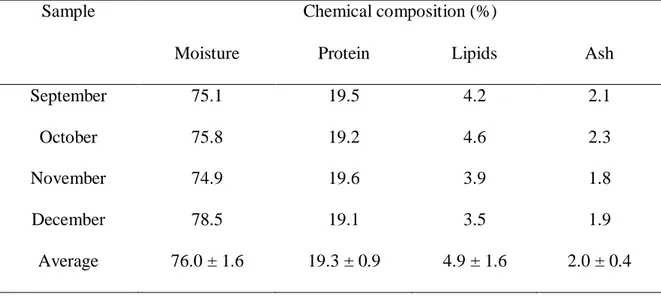
Centesimal Chemical Composition The results of the centesimal
chemical composition of the tilapia do Nilo
edible portion are described in Table 1 The
mean values of lipids and proteins in most
samples enable to classify this species in
category A where the fish have low fat
content (<5%) and high protein content
(15-20%) (IZQUIERDO, 2000). The
exception occurred with the March sample
that had 5.8% lipids, being on the threshold
of the category B (5 to 15% of TL). The
average content of 19.3 ± 0.9% protein,
which had a small variation coefficient
(CV = 4.2%), lies very close to those
reported for other species of the genus
Oreochromis, varying between 18.0 and
20.5% (EL-SAYED, 2002; IZQUIERDO,
2000). For JUNK (1985), the protein
content of tilapia do Nilo in the Amazon
River remained fairly stable at around 20%
for much of the year, but during the early
period of increased volume of river water
22 content gradually decreased, reaching the
minimum value of 17% in March, to
thereafter, increase again, which in April
had again reached an average of 20%.
Coincidentally, the lowest protein
value (19.1%) of tilapia in the Ceará pond
has also been found in March, the rainy
season in the Brazilian Northeast.
However, the protein average reported by
(MINOZZO, 2005) (19,4%) was obtained
with samples collected in the months of
January, May and July in the rivers of the
State of Paraná. LICHETENSTEI et al.
(2000) found contents varying from 18.47
to 19.33%. According to KIRK &
SAWYER (1981) when the Kjeldhal
method is applied, the total centesimal
composition can exceed 100%, due to the
multiplication of nitrogen by 6.25, which
was observed in this study (Table 1).
Thus, it appears that the habitat has
little influence on the protein content of the
fish of the genus Oreochomis, whereas the
small variation observed in the protein,
might be due to seasonal variation of food.
It is known that these species have a
preference for elements of the
phytoplankton, but can consume small
larvae, insects and worms and then feed on
silt or mud from the bottom of ponds
containing algae (especially diatoms), plant
debris and sand particles (SILVA et al.,
2002), probably present in greater quantity
and diversity during the rainy season.
Regarding the total lipids content
(TL), the average of 3.8 ± 1.5% is between
the values of 0.5 and 4.0% reported for
Prochilodus scrofa, Prochilodus cearensis
and Prochilodus nigricans (MAIA et al.,
1999). Higher values were observed for P.
scrofa which averaged 6.0% (MAIA et al.,
1995), while the Prochilodus cearensis,
without distinction of sex and size,
averaged 11.2% (OLIVEIRA, 1999). This
same species analyzed in the years 2006
and 2007 showed, respectively, an average
of 12.6% and 9.2% for males and 13.3%
and 9.2% for females (CAULA et al.,
2008). Perhaps the specimens sizes may be
23 among species of the genus Prochilodus
cearensis, Plagioscion squamosissimus
and Hoplia s malabaricus as, according to
OLIVEIRA (1999), it was observed a
significant positive correlation between
length and fat content, in both Prochilodus
cearensis males and females.
The inverse relationship between
moisture and lipid contents observed in
several fish (OLIVEIRA, 1999; MAIA,
1995; MAIA et al., 1999; URBINATI,
2004) can also be seen between the
samples of tilapia (Table 1). However, the
sample of September, compared to the
samples of November and Dezember, but
not in comparison with the sample of
October, deviated from this behavior. The
sum of the moisture and lipids contents,
averaged 80%, equal to the value of
IZQUIERDO (2000), and very close to
80.7% OLIVEIRA (1999) and 81% (VILA
NOVA, 2005).
1
Table 1. Data on the percentage chemical composition of tilapia do Nilo, Oreochomis niloticus.
Sample Chemical composition (%)
Moisture Protein Lipids Ash
September
October
November
December
75.1
75.8
74.9
78.5
19.5
19.2
19.6
19.1
4.2
4.6
3.9
3.5
2.1
2.3
1.8
1.9
24 The average content of 2.0 ± 0.4%
for ash is within the normal value reported
for freshwater fish (SANTOS et al., 2001)
and marine (MELO, 2003), but higher
average content between 3.0 and 4.2%
have been reported for freshwater fish
(CAULA, 2008) and from 2.5 to 3.2% for
marine fish (ÇELIK et al., 2005).
Lipid Classes Content
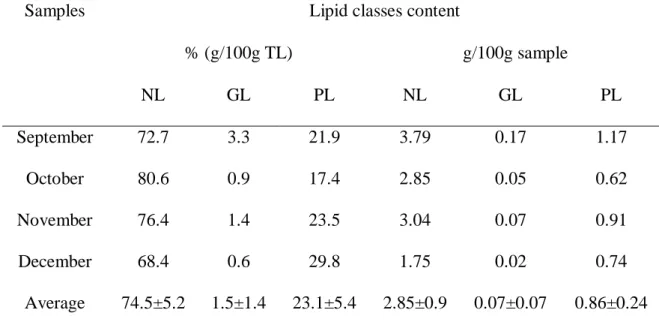
Table 2 shows the contents of the
classes of neutral lipids (NL), glycolipids
(GL) and phospholipids (PL) separated
from total lipids (TL) of fillets of tilapia do
Nilo Oreochomis niloticus. The NL was
always the majority class, contributing on
average with 74.5% of TL. The averages of
GL and PL were 1.5% and 23.1%,
respectively. Losses occurred during the
chromatographic separation process, as the
average recovery of the 4 samples was
83.1%. It is known that PL are the
constituents more susceptible to enzymatic
hydrolysis and autoxidation during the
handling (OETTERER et al., 2004) or
storage of fish on ice (PÉREZ et al., 2001)
or frozen. Moreover, according to
LAMBERTSEN (1972), the recovery
reduction is associated with retention in the
column of products more acid, free fatty
acid and/or some products derived from
the oxidation of lipids. For a more realistic
comparison of the results obtained in this
study with those from the literature, which
had recoveries of at least 98% (ERIC et al.,
2005), the data presented in Table 2 were
corrected to 100% of recovery.
In work with curimbatá, P. scrofa
captured in the State of Alagoas,
MENEZES (2006) found averages of
88.1% of NL and 11.8% of PL, but did not
detect glycolipids. Likewise, it was
verified the absence of GL in tambaqui,
Colossoma macropomum
(ARAÚJO-LIMA & GOULDING, 1997) and in pacu,
Piaractus mesopotamicus (RAMOS
FILHO, et al., 2008), which showed,
respectively, 90.7% of NL + 8.7% of PL
and 94.0% of NL + 5.0% of PL. There are
controversies about the presence of
25 fish. In 17 different species of fish from
Ceará, OLIVEIRA (1999) did not record
the occurrence of glycolipids.
Table 2. Content of lipid fractions in tilapia do Nilo, Oreochomis niloticus.
Samples Lipid classes content
% (g/100g TL) g/100g sample
NL GL PL NL GL PL
September
October
November
December
72.7
80.6
76.4
68.4
3.3
0.9
1.4
0.6
21.9
17.4
23.5
29.8
3.79
2.85
3.04
1.75
0.17
0.05
0.07
0.02
1.17
0.62
0.91
0.74
Average 74.5±5.2 1.5±1.4 23.1±5.4 2.85±0.9 0.07±0.07 0.86±0.24
Abbreviation: NL = neutral lipids; GL = glyceroglycolipids; PL = glycerophospholipid.
This lipid class was not detected in
"ayu" neither, Plecoglossus altivelis
cultured or natural, or in white and dark
meat of "white sucker", Catostomus
commersoni, nor in five species of
freshwater and marine fish and 3 species of
"shellfish" (NAKAGAWA, 2004). On the
other hand, WILSON et al. (2006) reported
the presence of glycolipids in quantities of
1.9% (equivalent to 22.8mg/100g of
sample) in muscle lipid extract of shrimp,
Penaeus aztecus, while BANERJEE et al.
(1997) found in "milkfish", Chanos chanos
an average of 2.4% of GL and BRUSCHI
(2001) reported very high levels of the
order of 26.4% of GL in the body flesh fish
from the mangrove Boleophthalmus
26 CONCLUSION
Considering the results of the
research, it is concluded that: The tilapia
nilotica is a fish that has low fat content
and high protein content;
Comparison of tilapia protein
contents with those reported in the
literature for other species of the genus
Oreochomis suggests that the habitat does
not affect the results of the protein;
It was observed an inverse
relationship between total lipids and
moisture contents, with the sum of these
constituents being on average 80%;
Among the lipid components, the
majority class was composed of neutral
lipids that showed concentration
approximately 3 times higher than that of
phospholipids.
REFERENCES
ARAÚJO-LIMA, C.R.M.; GOULDING,
M. So fruitful fish: ecology, conservation,
and aquaculture of the Amazon's tambaqui.
New York: Columbia University Press,
1997. 157p.
ASSOCIATION OF OFFICIAL
ANALYTICAL CHEMISTS (AOAC).
Horwitz, Washington. Oficial Methods of
Analysis of Association of Official
Analytical Chemists. 17 ed. Arlington:
AOAC Inc., 2000.
BANERJEE, D. et al. Lipids and Fatty
Acids of Air Breathing Fish
Boleophthalmus boddaerti. Food
Chemistry, v. 60, n. 3, p. 303-309, 1997.
BLIGH, E.G.; DYER, W.J. A Rapid
Method of Total Lipid Extraction and
Purification. Canadian Journal of Biochemistry and Physiology, v. 37, n. 8, p. 911-917, 1959.
BRUSCHI, F.L.F. Rendimento,
composição centesimal e perfil de ácidos
graxos de pescados e seus resíduos
monografia [Graduação em Oceanografia].
Itajaí, Santa Catarina. Centro de Ciências
Tecnológicas da Terra e do Mar,
Universidade do Vale do Itajaí. 2001.
27 CAMPOS-RAMOS, R. et al. An
investigation of sex determination in the
Mozambique tilapia, Oreochromis
mossambicus, using synaptonemal
complex analysis, fish, sex reversal and
gynogenesis. Aquaculture, (221):125-40,
2003.
CAULA, F.C.B. et al. Teor de colesterol e
composição centesimal de algumas
espécies de peixes do estado do Ceará.
Ciência e Tecnologia de Alimentos, v. 28, n. 4, p. 960-964, 2008.
ÇELIK, M, et al. Comparison of the
Proximate Compositions and Fatty Acid
Profiles of Zander (Sander lucioperca)
From Two Different Regions and Climatic
Conditions. Food Chemistry, Champaign,
v.92, n. 4, p. 637-641, 2005.
DESPREZ, D. et al. Production of a high
percentage of male offspring with a natural
androgen, 11bhydroxyandrostenedione
(11bOHA4), in Florida red tilapia.
Aquaculture, v. 216, p. 55-65. 2003. EL-SAYED, A. Effects of stocking density
and feeding levels on growth and feed
efficiency of nile tilapia (Oreochromis
niloticus L.) fry. Aquaculture Research,
v. 33, 621-6. 2002.
ERIC J. et al. Characterization of lipids in
complex samples using comprehensive
two-dimensional gas chromatography with
time-of-flight mass spectrometry. Journal of chromatography, 1086(1-2):2-11. 2005.
FERREIRA, M.W. et al. Efeito dos
métodos de cocção sobre a composição
química e perfil lipídico de filés de tilápia
do Nilo (Oreochromis niloticus Linnaeus,
1757). Ciência e Agrotecnologia, v. 31, n.
3, p. 798-803, 2007.
KIRK, R.S; SAWYER. R. Pearson's
composition and analysis of foods. 9th, ed.
Harlow Essex, Longman, 504-18, 1981
KUBITZA, F. Tilápia: tecnologia e
planejamento na produção comercial.
Jundiaí: Acqua & Imagem, 2000. 289p.
IZQUIERDO, P.C. et al. Análisis
proximal, perfil de ácidos grasos,
aminoácidos esenciales y contenido de
28 importancia commercial en Venezuela.
Archivos Latino Americanos de Nutricion, 50, 187-194, 2000.
JACQUOT, R. Organic Constituents of
Fish and Other Aquatic Foods. In:
BORGSTROM, G. (Ed.), Fish Food.
London: Academic Press, v.1, p. 145-210,
1961.
JOHNSTON, J.J. et al. Characterization of
Shrimp Lipids. Journal of Food Science,
v. 48, n. 1, p. 33-35, 1983.
JUNK, W. J. Temporary Fat Storage an
Adaptation of Some Fish Species to the
Waterlevel Fluctuation and Related
Environmental Changes of the Amazon
River. Amazoniana, v. IX, n. 3, p.
315-351, 1985.
LAMBERTSEN, G. Lipids in Fish Fillet
and Liver - A comparison of fatty acid
compositions. Fiskeridirektoratets Skrifter Serie Teknologiske Undersokelser, v. 15, n. 6, p. 3-15, 1972.
LICHETENSTEIN, A.H. et al. Dietary
guidelines: revision 2000: a statement for
healthcare professionals from the nutrition
committee of the American heart
Association. Circulation, (102/18):
2284-99, 2000
MAIA, E.L. Otimização da Metodologia
para a Caracterização de Constituintes
Lipídicos e Determinação da Composição
em Ácidos Graxos e Aminoácidos de
Peixes de Água Doce. Campinas: 242p.
(Tese de Doutorado). FEA/UNICAMP,
1990.
MAIA, E.L. et al. Fatty Acid Composition
of the Total, Neutral and Phospholipids of
Pond-Raised Brazilian Piara ctus
mesopotamicus. International Journal of
Food Science and Technology, v. 30, p. 591-597, 1995.
MAIA, E.L. et al. Composição química e
classes de lipídeos em peixes de água doce
curimatã comum (Prochilodus cea rensis).
29 MELO, J.F.B. et al. Efeito da alimentação
na composição química da carcaça do
jundiá Rhamdia quelen. Revista Biodiversidade Pampeana, v.1, n.1, p.12-23, 2003.
MEURER, F. et al. Lipídeos na
alimentação de alevinos revertidos de
tilápia do Nilo (Oreochromis niloticus L.).
Revista Brasileira de Zootecnia, v. 31, n.2, p. 566-73, 2002.
MINOZZO, M.G. Elaboração de patê
cremoso a partir de filé de tilápia do Nilo
(Oreochromis niloticus) e sua
caracterização físico-química
microbiológica e sensorial. [Dissertação de
Mestrado]. Curitiba, Paraná: Universidade
Federal do Paraná, 2005. 127pp.
MENEZES, M.E.S. Valor nutricional de
espécies de peixes (água salgada e
estuário) do estado de Alagoas.
(Dissertação de Mestrado). Maceió,
Alagoas: Universidade Federal de Alagoas,
2006. 113p.
NAKAGAWA, H.M. et al. Utilization of
α-starch in ayu, Plecoglossus altivelis,
relating to growth and body composition.
Journal of Applied Ichthyology, v.20,
n.5, p. 389 -394, 2004.
OETTERER, M.; SIQUEIRA, AA.Z.C.;
GRYSCHEK, S.B. Tecnologias
emergentes para processamento do
pescado produzido em piscicultura. In:
CYRINO, J. E. P.; URBINATI, E.C.;
FRACALOSSI, D.M.; CASTAGNOLLI,
N. (Ed.). Tópicos Especiais em
Piscicultura de Água Doce Tropical
Intensiva. São Paulo: TecArt, 2004. Cap.
15, p. 481-500.
OLIVEIRA, S.L.C.L. Estudo dos
Constituintes Lipídicos em Peixes do
Ceará. Fortaleza: DEP/UFC, 1999. 118p.
(Dissertação de Mestrado).
PEREZ, J.A.A. et al. Relatório da reunião
técnica de ordenamento da pesca de arrasto
nas regiões sudeste e sul do Brasil. Notas
30 RAMOS FILHO, M.M, et al. Perfil
lipídico de quatro espécies de peixes da
região pantaneira de Mato Grosso do Sul.
Ciência Tecnologia de Alimentos, 2008; 28(2): 361-5.
SANTOS, A.B. et al. Composição química
e rendimento do filé da traíra (Hoplias
malabaricus) Revista da Faculdade de
Zootecnia, Veterinária e Agronomia, v.7/8, n.1, p.33-39, 2001.
SILVA, P.C. et al. Desempenho produtivo
da tilápia do Nilo (Oreochromis niloticus
L.) em diferentes densidades e trocas de
água em "raceway".Acta Scientiarum,
(24/4):935-41, 2002.
SOUZA, M.L.R.; MARANHÃO, T.C.F.
Rendimento de carcaça, filé e subprodutos
da filetagem da tilápia do Nilo,
Oreochromis niloticus (L), em função do
peso corporal. Acta Scientiarum,
Maringá, v.23, n.4, p.897-901, 2001.
STANSBY, M. E. Proximate Composition
of Fish. In: HEEN, E.; KREUZER, R.
(Eds.), Fish in Nutrition. London: Fishing
News, p. 55-60, 1962.
VILA NOVA, C.M.V.M. et al.
Composição química, teor de colesterol e
caracterização dos lipídios totais de tilápia
(Oreochromis niloticus) e pargo (Lutjanus
purpureus). Ciência Tecnologia de Alimentos, (25/3): 430-436. 2005.