*Correspondence: Mukesh Lal Sah. Devsthali Vidyapeeth College of Phar-macy, Rudrapur, Uttarakhand, India. E-mail: [email protected]
A
vol. 48, n. 2, apr./jun., 2012
Programmed delivery of verapamil hydrochloride from tablet in a
capsule device
Mukesh Lal Sah
1,*, Vijay Juyal
2Devsthali Vidyapeeth College of Pharmacy, Rudrapur, Uttarakhand, India, 2Department of Pharmaceutical Sciences, Bhimtal
Campus Kumaun University, Nainital, Uttarakhand, India
The aim of the present work was to develop a programmed drug delivery system which would be able to release the drug after 6 h of lag time by use of hydrophilic polymers. The capsule body was made impermeable by use of formaldehyde vapor treatment, while the cap was untreated. The capsule was
illed with two layered tablets (tablet-in-capsule), followed by a sodium bicarbonate:citric acid mixture (SBCM) and lactose as bulking agent.Sodium alginate, chitosan,HPMC K15 and chitosan:sodium
alginate complex (CSAC) were used as the rate modulating layer. Through combined use of HPMC K15 and adjusting the ratio of CSAC, the desired lag time of 6 h was obtained. The effect of the bulking
agents on the lag time were also studied and it was found that the lag time was decreased with higher amounts of lactose, and delayed dissolution and decreased lag time was observed at higher amount of
effervescent mixture.
Uniterms: Circadian rhythm. Chitosan/sodium alginate complex. HPMC K15. Lactose. Effervescent
mixture.
O objetivo do presente trabalho foi desenvolver sistema de liberação programada de cloridrato de verapamil capaz de liberação imediata do fármaco após 6 h de intervalo de tempo usando polímeros hidrofílicos. O corpo da cápsula foi impermeabilizado por tratamento de vapor de formaldeído, enquanto
a tampa não foi submetida ao tratamento. Dois comprimidos foram inseridos na cápsula (comprimidos em cápsula) seguido de mistura de bicarbonato de sódio: ácido cítrico e lactose, utilizados como excipientes. O alginato de sódio, a quitosana, o HPMC K15 e o complexo quitosana:alginato de sódio foram utilizados para modular a razão de liberação do fármaco. A combinação entre o HPMC K15 e o ajuste da proporção do complexo quitosana:alginato de sódio permitiu a liberação do fármaco após 6 h. O efeito dos excipientes na liberação do fármaco foi também avaliado. Veriicou-se que o tempo de
latência foi reduzido na presença de maior quantidade de lactose, enquanto o menor tempo foi observado empregando maior concentração da mistura efervescente.
Unitermos: Ritmo circadiano. Quitosana/complexo de alginato de sódio. HPMC-K15. Lactose. Mistura efervescente.
INTRODUCTION
The delivery of the desired dose of a drug at a prede-termined time has always been the prime objective of drug delivery systems. Novel drug delivery systems have the potential to provide antihypertensive medication at the time
when the need is greatest (Elliott, Prisant, 1997; Prisant et al., 1992). The disease symptoms, such as hypertension,
ischemic heart disease, asthma and rheumatoid arthritis,
exhibit circadian rhythms (Lemmer, 1991; Traynor et al., 1992; Vyas et al., 1997). Cardiovascular diseases, which
account for the greatest morbidity and mortality, are greatly
affected by body rhythms (Muller, 1999). Moreover, treat -ment outcomes may be affected by body rhythms. Failure to recognize these points may account for chronopatho-logical events, including anterior ischemic optic neuropathy
(Hayreh, 1999) and cerebrovascular accidents among per -sons with hypertension whose blood pressure falls markedly
is recognized that myocardial infarctions, sudden cardiac death, transient ischemic attacks and cerebrovascular ac-cidents occur at a higher frequency in the early hours of the morning. Most cardiovascular medicines are designed to achieve a constant, or near-constant, effect throughout
the 24-hour dosing interval. In many cases, however, the
requirement for medication is not the same at nighttime
as it is during the day (Anwar, White, 1998). Many drugs
have been studied with respect to their pharmacokinetics and chronopharmacology, including analgesics, anticancer drugs, antibiotics, psychoactive drugs, local anesthetics,
antiasthmatics, anticonvulsants and beta-blockers (Ritschel, Forsuz, 1994).
In general, the release rate of a drug is controlled by using a polymer with opposite solubility to the drug, or by combining polymers of different solubilities, as the drug will diffuse out easily from the dosage form if the fabricated by polymer, or polymers, have the same solubility as the
drug. This concept was used to deliver verapamil (Verelan PM) by using water soluble and insoluble polymers. The chronotherapeutic oral drug absorption system (CODAS) verapamil PM, (Verelan PM, Schwarz Pharma, Inc., Me
-quon, WI) was designed to provide a drug-release proile
that complements the circadian pattern of blood pressure
(Prisant, 2001). This technology incorporated an initial 4-5 h delay, followed by the extended release of verapamil.
One should not assume that a drug dosed in the morning will have the same antihypertensive effect as a
drug dosed in the evening (Lemmer, 1996). Oral pulsed or
delayed delivery systems are designed to elicit program-mable lag phases preceding a prompt and quantitative, and
either repeated or prolonged release of the drug (Maroni, 2010). Therefore, the present study was aimed to develop
a drug delivery system, using hydrophilic polymers only, which would be able to release the drug immediately af-ter the desired lag time of 6 h. Verapamil was chosen as a representative drug, which is a potent calcium channel blocker and has been used for the treatment of essential hypertension and time related occurrence of disease
symp-toms (Lemmer, 1991).
MATERIAL AND METHODS
Material
Verapamil hydrochloride and HPMC K-15 were
received as gift samples from Alembic Ltd. Vadodra,
Gujarat, India. Empty capsule shells were received as gift samples from Erawat Pharma, Pithampur, Madhya
Pradesh, India. Chitosan with 85% deacetylation was
purchased from Marine chemicals, Kochi India. Sodium
alginate was purchased from Loba chemie, Pvt. Ltd,
Mum-bai, India. All other reagents were of analytical grade and
used as purchased.
Preparation of impermeable capsules body
For controlling the release of the drug from a novel tablet in capsule device, the body of the capsule was made impermeable, while the cap of the capsule remained
soluble, so that dissolution luid may enter from the soluble
part of capsule. The body and the cap of the gelatin capsule
(size 0) were separated. The body of the capsule was ex -posed to formaldehyde vapor for 6 h at room temperature
and dried at 50 °C for 48 h in a hot air oven (Sropathy et al., 1999). The treated capsule body and the untreated
soluble cap were stored in desiccators until used. Prior to use, the treated capsule body was studied for disintegration test and the treated capsule body did not show any signs of disintegration and was therefore used for the further study.
Preparation of two layered tablets
An accurately weighed amount of the powders, con -taining the immediate release layer and the rate modulating
layers, were sifted through 80 mesh size, and then tablets were compressed in a 7 mm single punch machine by hand illing. The immediate release layer was composed
of verapamil: lactose: cross povidone: magnesium stearate
(20:65:10:5), while the rate modulating membrane was
composed of polymers only.
Studies of the rate modulating layer
To select the material for the modulating layer, HPMC K15, chitosan and sodium alginate were chosen as candidates for the study, which are commonly used for
controlled or sustained release (n = 6).
Studies of weight of rate modulating layer on the release of drug
HPMC K15, chitosan and sodium alginate alone, and chitosan and sodium alginate in different proportions
at different weights (100, 150, 200 mg) were compressed.
To obtain mechanically stable tablets, the rigidities of
the tablets were kept in the range of 8 - 10 kg/mm2, as no signiicant effect of hardness was observed on the release of drug by Bin Li and co workers (Li et al., 2008). HPMC
K15 has been studied for lag time by Mukesh C. Gohel
Studies of the amount of bulking agent on the release of drug
To study the amount of bulking agent on the release
of drug, lactose and sodium bicarbonate:citric acid (1:1) were used as bulking agents. 150, 175 and 200 mg of lactose and 20, 30 and 40 mg of the effervescent mixtures
were selected to study the effect of the amount of bulking
agent on the release of drug (n = 6).
Fabrication of the capsule device for two pulse drug release
Two layered tablets containing the immediate re-lease and the rate modulating layer, followed by the
effer-vescent layer and lactose as iller were snuggly itted in the impermeable capsule body (Fig. 1), and then the soluble cap was placed on the body. The irst two layered tablet (A) was placed in the capsule body in such a way that the
immediate release layer was facing the outer side, while
the rate modulating layer faced inside. The layers (rate modulating and immediate release layer) of the second two layered tablet (B) were position facing the opposite way to irst two layered tablet.
In vitro drug release studies of the capsules
A total of 900 mL of the dissolution medium (pH 1.2) was used to ill the USPXXIII dissolution apparatus. The capsule (n = 6) was placed in a basket and the speed was adjusted to 100 rpm. The temperature of the dissolution medium was maintained at 37 ± 0.5 °C. After 2 h stirring
was stopped, the basket was washed with distilled water and the dissolution medium was replaced by phosphate
buffer (pH 6.8), which had previously been maintained at simulated body temperature. Aliquots (10 mL) were
withdrawn at 15 min time intervals and the same volume replaced by fresh dissolution medium.
RESULTS AND DISCUSSION
The aim of the study was to develop a pH indepen-dent dosage form with a lag time of 6 h and fast release thereafter. The total weight of the layered tablet was kept
at 200 mg for the study.
Effect of individual polymer on lag time
Results in Figure 2 show that only HPMC K15 was able to provide a lag time of 6 h. Only 7.5% of the drug was released after 6 h, which satisies the lag time criteria, but slow release was obtained thereafter, with only 20% of the drug being released after 8 h, and complete release being seen after 10 h. Lactose was added to the HPMC to reduce the swelling of HPMC gel at 10%, 20%, 30%, 40% and 50% w/w, but lag time was not controlled.
From Figure 2, it was also seen that chitosan and
sodium alginate were not able to produce the desired lag
time at maximum weight, and that lag time was dependent
on the pH of the medium. Sodium alginate rapidly forms a
viscous gel on contact with aqueous media. Because of its
high dissolution characteristics, the drug rapidly diffuses through the gel and released all of its active ingredient in
3 h, at the highest weight of polymer. Chitosan dissolves to some extent in inorganic mineral acids, hence providing the higher lag time of 4 h and the drug was released by
initial low dissolution and then erosion of chitosan.
Effect of CSAS
A combination of chitosan with sodium alginate for
sustaining the release of theophylline has also been stud-ied, and release was found to be independent of the pH of
the dissolution medium (Yamota et al.,1994). From the re
-sults, shown below (Figure 3), it was found that a lag time
FIGURE 1 - Schematic presentation of the bi-layered tablets in the impermeable capsule body.
FIGURE 2 - Lag time of sodium alginate, chitosan and HPMC
of 3 h was obtained from CSAS at a 50:50 ratio at 200 mg weight. When the ratio of chitosan was increased then lag time was also increased, but signiicant increase (p < 0.05) was not observed. The complex produced by combining the chitosan and sodium alginate had no signiicant effect
over chitosan and sodium alginate alone. Similar results
were also obtained by Jittima and co-workers (Chatcha -walsaisin et al., 2004).
Effect of HPMC K 15 and CSAS
HPMC K-15 and CSAS, when used alternately as
the rate modulating layer, gave the desired lag time of 6 h,
with only 8% of the drug being released from the formu
-lation, which satisies the lag time criteria. Lag time was
found to be independent of pH and the drug was released mainly by diffusion, although through a dissolution/ero-sion mechanism.
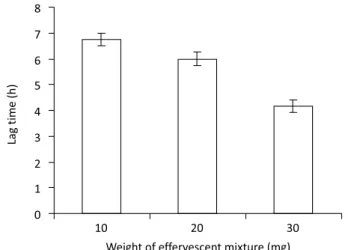
Effect of the SBCM on lag time/dissolution
SBCM was added to hasten the release of drug
after the desired lag time. No effect was observed at low
amounts of SBCM (Figure 4), but at higher amounts the
lag time was found to be reduced due to the pressure gen-erated in the system by CO2 after dissolution of SBCM
causing pressure on the gel matrix. Verapamil is a basic
drug which is why the dissolution of the drug was also
reduced as SBCM was increased.
Effect of lactose on lag time
Lactose was added as a bulking agent separately
to ensure the proper position of the tablet in the capsule
device, but a signiicant effect on the lag time of drug due to the amount of lactose was observed (Figure 5). The
increasing hydrodynamic pressure in the system, due to dissolution of lactose, shortened the lag time.
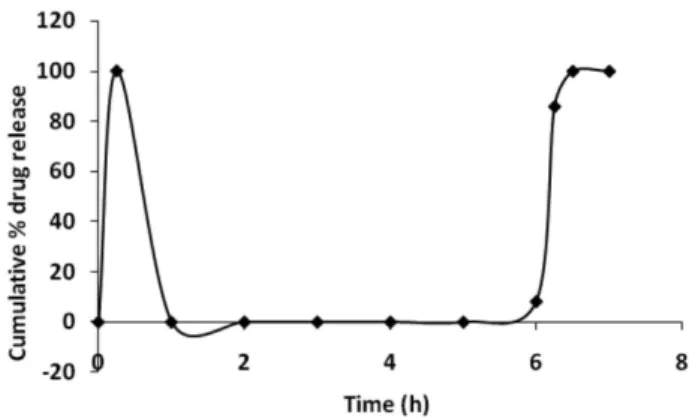
Investigation of two pulse release
From the above results, two pulse release was
successfully achieved (Figure 6) by using a bi-layered tablet containing 100 mg of immediate release layer and 100 mg of HPMC K 15 as a rate modulating layer, fol
-lowed by 100 mg of CSAC (50:50) as a rate modulating layer, 100 mg of immediate release layer, and 20 mg SBCM and 175 mg of lactose. After 6 h of lag time, 85%
release of drug was obtained within 15 min. Complete
release was obtained within 30 min and the release was
reproducible.
FIGURE 3 - Lag time of chitosan:sodium alginate polymer
complex, in different ratio, at 200 mg weight.
FIGURE 4 - Effect of the amount of effervescent mixture on the
lag time of the rate modulating layer containing HPMC K15 and
CSAC (50:50) at different weights.
FIGURE 5 - Effect of the amount of lactose on the lag time of
CONCLUSIONS
Pulsed release of a drug with variable lag time has been studied by various scientists. Lag time can control by using a polymer of opposite solubility to the drug, or
by combining hydrophilic and hydrophobic polymers. A
higher lag time for a water soluble drug using a hydrophilic
polymer is always dificult, as diffusion of the drug from
the polymer is not controlled easily. The present system is capable of delivering the drug after 6 h of desired lag time. It is known that in most people with high blood pressure,
there is a deinite rise in blood pressure upon awakening (also termed the “A.M.” surge), and that blood pressure
then goes down starting in mid-afternoon, hence the pro-posed system could be used successfully, as a once daily
does taken at night time, i.e. 10 p.m., which would enable delivery of the drug in the early morning i.e. 4 a.m.
AUTHORS’ STATEMENTS
The authors declare no conlict of interest.
ACKNOWLEDGEMENTS
The authors wish to acknowledge Dr. Neelesh
Chachda and Mr. Ashutosh JamLoki for providing the
gift samples of gelatin capsule shell and verapamil hy-drochloride.
REFERENCES
ANWAR, Y. A.; WHITE, W.B. Chronotherapeutics for
cardiovascular disease. Drugs, v.55,p.631-643, 1998.
CHATCHAWALSAISIN, J.; PODCZECK, F.; NEWTON,
M.J. The influence of chitosan and sodium alginate and formulation variables on the formation and drug release
from pellets prepared by extrusion/spheronisation. Int. J. Pharm., v.275, p.41-60, 2004.
ELLIOTT, W.J.; PRISANT, L.M. Drug delivery systems for
antihypertensive agents. Blood. Press. Monit., v.2,
p.53-60, 1997.
GOHEL, M.C.; MANHAPRA, S.G. Modulation of active
pharmaceutical material release from a novel ‘tablet in
capsule system’ containing an effervescent blend. J. Control
Rel., v.79, p.157-164, 2002.
HAYREH, S.S. Role of nocturnal arterial hypotension in the
development of ocular manifestations of systemic arterial
hypertension. Curr. Opin. Ophthalmol., v.10, p.474-482,
1999.
KARIO, K.; MATSUO, T.; KOBAYASHI, H.; IMIYA, M.; MATSUO, M.; SHIMADA, K., Nocturnal fall of blood
pressure and silent cerebrovascular damage in elderly
hypertensive patients. Advanced silent cerebrovascular damage in extreme dippers. Hypertension, v.27, p.130-135,
1996.
LEMMER, B. Differential effects of antihypertensive
drugs on circadian rhythm in blood pressure from the
chronobiological point of view. Blood Press. Monit., v.1,
p.161-169, 1996.
LEMMER, B. Circadian rhythms and drug delivery. J. Control. Rel., v.16, p.63-74, 1991.
LI, B.; ZHU, J.B.; ZHENG C.L.; GONG. W. A novel system for three pulse release based on “tablet in capsule” device.
Int. J. Pharm., v.352, p.159-164, 2008.
MARONI A.; ZEMA L.; CURTO M.D.D.; LORETI, G.; GAZZANIGA A. Oral pulsatile delivery: Rationale and
chronopharmaceutical formulations. Int. J. Pharm., v.398,
p.1-8, 2010.
MULLER, J.E., Circadian variation in cardiovascular events. Am. J. Hypertens., v.12, p.35-42, 1999.
PRISANT, L.M.; BOTTINI, B.; DIPIRO, J.T.; CARR, A.A.
Novel drug-delivery systems for hypertension. Am. J. Med.,
v.93,p.45-55, 1992. FIGURE 6 - In vitro release proile of two pulse release system,
PRISANT, L.M. Verapamil revisted: a transition in novel drug
delivery systems and outcomes. Heart Dis., v.3, p.55-62,
2001.
RITSCHEL, W.A.; FORSUZ, H. Chronopharmacological:
a review of drugs studies. Methods Find Exp. Clin.
Pharmacol., v.16, p.57-75, 1994.
SROPATHY, M.; SRINATH M.S.; PARANJOTHY, K.L.K.
Formulation of formaldehyde treated capsules containing
diltiazem hydrochloride-polymer mixture and its in vitro
release studies. Eastern Pharmacist, v.42, p.97-98, 1999.
TRAYNOR, K.; NEWTON, D.W.; HRUSHESKY W.J.M.; REITER R.J. A Pharmacist’s primer on chronotherapeutics.
Am. Pharm., NS32, p.261-267, 1992.
VYAS, S.P.; SOOD, A.; VENUGOPALAN, P.; MYSORE, N.
Circadian rhythm and drug delivery design. Pharmazie,
v.52, p.815-820, 1997.
YAMOTA, C.; MIYAZAKI, T.; OKADA, S. Sustained-release
effect of direct compressed tablet based on chitosan and Na
alginate. Yakugaku Zasshi, v.214, p.257-263, 1994.