Vol.
3,
No.
3,
1982
Chagas' Disease
Introduction
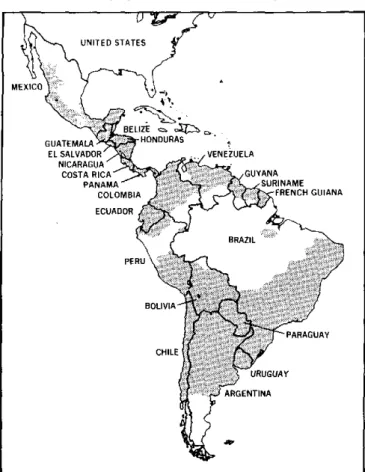
Chagas' disease, or American trypanosomiasis, is a parasitic disease caused by the hemoflagellate Trypanosoma (Schizotrypanum) cruzi, which is transmitted to man and other mammals mainly by hematophagous insects of the sub-family Triatominae. The disease occurs exclusively in the Americas, and is distributed in rural areas from Mexi-co to the northern part of Argentina, wherever the eMexi-colog- ecolog-ical conditions permit the vectors to come in contact with human dwellings (Fig. 1).
The Parasite and its Biological Cycle
T. cruzi evolves in invertebrate hosts (triatomine bugs commonly called "kissing bugs," "barbeiros," "chin-ches," "chipos") and in vertebrate hosts (man, dogs, cats, rodents, and other domestic and wild mammals). The triatomine bugs become infected by ingesting blood with circulating trypanosomes from infected mammals. These blood forms evolve to metacyclic trypanosomes in eight to 10 days while in the digestive tract of the insects. These infective forms are then eliminated in the feces.
The biological cycle in the vertebrate host starts with the penetration of the infective form through the skin or the ocular conjunctiva and other mucous membranes. The parasite rapidly invades fibroblasts and adipose cells un-derneath the skin as well as several organs and tissues: spleen, liver, bone marrow, kidneys, nervous tissue, lymph nodes, and striated muscle (heart).
Modes of Infection
In man, T. cruzi is transmitted by "contamination" with the triatomine bug feces. The transmission of the parasite can be through blood transfusion, the placenta (congenital) or through accidental contact with the blood of infected animals.
The penetration of the parasite through the ocular con-junctiva usually provokes a local inflammatory reaction characterized by painful unilateral edema of both eyelids, enlargement of the lacrimal sac without mucous secretion, and enlargement of the pre-auricular lymph nodes. This sign, called "ocular sign" or "Romaña's sign," is char-acteristic of the acute stage of the disease. The penetration of the parasite in other parts of the body causes a local
in-IN THIS ISSUE ...
* Chagas' Disease
* Diseases Subject to the International Health Regulations * Operational Aspects of Leprosy Control Programs * Dengue in Puerto Rico
* Diarrheal Diseases
Figure 1. Geographic distribution of Chagas' disease.
flammatory reaction called "Chagoma of inoculation." Both inflammatory reactions are due to the multiplication of the parasite in the underlying cells.
Blood transfusion is apparently the second most irn-portant way of transmission, since 1 to 15 per cent of sero-logic reactors have been detected among groups of blood donors examined in several Latin American countries (1).
Vectors and Epidemiology
More than 50 species of triatomine bugs have been re-ported to be naturally infected with T. cruzi, and about a dozen are epidemiologically important as vectors. Triato-ma infestans, Rhodnius prolixus, and Triatoma dimidiata are well adapted to the human dwelling and represent the principal vectors (2).
The public health impact of Chagas' disease is not clearly defined in most countries. Reliability of statistical data is questionable since notification of the disease is not compulsory. Despite the phenomenon of migration of the rural population into urban areas and the consequent "urbanization" of the disease in some countries, it re-mains basically a rural problem associated with poor so-cioeconomic conditions in the population, and the domes-tic nature of the vector.
It is estimated that at least 20 million persons in rural and urban areas are infected with T. cruzi. Argentina,
Brazil, Chile, Uruguay, and Venezuela are the countries where the disease has been more widely studied, and na-tional or provincial programs to control the disease are underway.
Three types of transmission cycles of T. cruzi are con-sidered: the domestic cycle, which is maintained by man, domestic animals (dogs, cats) and domestic triatomine bugs; the wild cycle, which involves rodents, marsupialia, and other wild mammals and the wild triatomine bugs, and the peridomestic cycle, which can be considered as a link between the other two cycles. The last cycle is integrated by the mammals (domestic rodents, marsupialia,guinea pigs, dogs, and cats) that move back and forth from the field into the human habitation, and by the wild triato-mine bugs that invade the houses attracted by light or blood sources (3).
The domestic cycle is undoubtedly the most important cycle in maintaining the Chagas' infection in rural and semirural areas in Latin America, since man and animal reservoirs live together in the house. Primitive houses still existing in such areas, with walls made of adobe or ba-hareque and covered with thatched roofs, constitute an excellent habitat for the vectors. They live and multiply in cracks in the walls, in beds, roofs, behind pictures, and in boxes where people keep and transport clothes and other personal effects from house to house when they move (2). Chagas recognized the role of rural housing and the en-vironment in the epidemiology of the disease. Products used in the construction of dwellings and wood piled for cooking have been found to have a possible role in linking the parasite to man. One such example is the common use of palm tree leaves as material to build roofs and walls of houses and outbuildings. Certain vectors, such as R. pro-lixus, glue their eggs to the leaves, allowing for coloniza-tion to develop in the building. On the other hand, T. di-midiata has been known to inhabit wood used for cooking, and T. infestans can be found in cactus and wood in corrals.
The importance of the peridomestic and wild cycles is still under careful investigation. T. cruzi isolates of known human origin, and T. cruzi-like trypanosomes isolated from animals and triatomine bugs need to be studied and typed in order to better define the epidemiology of Cha-gas' disease. The existence of trypanosomes in domestic and wild animals which are morphologically similar to T. cruzi is well known, but their human infectivity and path-ogenicity has not-been clarified satisfactorily. Several re-search laboratories are currently studying the structural, biochemical, and immunopathologic characteristics of freshly isolated trypanosomes of different origins (4).
Clinical Manifestations
amount of the inoculum, the number of infections, and the age and nutritional state of the host are under inves-tigation.
The prepatent period is about five days, and the incu-bation period lasts from five to 10 days. The infection usually evolves into acute and chronic stages of the dis-ease.
The acute stage occurs more often in the first years of life, and lasts for one to three months. Continuous moderate fever (37.5-38.50C) and the ophthalmoglandular syn-drome (Romaña's sign) are the principal symptoms re-ported in children and young adults. Sometimes local ede-ma of the face is seen, especially when Roede-maña's sign is present, or generalized edema in infants. Splenomegaly and hepatomegaly are reported, as well as enlargement of the lymph nodes particularly in the pre-auricular and sub-maxillar regions. Leucocytosis is moderate, with increase of the monocytes and lymphocytes. Severe infections in children may be accompanied by tachycardia, decreased blood pressure, gallop rhythm, and electrocardiographic changes. Severe myocarditis or acute meningoencephali-tis are the terminal stages in fatal cases.
The chronic stage of Chagas' disease manifests itself 10 to 15 years after the infection through slowly evolving heart damage, which includes cardiac enlargement. There is an asymptomatic or latent period between the acute and chronic stages, which is usually evidenced only by tran-sient parasitemias and serologic reactivity of the patients affected.
Digestive manifestations of T. cruzi infections, mainly megacolon and megaesophagus, have been reported prin-cipally in central Brazil. The prevalence and severity of chagasic myocardiopathy and digestive changes vary with the geographic region. The factors involved in this varia-tion are under investigavaria-tion (4).
In the acute stage of the disease, the interstitial edema and the inflammatory reactions produced by the multipli-cation of the parasite damage the contractibility of the heart muscle. In the chronic stage, these lesions are re-placed by fibrosis and the damage becomes irreversible. Aneurysmal dilation of the ventricular wall or the apex may occur. Sudden death can happen due to paroxysmal tachycardia and ventricular fibrilation.
Immunopathogenesis
The lack of relationship among parasitic nests and heart tissue lesions found in individuals with chronic cha-gasic myocardiopathy had suggested that an allergic reac-tion could be involved in the pathogenesis of the chagasic myocarditis (Reviewed in 6, 7). One possibility would be that cell mediated immunity is involved in the origin of le-sions. In fact, lymphocytes from rabbits experimentally infected with T. cruzi or inoculated with fractions of dead
parasites were able in vitro to destroy allogenic infected or non-infected rabbit heart cells. Moreover, the inoculation of the parasite fractions in this host induced heart lesions that histologically may resemble what could be found in infected humans. Similarly, lymphocytes from infected humans were able to react in vitro with non-infected mouse heart cells but not liver cells, and with infected and non-infected fetal human heart cells. Therefore, it seems reasonable to think that there are common antigens among T. cruzi and heart tissue, and that lymphocytes that would react against heart tissue are present in cha-gasic individuals (Rev. in 7). However, it is not yet known whether this sensitization is the origin of the lesion or a consequence of it.
In recent years, immunoglobulins (Igs) which react with the hosts' tissue have been found in patients with dif-ferent clinical forms of Chagas' disease. These antibodies react against endocardium, vascular structures, and in-terstitium of striated muscle (Rev. in 7,8).
These antibodies have the following characteristics (Rev. in 7-9):
* They are more commonly found in sera from cases of Chagas' disease than any other parasitic diseases or path-ological conditions.
* In adults with Chagas' disease, they are more preva-lent in cases with cardiac symptomatology than in asymp-tomatic ones.
* Their discovery, in some cases, was associated with the presence of skeletal muscle lesions, and intracellular myocardial alterations. In addition, biopsies of the car-diac and skeletal muscle of infected humans showed the existence of Ig deposits in the plasma membrane of these tissue cells.
* They have induced morphological and functional al-terations in rat myocardial cells in vitro, apparently through modifications of the 3 adrenergic receptors.
* They may have in vitro influence on the postsynaptic sites of the plasma membrane of pacemaker cells, possibly acting as a partial i agonist.
Antibodies reacting against neurons and Schwann cells of peripheral nerves have also been found in the serum of acute and chronic cases (Rev. in 10). Since it has been suggested that the lesion of the autonomic nervous system in the cardiac muscle and digestive tract may be the pathological mechanism for the lesions, these antibodies may play an important role in the pathogeny of Chagas' disease (Rev. in 10,11).
Absorption experiments have suggested that these anti-bodies cross-react with antigens shared by the parasite and the human host (Rev. in 7,8). Recently it has been shown that the host antibody is in the laminin, a glycopro-tein from the basement membrane, and that a laminin-like molecule is present in the parasite (12). On the other hand, the use of monoclonal antibodies against the dorsal
root ganglia membrane has also defined antigenic deter-minants which are common to T. cruzi, neurons, and car-diac muscle cells (13).
These findings suggested that host tissue-reacting Igs may be the origin of the cardiac lesion found in chronic Chagas' disease, which would support the earlier assump-tions that pathogenesis of the disease was linked to an im-munologic reaction of the host (6-8). Moreover, detection of these tissue-reacting antibodies may be a useful prog-nostic tool for the infection. However, later reports based on samples obtained from cases from other geographic areas confirmed the presence of tissue-reacting immuno-globulins but not their relationship between their presence and the existence of symptoms or their severity (10,14, 15). Identification of common antigens against the para-site and its human host may nevertheless provide useful information on the host-parasite interaction. In the event that vaccination attempts are made, the production of an-tigenic preparations that will not cross-react with human tissue components may be carried out.
vative (Lampit, Bayer 2502)* and Benznidazole (RO 7-1051, Radanil, Rodragen) which is a 2-nitroimidazole derivative. The drug Nifurtimox has shown experimen-tally in laboratory animals and in clinical trials that it is effective in the acute stage of the disease. A cure rate be-tween 75 to 90 per cent of patients treated has been re-ported by several South American investigators. In the chronic stage of the disease, definite results are still under evaluation since the parasitemia disappears but the sero-logic reactivity remains for years after treatment. It has been observed, however, that the heart damage remains apparently stationary in patients under treatment with evolutive heart disease. The problem with this drug is its toxicity, which causes collateral symptoms such as anore-xia, weight loss, nausea, vomiting, convulsions, head-ache, vertigo, and insomnia, which appear 15 to 20 days after the initiation of treatment, especially in adults. Children tolerate the drug very well. The dosis of Nifurti-mox actually recommended is between 8.5 to 12.5 mg per kg of weight, per day, during 90 to 120 days.
Benznidazole is also under careful investigation in the treatment of acute and chronic infections of the disease.
Diagnosis
The diagnosis of Chagas' disease is based on the pre-sence of T. cruzi in the blood. Xenodiagnosis, blood cul-ture in agar, blood concentration by centrifugation, and direct fresh blood examination between slip and coverslip are the parasitologic techniques used to detect T. cruzi in both acute and chronic human infections.
There are also four serologic techniques which coincide in sensitivity and specificity: (a) the complement fixation test (CFT) or Guerreiro-Machado's reaction; (b) the indi-rect hemagglutination test (IHA); (c) the immunofluores-cent test (IFA); and (d) the direct agglutination test (DA). The IHA, IFA, and DA become reactive earlier than the CFT, usually within three months after the infection; the CFT requires at least three months to become reactive. A new technique, the enzyme-linked immunosorbent assay (ELISA) is under intensive study with promising results. A presumptive diagnosis can be established by taking into account the clinical manifestations (especially those related to chronic heart damage), reactive serologic tests (preferably two of them), and a history of having lived in an endemic area. In patients under 20 years or over 50 years of age, rheumatic heart disease and coronary athe-rosclerosis have to be ruled out, respectively. In endemic areas, Chagas' heart disease has to be differentiated from other myocardiopathies, and efforts to establish a parasi-tologic diagnosis is highly recommended.
Treatment
Many chemical compounds have been subject to exten-sive studies in Chagas' disease, but at the moment only two have shown some activity against the T. cruzi. They are: Nifurtimox, which has a 5-nitrofur furylidene
deri-Control
Since T. cruzi infection depends on the distribution of domestic Triatominae, control measures are, fundamen-tally, directed to eliminate these insects from the human environment. Insecticides and housing improvement have been the most common and successfully used control measures. Health education of the population in endemic areas is also an important aspect of control.
The most commonly used insecticides with residual ac-tion are: benzene hexachloride (BHC, HCH, gammo-xane), dieldrin, and a methylcarbamate (OMS-33, Bay-gon, propoxur). Problems have arisen concerning the high cost of these insecticides as well as the resistance shown by some of the vectors in certain areas.
The construction or repair of human dwellings seems to be a very promising and permanent control measure to eliminate or importantly reduce the T. cruzi transmission to man. In 1943, Dias began the first construction project-in Brazil, which pioneered the concept of house improve-ment as a preventive measure in the control of Chagas' disease.
Since 1960 Venezuela has progressively reduced the in-festation of houses by R. prolixus through periodical insec-ticide spraying and the substitution of palm roofs with tin ones in rural houses in endemic areas. The effect of such combined control measures on the transmission of T. cruzi has been shown by reduced seropositivity in adult and children population samples surveyed in the state of Lara
in 1980-1981 (13.1 per cent), in comparison with surveys performed in 1959-1968 (44.4 per cent) when the control was established. In children 0-9 years old, the seropositi-vity dropped to 1.3 from 20.5 per cent in the same period
(16).
In 1979, with assistance from PAHO and the Edna McConnell Clark Foundation, the Government of Ve-nezuela began a pilot project aimed at defining the role of rural housing in the continued transmission of T. cruzi. The study area selected was in the State of Trujillo where the Government was in the process of modifying rural housing.
The initial construction phases of the project did not in-clude community participation or other socioeconomic considerations. Houses were either improved or new ones built depending on the cost of repair. No modification took place unless the criteria of land ownership or proper-ty agreements were met. Improvements consisted of plas-tering mud walls, cementing floors, and adding zinc roofs. The new houses used a standard design with ce-ment block walls, zinc roofs, and cece-ment floors.
Evaluations included preconstruction and routine post-construction, entomologic searches for vectors, xenodiag-nostic examination of dogs, cats, and some domestic ro-dents, and serologic and electrocardiologic examination of the occupants. Similar evaluations were made in a check area in Portuguesa State receiving periodical insecticide treatment.
The housing improvement was found to significantly reduce infestation indices (from 62.4 per cent at pre-construction to 18.8, 5.2, and 2.8 per cent at, respective-ly, 8, 18, and 24 months postconstruction). Initially some of the modified and new houses were infested with R. pro-lixus. This was due to returning infested personal belong-ings to the houses. Although the study is not complete, it does demonstrate that house improvement can make houses virtually vector free for a period of time.
References
(1) Cerisola, J. A., el al. Enfermedad de Chagas y la transfusión de sangre. Bol Of Sanit Panam 73(3):203-221, 1973.
(2) Zeledón, R. andJ. E. Rabinovich. Chagas' discase: An ecological
appraisal with special emphasis on its insects vectors. Ann Res Entomol
26:101-133, 1981.
(3) Carcavallo, R. U. Aspects of the epidemiology of Chagas' disease in Venezuela and Argentina. In New Approaches in American Trypanoso-miasis Research. PAHO Scientific Publication 318, 1976, pp. 347-58.
(4) Miles, M. A., et al. Do radically dissimilar Trypanosoma cruzi
strains (Zymodemes) cause Venezuelan and Brazilian forms of Cha-gas' disease? Lancct, June 20:1338-1340, 1981.
(5) Brener, Z. and Z. Z. Andrade. O parásito: Rela5oes
hospedeiro-parásito. In Trypanosornma cruzi e Doena de Chagas Rio de Janeiro, Editora Guanabara Koogan, 1979, pp. 1-41.
(6) Goble, F. C. South American Trypanosomes. In G. J. Jackson, el al. (eds.), Immunity to Parasitic Animals, Vol. 2. New York, Appleton-Century-Crofts, 1970, pp. 597-689.
(7) Brener, Z. Immunity to Trypanosoma cruzi. Adv Parasitol 18:247-292, 1980.
(8) Schmuñis, G. A., el al. Tissue-reacting antibodies (EVI anti-bodies) in Nifurtimox-treated patients with Chagas' disease. J Infect Dis
138:401-404, 1978.
(9) Gimeno, A. L., el al. Altered inotropic and chronotropic effects of norepinephrine on isolated rat atria exposed to chagasic sera. Influences of cocaine, normetanephrine and U-0521 (3', 4'-dihydroxy-2methyl propiophenone). Cardiovasc Res 13:723, 1979.
(10) Szarfman, A.,
et
al. Tissue-reacting immunoglobulins in patients with different clinical forms of Chagas' disease. Am J Trop Med Hyg30:43-46, 1981.
(11) Ribeiro dos Santos, R. et al. Antibodies against neurons in chronic Chagas' disease. Tropenmed Parasitol 30:19-23, 1979.
(12) Szarfman, A. el al. Antibodies to Laminin in Chagas' Disease.J
Exp Med 155:1161-1171, 1982.
(13) Wood, J. N., et al. A monoclonal antibody defining antigenic determinants on subpopulations of mammalian neurones and Trypano-soma cruzi parasites. Natlure 296:34-38, 1982.
(14) Peralta, J. M., el al. Autoantibodies and chronic Chagas' heart disease. Trans R Soc Trop Med Hyg 75:569, 1981.
(15) Manigot, D. A., el al. Anticorpos EVI e NP na infecaáo cha-gasica crónica. Estudo em pacientes com diferentes formas clínicas. Rev Inst Med Trop Sao Paulo 24:6-10, 1982.
(16) Villalobos, L. L., et al. Enfermedad de Chagas: Situación actual en el Estado Lara. VI Congreso Venezolano de Salud Pública "Salud para todos," (mimeographed document). Dirección de Malariología y Saneamiento Ambiental, Ministerio de Sanidad y Asistencia Social, Venezuela, 1981, p. 10.
(Source: Parasitic Diseases and Vector Control,
Division of Disease Prevention and Control, and Research Promotion and Coordination, Division of Human Resources and Research, PAHO.)