Received on 10/21/2011. Approved on 05/08/2012. The authors declare no confl ict of interest. Ethics Committee: 1120/09. Universidade Federal do Rio de Janeiro – UFRJ.
1. Master’s degree in Rheumatology, Universidade Federal do Rio de Janeiro – UFRJ
2. PhD; Adjunct Professor, UFRJ; Chief of the Rheumatology Service, Hospital Universitário Clementino Fraga Filho, UFRJ 3. PhD; Physician of the Anesthesiology Service, Hospital Universitário Clementino Fraga Filho, UFRJ
4. Adjunct Professor of the Vascular Surgery Service, UFRJ 5. PhD; Adjunct Professor of the Rheumatology Service, UFRJ 6. Full Professor of the Internal Medicine Service, UFRJ
7. Master’s degree in Statistics, UFRJ; Professor of the Research Division of the Hospital Universitário Clementino Fraga Filho, UFRJ
Correspondence to:Tatiana Melo Fernandes. Serviço de Reumatologia. Rua Prof. Rodolpho Paulo Rocco, s/n – 9º andar – Ilha do Fundão, Ilha do Governador. Rio de Janeiro, RJ, Brazil. CEP: 21941-590. E-mail: [email protected]
Evaluation of endothelial function in patients
with limited systemic sclerosis by use of
brachial artery Doppler ultrasound
Tatiana Melo Fernandes1, Blanca Elena Gomes Bica2, Nivaldo Ribeiro Villela3, Elizabeth Figueiredo Salles4, Mario Newton Leitão de Azevedo5, José Angelo de Souza Papi6, Rosângela Aparecida Gomes Martins7
ABSTRACT
Objectives: The aim of this study was to compare the brachial artery endothelium-dependent and endothelium-independent dilating responses in patients with limited systemic sclerosis (LSSc) with those of healthy subjects of the same gender, age and color. Methods: Twenty adult, non-obese, non-smoker, non-diabetic, non-dyslipidemic, and non-hypertensive women, who fulfi lled the American College of Rheumatology criteria for the diagnosis of SSc, were submitted to right brachial artery Doppler ultrasound. The vasodilating responses were analyzed as follows: the endothelium-dependent dilating response, after a 5-minute ischemia in the right arm; and the endothelium-independent dilating response, after administering 300 mcg of nitroglycerin (NTG) sublingually. The results were compared with the response obtained in healthy subjects. Results: Brachial artery longitudinal diameter was signifi cantly low at baseline 1: 3.57 ± 0.52 mm and 3.93 ± 0.39 mm for the LSSc group and the control group, respectively, P = 0.005. The vascular reactivity after the ischemia/reactive hyperemia and the NTG showed no signifi cant difference between the groups (8.60 ± 5.45 mm
vs. 9.26 ± 5.91 mm and 25.01 ± 12.55 mm vs. 19.59 ± 7.94 mm for the LSSc and control groups, respectively). Also, no statistically signifi cant difference was found between red blood cell velocity (RBCV) after reactive hyperemia and NTG (110.2 ± 43.86 cm/s vs. 102.0 ± 25.89 cm/s and 63.80 ± 17.69 cm/s vs. 65.4 ± 12.90 cm/s in the LSSc and control groups, respectively). Conclusion: Although the LSSc group showed lower brachial artery diameter, the endothelium-dependent and the endothelium-inendothelium-dependent dilating responses were preserved in both groups.
Keywords: limited scleroderma, vascular endothelium, brachial artery, ultrasound, Doppler effect.
© 2012 Elsevier Editora Ltda. All rights reserved.
INTRODUCTION
Systemic sclerosis (SSc) is a chronic connective tissue disease characterized by thickening and fi brosis of the skin and internal organs, due to deposition of collagen, glycosaminoglycans and other proteins of the extracellular matrix, in addition to vascular damage resulting from proliferative endarteritis. The triggering factor for endothelial injury is not known. However, the initial
lesion in genetically predisposed individuals is estimated to be triggered by the following: the injury caused by the ischemia/ reperfusion process; the presence of cytotoxic autoantibodies in the blood; infectious agents; and environmental factors.
leading to an unbalance in the vasodilation/vasoconstriction ratio favoring constriction, with permanent damage to blood vessel walls. That unbalance contributes to vascular hypoxia and endothelial injury, resulting in the release of cytokines by macrophages, platelets, mast cells and activated T cells. Thus, a vicious cycle of endothelial injury is maintained, associated with fi brosis resulting from the stimulation of fi broblasts, which are responsible for the synthesis of cell matrix and collagen.1
Although ischemia stimulates neoangiogenesis and the levels of angiogenic factors, such as vascular endothelial growth factor (VEGF), are increased, the skin of patients with SSc has large avascular areas. A dysregulation in the angio-genesis process in SSc is believed to occur.2 The presence of autoantibodies directed against endothelial cells in SSc can induce apoptosis of those cells. In those patients, endothelial precursor cells have been shown to be reduced in number and have a lower differentiation potential.3 In addition, a change in the sympathetic neural control of the vascular tonus,4 as well as in some intrinsic aspects of microcirculation, has been shown in SSc. There is an increase in platelet aggregation and activation associated with a reduction in the deformability of red blood cells and in fi brin deposition in the vascular wall,5 culminating in an elevated risk for the formation of thrombi in the microcirculation, with a higher expression of adhesion molecules, which aggregate neutrophils and platelets in the vascular wall and reduce the vascular lumen.6
The endothelium continually releases NO, and this release increases when the membrane receptors of endothelial cells are activated by soluble stimuli (acetylcholine, bradykinin, adenos-ine phosphate, substance P, and serotonin) or when calcium channels are opened by an increase in shear stress generated by turbulent blood fl ow.7 The NO target in the vascular wall is the guanylate cyclase enzyme, found in smooth muscle cells, whose activation generates accumulation of cyclic guanosine monophosphate (cyclic GMP), triggering relaxation of the smooth musculature and vasodilation, with consequent increase in local blood fl ow.8
Structural changes in arteriolar walls (resistant vessels) are well known in SSc. They consist in thickening/proliferation/ edema of the intima layer with infi ltration of mononuclear cells, hypertrophy of the media and intima layers, rupture of the lamina elastica interna, and presence of fi brotic scars in vessel walls.9,10 Little is known about the structural changes found in the wall of larger vessels, elastic vessels, such as the brachial, ulnar and radial arteries (conductance vessels), which can be measured by use of non-invasive techniques such as Doppler ultrasound. There is increasing evidence that the macrovas-culature is also involved in the SSc disease process, which is
speculated to relate to the presence of structural abnormalities, such as thickening and stiffness of the vascular wall.11 Although the vascular involvement is considered predominantly micro-vascular in SSc, macromicro-vascular disease can affect more than half of the patients,12 arterial occlusion being found particularly in the hands of patients with the limited form of SSc (LSSc) and in the presence of the anticentromere antibody.13
The ultrasound assessment of the brachial artery (BA) vasodilating response is a non-invasive technique described by Celermajer in 1992,14 being used as an index to assess the macrovascular function by measuring the BA diameter before and after the ischemic stimulus. The ischemia caused in the forearm determines a marked drop in peripheral vascular resistance, which is followed by an increase in the blood shear force exerted on the arterial wall after its release. The increase in shear stress stimulates the production and release of vasodilating substances by the endothelium, especially NO. The increase observed in the BA diameter is an indirect measure of NO release, and, thus, of endothelium-dependent vasodilation.15
A small percentage fl ow increase mediated by endothelium-dependent vasodilation can be interpreted as low availability of NO, being associated with an increased risk for vascular disease.16 The defi cient endothelium-dependent vasodilation found in SSc can be explained by lack of production and release of vasodilating substances by the chronically injured endothe-lium, especially NO, while normal vasodilating response to endothelium-independent factors (exogenous nitroglycerin) can be observed. However, macrovascular endothelial dys-function in SSc has been the object of several studies, whose authors have reported a reduction in the BA fl ow-mediated dilation (FMD),17–20 while others have not.9,21,22
This study aimed at comparing the endothelium-dependent dilating response obtained after a fi ve-minute ischemia induced by placing a sphygmomanometer cuff in the right upper limb (FMD) and the endothelium-independent dilating response obtained after sublingual nitroglycerin administration (nitro-glycerin-mediated dilation - NMD), in patients with LSSc and healthy individuals of matched gender, age and color.
PATIENTS AND METHODS
Study participants
assured of the confi dentiality of their identities. All patients had LSSc, characterized by cutaneous fi brosis restricted to face, neck and extremities.
This open, observational, non-randomized, prospective study was conducted in the Service of Rheumatology of the Hospital Clementino Fraga Filho of the Universidade Federal do Rio de Janeiro (HUCFF-UFRJ). This study’s project was submitted to the Committee on Ethics and Research of the HUCFF-UFRJ and approved on 12/28/2009 (protocol 1120/09).
The exclusion criteria were as follows: overlap syndrome with other collagenoses, myopathies or infl ammatory arthropa-thies; acquired immunodefi ciency syndrome; antiphospholipid antibody syndrome; pregnancy and lactation; malignant neo-plasias; heart failure; moderate to severe pulmonary artery hypertension; smoking; arterial hypertension; and diabetes.
The control group comprised 20 healthy white females, of the same age group of the patients studied, and who were not on any drugs that could alter endothelial response. They were included in the study after providing written informed consent.
Assessment of the endothelial function
The endothelial function was assessed by measuring FMD and NMD of the BA by use of color fl ow Doppler ultrasound, which is a non-invasive, high-resolution method that enables detailed assessment of the thoracic circulation, combining the following three components: B mode, pulsed, and color mode Doppler ultrasound.24 The exam was performed with the individual on the dorsal decubitus position in a controlled temperature (22°C) room.
A sphygmomanometer was positioned on the right arm, approximately 5 cm above the antecubital fossa. Images of the right BA were obtained on a longitudinal view, on the B mode of the Antares (Siemens) ultrasound device, using the linear transducer VFX9-4 with a 10-Mhz frequency positioned 2–3 cm above the antecubital fossa. The BA diameters were measured during the diastole of the cardiac cycle. The fl ows were obtained by use of spectral analysis of the velocity versus volume curves –1.5-mm window and angle lower than 60º positioned at the center of the vessel. Red blood cell velocity (RBCV) was obtained by use of Doppler ultrasound, with a 1.5-mm window and angle lower than 60ºpositioned at the center of the vessel.
The exam was initiated after a ten-minute resting period. The BA diameter and RBCV were measured at the baseline 1 phase. Then, the sphygmomanometer placed on the right forearm was infl ated at a pressure 50% above the initial sys-tolic pressure, and ischemia was maintained for fi ve minutes.
New measures of the BA diameter and RBCV (post-ischemia/ reactive hyperemia phase) were taken 60 seconds after releas-ing ischemia. After a new ten-minute restreleas-ing period (baseline 2), the individuals received a sublingual dose of 300 mcg of NTG, and the measures of the BA diameter and RBCV were taken after three minutes (post-NTG). The means of the three measures of BA diameter and RBCV obtained at each of the four phases were calculated (Figure 1).
Statistical analysis
For comparing baseline variables (numerical) between the LSSc and control groups, the Student t test or Mann-Whitney (non-parametric) test were used for independent samples. The homogeneity of variances between the groups was assessed by use of the Bartlett’s test. Analysis of variance (ANOVA) for repeated measures was used to assess the behavior over the three phases (baseline, reactive hyperemia, and post-NTG) in each group. Bonferroni adjustment (adjusted for three phases) for multiple comparisons was used to identify which phases signifi cantly differed between themselves. To assess whether the evolution throughout the experiment signifi cantly differed between the groups, ANOVA for repeated measures for one factor (effect of the interaction group x time) was used. In ANOVA for repeated measures, logarithmic transformation
Figure 1
Red blood cell velocity during the experiment.
S S
S
Control group LSSc group
150
130
110
90
70
50
30
Red blood cell v
elocity (cm/s)
mean ± SD
(natural log) was applied to the data. Non-parametric meth-ods were used, because the variables showed no normal distribution (Gaussian) due to data dispersion and rejection of the Kolmogorov-Smirnov test in the groups studied. The signifi cance level adopted was 5%. The statistical analysis was processed in the 6.11 SAS software (SAS Institute, Inc., Cary, NC). Data are shown as mean ± SD.
RESULTS
This study assessed 40 females, 20 comprising the LSSc group and 20 healthy females comprising the control group. Of those with LSSc, seven (35%) had disease duration > 10 years and 13 (65%) had disease duration < 10 years. Seven patients (35%) were on low oral prednisone doses (< 10 mg/day). Fourteen patients (70%) used vasodilators regularly and daily [calcium channel blockers (CCB), rheo-logical modifi ers of red blood cells, inhibitors of phospho-diesterases 1 and 5]. The groups did not signifi cantly differ regarding the following characteristics: age (38.6 ± 9.2 and 43.4 ± 9.6 years in control and LSSc groups, respectively, P = 0.11); weight (62.1 ± 5.4 and 58.7 ± 9.3 kg in control and LSSc groups, respectively, P = 0.32); systolic blood pressure (SBP) (110.8 ± 16.9 and 116.5 ± 15.7 mmHg in control and LSSc groups, respectively, P = 0.27); diastolic blood pressure
(DBP) (71.5 ± 12.8 and 75.0 ± 10.6 in control and LSSc groups, respectively, P = 0.35); and heart rate (73.2 ± 11.3 and 76.6 ± 11.9 in control and LSSc groups, respectively, P = 0.36).
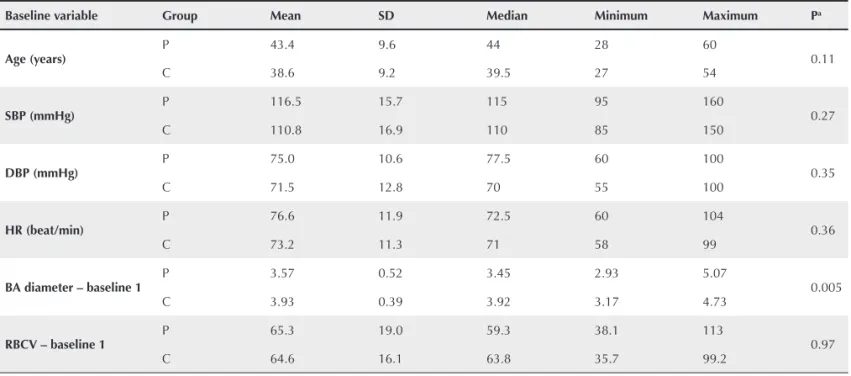
Table 1 shows the baseline variants of weight, age, SBP and DBP in the LSSc and control groups. Data regarding the longitudinal BA diameters in the baseline 1, post-ischemia, baseline 2, and post-NTG phases in both groups are shown in Table 2. Data regarding RBCV in the baseline 1, post-ischemia, baseline 2, and post-NTG phases in both groups are shown in Table 3.
Baseline measures
The BA diameter was signifi cantly lower in the LSSc group (P = 0.005), but no signifi cant difference in RBCV was ob-served in the groups (P = 0.90).
Flow-mediated dilation (FMD)
No signifi cant difference between the groups was observed regarding BA diameter (P = 0.07) and RBCV (P = 0.38).
Nitroglycerin-mediated dilation (NMD)
No signifi cant difference between the groups was observed regarding BA diameter (P = 0.24) and RBCV (P = 0.97).
Table 1
Data regarding the baseline variants of weight, age, SBP, and DBP in the LSSc and control groups
Baseline variable Group Mean SD Median Minimum Maximum Pa
Age (years)
P 43.4 9.6 44 28 60
0.11
C 38.6 9.2 39.5 27 54
SBP (mmHg) P 116.5 15.7 115 95 160 0.27
C 110.8 16.9 110 85 150
DBP (mmHg) P 75.0 10.6 77.5 60 100 0.35
C 71.5 12.8 70 55 100
HR (beat/min) P 76.6 11.9 72.5 60 104 0.36
C 73.2 11.3 71 58 99
BA diameter – baseline 1
P 3.57 0.52 3.45 2.93 5.07
0.005
C 3.93 0.39 3.92 3.17 4.73
RBCV – baseline 1 P 65.3 19.0 59.3 38.1 113 0.97
C 64.6 16.1 63.8 35.7 99.2
SD: standard deviation; HR: heart rate; SBP: systolic blood pressure; DBP: diastolic blood pressure; BA: brachial artery; RBCV: red blood cell velocity.
Dilating response of the BA after induced ischemia
No statistically signifi cant difference in the BA vasodilating response after induced ischemia (endothelium-dependent) was observed between the control (8.9%) and LSSc groups (8.6%).
DISCUSSION
Analysis of endothelial dysfunction by measuring both FMD, which is an endothelium-dependent dilation, and NMD, which is an endothelium-independent dilation, shows controversial results in SSc. Lekakis et al.17 and Cypiene et al.,19 studying
patients with the diffuse form of SSc (DSSc), have reported a reduction in both FMD and NMD as compared with those of healthy controls. Rossi et al.20 have also reported a signi
fi cant reduction in both FMD and NMD when studying patients with DSSc or LSSc, and comparing them with healthy controls. Szucs et al.18 have found a reduction in FMD, but no change in NMD, when studying individuals with DSSc or LSSc as compared with healthy women. Andersen et al.9 have found no alterations in FMD and NMD when comparing healthy individuals with those having DSSc or LSSc. Rajagopalan et al.,21 comparing individuals with primary RP and secondary RP
Table 2
Data regarding the BA diameter in the baseline 1, post-ischemia, baseline 2, and post-NTG phases in both groups
Time Mean ± SD Median Pa Signifi cant differencesb Pc
LSSc group
Baseline 1 3.57 ± 0.52 3.45
0.0001
Baseline 1 ≠ ischemia
0,31
Ischemia 3.77 ± 0.59 3.74 Baseline 1 ≠ NTG
Baseline 2 3.66 ± 0.62 3.58 Ischemia ≠ NTG
NTG 4.44 ± 0.64 4.33 Baseline 2 ≠ NTG
Control group
Baseline 1 3.93 ± 0.39 3.92
0.0001
Baseline 1 ≠ ischemia
0,31
Ischemia 4.14 ± 0.49 4.12 Baseline 1 ≠ NTG
Baseline 2 3.98 ± 0.56 3.90 Ischemia ≠ baseline 2. NTG
NTG 4.70 ± 0.58 4.69 Baseline 2 ≠ NTG
BA: brachial artery; SD: standard deviation.
aANOVA for repeated measures in each group (effect of time); b Bonferroni’s multiple comparisons at 5%; cANOVA for repeated measures between the two groups (effect of the interaction group*time).
Table 3
Data regarding the RBCV in the baseline 1, post-ischemia (reactive hyperemia), baseline 2, and post-NTG phases in both groups
Time Mean ± SD Median Pa Signifi cant differencesb Pc
LSSc group
Baseline 1 65.3 ± 18.96 59.3
0.0001
Baseline 1 ≠ ischemia
0.77
Ischemia 110.2 ± 43.86 103.1 Ischemia ≠ baseline 2
Baseline 2 63.3 ± 17.78 61.0 Ischemia ≠ NTG
NTG 63.8 ± 17.69 62.9
Control group
Baseline 1 64.6 ± 16.10 63.8
0.0001
Baseline 1 ≠ ischemia
0.77
Ischemia 102.0 ± 25.89 97.5 Ischemia ≠ baseline 2
Baseline 2 63.6 ± 14.57 59.8 Ischemia ≠ NTG
NTG 65.4 ± 12.90 63.9
RBCV: red blood cell velocity; SD: standard deviation.
with SSc and other connective tissue diseases, have confi rmed changes in the microcirculation by using laser Doppler fl uxm-etry after brief digital arterial occlusion; however, they have found no difference in FMD in the groups analyzed. Roustit et al.,22 comparing healthy individuals with primary RP and SSc, have not found any signifi cant change in FMD in the three groups. D’Andrea et al.25 have reported a discreet reduc-tion in FMD in patients with SSc as compared with healthy individuals. Bartoli et al.26 have also reported smaller FMD when comparing individuals with SSc with a control group.
Similarly to those by Andersen et al.,9 Rajagopalan et al.21 and Roustit et al.,22 our study found no evidence of vascular dysregulation confi rmed by FMD in patients with SSc as com-pared with a control group comprised by healthy individuals. In accordance with Szucs et al.18 and Andersen et al.,9 our study showed that NMD is not altered in individuals with SSc as compared with that same control group.
Unlike our study, most of those authors have studied patients with predominance of the DSSc. We chose to study individuals with the limited form of disease because we knew that the incidence of vasculopathy is greater in such cases (severe RP, telangiectasia, and a primary type of pulmonary hypertension in late disease). Anticentromere antibody is a known risk factor for digital ischemia and appears, mainly, in the long-standing limited form.27,28
Cheng et al.29 have conducted a study on the biomechani-cal properties and intima-media thickness of the carotid and femoral arteries in 19 patients with DSSc, 33 with LSSc, and 21 healthy controls. A progressive and signifi cant reduction in the carotid artery elastic properties of patients with LSSc was observed as compared with those of the control group. In addition to the microvascular changes characteristic of SSc, macrovascular involvement can occur, exacerbating existing distal hemodynamic disorders, responsible for the digital changes.
Based on our fi ndings, we believe that, although chronically damaged, the endothelium remains responsive in the population studied. The macrovascular abnormalities in individuals with SSc are attributed to structural and anatomical factors of the vessel wall rather than to endothelium functional changes.11 Signifi cant difference in the baseline BA diameter measure was identifi ed between the LSSc and control groups. That fact
per se can increase the risk of cardiovascular diseases in that population. An association has been shown between smaller BA diameter and the presence of subclinical atherosclerosis, estimated by measuring the intima-media thickness of the in-ternal carotid arteries, indicating that arterial remodeling is a systemic process in SSc. Whether BA dilation in those cases is
consequent to a structural change in vessel wall components or whether it is directly caused by the effect of cardiovascular risk factors on the vascular sympathetic tonus remains uncertain. A signifi cant reduction in the arterial compliance of patients with SSc relates to vascular elasticity, and can be consequent to connective tissue changes and increase cardiovascular risk.30 The BA diameter, a simple and reproducible index, can be a valuable indicator of cardiovascular risk, its variation being inversely proportional to that risk.31
Some of our data confl ict with those from the literature and can be explained due to bias present in our study. Our sample size was small due to the low prevalence of the disease in our population and the diffi culty in selecting pa-tients with LSSc who met all the inclusion criteria. Another confounding factor was that many of the individuals studied (70%) were on regular vasoactive drugs at the time of the FMD and NMD assessment with BA Doppler ultrasound. Similarly to most published studies,9,19–22,25 we chose to not suspend those drugs due to the severity of the peripheral vasculopathy of those patients.
Andersen et al.9 have allowed the use of angiotensin-con-verting-enzyme inhibitors (ACEI) and corticosteroids during their study, and observed no signifi cant difference between the treated and untreated groups, although plasma nitrate levels tended towards being lower in the group on corticosteroid. Bartoli et al.26 and Szucs et al.18 have chosen to suspend the vasoactive and antioxidant drugs for 24 hours before the exam. Rajagopalan et al.21 have allowed patients with SSc to maintain their regular use of CCB or ACEI as long as it had been initiated more than four months before beginning assessing endothelial function, but they have excluded patients on lipid-lowering therapy or more than two anti-hypertensive drugs combined. Of the 42 patients with SSc assessed by Roustit et al.,22 16 were on regular use of CCB, three on ACEI, one on angiotensin II receptor blockers, two on hydroxychloroquine, two on cyclo-phosphamide, one on corticosteroid, two on azathioprine, and one on methotrexate. No patient used prostacyclin analogues during this study. Of the 36 patients with primary RP, only two were on CCB.
BA dilating response varies with the position of the sphyg-momanometer on the upper limb of the individual assessed. Most of the response is NO-dependent when the sphygmo-manometer is placed on the forearm; however, when placed on the arm, the response is partially NO-dependent. We chose to place it on the arm because cutaneous sclerosis is more common on the forearm, which makes the area very painful when compressed.32
In conclusion, our fi ndings show that the BA diameter is reduced in patients with LSSc. However, both endothelium-dependent and endothelium-inendothelium-dependent dilating responses remained preserved, encouraging the treatment of those
patients in an attempt to reduce morbidity and mortality during the course of disease.
ACKNOWLEDGMENTS
REFERENCES
1. Derk CT, Jimenez SA. Systemic sclerosis: current views of its pathogenesis. Autoimmun Rev 2003; 2(4):181–91.
2. Abra ham DJ, Krieg T, Distler J, Distler O. Overview of pathogenesis of systemic sclerosis. Rheumatology (Oxford) 2009; 48(Suppl. 3): iii3–7. 3. Frech T, Hatton N, Markewitz B, Scholand MB, Cawthon R, Patel A et al. The vascular microenvironment and systemic sclerosis. Int J Rheumatol 2010; 2010(pii):362868.
4. Freedman RF, Girgis R, Mayes MD. Endothelial and adrenergic dysfunction in Raynaud’s phenomenon and scleroderma. J Rheumatol 1999; 26(11):2386–8.
5. Kahaleh MB, LeRoy EC. Autoimmunity and vascular involvement in systemic sclerosis (SSc). Autoimmunity1999; 31(3):195–214. 6. Szocs K. Endothelial dysfunction and reactive oxygen species
production in ischemia/reperfusion and nitrate tolerance. Gen Physiol Biophys 2004; 23(3):265–95.
7. Kuo L, Davis MJ, Chilian WM. Endothelial modulation of arteriolar tone. News Physiol Sci 1992; 7(1):5–9.
8. Wanstall JC, Homer KL, Doggrell SA. Evidence for, and importance of, cGMP-independent mechanisms with NO and NO donors on blood vessels and platelets. Curr Vasc Pharmacol 2005; 3(1):41–53. 9. Andersen GN, Mincheva-Nilsson L, Kazzam E, Nyberg G,
Klintland N, Petersson AS et al. Assessment of vascular function in systemic sclerosis: indications of the development of nitrate tolerance as a result of enhanced endothelial nitric oxide production. Arthritis Rheum 2002; 46(5):1324–32.
10. D’Angelo WA, Fries JF, Masi AT, Shulman LE. Pathologic observations in systemic sclerosis (scleroderma): a study of fi fty-eight autopsy cases and fi fty-eight matched controls. Am J Med 1969; 46(3):428–40. 11. Constans J, Gosse P, Pellegrin JL, Ansoborlo P, Leng B, Clément J
et al. Alteration of arterial distensibility in systemic sclerosis. J Intern Med 1997; 241(2):115–18.
12. Matucci-Cerinic M, Fiori G, Grenbaum E, Shoenfeld Y. Macrovascular disease in systemic sclerosis. 2.ed. Baltimore: Lippincot Williams & Wilkins, 2003.
13. Kahaleh B. Vascular disease in scleroderma: mechanisms of vascular injury. Rheum Dis Clin North Am 2008; 34(1):57–71 vi.
14. Celermajer DS, Sorensen KE, Gooch VM, Spiegelhalter DJ, Miller OI, Sullivan ID et al. Non-invasive detection of endothelial dysfunction in children and adults at risk of atherosclerosis. Lancet 1992; 340(8828):1111–5.
15. Rollando D, Bezante GP, Sulli A, Balbi M, Panico N, Pizzorni C et al. Brachial artery endothelial-dependent fl ow-mediated dilation identifi es early-stage endothelial dysfunction in systemic sclerosis and correlates with nailfold microvascular impairment. J Rheumatol 2010; 37(6):1168–73.
16. Joannides R, Haefeli WE, Linder L, Richard V, Bakkali EH, Thuillez C et al. Nitric oxide is responsible for fl ow-dependent dilatation of human peripheral conduit arteries in vivo. Circulation 1995; 91(5):1314–9.
17. Lekakis J, Papamichael C, Mavrikakis M, Voutsas A, Stamatelopoulos S. Effect of long-term estrogen therapy on brachial artery endothelium-dependent vasodilation in women with Raynaud’s phenomenon secondary to systemic sclerosis. Am J Cardiol 1998; 82(12):1555–7, A8.
18. Szucs G, Tímár O, Szekanecz Z, Dér H, Kerekes G, Szamosi S et al.Endothelial dysfunction precedes atherosclerosis in systemic sclerosis – relevance for prevention of vascular complications. Rheumatology (Oxford) 2007; 46(5):759–62.
19. Cypiene A, Laucevicius A, Venalis A, Dadoniene J, Ryliskyte L, Petrulioniene Z et al. The impact of systemic sclerosis on arterial wall stiffness parameters and endothelial function. Clin Rheumatol 2008; 27(12):1517–22.
21. Rajagopalan S, Pfenninger D, Kehrer C, Chakrabarti A, Somers E, Pavlic R et al. Increased asymmetric dimethylarginine and endothelin 1 levels in secondary Raynaud’s phenomenon: implications for vascular dysfunction and progression of disease. Arthritis Rheum 2003; 48(7):1992–2000.
22. Roustit M, Simmons GH, Baguet JP, Carpentier P, Cracowski JL. Discrepancy between simultaneous digital skin microvascular and brachial artery macrovascular post-occlusive hyperemia in systemic sclerosis. J Rheumatol 2008; 35(8):1576–83.
23. Preliminary criteria for the classifi cation of systemic sclerosis (scleroderma). Subcommittee for scleroderma criteria of the American Rheumatism Association Diagnostic and Therapeutic Criteria Committee. Arthritis Rheum 1980; 23(5):581–90. 24. Salles-Cunha SX, Morais Filho D. Princípios básicos. In:
Engelhorn CA, Morais Filho D, Barros FS, Coelho N. Guia prático de ultrassonografi a vascular. Rio de Janeiro: Dilivros, 2007. 25. D’Andrea A, Stisi S, Caso P, Uccio FS, Bellissimo S, Salerno G
et al. Associations between left ventricular myocardial involvement and endothelial dysfunction in systemic sclerosis: noninvasive assessment in asymptomatic patients. Echocardiography 2007; 24(7):587–97.
26. Bartoli F, Blagojevic J, Bacci M, Fiori G, Tempestini A, Conforti ML et al. Flow-mediated vasodilation and carotid intima-media thickness in systemic sclerosis. Ann N Y Acad Sci 2007; 1108:283–90. 27. Youseff P, Brama T, Englert H, Bertouch J. Limited scleroderma is
associated with increased prevalence of macrovascular disease. J Rheumatol 1995; 22(3):469–72.
28. Wan MC, Moore T, Hollis S, Herrick AL. Ankle brachial pressure index in systemic sclerosis: infl uence of disease subtype and anticentromere antibody. Rheumatology (Oxford) 2001; 40(10):1102–5.
29. Cheng KS, Tiwari A, Boutin A, Denton CP, Black CM, Morris R et al. Carotid and femoral arterial wall mechanics in scleroderma. Rheumatology (Oxford) 2003; 42(11):1299–305.