The Development of Mathematical Modelling Activities
from Thematic Projects in the Social-Critical Perspective
Regina Helena de Oliveira Lino Franchi and Frederico da Silva Reis
Department of Mathematics, Federal University of Ouro Preto, Ouro Preto 35400-000, Brazil
Received: May 1, 2012 / Accepted: June 12, 2012 / Published: June 25, 2012.
Abstract: In this paper, the authors present a modelling activity developed from a thematic project in the models and mathematical modelling class of the professional master’s degree program in mathematics education at the Federal University of Ouro Preto. The students enrolled in the class chose to study the theme Brazilian Public Politics. After several debates regarding the theme, the students were separated into three groups and each group chose a subtheme to study. The themes were IDH (index of human development), minimum wage and social security. As an example, a description of the thematic project about the minimum wage in Brazil is presented. The principal results obtained in the study of this theme include a discussion about the potentialities of the theme as a classroom activity in different levels of schooling. As an educational activity, the thematic project demonstrated itself to be greatly relevant, since not only did it provide the learning possibility of mathematics related to the issues studied, but also promoted various discussions regarding the theme, which, in our conception, contributes to the social-critical development of the students. Finally, from the point of view of applied mathematics and mathematics education, the development of a modelling activity from thematic projects showed itself to be a good source of researches.
Key words: Mathematical modelling, thematic projects, social-critical perspective.
1. Introduction
In the Brazilian scene, the mathematical modelling movement contains peculiar characteristics which distinguish it from those observed globally. Since the 1970s and 1980s, among the modelling scholars in the international scene, there was a certain concern on how these mathematical applications could be used more effectively in the teaching of mathematics as well as how to better plan, teach, and assess mathematical modelling courses, whereas Brazilian experiments were using modelling as a pedagogical proposal for mathematics, and had a more anthropological and social-political connotation than those experiments developed in other countries [1].
During this time, D’Ambrosio [2] developed studies
Corresponding author: Frederico da Silva Reis, Ph.D.,
associate professor, research fields: functional analysis, mathematical modelling, higher mathematics education. E-mail: [email protected].
of a social-cultural nature in mathematics education and launched the bases of the program he called ethnomathematics. Because of this movement, discussions which took place in education centers influenced research and Brazilian practices on modelling. Therefore, the cultural context where the modelling process is developed is frequently considered and instead of simply applying mathematics or building models, the modelling acquires a connotation of general projects which are developed from themes of interest from the community which is participating in the activities [1].
Activities of this type are considered and also defended by Brazilian authors, such as Franchi, Araújo, Barbosa and Reis [1, 3-5], amongst others. Apart from the interest for the modelling process, this pedagogical proposal also offers the possibility to study mathematical concepts and critical reflection concerning the context of the themes being studied.
DAVID PUBLISHING
That would be the sense given to the modelling approach from a social-critical perspective. The term utilized is supported by Skovsmose [6], who denominates critical mathematical education as one whose goal is not merely to develop abilities for mathematical equations, but one which mathematics may give rise to political, economical and environmental discussions, thus promoting critical participation by the students in society.
2. The Development of Mathematical Modelling
Activities from Certain Themes
There are various ways of developing mathematical modelling activities with this perspective in academic contexts. One of them is to start with a choice of themes of interest from the students themselves who are partaking in the activity.
The fact that students choose themes of interest does not “minimize” the teachers’ importance in carrying out the activity, but forces them to rethink their position in the guidance process.
Teachers must conduct the activity in such manner that students are challenged to point out themes of their interest. From there, they must investigate the initially suggested themes and then one theme may be chosen to be studied by all the participants. Having chosen a theme and working in groups, the idea is to formulate pertinent problems.
Within a broader theme, various types of problems may appear. Some of them may bring about sub-themes that may be studied separately by some of the groups within the class. Therefore, it is vital that the students and teachers do not lose sight of the broader investigated theme, so that the chosen problems may be discussed at any given moment in a holistic manner, making it possible to seek connections among them which point to relevant questions within the theme.
It is important to highlight the collaborative environment which is built into activities of this sort. As the theme is chosen by the participants, it is not
possible to predict what in fact might occur in the development of the activity, or even what kinds of mathematical contents will be necessary to formulate and solve the problems. It is not possible to even know if solutions might be found for all the proposed problems. In this case, the teacher is no longer the all-knowing individual who is going to transmit knowledge. Teacher and student learn together. It is up to the teacher to carefully conduct the activities in a way that they may better take advantage of the potential that the activity offers, not only in terms of the mathematics that appears, but also any possible reflections in the theme’s context.
3. The Context of Thematic Projects in Mathematical Modelling
In the second semester of the 2010 school year, a class on models and mathematical modelling was administered to students of the professional master’s degree program in mathematics education at the Federal University of Ouro Preto, in the state of Minas Gerais, Brazil.
The total class time of this class was 60 hours, and it was comprised of the following topics: mathematical modelling in an educational perspective; the study of classical models and the evolution of models conceptualizing mathematical techniques and statistical methods utilized; the development, realization and assessment of mathematical modelling activities and the evaluation of activities for the classroom.
The activities of the class were designed to take into account theoretical studies on mathematical modelling based on the literature and also the development of modelling activities with the participants of the class.
Papers or other readings were selected for the theoretical studies. These readings contemplated different conceptions of modelling in Brazilian and global mathematics education communities, involving theoretical aspects of mathematical modelling, classroom practice, teacher training and the relation of the modelling and information technology.
Different types of practical modelling activities were developed. The first type, which we call “activity of the newspaper”, was developed in a single class session of four hours. For this activity, newspaper reports with a variety of subjects were selected and presented to the students. The students, in pairs, were asked to choose an item of interest related to an article chosen and prepare an activity to be developed in the classroom. The goal was to build with the participants one possible type of modelling activity in which the problems and the data are pre-established for the students.
As the primary data source was the newspaper article, the previous selection of articles by the teacher sought to include those that contained sufficient data for further studies on the issues involved. The activities developed raised questions on various issues related to the themes of the stories so that mathematical concepts were used to obtain the answers. The activities were also designed to lead students to reflect on the context of the subject matter, involving knowledge other than mathematics and thus making the activity interdisciplinary. The activities developed by each pair of students were presented to the other participants and the pedagogical aspects of each were discussed.
As an example, the work of one of the pairs is presented. The newspaper article used was headlined: “Brazilian emissions of greenhouse gases increased by about 60% between 1990 and 2005”. The article from November 10, 20101 reports on Brazilian emissions in gigatons of CO2 (carbon dioxide) equivalent (a measure that takes into account all greenhouse gases)
1 http://tools.folha.com.br. In: November 10, 2010.
for the period in question as presented at the annual meeting of the Brazilian Forum of Climate Change. The data includes an estimate of emissions for the year 2009, indicating a reduction of Brazil’s emissions between 2005 and 2009 and discusses emissions from different sectors such as: the sector of land use change and forestry, agriculture, energy and industry.
Based on the data, the pair of students raised questions that could be presented in a classroom, to be worked on in groups. The questions are:
(1)According to data entry, what was the percentage increase in actual emissions of carbon dioxide between 1990 and 2005? Is this value consistent with the title of the article?
(2)What are the sectors responsible for national emissions and their percentage of contribution?
(3)According to some news accounts, cars are also sources of emissions of greenhouse gases. What would be a possible reason that this source was not cited in the article?
(4)How many gigatons of CO2 did Brazil did in 2009? What percentage does this represent over 2005?
(5)According to their calculations, have the authors manipulated of the truth? Do you agree with the author? Justify your answer.
(6)What actions cancontribute to reducing emissions? In practice, is it possible that one day we will no longer have a problem with greenhouse gases?
The pair found that the activity can be done with students in the final grades of elementary school and that answers to the questions raised can be worked out using mathematical concepts including: percentage, ratio, proportion, rule three and measurement systems. The pair also considered the possibility of realizing interdisciplinary activities, involving mainly the Portuguese language courses, science and geography.
same time, the participants were provided the opportunity to experience practical modelling activities, especially the development of thematic projects. It must be reiterated that these thematic projects were developed by nine students enrolled in the class; all of them are grade school or college mathematics teachers.
The thematic projects were developed along eight weeks of school, i.e., approximately two months, with a total of 22 classroom hours. The main objective was to make sure that the students experienced a mathematical modelling activity, developed from a theme chosen by them. Initially, students were divided into three groups, and after that they were invited to discuss a theme of common interest, and the possible problems to be studied within the theme.
The first suggested themes were: The Brazilian Football Championship, Public Politics in Brazil, Climate and Food. After ample discussion over the interests and possibilities of each theme, the students unanimously chose the Public Politics in Brazil theme. Upon having done further research and debated on the matter, three topics were selected: HDI (human development index), minimum wage, and social security, which were put under the responsibility of each group.
During the final presentation of each group, discussions on didactic and social-building potentials of the activity in terms of mathematics education were encouraged.
4. The Thematic Project about Minimum Wage in Brazil
As an example, the thematic project about minimum wage in Brazil will be discussed. At first, the group tried to understand what is a minimum wage. We brought up the history of the Vargas Government institution in 1936 as well as the Brazilian Constitution of 1988, to come to the conclusion that a worker has the right to a salary which meets his basic vital needs, as well as the needs of his family. These
needs include food, shelter, education, health, clothing, hygiene, transport and social security, those which have guaranteed periodical adjustments in order to preserve the worker’s acquisition power.
Every one of the participants agreed on the fact that our present minimum salary did not meet those needs. The analysis of this phenomenon as a whole seemed quite complex when considering all different aspects involved. The group therefore opted to focus their study on the purchasing power of a worker during the period between 2001 and 2010, having our basket of food staples2 as reference.
For this task, a search for data on the values of the staples basket and the minimum salary around this period was conducted, considering indicators such as the INPC (national consumer price index) and the supposedly ideal salary, calculated by the DIEESE (Interunion Department for Statistics and Socioeconomic Studies), to verify if they really meet the needs of a worker, as stated by our constitution. From there, the following issues came up:
(1)Was there an improvement on the purchasing power of the Brazilian employee in the last 10 years in relation to the staples basket? What was the percentual variation between 2001 and 2010?
(2)Assuming that the government continues with the same policy for the value of the minimum wage, what would the wage be in 2020?
(3)Is it possible that someday the minimum wage might be the same as the ideal salary proposed by the DIEESE?
(4)What is the INPC? And what is its relation to the minimum wage?
(5)How do we obtain the INPC if there are regional indexes?
For an evaluation on the workers’ purchasing power for the referent time period, a comparative table was made containing the data of the values of the basket of
2 Basket of staples in the name given to a package composed
staples in the city of Belo Horizonte–Minas Gerais, the minimum wage and the percentage the basket represents of a person’s minimum wage. The group noticed an increase in purchasing power in regards to the foods in the basket of staples, once its values were 63.92% of the minimum wage in 2001 and then 42.67% in 2010. It was concluded that there was also an increase in purchasing power in a general sense, since if the percentage of the basket of staples in regards to the salary decreased, then the remaining part of salary could be used in other expenses.
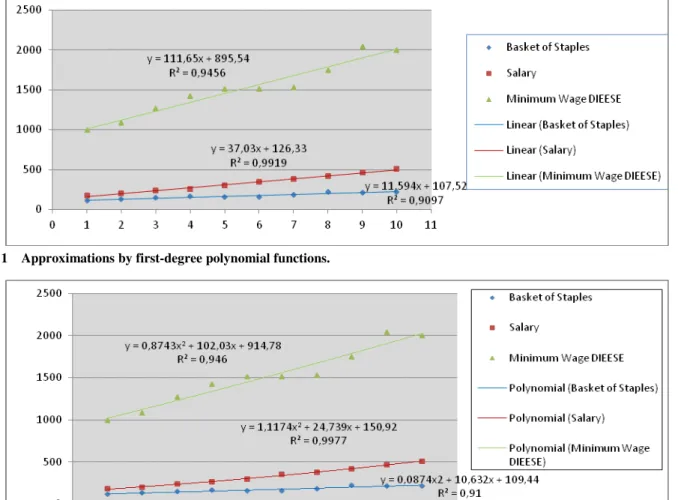
By using the Excel software package, the students constructed graphs using the data regarding the minimum wage, the salary calculated by the DIEESE and the value of the basket of staples, with the intent of assessing the increases in each one of them. They also did curve fitting in order to try to find possible
expressions for functions which may represent this growth. They attempted approximations by using polynomial functions of first and second degrees (Figs. 1 and 2, respectively), with both types being considered satisfactory for the given data, while considering the determining coefficient R2.
From their results, estimates were made for the minimum wage in 2020. By using the first-degree polynomial model, the value obtained in reais (Brazilian currency; at present 1 real is equivalent of 0.6 American dollars) was of R$866.83 and by using a second-degree polynomial model, that value was R$1,092.66.
The group then considered the second graph to be more adequate since its values proved to be closer to their reality, since the first-degree polynomial model showed values too low for the period for the next 10
Fig. 1 Approximations by first-degree polynomial functions.
years. The group also considered the possibility of using polynomial functions of a degree greater than two.
It is important to say that the choice was made only taking into consideration the perceptions and evaluations of the participants, based on their personal experience, once there was not sufficient time for an in-depth study.
In order to analyze if at any given moment our minimum wage would be equal to the wages calculated by the DIEESE, the group sought intersections among the corresponding functions, on both polynomial models. Intersection points of the curves were obtained using the software GeoGebra. Considering all of the cases, only one had a positive value for the abscissa (which refers to the year). Considering this value equal to 215.89, it was concluded that in approximately 216 years (the year 2226), the minimum wage paid by our Government would be equal to the ideal minimum wage proposed by the DIEESE, and this value would be approximately R$57,572.12.
The students also carried out studies related to the calculations from the INPC. Thus, the relation between this index, which considers the price variations of goods and services, and minimum wage, which seeks to provide the worker the possibility to obtain these goods and services for necessary subsistence, became clear. They identified two different ways of calculating this index:
(1)
Id
P i Qi
'
Pi Qi
⋅
=
⋅
∑
∑
in which Pi is the product price i in the base period, P'
i is the current product price i in the present period, and Qi is the quantity of product i;(2)
Id
Wi Idi
Wi
⋅
=
∑
∑
in which Wi is denominated the product weight i and is calculated byPi Qi
Wi
Pi Qi
⋅
=
⋅
∑
,Pi
i
P
Idi
=
'
.The group proved, by using mathematical tools, that
the two formulas are equivalent and proceeded to calculate the INPC related to the months of April and May of 2010.
The development of this project allowed the group to understand the meaning and the calculation formula of the INPC and minimum wage, as well as generating the opportunity for discussion and reflection on the Brazilian social context. As before, these discussions naturally took place during the presentation of their study to their peers.
The group then considered the possibility of the application of this project in middle school, high school, and college, where one may teach the concepts of percentage, 1st and 2nd degree equations, polynomial functions, tables, and statistical charts. The possibility of interdisciplinary activities involving geography, history, Portuguese and sociology was also considered.
5. Conclusions
From the point of view of applied mathematics and mathematics education, the development of a modelling activity from thematic projects showed itself to be greatly relevant, since not only did it provide the learning possibility of mathematics related to the issues studied, but also promoted various discussions regarding the theme, which, in our conception, contributes to the social-critical development of the students.
Specifically in the context of this activity, it should be reiterated that the experiences of the participating students who developed these projects, namely mathematics teachers in continuing education, made it possible to reflect about possible didactical and social formative contributions of the themes.
Acknowledgments
online higher mathematics education, educational technology and mathematical modelling.
References
[1] R.H.O.L. Franchi, Uma proposta curricular de matemática para cursos de engenharia utilizando modelagem matemática e informática, Ph.D. Thesis, Universidade Estadual Paulista, Rio Claro, 2002.
[2] U. D’Ambrosio, Ethnomathematics and its place in the history and pedagogy of mathematics, For the Learning of Mathematics 5 (1) 1985 41-48.
[3] J.L. Araújo, Modelling and the critical use of mathematics, in: C. Haines, P. Galbraith, W. Blum, S. Khan (Eds.),
Mathematical Modelling: Education, Engineering and Economics, Horwood, Chichester, UK, 2007.
[4] J.C. Barbosa, Modelagem matemática: Concepções e experiências de futuros professores, Ph.D. Thesis, Universidade Estadual Paulista, Rio Claro, 2001. [5] F.S. Reis, A modelagem matemática na educação
matemática: Algumas considerações e perspectivas, in: Proceedings of First Encontro Regional de Educação Matemática, Sociedade Brasileira de Educação Matemática, Ed., Universidade Federal de Ouro Preto, Ipatinga, Brazil, Nov. 1-4, 2008.