Original Article
Artigo Original
Leticia Macedo Penna1 Stela Maris Aguiar Lemos1 Cláudia Regina Lindgren Alves2
Correspondence address:
Leticia Macedo Penna
Avenida Alfredo Balena, 190, Belo Horizonte (MG), Brasil, CEP: 30130-100. E-mail: [email protected]
Received: 02/23/2014
Study carried out at Universidade Federal de Minas Gerais – UFMG – Belo Horizonte (MG), Brazil. (1) School of Speech-Language Pathology and Audiology, Universidade Federal de Minas Gerais – UFMG – Belo Horizonte (MG), Brazil.
(2) Department of Pediatrics, Universidade Federal de Minas Gerais – UFMG – Belo Horizonte (MG), Brazil.
Financial support: Minas Gerais Research Foundation (FAPEMIG).
Conlict of interests: nothing to declare.
The lexical development of children with hearing
impairment and associated factors
O desenvolvimento lexical de crianças com deiciência
auditiva e fatores associados
ABSTRACT
Purpose: This study aimed at analyzing the association between the lexical development of children with hearing impairment and their psychosocial and socioeconomic characteristics and medical history. Methods: An analytic transversal study was conducted in an Auditive Health Attention Service. One hundred and ten children from 6 to 10 years old using hearing aids and presenting hearing loss that ranged from light to deep levels were evaluated. All children were subjected to oral, written language and auditory perception tests. Parents answered a structured questionnaire to collect data from their medical history and socioeconomic status, and questionnaires about the features of the family environment and psychosocial characteristics. Multivariate analysis was performed by logistic regression, being the initial model composed by variables with p<0,20 in the univariate analysis. In the inal model, we adopted a signiicance level of 5%. Results: The inal model of the multivariate analysis showed an association between the performance on the vocabulary test and the results of phonemic discrimination test (OR=0.81; 95%CI 0.73–0.89). Conclusion: The results show the importance of stimulating the auditory processing, particularly the phonemic discrimination skill, throughout the rehabilitation process of children with hearing impairment. This stimulation can enhance lexical development and minimize the metalanguage and learning dificulties often observed in these children.
RESUMO
Objetivo: Estudar o desenvolvimento lexical de crianças com deiciência auditiva e analisar sua associação com aspectos assistenciais, características psicossociais da criança e socioeconômicas das famílias. Métodos:
Trata-se de um estudo transversal analítico, realizado em um Serviço de Atenção à Saúde Auditiva. Foram avaliadas 110 crianças com perda auditiva de grau leve a profundo, na idade de 6 a 10 anos de idade, usuárias de Aparelho de Ampliicação Sonora Individual. Todas as crianças foram submetidas a testes de linguagem oral e escrita e de discriminação auditiva. Os responsáveis pelas crianças responderam a um questionário estruturado para levantamento dos dados da história pregressa e socioeconômicos, aos questionários sobre os recursos do ambiente familiar (RAF) e sobre capacidades e diiculdades dos comportamentos sociais (SDQ). Foi realizada análise multivariada pela técnica de regressão logística, sendo o modelo inicial composto pelas variáveis com valor p<0,20 na análise univariada. No modelo inal, adotou-se nível de signiicância de 5%. Resultados: O modelo inal da análise multivariada mostrou associação entre o desempenho na prova de vocabulário e o resultado do teste de discriminação fonêmica (OR=0,81; IC95% 0,73–0,89).
Conclusão: O resultado reforça a importância da estimulação do processamento auditivo, principalmente da habilidade de discriminação fonêmica, durante todo o processo de reabilitação da criança com deiciência auditiva. Essa estimulação poderá potencializar o desenvolvimento lexical e minimizar as diiculdades de metalinguagem e aprendizagem, frequentemente observadas nessas crianças.
Descritores
Perda auditiva Linguagem infantil Auxiliares de audição
Percepção auditiva
Keywords
INTRODUCTION
One of the fundamental aspects for language development is learning words and knowing how to use them correctly. Accessing the mental lexicon enables an individual to represent, through words, an object, a feeling, or an action(1).
Language and vocabulary acquisition depend on innate biological conditions and are affected by stimuli from the environment to which a child is exposed, the social relation-ships established, and from cognitive and memory skills. Oral language skills also depend on neuromuscular integrity and maturation, and especially, on hearing(1,2).
Along with motor aspects, hearing — related to both memory and cognition — is a determining element in oral lan-guage development. For auditory information to be processed, an acoustic signal is received by peripheral structures and car-ried on to the auditory cortex. While in transit in the auditory pathway, the sound is processed and interpreted, in a process called central auditory processing. The development of audi-tory abilities is necessary for the interpretation of these sound patterns. The latter are interpreted in the auditory cortex, and consequently, the activation of lexical representations as well as of grammatical and contextual analysis occurs, which thus establishes a mental representation of the linguistic stimulus and its storage in the memory(3,4).
Hearing impairment is a highly prevalent condition that can seriously harm language development. Therefore, it is important to ensure that children with hearing impairment can receive early diagnoses and eficient speech and audiol-ogy intervention with the purpose of minimizing its impact on their development(5).
In children with hearing impairment, lexical development can present delays or alterations, and isolated speech and language intervention alone does not guarantee an effective rehabilitation. Oftentimes, a potentially successful recovery is barred by a lack of stimuli and parental participation in this process(6,7).
In addition to the family environment, socioeconomic characteristics and social risks can have a great inluence on cognitive and linguistic development(8-10).
In clinical practice, it is possible to observe great discrepan-cies in the auditory and linguistic development of children with hearing impairment. For this reason, it is essential to understand the dificulties faced by these children as well as the factors that inluence their development, such as speech and audiol-ogy treatments, and environmental and socioeconomic factors. Therefore, the aim of this study was to investigate the lexi-cal development of children with hearing impairment and to analyze its association with aspects related to the care received, the psychosocial characteristics of each child, and the socio-economic proile of their families.
METHODS
This is a cross-sectional, analytical, and observational study carried out with a nonprobability sample at an auditory health care center (AHCC) in Belo Horizonte, Minas Gerais, between September 2011 and May 2012.
This study was approved by the institution that houses the AHCC and by the ethics committee of Universidade Federal de Minas Gerais (approval report number ETIC 0316.0.203.000-10). All parents and legal guardians of the children who par-ticipated in the study signed the informed consent form.
In this study, we included children diagnosed with hearing loss, ranging from mild to profound degrees, aged between 6 and 10 years who received personal sound ampliication devices (PSAD) between 2008 and 2010, without any associated conditions, and whose par-ents signed the informed consent form. The diagnosis of hearing loss was conducted by immittance, tonal, and vocal audiometry.
After going through the names included in the database of the health-care service in question, 206 children were identiied. Considering the exclusion criteria (normal bilateral hearing, indication of otorhinolaryngological surgery, presence of as-sociated neurological syndromes and alterations, and death), the eligible population composed of 138 children. Out of these, 110 patients were located and participated in the assessments. The children’s parents and legal guardians illed out three ques-tionnaires: a structured questionnaire devised by the researchers, an inventory of their family environment resources (FER), and the Strengths and Dificulties Questionnaire (SDQ). These were admin-istered by interviews conducted without the children’s participation. The irst questionnaire was administered with the purpose of characterizing the sample, based on the following thematic axes: indicators of hearing loss at birth, data on the auditory diagnosis, speech and audiology intervention and treatment, school life, and socioeconomic indicators.
With the purpose of assessing the children’s family environ-ment, we used the FER questionnaire — Family Environment Resources(11) — composed of ten semi-structured questions that assess the resources available in the family environment, divided in three domains, namely resources that promote proxi-mal processes; expected activities that signal some degree of stability in family life; and parental practices that promote a family–school relationship. In the analysis of the instrument, we used the criteria recommended by the FER author(11).
When analyzing social behavior, we used the SDQ question-naire(12), comprising 25 semi-structured questions that assess social behavior, divided in ive subscales: pro-social behavior; hyperactivity; and issues related to emotions, conduct, and relationships. In the analysis of the instrument, we used the criteria recommended by the authors of the test(12).
all conceptual ields. We considered as the normality criterion values above 71.5%, as suggested in the literature(14). Owing to the sample’s heterogeneity, these tests were applied to the children whose parents had informed, on the structured questionnaire, that their child was able to communicate orally.
To assess written language, we used the School Performance Test (SPT)(15), developed to evaluate students from irst to sixth grade of elementary school. It is composed of three subtests: writing, arithmetic, and reading. The inal classiication on the SPT and on each subtest complied with the guidelines described by its author(15).
While conducting the SPT, the following criteria were con-sidered for the writing subtest: the child had to be able to write his/her own name or the irst ive words given by dictation. In the reading subtest, the child had to be able to read the irst ive words presented. In the analysis of the SPT, the categories average–low and average–high were grouped together in the average category.
The Test of Figures for Phonemic Discrimination (TFPD) was used to assess the children’s hearing abilities(16). This is made up of 60 words that compose 30 minimal pairs. It evaluates a child’s phonemic discrimination ability. Each minimal pair was presented through images, and the child had to identify the images mentioned by the examiner. The inal score was classiied as satisfactory or altered, according to age and the criteria mentioned in the literature(16). We at-tributed a zero score to the children who were unable to take the test. The hearing diagnoses were carried out according to the criteria established in the literature, pertaining to degree and type(17). In the analysis of the variable degree of hearing loss, we considered the di-agnosis of the ear with better hearing. The children were thus divided in three groups: mild-to-moderate degree; moderately severe-to-severe; and bilateral profound degree. The three groups counted children with neurosensory, mixed, and conductive hearing loss.
Only in the case of two children who presented normality in one of the ears, we opted for including them in the group with diagnoses of the ear with worse hearing, considering that unilateral hearing loss can inluence oral and written language development as well as hearing abilities.
The data were stored electronically and typed twice. We also veriied consistency of the database. For data processing and analysis, we used the statistical package Epi Info, build 7.1.0.6.
We carried out a descriptive analysis of the frequency dis-tribution of the categorical variables, as well as analyses of the measures of central tendency and dispersion for the continuous variables. To verify the associations between the results of the vo-cabulary test and the FER, social behavior, aspects of speech and audiology treatment, auditory diagnoses, and the performance on the auditory tests, we used Kruskal-Wallis’ test, analysis of vari-ance, χ2 test, and Fisher’s exact test. A multivariate analysis was carried out using logistic regression analysis in which the initial model was composed of the variables with p<0.20 in the univari-ate analysis. The variables were excluded one by one according to the highest p-value in each model (backward stepwise) until all the variables had a value of <0.05 in the inal model.
RESULTS
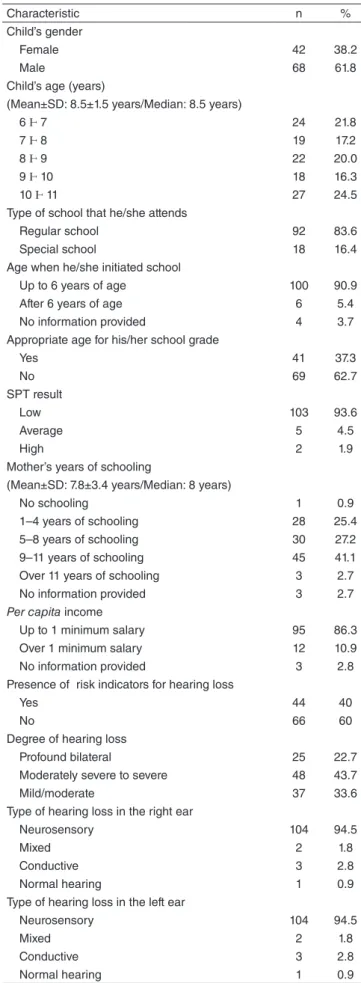
The main characteristics of the 110 children assessed in this study are shown in Table 1.
Characteristic n %
Child’s gender
Female 42 38.2
Male 68 61.8
Child’s age (years)
(Mean±SD: 8.5±1.5 years/Median: 8.5 years)
6 Ⱶ 7 24 21.8
7 Ⱶ 8 19 17.2
8 Ⱶ 9 22 20.0
9 Ⱶ 10 18 16.3
10 Ⱶ 11 27 24.5
Type of school that he/she attends
Regular school 92 83.6
Special school 18 16.4
Age when he/she initiated school
Up to 6 years of age 100 90.9
After 6 years of age 6 5.4
No information provided 4 3.7
Appropriate age for his/her school grade
Yes 41 37.3
No 69 62.7
SPT result
Low 103 93.6
Average 5 4.5
High 2 1.9
Mother’s years of schooling
(Mean±SD: 7.8±3.4 years/Median: 8 years)
No schooling 1 0.9
1–4 years of schooling 28 25.4
5–8 years of schooling 30 27.2
9–11 years of schooling 45 41.1
Over 11 years of schooling 3 2.7
No information provided 3 2.7
Per capita income
Up to 1 minimum salary 95 86.3
Over 1 minimum salary 12 10.9
No information provided 3 2.8
Presence of risk indicators for hearing loss
Yes 44 40
No 66 60
Degree of hearing loss
Profound bilateral 25 22.7
Moderately severe to severe 48 43.7
Mild/moderate 37 33.6
Type of hearing loss in the right ear
Neurosensory 104 94.5
Mixed 2 1.8
Conductive 3 2.8
Normal hearing 1 0.9
Type of hearing loss in the left ear
Neurosensory 104 94.5
Mixed 2 1.8
Conductive 3 2.8
Normal hearing 1 0.9
Caption: SD = standard deviation; SPT = School Performance Test
In this study, the majority (61.8%) of the participants were male, and the age average of the participants was 8.5 years. Among the children evaluated, 40% presented risk indicators for hearing loss in their medical history.
In regards to the auditory diagnoses, the most common type was neurosensory (94.5%) for both ears, and we found a greater occurrence of the moderately severe-to-severe degree (43.7%). Although the frequencies pertaining to the type of hearing loss in the right ear matched with the val-ues obtained for the left ear, we must highlight that several combinations of hearing loss type were found. Also, the two children who had normal hearing in one of the ears had signiicant losses in the opposite ear, and for this reason, were retained in the study.
The majority of the children assessed attended regular school (83.6%), started their studies before or at the age of 6 (90.9%), and were not attending the school grade adequate for their age (62.7%). Moreover, the majority of the children (93.6%) scored low on the SPT.
A monthly per capita income of up to one minimum sal-ary was reported by 86.3% of the families, and 41.1% of the mothers inished elementary school.
Table 2 shows the aspects related to the care received by these families.
We observed a marked variation in the results of the vocabulary test, and the median of DUW considered sat-isfactory was 65.2%. The median of omitted words (ten per child) was higher than that of substitutions (eight per child). The types of substitution more frequently observed were approximate co-eponyms (43.1%) and eponyms (22%), although several other types were used by many of the children.
Table 4 presents the analysis of association between the results on the vocabulary test and the variables related to speech and audiology treatment, socioeconomic issues, and aspects of social behavior and family environment. The variables included in the initial model of the multivariate analysis are highlighted in the p-value column of Table 4.
Considering the type of hearing loss, the group that had the largest number of children who had achieved satisfac-tory scores on the vocabulary task was the one with mild-to-moderate loss, although only half of the children in this group achieved this score.
We observed a higher number of satisfactory scores on the vocabulary test among children who did not present any risk indicators for hearing loss, who were under speech and audi-ology treatment, and who attended regular school. However, better performances on the vocabulary test were observed among the children who had altered SDQ results, per capita
income below one minimum salary, and those who attended speech therapy once a week or less.
The children whose scores on the vocabulary test were considered satisfactory were older; they achieved higher TFPD and FER scores; and their mothers were older than the rest.
Table 5 shows the inal multivariate analysis model. The TFPD results presented an independent association with the performances on the vocabulary test. For each extra point on the TFPD, the chances that the child would show altered results on the vocabulary test decreased by 20%.
Speech and language intervention Values Age of the diagnosis
Median (years) 4.6
Amplitude (years) 0.5–9.0
Age at adaptation with a device
Median (years) 5.8
Amplitude (years) 2.0–9.3
Length of PSAD use (hours/day)
Median (hours/day) 10
Amplitude (hours/day) 0–18
Age when speech therapy was initiated
Median (years) 4.0
Amplitude (years) 1.0–9.0
Duration of speech therapy
Median (months) 36
Amplitude (months) 0.4–9.4
Caption: PSAD = personal sound amplification device Table 2. Description of the aspects related to care
Table 3. Descriptive aspects of the vocabulary test results
Vocabulary test Values
Designation with usual words (%)
Median 65.2
Amplitude 16.1–91.5
Omission of words observed per child
Median 10.0
Amplitude 0–72
Number of substitutions presented per child
Median 8.0
Amplitude 3–11
Predominant substitution type (%)
Approximate co-eponyms 43.1
Distal co-eponyms 0.9
Immediate hyperonyms 1.8
Eponyms 22.0
Cultural paraphrase 1.8
Designation of function 0.9
Onomatopoeia 1.8
At the auditory health care center where the children assessed are treated, the time elapsed since their auditory diagnoses was given as a median of 4.6 years. The median age at the stage when hearing devices were irst used and the age when speech therapy commenced was 5.8 and 4 years, respectively.
Among the children evaluated in this study, 87.3% were undergoing speech/audiology treatment. A majority of them (77.7%) underwent speech therapy less than twice a week.
Table 4. Analysis of the association between the vocabulary test results and the variables of auditory treatment, socioeconomic issues, and aspects of social behavior and family environment
*ANOVA test; **χ2 test; ***Fisher’s exact test; ****Kruskal-Wallis test
Caption: DUW = designation by usual words; SD = standard deviation; TFPD = Test of Figures for Phonemic Discrimination; FER = Family Environment Resources; SDQ = Strengths and Difficulties Questionnaire
Variables DUW Total p-value
Satisfactory (n=28) Altered (n=82)
Age
Mean±SD (years) 9.4±1.2 8.2±1.5 – 0.0001*
Indicators of risk for hearing loss
Yes 8 36 44
No 20 46 66 0.2**
Degree of hearing loss
Profound bilateral 0 25 25
Moderately severe to severe 9 39 48 0.000**
Mild to moderate 19 18 37
Current audiology therapy
Yes 23 73 96
No 5 9 14 0.2***
Audiology therapy frequency
More than once a week 1 20 21
Once a week or less 20 53 73 0.02***
School type
Regular 28 64 92
Special 0 18 18 0.002**
Parents had been informed about difficulties at school
Yes 16 46 62
No 12 36 48 0.9**
Mother’s age (years)
Mean±SD 35.7±6.0 33.5±6.5 – 0.2*
Mother’s years of schooling
≤8 years 12 47 59
>8 years 16 32 48 0.19**
Father’s years of schooling
≤8 years 12 49 61
>8 years 12 23 35 0.17**
Income per person
Less than 1 minimum salary 21 74 95
Higher than or equal to 1 minimum salary 6 6 12 0.04***
TFPD Results
Median (points) 33.5 5.5 – 0.000****
Familial connection (FER)
Median 37.9 34.9 – 0.20****
Family-school connection (FER)
Median 6.6 6.6 – 0.4****
Family life stability (FER)
Median 14.3 14.4 – 0.9****
Total FER
Median 58.2 55.4 – 0.3****
SDQ
Normal (n) 10 33 43 0.8**
Variable OR 95%CI p-value
TFPD Result 0.81 0.73–0.89 <0.001
Table 5. Final multivariate analysis model
Caption: OR = Odds Ratio; 95%CI = confidence interval at 95%; TFPD = Test of Figures for Phonemic Discrimination
DISCUSSION
This study was carried out at an auditory health care center, which is a reference in high-complexity cases. It belongs to a public institution that assists the central macroregion of the State of Minas Gerais. The children assessed were 8.5 years old on average; the majority attended regular school and began their studies before the age of 6. The presence of indicators of risk for hearing loss in the medical history was observed in a large number of children evaluated in this study. The most frequent hearing loss was of the neurosensory type, and the group of individuals with moderately severe-to-severe hearing loss had the largest number of children.
In regard to aspects related to the care received, we observed that the age when the hearing loss was diagnosed, the age when PSADs were irst used, and the age when language and speech treatment received are not in accordance with the recommenda-tions found in the literature(18,19). Hearing loss diagnoses must be conducted up to the third month of life, and speech and hearing interventions must be initiated before the sixth month of life(18,19). Better results could have been found if the children evaluated had been advised early diagnosis provided by the Neonatal Auditory Triage Program (NATP). In Minas Gerais, the state law that recommends the performance of NATP was established in 2007(20), after the birth of these patients.
According to the literature, an early diagnosis, along with systematic use of a PSAD and adequate speech and audiology treatment, optimizes the linguistic development in children with hearing impairment(5). The span of hearing loss and psy-chosocial, socioeconomic, and environmental aspects can also inluence the lexical development in these children(21,22).
The lexical development in the children with hearing impairment assessed in this study turned out to be below ex-pectations. We observed a marked variation in the number of DUW among the children evaluated. It is important to highlight that the sample was composed of children with mild-to-severe hearing loss. According to the literature, alterations in the development of oral language due to auditory perception dif-iculties are directly related to the degree of hearing loss. As the degree of hearing loss worsens, dificulties in speech perception also increase and, consequently, the alterations in the speech will be more marked and signiicant. Auditory residues and the functional gain brought by PSAD are also of fundamental importance for the oral language development of children with hearing loss(23).
The larger number of word omissions in relation to the processes of word substitution is not corroborated by the lit-erature, which reports that it is more common for a child to replace a word than to not name it(24). However, in children
with hearing loss, dificulties in auditory recognition and comprehension, that is, in receptive language, can greatly impact expressive language(10).
The higher occurrence of substitutions by approximate co-eponyms and eponyms revealed substitutions of words with others that had approximate semantic attributes. This indicates a previous knowledge of the object to be named, but also high-lights delays in lexical development(25,26). It is can be inferred that the children came close to the semantic class in question but failed in the word retrieval appropriate for their age range.
Age is another factor that can inluence the language devel-opment of children. Older children have a larger repertoire of words in comparison to younger ones(27). A national study in which the expressive vocabulary of 21 children with hearing loss who were able to communicate orally was evaluated; the authors observed that the older children had a more extensive knowledge of words in the majority of the ields evaluated by the ABFW test(9). Similar results were found in this study, although no independent association was found between the children’s age and the vocabulary test results.
The type of school attended by children with hearing im-pairment can also inluence their lexical performance. In this study, the majority of the children studied in regular schools, and better scores on the vocabulary test were observed in this group. The social and interactive experience of children with hearing impairment who have contact with students with normal hearing can favor their lexical development, positively inluencing these children’s oral language(7,10). This analysis, however, was not conducted in the present study.
The majority of the parents included in this study had been previously contacted by the school because of their children’s learning issues. The lack of auditory acuity, along with language alterations found in children with hearing impairment, is a factor that can interfere with the learning process. Furthermore, lack of knowledge about hearing loss and unpreparedness for teaching and assessing children with hearing impairment on the part of teachers who work in regular schools can aggravate the dificulties in the reading and writing process in these students(24,28,29).
The dificulties in reading and writing are veriied by a large number of children with low SPT scores, which can be justiied by the dificulty presented by children with hearing loss in oral language tasks and also in the auditory discrimi-nation ability evaluated by the TFPD. The learning process is complex, and hearing impairments can cause important deicits, especially in mastering symbolization, generalization, sound manipulation, and phonological awareness, which are fundamental for learning and underdeveloped in these chil-dren(30). Sensory deicits, including unilateral hearing loss, along with lexical and phonological alterations, can cause dificulties in reading and writing. In this case, a larger amount of concrete and visual resources are necessary to minimize learning dificulties(24,31).
verbal models, provided by the environment, can inluence language development by their quantity, quality, and relations to situations faced by the child(22). A study carried out in Brazil shows that families with high per capita incomes and more schooling years, including post-secondary school, tend to use more complete sentences by using more syntactic variations and better grammatical complexity, which positively inluences oral language development(8). An independent association between socioeconomic and demographic factors and the children’s lexi-cal development could not be conirmed in the present study.
In regard to social behavior, children with emotional complaints and issues related to conduct, relationships, and hyperactivity can experience dificulties related to interact so-cially, sustain attention, and develop communication skills(32). It is through experience and context that a child is able to learn the meaning of a new word. A child with hearing impairment can have less opportunities for social interaction due to his/her dificulties with language(32). However, in this study, we did not observe any association between the children’s performances on the vocabulary test and the SDQ test results.
A stimulating family environment is described in the lit-erature as fundamental for the language development process of children with hearing impairment. The family is a modify-ing agent of the child’s reality, both positively and negatively. An environment with good-quality stimulation can be a factor of protection against language development alterations(22). However, a family environment with few resources, dificult interpersonal relationships, and inancial hardships can bring about consequences that impact the child’s language acquisi-tion, as well as physical, emotional, and psychic problems(8). In this study, however, no association was observed between lexical development and FER.
Although several factors may inluence the lexical devel-opment of children with hearing impairment, only the TFPD results were independently associated with the vocabulary test results. We found an inverse relation between these variables, that is, the higher the TFPD score, the lower the chance that the child would present alterations on the vocabulary test, thus conirming that the presence of phonemic discrimina-tion skills favors lexical development(33). Lexical acquisition requires the establishment of a correspondence between the phonological form of a word and its semantic representation. These aspects are strongly inluenced by the development of auditory skills, which, for the most part, are impaired in this group of children(31,33).
This result reinforces the importance of auditory process-ing in the hearprocess-ing and language development of children with hearing impairment. Regardless of the degree of hearing loss, a good phonemic discrimination performance enables an adequate lexical development. It is necessary that physi-ological mechanisms, such as the discrimination of sound sources and sequential sounds, temporal processing, recog-nition of physically distorted sounds, recogrecog-nition of verbal and nonverbal sounds, and unilateral and dichotic listening, operate for auditory comprehension to occur satisfactorily(4).
In addition to alterations in the peripheral system, in chil-dren with hearing impairment, a functional dificulty in the central auditory system can also be present. Thus, the entire acoustic signal processing can be compromised, impairing speech perception and comprehension. Deicits in the lexical development of these children are common. Consequently, their phonological, metalinguistic, and learning development is also compromised(3). The literature also reinforces the importance of phonological awareness for the lexical development of children with hearing impairment(33).
The use of electronic hearing devices in conjunction with speech and hearing therapy focused on auditory stimulation can favor neural plasticity and allow for better information processing in children with hearing impairment(34). The irst years of life are considered critical for a child’s auditory and language development, as it is in childhood that the pinnacle of the maturation of the central auditory system occurs(21). Late speech, language, and audiology interventions can cause irreversible damage(24).
In this study, the only factor associated with vocabulary alterations was the TFPD result. However, in clinical practice and in the literature, it is observable that care-related, socioeco-nomic and environmental factors, as well as social behavior, can interfere with lexical development. The discrepancies between the results presented in this study and others can be justiied by the different statistical approaches used(5,8,9). Considering the relevance of the topic, and for a better understanding of the language development process in children with hear-ing impairment, it is important that longitudinal studies be conducted with standardized methods and approaches that are speciic to this group of children.
There is a lack of standardized tests with values of reference for children with hearing impairment in the national literature, which hindered the comparison of the results found for others studies that have already been published.
CONCLUSION
The TFPD results showed an association with the vocabu-lary test results, thus indicating that phonemic discrimination skills favor lexical development. We did not observe any associations between the individuals’ performances on the vocabulary test and the socioeconomic, environmental, and social behavior variables studied.
The results reinforce the importance of stimulating phone-mic discrimination skills and auditory processing throughout the rehabilitation process of children with hearing impairment. This auditory stimulation can beneit the lexical and phono-logical development as well as the metalinguistic and learning skills, which are frequently impaired in these individuals.
ACKNOWLEDGMENTS
*LMP was responsible for the project, data collection and tabulation, and manuscript writing; SMAL supervised data collection, as well as manuscript elaboration and writing; CRLA was responsible for the study outline and overall supervision of the stages of study conduction, data analysis, and manuscript elaboration and writing.
REFERENCES
1. Gândara JP, Bei-Lopes DM. Tendências da aquisição lexical em crianças em desenvolvimento normal e crianças com Alterações Especíicas no Desenvolvimento da Linguagem. Rev Soc Bras Fonoaudiol. 2010;15(2):297-304.
2. Cachapuz RF, Halpern R. A influência das variáveis ambientais nodesenvolvimento da linguagem em uma amostra de crianças. Rev AMRIGS. 2006;50(4):292-301.
3. ASHA: American Speech-Language-Hearing Association [Internet] (Central) Auditory Processing Disorders. 2005 [cited 2013 Feb 15]. Available from: http://www.asha.org/docs/html/TR2005-00043.html 4. Pereira LD. Sistema auditivo e desenvolvimento de habilidades auditivas.
In: Fernandes FDM, Mendes BC, Navas ALGP, organizadoras. Tratado de Fonoaudiologia. 2ª edição. São Paulo: Roca; 2010. p. 3-8.
5. Fortunato CAU, Bevilacqua MC, Costa MPR. Análise comparativa da linguagem oral de crianças ouvintes e surdas usuárias de implante coclear. Rev CEFAC. 2009;11(4):662-72.
6. Mota JM, Tavares TF, Koji RT, Bento RF, Matas CG, Andrade CRF, et al. Efeito do programa de orientação a pais no desenvolvimento lexical de crianças usuárias de implante coclear. Arq Int Otorrinolaringol. 2011;15(1):54-8. 7. Scopel RR, Souza VC, Lemos SMA. A inluência do ambiente familiar
e escolar na aquisição e no desenvolvimento da linguagem: revisão de literatura. Rev CEFAC. 2012;14(4):732-41.
8. Maria-Mengel MRS, Linhares MBM. Fatores de risco para problemas de desenvolvimento infantil. Rev Latino-am Enfermagem. 2007;15:837-42. 9. Costa MCM, Chiari BM. Verificação do desempenho de crianças
deicientes auditivas oralizadas em teste de vocabulário. Pró-Fono. 2006;18(2):189-96.
10. Ferreira MIO, Dornelas SA, Teóilo MMM, Alves LM. Avaliação do vocabulário expressivo em crianças surdas usuárias da língua brasileira de sinais. Rev CEFAC. 2012;14(1):9-17.
11. Marturano EM. O Inventário de Recursos do Ambiente Familiar. Psicol Relex Crit. 2006;19(3):498-506.
12. Fleitlich B, Cortazar PG, Goodman R. Questionário de Capacidades e Diiculdades (SDQ). Infanto Rev Neuropsiquiatr Infanc Adolesc. 2000;8(1):44-50.
13. Lopes D. Prova de Vocabulário (parte B). In: Andrade CRF, Bei-Lopes DM, Fernandes FDM, Wertzner HF. ABFW:Teste de linguagem infantil nas áreas de Fonologia, Vocabulário, Fluência e Pragmática. São Paulo: Pró-Fono; 2000. p. 5-40.
14. Befi-Lopes DM. Prova de verificação do vocabulário: aspectos da efetividade como instrumento diagnóstico [Tese de Livre-Docência]. São Paulo: Universidade de São Paulo; 2002.
15. Stein LM. TDE — Teste de Desempenho Escolar: manual para aplicação e interpretação. São Paulo: Casa do Psicólogo; 1994.
16. Carvalho BS. Teste de Figura para Discriminação Fonêmica [dissertação]. Santa Maria: Universidade Federal de Santa Maria; 2007.
17. Loyd LL, Kaplan H. Audiometric interpretation: a manual of basic audiometry. Baltimore: University Park Press; 1978.
18. Lewis DR, Marone SAM, Mendes BCA, Cruz OLM, Nóbrega M. Comitê multiprofissional em saúde auditiva: COMUSA. Braz J Otorhinolaryngol. 2010;76:121-8.
19. Joint Committee of Infant Hearing. Year 2007 position statement: principles and guidelines for early hearing detection and intervention programs. Pediatrics. 2007;120(4):898-921.
20. Minas Gerais. Secretaria de Estado da Saúde [Internet]. Resolução 1.321, de 18 de outubro de 2007 [cited 2013 Feb 03]. Available from: http://www.saude.mg.gov.br/atos_normativos/legislacao-sanitaria/ estabelecimentos-de-saude/saude-auditiva/Resolucao%20SES-MG%20 no%201321,%20de%2018-10-2007.pdf
21. Angelo TCS, Bevilacqua MC, Moret ALM. Percepção da fala em deicientes auditivos pré-linguais usuários de implante coclear. Pró-Fono. 2010;22(3):275-80.
22. Yehudai N, Tzach N, Shpak T, Most T, Luntz M. Demographic factors inluencing educational placement of the hearing-impaired child with a cochlear implant. Otol Neurotol. 2011;32(6):943-7.
23. Pereira KL, Garcia VL. Análise da produção fonética em crianças deicientes auditivas. Rev CEFAC. 2005;7(4):473-82.
24. Brazorotto JS. Crianças usuárias de implante coclear: desempenho acadêmico, expectativas dos pais e professores [Tese]. São Carlos: Universidade Federal de São Carlos; 2008.
25. Brancalioni AR, Marini C, Cavalheiro LG, Keske-Soares M. Desempenho em prova de vocabulário de crianças com desvio fonológico e com desenvolvimento fonológico normal. Rev CEFAC. 2011;13(3):428-36.
26. Chilosi AM, Comparini A, Scusa MF, Orazini L, Forli F, Cipriani P, et al. A longitudinal study of lexical and grammar development in deaf Italian children provided with early cochlear implantation. Ear Hear. 2013;34(3):28-37.
27. Bei-Lopes DM, Gândara JP, Felisbino FS. Categorização semântica e aquisição lexical: desempenho de crianças com alteração do desenvolvimento de linguagem. Rev CEFAC. 2006;8(2):155-61. 28. Silva DRC, Santos LM, Lemos SMA, Carvalho SAS, Perin RM.
Conhecimentos e práticas de professores de educação infantil sobre crianças com alterações auditivas. Rev Soc Bras Fonoaudiol. 2010;15(2):197-205.
29. Luccas MRZ, Chiari BM, Goulart BNG. Compreensão de leitura de alunos surdos na rede regular de ensino. J Soc Bras Fonoaudiol. 2012;24(4):342-7.
30. S c h i r m e r C R , F o n t o u r a D R , N u n e s M L . D i s t ú r b i o s d a aquisição da linguagem e da aprendizagem. J Pediatr (Rio J). 2004;80(2):S95-S103.
31. Nishihata R, Vieira MR, Pereira LD, Chiari BM. Processamento temporal, localização e fechamento auditivo em portadores de perda auditiva unilateral. Rev Soc Bras Fonoaudiol. 2012;17(3):266-73. 32. Stivanin L, Scheuer CI, Assumpção-Junior FB. SDQ (Strengths
and Difficulties Questionnaire): identificação de características comportamentais de crianças leitoras. Psicol Reflex Crit. 2008;24(4):407-13.
33. Lee Y, Yim D, Sim H. Phonological processing skills and its relevance to receptive vocabulary development in children with early cochlear implantation. Int J Pediatr Otorhinolaryngol. 2012;76(12):1755-60.