Dante Pazzanese Risk Score for Non-ST-Segment Elevation Acute
Coronary Syndrome
Elizabete Silva dos Santos
1,2, Ari Timerman
2, Valéria Troncoso Baltar
2, Maria Tereza Cabrera Castillo
2, Marcos Paulo
Pereira
2, Luiz Minuzzo
2, Leopoldo Soares Piegas
2Instituto do Coração (InCor) HC-FMUSP1; Instituto Dante Pazzanese de Cardiologia2, São Paulo, SP, Brasil
Summary
Background: The probability of adverse events estimate is crucial in acute coronary syndrome condition.
Objectives: To develop a risk score for the brazilian population presenting non-ST-segment elevation acute coronary syndrome.
Methods: One thousand and twenty seven (1,027) patients were investigated prospectively at a cardiology center in Brazil. A multiple logistic regression model was developed to estimate death or (re)infarction risk within 30 days. Model predictive accuracy was determined by C statistic.
Results: Combined event occurred in 54 patients (5.3%). The score was created by the arithmetic sum of independent predictors points. Points were determined by corresponding probabilities of event occurrence. The following variables have been identified: age increase (0 to 9 points); diabetes mellitus history (2 points) or prior stroke (4 points); no previous use of angiotensin converting enzyme inhibitor (1 point); creatinine level increase (0 to 10 points); the combination of troponin I level increase and ST-segment depression (0 to 4 points). Four risk groups were defined: very low (up to 5 points); low (6 to 10 points ); intermediate (11 to 15 points ); high risk (16 to 30 points ). The C statistic was 0.78 for event probability, and 0.74 for risk score.
Conclusion: A risk score of easy application in the emergency service was developed to predict death or (re)infarction within 30 days in a brazilian population with non-ST-segment elevation acute coronary syndrome.(Arq Bras Cardiol 2009; 93(3) : 319-326)
Key Words: Cardiovascular diseases; unstable angina; myocardial infarction; prognostic; risk factors.
Mailing Address: Elizabete Silva dos Santos •
Avenida Dr. Dante Pazzanese, número 500 – 04012-909 – Vila Mariana – São Paulo, SP, Brasil
E-mail: [email protected]
Manuscript received November 25, 2008; revised mansucript received March 18, 2009; accepted March 18, 2009.
Introduction
Cardiovascular diseases are the first cause of death not only in developed countries but in developing countries as well1.
The risk of death or of recurrent ischemic events among patients with non-ST-segment elevation acute coronary syndrome varies widely due to heterogeneity. Therefore, it is important that the risk of experiencing these adverse events be determined for initial screening at the emergency department, as well as for identifying those patients who may benefit from potent but expensive and sometimes risky new therapies2. It is also crucial when choosing the most appropriate location for medical care and the recommendation of early invasive strategy3. The decision on the therapy to be used for each patient depends on their clinical presentation as well as the benefits from treatment choice4, which is to deliver benefits that make up for the risks from adverse results.
The strategy for risk stratification aims at assessing the variables that may predict adverse results at the point in time when patients are being screened at the emergency unit5 and must be based on the combination of patient’s clinical history, symptoms, electrocardiographic changes, plasma biomarkers, and risk score results6.
Study objective was to develop a risk stratification model that would be simple, and of easy application at the emergency unit for a brazilian population that had not gone through a selection, and using clinical, electrocardiographic variables as well as plasma biomarkers.
Methods
Study Population
by the local Research Ethics Committee. All patients signed the Informed Consent Form.
The inclusion criterion was having been diagnosed with non-ST-segment elevation acute coronary syndrome, with symptoms having been presented in the previous 48 hours: precordial or restrosternal pain described as chest discomfort, tightness or burning for a period longer than 10 minutes or dyspnea or syncope that might be ischemic in origin. Exclusion criteria included: ST-segment elevation acute myocardial infarction; non-cardiac causes symptoms; secondary unstable angina8; confounding electrocardiographic changes (pacemaker pace, atrial fibrillation rhythm, bundled branch block).
Electrocardiogram (ECG)
The following electrocardiographic changes were recorded
at admittance: ST-segment depression ≥ 0.5 mm in at least
one electrocardiographic lead measured at 80 milliseconds from J point followed by horizontal or descending ST-segment
based on previous TP segment; inversion of T wave ≥ 1 mm
in two contiguous leads, quantified by nadir measurement; pathologic Q waves that are 0.04 seconds long or longer, and amplitude larger than 1/3 of subsequent R wave in two contiguous leads.
Laboratory Exams
Blood samples were collected within 24 hours after admission. The following variables have been identified: hemogram, biochemistry, cardiac troponin I (cTnI), creatinaphosphokinase MB fraction (CK-MB) and high sensitivity C-reactive protein (hs-CRP). A second sample was collected 12 hours after the first for cTnI, CK-MB and hs - CRP level. The higher level of cTnI and hs - CRP was taken from the two samples. The samples were collected in dry vials with no anticoagulant added. Ater immediate centrifugation serum was kept in the freezer at – 80° C. Biomarkers level measure was done through IMMULITE DPCMedLab automated chemiluminiscence. Categorical data analysis was used for cTnI (≥ 0.5 ng/ml), since no values under 0.5 ng/ml or higher than 100 ng/ml were detectable through the methodology being used.
Clinical Outcome
Study outcomes included death due to all causes or (re)infarction within 30 days. (Re)infarction was considered as the clinical outcome whenever ischemic symptoms with new ST-segment elevation not shown on ECG at admission occurred within the first 24 hours from admission. In that period of time, either CK-MB or cTnI level increase with no new ST-segment elevation was related to admission event. After 24 hours, infarction was diagnosed by the presence of new Q waves or new CK-MB increases above normal level with or without ECG changes. For patients who had been submitted to percutaneous coronary interventions (PCI) or to coronary artery bypass graft (CABG) surgery, elevations that were respectively three or five times higher than CK-MB normal values were necessary for the diagnosis of procedure-related infarction9.
Statistical Analysis
Categorical variables are presented through simple and relative distribution frequencies; continuous variables, through means and standard errors. A descriptive analysis was performed, and complemented by simple logistic regression of variables previously selected as independent variables. Variables with descriptive level < 10 %, as well as gender, were selected for multiple logistic regression analysis. Stepwise backward and forward methods were used to help the selection of variables. Variables presenting p < 0.05 were kept in the final model. Predictive accuracy of the model was determined by the use of C statistic10. In order to develop a practical score, identified variables were given different weights according to respective probabilities of β regression coefficient. The score was calculated for each patient. The population was divided into four categories: very low, low, intermediate, and high risk for the occurrence of the combination of death or (re)infarction within 30 days.
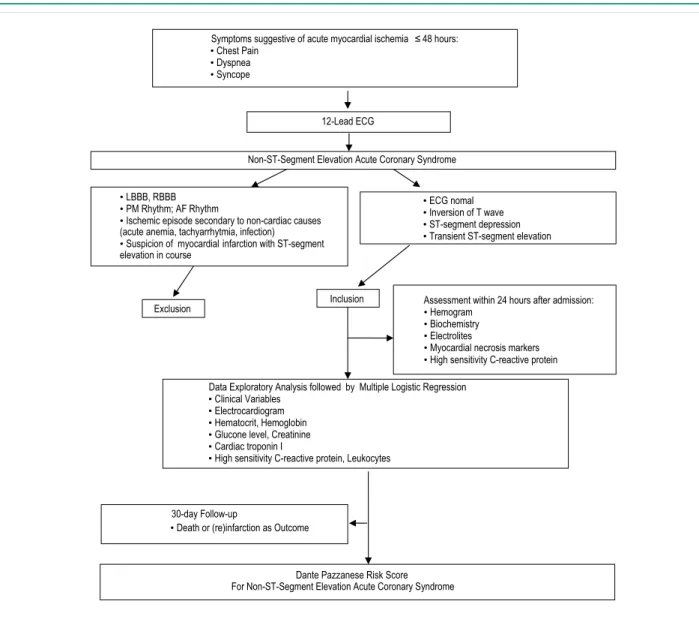
Research design flowchart can be found in Figure 1. Statistical analysis was carried out using SPSS for Windows, Version 13.0 (SPSS Institute, Chicago, IIlinois).
Results
Patients’ Characteristics, Treatment and Course
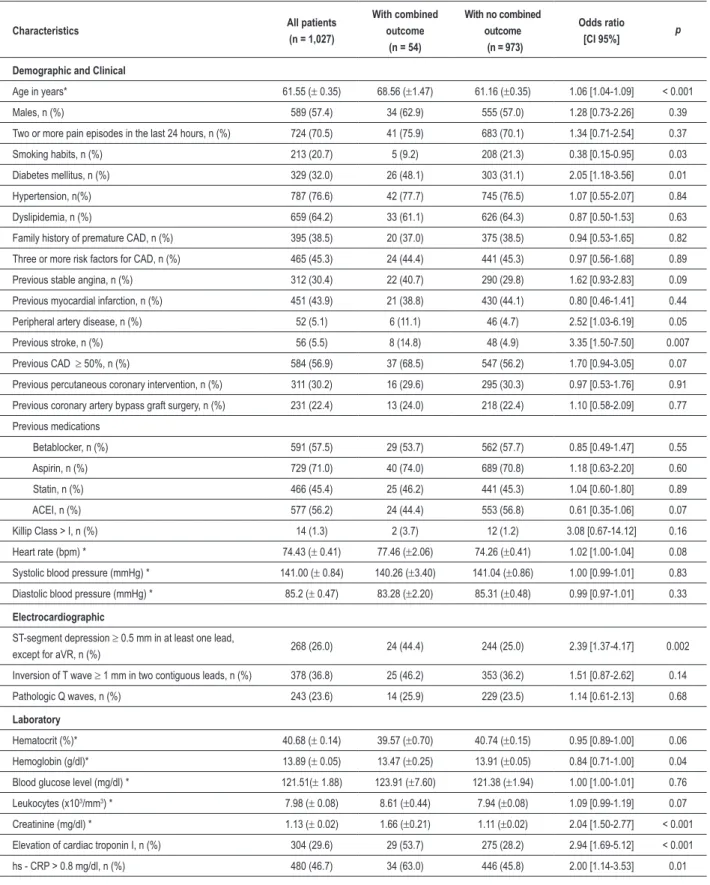
One thousand and twenty nine (1,029) patients were included in the study population. Two patients were lost to follow-up. Therefore, study population included a total of one thousand and twenty-seven (1,027) patients. Table 1 shows a summary of study population baseline characteristics. Five hundred and eighty-nine were males (57.4%), and mean age was 61.55 years of age (± 0.35). Most frequent risk factor for coronary artery disease (CAD) was systemic arterial hypertension followed by dyslipidemia. At admission, 258 patients (25.1%) presented non-ST-segment elevation acute myocardial infarction; 744 (72.4%) presented unstable angina III B; and 25 (2.4%), unstable angina III C in Braunwald’s classification8.
Patients were intensely medicated with betablocker (93.0%), salicylic acetyl acid (97.5%), IV nitroglycerin (94.3%), antithrombinics (84.3%), tienopiridinics (89.5%), angiotensin converting enzyme inhibitors (ACEI [84.1%]) and statin (94.4%).
Cinecoronariography was performed in 734 patients (71.5%). In the population as a whole, PCI was the indication for 276 patients (26.9%), and CABG surgery for 141 (13.7%). When analyzing only the patients who had been submitted to cinecoronariography in the ongoing hospitalization, PCI was indicated for 259 of them (35.3%), and CABG surgery for 114 (15.5%). The procedure was performed in the first in-hospital period in 254 patients (92%) and for 101 patients (71.6%) respectively for those treated with PCI and CABG surgery.
Non-ST-Segment Elevation Acute Coronary Syndrome
• LBBB, RBBB
• PM Rhythm; AF Rhythm
• Ischemic episode secondary to non-cardiac causes (acute anemia, tachyarrhytmia, infection)
• Suspicion of myocardial infarction with ST-segment elevation in course
• ECG nomal
• Inversion of T wave
• ST-segment depression
• Transient ST-segment elevation 12-Lead ECG
Data Exploratory Analysis followed by Multiple Logistic Regression
• Clinical Variables
• Electrocardiogram
• Hematocrit, Hemoglobin
• Glucone level, Creatinine
• Cardiac troponin I
• High sensitivity C-reactive protein, Leukocytes
Assessment within 24 hours after admission:
• Hemogram
• Biochemistry
• Electrolites
• Myocardial necrosis markers
• High sensitivity C-reactive protein Inclusion
Exclusion
Symptoms suggestive of acute myocardial ischemia ≤48 hours:
• Chest Pain
• Dyspnea
• Syncope
30-day Follow-up
• Death or (re)infarction as Outcome
Dante Pazzanese Risk Score For Non-ST-Segment Elevation Acute Coronary Syndrome
Figure 1 - Research design lowchart. LBBB - left bundled branch block; RBBB - right bundled branch block; PM - pacemaker; AF - atrial ibrillation; ECG - electrocardiogram
Data Exploratory Analysis
Table 1 shows data on the results of exploratory analysis of clinical, electrocardiographic and laboratory variables. Many of the variables were associated to the risk of the combined outcome in this analysis.
Multiple Logistic Regression Analysis
In order to identify independent prognostic variables, a multiple regression analysis was performed with variables for a 10% significance level in the exploratory analysis. Gender adjustment was kept in the analysis. The variables that follow have not shown statistic significance in the multiple logistic regression analysis: gender; current smoking habit; previous
stable angina; peripheral artery disease; CAD ≥ 50%; heart
rate; hematocrit; hemoglobin; total leukocyte count; hs - CRP; and ST-segment depression.
Although not statistically significant, ST-segment depression was kept in the final model due to its clinical significance.
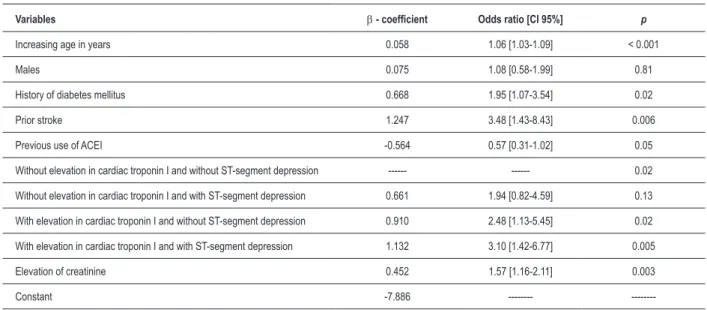
That was seen as the result of the multicollinearity between ST-segment depression and cTnI. The following prognostic variables have been identified: increased age (odds ratio[OR] 1.06; confidence interval [CI 95% 1.03 – 1.09; p < 0.001); previous history of diabetes mellitus (OR 1.90; CI 95% 1.05 – 3.45; p = 0.03); prior stroke (OR 3.46; CI 95% 1.43 – 8.40; p = 0.006); previous use of ACEI (OR 0.57; CI 95% 0.31 – 1.02; p = 0.05); elevation of cTnI (OR 2.06; CI 95% 1.12 – 3.78; p = 0.01); elevation of creatinine (OR 1.58; CI 95%
1.17 – 2.12; p = 0.003); ST-segment depression (OR 1.54;
CI 95% 0.83 – 2.83; p = 0.16).
Table 1 - Baseline Characteristics and Exploratory Analysis of Potential Determinants for the Combined Outcome of Death or (Re)Infarction within 30 days.
Characteristics All patients (n = 1,027)
With combined outcome
(n = 54)
With no combined outcome (n = 973)
Odds ratio
[CI 95%] p
Demographic and Clinical
Age in years* 61.55 (± 0.35) 68.56 (±1.47) 61.16 (±0.35) 1.06 [1.04-1.09] < 0.001 Males, n (%) 589 (57.4) 34 (62.9) 555 (57.0) 1.28 [0.73-2.26] 0.39 Two or more pain episodes in the last 24 hours, n (%) 724 (70.5) 41 (75.9) 683 (70.1) 1.34 [0.71-2.54] 0.37 Smoking habits, n (%) 213 (20.7) 5 (9.2) 208 (21.3) 0.38 [0.15-0.95] 0.03 Diabetes mellitus, n (%) 329 (32.0) 26 (48.1) 303 (31.1) 2.05 [1.18-3.56] 0.01 Hypertension, n(%) 787 (76.6) 42 (77.7) 745 (76.5) 1.07 [0.55-2.07] 0.84 Dyslipidemia, n (%) 659 (64.2) 33 (61.1) 626 (64.3) 0.87 [0.50-1.53] 0.63 Family history of premature CAD, n (%) 395 (38.5) 20 (37.0) 375 (38.5) 0.94 [0.53-1.65] 0.82 Three or more risk factors for CAD, n (%) 465 (45.3) 24 (44.4) 441 (45.3) 0.97 [0.56-1.68] 0.89 Previous stable angina, n (%) 312 (30.4) 22 (40.7) 290 (29.8) 1.62 [0.93-2.83] 0.09 Previous myocardial infarction, n (%) 451 (43.9) 21 (38.8) 430 (44.1) 0.80 [0.46-1.41] 0.44 Peripheral artery disease, n (%) 52 (5.1) 6 (11.1) 46 (4.7) 2.52 [1.03-6.19] 0.05 Previous stroke, n (%) 56 (5.5) 8 (14.8) 48 (4.9) 3.35 [1.50-7.50] 0.007 Previous CAD ≥ 50%, n (%) 584 (56.9) 37 (68.5) 547 (56.2) 1.70 [0.94-3.05] 0.07 Previous percutaneous coronary intervention, n (%) 311 (30.2) 16 (29.6) 295 (30.3) 0.97 [0.53-1.76] 0.91 Previous coronary artery bypass graft surgery, n (%) 231 (22.4) 13 (24.0) 218 (22.4) 1.10 [0.58-2.09] 0.77 Previous medications
Betablocker, n (%) 591 (57.5) 29 (53.7) 562 (57.7) 0.85 [0.49-1.47] 0.55 Aspirin, n (%) 729 (71.0) 40 (74.0) 689 (70.8) 1.18 [0.63-2.20] 0.60 Statin, n (%) 466 (45.4) 25 (46.2) 441 (45.3) 1.04 [0.60-1.80] 0.89 ACEI, n (%) 577 (56.2) 24 (44.4) 553 (56.8) 0.61 [0.35-1.06] 0.07 Killip Class > I, n (%) 14 (1.3) 2 (3.7) 12 (1.2) 3.08 [0.67-14.12] 0.16 Heart rate (bpm) * 74.43 (± 0.41) 77.46 (±2.06) 74.26 (±0.41) 1.02 [1.00-1.04] 0.08 Systolic blood pressure (mmHg) * 141.00 (± 0.84) 140.26 (±3.40) 141.04 (±0.86) 1.00 [0.99-1.01] 0.83 Diastolic blood pressure (mmHg) * 85.2 (± 0.47) 83.28 (±2.20) 85.31 (±0.48) 0.99 [0.97-1.01] 0.33
Electrocardiographic
ST-segment depression ≥ 0.5 mm in at least one lead,
except for aVR, n (%) 268 (26.0) 24 (44.4) 244 (25.0) 2.39 [1.37-4.17] 0.002 Inversion of T wave ≥ 1 mm in two contiguous leads, n (%) 378 (36.8) 25 (46.2) 353 (36.2) 1.51 [0.87-2.62] 0.14 Pathologic Q waves, n (%) 243 (23.6) 14 (25.9) 229 (23.5) 1.14 [0.61-2.13] 0.68
Laboratory
Hematocrit (%)* 40.68 (± 0.14) 39.57 (±0.70) 40.74 (±0.15) 0.95 [0.89-1.00] 0.06 Hemoglobin (g/dl)* 13.89 (± 0.05) 13.47 (±0.25) 13.91 (±0.05) 0.84 [0.71-1.00] 0.04 Blood glucose level (mg/dl) * 121.51(± 1.88) 123.91 (±7.60) 121.38 (±1.94) 1.00 [1.00-1.01] 0.76 Leukocytes (x103/mm3) * 7.98 (± 0.08) 8.61 (±0.44) 7.94 (±0.08) 1.09 [0.99-1.19] 0.07
Creatinine (mg/dl) * 1.13 (± 0.02) 1.66 (±0.21) 1.11 (±0.02) 2.04 [1.50-2.77] < 0.001 Elevation of cardiac troponin I, n (%) 304 (29.6) 29 (53.7) 275 (28.2) 2.94 [1.69-5.12] < 0.001 hs - CRP > 0.8 mg/dl, n (%) 480 (46.7) 34 (63.0) 446 (45.8) 2.00 [1.14-3.53] 0.01
Table 2 - Multiple logistic regression model for Dante Pazzanese risk score
Variables β - coeficient Odds ratio [CI 95%] p
Increasing age in years 0.058 1.06 [1.03-1.09] < 0.001
Males 0.075 1.08 [0.58-1.99] 0.81
History of diabetes mellitus 0.668 1.95 [1.07-3.54] 0.02
Prior stroke 1.247 3.48 [1.43-8.43] 0.006
Previous use of ACEI -0.564 0.57 [0.31-1.02] 0.05 Without elevation in cardiac troponin I and without ST-segment depression --- --- 0.02 Without elevation in cardiac troponin I and with ST-segment depression 0.661 1.94 [0.82-4.59] 0.13 With elevation in cardiac troponin I and without ST-segment depression 0.910 2.48 [1.13-5.45] 0.02 With elevation in cardiac troponin I and with ST-segment depression 1.132 3.10 [1.42-6.77] 0.005 Elevation of creatinine 0.452 1.57 [1.16-2.11] 0.003
Constant -7.886 ---
---CI = Conidence interval; ACEI = angiotensin converting enzyme inhibitor. ST-segment depression was represented by depression ≥ 0.5 mm in at least one lead, except for aVR. = 0.04); elevation of creatinine (OR 1.65; CI 95% 1.24 – 2.22;
p = 0.001); ST-segment depression (OR 1.82; CI 95% 1.01
– 3.28; p = 0.04). The other model was performed without
ST-segment depression: increased age (OR 1.06; CI 95% 1.03 – 1.09; p < 0.001); previous history of diabetes mellitus (OR 1.95; CI 95% 1.07 – 3.52; p = 0.02); prior stroke (OR 3.54;
CI 95% 1.46 – 8.58; p = 0.005); previous use of ACEI (OR
0.58; CI 95% 0.32 – 1.04; p = 0.07); elevation of cTnI (OR
2.27; CI 95% 1.26 – 4.10; p = 0.006); elevation of creatinine (OR 1.59; CI 95% 1.17 – 2.17; p = 0.003). With cTnI not having been included, ST-segment depression was presented as an independent prognostic variable for 5% significance level
(OR= 1.82; CI 1.01 – 3.28; p = 0.04), having been kept in
the final model where ST-segment depression and cTnI were combined (Table 2). The C-statistic for this model was 0.78 (CI 0.71-0.84; p < 0.01), and therefore was used in the Dante Pazzanese Risk Score.
The probability for the occurrence of a combined event was calculated for all patients in the population under study. For easier use of the model without the need of a computer, a score was created with points assigned according to the corresponding probabilities for the combined event in the original model. The lowest probability value was assigned to be = 1; values that were twice as high = 2, and those three times as high = 3, and so on. For continuous variables ranges were determined with values close to same height, twice as high, three times as high, and so on. A point scale was then developed varying from 0 to 30 points. After the final summing up, a score was calculated for each patient. Combined event risk was shown in a graphic. Figure 2 shows Dante Pazzanese risk score points and probability nomogram for combined outcome.
The score of each patient was calculated to assess the effectiveness of the scoring scale in predicting the probability of composite endpoint in the population studied. Combined event probability was observed to increase as scale points
increased. Patients were then ranked following the number of points: very low (up to 5 points); low (6 to 10 points); intermediate (11 to 15 points); high risk (16 to 30 points) for death or (re)infarction within 30 days. The event increased progressively as score risk increased (Figure 3). The area under the ROC (receiver operating characteristic) curve of risk score was compared to the area under the ROC curve of combined event probability within 30 days (Figure 4). The C statistic for the point scale was 0.74 (CI 0.67 – 0.81; p < 0.001), which showed good performance to discriminate those who will present the event and those who will not.
Discussion
The Dante Pazzanese risk score was applied in a single center to a population sharing similar demographic characteristics. Consequently, there was no influence from the study population lifestyle and social class or from the local clinical practice. It was a very simple way to determine the probability for the occurrence of death or (re)infarction within 30 days in patients with non-ST segment elevation acute coronary syndrome. The model incorporated variables that are easily obtained from daily medical practice: age; history of diabetes mellitus and stroke; use of ACEI prior to hospital admission; ST-segment depression shown in ECG at admission; cTnI; creatinine level.
Unlike other clinical trials that select patients at higher risk, our population was enrolled consecutively. The use of selected populations implies higher probability of permanence in the final model of the variables that are part of the study population inclusion criteria.
2%
6%
15%
47%
0% 5% 10% 15% 20% 25% 30% 35% 40% 45% 50%
up to 5 points 6 to 10 points 11 to 15 points 16 to 30 points
Figure 3 - Internal Validation of Dante Pazzanese risk score.
1 - Specificity 0,0
0,2 0,4 0,6 0,8 1,0
S
en
si
tiv
ity
Risk of death or (re)infarction event within 30 days Score (POINTS)
Reference line
0,0 0,2 0,4 0,6 0,8 1,0
Figura 4 - Areas under ROC (receiver operating characteristic) curve for the probability of death or (re)infarction within 30 days, and of Dante Pazzanese risk score.
Dante Pazzanese Risk Score for Non-ST-Segment Elevation Acute Coronary Syndrome
Clinical History
1) Age in years
<40...0
40<50...1
50<60...2
60<70...3
70<80...4
80<90...7
≥90...9
2) Past History Diabetes mellitus…...2
Stroke………...…...4
Previous medication Non-use of ACEI ...1
4) Cardiac troponin I and ECG Without elevation in cardiac troponin I and without ST-segment depression...0
Without elevation in cardiac troponin I and with ST-segment depression...1
With elevation in cardiac troponin I and without ST-segment depression...3
With elevation in cardiac troponin I and with ST-segment depression……...….4
• • • • 5) Serum creatinine (mg/dl) <1...0
1<2...1
2<4...4
≥4 ………...…………10
Total sum of points in each item
1) ___________________________ 2) ___________________________ 3) ___________________________ 4) ___________________________ 5) ___________________________
Total risk score
_____________ (0 to 30 points )
P
robabi
lity
of
30-day
death or (re) i
nfarc
tion
1,00
0,80
0,60
0,40
0,20
0,00
0 5 10 15 20 25 30
Dante Pazzanese Risk Score
Probability of combined event within 30 days
Figure 2 - Dante Pazzanese risk score and nomogram for the probability of death or (re)infarction events within 30 days. ACEI = angiotensin converting enzyme inhibitor; ECG= electrocardiogram.
significance level. In TIMI2 risk score variables were selected with significance level < 20%. In GRACE11 risk score variables were selected with significance level < 25%.
each point range, and never narrowed down to one sole cutt-off point.
The isolated analysis of risk factors showed that diabetes mellitus is an independend prognostic variable, which was consistent with previous reports ranking it as a key risk factor for cardiovascular morbidity and mortality13.
A history of stroke, transient ischemic attack and peripheral artery disease are associated to CAD and its wider-reaching extension14,15. Those clinical conditions affect chronic CAD patients negatively16. In the OPUS TIMI 16 study, investigators concluded that patients with both acute coronary syndrome and extracardiac vascular disease show an association with more severe CAD and worse outcomes. Those patients have probably received less aggressive treatment, which partially explains the higher
occurrence of adverse outcomes17. In the Dante Pazzanese
risk score, previous stroke was considered a factor for worse prognosis, having been kept in the final model. A history of peripheral artery disease was shown to be a prognostic variable in the exploratory analysis but not in the multiple logistic regression analysis.
Previous use of ACEI was a predictive variable for better prognosis, strongly pointing towards favorable results. Reports on the use of ACEI by patients with stable CAD under heart failure condition and left ventricle dysfunction have been published elsewhere3. Metanalysis from three prestigious studies18 has demonstrated that this drug class also reduces major cardiovascular events in atherosclerotic patients with no evidence of left ventricle systolic dysfunction or heart failure. The Dante Pazzanese risk score identified non-administration of ACEI prior to hospital admission as a factor for event occurrence.
The use of ST-segment depression ≥ 0.5mm was based
on previous reports19-21. At a first moment, ST-segment depression was not observed to be a prognostic variable at 5% significance level. That allowed the assessment of the possibility of multicollinearity22,23 between cTnI and ST-segment depression, through a separate analysis of two independent models – those variables were not included in one of them. ST-segment depression emerges as an independent variable when cTnI is not included in the model. The phenomenon may not have been observed in previous models due to the fact that those variables are part of the inclusion criteria for the study population, thus making it easier to keep them in the final model. In the present study the authors chose to include the combination between the two variables, considering that one potentializes the effect of the other.
In patients under acute chest pain, high levels of cTnI within the first 24 hours have been associated to the risk for acute myocardial infarction and of major cardiac events24. In the Dante Pazzanese risk score, cTnI increase showed to be an independent variable for worse prognosis.
Renal dysfunction is recognized as high risk for acute coronary syndrome patients25. It has proven to be a prognostic variable in one of the models published11. In the Dante Pazzanese risk score the absolute value of creatinine accummulation was an independent prognostic variable for worse prognosis. For better applicability, it was categorized in risk ranges. The higher creatinine accummulation the higher the probability of unfavorable results.
The Dante Pazzanese risk score reported good performance, thus justifying its applicability. It should be calculated at hospital admission and updated during hospital stay. It may be used for therapeutic decision-making. As any other risk stratification model, it should be subject to future reassessment, so that existing variables can be re-analyzed and new variables may be incorporated.
Study Limitations
The present study presents some limitations. The cTnI was assessed as qualitative variable. Quantitative analysis would imply an assessment of myocardial necrosis extension for the risk of adverse events. Serial ECG recordings were not obtained. The analysis of ischemic changes that may occur in other ECG recordings after the baseline ECG provides valuable data to be investigated and that could predict potentially unfavorable outcomes. The Dante Pazzanese risk score should not be applied to patients with changes confounding the ECG pattern (pacemaker rhythm, atrial fibrillation rhythm, bundled branch block). This group of patients would need new statistical analysis for the selection of specific prognostic variables.
Conclusion
An easy-to use risk stratification score was developed in a brazilian population with non-ST-segment elevation acute coronary syndrome. Easily applicable, it holds high predictive value for cardiovascular events. It may serve as source of information for medical teams, and for patients and their famliers as relevant prognostic assessment.
Potential Conflict of Interest
No potential conflict of interest relevant to this article was reported.
Sources of Funding
There were no external funding sources for this study.
Study Association
1. Laurenti R, Buchalla CM, Caratin CVS. Doença isquêmica do coração: internações, tempo de permanência e gastos. Brasil, 1993 a 1997. Arq Bras Cardiol. 2000; 74 (6): 483-7.
2. Antman EM, Cohen M, Bernink PJLM, McCabe CH, Horacek T, Papuchis G, et al. The TIMI risk score for unstable angina/non-ST elevation MI: a method for prognostication and therapeutic decision making. JAMA. 2000; 284: 835-42.
3. Anderson JL, Adams CD, Antman EM, Bridges CR, Califf RM, Casey Jr DE, et al. ACC/AHA 2007 Guidelines for the management of patients with unstable angina/non ST-elevation myocardial infarction: a report of the American College of Cardiology/American Heart Association Task Force on Practice Guidelines (Writing Committee to Revise the 2002 Guidelines for the Management of Patients With Unstable Angina/Non ST-Elevation Myocardial Infarction): developed in collaboration with the American College of Emergency Physicians, the Society for Cardiovascular Angiography and Interventions, and the Society of Thoracic Surgeons: endorsed by the American Association of Cardiovascular and Pulmonary Rehabilitation and the Society for Academic Emergency Medicine. Circulation. 2007; 116 (7): e148-304.
4. Boersma E, Pieper KS, Steyerberg EW, Wilcox RG, Chang WC, Lee KL, et al. Predictors of outcome in patients with acute coronary syndromes without persistent ST-segment elevation: results from an international trial of 9461 patients. The PURSUIT Investigators. Circulation. 2000; 101: 2557-67.
5. Cannon CP. Evidence-based risk stratification to target therapies in acute coronary syndromes [editorial]. Circulation. 2002; 106: 1588-91.
6. Bassand JP, Hamm CW, Ardissino D, Boersma E, Budaj A, Fernández-Avilés F, et al. Guidelines for the diagnosis and treatment of non-ST-segment elevation acute coronary syndromes. The Task Force for the Diagnosis and Treatment of Non-ST-Segment Elevation Acute Coronary Syndromes of the European Society of Cardiology. Eur Heart J. 2007; 28: 1598-660.
7. Santos ES, Minuzzo L, Pereira MP, Castillo MT, Palacio MA, Ramos RF, et al. Registro de síndrome coronariana aguda em um centro de emergências em cardiologia. Arq Bras Cardiol. 2006; 87 (5): 597-602.
8. Braunwald E. Unstable angina: a classification. Circulation. 1989; 80: 410-4.
9. Califf RM, Abdelmeguid AE, Kuntz RE, Popma JJ, Davidson CJ, Cohen EA, et al. Myonecrosis after revascularization procedures. J Am Coll Cardiol. 1998; 31: 241-51.
10. Harrell Junior FE, Califf RM, Pryor DB, Lee KL, Rosati RA. Evaluating the yield of medical tests. JAMA. 1982; 247: 2543-6.
11. Eagle KA, Lim MJ, Dabbous OH, Pieper KS, Goldberg RJ, Van de Werf F, et al. A validated prediction model for all forms of acute coronary syndrome: estimating the risk of 6-month postdischarge death in an international registry. JAMA. 2004; 291: 2727-33.
12. Stone PH, Thompson B, Anderson HV, Kronenberg MW, Gibson RS, Rogers WJ, et al. Influence of race, sex, and age on management of unstable angina and non-Q-wave myocardial infarction: the TIMI III registry. JAMA. 1996; 275: 1104-12.
13. Roffi M, Chew DP, Mukherjee D, Bhatt DL, White JA, Heeschen C, et al.
References
Platelet glycoprotein IIb/IIIa inhibitors reduce mortality in diabetic patients with non-ST-segment-elevation acute coronary syndromes. Circulation. 2001; 104: 2767-71.
14. Love BB, Grover-McKay M, Biller J, Rezai K, McKay CR. Coronary artery disease and cardiac events with asymptomatic and symptomatic cerebrovascular disease. Stroke. 1992; 23: 939-45.
15. Hirsch AT, Criqui MH, Treat-Jacobson D, Regensteiner JG, Creager MA, Olin JW, et al. Peripheral arterial disease detection, awareness, and treatment in primary care. JAMA. 2001; 286: 1317-24.
16. Reicher-Reiss H, Jonas M, Tanne D, Mandelzweig L, Goldbourt U, Shotan A, et al. Prognostic significance of cerebrovascular disease in 11.526 chronic coronary artery disease patients. Bezafibrate Infarction Prevention (BIP) Study Group. Am J Cardiol. 1998; 82: 1532-5, A7.
17. Cotter G, Cannon CP, McCabe CH, Michowitz Y, Kaluski E, Charlesworth A, et al. Prior peripheral arterial disease and cerebrovascular disease are independent predictors of adverse outcome in patients with acute coronary syndromes: are we doing enough? Results from the Orbofiban in Patients with Unstable Coronary Syndromes-Thrombolysis In Myocardial Infarction (OPUS-TIMI) 16 study. Am Heart J. 2003; 145: 622-7.
18. Dagenais GR, Pogue J, Fox K, Simoons ML, Yusuf S. Angiotensin-converting-enzyme inhibitors in stable vascular disease without left ventricular systolic dysfunction or heart failure: a combined analysis of three trials. Lancet. 2006; 368: 581-8.
19. Cannon CP, McCabe CH, Stone PH, Rogers WJ, Schactman M, Thompson BW, et al. The electrocardiogram predicts one-year outcome of patients with unstable angina and non-Q wave myocardial infarction: results of the TIMI III Registry ECG Ancillary Study. Thrombolysis in Myocardial Ischemia. J Am Coll Cardiol. 1997; 30: 133-40.
20. Hyde TA, French JK, Wong CK, Straznicky IT, Whitlock RM, White HD. Four-year survival of patients with acute coronary syndromes without ST-segment elevation and prognostic significance of 0.5-mm ST-segment depression. Am J Cardiol. 1999; 84: 379-85.
21. Savonitto S, Cohen MG, Politi A, Hudson MP, Kong DF, Huang Y, et al. Extent of ST-segment depression and cardiac events in non-ST-segment elevation acute coronary syndromes. Eur Heart J. 2005; 26: 2106-13.
22. Marill KA. Advanced statistics: linear regression. Part II: multiple linear regression. Acad Emerg Med. 2004; 11: 94-102.
23. Slinker BK, Glantz SA. Multiple linear regression: accounting for multiple simultaneous determinants of a continuous dependent variable. Circulation. 2008; 117: 1732-7.
24. Polanczyk CA, Lee TH, Cook EF, Walls R, Wybenga D, Printy-Klein G, et al. Cardiac troponin I as a predictor of major cardiac events in emergency department patients with acute chest pain. J Am Coll Cardiol. 1998; 32: 8-14.