DOI: 10.1590/1809-5844201729
Anelisa Maradei Marli dos Santos
(Universidade Metodista de São Paulo, Escola de Comunicação, Educação e Humanidades, Programa de Pós-Graduação em Comunicação Social. São Bernardo do Campo – SP, Brasil)
Abstract
This article aims to identify the social actors and the content of the demonstrations on Twitter about the gang rape occurred with a Brazilian teenager in 2016. We collected 200 tweets between May 25 and 28, 2016, according to the participation after the fact and at the time of highest views in this social network. Through the content analysis of tweets and retweets, we found a majority trend against gender discrimination in the sample studied. There were some opinions that relativized the crime, which indicates a sexist view on the matter by some social actors. The demonstrations are generally independent, although there is the presence of women’s groups and opinion makers. Most of recirculated contents on Twitter was produced by mainstream news media.
Keywords: Digital Public Sphere. Gender. Social Actors. Twitter. Rape.
Introduction
Data collected worldwide about rape are worrisome. The UN report - United Nations, reveals that about “120 million of young women in the world, the equivalent to one in ten, was a victim of rape or harassment until the age of 20” (BRASIL POST, 2014).
This data refers not only to poor countries, but also to rich countries. In a report produced by Cerqueira and Coelho (2014) for Ipea (Institute for Applied Economic Research), it is stated that in countries such as USA, for instance, the rates for 2006 showed that 0,2% of people were raped per year in that country, the majority of them (two thirds), being women. In Brazil, the same report shows that 0.26% people per year are raped. In other words, 527 thousand people suffered rape attempts or were raped. Only 10% of those cases are registered in police stations, according to the report.1
Researchers who elaborated the Ipea report clarify that previous data may be biased,
once there is a dramatic difference regarding notiications of rape attempts or consumed
rapes in municipalities that have healthcare centers compared to those that do not have. The report reveals that in 2011, in 3.901 Brazilian municipalities with less than 20 thousand
inhabitants and that probably did not have healthcare centers, the notiications ratio falls to
a quarter of the population. In the 2.113 municipalities that offer this specialized service, the ratio goes up to three quarters, almost 75% (CERQUEIRA; COELHO, 2014).
The study also reveals the victims and offenders’ proiles. For the victims, notiications show that 88.5% were women, 70% children and adolescents. Data showed
that 51% of those who suffered the violence are black or pardos2 and 46% have completed elementary school (CERQUEIRA; COELHO, 2014, p.7). Still, according to Cerqueira and Coelho (2014, p.9), regarding the offenders, the overwhelming majority are men, and there is a slight variation on the crime nature towards children, when approximately 92% are men; in the case of adolescents and adults, the rate goes up to 96%. A little more than 56% of children’s offenders are the parents or acquaintances of the victim, with 1.8% being women (p.9). The older the victim is, the greater are the chances of this offender being a stranger. Between 20 and 40% of cases, rape is associated to alcohol ingestion (p.10). Another relevant data is that the number of offenders is “bigger when the victim is an adolescent (...) 15% of rapes registered in Sinan - Brazilian Case Registry Database, of the Ministry of Health, were committed by two or more offenders” (p.8).
Before implementing the Law n° 12.015, as of August 7, 2009, rape was not acknowledged as crime “against sexual dignity and liberty”, but as against the morals, what means a great advancement regarding the rights of victims from sexual crime, including the LGBTQ (PRESIDÊNCIA DA REPÚBLICA, 2009).3
According to the Superior Court of Justice, “the crime of rape is heinous, even when not causing death or severe injury on the victim”. In 2013, decisions all over the country
were uniied about the seriousness of those acts, resulting in stiffer penalties to the offenders.
Before that, the Law 11.340, as of August 7, 2006, known as Maria da Penha, was a progress regarding crimes of domestic and family violence against women (JUSBRASIL, 2006).4
2 Color or Race - characteristic declared by people according to the following options: white, black, yellow, pardo (a designation used in Brazil to characterize mixed races, generally with darker skin tones) or indigenous, according to IBGE - Brazilian Institute of Geography and Statistics. More information available at: <http://www.ibge.gov.br/home/estatistica/populacao/condicaodevida/indicadoresminimos/ conceitos.shtm>. Accessed on: August 4, 2017.
3 LGBTQ stands for lesbian, gay, bisexual, transgender, and queer. More information available at: <https://www.plannedparenthood. org/learn/teens/lgbtq>. Accessed on: August 4, 2017.
However, on May 25, 2016, a crime was not restricted to the anonymity of the domestic setting. This time, the image of a naked 16 years-old female adolescent, lying unconscious on a bed, in a house in Morro São João, in Praça Seca, West Zone of Rio de Janeiro. She was victim of group rape and that image was rapidly spread on the Internet. Right after the images were disclosed, a torrent of protests invaded the digital social networks, newspapers, news radio and TV stations of the mainstream media, and the streets. According to the newspaper O Globo, “Many Internet users have changed their proile
pictures for images related to the matter, as in an unintentional campaign. The hashtag ‘#Estupro’ (#Rape) has become a trending topic in the country.” (RESENDE, 2016)
The theme caught our attention for its nature (being a rape); for the fact that the offenders disclosed videos of the crime on social media, causing a national and international commotion; for involving gender matters and a teenager; for the presence of multiple social actors that expressed themselves about the occurred on social media, especially on Twitter. Therefore, we sought he social actors in our research and their arguments used to discuss the crime, including in our observations the role of the media in this scenario For doing so, we carried out a qualitative and quantitative research, using the technique of content analysis on the messages posted on Twitter between May 25 and 28, 2016.
In the procedure of collecting posts, we considered the hashtag #estuprocoletivo
(#gangrape), created to assort content in categories on Twitter. 200 posts and their respective
ramiications were analyzed during four days (May 25 to 28, 2016). The details of the
analysis categories will be presented in topic 4.
As theoretical references, we take the concepts of “social actors”, according to Crozier and Friedber, cited by Dubar (2004), and Bourdieu and Torraine, cited by Ferreira (2017), to identify the authors of the posts; of gender, having in mind the power and domination relations between men and women, according to Bourdieu (2002), Scott (2016) and Gomes (2008); and of public sphere, to discuss the role of social media and the opinion formation, according to Habermas (2003), Fuchs (2015) and Castells (2013, 2015).
A naked body
The naked and unconscious body of the 16 years old teenager was laying on a bed, in a place called “slaughterhouse”, exposed to thousands of people on digital social media, beside a man that was saying: “more than 30 has made her pregnant [the adolescent]”. This scene reveals the subjugation of a women’s body that, according to Bourdieu (2002, p.13) is “a product of domination” made natural by its appearance.
dominants and those that are most frequent among the subdued (fat/thin, big/small, polite/ rude, light/heavy, etc.)”, complementing the list, men/women (BOURDIEU, 2002, p.76).
In this sense, the sociologist considers that the body experience the enforcement of the “socially demanded body” and the “practical relation with his/her own body imposed by the others’ looks and reactions”, creating “the disturbed body”, which uneasiness is bigger or smaller according to “sex and status in the social space” (BOURDIEU, 2002, p.77).
The disturbed body suffers symbolic violence, and the other types of violence, arises from the place it occupies in the social space, as said before. It is important to consider that the domination relations are associated to the socially imposed body, which means that men and women are victims of gender violence. To assume that is to extrapolate the association between sex and gender that Bourdieu (2002) communicate in his conceptions about male domination. It is necessary to consider that when a dissonance between the social perception imposed over the body and the gender identity occurs, it is not possible to consider gender and sex as similar categories.
In this sense, Scott (2012) highlights that “The use of ‘gender’ places emphasis upon a whole system of relations that may include sex, however it is not directly determined by sex nor directly determine sexuality” (p.7).
Following Scott’s example, who considers the “gender” category useful to discuss historical power and domination relations between men and women, instead of opposing male and female, Gomes (2008, p.238) analyzes that the expression “gender violence” comprehends much more complexity of violence relations between men and women, considering as scope” the manliness models that may structure violence in the gender relations”. The author dissociates sex from gender, in Scott’s perspective, emphasizing “a
more ampliied comprehension of those facts, situating in the scenario of gender relations
that may produce/reproduce violence”.
In the case of gender violence, it is necessary to consider, in this article, that despite the fact of dealing with gang rape against an adolescent, “locking certain characteristics
as exclusive of a speciic gender”, may “conigure as one facet of violence” (GOMES,
2008, p.238-239). Therefore, what must be taken into account in our observations is that, historically, women suffer violence for being associated to the “binomial mother and prostitute”, quoted by Simone de Beauvoir, which origins is in the “premise of heterosexuality and in the institutional matrix of patriarchate”, as analyzed by Swain (2011). The author also mentions that “maternity would be her destiny and her transcendence, and prostitution is the immanence in the impurity of her sex” (SWAIN, 2011).
This binomial is relected in criminal attitudes that occurred against women and men
‘categorize the individual’, make him/her a hostage of their own identity, ‘impose a law of truth’, that the individual and the others shall recognize”.
Social networks and social actors in the public sphere
Matters related to sexual violence, in the speciic case of feminine sexual violence,
are complex. The analyzed case becomes even more relevant for concerning an underaged woman exposed to the frenzy scenario of social digital media. Therefore, this study stimulates the debate so we can visualize how violence situations are handled in the contemporary public, impacted by the reality of new communication and information technologies. The present has new dynamics that allow the exposition of women, as we will observe in the case at hand. But the same public sphere that exposes women also opens space for them to protect and pursue their rights, which creates debate groups and impact phrases in electronic lists that emphasize women’s empowerment.
This way, it is necessary to revisit the public sphere concept, created by Habermas in 1961, understood as the public space between the State and the civil society, in which citizens make their statements, augmenting about public interest matters5 (HABERMAS, 2003). Nowadays, the debates about the concept are relighted, since the use of social medias in the Internet can mean the possibility of constituting a new space where public opinion may can freely manifested, or, at least, in alternative ways.
The press was considered by Habermas as one of the pillars to conigure the public
sphere in the XVIII century, once intellectuals took positions against monarchists and the Church and stated them in newspapers - a moment that marked the beginning of idealist press, or the press of ideas. With the advent of the modern press or merchant press (MARCONDES FILHO, 2000), the newspapers contribution for the formation of public opinion was questioned, as the news industry works under the capital sign, which has commercial interests.
This is the perspective of Thompson (2014), who criticizes the initial concept of public sphere, proposed by Habermas, reminding us that:
The media commerce deeply changes its character: what before was an exemplar forum of critical-relational debates has solely become a cultural consumption domain, and the bourgeoisie’s public sphere becomes empty in an unreal world of images and opinions. (THOMPSON, 2014, p.109).
However, Thompson’s great merit was the perception that the media does not determine what people think. To the author (2014, p.67): “Even if the individuals have little or no control over the contents of symbolic news that are offered to them, they can use, work and re-elaborate them in completely extraneous ways to those intentions or goals of producers”. This is what we will also propose to observe in this article, bearing in mind
the recirculation of news in online social media, crossed and reconigured by opinions of
social actors.
Online social media will be here seen as a public communicational space/process, despite the contradictions inherent to the very cyberspace, that is occupied by big technology and information companies, in which access and comprehending conditions are not equal among citizens. Fuchs (2015) criticizes the idealistic interpretations of the public sphere concept. To him, some authors, such as Benkler and Castells “focus on political and cultural communication and ignore the materiality of the public sphere and political economy that Habermas emphasized” (FUCHS, 2015, p.7).
Although we do not totally agree with Fuchs, because we believe that Castells brought
this dimension in his relections, there is a consideration that we have to include. Fuchs
(2015, p.8) arguments that some approaches do not ask: “Who owns Internet platforms? Who owns social media?”.
In his article for the Contracampo Journal, “Social Media and the Public Sphere” (2015), the author tries to answer those and other questions. He broadly discusses the digital
public sphere concept, starting from the veriication that modern society is divided into
different spheres: economic, political and cultural, which are all connected. Those three
spheres correspond: the irst to the “production of use value”; the second to “collective
decisions”; and the third, the cultural, is the sphere in which “social meanings and moral values are created”. The “public sphere/civil society” connect those divisions and “creates an overlapping between the public sphere and those areas: sociopolitical, socioeconomic, and sociocultural spheres”. For him, in modern society model “the relation between structures and actors is dialectical”, in which “both levels continuously create one another” (FUCHS, 2015, p.12).
In these dynamics, apart from division and relation between spheres, there is also the segregation of roles and the “creation of power structure (for instance, employer-employee, bureaucracy of state-citizen, citizen of the nation-immigrant, manager-assistant, roles of dominant gender, and sideline genders roles)” (FUCHS, 2015, p.13-14). The power is connected to structure control and their possession; the individuals organize themselves and act toward self and social group’s interests that represent them. However, it is possible
to exist conlicts and disputes in the three spheres of modern society.
But if there are losses and conlicts in contemporary public sphere, there are also gains.
considers that the conlicts in societies are signs of power relations where there are powers
and counter-powers. According to the author, social networks are an opportunity for all social actors to question the institutions’ power, claiming their rights, interests and values.
As shown in this study, not only the institutions’ power, but also the values that emerge from those institutions are suffering impact by the networks. The author, on dealing with power relation matters and disputes that are shaped in the contemporary public sphere,
plot a social and cultural contextualization, relecting in the sense that both the domination
dynamics and the resistance to domination depend nowadays on network formation and strategies of attack and defense. Consequently, the networks process the daily contradictions, in other words, male chauvinism, the patriarchal society, violence against women, prejudice, but also tolerance, citizenship, empowerment.
For Castells (2015, p.59), today, sources of social power are not different from our historical experience, but the terrain where power relations operate has changed. This says the author, is due to a new organization of social actors: “Meaning is constructed within society by means of communication process” (CASTELLS, 2015, p.59). Legitimacy depends on the consent obtained by the construction of meaning. Thus, a point of view is built around the values and interests of citizens expressed through debate in the digital public sphere. There is, however, the ability of citizens to produce content, even if that content and ambience deserve to be assessed.
For example, societies are unequal. Therefore, participation and access are also unequal in the public sphere. Habermas (apud FUCHS, 2015, p.17) also expressed his concerns about “economic colonization of the world of life” and “feudalization of the media system”. In the case of online social networks, the allotment made by large IT companies may also mean “feudalization of the media system” (p.6) (to use the term coined by Habermas), which in this case occurs through companies that primarily have a vocation for technology and information, not by traditional communications companies.
Gradually, I.T. companies incorporate communication functions that have become tools offerings, such as blogs, social networks, appropriated as public spaces by social actors. In them, power relations can be shaped and confronted, especially in the case of controversial themes, of social events, for which immediate position is required. During these events, the social agents do not just distribute information, but there is interactivity. The actors in the networks extrapolate the virtual universe and materialize themselves in the streets, bars, universities. Today, there are new actors on the scene who have appropriated their own causes.
The actor in the digital public sphere
to seize opportunities, as Dubar analyzes (2004, p.59), taking into consideration the work of Crozier and Friedber, “The Actor and the System” (2004). The actor acts in a context named
“concrete action system”, being “concretely [deined] by its position and power dynamics in
this system” (CROZIER; FRIEDBER, 2004, apud DUBAR, 2004, p.60).
Ferreira (2017), in her article “Similar to same, different to similar: subject, actor, agent and protagonism”, cites Touraine (1998) and Bourdieu (1983) to approach the
subject. The differences between two sociologists, says the author, is that the irst considers
social actor as an agent committed to political, economic and gender causes, seeking to have control over its own existing conditions; while for the second one, “social actors” are immersed in their “habitus”, built in the social ield in which they act, occupying some
positions that reveal domination relations (p.8).
In this article, we assume that the actors in social media can be agents of change at the same time that they also reproduce values, rules and dominations relations.
Having in mind the theoretical approach adopted, we present the procedures of posts capturing in Twitter for this study. Twitter was chosen for being used by journalists, citizens and organizations. 50 posts were selected per day, in the period between 25 and 28 May, 2016, which was observed as the moment with the higher number of posts. The time for the collection of the posts was from 11:00 to 11:30 p.m. The option for the night time was due to the fact that, according a study by Sprinklr, this is primetime in terms of number of people on Twitter (HORÁRIOS NOBRES, 2016)6. To collect the data, we used the Scup search tool7. Because the collection took place after the occurred, some critical posts were deleted. Even so, it was possible to observe the moves of the social actors and the trend in the manifestations.
To collect the data, we used the search engine Scup. Due to the collection occur after the period, some more critical posts were removed from the social network, even so, it was possible to observe the movement of social actors and the trend of manifestations.
The tool contributed to deine the sample studied: delimitation of more expressive
time and days in terms of posting. However, the qualitative research required the post-to-post reading for the analysis, according to previously established categories: 1) posts with retweets (to verify if the posts were original or derived from other social actors, such as opinion leaders, institutions etc.); 2) posts with content linked to the mainstream press (to observe the presence of press means in the social actors’ posts, through links from TV stations, portals and printed newspapers); 3) the approach of the posts, being divided into six subcategories: posts with commentaries (no value judgment expressed in relation to rape); posts with critical content
6 HORÁRIOS nobres. Sprinklr. 2015. Available at: <https://www.sprinklr.com/pt-br/horarios-nobres-redes-sociais/>. Accessed on: July 03, 2017.
(when there is a judgment or positive or negative elaboration regarding the subject); posts with expressions of sadness (expression sadness feelings for what happened); posts of awareness/ solidarity (expressions of solidarity towards the victim or expressions of awareness attitudes regarding rape culture); posts with satire and surveys (there were people who launched in the network a kind of research on the subject, in order to know the actors’ positions on the matter). Finally, two last categories: 5) gender and 6) social actors.
As Fragoso, Recuero and Amaral (2012, p.15) suggest, social research has always
been dificult, and the possibility of being able to observe society on a broad scale has always
seemed remote. In this sense, “Internet has given social scientists a gift”. Today we can see more interactions than we ever expected on issues such as violence, male chauvinism, rape culture, among many others.
Bardin (2010, p.38) deines content analysis as “a research technique whose
purpose is the objective, systematic and quantitative description of manifest content in communication”. Thus, the choice for content analysis is because this method allows us not only an in-depth analysis of the posts, but also the social articulations through the messages exchanged by the citizens. Complementing the content analysis, the authors sought the origin of the posts (information, ideas and comments) in tweets with retweets, to identify the dynamics of the circulation and recirculation of these contents.
About Retweets (or re-posting)
It was found that in addition to rely on retweets8, social actors were based on third-party Twitter links to guide their manifestations on the topic. They also relied on news videos or testimonials from other agents, as well as news from the mainstream press. Retweet is a
irst indication of how people communicated on the network about the gang rape. In table 1
we show the number of retweets per day in the 200 tweets analyzed:
Table 1 – Retweets
May 25 May 26 May 27 May 28
26 retweets 14 retweets 12 retweets 24 retweets
Source: Own elaboration.
Example of a recurring retweet compared a gang rape occurred in India and what happened in Brazil, “RT @XXXXXX 3: Gang rape in India, “that’s horrible! Those Indians are savages! Gang rape in Brazil: ‘But she must have teased them...’”9
Of 200 tweets we found 76 from retweets, that is, 38% of the demonstrations were referring to recirculated tweets from other actors, showing how people in the network are being guided by other actors. In addition to retweets, they use website links or other tweets and shortened links for news stories to express and reinforce ideas, re-circulating information and standpoints from third parties.
The posting of news and video links may be recurrent due to the limited character space on Twitter (140), or a sign of lack of initiative of the social actors to get involved in deepening the debate. However, it is not possible to be conclusive on this issue.
Here are some examples of the behavior of social actors in posts:
Figure 1 – Post with news link, May 25, 201610
Source: Twitter.
In Figure 1, there is the indication of the topic debated and the effective information is given by the newspaper’s article. The social actor acts as an intermediary to promote the motivation of the debate on the investigation of collective rape.
Similarly, in the following case, a social agent sends a retweet of a report stating that the police demand the arrest of suspects, and to give additional information to the reader, adds the report of the portal Veja.com. In this case, there is the use of two elements to compose the information passed forward: retweet + news: “RT @XXXXXX: Police order the arrest of four suspects of collective rape in Rio http://veja.abril.com.br/News/brazil/ police-asks-the-prison-of-four-suspect-of-rape-collective-in-rio via @veja”.
The news published on the mainstream media were also guiding the content that circulated on the social network Twitter. They have been propagated from video links,
newspaper portals, websites, and even their oficial social media networks. There were 82
reports that appeared through links and retweets. Below, we present the media that were
mostly present in our sample, with highlights for R711 (Rede Record portal), with 21% of the posts, and TV UOL (internet) 12, with 44% of the total.
Graph 1 – Presence of communication media in posts
Source: Own elaboration.
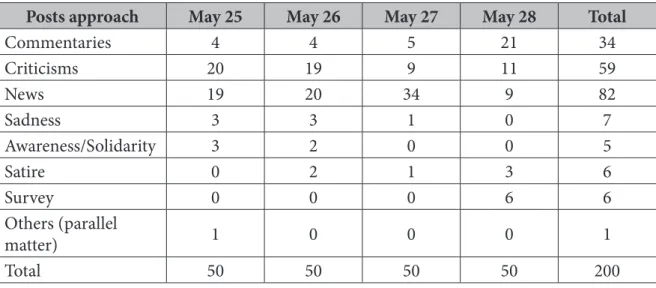
Posts approach
Regarding the type of commentary in Twitter during the analyzed period, we took into consideration eight types of approach, categorized after the observations. We saw that the types of approaches vary from commentaries (more neutral posts that simply reproduce information), criticisms (mainly show favorable or unfavorable positions regarding the fact, the criminal behavior or the victim), news (reproduce news of communications means), sadness (expressions of sadness regarding the fact), awareness/solidarity (expressions of solidarity and concerns regarding the exposition of the victim) satires (regarding the situation, the crime, the criminals) and surveys (questions asked based on the fact for Twitter users. In Table 2, we synthetized the observed trends.
11 R7 or R7.com is a portal of news and entertainment that belongs to the Record Communication Center. Internet address: <www. r7.com>.
Table 2 – Twitter approaches
Posts approach May 25 May 26 May 27 May 28 Total
Commentaries 4 4 5 21 34
Criticisms 20 19 9 11 59
News 19 20 34 9 82
Sadness 3 3 1 0 7
Awareness/Solidarity 3 2 0 0 5
Satire 0 2 1 3 6
Survey 0 0 0 6 6
Others (parallel
matter) 1 0 0 0 1
Total 50 50 50 50 200
Source: Own elaboration.
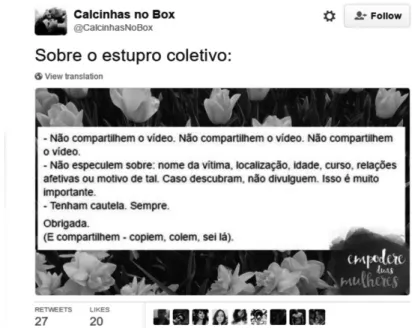
Figure 2 – Example of Post of Awareness/Solidarity13
Source: Twitter.
In the Post Approach, Criticism subcategory, both the favorable comments to the rape culture and the unfavorable ones were analyzed, as follows in Table 3, below.
Table 3 – Breakdown of Critical Posts
Date Posts with Criticism Against rape * In favor of rape ** Others ***
May 25 20 17 3 0
May 26 19 19 0 0
May 27 9 8 1 0
May 28 11 8 1 2
Total 59 posts 52 posts 5 posts 2 posts
Source: authors’ elaboration.
* Against the culture of rape or against violence against adolescents and children. ** In favor of rape culture or in favor of suspects.
*** Subjects not related to the matter of fact, although they are critical and bring the word rape.
13 “About the gang rape:
- Do not share the video. Do not share the video. Do not share the video.
- Do not speculate about: the victim’s name, localization, age, affective relations or reasons for these relations. In case you discover, do not disclose them. This is very important.
- Act with caution. Always. Thank you
Thus, as shown in Table 3, it can be seen that the critical manifestations were mostly against rape and in solidarity with women, that is, against violence. The posts expressed on Twitter in the period studied were opposed to the culture of rape and violence against women, demonstrating that there was outrage and protest in the social network in relation to
the episode. It is possible to say that these approaches on Twitter may have been inluenced by the characteristics of Twitter, by the crime’s nature and by the proile of social actors that
manifested themselves in this social media.
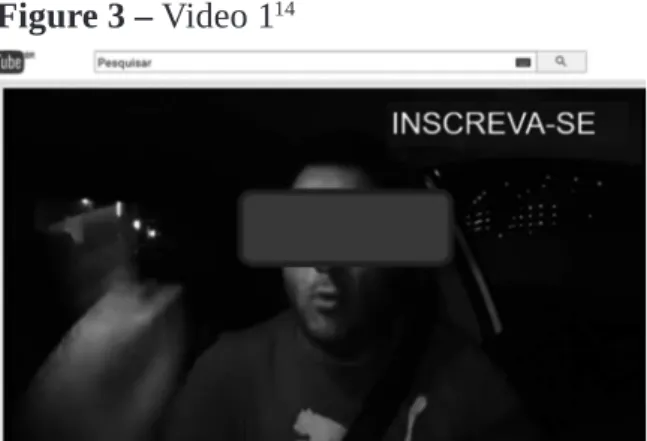
Nonetheless, there are strong criticisms on the adolescent’s behavior, media coverage, the role of society, parental attitude in upbringing their children, such as those presented in the two videos analyzed below, selected due to, until the end of the collection for research data, they had already 777 thousand and 868 thousand views, respectively, representative numbers in terms of audience. Both were posted by men.
Figure 3 – Video 114
Source: YouTube.
Figure 4 – Video 215
Source: YouTube.
In Video 1, the author is said to be against rape, but ironizes the violence practiced against the adolescent. He mentions that if the community in which the crime occurred does not accept rapists, the “poor thing” (referring ironically to the adolescent) consented to the sexual act. The author of the video questions the society’s omission in relation to facts like this, and exclaims: “Omission is fault!”. Further on, in a tone of indignation, he shouts: “They have made our nation miserable!” He calls on parents, teachers and society who, according to him, were negligent. For the aforementioned author, society would be diverting its eyes from the true social problem: education.
In Video 2, there are strong criticisms to the adolescent, with arguments that refer to her previous sexual behavior as a trigger for collective rape. The author of the video is in favor of reducing the age of criminality from 18 to 16 years. As in the previous case, the man also claims that if there was no consent the crime would not have happened, for “rape in the favela
is death”, suggesting that in such cases criminals would be punished by the community itself.
In the statements are no reviews to media coverage, speciically the Globo network.16
In the comments added to Video 2, similar arguments are observed, which reiterate that it was the victim’s fault rather than the perpetrators. Some even call the adolescent a
“prostitute of traficking”, and one would expect the “traficker’s girlfriend”, who “goes to
the favela and funk ball” to be raped: “these piranhas [whores] dispute “who has more sex in one night’, getting pregnant of “fuckers” that they do not even know the name”. Those are manifestations of discrimination that refer us to what Beauvoir refers to as the binomial “mother and prostitute”, a legacy of the patriarchal society, which expresses the prejudices one has regarding women and the feminine as gender identity.
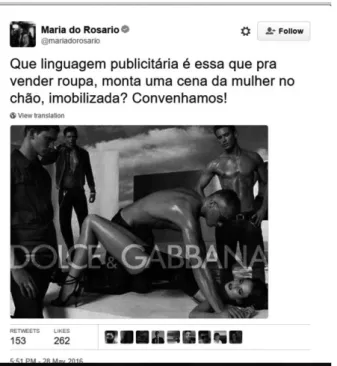
Another aspect of tweets that deserve to be analyzed is the critique of commercial advertisements in the media. The Dolce & Gabbana brand advertisement, reproduced in one of the tweets (posts), in a critical tone, shows an image that, according to the social agent, stimulates the culture of rape. The netizen who posted the advertisement calls attention to the woman on the ground, immobilized, in a situation of submission and violence.
Figure 5 – Advertising encourages collective rape17
Source: Twitter.
It is also possible to observe another tweet about the personal page of the teenager who suffered the collective rape in Rio de Janeiro. There are comments for and against her position, exposing it to all kinds of public judgment.
Although most tweets and retweets have been adolescent-like or show outrage at rape culture, the comments or the weight of the audience conveyed by the videos that condemned the adolescent indicate that there is a further tendency to polarize the debates than awareness about social and cultural issues that involve such crimes.
Social actors
Considering original postings - from which the main tweets originated - there are in total 78 manifestations made by men, equivalent to 39% of our sample, 114 by women, 57%, and 8 by other actors dispersed in the network, NGOs, collectives and mainstream communication companies.
It is important to emphasize that the identiication of social actors is not an easy
task, since the citizen chooses how he wants to present himself on Twitter. Therefore, these
igures may not accurately represent reality, but the contents express the ideology of the
positions taken.
What we can precisely state is that the original posts started predominantly from women, linked or not to collectives or institutions. Finally, we note that the theme brought to
the digital public sphere both political igures and artists, who have manifested themselves
or were called to manifest themselves.
In the case of politicians, we identify names such as former President Dilma Rousseff18, Congressman Jair Bolsonaro19, and the current President Michel Temer20 circulating in the comments more recurrently. Some examples of social actors are presented below.
Politicians May 26
“Stop using the case of the collective rape to defend fucking Bolsonaro, geez dude, I hate it.”
“RT @folha: Dilma and actresses express rejection of teenager gang rape in Rio http://uol.com/bwjNhj https://t.co/VO1xdu6nb5”
May 27
“Outraged, Temer called emergency meeting after gang rape - Valencia Online http:// fb.me/1fCBz8eA8”
May 28
“RT @xxxx: Lula’s desperate, to the point of setting up a fake collective rape with the help of blck bloc lawyer of PSOL. Do you understand?? #Ava?”
In the irst example, it is perceived that the citizen manifests himself contrary to the
ideas of the deputy Jair Bolsonaro (PP-RJ)21, a controversial igure in the Brazilian political scene, whose positions squander insults to blacks, women and homosexuals. Following this, two posts bring references to authorities: former President Dilma Rousseff and current President Michel Temer, who are included in the debate. In the case of Dilma and Temer, we have the reproduction of news with manifestations of repudiation of the crime, carried
out by these public igures.
18 Ex-President Dilma Rousseff was already removed from ofice because of the impeachment process that was doing its course when the collective rape occurred. After the end of the process, she was substituted by Michel Temer.
19 Bolsonaro is known for his controversial and conservative positions on issues such as homosexuality, for example.
20 Michel Temer was Dilma Rousseff Vice President from 2011 to 2014 and from 2015 to 2016, took over as president while the impeachment trial of President Dilma took place in the Senate.
In the example of former president Lula, the content of the tweet extrapolates the fact itself, and gains parallel connotations. It is noticed that the term “collective rape” gains so much visibility in the network that begins to appear in Twitter in tone of irony: “Lula is desperate, to the point of setting up a fake collective rape ...”, says the citizen. The fact gains a joking tone within other connotations related to political practice and not sexual violence itself. The aforementioned despair mentioned by the author of the post is related to the fact that the former president of Brazil, of the Workers’ Party (PT), is involved in investigations carried out by the Federal Public Ministry of Brazil.22
Artists May 25
“RT @xxxxx: Same day, a collective rape plot and the visit to the ministry of a guy who confessed rape on national network ...?”
May 28
RT xxxxx: What the red carpet offered to Frota has to do with the collective rape in Rio http://www.viomundo.com.br/denuncias/mario-magalhaes-o-que-tapete-vermelho-oferecido-a-alexandre-frota-tem-a-ver-o-estupro-coletivo-no-rio.html via @vi?
At the same day when the news of the collective rape gained repercussion, actor Alexandre Frota was greeted by the then Education Minister Mendonça Filho. He became
a well - known actor in Brazil primarily due to his acting in pornographic ilms and for
having confessed the rape of a ‘Mãe de santo’ (Umbanda’s religious igure) on TV – he
later said it was just a joke. Fiction or not, the rape story was received with applause and laughter by a comedian in his TV program. No less disastrously, this host commented on the pregnancy of a Brazilian singer, saying he would “fuck her and the baby”.2324
Jokes? The men who took part in the collective rape in Rio de Janeiro also assumed
they were making a “joke” by posting the image of the abused girl they ilmed. None of them
was able to question the heinous crime. On social networks, they laughed at the woman, who was unconscious and bleeding. This type of behavior makes them co-responsible for physical violence against women and brings to the surface symbolic violence, which is as harmful as physic violence.
22 HAIDAR, Daniel. Por que Lula é alvo da Lava Jato e foi obrigado a depor. Época. 04 de maio 2016. Available at: http://epoca.globo. com/tempo/noticia/2016/03/alvo-da-lava-jato-lula-e-obrigado-depor.html. Accessed on: July 02, 2017.
23 BOECHAT, Breno. Após declaração sobre estupro e ameaça, Alexandre Frota denúncia à polícia ativista que o repudiou. Extra, Rio de Janeiro, 31 jul.2015. Available at: https://extra.globo.com/famosos/apos-declaracao-sobre-estupro-ameaca-alexandre-frota-denuncia-policia-ativista-que-repudiou-17028976.html. Accessed on: July 14, 2017.
The fact is that the presence of Frota in the Ministry generated many protests in social networks, which we could highlight. It brought the actor to the scene on Twitter in a negative way, even compromising the image of the Ministry. What has become clear is that there is no need for a physical attack on women to shape violence. By making a joke, by giving voice to male chauvinism, by denying women their voices and objectifying their existence, signs of oppressive behavior emerge.
In another episode, the comedian Danilo Gentili was not spared by the social actors
in the network. The following tweet exempliies:
May 26
“RT @ludj: Guys, it’s no use getting indignant at the collective rape and following/ enjoying Gentili (who deleted a post encouraging abuse).”
Netizens found out that a tweet of 2012, written by the comedian, had been erased after the episode of sexual violence against the teenager in Rio de Janeiro. Too late. At the time, Danilo Gentili said that the man who waits for a woman to get drunk and “black out” to “have sex” with her is a “genius”. After that, the comedian gained space in the social network for trying to aid in the investigations, asking his followers to report any information about the suspects. Some more unsuspecting netizens retweeted his request; others, more attentive, said: “and where do I denounce this guy here?” in criticism of the artist’s previous stance.
Other social actors
May 26
“@evandromesquita Collective rape expresses insane of exhibitionist male chauvinism. Phallocratic BBB is fed by culture of violent unpunished imprisonment”[sic]
May 27
“RTxxxx @SergioSGTF: Lobão creates controversy when commenting on case of collective rape in Rio http://extra.globo.com/casos-de-policia/lobao-cria-polemica-ao-comentar-caso-de-estupro-coletivo-no-rio-19383894.html #EstuproNãoÉCulpaDaVitima #LobaoSem?” [Sic]
Some artists were criticized, such as singer-songwriter Lobão and humorist Danilo Gentili. Other personalities were praised for their support of the teenager, such as President Dilma. Opinion leaders appear in posts through mentions25, as the singer and actor Evandro
Mesquita and the journalist Sônia Abrão, or simple reference, such as the American actor Johnny Depp, who in the same week was involved in troubled episode of violence against
his wife. In any case, the involvement of personalities in the debate relects the relevance
and proportion that the collective rape had.
Thus, what is clear is that crime caused commotion, demonstrations and polarizations among the most diverse social actors, involving them directly or indirectly in the discussions that circulated in the web. Among the social actors in Twitter, in addition to citizens, artists and politicians, we detect organizations, institutions and the press. As an example, UN Women, the Bar Association of Rio de Janeiro, Folha de S. Paulo, and the feminist space Panties in the Shower.
Final considerations
In the introduction of this article, we could contextualize the crime of rape and its
incidence in Brazil, as well as the proiles of the victims and aggressors, in addition to some
more recurring aspects of the IPEA (Institute of Applied Economic Research) research in these circumstances. The adolescent victim of the crime of collective rape does not escape the statistics: 70% of the victims of this crime are children and adolescents, 88.5% are women, and adolescents are more subject to collective rape. In the case of the aggressors, 96% are men, and the more the victim’s age increases, the greater the probability that the aggressor is a stranger. In between 20 and 40% of the cases, rape is associated to alcohol ingestion.
It is a crime against “sexual dignity and sexual freedom”, considered heinous by the Brazilian Civil Code. Therefore, it has serious consequences for victims - issues not discussed in this article. However, just for the fact that it is associated with dignity, whose meaning includes self-love, respect and honor, it is possible to measure the impact it has had on the 16-year-old adolescent. For this reason, the crime has had great repercussion in the press and social networks.
It was a video posted on Twitter that triggered the debate on social networks, so in this article we sought to identify the social actors as well as their manifestations on Twitter about the collective rape suffered by the teenager.
In light of the concepts of the public sphere, genders and online social media, we
highlight some relections that help us analyze the dynamics in online social media on a
highly controversial theme that aroused commotion in Brazilian society.
In the case of online social media, as Castells (2015) says, by the communication model that allows a more active participation of society, they offer opportunities for citizens to claim their rights, express their values and express their interests. This is what can be observed in the case studied, since both citizens who are not linked to any group and feminist groups, as well as opinion makers, such as artists and journalists, have expressed their views on the subject, exposing their points of view, sometimes contradictory, that
conigured the collective and cultural spheres to which Fuchs (2015) refers.
The appropriation of social media by social actors consolidates the public sphere and its dimensions (economic, collective and cultural) at the intersection between the private (cyberspace as business of IT companies and communication companies) and the public (which is the presence of different social actors in the web to discuss topics of social relevance). In cultural public sphere, “social meanings and moral values are created” and in the sphere of collective decisions, social actors can build consensus (FUCHS, 2015, p.12), such as those observed on gender issues that emerged in the discussions about the
collective rape. In the cultural sphere, there is also the reiication of “certain characteristics as exclusive of a speciic genre”, stereotypes present in the patriarchal society. As Gomes (2008, p.239) maintains, reiication can “constitute as a facet of violence”, and in the case of
the adolescent gang rape, some of the manifestations observed constituted gender violence by attributing a stereotype of female identity to the adolescent.
Independently of the violence of the crime and gender violence and themes present in the manifestations on Twitter, we emphasize that not only the number of posts in the sample studied but also the content approach, but ethical principles (of esteem to human life, of criticism to the culture of the rape and awareness of male chauvinism) were more present in the approach to the posts.
Although we observed a tendency of social engagement in gender issues, it was also possible to verify in the arguments a certain relativization of the aggressors’ attitude.
Basically, there was a disqualiication of the victim, associating her with the image of a prostitute, an opinion justiied by alleged antecedents and behaviors considered unsuitable
to morals and good manners, according to a macho view clearly manifested in some examples of posts presented in this article.
We also analyze the content of the sample that the victim’s image in the bed, next to her attackers, express male dominance and power relations in the patriarchal society (BOURDIEU, 2002). As a social institution, patriarchy shapes and subdues the subject and, as Foucault (1995, p.235) said, quoted by Temer and Santos (2006, p.6), “‘imposes on him a law of truth’, which both the subject and others must recognize”.
Finally, the reverberation and recirculation of content produced by news portals,
websites and journalistic blogs by social agents on Twitter conirms, in the analyzed
opinion formation, although the agents that make it recirculate do not have control over its production. However, as says Thompson (2014, p.67): “Even if the individuals have little or no control over the contents of symbolic news that are offered to the, they can use, work and re-elaborate them in completely extraneous ways to those intentions or goals of producers”. Taking advantage of Thompson’s cue, we recall Genro Filho (1987) when he analyzes journalism and its contradictions. As a phenomenon related to capitalism and technology, journalism is neither neutral nor immune to interests. In the cultural industry it
is a commodity, however, as it disseminates information, no matter how supericial it may
be, it has a democratizing and lucidity potential as a form of knowledge in the world, being reverberated, recirculated and recreated in social media. Thus, even with all of Habermas’s critique of the capitalist media that, for the author, makes the public sphere and participatory democracy unfeasible, contemporary society has reinvented its own gaps.
References
ALL About Being LGBTQ. Planned Parenthood. Available at: <https://www.plannedparenthood.org/learn/ teens/lgbtq>. Accessed on: July 3, 2017.
ALMEIDA, Gustavo de. Alexandre Frota é recebido pelo ministro da Educação e diz que ‘não está parado’. Jornal Extra. 25 maio 2016. Available at: <http://extra.globo.com/noticias/brasil/alexandre-frota-recebido-pelo-ministro-da-educacao-diz-que-nao-esta-parado-19375722.html#ixzz4DqlYACK>. Accessed on: July 2, 2017.
BARDIN, Laurence. Análise de Conteúdo. Lisboa: Edições 70, 2010. 280p.
BENKLER, Yochai. The Wealth of Networks: how social production transforms markets and freedom. Yale University Press, 2006. 515p.
BOBBIO, Norberto; MATTEUCCI, Nicola; PASQUINO, Gianfranco. Dicionário de Política, 5ª edição, v.1, p.106, Brasília: Editora UnB, 1909.
BOURDIEU, Pierre. Questões de sociologia. Rio de Janeiro: Marco Zero, 1983. 244p.
______. A dominação masculina. Rio de Janeiro: Bertrand Editora, 2002. 176p.
BOECHAT, Breno. Após declaração sobre estupro e ameaça, Alexandre Frota denúncia à polícia ativista que o repudiou. Extra, Rio de Janeiro, 31 jul. 2015. Available at: < https://extra.globo.com/famosos/apos-declaracao-sobre-estupro-ameaca-alexandre-frota-denuncia-policia-ativista-que-repudiou-17028976.html>. Accessed on: July 14, 2017.
CASTELLS, Manuel. O poder da comunicação. Paz & Terra (Grupo Editorial Record), 2015. 630p.
CERQUEIRA, Daniel; Coelho, Danilo Santa Cruz. Estupro no Brasil: uma radiograia segundo os dados da Saúde1 (versão preliminar). IPEA – Instituto de Pesquisa Econômica Aplicada. March, 2014. Available at: <http://www.ipea.gov.br/portal/images/stories/PDFs/nota_tecnica/140327_notatecnicadiest11.pdf>. Accessed on: July 2, 2017.
CHAPARRO, Manuel Carlos. Interesse público não se confunde com “interesse do público”. O xis da questão. 2012. Available at http://oxisdaquestao.provisorio.ws/wp-content/uploads/2016/03/2012_7_31_14_31_7_54154. pdf. Accessed on: July 2, 2017.
DUBAR, Claude. Agente, ator, sujeito, autor: do semelhante ao mesmo. Unité Mixte de Recherche. Université CNRS, Paris, 2004. Available at: <http://www.uff.br/observatoriojovem/sites/default/iles/documentos/ dubarclaude-agenteatorsujeitoautor-atoragenteautordosemelhanteaomesmo2004.pdf>. Accessed on: July 2, 2017.
FERREIRA, Dina Maria Martins.Do semelhante ao mesmo, do diferente ao semelhante: sujeito, ator, agente e protagonismo na linguagem. Revista brasileira de linguística Aplicada [online], 2017. Available at: <http:// www.scielo.br/scielo.php?pid=S1984-63982017005003102&script=sci_abstract&tlng=pt>. Accessed on: July 2, 2017.
FOUCAULT, Michel. O sujeito e o poder (apêndice) In: DREYFUS, Hubert; RABINOW, Paul. Michel Foulcault: uma trajetória ilosóica. Para além do estruturalismo e da hermenêutica. Trad. Vera Porto Carrero. Rio de Janeiro, Forense, 1995, p.229-250.
FRAGOSO, Suely; RECUERO, Raquel; AMARAL, Adriana. Métodos de pesquisa para Internet. Porto Alegre: Sulina, 2012. 239p.
FROTA, Marcel. Bolsonaro coleciona polêmicas, insultos e representações arquivadas. Portal iG.Brasília, 16 dez. 2014.Available at: <http://ultimosegundo.ig.com.br/politica/2014-12-16/bolsonaro-coleciona-polemicas-insultos-e-representacoes-arquivadas.htm>l. Accessed on: July 3, 2017.
FUCHS, Christian. Mídias sociais e a esfera pública. IRevista Contracampo, v.34, n.3, 2015. Available at <http://www.contracampo.uff.br/index.php/revista/article/view/912/pdf_1>. Accessed on: July 5, 2017.
GENRO FILHO, Adelmo. O segredo da pirâmide: para uma teoria marxista do jornalismo. Porto Alegre, Tchê, 1987. 230p.
GOMES, Romeu. A Dimensão Simbólica da Violência de Gênero: uma discussão introdutória. In: Athenea Digital, n.14, 2008. Available at <http://www.raco.cat/index.php/Athenea/article/viewFile/120296/164309>. Accessed on: June 25, 2017.
HABERMAS, Jürgen. Mudança estrutural da esfera pública: investigações quanto a uma categoria da sociedade burguesa. Tradução: Flávio R. Kothe. Rio deJaneiro: Tempo Brasileiro, 2003. 568p.
HORÁRIOS nobres. Sprinklr. 2015. Available at: <https://www.sprinklr.com/pt-br/horarios-nobres-redes-sociais/>. Accessed on: July 3, 2017.
IBGE. Instituto Brasileiro de Geograia e Estatística. Conceitos. Available at: <http://www.ibge.gov.br/home/ estatistica/populacao/condicaodevida/indicadoresminimos/conceitos.shtm>. Accessed on: July 2, 2017.
JUSBRASIL. Lei Maria da Penha - Lei 11340/06 | Lei nº 11.340, de 7 de agosto de 2006. Available at: <http://presrepublica.jusbrasil.com.br/legislacao/95552/lei-maria-da-penha-lei-11340-06>. Accessed on: July 2, 2017.
LEI Maria da Penha - Lei 11340/06 | Lei nº 11.340, de 7 de agosto de 2006. JusBrasil. Available at: <http:// presrepublica.jusbrasil.com.br/legislacao/95552/lei-maria-da-penha-lei-11340-06>. Accessed on: July 2, 2017.
MARCONDES FILHO, Ciro. Comunicação e Jornalismo: a saga dos cães perdidos. São Paulo: Hacker Ediores, 2000. 171p.
ONU:uma em cada dez jovens foi vítima de estupro até os 20 anos. Brasil Post. 05 set. 2014. Available at <http://www.brasilpost.com.br/2014/09/05/onu-estupros-mundo_n_5771530.html>. Accessed on: July 2, 2017.
PRESIDÊNCIA da República. Lei nº 12.015, de 7 de agosto de 2009. Planalto. Available at: <http://www. planalto.gov.br/ccivil_03/_ato2007-2010/2009/lei/l12015.htm>. Accessed on: July 2, 2017.
RAFINHA Bastos faz piada sobre a indenização que pagará a Wanessa Camargo. Diario de Pernambuco, Recife, 26 jun. 2015. Available at: <http://www.diariodepernambuco.com.br/app/noticia/viver/2015/06/26/ internas_viver,583291/rainha-bastos-faz-piada-sobre-a-indenizacao-que-pagara-a-wanessa-camargo.shtml>. Accessed on: July 3, 2017.
RESENDE, Daiane. Internautas fazem campanha contra o estupro nas redes sociais. O Globo, Rio de janeiro, 26 jun. 2016. Available at: <http://oglobo.globo.com/rio/internautas-fazem-campanha-contra-estupro-nas-redes-sociais-19381751#ixzz4CyTmSLov>. Accessed on: July 2, 2017.
SCOTT, Joan. Gênero: uma categoria útil para análise histórica. Tradução. Christine Ruino Dabat e Maria Betânia Ávila. Compromisso e atitude. 2012. Available at: <http://www.compromissoeatitude.org.br/genero-uma-categoria-util-para-analise-historica-por-joan-scott/>. Accessed on: June 20, 2016.
STJ: qualquer estupro é crime hediondo. 2012. JusBrasil. Available at: <http://oab-rj.jusbrasil.com.br/ noticias/100108638/stj-qualquer-estupro-e-crime-hediondo>. Accessed on: June 25, 2016.
SWAIN, Tania Navarro. Figuras de mulher em Simone de Beauvoir:a mãe, a prostituta, a lésbica. Universidade Livre Feminista, 08 fev. 2011. Available at: <http://feminismo.org.br/iguras-de-mulher-em-simone-de-beauvoir-a-mae-a-prostituta-a-lesbica/>. Accessed on: July 2, 2017.
THOMPSON, John B. A mídia e a modernidade: uma teoria social da mídia. Tradução Wagner de Oliveira Brandão. 15ª. ed. Petrópolis, Rio de Janeiro: Vozes, 2014. 264p.
TOURAINE, A. Igualdade e diversidade: o sujeito democrático. Trad. Modesto Florenzano. Bauru: Edusc, 1998. 109p.
Anelisa Maradei
Doctorate student in Communication Sciences from the Methodist University of São Paulo, holds a Capes Scholarship for a interuniversity exchange at the University of Beira Interior, Portugal (2017). Master in Communication Sciences from the Methodist University of São Paulo (2013), MBA in Communication Management by the School of Communication and Arts (ECA) of the University of São Paulo (2006) and in Social Communication by the School of Advertising and Marketing (ESPM) (2000). Anelisa holds a bachelor’s degree in Law from Mackenzie University (1990) and Journalism by Methodist University of São Paulo (1988). She is the author of several publications in books and academic journals, such as: Folha de São Paulo and the coverage of the MPL (Free Pass Movement) protests (co-authoring, 2016); Communication and Democracy: 50 years of the military coup of 1964 authoring, 2015); Repercussion of Organizational Crises in Twitter: the Playcenter case (co-authoring, 2015); The presence of brands on Twitter during 2014’s World Cup (co-(co-authoring, 2014). Member of the Research Groups New Journalism Practices and Criticom: Business Communication in Brazil, a Critical reading. Email: [email protected].
Marli dos Santos
PhD in Communication Sciences from the School of Communication and Arts (ECA) of the University of São Paulo (2004) and Master in Social Communication from the Methodist University of São Paulo (1998). She graduated in Social Communication - - Marketing and Advertising (1979) and Journalism (1989) from the Methodist University of São Paulo. Marli is coordinates and teaches in the Graduate Program in Social Communication of the Methodist University of São Paulo. . Her main publications are: Hybrid Borders of Journalism (co-authoring), Specialized Journalism: theory, practice and instruction (co-authoring); Communication and Democracy: 50 years of the military coup of 1964 (co-authoring). She is a member of the Ethics Committee in Research of the Methodist University of São Paulo, leader of the Research Group New Journalistic Practices and vice-coordinator of the Work Group Studies about Journalism of ALAIC (Latin-American Association of Communication Researchers). Email: [email protected].