The adaptation of the radiologic technician to new
technologies*
A adaptação do técnico de radiologia às novas tecnologias
Célia Maria Ferreira Felício1, Vitor Manuel Costa Pereira Rodrigues2
OBJECTIVE: The present study was aimed at evaluating radiologic technicians’ capacity to adapt to new technologies, besides investigating which factors could be related to the implementation of new technologies and to identify some of its possible advantages and disadvantages as well. MATERIALS AND METHODS: The present descriptive and cross-sectional study evaluated data collected by means of a structured questionnaire divided into four components: sample characterization, evaluation of the opinion about new technologies, information system satisfaction scale, and scale of overall assessment of information systems. Data anonymity and confidentiality were assured. The sample included 58 radiologic technicians working at healthcare institutions of Trás-os-Montes and Alto Douro, Portugal. RESULTS: The data have allowed the author to observe that all the technicians were unanimous in considering that new technologies represent important and useful tools in their daily activity, with advantages in terms of facility to access the patients’ radiological data, decrease in data loss, faster examinations and data accuracy. CONCLUSION: In general, one can conclude that radiologic technicians could satisfactorily adapt themselves to new technologies implemented in their respective departments.
Keywords: Radiology; Technological development; Adaptation.
OBJETIVO: Pretendeu-se avaliar a capacidade de adaptação dos técnicos de radiologia às novas tecnolo-gias, avaliar os fatores relacionados com o processo de implementação das novas tecnologias e conhecer algumas vantagens e desvantagens identificadas pelos técnicos de radiologia. MATERIAIS E MÉTODOS: Tra-tou-se de um estudo descritivo e transversal. Os dados foram recolhidos através de um questionário estru-turado em quatro componentes – caracterização da amostra, avaliação da opinião acerca das novas tecno-logias, escala de satisfação com a utilização de sistemas de informação, e a escala de avaliação geral dos sistemas de informação –, tendo sido garantidos o anonimato e a confidencialidade dos dados. Participaram neste estudo 58 técnicos de radiologia a exercer funções em instituições hospitalares da região de Trás-os-Montes e Alto Douro, Portugal. RESULTADOS: Os resultados obtidos permitiram-nos constatar que a tota-lidade dos técnicos afirma que a nova tecnologia é vista como uma ferramenta de trabalho com utitota-lidade para a sua atividade profissional, sendo que as vantagens da implementação das novas tecnologias refle-tem-se na facilidade de acesso ao arquivo radiológico do usuário, na diminuição da perda de informação, na rapidez de execução dos exames e no rigor dos registros do usuário. CONCLUSÃO: Podemos dizer, de uma maneira geral, que os técnicos de radiologia se adaptaram de uma forma muito satisfatória às novas tecno-logias implementadas nos seus departamentos.
Unitermos: Radiologia; Desenvolvimento tecnológico; Adaptação. Abstract
Resumo
* Study developed at Universidade de Trás-os-Montes e Alto Douro, Portugal.
1. Master of Management of Health Centers, Radiologic Tech-nician at Centro Hospitalar de Trás-os-Montes e Alto Douro, Unidade de Vila Real, Portugal.
2. PhD of Biomedical Sciences, Coordinator, Professor, Inte-grated Member of Center of Research in Sports, Health and Human Development (CIDESD), Universidade de Trás-os-Mon-tes e Alto Douro, Portugal.
utilization of information technologies as a strategic investment, capable of promot-ing the rationalization of the use of avail-able resources and increasing efficiency and quality. In the current context of pro-found transformations, one of the key fac-tors is the capability to organize multiple and scattered data into a useful set of indi-cators that allows the rigorous management the health system as a whole in a scenario encompassing process efficiency and qual-ity of information(3).
Information systems for the manage-ment of images and clinical data first
ap-Felício C, Rodrigues V. The adaptation of the radiologic technician to new technologies. Radiol Bras. 2010;43(1):23–28.
greater challenges and demands for orga-nizations, as well as constant changes at faster speed. The organizations have to adjust to this reality in order to remain com-petitive and to maintain their ability to pro-vide quality services(1,2). One of the
chal-lenges posed by the modernization of the health system lies on the more intensive
INTRODUCTION
Today there is widespread conscious-ness that the world is in the age of infor-mation, knowledge and globalization. An increasingly global economy implies
Mailing address: Dr. Vitor Manuel Costa Pereira Rodrigues. ESEnf. – Universidade de Trás-os-Montes e Alto Douro. Lugar do Tojal - Lordelo 5000-232 Vila Real, Portugal. E-mail: [email protected]
peared late in the eighties, when the digi-tal acquisition systems started being de-ployed in large scale at hospitals. At that time, each equipment was considered as a separate system, connected only with its workstation and with a determined printer(4).
The radiological film has served radiol-ogy for over 100 years with excellent re-sults, in the images acquisition, visualiza-tion and storage. The developments of con-ventional radiology have led to the system comprising film + intensifier screen, which, in association, originated the im-ages acquisition, visualization and also data storage(5).
The introduction of devices that allow the acquisition of digital radiological im-ages without the utilization of films, in association with the current computer ca-pabilities and other means, has originated the digital radiology.
At the end of the last century, particu-larly over its last decade, due to develop-ments in the information technology, alter-native solutions for the use of films started being developed. The picture archiving and communication system (PACS), or a digi-tal storage and communication system for medical images, has emerged as the alter-native to replace all the film-based struc-ture, both at the functionality and utility levels, originating the digital radiology concept, with the main and subjacent idea that, in this context radiological films would not be produced anymore(6). The
digital techniques in radiology are still par-tially in the works in progress stage. Digi-tizing means transforming analog data into numerical data(7). In digital radiology, the
image acquisition, visualization and data storage are independent components. Thus, the image is acquired, the data are sent to a computer which, after processing the data, sends them to an appropriate moni-tor to be visualized, or to one of the avail-able storage systems. The most immediate advantage in this process is the digital sys-tem capability of previously manipulating the data, in such a way to optimize the image visualization and storage(5–7).
Teleradiology is clearly the most rel-evant area of telemedicine both in Portu-gal and worldwide. Teleradiology is the electronic transmission of radiological
images and clinical reports from one loca-tion to another, for later interpretaloca-tion and reference(8). This type of technology allows health system users a greater accessibility to differentiated medical care, a higher di-agnostic quality, faster information on the user health and reduction in costs. For the health institutions and professionals the advantages in the implementation of such technology include the centralization and optimization of complex activities, the de-crease in the geographic isolation impact, swiftness in the diagnosis health care de-centralization, improvement in the diagno-sis quality through the exchange of expe-riences, and the possibility of distance medicine teaching(9).
Thus, and considering that the introduc-tion of new informaintroduc-tion technologies in the field of Imaging Sciences determines a pro-found redefinition of the radiological activ-ity both at the architectural level and in terms of tasks distribution, the present study was developed with the objective of evaluating radiology technicians adaptabil-ity to the new technologies as well as the factors that may be related to the process of implementation of such technologies, and analyze some of the advantages/short-comings identified by the radiology tech-nicians.
MATERIALS AND METHODS
The present descriptive and cross-sec-tional study included 58 radiology techni-cians working at Centro Hospitalar de Trás-os-Montes e Alto Douro and Centro Hos-pitalar do Nordeste in the region of Trás-os-Montes and Alto Douro, Portugal.
Data collection was made by means of a four-section structured questionnaire. The first section comprised five questions aimed at characterizing the sample. The second section was composed of nine ques-tions aimed at evaluating the technicians’ opinion about the implementation of new technologies and their advantages/disad-vantages. The third section was composed by a scale of “satisfaction with the utiliza-tion of informautiliza-tion systems” (SUIS)(10).
Such scale is composed by nine items, and is a Likert-type five-point scale, where 1 corresponds to zero and 5 corresponds to very high. Thus the maximum score is 45
points, and the higher is the obtained score, the higher is the SUIS. As regards the analysis of the SUIS internal consistency, the Cronbach’s alpha corresponds to 0.85. The fourth section is composed by a scale of “general evaluation of the information systems” (GEIS)(10). This scale comprises
six items. It is a Likert-type four-point scale, where 1 corresponds to totally inap-propriate, and 4 corresponds to very appro-priate. The maximum possible score is 24 points, and the higher is the score, the bet-ter is the GEIS. As regards the Cronbach’s alpha was 0.75.
The data collection was previously ap-proved by the Council of Administration of Centro Hospitalar de Trás-os-Montes e Alto Douro and of Centro Hospitalar do Nordeste. The technicians participating in the study were given an explanation on the research foundations and objectives, as well as on the criteria of data confidential-ity and anonymconfidential-ity, and signed a term of free and informed consent.
The data were processed by means of the software Statistical Package for the Social Sciences (SPSS-version13.0). For such purpose, relative frequencies, mean and standard deviation were utilized, and the data were analyzed by means of the Student’s t-test and analysis of variance ANOVA I. The adopted level of statistical significance was p < 0.05.
RESULTS
Among the 58 technicians included in the present study population, 41 (70.7%) were women and 17 (29.3%) were men. The Student’s t-test demonstrated statisti-cally significant differences (p = 0.003) between genres and SUIS only in relation to adaptability to new technologies. How-ever, men presented a higher mean in rela-tion to GEIS (Table 1). Therefore, one can conclude that the female technicians had more difficulty in the utilization of infor-mation systems.
with ages < 31 years and > 50 years repre-sented, respectively, 12.1% and 13.8% of the study population. The analysis of vari-ance ANOVA I demonstrated statistically significant differences (p = 0.033) only between age groups and SUIS in relation to the technicians’ adaptability to new tech-nologies. It is important to observe that the age group between 51 and 60 years pre-sented the highest mean both in relation to the SUIS and to GEIS (Table 2).
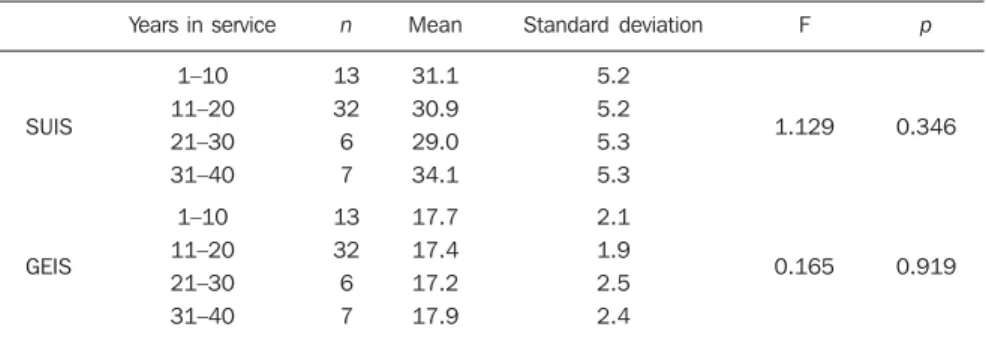
Regarding years in service, the time ranged from a minimum of 1 year to a maximum of 37 years (mean, 14.5 years). Most of the technicians – 32 (55.2%) were in the interval from 11 to 20 years of ser-vice. The level of adaptability to new tech-nologies of the technicians with more years in service was analyzed by means of the ANOVA I that demonstrated no statistically significant difference as far as years in ser-vice, SUIS and GEIS are concerned. How-ever, technicians with more years in service (31–40 years) presented highest means for SUIS (34.1) and for GEIS (17.9) (Table 3). For the greatest majority of the techni-cians, the new technology is seen as a use-ful working tool for their professional ac-tivity. Among the 58 technicians, 52.1% consider the new technology as extremely useful, 32.8% as very useful, and 5.2% as reasonably useful. With the purpose of vestigating whether the knowledge on in-formation technology acquired before the deployment of the new technology contrib-uted for the individual performance in this system, the authors observed that the ma-jority responded favorably. Among the 58 technicians, 23 (39.7%) responded that it contributed very much, 15 (25.9%) re-sponded that it contributed reasonably, 10 (17.2%) responded that it contributed much, and 10 (17.2%) responded that it contributed little. As regards the relation between the previous knowledge on infor-mation technology and the SUIS and GEIS, no statistically significant difference was observed. However, those technicians that considered that such knowledge contrib-uted to their performance in the system, presented highest means for SUIS (31.5) and for GEIS (17.6).
The utilization of the new technology is seen as a motivating factor, considering the responses regarding this topic, with the
following results: 43.1% very much, 27.6% much, 27.6 reasonably and only 1.7% little. The Student’s t-test demonstrated that there was no statistically significant difference between professional motivation and the SUIS and GEIS. It is important to note that the technicians with highest professional motivation after using the new technology, presented highest means in relation to SUIS (31.2) and GEIS (17.5).
With respect to the responses regarding advantages of the deployment of the new technology, some subcategories emerged as follows. Table 4 demonstrates that, the advantages related to efficiency are most frequently mentioned, followed by advan-tages at the technical level. So, at the effi-ciency level, the greater facility of access to the users’ radiological data file and the
decrease in data loss are highlighted. At the technical level, the most frequently men-tioned advantages were the swiftness of examinations and the accuracy in the users’ data records.
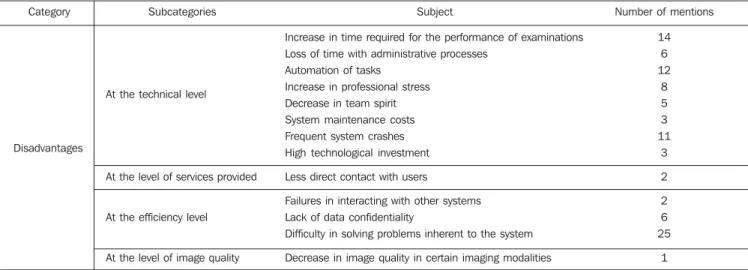
With regards to disadvantages in the implementation of the new technology identified by the technicians, subcategories emerged as shown on Table 5. The disad-vantages at the technical level were most frequently mentioned by the technicians, followed by disadvantages at the efficiency level. In the first subcategory, the most fre-quently mentioned disadvantages were the increase in time spent in the examination, i.e., the examination takes longer to be completed, and the automation of tasks. In the second subcategory, the most fre-quently mentioned disadvantage was the
Table 1 Means and respective standard deviations of SUIS and GEIS according to sex.
SUIS GEIS Sex Male Female Male Female n 17 41 17 41 Mean 34.2 29.8 18.3 17.2 Standard deviation 5.4 4.7 2.7 1.7 t 3.121 1.914 d.f. 56 56 p 0.003 0.061
n, sample number; d.f., degrees of freedom.
Table 2 Means and respective standard deviations of SUIS and GEIS according to age group.
SUIS GEIS Age group 20–30 31–40 41–50 51–60 20–30 31–40 41–50 51–60 n 7 30 13 8 7 30 13 8 Mean 29.0 32.2 28.2 33.6 17.3 17.8 16.7 18.0 Standard deviation 3.1 5.5 4.2 5.5 1.6 2.1 1.8 2.3 F 3.131 1.088 p 0.033 0.362
n, sample number; F, ANOVA test value.
Table 3 Mean and respective standard deviations of SUIS and GEIS, according to years in service.
SUIS
GEIS
Years in service
1–10 11–20 21–30 31–40 1–10 11–20 21–30 31–40 n 13 32 6 7 13 32 6 7 Mean 31.1 30.9 29.0 34.1 17.7 17.4 17.2 17.9 Standard deviation 5.2 5.2 5.3 5.3 2.1 1.9 2.5 2.4 F 1.129 0.165 p 0.346 0.919
Table 4 Advantages in the implementation of the new technologies.
Category
Advantages
Subcategories
At the technical level
At the economic level
At the level of services provided
At the efficiency level
At the image quality level
Subject
Swiftness in examinations
Greater responsabilization Planning of activities
Accuracy in patient records
Greater productivity Material cost reduction
Reduction in use of paper
Decrease in radiological exposure Decrease in access time
Decrease in data loss
Greater swiftness in image availability Improvement in data confidentiality
Digital image storage
Greater ease in accessing users’ radiological data
Possibility of image post processing
Optimization of image quality
Number of mentions
17
4 3
14
8 8
5
7 4
14
10 8
8 18
10
17
Table 5 Disadvantages in the implementation of the new technologies.
Category
Disadvantages
Subcategories
At the technical level
At the level of services provided
At the efficiency level
At the level of image quality
Subject
Increase in time required for the performance of examinations Loss of time with administrative processes
Automation of tasks Increase in professional stress
Decrease in team spirit System maintenance costs
Frequent system crashes High technological investment
Less direct contact with users
Failures in interacting with other systems
Lack of data confidentiality
Difficulty in solving problems inherent to the system
Decrease in image quality in certain imaging modalities
Number of mentions
14 6
12 8
5 3
11 3
2
2
6 25
1
difficulty in solving problems inherent to the information system.
The success in the implementation of a new technology is something that does not have a single measurement, but several. One of the objectives was also learning the radiology technicians’ opinion with regards to the benefits of the deployment of new technologies in the area of imaging sci-ences, for the institutions themselves. By analyzing Table 6, it is possible to observe that the benefits at the efficiency level were the most frequently mentioned, followed by the benefits at the level of care rendered to users. Thus, at the efficiency level, the accessibility to images throughout the
in-stitution and, the level of at the care ren-dered to users, an improvement in the qual-ity of the services are highlighted.
DISCUSSION
When analyzing whether the number of years in service interfered in the adaptabil-ity to new technologies, it was possible to conclude that those technicians with longer time in service (31–40 years) are more sat-isfied with the use of the information sys-tems, and also made more positive general evaluations of the technology they are us-ing. Such results are not in agreement with those reported by Santos Júnior et al.(11),
that resistance of technicians with longer times in service is a potentially inhibiting factor in the adoption of new technologies in any type of organization.
All the technicians stated that the new technology is seen as a useful tool in their professional activities. Such results are in agreement with the study developed by Dias(12), which confirmed the existence and
Barreira et al.(13), where 63.9% of the
re-spondents considered that knowledge on information technology, previous compe-tence and valorization of the professional activity contributed to the process of the information system implementation.
When investigating whether the use of the new technology was a factor of profes-sional motivation, the authors observed that 57 technicians, or 98.3% of the sample, stated that the use of the new technology was a factor of professional motivation, exactly because a challenging job and the working conditions represent factors that influence the satisfaction/motivation of individuals(14). With respect to the process
organizational change with the implemen-tation of information technology resources and the involvement of the staff members, most of the technicians responded favor-ably (58.6%), however, for a significant number (41.4%) this did not happen, as when technical and structural changes are associated with changes at the level of products/services, the organizations carry out adjustments in human resources man-agement practices, with the purpose of in-creasing functional flexibility(15).
Regarding the advantages of the imple-mentation of the new technologies, the most frequently mentioned ones were re-lated to the level of efficiency and techni-cal level, because the deployment of a filmless radiology service is aimed at im-proving the accessibility and the integration of information by linking the images with the users’ electronic records, and the appli-cation of new techniques for the develop-ment of new modalities of images acquisi-tion, display, and processing(4). With
re-spect to the disadvantages of the imple-mentation of the new technologies, they
were mostly at the efficiency level, because of the increase in the time required for the examinations and because the automation of tasks implied difficulties to solve prob-lems inherent to the information system. These results are not in agreement with the study developed by Soares(6) who reports
that the implementation of a digital radiol-ogy system allows the examinations to be performed in less time, with a better time management, both by the technician who would then be able to perform more exami-nations, and the radiologist, that would received the images more swiftly and would be able to prepare the report in a shorter time. On this subject, Laudon & Laudon(16) report that the interrelation
be-tween technology and people is a relevant factor for the organizations that must to changes, and the people must know how to manage, understand and responsibly utiliz-ing the technology in the benefit of the or-ganization.
In what concerns the benefits to the in-stitution resulting from the implementation of the new technologies, it is possible to say that they are mostly at the efficiency level (image accessibility) and at the level of the service rendering (improvement in the quality of the services), as the benefits are innumerable, including the possibility of making the images available at any location of the institution in a very short time, the data confidentiality, and also the possibil-ity of exchanging information and experi-ence with other institutions by means of teleradiology(6).
CONCLUSIONS
It is widely known that information sys-tems represent an indispensable source of
knowledge and a powerful support to the decision making process, allowing impor-tant gains for the health of all the users of health centers. In order for these gains to materialize, the workflow of health profes-sionals must be optimized, i.e., data must be stored in dynamic information system solutions operating as a system for support-ing medical decisions.
More than providing answers and con-clusions, the present study in the area of new technologies in radiology proposes a reflection on the different factors involved in the process of information systems implementation in a hospital environment, contributing to promote a greater con-sciousness among organizations and re-searchers involved in the investigation of this matter.
Furthermore, this study allows the clusion that such professionals are con-scious of their relevant role in the health system, and therefore require the support of the investigation and application of the respective results, as an indispensable fac-tor for the development of a professional activity that happens in the scientific, tech-nical and human fields, in the sense of keeping up the appropriateness of new the technologies to new and growing demands of the information and knowledge society.
REFERENCES
1. Serrano A, Fialho C. Gestão do conhecimento – o novo paradigma das organizações. Lisboa: FCA – Editora de Informática; 2003.
2. Macedo HAS, Rodrigues VMCP. Programa de controle de qualidade: a visão do técnico de ra-diologia. Radiol Bras. 2009;42:37–41. 3. Fernandes A. O papel dos sistemas de
informa-ção na modernizainforma-ção do sistema de saúde. Diá-logo. 2006;52:18–9.
4. Azevedo-Marques PM, Caritá EC, Benedicto AA, et al. Integração RIS/PACS no Hospital das
Clí-Table 6 Benefits for the institution from the implementation of the new technologies.
Category
Benefits
Subcategories
At the economic level
At the level of services provided
At the efficiency level
Subject
Decrease in material and human resources costs
Improvement in quality of user service Improvement in quality of services
Greater efficiency in user service
Exchange of information with other intitutions Better information management
Image accessibility throughout the institution Modernization of the operation
Number of mentions
15
13 7
10
11 9
nicas de Ribeirão Preto: uma solução baseada em “web”. Radiol Bras. 2005;38:37–43.
5. Lima JJP. Técnicas de diagnóstico com raios X. Aspectos físicos e biofísicos. Coimbra: Imprensa da Universidade de Coimbra; 2005.
6. Soares P. PACS. In: Gaivão FM. Imagiologia clí-nica: princípios e técnicas. Coimbra: Serviço de Imagiologia dos Hospitais da Universidade de Coimbra; 2005. p. 337–53.
7. Ferreira M. Radiologia convencional/digital. In: Gaivão FM. Imagiologia clínica: princípios e téc-nicas. Coimbra: Serviço de Imagiologia dos Hos-pitais da Universidade de Coimbra; 2005. p. 355– 69.
8. American College of Radiology. ACR technical standard for teleradiology. Reston: American College of Radiology; 1996. p. 913–23.
9. Agostinho A. Telerradiologia. In: Gaivão FM. Imagiologia clínica: princípios e técnicas. Coim-bra: Serviço de Imagiologia dos Hospitais da Universidade de Coimbra; 2005. p. 327–35.
10. Rodrigues V, Nogueira F, Granjo C. What impli-cations do information systems have for the re-structuring of health organisations? Proceedings book of the IASK International Conference Glo-bal Management; 2007;284–9.
11. Santos Junior S, Freitas H, Luciano EM. Dificul-dades para o uso da tecnologia da informação. RAE-eletrônica. 2005;4(2):art 20.
12. Dias DS. Motivação e resistência ao uso da tec-nologia da informação: um estudo entre gerentes. RAC. 2000;4:51–66.
13. Barreira A, Santos E, Silva JC, et al. Estudo dos factores que interferiram no processo de
informa-tização do serviço de Urgência do Hospital Dis-trital de Chaves. Livro de Actas do I Encontro de Investigação: da divulgação à consolidação do conhecimento. Vila Real: Escola Superior de Enfermagem de Vila Real; 2005. p. 43–50. 14. Ferreira JMC, Neves JG, Caetano A. Manual de
psicossociologia das organizações. Lisboa: McGraw-Hill; 2001.
15. Caetano A, Tavares S. Tendências na mudança organizacional e tensões na gestão de pessoas. Lisboa: Dinâmia – Centro de Estudos sobre a Mudança Socioeconómica; 2000.