BAR, Rio de Janeiro, RJ, Brazil, v. 15, n. 3, art. 2, e180006, 2018
http://dx.doi.org/10.1590/1807-7692bar2018180006
The Motivation to Participate in Citizen-Sourcing and
Hackathons in the Public Sector
Gabriel de Deus Ferreira1
Josivania Silva Farias1
Universidade de Brasília, Programa de Pós-Graduação em Administração, Brasília, DF, Brazil1
Received 22 January 2018; received in revised form 31 July 2018 (this paper has been with the authors for two revisions); accepted 9 August 2018; first published online 14 September 2018.
Abstract
Key challenges of how citizens can be motivated to participate in citizen-sourcing initiatives remain unaddressed. In this paper, we identified the influence of eight motivation variables in the number of participations in Hackathons, a citizen-sourcing initiative, in Brazil. We adapt different models from Self-Determination Theory and the Theory of Planned Behavior with recent studies of crowdsourcing and open software initiatives. To validate the survey, we conducted a confirmatory factorial analysis, using Structural Equation Modelling. Tests with 308 questionnaires confirm the reliability and validity of the survey as well as the model’s overall quality. This research shows evidence that supports that recognition, learning, financial rewards and fun influence attitude towards participation in Hackathons. We present theoretical and managerial implications to scholars and public agents interested in engaging citizens in solving public problems.
Introduction
Citizen engagement in the public sector is unarguably called for. Due to major political, economic and social changes, public administrations are under serious pressure to create solutions to the many problems they face every day. Citizen involvement is a hopeful way to innovate in public sectors that struggle with stagnating resources and limited innovativeness (Thapa, Niehaves, Seidel, & Plattfaut, 2015).
The government invites the citizen to play the role of an expert on a particular subject, or even to idealize public solutions. These dynamics are citizen-sourcing strategies - a term derived from crowdsourcing, an online participatory activity to reach the “crowd” (Estellés & González, 2012, p. 2). In the public sector, crowdsourcing transforms into citizen-sourcing, a strategy for approaching citizens and public agents in the construction of solutions to problems of public interest. The citizen is not only the consumer of a public service, but an actor in the development of a solution to a social problem (Mattson, 1986).
Contests are one of the citizen-sourcing strategies most used by governments (Nam, 2012). Although contests still have institutional barriers (such as bureaucracy and difficulties in distributing financial rewards, involving detailed specifications, requests for proposals, bids, selections, and difficult contractual negotiations), they become a feasible strategy to solve public administration problems (Mergel & DeSouza, 2013).
A contest conducted in both the private and public sector is the Hackathon. According to the Brazilian House of Representatives (Câmara dos Deputados, 2014), Hackathon is a marathon that brings together programmers, developers and inventors (the hackers), to create projects that transform information of public interest into digital solutions, accessible to all citizens. A documentary review conducted in December 2016 in the Official Gazette of the Union (http://portal.imprensanacional.gov.br) and news portals (Google News and Ping Hacker), has shown that 47 Hackathons were promoted by the public sector in Brazil since 2012. These Hackathons often use different formats (phases, activities and deadlines) and incentives (e.g. prizes and recognition).
The literature about this theme is in the beginning stage of discussions to pursue ways to engage citizens in the search for solutions to public problems. Nevertheless, key challenges of citizen engagement in public sector innovation remain unaddressed: How can citizens be motivated to participate in such initiatives?
Studies have shown that there is still little scientific production which aims to explain the motivational factors for citizen participation in citizen-sourcing initiatives (Ferreira, Farias, Moreira, & Soares, 2016). Most of these papers analyse initiatives in countries with strong and well-established democracies, including Finland and Germany (Antikainen, Mäkipää, & Ahonen, 2010; Wijnhoven, Ehrenhard, & Kuhn, 2015).
In addition, some studies are conflicting, especially with respect to the importance of extrinsic motivations, such as financial rewards, and attitude towards a behavior (Battistella & Nonino, 2012).
Further empirical research is demanded to develop more comprehensive models focusing on citizens’
attitude and motivations (Nam, 2012).
In this paper, we aim to identify the influence of motivations in the number of participations in Hackathons, a citizen-sourcing initiative, in Brazil. Grounded on Self-Determination Theory and the Theory of Planned Behavior, we adapt different models from classic motivation theory with recent studies in crowdsourcing and open software initiatives.
Motivations to Participate in Citizen-Sourcing Iniciatives
Studies have shown that citizens’ motivations to participate in citizen-sourcing initiatives vary among intrinsic (e.g.: fun, community love, challenging tasks etc.), extrinsic (e.g.: financial or non-financial rewards, career improvement, reputation etc.) and according to the level of expertise/competence required of the providers (Wirtz, Weyerer, & Rösch, 2017). The Self-Determination Theory makes a distinction between intrinsic motivations, which relate to the execution of something interesting or pleasing to the subject, and extrinsic motivation, which encourages doing something because it would lead to a result, denoting self-control for an instrumental value (Ryan & Deci, 2000).
Before analysing intrinsic and extrinsic motivations, it is necessary to consider the antecedent variable of the engagement itself. One of the baselines motivation theories, accompanied with Self-Determination Theory, is the Theory of Planned Behavior, which considers attitudes towards a certain behavior. In general, the degree to which a person considers certain behavior favourable or unfavourable might explain the occurrence of the behavior (Ajzen, 1991). Studies with participants of crowdsourcing platforms identified that attitude was able to explain the intention to contribute to those platforms (Pinto & Santos, 2015). Therefore, we suggest:
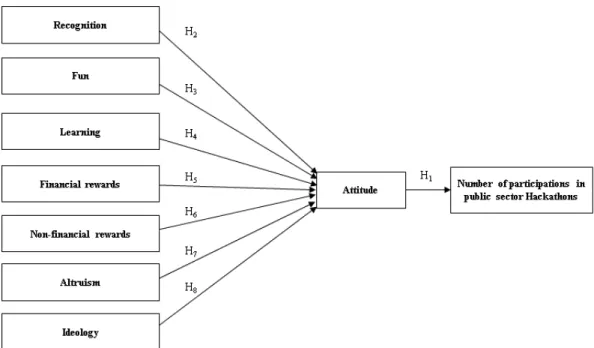
H1: Attitude positively influences the number of participations in public sector Hackathons.
It is necessary to identify the precedents to motivations that might explain the attitude of the citizen. While explicative models have already been used in crowdsourcing initiatives, few empirical studies have taken into account more complex activities and the public sector as locus.
Thus, to reach the objectives of this work, we used the motivation factors that: (a) were repeated more in the studies about crowdsourcing, citizen-sourcing and open innovation; and (b) presented greater significance in the various types of tests that aimed to analyse relations between the motivation and attitude variables of individuals participating in citizen-sourcing initiatives.
Individuals are expected to increase their reputation or receive special merit by demonstrating their skills and abilities. In communities, individuals gain recognition, respect and credibility in the eyes of other members of the community or organization by demonstrating their competencies (Kaufmann, Schulze, & Veit, 2011). Therefore, we believe that:
H2: Recognition positively influences the attitude of the subject, that in turn, influences the
number of participations in public sector Hackathons.
A person is moved intrinsically by the fun or personal pleasure involved in the task. In innovative and creative contests, such as Hackathons, the contentment to accomplish a task, especially when the effort does not seem to be a job is indeed a motivation for the participants (Wijnhoven et al., 2015). Therefore:
H3: Fun positively influences the attitude of the subject, that in turn, influences the number of
participations in public sector Hackathons.
Not only the expectation of a group, or personal pleasure, plays an important role. Individuals search to find new ways to accomplish activities or bypass existing problems and learning by doing (Kaufmann et al., 2011). The objective of acquiring or improving skills is hypothesized:
H4: Learning positively influences the attitude of the subject, that in turn, influences the number
of participations in public sector Hackathons.
to monitor infrastructure services in the state of Brandenburg) in Germany (Pinto & Santos, 2015; Wijnhoven et al., 2015). However, extrinsic variables, like financial rewards, did not present significant results in all studies.
A study of open innovation platforms and user participation has shown that extrinsic motivations (e.g.: financial rewards) have limited power to encourage participation, while the intrinsic motivations, related to social influence, have greater influence on user participation (such as: recognition and learning) (Thapa et al., 2015). The more concrete the phases of innovation become, the greater the use of extrinsic motivational incentives in online platforms. In other words, initiatives at a stage such as product or service design use more financial incentives than initiatives with less concrete phases, such as idea generation (Battistella & Nonino, 2012).
The use of monetary rewards as a way to encourage the participation and intensity of collaboration in initiatives is a common engagement strategy in Hackathons. As with financial rewards, non-financial rewards (e.g. tickets, trips, tech prizes) are used as a way to encourage behavior. We decided to follow the existing research regarding financial and non-financial rewards. While the first is cash, non-financial rewards can take form of any compensation (trips, internships, tech prizes etc.). This is especially important in Hackathons. Financial rewards can be used in the solution created during the contest, while non-financial rewards, in general, are addressed to the person, not to the solution (e.g. a trip to the winners). Thus, other hypotheses are:
H5: Financial rewards positively influence the attitude of the subject, that in turn, influences the
number of participations in public sector Hackathons.
H6: Non-financial rewards positively influence the attitude of the subject, that in turn, influences
the number of participations in public sector Hackathons.
Research in Germany, France, Finland and the Netherlands identified that financial rewards are not always the best way to motivate participation in open innovation online initiatives (Antikainen et al., 2010; Wijnhoven et al., 2015). Participants appreciate intangible factors such as altruism and ideology. Altruism is referred to as a positive social outcome and performance of civic duty. This motivation emerges from the feeling of fellowship and belonging to a group. It is a natural human tendency to join a group, feel part of a community, and take responsibility for other members by participating in developing something better for others. In addition, there is the ideology that individuals feel compelled to contribute in their area of development or interest (e.g. technology or hackers communities). The contribution is made because individuals are convinced that everyone must participate. That being said, we suggest:
H7: Altruism positively influences the attitude of the subject, that in turn, influences the number
of participations in public sector Hackathons.
H8: Ideology positively influences the attitude of the subject, that in turn, influences the number
of participations in public sector Hackathons.
Lastly, to study the relationship between variables, we suggest H9, taking into account the
theoretical model presented in Figure 1:
H9: The effect of motivations on the number of participations in public sector Hackathons is
Figure 1. Theoretical Model of the Influence of Factors in the Number of Participation in Public Sector Hackathons
Table 1
Representative Research of Motivation to Participate in Citizen-sourcing and Crowdsourcing
Reference Data collection and context Observed variable
Key observed motivation
Attitu d e R ec o g n itio n Fu n L ea rn in g Fin an cial rewa rd s No n -fin an cial rewa rd s Altr u is m Id eo lo g y
Frey, Lüthje and Haag (2011)
Survey with 104 users of a
crowdsourcing platform mainly from Switzerland and Germany
Observed behavior: # of contributions in the online platform
No No Yes Yes Yes No No No
Kaufmann, Schulze and Veit (2011)
Survey with 431 users of a
crowdsourcing platform mainly from USA and India
Observed behavior: time spent on
the platform No Yes No Yes Yes No Yes Yes
Battistella and Nonino (2012)
Secondary data review from 116 crowdsourcing online platforms
Taxonomy of motivations to participate in open innovation platforms
No Yes Yes Yes Yes Yes Yes No
Antikainen, Mäkipää and Ahonen (2015)
Open-ended questionnaire with 12 users and secondary internet document review of open innovation platforms in France, The Netherlands and Finland
Intention to contribute in
crowdsourcing platforms No Yes Yes Yes Yes Yes Yes Yes
Pinto and Santos
(2015) Survey with 214 Brazilian subjects
Intention to contribute in two
online crowdsourcing platform Yes Yes Yes Yes Yes Yes No No
Thapa, Niehaves, Seidel and Plattfaut (2015)
Survey with 128 German citizens Intention to participate in
citizen-sourcing initiatives No Yes Yes Yes Yes Yes Yes No
Table 1 (continued)
Reference Data collection and context Observed variable
Key observed motivation
Attitu
d
e
R
ec
o
g
n
itio
n
Fu
n
L
ea
rn
in
g
Fin
an
cial
rewa
rd
s
No
n
-fin
an
cial
rewa
rd
s
Altr
u
is
m
Id
eo
lo
g
y
Wijnhoven, Ehrenhard and Kuhn (2015)
Survey with 168 German citizens Intention to participate in open
government initiatives No Yes Yes Yes Yes No Yes Yes
Wirtz, Weyerer
and Rösch(2017) Survey with 210 German citizens
Intention to use open government
data No Measure Extrinsic Motivation and Intrinsic Motivation
This study
Survey with 308 Brazilian citizens that participated in citizen-sourcing initiative Hackathon
Observed behavior: # of
participations in citizen-sourcing initiative (Hackathon)
Method
This is a quantitative exploratory-descriptive study where data was collected using an online survey (Creswell, 2014). Considering the voluntary nature of subjects participation in the survey, it is characterized as convenience and non-probabilistic sampling.
We implemented the snowball strategy (Berg, 1988), aiming for a greater survey reach. Subjects were requested to participate in sharing the survey on social networks and via e-mail. Also, some organizations shared contact information of Hackathon participants. Primary data were collected from 319 answered questionnaires, of which 308 gave usable responses.
It is estimated that 30 people participate in each Hackathon (Klix, 2013). We catalogued 47 initiatives promoted by the public sector; therefore, a population of approximately 1,410 subjects (data from 2016). Bartlett, Kotrlik and Higgins (2001) suggest that the appropriate sample size for a categorical survey of 1410 population should be 303 subjects; i.e., fewer than the answers we collected (308 usable responses). This sample takes into account a 95% confidence interval (z-score of 1.96), 5% margin of error, and a 50% estimate of the population proportion– this percentage results in sample maximization, and is a conservative measure recommended to researchers (Bartlett, Kotrlik, & Higgins, 2001).This sample size (n = 308) allowed detecting effects of medium size with a power higher than 80% in the regression models and the structured equation models used in the study (Soper, 2018).
The questionnaire was composed of 33 items distributed in two sections. The first section, with 25 items, corresponds to the affirmations regarding the factors that will be presented in Table 2, namely: attitude, recognition, fun, learning, financial rewards, non-financial rewards, altruism and ideology. The affirmations were answered on a Likert scale, ranging from 1, strongly disagree, to 5, strongly agree. The second section (items 26 to 33) identifies subjects’ sociodemographic characteristics.
The survey was submitted to validation in three stages, as suggested by Pasquali (2010). In the first stage, a theoretical and semantic evaluation was carried out by four judges. The second stage consisted of the application of questionnaire pre-tests with four subjects of the target audience of the research. The last step consisted of a confirmatory factorial analysis.
For the semantic and theoretical validation, four judges, with doctorate degrees in the area of Administration, were asked to evaluate each item of the questionnaire for three dimensions (clarity of the language, relevance of the item and theoretical relevance) on a scale of 1 (minimum) to 5 (maximum). We also requested they indicate to which factor each item refers. Items that presented a CVC Index lower than 0.8 were revised. The Content Validity Coefficient (CVC) is the index calculated by the average of the scores attributed by the judges, divided by the highest possible grade (Pasquali, 2010). The judges’ suggestions contributed to clarification of 15 survey items. No items were removed from the instrument at this stage. Next, we conducted a pre-test with four subjects of the research target population, and no further reviews were necessary.
After the review of the instrument and question randomization, as suggested by the judges and Warner (1965), we launched the survey. Survey data collection occurred from June to December 2016.
Results
Socio-demographic profile of Hackathon participants promoted in the Brazilian public
sector
From 317 responses, nine were excluded because they had more than 10 missing items or the subject who answered had not participated in any Hackathon in public sector. Of the remaining 308 responses, there were no cases with more than 2 missing answers. In total, there were 34 missing among the 7392 possible answers (308 participants * 24 questions = 7392), which corresponds to 0.46%. These values were replaced by the average of the answers.
The sample includes 308 participants in Hackathons in the public sector, 81.1% male, aged between 15 and 54 years and average age of 28 years. Most participants were aged 25 to 34 years (51.0%) and from 15 to 24 years (34.1%). Most have an undergraduate degree (55.7%) or higher (15.6% have lato sensu degree; 13.4% are Master’s and 3.3% are PhD). As for Expertise, 78.6% are in the area of Technology. Table 2 presents the subjects’ sociodemographic profiles and expertise.
Table 2
Sociodemographic Profiles and Expertise
Variables Categories n %
Gender (N = 307) Female 58 18.9%
Male 249 81.1%
Age (N = 308) From 15 to 24 105 34.1%
Minimum - maximum: 15 - 54 From 25 to 34 157 51.0%
Mean (standard-deviation): 28.0 (6.6) From 35 to 44 39 12.7%
From 45 to 54 years old 7 2.3%
Education (N = 307) Basic education 37 12.1%
Graduate degree 171 55.7%
Lato sensu degree 48 15.6%
Master’s degree 41 13.4%
PhD degree 10 3.3%
Area of Expertise (N = 308) Technology 242 78.6%
Social/Humanities 27 8.8%
Business/Management 24 7.8%
Health 3 1.0%
Others a 12 3.9%
Experience in public management
(N = 275)
No experience (0 years) 210 76.4%
From 1 to 5 35 12.7%
Minimum - maximum: 0 - 32 From 6 to 10 19 6.9%
Mean (standard-deviation): 1.7 (4.0) More than 10 years 11 4.0%
Table 2 (continued)
Variables Categories n %
Experience in technological development (N = 304)
No experience (0 years) 20 6.6%
From 1 to 5 144 47.4%
Minimum - maximum: 0 - 30 From 6 to 10 82 27.0%
Mean (standard-deviation): 6.7 (5.6) More than 10 years 58 19.1%
Experience in management improvement (N = 286)
No experience (0 years) 101 35.3%
From 1 to 5 132 46.2%
Minimum - maximum: 0 - 25 From 6 to 10 39 13.6%
Mean (standard-deviation): 3.1 (4.0) More than 10 years 14 4.9%
Number of participations in public sector Hackathons (N = 280)
1 154 55.0%
2 71 25.4%
3 29 10.4%
Minimum - maximum: 1 - 10 4 11 3.9%
Mean (standard-deviation): 1.9 (1.4) 5 7 2.5%
6 3 1.1%
7 or more 5 1.8%
Note. a In Others category included: Technology and business, Sustainability, Applied Social Science, Social Medias,
Logic/Math/Ethics, Government, Information Management, Design (2), Communication (2) and Communication and Technology.
Most participants (93.4%) have at least one year of experience in developing technology solutions. The average experience in this area is 6.7 years, with the predominance having one to five years (47.4%) and six to 10 years of experience (27.0%). It should be noted that 76.4% of participants have no experience in public administration. The average experience in public administration is 1.7 years.
The average experience in management improvement is 3.1 years, mostly those who do not have any experience (35.3%) or between 1 to 5 years (46.2%). On average, each subject participated in 1.9 Hackathons. 55.0% of subjects participate in only one Hackathon in the public sector.
From the data collected, it is possible to verify that the representative profile of Hackathon participants in the public sector as male, between 25 and 34 years old, with higher education and 1 to 5 years of experience in technological and management improvement. They have participated in two Hackathons organized by the public sector, but without experience in public administration.
Instrument validation
To conduct the Confirmatory Factor Analysis, survey items were grouped into dimensions (constructs) according to the consulted literature and as described in Table 3. The factorial structure was analysed using Structural Equation Models. The validation was performed according to the proposed procedures of Hair, Black, Babin and Anderson (2010) and Marôco (2010), using the Maximum-Likelihood Estimation (MLE) method, assuming the correlation between the dimensions.
The normal distribution of the data was verified through analysis of the symmetry and kurtosis coefficients. Obtained values below 3 guarantee the approximation to multivariate normality (the highest absolute value of symmetry was 1.939 and of kurtosis was 1.895), not harming the quality of the adjustment indices and the parameter estimates (Marôco, 2010).
In an initial analysis of the overall quality of adjustment, reliability and validity of the survey, there were items with low factorial weights and adjustment quality indices far from the reference values. Following indications by Hair et al. (2010), items with standardized factorial weights lower than 0.50 were excluded. That way, four items were removed: “9. For me, it is important that the challenge of a Hackathon is fun or enjoyable.”, “12. The challenge of finding solutions to problems attracts me to Hackathon.”, “13. Regardless of the outcome of Hackathon, I feel pleased that I gained a new experience contributing.” and “23. I strongly believe that citizens must participate in initiatives such as Hackathon.” The results of survey validation, after the removal of these items, are presented in Table 3.
Table 3
Confirmatory Factor Analysis: Factorial Weights (FW), Average Variance Extracted (AVE) and Construct Reliability (CR)
Factors and survey items FW AVE CR
Attitude .595 .812
1. I like the idea of contributing to a Hackathon .882
2. It’s a good idea to contribute to a Hackathon .645
3. Contribute to a Hackathon is interesting .768
Recognition .560 .792
4. By participating in a Hackathon, I hope to be recognized by people because of my contribution to the challenge
.808
5. By participating in a Hackathon, I hope to have my credibility recognized in the eyes of other participants and organizations
.737
6. I wish the other participants in the Hackathons would see how good I am at solving a challenge
.695
Fun .572 .728
7. Attending a Hackathon is fun .760
8. Attending a Hackathon makes me happier .753
Learning .629 .772
10. Participating in a Hackathon would be an opportunity to learn new skills, abilities or attitudes
.793
11. Participating in a Hackathon increases my knowledge .793
Table 3 (continued)
Factors and survey items FW AVE CR
Financial rewards .542 .824
14. My intention to participate in a Hackathon increases when there are financial rewards
.829
15. I do not care about the financial reward I can earn on a Hackathon (item with inverted scale)
.617
16. I participate in a Hackathon looking for financial rewards .782
17. Depending on the Hackathon reward, I'd rather not participate. .699
Non-financial rewards .568 .724
18. My intention to participate in a Hackathon increases when there are other types of rewards, rather than financial
.702
19. When participating in a Hackathon, I hope to earn some non-financial reward
.802
Altruism .499 .744
20. Participating in a Hackathon assists in supporting democracy .546
21. I participate in Hackathon to assist in the improvement of services provided to society
.824
22. I participate in Hackathon to develop solutions to help others .721
Ideology .715 .834
24. By participating in a Hackathon I am exercising my duty as a citizen
.872
25. I participate in Hackathon because it is a duty of citizens .818
Note. Goodness of Fit of the model: Χ2=295.67; degrees of freedom = 161; p<.001; Χ2 / df = 1.84 CFI = .944; RMSEA =
.052 (IC90%: .043-.061)
The verification of the dimensions’ validity took into account factorial validity, convergent validity and discriminant validity. All items presented standardized factorial weights equal or superior to .50, guaranteeing the factorial validity of each dimension and confirming that the specification of the items was correct (Marôco, 2010). Due to the proximity of the result of the variable Altruism to the parameter of .50, we preserved the factor. For future studies, we recommend revising item 20 to improve the survey indices. Construct reliability is higher than .70 (Table 3), the minimum recommended to guarantee the construct reliability (Hair et al., 2010; Marôco, 2010).
Table 4
Average, Correlation and Square Root of AVE between Factors of the Survey
Average (SD) At
tit ud e Rec o g nitio n F un L ea rning F ina ncia l re wa rds No n -f ina ncia l re wa rds Alt ruis m Ideo lo g y
Attitude 4.53 (0.59) (.771)
Recognition 3.74 (0.96) .213* (.748)
Fun 4.31 (0.74) .766** .374** (.757)
Learning 4.40 (0.80) .549** .208* .504** (.793)
Financial rewards 2.83 (1.08) -.067 .341** -.130 -.113 (.736)
Non-financial rewards 3.41 (1.03) .052 .373** .114 .081 .453** (.754)
Altruism 4.15 (0.80) .365** .131 .307** .382** -.134 .039 (.706)
Ideology 2.76 (1.28) .390** .129 .361** .260** -.175* .056 .588** (.845)
Note. The diagonal elements (in parentheses) refer to the square root of the AVE. The elements outside the diagonal correspond to the correlations between the dimensions; * p ≤ .05; ** p ≤ .001.
Attitude, learning, fun, and altruism were the dimensions with higher averages and medians measured. Financial rewards and ideology were the least valued motivations, with an average lower than the midpoint of the scale, which is 3 (items on a Likert scale, ranging from 1 = strongly disagree to 5 = strongly agree).
To evaluate the Goodness of Fit we analysed the indices suggested by Hair et al. (2010): the value of Chi-square statistics and their degrees of freedom, the CFI (Comparative Fit Index) and RMSEA (Root Mean Square Error of Approximation). The chi-square test (X² = 295.67, degrees of freedom = 161, p <0.001) is significant. The values of the rational X² / df = 1.84, CFI = .944 and RMSEA = .052 (IC90%: .043-.061) guarantee the Goodness of Fit of the model, according to Marôco (2010) and Hair
et al. (2010).
Based on the tests performed, the instrument shows a good theoretical and statistical warranty, guaranteeing the reliability and validity of the instrument, as well as the overall quality of the adjusted model.
The influence of
subjects’
motivation in the number of participations in public sector
Hackathons
Table 5
Standardized and Non-standardized Coefficients Obtained from Structural Equation Modeling
INDEPENDENT VARIABLES
Non-standardized
coefficient (B)
Standardized
coefficient (β) p
Recognition → Attitude -0.134 -0.092 .070
Fun → Attitude 0.702 0.710 < .001
Learning → Attitude 0.201 0.181 .008
Financial rewards → Attitude 0.147 0.078 .040
Non-financial rewards → Attitude -0.067 -0.051 .345
Altruism → Attitude 0.054 0.050 .491
Ideology → Attitude 0.103 0.059 .175
Attitude → Number of participations in public
sector Hackathons (logarithm) 0.145 0.128 .024
Note.Goodness of Fit: Χ2 = 314.10; degrees of freedom = 181; p<.001; Χ2 / df = 1.74; CFI = .945; RMSEA = .049 (IC90%:
.040-.058); R² = 2.1%
From the first test, we can observe that fun (β = 0.710, p <.001), learning (β = 0.181, p = .008) and financial rewards (β = 0.078, p = .040) influence attitude that, in turn, influences the number of participations in Hackathons (β = 0.128; p = .024). Table 6 presents the indirect effects of the variables to the number of participations in public sector Hackathons:
Table 6
Standardized Indirect Effects (Mediated by Attitude) on Number of Participations in Public Sector Hackathons (Logarithm)
INDEPENDENT VARIABLES Standardized
indirect effect
Confidence interval
(95%) p
Recognition -0.024 …, -0.005 .011
Fun 0.109 0.020, 0.197 .023
Learning 0.019 -0.011, 0.067 .202
Financial rewards 0.022 -0.001, 0.060 .054
Non-financial rewards -0.008 -0.052, 0.007 .252
Altruism 0.013 -0.014, 0.051 .295
Ideology 0.010 -0.013, 0.043 .277
Note.We opt to maintain Financial Rewards due to the approximation of p to the parameter .05 and strong theoretical support.
Table 7
Summary of Hypotheses Analysed in the Study
Hypotheses Direct effect of motivations
on the dependent variable
Indirect effects of motivations (mediated by
Attitude) on number of participations in public
sector Hackathons (logarithm)
H1: Attitude positively influences the number of participations in public sector Hackathons
Significant H1 is supported
-
H2: Recognition positively influences the attitude of the subject, that in turn, influences the number of participations in public sector Hackathons
Non-significant H2 is rejected
Significant H2 is partially supported
H3: Fun positively influences the attitude of the subject, that in turn, influences the number of participations in public sector Hackathons
Significant H3 is supported
Significant H3 is supported
H4: Learning positively influences the attitude of the subject, that in turn, influences the number of participations in public sector Hackathons
Significant H4 is supported
Non-significant H4 is rejected
H5: Financial rewards positively influence the attitude of the subject, that in turn, influences the number of participations in public sector Hackathons
Significant H5 is supported
Significant H3 is supported
H6: Non-financial rewards positively influences the attitude of the subject, that in turn, influences the number of participations in public sector Hackathons
Non-significant H6 is rejected
Non-significant H6 is rejected
H7: Altruism positively influences the attitude of the subject, that in turn, influences the number of participations in public sector Hackathons
Non-significant H7 is rejected
Non-significant H7 is rejected
H8: Ideology positively influences the attitude of the subject, that in turn, influences the number of participations in public sector Hackathons
Non-significant H8 is rejected
Non-significant H8 is rejected
H9: The effect of motivations on the number of participations in public sector Hackathons is mediated by attitude
H9 is partially supported H9 is partially supported
The fun variable exerts the strongest influence as a predictor of attitude. This result corroborates a number of studies (Battistella & Nonino, 2012; Frey et al., 2011; Pinto & Santos, 2015; Ryan & Decy, 2000; Wijnhoven et al., 2015). This demonstrates that Hackathon participants are intrinsically moved by the personal pleasure involved in the task. It is believed that subjects are satisfied by performing the task, especially if it does not look like a job. Whether it is an interesting self-determined task (the participant voluntarily subscribes to participate) or an intellectually challenging task (such as solving a problem in the public sector with technology), this influences the subject’s participation, especially when they feel they are serving a major cause (Boudreau & Lakhani, 2009).
The individual objective to acquire, apply or improve skills was also a significant influence on attitude. However, it did not have an indirect effect on the number of participations in Hackathons. Learning is a variable present in several studies about participation in open-source projects. The subjects collaborate with the objective of improving programming skills and human capital (Wijnhoven et al., 2015). It is important to note that Learning had the second highest average score (average = 4.40, SD = 0.80), only below Attitude (average = 4.53, SD = 0.59). Equivalent results are justified if compared to the motivations in participation in open-source projects.
Financial rewards are often an incentive but are not always necessary due to the variety of motivational factors behind citizen-sourcing initiatives (Antikainen et al., 2010; Thapa et al., 2015). Extrinsic motivations (such as financial rewards) have a limited power to encourage participation, while intrinsic motivations have a greater influence on open-innovation platform participation (such as reputation, recognition and personal growth) (Battistella & Nonino, 2012). These authors have identified that the more concrete the phases of innovation become, the greater the use of extrinsic motivation incentives for online collaboration platforms, mainly financial incentives. In other words, initiatives at a stage such as product or service design use more financial incentive strategies than initiatives at less tangible stages, such as trend forecasting or idea generation. In the case of Hackathons, in addition to suggesting ideas, participants also construct prototypes (more concrete solutions). Financial rewards are the incentives most used by most public-sector organizations.
Financial rewards (average = 2.8, SD = 1.08) and ideology (average = 2.8, SD = 1.28) had the lowest scores, with averages lower than the intermediate point of the scale (3). In addition, compared to the other variables that presented significance in the model, financial rewards had the lowest effect on attitude (β = 0.078). Financial rewards are supposed to have a limited effect on the attitude and participation in public sector Hackathons, as in the cases of open innovation online platforms investigated by Battistella and Nonino (2012). This effect tends to be more limited according to the age of the participant.
Other studies (Wirtz et al., 2017) show that intrinsic variables, such as fun and learning, positively influence the intention to use open data in government. Extrinsic motivations, such as financial rewards, do not significantly influence the intention to use it. This study reinforces that in the Hackathons initiatives, extrinsic motivations play a significant role in explaining the attitude of the subject participating in Hackathons.
Thus, the hypotheses: (1) Attitude positively influences the number of participations in public sector Hackathons, (2) Recognition positively influences the attitude of the subject, that in turn, influences the number of participations in public sector Hackathons, (3) Fun positively influences the attitude of the subject,that in turn, influences the number of participations in public sector Hackathons, (4) Learning positively influences the attitude of the subject, that in turn, influences the number of participations in public sector Hackathons, (5) Financial rewards positively influence the attitude of the subject,that in turn, influences the number of participations in public sector Hackathons, and finally (9) The effect of motivations on the number of participations in public sector Hackathons is mediated by attitude, cannot be rejected.
that in turn, influences the number of participations in public sector Hackathons; and (8) Ideology positively influences the attitude of the subject, that in turn, influences the number of participations in public sector Hackathons.
Individuals expect to improve their reputation or receive special merit by demonstrating their abilities and skills. Citizens with specific skills (experts, such as hackers) respond less to financial incentives than recognition (Thapa et al., 2015). Other authors corroborate these findings (Antikainen
et al., 2010; Battistella & Nonino, 2012; Kaufmann et al., 2011; Pinto & Santos, 2015; Wijnhoven et al., 2015). However, the result of the test of the theoretical model suggests that while financial rewards exert an influence on the attitude, even if limited, the recognition was not significant as an attitude influencer. Even in the subjects’ evaluation, recognition presents an average of 3.7 (SD = 0.59), lower than four other variables: attitude (average = 4.5, DP = 0.59), learning (average = 4.4, SD = 0.80), fun (average = 4.3, SD = 0.74) and altruism (average = 4.2, SD = 0.80).
Another important finding is that recognition presented a negative indirect effect (mediated by attitude) on the number of participations in Hackathons (-0.024). None of the studies about motivations to citizen-sourcing or open source projects has indicated this before. Because of this, H2 is partially
supported.
Although altruism was evaluated by the participants close to the maximum point of the scale (Mean = 4.2, SD = 0.80), it did not present a significant result when its influence on subjects’ attitudes was tested, differently from previous studies (Antikainen et al., 2010; Battistella & Nonino, 2012; Kaufmann et al., 2011; Wijnhoven et al., 2015). We believe that by participating in Hackathons, as a citizen-sourcing strategy to solve a problem or to innovate in the public sector, subjects presented motivations that emerge from the feeling of belonging and companionship in a group. It is a natural human tendency to join a group, feel part of a community, and take responsibility for other members (Leimeister, Huber, Bretschneider, & Krcmar, 2009).
Ideology, or the sense of obligation to contribute in the field of interest and expertise on the subject, was highlighted in research about motivations in open-source projects (Antikainen et al., 2010; Kaufmann et al., 2011; Wijnhoven et al., 2015). However, among this study’s variables, it was the one that presented the lowest result in the evaluation of the subjects (average = 2.76, SD = 1.28). The variable was also non-significant when influencing participants’ attitude. Although the characteristics of
participants’ tasks and profiles present some similarity with open-source initiatives, the nature of the
activity may have influenced the dissociation of the results between the initiatives.
From the results obtained with the test of the proposed theoretical model, we can conclude that the attitude is a significant variable, but it does not explain the variation in the number of participations in public sector Hackathons by itself. The variability explained by the attitude in the number of participations is low (R² = 2.1%). The other seven variables of the model explain a large part of the variation of the attitude variable (R² = 67.5%).
Due to the current relevance of the theme, few researches about motivations for participating in citizen-sourcing initiatives have been found in the literature. This study brings exploratory results on the issue. The results open the way for future studies to investigate other variables that could explain the remaining 97.9% of the variability of the number of participations in public sector Hackathons. In addition, when comparing the results of this research with other studies, we verified that Hackathons differ from other citizen-sourcing strategies, and it is necessary to research variables that may emerge specifically for these cases.
Conclusion
of initiative. This study evaluated eight motivation variables, grounded in Self-Determination Theory and the Theory of Planned Behavior, and their influence on participation in a citizen-sourcing strategy - the Hackathons.
This study offers some theoretical implications. First, the model tested reinforces the importance of the attitude variable in the interaction between other motivation variables and the number of participations. Few studies about motivations in citizen-sourcing, crowdsourcing and open innovation initiatives recognize its importance.
Secondly, recognition presented a negative indirect effect on the number of participation in Hackathons. Most of literature about motivations for citizen-sourcing or open source projects indicates that there is a positive effect. This could be an indication that person-centred feelings give space to collective-centred thinking (such as altruism).
The Hackathons are a highly specialized and demanding citizen-sourcing initiative (often one to three days marathon of programming and creative tasks). It would make sense to make distinctions in the level of the complexity of citizen engagement and which motivational variables are significant. This might produce an explanation for the divergence of the results with previous studies and an agenda for future researches.
The few existing studies concentrate on motivation variables. Although the tested model explains much of the variability of the attitudinal variable (R² = 67.5%), it weakly explains the variability in the number of participations in Hackathons (R² = 2.1%). It is important that more exploratory studies are developed, preferably with citizens and public agents, to identify what lies beyond motivation? What variables, other than motivation, explain the engagement in citizen-sourcing?
At the least, this study is an unprecedented effort to propose an instrument to analyse the motivations to engage in citizen-sourcing initiatives in Brazil. Most of the literature consulted for the purposes of this study originated outside of Brazil and Latin America. The regional limitation of research also suggests studies that replicate efforts in other contexts, as well as to compare and minimize specific regional factors – such as culture, sociodemographic profile of the population, legitimacy of public administration, among others. We hope that new studies using the same instrument would help shed light on these questions.
We believe public agents must rethink how they promote and structure citizen-sourcing initiatives. Fun was the variable with the greater influence on attitude, debunking classic incentives to attract contributions like financial rewards and recognition. Also, we mapped the profile of the participant of Hackathons in the public sector. They are predominantly well-educated young males with no experience in the public sector. We hope it can be used as a resource to plan more engaging experiences to attract fruitful solutions to public problems.
Due to convenience sampling, and the difficulty in reaching more Hackathon participants, this is an exploratory, non-probabilistic, study - and one of the first of its kind in the Brazilian context. There were no intentions to draw larger inferences and generalization from the sample. In addition, we suggest carrying out more surveys with larger and probabilistic samples and also exploring other theoretical factors and models aiming to explain citizen participation in citizen-sourcing strategies.
Contributions
1st author: has participated actively in the concept, design, writing, analysis, discussion of results, final revision and final approval of the paper.
2nd author: has participated actively in the concept, design, writing, analysis, discussion of results, final revision and final approval of the paper.
References
Ajzen, I. (1991). The theory of planned behavior. Organizational Behavior and Human Decision
Processes, 50(2), 179-211. https://doi.org/10.1016/0749-5978(91)90020-T
Antikainen, M., Mäkipää, M., & Ahonen, M. (2010). Motivating and supporting collaboration in open innovation. European Journal of Innovation Management, 13(1), 100-119. https://doi.org/10.1108/14601061011013258
Bartlett, J. E., Kotrlik, J. W., & Higgins, C. C. (2001). Organizational research: Determining appropriate sample size in survey research. Information Technology, Learning, and Performance Journal,
19(1), 43-50.
Battistella, C., & Nonino, F. (2012). Open innovation web-based platforms: The impact of different forms of motivation on collaboration. Innovation: Management, Policy and Practice, 14(4), 557-575. https://doi.org/10.5172/impp.2012.14.4.557
Berg, S. (1988). Snowball sampling. In S. Kotz, & N. L. Johnson (Eds.), Encyclopedia of statistical sciences (Vol. 8, pp. 528-532). New York: John Wiley and Sons.
Boudreau, K. J., & Lakhani, K. R. (2009, Summer). How to manage outside innovation. MIT Sloan Management Review, 50(4). Retrieved from https://sloanreview.mit.edu/article/how-to-manage-outside-innovation/
Câmara dos Deputados. (2014). Hackathons. Retrieved October 11, 2015, from
http://www2.camara.leg.br/responsabilidade-social/edulegislativa/educacao-legislativa-1/educacao-para-a-democracia-1/hackathon/2014
Creswell, J. W. (2014). Research design: Qualitative, quantitative, and mixed methods approaches. Thousand Oaks, CA: SAGE Publications.
Estellés, E. A., & González, F. L. G (2012). Towards an integrating crowdsourcing definition. Journal of Information Science, 38(2), 189-200. https://doi.org/10.1177%2F0165551512437638
Ferreira, G., Farias, J. S., Moreira, M. F., & Soares, G. F. (2016). Citizen-sourcing e inovação aberta no setor público: Um panorama da publicação atual e perspectivas futuras. Proceedings of the Encontro Nacional de Programas de Pós-Graduação da ANPAD, Costa do Sauípe, BA, Brazil, 40.
Frey, K., Lüthje, C., & Haag, S. (2011). Whom should firms attract to open innovation platforms? The role of knowledge diversity and motivation. Long Range Planning, 44(5-6), 397-420. https://doi.org/10.1016/j.lrp.2011.09.006
Hair, J. F., Black, W. C., Babin, B. J., & Anderson, R. E. (2010). Multivariate data analysis. vectors
Kaufmann, N., Schulze, T., & Veit, D. (2011). More than fun and money. Worker motivation in crowdsourcing – A study on Mechanical Turk. Proceedings of the Americas Conference on Information Systems, Detroit, Michigan, USA, 17.
Klix, T. (2013). Hackathon promovido pelo Inep e Fundação Lemann premia três trabalhos desenvolvidos a partir de informações públicas sobre o sistema de ensino brasileiro. Retrieved January 12, 2016, from http://ultimosegundo.ig.com.br/educacao/2013-04-16/em-36-horas-dados-educacionais-viram-ferramenta-aplicativo-de-celular-e-mapa.html
Leimeister, J. M., Huber, M., Bretschneider, U., & Krcmar, H. (2009). Leveraging crowdsourcing: Activation-supporting components for IT-based ideas competition. Journal of Management Information Systems, 26(1), 197-224. https://doi.org/10.2753/mis0742-1222260108
Marôco, J. (2010). Análise de equações estruturais: Fundamentos teóricos, software & aplicações. Pêro Pinheiro, Portugal: ReportNumber.
Mattson, G. A. (1986). The promise of citizen coproduction: Some persistent issues. Public Productivity Review, 10(2), 51-56. https://doi.org/10.2307/3380451
Mergel, I., & Desouza, K. (2013). Implementing open innovation in the public sector: The case of challenge.gov. Public Administration Review, 73(6), 882-890. https://doi.org/10.1111/puar.12141
Nam, T. (2012). Suggesting frameworks of citizen-sourcing via Government 2.0. Government Information Quarterly, 29(1), 12-20. https://doi.org/10.1016/j.giq.2011.07.005
Pasquali, L. (2010). Testes referentes a contrutos: Teoria e modelos de construção. In L. Pasquali,
Instrumentação psicológica: Fundamentos e prática (pp. 165-198). Porto Alegre: Artmed.
Pinto, L. F. S., & Santos, C. D. (2015). Motivações dos contribuidores de crowdsourcing full paper.
Proceedings of theAmericas Conference on Information Systems, Fajardo, Puerto Rico, 21.
Ryan, R. M., & Deci, E. L. (2000). Intrinsic and extrinsic motivations: Classic definitions and new directions. Contemporary Educational Psychology, 25(1), 54-67. https://doi.org/10.1006/ceps.1999.1020
Soper, D. S. (2018). A-priori sample size calculator for multiple regression [Software]. Fullerton, CA: Author. Retrieved from https://www.danielsoper.com/statcalc/calculator.aspx?id=1
Thapa, B. E. P., Niehaves, B., Seidel, C. E., & Plattfaut, R. (2015). Citizen involvement in public sector innovation: Government and citizen perspectives. Information Polity, 20(1), 3-17. https://doi.org/10.3233/ip-150351
Warner, S. L. (1965). Randomized response: A survey technique for eliminating evasive answer bias.
Journal of the American Statistical Association, 60(309), 63-66. https://doi.org/10.2307/2283137
Wijnhoven, F., Ehrenhard, M., & Kuhn, J. (2015). Open government objectives and participation motivations. Government Information Quarterly, 32(1), 30-42. https://doi.org/10.1016/j.giq.2014.10.002
Wirtz, B. W., Weyerer, J. C., & Rösch, M. (2017). Citizen and open government: An empirical analysis
of antecedents of open government data citizen and open government. International Journal of
Authors
Gabriel de Deus Ferreira
Universidade de Brasília, Campus Universitário Darcy Ribeiro, Prédio da FACE, 70910-900, Brasília, DF, Brazil. E-mail address: [email protected]. http://orcid.org/0000-0002-0934-442X
Josivania Silva Farias
Corrigendum
In document “The Motivation to Participate in Citizen-Sourcing and Hackathons in the Public
Sector”, http://dx.doi.org/10.1590/1807-7692bar2018180006, published in BAR – Brazilian
Administration Review,
15
(3), e180006, page 15, where it reads
Table 6
Standardized Indirect Effects (Mediated by Attitude) on Number of Participations in Public Sector Hackathons (Logarithm)
INDEPENDENT VARIABLES Standardized
indirect effect
Confidence interval
(95%) p
Recognition -0.024 …, -0.005 .011
Fun 0.109 0.020, 0.197 .023
Learning 0.019 -0.011, 0.067 .202
Financial rewards 0.022 -0.001, 0.060 .054
Non-financial rewards -0.008 -0.052, 0.007 .252
Altruism 0.013 -0.014, 0.051 .295
Ideology 0.010 -0.013, 0.043 .277
Note.We opt to maintain Financial Rewards due to the approximation of p to the parameter .05 and strong theoretical support.
… it should read:
Table 6
Standardized Indirect Effects (Mediated by Attitude) on Number of Participations in Public Sector Hackathons (Logarithm)
INDEPENDENT VARIABLES Standardized
indirect effect
Confidence interval
(95%) p
Recognition -0.024 -0.063, -0.005 .011
Fun 0.109 0.020, 0.197 .023
Learning 0.019 -0.011, 0.067 .202
Financial rewards 0.022 -0.001, 0.060 .054
Non-financial rewards -0.008 -0.052, 0.007 .252
Altruism 0.013 -0.014, 0.051 .295
Ideology 0.010 -0.013, 0.043 .277