Repositório ISCTE-IUL
Deposited in Repositório ISCTE-IUL:
2018-07-12
Deposited version:
Post-print
Peer-review status of attached file:
Peer-reviewed
Citation for published item:
Faria, J., Cardoso-Grilo, T. & Gomes, C. (2018). Planning health workforce training in the detection and prevention of excessive alcohol consumption: an optimization-based approach. In Vaz A., Almeida J., Oliveira J., Pinto A. (Ed.), 18th Congress of APDIO, the Portuguese Association of Operational Research. (pp. 69-86). Valença: Springer.
Further information on publisher's website:
10.1007/978-3-319-71583-4_6
Publisher's copyright statement:
This is the peer reviewed version of the following article: Faria, J., Cardoso-Grilo, T. & Gomes, C. (2018). Planning health workforce training in the detection and prevention of excessive alcohol consumption: an optimization-based approach. In Vaz A., Almeida J., Oliveira J., Pinto A. (Ed.), 18th Congress of APDIO, the Portuguese Association of Operational Research. (pp. 69-86). Valença: Springer., which has been published in final form at https://dx.doi.org/10.1007/978-3-319-71583-4_6. This article may be used for non-commercial purposes in accordance with the Publisher's Terms and Conditions for self-archiving.
Use policy
Creative Commons CC BY 4.0
The full-text may be used and/or reproduced, and given to third parties in any format or medium, without prior permission or charge, for personal research or study, educational, or not-for-profit purposes provided that:
• a full bibliographic reference is made to the original source • a link is made to the metadata record in the Repository • the full-text is not changed in any way
The full-text must not be sold in any format or medium without the formal permission of the copyright holders.
Serviços de Informação e Documentação, Instituto Universitário de Lisboa (ISCTE-IUL) Av. das Forças Armadas, Edifício II, 1649-026 Lisboa Portugal
Planning health workforce training in the detection
and prevention of excessive alcohol consumption:
an optimization-based approach
Joana Faria
1, Teresa Cardoso-Grilo
2,1, Cristina Gomes
31
Centre for Management Studies of Instituto Superior T´
ecnico (CEG-IST)
2Instituto Universit´
ario de Lisboa (ISCTE-IUL),
3Dire¸c˜
ao-Geral da Sa´
ude
Abstract — The adequate training of health workforce in the field of excessive alcohol consumption is essential to provide health professionals with the necessary tools for an adequate provision of care, thus leading to a decrease in alcohol consumption. Proper planning of such training is thus essential, but literature in this area is still scarce. This paper proposes an optimization model based on mathematical programming for supporting the planning of health workforce training in the field of excessive alcohol consumption in National Health Service-based countries – the WFTMalcohol. The model aims at informing on i) how many health professionals (physicians and nurses) should be trained per year and health unit, and ii) which training packages should be available per year. The model allows exploring the impact of considering different objectives relevant in this sector, including the minimization of costs and the maximization of multiple performance indicators. Acknowledging that several sources of uncertainty may affect planning decisions, a sensitivity analysis on key parameters of the model is performed. To illustrate the applicability of the model, a case study based on the Oeste Sul ACES in Lisbon is analyzed. Results confirm that there is a shortage of trained professionals in this field in Portugal.
Keywords — Health workforce training, excessive consumption of alcohol, optimization, mathemat-ical programming models, performance indicators.
1
Introduction
Alcohol consumption is the third reason of sickness and death in the world (Dias, 2015). In 2014, Portugal was the 11th country with higher alcohol consumption in Europe. The alcohol is responsible for many diseases like mental disorders and cardiovascular diseases, and a higher consumption leads to an increased risk of achieving these conditions. The alcohol consumption represents large costs, both tangible (in order of 123 billion euros) and intangible costs (270 billion euros) (Gomes, 2010).
The alcohol consumption is defined by the daily consumption of alcohol in grams (Anderson et al., 2004): the low risk consumption is defined by a consumption lower than 20 g and 40 g in woman and men, respectively; the hazardous consumption is defined by a consumption in between 20 g and 40 g in woman and in between 40g and 60 g in men; the harmful consumption is the consumption higher than 40 g and 60 g in woman and men, respectively; and dependent consumption is the consumption where the alcohol consumption is faced as priority.
So as to reduce the impact of this consumption in today’s society, preventive strategies and an earlier detection play a key role (Dias, 2015). This prevention and detection is not only essential to improve the quality of life of population, but also to control the costs associated with the provision of care for people with varying levels of alcohol consumption. And in National Health Service (NHS)-based countries, this cost control is even more relevant. It is for this reason that programs focused on the prevention and early detection of alcohol consumptions should be seen as a priority in any NHS-based countries, and the same applies for the adequate training of the health workforce that provides these services.
The prevention and early detection of alcohol consumption in NHS-based countries is typically ensured by health professionals belonging to primary health care centers (PHCC) (Nunes et al., 2012). PHCC are typically located near urban centers and workplaces, representing the first point of contact with the populations (World Health Organization, 1978). Thus, the screening should be performed by these
professionals, mostly because they can combine the diagnosis of excessive alcohol consumption with the treatment of other diseases. As examples of screening methods, one can have biochemical tests or simple questionnaires. Nevertheless, health professionals do not typically use these methodologies because they do not feel comfortable with this type of intervention. Some studies, like BISTAIRS and PHEPA projects, have proven that the main difficulties felt by doctors include i) the lack of time and incentives, and ii) the fear of conflict with patients and frustrating consultations (Anderson et al., 2004; Gomes, 2010; Dias, 2015). In fact, according to the mentioned studies, health workforce devoted to these activities are not adequately trained.
It is thus clear that an adequate training of health workforce in the prevention and early detection of alcohol consumption is essential to improve the care provided for the populations, as well as to improve health professionals’ knowledge and motivation – it is recognized that a system operating with health professionals with the adequate training in these areas have potential to increase the early detection rates, as well as to increase by 50% the prevention of alcohol consumption (Anderson et al., 2004; Dias, 2015). Nevertheless, although recognized as relevant, a lack of research exists to support an adequate planning of the health workforce in areas related to the prevention and early detection of alcohol consumption. Still, when considering other areas, including the healthcare sector in general, mathematical programming models appear as the preferred approach to support the training of professionals (e.g., Wishon et al. (2015) and Horn et al. (2015), outside the health care sector). Accordingly, mathematical programming models appear as a potential tool to be used to support the planning of workforce in the area of prevention and early detection of alcohol consumption.
Within this context, this paper develops an optimization model based on mathematical programming to support the planning of health workforce training in the field of excessive alcohol consumption in NHS-based countries – herein after mentioned as WFTMalcohol model. The proposed model aims at
informing on how many health professionals (both physicians and nurses) should be trained per year and per health unit, as well as which training packages should be made available per year. The model allows exploring the impact of considering different objectives relevant in this sector, such as the minimization of costs and the maximization of multiple performance indicators (both mandatory and optional indicators, with optional indicators being assigned with a lower priority). Acknowledging that several sources of uncertainty may affect planning decisions, a sensitivity analysis on key parameters of the model is also performed.
This paper contributes to the literature in the area by: i) proposing methods that can be used to support the training of health workforce in areas related to the prevention and early detection of alcohol consumption, which represents an area not studied in existing literature; ii) exploring the impact of accounting for different policy objectives relevant in this sector, such as the minimization of costs and the maximization of performance indicators; and iii) proposing a generic approach that can be easily adapted to be applied to other areas in the health care sector.
This paper is organized as follows. Section 2 presents a literature review on key studies in the area. Section 3 presents some background information. Section 4 presents the mathematical details of the proposed model, followed by the presentation of the case study in section 5. Final conclusions and lines of further research are presented in section 6.
2
Literature Review
The review herein presented aims at identifying methodologies used to solve problems related to the training of workforce in general, and health workforce in particular.
Workforce planning in general has been treated extensively in the literature since 1950 (Price et al., 1980; Lopes et al., 2015). In fact, many different workforce planning perspectives exist, but this paper will be only focused on workforce training. The methodologies most widely used to support the planning of workforce training are: i) simulation models; ii) mathematical programming models; iii) dynamic systems; and iv) portfolio prioritization models. Nevertheless, when considering the healthcare sector in particular, just few examples can be identified. As a recent example, Ballard et al. (2015) presents a simulation model to support the training of the workforce engaged in cardiothoracic transplantation. The proposed simulation model accounts for the uncertainty surrounding the number of transplants and the number of professionals with the skills to do the procedure.
Within the before mentioned approaches, mathematical programming models represent the approach most widely used to support the training of workforce, particularly, linear programming models (Price et al., 1980; Stewart et al., 1994). This type of approach has been extensively used outside the healthcare sector - e.g., Wishon et al. (2015) developed a mathematical programming model to plan the training of workforce in the agricultural sector; and Horn et al. (2015) developed a similar model to plan the training in the military sector. But when considering the healthcare sector in particular, there is still little research in this area.
Within the healthcare sector, Lavieri and Puterman (2009) proposed a single-objective linear program-ming model to support the hierarchical planning of nurses, in which the main aim was to determine the optimal number of nurses to train, recruit and promote. This model is applied considering a 20 years’ time horizon, and the main goal is to achieve different specialization levels. User-friendly interfaces were also developed so as to enable the use of the proposed model. The authors argue that linear programming models represent the most adequate approach due to its transparency, because it is easy to obtain the optimal solution and also because it is easy to modify and realize a scenario analysis.
Hu et al. (2016) have also proposed a mathematical programming model to plan the training, promotion and hiring process of nurses, while aiming at minimizing total costs. An additional model was developed by Senese et al. (2015), who developed a linear programming model to support the optimal assignment of medical specialization grants for physicians, while minimizing the gap between supply and demand of physicians.
Table 1 summarizes the studies presented before. Based on this table it can be concluded that no study exists accounting for the specificities inherent to the sector of prevention and early detection of alcohol consumption. Furthermore, it can also be concluded that existing studies are mainly focused on objectives related to cost minimization or gap minimization, with no study being also focused in maximizing performance indicators;and most of it are focused in only one profession – nurses or doctors –, and not in both.
Accordingly, it can be concluded that there is space to develop research devoted to the development of planning models based on mathematical programming so as to plan the training of both nurses and physicians working in the prevention and early detection of alcohol consumption – the WFTMalcohol.
Table 1: Key features analyzed in existing mathematical programming planning models devoted to the workforce training in the health care sector
Objectives Training of nurses Training of physicians Alcohol consumption Gap Cost Others
Lavieri and Puterman (2009) Hu et al. (2016) Senese et al. (2015)
WFTMalcohol
3
Excessive Alcohol Consumption Background
The present paper develops the WFTMalcohol model to support the planning of workforce training in the field of excessive alcohol consumption, with background information being presented in this section. Prevention and early detection of alcohol consumption
This study aims at proposing a planning model for the health workforce training in the area of prevention and early detection of alcohol consumption in NHS-based countries, and the Portuguese NHS system will be considered as reference. Accordingly, this study considers that:
i These services are provided in primary health care units;
ii These services are provided by several health professionals, including general practitioners, nurses specialized in mental health care and non-specialized nurses;
iii Different performance indicators can be contracted and used to evaluate the performance of each unit in the area of prevention and early detection of alcohol consumption, and different units may have contracted different indicators. These indicators may include:
a Mandatory contracted performance indicators; b Optional contracted performance indicators;
c Non-contracted performance indicators.
iv Varying levels of training related to the prevention and early detection of excessive alcohol consump-tion can be found within professionals in the same unit;
v A training package including multiple training courses is available, with each specific type of training course having its own objectives;
vi Each training course made available to a group of health professionals in a given unit may have impact in different performance indicators.
Planning objectives
Depending on the planning context, different objectives may need to be pursued when training health workforce in the area of prevention and early detection of alcohol consumption. Particularly, cost min-imization plays a key role within the current context of severe budget cuts, but the maxmin-imization of different performance indicators may also be required. Specifically, three key performance indicators will be considered (these are the ones currently used in Portugal) (Ministry of Health, 2011):
i Performance indicator A: Percentage of patients aged above 14, with alcohol consumption record (one record, minimum);
ii Performance indicator B: Percentage of patients aged above 14 with excessive alcohol consumption (the ones with low risk, hazardous or harmful consumption), and with a consultation in the last three years;
iii Performance indicator C: Percentage of patients aged above 14 with chronic alcohol abuse (the ones with dependent consumption).
Training package
So as to improve the care provided in the area of prevention and early detection of alcohol consumption within the scope of primary health care units, a training package comprising multiple training courses should be available. Particularly, a comprehensive training package should comprise i) training courses on the prevention of alcohol related problems, ii) training courses on the prevention of alcohol related problems specially driven to particular groups, such as pregnant women, young people at risk or older people, and iii) training courses on screening tools in the area of prevention and early detection of alcohol consumption. Health professionals in each unit may receive a single training course (hereafter mentioned as individual training courses), or a combination of training courses (for instance, a course comprising topics both on prevention and screening tools), depending on the individual objectives of each unit and on other factors, such as the availability of trainers and the type of competences already available in each unit.
Different training courses will have varying levels of impact in the previously mentioned performance indicators – for instance, if a group of professionals belonging to a given health unit receive training on screening tools, it is expected that the competences of this group of professionals on detecting alcohol consumption related problems increases, thus improving the performance indicator A; also, if another group of professionals receive training on the prevention of alcohol related problems, it is expected a improvement in the prevention of these problems, thus improving performance indicators B and C.
4
Mathematical formulation of the model
The model proposed in this paper – the WFTMalcohol model – aims at supporting the planning of
health workforce training on prevention and early detection of alcohol consumption in any country with a National Health System. Relying on the previous context, this planning should follow different objectives, such as the cost minimization or the maximization of multiple performance indicators. Also, it is essential to consider several constraints inherent to this context.
The notation used for the model formulation is presented below, together with the mathematical formu-lation of the objectives and key constraints of the model.
4.1
Notation
Indices and Sets
p ∈ P Health professionals
f ∈ F Training courses (individual training courses and combination of individual train-ing courses)
of ∈ OF Individual training courses u ∈ U Health units
t ∈ T Time periods (in years) i ∈ I Performance indicators
Parameters
Df The duration of each training course f , in hours
Lof Maximum capacity of health professionals in each individual training course f
N ff Number of trainers for each training course f
Cff Cost per hour associated with each trainer for each training course f , ine
impacti,f Impact in each performance indicator i obtained as a result of each training
course f
targeti,u The value associated with the target of each performance indicator i in each unit
u
SQi,u The initial value of each performance indicator i in each unit u
N pup,u Number of health professionals p in each unit u
N pufp,u,f Number of health professionals p in each unit u with the training course f
Nof,f Combination of individual training courses
HFt Available work hours in each year t
pii Performance indicator weights, being different if it is mandatory or optional
Bt Available budget per year t
N ht Annual number of training hours for each trainer
Variables
xp,u,f,t Number of professionals p in a unit u to be trained with a given training course
f at t
kt,f Number of training courses f to be performed in a year t
yp,u,of,t Number of professionals p trained in a given unit u with a given individual
training course of in a year t
wp,u,of,t Number of professionals p in a unit u without the individual training course of
at a given year t
jp,u,f,of,t Number of professionals p in a unit u missing a given training course f , which
includes an individual training of , in a given year t indicatoru,i Value of performance indicator i in a unit u at t = T
ct Number of hours used to train in a given year t
Z1 Cost minimization variable
Z2 Performance indicator maximization variable
4.2
Objective functions
Depending on the planning circumstances, the objectives to be considered may differ.
Within the current context of budgetary cuts, minimization of costs plays a key role. In such circum-stances, the objective is to minimize the cost associated with the payment of trainers (health professionals training other health professionals within the scope of the prevention and early detection of alcohol con-sumption). In this case, the objective function follows Equation 1.
M in Z1= X t∈T X f ∈F kt,f × Cff× N ff× Df (1)
On the other hand, if the focus is on the improvement of multiple performance indicators, the objec-tive is to maximize the improvement found across indicators (Equations (2-3)). This maximization is affected by the nature of each indicator, which can be mandatory or optative – and a different weight (pii)
is attributed to each of these indicators, with a higher weight being assigned to performance indicators with a higher priority.
M ax Z2=
X
u∈U
X
i∈I
pii× |indicatori,u− SQi,u| (2)
indicatori,u= X t∈T X f ∈F X p∈P
xp,u,f,t× impacti,f+ SQi,u ∀u ∈ U, i ∈ I (3)
4.3
Constraints
A set of constraints are considered in the model, and are described below. Maximum capacity of health professionals per training course
Equation 4 ensures that the number of professionals that are receiving training course f should not exceed the maximum capacity of that training course, since it is not allowed an overcrowded training.
X
u∈U
X
p∈P
xp,u,f,t≤ kt,f× Lof ∀t ∈ T, f ∈ F (4)
Maximum value of each performance indicator per unit
Equation 5 ensures that each indicator i does not exceed 1. The maximum value of each indicator is 1, which corresponds to 100%. X t∈T X p∈P X f ∈F
xp,u,f,t× impacti,f+ SQi,u≤ 1 ∀u ∈ U, i ∈ I (5)
Maximum number of health professionals that can be trained per unit
Equation 6 ensures that the number of professionals p to be trained in a unit u, in a given year t and with the training course f , does not exceed the number of health professionals in that unit without that specific training. For example, if at t=0, in a given unit, exists 10 physicians without any training, and if in the same unit at t=1 there are 3 physicians trained with an individual training of2, then at t=2 there
are only 7 physicians that can be trained with a given training that includes the individual training of2.
xp,u,f,t≤ jp,u,f,of,h ∀p ∈ P, u ∈ U, of ∈ OF, t ∈ T, t > h (6)
Budget constraints and limit of training hours
In the case of a budget limit for the health workforce training within the scope of excessive alcohol consumption, it is necessary to define Equation 7. Equation 7 ensures that the budget is not exceeded throughout the planning horizon.
X
f ∈F
kt,f × Cff× N ff× Df ≤ Bt ∀t ∈ T (7)
In addition, it is also necessary to take into account the maximum number of training hours that are available – Equation 8 prevents that the annual hours that can be used for training are not exceeded.
HFt× N ht ≥
X
f ∈F
Targets for performance indicators
If specific targets need to be achieved for each performance indicator, Equation 9 is required.
X t∈T X p∈P X f ∈F
xp,u,f,t× impacti,f+ SQi,u≥ targeti,u+ SQi,u ∀u ∈ U, i ∈ I (9)
Number of health professionals receiving training
Equation 10 sets the number of professionals p, in a unit u, trained with an individual training of in a given year t. yp,u,of,t= P f ∈F
Nof,f× (xp,u,f,t+ N pufp,u,f) ∀p ∈ P, u ∈ U, of ∈ OF, t ∈ T, t = 0
yp,u,of,t−1+ P f ∈F
Nof,f× xp,u,f,t ∀p ∈ P, u ∈ U, of ∈ OF, t ∈ T, t > 0
(10)
Equation 11 sets the number of health professionals p that were not trained in a given unit u with a standard training of in a given year t. Each professional can only have one individual training of each type, so it is essential to control how many health professionals do not have each type of training. However, this equation is defined only for individual trainings of , so it is necessary to control it for all the training courses (including combinations of individual trainings), according to Equation 12.
wp,u,of,t= N puu,p− yp,u,of,t ∀p ∈ P, u ∈ U, of ∈ OF, t ∈ T (11)
jp,u,f,of,t= Nof,f× wp,u,of,t ∀p ∈ P, u ∈ U, of ∈ OF, t ∈ T (12)
Number of hours used for training
Equation 13 sets the number of hours devoted to training purposes in a given year t.
ct=
X
f ∈F
kt,f× Df ∀t ∈ T (13)
5
Case Study
In this section we apply the WFTMalcohol model to real data from a Portuguese region to illustrate how
it can be used to support the planning of workforce training on prevention and early detection of alcohol consumption. Specifically, the model is applied in the context of Oeste Sul ACES (Agrupamentos de Centros de Sa´ude) in Lisbon.
5.1
Dataset and assumptions used
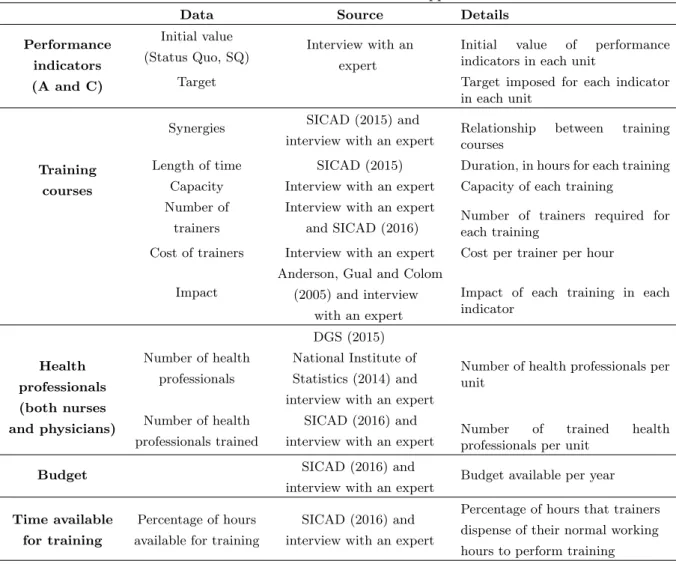
The details on the dataset used for applying the model is presented in Table 2. The model was applied in the context of Oeste Sul ACES in Lisbon, Portugal, which comprises 11 health units and two contracted indicators – Performance Indicator A and Performance Indicator C. The first indicator corresponds to screening activities and the second one corresponds to excessive alcohol consumption identification.
Table 2: Dataset used in the model application
Data Source Details
Performance indicators (A and C) Initial value (Status Quo, SQ) Interview with an expert
Initial value of performance indicators in each unit
Target Target imposed for each indicator in each unit
Training courses
Synergies SICAD (2015) and
interview with an expert Relationshipcourses between training Length of time SICAD (2015) Duration, in hours for each training
Capacity Interview with an expert Capacity of each training Number of
trainers
Interview with an expert and SICAD (2016)
Number of trainers required for each training
Cost of trainers Interview with an expert Cost per trainer per hour
Impact
Anderson, Gual and Colom (2005) and interview
with an expert
Impact of each training in each indicator Health professionals (both nurses and physicians) Number of health professionals DGS (2015) National Institute of Statistics (2014) and interview with an expert
Number of health professionals per unit
Number of health professionals trained
SICAD (2016) and
interview with an expert Numberprofessionals per unitof trained health
Budget SICAD (2016) and interview with an expert
Budget available per year
Time available for training
Percentage of hours available for training
SICAD (2016) and interview with an expert
Percentage of hours that trainers dispense of their normal working hours to perform training
To apply the model, it was considered that 8 individual training courses are available, as shown in Table 3, and that 120 training courses are derived from the first ones (by combining individual training courses). It should be noted that, although individual training courses f1, f2, f7and f8represent training courses on
screening tools, the specific objectives and tools explored within the scope of each course differs between courses; and the same applies to the individual training courses in the area of prevention of alcohol related problems.
Table 3: Summary on training courses and the associated impact in different performance indicators
Training course Area of training Indicator with impact f1
Screening tools Performance indicator A Prevention of alcohol related problems Performance indicator C f2 Screening tools Performance indicator A
f3 Prevention of alcohol related problems Performance indicator C
f4 Prevention of alcohol related problems Performance indicator C
f5 Prevention of alcohol related problems Performance indicator C
f6 Prevention of alcohol related problems Performance indicator C
f7 Screening tools Performance indicator A
f8 Prevention of alcohol related problems Performance indicator C
Also, several assumptions were made in order to assign impacts do different training courses – e.g., individual training course f1has impact on performance indicator A and C (0,04 and 0,005, respectively),
and f5 only have impact on indicator C (0,0035). More details on the how these impacts were derived
5.2
Scenarios under study
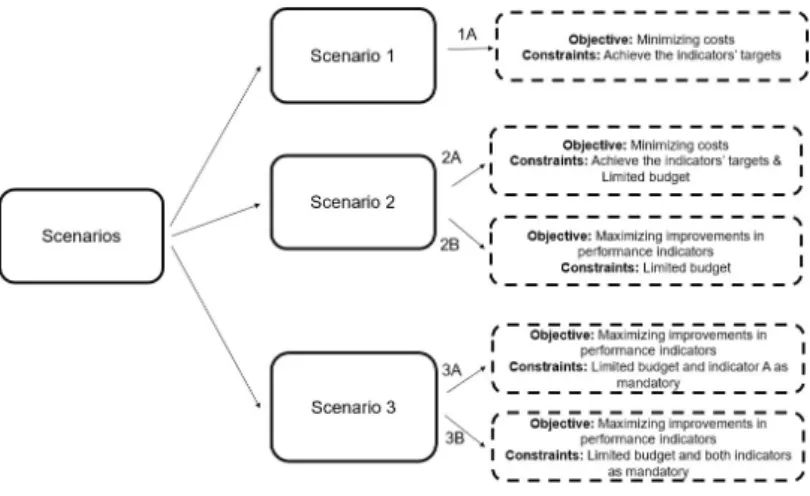
Figure 2 summarizes the different scenarios under analysis in this paper.
Figure 1: Scenarios’ summary
The first scenario (Scenario 1A) refers to a situation where one wants to plan the workforce training without any restriction in terms of budget, i.e., the question is “How much would it cost to achieve the pre-defined targets for the contracted performance indicators?”. The goal of this scenario is thus to analyze how expensive would be the training of professionals so as to achieve the desired indicators, in one year. In this case the objective would be to minimize costs (Equation 1), while performance indicators targets are imposed as constraints (Equation 9).
Two additional scenarios where a budget constraint is imposed were also explored. Two different situa-tions were analyzed:
i In scenario 2A it is intended to plan the health workforce training when a limited budget exists and when the aim is to achieve the targets imposed for contracted indicators. The key difference between scenario 1A and scenario 2A is related to the time required to achieve these targets – since there is a limited budget per year, it may take more time to achieve those targets, and so the time frame was changed to five years, following indications of experts in the area;
ii In scenario 2B it is analyzed which are the maximum improvements for different performance in-dicators, using the available budget. Here the goal is to maximize the improvements in contracted indicators (Equation 2), as an alternative to minimizing costs.
Finally, two additional scenarios were analyzed, in which it is considered that part of the indicators that are currently optional change to mandatory (currently, all the indicators are taken as optional). The following two scenarios were analyzed, with a time frame of five years:
i In scenario 3A it is proposed to analyze which are the maximum improvements for performance indicators, using the available budget. In this case, indicator A was considered as mandatory (having a weight of 1) and indicator C was optional (having a weight of 0,2);
ii In scenario 3B it is intended to analyze which are the maximum improvements for performance indicators, using the available budget and when considering both indicators as mandatory. The two performance indicators are assigned with a weight equal to 1.
5.3
Results
Results obtained under each scenario are described below. These results were obtained with the General Algebraic Modeling System (GAMS) 23.7 using CPLEX 12.0 on a Two Intel Xeon X5680, 3.33GHz computer with 12GB RAM.
Scenario 1A
It was found that is possible to achieve the pre-defined targets for the performance indicators in one year, with total costs of around 7 700e. In such circumstances, a package of training only based on
prevention courses (f1, f2, f3, f6, f8) should be offered. Still, these costs exceed the current annual
available budget, and also the budget currently available for the coming 5 years in Lisbon for areas related to the prevention and early detection of alcohol consumption. These results make it clear the relevance of exploring scenarios where a budget limit is imposed, such as under scenarios 2 and 3. Scenario 2
Within 5 years, and according to Scenario 2A, the targets imposed for the different performance indicators cannot be achieved using the available budget. For this reason, an additional run of the model was performed, allowing for longer time horizons. Under these new circumstances, it has been found that it is possible to achieve the targets in 8 years, with a cost of around 7 000e(for the 8 years).
According to Scenario 2B, it can be seen that a total budget of 5 600eand a total of 70 hours of training are required to maximize the two contracted performance indicators. In general terms, it was found that indicator A increases at a great extent in all the units, while indicator C does not exceed the pre-defined target. For example, in one of the units, indicator A increased about 81% when compared to the imposed target, while the highest growth of indicator C was 3,1%.
Scenario 3
In both scenarios 3A and 3B the costs incurred with training is the same found under scenario 2B -5 600eand 70 hours of training. The training courses that should be ensured are also the same when compared to scenario 2B (combination of individual training courses on prevention – f1, f2, f3 – and on
screening tools - f7). Similarly to scenario 2B, indicator A will always have the highest improvement
when compared to improvements in indicator C. It was also found that the value of indicator A is the same for both scenarios 3A and 3B.
Table 4 summarizes the results obtained under each of the five scenarios under study. These results make it clear the urgent need for investments in the training of health professionals in the area of prevention and early detection of alcohol consumption, independently of the scenarios under study.
Table 4: Key results obtained under the scenarios presented in Figure 1
Number of professionals to train Total hours of
training Cost [e] Scenario Physicians Nurses Total
Scenario 1A 50 49 99 84 7 700
Scenario 2A No results were obtained within a 5 years’ time frame (due to the limited budget) Scenario 2B 112 146 259 70 5 600
Scenario 3A 109 150 259 70 5 600 Scenario 3B 110 149 259 70 5 600
5.4
Sensitivity analysis
A set of sensitivity analysis were performed to explore how much sensitive are the previous results to changes in key parameters of the model that are associated with the highest level of uncertainty, namely:
i The impact caused by each training course in each performance indicator; ii The indicator weight assigned to optative indicators.
Scenario 2A was used to explore the impact of increasing the impact in indicators by 20%, and scenario 3A was used to explore the impact in changing the optative indicator’s weight from 0,2 to 0,1 and 0,3. These scenarios were selected for this analysis because these represent the ones that more closely represent the reality in Portugal.
It was found that the initial values used for the impact of each training course per indicator do not allow achieving the pre-defined targets of indicators, but increasing this impact by 20% allows achieving those targets within 5 years. On the other hand, when analyzing the impact of changing the weight assigned to optional indicators, it was found there is no change in the number of trained professionals, cost and hours of training. However, there is only a minimal change in the improvement found for indicator C. According to these results, it can be concluded that the planning of workforce training is sensitive to changes in the impact of training courses on indicators, as well as on changes in the importance attributed to the optional indicators (with this importance being traduced by the associated weight).
5.5
Computational results
Key computational results obtained when running the model under each scenario are presented in Table 5.
Table 5: Key computational results per scenario
Scenarios Time [minutes] Gap Iterations Equations Integer variables Variables Scenario 1A 11,45 0 108 652 18 282 2 760 12 078 Scenario 2B 1,8 0 2 303 179 044 13 800 60 212 Scenario 3A 2,2 0 2 649 179 044 13 800 60 212 Scenario 3B 2,1 0 2 247 179 044 13 800 60 212
5.6
Discussion of results
From Table 4 it is clear that if there is not a budget constraint or limited resources (scenario 1A), the costs incurred would be around 7 700e, with 84 total hours of training in a single year. Nevertheless, in real practice there is a limited budget for training health workforce in the alcohol consumption sector, and the current budget is far from being enough to ensure this level of training in one single year. In general terms, the need for such a high level of training shows that the health workforce currently providing care in the area of prevention and early detection of alcohol consumption in Lisbon are not adequately trained, and so it can be concluded that there is a shortage of trained professionals in this field in Lisbon. Under scenario 2A it was found that it is impossible to achieve the performance indicators targets within the five years’ time frame. This is mainly related with the lower budget that is available per year (on average, 1 294eper year), when compared to the costs incurred under Scenario 1A (7 700e).
On the other hand, when the objective is the maximization of the improvement of performance indicators (scenario 2B) there is a significant change in costs, time and training of health professionals, when compared to scenario 2A – this happens because a lower budget is available, limiting the number and type of training courses per year. However, when the objective is to maximize the improvement of the indicators and the only change is on the nature of the indicators (that can be mandatory or optional), there are no significant changes in training time, monetary costs and on the number of professional to be trained – this can be concluded by comparing the results obtained under scenarios 2B, 3A and 3B. It was also found that, whenever there is a limited budget, the training should be the simplest possible (only individual training courses, rather than the combination of different training courses).
6
Conclusions and further work
The alcohol consumption area had been a major challenge in several European countries, including in Portugal. Some studies have shown that there is a gap in the workforce training, as well as no incentives for health professionals working in this field. Accordingly, there is clearly the need for an adequate planning of health workforce training in the area of prevention and early detection of alcohol consumption. Still, there is a lack of methods devoted to this issue.
Within this setting, this study proposes the development of the WFTMalcohol model. This is an opti-mization model based on linear programming developed to plan the training of health workforce in the alcohol consumption area in NHS-based countries. This model aims at informing on how many health professionals (both physicians and nurses) should be trained per year and health unit, and which training packages should be made available per year. Multiple objectives relevant in this sector are considered, including the minimization of costs and the maximization of performance indicators (both mandatory and optional indicators).
The key contributes of the present paper are as follows:
i It is focused on the training of health professionals in the field of excessive alcohol consumption, a health care area not widely studied in the health planning literature;
ii It accounts for the impact of different planning objectives, including the minimization of costs and the maximization of performance indicators;
So as to illustrate the usefulness of the proposed model, it was applied to a Portuguese case study, namely, to Oeste Sul ACES in Lisbon, Portugal. The main results confirm that there is a lack of training in excessive alcohol consumption area in Lisbon – in fact, results show that in the unit with the lowest performance for the contracted indicators, the health professionals need to have an average of 2 trainings in distinct areas. By performing a sensitivity analysis, it was confirmed that workforce training is sensitive to changes in the impact of training courses on indicators, as well as on changes in the importance attributed to the optional indicators.
In terms of further research, different lines of research are worth to be pursued. First, it should be explored how to prioritize different indicators. In particular, multiple criteria methods should be employed for that purpose. Specifically, the MACBETH (Measuring Attractiveness by a Categorical Based Evaluation Technique) methodology could be used (Bana Consulting, 2016). Secondly, having recognized the impact of uncertainty in planning decisions, it is also considered as relevant the development of a stochastic model so as to allow for a detailed analysis of uncertainty. Also, having recognized as relevant the analysis of different policies objectives when planning the health workforce training, multi-objective models that allow exploring the joint impact of multiple objectives, such as minimizing costs together with the maximization of performance indicators (and also other policy objectives that may be considered as relevant), should also be pursued. In addition, since sensitivity analysis has confirmed that planning results are sensitive to the impact in performance indicators, there is clearly the need to develop further research so as to build accurate estimates of this impact. Particularly, there is need to estimate this impact over the years while accounting for the type of topics covered in the training courses, for the number of professionals receiving training per course, for the target population to be served, among other factors.
References
Anderson P, Gual A, Colom J (2005) Clinical Guidelines for the Detection and Brief Interventions [Recomenda¸c˜oes Cl´ınicas para a Dete¸c˜ao e Interven¸c˜oes Breves], Barcelona
Anderson P, Kaner E, Wutzke S, Funk M, Heather N, Wensing M, Grol R, Gual A, Pas L (2004) Attitudes and managing alcohol problems in general practice: an interaction analysis based on findings from a who collaborative study. Alcohol & Alcoholism 39 (4): 351–56
Ballard T, Grenda T, Cohn A, Daskin MS, Seagull FJ, Reddy RM (2015) Innovative Scheduling Solutions for Graduate Medical Education. Journal of Graduate Medical Education, 7: 169-170
Bana Consulting (2016) M-MACBETH. Available via http://www.m-macbeth.com/en/ m-home.html, September 2016
Dias J (2015) Training in prevention and brief interventions in the area of alcohol consumption change attitudes of health profes-sionals? [A Forma¸c˜ao em rastreio e interven¸c˜oes breves do ´alcool muda as atitudes dos profissionais de sa´ude ocupacional? ], Lisbon, Universidade Nova de Lisboa
SICAD (2015) Training plan in Additive Behaviors and Dependencies [Plano de Forma¸c˜ao em Comportamentos Aditivos e De-pendˆencias], EMPECO, SICAD
Gomes C (2010) General and Family Medicine and the Alcohol Consumption Approach [A medicina Geral e Familiar e a Abor-dagem do Consumo de ´alcool ], SICAD
Horn M, Elgindy T, Gomez-Iglesias A (2015) Strategic workforce planning for the Australian Defence Force. Journal of the Operational Research Society, 67(4): 664-675
Hu W, Lavieri MS, Toriello A, Liu X (2016) Strategic Health Workforce Planning. IIE Transactions, 48(12): 1127-1138
Lavieri MS, Puterman ML (2009) Optimizing nursing human resource planning in British Columbia. Health Care Management Science, 12(2): 119-128
Lopes MA, Almeida A, Almada-Lobo B. (2015) Handling healthcare workforce planning with care: where do we stand? Human Resources for Health, 13:38
Ministry of Health (2011) Health Strategies, V HNP Books – Health Indicators and Targets [Estrat´egias para a Sa´ude, V Cadernos do PNS - Indicadores e Metas para a Sa´ude], Alto Comissariado da Sa´ude
Nunes C, Correia C, Ribeiro C, Santos C, Marquˆes L, Barbosa M, Pereira ML, Pardal P, Seixas T, Ramos V (2012) Primary Health Care in Local Units [Os Cuidados de Sa´ude Prim´arios nas Unidades Locais de Sa´ude], Technical Group for the Development of Primary Health Care Services, Ministry of Health
DGS (2015) Primary Health Care Centers and Hospital Units – Resources and Production 2012 [Centros de sa´ude e unidades hospitalares - Recursos e Produ¸c˜ao 2012 ]. Ministry of Health, Directorate General for Health
Price WL, Martel A, Lewis KA (1980) A Review of Mathematical Models in Human Resource Planning. Omega, 8(6): 639-645 Senese F, Tubertini P, Mazzocchetti A, Lodi A, Ruozi C, Grilli R (2015) Forecasting future needs and optimal allocation of medical residency positions: the Emilia-Romagna Region case study. Human Resources for Health, 13:7
SICAD (2016) Forma¸c˜oes SICAD. Available in: http://www.sicad.pt/PT/Formacao/SitePages/FormacaoSICAD.aspx
Stewart BD, Webster DB, Ahmad S, Matson JO (1994) Mathematical models for developing a flexible workforce. Int. J. Production Economics, 36(3): 243-254
World Health Organization (1978) Alma Ata Declaration, WHO
Wishon C, Villalobos JR, Mason N, Flores H, Lujan G (2015) Use of MIP for planning temporary immigrant farm labor force. Int. J. Production Economics, 170: 25-33