A DIGITAL ENVIRONMENT TO RUN ONLINE SIMULATION
EXERCISES OF PUBLIC HEALTH CRISIS
Rodrigo Martins Filipe
MESTRADO EM EDUCAÇÃO
Área de Especialidade Educação e Tecnologias Digitais
Trabalho de Projeto Orientado pela Professora Doutora Neuza Pedro
Dedication
I dedicate this master's degree in education and digital technologies to my children Gabriel and Sílvia who had less of daddy's time during these two years and to my wife Carla, who has always been there to support and encourage me pursue this goal.
Acknowledgements
I would like to acknowledge the dedicated work of my coordinator Professor Neuza Pedro for the patience, guidance and wise advice. Special thanks to my line managers who encouraged me to apply and supported my engagement in this masters’ programme. Finally, I would like to thank in alphabetical order all experts who took part in the expert panel I interviewed, Laszlo Balkanyi, Massimo Ciotti, Daniel Faensen, Josep Jansa, Paul Riley and Carmen Varela Santos.
TABLE OF CONTENTS ABSTRACT 6 RESUMO 7 List of Annexes 11 List of Figures 12 List of Abbreviations 14 1. INTRODUCTION 15 2. BACKGROUND 17 3. METHODOLOGY 23 3.1 Project Approach 23 3.2 Data Collection 25 3.2.1 Semi-structured Interviews. 25 3.2.2 Expert Panel. 26 3.3 Data Analysis 30 4. RESULTS 31 4.1 Interview Results 31 4.2 List of Requirements 38 5. IMPLEMENTATION 43
5.1 Template for Tabletop Exercises 47
5.2 Template for Functional Exercises 56
6. CONCLUSION 63
7. LIMITATIONS AND NEXT STEPS 65
ABSTRACT
This individual project envisages the creation of a digital online environment to run
simulation exercises of public health crisis situations. The project is developed in the context of the Master Programme in Education and Digital Technologies of the Instituto de Educação, Universidade de Lisboa. The work takes place between September 2016 and October 2017, following a project plan composed of six phases: conceptualization; research; data collection and analysis; implementation; and reporting. A panel of six experts provides data (by means of semi-structured interviews) to support the process of definition of solid requirements for the implementation of a successful online environment to run simulation exercises. The outputs are two templates for tabletop and functional exercises that are ready to use in the learning management system of the European Centre for Diseases Prevention and Control. The project explores the innovative application and implementation of distance learning technologies to serve the execution of simulation exercises to prepare for public health crisis, which are traditionally delivered in face-to-face format. The target group for the project’s outputs is European audience of designers of simulation exercises. It is aimed to facilitate continuous training initiatives for professionals working in the area of preparedness and response to public health crisis in the European Union.
RESUMO
Este projeto centra-se na criação de um ambiente digital para executar exercícios de simulação online de situações de crise de saúde pública. Este projeto é desenvolvido no contexto do programa de mestrado em Educação e Tecnologias Digitais do Instituto de Educação da Universidade de Lisboa. Seguindo um planeamento de projeto composto por cinco fases: conceptualização; investigação; recolha e tratamento de dados; implementação; e escrita do relatório, o mesmo decorre entre setembro de 2016 e outubro de 2017. Durante a fase de conceptualização, vários temas são sugeridos e analisados no que diz respeito à sua pertinência, actualidade, exequibilidade e dependências de terceiros. Esta análise é levada com o apoio técnico de elementos em atuação no Centro Europeu para Prevenção e Controlo de Doenças Infecciosas (ECDC), onde o autor exerce funções na área da formação
profissional. Na fase de investigação foram realizadas as pesquisas bibliográficas relevantes para o projeto, emergindo como documentação de base os manuais para suporte à
organização de exercícios de simulação na área de saúde pública, publicados pelo ECDC em 2014 e pela Organização Mundial de Saúde em 2017. Estes documentos definem a base sobre a qual este projeto se edifica. Os exercícios de simulação são organizados com dois tipos de objetivos: formativos e procedimentais. Os objetivos formativos são alcançados envolvendo especialistas da área em tarefas que lhes permita exercitar as suas práticas. Os objetivos procedimentais são de extrema relevância para testar novos procedimentos ou alterações aos mesmos. Com recurso a entrevistas semi-estruturadas, um painel de seis especialistas foi constituído com vista a fornecer dados que, depois de analisados, permitem a definição de requisitos a considerar na criação de um ambiente online bem sucedido para suporte a exercícios de simulação, nomeadamente: a possibilidade reutilização dos exercícios; a simplicidade visual dos interfaces desenvolvidos que devem ser intuitivos, de fácil utilização e não requerentes de formação específica; a flexibilidade de adaptação aos objetivos e
especificidades de cada exercício; a abrangência do grupo de potenciais utilizadores que primeiramente são as autoridades internacionais e as autoridades nacionais dos países membros da União Europeia, mas também outros países a nível mundial, especialmente os em vias de desenvolvimento; a fiabilidade do ambiente em termos de robustez da plataforma tecnológica bem como da segurança de dados; e finalmente o suporte dado à interação humana por meio das tecnologias digitais. O produto final deste projeto criado pelo aluno durante a fase de implementação, é constituído por dois modelos para exercícios de simulação implementados e prontos a utilizar, no sistema de gestão de aprendizagem do ECDC: um relativo a exercícios tabletop, baseados em discussão e interação dos participantes, que pode ser utilizado em formato totalmente a distância ou em formato híbrido com os passos pré- e pós-exercício a distância e a discussão a decorrer presencialmente; e outro relativo a
exercícios funcionais, baseados em operações mais estruturadas, onde normalmente os participantes interagem a partir dos seus postos de trabalho e reagem a informação que lhes é apresentada seguindo os procedimentos estabelecidos. Nos exercícios funcionais, mede-se a eficácia de procedimentos e o alinhamento entre os vários procedimentos com vista a
identificar pontos de melhoramento. O projeto é focado na exploração da aplicação inovativa das tecnologias de aprendizagem ao serviço dos exercícios de simulação de crises de saúde pública, que tradicionalmente são realizados em formato presencial. Os produtos finais deste projeto são desenhados para um público-alvo especifico, criadores de exercícios de
simulação para a formação contínua de profissionais a exercerem funções em posições relacionadas com a preparação e resposta a situações de crise de saúde pública na União Europeia, nos países do Espaço Económico Europeu e nos países vizinhos. Sendo no entanto possível a abertura deste ambiente a outros países que o requeiram perante o ECDC. Os principais contributos dos produtos desenvolvidos neste projeto são: a capacidade de repetir a baixo custo mais exercícios de simulação, envolvendo assim mais pessoas em exercícios
realizados a distância que doutra forma não poderiam tomar parte dos mesmos, ampliando-se assim formação individual fornecida e as contribuições recolhidas para os resultados dos exercícios; a estruturação dos vários elementos dos exercícios duma forma clara e acessível; a mais valia de poder recolher dados de avaliação de uma forma sistemática quer por parte dos participantes quer por parte dos observadores; oferecer um meio para comunicação entre os participantes nos exercícios e e finalmente de fazer um acompanhamento das actividades por eles levadas a cabo, questionando-os acerca do impacto do exercício. Através deste projecto, conclui-se que a relevância dos exercícios de simulação online é elevada no sector da saúde pública. Apesar da interação humana ser um aspeto importante para o fortalecimento de relações profissionais, há espaço para uma ampliação da massa critica de especialistas envolvidos nos exercícios através da execução de mais exercícios promovendo a interação, a distância, suportada por uma plataforma online. Conclui-se ainda que interfaces pessoa-máquina, que simulem ambientes imersivos de jogo, é ainda entendida como pouco ajustada à realidade vigente.
A escolha técnica do ambiente de gestão de aprendizagem do ECDC traz vantagens
estratégicas que potenciam a sua utilização mas introduz limitações na escolha da tecnologia a utilizar que poderia doutra forma ser escolhida dentro de um leque mais alargado de opções. Muitas das dificuldades identificadas pelo painel de especialistas, como a definição vaga de objetivos ou a falta de um plano de ações pós-exercícios, são questões que se aplicam genericamente a todos os exercícios de simulação e como tal não são uma preocupação especifica dum ambiente online. Este projeto assume algumas limitações: i) no que diz respeito à composição do painel de especialistas onde se poderia encontrar representada mais significativamente a área de formação de adultos e da aprendizagem em ambientes online; ii) a falta de um processo de validação dos resultados junto do painel de especialistas
realização de um exercício piloto para testar o ambiente online em ação. Finalmente há que salientar que este tópico se revelou bastante abrangente e a sua adaptação a um projeto de mestrado, temporalmente circunscrito, acabou por limitar o trabalho a ser desenvolvido. Sem esta limitação este projeto poderia ser expandido em várias dimensões incluindo a mais abrangente que se prende com a internacionalização da perspetiva de análise e de conceção assumida no trabalho bem como a sua abertura aos desenvolvimentos que se encontram estabelecidos (e por estabelecer) nos setores de proteção civil e militar cujos exercícios de simulação certamente encontram paridade com os de saúde pública.
Palavras chave: Exercício de simulação; Formação em serviço; Crise de saúde pública; Plataforma online; Sistema de Gestão de Aprendizagem; LMS,
List of Annexes
ANNEX I - Invitation letter (e-mail) ANNEX II - Interview guide
List of Figures
Figure 1. Steps of the emergency preparedness cycle (retrieved from WHO, 2017, p. 11) 18 Figure 2. Decision tree to determine the right type of simulation exercise. (retrieved from
WHO, 2017, p. 15) 20
Figure 3. Schedule of the project phases 23
Figure 4. Extract from EVA’s template category showing TTX and FX templates 46 Figure 5. Heading of FX template and topic (0) Before you start preparing the exercise 48
Figure 6. TTX (1) Exercise overview 48
Figure 7. TTX (2) Prepare for the exercise 49
Figure 8. TTX (3) The exercise begins 51
Figure 9. TTX (4) Development of the exercise 53
Figure 10. TTX (5) Closure of the exercise 54
Figure 11. TTX (6) Post exercise 56
Figure 12. Example of a timeline box for a three-day long FX 57 Figure 13. Topics of FX template until the exercise start 58 Figure 14. Activities for exercise development - FX template 60
List of Tables
Table 1: Exercise types in different areas of the emergency preparedness cycle (EPC) 19 Table 2: Time schedule and duration of the interviews with members of the expert panel 27 Table 3: List of requirements for a system supporting implementation of TTX and FX 38
List of Abbreviations
EC European Commission
ECDC European Centre for Disease Prevention and Control EEA European Economic Area
EPC Emergency Preparedness Cycle
EPIS Epidemic Intelligence Information System
EU European Union
EVA ECDC Virtual Academy
EWRS Early Warning and Response System FETP Field Epidemiology Training Programme FX Functional exercise
IHR International Health Regulations IT Information Technology
LMS Learning Management System
PH Public Health
SCORM Sharable Content Object Reference Model
SWOT Strengths, Weaknesses, Opportunities and Threats TTX Tabletop exercise
URL Uniform Resource Locator WHO World Health Organization
1. INTRODUCTION
This project envisages the creation of a digital online environment to run simulation exercises of public health crisis situations, with the objective to increase the reusability of simulation exercises already designed and currently available in the European Union. The project is developed in the context of the Master Programme in Education, specialization in Education and Digital Technologies of the Instituto de Educação, Universidade de Lisboa. The project is executed in the period of September 2016 to October 2017 and the work follows a project plan composed of five slightly overlapping phases: conceptualization; research; data collection and analysis; implementation; and reporting. A qualitative research methodology is applied to understand the pertinence of simulation exercises as an approach for training of the workforce, the adequacy to run exercises in an online platform and
recommendations for a successful implementation of the platform. A series of 45-60 minutes semi-structured interviews are organised with a panel of six experts. The information from these interviews provides data for the analysis to allow the definition of solid requirements for the implementation of two templates in the ECDC Virtual Academy (EVA), which is the learning management system of the European Centre for Diseases Prevention and Control (ECDC). One template focuses on participants interaction and is suitable for discussion-based exercises, namely tabletop, while the other is applicable for operations-based exercises
(without field deployment), namely functional exercises. The implementation process explores the best application of distance learning technologies to serve the specific needs of simulation exercises of public health crisis, which are traditionally delivered in a face-to-face format. The outputs of this project are designed to support designers of simulation exercises that are a component of a continuous training of professionals working in positions related to the preparedness and response to public health crisis in the European Union. The outputs are
intended for practical application by national authorities of the EU Member States, as well as by ECDC in designing and performing simulation exercise on cross border health threats.
2. BACKGROUND
This project results from an initiative to identify innovative opportunities to engage wider audiences in simulation exercises organised at European and national level (e.g. by the European Centre for Disease Prevention and Control (ECDC) and its stakeholders).
ECDC is an agency of the European Union (EU), established in 2005 following the decision of the European Parliament and of the Council of the European Union (EC 2004). ECDC works with all EU Member States and countries from the European Economic Area (EEA), we well as with EU enlargement and neighbourhood policy countries, to prevent and control the spread of infectious diseases. ECDC plays a central role in coordinating the
combat to cross-border health threats in the EU. ECDC provides technical, scientific advice in assessment of risks for the spread of communicable diseases, supports countries in improving preparedness plans for timely and relevant response to threats, and according to its mandate delivers training aimed to support the EU public health workforce to respond to threats of infectious diseases. ECDC organises, facilitates and coordinates several training activities in a variety of formats, including simulation exercises. Simulation exercises, as a training
technique, have been considered as important element in efforts to improve public health preparedness planning. In 2004 ECDC published a handbook on simulation exercises aimed to support training of public health experts to prepare for adequate response to public health (PH) crises (ECDC, 2014b).
The target audience for simulation exercises is the European public health experts working in front line duties related to the preparedness and response to emergency situations of public health concern. This includes the active workforce and the ones joining in the upcoming years. The outputs of this project are meant to be used by designers/organisers of
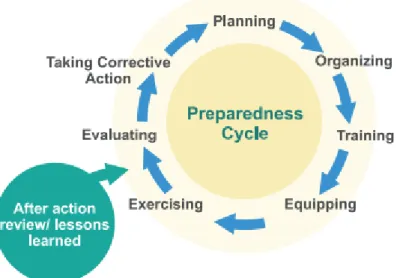
simulation exercises at ECDC or in the EU Member States. In this document these professionals are referred to as exercise designers. Exercise designers and exercise coordinators prepare in detail the exercises and design their activities to meet the exercise goals and allow their objective evaluation. The public health experts perform activities related to emergency preparedness along iterations following cyclic logic called the emergency preparedness cycle (EPC) illustrated by WHO (see Figure 1) (WHO, 2017). Different types of simulation exercises focus on different steps of the EPC.
Figure 1. Steps of the emergency preparedness cycle (retrieved from WHO, 2017, p. 11)
There are several types of simulation exercises and the decision to choose the right type of exercise shall be carefully made taking, as a starting point, the objectives and the intended outcomes. Both ECDC (ECDC, 2014b) and WHO (WHO, 2017) define in their manuals for simulation exercises two categories of exercises: discussion-based and operations-based exercises. Discussion-based exercises are typically tabletop which are informal meetings where exercise players discuss possible solutions for a given problem. ECDC defines another type of discussion-based exercise, orientation exercise which typically take shape of seminars or webinars, in this project the focus is on tabletop exercises. The exchange of perspectives and understanding of each other's viewpoints is a crucial part of these exercises. The category
of operations-based exercises is very vast in terms of formats. Depending on the objectives to be met, in increasing order of complexity and resources required, exercises can take the shape of drills, functional exercises (also known as command-post exercises) and full-scale
exercises (also known as field exercises). A mapping between the different types of simulation exercises and the various phases of the preparedness cycle is very clearly explained by WHO in it is manual for simulation exercises (WHO 2017) (see Table 1).
Table 1: Exercise types in different areas of the emergency preparedness cycle (EPC) Type of exercise Corresponding EPC component
Tabletop Planning, organizing, training and taking corrective action Drills Training, equipping, exercising and evaluating
Functional Training, exercising and evaluating
Field/full-scale exercise Training, equipping, exercising and evaluating
Note. Adapted from WHO, 2017, p. 13.
In Figure 2, the various types of exercises are the endpoints of a decision tree suggested in WHO’s simulation exercise manual (WHO 2017). A few questions are directed to the objectives of the exercise and help the exercise designer determine the most appropriate type of exercise to select.
Figure 2. Decision tree to determine the right type of simulation exercise. (retrieved from WHO, 2017, p. 15)
To understand the context in which this project is being developed it is relevant to be aware of some legislation related to public health and the ongoing activities by the
international organisations competent in this field. In 2005, as agreed by 196 countries, the World Health Organization (WHO) published the International Health Regulations (IHR). It presents a set of capacities aimed at development and improvement of prevention and control of infectious diseases. As suggested by WHO, countries shall be prepared to respond quickly and effectively to threats to public health (WHO 2016). Coordination and collaboration of staff in different sectors is crucial to successfully respond to and control the spread of diseases. The decision nº 1082/2013/EU of the European Parliament and of the Council on serious cross-border threats to health lays down for all EU Member States rules on
epidemiological surveillance, monitoring, early warning of, and combating serious cross-border threats to health, including preparedness and response planning related to those activities, in order to coordinate and complement national policies (EU 2013). In 2015 the European commission published a report on the implementation of Decision 1082 (EC 2015) on cross border health threats, where the importance of in-country as well as cross-border exercises is highlighted and organisations are encouraged to conduct simulation exercises to ensure that IHR capacities, business continuity and interoperability of preparedness plans are maintained.
This project explores an innovative complementary format to carry out simulation
exercises – through the use of online platforms. This alternative approach could save time and costs for travel (if experts are called for face-to-face tabletop exercises).
3. METHODOLOGY
The methodology chapter is organised in three subchapters: 3.1 The methodology of the project; 3.2 The methodology for data collection; and 3.3 The methodology for data analysis.
3.1 Project Approach
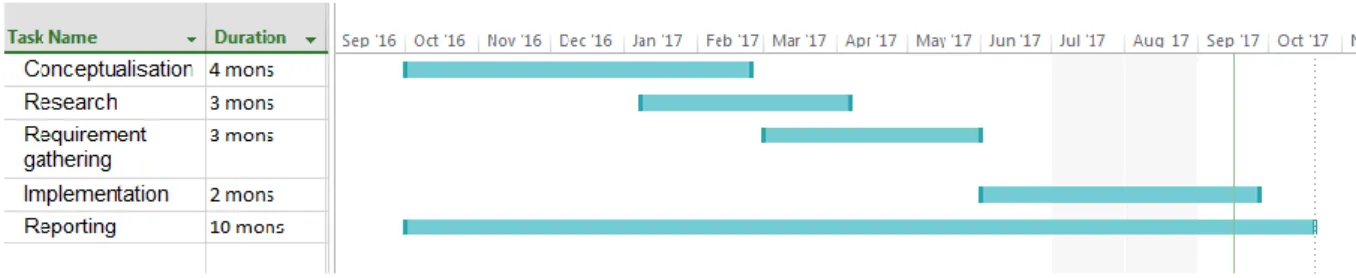
This project is done following these slightly overlapping but sequential phases, as illustrated in Figure 3: 1. Conceptualisation; 2. Research; 3.Requirement gathering; 4. Implementation; and 5. Reporting.
Figure 3. Schedule of the project phases
The conceptualisation phase is done with a series of formal meetings developed with the author, the supervisor and an expert adviser from the training section of the ECDC. These meetings have the purpose of exploring different ECDC activities to as candidate topics for this project. An initial comparison of the advantages and disadvantages of the different topics is followed by a thorough Strengths, Weaknesses, Opportunities and Threats (SWOT)
analysis where the creation of a virtual environment to run simulation exercises of public health crisis is a topic of high pertinence to the domain of public health, as well as to the field of perfecting skills in adult learning. The innovative aspect of the project as well as the lack of dependencies on third parties are determinant opportunities of this topic.
The research phase is initiated with a study of the subject matter and a search for similar tools already available. The military seems to be the domain in which the planning and execution of simulation exercises are more standardized and where there are systems available to simulate crisis management (Shalamanov, 2006). (Perhaps) Due to the
confidentiality of the military documents no relevant literature is promptly available in the open domain relevant to this project. The two international organisations leading the
organisation of simulation exercises in the field of public health and supporting the countries of the EU in their own exercises are the ECDC and WHO-Euro which both have published simulation exercises manuals. These manuals are the underlying literature base in which this project builds upon.
The requirement gathering phase starts with inviting experts for integrating an expert panel, booking and conducting individual semi-structured interviews to collect data, followed by the data extraction into tables and afterwards data analysis and interpretation.
The implementation phase is an individual task. The student creates two templates addressing as much as possible the requirements collected from the expert panel. The tool used is Totara Learn, a Moodle based Learning Management System which is currently used by the ECDC.
Reporting is a project phase which extends along the whole duration of the project and is done by the student with supervision and guidance of the supervisor using google docs for co-authoring of the document online.
3.2 Data Collection
3.2.1 Semi-structured Interviews.
Interviews are commonly referred as “controlled conversation”, where the dialogue is oriented towards the interests of the interviewer. As no research interview lacks structure most of the qualitative research interviews are either semi-structured, lightly structured or in-depth (Mason, 1994). Semi-structured interviews are utilized extensively as interviewing format possibly with an individual or sometimes even with a group; in semi-structured interviews the respondents have to answer some pre-set open-ended questions. These
questions are structured in an interview guide, which is a schematic presentation of the topics and need to be explored by the interviewer. Very often, for an effective data collection
process, the interview is recorded; audio format is considered an appropriate choice (Jamshed, 2014).
I design an interview guide, available in Annex II, aiming at 45-60 minutes
semi-structured interviews to collect data individually from each of the members of the panel. The interviews are audio recorded to facilitate the post interview analysis of results. Based on the comparison of research methods presented by Creswell (Creswell, 2009), I choose semi-structured interviews as the tool for data collection. This type of interviews is open enough to meet the exploratory objective of this project, and sets a frame to enable structured data analysis procedures. The goals set for the data collection are: validate assumptions on the relevance of simulation exercises of public health crisis; assess the appropriateness of a digital environment to run the exercises; and to extract recommendations from the experts on how to shape such an environment successfully.
3.2.2 Expert Panel.
For collecting relevant inputs in simulation exercises practice, suitability to adapt to the digital environment and recommendations for a successful implementation, a group of specialists from relevant areas of expertise is invited to integrate a panel of experts. The constitution of an expert panel is regularly identified as a Delphi Method. In this study some of the main characteristics of a Delphi Method are respected, others are not. Therefore, this research technique is not assumed as the methodological approach of the study.
An expert panel is indeed constituted and a method for consensus-building was used; however, it is built upon individual interviews and no multiple iterations (series of rounds) of data collection from the panel is conducted (Hsu & Sandford, 2007). For the constitution of the panel the main ideas presented by Klee (1972) are followed: an adequate (minimal) number of experts, a suitable variety of background knowledge (for assuring reliability and accuracy), sensitivity to the topic and to the selected research methodology, and the guarantee of their availability and commitment to the study.
The panel is composed by six experts. Initially the number of experts intended to be odd to avoid a draw regarding potential conflicting opinions, however at a later stage, when factoring the availability to support the project, the expert panel ended up in an even number.
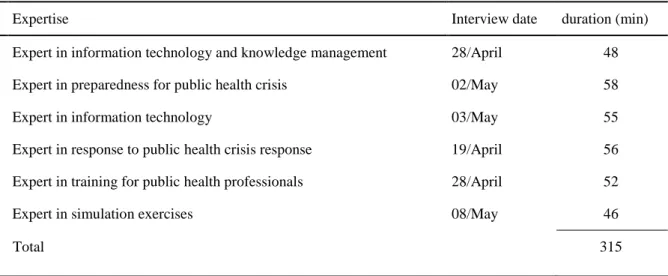
The members of the expert panel are invited by email using the template in Annex I. According to the availability expressed in the responses to the invitation, the members of expert panel are interviewed according to the schedule presented in Table 2, where the interview duration ranges from 46 to 58 minutes. The second interview mentioned in the invitation email does not take place during this project due to the delayed implementation and time constraint imposed by the project deadline. At the stage of the publication of this project report this is a possible future step.
Table 2: Time schedule and duration of the interviews with members of the expert panel
Expertise Interview date duration (min)
1 Expert in information technology and knowledge management 28/April 48 2 Expert in preparedness for public health crisis 02/May 58
3 Expert in information technology 03/May 55
4 Expert in response to public health crisis response 19/April 56 5 Expert in training for public health professionals 28/April 52
6 Expert in simulation exercises 08/May 46
Total 315
The selection of experts is made based on the skillset of each individual to ensure three knowledge domains are represented in the panel: simulation exercises of PH crisis; adult learning and in-service training; and information systems.
The simulation exercises experience is brought to the panel by three experts (experts 2, 4 and 6) with extensive experience in participating and organising them, whereas the remaining experts had marginal exposure to simulation exercises mostly as participants. All three
experts participated in several multisectorial and international exercises.
● Expert 2 is a Medical Doctor specialised in public health and in medical statistics. Since 1988 he has been working in international health, mainly in the communicable disease field, living in developing and developed countries. During his career he has participated in different WHO programmes. As a liaison officer in Luxembourg he had a key role in strengthening the cooperation between EU and WHO. He then moved to ECDC, where his main areas of responsibilities have been in crisis management planning and operations, epidemic intelligence, strategic development in European preparedness and response to communicable disease, including pandemic influenza and deliberate outbreaks. Currently holds responsibilities as deputy head of the public health capacity and communication unit and head of the section of preparedness country support.
● Expert 4 is a Medical Doctor with a PhD. He has been holding different positions at local, regional, national and international levels in Catalonia, Spain and in several countries in the areas of epidemiology of infectious diseases, public health surveillance and health threats, community health, drug abuse, international health and migrants’ health. Has been teaching epidemiology and international health for more than 20 years, and has been coordinating the Master on International Health and Tropical Medicine in the Autonomous University of Barcelona. Since 2012 works at the ECDC as head of the Epidemic Intelligence and Response section and deputy head of the Surveillance and response Support Unit. He has been involved in different missions of health cooperation, humanitarian and public health crisis (refugees, armed conflicts, epidemics) and consultancy on health services.
● Expert 6 is graduated in Natural Sciences with over 14 years of experience in
planning, conducting and evaluating simulation exercises at Public Health England, formerly known as Health Protection Agency. Since May 2017, has joined ECDC as a senior expert in preparedness where he has responsibilities in organising multi-country and multi sectoral simulation exercises to support the Member States of the EU in improving their capacity to prevent and respond to crisis situations. This expert has the widest experience in planning, designing, organising, conducting and evaluating simulation exercises having taken this responsibility in hundreds of exercises ranging in duration from half-day to week long exercises and in size from a handful of individuals to thousands of participants.
The adult learning knowledge domain is brought to the panel by expert 5 with many years of experience in planning and providing training to professionals in the domain of public health. Expert 4 also had relevant experience in adult learning, although more focused on academia rather than continuous professional development.
● Expert 5 graduated in veterinary medicine with specialty of medicine and public health. Worked as food safety inspector in Galicia. Attended the Spanish Field Epidemiology
Training Programme (FETP), and completed a master's degree in applied epidemiology. Worked in preparedness, early warning and response at the directorate general of public health. As academic coordinator of the Spanish FETP in the national centre of epidemiology in Madrid, this expert managed the activities of the programme and supervised FETP fellows from four cohorts. Joined the ECDC as senior expert in 2005, contributing to building public health capacity in the EU through training, involvement on pandemic preparedness,
monitoring health threats, rapid risk assessment and response support. Since 2011, she leads the training network strengthening group, the team who organises external training for public health professionals, and since February 2017, is head of the public health training section, which involves the management and strategic direction of ECDC training programmes.
The information systems knowledge domain is brought to the panel by experts 1 and 3, working for many years in the fields of information systems for public health also have a background in biological sciences, which makes them closer to the target audience with more sensitivity to the importance of public health crisis preparedness and response as compared to pure information science experts.
● Expert 1 holds a PhD in Medical informatics. With a medical doctor background, has been working with information systems for the health and public health sector for more than 20 years in international environments such as the World Bank, the WHO and more recently ECDC. Currently holds responsibilities at ECDC as knowledge manager and member of the Enterprise Architecture project, giving him a wide overview of the systems used by the ECDC and its stakeholders and the interoperability among those systems using common standards.
● Expert 3 holds a PhD in biology as well as a degree in computer science. Having experience as secondary school teacher, has worked at the Freie Universitaet Berlin, Computer Science Institute as senior researcher specialized on databases and information
systems/digital libraries. Worked at the Robert Koch Institute, Berlin as data manager and IT expert/project manager with responsibilities in analysis of surveillance data; development of surveillance systems; training of software and participated in a simulation exercise. Currently works at the ECDC as IT expert and group leader for business analysis with responsibilities as project manager for the development of surveillance systems; assessment of surveillance systems and business analysis.
3.3 Data Analysis
Following the data collection phase, and using 315 minutes of recordings of the
interviews, I paraphrase the statements made by each expert and added them as entries in the respective data table. Tables were created and managed in a personal Google spreadsheet which allowed the work to be supervised at distance by the coordinator and is an easy to use tool to handle large tables and sorting data by a specific column. Since the interviews are semi-structured, experts deviate from the guide in different directions and, during data analysis stage, statements are classified under the table of most pertinence. When an expert repeats an already recorded statement, instead of adding a new line, another column of the already existing line is signalled and the frequency increased. Note that the same expert mentioning the same thing twice or more often does not increase the occurrence. The entries in each table are then ordered by the frequency or a Likert scale and are available in ANNEX III. The analysis of these results is presented in the results chapter. To protect personal data, the interview recordings are stored offline, in a private storage unit until the presentation of this project to the jury and then erased.
4. RESULTS
This chapter presents and analyses the results of the individual interviews. The data directly extracted from the interviews, available in Annex III, is the foundation of sub-chapter 4.1 Interview results. The sub-chapter 4.2 Requirements lists the most relevant requirements endorsed by at least 50% of the experts in the panel.
4.1 Interview Results
The interview results presented in this subchapter are organised in four parts corresponding directly to the structure of the interview guide, available in Annex II.
Part I - Interviewees’ background - The experience of the experts covers the fields of simulation exercises and distance learning. While two experts have only minimal experience participating in simulation exercises and no experience organising them, four experts are very experienced participants in simulation exercises of various types (drills, tabletop, command-post, full scale). The exercises in which the experts are experienced ranges in size from 20 to 2000 participants and in duration from a few hours to several weeks. One expert reports to be very experienced and three somehow experienced in planning, organising, running and evaluating simulation exercises. With the exception of one, all experts have at least minimal experience as participants in distance learning activities. Two of the experts have also experience in organising distance learning. The expert panel overall has relevant experience to consider significant the data collected.
Part II - Relevance of PH crisis simulation exercises - It is unanimous among the expert panel that simulation exercises are highly relevant for strengthening the capacity building in the field of infectious disease prevention and control. The major outcomes can be grouped in
two major fields: training of staff and testing processes and procedures. In terms of staff training, exercises may vary significantly on their training objectives and they may range from delivery of new knowledge (e.g. new procedures), exercising of new skills (e.g. new systems), refreshment of rarely applied skills (e.g. activation of emergency mechanisms), enhancement of attitudes (e.g. increased confidence in dealing with a crisis) and increased professional relations bringing experts of different organisations closer. In terms of the usage of exercises to test processes and procedures, simulation exercises are an instrumental
mechanism to be activated every time there are major changes to a process or procedure (e.g. changes in the organisation, roles responsibilities, sequence of steps, systems used,
stakeholders engaged). Outcomes of the simulation exercises may come in form of report, lessons learnt or action plan, but typically result in identification of staffing gaps, outdated or malfunctioning equipment, mismatch of procedures which should be aligned and overall evaluation of the preparedness plans.
When questioned about the shortcomings of simulation exercises, the expert panel is
unanimous in identifying that a real crisis can’t be fully reproduced in an exercise; hence the unavoidable implicit element of artificiality. In real situations, there are spontaneous attitudes and sudden resource availability caused by the stress of the crisis which can’t be reproduced. Four experts identify the biggest shortcoming being related to poor definition of exercises’ objectives. Incomplete exercises are seen unsuccessful if they lack a good evaluation and an action plan to improve the response capacity. Two experts highlight the fact that exercise participants feel personally evaluated and may distort the results of an exercise pertaining the evaluation of a procedure; hence extreme caution should be taken to clearly define and communicate the objectives of the exercise. Exercises’ outcomes may be hindered by a bad selection of participants not having the right skillset, hence extra caution defining the roles of the participants and the expected profile for each role must be considered. One expert says
that the simulation exercises have a short-term effect on training the workforce due to high levels of staff turnover in some settings.
When questioned on the cost effectiveness of simulation exercises, all experts indicate that it is very difficult to quantify precisely. The exercise design and execution is resource
consuming and has considerable direct and indirect costs. Nonetheless, the value a good exercise can produce is priceless, potentially stopping disease spread at its early stages and sparing many human and animal lives which could otherwise be victims of an epidemic or even a pandemic. The expert panel unanimously supports the potential of increasing the cost effectiveness of a simulation exercise, considering that a small increase of the cost can produce great increase in the value. Namely, modelling the simulation exercise in a virtual platform allows its reproducibility at reduced additional cost and amplifies the potential of the exercise in the amount of staff which can be trained.
The expert panel suggests that, at least once per year, an expert involved in the field of crisis preparedness and response should be involved in a simulation exercise to ensure the
knowledge is up to date and skills are freshly exercised. Although two experts consider optional the attendance of a simulation exercise if a staff member has been responding recently to a real crisis, the expert mostly experienced in organisation of simulation exercises disagrees and suggests that even if frequently involved in response to crisis, experts should be given the chance once a year to participate in an exercise and critically look at the procedures and the steps they are taking to reflect on how these can be improved. The timing to plan an exercise is also important ensuring that the procedures and tools which are part of the exercise have an expected longevity and are not planned to be replaced in the near future. It is wiser to plan an exercise right after establishing a new procedure or launching a new system to pilot them before a real crisis strikes. One expert says that new staff members should be involved in the next possible exercise. Two experts touch upon the need to find the right balance
between training selectively only the core crisis response team as opposed to training all staff involved in a large-scale crisis, including the ones who might potentially be minimally contributing. This is an organisational or national decision mostly driven by business continuity strategies.
Part III - Appropriateness of distance learning to run simulation exercises - Five of the experts have previous experience in some kind of synchronous distance interaction such as videoconferencing or command-post exercises. All experts (100%) support the idea of creating a virtual environment to support simulation exercises of public health crisis. This finding is in line with the conclusions of a recent study evaluating if medical education is ready to use blended learning to gain clinical skills. Although the focus of the study is on clinical skills and not response to public health emergencies, and the target audience being academic students instead of active professional, the conclusions support the expert panel unanimous opinion. “On-line learning with its branches ... has a meaningful impact of learning and consistently demonstrated their efficacy with learner satisfaction” (Andruseac, 2017).
The advantage most frequently identified (four experts) is scalability, meaning that it will cater for an increase in the number of participants exposed to the simulation exercise, both by the number of editions and the reduction in logistical costs associated with traveling and absence from work. Considering an immersive system artificially simulating a PH crisis, one of the experts with IT background suggests that the real usage of the proper systems will be more realistic and achieve better results than simulated versions. Pre-production, test or staging versions of existent crisis management systems and online communication tools can be used with no impact on the availability of the real tools. One expert highlights that distance
interaction is more environmentally friendly than the face-to-face and this fact should be used as an argument when promoting this solution.
When questioned about the major concerns about this concept, experts point out many recommendations which are recorded in part IV of the interview. Half of the experts anticipate reluctance from exercise participants in engaging in exercises run online and believe persuading users is a concern to have in mind when communicating about the exercise. Two experts point out the concern of data protection both of the individuals participating in the exercise and the possibly classified procedural information tested in the exercise. Two experts alert for the fact that the virtual interaction put at risk the professional networking outcome which is a clear advantage in face-to-face exercises attributable to the human interaction among participants. It is important to provide human interaction via the technology and not simply let people interact with pre-programmed algorithms. The high levels of complexity of some exercises is another concern that may affect the feasibility of using a virtual environment to run them. Another concern related to exercise design has to do with the low quality of the design of some ad-hoc exercises which will emerge in the digital environment and this can be a reason to not willing to use it. Technical concerns are linked to hardware and software compatibility (two experts), sufficient bandwidth in all ends of the interaction especially when considering videoconferencing (two experts). One expert points out the total cost of ownership of this environment as concern, explaining that typically the long-term maintenance cost is 3 to 4 times higher than the development cost. This statement is in line with Kane-Gill’s publication in the Pharmacy journal, where there is a strong emphasis on the human resources required to organize, develop and follow up with students with debriefings after the simulations (Kane-Gill, 2013). Finally, one expert points out to the market competition challenge, pointing out that there are companies which have tools
Part IV - Recommendations - When questioned about recommendations for the setup of a successful platform to run simulation exercises the expert panel is unanimous pointing out the reusability of the exercises. Four experts stress that a successful platform must be ease of use, intuitive, not requiring any training before starting using it. Three experts indicate that this platform is likely to be more successful if it becomes available to the EU Member States to run their own exercises. Another expert goes even further and mentions that the developing countries in Africa should be seen as the biggest beneficiaries of such a platform due to the long distances and the lack of resources. Three experts point out that the success is likely to be higher if the system addresses a gap instead of competing with existing solutions, meaning that the concept should not threaten the already existing face-to-face exercises, it should rather look at how to reach a wider audience which is currently not offered the possibility to participate in an exercise. Three experts highlight that the realistic simulation is an important success factor. Two experts indicate that the cost-efficiency increase brought by this
innovative format are a great success factor. Several experts indicate flexibility related success factors such as the possibility to offer exercises in blended format (two experts), enrolment of observers, the possibility to host different types of exercises, supporting real time and compressed time exercises, having single player possibility in addition to the multiplayer traditional nature. IT experts recommend the usage of standards for data storage and data exchange to ensure compatibility with current and future technologies, which is not yet being used for crisis response such as augmented reality, artificial intelligence systems supporting decision making and dashboards displaying data from various sources updated on real time. Experts have indicated some reliability related success factors such as system stability, sound documentation and solid structure. Providing a library of exercises as inspirational examples is also referred as a success factor. Finally, a success factors is if this
solution caters to improve good practices such as clear and structured briefings and debriefings as well as data collection during the exercise.
When questioned about what would make this platform a failure, experts repeated in a mirrored format most of what was said as success factors (see table III.4 Recommendations’ data, in Annex III). However, this negative angle opened-up for a few pitfalls which should be avoided such as slow performance, lack of user support, technological limitations distort the objectives of the exercise, mismatch between the system and the simulation exercise manuals and templates available. For specific objectives of testing IT systems used in crisis response, the use of simulated environments might be a failure in the sense that the exercise results are not valid. Finally, the lack of realism in the simulated environment is a risk brought up by several experts in different comments, such as a too gamified environment or bad replicas of real crisis response systems.
When questioned about the communication tools which the professionals responding to a crisis situation are most familiar using, the experts identify telephone, videoconferencing and email as the top three communication tools. For the formal crisis response communication, at international level, three experts pointed out the unavoidable usage of the Early Warning and Response System (EWRS). Communication within the crisis response teams for informal contacts and team communication is nowadays performed using instant messaging and office tools for simultaneous co-authoring of documents. To ensure effective and timely
communication with other experts or teams responding to a crisis it is important to have good data visualisation tools to produce maps, tables and charts and disseminate them using
appropriate restricted and targeted communication channels such as the EWRS and the Epidemic Intelligence Information System (EPIS). In terms of communication with the general public about crisis management, experts mentioned social media, wiki and press conferencing.
4.2 List of Requirements
From the results presented in the previous subchapter this project builds upon the
recommendations of the expert panel expressed in part IV of the interview and addressing the concerns raised in part III. The requirements listed in this subchapter are supported by at least 50% of the members of the expert panel. Many results obtained are pertinent when organising a simulation exercise but are requirement for the creation of an online environment.
Table 3: List of requirements for a system supporting implementation of TTX and FX ID:01
Reusability of exercises
Type of requirement: Functional
Nr of experts supporting: 6
Description: The system shall allow the users to choose from the library of exercises existent which they wish to reuse. A simple download function shall be available for the library of previously existing exercises in conventional formats. A duplication function shall be available for the exercises modelled on the online environment allowing their easy reproducibility.
ID:02
User friendly / Intuitive
Type of requirement: Non-functional
Nr of experts supporting: 5
Description:
The system shall be simple to use, dispensing any type of training for the user to learn how to use it. If the system has a challenging interface this may be a huge risk for the project. Account creation and enrolment shall be a simple and smooth process to take users to the relevant content with minimal effort. At every step, the system must display only the necessary information and have clearly identified the options available. The system shall suggest the user the next step to be taken. The language shall be using simple and clear terminology, understandable for an international audience with a limited English
vocabulary. Quick reference help shall be available within the interface dispensing the need of a user manual or separate help page.
ID:03 Flexibility Type of requirement: Functional Nr of experts supporting: 5 Description:
The system must allow the exercise designer to configure it in many different ways to meet the specific objectives of the exercise. It shall allow for flexibility in regards the type of exercise: Discussion based such as a tabletop; operations based such as a functional exercise. The system must allow large number of participants with different roles
(organiser, participant, and observer). The system must allow configuration of full distance exercise as well as blended exercise (distance and face-to-face blend). The system must allow real time and compressed time exercises. For some exercise objectives, the system should allow for a single player possibility where a user can interact on its own with the system on a learning experience. This is in addition to the multiplayer traditional nature of the simulation exercises.
ID:04 Reach Type of requirement: Non-functional Nr of experts supporting: 4 Description:
As an online system, users shall be able to connect from anywhere in the globe without any restrictions. The system must allow granting elevated permissions of exercise designers to key users in the EU Member States or in other countries in need of using the platform, to enable them configuring in the platform their own exercises. Being an exercise designer for one exercise should not affect the permissions given to other exercises.
ID:05 Reliability Type of requirement: Non-functional Nr of experts supporting: 4 Description:
The platform must be reliable, i.e. robust, available and credible. Data stored in it must be available when needed and downtimes must be planned and announced in advance. The infrastructure must have redundancy to enable a quick recover from an incident. Data must be backed up regularly to avoid data loss. User support must be available both for end user troubleshooting and to respond to advanced configuration questions posed by simulation exercise designers.
ID:06
Enable personal interaction
Type of requirement: Functional
Nr of experts supporting: 3
Description:
The system must prime to stimulate interaction among participants. Having human interaction over the online platform instead of users interacting with pre-programmed algorithms. The system must display clearly the list of participants and allow each user to contact other system users. The system shall allow private conversations, via embedded chats or alternative communication channels. The system shall display at a glance the other online users. Communicating to all shall be easily accessible to all exercise participants via open discussion forums. Body language is an important communication element, hence smooth integration with video-conferencing services shall be made available in the environment.
In addition to the requirements listed in table 3, which are strongly supported by the data collected from the interview it is also of great importance to highlight the compatibility requirement mentioned only by experts 1 and 4. The variety of systems and platforms is very large, hence compatibility with various platforms and IT configurations must be ensured. Many examples of obstacles to compatibility of hardware, software, licences, security certificates, browsers, etc inhibit users from taking part in online activities nowadays. The system shall use a basic interface giving priority to simplicity and reducing the number of dependencies to increase compatibility. The usage of state of the art standards for data storage, communication and interoperability opens the possibility for compatibility with future technologies yet to be developed which can be integrated at future stages.
5. IMPLEMENTATION
In this chapter a number of choices are made having in regard the advice collected by the expert panel distilled to the requirements listed in the results chapter.
The output of this project is a platform for development of simulation exercises. This is a toolset which consists of two templates assembled in a Learning Management System, ECDC Virtual Academy (EVA). The templates may be instantiated multiple times to create as many exercises as needed. Since the infrastructure is hosted at ECDC, its scalability can be
proportionally adjusted to the needs of the EU Member States as it is an EU system. This technological choice addresses several of the recommendations made by the expert panel, namely, stability, reliability, availability and data protection. EVA is a stable platform, established in 2015 with over 1.000 users and over 98% availability during the year 2016 (ECDC, 2017). EVA is installed in a reliable infrastructure of servers which are regularly monitored by ECDC’s IT backoffice which routine tasks include system regular updates, backups and security audits. EVA is an instance of Totara Learn 9.0 which is a Moodle based Learning Management System (LMS) installed on top of Moodle 3.0 and using a Mysql database. All data stored in ECDC servers is secured and encrypted. Access to data is available only after authentication with strong passwords. All personal data processing at ECDC, including EVA, are reported to the Data Protection Officer of ECDC and comply with the European data protection regulations (ECDC, 2015).
Within EVA, for every training activity, several roles can be attributed to users which imply the permissions they are granted. A participant of a simulation exercise is granted the role of “learner” in Totara, which is intended to not create instructional content but expected to provide responses to questionnaires, download materials, contribute to discussion forums, etc. The simulator exercise facilitators are given the role of “trainer” in Totara which is a role designed to see the submissions made by students, grade results and engage in discussions but
can’t design nor change the instructional content. Simulation exercise designers are assigned the role of “editing trainers” in Totara which is designed to have full control over the structure of the exercise, the user groups and the content (create, move, edit, hide, restrict, configure and delete). Exercise observers are assigned the EVA specific role also called “observer” which allows users to have view only rights in most activities. For activities where observers are expected to provide input, activity specific permissions must be granted. The Totara role is “Administrator”, this role has full control over all configuration settings and it is critical for the setup of the activity, but does not imply an active role during the activity execution. There is no simulation exercise role equivalent to this, this is a support role of the EVA platform to the organisers of simulation exercises.
From all types of exercises briefly described in the background chapter of this report and in detail analysed by WHO (WHO, 2017) and ECDC (ECDC, 2014b), and having in regard the expert panel’s advice to keep interfaces simple and complexity levels low, the scope of the platform implemented in this project is narrowed down to Tabletop exercises (TTX) and Functional exercises (FX). Full scale exercises have levels of complexity which would make the virtual environment too large, more difficult to navigate and eventually too slow if thousands of users access it simultaneously. Drills are also excluded from the scope due to their practical nature. Realistic drills tend to be unannounced, hence no pre-exercise phase is relevant for participants. Moreover, the execution of drills normally implies physical
deployment of staff and equipment, meaning that the only part of a drill adequate to run in the virtual platform would be the post exercise phase. Although it can be done in specific cases, it seems more natural to have drill debriefings and evaluations done using conventional field deployment methods and techniques instead of requesting participants to enter the virtual platform only after all is concluded.
The data collected gives strong emphasis to the benefits of the reusability of exercises as listed in requirement 1 in table 3. The reusability comes in two formats. Firstly, have the library function to allow share existing simulation exercise design materials among the interested community. This function is not the core scope of this project and is therefore not addressed by the templates below. The ECDC training section has solutions in place for sharing training materials in general which may also be used to fulfil this gap. The solution for this problem is not a new technical mechanism, it is rather a procedural change on how the materials are made accessible to externals. Secondly, the reusability of an exercise which is already modelled in the environment showed to be of high relevance among the expert’s opinions and is addressed by the ease of duplicating training activities in EVA. Using Totara import and export functions, an administrator can, with a small amount of effort duplicate an instance of a TTX or a FX giving it a different name. This copy may technically include the enrolled users and user data, which is a feature not relevant for the simulation exercise as the participants are very unlikely to be the same from one exercise instance to the next. Following the duplication, the exercise designer has to revise all elements and update dates, instructions and list of participants to mention a few aspects, depending on the differences to the previous exercise. Concluding, the duplication is possible and relatively easy but requires some
investment to prepare a new edition of the same exercise design.
It is beyond the scope of this project to implement gamified simulations. The expert panel advises that the usage of the actual communication systems, or test versions of these, brings more value than creating an artificial interface to gamify the interaction with the systems and other exercise participants. Moreover, some exercises contain among their objectives the evaluation of the usage of these systems, an immersive simulator does not produce real results. Although people can successfully train specific skills through individual interaction with a fully simulated micro environments which support the learner in a
scaffolding approach (Keser, 2014), this project is rather focussing on the benefits which an LMS platform can bring to the execution of simulation exercises in blended format and distance discussion-based exercises.
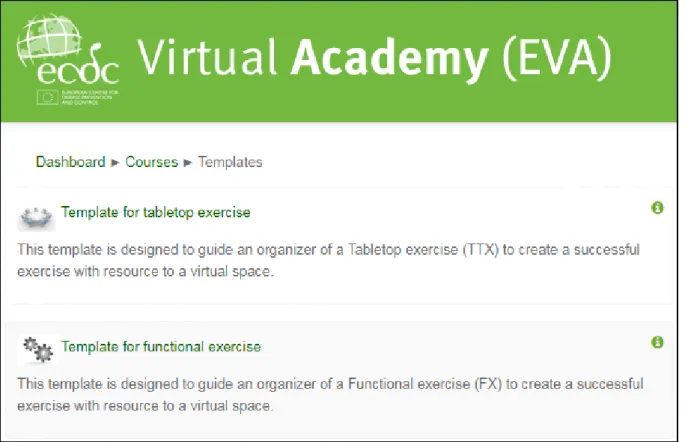
The templates presented in the subchapters 5.1 and 5.2 are available in the EVA under these links respectively: TTX - https://eva.ecdc.europa.eu/course/view.php?id=141 and FX - https://eva.ecdc.europa.eu/course/view.php?id=151. Figure 4 shows both templates in templates category of EVA which a short description. Each of the templates has the Totara default roles (learner, trainer and editing trainer) renamed to the simulation exercise specific terminology (participant, facilitator, designer) creating an environment with terminology more familiar to the users.
5.1 Template for Tabletop Exercises
The first element of the template is a forum1 with forced subscription activated which
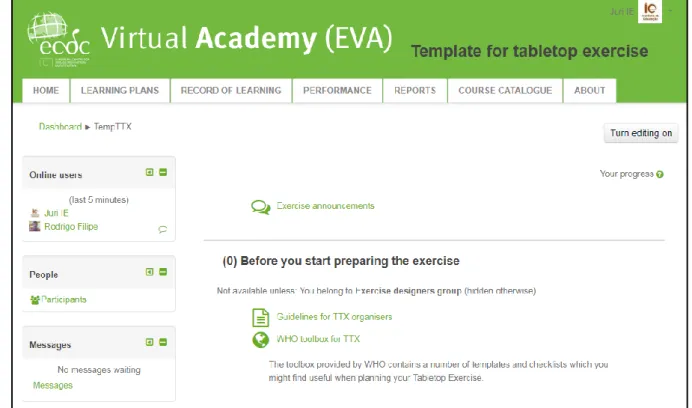
supports a one-way communication to reach widely and structured all exercise intervenients. Important communications are announced by the exercise director and/or facilitator(s), which become available to all participants. In Figure 5 it is visible a set of three boxes, vertically aligned on the left-hand side of the screen, these aim at stimulating informal interaction between participants. The first box shows all users currently online. The second box show the full list of people enrolled in the exercise. From both these boxes, users may click on other people’s profiles and easily send them private text messages via EVA. The third box shows the inbox of EVA messages. Since the personal interaction and networking was a concern raised unanimously by the expert panel, aware of its limitations, this is the way the TTX template mitigates this limitation of the virtual environment.
The first topic in the body of the page, in Figure 5, is topic 0 named “Before you start preparing the exercise”. This topic is visible only to exercise designers, i.e. invisible for participants, and contains guidelines for organisation of TTX in an embedded page2 format which allows a large portion of rich text to be placed in the environment without the
overwhelming feature of taking screen space in the main page and, at the same time, without being so detached as a downloadable file. Secondly a link3 to WHO’s toolbox for TTX where many useful templates can be found. In addition to a usual Uniform Resource Locator (URL) used in rich text, the URL Moodle resource allows the definition of an explanation why the link is provided and what can be found there, as seen in the example.
1 Forum activity is a Moodle activity fully documented in Moodle docs:
https://docs.moodle.org/30/en/Forum_activity
2 Embedded page is implemented using Moodle’s Page resource: https://docs.moodle.org/30/en/Page_resource 3 Link is implemented using Moodle’s URL resource: https://docs.moodle.org/30/en/URL_resource
Figure 5. Heading of FX template and topic (0) Before you start preparing the exercise
The exercise participant will see as the first topic the exercise overview visible in Figure 6. To prime for simplicity, it contains one single activity, a lesson4, which has five pages to display respectively the objectives of the exercise, establish the ground rules, indicate dates and durations, logistical aspects and finally the formal list of participants. This topic is an important communication element which brings clarity, contributes to set the expectations and increase the engagement of the participants.
Figure 6. TTX (1) Exercise overview
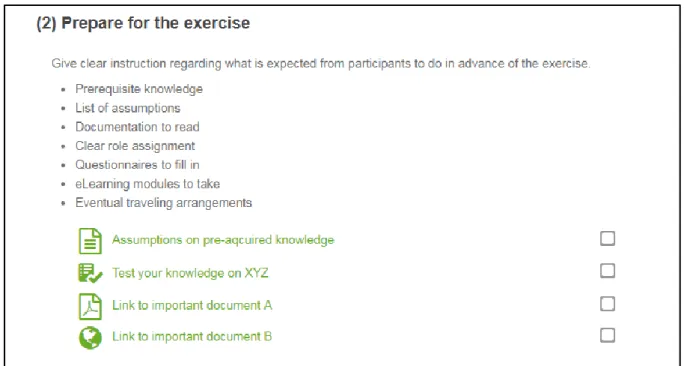
As soon as participants are enrolled in the simulation exercise they shall be able to see the second topic “Prepare for the exercise” as shown in Figure 7. The template suggests several alternative formats to share pre-exercise documentation: Page; knowledge testing quiz; Link to a PDF; Link to a webpage. The alternatives can be ever wider such as a video recorded speech, interactive lectures, e-learning modules in Sharable Content Object
Reference Model (SCORM) format. It is up to the exercise organisation team to decide what are the necessary pre-exercise readings and activities and the best way to explain them. When modelling the exercise in this template, the exercise designer will choose the most appropriate format and use the template elements of relevance.
Figure 7. TTX (2) Prepare for the exercise
Preparation for the exercise is a self-paced activity which each individual will do with different depth, pace and timing. From this point onwards, the template is designed for synchronous activities, therefore the following topics have a visibility condition triggered by a time constraint which is illustrated with an example for a half day TTX on 16th November 2017 and shall be adjusted to specificities of each exercise. The template has an implicit
facilitation feature, which is timekeeping; it is therefore important that the facilitator(s) work together with the exercise designers) to define these elements.
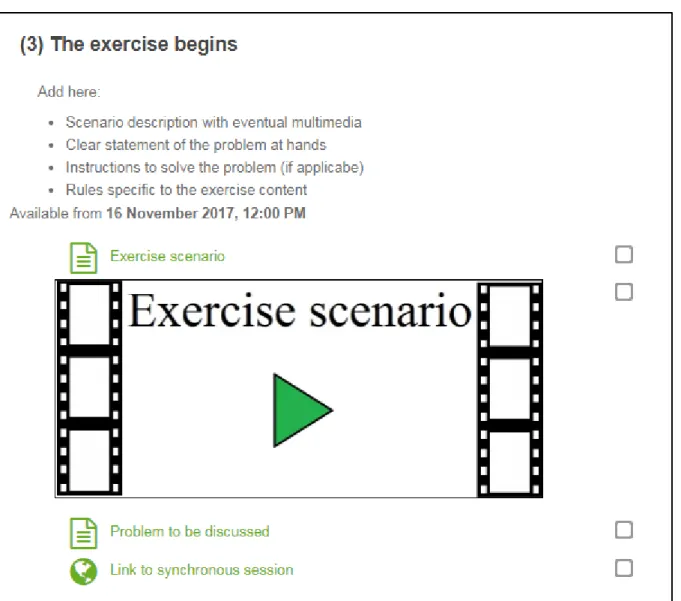
In figure 8, a topic entitled “The exercise begins” discloses to participants the novelty elements of the exercise. The scenario, the exercise specific roles (in case there is
roleplaying), problem postulation and rules for the interaction with other participants. Each participant is given a fixed time to process this information and, at a defined point in time, all participants initiate the discussion. The template suggests both textual (using embedded pages) and audio-visual explanations (using labels5) of the scenario to cater for different types of learning styles of the participants. The exercise designer shall also determine the best suitable option for the specific exercise, taking into consideration the exercise objectives, the budget and time available to prepare and ideally a previous knowledge for the preferred learning styles of the exercise participants. If multiple formats are used simultaneously, special caution shall be taken to ensure the alignment of the content. Finally, the template suggests a textual postulation of the problem at hands to ensure all participants have a precise description of the given problem to solve. In some exercises, where separate groups of participants get different instruction, this topic of the template can be duplicates and
configured differently for the separate groups and visibility restriction can be applied based on group membership to ensure participants see only the materials respective to their group.
Figure 8. TTX (3) The exercise begins
The discussion itself may be done virtually with web-/video-conferencing software or physically in a room. In case of virtual conferencing, links to the virtual rooms and
instructions to connect may also be made available in this space, as seen at the bottom of figure 8. This flexibility, makes this template suitable for distance TTX and for blended format TTX. Both implementations are valid and viable as supported by the expert panel advice. where videoconferencing technologies are available and referred as commonly used tools by the individuals who compose the European workforce working in the response to public health crisis.