
Universidade do Minho Escola de Engenharia Departamento de Informática
David Rodrigues Teixeira
Deploying time-based sampling techniques
in Software-Defined Networking
Universidade do Minho
Escola de Engenharia Departamento de Informática
David Rodrigues Teixeira
Deploying time-based sampling techniques
in Software-Defined Networking
Master dissertation
Master Degree in Computer Science
Dissertation supervised by
Maria Solange Pires Ferreira Rito Lima João Marco Cardoso da Silva
A C K N O W L E D G E M E N T S
Terminada esta fase académica, é momento de refletir e agradecer às pessoas que me acom-panharam e ajudaram neste trajeto longo e sinuoso mas ainda assim gratificante, que certa-mente contribuiu para o meu enriquecimento enquanto aluno, pessoa e profissional.
Aos meus orientadores, Professora Maria Solange Pires Ferreira Rito Lima e Professor João Marco Cardoso da Silva, agradeço pelo tema proposto e pela orientação e aconselhamento que foram demonstrando para que a conclusão deste ciclo de estudos fosse possível. O conhecimento da área e espírito crítico que incutiram em mim foi sem dúvida essencial para a conclusão deste projeto.
Dedico esta dissertação aos meus pais, que com o seu amor incondicional estiveram sem-pre sem-presentes para me incentivar, por depositarem confiança em mim e nas minhas capaci-dades e por me fazerem acreditar que é possível atingir os objetivos mesmo perante os ob-stáculos mais difíceis.
Para a minha irmã Catarina, pela sua personalidade e pontos de vista, que me fazem recordar que pode haver harmonia e convergência entre pessoas com características diferentes, através das vivências partilhadas.
Aos meus amigos, obrigado pela capacidade de estarem presentes, ouvir e aconselhar quando foi necessário.
Por fim, para a Catarina, pelo incentivo na conclusão da dissertação, pela persistência quando a vontade se convertia em distração, e sobretudo pelo carinho, atenção e por potenciar o que de melhor há em mim.
A B S T R A C T
Today’s computer networks face demanding challenges with the proliferation of services and applications requiring constant access, low latency and high throughput from network infras-tructures.
The increase in the demand for this type of services requires continuous analysis and a network topology capable of adapting to the dynamic nature of applications, in order to overcome challenges such as performance, security and flexibility.
Software-Defined Networking (SDN) emerge as a solution to meet these challenges by using a network control plane, dissociated from the data plane, able to have a global view of the topology and act when required, depending on the variation in infrastructure congestion.
Decisions involving different activities, such as network management and performance evaluation, rely on information about the state of the network that in traditional networks in-volves a substantial amount of data. Traffic sampling is essential in order to provide valuable statistical data to applications and enable appropriate control and monitoring decisions to be made.
In this context, this work proposes the application of time-based sampling techniques in a SDNenvironment to provide network statistics at the controller level, taking into account the underlying need to establish a balance between the reliability of the data collected and the computational burden involved in the sampling process.
The results obtained emphasize that it is possible to apply these sampling techniques by using OpenFlow Group Mod messages, although packet losses can occur on the switch during periods of network congestion.
R E S U M O
As redes de computadores atuais enfrentam desafios exigentes, com a proliferação de serviços e aplicações que exigem acesso constante, baixa latência e elevado fluxo de dados.
O aumento na procura deste tipo de serviços exige análise contínua e uma topologia de rede capaz de se adaptar à natureza dinâmica das aplicações, de forma a superar desafios como desempenho, segurança e flexibilidade.
As redes definidas por software (Software-Defined Networking -SDN) surgem como uma solução para corresponder a este desafio, através da utilização de uma estrutura de con-trolo na rede, separada do plano de dados, capaz de ter uma visão global da arquitetura e agir adequadamente consoante as necessidades, dependendo da variação na congestão da infraestrutura.
As decisões que envolvem diversas atividades, tais como gestão da rede e avaliação de desempenho, dependem de informação sobre o estado da rede que, em redes tradicionais, envolve uma quantidade substancial de dados. A amostragem de tráfego é essencial para fornecer dados estatísticos valiosos a aplicações e permitir definir decisões adequadas de controlo e monitorização.
Neste contexto, este trabalho propõe a implementação de técnicas de amostragem baseadas em tempo num ambienteSDN, para disponibilizar estatísticas da rede ao nível do controlador, tendo em conta a necessidade subjacente de estabelecer um balanço entre a fiabilidade dos dados recolhidos e o peso computacional envolvido no processo de amostragem.
Os resultados obtidos enfatizam que é possível aplicar essas técnicas de amostragem uti-lizando mensagens OpenFlow Group Mod, embora perdas de pacotes possam ocorrer no switch em períodos de congestionamento da rede.
C O N T E N T S
Abstract ii
Resumo iii
List of Figures vi
List of Tables vii
List of Abbreviations viii
1 i n t r o d u c t i o n 1
1.1 Motivation and Goals 1
1.2 Main Contributions 2 1.3 Document Layout 2 2 s d n s tat e o f t h e a r t 4 2.1 Programmable Networks 4 2.2 SDN Architecture 6 2.3 OpenFlow 7
2.3.1 OpenFlow Switch Specification 8
2.3.2 OpenFlow Versions 9
2.4 SDN Controller 10
2.5 Virtual Switching 12
2.6 Emulation Software for SDN 14
2.7 Summary 15
3 m o n i t o r i n g i m p l e m e n tat i o n i n s d n 16
3.1 Sampling in Monitoring Systems 16
3.1.1 Systematic Sampling 18
3.1.2 Random Sampling 19
3.1.3 Adaptive Sampling 19
3.2 Existing Monitoring Tools Based on OpenFlow 20
3.2.1 sFlow 20 3.2.2 FleXam 21 3.2.3 PayLess 22 3.3 Summary 23 4 s d n s a m p l i n g c o n t r o l l e r 25 4.1 Design Goals 25 4.2 System Architecture 26 4.3 Implementation Decisions 27
4.3.1 OpenFlow Messages Used in the Sampling Process 27
4.3.2 Stages of the Sampling Process 32
4.4 Implementation Tools 36
4.4.1 Mininet 36
Contents v
4.4.2 OpenFlow 36
4.4.3 Choosing the Controller 37
4.4.4 Switch Software 37
4.4.5 Other System Settings to Consider 38
4.4.6 Components Integration 38 4.5 Summary 39 5 t e s t s c e na r i o s a n d r e s u lt s 40 5.1 Experiment Setup 40 5.2 Results 43 5.3 Discussion 46 5.4 Summary 48 6 c o n c l u s i o n s 49 6.1 Conclusions 49
6.2 Prospect for Future Work 50
Bibliography 51
Appendix a sdn sampling controller 57
a.1 Sampling_controller.py 57
Appendix b m e s s a g e f l o w t o i m p l e m e n t s a m p l i n g m e c h a n i s m s 73
Appendix c commands to test the architecture 74
L I S T O F F I G U R E S
Figure 2.1 Differences between traditional, hybrid and SDN networks [7] 5
Figure 2.2 Software-Defined Network architecture [11] 6
Figure 2.3 OpenFlow elements [7] 7
Figure 2.4 OpenFlow Switch starting from version 1.1 [13] 8
Figure 2.5 Open vSwitch components [29] 13
Figure 3.1 Sampling concepts [5] 17
Figure 3.2 Systematic Count-based [5] 18
Figure 3.3 Systematic Time-based [5] 18
Figure 3.4 Random n-out-of-N [5] 19
Figure 3.5 OpenFlow and sFlow interaction [43] 21
Figure 3.6 Action implemented by FleXam 22
Figure 3.7 PayLess in the SDN stack [49] 23
Figure 4.1 Representation of the system architecture 26
Figure 4.2 Packet-In message structure [50] 27
Figure 4.3 Packet-In message representation 27
Figure 4.4 Flow Mod message structure [54] 29
Figure 4.5 Flow Mod message representation 29
Figure 4.6 Group Mod message structure [56] 31
Figure 4.7 Group Mod message representation 31
Figure 4.8 Stages of interaction 32
Figure 4.9 Group Mod triggered to start the sampling mechanism 33 Figure 4.10 Group Mod sent twice to stop and restart the sampling mechanism 34 Figure 4.11 Sequence Diagram representing messages exchanged between switch
and controller 35
Figure 4.12 Mininet diagram [35] 36
Figure 4.13 Architectural scheme 38
Figure 5.1 Topology overview on MiniEdit graphical user interface 41
Figure 5.2 Network interfaces 42
Figure 5.3 Comparison of SysT, LP and MuST sampling parameters in SDN 44
Figure 5.4 Throughput for OC-48 traffic 44
Figure 5.5 Throughput for OC-192 traffic 45
Figure B.1 Group Mod and Packet-In messages exchanged between controller and
switch 73
L I S T O F TA B L E S
Table 2.1 OpenFlow versions 9
Table 2.2 SDN controllers under analysis 11
Table 5.1 Traces used for testing 40
Table 5.2 System Information 42
Table 5.3 Metrics collected from all sampling techniques 43
Table 5.4 Throughput, error estimation and peak-to-average ratio 46
Table 5.5 OC-48 trace sampling results in [39] 46
L I S T O F A B B R E V I AT I O N S
AHP Analytic Hierarchy Process11
API Application Programming Interface 1, 4, 7, 10, 12, 16,36,37
ASIC Application Specific Integrated Circuit13 ATM Automated Teller Machine5
AT&T American Telephone & Telegraph5 BOS Bottom of Stack bit80
CAIDA Center for Applied Internet Data Analysis40,42 CBE Container-Based Emulation14
CDPI Control-Data-Plane Interface6 CLI Command-line interface14,36 DDoS Distributed Denial-of-Service16 DPDK Data Plane Development Kit38 DPN Deeply Programmable Network50 EPL Eclipse Public License13
ForCES Forwarding and Control Element Separation5 GUI Graphical User Interface14,15
IETF Internet Engineering Task Force5 IoT Internet of Things1
IP Internet Protocol43,81
IRSCP Intelligent Route Service Control Protocol6 IVS Indigo Virtual Switch12,13
LP Linear Prediction35,40,41,43–46,57 MAC Media Access Control33,42
MCDM Multi-Criteria Decision Making11 MIB Management Information Base20 MP Measurement Point17,18,43
List of Tables ix
MPLS Multiprotocol Label Switching80 MTU Maximum Transmission Unit28
MuST Multiadaptive Sampling Technique35,40,41,43–46, 57
NAT Network Address Translation7 NBI NorthBound Interface6,10–12 NCP Network Control Point5
NEC Nippon Electric Company, Limited11 NIC Network Interface Controller50 NOS Network Operating System10,20,37 NTT Nippon Telegraph and Telephone11
ONF Open Networking Foundation6,8,14,21,36,75 OOTB out-of-the-box27,36
OVS Open vSwitch12,13,25,38,43,48 OXM OpenFlow Extensible Match28,79–82 OXS OpenFlow eXtensible Statistics81 PBB Provider Backbone Bridging80,81 PCE Path Computation Element5 PPP Point-to-Point Protocol81 QoS Quality of Service7,12,16,78 RCP Routing Control Platform5 REST Representational State Transfer12 RFC Request For Comments5,20 RME Relative Mean Error40,45,47,49 SBI SouthBound Interface6,10,11
SDN Software-Defined Networking ii, iii, vi, 1–7, 10–16, 20,22,23,25,26,36,37,39,40,43,46,48,49
SLA Service Level Agreement6,16
SystT Systematic Time-based35,40,41,43–46,49,57 TLV type-length-value28,79,80
TTL Time To Live27 VM Virtual Machine36,48
1
I N T R O D U C T I O NFaced with the exponential increase in services supported by communication networks, moni-toring activities are playing a vital role in the maintenance of these services. At the same time, it is important to ensure that network management activities are able to keep up with this ac-celerated pace, supporting next generation networks and seamless integration with trending concepts such as theInternet of Things (IoT), Cloud Computing and Smart Cities.
It is in this context that Software-Defined Networking (SDN) can play a difference, for the versatility and quantity of diversified solutions that can result from this concept for purposes of forwarding, monitoring, security, auditing, among others.
The main principle behind the SDN architecture is that the control and data plane are disaggregated. A centralized controller has a global view of the network infrastructure and directly communicates with the applications, establishing the bridge between them. To sup-port it, a communication layer exists between the control plane and those components in the data plane, providing programmability of the network behaviour [1].
On the other hand, traditional networks have the data and control planes combined in a network node. In the control plane, forwarding policies are static, most times unaware of dynamic changes and specific demands coming from users and applications. This static approach has proven to be restrictive, affecting network scalability and performance as traffic patterns change [1], making it difficult to monitor the amount of packets and flows in each moment.
In monitoring systems, traffic sampling has become mandatory for effective network mea-surements, especially in the network core, reducing the packets collected to a manageable amount [2]. It consists of picking a subset of packets from the network to estimate different parameters about network traffic, not necessarily processing every part of it [3].
SDN flexibility enables programmable measurements, allowing a controller to manage concurrent measurement tasks at different spatial and temporal scales [4]. It also brings a different approach for deploying sampling techniques strategies, in order to try to obtain a balance between sampling efficiency and estimation accuracy [3].
1.1 m o t i vat i o n a n d g oa l s
Current mainstream network systems impose equipments provided with a restricted set of protocols, rules and interfaces (Application Programming Interface (API)).
1.2. Main Contributions 2
With the advent of SDN, the possibility to easily extend the set of features with small code implementations has arised. SDN can open ways for deploying sampling techniques that can be more efficient in accuracy and in the computational resources they require [5]. The development of software through SDN’s provided interfaces, with the ability to control and take decisions over the network devices, emerges as a real possibility to turn this into a feasible concept.
There are currently several sampling techniques for different scenarios, but many are not simple to implement in today’s infrastructures due to the limitations imposed by traditional network architecture such as its programmability. This situation can be changed through the use ofSDNs.
Aiming at improving the efficiency of measurement systems, the main objective of this work is to exploreSDNconcepts, sampling measurement techniques and study possible solu-tions for applying the flexibility introduced by SDNinto a software solution. In more detail, this involves:
• to studySDNconcepts;
• to study existing solutions of software-defined measurements;
• to study the feasibility of employing sampling measurement techniques in SDN con-trollers, with particular emphasis on time-based sampling;
• to implement sampling techniques, using a controller prototype, that takes advantage of SDN concepts to collect useful statistical data from switches in real-time inflicting minimal overhead.
1.2 m a i n c o n t r i b u t i o n s
The main contribution from this work is to make use of the interaction between theSDN con-troller and switches to collect real-time statistics using sampling techniques with ideally low computational weight. The availability of this data at the controller level provides informa-tion that can be used to monitor and improve network stability, anomaly detecinforma-tion, provide network wide information to high level applications, among other tasks.
1.3 d o c u m e n t l ay o u t
The structure of this dissertation is divided into six chapters covering the research work to achieve the objective proposed in this chapter, the results collected from the practical imple-mentation, their analysis and prospects for future work.
Chapter 2 -SDNState of the Art: theSDNconcepts and architecture are presented in this chapter. An overview of the OpenFlow communication protocol and versions features is provided, as well as virtual switching, Mininet virtualization technology, and several existing controllers.
1.3. Document Layout 3
Chapter 3 - Monitoring implementation in SDN: the sampling concepts are described and an analysis of existing solutions is carried out to understand how different tools are already taking advantage of theSDNarchitecture to collect network data. The study of this informa-tion is an important starting point for identifying common characteristics and possible ways forward.
Chapter 4 -SDNsampling controller: focus on the development decisions and implementa-tion process of time-based sampling techniques using OpenFlow, initially defining the design goals to be achieved. In this chapter, a description about the setbacks and obstacles identified along the way is also provided.
Chapter 5 - Test scenarios and results: contains the experiments conducted with the sampling controller, including the results and their critical analysis and discussion.
Chapter 6 - Conclusions: includes the conclusions from this research and possible future work.
2
S D N S TAT E O F T H E A R TSDN technology emerged from the disruptive idea of separating the control and data lay-ers present in legacy networks, taking apart switching and routing functionalities into two distinct components: the control plane, responsible for the routing, and the data plane, re-sponsible for the switching. This concept emerged from the need of having simpler and more flexible networks [6].
WithSDN, developers are able to create software applications abstracted from the physical layer of the network, capable of controlling and monitoring network’s connectivity in each network node and help to visualize the network as a whole, to identify issues and modify network settings to improve performance. This is possible with the open interfaces SDN provides [6].
In this context, this chapter addresses the fundamental concepts inSDN, starting with the historical contextualization that led to the creation of programmable networks. The OpenFlow protocol is analysed, as well as existing software in terms of controllers, virtual switching and emulation tools.
2.1 p r o g r a m m a b l e n e t w o r k s
Current networking paradigms can be divided in three categories considering the placement of data and control planes, represented in Figure 2.1.
In traditional, hardware-centric networks, the switches represent a unit that focuses on the control of the interfaces and manage data within. They are characterized by being closed to new approaches, usually with embedded software solutions inaccessible to external improve-ment and different specifications according to the manufacturer [7]. Therefore, it becomes difficult to implement new functionalities and protocols and even extend existing protocols. Usually it requires the hardware to be upgraded or replaced, leading to increased process costs.
Diverging from this way of thinking, in aSDNnetwork the switch becomes simpler, serv-ing the purpose of traffic forwardserv-ing. It communicates with a highly programmable con-troller, which imposes the rules of network management. This division of responsibilities with the assignment of the network control role to the controller, makes the system more flexible, receptive to new protocols and services. The switches and data contained therein become accessible through abstract APIs at application level, provided by the controller’s programmability [7].
2.1. Programmable Networks 5
Lastly, a hybrid architecture intends to support centralized and distributed control planes. Some OpenFlow switches described in Section 2.5 are hybrid solutions, offering support for traditional protocols in addition to OpenFlow.
Figure 2.1: Differences between traditional, hybrid andSDNnetworks [7]
Although the concept of network programmability has been explored in more depth in recent times, research on this area was already being done even before SDNemerged. The first dated initiatives proposing to separate data and control signalling appeared in the 80s. Network Control Point (NCP) was probably the first project to try the separation of control and data plane signalling. American Telephone & Telegraph (AT&T) introduced NCPs to improve the management and control of its telephone network. From this point on, other projects were inspired by this proposal to design architectures that benefited from the global vision thatNCPs provided [8].
SDNnetworks have given new relevance to network virtualization by using it to increase flexibility while abstraction network services. However, one of the first projects that addressed network virtualization was Tempest in the late 90s [8]. Tempest, anAutomated Teller Machine (ATM)virtualization project, had the objective to conjugate multiple virtual networks to use the same shared physical resources. To decide over forwarding policies, a software controller was included [7]. MBone was another initiative to create virtual network topologies on top of legacy networks [8].
Forwarding and Control Element Separation (ForCES), anInternet Engineering Task Force (IETF)standard protocol defined through a number of Request For Comments (RFC)s, pro-vides a communication interface between control and data elements for improved manage-ment in Ethernet [7] [8]. It suggests a flexible approach to traditional network management without changing the network’s architecture, which means a centralized external controller is not required. Control and data planes are logically separated but can work together in the same network component. [8]. ForCESled to the development of Ethane in 2007 [9] and later OpenFlow in 2008 [10].
Other projects also promoted a centralized entity for network management and control, such as Path Computation Element (PCE), Routing Control Platform (RCP) SoftRouter and
2.2. SDN Architecture 6
Intelligent Route Service Control Protocol (IRSCP). Security approaches also encourage the centralization of the control plane [7].
Ethane’s authors proposed a different method to manage the network of a company. The main idea was the creation of a centralized flow policy managed by the controller. Switches have become simple machines that only have to forward and drop packets (match/action) according to the rules defined by the controller [7] [8] [9]. This project became the precursor of the OpenFlow protocol [10].
2.2 s d n a r c h i t e c t u r e
The SDNsystem architecture, as described by theOpen Networking Foundation (ONF)[11] [6], consists of the data, control and application layers.
The data plane is comprised of low-end network devices, that is, switches that commu-nicate with each other and hosts connected to them that want to use the network to receive and send information. They communicate directly to the controller through the Control-Data-Plane Interface (CDPI)Agent. This lower interface is also mentioned as theSouthBound Interface (SBI). The features within those resources are transmitted throughSDNdatapaths to theSDNcontroller in the control layer, as evidenced in Figure2.2. In turn, the controller plays the role of intermediary between the data plane and the application plane, translating appli-cation requests onto the SDN datapaths and forwarding relevant information coming from the data plane towards the application plane. The communication between the controller and the application layer is established viaNorthBound Interface (NBI)drivers.
Figure 2.2: Software-Defined Network architecture [11]
There is yet another layer responsible for the monitoring of the previous stated planes: the Management & Admin plane [6]. It monitors performance and defines policies at the con-troller level, sets up network elements at the bottom and manages Service Level Agreement (SLA) in the application plane. Control decisions, such as assigningSDNdatapaths toSDN controllers, are taken in this plane.
2.3. OpenFlow 7
A great benefit from this architecture is the possibility of coexistence with non-SDN net-works. The interoperability created to support non-SDNnetworking systems intends to be an intermediate step that allows the cohabitation of different architectures, requiring less initial investment to change existing network infrastructures, and, ultimately envisions the migra-tion of existing hardware and software to supply a fully enabled SDN network, bringing flexibility to perform tasks that traditional networks did not antecipate [6].
2.3 o p e n f l o w
The main SDN communication standard was created in 2008 at Stanford University [10]. OpenFlow is non-proprietary and defines anAPIfor communication between controller and switches [7]. This means both control and data planes must understand and correctly inter-pret the standard.
Initially, OpenFlow was developed for researchers to deploy experimental protocols on academic campus. However, at an early stage, the goal was also having network vendors including OpenFlow in their equipments [10].
The protocol arises from the need to have programmable networks, and was inspired by Ethane [10] [9]. After identifying that commercial solutions were inflexible and too closed, and performance problems and cost limitations related to existing research solutions were common, an approach providing switch flexibility began to be delineated [10]. It intended to be capable of providing high-performance and low-cost implementations, support different research purposes while assuring the isolation of experimental traffic from production traffic, and be able to meet vendors’ requirements for closed platforms.
OpenFlow exploits the fact that most modern Ethernet routers and switches have flow tables running at line-rate to implement different features (such as firewalls,Network Address Translation (NAT),Quality of Service (QoS), etc) and gather statistics [10].
Being an open protocol, OpenFlow is provided to program the flow table in different switches and routers. A network administrator can decide to split network traffic into multi-ple categories by flow. It is thus possible to categorize and mark traffic to follow a particular processing path as desired [10].
2.3. OpenFlow 8
Figure 2.3 describes the interaction between controller and switch using OpenFlow to communicate. The controller defines the rules to be set in the forwarding tables. The switch makes sure to forward packets according to the forwarding table. The OpenFlow interface is common to both entities which need to communicate through a common protocol.
2.3.1 OpenFlow Switch Specification
The OpenFlow Switch Specification is a document maintained by theONFthat describes the OpenFlow protocol properties [12].
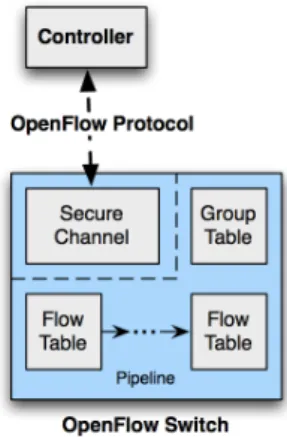
The OpenFlow switch contains one or more flow tables and group tables (since version 1.1). A secure channel establishes the communication switch-controller via the OpenFlow protocol (see Figure2.4) [13].
Figure 2.4: OpenFlow Switch starting from version 1.1 [13]
A flow table contains a list of flow entries. Each flow entry contains a set of fields that change according to the OpenFlow version. Fields available across multiple versions are: i) match fields - to match against packets, ii) counters - updated every time a packet matches the flow entry, iii) instructions - to define packet processing actions through the pipeline. When an incoming packet arrives at the switch, it is compared with the match fields of each entry and if a match exists, the packet is processed according to the flow entry instructions. Statistics about packets are collected through counters. The packet can be encapsulated and sent to the controller, if no match is found or if requested by the controller [12].
Flow entries may eventually point to a group, specifying additional processing. Sets of actions are defined by groups, to comply with actions such as flooding and more complex forwarding semantics, which are not achievable with flow entries alone [14].
The group table represents group entries. The group entry contains a list of action buckets with specific semantics dependent on group type. Packets sent to the group are manipulated according to defined action buckets [14].
Flow and group tables are managed by the controller via the OpenFlow protocol. The controller is able to manipulate flow entries and groups (add, modify and delete) proactively and reactively (when a Packet-In message is received) [14].
2.3. OpenFlow 9
2.3.2 OpenFlow Versions
Some important changes in the main versions of the OpenFlow protocol happened as the protocol evolved.
This section reviews some of theses changes to have a more in-depth knowledge of the protocol evolution, and thus be able to decide which will be the most suitable version for the implementation of the intended solution.
As highlighted in the latest version release notes (version 1.5.1), these changes are only informative and historical, some of which have been removed, replaced, or updated in later versions, and therefore may not conform to the most recent protocol specification [15].
Version 1.0 was the first OpenFlow version expected to have vendor support. Versions prior to 1.0 were marked as Draft with the information that one should not create a switch specification from these versions.
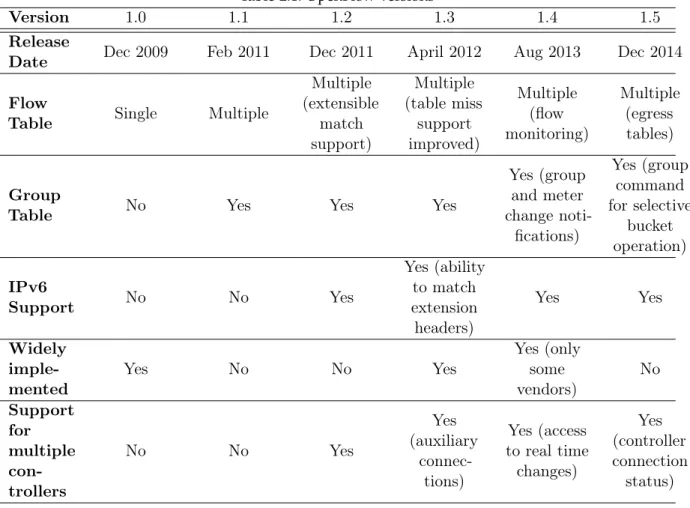
Table2.1summarizes the main features of each version, starting with version 1.0. A more exhaustive list of amendments that have been introduced in each major version is available in annexD[7] [16] [17].
Table 2.1: OpenFlow versions
Version 1.0 1.1 1.2 1.3 1.4 1.5
Release
Date Dec 2009 Feb 2011 Dec 2011 April 2012 Aug 2013 Dec 2014 Flow
Table Single Multiple
Multiple (extensible match support) Multiple (table miss support improved) Multiple (flow monitoring) Multiple (egress tables) Group
Table No Yes Yes Yes
Yes (group and meter change noti-fications) Yes (group command for selective bucket operation) IPv6 Support No No Yes Yes (ability to match extension headers) Yes Yes Widely imple-mented
Yes No No Yes Yes (onlysome
vendors) No Support for multiple con-trollers No No Yes Yes (auxiliary connec-tions) Yes (access to real time changes) Yes (controller connection status)
2.4. SDN Controller 10
2.4 s d n c o n t r o l l e r
InSDN’s network architecture, the control logic is displaced to an external entity, named con-troller orNetwork Operating System (NOS)[8], which plays a central role in all the dynamics of this architecture. This element establishes the communication with the devices in the in-frastructure layer, using a protocol (e.g., OpenFlow) to define the creation, modification or elimination of flow and group rules (as of version 1.1 of OpenFlow) through its SBI. It is also the intermediate point between the datapath and the application layer through theNBI [18]. A controller possessing an independentNOSpromotes an abstraction layerAPIapplications can use to achieve their purposes, be it monitoring, security, accounting, etc. The controller’s purpose is comparable to that of a traditional operating system [8].
A single controller implementation may present scaling limitations and represents a point of failure in the architecture. For that reason, a distributed topology may be defined and controllers need to communicate with other controllers and non-SDN controllers in a dis-tributed environment through east/westbound interfaces. In this case, information has to be exchanged between controllers, including features such as adjacency and capability discovery, topology information, among other details [8].
The choice of a suitable controller can represent a difficult decision because it is necessary to adapt the correct metrics to the proposed objective in order to reduce the list of controllers to analyze, whose number continues to increase over time [18].
This work focuses on the investigation of existing controllers prepared to work in aSDN ar-chitecture supporting the OpenFlow protocol in theSBI. It is also pertinent to find controllers that have open source code for easy modification and provide support for virtualization.
Based on their use, 5 controllers [18] were selected for analysis. They are: Ryu [19], POX [20], Trema [21], FloodLight [22] and OpenDaylight [23]. Other controllers such as NOX (C++/Python), FlowER, MUL (C), Jaxon, Beacon (Java), Maestro (Java), NDDI-OESS, Node-Flow (JavaScript) and ovs-controller (C), are not being considered because they either support a limited set of OpenFlow versions, have little documentation or a poorly-deployed imple-mentation [18]. Controllers that have narrow scopes were also discarded (e.g., SNAC (C++), Reasonance, RouteFlow, Flowvisor (Java) and Oflops (C)) [18].
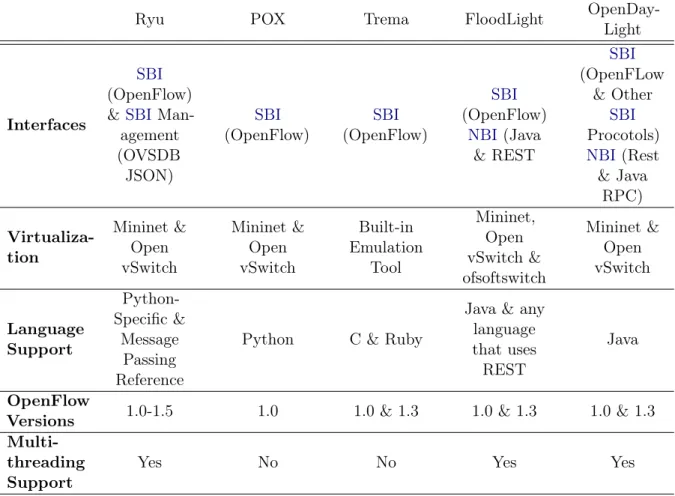
After defining the controllers under study, the comparison of their characteristics is pro-vided in Table2.2.
2.4. SDN Controller 11
Table 2.2: SDN controllers under analysis
Ryu POX Trema FloodLight OpenDay-Light
Interfaces
SBI (OpenFlow) &SBI
Man-agement (OVSDB JSON)
SBI
(OpenFlow) (OpenFlow)SBI
SBI (OpenFlow) NBI(Java & REST SBI (OpenFLow & Other SBI Procotols) NBI(Rest & Java RPC) Virtualiza-tion Mininet & Open vSwitch Mininet & Open vSwitch Built-in Emulation Tool Mininet, Open vSwitch & ofsoftswitch Mininet & Open vSwitch Language Support Python-Specific & Message Passing Reference
Python C & Ruby
Java & any language that uses REST
Java OpenFlow
Versions 1.0-1.5 1.0 1.0 & 1.3 1.0 & 1.3 1.0 & 1.3
Multi-threading Support
Yes No No Yes Yes
• Ryu - Framework designed for SDN supported by Nippon Telegraph and Telephone (NTT). The word Ryu stands for "Flow" in Japanese [19]. The Ryu controller has a set of pre-defined components that can be modified and extended to create a customized con-troller application. Although Python is the main development language, any language can be used to develop a new component [18]. Ryu provides support for protocols to manage network devices, such as OpenFlow, Netconf and OF-config. Versions 1.0 to 1.5 of the OpenFlow protocol are fully supported as well as Nicira Extensions. The framework code is freely available under the Apache 2.0 license [19]. Selected as the best open source controller in [18] through aMulti-Criteria Decision Making (MCDM) method namedAnalytic Hierarchy Process (AHP).
• POX - Single-threaded controller that supports OpenFlow v1.0 switches [24]. Emerged from the NOX controller and is written in Python [18]. Supports Open vSwitch/Nicira extensions and requires Python 2.7 to run. Is able to run on Linux, Mac and Windows or any operating system as long as Python is supported [20]. Its modular structure allows the development of prototype controllers as well as integration into virtualized network environments [18].
• Trema - Full-stack OpenFlow framework to develop modular controllers in Ruby and C. It is supported by Nippon Electric Company, Limited (NEC)labs [18]. Provides a high-level OpenFlow library and also has its own network emulator to test and deploy
2.5. Virtual Switching 12
network experiments locally from any computer. The framework is available under the GNU General Public License version 2.0 or MIT License [21]. Contains an OpenStack Quantum plug-in for switch abstraction. Current OpenFlow supported versions are 1.0 and 1.3, even though Trema for OpenFlow 1.3 does not support version 1.0 [25].
• FloodLight - With its roots in the Beacon controller, FloodLight is a Java-based controller that consists of a set of modules that supply services to other modules and to the control logic applications through either a simpleRepresentational State Transfer (REST)or Java API. This controller software is compatible with Linux, Mac and Windows [18] and works with physical and virtual OpenFlow protocol (1.0 and 1.3) compliant switches. It is also ready to work with non-OpenFlow networks besides including support for OpenStack and multithreading. The software is distributed under the Apache license [22].
• OpenDaylight - Modular Java-based open source platform under the responsibility of The Linux Foundation [18]. The goal of the project is to promote the acceptance of the SDN concept among users and vendors, and to create quality code encompassing the existing components in the architecture [23]. It is also the goal of the project to have a community that regularly contributes with code development and promotes the use of the software in commercial solutions [18]. Designed to support multiple protocols and render maximum flexibility when creating newSDNcontrollers. OpenFlow versions 1.0 and 1.3 are supported [23].RESTand JavaAPIs are available on theNBI[18].
2.5 v i r t ua l s w i t c h i n g
OpenFlow switch software must be carefully chosen. It has an impact on the performance of aSDNnetwork. The switch is directly involved in the forwarding of packets and application of rules coming from the controller and must be able to cope with a set of tasks: match the packet header against flow entries and identify the actions to be implemented for every packet passing by.
When using an emulated environment in SDN, only compatible platforms with network virtualization and support for the OpenFlow protocol are viable [26]. For this purpose, some software switch projects are discussed here. They are Open vSwitch (OVS), OFSoftSwitch13, LINC,Indigo Virtual Switch (IVS)and the OpenFlow reference implementation switch.
• Open vSwitch (OVS) - OVS is a multilayer virtual switch working as a virtual switch within the hypervisor in virtualized environments and offers the possibility to be ported to multiple hardware platforms [7] [27]. XenServer, Xen Cloud Platform, VirtualBox and KVM are among the virtualization technologies supported by OVS . The software is open source under the Apache 2.0 Linux license and distributed with some Linux distributions by default. OVSis also supported on FreeBSD, NetBSD and Windows [26] . OVSuses OpenFlow protocol to be applied across a variable number of hosts, to sup-port efficient datapath management, switch configuration and implementation of QoS policies. The technology is compatible with versions 1.0 to 1.3 of the OpenFlow protocol.
2.5. Virtual Switching 13
Furthermore,OVSprovides interfaces to interact with other monitoring protocols such as sFlow and NetFlow. Other standard management protocols are also supported (e.g., SNMP and NETCONF). It is common to see software solutions that integrateOVSwith Mininet to test SDN networks using OpenFlow [26]. Figure 2.5 shows OVS modules and layers. The first packet crossing the switch’s modules is sent to the userspace to be acknowledged (slow path). Subsequent packets are handled directly at kernel level (fast path) [28].
Figure 2.5: Open vSwitch components [29]
• OFSoftSwitch13 - This software solution is an OpenFlow version 1.3 compatible switch solution running in the userspace, formerly supported by Ericsson Innovation center in Brazil [30]. OFSoftSwitch13 allows to incorporate the switch software with Mininet and the NOX controller [26]. The s oftware is mainly written in C/C++ [7]. The support is now done on a best-effort base [30].
• LINC - Is an open source project compatible with OpenFlow protocol versions 1.2 and 1.3, designed to run on conventional x86 hardware and several operating systems (Linux, OSX, Windows, etc) [26]. The software is written in Erlang and supports OpenFlow ver-sions 1.2-1.4 [31]. LINC is implemented in the operating system’s userspace to allow flexibility and quick development of new OpenFlow features. The software switch con-tains a modular architecture, thus it is easily extensible [31].
• Indigo Virtual Switch (IVS) - Supports OpenFlow protocol 1.0 (only) on hypervisor and physical switches. It’s an open source project aiming to provide high performance and requires little settings administration to use the hardware capabilities of Application Specific Integrated Circuit (ASIC)s and run OpenFlow at line rate [26]. It is developed and maintained by the same entity (Big Switch Networks sponsored community project) that provides the FloodLight controller [22] and is built on top of the Indigo Framework. The project is distributed under the Eclipse Public License (EPL) open source license [32].
2.6. Emulation Software for SDN 14
• OpenFlow reference implementation - Minimal OpenFlow stack implementation used for OpenFlow specification tracking. It supports OpenFlow v1.1 and the code base is now considered an archive by theONF[7].
2.6 e m u l at i o n s o f t wa r e f o r s d n
Container-Based Emulation (CBE)expedites the test of specific network case studies in a vir-tual environment before deploying them in productive networks. Software emulates hosts, switches and controllers to test the applicability of new ideas in a controlled testing environ-ment.
Virtualization software runs real code on an emulated network using OS-level lightweight virtualization techniques, providing careful resource allocation. Emulation also provides real-istic simulation testbeds [33].
Some existing tools are examined in this section, which streamline prototyping of different research ideas with software virtualization. The virtualization software frameworks under analysis are Mininet, ns-3, EstiNet and Trema.
• Mininet - is a platform to emulate multiple virtual end hosts, OpenFlow switches and controllers on a single machine [7]. Mininet supports rapid development inSDNusing the OpenFlow protocol. It is the most popular platform used by researchers to explore SDNdue to its flexibility and ease of use [26]. Moreover, Mininet focuses its implemen-tation on the OpenFlow protocol [34].
The framework uses Linux kernels and Python language scripts to create a virtual network of large number of network components (switches, hosts, controllers) [26]. Mininet’sCommand-line interface (CLI)can be used to develop and customize different network topologies [35] and many external controller types and OpenFlow versions 1.0 - 1.3 are supported by this network emulator [26].
• ns-3 - discrete-event network simulator for Internet systems, targeted for research and educational use. This software framework is currently licensed under the GNU GPLv2 license, and is available for research, development, and public use [36]. The natively support provided by ns-3 is for OpenFlow 0.89 only, which is currently deprecated [7]. Therefore, researchers are limited to test and develop projects compatible with newer versions of OpenFlow. Another disadvantage is it cannot run a real OpenFlow controller such as Ryu, POX or Floodlight without some tweaks. ns-3 has implemented its own C++ OpenFlow controller as a module. It runs on Linux, Windows, FreeBSD and OSX [26].
• EstiNet - able to simulate thousands of OpenFlow v1.0 and v1.3 switches and run real-world controllers (e.g., Ryu, POX, Floodlight, etc) [7]. EstiNet provides support for many other network protocols. It is a proprietary software and uses company servers to run the emulation projects. One of the distinguished characteristics of this software is its accuracy and repeatable results with aGraphical User Interface (GUI) that contains
2.7. Summary 15
simulation statistics graphically represented for each node in the network [26]. EstiNet 9.0 is the last known product version and runs on top of the Linux kernel [37].
• Trema - framework to help in the development of SDN controllers in Ruby and C [7] (see Section2.4) and work as a network emulator [26]. The project source tree includes examples of sample applications, libraries and modules that work as an interface to OpenFlow switches. The software includes an integrated testing and debugging envi-ronment to help manage, monitor and diagnose tests with a network emulator and a diagnostic tool. OpenFlow 1.0 and 1.3 are the supported versions and the framework runs on Linux. Trema’s popularity may be constrained since the software does not have aGUIand uses C and Ruby programming languages for development [26].
2.7 s u m m a r y
At the end of this chapter, it is intended to have a global view aboutSDN, its architecture, his-tory and purpose, and also existing software and protocols to provide a coherent connection between main entities composing the system.
Initially, the chapter starts by comparing SDN’s disruptive proposal compared to tradi-tional and hybrid networks, before describing each element that composes the architecture.
Next, the importance of the OpenFlow protocol is emphasized, enabling communication paths between controllers and switches.
A brief review of the functionalities introduced in several versions of the protocol is carried out, in order to identify improvements and guarantee the maximum compatibility for the targeted solution.
After, switch virtualization software is covered, highlighting their main features and com-patibility with OpenFlow versions.
Then, the scope of existing network virtualization software is presented, for the architec-ture emulation and testbed creation.
3
M O N I T O R I N G I M P L E M E N TAT I O N I N S D NMonitoring tasks are an important part of communication networks for their proper main-tenance and improvement. When coupled with sampling, they are able to offer a balance between accuracy and the impact they cause in the network, that is, the data volume col-lected for monitoring purposes.
An overview of sampling concepts in monitoring activities is provided in this chapter. Then, an insight of existing monitoring tools that rely on Openflow to collect their metrics is provided, and the challenges those projects face when implementing sampling techniques in SDN.
3.1 s a m p l i n g i n m o n i t o r i n g s y s t e m s
Traffic sampling techniques serve a wide variety of network tasks at current. These tasks still gain more prominence in SDN, with the controller representing an intermediate point with which monitoring applications can communicate, through anAPIfor the purpose.
Some examples of network activities are described in [38] and here presented:
• Network planning and management - network management solutions including operation, maintenance and service provision;
• Traffic engineering - modeling, control and characterization of traffic to optimize network performance;
• Security - detection of intrusions and anomalies, botnets, Distributed Denial-of-Service (DDoS)attacks and other cyber threats;
• Performance evaluation - detailed analysis of network reliability and management tools performance;
• SLA- measurement and reporting ofSLAcompliance with the use of auditing tools; • QoScontrol - provide useful parameters such as packet loss and delay.
It is therefore important to realize the concepts that form the various sampling techniques in order to meet a set of requirements as broad as those just mentioned.
3.1. Sampling in Monitoring Systems 17
For a better understanding of the concepts related to packet sampling, the terminology used to describe the techniques discussed in this document is based on the following defini-tions [5][38]:
• Sample - set of packets selected from a network according to a particular criteria, es-sential for estimating the network parameters. It is also known as sample event - an individual event to select and capture traffic packets in the network;
• Sample size - defined by packet counters or time intervals delimiting the sample. Events running on the switch (or other device serving asMeasurement Point (MP)) define the start and ending points of a sample, with reference to the position of the packet in the stream or the packet arrival timestamp;
• Interval between samples - similar to the sample size with the difference being the num-ber of packets or the time interval in which the packets are ignored (for monitoring purposes), depending on the selection trigger.
The concepts of sampling are represented in Figure 3.1. The packets marked in blue corre-spond to the sample size and the remaining packets represent the interval between samples.
Figure 3.1: Sampling concepts [5]
Sampling techniques have several characteristics that identify them and may be grouped by their granularity, selection scheme and selection trigger. The definition of each of these components is as follows [38]:
• Granularity - atomicity of the element that is under analysis by the sampling process: packets represent individualized entities; whereas at the flow level, sampling can be applied to packets belonging to a pre-established stream or to a set of streams;
• Selection scheme - represents the function that characterizes the traffic selection. The selection scheme can be deterministic, random or adaptive;
• Selection trigger – designates the temporal or spatial sample delimiters that can either be count, event or time-based.
In the following subsections, a description of the content-independent sampling tech-niques is provided. They are so called because they do not require access to the packet content in the decision process, as opposed to content-dependent techniques [5]. The sam-pling process is ruled by the packet position in the stream or event timestamp, applying a deterministic, random function or adaptive algorithm depending on the intended technique.
3.1. Sampling in Monitoring Systems 18
Within the deterministic category are the Systematic Count-based and Systematic Time-based techniques, while Random n-out-of-N and Random Uniform Probabilistic are part of the non-deterministic techniques. Adaptive techniques use different sampling methods (e.g., linear prediction) to adapt to network activity [5].
3.1.1 Systematic Sampling Systematic Count-based
The Sampling Count-based technique performs the packet selection according to its posi-tion, through packet counters that define the starting point of a sample and the sample size to define the sample duration, resulting in a function with a deterministic pattern. A deploy-ment example for this technique is the periodic selection of every k-th packet of a stream. In the scenario illustrated in Figure 3.2, every 5th packet is selected, the sample size is set to 1 and the interval between samples is equal to 4. This technique has been widely deployed by network equipment vendors and industry due to its ease of implementation and low resource utilization [5].
Figure 3.2: Systematic Count-based [5]
Systematic Time-based
In this sampling technique, a deterministic function is employed having the sample size and interval between samples as input parameters, with characteristics that resemble the systematic count-based technique. The difference lies in the fact that this technique is oriented to the arrival time of the packet at theMP. In this method, every incoming packet is selected during a specific time interval (defined by the sample size), and ignored if they reach theMP during the interval between samples. In the example depicted in Figure 3.3 the sample size is 100 milliseconds and the interval between samples is 200 milliseconds [5].
3.1. Sampling in Monitoring Systems 19
3.1.2 Random Sampling Random n-out-of-N
The Random n-out-of-N technique is a random method to capture n packets from a sequen-tial stream of N packets (n-out-of-N). A pseudorandom function is applied by this technique to generate n numbers between [1,N], then picking the packets from the stream that are in the same position as one of the random numbers generated. The scenario depicted below in Figure3.4corresponds to a packet being select out of a stream of 5 consecutive packets [5]. It is important to highlight that in this technique the packet selection is performed with the same probability p (with p = n / N) for all packets of stream N.
Figure 3.4: Random n-out-of-N [5]
Random Uniform Probabilistic
This sampling technique consists of a predefined uniform probabilistic function deciding which packets are selected to constitute the sample, with the same probability of being se-lected. The packet content is not relevant for the selection. An example of implementation is based on a count-driven technique, defining the sample size to be 1 packet and the interval between samples to follow an independent random variable with distribution of mean 1/p. Another approach would be to use a time-driven technique with the interval between samples following a exponential distribution [5].
3.1.3 Adaptive Sampling
Adaptive sampling strategies are used in techniques designed to change the packet selection during the capture period in the network. This flexibility aims to identify the most important parts of a traffic flow according to measurement needs and to use network resources as little as possible in critical periods of operation [5].
Some multiadaptive sampling techniques [5][39] use linear prediction to identify and adapt to changes in network activity by setting a more suitable sampling pattern, adjust-ing the sample size and interval between sampladjust-ing, thus modifyadjust-ing the sampladjust-ing frequency. This conduct leads to reduction of the weight of sampling in the network while maintaining measurement accuracy [39].
3.2. Existing Monitoring Tools Based on OpenFlow 20
3.2 e x i s t i n g m o n i t o r i n g t o o l s b a s e d o n o p e n f l o w
There are several proposals of monitoring systems inSDNthat follow different methodologies and design goals. The next subsection contains an analysis with particular interest, insofar as studying these approaches is important to get to know the work already done in the field and understand the challenges towards designing the intended solution.
3.2.1 sFlow
sFlow is an industry standard, proposed as a RFC (i.e., RFC 3176 [40]), used by multiple vendors and early adopted as the sampling technology embedded in many existing switches and routers.
This standard defines a set of sampling mechanisms which aim to decentralize monitoring operations typically implemented on the switches, by sending sampled packets to a remote external data collector in partnership with one or more sFlow Agents for monitoring traffic and a sFlow Management Information Base (MIB). Its purpose is to control the sFlow Agent and the format of sample data used by the sFlow Agent when forwarding the data [40]. With sFlow monitoring, the sampled packet headers are sent to a traffic analysis application which decodes the packets and aggregates the data to provide network visibility when requested [41].
Many of the network operators and manufacturers interested in OpenFlow are also mem-bers of the sFlow.org industry consortium and the sFlow standard is widely supported in Eth-ernet switches, including many of the OpenFlow and non-OpenFlow switches. This helped that, at an early stage, an OpenFlow version targeted at vendors and real world devices began to be planned between the members of the consortium [42].
sFlow integrates OpenFlow to perform decoding and analysis of network traffic with ex-ternal software, allowing theNOSto delineate measurements in consistency with its internal network model. Hardware-based measurements, in contrast, are inflexible, requiring switch vendor hardware/firmare upgrades to implement new measurements and features. This is a bounding characteristic, sometimes causing measurements obtained with different hardware to be inconsistent between suppliers, or even within the range of products from the same manufacturer [41].
The diagram in Figure3.5shows how sFlow and OpenFlow can play complementary roles when implemented over the same network [43]. On one side, the OpenFlow protocol provides a controller running its own software on a separate component, responsible for configuring both switches and hardware forwarding tables. The sFlow standard specifies instrumentation to collect real-time information about the state of the network and sends it to a remote monitor. This protocol also provides real-time statistics in regards to servers’ performance [43].
3.2. Existing Monitoring Tools Based on OpenFlow 21
Figure 3.5: OpenFlow and sFlow interaction [43]
A research was conducted at HP Labs to replicate the hybrid sFlow/OpenFlow controller interaction pictured above, combining together the strengths of sFlow and OpenFlow, as a combined measurement and control framework, in order to create a scalable traffic control system. The research revealed interesting results such as reducing the controller-level over-head [44] [43].
sFlow provides only two count-based techniques - systematic and random. Consequently, the standard does not include other sampling strategies, such as the time-based techniques, which are relevant for other kind of activities, such as anomaly detection [5].
An equally important fact to highlight is the project update status, whose latest version (version 5) was launched several years ago [45], meaning new sampling techniques have arisen in the meantime, even with direct interaction with OpenFlow, and possibly have not yet been integrated by sFlow.
3.2.2 FleXam
FleXam is a per-flow sampling framework and is described by its authors as a flexible sam-pling extension for OpenFlow that enables the controller to access packet-level information. The tool provides two sampling possibilities: stochastically, by selecting packets according to a predetermined probability p; or deterministically, which involves catching m consecutive packets from each k consecutive packets, skipping the first δ packets of the flow [46]. Both methods provide flexibility to match different measurement purposes. The controller has the power to decide which parts of the packet should be sent (e.g., headers only, payload, etc.), as well as their destination.
To meet its design goals, modifications to the OpenFlow protocol specification have to be made to include monitoring abilities, thus proposing changes to the standard that is main-tained by theONF[46] [47]. Sampling is defined through a new action (OFPAT_SAMPLING) that can be assigned to each flow, whose parameters are described in Figure 3.6. The new
3.2. Existing Monitoring Tools Based on OpenFlow 22
action is similar to OFPAT_OUTPUT, with the objective of sending the sampled packets to the controller.
Figure 3.6: Action implemented by FleXam
The action has six parameters: scheme, p, m, k, δ and destination. The scheme parameter defines the sampling scheme that identifies which parts of the sampled packets should be sent. The m, k and δ parameters are defined to be used for deterministic sampling, and the p parameter is the probability used by the stochastic sampling technique. The destination parameter specifies the host to where sampled packets should be sent. It may be the controller or other network element that will handle the sampled packets [46].
From the analysis made to FleXam, it is noticeable that the customization of the sampling mechanism has obvious implementation advantages. It can be added to current OpenFlow implementation with no need for matching specific flow tables or perform multiple actions. Secondly, there’s no overhead for flows that do not require sampling, given it is flow driven. Nonetheless, this approach promotes unwanted fragmentation in the implementation of a protocol (OpenFlow) that, in itself, is already implemented in several versions by the manu-facturers.
Flow sampling has however associated disadvantages, such as not promoting a direct packet sampling mechanism, making it impossible to implement traffic sampling techniques [46].
3.2.3 PayLess
One different approach is supplied by PayLess. It is a query-based monitoring framework for SDNthat provides a flexible RESTful API for flow statistics collection at different aggregation levels [48].
This monitoring framework gathers real-time information with high accuracy without pro-voking significant network overhead. PayLess replaces the controller policies when polling the switches, implementing an adaptive scheduling algorithm proposed to achieve the same level of accuracy as continuous polling but with much less communication overhead. Thereby, different network applications can develop new monitoring applications and access the data
3.3. Summary 23
collected by PayLess with the different aggregation levels (such as flow, packet and port) the tool provides.
Figure3.7illustrates the positioning of the framework in theSDNstack.
Figure 3.7: PayLess in theSDNstack [49]
This strategy offers the possibility of also getting information from the network from time to time without causing much network overhead. It is comparable to the behaviour when a flow is being removed from the switch. In that scenario, if the flow entry’s OF-PFF_SEND_FLOW_REM flag is set, the switch is required to send a flow removed message to the controller when the timeout is reached, with a complete description of the flow that has been removed, including statistics [13]. The monitoring frequency in PayLess is adjusted according to network load [49].
PayLess’s evaluation results evidence low overhead - 6.6 monitoring messages are sent per second on average - as opposed to the controller’s periodic polling, with an overhead of 13.5 monitoring messages per second on average [48]. The trade-offs between accuracy and the monitoring overhead within the given minimum polling interval (Tmin) demonstrate that the monitoring data is accurate but the message overhead is very high for a short time interval, e.g., Tmin = 250 ms. However, for a large time interval, e.g., Tmin = 2000 ms, the message overhead is low but the monitoring data error increases substantially [48]. Hence, the accuracy of monitoring implies increasing the cost of network overhead [48] .
Moreover, it should be noted that this kind of solution is highly dependent on OpenFlow collectable statistics, potentially compromising the solution’s flexibility for specific monitoring objectives and does not provide any traffic sampling solution.
3.3 s u m m a r y
Sampling plays an important role in monitoring because it allows inferring over a network and its state without the need to directly inspect the entire flow of data in circulation. Moni-toring tools give network administrators the ability to detect the amount of resources in use
3.3. Summary 24
and to be able to make decisions that aim to improve overall network performance at all times.
As described in this chapter, there are several solutions created with the purpose of pro-viding monitoring tools in SDN, with sFlow being the best known, working through agents that collect data from the network components and store them remotely in a monitor to be subsequently scrutinized. Another solution is FleXam, which identified the lack of OpenFlow messages dedicated for monitoring activities and therefore provides a single sampling solu-tion for different techniques by adding a new rule to the protocol. Finally, Payless is presented as a framework that offers monitoring for potential application developers, collecting and ag-gregating OpenFlow flow statistics to be easily provided to the application layer through its own API.
It is important to note that all monitoring systems discussed in this chapter suggest im-plementations that work in parallel with the OpenFlow protocol (sFlow), integrate new rules (FleXam) or rely on flow statistics (PayLess) in order to design efficient and accurate sam-pling mechanisms, but do not consider an implementation which has the benefit of exploring existing OpenFlow messages in their sampling mechanisms.
4
S D N S A M P L I N G C O N T R O L L E RThis chapter contains the development decisions which have been weighted and a detailed de-scription of the design and implementation process proposed to implement network sampling techniques, usingSDN’s architecture and available OpenFlow features, after the research done on the subject. The chapter also includes the reasons for choosing Mininet, Ryu andOVS.
The design was accomplished considering the most updated features and software ver-sions at the time, namely the OpenFlow switch specification and existing protocol messages, Ryu framework development status, as well as the latest version ofOVS.
4.1 d e s i g n g oa l s
Proposing a new sampling approach inSDNraises several challenges. In the previous chapter, the solutions presented suggested additional elements to be included in the existing architec-ture, ignoring the changeability that can be made at the controller level.
After unveiling the objective of providing sampling techniques at the controller level, it was necessary to start by defining the design goals to accomplish the purpose at hand before proceeding to the implementation phase.
An investigation was carried out to explore ways to implement and configure sampling using the OpenFlow counters information. Since the protocol was not designed to provide this information on demand efficiently, since it would require obtaining counters’ values frequently leading to greater overhead, this hypothesis was discarded.
The design goals must suit SDN’s architecture approach while at the same time meet the objectives outlined in Chapter 1. They are as follows:
• The solution must provide sampling measurements that are efficient and lightweight respecting theSDNmodel and OpenFlow standard;
• Ensure compatibility with any OF-enabled Layer 2 and 3 devices;
• Overcome OpenFlow related constraints regarding sampling collection by defining method-ologies in the controller that minimize this protocol gap;
• Explore the separation of the data and control planes to collect and make available sampled measurements in real-time environments;
• Find mechanisms that allow the application of time-based sampling techniques follow-ing all previous assumptions.
4.2. System Architecture 26
4.2 s y s t e m a r c h i t e c t u r e
The system architecture proposed is based on elements already available inSDN, without the need to include extra modules to provide sampling mechanisms for monitoring tasks.
Figure 4.1: Representation of the system architecture
The proposed mechanism consists of withdrawing utility from the OpenFlow messages that constitute the communication channel between the controller and the switches in a typical SDN architecture, implementing sampling techniques depending on the available messages’ parameters.
Therefore, the main components used in the proposed strategy are the ones shown in Figure4.1: the network controller; OpenFlow and compliant switches.
• Network controller - This element plays an important role in the architecture not only because it has a global view of the system but also because it is responsible for the implementation of sampling mechanisms in the switches. By its role, in case of failure it can cause serious problems in network control and management operations, something that should be planned but can be solved with the inclusion of more controllers to function in a distributed way. It is also important for the controller to be able to support recent versions of OpenFlow to fully exploit the improvements introduced over time. • OpenFlow Message Layer - OpenFlow has become the standard communication protocol
to transport messages between controllers and switches with ruling decisions, statistics and packet forwarding. If we consider packet forwarding for sampling purposes, it is poorly explored using OpenFlow, when compared to flow statistics for monitoring purposes. A method designed to efficiently carry packets to facilitate the collection of relevant data, might produce interesting results.
4.3. Implementation Decisions 27
• OpenFlow switch - Native support for the OpenFlow protocol must be provided by the switches in the data plane, including support for recent versions of the protocol for better compatibility. A software layer which renders dynamic network control in au-tonomous entities is also a requirement, to be able to cope with the packet forwarding and buffering processes and properly interpret and implement OpenFlow messages, while maintaining good performance.
4.3 i m p l e m e n tat i o n d e c i s i o n s
In order to force packet collection per request, the controller needs to communicate this in-tention to switches. For this reason, beyond the elements that establish the architecture, a set of relevant messages within the OpenFlow standard are worth mentioning, as well as their combination to achieve the proposed objective.
4.3.1 OpenFlow Messages Used in the Sampling Process
The three most relevant messages OpenFlow provides out-of-the-box (OOTB) in its switch specification tailored for the task are Packet-In, flow table modification and group table mod-ification messages:
• Packet-In - Exists since the conception of OpenFlow as an idea to become the protocol between distributed components and began to gain practical implementation in version 1.0. It is the way the switch sends a packet to the controller when packets are received by the datapath, technically called OFPT_PACKET_IN, represented in Figure4.3. There are three reasons for this message to be sent: i) resulting from an explicit action defined by a match rule asking for this behaviour; ii) due to a miss in the match tables; iii) caused by a Time To Live (TTL)error [50].
Figure 4.2: Packet-In message structure [50] Figure 4.3: Packet-In message representation
The message structure under analysis represented in Figure 4.2 was defined in Open-Flow 1.3 (same applies to subsequent figures in this chapter concerning message struc-tures). The reason for choosing this particular version is related to two main factors: i) the significant amount of changes compared to previous versions of the protocol makes
![Figure 2 . 1 : Differences between traditional, hybrid and SDN networks [ 7 ]](https://thumb-eu.123doks.com/thumbv2/123dok_br/17291633.790369/16.892.324.636.198.452/figure-differences-traditional-hybrid-sdn-networks.webp)
![Figure 2 . 2 : Software-Defined Network architecture [ 11 ]](https://thumb-eu.123doks.com/thumbv2/123dok_br/17291633.790369/17.892.281.680.672.923/figure-software-defined-network-architecture.webp)
![Figure 2 . 3 : OpenFlow elements [ 7 ]](https://thumb-eu.123doks.com/thumbv2/123dok_br/17291633.790369/18.892.360.598.860.1090/figure-openflow-elements.webp)
![Figure 2 . 5 : Open vSwitch components [ 29 ]](https://thumb-eu.123doks.com/thumbv2/123dok_br/17291633.790369/24.892.288.673.306.532/figure-open-vswitch-components.webp)
![Figure 3 . 2 : Systematic Count-based [ 5 ]](https://thumb-eu.123doks.com/thumbv2/123dok_br/17291633.790369/29.892.245.722.551.600/figure-systematic-count-based.webp)
![Figure 3 . 4 : Random n-out-of-N [ 5 ]](https://thumb-eu.123doks.com/thumbv2/123dok_br/17291633.790369/30.892.243.717.390.464/figure-random-n-n.webp)
![Figure 3 . 5 : OpenFlow and sFlow interaction [ 43 ]](https://thumb-eu.123doks.com/thumbv2/123dok_br/17291633.790369/32.892.211.750.95.398/figure-openflow-sflow-interaction.webp)