Original Article Barros et al.
Rev Bras Ativ Fís Saúde 2016;21(5):388-399
DOI: 10.12820/rbafs.v.21n5p388-399 RBAFSSOCIEDADE BRASILEIRA DE ATIVIDADE FÍSICA E SAÚDE
Brazilian Journal of Physical Activity and Health
RBAFS
Revista Brasileira de Atividade Física & Saúde
SOCIEDADE BRASILEIRA DE ATIVIDADE FÍSICA E SAÚDE Brazilian Journal of Physical Activity and Health
RBAFS
Revista Brasileira de Atividade Física & Saúde
SOCIEDADE BRASILEIRA DE ATIVIDADE FÍSICA E SAÚDE
Brazilian Journal of Physical Activity and Health
Brazilian Journal of Physical Activity and Health Sociedade BraSileira de atividade FíSica & Saúde
1 University of Pernambuco, School of Physical education, Pernambuco, Brazil. 2 Santa cruz State University, department of Health Sciences, ilhéus, Ba, Brazil. 3 Federal rural University of Pernambuco, department of Physical education, recife, Pernambuco, Brazil.
Abstract
The aim of this study was to describe methodological aspects of the Project SUS+Ativo – Evaluation of programs and inter-ventions for physical activity promotion within the primary healthcare network in the state of Pernambuco. A methodo-logical study, with descriptive analysis. The programs and in-terventions for physical activity promotion developed within the Primary Health Care system of the 184 municipalities in the state of Pernambuco, as well as the island of Fernando de Noronha, constituted this field of study. Data were collected from managers, professionals and users involved in these pro-grams and interventions. For the subgroup of managers and professionals, a census was conducted, while for participants the sample was dimensioned by the size of the municipalities and number of programs and interventions on physical activ-ity that were active at the time. The instruments presented the following dimensions: individual characteristics of respondent (socio economic profile and education); characteristics and management of the program/intervention being evaluated; technical competency of professionals; perception of the quali-ty of the programs and/or interventions. An observation script was used, filled by the researchers, for assessment of the envi-ronment and ongoing activities. Results were presented accord-ing to the phases: 1st) construction of matrixes, 2nd) face and
content validity; 3rd) clarity and applicability of the instruments
and 4th) analysis of reproducibility for the instrument.
Method-ological resources used in this study may support the develop-ment of new research of evaluation of process, structure and results, as well as the planning of programs and interventions for physical activity promotion in the field of public health.
Keywords
Motor activity; Health Care; Epidemiology.
Resumo
Descrever os aspectos metodológicos do Projeto SUS+Ativo - Ava-liação dos programas e intervenções para promoção da atividade física na rede de Atenção Básica à Saúde no estado de Pernambu-co. Estudo de caráter metodológico, com abordagem descritiva. O campo de estudo foi constituído pelos programas e intervenções para promoção da atividade física, desenvolvidos na Atenção Básica à Saúde, dos 184 municípios do estado de Pernambuco mais a Ilha de Fernando de Noronha. Os dados foram coletados com gestores, profissionais e usuários envolvidos nesses programas e intervenções. Para os subgrupos de gestores e profissionais, optou-se por realizar um censo, já para os usuários a amostra foi dimensionada pelo porte dos municípios e número de programas e intervenções de atividade física que estavam em funcionamento em cada municí-pio. Os instrumentos foram constituídos pelas seguintes dimensões: características dos entrevistados (perfil socioeconômico e de forma-ção); características e gestão do programa/intervenção avaliada; competência técnica dos profissionais; percepção sobre a qualidade dos programas e/ou intervenções. Foi utilizado um roteiro de obser-vação, preenchido pelos pesquisadores, para avaliação do ambiente e das atividades desenvolvidas. Os resultados estão apresentados de acordo com as etapas: 1ª) construção de matrizes, 2ª) validade de face e conteúdo; 3ª) clareza e aplicabilidade dos instrumentos e 4ª) análise da reprodutibilidade do instrumento. Os recursos metodoló-gicos utilizados nesse Projeto poderão subsidiar o desenvolvimento de novas pesquisas de avaliação sobre processo, estrutura e resulta-dos, bem como subsidiar o planejamento dos programas e interven-ções de promoção da atividade física no campo da saúde pública.
Palavras-chave
Atenção à saúde; Epidemiologia; Atividade motora.
evaluation of programs and interventions for
physical activity promotion in primary health care in
Pernambuco: construction and validation of instruments
and fieldwork methods of the SUS+ativo Project
Avaliação dos programas e intervenções de promoção da atividade física
na atenção básica à saúde de Pernambuco: construção, validação de
instrumentos e método de trabalho de campo do Projeto SUS+Ativo
Mauro Virgílio Gomes de Barros1, Emmanuelly Correia de Lemos1, Juliana Rafaela Andrade da Silva1, Caroline Ramos de Moura Silva1, Silvio Aparecido Fonseca2, Rafael Miranda Tassitano3
Introduction
The benefits of regular physical activity practice and the state of health of the population1-3 in general consolidated the recommendation and stimulated the
promotion of physical activity in public health among many countries4. As a
con-sequence, governmental entities have created strategies to incorporate the physi-cal activity theme in public health policies5-7. In Brazil, public investments in the
field of physical activity promotion have been potentiated after the release of the Global Strategy on Diet, Physical Activity and Health5 and the National Policy for
Health Promotion (NPHP)8.
The NPHP listed physical activity practice as one of its priorities and allowed, through financial support, the creation of projects and programs for physical ac-tivity promotion in over 1500 Brazilian municipalities13. In the initial years of
cre-ation of such policy until 2010, around 70% of municipalities developing projects for health promotion focused on actions that included physical activity13. Besides,
the advent of the Nuclei of Support to Family Health (NSFH), in 2008, and the Academia da Saude Program, in 2011, strengthened the incorporation of physical activity in the field of Public Health13-14.
In this sense, the current scenario of expansion and consolidation of interven-tions in physical activity promotion, expressed by programs and/or projects for promotion of physical activity in the community, has developed the interest of research institutions and governmental offices for the conduction of evaluation studies9-11,16. However, even though they present important results, Hoehner et al12
indicate there are few studies of evaluation that have been disseminated, and many present limitations in the methodological approaches used, since the selection of instruments, as well as the disclosure of methodological procedures. Therefore, it is necessary to propagate studies presenting the validation of instruments and methodologies for fieldwork to be set as basis for academic consultation and pro-fessional use by programs and interventions in the promotion of physical activity. In this perspective, the Research Group in Lifestyles and Health at the Univer-sity of Pernambuco (GPES-UPE) elaborated, during the years of 2013 and 2014, the research project entitled “Evaluation of programs and interventions for phys-ical activity promotion in primary health care in Pernambuco – Project SUS+A-tivo”. The SUS+Ativo project can support the development of research in evalu-ation of programs and interventions in physical activity in the context of public health in the different Brazilian states. Therefore, the aim of this study was to describe the methodological aspects of the SUS+Ativo project, specifically study design, construction and validation of measurement instruments and procedures for fieldwork.
Methods
Type of study
The present study, characterized as methodological, of descriptive approach, re-fers to the Project entitled SUS+Ativo. The SUS+Ativo project is cross-sectional, statewide, with descriptive and analytical components focusing in the evaluation of the different macro processes related to operationalization, professional skills and management of programs and interventions for physical activity promotion developed within the Primary Health Care System in Pernambuco.
In order to execute the project, between November of 2013 and February of 2014, the following phases were undertaken: (1) construction and validation of in-struments and (2) organization and execution of fieldwork. A post-doctorate, one
doctorate, two graduate students and two professionals composed the technical committee of the project, all with academic and/or professional experience in the theme. All phases are detailed as follows:
Construction and validation of instruments
Considering this a broad Project with different goals, four instruments were de-veloped. This process is justified by two reasons: (a) distinct specificity to the ex-perience of managers and professionals, user perception and the environment; (b) lack of validated instruments to achieve the aim of the project.
The four instruments were built in four phases: 1st) construction of matrices,
2nd) face and content validity; 3rd) clarity and applicability of instruments and 4th)
analysis of psychometric properties or testing of reproducibility, the last two con-ducted through a pilot study.
In the first phase (construction of matrices), during the months of Novem-ber and DecemNovem-ber 2013, three rounds of committee meetings were conducted to define, initially, which indicators should compose the matrix of the four instru-ments. On this phase, managers and professionals from different Secretaries and health departments in the State of Pernambuco and other municipalities were also consulted on the construction of the matrix. Additionally, journal articles, thesis, dissertations, institutional reports, manuals and legislations pertaining to the aim of the study were used to theorize the matrix indicators.
Furthermore, the committee organized fours matrices in figures composed by dimensions and indicators that were sent to 81 specialists experienced in the evaluation of health services or with research in physical activity and health, epi-demiology, as well as Physical Education professionals with experience in Primary Health Care or with a title as multiprofessional residency in Health. All were in-vited to proceed critically to the matrices through electronic forms (Google Docs application), with answer options in a likert scale of four points referring to perti-nence of indicators (not pertinent, a little pertinent, pertinent or very pertinent). Also, it was allowed reviewers to write a review on an indicator, dimension or the matrices. It is important to note that managers and respective teams in the Sec-retary of Health Vigilance of the Ministry of Health also analyzed the matrices.
On the second phase (face and content validity), during the months of Decem-ber 2013 and January 2014, suggestions and information from reviewers were tak-en into account to the construction of instrumtak-ents. Therefore, one instrumtak-ent was created to each interest focus of the Project SUS+Ativo (manager, professional, user and environment), and submitted to appreciation of the internal project commit-tee in three rounds. After this procedure was concluded, versions of the fours in-struments were, once more, sent out to the same specialists invited for the reviews on matrices, independently from having collaborated or not during the first phase. For this procedure, the specialists were asked to evaluate, with response op-tions in a likert scale, how adequate writing/language of quesop-tions seemed to be (not clear, a little clear, clear, very clear), how adequate scales of answers were (not adequate, a little adequate, adequate, very adequate) and, also, a general evalua-tion of the degree of quality of each quesevalua-tionnaire, according to the following op-tions: very bad, regular, good, very good. Additionally, all items allowed the specialist
to review indicating critics, comments and/or suggestions.
After the evaluations returned, the internal committee discussed the considera-tions and elaborated a consolidated version of all instruments for testing in a pilot study, in order to test the clarity of questions and applicability of instruments (3rd
phase) and the psychometric properties (4th phase). In January 2014 training was
con-ducted for the team responsible for data collection, as well as the evaluation of time and mode of application of instruments, following orientations on the interviewer manual. This phase also aimed at standardizing methodological procedures, such as definition of contact process to municipalities, scheduling visitation, among others.
For the application of the pilot study metropolitan municipalities of Recife were chosen. In this phase, the contact with the goal population (users, profes-sionals and managers) allowed for the data collection team to build a summary with interviewer reports, suggestions from participants, inconsistency analysis for questions and answers, with all observations to the fieldwork phase, from organiz-ing materials, staff, transportation, how to approach participants, adequate prac-tice in questions and answers of instruments, among others.
After the pilot testing phase with the considerations from the document cited above, the final version was created, being the first instrument, directed at users of programs and/or interventions, developed to be applied as a face-to-face inter-view, guided by a structured questionnaire. The second instrument, directed at health professionals responsible for guiding sessions of physical activity or who collaborated some how to physical activity education in health activities, devel-oped a structured self-guided questionnaire. A similar procedure was adopted for the construction of the third instrument, directed at managers for programs and/ or interventions, with three additional questions to be answered as an interview. At last, for environment measures, an instrument was constructed as an observa-tion guide, to be filled by members of the research team.
To test semantic clarity of questions and applicability (3rd phase) and
instru-ment reproducibility (4th phase), the questionnaire was applied and reapplied with
a one-week difference with users (n=40) and professionals (n= 20). For managers we opted for not doing the re-rest due to the way and strategies for application. The interview was face to face and had a mean duration of 60 minutes and it was allowed and encouraged a dialog about the instrument.
Fieldwork methods
Considering the territorial and logistic broadness of the project, the fieldwork operationalization was conducted from a consortium of four Higher education institutions: Federal University of Vale do São Francisco (UNIVASF), located in the backwoods, Faculdade ASCES, located in the Agreste, Rural Federal Univer-sity of Pernambuco (UFRPE) and UniverUniver-sity of Pernambuco (UPE), located in the metropolitan region of Recife, being the project lead by researchers allotted in the last institution and under the responsibility of the members of the Lifestyles and Health Research Group (GPES - http://www.gpesupe.org/).
The steps of the fieldwork were: (a) training staff for data collection and (b) communication process and scheduling visitation in electable municipalities. The training for data collection staff that was definitive was conducted during the months of January (team UPE and UFRPE) and February (team UNIVASF and ASCES) 2014, with a load of eight hours. In total, three teams were assembled to represent UPE, UFRPE, ASCES and UNIVASF. During training the interviewer manual and the four data collection instruments were presented and discussed, at its final version. Moreover, there were simulations of instrument application (with the participants in the training). At this moment, there was better development of collection technique and questions were asked based on the consolidated doc-ument for the observations during the pilot study.
The internal committee of the project coordinated the official communication to the municipalities about the research. As a strategy, there was a partnership beyond the universities, incorporating in the process the State Secretary of Health of Pernam-buco (SEH-PE). The SEH-PE elaborated and sent a letter to all Municipal Secretaries of Health, with information about the project, its aims, and asking for support to the fieldwork required by the study with team visitations to the referred municipalities.
After sending out the letter, a researcher was responsible to contact all the 184 municipalities in the State of Pernambuco and the Island of Fernando de Noronha by phone or e-mail. The contact was made to ABS coordinators, municipal health secretaries or coordinators of programs to verify if in the municipalities in fact there were ongoing programs and/or interventions for PA promotion connected to the Municipal Secretary of Health. When there was a positive confirmation of the existence of such programs and/or interventions, a data and time were sched-uled for data collection in the municipality.
An intervention for promotion of physical activity was considered when it was institutionally recognized in the national perspective (Academia da Saude Program - PAS), State (Academia da Cidade Program - PACID and Mae Coruja Program – mother owl, in English) and Municipal (Academia da Cidade Program - PAC, or similar), while intervention was considered as systematic actions for pro-motion of physical activity developed by professionals in the Nucleus for Support to Family Health (NSFH) through PA practice or orientation for PA practice in the groups within the units and the social equipment in the community. It may or may not be conducted by Physical Education professionals.
The following step constituted the selection of subjects (users, professionals and managers). For managers and professionals, there were no selection criteria, while looking to collect data from all of the available subjects during municipal-ity visitation. For dimensioning of the sample of users, it was considered the size of the municipality and the existence of program or intervention for promotion of PA, and from that information the municipality scenario was defined and the minimum number of interviews, as presented in Figure 1.
Exemplifying, a municipality A, with 22 thousand inhabitants, and that through telephone contact of the health manager affirmed to have ongoing PAC-ID and NSFH with the development of physical activity promotion, it would be necessary to collect data from a minimum of 12 users.
The research project to which this study is a part of was approved by the Ethics Committee in Research with Human Beings of the University of Pernambuco - CAAE: 13373313.5.0000.5207. The participation of subjects was voluntary and through a signed consents form.
Results
The results are presented according to the following phases: 1st) construction of
matrices, 2nd) face and content validity; 3rd) clarity and applicability of instruments
and 4th) analysis of instrument reproducibility.
Construction of matrices
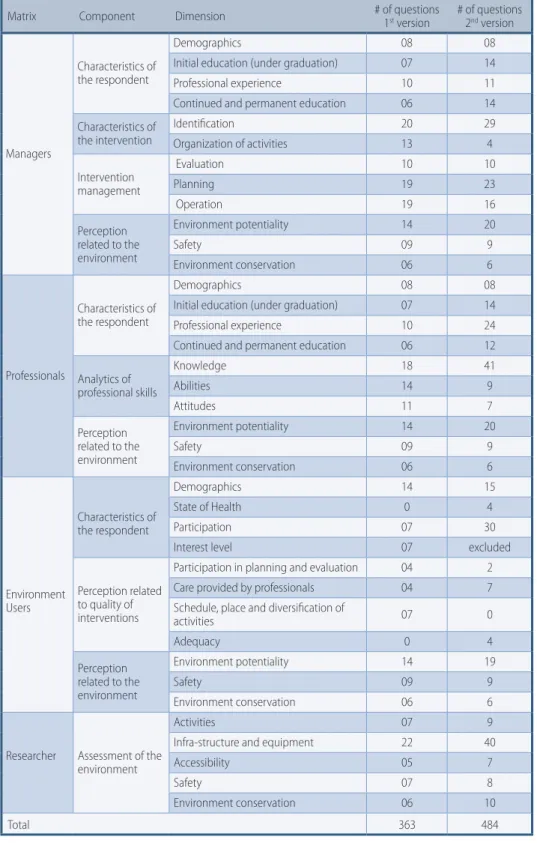
Considering the analysis of reviewers for the matrices of all instruments, a mean ans-wer rate was 22 reviews, with a total of 30 from the management instrument, 19 for professional, 18 for users and 21 for environment. Additionally, reviewers, 79 for mana-gement instrument, 42 emitted 198 suggestions, questions or commentaries for pro-fessionals, 28 for users and 49 for environment, the final result can be seen in Figure 2.
Strategy for dimensioning of the number of users Scenarios 1 2 3 4 5 6 7 Type of ongoing program
Mãe coruja Cantos YES YES YES YES
NSFH Nuclei YES YES YES YES
PAC or similar Poles YES YES YES YES
Size of municipality < 20 thousand Pregnant 2 2 0 3 2 2 3 Adolescents 0 2 2 2 2 3 3 Adults 0 3 3 3 3 4 4 Older adults 0 2 2 2 2 3 3 Total 2 9 7 10 9 12 13 20 – 49,4 thousand Pregnant 2 2 0 3 2 2 3 Adolescents 0 2 2 2 2 3 3 Adults 0 3 3 3 3 4 4 Older adults 0 2 2 2 2 3 3 Total 2 9 7 10 9 12 13 50 – 99,9 thousand Pregnant 3 3 0 4 3 3 4 Adolescents 0 3 3 3 3 4 4 Adults 0 4 4 4 4 5 5 Older adults 0 3 3 3 3 4 4 Total 3 13 10 14 13 16 17 100 thousand or more Pregnant 4 4 0 5 4 4 5 Adolescents 0 4 4 4 4 5 5 Adults 0 5 5 5 5 6 6 Older adults 0 4 4 4 4 5 5 Total 4 17 13 18 17 20 21
Figure 1 – Dimensioning of the number of users according to the existence of ongoing interven-tions for promotion of PA and size of municipalities.
Face and content validity and clarity and applicability of the instruments
In face and content validity a mean response rate was 8 reviews (researchers) and a mean total of 13 reviews (professionals, managers and users). In general lines, the reviewers indicated a good evaluation relating to pertinence, evaluation of the de-gree of adequate writing, language on questions and answers and general evalua-tion of the quesevalua-tionnaire. In addievalua-tion, reviewers also sent specific comments (mean of 49) for adjustment in questions and answer categories.After the round of analysis of the matrices, four versions of instruments were constructed (manager, professional, user and environment) denominated Ques-tionnaire for Evaluation of Interventions for Physical Activity Promotion in Pri-mary Health Care. The version of the instrument for managers was constituted by
fours components, 12 dimension and 167 questions; the version for professionals was constituted by three components, 16 dimensions and 151 questions; the ver-sion for users with three components, 9 dimenver-sion and 94 questions; and, the environment version, one component, 41 dimensions and 74 questions.
Testing of Reproducibility of instruments
The reproducibility (test and re-test) of instruments in the professional and user versions was tested through the intraclass correlation for continuous variables, Kappa for nominal variables and Spearman (rho) for ordinal scale variables. Values of ≥ 0,4 were considered satisfactory.
Matrix Component Dimension # of questions 1st version # of questions 2nd version
Managers
Characteristics of the respondent
Demographics 08 08
Initial education (under graduation) 07 14
Professional experience 10 11
Continued and permanent education 06 14 Characteristics of the intervention Identification 20 29 Organization of activities 13 4 Intervention management Evaluation 10 10 Planning 19 23 Operation 19 16 Perception related to the environment Environment potentiality 14 20 Safety 09 9 Environment conservation 06 6 Professionals Characteristics of the respondent Demographics 08 08
Initial education (under graduation) 07 14
Professional experience 10 24
Continued and permanent education 06 12 Analytics of professional skills Knowledge 18 41 Abilities 14 9 Attitudes 11 7 Perception related to the environment Environment potentiality 14 20 Safety 09 9 Environment conservation 06 6 Environment Users Characteristics of the respondent Demographics 14 15 State of Health 0 4 Participation 07 30
Interest level 07 excluded
Perception related to quality of interventions
Participation in planning and evaluation 04 2
Care provided by professionals 04 7
Schedule, place and diversification of
activities 07 0 Adequacy 0 4 Perception related to the environment Environment potentiality 14 19 Safety 09 9 Environment conservation 06 6
Researcher Assessment of the environment
Activities 07 9
Infra-structure and equipment 22 40
Accessibility 05 7
Safety 07 8
Environment conservation 06 10
Total 363 484
Figure 2 – Consolidation of analytical matrices.
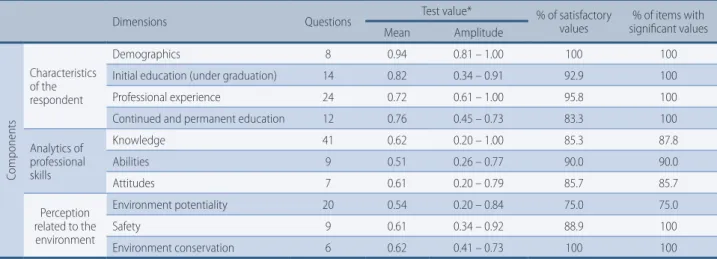
The final instrument for professionals was composed by 151 questions divided in three components, according to the description on table 1. The first component relates to characteristics of the participant and is composed by 58 questions divid-ed into four dimensions. Values for reproducibility tests were always significant and presented a mean always of or above 0.72 (dimension of professional experi-ence). Only 4 questions (6.7%) were below 0.4.
The second component provides the analysis of competency of the profession-al, composed by 57 questions divided into three dimensions. Mean values for the reproducibility test varied between 0.51 (abilities dimension) to 0.62 (knowledge dimension). A total of eight questions (14%) presented values inferior to 0.4, sim-ilar to the level of significance.
The third component relates to the environment perception and is composed by 35 questions divided into three dimensions. Mean values for reproducibility vary between 0.54 (environment potentiality dimension) and 0.62 (environment perception). A total of six questions presented values below 0.4 (17%), in which the environment potentiality dimension presented values of 25% while safety did not present any values below what was recommended for the test.
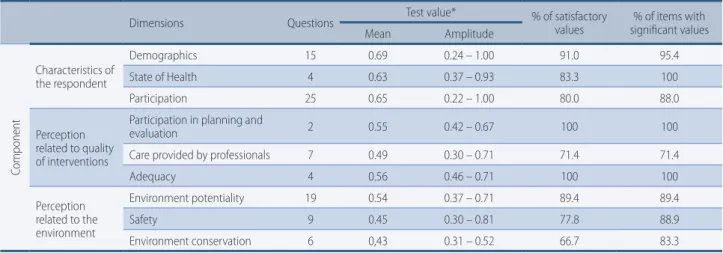
The final instrument for users was composed of 91 questions divided into three components, as described on table 2. The first component relates to char-acteristics of the participant and is composed by 44 questions divided into three dimensions (demographics, state of health and participation). The mean value for all dimensions was above 0.60 and above the 80% in what concerns percentage of satisfactory values (>0.40) and of significance (p<0.05).
The second component reports the perception on the quality of interventions, and is composed by 13 questions divided into three dimensions (participation in planning and evaluation, care provided by professionals, and adequacy). Mean values for the reproducibility test varied between 0.49 (care provided) to 0.56 (ad-equacy). Expect for the dimension of care provided, all other reached 100% for the above-cited items with values beyond 0.4 and of test significance.
The third component relates to the perception of the environment and is composed by 34 questions divided into three dimensions. The mean value of reproducibility var-ied between 0.43 (environment conservation) and 0.54 (environment potentiality). Table 1 – Reproducibility analysis for the instrument – professional version.
Dimensions Questions Test value* % of satisfactory values significant values% of items with Mean Amplitude Componen ts Characteristics of the respondent Demographics 8 0.94 0.81 – 1.00 100 100
Initial education (under graduation) 14 0.82 0.34 – 0.91 92.9 100
Professional experience 24 0.72 0.61 – 1.00 95.8 100
Continued and permanent education 12 0.76 0.45 – 0.73 83.3 100
Analytics of professional skills Knowledge 41 0.62 0.20 – 1.00 85.3 87.8 Abilities 9 0.51 0.26 – 0.77 90.0 90.0 Attitudes 7 0.61 0.20 – 0.79 85.7 85.7 Perception related to the environment Environment potentiality 20 0.54 0.20 – 0.84 75.0 75.0 Safety 9 0.61 0.34 – 0.92 88.9 100 Environment conservation 6 0.62 0.41 – 0.73 100 100
*Intraclass correlation test for continuous variables; Kappa for nominal variables and Spearman (Rho) for ordinal variables. Open ques-tions were not included in reproducibility analysis.
Fieldwork
During the phase of data collection, the Superior School of Physical Education (ESEF) of the UPE was responsible for coordinating the research project and conduct data collection in seven of the twelve health regionals in the State of Pernambuco (munici-palities from the I, II, III, V, VI, X and XII regionals). The team from ASCES was respon-sible for region IV and UNIVASF collected data in four regionals (VII, VIII, IX and XI).
Each team, formed by four researchers, was responsible for visitation of one city per day but, depending on proximity of municipalities and different sched-ules of intervention, this number came up to two visits per day. The data collec-tion team visitacollec-tion went during the hours of programs and intervencollec-tions. Usual-ly this schedule varied between 5:00 a.m. and 8:00 p.m.
During visitation the collection teams were divided as follows: one researcher responsible for the environment instrument, also responsible for following man-agers and professionals interview at the end of applying the first instrument. The remaining researchers were responsible for interviewing users. Each interview with users lasted for about 30 minutes.
When arriving to places where interventions and/or programs were being held, re-searchers presented themselves to professionals who were aware and, when not aware, the research and its goals were also presented and following they presented themselves to users, who were invited to participate. The team of researchers remained in the lo-cation until all interviews had been concluded with users who accepted to participate. In some cases, it was necessary to go to different places, beyond where interventions were held, to guarantee the interviews with users, for example, their residences.
In case of professionals and managers working at both PACID and NSFH pro-grams, they must respond to two questionnaires, each one taking into consid-eration the place and characteristics of that intervention. The same way only in reverse, when municipalities were contacted and there was confirmation of inter-ventions for promotion of physical activity being developed at both the NSFH and the PACID pole, but, when arriving at the location it was identified that in fact the intervention was only in one if the programs, the professionals involved would only respond to one questionnaire.
According to the communication released before the teams went to the munic-ipalities to collect data, the information obtained by telephone allowed to predict the amount of individuals to collect data from, in this case, organization until this moment (only the IV regional has not been collected), there was a forethought to collect from 124 managers, 348 professionals, 1047 users and 190 environments. However, that number was reached with in August 2015, with a total of 146 man-agers, 388 professionals, 978 users and 166 environments.
Through field diaries from the researchers, it was possible to identify facilitator and barrier aspects for conducting fieldwork, as described on Figure 3.
Table 2 – Reproducibility analysis for the instrument – user version.
Dimensions Questions Test value* % of satisfactory values significant values% of items with
Mean Amplitude Componen t Characteristics of the respondent Demographics 15 0.69 0.24 – 1.00 91.0 95.4 State of Health 4 0.63 0.37 – 0.93 83.3 100 Participation 25 0.65 0.22 – 1.00 80.0 88.0 Perception related to quality of interventions
Participation in planning and
evaluation 2 0.55 0.42 – 0.67 100 100
Care provided by professionals 7 0.49 0.30 – 0.71 71.4 71.4
Adequacy 4 0.56 0.46 – 0.71 100 100 Perception related to the environment Environment potentiality 19 0.54 0.37 – 0.71 89.4 89.4 Safety 9 0.45 0.30 – 0.81 77.8 88.9 Environment conservation 6 0,43 0.31 – 0.52 66.7 83.3
*Intraclass correlation test for continuous variables; Kappa for nominal variables and Spearman (Rho) for ordinal variables. Open ques-tions were not included in reproducibility analysis.
Items Facilitators Barriers Preliminary contact and scheduling Partnership with State Secretary of Health Expressive participation of municipalities
Constant change of managers in the municipalities Outdated or inexistent contacts.
Lack of understanding the aims of the study by managers and professionals (qualify versus supervise)
Displacement/travel and lodging Knowledge of municipalities by the research team Team with few experienced people to drive long distances Reception of the research team by
users in the municipalities
Curiosity to know the study
Interest to improve spaces destined to
physical activity practice Not being informed of the visit of the research team Reception of the research team by
professionals in the municipalities Interest to improve quality of the work offered to users Incompatible hours with the research team’s visit Activities performed only for the purpose of the research team’s visit
Reception of the research team by
managers in the municipalities Point out what has been done regarding physical activity in the municipality Misunderstanding the aims of the visit from the research teamDevelop programs, interventions, activities in general only for the moment the research team’s visit was undergoing
Questionnaire application Contemplated diverse dimensions Length of professional version instrument
Funding
Funding from the Foundation for Support to Science and Technology in the State of Pernambuco (FACEPE), of the Professional Development Coordination (CAPES) and the CNPQ.
Financing agencies not providing funds in the determined deadline
Reduction and delay of financial support by the funding agencies Figure 3 – Description of facilitators and barriers for the developing the study, identified by researchers.
Discussion
According to detailed methodological procedures and with the most rigor possib-le for this type of study, important contributions were observed to the process and the products derived from the construction of instruments for data collection.
Regarding the process, we may highlight the attention put into the literature review and meetings with the project team for construction of matrices and in-struments. The expedition in the process of construction of matrices, as well as the contribution of managers and professionals of different educational back-grounds and locations in the country is another important point. We intended to reach for an expressive number of specialists (n=81) and 17% for those invited returned with reviews, a relatively good response rate once all regions of Brazil were represented (validity) and over 200 reviews, suggestions and comments were received. We believe the use of a free app for reviews has contributed to the agility and responsiveness, beyond saving the expense on project budget.
In the process of constructing the matrices and the instruments, the form uti-lized allowed for triangulation of information derived from questions with open an-swers in a closed scale and, also, open questions. Even though all quantitative indica-tors were favorable by 63% of reviewers, the team members put an extra effort in the discussion, contemplation and adequacy of the suggestions present in the reviews.
As for derived products of the construction process of the instruments, it stands out the fact that quantitative metrics reveal acceptable indicators of writ-ing/language of questions, adequate levels of response scales and positive percep-tion of the quality of quespercep-tionnaires.
The method for obtaining answers from professional and managers (self-re-port) allows the use of instruments by different teams of researchers once it brings out the possibility to interview users of programs at the same time. The diversity and amount of matrices, components, dimensions and indicators in the instru-ment allows its total or partial use. Furthermore, it allows the creation through isolated or combined answers for the creation of other metrics of answers, in the
option of knowledge scores, levels of knowledge (example: perceived knowledge domain and objectively measure knowledge domain) of physical activities in dif-ferent cycles of life.
On psychometric analysis, most dimensions presented a satisfactory index, however, questions related to perception of safety and quality of environment had great amplitude for the professional as well as the user version of the instrument, which can be attributed to a modified perception of reality, not previously per-ceived, and when asked (test) was awaken, stimulated reflection and on a second moment (retest) allowed them to have a more detailed and critical analysis about the processes involving the programs and/or interventions they participate in.
This aspect was identified in the field diaries, when researchers returned for the second round and users commented on the possibility of offering a different response than the one reported the previous week, because of such more critical analysis of the reality. Another dimension to highlight on the same sense was the dimension of knowledge, where the same reported having searched information on certain subjects that were questioned during the first interview. However, these inferior results represent the minority of questions, therefore, it was preferred to keep such questions due to the positive evaluation from specialists.
Therefore, the four products generated related to the four versions of the in-struments (Manager, Professional, User and Environment), are useful to be used in the Brazilian context and, mainly, in the programs Academia da Saude, similar and interventions of physical activity promotion developed in the NSFH. Its use will allow to establish criteria of comparability for strengths and frailties of the referred programs and interventions.
Acknowledgments
We thank all those people who directly or indirectly contributed to this project, especially users, professionals and managers, GPES e funding agencies (CNPQ, FACEPE and CAPES).
Authors’ contributions
All the authors contributed in the conception of the project or analysis and inter-pretation of the data, writing the manuscript or critically reviewing for all intellec-tual content, as well as the approval of the final version to be published.
Funding sources
CNPq, FACEPE, CAPES.References
1. Miranda LS, Sattelmair J, Chaves P, Duncan GE, Siscovick DS, Stein PK, et al. Physical Activity and Heart Rate Variability in Older Adults: The Cardiovascular Health Study. Circulation. 2014;129:2100-10.
2. Farias, ES Gonçalves EM, Morcillo AM, Guerra-Júnior G, Amâncio OMS. Effects of programmed physical activity on body composition in post-pubertal schoolchildren. J Pediatr (Rio J). 2015;91(2):122-9.
3. Branco JC, Jansen K, Teixeira S, Carrapatoso S, Spessato B, Carvalho J, et al. Physical benefits and reduction of depressive symptoms among the elderly: Results from the Portuguese “National Walking Program”. Ciênc Saúde Coletiva. 2015;20(3):789-95.
4. World Health Organization. Global status report on non-communicable diseases 2010. Geneva: World Health Organization; 2011.
Corresponding Author
raFael Miranda TassiTano
REcEivEd 02/12/2015
AppRovEd 12/01/2016
Dom Manoel de Medeiros, S/N, Dois Irmãos/ Recife/ Pernambuco. CEP:52171-900. (081) 33206475.
5. World Health Organization. Global Strategy on Diet, Physical Activity and Health. Geneva, Switzerland: World Health Organization; 2004.
6. Neira M, Onis M. The Spanish strategy for nutrition, physical activity and the prevention of .obesity. Br J Nutr. 2006;96:S8–11.
7. Pate RR. A National Physical Activity Plan for the United States. J Phys Act health. 2009; 6:S157–8.
8. Brasil. Ministério da Saúde. Secretaria de Vigilância em Saúde. Secretaria de Atenção à Saúde. National Policy in Health Promotion/Ministry of Health, Secretary of Surveillance, Secretary of Primary Health Care. – 3. ed. – Brasília: Ministério da Saúde, 2010.
9. Bejarano BM. Analysis of experiences in promotion of physical activity. Rev. Salud Pública. 2006;8:42-56.
10. Gomes MA, Duarte MFS. Effectiveness of an intervention in physical activity for adults in the health family strategy: program action and health Floripa – Brazil. Rev Bras Ativ Fís Saúde. 2008;13(1):44-56.
11. Hallal PC, Tenório MCM, Tassitano RM, Reis RS, Carvalho YM, Cruz DKA, et al. Evaluation of the program for physical activity promotion Academia da Cidade in Recife, Pernambuco, Brazil: perceptions of users and non-users. Cad. Saúde Pública. 2010;26(1): 70-8.
12. Hoehner CM, Soares J, Perez DP, Ribeiro IC, Joshu CE, Pratt M. Interventions in Physical Activity in Latin America: a systematic review. Am J Prev Med 2008;34(3):224–33.
13. Malta D, Silva MMA, Albuquerque GM, Amorim RCAR, Araújo GB, Silva TS, et al. National Policy for Health Promotion, description of implementation of the physical activity and movement axis, 2006 to 2014. Rev Bras Ativ Fis e Saúde. 2014;19(3):286-99.
14. Coutinho SS. Competence of the Physical Education professional in primary health care. 2011. 207 f. Dissertation (Doctorate in Public Health). Escola de Enfermagem de Ribeirão Preto/Universidade de São Paulo, São Paulo, 2011.
15. Scabar TG, Pelicioni AF, Pelicioni MCF. Performance of Physical Education Professionals in the Unified Health System (SUS): analysis of the National Policy for Health Promotion and Guidelines of the Nucleus for Support of Family Health-NSFH. J Health Sci Inst. 2012;30(4):411-8.
16. Amorim TC, Knuth AG, Cruz DKA, Malta DC, Reis RS, Hallal PC. Description of municipal programs for physical activity promotion funded by the Ministry of Health. Rev Bras Ativ Fis Saúde. 2013;18(1):63-74.