1 European Group of Public Administration (EGPA) Conference – Toulouse 2010
Evaluation of training of public managers in the context of the Portuguese public administration
César Madureira and David Ferraz
1. Introduction
It is largely recognized that Public Administration is an important structure in the process of governance. In addition to applying public policies set by governments, Public Administration also plays an important role in its definition, being the link between political power and the citizen (Dowding, 1995; Peters, 2001; Mozzicafreddo, 2001).
It is therefore important that public organisations become highly qualified, particularly within the designated “top public management”1
which is composed of people who perform their duties with great impact in the governance process (Mulgan, 2007; Ferraz, 2008). In this sense it is important that these professionals hold the necessary skills to carry out these functions.
Taking this reality in context, Portugal established as a requirement for the development of managerial functions specific training for managers of public administration for the first time in 2004 (according to the Law No. 2 / 2004 of 15 January). The law decreed that all public managers should attend a long training cycle program in order to maintain their roles as managers in the administration.
Later, with the Law No. 51/2005 of 30 August, the courses for the training of public managers have been restructured, resulting in the courses that exist today. The law also previewed that some certified entities, selected by a competition, could perform those courses. In the National Institute of Administration, I.P. (INA, IP), the pioneering institution in the implementation of these courses, and the only one that belongs to the central administration, the training courses had been coordinated from the beginning (2003-2004) by the
1 In our paper we will use the concepts of top managers, leaders, public managers and senior civil
2 Managers Training Department (FDIR) whose mission is "to provide leadership training for top-level and middle level public managers”.
In the recent past, a study pointed that public managers in Portuguese public administration attended less training when compared with the officials with a degree (Madureira, 2004).
At that time, it was already a common practice, in other countries, the requirement of prior certified training to occupy managerial functions in the public administration (Ferraz and Madureira, 2006). Furthermore, since the 90's that OECD studied the profile of the public leaders in the XXI century, suggesting that countries around the world should develop the identified profile in their public administrations (Ferraz, 2008). In 2003 and 2004 the public administration reform in Portugal was designed in order to introduce compulsory training to both top level managers and middle level managers, enforcing the need for training of leaders, in line with OECD suggestions.
After about 5 years it is necessary to do a reflection on the training process of public managers. Accordingly, given, on the one hand, the need for evaluation of any training activity, and secondly, the fact that the training of managers in Public Administration is still a novelty in Portugal and that the Government is considering the development of new training courses, our study explores the assessment made by Portuguese public managers in terms of:
1. its response to training,
2. the level of importance of training in their learning 3. changes in their behaviours in working context and
4. the main training needs that still need to be developed in future actions. Through the application of a questionnaire survey to all public managers who attended training courses for leaders at INA, IP, between 2004 and 2009 (3604 managers), this paper intends to explain public managers training evolution in the Portuguese Public Administration as well as to present practical assessment of these training programs in the last 5 years, using the Kirkpatrick model of training evaluation.
3 2. The leaders training assessment
2.1. The Public Administration leaders training in Portugal
Very recent studies show that in the context of the Portuguese Public Administration, the leaders (including top public managers) tend to remain in managerial functions over an extended period of time (Ferraz, 2008; Teixeira, 2009; Robinson, 2010). Nunes (2003) says that in the Portuguese Public Administration there is a considerable instability in the management functions but, at the same time, a strong stability of people performing these functions. In other words, despite the successive changes of government leaders, even if top public managers leave the places they occupy in a particular public body, they restart leadership functions within other public sector bodies in a short period of time.
This fact is justified in part by historical and cultural heritage of our administration: in fact, in Portugal only in 1979, and in accordance with the provisions of the Law Decree No. 191-F/79 of June 26, managers of the Portuguese public administration left to be filled for life, being appointed on a three years’ service commission (Teixeira da Cruz, 1992). The dynamic evolution of the political and socio-economic development in the 70’s has been crucial to make some changes in the Portuguese Public Administration. However, despite the outside social influences, in essence, the legal bureaucracy remained almost identical to the system which prevailed during the nearly 50 years of dictatorship (Rocha, 2009).
The discussion on the recruitment of middle and top-level managers in the Portuguese public administration has been a constant over the past three decades. Successive laws have been changing the ways of recruiting leaders. Law No. 2 / 2004 of January 15, in his Article 20, provided for the first time, as a prerequisite for the exercise of leadership functions, in addition to an academic degree and a minimum period of professional experience, the use of a training course for senior management in administration public.
Promulgated and published in 2005, Law No. 51/2005 of August 30 (that change the Law No. 2 / 2004 of January 15) appears to establish new rules for
4 the appointment of senior executive positions in public administration. Article 12 emphasizes the obligation to senior officials to enroll on training so they can exercise managerial functions in the Portuguese Public Administration.
Nevertheless, the requirement for the public administration leaders to attend training courses is too recent in our country. Unlike other countries, where the leaders themselves seek for training, the new legal framework, which makes training compulsory for Portuguese public managers, reveals that in the organizational culture of the Portuguese public administration, there was never a tradition to train senior civil servants (Ganhão, 1994; Madureira, 2004). Until our days, in Portugal, public managers were almost all officials at the end of their career (learning their skills and competences through the learning by doing system) or civil servants appointed by political appointment.
In this new context, the training of leaders arises with the new legal framework designed by the instilled reform, as a response to the training needs of managers in Portuguese public administration, responding to one of the main objectives of administrative reform in Portugal: the qualification of managerial staff.
2.2. Vocational training and the need for evaluation
The end of the twentieth century has been prolific in presenting scientific papers which try to discuss the importance of training evaluation and assessment. Many authors like Brinkerhoff (1987), Le Boterf (1992, 1999), Guerrero (2000) and Kirkpatrick (1996) are good examples of this work. Nevertheless, it is the work of Kirkpatrick that remains as the main theoretical framework in the field of evaluation training.
The assessment approach of Kirkpatrick
Kirkpatrick (1996) proposes to divide the training assessment theoretical concept in four steps:
5 Step 2: Learning made
Step 3: Behavior Change in the workplace
Step 4: Tangibility of organizational results from the training provided
On the following points we will present in detail each of the steps proposed by Kirkpatrick (1996):
Step 1: Reaction
Kirkpatrick (1996) suggests that in assessing the reaction of the trainees, the distinction between evaluation of the relevance of topics and the quality evaluation of the trainer should be well highlighted at the assessment tool to be used. Only then we can know, with precision, what kind of representations the trainees have on the quality of training in its different aspects.
It is also noted that the importance of assessing this dimension of analysis is due to the fact that we assume that a motivated trainee could perhaps be predisposed to take an advantage of learning.
Step 2: Learning
A good reaction to the training does not necessarily correspond to a convenient learning. However, if the perception of trainees of the training program in which they took part is bad, this can be very negative for their learning capacity. This is because the motivation of learners is a necessary condition for it to be effective learning.
In the words of Kirkpatrick (1996), learning should be understood as “the attitudes that have been changed and the knowledge and skills acquired during training program”.
Step 3: Behavior
According to Kirkpatrick (1996), if we want to make a complete evaluation of a training process, we should be able to distinguish between what is meant by 'learning of concepts, principles and procedures "and its use in the workplace. If possible this assessment should be made by the trainee himself and by other agents that interact professionally with the trainee. Nevertheless in our research
6 we only have the feedback of the trainee himself. Especially for top managers it was very difficult to assess the opinion of their chiefs (we are talking about ministers!) about the managers’ behavior changes after training.
Step 4: Results
The major difficulty in evaluating the results is the impossibility of separation of organizational variables. That is to say that at this stage of evaluation, we should be able to find the relative weight of training in the improvement of certain indicators, and the weight of other organizational and individual factors. The answer to this question can never be entirely clear; thus, this stage of evaluation will not be included in our empirical investigation.
3. Evaluation of training by public managers
Given, firstly, the need for evaluation of any training activity and secondly the fact that the training of public administration leaders/managers still constitutes a relative novelty, our study try to assess, through the application of a questionnaire survey to all public managers who attended training for leaders in the INA, IP between 2004 and 2009, which assessment is made by them in terms of their reaction to training.
Our instrument has also included two questions about the perceptions of managers regarding the level of importance of training in their learning and effective change in their behaviors, respectively. However, this is just a collection of perceptions on learning (1 question) and behavior change (1 question) and not an effective assessment of them.
The survey was built based on the recommendations of the evaluation model proposed by Kirkpatrick (1996).
7 3.1 Population
Our population was constituted by top and middle level managers who attended training for leaders in the INA, IP between 2004 and 2009. That makes a population of about 3604 people. Consequently, about 3604 emails were sent asking these professionals to reply to the questionnaire. From the total, 451 e-mails were not delivered to the recipient for one of the following reasons:
1. Mailbox does not exist in the organization 2. Mailbox full
3. E-mail address given with errors
Thus, 3153 leaders were asked to respond to the survey posted online at a website created for this purpose using the open source technology of Limesurvey.
3.2 Sample / Response Rate
Of the 3153 public managers who were sent the survey, 580 have respond (this is the number that we consider to be our sample) which represents a response rate of 18.4%.
8 3.3 Sample Characterization
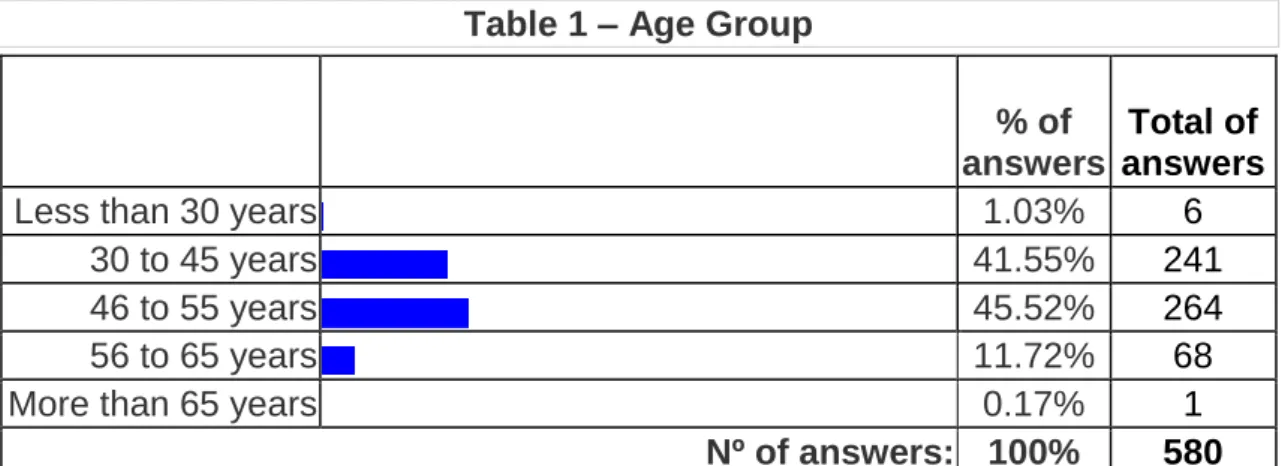
Table 1 refers that over 45.5% of respondents leaders are between the ages of 46 and 55 years old. The other most significant slice of the sample covers the individuals that fall within the range between 30 and 45 years of age.
Table 1 – Age Group
% of answers
Total of answers
Less than 30 years 1.03% 6
30 to 45 years 41.55% 241
46 to 55 years 45.52% 264
56 to 65 years 11.72% 68
More than 65 years 0.17% 1
Nº of answers: 100% 580
Table 2 shows that nearly 59% of the respondent sample is composed of female individuals. Table 2 – Sex % of answers Total of answers Male 41.38% 240 Female 58.62% 340 Nº of answers: 100% 580
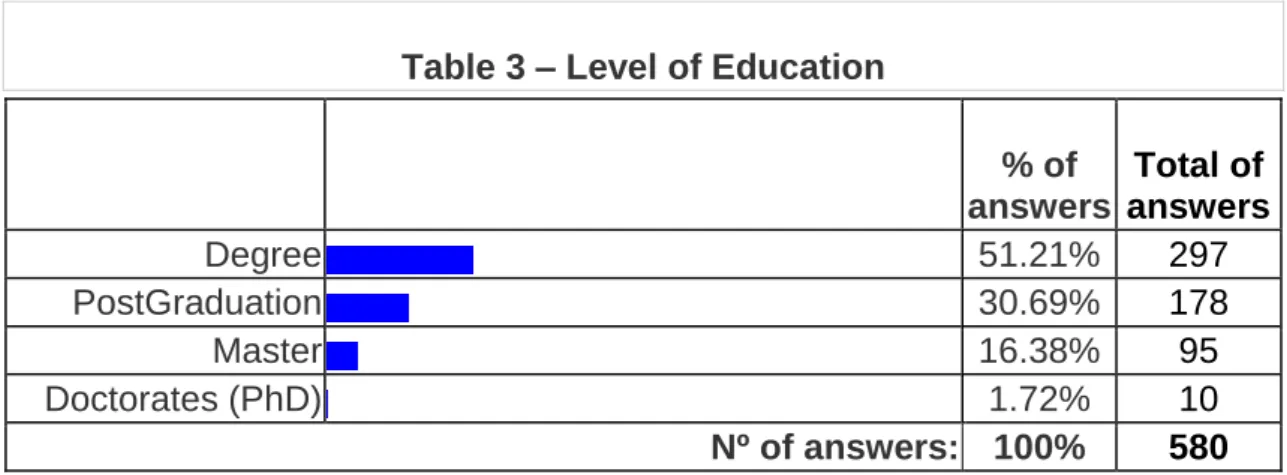
The data revealed in Table 3 show that half of the sample has a degree, more than 30% are postgraduates (it should be noted that while the graduate is not an academic degree, gives one more year in college with school performance), 16,38% have a master and only 1,72% of the respondents reported having doctorates.
9
Table 3 – Level of Education
% of answers Total of answers Degree 51.21% 297 PostGraduation 30.69% 178 Master 16.38% 95 Doctorates (PhD) 1.72% 10 Nº of answers: 100% 580
As we can observe in table 4, the predominant areas of specialization in our sample are Economics and Management (22.59%), Law (16.38%), Public Administration and Management (11.90%) and Engineering (11.38%). These figures allow us to realize that the management places, which in mechanistic bureaucracies are traditionally mainly occupied by graduates in Law, are spread over several areas of specialization.
Table 4 – Area of specialization
% of answers Total of answers Public Administration and Management 11.90% 69 Economics and Management 22.59% 131 Architecture Arts 1.38% 8 Natural Sciences 2.41% 14 Education Sciences 1.72% 10 Engineering 11.38% 66 Law 16.38% 95 Health 4.31% 25 Psychology 1.55% 9 Sociology 3.28% 19 Languages and / or Literature 3.10% 18
10
History 4.66% 27
Another 15.34% 89
Nº of answers: 100% 580
According to data arranged in Table 5, about 78% of respondents revealed to play leadership roles in the current time (it should be noted that the questionnaires were addressed to managers that attended courses at INA, IP since 2004 which might be assumed that, in presumption of a higher turnover of the ruling class, we could not get a percentage of stay in leadership positions so high).
Table 5 – Performance of manager role at the present time
% of answers Total of answers Yes 77.59% 450 No 22.41% 130 Nº of answers: 100% 580
In Table 6, it is important to note that the number of answers declines as one goes back in time (only exception to the answers concerning the year 2009. There are very few due to the fact that the empirical data have been collected during the month of April 2009). It is therefore in the year 2008 that we have a higher percentage of respondents.
Table 6 – Year of frequency of training in INA, IP % of answers Total of answers 2004 10.17% 59 2005 13.79% 80 2006 18.28% 106 2007 19.31% 112 2008 29.31% 170 2009 9.14% 53 Nº of answers: 100% 580
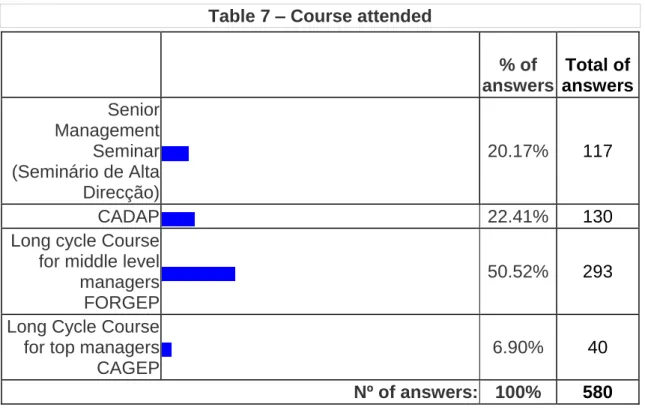
11 According to the figures in Table 7, it appears that more than a half of the sample respondents were leaders who attended the FORGEP (Long cycle Course for middle level managers). Furthermore, it should be noted that only 6.9% of the sample consists of respondents who have attended the CAGEP (Long Cycle Course for top managers).
Table 7 – Course attended
% of answers Total of answers Senior Management Seminar (Seminário de Alta Direcção) 20.17% 117 CADAP 22.41% 130
Long cycle Course for middle level managers FORGEP
50.52% 293 Long Cycle Course
for top managers CAGEP
6.90% 40
Nº of answers: 100% 580
3.4 Findings Presentation
According to the data presented in Table 8, more than a half of the sample admitted that INA, I.P’ training courses for Senior Civil Servants present new ideas, enhancing the skills of managers which, consequently, allow them to actively contribute to management improvement in their units.
12
N=553
As indicated in Table 9, over 66% of the respondents admitted that "the impact that the acquisition of knowledge and behavioral skills had on performance and overall results of their service" should be the main component of evaluation of training programs for managers. A small minority relegates to a secondary sphere of importance the assessment of “acquisition of behavioral skills”, “effective learning of subjects taught” and the “learner's opinion regarding the trainer” (see Kirkpatrick, 1996).
13 Table 9 - Strands to focus on the evaluation of training for managers
N=553
In what concerns to the evaluation of the importance of learning methodologies, as table 10 reveals, according to the opinion of the senior civil servants, all methods of training should be used in training.
We can conclude however that the methodologies of teaching / training mostly chosen as "very appropriate" by the respondents are the case studies (42,28%), internships in International Public Administration (38,69%), discussion forums (38,48%), coaching (37,63%), the role-playing/simulations (34,46%) and visits and / or internships on private sector in organizations that for one reason have to establish some relationship with the administration and / or service trainees (31,29%).
Moreover, it should be noted that all methods of teaching / training suggestions are considered by more than a half of the sample as "adequate" (except in respect of international internships in government where only 48,41% of the respondents chose the hypothesis "appropriate" to classify this method.
14 Table 10 – Evaluation of importance of learning methodologies
N=473
The information shown on Table 11 reveals that, according to the opinion of the managers/leaders contemplated in the sample, the monitors, the teaching methodologies, the interest of the subjects, the importance and relevance of learning for their current jobs and the relevance of learning for the modernization of services and public administration in general are seen essentially as "good." Only the distance learning component is perceived as “fair”.
15 Table 11 – General assessment of training
N=523
Taking into account the data provided in Table 12, more than a half of the sample state that the area of expertise further improved after training was the “general knowledge about the subjects. However, 30,02% of respondents admit that the domain of attitudinal and behavioral skills is the one that stands more enhanced after training.
16 Table 12- Areas of expertise further improved
N=523
In what concerns to the contribution of training to influence professional behavior of managers, as we can see on Table 13, about 50% of the sample think that the contribution is only "partial" and 21,4% think this contribution is “high”.
A very low percentage of managers think that the existence of a contribution of training to a behavioral change is "none."
Table 13 – Contribution of training to influence professional behavior
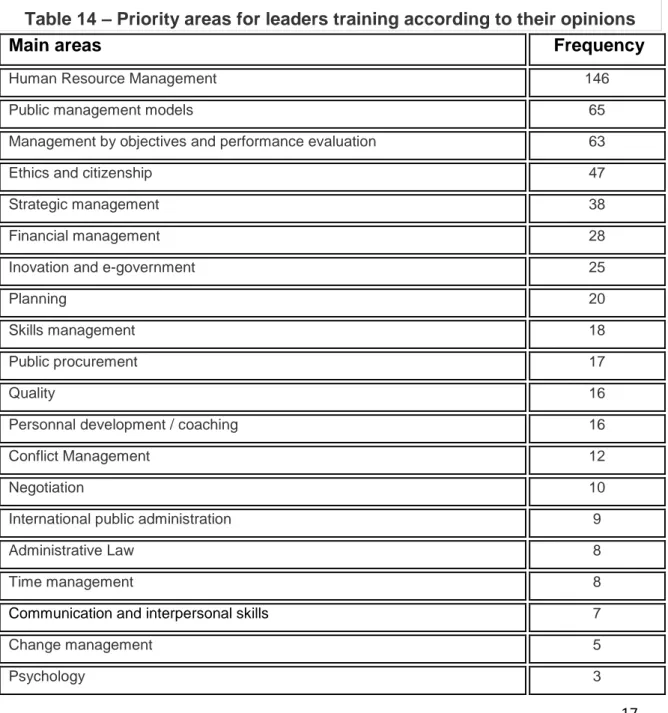
17 With regard to training areas regarded as priorities by leaders, in table 14 we can observe that training in human resource management is, at a great extent, the most identified priority in the opinion of the respondents. This area is considered by public officials as the more priority one, followed by training in public management models. The third area suggested as more priority is management by objectives and performance evaluation.
We must also stress the need felt by leaders in the field of tools to make a strategic management and the importance that is given to ethics and citizenship in the exercise of public functions. Other priorities can be identified on table 14.
Table 14 – Priority areas for leaders training according to their opinions
Main areas Frequency
Human Resource Management 146
Public management models 65
Management by objectives and performance evaluation 63
Ethics and citizenship 47
Strategic management 38
Financial management 28
Inovation and e-government 25
Planning 20
Skills management 18
Public procurement 17
Quality 16
Personnal development / coaching 16
Conflict Management 12
Negotiation 10
International public administration 9
Administrative Law 8
Time management 8
Communication and interpersonal skills 7
Change management 5
18
Sociology 3
Public Marketing 3
Applications for Funds Management 3
Environmental policies 2
Comunitary affairs 2
4. Conclusions
According to the data presented more than a half of the sample admitted that INA training courses for Senior Civil Servants present new ideas, enhancing the skills of managers which, consequently, allow them to actively contribute to management improvement in their units. Thus, we can say that for the majority of the respondents the training for leaders is perceived as something good and useful for their careers.
According to the opinion of the managers/leaders contemplated in the sample, the monitors, the teaching methodologies, the interest of the subjects, the importance and relevance of learning for their current jobs and the relevance of learning for the modernization of services and public administration in general are seen essentially as "good." Only the distance learning component is perceived as “fair”. Probably managers would appreciate an improvement of the distance learning component on leaders training programs in order to avoid them to leave the services some full days per week, during months, to attend training.
We should also highlight that the major competences developed in the opinion of senior civil servants are general knowledge (more than a half of the sample) with damage to attitudinal and behavioral skills. Unfortunately we know that administrative reform (in Portugal like in elsewhere) depends, most of all, on behavioral skills. So probably, the leaders’ training programs will have to enforce the behavioral dimension in the future.
19 Regarding the contribution of training to change the professional behaviors of managers, to about 50% of the senior civil servants, the contribution is only partial, which indicates a relative disbelief in training as a fundamental pillar of the transformation behavior in the managers elites.
Nevertheless, according to their perception as trainees, our public managers believe that the impact of the acquisition of knowledge and behavioral skills on the performance of the public services is the most important type of assessment for managers and the most important part on future assessments of training courses. This shows that our managers really want to be sure that the training effects can be assessed and evaluate in the context of real work. Unfortunately, as stated by Kirkpatrick, this is the hardest step of the evaluation process because it is almost impossible to separate all the organizational variables and to understand the weight of each of them on organizational performance.
Nevertheless INA, I.P. and other training institutions must work on training methodologies that not only promote training as a whole to all publics but also addresses specific courses, to specific needs, trying to evaluate the real impact of that training in terms of the improvement of performance.
5. References
- BRINKERHOFF, R. (1987), Achieving Results from Training, San Francisco, Jossey Bass.
- CAUDEN, J., SANCHES, A (1998), Gestion de ressources humaines, Gestion Publique, Paris, Berger-Levrault.
- CAVALCANTI (1990), Avaliação de Treinamento e Desenvolvimento: Uma função em busca de respostas, Revista de Administração de Empresas, 30, nº1, pp17-25.
- CHMIELEWSKI, T.L., PHILLIPS, J.J. (2002), Measuring Return on Investement in Government: Issues and Procedures, Public Personnel
Management, Volume 31, nº2.
- CRUZ, J.P. (1998), Formação Profissional em Portugal – Do Levantamento
20 -FERRAZ, David e MADUREIRA, César (2006), Modelos de formação de
dirigentes públicos - análise comparativa, Oeiras: INA.
- FERRAZ, David (2008), A selecção de dirigentes públicos no contexto de
evolução dos modelos de Estado e de Administração, Dissertação de
Mestrado, Lisboa, ISCTE-IUL. -
FORD, J.K., SEGO, D. (1990), Linking training evaluation to training needs
assessment, Brooks AFB, TX, Air Force Human Resources Laboratory
- GANHÃO, M.T. (1994), Desburocratização da Administração Pública, Forum
Sociológico – Revista do Instituto de Estudos e Divulgação Sociológica,
Número 5
- GOLDSTEIN, I.L., GESSNER, M.J. (1988), Training and development in work organizations, in COOPER, C.L., ROBERTSON, I.T. (Editors), International
Review of Industrial and Organizational Psychology, Chichester, John Wiley
and Sons
- GROVE, D.A, OSTROFF, C, (1990), Program evaluation, in WEXLEY, K., HINRICHS, J., (Editors), Developing Human Resources, Washington, BNA Books
-
GUERRERO, S. (2000), Où en sont les entreprises françaises en matière d’évaluation des actions de formation?, Revue Gestion 2000, Septembre-Octobre
- JOUVENEL, G., MASINGUE, B. (1994), Les évaluations d’une action de
formation dans les services publics, Enjeux, Méthodes et outils, Paris, Les
Editions d’Organisation.
- KIRKPATRICK, D. (1996), Evaluation, in CRAIG, Robert (editor), The ASTD
Training and Development Handbook, McGraw-Hill, pp-294-312.
- LE BOTERF, G. (1999), L’ingénerie des compétences, Editions d’Organization, Paris.
- LE BOTERF, G. (1992), Avaliar o investimento em formação, Formar, nº 6, pp-54-56.
- MADUREIRA, César (2006), Behavioural and motivacional training for Senior Staff in the Portuguese Public Sector, European Journal of Vocational Training, Nº39, (2006/3), CEDEFOP.
- MADUREIRA, César (2004), A formação comportamental no contexto da
21 - MARQUES, C.A, CRUZ, C.P.A, GUEDES, P.C.R. (1995), Medir Resultados de Formação: Para além da Ilusão, Comportamento Organizacional e Gestão, Lisboa, ISPA, vol.1, nº 2.
- NOE, R.A, FORD, J.K. (1992), Emerging issues and new directions for training research, in Research in Personnel and Human Resources Management, volume 10.
- NUNES, Filipe (2003), “Os Directores Gerais. A elite administrativa portuguesa durante o XIV Governo Constitucional” in Freire, André; Pinto, António Costa (Orgs.), Elites, Sociedade e Mudança Política, Celta Editora, Oeiras.
- PAIN, A (1992), Évaluer les actions de formation, Paris, Les Éditions d’Organisation.
- PHILLIPS, J. (1996), Measuring the results of training, Craig, R. (editor), The
ASTD Training and Development Handbook, McGraw-Hill, pp-313-341
- ROCHA, J.A.O (2009), Gestão Publica e Modernização Administrativa, Oeiras, INA.
- RODRIGUES, Carlos (2010), Governação das Organizações Públicas, Tese de Doutoramento, Lisboa, ISCTE-IUL Business School.
- SOYER, J (1998), Fonction formation, Paris, Editions d’Organisation
- TEIXEIRA, Carla (2009), Administração Pública e Política: os limites da
coexistência, Tese de Doutoramento, Lisboa, ISCTE-IUL.
- TEIXEIRA DA CRUZ, J.M. (1992), O recrutamento, a selecção e a avaliação dos dirigentes, Revista Administração, Dirigentes e Técnicos do Estado, Série 3, Nº3, Maio-Junho
Law references
- Lei nº51/2005 de 30 de Agosto - Lei nº 2/2004 de 15 de Janeiro
22 Evaluation of training of public managers in the context of the Portuguese
Public Administration
César Madureira [email protected] David Ferraz [email protected]
National Institute of Public Administration (Portugal) Abstract
Public administration is an important structure in the process of governance. In addition, public administration not only apply the policies set by the governments, but also play an important role in its definition (Dowding, 1995; Peters, 2001; Mozzicafreddo, 2001).
It is therefore important that these public organisations are highly qualified, particularly within the designated “top public management” which is composed of people who perform their duties with great impact in the governance process (Mulgan, 2007; Ferraz, 2008). In this sense it is important that these professionals hold the necessary skills to carry out these functions.
In Portugal, a requirement for specific training for managers of public administration was established for the first time in 2004 (according to the Law No. 2 / 2004 of 15 January), which decreed that all public managers should attend a long training cycle work in order to maintain their roles as managers in the administration.
Later, with the Law No. 51/2005 of 30 August, the courses for the training of public managers have been restructured resulting in the courses that exist today and are taught by certified entities.
In the National Institute of Administration, I.P. (INA, IP), the pioneering institution in the implementation of these courses, and the one that belongs to the central administration, this training has been coordinated from the beginning by the Managers Training Department (FDIR) whose mission is "to provide leadership training for top-level and middle level public managers”.
In the recent past, a study pointed to the fact that public managers in Portuguese public administration attended less training compared with the officials technicians with a degree (Madureira 2004).
23 At the time, it was already a common practice, in other countries, the requirement of prior certified training to public managers in public administration (Ferraz and Madureira, 2006). Furthermore, since the 90's that the OECD studied the profile of skills that the leader of the XXI century should have and suggested that countries should develop this profile in their public administrations (Ferraz, 2008).
Thus, the need for training of leaders began, also in Portugal, to establish itself as an issue that mattered to understand and improve.
Given, on the one hand, the need for evaluation of any training activity, and secondly, the fact that the training of managers in Public Administration is still a novelty in Portugal and that the Government is considering the development of new training courses, our study explores what assessment is made by these managers in terms of its response to training, the level of importance of training in their learning and changes in their behaviours in working context and the main training needs that still need to be developed in future actions.
Through the application of a questionnaire survey to all public managers who attended training for leaders in the INA, IP between 2004 and 2009 (3604 managers), this paper intends to explain public managers training evolution in Portugal Public Administration as well as to present the practical assessment of these training programs in the last 5 years, using the Kirkpatrick model of training evaluation.
Bibliografia
Dowding, Keith (1995), “Policy-Making: Civil Servants in the Cross Fire” in The
Civil Service, London: Routledge, Cap. 6, pp.108-128.
Ferraz, David. (2008), A Selecção de Dirigentes Públicos no contexto da
evolução dos modelos de Estado e de Administração: contributo para a definição de uma política integrada, Lisboa: ISCTE
Ferraz, David e Madureira, César (2006), Modelos de Formação de Dirigentes
Públicos - Análise Comparativa, Caderno INA 27, Oeiras: INA.
Peters, B. Guy (2001), The Politics of Bureaucracy, 5ª ed. - London: Routledge. Mozzicafreddo, Juan, e Salis Gomes (orgs.) (2001), Administração e Política:
Perspectivas de reforma da Administração Pública na Europa e nos Estados Unidos, Oeiras, Celta Editora.
Mulgan, Richard (2007), “Truth in Government and the Politicization of Public Service Advice”, in Public Administration, vol. 85, nº3, 2007, pp. 569-586.