A Social Content Network Proposal for World
Films: three essays on the topic
Fernando Manuel Pereira Governo
Doctoral Thesis in the Digital Media Program Austin | Portugal
Supervised by:
Aurora A. C. Teixeira
Ana M.O. Brochado
Acknowledgements
As is the case with almost every work, this one is very much indebted to many people. My deepest debt of gratitude is owed to Prof. Aurora Teixeira, a prominent thinker who has influenced me profoundly. This dissertation was largely possible due to her support, continuous supervision and constructive comments which greatly benefited the research conducted. Even a long dedication would be too short and too commonplace to honour such admiration. To my co-supervisor, Prof. Ana Brochado, for her kindness and prompt availability, thank you. I would also like to express my deepest gratitude to my colleagues, Paulo Fontes, Sandro Tavares and Daniel Rodrigues, who held me accountable and challenged me to create a work that was worthy of my effort and dedication. My recognition to the Foundation for Science and Technology (PhD Scholarship SFRH /BD / 51744 / 2011) is fully noted. Finally, to those who inspired it but will not read it. To all, my heartfelt thanks.
ii
Abstract
With digital media technologies pervading our lives and accelerating the future of online films, the way film lovers experience films has undergone a major shift; what was formerly a communal activity is now increasingly individual in its reception and fragmented in its social experience.
Faced with this immense momentum of media change and social revolution, there is one important feature that emerges from our research: from one hand, the ubiquitous presence of the new media applications is leading to individualized forms of film reception and social isolation; on the other hand, the network architecture of the Internet is creating new possibilities for the reintegration of the film lover.
We argue that a new re-conceptualisation of the area is required. Thus, in the first essay, it is surveyed and analyzed the relationship between ‘social media’ landscape and the ‘over-the-top’ (OTT) film industry and provide a new market overview.
By clearing up the boundaries and affordances of the distinct media platforms and by discussing the opportunities opened by the development of pervasive social computing, we sustain the development of a new film service that aims to merge the entertainment of online films and the mutual relationships between film lovers, emphasizing thereby the sociability between them is needed. Thus, in the second essay, it is proposed a new film-centered social network model that reaches beyond the functionality-based approaches to the development of OTT video sites and focuses on domains related to sociality.
Since SCNs are innovative, yet to be considered valuable by film lovers, an evidence-based (in current IS usage models) is needed to validate which social affordances are crucial to influence their decision towards the intention to use a SCN. Thus, the third essay developed and empirically tested a comprehensive framework to examine the film lovers’ intention to participate in a SCN.
iii
Resumo
Com as tecnologias média digitais cada vez mais impregnadas no nosso quotidiano e acelerar o futuro dos filmes online, a forma como os fãs de cinema experienciam os filmes observou uma grande mudança; o que antes era uma actividade comunitária é agora cada vez mais individual na sua recepção e mais fragmentada socialmente.
Diante do impulso de mudança nos média e de revolução social, há uma característica importante que emerge da nossa investigação: de um lado, a omnipresência das novas aplicações media está a originar formas individualizadas de recepção de filmes e ao isolamento social; por outro lado, a arquitectura de rede da Internet está a criar novas possibilidades para a reintegração dos fãs de cinema/filmes.
Nós argumentamos que é necessária uma nova re-concepção da área. Assim, no primeiro ensaio, é examinada e analisada a relação entre os "médias sociais" e a indústria de filmes "over-the-top" (OTT), fornecendo assim uma nova visão geral do mercado.
De seguida, ao clarificar os limites e os recursos das diferentes plataformas de média, e ao discutir as novas oportunidades proporcionadas pelo desenvolvimento da computação social generalizada, é sustentado que é necessário o desenvolvimento de um novo serviço de filmes que efetue uma fusão entre o entretenimento dos filmes online e as relações entre os fãs de cinema/filmes, enfatizando dessa forma, a socialidade entre eles.
No segundo ensaio, é proposto um novo modelo de rede social centrado nos filmes que ultrapassa as abordagens mais funcionais no desenvolvimento de sites OTT e que se concentra em domínios relacionados com a socialidade.
Como as redes sociais de conteúdo são inovadores e ainda não legitimadas pelos fãs de filmes, é necessário um modelo de uso baseado em evidências (nos modelos de uso dos sistemas de informação) para validar quais as características da componente social que são cruciais para influenciar a decisão de intenção de uso de um SCN. Assim, no terceiro ensaio é desenvolvido um enquadramento abrangente que permite analisar e testar empiricamente a intenção dos fãs de cinema/filmes usar uma rede social de conteúdos.
iv Contents Acknowledgements ... i Abstract ... ii Resumo ... iii Introduction ... 1
What do we really know about the online film landscape? ... 1
Challenges and opportunities ... 2
Social content network systems ... 3
Overview of the dissertation ... 4
References ... 5
ESSAY 1 ... 7
Social multimedia computing: an emerging area of research and business for film ... 8
Abstract ... 8
1. Introduction ... 9
2. OTTs, social media and film industry: setting the direction for the merging ... 11
2.1. Disentangling the key concepts ... 11
2.2. The evolution of OTTs and social media platforms: the redesign of the film business model ... 12
2.3. OTT to disrupt core business models ... 12
2.4. Opportunities and challenges opened up by social computing initiatives ... 14
3. The current state of play for the online film business: how OTT is changing the value chain and revenues opportunities ... 15
3.1. The complex issue of content rights in the OTT video landscape ... 16
3.2. New on-demand windows of distribution ... 17
3.3. Mix of established and new revenues gathering ... 17
3.4. More complexity in the world of OTT video Services ... 19
4. Social networking and video streaming: the merging paradigm ... 20
5. Over the Top video as an opportunity for world films ... 21
6. Concluding remarks ... 23
6.1. Proposing a social content network for world films... 23
6.2. A two-way social content network: a forward approach for future research ... 25
v
ESSAY 2 ... 37
Merging social computing with content: A proposal of a new film platform – Avids ... 38
Abstract ... 38
1. Introduction ... 39
2. Convergence process: The emerging OTT multimedia market ... 40
2.1. The rise of social multimedia platforms ... 40
2.2. Challenges for effective social multimedia experiences: The forgotten elements ... 41
3. Elements of a new platform for films: Methodological and practical issues ... 42
3.1. Categorisation of OTT services based on the social media honeycomb framework.... 42
3.2. Merging social computing with content (fusion phase of IT) ... 47
3.3. Key elements for holistic social experiences in an SCN ... 48
Object (films) ... 49
Identity ... 50
Links and pairing links ... 51
Presence ... 51 Actions ... 52 Sharing ... 52 Reputation ... 53 Relationship ... 54 Groups ... 54 Conversation ... 55
4. Describing a social (to the core) content network: The architecture of Avids ... 56
5. Conclusions ... 60
References ... 62
ESSAY 3 ... 75
Determinants of users’ acceptance of a social content network: the case of film lovers ... 76
Abstract ... 76
1. Introduction ... 77
2. Theoretical background and conceptual framework ... 80
2.1. Main concepts ... 80
2.1.1. SCN systems ... 80
2.1.2 Concept of sociality in SCNs ... 81
2.1.3 Film lovers’ intentions to use SCNs ... 82
vi
2.2.1. Perceived enjoyment ... 86
2.2.2. Perceived interactivity: antecedents and effects ... 87
2.2.3. From interactivity to sociality: supporting components of sociality ... 89
2.2.4. Perceived sociality ... 90
3. Methodology ... 94
3.1 Methodological design ... 94
3.2. Target population, questionnaire and hypotheses’ main proxies ... 95
4. Empirical results ... 100
4.1. Descriptive results ... 100
4.2. Determinants of intentions to use Avids: estimation results ... 101
4.2.1. Measurement model ... 102
4.2.2. Structural model ... 106
4.3. Discussion of results ... 108
5. Conclusions ... 112
5.1 Main theoretical contributions ... 114
5.2 Practical implications ... 115
5.3 Limitations and paths for future research ... 115
References ... 117
Conclusion... 139
vii
List of Figures
Essay 2
Figure 2. 1: Fusion of honeycomb elements into social experiences in SCNs ... 49
Figure 2. 2: Users’ interface (level 1) Figure 2. 3: Users’ interface (level 2) ... 57
Figure 2. 4: Example of a film’s homepage ... 59
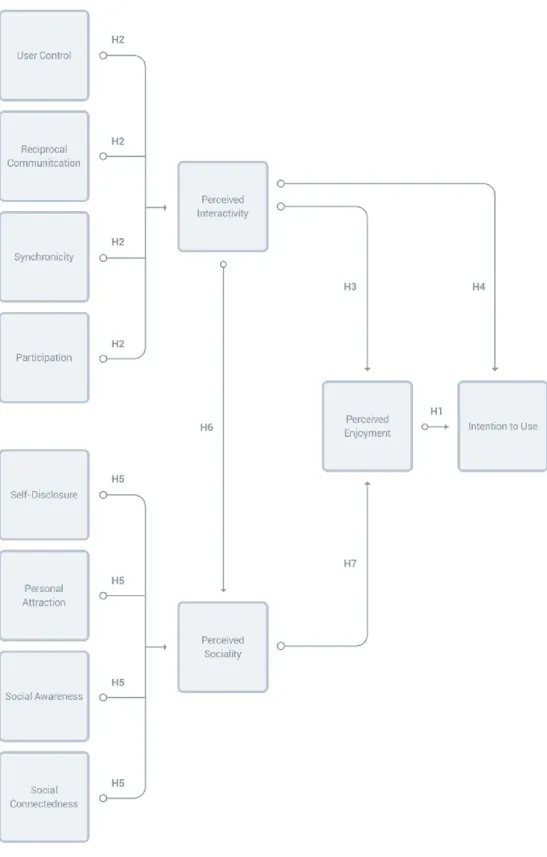
Essay 3 Figure 3. 1: Proposed model of acceptance of SCNs ... 85
Figure 3. 2: Respondents’ age distribution (number [N] = 479) ... 99
Figure 3. 3: Respondents’ country of residence distribution (N = 479) ... 99
Figure 3. 4: Proposed model ... 102
viii
List of Tables
Essay 2
Table 2. 1: Overview of streaming video services based on honeycomb social constructs ... 44
Essay 3 Table 3. 1: Descriptive statistics of model constructs ... 97
Table 3. 2: Specification of outer model ... 103
Table 3. 3: Construct validity criteria for reflective constructs ... 104
Table 3. 4: Discriminant validity ... 104
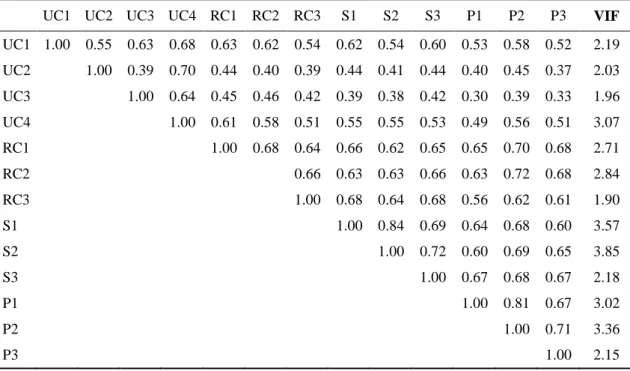
Table 3. 5: Perceived interactivity correlations and VIF ... 105
Table 3. 6: Perceived sociality correlations and VIF ... 105
Table 3. 7: Assessment of second-order formative constructs ... 106
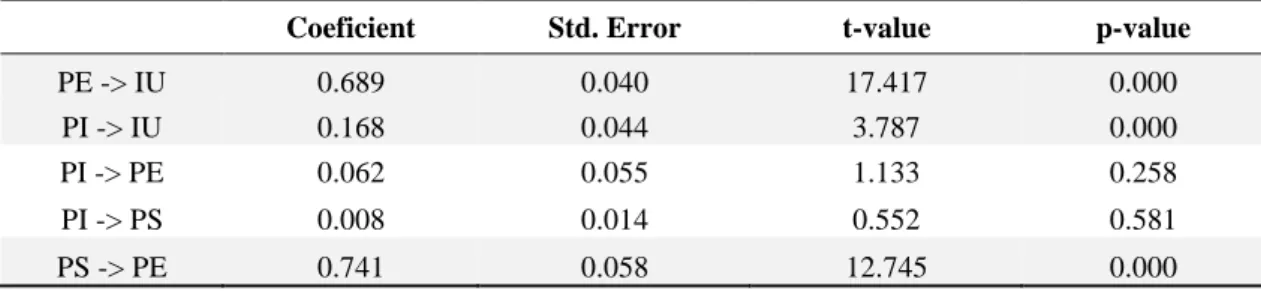
Table 3. 8: Structural model results ... 107
1
Introduction
What do we really know about the online film landscape?
The current rate of change in technology, consumer behaviour, and the new business models are accelerating the future of online films. The emergent popularity of Over-the-Top (OTT) media services such as Hulu, YouTube, Amazon and Netflix has opened up the global film landscape, altering the way we access and engage with films (Cha and Chan-Olmsted, 2012; Gubbins, 2014).
An important feature of this dissertation is the recognition that our research is not just about the technology; it is also about the huge numbers of film consumers who now have access to it and what they are doing with it. Film consumers are now able to watch films practically anywhere or anytime they wish, while having access online to all aspects of film culture (Tryon, 2013). Without any contradiction, convergence mechanisms and the Internet created a world in which films are ubiquitous and can be watched on personal devices, such as laptops, tablets, smartphones, etc. On these devices, the viewing experience in OTT film services coexist with the social practices surrounding film in other film-related websites, forums, social media platforms and social networks, resulting in a social trend in multimedia data generation and consumption (Christie, 2012; Juhlin et al., 2013; Sang, 2014; Adolf and Deicke, 2015; Wiard and Domingo, 2016).
Despite the growing literature, these disruptive changes still represent a challenge domain for scholarly research, specially to the disciplines of film, media studies, social behaviour and social computing related studies (Lee and Chen, 2013). There are a number of trends regarding how film is produced, consumed, shared, and interacted with that require a re-conceptualisation of the area (Juhlin et al., 2013; Sang, 2014; Adolf and Deicke, 2015). OTT video delivery is not only affecting economic models and practices of the film industry; it is also promoting an on-demand film culture and transforming the practices and perceptions of media culture. Research has failed to depict these distribution systems that allow millions of individuals to interact and stream films, which has resulted in extensive misunderstandings about the actual essence and configuration of the online film industry.
The guiding principle for our research is to understand the emerging socio-technical developments and social practices that are shaping film in an online era, and offer an
2 interpretation of how individuals engage with films in this new dynamic environment; and answer to the question of how can we accelerate the demand of world films. Thus, we begin our research with a market overview and provide a new perspective about the transmutation of the film value chain ignited by the massive adoption of social media, streaming video and the Internet.
Challenges and opportunities
In a social age characterised by the rise of social multimedia platforms and changes in the consumer behaviour, OTT video providers —realizing the power of social media, are now facing the challenge how to implement these tools and improve their business models (Weide, Kevorkian, & Ireland, 2011). Empowered by social computing technologies, leading OTTs started to connect actively with consumers on other social media platforms and incorporate social media functionalities for a more enriching consumption experience.
But blending dynamic social media processes with traditional infrastructures presents complex challenges. And, although OTT websites evolved to become more social, many observers have noted the OTT video is strongly connected to processes of fragmentation, segmentation and the loss of social capital that might cause individualization in the sense of increased physical separation and a decline of personal interaction (Adolf and Deicke, 2015). This means, despite the affordances of social computing, OTT providers are missing the opportunity to take advantage of users’ need for explicit interaction and of on-site relationships (Yan et al., 2013; Sang, 2014).
Accordingly, film viewers are now re-imagined as individualized. This proposition fails, however, to account the integrative features of social networks. We acknowledge the network architecture of the Internet creates new possibilities for reintegration of audiences that consume films and share social practices, values and discourses (Napoli, 2011; Tryon, 2013; Adolf and Deicke, 2015; Wiard and Domingo, 2016).
New film cultures are emerging online. Film lovers who see films as sources of the self and relational intimacy are coming online in large numbers, not just to watch films, but also to interact and be socially integrated through films. Currently, the missing differential in the film ecosystem is an aggregated community, one united by values, interests, and behaviours; a community that provide a shared context for film lovers to communicate
3 and share information, films, and personal experiences, and that focus on features that play a salient role in constructing individual profiles, vital for social integration and social cohesion (Hope, 2013; Adolf and Deicke, 2015).
The boom in social media platforms and the skyrocketing demand for online video is now perceived as an opportunity for niche content that may otherwise be in short supply on mainstream platforms (Hope, 2013; Gubbins, 2014). Because film tastes are more diverse on OTT video, and the niche is global, media companies and media entrepreneurs can “aggregate disperse audiences” that are similar in their film-taste and tap into its specialised demand (Screen Australia, 2014). World films for example, have strong opportunities in an online, on-demand film culture, but they require to actively consider new business models and new pathways to its audiences.
The participatory property of social multimedia offers a new solution perspective. Thus, based on a discussion of the concept objectualization that points towards films as relationship partners in embedded environments, and considering the developments of pervasive computing, we envision a pervasive sociality between online film lovers. At the heart of our approach lies the concept of a film-centred social network (Engëstrom, 2005; Marie et al., 2011; Adolf and Deicke, 2015).
Social content network systems
Confronted with a market of dissatisfied film lovers that are craving to belong to a community that share the same tastes in films, we suggest throughout these essays that SCNs are a creative solution for those who want to watch world films, to have ongoing interaction, and is a space of inclusion for those with desire for social relationships nearly as rich as those in real life (Bouman et al., 2008; Marie et al., 2011; Akgun, 2014; Adolf and Deicke, 2016; Ooyala, 2016; Wiard and Domingo, 2016). We should not forget that films are one incredibly powerful social tool capable of bringing people together in a shared experience.
A SCN is a social structure where film is the reason why people affiliate with each specific other and not just anyone. And, in our research, world films are at the same time interaction triggers, context providers and communication anchors (Engëstrom, 2005; Marie et al., 2011; Adolf and Deicke, 2015).
4 In this dissertation, we introduce our SCN. Note that this is the first hybrid multimedia platform where film lovers actively participate in generation and consumption processes, and where the interaction is a generalised principle, which consists of film lover–film lover relationships, content–content similarities and film lover–content interactions.
Overview of the dissertation
The dissertation comprises 3 essays. In the first essay, we analyze the relationship between ‘over-the-top’ (OTT) providers, social media and the film industry, and discuss some of the opportunities and challenges opened by social computing initiatives. A new social content network model that connects individuals socially through films is proposed in second essay. The third essay develops and empirically tests a comprehensive framework to examine the film lovers’ intention to participate in a SCN. We conclude the dissertation by summarizing the major points and identifying the future works.
Essay 1: Social Multimedia Computing: An Emerging Area of Research and Business for Films. We survey and analyze the relationship between ‘social media’ landscape and the ‘over-the-top’ (OTT) film industry and provide a new market overview. By clearing up the boundaries and affordances of the distinct media platforms and by discussing the opportunities and challenges opened by social computing initiatives, this essay sustains that developing a social content network that connects people socially through films is both a managerial and scientific opportunity for the film industry and academic research. Essay 2: Merging social computing with content: A proposal of a new film platform – Avids. With consumers continuously online and logged on, leading OTT providers, empowered by social computing technologies, have started to establish a social media presence and incorporate elements drawn from social media into their services. Thus, in this essay, we provide a structured categorisation of the most salient social media features of the best-known applications in the OTT video business, and then propose a new social content network model that reaches beyond more fixed, functionality-based approaches to the development of OTT video sites and focuses on domains related to sociality. Essay 3: Determinants of users’ acceptance of a Social Content Network: the case of ‘film lovers’. The expansion of the OTT film market, the growing presence of online fragmented film audiences, and the evolution of Internet technologies is leading to the development of a new wave of film services that aim to merge the entertainment of online
5 films and the mutual relationships between film lovers, emphasizing thereby the sociability between them. Since SCNs are innovative, yet to be considered valuable by film lovers and with very few information about the factors associated to its acceptance, an evidence-based (in current IS usage models) is needed to validate which social affordances are crucial to influence their decision towards the intention to use a SCN. To fill this gap, this essay develops and empirically tests a comprehensive framework to examine the film lovers’ intention to participate in a SCN.
References
Adolf, M., & Deicke, D. (2015). New modes of integration: Individuality and sociality in digital networks. First Monday, 20 (1-5) January. http://dx.doi.org/10.5210/fm.v20i1.5495
Akgun, O. (2014). The Role of New Media in Contemporary Entertainment Culture. In R. Ozturk (Ed.), Handbook of Research on the Impact of Culture and Society on
the Entertainment Industry (pp. 542-557). Hershey, PA: IGI Global.
Bouman, W., Hoogenboom, T., Jansen, R., Schoondorp, M., de Bruin, B., & Huizing, A. (2008). The Realm of Sociality: Notes on the Design of Social Software, Paper presented at the International Conference on Information Systems 2007.
Cha, J., & Chan-Olmsted, S.M. (2012). Relative advantages of online video platforms and television according to content, technology, and cost–related attributes. First Monday, 17(10).
Christie, I. (2012). Audiences: Defining and Researching Screen Entertainment Reception. Amsterdam: Amsterdam University Press.
Gubbins, M. (2014), Audience in the Mind. A Cine-Regio Report. Sampomedia.
Hope, T. (2013). 17 things about the film business that should significantly influence your behaviour. Artist to Entrepreneur. San Francisco Film Society. Retrieved 8 August 2014, from http://trulyfreefilm.hopeforfilm.com/2013/05/16-things-about-the-film-biz.html
Weide, K., Kevorkian, S., & Ireland, G. (2011). Social Entertainment 2.0: What is it, and why is it important? White Paper. IDC. Retrieved September 10, 2016, from http://tech-insider.org/social-networks/research/acrobat/1104.pdf
6 Juhlin, O., Zoric, G., Engström, A., & Reponen, E. (2013). Video interaction: A research
agenda. Personal and Ubiquitous Computing, 18(3), 685-692.
Engeström, J. (2005). Why some social network services work and others don’t - Or: The case for object-centered sociality. (2010). Retrieved Jully 06, 2016, from http://www.zengestrom.com/blog/2005/04/why-some-social-network-services- work-and-others-dont-or-the-case-for-object-centered-sociality.html
Lee, M. R., & Chen, T. T. (2013). Understanding Social Computing Research. IT Professional,15(6), 56-62.
Marie, N., Gandon, F. & Myriam, R. (2011), “Pervasive sociality: advanced social objects recommendation”, Web Science Conference 2011 (WebSci11), Jun 2011, Koblenz, Germany.
Napoli, P. M. (2011). Audience evolution: new technologies and the transformation of
media audiences. New York: Columbia University Press.
Ooyala (2016). State of the Broadcast Industry 2016. Retrieved January 21, 2018, from http://go.ooyala.com/rs/447-EQK-225/images/Ooyala-State-Of-The-Broadcast-Industry-2016.pdf
Sang, G. (2014), User-Centric Social Multimedia Computing, Doctoral Thesis accepted by University of Chinese Academy of Sciences, Beijing, China. Springer Theses Recognizing Outstanding Ph.D. Research.
Screen Australia (2014), Online and on demand Trends in Australian online video use.
Retrieved June 03, 2018, from
https://www.screenaustralia.gov.au/getmedia/0062da06-db04-4932-a3e1-20a81d383129/Online-on-demand.pdf
Tryon, C. (2013). On-demand culture: Digital Delivery and the Future of Movies. New Brunswick, NJ: Rutgers University Press.
Wiard, V., & Domingo, D. (2016). Fragmentation versus convergence: University students in Brussels and the consumption of TV series on the Internet. Particip@ tions, 13(1), 94-113.
Yan, N., Qian, H., Ji, X. (2013). Netflix Social Redesign. Team Netflixers. Retrieved September 09, 2016, from http://niyandesign.com/img/research/ Netflix%20Social%20Redesign_FinalReport_Team%20Netflixers.pdf.
7
ESSAY 1
____________________________________________________________
Social multimedia computing: an emerging area of research and
business for film a neglected, emergent area of research
8
Social multimedia computing: an emerging area of research and
business for film
1Abstract
We survey and analyze the relationship between ‘social media’ landscape and the ‘over-the-top’ film industry and provide a new market overview of how distinctive media platforms are leveraging each other features as part of their business model. With an elevated penetration of mass-market OTT services and coexistence of several business models and value chains that need to be proven, our findings suggest that new entrants, to stand apart, will have to experiment new business models and with multimedia integration of content and services; and, unless they establish new niche services to communities of interest it will be difficult for them to differentiate their offerings and survive. Developing a social content network that connects people socially through films can offer media entrepreneurs and the ‘world film’ industry with a stable business model and a new window of opportunity in their competition for market share. By clarifying the boundaries and affordances of distinct OTT and social media platforms, the present research sustains that coupling video streaming and social networking is the future. It further bears that social multimedia computing should be used to capture and leverage the social activity and interaction of users in order to understand the drivers and trends in the film industry. Finally, it provides a direction for online world films.
Keywords: social multimedia computing; social media platforms; film industry;
streaming video providers.
1 Published as Governo, F., Teixeira, A.A.C., Brochado, A.M. (2017). Social Multimedia Computing: An Emerging Area of Research and Business for Films. Journal of Creative Communications, Vol. 12, Issue: 1, 31-47.
9
1. Introduction
The characteristics and reach of social media and Social Networking Sites (SNSs) are rapidly evolving; many of the features that differentiate them vanished, while others have been replicated by other genres of social media (Boyd and Ellison, 2007; Kim et al., 2010; Ellison and Boyd, 2013). Some researchers (e.g., Harris, 2009; Kim et al., 2010; Kietzmann et al., 2011) state there are hundreds of distinctive (social) media platforms supporting a broad range of interests and practices (e.g., social networking, streaming videos, discussion groups, etc.) and to know what constitutes what is becoming increasingly challenging.
While it is not easy to discern them (Hanna et al., 2011), these media platforms are taking advantage of a series of radical innovations generated by the progressive process of convergence involving the audiovisual, informatics and telecommunication industries. These latter’s combination led to the development of a new variety of media platforms that, besides online video, offer simultaneously multimodal data in one stand-alone platform (Pagani, 2008; MCcann Report, 2009; Vartanova et al., 2013; Sang, 2014). With more users adopting these online participatory technologies and turning to “over the top” (OTT) content (Oestreicher-Singer and Zalmanson, 2013; Skytide, 2014), OTT video providers themselves (aroused by the potentialities of social computing) are blending their services with social media functionality (Weide et al., 2011; Greenberg and Zanetis, 2012; Albarran and Moellinger, 2013) and becoming major platforms for multimedia content delivery and social interaction (Benevenuto et al., 2009; Tian et al., 2010).
Disruptive these changes may be to the media ecosystem itself, these platforms are, on the other hand, creating new consumption habits by changing the way people access, engage with, and perceive the current global cinematic landscape (Cunningham and Silver, 2013; Kapka, 2013; Maskin et al., 2014; Lopez, 2014); for these reasons, they are posing new research challenges to the disciplines of film, media studies and social computing (Tian et al., 2010; World cinema on-demand2).
Despite the entrepreneurial and academic relevance of the new many issues involving the wide prevalence of social multimedia in OTT video services and the growth of video in social media applications, researchers have not (yet) included sites that host films in a
10 social multimedia research, neither have, adequately, discussed how these transformations are affecting the business and industry practices, and failed to depict these distribution systems that allow millions of people to interact and stream films, which has resulted in extensive misunderstandings about the actual essence and configuration of the online film industry (Lisi, 2013; World cinema on-demand). Moreover, it is also not clear, and has not been taken in consideration by academic research, the market and societal relevance of these changes in the World film industry.
Consequently, the main purpose of this paper is to provide a market overview of how media platforms are leveraging each other features as part of their business model, while giving a new perspective about the transmutation of the film value chain ignited by the massive adoption of social media, streaming video and the Internet (World cinema on-demand). In this analysis, we sustain that further investigation needs to be conducted in order to offer a multilayered interpretation of how people engage with films in this new dynamic environment and answer to the pragmatic question of how can we accelerate demand and fully engage with online world films.3
The structure of this article is organized as follows. The next section analyzes the relationship between OTTs, social media and the film industry, and discusses some of the opportunities and challenges opened by social computing initiatives. The state of the play of the online film business is analyzed in Section 3, where we also highlight the issue of content rights, new windows of distribution and revenues gathering. Section 4 establishes the argumentation for the future merge paradigm, while Section 5 presents “over-the-top” disruption as a new window of opportunity for world film. Finally, Section 6 concludes highlighting how a social content network approach is both a managerial and scientific opportunity for the film industry and research.
3 World films mean firstly the films that are not distributed by the Classic Hollywood Studio System. With this in mind, world films are conceptualized as films produced outside of Hollywood that never achieved, in any meaningful sense, conventional forms of international distribution (Chanan, 2011; Kapka, 2013).
11
2. OTTs, social media and film industry: setting the direction for the merging 2.1. Disentangling the key concepts
Despite the growing literature regarding the film distribution, the online movie industry still represents a challenge domain for scholarly research (see Cunningham and Silver, 2013) and currently, there is lack of academic studies about how the main players are operating in this unique environment of the online film business.
Around the world, over-the-top video is becoming mainstream, and, as multiple new OTT services emerge, understanding the competitive dynamics of the market is a key challenge (Viviez et al., 2014). Thus, to best survey the cluttered and confusing media landscape of the online video space, it is of most importance, first, to separate the Over-the-top (OTT) services from the social media platforms.
Used for many types of content delivery, the term OTT signifies the method and technology of delivering content and services (NMHH, 2014). OTT services are called Over-The -Top as they are carried along (or “on top of”) existing telecommunication lines and delivered to the customers via the Internet (Taga et al., 2012; Maskin et al., 2014). The services provided through OTT method include communications services (e.g. VoIP), search engines (e.g. Google), e-commerce (e.g. eBay) and entertainment video services (e.g. video on demand) (Taga et al., 2012; Moir, 2013). In this paper, we focus only at the “Pureplay” offerings (not provided directly by telecom operators) that allow some level of interaction and have (already) left their mark on the entertainment media markets, and include the better-known brands Netflix, YouTube, Hulu and Amazon (Taga et al., 2012; Robinson, 2014; Suciu, 2014).
To blur the OTT video space, the social media domain itself is quickly changing and taking numerous configurations: social networking sites (for instance, Facebook) content communities (for instance, YouTube), etc., are reproducing each other features and incorporating more salient media/social network components for their user’s experience, which signals a major shift in the entertainment and promises to destabilize, even further, the online video ecosystem. Given that now, OTTs and social media platforms have both the social and media components, it becomes increasingly challenging for researchers to know what should be included under these terms (see Kaplan and Haenlein, 2010; Hanna et al., 2011; Baruah, 2012; Hong, 2012).
12
2.2. The evolution of OTTs and social media platforms: the redesign of the film business model
While industry and research are trying to come to terms with the above fluid definitions, there is no question: these online services have changed the production, distribution, promotion and consumption of films (Meredith, 2013). And, since the Internet has become individual and mobile, the content consumption is undergoing a radical change: the consumer demand for video has increased rapidly, more viewers are shifting their entertainment habits online, and the consumption of video influenced by social media has already obliterated non-social video in terms of audience size (Business Insider, 2013; IQPC, 2014).
The key long-term tendency in online video is precisely the ascension of social media platforms as video distribution hubs. As reported by the Business Insider (2013), a large number of viewers today, and a progressively amount in the near future, will come across or will watch video content on social media platforms and mobile-focused social video apps.
With consumers steadily using social software and adopting on-demand services, the OTT pure players are rethinking their business models and reinventing their strategies to extend the use-value of their services and exceed the consumer expectation. The major video distribution platforms (e.g., Hulu and Netflix) are now looking to established computing technologies as a means of developing more refined and unified value added services. For that end, these companies are building business models that address demand anytime and anywhere, creating thereby new markets, while “pushing” content (in some cases innovative) on a large scale (Narang, 2012; Taga et al., 2012; Brown, 2013; Cunningham and Silver, 2013). Moreover, to engage with their audience and drive more traffic to their media services, they are incorporating and upgrading social media functionalities - most of them deployed as social network tools - for a more enriching consumption experience (Alcatel-Lucent, 2011; Weide et al., 2011; Lopasso, 2011; Oestreicher-Singer and Zalmanson, 2013).
2.3. OTT to disrupt core business models
The same content providers that have been agitating the media markets, producing all sorts of collaboration and experimentation, are now forging disruptive partnerships to
13 build relationships with their subscribers and the general public (Rosenblatt, 2011). Fuelling this trend is the development of high-quality user-friendly interfaces (that enhance the appeal) and the integration of OTTs with social media platforms (or tools), which represents not only an example of the growing convergence between media companies, but also a new approach for OTTs to become more personal (Rosenblatt, 2011; Brown, 2013).
These OTTs are trying to find sophisticated strategies to leverage the consumer relationship, benefit from their consumer knowledge, and provide value to both sides (Rosenblatt, 2011; Brown, 2013). For example, to broaden its user base and embrace the increasing need for social interactions, in March of 2013, Netflix added the Facebook Open Graph sharing system to its site, so that users could link their Netflix and Facebook pages. This would give users the chance to improve and share movie recommendations with friends in a public forum that would be seen by non-Netflix subscribers (Knudsen et al., 2013; Yan et al., 2013).4
One of the aspects worth analyzing in the Netflix/Facebook relationship is the issue of identity; Netflix faced a problem, as its database did not exactly represented “my movies” but rather households. So one of the things Netflix is trying to fix on its way to becoming more social, is to become more personal; in other words, is targeting the individual consumer and building in individual accounts to improve its ability to track individual user preferences.
In addition to helping identify discrete people within a household, the Facebook opt-in feature, also suggested recommendations built upon films that friends have viewed and rated in the social network (Netflix, 2011; Rosenblatt, 2011; Yan et al., 2013). The integration indicated that more than a half of its subscribers no longer would have to endure the exhaustion of choosing what films to watch; alternatively they just would need to browse their homepage of suggestions generated by Netflix (Brown, 2013; Sales, 2013; Yan et al., 2013). Also, by providing a combined service, the social network would give Netflix with a new broad market of consumers to target, while it making the film
4Although Netflix has invested a lot in their recommendation system (algorithm) in terms of the accuracy and relevancy, they still regard recommendations by friends as the most relevant way of marketing— the company claims that 75 percent of viewer activity is driven by recommendation (Yan et al., 2013). This type of sharing would mean that consumers could act as accelerates to Netflix’s core business by turning non-subscribers into subscribers (Knudsen et al., 2013).
14 experience more compelling (Hollywood Report, 2013; Yan et al., 2013; Taibleson, 2013).
Within the OTT domain, however, Netflix has no operational superior position over competitors (Taga et al., 2012). In fact, when compared with the competition, they are still not giving their audience much of a chance to interact with, comment, or share their content (Knudsen et al., 2013). In YouTube, the best know social platform, users can connect their accounts and embed their videos to other social media, most notably Google Plus, Facebook and Twitter easing the share of information, endorsements, and thoughts about videos amid individuals with comparable interests in the social networks (Cheng et al., 2008). In fact, such a strategy of using social media design to diversify its service offerings seems to have paid off: according to several accounts, YouTube is presently the leading platform for viewing video online (Song and Wildman, 2013). In Hulu, other major competitor, members can also connect their account to social networks and get recommendations. What Hulu wishes is for users to opt in to sharing with all their Facebook, and Hulu friends and bestride the network effect from sharing and linking out to Facebook, moving thereby audiences from peripheral awareness to active engagement (Crawford, 2009; Lawler, 2011; Jenkins et al., 2013). Hulu and Amazon Video also have sharing options for Twitter, identified comments (from Facebook users on Hulu and Amazon users on Amazon), and email. Since Hulu (the commercials plan) is available to anyone online (within the US), Hulu has little to lose from letting users share their viewing data more easily.
2.4. Opportunities and challenges opened up by social computing initiatives
The skyrocketing demand for online video and the boom of social computing technologies is now perceived as an opportunity towards defining new markets that can contribute to new forms of user interaction and a more personalized viewing experience (Greenberg and Zanetis, 2012; Oestreicher-Singer and Zalmanson, 2013; Tryon, 2013). With the emergence of social computing, OTTs entered the immersion phase of IT strategy (see El Sawy, 2003) by connecting actively with consumers on several other major platforms while offering increasingly diversified ways for their audiovisual items (Greenberg and Zanetis, 2012; Oestreicher-Singer and Zalmanson, 2013).
15 The wide adoption of these tools is, nevertheless, creating more confusion and challenges for content providers and their users. As mentioned earlier, increasingly, users are offered the opportunity to sign into streaming services using social network accounts. The downside is that it is harder and harder to keep separate identities on the Web, as Facebook’s one-identity ethos is adopted by other media companies eager to use its platform (Hill, 2012). Besides, not all consumers want to log in via social networks or share their video viewing habits with friends on Facebook (or in another identity provider such as Google+ and Twitter). Most users have a wide range of friends with different interests and levels of intimacy, and they do not want to expose their taste to all these friends. Another big concern is the fear of being misunderstood about their historical streaming behaviour. Since there are both strong connections and weak connections on social networks, it is only natural that people care about the impressions they have on friends who do not know them very well (Yan et al., 2013).
As these sites become another platform to engage with, users may see them as an extension of the content provider and find the social media integration confusing and not very meaningful (Yan et al., 2013). There is also the chance that OTT content provision services that focus their endeavours on a particular SNS could fall out of touch with current trends and miss the opportunity to preserve the connection with their consumers, who are searching other platforms to share content (Elkaim, 2014).
3. The current state of play for the online film business: how OTT is changing the value chain and revenues opportunities
Despite the progressive relevance of social media in the OTT business model, the old adage “content is the king” remains truer than ever, and a rich and varied content library is still paramount for the success of OTT video services (Alcatel-Lucent, 2011; Taga et al., 2012; Dixon, 2013; Viviez et al., 2014). For that reason, and considering that the profitability of the OTT business also depends on a large subscriber base, aggregating and secure content that attracts and retains consumers is the main occupation of the OTT players (Taga et al., 2012; Lopez, 2014).
16
3.1. The complex issue of content rights in the OTT video landscape
In the traditional media value chain, an OTT negotiates the rights to deliver specific content provided by a content owner. Once these rights are granted, the service provider can incorporate the content into its branded service environment (Alcatel-Lucent, 2011). As more consumers are opting to stream films through the web and the global demand for content is so acute, video providers are constantly striving to offer exclusivity and original programming, while competing to secure rights over new content, placing ascending pressure on prices (Taga et al., 2012; Dixon, 2013; Seals, 2014; MTM, 2015)5 — not to mention the lifespan of licenses, which must continually be renegotiated, often at a stepped-up price, every time they expire (Dixon, 2013; Edelman, 2013; Knudsen et al., 2013; MTM, 2015).
As a consequence of these intricate content rights procurement and the disparate windowing regimes across markets, leading OTTs are experiencing difficulties in their global expansion, and in the harmonization of their content libraries (Taga et al., 2012; Sappington, 2015).6 The international expansion requires working with content owners to clear the rights, and to address intellectual property and licensing issues, global negotiations are, normally, negotiated by film, by geography and by a business model basis. These agreements can take a while to be established (see Taga et al., 2012; Knudsen et al., 2013; Hulu, 2015).
Thus, taking into account that having their core value of business yield to to a third party control (being vulnerable on a systematic basis) was not the best business strategy for the long-term success, Netflix, Hulu and Amazon stopped acting as mere intermediaries in the value chain and started to invest heavily and produce (at lower cost) their own content (Taga et al., 2012; Lopez, 2014).7
5 After selling the streaming rights to leading premium OTT aggregators at low prices because they thought over-the-top video would go nowhere, content owners are now making their streaming licenses pay off; the high appetite for online content, and the trend for long viewing sessions convinced them that their assets are in high demand, thus, the prices can only go higher (Ascharya, 2014). In 2012, Netflix spent about 48 percent of its revenues on content acquisition, or about $1.7 billion, mostly focused on the acquisition of licenses to stream third-party content. The amount spent on the production of original content was relatively small: just $100 million for two 13-episode seasons of House of Cards as an example (Seals, 2014). 6 For example, in France, an OTT video provider can only access to films with three years old (Taga et al., 2012).
7 The investment in original content provides SVOD services with a hedge against spiraling content costs, which have increased 700% in just two years. While investments in original content can be expensive and risky, it buys leverage and the potential to better control their fate. Despite all these advantages, Netflix and its peers also do not necessarily want their original programming to eclipse that of their suppliers – the
17
3.2. New on-demand windows of distribution
After coming forward in the supply chain to produce their own content for direct release in their platforms (see Neubauer et al., 2013 and Moir, 2013), OTTs are changing the current sequence of commercial windows to handle more innovative ones, such as the case of Day-and-Date (DIY) release strategies, where films are simultaneously released in VOD and cinemas (Tide, 2013). Netflix, for example, to pursue their strategy to release high-profile, exclusive films, made the bold move of purchasing the worldwide rights of the film Beasts of No Nation (2015) and, in an interesting twist, became a first-run distributor by releasing it in cinemas and on its streaming service simultaneously (Lee, 2015).
3.3. Mix of established and new revenues gathering
The continued movement towards online content delivery models has led OTT video providers to develop new and mixed revenue streams to support the distribution of their content and services (Moir, 2013; De Vink et al., 2014). With advertising or Ad-supported video on-demand (AVOD), subscription (SVOD) and transactional VOD (TVOD) being the dominant methods of monetizing the online video content, there is substantial discrepancy in the nature of value interactions within these business models (Pardo, 2012; Brown, 2013; Cunningham and Silver, 2013).
The central premise backing the AVOD model is that the video content is available to consumers without a cost, or at minimal cost, as an attempt to promote web traffic (Moir, 2013). The content draws attention, which is in turn supported by the confidence of content consumers and commercial customers (advertisers) (see Knudsen, 2013). In the OTT ecosystem, YouTube is by far the most popular player with a free-to-air approach. YouTube’s principal strategy relies on advertising revenues from the attention drawn by the site’s wide range of videos (Jenkins et al., 2013). But although AVOD is currently the main contributor, the giant pure player has also launched first-class channels, permitting any channel over 100,000 groups to go premium (Moir, 2013; Lopez, 2014).
networks and studios – or they will be viewed as a direct threat and find access to third-party content greatly diminished. It will be a balancing act (Skytide, 2014).
18 Another approach used by OTT video providers has been to implement a hybrid model that combines elements of both SVOD and AVOD business models (Moir, 2013). These OTT (e.g., Hulu), instead of implement the traditional model that relies entirely on AVOD revenues, they offer a “freemium” model where the consumption is free and sponsored by ads, along with the option to subscribe (if the user wishes to upgrade) a premium service (with no commercials)8 with a wider variety of content and functionalities (Brown, 2013; Gambaro, 2013; Moir, 2013). This double offering is a way for some OTT pure players distinguish their service from the innumerable competitors now available online (Moir, 2013).
It is also frequent for some OTTs (e.g., Netflix) to charge a monthly9 or yearly subscription fee for “all you can eat” access to its content library. Success in this model, however, relies in both the depth and the range of the catalogue. Netflix, the reference in this model, has always made its money exclusively through subscription fees because operates with a reduced cost base; notorious for not having latest film releases, generally, offers delayed access to new content, which has allowed it to rely on subscription fees without the need for advertising revenues (Knudsen 2013; Moir, 2013).
To handle different genres, consumer price points and windows, the platforms’ revenues models are also becoming multilayered (Bernefeld, 2012). Mubi allows SVOD, renting per unit and bundles of films for a specific payment (De Vink et al., 2014). AVOD platforms such as YouTube, and SVOD such as Amazon, are now adding premium TVOD (Bernefeld, 2012) where consumers can buy a download-to-own (DTO),10 rent a temporary download (DTR) or buy temporary access to a stream (VOD rental), which is content available to view (not to keep) for a one-off payment (see Pardo, 2012). Other examples of Pay-per-view and rental are the OTT services Apple’s iTunes and Amazon on-demand, where (without subscription) any consumer with credit card can own, rent and stream films (Lopez, 2014).
8Due to streaming rights, some content are not included in the No Commercials plan. They will play with a commercial before and after each episode (Hulu, 2016).
9 In itself, the subscription provides a predictable revenue stream (Krauska, 2009). However, as most SVOD strategies are monthly subscription without commitment, they traditionally experience high churn (Lopez, 2014).
10 The term is sometimes used interchangeably with the Electronic Sell Through (EST). It is the sale of a title to consumers for a one-time price. The purchaser owns the content. With EST the films can be streamed or downloaded, and if they are streamed, they are usually stored in a cloud and linked to a user’s account.
19
3.4. More complexity in the world of OTT video Services
The OTT video provision is in a relatively early stage of its life cycle, and it still undergoing (and initiating) major changes in order to find viable business models in the new competitive environment and market (NMHH, 2014). Hulu announced the removal of the “Plus” from their premium service and described the rationale (to drop the Hulu Plus brand) as a need to erase confusion among people that are trying to understand the difference between both. The industry was guessing this to be part of a vast redesign of the site and service, or maybe a plan to lessen the advertising and copy the Netflix model (Peterson, 2015; Cord Cutters News, 2015; Roettgers, 2015).
Although no official numbers have been released, there is a strong speculation that Hulu makes more from ads than subscribers. Moving away from that model would signal a shift in the way the company is run (Cord Cutters News, 2015). So far, nothing seems to have changed; similar to other services, Hulu continues to offer a free option with other features hidden behind a pay wall where Hulu offers a new membership level with no ads or very limited ads.
YouTube, intended for amateur users, evolved since its inception into a pop-culture medium that drives rapid dissemination of commercially produced videos worldwide. From its earlier days, YouTube has signed revenue-sharing deals with corporate producers to distribute their videos - everything from films, film trailers and music videos - alongside user-created content. As already mentioned, YouTube has also launched premium channels, allowing any channel over 100,000 followers to go premium. It is not yet apparent whether this strategy will be successful ((Parameswaran and Whinston, 2007; Moir, 2013; Lopez, 2014).
With the Streaming Partners Program, Amazon is also experimenting with new forms of distribution, to set itself apart from streaming competitors Netflix and Hulu. Unlike the rivals, Amazon’s plan is to offer itself as more of a platform for others’ content. Amazon says it will help small providers acquire more subscribers, handle customer service, manage billing and credit cards, and deal with streaming their content to different devices. At the same time, those smaller services get to keep their name and brand intact (Alba, 2015).
With the online distribution market in a flux, rather than a clear scenario, the general direction seems to point to the coexistence of several business models and value chains
20 that still need to be proven. As the market becomes more crowded and competitive, moving from business to business model is going to be difficult for OTTs to accept, but that is the new reality of competing successfully in the digital video services (Dobberstein et al., 2012). Thus, we conjecture that newcomers will have to experiment with new models, multimedia integration of content and services, and extensive partnerships with rights owners and advertisers, because the potential for mining and exploiting value of a social multimedia platform might open new sources of revenues.
4. Social networking and video streaming: the merging paradigm
Perceived as important points of entry to OTT content consumption, social media platforms are now manoeuvring as the infrastructure or are being tested as a window per se for commercial exploitation (Goldsmith, 2012; Narang, 2012; Brown, 2013; Ward, 2014). Facebook has already released, as an experiment, a small number of films for streaming rental. The participation in the online film distribution was temporarily, but accordingly to Cunningham and Silver (2013), the social network has the scale, resources and a user-base to be a serious contender if it chooses to do it, and there are some indicators that it might.
Mark Zuckerberg has already delineated his determination for Facebook to become an entertainment hub, allowing not only sharing and endorsement but also consumption (Halliday 2011; Brown, 2013). The social network understood that by adding video content to the social media offerings, they can provide the best “virtual” platform to better connect people for both social and entertainment purposes,11 and, according to its CEO, in five years, most of Facebook will be video. The social network’s big plan, going forward, is to develop an infrastructure to support and to make of video an integral part of their social experience (see Richardson, 2014). In doing so, however, they are in rivalry with other major conventional players, each of which is targeting, in diverse ways, to deliver the structure for digital distribution (Brown, 2013).
11 While social networks are not (yet) entirely accepted as entertainment companies, they are the champions in expanding value to the consumer experience (Edelman, 2010); and, based on a THR study, The Hollywood Report reveals that 9 in 10 consumers look at social networks as a new form of entertainment (Hollywood Report, 2012).
21
5. Over the Top video as an opportunity for world films
Despite the Internet stimulates the demand for films and ‘over the top’ video is now widespread (Viviez et al., 2014), the prevailing consumption of films does not match the yearly production output of approximately 50,000 films (Hope, 2013). And since consumers are (generally) much more satisfied by hit products than by niche products (Tan, 2014), the main industry’s economic models and mass-market services offerings focus mainly on providing films targeted to mainstream consumers - around 1% of the world’s annual supply, and fail to address consumers’ desires to expand their access to the world’s cultural diversity through a broader genre of content (Hope, 2013; Jenkins et al., 2013; Viviez et al., 2014; Tan, 2014; MTM, 2015).
While the penetration of mass-market OTT services is perceived as elevated, the market for niche services is relatively underdeveloped (MTM 2015), which means that consumers seeking “free” world films still find minimally attractive content online. Nonetheless, the recent innovations are disrupting the niche film industry and opening a new window of opportunity, by ending, in the context of transnational circulation, the audiovisual “market failure” caused by shortage of range, which restricted the channels from which the public could obtain content (Graham, 2006; Venturini, 2011; Gubbins, 2012; Jenkins et al., 2013; Osterwalder and Pigneur, 2013; Viviez et al., 2014). Additionally, although it may be true the majority of consumers do not venture into niche films as deeply, there are, as one can easily observe, multiple audiences and a considerable variation between consumer segments in film preferences (Graham, 2006; Tan, 2014).
For the aforementioned reasons, independent filmmakers and a wide range of niche services are now harnessing these digital forms of online distribution and making available a much larger number of films with a low concentration of demand (Graham, 2006; Costa, 2012; Gubbins, 2012; Jenkins et al., 2013). Be as it may, access is not the same as engagement, and without the budgets and platforms of big media companies — and amid the competition, it is still hard for independent content creators to connect with the right audiences, who, understandably, feel overwhelmed by the number of films and start-up distribution platforms (Jenkins et al., 2013).
With many new services appearing across global markets, and despite the optimistic prospects for niche OTT providers, we argue that, in order to survive, new entrants have
22 to find ways to stand apart from other OTT services (MTM, 2015; Sappington, 2015). And, unless they establish new niche video services with distinctive benefits to communities of interest that include existing fan bases and connoisseur films, it is likely to be increasingly difficult to differentiate their services from existing offerings (Jenkins et al., 2013; MTM, 2015).
We also argue that, with the development of on-demand services and the proliferation of individual (and portable) digital devices (that make it easier to watch films), the viewing activity is becoming increasingly solitary. For that matter, new entrants cannot ignore that films are social experiences and people still see films to enjoy a shared cultural experience and establish both individual and group identities (Rosenblatt, 2011; Jenkins et al., 2013). Plus, as evaluations and understandings of films are socially determined, films also affect how individuals socialize.12 While mainstream films help us all “be friendly” and provide a common ground for conversation with a wide variety of people, niche films help people to find “best friends” and to distinguish their particular interests and sensibilities from most others (Jenkins et al., 2013).
Thus, while our shared film experience is deteriorating and taking us away from the world, people around the world are still looking for similar individuals to connect socially through films, and still rely on a network of like-minded individuals to help them distinguish themselves and to choose content (Rosenblatt, 2011; Jenkins et al., 2013). However, little attention is being paid to these increasing niche consumer bases that are craving for social integration and ways to connect socially through films (Rosenblatt, 2011). As follows, we argue there is a clear growth potential for an OTT video service13where worldwide fans (communities of interest) can encounter world films (that respond to their demand), that is at the same time, a (social) space to find affiliate people whose online interactions are based upon the same shared enthusiasm (see Kozinets, 1999; MTM, 2015).
12 We get recommendations from friends and we frequently readjust our evaluations when those whose tastes we respect have differing opinions. Deciding to like or not like, or to consume or not consume a film has always been a social process (Childress, 2012).
13 Regarding the supply factor, there is a wealth worldwide archive of world films that is not yet available or monetized (and that could be acquired at a relatively low cost) and whose value is muted if consumers are unable to find it (see Viviez et al., 2014).
23
6. Concluding remarks
6.1. Proposing a social content network for world films
Films have been the primary attraction on OTT thus far, but the fact that modern viewers go continuously online for their film experiences, and an increasing number of VOD platforms are directly linked to social media platforms is the most compelling evidence that the social film experience is beginning to migrate onto the web.
However, even today is hard for consumers to know “where” interact: OTT video sites still exist as final destinations to watch content, and the social film experience often exist in silos that require consumers to switch and navigate between many different platforms, resulting in a counter intuitive and fragmented film experience (Weide et al., 2011; Maskin et al., 2014; Marie et al., 2011).
Give the above, we envision that the future of world films does not (only) consist in content aggregation, which is quickly becoming commoditized, but (also) in audience aggregation. However, at the present time, there is no audience aggregation platform solely for those passionate about world films, no place where all can engage deeply around films and form meaningful relationships (Hope, 2013). This led us into the question how to balance of the interconnections between relationships with films and relationships with people.
Taking into consideration that OTTs are experience-centric and social networks award individuals a public voice that can be connected worldwide, we argue that it may be worthwhile for media entrepreneurs leverage the desire of film community and develop a free-to-air business model14 - a hybrid between “content provider” and “virtual community” (Weill and Vitale, 2001; Oestreicher-Singer and Zalmanson, 2013) - that we refer as a social content network, and provide a broad mix of content that better fits to the specific taste of the world film lovers community (Weill and Vitale, 2001; Geddes, 2012; Sánchez-Tabernero et al., 2013).
14 A SCN with an ad-supported revenue strategy appears to be, at present, the most propitious business model; by providing opportunities for demographic, geographic, and even behavioural targeting, a SCN offers the promise of a higher return on advertising spending (Viviez et al., 2014). According to Ettinger (2013), advertisers for unpaid services want to be on the platforms with most users, especially if the platform allows them to more effectively reach users in their target demographic; and content owners want to be on platforms with most users, if they are paid on a royalty basis.
24 The connection between users would be the root of the service, with world films acting as a vehicle for connection building (Weide et al., 2011). The connections could be made well beyond the traditional social networking foundation of friends and family, and be based on connecting filmmakers, tastemakers, researchers and enthusiasts from over the world, all contributing to a more personal and real-time engaging experience (Kaldoudi et al., 2011).
The basic premise would be to replicate the social film experience by blending relationships, real time interactivity and cinematic narrative.15 In the essence, this content network would improve the model of traditional social networks, in which interactions with other members are central and reasons for interacting with them, including content interest, are secondary (Weide et al., 2011). By resetting a social network around interest for world films and friendship clusters, the contentitself will spread more rapidly and will be carried forward through the power of personal ties and trusted recommendations. In this time of transition, as more films get spread through devices that rely deeply on the backing of passionate followers (Jenkins et al., 2013), we conjecture that a SCN focused on world films as objects at the heart of connection between people, can be the engine for the world cinephilia experience, and a stable business model for media businesspersons in their struggle to get market share via social media stands (Venturini, 2011; Narang, 2012; Khajeheian, 2013).
We speculate that a trend of higher levels of engagement through a SCN can, theoretically, accelerate the demand, generate new taste groups/large audiences by exploiting network effects, lock in exclusive content agreements and, ultimately, be a transformational force in the world film industry (KEA, 2010; Gubbins, 2012; Ettinger, 2013; Jenkins et al., 2013; Oestreicher-Singer and Zalmanson, 2013). The emergence of such network is even more relevant today, with the increasing need for dynamic content and new emergent market for interactive films16 that are presented through the lens of social media (e.g., Him, Her and Them; Inside; The Beauty Inside; The Power Inside).
15 Our understanding of the role of supply and demand in world films is based on the concept that films are instruments of potential communication.
16 Social films are interactive films distributed digitally and integrated within a social networking service. A social film engages viewers to interact directly with the audiovisual work through the social media tools available (See wikipedia.org/wiki/Social_film; Karpel, 2011; Shenkler, 2011; Zachia, 2013). As the film can be released in the social content network, we are able to measure the audience engagement in ways that is impossible in traditional social media and streaming sites.
25
6.2. A two-way social content network: a forward approach for future research
Although we live in an exciting time for multimedia research, with huge streams of data “available” for research (due to the growing volume of content, online viewing and digital interaction in both OTTs and social media platforms) the need for comparable data to understand the impact of these changes in the contemporary film culture has never been greater. Because of the competitive advantage, incumbent companies are, however, reluctant to share comprehensive data and particulars of their systems in the academic sphere (Lew et al., 2006; Bernestein et al., 2011; Shang et al., 2011; Markoff, 2012; Gubbins, 2014). This is a problem. As consequence of restricted access to data and OTT video systems, there is a lack of research that is holding back contemporary information about the influence and implications these consumer-centric businesses are having in the film industry, especially in the world cinema, and that is risking to leave behind studies about online distribution (Cinema on-demand; Gubbins, 2014).
As many of the new topics involving social activity and interface around films must be approached in a media-specific way, we argue there is a need to renew film as a social object and bring into view aggregate levels of online sociality that are world film-centered (Naaman, 2010; Marie et al., 2011). As result, we sustain that researchers need to forge their identity between academics and entrepreneurs and design an interactive system, or a social content network, that brings world films and film lovers in the same space, and offer a different avenue for film research in the social multimedia domain (NextMedia, 2010; Naaman, 2010; Bernestein et al., 2011; Vartanova et al., 2013). Researchers could, for example, use social multimedia technologies to enable more powerful social interactions, extract new explicit and implicit metadata and use complex behavioural data to understand, for example, the user’s tastes or even study the social dynamics within the film community (see Naaman, 2010; Tian, 2010; Kaldoudi et al., 2011; Konstantinidis et al., 2013; Gubbins, 2014) because, only by engaging with consumers within these new structures of content, researchers can learn and tell about their dynamics of consumption and interaction.
References
Alba, D. (2015), “Amazon prime members can now subscribe to showtime and other channels à la carte”. Available in: