EUROPEAN ACCOUNTING AND MANAGEMENT REVIEW
VOLUME 4, ISSUE 2, ARTICLE 5, 111-128, MAY 2018
Online disclosure of intellectual capital: an analysis of the
Iberian banks?
Maria de Lurdes Ribeiro da Silva
Higher Management School, Polytechnic Institute of Cávado and Ave
Maria do Rosário Meireles Ferreira Cabrita
UNIDEMI, Department of Mechanical and Industrial Engineering, Faculty of Science and Technology, FCT, Universidade Nova de Lisboa
Ana Maria Gomes Rodrigues
Faculty of Economy, Universidade de Coimbra
María del Pilar Muñoz Dueñas
Faculty of Economic Sciences and Business, Universidade de Vigo
Received February 5, 2018; accepted March 6, 2018.
ABSTRACT
Based upon an empirical-positivistic methodology, and resorting to the content analysis of the webpages through the application of an innovative index of disclosure based on the European models Intellectus and InCas, built specifically to analyze the disclosure of intellectual capital in the banking sector, we studied the disclosure of intellectual capital of the eighty-six banks operating in Portugal and Spain in 2016. The empirical results revealed that the banks in Portugal and Spain have disclosed an average value of 0.2355 of information on intellectual capital through their webpages in 2016. Relational capital was the component these organizations most disclosed with an average of 0.4529, followed by the disclosure of structural capital, and lastly, human capital. The use of a particular index of disclosure about intellectual capital applied to the singularity of the banking sector that covers two peripheral countries in Southern Europe, reveal to be the most contribute to the literature.
KEYWORDS
112
1.
Introduction
Intellectual capital is a subject of growing interest for professionals, researchers from academia, and for accounting standard setters.
This present paper aims to analyse the extent of disclosure of intellectual capital through the webpages, as well as each of its components or categories, more specifically, human capital, structural capital and relational capital, of the banks operating in Portugal and Spain.
For that purpose, we have applied an index built specifically for the disclosure of
information of intellectual capital, based on the most recent European models of measurement and report of intellectual capital. By using this particular disclosure index, which reflects what we consider to be the most relevant information in the field of
intellectual capital in the banking sector, we aim to contribute to a wider analysis of this topic, in order to reach greater rigor, transparency and reliability in the disclosure of this singular sector, which is focus of attention of many stakeholders.
Furthermore, we believe that it is important to evaluate the tendency of the disclosure of intellectual capital via the webpages made by Iberian banking institutions, because of the
increasing importance that the internet presently holds, due to its’ fast, economical and
visible propagation of information. Given the similar economic and social characteristics of these two countries, the joint analysis of the banks operating in Portugal and in Spain allows us to have a better perception of the disclosure in this sector. We do not intend to make a comparison between these two countries, but rather to obtain a broader analysis to make up for the limitation of the small number of banks in each country. Thus, we aim to reveal how the banking sector views the disclosure of its intellectual capital through a means of communication that is available to all of its stakeholders.
The present research begins with a conceptual framework on intellectual capital and its’ application in the banking sector, followed by the presentation of the model applied,
detailing its’ indicators of disclosure. Then it follows with a reference to the research
113
2.
Conceptual framework and review of the Literature
2.1.
Intellectual capital in modern day organizations
In modern day organizations, there is a greater use of mental force, and change occurs at
a very fast rate, and therefor intellectual and organizational capacities requiring more creativity, talent and competencies are more important than the control of physical resources. Businesses of the knowledge-based economy have changed the traditional
organizational structure arriving at a new form of organisational design: the network (Stewart, 1997). Lev (2003) describes the “new economy” as an economy based on the globalization and introduction of new markets and the de-materialization of production, where information and communications technologies, especially the internet, play a very important role, creating a network economy with an intensive use of knowledge and innovation in the production of goods and services.
The dramatic growth of intangible factors is the result of the progress that occurred in the worldwide panorama in the last decades of the twentieth century, accounting for this situation, namely the large fusions and acquisitions operations, the growth in the services sector, the sophistication of technologies and of markets, and the strong client orientation (Rodrigues, 2006 and 2011).
Intellectual capital is categorized in literature into three components: human capital, structural capital and relational capital. Human capital has a particular characteristic, which is the impossibility of separating this type of intangible assets from the people undertaking them, it is the knowledge that employees take with them when they leave the company. Besides the knowledge acquired by each person, it includes other individual
characteristics such as loyalty, polyvalence, or flexibility, that increment productivity and
the value of the individual’s contribution to the organization (Cañibano et al., 2008). Human capital represents, therfor, the source of innovation and renewal (Stewart, 1997),
that is, the main source of heterogeneity of companies (Cabrita, 2009).
Structural capital is a strategic asset that contains a group of infrastructures, information systems, data bases, patents, trademarks, routines, and administrative processes that represent the intellectual potential that exists in the organization (Cabrita, 2009). It is, therefore, a part of the knowledge that remains in the company at the end of the day Cañibano et al., 2008).
Relational Capital is the value of an organization’s relationship with the entities with
114
means (Stewart, 1997), that is, it is the knowledge incorporated in the relationships with stakeholders (Cabrita and Vaz, 2006 and 2008). Satisfaction, the relationships’ longevity, loyalty and trust are attributes of the relations with third parties and form a knowledge base and a means of accessing numerous resources (Cabrita, 2009).
Stewart (1997) refers that intellectual capital is not created from discreet groups of human, structural, and client capital, but rather from the interaction that exists between them. There is therefor, a consensus that none of these components are of value on their own, and that the creation and the feeding of value is made through the efficient interaction between the three dimensions of intellectual capital (Cabrita and Bontis, 2008), classifying intellectual capital as a multi-dimensional concept.
2.2.
Intellectual capital and the banking sector: a brief exposition
Intellectual capital’s influence upon the way the banking sector operates has not been
adequately studied on a worldwide level, especially on what refers to the way in which organizations from this sector disclose information about the resources that give them their most competitive advantages.
The banking sector has undergone dramatic changes in the last few years through new strategies, new business models and forms of organizations. The many mergers and acquisitions that affect the sector also represent a constant challenge for the banking regulation organisms (Mention, 2011). These advances have forced banks to re-think their roles as financial intermediaries (Walter, 2009).
In this context, banks must have a proactive and innovative management in the development of new financial products and services, that is, a continuous application of
knowledge as a valuable resource in this sector’s organizations. The truth of the matter is
that bank activities involve close interactions with clients and depend largely on the integration of information and communication technologies for the development of new
products and services, as well as for the automation of processes (Cabrita and Bontis, 2008 and Mention, 2011). While physical capital is essential for banks to operate, it is intellectual capital that determines the quality of the products and services supplied to its clients (Goh, 2005; Kamath, 2007; Wang et al., 2011).
115 inference on the economy and much potential for social impact since it influences a large number of stakeholders (Chen and Pan, 2011).
3.
Study Design
The model upon which we defined the parameters to analyse in order to evaluate the disclosure of intellectual capital was constructed with basis on the following two models: Intellectus, developed by the Centro de Investigación sobre la Sociedad del Conocimiento - Instituto de Administración de Empresas de la Universidad Autónoma de Madrid (CIC-IADE), and InCaS (made in Europe), which were adapted and applied for the very first
time to the subject matter of voluntary disclosure of information on intellectual capital in the banking sector in Portugal (Silva et al., 2011).
As Cabrita (2009) refers, the study model to be applied should be chosen taking into account the comprehension of the elements and the context in which the organization operates, that is, the indicators used for analysis in an organization or sector are not necessarily the ones that are suitable for other organizations (sectors), therefor those indicators should be as specific or particular as possible for evaluating the knowledge that
is crucial for delivering each organization’s strategy. Based upon this premise, and due to
the particularity of the financial sector, we believe that this index is the best support on which to underpin our research. We find that the detail and depth that result from the structuring presented by the Intellectus model in identifying the components of intellectual capital to be important, as well as the existence of studies carried out by the Intellectus working group on the application of this model to various Spanish financial entities for measuring intellectual capital. Equally, the recent applicability of the InCaS model to the organizational reality on a European level has added valuable contributions to our investigation, which aims to add to the literature about the existence of a rigorous and standardized report of intellectual capital for banks.
3.1.
Construction of the indicators of disclosure of intellectual capital
116
indicators of disclosure that we consider to be the most significant in banking sector, hoping to help encourage their disclosure by these entities.
Therefore, and given the small dimension of the banking industry in Portugal and Spain, we have identified the universe of these entities, and we propose to analyse their practices of disclosure of intellectual capital such as Firer and Williams (2005), Striukova et al. (2008), Sousa (2009), Lee (2010) and Mention (2011), focusing our study (as Cabrita et al., 2017) entirely on online disclosure and on the Iberian banking sector.
HC Elements
(3) Variables (6) Disclosure Indicators (21)
HC1 – Professional skills
CH 1.1 – Qualified employees
HC1.1.1 – Number of employees in each professional category HC1.1.2 – Number of employees per schooling
HC1.1.3 – Number of qualified employees per level of salary HC1.2 – Continuous
training
HC1.2.1 – Number of hours of training HC1.2.2 – Themes of training
HC1.2.3 – Number of employees in training
HC1.3 – Contract
HC1.3.1 – Number of admissions per competencies HC1.3.2 – Number of employees with working contracts HC1.3.3 – Number of employees working part-time HC1.3.4 – Number of employees in apprenticeship
HC2 – Social competencies
HC2.1 – Social/cultural activities
HC2.1.1 – Internal social/cultural activities
HC2.1.2 – Social/cultural activities involving the civil community
HC3 – Motivation
HC3.1 – Promotions and incentives
HC3.1.1 – Number of employees promoted on a regional, national and international level
HC3.1.2 – Benefits and bonuses given to the employees HC3.1.3 – Incentive plans to attract and keep talent HC3.1.4 – Payment plans of variable salaries
HC3.1.5 – Plans for employee satisfaction (motivation questionnaires
HC3.2 – Stability
HC3.2.1 – Rotation rate HC3.2.2 – Absenteeism rate HC3.2.3 – Average age of employees
HC3.2.4 – Identification of employees by average age Table 1. Elements, variables and human capital indicators
Benefitting from the contributions of the mentioned models, the elements that make up
these entities’ human capital (HC) provide orientations about their professional skills
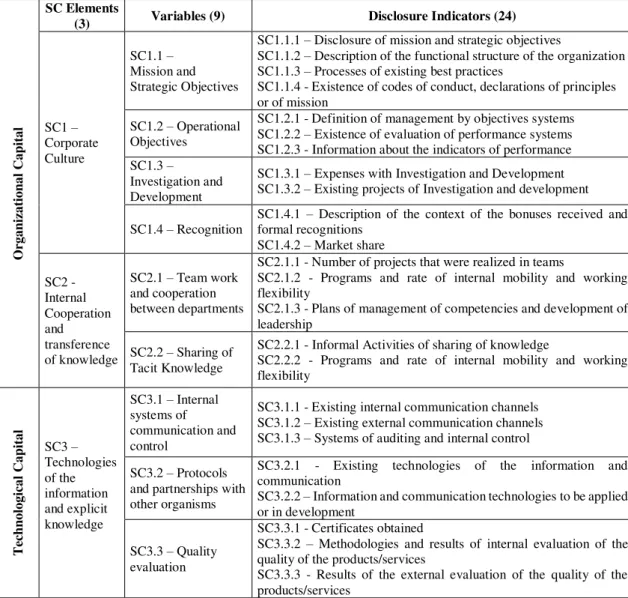
117 Organi zational Capita l SC Elements
(3) Variables (9) Disclosure Indicators (24)
SC1 – Corporate Culture
SC1.1 – Mission and Strategic Objectives
SC1.1.1 – Disclosure of mission and strategic objectives
SC1.1.2 – Description of the functional structure of the organization SC1.1.3 – Processes of existing best practices
SC1.1.4 - Existence of codes of conduct, declarations of principles or of mission
SC1.2 – Operational Objectives
SC1.2.1 - Definition of management by objectives systems SC1.2.2 – Existence of evaluation of performance systems SC1.2.3 - Information about the indicators of performance SC1.3 –
Investigation and Development
SC1.3.1 – Expenses with Investigation and Development SC1.3.2 – Existing projects of Investigation and development
SC1.4 – Recognition
SC1.4.1 – Description of the context of the bonuses received and formal recognitions
SC1.4.2 – Market share
SC2 - Internal Cooperation and transference of knowledge
SC2.1 – Team work and cooperation between departments
SC2.1.1 - Number of projects that were realized in teams
SC2.1.2 - Programs and rate of internal mobility and working flexibility
SC2.1.3 - Plans of management of competencies and development of leadership
SC2.2 – Sharing of Tacit Knowledge
SC2.2.1 - Informal Activities of sharing of knowledge
SC2.2.2 - Programs and rate of internal mobility and working flexibility
Technologic
al Capital
SC3 – Technologies of the information and explicit knowledge
SC3.1 – Internal systems of communication and control
SC3.1.1 - Existing internal communication channels SC3.1.2 – Existing external communication channels SC3.1.3 – Systems of auditing and internal control
SC3.2 – Protocols and partnerships with other organisms
SC3.2.1 - Existing technologies of the information and communication
SC3.2.2 – Information and communication technologies to be applied or in development
SC3.3 – Quality evaluation
SC3.3.1 - Certificates obtained
SC3.3.2 – Methodologies and results of internal evaluation of the quality of the products/services
SC3.3.3 - Results of the external evaluation of the quality of the products/services
Table 2. Elements, variables and structural capital indicators
In the same manner, the structural capital (SC) elements that are considered adequate for
118
Business Capit
al
RC Elements
(3) Variables (8) Disclosure Indicators (21)
RC1 – Customer relations
RC1.1 – Accessibility and client support
RC1.1.1 – Number of branches/agencies and their localization RC1.1.2 – Online customer service channels
RC1.1.3 – Other communication and customer service channels RC1.1.4 - Products/Services solutions for clients
RC1.2 – Group relations
RC1.2.1 - Countries where the Group operates RC1.2.2 –Products supplied by the groups´ companies RC1.2.3 - Strategic Alliances of the Group
RC1.3 – Client Satisfaction
RC1.3.1 – Number of Clients
RC1.3.2 – Information regarding systems for handling suggestions and complaints
RC1.3.3 – Client satisfaction measuring processes
RC2 – Relations with investors
RC2.1 – Future oriented information
RC 2.1.1 - Information about company growth RC 2.1.2 - Information about future projects
RC2.2 – Importance of the Investor
RC2.2.1 - Information about Investor support networks RC2.2.2 - Information about the relationship with the investor
Societ
y Capita
l
RC3 – Relations with other stakeholders
RC3.1 – Actions in social and
environmental fields
RC3.1.1 - Identification of the organizations and the form of relationship
RC3.1.2 – Social responsibility activities and human rights protection RC3.1.3 – Commitments regarding good environmental and
energetic practice
RC3.2 – Protocols and partnerships with other organisms
RC3.2.1 - Description of organisms with whom partnerships are maintained
RC3.2.2 – Form of partnership developed or to be developed
RC3.3 – Other stakeholders
RC3.3.1 - Identification of the stakeholders
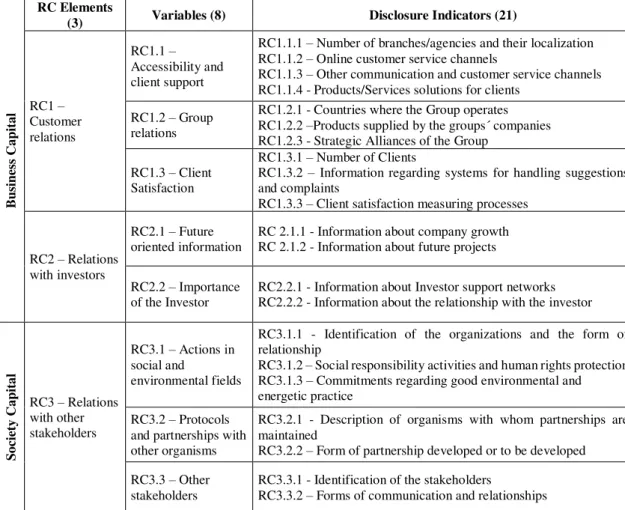
RC3.3.2 – Forms of communication and relationships Table 3. Elements, variables and relational capital indicators.
Relational Capital (RC) elements seek to represent the variety of relations established; the relations with clients (CR1); the relations with investors (CR2), and the relations with stakeholders (CR3), as presented in table 3.
4.
Disclosure theories, methodological proceedures, sample and
research issues
119 (Suchman, 1995 and Deegan, 2002) theories greatly influence these entities’ disclosure of information.
In this paper, we have adopted a positivist approach applying quantitative methods and
using the content analysis technique on banks’ webpages in order to analyse and process
data with proper statistical tools. This text coding technique allows us to determine the meaning of the content of the information in a “systematic”, “objective”, “reliable” and
“reproducible” manner (Krippendorff, 1990), to obtain valid and replicable inferences
(Guthrie and Petty, 2000; Guthrie and Abeysekera, 2006).
The coding of the content to be analysed was based on a specific index of disclosure, made up of sixty-six disclosure indicators, where we used a mechanistic approach of
content analysis by applying a dichotomous criterion in an expressive categorization: defining 1 as the existence of information about the indicator being analysed; defining 0
as the non- existence of information contained in that indicator (Bardin, 1996). The disclosure index is represented in the equation below.
Intellectual Capital Index = ∑ disclosure items (1) / 66 1
Figure 1. Intellectual Capital Index
An empirical analysis was carried out through descriptive statistics of the variable being explained (disclosure of information on intellectual capital), as well as average comparison tests to comparatively analyse intellectual capital’s elements.
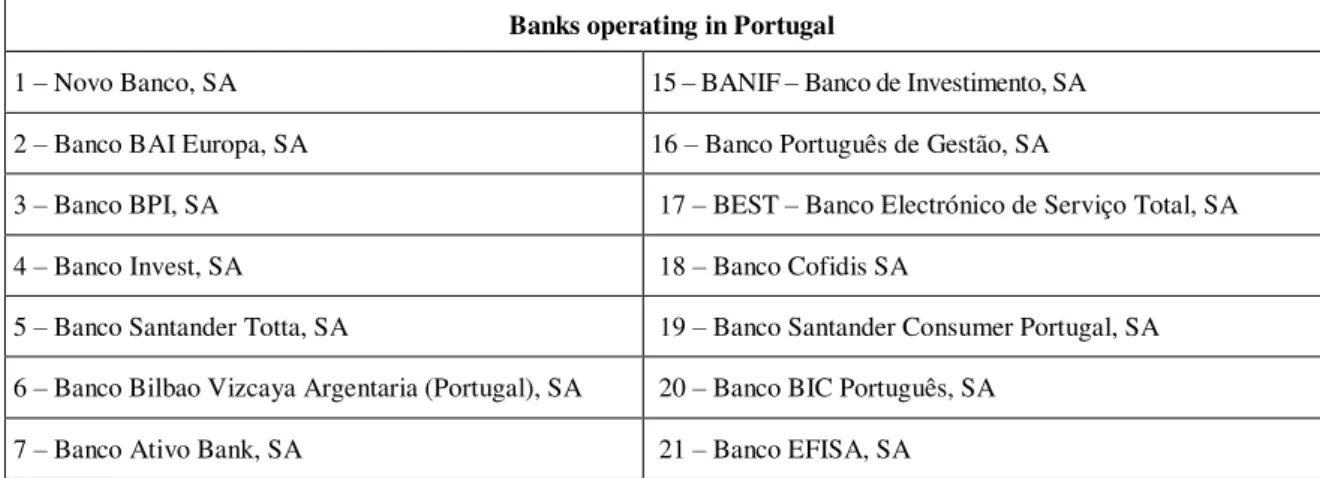
In order to carry out this work, we identified a total of eighty-six banks that in August of 2016 were listed in the Bank of Portugal and in the Bank of Spain, and that at that date had active and autonomous webpages available in each of those countries’ languages, which we present in table 4.
Banks operating in Portugal
1 – Novo Banco, SA 15 – BANIF – Banco de Investimento, SA
2 – Banco BAI Europa, SA 16 – Banco Português de Gestão, SA
3 – Banco BPI, SA 17 – BEST – Banco Electrónico de Serviço Total, SA
4 – Banco Invest, SA 18 – Banco Cofidis SA
5 – Banco Santander Totta, SA 19 – Banco Santander Consumer Portugal, SA
6 – Banco Bilbao Vizcaya Argentaria (Portugal), SA 20 – Banco BIC Português, SA
120
8 – Caixa-Banco de Investimento, SA 22 – Novo Banco dos Açores, SA
9 – Banco Comercial Português SA 23 – Banco Privado do Atlântico - Europa, SA
10 – Caixa Geral de Depósitos, SA 24 – BNI – Banco de Negócios Internacional (Europa), SA
11 – Banco Popular Portugal SA 25 – Banco CTT, SA
12 – Haitong Bank, SA 26 – Banco LJ Carregosa, SA
13 – Banco Finantia SA 27 – Banco Primus SA
14 – Banco de Investimento Global SA 28 – Banco Credibom, SA
Banks operating in Espanha
29 – Abanca Corporación Bancaria, SA 58 – Bankia, SA
30 – A&G – Banca Privada, SA 59 – Bankinter, SA
31 – Allfunds Bank, SA 60 – Bankoa, SA
32 – AndBank España, SA 61 – Banque Marrocain du Commerce Exterieur International, SA
33 – AresBank, SA 62 – BNP Paribas España, SA
34 – Banca March, SA 63 – CaixaBank, SA
35 – Banca Pueyo, SA 64 – Cajasur Banco, SA
36 – Banco Alcala, SA 65 – Catalunya Banc, SA
37 – Banco Bilbao Vizcaya Argentaria, SA 66 – CecaBank, SA
38 – Banco Caixa Geral, SA 67 – Citibank España, SA
39 – Banco Caminos, SA 68 – Deutsche Bank, Sociedad Anonima Española
40 – Banvo Cetelem, SA 69 – Dexia Sabadell, SA
41 – Banco Cooperativo Español, SA 70 – EBN Banco de Negocios, SA 42 – Banco de caja España de Inversiones, Salamanca y
Soria, SA 71 – Evo Banco, SA
43 – Banco de Castilla-La-Mancha, SA 72 – Ibercaja Banco, SA
44 – Banco de Crédito Social Cooperativo, SA 73 – KutxaBank, SA
45 – Banco de Sabadell, SA 74 – LiberBank, SA
46 – Banco Europeo de Finanzas, SA 75 – Nuevo Micro Bank, SA
47 – Banco Finantia Sofinloc, SA 76 – Nuevo Micro Bank, SA
48 – Banco Inversis, SA 77 – Popular Banca Privada, SA
49 – Banco Mare Nostrum, SA 78 – RBC Investor Services España, SA
50 – Banco Mediolanum, SA 79 – Renta 4 Banco, SA
51 – Banco Occidental, SA 80 – Santander Consumer Finance, SA
52 – Banco Pastor, SA 81 – Santander Securities Services, SA
53 – Banco Pichincha España, SA 82 – Self Trade Bank, SA
121
55 – Banco Santander, SA 84 – Unicaja Banco, SA
56 – Bancofar, SA 85 – Unoe Bank, SA
57 – Bank Degroof Petercam Spain, SA 86 – Wizink Bank, SA Table 4. Banks studied
Since it is possible to alter the information contained in webpages, these were analysed
only once in the month of August of 2016, because we consider that it is the month containing more stable online information, since it is in that month that most vacation time is taken. In this analysis, we only considered the information contained in the
navigator format, not taking into consideration the information contained in documents included in the webpages (such as word, pdf, power point, etc.) (Striukova et al., 2008). The research issues that we propose to analyse are:
1st- What is the extent or magnitude of the disclosure of intellectual capital that the banks
operating in the Iberian Peninsula present in their webpages and;
2nd-What is the disclosure of each of the components into which we subdivided
intellectual capital (human capital, structural capital and relational capital), revealed by these entities.
The extent of the disclosure of information about intellectual capital will be analysed through the disclosure of each of intellectual capital’s components (human capital, structural capital and relational capital), and through the general level of the disclosure of intellectual capital (Guthrie et al., 2006).
5.
Presentation and analysis of results
In order to respond to the research issues that we presented, we began by analysing the
average of disclosure of intellectual capital revealed through the internet by the Iberian banks. However, the analysis of the disclosure of intellectual capital considered in an aggregated form may not respond to the rigour and usefulness aimed for in the studies on this subject, namely, to the demands of the various stakeholders. Therefore, and like most of the research carried out in this field, we consider that it is acute to separately analyse
122
N Average Minimum Maximum Standard deviation
Intellectual Capital 86 0.2355 0.0734 0.6032 0.1038
Human Capital 86 0.0493 0.0000 0.2857 0.0634
Sctructural Capital 86 0.2044 0.0417 0.6667 0.1117
Relational Capital 86 0.4529 0.0952 1.0000 0.1885
Table 5. Disclosure of intellectual capital
An analysis of the results shown on table 5 allows us to verify that the average of
disclosure of information about intellectual capital in the Iberian banks’ webpages is
0.2355, with a standard deviation (SD) of 0.1038, showing great variability of the values in relation to the average. Relational Capital presents the largest average of disclosure (with a value of 0.4529), followed by structural capital with an average value of 0.2044 and human capital with an average of disclosure of 0.0493.
N Average Minimum Maximum Standard deviation
HC1 - Professional skills 86 0.0362 0.0000 0.2222 0.0576
HC2 - Social competencies 86 0.0581 0.0000 0.0581 0.2089
HC3 – Motivation 86 0.0613 0.0000 0.0613 0.0930
SC1 - Corporate Culture 86 0.2209 0.0000 0.6667 0.1226
SC2 - Internal Cooperation and
transference of knowledge 86 0.0203 0.0000 0.8333 0.1171 SC3 - Technologies of the information
and explicit knowledge 86 0.2151 0.0000 0.8333 0.1680
RC1- Customer relations 86 0.5707 0.0000 1.0000 0.1840
RC2 - Relations with investors 86 0.1977 0.0000 1.0000 0.2742
RC3 - Relations with other
stakeholders 86 0.3785 0.0000 1.0000 0.3085 Table 6. Comparison of the average of disclosure of the intellectual capital elements
123
In order to analyse the disclosure of each of intellectual capital’s components in the
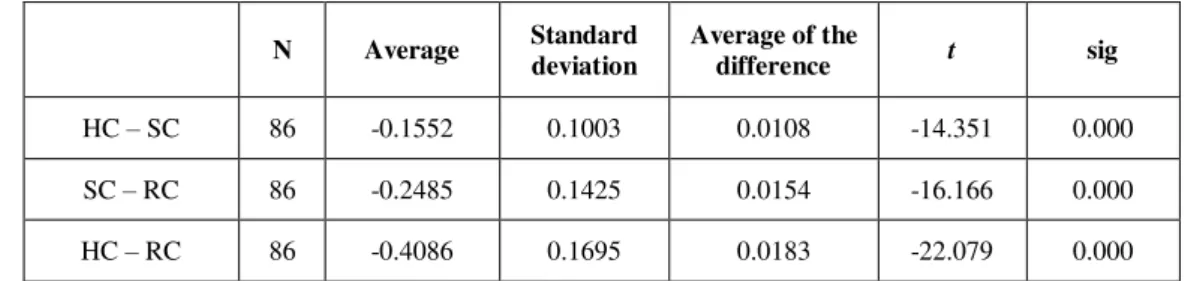
webpages made by Iberian banks, we have also compared the average of disclosure between each of these components, through the statistical significance of the t-student test.
N Average Standard deviation
Average of the
difference t sig
HC – SC 86 -0.1552 0.1003 0.0108 -14.351 0.000
SC – RC 86 -0.2485 0.1425 0.0154 -16.166 0.000
HC – RC 86 -0.4086 0.1695 0.0183 -22.079 0.000 Table 7.Comparason of the average of disclosure of intelectual capital’s components
As we can verify from table 7, the values show statistical evidence confirming that there
is greater disclosure of information about relational capital on the Iberian bank’s
webpages than disclosure of information about human capital and about structural capital, followed by the disclosure of information about structural capital and the information about human capital.
Thus, webpages prove to be a preferential means of disclosure of information of commercial nature and of marketing, associated with the relations between customers and investors, as well as the relations with other stakeholders, however this means of communication is not the one that banks consider to be very important for disclosing their technological resources (structural capital). Clearly human resources present a derisory disclosure through this means of communication of information, generically identified as
“taboo information”. The result presented in the disclosure of this component in the
internet can be explained by three general reasons (Silva, 2012): this means of disclosure
is associated to be being vulnerable and easily manipulated; the non-relevance of this information for the main users of webpages (mainly clients); and the scarce acknowledgment amongst the organizations of the importance given to human resources
as a source of strategic value for those entities. The third reason does not seem to us to be
the most probable, as an example let’s look at the results obtained in the studies by
124
Thus, confirming that there is a high degree of heterogeneity in the quantity of
information disclosed in each of intellectual capital’s components in the Iberian banks’
webpages. The results reveal a strategy to disclose, through the webpages, certain information that is more specific and directed at the main users of this means of information (essentially clients and the general public) (Gandía, 2002 and 2003; Branco et al., 2011).
In view of the above, we consider that the banks operating in the Iberian Peninsula show a strong preference towards the use of webpages as a channel of disclosure of relational capital, this being the information that meets the demands of the main stakeholders that use this channel of information.
6.
Conclusion
The banking sector holds great intensity in intellectual capital, which reveals to be the
most visible to a large number of stakeholders considering the importance of its’ activity
upon the general economy. This is also the sector that should invest more intensely in the
disclosure of its’ intellectual capital, using the most advanced information and communications technologies. Webpages are a privileged means for disclosing the management of organizational knowledge and they acquire great acuity in the field of disclosure of intellectual capital. Given this situation, and in light of the stakeholders and the legitimacy theories, in this study we proposed to analyse the disclosure practices on the webpages in August of 2016 of intellectual capital made by banks operating in Portugal and Spain.
By applying an index built specifically for the disclosure of intellectual capital of banking sector organizations, we aimed to analyse the extent and breadth of the online disclosure of intellectual capital and of each of its components, human capital, structural capital and relational capital, by Iberian banks.
The study revealed an average of disclosure of intellectual capital on webpages of 0.2355. As for the components that make up intellectual capital, the disclosure made by banks in
125
Intellectual Capital’s influence upon the operation of the banking sector has been little
-studied on a worldwide level, especially in what regards to the way in which this sector’s
126
REFERENCES
Antunes, M.T. (2005). O capital intelectual segundo o entendimento de gestores de empresas brasileiras. Revista Brasileira de Gestão de Negócios, 7 (19), 9-20.
Antunes, M.T. (2006). A controladoria e o capital intelectual: Um estudo empírico sobre sua gestão. Revista Contabilidade & Finanças, 17 (41), 21-37.
Antunes, M.T. & Martins, E. (2007). Capital intelectual: Seu entendimento e seus impactos no desempenho de grandes empresas brasileiras. BASE – Revista de Administração e Contabilidade da Unisinos, 4 (1), 5-21.
Bardin, L. (1996). El análisis de contenido. 2ª edición. Ediciones Akal.
Branco, M.C.; Delgado, C.; Sousa, C.; Sá, M. (2011). Intellectual capital disclosure media in Portugal. Corporate Communications: An International Journal, 16 (1), 38-52. Cabrita, M.R. (2009). Capital intelectual e desempenho organizacional. Porto: Lidel Editora.
Cabrita, M.R. & Bontis, N. (2008). Intellectual capital and business performance in the Portuguese banking industry. International Journal of Technology Management, 43 (1/2/3), 212-237.
Cabrita, M.R., Silva, M.L., Rodrigues, A.M. & Muñoz Dueñas, M.P. (2017). Competitiveness and Disclosure of Intellectual Capital: An Empirical Research in Portuguese Banks. Journal of Intellectual Capital, 18 (3), 486-505.
Cabrita, M.R. & VAZ, J.L. (2006). Intellectual capital and value creation: Evidence from the Portuguese banking industry. Electronic Journal of Knowledge Management 4 (1), 11-20.
Cabrita, M.R. & Vaz, J.L. (2008). Creating value from intellectual capital: An approach based on the specification of models. Portuguese Journal of Management Studies, 13 (2), 221-235.
Cañibano, L.; García Meca, E.; García Osma, B.; Gisbert Clemente, A. (2008). Los intangibles en la regulación contable. Madrid: AECA/Instituto de Análisis de Intangibles.
Chen, K. & Pan, C. (2011). A study of credit risk efficiency and productivity change for commercial banks in Taiwan. The Journal of American Academy of Business, 16 (2), 279-286.
Deegan, C. (2002). Introduction: The legitimising effect of social and environmental disclosures – A theoretical foundation. Accounting, Auditing & Accountability Journal, 15 (3), 282-311.
Donaldson, T.; Preston, L.E. (1995). The stakeholder theory of the corporation: Concepts, evidence, and implications.Academy of Management Review, 20 (1), 65-91.
Firer, S., Williams, S.M. (2005). Firm ownership structure and intellectual capital disclosures. SA Journal of Accounting Research, 19, 1-18.
127 Gandía, J.L. (2002). La divulgación de información sobre intangibles en internet: Evidencia internacional. Revista Española de Financiación y Contabilidad, 31 (113), 767-802.
Gandía, J.L. (2003). Intangibles disclosure information on internet by multinational corporations. The International Journal of Digital Accounting Research, 3 (5), 61-99. Goh, P.C. (2005). Intellectual capital performance of commercial banks in Malaysia. Journal of Intellectual Capital, 6 (3), 385-396.
Guthrie, J. & Abeysekera, I., 2006. Content analysis of social, environmental reporting: what is new?. Journal of Human Resource Costing & Accounting, 10 (2), 114-126. Guthrie, J. & Petty, R. (2000). Intellectual capital: Australian annual reporting practices. Journal ofIntellectual Capital, 1 (3), 241-251.
Guthrie, J.; Petty, R.; Ricceri, F. (2006). The voluntary reporting of intellectual capital: Comparing evidence from Hong Kong and Australia. Journal of Intellectual Capital, 7 (2), 254-271.
Kamath, G.B. (2007). The intellectual capital performance of Indian banking sector. Journal of Intellectual Capital, 8 (1), 96-123.
Krippendorff, K. (1990). Metodología de análisis de contenido. Teoría y práctica. Barcelona: Paidós Comunicación.
Lee, M.H. (2010). Evaluation of annual reports on human resource disclosure using content analysis. Unitar E-Journal, 6 (1), 38-52.
Lev, B. (2003). Intangibles: Medición, gestión e información. Barcelona: Deusto. Mention, A.-L. (2011). Exploring voluntary reporting of intellectual capital in the banking sector. Journal of Management Control, 22 (3), 279-309.
Rodrigues, A.M. (2006). O Goodwill nas contas consolidadas. Coimbra: Coimbra Editora.
Rodrigues, A.M. (2011). Activos intangíveis. Algumas reflexões contabilísticas e fiscais. En P. Otero, F. Araújo and J.T. Gama (eds.), Estudos em memória do Prof. Doutor J. L. Saldanha Sanches, 4, 469-520. Coimbra: Coimbra Editora.
Silva, M.L. (2012). Capital Intelectual: sua divulgação no setpor bancário em Portugal. Doctoral Tesis. Universidade de Vigo.
Silva, M.L., Rodrigues, A.M., Muñoz Dueñas, M.P. (2011). Divulgação dos activos intangíveis nas contas consolidadas das sociedades financeiras ibéricas: evidência empírica. Em: ACCID, IV Congrés Catalá de Comptabilitat i Direcció. Barcelona, 26-27 de maio de 2011.
Sousa, C. (2009). O Capital Intelectual em Portugal. Uma análise exploratória. Master Tesis. Faculdade de Economia, Universidade do Porto.
Stewart, T.A. (1997). Intellectual Capital: The new wealth of organizations. New York: Doubleday.
Striukova, L.; Unerman, J.; Guthrie, J. (2008). Corporate reporting of intellectual capital: Evidence from UK companies. The British Accounting Review, 40 (4), 297-313.
128
Walter, I. (2009). Economic drivers of structural change in the global financial services industry. Long Range Planning, 42 (5-6), 588-613.