ISSN 1518-3483 Licenciado sob uma Licença Creative Commons
[T]
Review studies: conceptual and
methodological implications
Estudos de revisão: implicações conceituais e metodológicas Dilmeire Sant’Anna Ramos Vosgerau[a], Joana Paulin Romanowski[b] [a] PhD, professor, Pontifícia Universidade Católica do Paraná (PUCPR), Programa de Pós-Graduação
em Educação, Curitiba, PR - Brasil, e-mail: [email protected]
[b] PhD, professor, Pontifícia Universidade Católica do Paraná (PUCPR), Programa de Pós-Graduação em Educação, Curitiba, PR - Brasil, e-mail: [email protected]
[R] Abstract
Thi article aims to analyses the numerous denominations and orientations adopted for studies that map subject areas of studies, while it also assesses and synthesizers search outcomes showing methodological evidence. The studies used for this analysis were selected from journals by Capes. The analysis considered mainly Education articles; however, some Medical studies were also included given studies of this sort originated in the Medical subject area. Therefore, several studies in that area have better level of detail and clearer methodological specification allowing better characterization of each of the denominations. This article allowed consideration of the existence of different nomenclatures for the same sort of study, sometime seven in the same subject area; another development is that various different computer applications are used by researchers when executing this sort of investigation. However, value and credibility
accredited to a research study rely essentially on the transparence and methodological rigour employed by the researcher.
Keywords: Revision studies. State-of-the-art research. Systematic research. Meta-analysis. [R]
Resumo
Este artigo tem por finalidade analisar as diferentes denominações e encaminhamentos utilizados para os estudos que mapeiam campos de estudo, bem como avaliam e sintetizam resultados pesquisas apontando alguns indicativos metodológicos. Os estudos utilizados esta análise foram selecionados a partir da base de periódicos da Capes. Foram considerados na análise artigos oriundos prioritariamente do campo educacional, contudo buscou-se alguns artigos no campo de saúde visto que a origem destes tipo de estudo se deu inicialmente neste campo, portanto, muitos estudos apresentam um detalhamento e uma especificação metodológica mais clara que nos permitiu melhor caracterizar cada uma das denominações. Este trabalho permitiu com que observássemos a existência de diversas nomenclaturas para o mesmo tipo de estudo, algumas vezes em uma mesma área; também pudemos constatar que diversos softwares são utilizados para instrumentar o pesquisador na realização deste tipo de investigação, contudo o valor e a credibilidade do estudo depende fundamentalmente da transparência e do rigor metodológico empreendido pelo pesquisador.
[P]
Palavras-chaves: Estudos de revisão. Pesquisas do tipo Estado da Arte. Revisões sistemáticas. Metapesquisa.
Introduction
Research in education, in Brazil, have assumed prominence in the university space since the creation of graduate programs in 1965, and its expansion in the 1970s and with the institutionalization of research groups and training of high level researchers, albeit with limited support from funding agencies, as stated by André (2006).
The continued expansion of graduate programs, today with over two hundred master and doctoral courses recommended, a significant increase in the number of research groups totaling thousands, support programs and research grants, generate intense research output. Annually, thousands of theses and dissertations, as for example, in 2012, they have totaled 6,186 theses and dissertations in education, according to the database of abstracts available at Capes, totaling approximately 60,000 studies conducted over the nearly five decades of the existence of these programs. Similarly, the number of journals and scientific events in the field has multiplied, favoring the publication of these surveys’ results.
This continuous expansion of research pointing to expressive quantitative growth evokes the development of studies to allow surveys, reports, maps, critical analysis, which seek to highlight the issues and focused topics, methodological approaches, procedures and analyzes, the theoretical and methodological contributions, results that can be replicated or avoided (THOMAS, 2007), as well as the gaps that can stimulate the production of new research. Indeed, these studies favor to examine the contributions of the research, from the perspective of defining the area, the field and the disciplines that constitute the cumulative assessment of the area, pointing out the need to improve the theoretical and methodological theoretical statute, and even the research trends.
From this perspective, the studies aiming at the realization of this review allow the understanding of the movement in the area, its configuration, methodological and theoretical tendencies, reviewing analyses which indicate trends, gaps and relapses.
The review studies are to organize, clarify and summarize the main existing papers, as well as to provide full citations covering the spectrum of relevant literature in an area. The literature reviews may submit a revision to provide a historical overview of a topic or issue considering the publications in a field. Often an analysis of the publications can contribute to the historic reshaping of academic dialogue by presenting a new direction, setting and referrals.
Reviews are necessary for beginning researchers in a particular field of knowledge. These studies may include analyzes designed to compare research on similar or related issues; to point to the evolution of theories, of the methodological theoretical contributions and their understanding in different contexts; indicate trends and methodological procedures used in the area, pointing out trends in the approaches of educational practices.
Thus, this article aims to discuss and point out directions for conducting such studies. It was organized from the practices for achieving studies of this approach, pointing out suggestions for procedures, criteria in developing and finalizing with indications of possible limits.
Review studies type
The need to conduct analyzes on the knowledge derived from research had already been indicated since the Didactics on Issue Seminar, in the 1980s. For Soares and Maciel (2000, p. 4) these studies are needed “in the science evolution process, in order that periodically the set of information and results already obtained are ordered,” favoring the organization which shows the emerging integration and configuration , the different investigated perspectives, the recurring studies, gaps and contradictions.
By doing a survey based on Capes national and international journals, we find different types of studies which conduct literature reviews and scientific productions with the most varied descriptions: bibliographic survey (MORAES; ASSUMPÇÃO 2012; SANTOS, 2013), literature review (MIRANDA; FERREIRA, 2009), bibliographic review (FRANÇA; MATTA; ALVES, 2012), state of the art (ISOTANI et al., 2009), narrative review (ELIAS et al., 2012.), bibliometric study (SILVA; HAYASHI, 2013), systematic review (DEPAEPE; VERSCHAFFEL; KELCHTERMANS, 2013), integrative review (SOBRAL; CAMPOS, 2012), meta-analysis (KYRIAKIDES; CHRISTOFOROU; CHARALAMBOUS, 2013), meta-summary (SANDELOWSKI; BARROSO; VOILS, 2007) and
synthesis of qualitative evidence (TONDEUR, 2012). Despite coming from different areas all referenced research deal, in some way, with topics related to education, which can lead a researcher in the educational process to different paths which do not always correspond to their needs.
Thus, this diversity of terms found to name the studies which conduct reviews lead us to question the relationship between them, what distinguishes them, when the expressions represent the same type of study.
To answer these questions in this theoretical study we grouped the types of revisions cited in two groups: the reviews that map revisions and the reviews that evaluate and synthesize.
Review studies: mapping
As a first mapping step we present the Bibliographical Survey, which aims to raise all references found on a particular topic (HART; BERVIAN, 2002). These references may be in any format, that is, books, websites, magazines, and videos, everything that can contribute so that we can have a first contact with the investigated subject matter. It is noticed that in this option there is not a detailed and specific criteria for the selection of the source material; as long as it is just about the investigated topic.
If these surveys were previously written in cards using a text editor or spreadsheet, currently this process is facilitated by the use of specific software such as End Note and Mendeley, which allow cataloging and access via the Internet through computers or mobile devices of all the cataloged material.
Some of the studies which cited in their titles that they were conducting a literature review, as the studies presented by Moraes and Assumpção (2012) and Santo (2013), went beyond a survey, since they produced a discussion about the material collected in essay theory form, which could be characterized as a Literature Review (MIRANDA, FERREIRA, 2009), or a bibliographic review (FRANÇA; MATTA; ALVES, 2012).
The literature review or bibliographic review would then have two purposes (ALVES-MAZZOTTI, 2002): building a context for the problem and the analysis of the possibilities present in the verified literature for the conception of the theoretical reference of the research.
Thus, this type of production, the material collected by literature survey is organized by origin, that is, scientific sources (articles, theses, dissertations) sources to disseminate ideas (magazines, websites, videos, etc..), and from its analysis it allows researchers the development of tests which favor contextualization, problematization and an initial validation of the theoretical framework to be used in undertaken research. For this type of production the physical and virtual organization of the documents raised is essential. Given that currently we use physical and virtual source material, for example, borrowed books from libraries and other sources, articles downloaded from databases, information contained on websites, videos located on YouTube, it is needed a classification system of the material, both in physical and virtual folders with the same name. This organization of folders in the computer containing the material virtually consulted and copies of book chapters used and organized in physical folders, facilitates the use of this material in the production of more refined analyzes for its further development.
Further analysis may constitute study of State of the Art Type (PICHETH, 2007; ROMANOWSKI; ENS, 2006), name usually used in the educational field or as called in healthcare, Narrative Review (ELIAS et al., 2012), for allowing to establish relationships with previous productions, identifying recurring themes, pointing to new perspectives, consolidating an area of knowledge and constituting pedagogical practices guidelines for defining the parameters of professional education to work in the area, according to Rocha (1999) .
In this type of study, it is analyzed the literature production in a “given area [...] providing the state of the art on a specific topic, highlighting new ideas, methods, sub-themes which have received greater or lesser emphasis on selected literature” (NORONHA; FERREIRA, 2000, p. 191). As the production volume may be large, it is usual, in addition to establishing
the field of research and the researched topic, to define a research period, and to establish a particular data source, such as certain magazine articles, theses and dissertations (PICHETH, 2007), from may be a comprehensive national database such as dissertations and theses from Capes or slightly more restricted to one or more scientific journal or the joining of both, as the work of Barreto (2006) who conducted a survey of national output in the education and technology area, during the period 1996-2000 in which dissertations and theses in the Education Graduate Programs were mapped respectively with grades 4 (Masters) and 5 or 6 (PhD) at Capes evaluation and 2 articles published in journals classified as “the National” in Qualis Capes.
As indicated by Soares and Maciel (2000) to carry out such studies in examining prospects, multiplicity and plurality of approaches, it is possible to infer indicators to clarify and solve historical issues, and to understand the significant contributions from theory and pedagogical practice, restrictions and ‘islands’ of dissemination on a topic or area of knowledge as proposed by Messina (1998).
The term state of the art or state of knowledge after Brandão (1986, p. 7), comes from an English literal translation, and according to the author who aims to carry out surveys of what it is known about a specific subject from the research conducted in a certain area. State of knowledge is a “descriptive study of the trajectory and distribution of the scientific production on a particular object, establishing contextual relationships with a number of other variables, such as date of publication, themes and periodicals, etc.” (UNIVERSITAS, 2000).
A state of knowledge is not restricted to identify the production, but to analyze it, categorize it and to reveal the multiple approaches and perspectives. According to Soares and Maciel (2000, p. 4), a state of the art is necessary to consider “categories that identify, in each text, and on their sets the facets on which the phenomenon has been analyzed.” For Messina (1998, p. 1) “a state of the art is a map that allows us to keep walking; a state of the art is also a possibility to perceive speech that at a first examination appear as discontinuous or contradictory. In a state of the art it is present the possibility to contribute to theory and practice” of an area of knowledge.
In Brazil, the terms state of the art and state of knowledge have been used as similar in several investigations. In essay, Nobrega-Therrien and Therrien (2004) seek to explain the comprehension of such studies, when discussing the state of the question. It is clarified that the state of the question aims to situate how the theme or subject of the investigation in the present state of science is found, which “requires substantial consultation to documents” accustomed to the construction of the research object. Thus, the purpose is to define, clarify and characterize the study object, performed by selective literature review restricted to studies and parameters close to specificities of interest to the researcher (NOBREGA-THERRIEN; THERRIEN, 2004, p. 8).
Different resources and techniques have been used in analyzes. The work by Zuffo (2011) presents in detail the use of Excel spreadsheets editor that would be the resource commonly used, both in the collection and selection of material regarding the analysis through the creation of columns in which the extracts are copied from the analyzed text that contains from the reference to the analyzed indicator.
Now, the work by Milani (2013) complements the analysis process of the articles using the software Atlas.ti, applying the technique of content analysis (BARDIN, 2011).
With regard to the presentation of the results, this happens in textual form, with graphics that show the results obtained and in some studies are used the descriptive statistics as shown in studies by Barreto (2006).
Finally, research state-of-the-art type focus their analysis on the problematization and methodology, its central purpose is mapping, primarily serving the researcher as a reference to the gap justification that research to be achieved can fill, as found in the works by Costa (2010), Pinheiro (2012) and Milani (2013).
Another focus of scientific production analysis, are bibliometric studies very present in the areas of social sciences and health sciences, but still recent in the educational field. The research found in the educational field, usually intersected with these areas, such as the study by Silva and Hayashi (2013), which presents a bibliometric study of scientific production in the field of Special Education.
Bibliometrics has its origin in the field of librarianship and is characterized by using “the measurement practices of the quantitative aspects of content in any form” (BUFREN; PRATES 2005; LOPES et al., 2012). That is, the materials to be analyzed may include: books, theses, book chapters, articles published in scientific journals, presentations at conference proceedings papers, texts, sources or databases. The analysis process uses statistical methods, “such as vector space model, Boolean retrieval models, probabilistic models, language processing, knowledge-based approaches and thesaurus, aiming to improve the recovery efficiency” (BUFREN; PRATES 2005, p. 11).
In the study by Silva and Hayashi (2013) as well as in others (MOSTAFA; MAXIMO, 2003; DIAS; SIGOLO, 2009), it is observed that there is a narrower definition regarding the source of the searched articles. There is an explicit criterion for the definition of the journal, which usually is the impact of the journal in the research field defined by the researcher. As well as in the research state of the art type, the search derives from a theme, as observed in the work by Mostafa and Maximo (2003) when seeking publication in the proceedings of two events on the theme “educational communication” in which all the found documents are recovered and used independently from the type of text, be an essay, a scientific article, literature or others.
Lopes et al. (2012) define four types of bibliometric indicators: scientific quality indicators, scientific activity indicators, scientific impact indicators, thematic association indicators. These indicators would originate several variables recorded in bibliometric studies, which include: the amount and evolution of published articles, type of articles, page numbers, authorship, scientific collaboration between authorship, authors’ productivity; transience of authors; gender and institutional and geographical affiliations of authors; citations made by authors: articles’ thematic, citation authorship, typology of cited sources; update level of the cited sources; origin of cited sources; languages of cited sources; range of bibliographic sources (SILVA; HAYASHI , 2013).
Several software programs have been used for the analysis of this material. From the simple use of spreadsheet editors, such as, Excel, and other software that from a qualitative analysis allow easier viewing and processing of quantitative results, as in the case of the Sphinx (DIAS; SIGOLO 2009). Also the NVivo software (WILSON et al., 2011) has been used because of the possibility it offers to generate quantitative matrices that can be easily imported by the editors of worksheets and specific software for processing and quantitative analysis such as SPSS (SENDIGHI, 2013). For the identification of collaborative networks, Pajek software has been used (CATALÁ-LOPEZ et al., 2012) among others (COBO et al., 2011) for also allowing the graphical and quantitative visualization of collaborative authoring of the variables analyzed in bibliometric studies.
We conclude that mapping revisions have as their central purpose to raise indicators which provide paths or theoretical references for further research. These indicators may consist of information from qualitative demands, such as research and literature review of the state of the art type and from the qualitative information which when coded are transformed into quantitative data as is the case of bibliometric revisions.
However, besides the need for further research notes, it was observed that with the volume of evidence produced by research, there is the need to check how and under what conditions these evidences are repeated and even about the applicability of these both for the formulation of policies to stimulate research and in the education process of these professionals (THOMAS, 2007). In this perspective, we highlight the revisions which evaluate and synthesize the research results.
Review studies: evaluation and syntheses
In this review category there are the systematic review denominations (DEPAEPE; VERSCHAFFEL; KELCHTERMANS, 2013), integrative review (SOBRAL; CAMPOS, 2012), synthesis of qualitative evidences (TONDEUR, 2012), qualitative meta-synthesis (MATHEUS, 2009), meta-analysis
(KYRIAKIDES; CHRISTOFOROU; CHARALAMBOUS, 2013), and meta-summary (SANDELOWSKI; BARROSO; VOILS, 2007). These revisions are distinguished from the revisions that map in formulating the research question, in the establishment of strategies for critical diagnosis and the requirement for transparency in the establishment of criteria for inclusion and exclusion of studies, necessarily primary, that is, collected by the researcher, such as surveys, interviews, observations, reports, etc. (DAVIES, 2007).
These studies have their origin in the area of health sciences, since they seek to identify the conditions under which certain evidence occur and the possibility of identifying patterns of occurrence. Currently, in this area most of these studies follow the directions set by the UK Cochrane Centre (http://ukcc.cochrane.org), a reference center that brings together groups of researchers who conduct reviews which summarize results following standards defined by the center.
In the educational field, in the late 2000s, emerged the Campbell Collaboration (http://www.campbellcollaboration.org) inspired by the research produced by the UK Cochrane Centre and by the needs raised by its researchers, seeking evidence that could not only assist health interventions, but also social interventions.
It currently brings together six research groups: crime and justice, education, international development, methods, social welfare and group users. The first five would be systematizing research groups, which bring together researchers interested in conducting research systematic reviews: the sixth, the user group, incorporates entities, professionals from each one of the areas and / or researchers users of systematizations produced by Campbell Collaboration (CAMPBELL, 2013).
The institution encourages and accepts the participation and collaboration of researchers from around the world, as long as they follow the protocol defined by the organization and have their revision proposal approved by the management committee from the institution.
The studies are based on a central, well-defined research issue and seek to identify research using primary sources that have tried to answer as close as possible to the issue posed by the researcher. In defining the criteria
for inclusion and exclusion of articles it is important the presence of evaluation indicators regarding the proximity and distance of the issue asked, that could be defined as theme proximity criteria; but it is also necessary criteria for inclusion and exclusion explicit in the research, which could be defined as methodological criteria for inclusion or exclusion of scheduled research. And from the selection of articles the central focus of the analysis and systematization are the results.
In the structure of the publications resulting from these studies it is observed in the introduction the contextualization and problematization of the issue investigated, and in some cases the presentation of the theoretical frameworks of the concepts covered in the issue, as is the case of the research presented by Depaepe, Verschaffel and Kelchtermans (2013 ) in the systematic review presented on the appropriations made to the concept of the Pedagogical Content Knowledge by the research on mathematics education.
Other research as exemplified in the work of Tondeur et al. (2012), which uses the term “synthesis of qualitative evidence” for the systematic review presented on preparing future teachers to integrate technology in education, distribute the same topics in four sessions. In the section entitled introduction, it presents the rationale and context of the addressed subject; in the session translated as theoretical framework it is presented the theoretical framework on the integration of technologies in teacher education, that is, what is the definition of integration accepted by researchers; in the session named the study purpose, the goal of the study is presented. Anyway, even if the topic structure is not the same, both studies bring essential information so that the scientific community can learn the conceptual delimitation and the theoretical framework which supports the review presented.
Further, in the structure of publications, we found the methodological referral of the research. In this topic it is presented: the selection criteria of the journal or database from which the articles will be selected; the criteria for inclusion and exclusion of articles; the analysis approach used, for example, meta-ethnography (NOBLIT; HARE, 19881 1 NOBLIT, G. W.; HARE, R. D. Meta-ethnography: synthesizing qualitative studies. Newbury Park:
apud TONDEUR et al., 2012, p. 136), the vertical analysis defined by Miles and Huberman (1994) used in the review presented by Depaepe, Verschaffel and Kelchtermans (2013); the categories created during the analysis process (DEPAEPE; VERSCHAFFEL; KELCHTERMANS, 2013); and the criteria for methodological evaluation of selected articles (TONDEUR et al., 2012).
The data analysis process of the collected material, according to Tondeur et al. (2012), occurs in eight stages: (1) analysis of the purpose of the study presented in the article, that is, if the goal focuses on the issue defined for review; (2) identification in the keywords text that should include the study in question, (3) assessment of study quality, (4) careful reading of the study to identify the issues raised by the authors, (5) determine the relationship between the studies surveyed, (6) identification of similarities, differences and unique characteristics between the studies, (7) preparation of summaries and explanations, (8) and developing models from the synthesized results. Matheus (2009), when defining the qualitative meta-synthesis, brings these phases in six steps, making us conclude that it is another term used for the systematic review.
For the assessment of the methodological quality of the study, Tondeur et al. (2012) suggest that the following questions be answered: is it a qualitative research? Are the issues clearly defined? Is the adopted qualitative approach clearly justified? Is the selected approach appropriate for the defined research issue? Is the study context clearly defined? Is the role played by the researcher during the study clearly explained? Is the sampling method clearly defined? Is the sampling selection strategy clearly defined? Is the data collection method clearly defined? Is the data collection method appropriate for the investigated issue? Is the analysis method clearly defined? Is the undertaken analysis appropriate for the proposed research issue? Are the conclusions based on sufficient evidence? Also, in the analysis of the material collected by Depaepe, Verschaffel and Kelchtermans (2013) nine major clippings are listed which guide the article analysis and these will then be dissected individually seeking similarities and differences for similar groupings; we include six that we consider may
be generally applied in any systematic review: (1) the definitions of the investigated concept presented in the studies, (2) the research issue, (3) the research method employed, (4) the country where the study was conducted, (5) the number and origin of the participants; (6) the main research results.
To perform this encoding, required for analysis, the software oriented for treatment of the qualitative data can offer great contribution, such as NVivo (BAZELEY, 2007), Atlas.ti (FRIESE, 2012), as they allow rapid retrieval of coded extracts in the text, creating analysis categories and subcategories, producing relationship nets between codes, texts categories and extracts and even export to other quantitative treatment software, when necessary.
To systematize the results, two dominant views determine the review studies that evaluate and synthesize: the integration and aggregation and interpretation of the evidence found in the results.
Studies which use interpretative view of the evidence found in the results appear in the journals’ databases under different names: systematic review, integrative review, qualitative evidence synthesis and qualitative meta-synthesis.
These studies analyze primary research whose data origin can be both qualitative and quantitative, and its analysis focus are the conclusions drawn from the undertaken analysis.
These studies start from the principle that an interpretative view of the evidence would be more appropriate to the educational field, given that the findings, the collection instruments and participating subjects are usually varied making it difficult to aggregate or account the results. Thus, the qualitative results, as well as the conditions for the acquisition of these results need to be grouped and regrouped in an interpretative way by similarities so they can answer the central issue of the proposed research.
As can be seen in the work of Tondeur et al. (2012), that answer the central research question “what content and methods of intervention better prepare future” teachers to integrate technology in their future classrooms “grouped survey results analyzed in two broad categories: related results the preparation of teachers and related institutional level results. Each of these categories have been recalculated and category
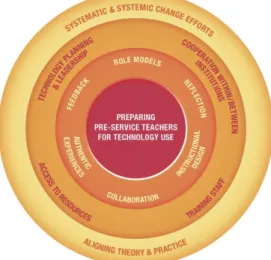
related to the preparation of teachers results is divided into seven new subcategories: 1) alignment between theory and practice, 2) use the teacher as a model, 3) refl ection of your attitudes about the role of technology in education, 4) learning technology through planning your lessons; 5) by peer collaboration; 6 ) being supported in achieving authentic experiences with technology; 7) off ering continuous feedback, by educators on the use of technology rather than conducting summative evaluations on usage. In these seven categories it was described the conditions under which one of the selected research pointed to such result and specifi cities of the research that could lead to the understanding of it. Th is re-categorization also occurred in the category of results related to the institutional level.
It is observed, then, that this type of systematic categorizations by grouping and by similarity occur in a systematic way allowing the generation of models and schemas for the understanding and discussion of identifi ed proposals. According to Tondeur et al. (2012), they generate in the work from the performed analyzes.
Figure 1 - Model to prepare beginner teachers for the use of technology Source: TONDEUR et at., 2012, p. 141.
Now, the integration and aggregation are present in studies that evaluate and synthesize only quantitative studies, such as meta-analysis (D’AGOSTINO; POWERS, 2009; KYRIAKIDES; CHRISTOFOROU; CHARALAMBOUS, 2013), whose initial criterion for selection is to have statistically measurable results.
The term was coined by Glass (1976) when working on a research categorization according to the source of the analyzed data, performed until the 1970s, ranking them in primary research, those in which the researchers analyzed the data collected by themselves, secondary when recovering data from other research and validating them applying other statistical methods and used the term meta-analysis to refer to the statistical analysis of a large collection of analyses results derived from individual studies and having as goal the integration of results (GLASS, 1976. p. 1).
Kyriakides, Christoforou and Charalambous (2013) describe meta-analysis as a powerful tool which by calculations of average effect size could work to correct possible distortions of results that would provide illusion and the conflicting results may obscure the real understanding of the problem.
In the educational field, the authors (KYRIAKIDES; CHRISTOFOROU; CHARALAMBOUS, 2013) suggest that it be used for three purposes: to unveil the accumulated knowledge in a particular field allowing it to be used by researchers or professionals to advance their studies or to enhance the work; in the construction of new theories, redefine existing ones or design new studies; and in conducting tests that allow to verify the empirical validity of the effectiveness of models and theoretical frameworks.
Meta-analysis resembles systematic reviews of phase 1 - analysis of the objectives of the study presented in the article up to stage 6 - identifying similarities, differences and unique characteristics among the studies, the phases defined by Tondeur (2009). However, from this stage begins a recording of quantitative variables collected and analyzed by the research and applied to these statistical tests. This is necessary to verify the results presented after the integration and aggregation of the results, such as fixed, random and multilevel effect factors, ANOVA
method, among others (HERBERT et al., 2009), using statistical software such as SPSS (D ‘AGOSTINO; POWERS, 2009).
However, the application of this analytical method in education research is still a challenge due to the lack of information and transparency in articles about the used statistical methods, preventing a generalized meta-analysis (D’AGOSTINO; POWERS, 2009) still remaining the challenge pointed by Glass (1976) that we are in an awkward position knowing less than we prove, because the evidence that often reside are haughtily despised and insufficiently respected.
This challenge is even greater for the studies that seek to integrate and aggregate both quantitative and qualitative data in the same systematization and that is the case with recent studies in the healthcare area called meta-summary (SANDELOWSKI; BARROSO; VOILS, 2007; SUGA; TERADA, 2013) or qualitative meta-synthesis (MATHEUS, 2009).
According to Mathews (2009, p. 545) the transformation of a set of qualitative studies in a new study “requires theoretical sensitivity of the researcher to deconstruct and analyze the research data from inductive and interpretative process.” Furthermore, the methodology itself requires it to be a team effort due to the need of double or even triple validation of the research raised as it is explicit in the referral presented by Suga and Terada (2013).
A detailed description of the process of organization selection, validation and analysis and valuation of the research used in the study is essential, complex and challenging, but fundamentally necessary “to ensure for the process of this type of study is challenging requiring the validity of qualitative meta-synthesis” (MATHEUS, 2009, p. 545).
This research validation that evaluate and synthesize the results was discussed in the study by Ahn, Ames and Myers (2012) when 56 meta-analyzes published in the 2000s were analyzed. They concluded their study with recommendations for this type of study in education that could be used as a checklist for researchers who get involved in this endeavor.
This list comprises five stages of conducting reviews: problem formulation, data collection, data evaluation, analysis and interpretation of
data and report the results. Summarizing the observations brought up for each stage, the authors (AHN; AMES; MYERS, 2012) report that in general the problems are well formulated and the data properly collected, but they indicate the need to improve the process of analysis being done in this type of research. Moreover, they alert that the lack of information about the used statistical methods hinders the transformation results in meta-analytic studies in general that could effectively contribute to the transformation of educational practices.
Final considerations
It was observed in this study that we can count on types of review procedures, which were grouped according to their characteristics: literature review; bibliometric studies; state of the art research type; narrative review, systematic review; integrative review; qualitative evidence synthesis, meta-analysis; qualitative meta-synthesis or meta-summary.
This paper allowed us to observe that there are different nomenclatures for the same type of study, sometimes in the same area; we also found that many software are used to instrument the researcher in conducting this type of investigation; however, the value and credibility of the study crucially depend on the transparency and rigor undertaken by the researcher.
It is important to highlight that each type of study has a specific purpose, which does not correspond to a hierarchy of quality and specificity of its application. The access and accomplishment of such studies can greatly contribute in the researcher’s education, since analyzing the process of carrying out the research raised, a methodological criticality can be developed that may assist in identifying gaps in their own research.
In the education area, the review studies need further improvement, and at present, due to the large number of empirical research conducted are necessary and fundamental to synthesize, evaluate and point out trends, but mostly to indicate the weak points in order to favor critical analysis of the cumulative area.
References
AHN, S.; AMES, A. J.; MYERS, N. D. A Review of meta-analyses in education: methodological strengths and weaknesses. Review of Educational Research, v. 82, n. 4, p. 436-476, 2012.
ALVES-MAZZOTTI, A. J. A “revisão bibliográfica” em teses e dissertações: meus tipos inesquecíveis – o retorno. In: BIANCHETTI, L.; MACHADO, A. M. N. (Org.).
A bússula do escrever: desafios e estratégias na orientação de teses e dissertações.
São Paulo: Cortez, 2002. p. 25-44
ANDRÉ, M. D. A jovem pesquisa educacional brasileira. Diálogo Educacional, v. 6,
n. 19, p. 11-24, set./dez. 2006.
BARDIN, L. Análise de conteúdo. Lisboa: Edições 70, 2011.
BARRETO, R. G. (Coord.). Educação e tecnologia (1996-2002). Brasília: MEC/Inep, 2006.
BAZELEY, P. Qualitative Data Analysis with Nvivo. 2nd ed. London: Sage Publication, 2007.
BRANDÃO, Z.; BAETA, A. M. B.; ROCHA, A. D. C. Evasão e repetência no Brasil: a escola em questão. 2. ed. Rio de Janeiro: Dois Pontos, 1986.
BUFREM, L.; PRATES, Y. O saber científico registrado e as práticas de men-suração da informação. Ciência da Informação, v. 34, n. 2, maio/ago. 2005. Avaliable at: <http://www.scielo.br/scielo.php?script=sci_arttext&pid=S0100--19652005000200002&lng=pt&nrm=iso>. Accessed in: 6 nov. 2013.
CAMPBELL Collaboration.2013. Avaliable at: <http://www.campbellcollabora-tion.org>. Accessed in: 10 Oct. 2013.
CATALÁ-LOPEZ, F. et al. Coauthorship and institutional collaborations on cost-effectiveness analyses: a systematic network analysis. PLoS ONE, v. 7, n. 5, e38012, 2012.
CERVO, A. L.; BERVIAN, P. A. Metodologia científica. 5. ed. São Paulo: Prentice Hall, 2002.
COBO, M. J. et al. Science mapping software tools: review, analysis, and coopera-tive study among tools. Journal of the American Society for Information Science and
Technology, v. 62, v. 7, p. 1382-1402, 2011.
COSTA, S. T. G. O imaginário do professor sobre o uso das tecnologias
educati-vas: pressupostos para uma proposta de formação. 2010. 255 f. Dissertação
(Mestrado em Educação) –– Pontifícia Universidade Católica do Paraná, Curitiba, 2010 Avaliable at: <http://www.biblioteca.pucpr.br/tede/tde_busca/arquivo.
php?codArquivo=1774>. Accessed in: 9 June 2011
D’AGOSTINO, J. V.; POWERS, S. J. Predicting teacher performance with test scores and grade point average: a meta-analysis. American Educational Research
Journal, v. 46, n. 1, p. 146-182, 2009.
DAVIES, P. Revisões sistemáticas e a Campbell Collaboration. In: THOMAS, G. et al. Educação baseada em evidências: atualização dos achados científicos para a qualificação da prática pedagógica. Porto Alegre: Artmed, 2007. p. 31-43. DEPAEPE, F.; VERSCHAFFEL, L.; KELCHTERMANS, G. Pedagogical content knowl-edge: a systematic review of the way in which the concept has pervaded mathematics educational research. Teaching and Teacher Education, v. 34, p. 12-25, 2013.
DIAS, A. T. T. Pesquisando a relação família-escola: o que revelam as teses e disser-tações dos programas de pós-graduação brasileiros. 2009. 219 f. Tese (Doutorado em Educação Escolar) – Universidade Estadual Paulista, Araraquara, 2009. Avaliable at: <http://portal.fclar.unesp.br/poseduesc/teses/Andrea_Theodoro_ Toci_Dias.pdf>. Acesso em: 10 July 2013.
ELIAS, C. S. et al. Quando chega o fim? Uma revisão narrativa sobre terminalida-de do período escolar para alunos terminalida-deficientes mentais. SMAD: Revista Electrónica
FRANÇA, C. L.; MATTA, K. W.; ALVES, E. D. Psicologia e educação a distância: uma revisão bibliográfica. Psicologia: Ciência & Profissão, v. 32, n. 1, p. 4-15, 2012. FRIESE, S. Qualitative data analysis with Atlas.ti. London: Sage Publications, 2012.
GLASS, G. V. Primary, secondary and meta-analysis of research. American
Educational Research Association, v. 5, n. 10, 3-8, 1976.
MARSH, M. W. et al. Gender effects in the peer reviews of grant proposals: a comprehensive meta-analysis comparing. Review of Educational Research, v. 79, n. 3, 1290-1326, 2009.
ISOTANI, S. et al. Estado da arte em web semântica e web 2.0: potencialidades e tendências da nova geração de ambientes de ensino na internet. Revista Brasileira
de Informática na Educação, v. 17, n. 1, p. 30-42, 2009.
KYRIAKIDES, L; CHRISTOFOROU, C.; CHARALAMBOUS, C. Y. What matters for student learning outcomes: a meta-analysis of studies exploring factors of effective teaching. Teachingand Teacher Education, v. 36, p. 143-152, 2013.
LOPES, S. et al. A bibliometria e a avaliação da produção científica: indicadores e ferramentas. CONGRESSO NACIONAL DE BIBLIOTECÁRIOS, ARQUIVISTAS E DOCUMENTALISTAS, 11., 2012, Lisboa. Actas... Lisboa: Fundação Calouste Gulbenkian, 2012. Avaliable at: <http://www.bad.pt/publicacoes/index.php/ congressosbad/article/view/429 >. Acesso em: 10 Aug. 2013.
MATHEUS, M. C. C. Metassíntese qualitativa: desenvolvimento e contribuições para a prática baseada em evidências. Acta Paulista de Enfermagem, v. 22, Edição Especial, p. 543-545, 2009.
MESSINA, G. Estudio sobre el estado da arte de la investigacion acerca de la formación
docente en los noventa. 1998. Trabalho apresentado à Reúnion de Consulta Técnica
sobre investigación en Formácion del Professorado, Organización de Estados Ibero-Americanos para la Educación, la Ciência y la Cultura, México,1998.
MILANI, M. L. C. A presença das tecnologias educacionais no currículo dos cursos de
licenciatura em matemática. 2013. 114 f. Dissertação (Mestrado em Educação) ––
Pontifícia Universidade Católica do Paraná, Curitiba, 2013. Avaliable at: <http:// www.biblioteca.pucpr.br/tede/tde_busca/arquivo.php?codArquivo=2594>. Accessed in: 5 Dec. 2013.
MILES, M. B.; HUBERMAN, A. M. Qualitative data analysis. 2nd ed. Thousand Oaks: Sage, 1994.
MIRANDA L. M. de; FERREIRA, S. F. As contribuições da internet para o idoso: uma revisão de literatura. Interface: Comunicação, Saúde, Educação, v. 13, n. 29, p. 383-395, abr./jun. 2009.
MORAIS, J. F. S.; ASSUMPÇÃO, R. P. S. Olhares para a produção bibliográfica sobre educação física escolar: algumas reflexões a partir de um levantamento bi-bliográfico. Acta Scientiarum: Education, v. 34, n. 1, p. 121-128, 2012.
MOSTAFA, S. P.; MÁXIMO, L. F. A produção científica da Anped e da Intercom
no GT da Educação e Comunicação. Ciência da Informação, v. 32, n. 1, 2003. Avaliable at: <http://www.scielo.br/scielo.php?script=sci_arttext&pid=S0100--19652003000100010&lng=en&nrm=iso>. Accessed in: 6 Nov. 2013.
NÓBREGA-THERRIEN, S.; THERRIEN, J. O estado da questão: sua compreensão na construção de trabalhos científicos: reflexões teórico-metodológicas. Estudos
em Avaliação Educacional, v. 15, n. 30, p. 5-16, jul./dez. 2004.
NORONHA, D. P.; FERREIRA, S. M. S. P. Revisões de literatura. In: CAMPELLO, B. S.V. C.; CENDÓN, B. V.; KREMER, J. M. (Org.). Fontes de informação para
pes-quisadores e profissionais. Belo Horizonte: UFMG, 2000.
PICHETH, F. M. PeArte: um ambiente colaborativo para a formação do pesquisador
que atua no ensino superior por meio da participação em pesquisas do tipo estado da arte. 2007. 139 f. Dissertação (Mestrado em Educação) –– Pontifícia Universidade Católica do Paraná, Curitiba, 2007. Avaliable at: <http://www.biblioteca.pucpr.br/ tede/tde_busca/arquivo.php?codArquivo=828>. Accessed in: 10 Aug. 2013.
PINHEIRO, R. B. As representações sociais do projeto Ler e Pensar. 2012. 267 f. Dissertação (Mestrado em Educação) –– Pontifícia Universidade Católica do Paraná, Curitiba, 2012. Avaliable at: <http://www.biblioteca.pucpr.br/tede/tde_ busca/arquivo.php?codArquivo=2395>. Accessed in : 11 Apr. 2013.
ROCHA, E. A. C. A pesquisa em Educação Infantil no Brasil: trajetória recente e
pers-pectiva de consolidação de uma pedagogia da educação infantil. Florianópolis: UFSC, Centro de Ciências da Educação, Núcleo de Publicações, 1999.
ROMANOWSKI, J. P.; ENS, R. T. As pesquisas denominadas do tipo “estado da arte” em educação. Diálogo Educacional, v. 6, n. 19, p. 37-50, set./dez., 2006. SANDELOWSKI, M.; BARROSO, J.; VOILS, C. I. Using qualitative metasum-mary to synthesize qualitative and quantitative descriptive findings. Research in
Nursing & Health, v. 30, n. 1, p. 99-111, 2007.
SANTOS, L. M. A. Panorama das pesquisas sobre TDIC e formação de professo-res de língua inglesa em LA: um levantamento bibliográfico a partir da base de dissertações/teses da Capes. Revista Brasileira de Linguística Aplicada, v. 13, n. 1, p. 15-36, 2013.
SEDIGHI, M. Interdisciplinary relations in some high-priority fields of science and technology: an analytical study. Library Review, v. 62, n. 6-7, p. 407-419, 2013.
SILVA, R. C.; HAYASHI, M. C. P. I. Revista Educação Especial: um estudo biblio-métrico da produção científica no campo da Educação Especial. Revista Educação
Especial, v. 21, n. 31, p. 117-136, 2013. Disponível em: <http://cascavel.ufsm.
br/revistas/ojs-2.2.2/index.php/educacaoespecial/article/view/15>. Acesso em: 3 Nov. 2013.
SOARES, M. B.; MACIEL, F. P. Alfabetização. Brasília: MEC/Inep/Comped, 2000. (Estado do Conhecimento, n. 1). Avaliabel at: <http://www.publicacoes. inep.gov.br/arquivos/%7BE35088B3-B51D-482A-827D-66061A4AE11E%7D_ alfabetiza%C3%A7%C3%A3o.pdf>. Accessed: 3 Sept. 2013.
SOBRAL, F. R.; CAMPOS, C. J. G. The use of active methodology in nursing care and teaching in national productions: an integrative review. Revista da Escola de
Enfermagem da USP, v. 46, n. 1, p. 208-218, 2012.
SUGA, U. S. G. Fatores que conduzem ou afastam os dentistas na realização de
me-didas preventivas em relação à cárie dentária: uma revisão sistemática e
metassu-marização. 2013. 90 f. Dissertação (Mestrado em Odontologia Integrada) –– Universidade Estadual de Maringá, Maringá, 2013.
THOMAS, G. Introdução: evidência e prática. In: THOMAS, G. et al. Educação
baseada em evidências: atualização dos achados científicos para a qualificação da
prática pedagógica. Porto Alegre: Artmed, 2007. p. 9-27.
TONDEUR, J. et al. Preparing pre-service teachers to integrate technology in education: a synthesis of qualitative evidence. Computers & Education, n. 59, p. 134 -144, 2011.
UNIVERSITAS. A produção científica sobre educação superior no Brasil, 1968 – 2000. Porto Alegre: GT Política de Educação Superior/ANPEd, 2002. Disponível
em: <http://www:pucrs.br/faced/pos/universitas>. Acesso em: 10 Dec. 2013. WILSON, S. et al. Publications of Autralians LIS academics in databases.
Australian Academic & Research Libraries, v. 42, n. 3, p. 211-230, 2011.
ZUFFO, D. A formação de professores para o uso das tecnologias educacionais: o que apontam as teses e dissertações defendidas no Brasil no período de 2003 a 2008. 2011. 149 f. Dissertação (Mestrado em Educação) –– Pontifícia Universidade Católica do Paraná, Curitiba, 2011. Disponível em: <http://www.biblioteca.puc-pr.br/tede/tde_busca/arquivo.php?codArquivo=1890>. Acesso em: 5 Aug. 2011. Received: 12/18/2013
Recebido: 18/12/2013
Approved: 01/25/2015