Contents lists available atScienceDirect
The Quarterly Review of Economics and Finance
j o u r n a l h o m e p a g e :w w w . e l s e v i e r . c o m / l o c a t e / q r e fNew challenges for public research organisations in agricultural
innovation in developing economies: Evidence from Embrapa in
Brazil’s soybean industry
Paulo N. Figueiredo
∗Brazilian School of Public and Business Administration (EBAPE) at the Getulio Vargas Foundation (FGV), Brazil
a r t i c l e i n f o
Article history:Received 30 August 2015
Received in revised form 15 July 2016 Accepted 19 July 2016
Available online 3 August 2016 JEL classification:
12.007: L7 – Industry Studies: Primary Products and Construction
14.005: N5 – Agriculture, Natural Resources, Environment, and Extractive Industries 15.001: O1 – Economic Development 15.003: O3 – Technological Change 17.001: Q1 – Agriculture Keywords: Technological capability Innovation Agriculture Soybean industry EMBRAPA Brazil
a b s t r a c t
This article is concerned with the characteristics of technological capabilities for agricultural innovation in indigenous public research organisations in developing economies. This issue is examined in the con-text of the Brazilian Corporation for Agricultural Research (Embrapa), in relation to the soybean industry. EMBRAPA’s technological capabilities for innovation are diverse in terms of their levels of novelty and complexity, they are varied across different technologies and they are inter-organisationally distributed. Considering the evidence and in view of the developing world’s unprecedented demand for food and the increased interdependency of the innovative activities, the article suggests that indigenous public research organisations, such as EMBRAPA, need to re-invent the way in which they manage their tech-nological capabilities to play an even more active and complementary role in agricultural innovation and productivity growth in developing economies.
© 2016 Board of Trustees of the University of Illinois. Published by Elsevier Inc. This is an open access article under the CC BY-NC-ND license (http://creativecommons.org/licenses/by-nc-nd/4.0/).
1. Introduction
Demand for agricultural products faces an unprecedented increase, as the world’s population is expected to reach nine billion by 2050. Most of this population will reside in developing countries, have higher incomes and desire a richer diet. By 2050, there will be a 35% increase in food demand, notably from China, India, other Asian countries and Africa. However, worldwide agricultural pro-ductivity growth has been slowing: annual growth is estimated at only 1% over the next two decades, much slower than historical trends. Meeting food demand in 2030 will require an additional 175 million to 220 million hectares of cropland (seeFAO, 2014; IFPRI, 2012; McKinsey Global Institute, 2011).
∗ Correspondence to: Fundac¸ão Getulio Vargas/EBAPE, Praia de Botafogo 190, 22250-900 Rio de Janeiro, RJ, Brazil. Tel.: +55 21 3799 5742; fax: +55 21 3799 5710.
E-mail address:paulo.fi[email protected]
In addition to the increased food demand and income growth, by 2050, climate change is expected to cause water scarcity and serious declines in yields of the most important crops in develop-ing countries, particularly Africa and South and Central Asia as well as in large food producers such as Brazil (IFPRI, 2012;IPCC, 2014). By 2070, in Brazil, there will be significant damage to crop species such as corn, rice, beans, cotton, sunflower and cassava, and soy-bean losses may reach 40% (Assad & Pinto, 2008). Climate change will lead to price increases for agricultural crops such as rice, wheat, maize and soybeans. Furthermore, even in a more optimistic sce-nario, by 2050, the number of malnourished children is expected to range from 76 million to 84 million, depending on the extent of climate change (FAO, 2014; IFPRI, 2012).
Over the past several decades, effective efforts in technologi-cal innovation have played a major role in increasing agricultural productivity and food security. In some developing economies, governments have implemented relevant agricultural innovations through their indigenous public research agricultural research http://dx.doi.org/10.1016/j.qref.2016.07.011
1062-9769/© 2016 Board of Trustees of the University of Illinois. Published by Elsevier Inc. This is an open access article under the CC BY-NC-ND license (http:// creativecommons.org/licenses/by-nc-nd/4.0/).
organisations. However, innovative activities in agriculture have become increasingly interdependent and collaborative. Addition-ally, multinational enterprises (MNEs) have played a major role in agricultural innovation in certain developing economies (Arza & Van Zwanenberg, 2013). Therefore, the objective of this article is to address some of the new challenges for indigenous pub-lic research organisations in the light of increasing food demand and greater complexity of agricultural innovation management. This issue is addressed herein through an empirical examination of the Brazilian Corporation for Agricultural Research (EMBRAPA), a public research organisation, from the standpoint of its tech-nological capabilities for innovative activities in the soybean industry.
The remainder of the article is organised as follows. Section 2 provides a brief overview of Brazil’s soybean industry and EMBRAPA. Section3develops a brief empirical literature review leading to the article’s research question. Section4presents the article’s conceptual framework. The empirical section, Section5, explores the role of EMBRAPA in contributing to innovative activ-ities in Brazil’s soybean industry and its underlying technological capabilities. Section6outlines the article’s conclusions.
2. Brazil’s soybean industry and EMBRAPA
Over the past two decades, Brazil’s agricultural industry has experienced enormous growth in both production and export of a diversified line of agricultural products. This article focuses on soybeans, a crop species in which Brazil holds a strong leading inter-national competitive position. Brazil is the world’s second largest soybean producer (the first is the US) and the world leader in soy-bean productivity (kg/ha). During 2012/13, Brazil produced 81.5 million tonnes of soybeans, while the US produced 82.1 million tonnes. Brazil’s soybean production grew by 9.3% from 2008/09 to 2012/13, while US production grew by 0.43% over the same period. Brazil produces a quarter of the world’s soybean exports on just 6% of the country’s arable land. By 2012, the overall average yield of soybeans in Brazil (3000 kg/ha) had surpassed the average yield in the US (2800 kg/ha). The cost of producing soybeans in Brazil fell to about $6.30 per 60 kg/bag, around half the US cost of $11.80. It is worth reiterating that EMBRAPA has played an important role in the achievement of this competitive position.
Agricultural production in Brazil occurs in commercial and family-based units. Commercial agriculture accounts for 65% of out-put and involves crop species such as soybeans, sugar cane, coffee, and rice. Commercial output is oriented mainly toward exports. Family-based agriculture accounts for the remaining 35% of out-put and is oriented toward the internal market. Approximately 70% of agricultural products (including fruit) consumed in Brazil are supplied by family-based agriculture. There are two agriculture ministries: the Ministry for Agriculture, Livestock and Food Supply, dedicated to large-scale commercially and export-oriented agri-culture; and the Ministry for Agrarian Development, dedicated to family-based farming. Created in 1973, EMBRAPA is formally under the Ministry of Agriculture, Livestock and Food Supply. The creation of EMBRAPA was motivated by Brazil’s low agricultural productiv-ity, decline in crop production, scarcity of foreign exchange and the fact that Brazil was a food importer (Cabral, 2005; Lopes et al., 2012). EMBRAPA is largely funded by the federal government. It has approximately 9600 employees, of whom 25% (2400) are researchers. More than 80% of EMBRAPA’s researchers hold PhD degrees. EMBRAPA is considered one of the leading institutions for science and technology (S&T) related to agricultural production in the tropics.
Internally, EMBRAPA is organised as a network of 47 research units spread across all regions of Brazil (Lopes et al., 2012).
The research units include (i) 18 specialised centres: these are devoted to research and innovation pertaining to important crop species in Brazilian agriculture (e.g., soybean, corn, wheat, rice, cotton, vegetables); (ii) 12 strategic organisational units: these are responsible for developing knowledge, processes, innovations in biotechnology, genetic resources, advanced instrumentation, information technology (IT), agroenergy, soils, agrobiology and tropical agroindustry; and (iii) 17 eco-regional units: these under-take adaptations of technologies, information, and product systems to enable the sustainable use of natural resources across differ-ent biomes in Brazil. There are also five service units dedicated to activities such as production and marketing, plant quaran-tine and land management. Additionally, an area is dedicated to international technical cooperation and corporate management units. This article focuses on one specialised centre: EMBRAPA Soybean.
From an inter-organisational perspective, EMBRAPA coordi-nates the National System of Agricultural Research (SNPA), which was created in 1991. This system involves EMBRAPA and its units, nearly 20 state research organisations (OEPAs), state and federal universities, research institutes and other public and private orga-nisations related directly or indirectly to agricultural research.
3. Literature review and research question
The Green Revolution of the 1960s stimulated several develop-ing economies to structure their research activities to tackle food scarcity. The development of new seeds attracted large firms and large-scale farming, input supplier development, mechanisation and the emergence of new agriculture techniques and manage-ment practices (Beintema & Stads, 2011; Hayami & Ruttan, 1985). The policy and institutional reforms and effective research efforts raised agricultural productivity in Brazil and China above that of the rest of the world during the 1980s (Chen, Flaherty, & Zhang, 2012). During the 1990s and early 2000s, the agricultural knowl-edge and information system (AKIS) approach became prominent. AKIS emphasised the development of research infrastructure and interactions between research, education and extension to meet farmers’ demands for new technological solutions (World Bank, 2006).
A large part of AKIS was once state-owned, particularly in the form of public research organisations. Self-sufficient in knowl-edge, these organisations were deemed the locus of agricultural research (Leeuwis & van den Ban, 2004). However, since the early 2000s, large bioscience multinational enterprises (MNEs) have taken on a greater share of agricultural research worldwide (Pingali & Traxler, 2002). MNEs have also intensified the allocation of their agricultural research activities in developing economies following changes in their economic and institutional conditions (Arza & Van Zwanenberg, 2013).
Nevertheless, in developing economies, public research organi-sations have been responsible for the bulk of agricultural research: during the 1990s, 10% to 15% of agricultural R&D in developing economies was undertaken by the private sector compared with more than 50% in the OECD countries (Alstom et al., 1998, cited inArza & Van Zwanenberg, 2013). While in developing economies, business firms accounted for approximately 6% of agricultural R&D, in advanced economies, they accounted for approximately 50% (Pardey & Pingali, 2010). By 2008, public agricultural R&D spend-ing in China, India and Brazil already accounted for 25% of global spending and 50% of combined spending in the developing world (IFPRI, 2012).
Indigenous public agricultural research organisations play an important role in the implementation of relevant innovations and agriculture development in developing economies (Mazzoleni
& Nelson, 2007). The relationship between public research organisations and private firms, especially MNEs, can be comple-mentary instead of mutually exclusive. There is a need for synergies between local public agricultural research organisations and MNEs to deliver the innovations necessary to address the challenges of the world’s current and future food demand (Pardey & Pingali, 2010).
There are several ways in which public agricultural research organisations can be complementary with business firms while enhancing the welfare of the poor. These include seeking direct partnerships, concentrating on areas under-researched by private firms and generating public goods that are useful to private and public institutions (Pingali & Traxler, 2002). There are several opportunities to foster interactions between MNEs and indigenous public research organisations to promote technology transfer and adaptations to host country conditions. Interactions may provide MNEs with access to resources of public research organisations (e.g., germplasm, expertise and basic research) in exchange for investment by such firms in commercially less attractive activi-ties (Arza & Van Zwanenberg, 2013). Indeed, the so-called next green revolution should move a step forward by bringing the ben-efits of agricultural innovation and, especially, research to small and poorer farmers across the developing world (The Economist, 2014).
There is a consensus on the relevant role of indigenous pub-lic research organisations, particularly in developing economies, in agricultural innovation and productivity growth. Nevertheless, there is a dearth of empirical research, from the perspec-tive of indigenous public research organisations in developing economies, on the nature of the technological capabilities that are required for innovative activities and productivity growth in agriculture.
This article seeks to contribute in this direction by exploring these issues in relation to the Brazilian Corporation for Agricul-tural Research (EMBRAPA) within the soybean industry. Brazil has achieved impressive productivity growth records in agri-culture, especially in soybeans. Previous research suggests that EMBRAPA has played a decisive role in these achievements (e.g., Ekboir, 2003; Mazzoleni & Nelson, 2007; World Bank, 2012). Therefore, this article addresses the following question: What are the main characteristics of the technological capabilities of EMBRAPA and its challenges to undertake innovative activities to achieve and sustain world-leading productivity in Brazil’s soybean industry?
To address this research question, this article draws on quali-tative evidence from EMBRAPA and related institutions in Brazil’s soybean industry. Evidence was gathered through different sources and techniques (e.g., interviews, consultations with archival records and published materials from EMBRAPA and related organi-sations, the Brazilian government and other sources). By addressing this question, this article contributes to furthering our understand-ing of role of indigenous agricultural research organisations in agricultural innovation in developing economies, from the perspec-tive of technological capabilities.
4. Innovative activities and technological capabilities: a perspective from latecomer organisations
4.1. Latecomer organisations
In research on the economics of innovation and industri-alisation, latecomer organisations and industries are those located in developing and emerging economies. They are at a historically determined – rather than a strategically chosen – position of late entrance (Mathews, 2002). Their late entrance
is determined not by choice but by the late industrialisation process of their economies. Latecomers are characterised by an initial low level (or even absence) of technological capabilities and by being ‘initially imitative’, regardless of how ill-positioned they may be with respect to markets and technology sources. Put differently, although latecomers start as uncompetitive simple users, licensers and imitators of existing technologies, they may pursue a progressive innovative pattern and catch up technologically and commercially with global leaders. However, technological catch-up does not always mean that latecom-ers always follow the same steps previously pursued by global leaders.
Instead, by exploring the fluidity of the innovation frontier, latecomers may move in qualitatively novel directions that allow them to open up new-to-the-world technological segments and attain world-leading positions (Lee & Lim, 2001; Figueiredo, 2010; Bell & Figueiredo, 2012). In natural resource-related industries, such as agriculture, this ‘non-imitative’ technological catch-up process appears to occur with greater frequency than has been documented by researchers. Because of specific local con-ditions of soil, climate and disease, knowledge from frontier countries is not always suitable. Consequently, as latecomers are constrained in simply copying certain existing technolo-gies, they must create technologies suitable to their national needs. Indigenous public research organisations play a fun-damental role in this catch-up process (Mazzoleni & Nelson, 2007).
4.2. A comprehensive perspective on innovative activities
This article adopts a comprehensive approach to innovation as a process that involves all types of changes in products, services, production processes, raw materials, physical systems, organisa-tional systems and arrangements and managerial practices that add value to organisations and the economy (Dosi, 1988; Pavitt, 2005; Tidd, Bessant, & Pavitt, 2001). Such changes originate from a spectrum of activities involving all types of imitation, problem-solving, trial-and-error, experimentation, adaptation, design and development and different stages of research and development (R&D), where the latter may range from trouble-shooting R&D to pure research (Dosi, 1988; Rosenberg, 1976). As observed above, most technological innovations do not derive from major breakthroughs achieved through scientific endeavours but from small, cumulative changes (Kline & Rosenberg, 1986; Rosenberg, 1982). Specifically, most innovations derive from new combina-tions of technologies, which in turn open up opportunities for new businesses and future innovations (Bell, 2009; Fagerberg, 2005).
Therefore, there should be no distinction between innovation and imitation; the latter involves a series of creative activities that may lead to substantial modifications of original innova-tions (Arnold & Bell, 2001). Innovation does not result only from a linear knowledge flow from basic and applied research; it involves complex systems and intra- and inter-organisational interactive processes (Mowery & Rosenberg, 1978; Rosenberg, 1976). However, engagement in internal and external knowl-edge relationships does not imply that such knowlknowl-edge transfer will take place efficiently and effectively (Teece, 1989). Such knowledge interactions may be truncated by a lack of in-house expertise and a lack of demand for local R&D outputs. To gain access to such knowledge, it is necessary to build up a substan-tial level of in-house expertise or absorptive capacity as well as demand for local R&D outputs (Cohen & Levinthal, 1990; Mowery, 1983).
Roughly in line with this view, as early as the 1970s,Hayami and Ruttan (1970),Hayami and Ruttan (1985) conceived a new
approach to agricultural development.1They dismissed the
then-prevalent idea that technological innovation in agriculture is exclusively a product of scientific advances – or exogenous to economic activity. In their theory of induced innovation, they char-acterised technological innovation as changes at the level of firms and industries that result from R&D and different forms of learning by doing. They went on to argue that technological innovations are induced through responses of farmers, agribusiness entrepreneurs, scientists, and public administrators to resource endowments and changes in the supply and demand of factors and products. How-ever, on the one hand, this theory did not consider inputs into technological innovation – or capabilities. On the other hand, it did not consider the role of collaborative networks in innovation (Knickel, Brunori, Rand, & Proost, 2008). Therefore,Ruttan (1997) suggests a dialogue with other literatures to deepen our under-standing of the intricacies of the agricultural innovation process.
Additionally, innovative activities vary across a scale of inno-vation novelty, running from ‘new-to the firm’, via ‘new to the market’, to ‘new to the world’ (OECD, 2005). In line with this view and followingBell (2009), the present article takes into account the possibility that the degree of novelty in innovation need not be global; it can also be highly localised, and the ‘scale’ of an inno-vation may refer to a small change or improvement. This article considers distinctions in terms of the technological/market ‘nov-elty’ of an innovation – the extent to which it differs from existing technologies, ranging from innovations that are close to being pure imitations to those that are fundamentally different from anything that currently exists. These considerations do not suggest that rel-evant innovative activities are related only to the high-end of the spectrum. New-to-the-world innovations are not always science-based or high-tech: they may be present in all types of activities and industries. Therefore, this article dismisses the view that indus-tries and organisations can be classified in a simple binary manner (‘innovative’ versus ‘non-innovative’); instead, as noted above, it views innovation as a process (Bell & Figueiredo, 2012; Pavitt, 2005). In agriculture, for instance, relevant innovations may not derive from or create sophisticated ‘novel’ technologies; novel innova-tions may emerge from different ways of thinking and doing things (van der Ploeg, 2010).
4.3. Innovative activities: beyond organisational boundaries Innovative activities and corresponding technological capa-bilities are not necessarily confined within an organisation’s boundaries; instead, they may involve several interdependent actors. A wide a range of processes and opportunities for the development of increasingly novel and sophisticated innova-tions through inter-organisational relainnova-tionships now exists (Bell & Figueiredo, 2012). In several ways, such as ‘open’, ‘distributed’ innovation (Chesbrough, 2003) or collaborative networks (Powell & Grodal, 2005), the process of innovation is being substantially de-integrated – or organisationally de-composed, both internally and externally (inter-organisational decomposition) (Schmitz & Strambach, 2009).
Such a perspective on innovation is consistent with the tech-nological characteristics of the agricultural industry. It has become clear that agriculture involves multiple types of technologies and complementarities among them. Diverse sources of technological innovation now exist (e.g., private and public research institu-tions, different types of cooperative research, farm production units). As noted by Possas, Salles-Filho, and Da Silveira (1996), agricultural innovation depends increasingly on collaborative
1 See assessment inKoppel (1995).
networks. Furthermore, there are different technological trajecto-ries within agriculture. Thus, agriculture should not be considered a homogenous whole. Similar to any industrial sector, agriculture is characterised by features such as technological trajectories, sources of innovation, competitive asymmetries and capabilities.
4.4. Technological capabilities: resources needed to undertake innovative activities
As noted byRush, Bessant, and Hobday (2007), although it is widely accepted that innovative activities are essential for the sur-vival and growth of organisations, “[I]n the long term, however, it is not specific innovations that matter, but rather the capabil-ity to generate a stream of products and processes changes that matters” (p. 221). The term ‘capabilities’ reflect what a firm can actually do (Nelson & Winter, 1982; Jacobides & Winter, 2012). As defined inDosi, Nelson, and Winter (2000), “[T]o be capable of some thing is to have a generally reliable capacity to bring that thing about as a result of intended action” (p.2). In this article, this ‘reliable capacity’ involves a reservoir of knowledge-related assets, which are embodied in interdependent dimensions such as the human capital (e.g., specialist professionals, knowledge bases and skills/talents that are formally and informally allocated within specific organisational units, projects and teams), techno-physical systems (databases, machinery, software, etc), organisational and managerial systems (firms’ internal and external organisa-tional arrangements, organisaorganisa-tional and administrative routines and procedures, and managerial systems) – (Bell & Pavitt, 1993; Dutrénit, 2000; Kim, 1997; Leonard-Barton, 1995; Teece, 2007).
This reservoir of knowledge related assets (technological capa-bilities) allows organisations to undertake at least two types of activities: operational and innovative. Operational capabilities refer to the use of existing technologies and production systems with given levels of efficiency, whereas innovative capabilities refer to a firm’s abilities to assimilate, adapt and change existing tech-nologies, create new technologies and develop new products and processes (e.g.,Bell & Figueiredo, 2012; Bell & Pavitt, 1993, 1995). Although this article is concerned with innovative capabilities, the distinction between these two types of capability may be blurred in practice; operational capabilities may even contribute to the accumulation of innovative capabilities (Bell & Figueiredo, 2012; Figueiredo, 2008).
Consistent with the perspective on innovative activities adopted herein, this article recognises that a substantial part of a firm’s technological capabilities lies in other organisations (e.g., research institutes, universities). Consequently, the development of inno-vative capability is not necessarily confined to an organisation’s boundaries but may involve several interdependencies. For an organisation to develop such interactions, it must build up substan-tial in-house expertise (Mowery, 1983), and there must be demand for local R&D outputs (Bell & Pavitt, 1993).
Therefore, the ability of firms to implement innovative activ-ities and achieve distinctive performance reflects the nature and depth of their technological capabilities (e.g.,Bell & Pavitt, 1993; Dosi, 1988; Lall, 1992). This argument is supported by empirical insights that show that firm capabilities permit inno-vative activities (not always R&D-based) to be implemented with differing degrees of novelty and complexity, with important positive operational economic effects (e.g.,Figueiredo, 2014; Hol-lander, 1965; Patel & Pavitt, 1994). These studies demonstrate that a wide range of innovative activities, several of which are engineering-based, and incremental capabilities that intermediate between several improvements in operational and environment-related performance parameters are vital to the international competiveness of such firms.
4.5. Technological capabilities: how transferable?
Technological capabilities have a multi-dimensional, idiosyn-cratic, pervasive and diffused nature. These properties have implications for their transferability. In line withLeonard-Barton (1995), aspects of technological capabilities may be readily available to outsiders (e.g., physical systems), while others are more intrinsic (e.g., organisational systems). Indeed, “[A]lthough, at least potentially, aspects of these four dimensions of [employee’s knowledge and skills, physical technical systems, managerial sys-tems and value and norms] may be readily absorbed by outsiders, it is those portions of the system, and especially the synergy from unique combinations of them, that are neither readily transferred nor imitated” (Leonard-Barton, 1995, p. 20). Nevertheless, it is feasible to pursue the transfer of technological capabilities (or flow of knowledge). However, such transfers are far from simple or automatic. Transfers of technological capabilities (or flows of knowledge) evolve along a continuum (Leonard-Barton, 1995). This continuum may involve levels ranging from operational to progressive levels of innovative technological capabilities (Baranson & Roark, 1985; Hayami & Ruttan, 1970, 1985). Levels along this continuum interact with the dimensions of technolog-ical capabilities: each level involves different challenges in each dimension (Leonard-Barton, 1995).
4.6. Operationalising technological capabilities
In operationalising the innovative technological capability con-struct developed over the past few decades in advanced economies, assessing innovation capabilities has been mainly based on quan-titative measures such as R&D expenditures and/or patent grants (Hagedoorn & Cloodt, 2003). These capabilities may only become useful when firms have developed their innovative capabilities to the point where they involve measurable R&D activities or recorded patenting. These capabilities reflect only a fraction of a firm’s innovative capabilities and do not reflect the capabilities of firms that have only non-R&D-based innovative capabilities (Bell & Figueiredo, 2012; Bell & Pavitt, 1993). The limitation of relying on one aggregate measure of a firm’s innovation capability (e.g., R&D expenditures) is that it neglects a range of mixed technologi-cal activities that are necessary to develop and produce particular products (Patel & Pavitt, 1994) and does not capture the process of technological transformation, which involves a wide spectrum of activities.
This limitation has been overcome through a comprehensive approach that has provided the primary basis for research in this area since the earliest studies of the technological capabilities of latecomer firms, i.e., using qualitative assessments of innovative capability levels (Bell & Figueiredo, 2012; Bell & Pavitt, 1993, 1995; Lall, 1992). The use of such a typology captures what firms are able to achieve technologically by adopting a nuanced perspec-tive on the ‘levels’ of capabilities required to undertake innovaperspec-tive activities characterised by differing degrees of novelty. Specifi-cally, this article draws on previous studies that have identified levels of capability in terms of the types of innovation firms under-take (e.g.,Ariffin & Figueiredo, 2004; Figueiredo, 2008; Lall, 1992). By drawing on this detailed method of classification and taking the broad perspective on innovative activities adopted herein, this article distinguishes between four levels of technological capabili-ties (and innovative activicapabili-ties): ‘basic’, ‘incremental/intermediate’, ‘advanced’ and ‘world leading’. This approach identifies ‘levels’ of innovative capability ranging from ‘basic’ to ‘world-leading’ – an approach consistent with the characterisation of innovation in terms of degrees of novelty and complexity of technological activ-ities; thus, these levels are consistent with the Oslo Manual (see OECD, 2005).
5. Innovative activities and technological capabilities: the experience of EMBRAPA in Brazil’s soybeans industry
Section5.1briefly describes two important innovative activi-ties that have contributed substantially to productivity increases in Brazil’s soybean industry: the implementation of zero tillage (ZT) technology for agricultural processes and the development of new soybean cultivars. Implementation of these innovative activities relies, to a large extent, on EMBRAPA’s accumulated technological capabilities (Section5.2). Section5.3briefly describes some of the risks and challenges facing EMBRAPA in sustaining and renewing its innovative capabilities, whereas Section5.4outlines some aspects of potential transferability of such capabilities to other related orga-nisations in developing economies.
5.1. Innovative activities
5.1.1. Implementation of ZT in Brazil’s Savanah (or ‘Cerrados’) Used since ancient times, ZT refers to planting with minimum soil disturbance, coverage of soil with plants and plant residues and rotation of crops. Through ZT, farmers can grow crops from year to year without ploughing or disturbing the soil at ground level through tillage. The ZT technique increases the amount of water that infiltrates the soil and increases organic matter reten-tion and cycling of nutrients in the soil. The most powerful benefit of no-tillage is improvement in soil biological fertility, making soils more resilient. ZT permits improved erosion control, improved soils, reduced turnaround times between crops, increased flexibil-ity of operation time, and improved nutrient mobilisation. Modern ZT technology emerged during the mid-1950s in the UK and later spread across Europe and world-wide as a result of research activ-ities by the British chemical firm ICI.2 Today’s ZT is a highly
relevant and sophisticated technology that involves the integration of different components such as seeds, agrochemicals, machinery, agricultural practices and different knowledge specialisations. ZT is sensitive to ecological conditions and requires substantial adap-tation to local conditions.3
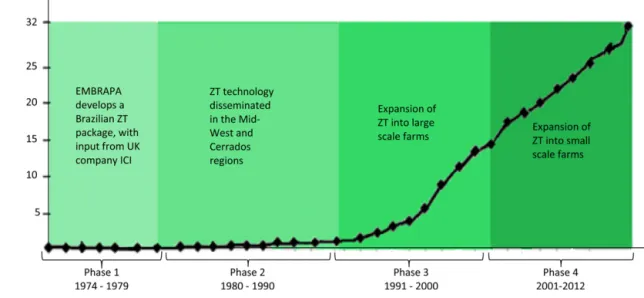
ZT is among the most important agricultural technologies adopted in Brazil over the last 50 years: it reversed soil degradation, enabled the expansion of agriculture into marginal areas (notably the Cerrados), boosted farmers’ profitability and increased Brazil’s agriculture competitiveness. During the early 1970s, ZT-cultivated areas were negligible in Brazil. By 2009, Brazil had reached 25,502 million hectares of ZT-cultivated area, whereas the US had reached 25,304 million hectares. Brazilian farmers have been using ZT tech-niques for over 50% of their grain crops. Because ZT is sensitive to ecological conditions and therefore requires substantial adaptation to local conditions, Brazil could not simply replicate the same tech-niques adopted in other countries.4The adoption process involved
four phases (Ekboir, 2003; Mantovani & Denardin, 2008; EMBRAPA, 2012) – seeFig. 1.
The first phase involved the transfer of ICI’s ZT research team to Brazil. ICI developed its initial partners with local researchers and farmers, the Paraná Agronomic Institute (IAPAR) and EMBRAPA. By the late 1970s, EMBRAPA, together with partners, had developed a ZT package adapted to conditions in Southern Brazil. The second phase involved dissemination of ZT technology to the Mid-west and the Cerrados. To that end, EMBRAPA sent several researchers for overseas training, especially to the US, in agricultural technolo-gies. In parallel, there were extensive activities involving input
2See alsoDerpsch (1998). 3See alsoEkboir (2003).
4For details of technical aspects of ZT implementation in Brazil, seeEkboir (2003);
Fig. 1. Evolution of zero tillage implementation in Brazil (1974-2012).
Source: Adapted fromMantovani and Denardin (2008),EMBRAPA (2012).
providers and farmers. The third phase involved the expansion of ZT to large-scale commercial farms. The fourth phase refers to fur-ther expansion of ZT to both small-scale and large-scale commercial farms across new areas of the Cerrados. In parallel, the biological nitrogen fixation developed by EMBRAPA during this period helped increase the productivity of ZT plantations.
The evidence suggests that innovative activities that have sig-nificant effects on productivity do not necessarily reflect only sophisticated R&D efforts, as there are other types of relevant non-R&D innovative activities. The implementation of the ZT tech-nology in Brazil’s soybean industry represents an effective creative imitation; several inventive activities characterised the process of imitation and adaptation to local soil and climate conditions. This finding supports previous studies of the importance of non-R&D innovative activities in innovation and the competitive perfor-mance of latecomer organisations.
5.1.2. Development of new soybean cultivars
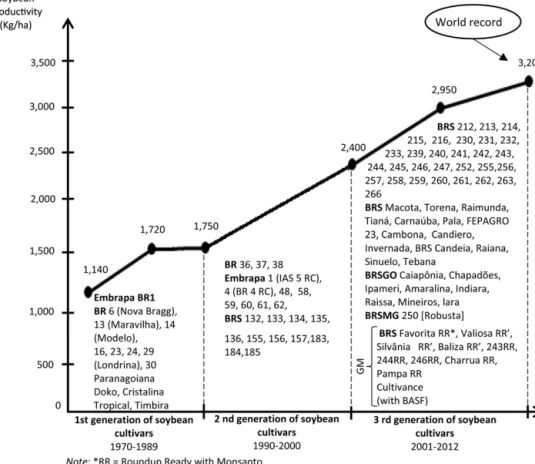
Given that soya (Glycine max L.) is native to the temperate climates of Japan and China, Brazil could not simply transplant existing soya crops. Until the late 1970s, commercial cultivation of soybeans worldwide was restricted to regions of temperate and subtropical climates. Specifically, during the early 1970s, EMBRAPA Soybean engaged in the development of new soybean cultivars adapted to Brazil’s soil and climate conditions. During the 1980s, due to the spread of disease (e.g., cancer stem, the cyst nematode and powdery mildew bacterial pustule), EMBRAPA intensified its efforts to develop new cultivars. The highly ‘latitude sensitive’ soy-bean varieties flourish in the tropics’ shorter day length and mild, wet climate. From the early 1970s to the mid-2000s, EMBRAPA developed more than 300 new cultivars specific to different regions of Brazil. These new cultivars have led to impressive productivity growth in Brazil’s soybean industry (Fig. 2). In addition to being more adapted to Brazil’s regional specificities, these new cultivars are more nutritive, resistant to pests and diseases and require less use of chemical defensives.
The illustrative evidence inFig. 2suggests the great impor-tance of non-transgenic soybeans in Brazil’s soybean industry.5
From the early 2000s, innovative activities in new cultivar
5 The plantation of transgenic soybean in Brazil was approved in 2005 through
enactment of Biosecurity Law no. 11105.
development based on non-transgenic (or conventional) soy seeds have coexisted with transgenic soy seeds. It has been reported that non-transgenic EMBRAPA-related soybeans have outperformed transgenic ones in different Brazilian regions in terms of produc-tivity. These non-transgenic cultivars meet the specific conditions of each region. For example, cultivar BRS 284 (resistant to the pres-ence of nematode gall meloidogyne javanic, early and undetermined growth) has achieved industry record levels of productivity, from 77 to 79 bags/ha, over two consecutive crops in mid-western Brazil. In Northern Brazil, around the region of Rondonia, the most pro-ductive cultivars are the BRS 313, BRS 8183 and BRSMG, with an average productivity of 74 bags/ha, compared with the regional industry average of 53 bags/ha. Although there is a trend towards the use of transgenic soybeans, the experience in Brazil appears to suggest the co-existence of both technologies in the industry. From the point of view of farmers, non-transgenic soybeans offer some advantages in relation to transgenic ones: on average, the costs of non-transgenic soybeans are 2% to 3% lower than transgenic soy-beans; productivity of non-transgenic soybeans is, on average, 3.8 bags greater than that of transgenic soybeans. Payments of roy-alties also constrain the adoption of transgenic seeds. Despite the exponential growth of transgenic soybeans in Brazil, conventional soybeans remain highly productive.
In sum, over the past decades, EMBRAPA Soybean has intensified the implementation of innovative activities, with effects on soy-bean productivity growth. These innovative activities vary greatly and involve, for instance, substantial R&D efforts at the frontier, supported by advanced biotechnology techniques (genetic engi-neering, rDNA) and other advanced techniques (cross-breeding methods based on advanced tools such as gene makers, molecular biology and bioinformatics) to enhance seed properties. In parallel, new agricultural processes have been developed, and existing ones have been improved. For example, from 2008 to 2012, EMBRAPA Soybean developed new technologies in the form of a database, tools, methods and new cultivars (Table 1). These innovations have enabled firms to gain positions as technology providers to the seed market.
5.2. Technological capabilities underlying innovative activities The innovative activities described in the previous section reflect technological capabilities accumulated by EMBRAPA Soy-bean. These technological capabilities reside in the physical
Fig. 2. Some examples of developed new cultivars and productivity increases.
Source: Author’s elaboration based on the study.
Table 1
Development of technologies, products and processes at EMBRAPA Soybean.
2008 2009 2010 2011 2012 Total
Database, software biologic collection and scientific methodologies 10 7 4 8 9 38
Cultivars generated/launched 5 20 15 10 15 65
Cultivars tested/recommended 7 11 16 11 9 54
Agricultural feedstock, agricultural practice/process 6 1 9 4 2 22
Total 28 39 44 33 35 179
Source: Embrapa Soybean’s archival records.
systems and professionals of the National Centre of Soybean Research (CNPSo), known as EMBRAPA Soybean. Created in the early 1970s, it is located in the state of Paraná, Southern Brazil. By 2012, the CNPSo and its Technological Nuclei of Seeds and Grains were upgraded into five laboratories, acclimatised cham-bers, and training facilities. EMBRAPA Soybean has approximately 300 employees, of which 55 are researchers, and 245 are tech-nicians and supporting staff. One of the key features of the technological capabilities of EMBRAPA Soybean, which reflects EMBRAPA’s capabilities as a whole, concerns the organisational dimension. This is the creation and constant strengthening of a business model based on inter-organisational arrangements – a business model aligned with the dynamics and increased compe-tition of cultivars such as soybeans. Such a business model entails integration between technical activities (from genetics to services) and marketing practices, which is not easy to achieve in public research organisations.6
Over the past two decades, EMBRAPA has built an organi-sational configuration that emphasises partnerships with other
6SeeAlves, Souza, Gomes, Magalhães, and Rocha (2012).
(public and private) research institutes, universities and firms (especially MNEs) in undertaking innovative activities. Such part-nerships in the development of technologies have a significant role in the research activities of EMBRAPA. A worldwide network of partners develops technology together with EMBRAPA through bilateral cooperation agreements. The worldwide network involves 55 countries, 555 research institutions and more than 250 R&D projects.
For example, with regard to inter-organisational arrangements for non-transgenic cultivars, EMBRAPA Soybean has built partner-ships with other units of EMBRAPA and with state-level research organisations (OEPAs). Several of EMBRAPA’s partnerships are with the private sector, especially foundations created and funded by agricultural producers to engage in research into cultivars for resis-tance to major diseases that attack the Brazilian crop. EMBRAPA Soybean’s new cultivar development has increasingly depended on these partnerships: of the 150 new cultivars generated and launched between 2000 and 2007, only five were fully devel-oped by EMBRAPA. EMBRAPA’s partners in the development of new cultivars and new agricultural processes are spread across Brazilian regions, for example: South (Fundac¸ão Pró-Sementes; Fundac¸ão Meridional), Southeast Brazil (Federal University of
Table 2
Evolution of Field Days for soybean in Southern Brazil.
Activities/participants Crops
2002/2003 2003/2004 2004/2005
Demonstration units 92 78 89
Field days 77 69 84
Number of participants 68,552 84,554 97,859
Source: Embrapa Soybean.
Vic¸osa, UFV), Agricultural Research Corporation of Minas Gerais (EPAMIG), Fundac¸ão Meridional); Southwestern Brazil (Fundac¸ão Vegetal), Mid-west (Agencia Rural, Technological Centre for Agri-cultural Research), Northeast (Fundac¸ão Bahia; Foundation for Export Support), North (Rondônia Federal Institute, Cooperative for Agricultural Development).
With regard to transgenic cultivar development, EMBRAPA has intensified public-private partnerships, especially since the late 1990s, following enactment of the Law of Cultivars Pro-tection. EMBRAPA established agreements and partnerships to preserve its public function and retain its assets (germplasm banks). EMBRAPA’s partnerships with MNEs have become increasingly important. Technical cooperation with Monsanto has generated Roundup Ready (RR) soy seeds, which are resistant to glyphosate. While EMBRAPA owns the cultivars that are produced, Monsanto has the rights to the genes incorporated into the seeds (the genes provide the tolerance to the glyphosate herbicide). For example, a joint-research project with BASF, coordinated by EMBRAPA, led to the development of Cultivance, a new transgenic soy seed that is resistant to herbicides of the ‘imidazolinonas’ class.
The effectiveness of new cultivar development depends on the quality of technology transfer through extension programmes. In 2010, EMBRAPA Soybean re-organised its Department of Technol-ogy Transfer. The new organisational unit involves the TechnolTechnol-ogy Forecast and Evaluation Unit, the Technology Transfer Implemen-tation Unit and the Local Committee of Intellectual Property. These units transfer technology by means of knowledge exchange and technical solutions through ‘strategic alliances’ with several partners. This re-organisation sought to overcome some of the problems in the extension area (following the shut-down of its former extension unit, EMBRATER).
Specifically, technology transfers by EMBRAPA Soybean involve the use of different communication and interactive strategies aimed at promoting production, marketing and institutional dynamism through the application of technical solutions in differ-ent contexts. Knowledge exchange involves an interactive process and dialogue that enables the adaptation of existing technical solu-tions to specific contexts through the exchange of tacit knowledge. Mechanisms used by EMBRAPA Soybean to transfer technology to local producers include demonstration units and field days involv-ing thousands of participants (Table 2).
The implementation of the training and visit (T&V) mechanism reached its 50thedition in 2013. This mechanism reaches represent-atives of cooperrepresent-atives, rural private firms and local professionals, who share their problems during their soybean crop and receive training on specific technical themes. Participants then replicate this training within their own organisations, thus creating a cycle of knowledge dissemination. For example, between the 2007/2008 and the 2012/2013 soybean crops in Southern Brazil, there were on average 64 T&Vs and Field Days per crop, with a corresponding average of 25,271 participants per crop.7
In sum, the innovative activities briefly described above have had significant positive effects on productivity growth in Brazil’s
7 See Embrapa Soja’s archival records.
soybean industry. Such innovative activities have permitted Brazil to attain a world-leading technological and commercial position in the industry, as reflected in output and yield. This article suggests that these innovative activities are varied in terms of types, tech-nical complexity and degrees of novelty. The lower part ofFig. 3 indicates the diverse nature of these innovative activities.
Implementation of these innovative activities derives from the technological capabilities accumulated at EMBRAPA Soybean and its partners. As represented in the upper part ofFig. 3, these capabil-ities are stored in key components such as techno-physical systems, professionals’ skills and qualifications and the organisational sys-tem. These technological capabilities are by no means confined to EMBRAPA Soybean’s boundaries: they are distributed across a wide network of partners. The organisational system of EMBRAPA Soy-bean plays an important role in managing this nation-wide network of agricultural research and experimental stations.
Therefore, based on types of innovative activities, the article suggests that these underlying technological capabilities are: (i) Diverse in terms of levels of novelty and complexity: they differ from capabilities needed to undertake basic (e.g., improvements in existing technologies for agricultural processes) to intermedi-ate (e.g., cross breading based on molecular markers) innovative activities; world leading (cross breeding based on genomic selec-tion; genetic engineering to generate transgenic events); (ii) Varied across different technologies: some capabilities are related to dif-ferent technologies and technological routes such as agricultural processes, development of new cultivars based on non-transgenic and transgenic technological routes; and (iii) Distributed along inter-organisational arrangements across the country. Although more detailed evidence is needed to substantiate these results, it appears that more technically sophisticated innovative activities require more complex inter-organisational arrangements (e.g., world-leading activities in genetic engineering), especially with MNEs. Therefore, the achievement of innovative activities appears to depend on the quality of the organisational dimension of techno-logical capabilities.
5.3. New challenges for EMBRAPA Soybean’s technological capabilities
The evidence suggests that technological capabilities accumu-lated at the level of EMBRAPA Soybean and its partners have played a fundamental role in the achievement of innovative activities and world-leading yield rates. The accumulation of these innovative capabilities is particularly important in light of the challenging scenarios outlined in Section1. Technological capabilities, such as those explored herein, take decades to develop. However, regard-less of how robust and novel they are, innovative technological capabilities may weaken and became irrelevant and/or disappear within years. The weakening and loss of technological capabili-ties depend on how top management invests to sustain and renew them. Thus, one of the main challenges in managing these inno-vative capabilities involves avoiding structural inertia and the comfort zone of positive feedback.
The first challenge is to avoid overlooking the true nature of technological capabilities in terms of varied levels of novelty and the complexities of different technologies. For example, trans-genic and non-transtrans-genic technological routes appear to be equally important in achieving world-leading productivity. Thus, manage-ment should avoid duality in formulating a technological strategy because different technological routes may co-exist. This is also important for other crop species and other units of EMBRAPA that focus on crops cultivated in family-based farming. These sources supply 70% of the domestic market.
The second challenge is to pursue clear positioning within the agriculture industry. For example, EMBRAPA Soybean (and
Fig. 3. Representation of EMBRAPA Soybean’s technological capabilities.
Source: Author’s elaboration based on the study.
EMBRAPA as a whole) was not conceived to compete against private firms. However, in a highly competitive market, such as soybeans, it is important to maintain a strategic position. For example, the use of cultivars developed by EMBRAPA in Brazil’s commercial crops has dropped from 70% (late 1980s) to 30% (late 2000s). This reduc-tion in EMBRAPA’s participareduc-tion might reflect the growth of local competition and an increased distribution of innovative technolog-ical capabilities related to new cultivars developed by a wide range of organisations in Brazil.
The third challenge concerns the fact that EMBRAPA’s activi-ties have increasingly been undertaken on the basis of a ‘system’ involving extensive partnerships with other public and private
research institutes and universities and firms. EMBRAPA thus has operated on the basis of a network of partners. In the soy-bean industry, specifically, there has been growing interaction between subsidiaries of multinational enterprises (MNEs), which has increasingly been an important aspect of innovation in the world seed industry. There appears to be evidence of strains in inter-organisational relationships. For example, since the mid-2000s, tensions and bottlenecks have arisen in the functioning of the National Systems of Agricultural Research. While some local research institutions for agricultural research were well equipped and received strong support from local governments, others suf-fered as a result of inadequate support and consequently faced
scarcities of resources in terms of organisation, physical systems, funding and human capital.
Additionally, there was a lack of proper coordination between EMBRAPA and state-level organisations. Another problem was that local organisations complained that EMBRAPA took up tasks that should be implemented by local organisations, thereby creating redundancies. Thus, the large number of partners, especially certain local universities and research institutions that lack fully scientific and technical capabilities, could be replaced by a more selective set of partners that could add to EMBRAPA Soybean’s knowledge.
Therefore, on the one hand, EMBRAPA should improve the gov-ernance of its research network to allow for greater flexibility and autonomy on the part of its partners. On the other hand, it should improve the arrangements that permit it to undertake innovative activities on the basis of increasingly distributed capabilities. In the case of crops such as soybean, this involves developing specific arrangements with MNEs. Consequently, there is a need to develop and strengthen capabilities associated with intellectual property management.
The fourth challenge is how to enable EMBRAPA’s world-leading technological capabilities to reach poor rural areas such as those on the northern border of the Southeast with Northeast regions and the interior of the North-eastern and Northern regions. This is not the case for soybeans, as this crop is produced by large com-mercial farmers and oriented to international markets. However, it is important for other crop species, especially those based on family farming. EMBRAPA must also build a more agile organisa-tional model, with greater autonomy for partner organisations, and improve the functioning of its network to speed up the innovation process and technology transfer.
The fifth challenge is to renew its network of qualified profes-sionals. During the 1970s and 1980s, the organisation invested in overseas training of hundreds of young researchers. However, a large number of these professionals are nearing retirement age. The organisation must not only retain and attract a new generation of researchers. It must also ensure that the knowledge accumulated by the organisation over decades be transmitted to and assimi-lated by the new generation of professionals. Finally, EMBRAPA’S exclusive dependence on federal government funding may make future investments in technological capability building problem-atic. Therefore, one challenge is to find new sources of funding for innovative activities.
5.4. Potential of transferability of EMBRAPA Soybean capabilities Given the challenging scenarios regarding food security outlined in Section1, it is important that other agricultural research orga-nisations in developing economies also become technologically capable of engaging in relevant innovative activities to raise agri-cultural productivity. Therefore, it appears relevant to consider the potential for transfer of technological capabilities explored herein to other related organisations in developing economies.
This article suggests that the fact that these technological capa-bilities are intrinsic to EMBRAPA Soybean and distributed to a network of partners makes their transferability from their original source to receivers in other developing locations difficult. However, the degree of transferability may vary according to levels of techno-logical capabilities and their corresponding components. At basic to intermediate levels of technological capabilities, corresponding organisational arrangements are relatively simple, and the neces-sary levels of professionals’ qualifications are not highly advanced. On the side of the receiver, the development of these capabil-ities involves deliberate and effective efforts to absorb external knowledge and implement local production-based and innovative activities by cooperatives, farmers and other private firms, rural extension organisations and other stakeholders. These efforts may
begin at a basic level of technology to understand its underlying principles. Local universities may play a central role in helping local farmers understand the technology. A further step along this continuum may involve duplicative imitation, followed by creative imitation in which the receiver engages in modifications to suit technology to local soil, climate and crop conditions.
The development of technological capabilities depends not only on the availability of funding but also on the effectiveness of learn-ing processes. The second factor relates to the buildlearn-ing of and/or improvement of components of the institutional framework – sup-port of knowledge-related institutions to provide human capital and support for innovative activities. The development of such capabilities would also involve the design of specific government policies. An important feature of EMBRAPA’s role in these two industries is its application-oriented research linked to an indus-try’s needs and difficulties.
In 2006, EMBRAPA started its first international office: EMBRAPA Africa. This development reflected changes in the federal government’s policies towards South-South technical cooperation. According to EMBRAPA, ‘the main purpose of EMBRAPA Africa is sharing of scientific and technological knowledge to contribute to social and economic development, to food security and to combat hunger across the region’ (EMBRAPA, 2012, p. 2). EMBRAPA Africa’s activities emphasise specific needs of each partner country related to: (i) projects focused on agricultural development; (ii) technical assistance, training, and the development of human capital. These activities are intended to cover areas such as agro-energy, tropical fruit production, cassava and vegetables, post-harvest technolo-gies, animal beef/milk production, and forests.
Over the past several years, EMBRAPA has intensified its cooper-ation programmes with Senegal, Mozambique, Mali and Ghana and conducted research projects in 18 other countries. EMBRAPA also operates in other Latin American and Caribbean countries and East Timor. In Africa, these efforts have yielded some promising results, for example, in the cotton industry in the Cotton Four (Benin, Chade, Mali e Burkina Faso). Another initiative concerns the Nacala cor-ridor project. This project involves Mozambique and Japan in an area of 14 million hectares that is similar to Brazil’s Cerrados. How-ever, the progress of these international cooperation initiatives has slowed.
Finally, one aspect of the EMBRAPA’s experience appears to have particular relevance to the context of sub-Saharan Africa, especially its experience in achieving centralised or large-scale coordination and ‘critical mass’ in application-oriented research while at the same time fostering a decentralised engagement with producers to understand the diverse problems faced by farmers in different areas. There is some evidence that African govern-ments are attempting to create larger markets and pool technical resources through the formation of regional trading areas. These include the Southern African Development Community (SADC), the East African Community (EAC), and the Economic Community of West African States (ECOWAS). Some aspects of the functioning of EMBRAPA and its problems and challenges could perhaps shed light on how these regional bodies might tackle the technical aspects of natural resource management and policies in ways that would strengthen agricultural research in particular developing countries in Africa.
6. Conclusions
This article has explored the main characteristics of the tech-nological capabilities required for innovation and productivity growth in agriculture and the role of indigenous research orga-nisations in developing economies. The article has empirically explored this issue for the case of EMBRAPA in Brazil’s soybean
industry. To analyse this issue, the article has drawn on a robust conceptual framework that includes a comprehensive perspective on innovative activities and corresponding technological capabil-ities from the viewpoint of latecomer organisations. By adopting a comprehensive approach to both technological and innovative activities that goes beyond standard proxies used in the main-stream innovation literature, the article takes a nuanced view of the characteristics of technological capabilities of innovative activities within the soybean industry from the standpoint of EMBRAPA.
The article suggests that the technological capabilities accu-mulated at the level of EMBRAPA Soybean, which have played a decisive role in innovative activities underlying Brazil’s achieve-ment of world-leading soybean yields, vary across different technologies, diverse in terms of levels of novelty and complexity and inter-organisationally distributed. However, these technolog-ical capabilities are subject to weakening and even disappearance. Although these capabilities are intrinsic to the context in which they have been developed, they are transferable.
Given the developing world’s unprecedented demand for food and increased interdependency of the innovation process, indige-nous public research organisations, such as EMBRAPA, are expected to play an even more active but complementary role in agricul-tural innovation in developing economies over the next decades. To achieve this, these organisations will need to avoid the weak-ening and loss of existing technological capabilities as they seek to develop new types of technological capabilities for new innovative activities. They will also have to learn how to manage a multi-plicity of types and levels of technological capabilities suitable to increasingly inter-organisationally de-composed innovative activ-ities. Specifically, they must learn how to explore synergies with multiple partners as sources of innovative technological capability development. This is important not only for crops that compete in international markets but for crops common in family-based farming.
Furthermore, in light of the challenging scenarios of increased food demand and constraints, agricultural research organisations in developing economies should explore opportunities for transfer of their technological capabilities. Therefore, effective investment in strengthening their existing innovative capabilities and creating new ones should rank high on the agendas of managers and policy makers in developing economies.
Funding
This document is an output from a project funded by the UK Aid from the Department for International Development (DFID) for the benefit of developing countries. However, the views expressed and information contained in it are not necessarily those of or endorsed by DFID, which can accept no responsibility for such views or infor-mation or for any reliance placed on them.
Acknowledgements
An earlier version of this article was presented at the IRIBA Research Workshop (Rio de Janeiro, 5-7 May 2014). I thank Bernardo Mueller, Phil Woodhouse, Edmund Amann and Armando Barrientos and other workshop participants for their valuable com-ments and suggestions. I am grateful to two anonymous reviewers for their constructive feedback. The study reported in this arti-cle would not have been materialised without the invaluable cooperation from the professionals from EMBRAPA and related organisations who participated in the fieldwork. All disclaimers apply.
References
Alves, E., Souza, G. S., Gomes, E. G., Magalhães, E., & Rocha, D. P. (2012). Um modelo de produc¸ão para a agricultura brasileira e a importância da pesquisa da Embrapa. Revista de Política Agrícola, 21(4), 35–59.
Ariffin, N., & Figueiredo, P. N. (2004). Internationalisation of innovative capabilities: Counter evidence from the electronics industry in Malaysia and Brazil. Oxford Development Studies, 32(4), 559–583.
Arnold, E., & Bell, M. (2001, February). Some new ideas about research for development. Mimeo (35 pp.).
Arza, V., & Van Zwanenberg, P. (2013). The politics of technological upgrading: International transfer to and adaptation of GM cotton in Argentina. World Devel-opment, 59, 521–534.
Assad, E., & Pinto, H. S. (2008). Aquecimento Global e Cenários Futuros da Agricultura Brasileira. São Paulo: EMBRAPA/UNICAMP.
Baranson, J., & Roark, R. (1985). Trends in north–south transfer of high technology. In Nathan Rosenberg, & Claudio Frischtak (Eds.), International technology transfer: Concepts, measures, and comparisons (pp. 24–52). New York: Praeger. Beintema, N. M., & Stads, G. J. (2011). Agricultural R&D in the new millennium: Progress
for some, challenges for many. Food Policy Report. Washington, DC: IFPRI. Bell, M. (2009). Innovation capabilities and directions of development, STEPS Working
Paper 33. Brighton: STEPS Centre.
Bell, M., & Figueiredo, P. N. (2012). Building innovative capabilities in latecomer emerging market firms: Some key issues. In J. Cantwell, & Ed Amann (Eds.), Innovative firms in emerging market countries. Oxford: Oxford University Press. Bell, M., & Pavitt, K. (1993). Technological accumulation and industrial growth:
Con-trasts between developed and developing countries. Industrial and Corporate Change, 2, 157–211.
Bell, M., & Pavitt, K. (1995). The development of technological capabilities. In I. u. Haque (Ed.), Trade, technology and international competitiveness. Washington: The World Bank.
Cabral, J. I. (2005). O Sol da Manhã. Memória da EMBRAPA. Brasília: UNESCO. Chen, K., Flaherty, K., & Zhang, Y. (2012). China: Recent developments in agricultural
R&D. ASTI Country Note. Washington, DC: IFPRI.
Chesbrough, H. (2003). Open innovation: The new imperative for creating and profiting from technology. Boston: Harvard Business School Press.
Cohen, W. M., & Levinthal, D. A. (1990). Absorptive capacity: A new perspective on learning and innovation. Administrative Science Quarterly, 35(1), 128–152. Derpsch, R. (1998). Historical review of no-tillage cultivation of crops. In Proceedings,
The 1st JIRCAS seminar on soybean research. No-tillage cultivation and future research needs (pp. 1–18). JIRCAS Working Report No. 13.
Dosi, G. (1988). Sources, procedures, and microeconomic effects of innovation. Jour-nal of Economic Literature, XXVI, 1120–1171.
Dosi, G., Nelson, R., & Winter, S. (2000). The nature and dynamics of organizational capabilities. Oxford University Press.
Dutrénit, G. (2000). Learning and knowledge management in the firm. Cheltenham: Edward Elgar.
Ekboir, J. M. (2003). Research and technology policies in innovation systems: Zero tillage in Brazil. Research Policy, 32, 573–586.
EMBRAPA. (2012). Research, development and innovation to tropical agriculture. Brasilia: Technology Transfer Department.
Fagerberg, J. (2005). Innovation: A guide to the literature. In J. Fagerberg, D. C. Mow-ery, & R. R. Nelson (Eds.), The Oxford handbook of innovation (pp. 1–26). Oxford: Oxford University Press.
FAO (Food and Agriculture Organization of the United Nations). (2014). The state of food and agriculture.
Figueiredo, P. N. (2008). Industrial policy changes and firm-fevel technological capa-bility development: Evidence from Northern Brazil. World Development, 36(1), 55–88.
Figueiredo, P. N. (2010). Discontinuous innovation capability accumulation in late-comer natural resource-processing firms. Technological Forecasting and Social Change, 77(7), 1090–1108.
Figueiredo, P. N. (2014). Beyond technological catch-up: An empirical investiga-tion of further innovative capability accumulainvestiga-tion outcomes in latecomer firms with evidence from Brazil. Journal of Engineering and Technology Management, 31, 73–102.
Hagedoorn, J., & Cloodt, M. (2003). Measuring innovative performance: Is there an advantage in using multiple indicators? Research Policy, 32(8), 1365–1379. Hayami, Y., & Ruttan, V. W. (1970). Agricultural productivity differences among
countries. American Economic Review, 60, 895–911.
Hayami, Y., & Ruttan, V. W. (1985). Agricultural development: An international per-spective. Baltimore: The Johns Hopkins University Press.
Hollander, S. (1965). The sources of increased efficiency: A study of Du Pont Rayon plants. Cambridge, MA: MIT Press.
IFPRI (International Food Policy Research Institute). (2012). ASTI global assessment of agricultural R&D spending.
IPCC (Intergovernmental Panel on Climate Change). (2014). Synthesis report. Con-tribution to Working Groups I, II and III to the Fifth Assessment Report of the Intergovernmental Panel on Climate Change. pp. 151. Geneva: IPCC.
Jacobides, M., & Winter, S. (2012). Capabilities structure, agency and evolution. Orga-nization Science, 23(5), 1365–1381.
Kim, L. (1997). Imitation to innovation: The dynamics of Korea’s technological learning. Boston: Harvard Business School Press.
Kline, S. J., & Rosenberg, N. (1986). An overview of innovation. In R. Landau, & N. Rosenberg (Eds.), The positive sum strategy: Harnessing technology for economic growth (pp. 275–304). Washington, DC: National Academy Press.
Knickel, K., Brunori, G., Rand, S., & Proost, J. (2008). Towards a better conceptual framework for innovation processes in agriculture and rural develop-ment: From linear models to systemic approaches. In 8th European IFSA symposium.
Koppel, B. (Ed.). (1995). Induced innovation theory and international agricultural devel-opment: A reassessment. Baltimore: Johns Hopkins University Press.
Lall, S. (1992). Technological capabilities and industrialisation. World Development, 20, 165–186.
Lee, K., & Lim, C. (2001). Technological regimes, catching-up and leapfrogging: Find-ings from the Korean industries. Research Policy, 30, 459–483.
Leeuwis, C., & van den Ban, A. W. (2004). Communication for rural innovation – Rethinking agricultural extension (3rd ed.). Blackwell Science.
Leonard-Barton, D. (1995). Wellsprings of knowledge. Boston: Harvard Business School Press.
Lopes, M. A., Faleiro, F. G., Ferreira, M. E., Lopes, D. B., Vivian, R., & Boiteux, L. S. (2012). Embrapa’s contribution to the development of new plant varieties and their impact on Brazilian agriculture. Crop Breeding and Applied Biotechnology, S2, 31–46.
Mathews, J. A. (2002). Competitive advantages of the latecomer firm: A resource based account of industrial catch-up strategies. Asia Pacific Journal of Manage-ment, 19(4), 467–488.
Mantovani, E. C., & Denardin, J. E. (2008). Conservation tillage technology for tropical agriculture. Sete Lagoas. Mimeo: EMBRAPA.
Mazzoleni, R., & Nelson, R. R. (2007). Public research institutions and economic catch-up. Research Policy, 36(10), 1512–1528.
McKinsey Global Institute. (2011). Resource revolution: Meeting the world’s energy, materials, food and water needs.
Mowery, D. (1983). The relationship between intrafirm and contractual forms of industrial research in American manufacturing, 1900–1940. Explorations in Eco-nomic History, 20, 351–374.
Mowery, D. C., & Rosenberg, N. (1978). The influence of market demand upon inno-vation: A critical review of some recent empirical studies. Research Policy, 8(2), 103–153.
Nelson, R., & Winter, S. (1982). An evolutionary theory of economic change. Harvard University Press.
OECD. (2005). Oslo manual. Paris: EU/Eurostat.
Pardey, P. G., & Pingali, P. L. (2010). Reassessing international agricultural research for food and agricultural. In Global conference on agricultural research for devel-opment.
Patel, P., & Pavitt, K. (1994). The continuing, widespread (and neglected) importance of improvements in mechanical technologies. Research Policy, 23, 533–545. Pavitt, K. (2005). Innovation process. In The Oxford handbook of innovation. Oxford:
Oxford University Press.
Pingali, P. L., & Traxler, G. (2002). Changing locus of agricultural research: Will the poor benefit from biotechnology and privatization trends? Food Policy, 27, 223–238.
van der Ploeg, J. D. (2010). The peasantries of the twenty-first century: The com-moditisation debate revisited. Journal of Peasant Studies, 37(1), 1–30. Possas, M. L., Salles-Filho, S., & Da Silveira, J. M. (1996). An evolutionary approach
to technological innovation in agriculture: Some preliminary remarks. Research Policy, 25(6), 933–945.
Powell, W. W., & Grodal, S. (2005). Networks of innovators. In J. Fagerberg, D. C. Mowery, & R. R. Nelson (Eds.), The Oxford handbook of innovation (pp. 56–85). Oxford: Oxford University Press.
Rosenberg, N. (1976). Perspectives on technology. Cambridge: Cambridge University Press.
Rosenberg, N. (1982). Inside the black box: Technology and economics. Cambridge: Cambridge University Press.
Rush, H., Bessant, J., & Hobday, M. (2007). Assessing the technological capabilities of firms: Developing a policy tool. R&D Management, 37(3), 221–236.
Ruttan, V. W. (1997). Induced innovation, evolutionary theory and path dependence: Sources of technical change. Economic Journal, 107(444), 1520–1529. Schmitz, H., & Strambach, S. (2009). The organisational decomposition of innovation
and global distribution of innovative activities: Insights and research agenda. International Journal of Technological Learning, Innovation and Development, 2(4), 231–249.
Teece, D. (1989). Inter-organisational requirements of the innovation process. Man-agerial and Decision Economics, 1-2, 35–42.
Teece, D. J. (2007). The role of managers, entrepreneurs and the literati in enter-prise performance and economic growth. International Journal of Technological Learning, Innovation and Development, 1(1), 43–64.
The Economist. (2014). . Briefing: The new green revolution (May 10th).
Tidd, J., Bessant, J., & Pavitt, K. (2001). Managing innovation: Integrating technological, market and organisational change (2nd ed.). Chichester: John Wiley.
World Bank. (2006). Enhancing agricultural innovations: How to go beyond strength-ening research systems. Washington, DC: The World Bank.
World Bank. (2012). Agricultural innovation systems: An investment sourcebook. Washington, DC: The World Bank.