Physiological potential of peanut seeds submitted to drying and storage
11Submitted on 06/07/2016. Accepted for publication on 07/11/2016.
2Universidade Federal da Grande Dourados, Faculdade de Ciências Agrárias, Caixa Postal 533, 79804-970 - Dourados, MS, Brasil. *Corresponding author< [email protected]>
Karina Laís Leite Sarath
2, André Luís Duarte Goneli
2, Cesar Pedro Hartmann
Filho
2*, Tathiana Elisa Masetto
2, Guilherme Cardoso Oba
2ABSTRACT - This study was performed to evaluate the immediate and latent effects of drying air temperature on the physiological potential of peanuts (Arachis hypogaea L.). The fruits were harvested at the physiological maturity stage, with 36 ± 2% water content (w.b.), and dried at temperatures of 40, 50, 60 and 70 ºC, until 7 ± 1% (w.b.). Thereafter, the fruits were stored in an environment with non-controlled temperature and relative humidity for 150 days, and the water content, germination and vigor of seeds were immediately determined, as well as at every 30 days thereafter, through the first count, and the tetrazolium test, accelerated aging test, cold test with soil and electrical conductivity. According to the results, it was found that the physiological potential of peanut seeds is inversely related to the drying temperature and the storage time, due to the fact that the germination and vigor are reduced as both factors increase. The air temperature of 40 °C may be recommended for the drying of peanut seeds, and even associated with the storage time of 150 days under uncontrolled conditions.
Index terms: Arachis hypogaea L., germination of seeds, vigor, post-harvest.
Potencial fisiológico de sementes de amendoim submetidas
à secagem e ao armazenamento
RESUMO - O presente trabalho foi conduzido com o objetivo de avaliar os efeitos, imediato e latente, de diferentes temperaturas do ar de secagem sobre o potencial fisiológico de sementes de amendoim (Arachis hypogaea L.). Os frutos foram colhidos no estádio de maturidade fisiológica, com aproximadamente 36 ± 2% de teor de água (b.u.), e submetidos à secagem nas temperaturas de 40, 50, 60 e 70 °C, até atingirem 7 ± 1% (b.u.). Posteriormente, esses foram armazenados em ambiente com temperatura e umidade relativa não controladas por 150 dias, sendo imediatamente e a cada 30 dias subsequentes determinado o teor de água, a germinação e o vigor das sementes por meio da primeira contagem e dos testes de tetrazólio, envelhecimento acelerado, frio com solo e condutividade elétrica. De acordo com os resultados obtidos, verificou-se que o potencial fisiológico das sementes de amendoim diminui com o aumento da temperatura de secagem e com o tempo de armazenamento, posto a germinação e o vigor das sementes serem diminutos conforme o incremento de ambos os fatores. A temperatura do ar de 40 °C pode ser recomendada para a secagem de sementes de amemdoim, sendo associada ao período de armazenamento de 150 dias em condições não controladas.
Termos para indexação: Arachis hypogaea L., germinação de sementes, vigor, pós-colheita.
Introduction
Peanuts (Arachis hypogaea L.) are among the main
oilseeds planted in Brazil and worldwide currently, mainly since this culture counts on a broad adaptability and short cycle, and also because it is an important vegetable protein and oil source (Nakagawa and Rosolem, 2011; Santos et al., 2012). However, it was due to its characterization as an alternate fuel source that its importance increased regarding agribusiness,
thus, increasing the speculations related to the intensification of
of the seed (Peske et al., 2012). As reported by Fernandes and Rosolem (1999) and by Krzyzanowski et al. (2006), the
drying method directly influences the quality of the peanut
seeds and the productivity of the culture, considering that the promotion of vigorous plants and, consequently, the adequate development of the crop depend directly on this operation.
Drying is characterized for reducing the biological activity of the seeds, therefore, hampering possible chemical and physical changes that may occur on the product during storage (Ullmann et al., 2015). In turn, the aim of the latter is to stock the product in a safe manner up to its commercialization (Smaniotto et al., 2014). However, when conducted without the due care, both operations may lead to a reduction on the quality of the seeds; drying may immediately harm the harvested material, and storage may
aggravate the damages caused by drying, affecting specially the
storage potential of the product (Afonso Júnior and Corrêa, 2000; Ullmann et al., 2010; Menezes et al., 2012a; Menezes et al., 2012b; Oliva et al., 2012; Mutegi et al., 2013; Faria et al., 2014).
Based on these considerations, the aim of this study was to evaluate the physiological potential of peanut seeds
submitted to different drying temperatures associated to different storage periods.
Material and Methods
This study was conducted at the Laboratory of Physical Properties of Agricultural Products of Plant Sciences Department of the Federal University of Grande Dourados, located in the municipality of Dourados, MS, Brazil.
The peanut fruits from the IAC - 505 variety were manually harvest during the physiological maturity stage, according to the determination by Nakagawa and Rosolem (2011), with water content of approximately 36 ± 2% (b.u.). Then, they were submitted to the drying process, which occurred on an oven with air-circulation and air renewal, using constant temperatures of 40, 50, 60 and 70 °C, during the period of 42, 36, 18 and 11 hours for each temperature, respectively.
During drying, the fruits were arranged on perforated metallic trays, and at every hour, they were turned over in order to avoid the moisture accumulation on any part of the mass. The trays were periodically weighted, and the
final water content of 7 ± 1 % (b.u.) was determined by the
gravimetric method.
After drying, the peanut fruits were stored according to the drying treatment on permeable polyethylene bags. The closed bags were kept on an environment with non-controlled temperature and relative humidity for a period of 150 days, and the physiological quality of the seeds was immediately evaluated after drying at every 30 days subsequently. In order
to follow the temperature and the relative humidity of the air on the location during the storage period, two thermo-hygrometers installed close to the packages were used.
The water content of the peanut fruits and seeds right after harvesting and during storage were determined according to the gravimetric method, using a regulated oven at 105 ± 3 °C, for 24 hours, on both replications (Brasil, 2009).
In order to evaluate the quality of the seeds, the
germination, first count, tetrazolium, accelerated aging, cold
test with soil and electrical conductivity tests were used. Before assembling each test, except for the accelerated aging and electrical conductivity tests, the seeds were removed from the fruits and went through pre-conditioning at 25 °C for 24 hours, where they remained on suspended stainless steel screens inside gerbox-type plastic boxes, with 40 mL of distilled water on the bottom. Then, the seeds were disinfected
on a hypochlorite solution at 2% for five minutes, and then
they were rinsed with distilled water.
The germination and first count tests were jointly
conducted, using four subsamples with 50 seeds, for each treatment, distributed on paper rolls moistened with distilled water, at a volume equivalent to three times the mass of the dry paper, and maintained at 25 °C on a Mangelsdorf germinator.
The evaluations were conducted on the fifth and the tenth day after the installation of the test, calculating, on the fifth day, the percentage of normal seedlings for the first counting,
and, on tenth day, the percentage of normal and abnormal seedlings and dead seeds, according to the criteria established on the Rules for Seed Testing (Brasil, 2009).
For the tetrazolium test, four replications with 50 seeds
for each drying treatment were used, and they were firstly
pre-conditioned for 18 hours at 25 °C on a paper towel with a water volume equivalent to 3 times the mass of the dry paper, and, then, they were kept submerged on a 2,3,5- triphenyl tetrazolium chlorite solution at 1%, for 24 hours, at 30 °C, for coloration. The results were expressed as the percentage of viable seeds (Moore, 1985).
The accelerated aging test was conducted according to the methodology described by Marcos-Filho (1999), with 300 seeds for each treatment, distributed on a single and uniform layer on a stainless steel screen, which was then suspended inside a gerbox-type plastic box, containing 40 mL of distilled water on the bottom. The boxes, then closed, remained on a B.O.D. chamber with controlled temperature of 40 °C for 48 hours. After this period, the water content of the seeds was determined, and the germination test was conducted (Brasil, 2009), and the
percentage of normal seedlings was calculated on the fifth day
after assembling the test.
the methodology described by Barros et al. (1999), four subsamples with 50 seeds were used for each treatment. They were sown on plastic boxes containing a mix of sand and soil (1:1) and moistened with distilled water, aiming at keeping 60% of the water retention capacity of the substrate. The boxes were kept on a B.O.D. chamber at a temperature
of 10 °C for five days, and they were then transferred to a
germinator with controlled temperature of 25 °C, where they remained for ten days. At the end of the test, the percentage of normal seedlings was calculated.
The electrical conductivity was determined using four subsamples with 50 seeds from each treatment weighted and soaked into 75 mL of distilled and deionized water at 25 °C, for 24 hours. After this period, the electrical conductivity of the soaking solution was determined through a digital conductivity meter from the Gehaka brand, model CG 1800, and the results obtained on the readings (mS .cm-1) from each
replication were divided by the respective mass, obtaining the
final result in mS .cm-1 .g-1 (Vieira and Krzyzanowski, 1999).
The experiment was assembled on a design with 4 x
6 subdivided plots, with four drying air temperatures on
the plots and six different storage times on the subplots,
on a completely randomized design. In order to evaluate
the latent effect of the drying temperatures, the data were
subjected to regression analysis. The models were selected
considering the magnitude of the determination coefficient
(R2), the regression significant, according to the F test, and
the studied phenomenon.
Results and Discussion
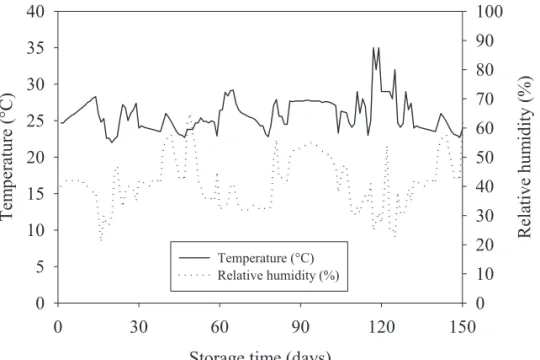
Figure 1 shows the mean daily values for the temperature and relative humidity of the air of the storage environment of the peanut fruits during the 150 days of storage. Since the environmental conditions were not controlled, thermal and relative humidity variations were noticed. The mean temperature during the storage period was 25.8 °C, considering that the maximal temperature was 35 °C, and the minimal was 22 °C. The mean relative humidity was 41%, and the recorded maximal was 65%, and the minimal was 21%.
Storage time (days)
0 30 60 90 120 150
Te
m
per
atu
re
(°
C)
0 5 10 15 20 25 30 35 40
Rela
tiv
e h
u
m
id
ity
(%)
0 10 20 30 40 50 60 70 80 90 100
Temperature (°C)
Relative humidity (%)
Figure 1. Daily means for the temperature and relative air humidity during the storage of the peanut fruits on an uncontrolled environment.
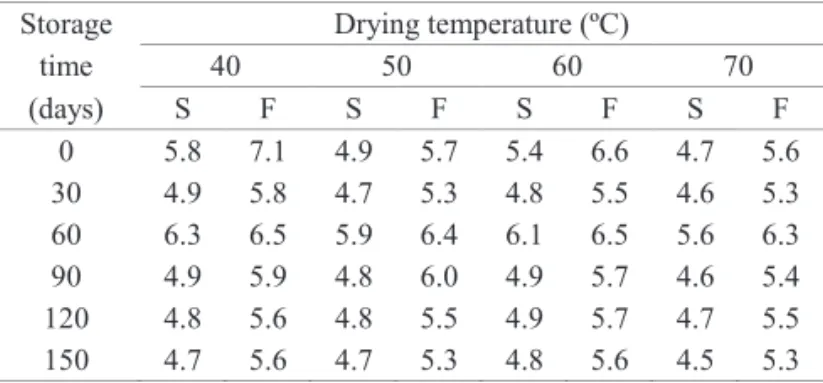
Table 1 shows that, due to the hygroscopicity both in relation to the fruits and the seeds, oscillations on the water contents of both occurred during storage, above all, due to the uncontrolled temperature and relative humidity conditions, which allowed the occurrence of phenomena such as sorption and desorption (Tiecker Junior et al., 2014). In addition, the lower balance water content observed for the seeds, in comparison to the fruits, probably occurred due to the high
hydrophobic potential of the seeds with a high oil content. Deliberali et al. (2010) and Bessa et al. (2015) also attributed the variation on the water content of the grains of
Triticum aestivum and Crambe abyssinica, respectively, to the
as responsible for the variations on the water content of the product during storage, such as: the drying air temperature, the physical integrity and the sanitary condition of the seeds, in addition to genetic factors (Chen, 2000; Carneiro et al., 2005).
Table 1. Mean values of the water content (% b.u.) of the peanut seeds (S) and fruits (F), according to the drying temperature and the storage time.
Storage Drying temperature (ºC)
time 40 50 60 70
(days) S F S F S F S F
0 5.8 7.1 4.9 5.7 5.4 6.6 4.7 5.6 30 4.9 5.8 4.7 5.3 4.8 5.5 4.6 5.3 60 6.3 6.5 5.9 6.4 6.1 6.5 5.6 6.3 90 4.9 5.9 4.8 6.0 4.9 5.7 4.6 5.4 120 4.8 5.6 4.8 5.5 4.9 5.7 4.7 5.5 150 4.7 5.6 4.7 5.3 4.8 5.6 4.5 5.3
normal seedlings was observed as the drying air temperature
raised. This deleterious effect was potentiated on a linear
manner as the storage progressed (Figure 2a). In addition, an increase could also be observed on the percentage of abnormal seedlings as both factors increased (Figure 2b), as well as a decrease on the percentage of dead seeds (Figure 2c).
Right after drying, the percentages of normal seedlings observed on the germination test for the temperatures of 40, 50, 60 and 70 °C were 96, 84, 65 and 10%, respectively. However, due to the occurrence of the referred latent behavior, at the end of the 150 days of storage, the observed percentages for the same temperatures were 83, 59, 41 and 0% (Figure 2a). Therefore, in case the parameters established by the normative guideline number 45 suggested by Brasil (2013) was adopted, which establishes as the minimal limit for the commercialization of peanut seeds as 70% of normal seedlings upon the germination test, only the lot of seeds dried at 40 °C could be marketed after the 150 days of storage, since the lot dried at 50 °C did not meet this requirements approximately after 90 days, and the other lots immediately after drying.
There was a significant effect between the drying
temperatures and the storage time for the germination of seeds, and an immediate reduction on the percentage of
(a) (b) (c)
N40 °C = 96.4286 - 0.0890 TA (R2 = 0.9075)
N50 °C = 83.6429 - 0.1652 TA (R2 = 0.9734)
N60 °C = 65.4762 - 0.1619 TA (R2 = 0.7733)
N70 °C = 10.0476 - 0.0662 TA (R2 = 0.4828)
A40 °C = 2.6190 + 0.0762 TA (R2 = 0.8350)
A50 °C = 8.7857 + 0.1062 TA (R2 = 0.8053)
A60 °C = 8.3571 + 0.1686 TA (R2 = 0.8600)
A70 °C = 2.1905 + 0.2252 TA (R2 = 0.8880)
D40 °C = 0.5952 + 0.0176 TA (R2 = 0.8206)
D50 °C = 6.0952 + 0.0710 TA (R2 = 0.9411)
D60 °C = 11.7381 + 0.1857 TA (R2 = 0.7949)
D70 °C = 56.7857 + 0.2429 TA (R2 = 0.9205)
40°C 50°C 60°C 70°C
Storage time (days)
0 30 60 90 120 150
Nor
m
al
see
dli
ngs (%)
0 20 40 60 80 100
Storage time (days)
0 30 60 90 120 150
Abnor
m
al
se
edli
ngs (%)
0 5 10 15 20 25 30 35 40 45
Storage time (days)
0 30 60 90 120 150
Dea
d see
ds (%
)
0 20 40 60 80 100
Figure 2. Results for the percentage of normal (a) and abnormal (b) seedlings and dead seeds (c) for the germination test of the peanut seeds, according to the drying temperature and the storage time.
In relation to the lot with seeds dried at 70 °C, it could be observed that, although the low percentage of abnormal seedlings (2%) does not portray the severity of the damages caused by the temperature immediately after drying, the number of dead seeds observed (57%) and the potentiation
of the latent deleterious effect evidenced by both variables, expressed by the increasing multiplicative coefficient, are an
evidence of such behavior (Figures 2b and 2c).
A significant effect was observed regarding the interaction
between the drying temperatures and the storage of seeds for
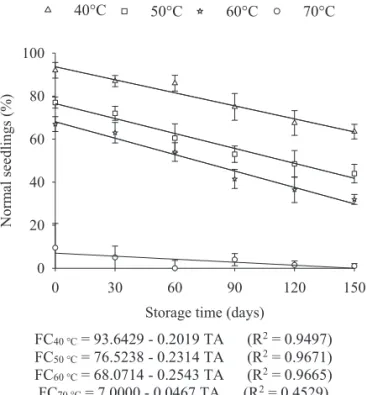
the first count test. Furthermore, in addition to the promotion of
normal seedlings as evidence of the vigor of the seeds submitted to drying and storage, the speed of the germination process, under adequate circumstances, could also be observed, since the
test allows this verification, as reported by Nakagawa (1999) and
results decreased as the air temperature and the storage time increased, as well as right after drying (94, 76, 68 and 7%) and at the end of the experiment (63, 42, 30 e 0%), it could be inferred that the germination speed was reduced (Figure 3).
tetrazolium test, which also indicated the reduction on the physiological quality of the seeds, indicating the negative
effects on the percentage of viable seeds (Figure 4).
However, since the test uses the coloration of living tissues
as its evaluation parameter, its sensitivity to differentiate
the lots, despite being immediately clear, was more evident when the drying air temperature of 70 °C was used, considering that the lots dried at 40, 50 and 60 °C showed
a more expressive difference on the coloration from 30
days of storage. As a consequence, therefore, it could be assumed that the damages promoted by the temperature of 70 °C were both of a physical and thermal nature, since the penetration of the tetrazolium salt was supposedly facilitated by the promotion of clefts on the cotyledons, as a result of the high water reduction rate, and also due to the lesions caused on the tissues, especially on the cellular membranes, resulting from the exposure to a high drying temperature for the culture.
FC40 °C = 93.6429 - 0.2019 TA (R2 = 0.9497) FC50 °C = 76.5238 - 0.2314 TA (R2 = 0.9671) FC60 °C = 68.0714 - 0.2543 TA (R2 = 0.9665) FC70 °C = 7.0000 - 0.0467 TA (R2 = 0.4529)
40°C 50°C 60°C 70°C
Storage time (days)
0 30 60 90 120 150
Nor
m
al
see
dli
ngs (%)
0 20 40 60 80 100
Figure 3. Results for the percentage of normal seedlings for
the first count test with peanut seeds, according to
the drying temperature and the storage time.
When evaluating the effect of different drying
temperatures on the physiological quality of saccharine sorghum seeds, Ullmann et al. (2015) obtained similar results to the ones found here. The authors observed that, as the drying air temperature increased, both the germination percentage and the speed of the germination process, indirectly expressed
by the first count, are reduced. As suggested by Afrakhteh et
al. (2013), such fact is usually a result of the increase on the speed in which the water is removed from the product, which is stimulated by the increase on the drying air temperature;
by creating a very high gradient different between the outer
and the inner part of the product, it promotes the formation of tegumentary clefts and microcracks on cotyledons, negatively impacting the quality of the seed. In addition, situations such as these also increase the susceptibility of the material to latent damages, or also aggravate their deterioration, therefore, reducing the longevity of the product and its quality (Mbofung et al., 2013).
A significant effect of the interaction between the
drying temperatures and storage was observed for the
VIA40 °C = 83.2381 - 0.1710 TA (R2 = 0.9828)
VIA50 °C = 78.0476 - 0.2795 TA (R2 = 0.9358)
VIA60 °C = 71.6905 - 0.3214 TA (R2 = 0.8224)
VIA70 °C = 11.6667 - 0.0700 TA (R2 = 0.8956)
40°C 50°C 60°C 70°C
Storage time (days)
0 30 60 90 120 150
Viabl
e se
eds (%
)
0 20 40 60 80 100
Figure 4. Results for the percentage of viable peanut seeds, according to the temperature of the drying air and the storage time.
On Table 2, it may be observed that the difference
Table 2. Mean values for the water content (% b.u.) of peanut seeds, subjected to 48 hours of accelerated aging at 40 °C, according to the drying temperature and the storage time.
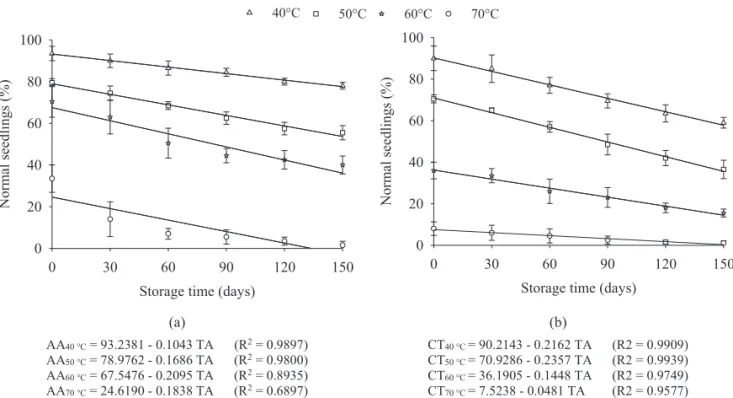
susceptibility of the material to the adverse environmental conditions imposed by the tests, such as the high temperature and relative humidity (accelerated aging) and low temperature (cold test) (Figure 5).
Immediately after drying, the percentage of normal seedlings observed for the accelerated aging test, related to the drying temperatures of 40, 50, 60 and 70 °C, were 93, 79, 67 and 25%, respectively. However, at the end of the 150 days of storage, the results observed for the same temperatures were 78, 54, 36 and 0% (Figure 5a), indicating the occurrence
of deteriorative effects during storage. For the cold test with
soil, the results observed for the same drying temperatures and evaluation times were 90, 71, 36 and 7%, respectively, and 58, 36, 14 and 0% (Figure 5b). However, since the results observed for the cold test were lower in relation to the values obtained by the aging test, a greater susceptibility of the seeds to cold possibly occurred, due to the imposed treatments, than under the high temperature and relative humidity conditions.
Storage time (days)
Drying temperatures (°C)
40 50 60 70
0 9.7 11.3 12.7 12.2
30 13.9 10.9 13.9 12.1
60 10.5 12.1 13.8 12.3
90 10.5 13.7 12.7 15.5
120 14.9 14.2 14.4 12.8
150 14.7 14.9 14.2 14.4
There was a significant effect of the drying temperatures
and storage for the accelerated aging and cold tests that also indicated the reduction on the vigor of seeds as both factors increased, as well as the progressive increase of the
(a) (b)
AA40 °C = 93.2381 - 0.1043 TA (R2 = 0.9897)
AA50 °C = 78.9762 - 0.1686 TA (R2 = 0.9800)
AA60 °C = 67.5476 - 0.2095 TA (R2 = 0.8935)
AA70 °C = 24.6190 - 0.1838 TA (R2 = 0.6897)
CT40 °C = 90.2143 - 0.2162 TA (R2 = 0.9909)
CT50 °C = 70.9286 - 0.2357 TA (R2 = 0.9939)
CT60 °C = 36.1905 - 0.1448 TA (R2 = 0.9749)
CT70 °C = 7.5238 - 0.0481 TA (R2 = 0.9577)
40°C 50°C 60°C 70°C
Storage time (days)
0 30 60 90 120 150
No
rm
al
see
dlings (%)
0 20 40 60 80 100
Storage time (days)
0 30 60 90 120 150
Nor
m
al
see
dli
ngs (%)
0 20 40 60 80 100
Figure 5. Results for the percentage of normal seedlings for the accelerated aging test (a) and for the cold test with soil (b), according to the drying temperature and the storage time.
When evaluating the physiological quality of rice seeds
submitted to different drying air temperatures through the
accelerated aging and cold tests, Menezes et al. (2012a) also observed that, as the air temperature increases, the vigor of the seeds is reduced, since the seed gets more susceptible to adverse environmental conditions, since its integrity is
compromised due to the deleterious effects of drying.
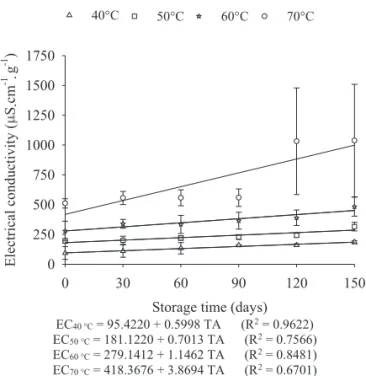
A significant effect of the drying temperatures and storage
Figure 6. Results of the electrical conductivity of the soaking solution of peanut seeds, according to the drying temperature and the storage time.
Acknowledgments
The financial support provided by the Coordenação de
Aperfeiçoamento de Pessoal de Nível Superior - Capes, and by the Fundação de Apoio ao Desenvolvimento do Ensino, Ciência e Tecnologia do Estado do Mato Grosso do Sul - Fundect.
References
AFONSO JÚNIOR, P.C.; CORRÊA, P.C. Efeitos imediato e latente da secagem de sementes de feijão colhidas com diferentes níveis de umidade. Ciência e Agrotecnologia, v.24, p.33-40, 2000. http://www.editora.ufla.br/ index.php/revistas/ciencia-e-agrotecnologia/artigos-publicados/10-volumes-revista/65-edicaoespeciale
AFRAKHTEH, S.; FRAHMANDFAR, E.; HAMIDI, A., RAMANDI, H.D. Evaluation of growth characteristics and seedling vigor in two cultivars
of soybean dried under different temperature and fluidized bed dryer.
International Journal of Agriculture and Crop Sciences, v.5, n.21, p.2537-2544, 2013. http://ijagcs.com/wp-content/uploads/2013/09/2537-2544.pdf ALMEIDA, D.P.; RESENDE, O.; MENDES, U.C.; COSTA, L.M.; CORRÊA,
P.C.; ROCHA, A.C. Influência da secagem na qualidade fisiológica do feijão
adzuki. Agrária - Revista Brasileira de Ciências Agrárias, v.8, n.2, p.311-315, 2013. http://agraria.pro.br/sistema/index.php?journal=agraria&page=arti-cle&op=view&path%5B%5D=agraria_v8i2a2164&path%5B%5D=1369 ARAUJO, W.D.; GONELI, A.L.D.; SOUZA, C.M.A.; GOLÇALVES, A.A.; VILHASANTI, H.C.B. Propriedades físicas dos grãos de amendoim durante a secagem. Revista Brasileira de Engenharia Agrícola e Ambiental, v.18, n.3, p.279-286, 2014. http://www.agriambi.com.br/revista/v18n03/v18n03a06.pdf BARBOSA, R.M.; VIEIRA, B.G.T.L.; MARTINS, C.C.; VIEIRA, R.D.
Qualidade fisiológica e sanitária de sementes de amendoim durante o processo
de produção. Pesquisa Agropecuária Brasileira, v.49, n.12, p.977-985, 2014. http://seer.sct.embrapa.br/index.php/pab/article/view/19217/12839
BARROS, A.S.R.; DIAS, M.C.L.L.; CICERO, S.M.; KRZYZANOWSKI, F.C. Testes de frio. In: KRZYZANOWSKI, F.C.; VIEIRA, R.D.; FRANÇA-NETO, J.B. (Eds.). Vigor de sementes: conceitos e testes. Londrina: ABRATES, 1999. p.5-1 a 5-15.
BESSA, J.F.V.; DONADON, J.R.; RESENDE, O.; ALVES, R.M.V.; SALES, J.F.; COSTA, L.M. Armazenamento do crambe em diferentes embalagens e
ambientes: parte I - qualidade fisiológica. Revista Brasileira de Engenharia
Agrícola e Ambiental, v.19, n.3, p.224-230, 2015. http://www.agriambi.com. br/revista/v19n03/v19n03a05.pdf
BRASIL. Instrução Normativa, nº.45, de 17 de setembro de 2013. Padrões de Identidade e Qualidade para a produção e a comercialização de sementes. Seção 1. Ministério da Agricultura, Pecuária e Abastecimento. Diário Oficial da União de 20/09/2013. Brasília. http://apasem.com.br/site/index.php/ instrucao-normativa-no-45/
BRASIL. Ministério da Agricultura, Pecuária e Abastecimento. Regras para análise de sementes. Ministério da Agricultura, Pecuária e Abastecimento. Secretaria de Defesa Agropecuária. Brasília: MAPA/ACS, 2009. 395p. http://
www.agricultura.gov.br/arq_editor/file/2946_regras_analise__sementes.pdf
CARNEIRO, L.M.T.A.; BIAGI, J.D.; FREITAS, J.G.; CARNEIRO, M.C.; FELÍCIO, J.C. Diferentes épocas de colheita, secagem e armazenamento na qualidade de grãos de trigo comum e duro. Bragantia, v.64, n.1, p.127-137, 2005. http://www.scielo.br/pdf/brag/v64n1/23860.pdf
EC40 °C = 95.4220 + 0.5998 TA (R2 = 0.9622)
EC50 °C = 181.1220 + 0.7013 TA (R2 = 0.7566)
EC60 °C = 279.1412 + 1.1462 TA (R2 = 0.8481)
EC70 °C = 418.3676 + 3.8694 TA (R2 = 0.6701)
40°C 50°C 60°C 70°C
Storage time (days)
0 30 60 90 120 150
Ele
ctric
al
conducti
vity
(
S
c
m
-1 g -1 )
0 250 500 750 1000 1250 1500 1750
These results indicate that the loss of integrity of the components of the membrane was caused by drying at temperatures above 40 ºC, associated to the prolonged storage, since, according to Marcos-Filho (2015), the electrical conductivity test expresses the degree of disorganization of the cell membranes, since the higher their integrity, the greater will be their capacity not to allow leaching and ions from its interior to the soaking solution. However, the integrity may usually be compromised by some factors, such as by the drying air temperature and the storage time, as observed for bean seeds (Faroni et al., 2006), jatropha seeds (Ullmann et al., 2010), adzuki bean seeds (Resende et al., 2012; Almeida et al., 2013), soy seeds (Smaniotto et al., 2014) and saccharine sorghum seeds (Ullmann et al., 2015), whose results related to the electrical conductivity also showed damages occurred on the cellular membranes of the seeds submitted to temperatures above 40 ºC and storage periods of over 100 days.
Conclusions
The increase on the drying air temperature affects the physiological potential of the peanut seeds, and this effect is
potentiated according to the storage time.
The drying air temperature of 40 °C favors the maintenance of the germination capacity of the seeds during the storage period of 150 days.
.
CHEN, C. Factors which effect equilibrium relative humidity of
agricultural products. Transactions of the American Society of Agricultural Engineers, v.43, n.3, p.673-683, 2000. http://eli- brary.asabe.org/abstract.asp?aid=2749&t=2&redir=aid=2749&c o n f a l i a s = & r e d i r = [ v o l u m e = 4 3 & i s s u e = 3 & brary.asabe.org/abstract.asp?aid=2749&t=2&redir=aid=2749&c o n f = t & o r g brary.asabe.org/abstract.asp?aid=2749&t=2&redir=aid=2749&c o n -f=t2000]&redirType=toc_journals.asp&redirType=toc_journals.asp DELIBERALI, J.; OLIVEIRA, M.; DURIGON, A.; DIAS, A.R.G.; GUTKOSKI, L.C.; ELIAS, M.C. Efeitos de processo de secagem e tempo de
armazenamento na qualidade tecnológica de trigo. Ciência e Agrotecnologia,
v.34, n.5, p.1285-1292, 2010. http://www.scielo.br/pdf/cagro/v34n5/29.pdf FARIA, R.Q.; TEIXEIRA, I.R.; CUNHA, D.A.; HONORATO, J.M.;
DEVILLA, A. Qualidade fisiológica de sementes de crambe submetidas à
secagem. Revista Ciência Agronômica, v.45, n.3, p.453-460, 2014. http:// www.ccarevista.ufc.br/seer/index.php/ccarevista/article/view/2306/971 FARONI, L.R.A.; CORDEIRO, I.C.; ALENCAR, E.R.; ROZADO, A.F.;
ALVES, W.M. Influência do conteúdo de umidade de colheita e temperatura
de secagem na qualidade do feijão. Revista Brasileira de Engenharia Agrícola e Ambiental, v.10, n.1, p.148-154, 2006. http://www.scielo.br/pdf/ rbeaa/v10n1/v10n1a22.pdf
FERNANDES, E.M.; ROSOLEM, C.A. Produtividade de amendoim em função da calagem e do método de secagem. Pesquisa Agropecuária Brasileira, v.34, n.1, p.11-20, 1999. http://seer.sct.embrapa.br/index.php/pab/ article/view/5142/2334
KRZYZANOWSKI, F.C.; WEST, S.H.; FRANÇA-NETO, J.B. Drying peanut seed using air ambient temperature at low relative humidity. Revista Brasileira de Sementes, v.28, n.3, p. 1-5, 2006. http://www.abrates.org.br/ artigos-publicados
MARCOS-FILHO, J. Fisiologia de sementes de plantas cultivadas. 2 ed. Londrina, PR: ABRATES, 2015. 660p.
MARCOS-FILHO, J. Teste de envelhecimento acelerado. In: KRZYZANOWSKI, F.C.; VIEIRA, R.D.; FRANÇA-NETO, J.B. (Eds.). Vigor de sementes: conceitos e testes. Londrina-PR: ABRATES, 1999. p.3-1 a 3-24. MBOFUNG, G.C.Y.; GOGGI, A.S.; LEANDRO, L.F.S.; MULLEN, R.E.
Effects of storage temperature and relative humidity on viability and vigor
of treated soybean seeds. Crop Science, v.53, n.3, p.1086-1095, 2013. https:// dl.sciencesocieties.org/publications/cs/articles/53/3/1086
MENEZES, N.L.; PASQUALLI, L.L.; BARBIERI, A.P.P.; VIDAL, M.D.; CONCEIÇÃO, G.M. Temperaturas de secagem na integridade
fí-sica, qualidade fisiológica e composição química de sementes de arroz.
Pesquisa Agropecuária Tropical, v.42, n.4, p.430-436, 2012a. https:// www.revistas.ufg.br/index.php?journal=pat&page=article&op=view&pa-th%5B%5D=18457&path%5B%5D=12715
MENEZES, N.L.; CICERO, S.M.; VILLELA, F.A.; BORTOLOTTO, R.P.
Using x-rays to evaluate fissures in rice seeds dried artificially. Revista Brasileira de Sementes, v.34, n.1, p.70-77, 2012b. http://www.scielo.br/pdf/ rbs/v34n1/a09v34n1.pdf
MOORE, R. P. Handbook on tetrazolium testing. International Seed Testing Association - ISTA, 1985. 99p.
MUTEGI, C.K.; WAGACHA, J.M.; CHRISTIE, M.E.; KIMANI, J.;
KARANJA, L. Effect of storage conditions on quality and aflatoxin
contamination of peanuts (Arachis hypogaea L.). International Journal of AgriScience, v.3, n.10, p.746-758, 2013. http://oar.icrisat.org/7288/1/ IntlJAgriSci_3_10_746_758_2013.pdf
NAKAGAWA, J. Teste de vigor baseados no desempenho de plântulas. In: KRZYZANOWSKI, F.C.; VIEIRA, R.D.; FRANÇA-NETO, J.B. (Eds.). Vigor de sementes: conceitos e testes. Londrina: ABRATES, 1999. p.2-1 a 2-24. NAKAGAWA, J.; ROSOLEM, C.A. O Amendoim: Tecnologia de Produção. Botucatu: FEPAF, 2011, 325p.
OLIVA, A.C.E.; BIAGGIONI, M.A.M.; CAVARIANI, C. Efeito imediato do método de secagem na qualidade de sementes de crambe. Revista Energia na Agricultura, v.27, n.3, p.16-30, 2012. http://revistas.fca.unesp.br/index.php/ energia/article/view/645/303
PESKE, S.T.; VILLELA, F.A.; MENEGHELLO, G.E. (Eds). Sementes:
fundamentos científicos e tecnológicos. Pelotas: Editora Universitária da
UFPel, 3.ed., 2012. 573p.
RESENDE, O.; ALMEIDA, D.P.; COSTA, L.M.; MENDES, U.C.; SALES, J.F. Adzuki beans (Vigna angularis) seed quality under several drying conditions. Ciência e Tecnologia de Alimentos, v.32, n.1, p.151-155, 2012. http://www.scielo.br/pdf/cta/v32n1/aop_cta_5007.pdf
SANTOS, R.C.; FREIRE, R.M.M.; LIMA, L.M.; AGONEL, G.F.; COSTA,
B.J. Produtividade de grãos e óleo de genótipos de amendoim para o mercado
oleoquímico. Revista Ciência Agronômica, v.43, n.1, p.72-77, 2012. http:// www.ccarevista.ufc.br/seer/index.php/ccarevista/article/view/1564/671 v SMANIOTTO, T.A.S.; RESENDE, O.; MARÇAL, K.A.F.; OLIVEIRA,
D.E.C.; SIMON, G.A. Qualidade fisiológica das sementes de soja
armazenadas em diferentes condições. Revista Brasileira de Engenharia Agrícola e Ambiental, v.18, n.4, p.446-453, 2014. http://www.agriambi.com. br/revista/v18n04/v18n04a13.pdf
TIECKER JUNIOR, A.; GUIMARÃES, L.E.; FERRARI FILHO, E.; CASTRO, B.; DEL PONTE, E.M.; DIONELLO, R.G. Qualidade físico-química de grãos de milho armazenados com diferentes umidades em ambientes hermético e não hermético. Revista Brasileira de Milho e Sorgo, v.13, n.2, p.174-186, 2014. http://rbms.cnpms.embrapa.br/index.php/ojs/ article/view/484/pdf_93
TILLMANN, M.A.A.; MENEZES, N.L. Análise de sementes. In: PESKE, S.T.; VILLELA, F.A.; MENEGHELLO, G.E. (Eds.). Sementes: fundamentos
científicos e tecnológicos. Pelotas: Editora Universitária da UFPel, 3.ed.,
2012. p.161-272.
ULLMANN, R.; RESENDE, O.; SALES, J.F.; CHAVES, T.H. Qualidade das
sementes de pinhão manso submetidas à secagem artificial. Revista Ciência
Agronômica, v.41, n.3, p. 442-447, 2010. http://www.ccarevista.ufc.br/seer/ index.php/ccarevista/article/view/911/463
ULLMANN, R.; RESENDE, O.; CHAVES, T.H.; OLIVEIRA, D.E.C.;
COSTA, L.M. Qualidade fisiológica das sementes de sorgo sacarino
submetidas à secagem em diferentes condições de ar. Revista Brasileira de Engenharia Agrícola e Ambiental, v.19, n.1, p.64-69, 2015. http://www. agriambi.com.br/revista/v19n01/v19n01a11.pdf
VASCONCELOS, F.M.T.; VASCONCELOS, R.A.; LUZ, L.N.; CABRAL, N.T.; OLIVEIRA JÚNIOR, J.O.L.; SANTIAGO, A.D.; SGRILLO, E.; FARIAS, F.J.C.; MELO FILHO, P.A.; SANTOS, R.C. Adaptabilidade
e estabilidade de genótipos eretos de amendoim cultivados nas regiões
Nordeste e Centro-Oeste. Ciência Rural, v.45, n.8, p.1375-1380, 2015. http:// www.scielo.br/pdf/cr/v45n8/0103-8478-cr-45-08-01375.pdf