Repositório ISCTE-IUL
Deposited in Repositório ISCTE-IUL:
2020-11-06
Deposited version:
Accepted Version
Peer-review status of attached file:
Peer-reviewed
Citation for published item:
Neto, D. D., Baptista, T. M., Marques, C. & Ferreira, A. S. (2020). The role of weight perceptions and their impact on health and well-being: a multiple mediation model. Clinical Obesity. 10 (4)
Further information on publisher's website:
10.1111/cob.12362
Publisher's copyright statement:
This is the peer reviewed version of the following article: Neto, D. D., Baptista, T. M., Marques, C. & Ferreira, A. S. (2020). The role of weight perceptions and their impact on health and well-being: a multiple mediation model. Clinical Obesity. 10 (4), which has been published in final form at https://dx.doi.org/10.1111/cob.12362. This article may be used for non-commercial purposes in accordance with the Publisher's Terms and Conditions for self-archiving.
Use policy
Creative Commons CC BY 4.0
The full-text may be used and/or reproduced, and given to third parties in any format or medium, without prior permission or charge, for personal research or study, educational, or not-for-profit purposes provided that:
• a full bibliographic reference is made to the original source • a link is made to the metadata record in the Repository • the full-text is not changed in any way
The full-text must not be sold in any format or medium without the formal permission of the copyright holders.
Serviços de Informação e Documentação, Instituto Universitário de Lisboa (ISCTE-IUL) Av. das Forças Armadas, Edifício II, 1649-026 Lisboa Portugal
Phone: +(351) 217 903 024 | e-mail: [email protected] https://repositorio.iscte-iul.pt
The role of weight perceptions and their impact on health and well-being: A multiple mediation model
What is already known about this subject
• People generally underreport their weigh although different conditions can affect this bias
• Some research suggests that weigh perceptions associated more strongly with health and wellbeing outcomes than actual weigh.
What this study adds
• Weigh perceptions mediate the relationship between actual weight and health and wellbeing outcomes
• The distance between perceived and desired weigh (that may reflect a critical attitude towards weight) is more relevant in this process than the distance between perceived and actual weight (that may reveal misperception)
Abstract
The present study analyses the role of weight distortion and weight self-criticism in explaining the relationship between actual weight and perceived health, well-being, body satisfaction, and emotional eating. 806 individuals were selected from a national study on nutrition. They were divided into two groups according to self-reported dieting. A
questionnaire measuring the outcome variables was implemented. Weight distortion and self-criticism were calculated using actual, estimated, and desired BMI. A multiple mediation model was estimated using Structural Equation Modelling. A valid model was obtained in which weight self-criticism is a partial mediator of the relationship between weight and body satisfaction and a full mediator of the relationship between weight and emotional eating for the non-dieter group. For the dieter group, full mediation of weight self-criticism is observed in the relationships between weight and health, well-being, and body satisfaction. For weight distortion, no mediation effect is found in either group. The results highlight the importance of weight perceptions in understanding the influence of body weight on several aspects of health and well-being. The type of weight perception is also relevant. A critical attitude towards weight is more determinant than the distortion in weight appraisal.
Introduction
The influence of obesity on health and other outcomes is well established. Obesity is a risk factor for various illnesses and leads to a rise in mortality (1,2). Furthermore, an increased Body Mass Index (BMI) has been found to influence major depression, suicide ideation and suicide attempts (3,4), as well as self-reported poorer health and mental health (5). Obesity not only has a visible negative effect on health but it has also been associated with reduced quality of life and subjective well-being (5,6) and increased costs for health systems (7).
Research is now focusing on mechanisms that explain the impact of obesity. There is evidence that the physiological consequences of obesity influence certain physical illnesses (2). However, cultural and psychological factors associated with body weight affect a wide range of health outcomes, depression, and well-being and, in some instances, these factors may be more relevant than actual body weight. For example, Chaiton et al. (8) found that body satisfaction and reported pressure to be thin play an important role in the relationship between adiposity and depression. More recently internalized weight stigma was found to mediate the relationship between weight and depressive symptoms on overweigh university students (9). This research thus suggests that psychological factors may be crucial mechanisms through which weight affects health and wellbeing.
Research on emotional eating provides further evidence of the relevance of psychological mechanisms in understanding the relationship between obesity and health outcomes (10). Emotional eating refers to changes in eating behaviour in response or associated with significant emotional responses (e.g., eating to deal with negative affect) (11). Whereas overweight individuals reported eating more than normal- and under-weight individuals, when in a negative emotional state; underweight individuals reported eating
less than the other groups (12). Emotional eating has also been associated with depression and poor eating habits and higher body mass (11).
The influence of this psychological dimension is addressed in this research by studying body weight with reference to illness perception theories. These theories state that health outcomes and personal responses to illness depend on how these illnesses are
perceived and represented (13–15). Weight perception can be an important factor in the individuals’ relationship with their body weight. One aspect of weight perception and reporting that is particularly relevant the perception of actual weight. The literature has identified a general trend of under-reporting body weight in various contexts (16,17) and cultures (18). The fact that this bias exists suggests that weight estimations can be used to study weight perceptions.
Several variables affect perceived weight. Gender, obesity or body weight, and age are among the most frequently observed in the literature (19–22). Gender, in particular, has an essential role in perceived weigh. Women are more likely to perceive themselves as being overweight, and this over-reporting has several implications for variables such as subjective attractiveness and well-being (23,24). These results may also help to understand why obesity is a more significant risk factor in terms of mental health for women (25)
With respect to its consequences, weight perception is more relevant than actual weight for some variables such as psychological distress and self-rated health. Bias in perceived weight increases the probability of suffering from medium or high psychological distress; on the other hand, actual weight status does not increase this distress when
perceived weight is statistically controlled (26). Also, although both perceived weight and actual weight status influence self-rated health and life satisfaction, perceptions are more closely related to these outcomes (27). The understanding of the mechanisms through
which the perception of weight affects these outcomes will increase our understanding of the consequences of weight and obesity.
Another result that highlights the relevance of adequate weight estimation is its relationship with the likelihood of engaging in weight reduction behaviours (28,29). The perception of body weight may be associated with the representation of obesity, and this can affect both the body image and willingness to engage in weight reduction activities (30). Finally, more than the actual weight, perceived weight has a greater influence on disordered eating behaviour (31).
Despite the importance given to weight perception in the literature reviewed, the full picture may be more complex. For example, patients with eating disorders report their body weight very accurately (32), and this draws attention to the relevance of addressing weight perception considering other dimensions. The focus given to eating and the intention involved in eating and dieting may play a role. Patients with eating disorders give greater attention to body weight and dieting, and this affects their identities and lifestyles. The fact that these individuals focus on controlling their weight affects how body weight itself is perceived. In other words, the perceived actual weight is not necessarily biased in all cases but may be a function of the focus given to obesity and eating behaviour. In the general population, the same process may occur in other situations. The increased focus may be relevant to dieting behaviour as it is assumed that more attention is given to weight control. For example, restrained eaters tend to underestimate their body weight regardless of gender or BMI, and restrained eating is the best predictor of this underestimation in college
students (33). Future research will then have to consider weight perceptions considering the different focus given, by different participants, to eating and dieting.
Present Study
The literature shows several impacts of weight and obesity in health and well-being. Some of these impacts are due to weight perceptions. Research has shown the impact of weight perception on several outcomes and processes associated with obesity. Nevertheless, a fuller understanding of the relationship of these variables with outcomes such as well-being or health is required. Namely, whether the type of weight perceptions is relevant and taking into account the focus given to eating and dieting. The reviewed literature serves as the basis for the conceptual framework that underlies the analysis of this study. It is
assumed that some of the effects of actual weigh on health and well-being are due to weight perceptions. Although the present study does not allow causal inferences, this conceptual framework implies that the association between weigh and health and well-being outcomes will be explained – at least partially – by weight perceptions.
The present study involves a multivariate analysis to test a multiple mediation model using Structural Equation Modelling (SEM). The model will test the mediating role of weight distortion (perceived BMI - actual BMI) and weight self-criticism (desired BMI - perceived BMI) in the relationship between actual BMI and perceived health, well-being, body satisfaction, and emotional eating. Weight distortion is assumed to refer to the accuracy in perceiving weight, while weight self-criticism reflects the attitude towards weigh irrespective of the accuracy of its estimations. Given the importance of the focus on eating behaviour for weight perceptions, two groups will be tested on whether the
participants report being on a diet or not: a) dieters and b) non-dieters. In light of the presented conceptual model, the following hypotheses are proposed:
H1: Body weight is negatively associated with perceived health, well-being, body satisfaction, and emotional eating;
H2: Weight distortion and self-criticism mediate the relationship between body weight and the outcomes, namely perceived health, well-being, body satisfaction, and emotional eating; H3: The mediation of weight distortion and self-criticism is stronger in the group of dieters.
Considering the role of gender in weight representation, the proposed model will be analysed for both males and females. By addressing a broad range of outcomes, it is possible to study the differential role of weight perceptions for several outcomes. This broad range includes not only health and well-being but also two specific consequences of body weight and obesity. Body satisfaction and emotional eating refer to both the emotional appraisal of body image and weight and the emotional impact on feeding behaviour. This study will allow the analysis of whether weight perceptions explain the influence of body weight and obesity on these outcomes more clearly.
Materials and Methods Participants
The study sample was selected from the Portuguese national survey on nutrition and feeding behaviour: ‘Observatório da Nutrição e Alimentação em Portugal’ (34), the aim of which is to analyse the nutrition and food behaviour habits of Portuguese citizens aged 15 years or over. Reason behind this age span was to include all citizens than can participate without parental consent, according to the country’s legal framework. This is a
sample stratification took region residence, gender, and age group into account. Data were collected from several public spaces of the different regions under analysis, on various randomly chosen weekdays and times. Informed consent was obtained from all individual participants included in the study. The original sample included 1221 participants.
The present study analyses all participants that completed the questionnaire, including the objective measurement of body weight and height. There were 806
participants, 457 (56.7%) of whom are female; the average age of the sample is 47.4 (SD = 18.77, Min = 15, Max = 97, 5th percentile = 22, 95th percentile = 75). Most participants were married (318, 39.9%) or single (267, 33.5%) and most had secondary education (12 years; 316, 39.2%), BA or higher (241, 29.9%) or third cycle (9 year of education; 120, 14.9%). Participants were divided into two groups, namely those who stated they were on a diet and those that did not. Table 1 compares the socio-demographic characteristics of the two groups. These analyses were conducted using SPSS 23 (35).
(Table 1 around here)
Instruments
In the original survey, a questionnaire was administered in an individual interview, after which several objective measurements were taken. All interviews were conducted by nutritionists with specific training on how to apply the questionnaire.
This analysis considered four outcome variables: perceived health, well-being, body satisfaction, and emotional eating. Perceived health was measured by the following two items on a seven-point semantic differential scale ranging from bad (1) to excellent (2): ‘how do you consider your physical health in general’ and ‘how do you consider your
mental health in general.’ Well-being was assessed according to the Ryff model (36,37), more specifically based on participants' answers to the question ‘how often do you feel the following dimensions of well-being: general well-being, personal fulfilment, life
satisfaction, happiness, self-acceptance, positive relations with others, control over the environment, life goals, personal growth and autonomy?’. Participants were invited to rate each of these dimensions on a five-point Likert scale ranging from never (1) to always (5). Body satisfaction included two items measured on a four-point Likert scale (from 1, very unsatisfied, to 4, very satisfied): ‘How satisfied are you with your weight?’ and ‘How satisfied are you with your body image?’ Lastly, emotional eating included three items: ‘When I am emotionally unstable, I eat less healthily’; ‘When I am emotionally unstable, I eat in excess’; and ‘On at least one occasion, I have started eating and could not stop even though I was not hungry.’ These questions had yes/no responses that were converted to ratios to allow for the analyses.
Weight and height were objectively measured. Height was measured with a stadiometer SECA 213®. Weight was measured using a portable Omron BF511® scale. Participants were instructed to keep their feet in a parallel position and slightly separated, with their body in an upright position, and with their arms on the side. Both weight and height were measured by trained researchers after the participants had removed their shoes. All measurements were rounded to the nearest decimal value (0.1kg and 0.1cm). The BMI (BMI = weight / height2) was calculated from the measured body weight (measured in
kilograms) and height (measured in meters). Participants provided information on their perceived weight and height as well as desired weight in the questionnaire. This
information was used to calculate the estimated BMI and the desired BMI. The mediating variables considered in the model are weight distortion and weight self-criticism, calculated
as follows: weight distortion is the difference between real BMI and perceived BMI, and weight self-criticism is the difference between perceived BMI and desired BMI.
Model Estimation Procedure
Structural equation modelling (SEM) was used to test the proposed direct and multiple mediation relationships. Multiple mediation involves the simultaneous mediation of two possible mediators: weight distortion and self-criticism. The advantage of using one multiple mediation model rather than several simple mediation models is that it determines the effect of a conditional mediator in the presence of other mediators (38). The hypothesized model was estimated by the Maximum Likelihood Method using Amos 23 (39). The bias-corrected bootstrap was adopted to produce more accurate confidence limits for the indirect effects (38). The Bollen-Stine bootstrap procedure was also used to obtain a goodness-of-fit statistic (40).
A measurement model with all latent variables and their corresponding items was first estimated by confirmatory factor analysis to assess the convergent and discriminant validity. The correct evaluation of measurement models is a pre-requisite for structural model evaluation (41,42). Different types of goodness-of-fit measures were used to assess the model-data fit in both the overall measurement model and structural model; these included the Chi-square, the Root Mean Square Residual (RMR), the Root Mean Square Error Approximation (RMSEA), the Goodness-of-Fit Index (GFI), the Adjusted GFI (AGFI) as well as the Comparative Fit Index (CFI) and the Parsimonious CFI (PCFI). RMSEA values ranging from 0.01 to 0.06 are indicative of a close fit, and 0.06 to 0.10
indicate an acceptable fit (43). The smaller the RMR, the better the model fit is. The GFI, AGFI, CFI, and PCFI range from 0 (no fit) to 1 (perfect fit) (44).
Results
An overall measurement model was estimated for each group of respondents to assess the convergent and discriminant validity. Few items were dropped due to low standardized loadings (inferior to 0.5) in the models for the non-dieter and dieter groups. After this purification procedure, items were deemed valid (convergent and discriminant validity and composite reliability). Table 2 presents the standardized loading estimates for each item.
(Table 2 around here)
A multigroup structural equation modelling approach was also carried out to compare men and women on the structural relationships. To test for model invariance across gender, the chi-square from a model with all parameters allowed to be unequal across gender was compared to the chi-square from a model with all parameters constrained to be equal across gender except structural coefficients for both the non-dieter and dieter groups.
Regarding the overall model fit, the indices values were placed within the recommended limits in the two models and were considered indicative of good fit (see note to Figure 1 on group models). The RMSEA value is 0.101 for both models, which is precisely in the acceptable limit and within the 90% confidence interval for RMSEA. This result means that the RMSEA is within the range associated with an acceptable fit.
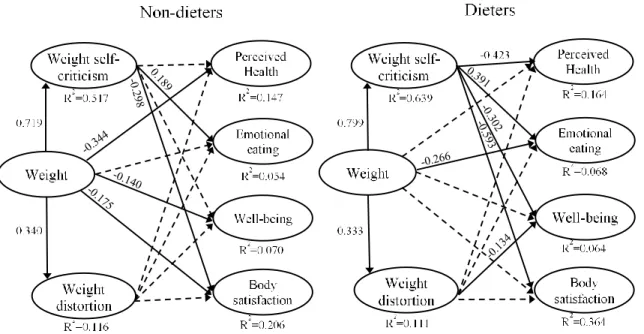
Figure 1 shows the results of the structural model for both groups, namely the standardized significant estimates of regression coefficients and the squared multiple correlations of each dependent construct. The former estimates are indicative of the relationships' strength, whereas the latter indicates the amount of variance in each endogenous latent variable accounted for by the antecedent latent variables. Solid lines represent significant relationships between variables. Table 5 presents the indirect effects of body weight on the outcome variables through weight self-criticism and distortion, and their total effect (direct and indirect effects), for both the non-dieter and dieter groups.
(Figure 1 & Table 3 around here)
Weight self-criticism is a full mediator of the relationships between body weight and perceived health, well-being, and body satisfaction and a suppressor of the relationship between weight and emotional eating in the dieter group. In the non-dieter group, weight self-criticism is a partial mediator of the relationship between weight and body satisfaction and a full mediator of the relationship between weight and emotional eating. In contrast, weight distortion does not mediate any relationship with weight in either group of participants. The mediation of weight self-criticism is stronger in the dieter group than among non-dieters
As expected, the estimate of the squared multiple correlation coefficient for the outcome variables is low since there is only one predictor (weight). However, body satisfaction has a higher R2 than the other outcome variables, reaching 0.364 in the dieter group. It is also interesting to note that weight explains 52% and 64% of the weight
self-criticism in the non-dieter and dieter groups respectively, but just over 10% of the weight distortion.
A multigroup SEM analysis was used for testing gender differences for non-dieters and dieters. Chi-squared test for differences shows that there is no difference between the female and male models in the non-dieters group [∆χ2 (26) = 36.558, p = 0.082]. In contrast, this test presents differences in the regression coefficient estimates across the two gender models in the dieter group [∆χ2 (26) = 32.529, p < 0.01]. Table 6 presents the standardized regression coefficients for the two gender models.
(Table 4 around here)
Discussion
The broad aim of the present study was to understand the role of weight perceptions in the way actual weight affects the following outcomes: perceived health, well-being, body satisfaction, and emotional eating. Previous research had established both the relationships between weight and these outcomes and other studies established the importance of weight perceptions. By using structural equation modelling, we analysed the effects of weight perceptions on these variables in a multivariate way. Furthermore, the model was tested in two groups assumed to have different focus given to eating and dieting by contrasting participants on a diet or not. The results confirm that weight perceptions are of vital importance to understand some of the effects of body weight on perceived health, well-being, emotional eating, and body satisfaction.
The first hypothesis - body weight associates with perceived health, well-being, body satisfaction, and emotional eating - is partially confirmed for both the non-dieter and
dieter groups. As expected, body weight has a direct and negative relation with perceived health, well-being, and body satisfaction for non-dieters; however, it does not have an effect on emotional eating. The direct effects of body weight are the result of the complex nature of weight and the importance of other factors, such as biological consequences and the cultural representation of obesity (1,2,6). Emotional eating is only associated with actual weight in the dieter group; this suggests it is only relevant to actual body weight when individuals have a particular focus on eating because they are on a diet.
The second hypothesis - weight perception has a mediating role - is not confirmed for weight distortion but is partially validated for weight self-criticism in the non-dieter group. Four specific results show these relations. First, body weight is associated positively both with weight self-criticism and distortion but has a stronger effect on the former than the latter. Second, weight distortion is not related to any outcome; therefore, it is not a mediator of the relationships between body weight and the four outcomes. Third, weight self-criticism is associated with satisfaction with the body and emotional eating. Fourth, two mediating effects of weight self-criticism are found: weight self-criticism is a partial mediator of the relationship between body weight and body satisfaction and a full mediator of the relationship between weight and emotional eating. Whereas this partial mediation means that body weight still has a direct effect on body satisfaction, full mediation means that the direct association between weight and emotional eating is no longer significant when the mediator, self-criticism, is considered (45,46).
The second hypothesis is partially verified for weight self-criticism in the dieter group due to the following results. Firstly, weight distortion negatively affects well-being, but it does not mediate the weight/well-being relationship. Since weight distortion does not affect any other variable, it is not a mediator of any of these weight relationships. Secondly,
weight self-criticism is related to all the outcomes but only has a positive effect on emotional eating. Thirdly, as body weight also has a very strong and positive relation with weight self-criticism, the relationship of weight with perceived health, well-being and body satisfaction is fully mediated by weight self-criticism.
Weight self-criticism has a specific effect on the relationship between body weight and emotional eating in the dieter group, known as statistical suppression (46). Suppression occurs when the direct effect of body weight is directionally opposite to its indirect effect via weight self-criticism. This means that an increase in actual weight slightly reduces emotional eating; however, when self-criticism is considered, actual weight increases emotional eating, thus suppressing the previous effect. Future research should examine this observation in greater depth. Emotional eating is linked to emotional distress, and its relationship with actual weight may be more complex than previously thought.
Of the two possible mediators considered, weight self-criticism plays a more significant role than weight distortion. Weight distortion has only direct associations with actual weight (in both groups) and well-being (in dieters), but it is not a mediator of any of the relationships considered. This means that for these outcomes and in a community sample, the valence of the evaluation of individual weight is more important than the misrepresentation of actual weight. This result may not be the same in all samples; for example, body image distortion has been considered relevant for eating disorders (47,48).
The results support the third hypothesis, namely that the strength of these
mediations differ in the two groups. In the dieter group, weight self-criticism has a more significant role in terms of both the number and strength of mediations. The difference between groups can be understood by the greater focus on eating and body weight,
characteristic of people on a diet. When less focus is placed on controlling eating, self-criticism about weight may be less relevant and less associated with outcomes such as perceived health and well-being. The difference between groups means that the importance of the focus people place on controlling eating may have an effect on the importance of weight perception. People’s motivations for tackling weight issues can help tailor
intervention programs; the findings of this study can be used for this purpose. It should be noted that dieters and non-dieters not only differ in body weight but also in other variables such as age. These variables, particularly age, should be considered in future research studying this model.
The present model shows several differences across gender for the dieter’s group. Firstly, the effect of body weight on self-criticism is stronger for men. This means that for women, other factors than actual body weight may play a more significant role in weight criticism. Secondly, the effect of self-criticism on well-being is stronger but negative for women. Among men, this effect does not exist. This is consonant with the greater
importance given in society to weight in the female gender (23,24,49). The fact that gender representations are consonant with the directions of the relationships of the anticipated variables and the fact that this is only true for the dieter’s groups reinforces the results of the overall model.
The results of the present study suggest that weight perceptions partially determine the influence of body weight. It is important to stress that these outcomes are self-reported. However, while an eventual bias, in reporting, is less applicable to psychological outcomes such as well-being and body satisfaction, it may be more relevant for variables such as health. It should be noted that even though the self-reported dimension in these variables is
relevant, the results are consistent with the literature on objective measures (26,27). Furthermore, this study found that actual weight had a direct effect on these self-reported outcomes.
There are several limitations to this research. Firstly, although both groups were selected from a representative sample of the Portuguese population, only participants with objective measurements of body weight/height or BMI were considered. Participants who did not agree to measure body weight could have been different from the current sample in terms of weight perceptions or actual weight. Secondly, the participants were interviewed using a questionnaire specifically developed for a national survey on this area. Therefore, the variables were analysed without using the most researched and established instruments. Thirdly, since this study used cross-sectional data, it does not allow determining causality between variables. Finally, this research was conducted in a broad national sample. Future research should analyse the relationships in specific groups based on demographic (e.g., age) and other variables (e.g., presence of obesity).
Conclusion
The model analysed in this research corresponds to a new way of understanding the influence of body weight, and the results have several implications. First, the results show the importance of multivariate analyses in understanding a phenomenon as complex as obesity. Body weight and its consequences will be influenced by several factors that should be considered in future studies. The present study shows that one of these factors, weight perceptions, has to be understood in a more complex way. It is not only relevant to assess it
under or overestimation but also how the individuals position themselves towards their weight – in a critical or accepting manner. Finally, these variables relate in a different way whether individuals are on a diet or not. These individuals will give a different attention or focus on their weight and feeding behaviour. Future research should consider other
conditions that affect this focus, such as in eating disorders.
Furthermore, weight perceptions should be taken into account when designing interventions to prevent and treat obesity. In addition to their role in health and well-being outcomes, weight perceptions may also be valuable in the adherence to treatment plans or healthy lifestyles. In particular, this research suggests that the misappraisal of weight by the general population is less relevant than self-criticism about weight. Interventions that foster weight acceptance may promote change more successfully than those providing precise feedback about changes in personal weight.
Acknowledgements
This paper resulted from a secondary analysis done on the raw data of a national survey on nutrition and feeding behaviour conducted by Premivalor and in which the Ordem dos Psicólogos Portugueses (OPP) participated. The authors would like to thank the OPP and PREMIVALOR for allowing and facilitating access to this data.
DDN and TMB conceived the analysis considering the lituerature. CM ASF conducted the analyses. All authors were involved in writing the paper and had final approval of the submitted and published versions.
Funding
This study was funded by Fundação para a Ciência e a Tecnologia, research project UID/GES/00315/2013
Declaration of Conflicting Interests
The authors declare that there is no conflict of interest.
References
1. Flegal KM, Kit BK, Orpana H, Graubard BI. Association of all-cause mortality with overweight and obesity using standard body mass index categories. JAMA.
2013;309(1):71–82.
2. Bell JA, Kivimaki M, Hamer M. Metabolically healthy obesity and risk of incident type 2 diabetes: A meta-analysis of prospective cohort studies. Obes Rev.
2014;15:504–15.
3. Carpenter KM, Hasin DS, Allison DB, Faith MS. Relationships between obesity and DSM-IV major depressive disorder, suicide ideation, and suicide attempts: Results from a general population study. Am J Public Health. 2000;90(2):251–7.
4. Swahn MH, Reynolds MR, Tice M, Miranda-Pierangeli MC, Jones CR, Jones IR. Perceived overweight, BMI, and risk for suicide attempts: Findings from the 2007 youth risk behavior survey. J Adolesc Heal [Internet]. 2009;45(3):292–5. Available from: http://dx.doi.org/10.1016/j.jadohealth.2009.03.006
5. Ford ES, Moriarty DG, Zack MM, Mokdad AH, Chapman DP. Self-reported body
mass index and health-related quality of life: findings from the Behavioral Risk Factor Surveillance System. Obes Res. 2001;9(1):21–31.
6. Robertson S, Davies M, Winefield H. Why weight for happiness? Correlates of BMI and SWB in Australia. Obes Res Clin Pract [Internet]. 2015;9(6):609–12. Available from: http://dx.doi.org/10.1016/j.orcp.2015.04.011
7. Specchia ML, Veneziano MA, Cadeddu C, Ferriero AM, Mancuso A, Ianuale C, et al. Economic impact of adult obesity on health systems: A systematic review. Eur J Public Health. 2014;25(2):255–62.
8. Chaiton M, Sabiston C, O’Loughlin J, McGrath JJ, Maximova K, Lambert M. A structural equation model relating adiposity, psychosocial indicators of body image and depressive symptoms among adolescents. Int J Obes (Lond) [Internet].
2009;33(5):588–96. Available from: http://dx.doi.org/10.1038/ijo.2009.43
9. Decker KM, Thurston IB, Kamody RC. The mediating role of internalized weight stigma on weight perception and depression among emerging adults: Exploring moderation by weight and race. Body Image. 2018;27:202–10.
10. Nguyen-Rodriguez ST, Chou CP, Unger JB, Spruijt-Metz D. BMI as a moderator of perceived stress and emotional eating in adolescents. Eat Behav. 2008;9(2):238–46. 11. Konttinen H, Mannisto S, Sarlio-Lahteenkorva S, Silventoinen K, Haukkala A.
Emotional eating, depressive symptoms and self-reported food consumption. A population-based study. Appetite. 2010;54(3):473–9.
12. Geliebter A, Aversa A. Emotional eating in overweight, normal weight, and underweight individuals. Eat Behav. 2003;3(4):341–7.
13. Martin R, Nothrock N, Leventhal H, Leventhal E. Common sense models of illness: Implications for symptom perception and health‐related behaviors. In: Suls J, Wallston KA, editors. Social psychological foundations of health and illness. Malden, MA: Blackwell Publishing; 2003. p. 199–225.
14. Weinman J, Petrie KJ. Illness perceptions: A new paradigm for psychosomatics? J Psychosom Res. 1997;42(2):44–6.
15. Figueiras MJ, Maroco J, Monteiro R, Caeiro R, Neto DD. Discerning the impact of personal and situational variables in risk perception of coronary heart disease. J Health Psychol [Internet]. 2017 Mar;22(4):483–92. Available from:
http://hpq.sagepub.com/content/early/2015/09/11/1359105315604379.abstract 16. Gorber SC, Tremblay M, Moher D, Gorber B. A comparison of direct vs. self-report
measures for assessing height, weight and body mass index: A systematic review. Obes Rev. 2007;8(4):307–26.
17. Brener ND, Eaton DK, Lowry R, McManus T. The association between weight perception and BMI among high school students. Obes Res. 2004;12(11):1866–74. 18. Mikolajczyk RT, Maxwell AE, El Ansari W, Stock C, Petkeviciene J, Guillen-Grima
F. Relationship between perceived body weight and body mass index based on self- reported height and weight among university students: A cross-sectional study in seven European countries. BMC Public Health. 2010;10:40.
19. Gunnare NA, Silliman K, Morris MN. Accuracy of self-reported weight and role of gender, body mass index, weight satisfaction, weighing behavior, and physical activity among rural college students. Body Image [Internet]. 2013;10(3):406–10. Available from: http://dx.doi.org/10.1016/j.bodyim.2013.01.006
validity of obesity based on self-reported weight and height: Implications for population studies. Obesity [Internet]. 2007 Jan;15(1):197–208. Available from: http://doi.wiley.com/10.1038/oby.2007.536
21. Coleman L, Loprinzi PD. The Influence of Weight Status Duration on Weight Perception Accuracy. Am J Heal Promot [Internet]. 2018 Mar 22;32(3):816–20. Available from: http://journals.sagepub.com/doi/10.1177/0890117116686013 22. Buscemi S, Marventano S, Castellano S, Nolfo F, Rametta S, Giorgianni G, et al.
Role of anthropometric factors, self-perception, and diet on weight misperception among young adolescents: A cross-sectional study. Eat Weight Disord [Internet]. 2018;23(1):107–15. Available from: https://doi.org/10.1007/s40519-016-0306-4 23. McCreary DR, Sadava SW. Gender differences in relationships among perceived
attractiveness, life satisfaction, and health in adults as a function of body mass index and perceived weight. Psychol Men Masc [Internet]. 2001;2(2):108–16. Available from: http://doi.apa.org/getdoi.cfm?doi=10.1037/1524-9220.2.2.108
24. Tiggemanng M, Winefield HR, Winefield AH, Goldney RD. Gender differences in the psychological correlates of body-weight in young adults. Psychol Health. 1994;9(5):345–51.
25. Barry D, Pietrzak RH, Petry NM. Gender differences in associations between body mass and DSM-IV mood and anxiety disorders: Results from the national
epidemiologic survey on alcohol and related conditions. Ann Epidemiol. 2008;18(6):458–66.
26. Atlantis E, Ball K. Association between weight perception and psychological distress. Int J Obes. 2008;32(4):715–21.
27. Herman KM, Hopman WM, Rosenberg MW. Self-rated health and life satisfaction among Canadian adults: Associations of perceived weight status versus BMI. Qual Life Res. 2013;22(10):2693–705.
28. Lemon SC, Rosal MC, Zapka J, Borg A, Andersen V. Contributions of weight perceptions to weight loss attempts: Differences by body mass index and gender. Body Image [Internet]. 2009 Mar;6(2):90–6. Available from:
http://linkinghub.elsevier.com/retrieve/pii/S1740144508001307
29. Bojorquez I, Villatoro J, Delgadillo M, Fleiz C, Fregoso D, Unikel C. Social factors, weight perception, and weight control practices among adolescents in Mexico. J Health Psychol. 2018;23(7):939–50.
30. Fernald LC. Perception of body weight: A critical factor in understanding obesity in middle-income countries. J Women’s Heal. 2009;18(8):1121–2.
31. Alkazemi D, Zafar TA, Ebrahim M, Kubow S. Distorted weight perception correlates with disordered eating attitudes in Kuwaiti college women. Int J Eat Disord. 2018;51(5):449–58.
32. McCabe RE, McFarlane T, Polivy J, Olmsted MP. Eating disorders, dieting, and the accuracy of self-reported weight. Int J Eat Disord [Internet]. 2001 Jan;29(1):59–64. Available from:
http://doi.wiley.com/10.1002/1098-108X%28200101%2929%3A1%3C59%3A%3AAID-EAT9%3E3.0.CO%3B2-%23 33. Shapiro JR, Anderson DA. The effects of restraint, gender, and body mass index on
the accuracy of self-reported weight. Int J Eat Disord. 2003;34(1):177–80.
34. Premivalor. Observatório da nutrição e alimentação em Portugal (1a Edição). Lisboa; 2016.
35. IBM Corp. IBM SPSS Statistics for Windows, Version 23.0. Armonk, NY: IBM Corp; 2015.
36. Ryff CD, Keyes CL. The structure of psychological well-being revisited. J Pers Soc Psychol. 1995;69(4):719–27.
37. Ryff CD. Beyond Ponce de Leon and life satisfaction: New directions in quest of successful ageing. Int J Behav Dev. 1989 Mar;12(1):35–55.
38. Preacher KJ, Hayes AF. Asymptotic and resampling strategies for assessing and comparing indirect effects in multiple mediator models. Behav Res Methods [Internet]. 2008 Aug [cited 2017 Apr 11];40(3):879–91. Available from: http://www.springerlink.com/index/10.3758/BRM.40.3.879
39. Arbuckle JL. AMOS (version 23.0). Chicago: IBM SPSS; 2014.
40. Bollen KA, Stine R. Direct and indirect effects: Classical and bootstrap estimates of variability. Sociol Methodol [Internet]. 1990;20(1):115–40. Available from:
http://www.jstor.org/stable/pdf/271084.pdf%5Cnhttp://www.jstor.org/stable/271084 %5Cnhttp://about.jstor.org/terms
41. Anderson J, Gerbing D. Structural equation modeling in practice: A review and recommended two-step approach. Psychol Bull. 1988;103(3):411–23.
42. Fornell C, Larcker DF. Evaluating structural equation models with unobservable variables and measurement error. J Mark Res [Internet]. 1981 Feb [cited 2017 Apr 11];18(1):39–50. Available from:
http://www.jstor.org/stable/3151312?origin=crossref
43. Browne MW, Cudeck R. Alternative ways of assessing model fit. In: Bollen KA, Long JS, editors. Testing structural equation models. Beverly Hills, CA: Sage Publications; 1993. p. 136–62.
44. Hair JFJ, Black WC, Babin BJ, Anderson RE. Multivariate data analysis. 7th ed. Upper Saddle River: Prentice Hall; 2010. 734 p.
45. Baron RM, Kenny DA. The moderator-mediator variable distinction in social psychological research: Conceptual, strategic, and statistical considerations. J Pers Soc Psychol. 1986;51(6):1173–82.
46. MacKinnon DP, Krull JL, Lockwood CM. Equivalence of the mediation, confounding and suppression effect. Prev Sci. 2000 Dec;1(4):173–81. 47. Hrabosky JI, Cash TF, Veale D, Neziroglu F, Soll EA, Garner DM, et al.
Multidimensional body image comparisons among patients with eating disorders, body dysmorphic disorder, and clinical controls: A multisite study. Body Image [Internet]. 2009 Jun;6(3):155–63. Available from:
http://dx.doi.org/10.1016/j.bodyim.2009.03.001
48. Stice E. Risk and maintenance factors for eating pathology: A meta-analytic review. Psychol Bull. 2002;128(5):825–48.
49. Furnham A, Badmin N, Sneade I. Body image dissatisfaction: Gender differences in eating attitudes, self-esteem, and reasons for exercise. J Psychol Interdiscip Appl. 2002;136(6):581–96.
Table 1
Characterization of the Dieters and Non-Dieters Groups Variable Dieters (n= 238) Non-dieters (n = 568) Group differences Gender Male 98 (41.0%) Female 140 (59.0%) Male 251 (44.2%) Female 317 (55.8%) χ2 (1) = 0.62, p > .05 Age (years) M = 45.3, SD = 17.6 M = 48.3, SD = 19.2 t (804) =2.12, p < .05 Weight (Kg.) M = 73.4, SD = 13.5 M = 69.2, SD = 13.7 t (804) = -3.93, p < .01 Height (m.) M = 1.65, SD = 0.09 M = 1.64, SD = 0.1 t (804) = -0.70, p > .05 BMI (Kg/m2) M = 27.1, SD = 4.54 M = 25.7, SD = 4.39 t (804) = -4.04, p < .01
Table 2
Descriptives and Standardized Item Loadings for the Overall Measurement Models Latent Variable Item Non-dieters’ model Dieters’ model
mean±SD Std. loadings
mean±SD Std. loadings Body weighta Actual BMI 25.7 ± 4.39 1.000 27.1 ± 4.54 1.000 Weight self-criticisma Desired BMI – perceived BMI 1.2 ± 2.35 1.000 2.3 ± 2.83 1.000 Weight distortiona Perceived BMI – actual BMI 1.0 ± 1.46 1.000 0.9 ± 1.58 1.000 Perceived Health (CRND = 0.670; CRD= ---)c Mental health 5.0 ± 0.93 0.542 b b Physical health 4.7 ± 0.86 0.707 4.8 ± 0.96 1.000 Emotional eating (CRND = 0.978; CRD = 0.980)c Compensatory eating 0.2 ± 0.25 0.951 0.3 ± 0.25 0.796 Overeating 0.2 ± 0.23 0.533 0.2 ± 0.25 0.749 Compulsive eating b b b b Well-being (CRND = 0.920; CRD = 0.931)c General well-being 3.7 ± 0.90 0.723 3.8 ± 0.90 0.714 Personal fulfilment 3.6 ± 0.95 0.809 3.6 ± 0.89 0.760 Life satisfaction 3.6 ± 0.95 0.860 3.8 ± 0.86 0.804 Happiness 3.7 ± 0.93 0.850 3.8 ± 0.83 0.769 Self-acceptance 3.8 ± 0.89 0.717 3.9 ± 0.88 0.765 Positive relations with others 4.1 ± 0.80 0.569 4.1 ± 0.68 0.676 Control over the environment 3.6 ± 0.91 0.548 3.7 ± 0.88 0.584 Life goals 3.8 ± 1.03 0.661 3.9 ± 0.87 0.687 Personal growth 3.7 ± 0.98 0.656 3.9 ± 0.86 0.678 Autonomy 4.1 ± 0.87 0.575 4.2 ± 0.79 0.550 Body satisfaction (CRND = 0.934; CRD = 0.919)c
Satisfaction with weight 2.8 ± 0.62 0.948 2.6 ± 0.72 0.906 Satisfaction with body image 2.8 ± 0.55 0.702 2.8 ± 0.61 0.766
Note. a Note that body weight, weight self-criticism, and weight distortion are each measured by a single indicator; b Item dropped during the purification procedure; c CR
ND and CRD referto Composite Reliability
(χ2 (142) =967.191, p=0.000; GFI=0.840; AGFI=0.785;
CFI=0.829; PCFI=0.627; RMR=0.119; RMSEA=0.101, P=0.000, 90%CI=[0.095, 0.107] )
(χ2 (142) =455.569 p=0.000; GFI=0.835; AGFI=0.780;
CFI=0.867; PCFI=0.720; RMR=0.107; RMSEA=0.097, P=0.000, 90%CI=[0.087, 0.107] )
Figure 1. Standardized regression coefficient estimates for the structural model in both
groups.Dashed lines refer to non-significant regression coefficient estimates. Model fit measures are presented below the models.
Table 3
Direct, Indirect and Total Effects for both Groups: Standardized Estimates and corresponding Standard Errors (in parentheses)
Independent
Variable Effect Type
Dependent Variable Weight self-criticism Weight distortion Perceive d Health Emot. Eating Well-being Body Satisf. Non-dieters’ group Body weight Direct 0.719* (0.016) 0.340* (0.013) -0.344* (0.011) 0.031 (0.002) -0.140** (0.009) -0.175* (0.008) Total indirect - - -0.037 (0.073)c 0.154** (0.058)c -0.105** (0.046)c -0.227* (0.068)c Total 0.719* (0.016) 0.340* (0.013) -0.381* (0.056)c 0.185** (0.041)c -0.245** (0.044)c -0.402* (0.049)c WC - - -0.040 (0.020) 0.189* (0.004) -0.110a (0.017) -0.298* (0.014) WD - - -0.025 (0.023) 0.054 (0.004) -0.075 (0.020) -0.038 (0.017) Dieters’ group Body weight Direct 0.799* (0.024) 0.333* (0.021) 0.064 (0.022) -0.266** (0.005) 0.163 (0.016) -0.013 (0.014) Total indirect - - -0.368* (0.095)c 0.341* (0.102)c -0.286** (0.104)c -0.474* (0.095)c Total 0.799* (0.024) 0.333* (0.021) -0.304* (0.066)c 0.075 (0.066)c -0.123 (0.068)c -0.487* (0.051)c WC - - -0.423* (0.034) 0.391* (0.007) -0.302* (0.025) -0.593* (0.022) WD - - -0.088 (0.038) 0.087 (0.008) -0.134b (0.029) 0.002 (0.025)
Note. WC = Weight self-criticism; WD = Weight distortion; *p < 0.01; **p < 0.05; a p = .071; b p = 0.057; c Bootstrap Standard Error.
Considering A an independent variable and B a dependent variable, a Total effect between A and B = Direct
effect between A and B + Total indirect effects between A and B; where the Total indirect effects between A and B is the sum of all indirect effects between A and B. The direct effect between A and B measures the extent to which the dependent variable B changes when the independent variable A increases by one.
Table 4
Multiple Group Analysis for Dieters: Standardized Estimates and T statistic for Differences between Males and Females
Relationships Male (n=98) Female (n=140) T statistic Std.Est. SE Std.Est. SE
Weight –> Weight self-criticism Weight –> Weight distortion Weight –> Perceived Health Weight –> Emotional Eating Weight –> Well-being Weight –> Body satisfaction
0.830* 0.332* 0.091 0.156 -0.276 -0.106 0.039 0.040 0.038 0.007 0.028 0.028 0.804* 0.332* -0.020 -0.267 0.279 -0.157 0.029 0.024 0.028 0.006 0.019 0.016 -2.303** -0.804 -0.511 -1.819 2.244** -0.047 Weight self-criticism –> Perceived Health
Weight self-criticism –> Emotional Eating Weight self-criticism –> Well-being Weight self-criticism –> Body satisfaction
-0.410** 0.278 0.147 -0.504* 0.058 0.010 0.040 0.040 -0.339** 0.227 -0.386* -0.449* 0.047 0.010 0.033 0.028 0.127 -0.136 -2.266** 0.519 Weight distortion –> Perceived Health
Weight distortion –> Emotional Eating Weight distortion –> Well-being Weight distortion –> Body satisfaction
-0.061 -0.052 0.040 0.089 0.052 0.010 0.038 0.038 -0.068 0.004 -0.198** 0.032 0.055 0.011 0.038 0.033 -0.184 0.376 -1.771 -0.437 Note. *p < 0.01; **p < 0.05.