A Work Project presented as part of the requirements for the Award of a Master’s degree in Management from the Nova School of Business and Economics.
Customer behaviour and experience through a new concept of
grocery shopping
Student name: Gaetano Naselli
Work project carried out under the supervision of: Sofia Kousi
Abstract
Technologies are continuously impacting the daily life of each business. Pingo Doce & Go Nova represents an innovative concept of grocery shopping, which, through a combination of technologies, is willing to deliver one of the most advanced shopping experiences possible. The main objective of this paper is to examine how this service affects customer behaviour in terms of impulse buying and to demonstrate how consumers react to problems originated by disruptions in the technological system of the supermarket.
The results of an online experiment provide an insight that this technology is widely accepted by the consumers, and that they find it both easier to use and more time efficient compared to existing technologies already adopted by regular supermarkets. The study indicates that the technology affects the different ways customers feel while grocery shopping at the two different retail environments analysed, even though they would react similarly while facing a problem in the store, and how their buying impulse is further impacted in tech-driven supermarkets.
Keywords: Retail, Technology Acceptance Model, Impulse buying, Customer Experience
This work used infrastructure and resources funded by Fundação para a Ciência e a Tecnologia (UID/ECO/00124/2013, UID/ECO/00124/2019 and Social Sciences DataLab, Project 22209), POR Lisboa (LISBOA-01-0145-FEDER-007722 and Social Sciences DataLab, Project 22209) and POR Norte (Social Sciences DataLab, Project 22209).
Table of Contents
Abstract ... 1
Introduction ... 3
Literature Review ... 4
Why This Topic ... 4
Innovative technologies in the retail sector ... 5
How Impulse Buying can be affected by technology ... 6
Technology and Experience Economy ... 7
Technology Acceptance Model (TAM) ... 9
Research Questions & Methodology ... 10
Research Questions ... 10
TAM ... 11
Impulse Buying ... 11
Experience Economy ... 12
Research Design ... 12
Structure of the questionnaire ... 13
Data Collection ... 14
Results and Analysis ... 15
Discussion ... 19
Implications ... 23
Limitations and future research ... 24
Conclusions ... 25 References ... 26 Appendix ... 29 Appendix 1 ... 29 Appendix 2 ... 30 Appendix 3 ... 30 Appendix 4 ... 31 Appendix 5 ... 31 Appendix 6 ... 31
Introduction
Competition in the retail sector is fierce, and every player has to differentiate itself in the most innovative and unique way to attract as many customers as possible. The retail industry, and particularly the supermarkets, sector has seen huge innovations in the last years (Strange, 2019); technologies such as self-service check-out systems are nowadays found in almost every supermarket big or small.
From a logistical perspective, technology has covered a crucial role in this sector, since it has helped to better coordinate and to facilitate the stockage of the stores. The technology that Amazon has launched in 2018 with Amazon GO, defines a new concept of supermarkets that does not provide any physical cashier system with their “Just Walk-Out Technology”, and it is dramatically revolutionizing the industry.
Following a similar strategy of the American multinational, in 2019 Jeronimo Martins launched Pingo Doce & Go Nova (“Pingo Doce: Food Distribution”, n.d.). This store represents one of the finest technological developments of the retail industry and it offers a new concept of grocery shopping. The technology that allows this supermarket to work is a mix of NFC (Near Field Communication) and computer vision (“Pingo Doce: FAQ”). Through the store app every customer after registration can get into the store scanning the QR code on their smartphones. Once entered, it is a contactless technology (Near Filed Communication or NFC) that allows your smartphone to scan the price tags as you go; with just one tap customers are able to purchase goods that are stored automatically into a virtual shopping chart that can be paid for instantly without waiting in line.
This technology has the goal of enhancing the grocery shopping experience of customers and saving time in the usually lengthy check-out process. As we live in a world where the competition in the retail industry is continuous and full of innovations, it is crucial to know more about the new progresses of the technologies within this sector, their impacts and how
they could be beneficial for business when a company is intended to undertake an investment of this calibre. The general understanding is that the whole industry is moving towards the direction taken by Amazon and Jeronimo Martins, and that in few years the majority of supermarkets might present similar concepts of technology, prioritizing the consumers desire to reduce check-out time through the application of technology (Portell and Ghandi, 2019). Considering the location of Pingo Doce & Go Nova at the Nova SBE campus in Lisbon, the target of this research is students from Nova School of Business and Economics in Lisbon, that are supposed to be highly familiar with smartphones and the latest tech innovations.
In this research, this innovative concept of grocery shopping has been analysed through three different parameters: (1) the Technology Acceptance Model (TAM), to define whether customers correctly understand this technology and whether they find it easier to use rather than other kind of technologies used in supermarkets; (2) one of the categories of consumer behaviour, impulse buying, to discover if hi-tech services actually have an impact on how consumers grocery shop and how they perceive it; (3) and finally, customer experience, to be able to determine that customers could feel differently in a new and innovative retail concept rather than a traditional one, particularly when encountering an issue during their grocery journey.
Literature Review
Why This Topic
This research will cover several topics related to an innovative technological environment such as Pingo Doce & Go Nova, the new concept of grocery store launched by Jeronimo Martins in Portugal. In order to analyse how customers perceive the technology, and whether they are in favour of this kind of supermarket, the researcher proposes to examine the technology behind
evaluated, the study will present an analysis of two marketing related topics: (1) customer behaviour, under the concept of impulse buying, and (2) customer experience, in terms of how consumers feel, and more specifically how they could react in occasion of facing an issue in such environment.
The reason why the researcher has decided to focus on customer experience and customer behaviour is linked to the fact that both are topics that are always highly discussed in the marketing industry and are considered key aspects when a business has to implement a marketing plan. Fully understanding these concepts in relation to technologies in the retail industry can lead entrepreneurs to have a more transparent overview of the opportunities in this sector.
Innovative technologies in the retail sector
In many studies about the retail sectors it has been researched how technologies such as Near Field Communication (NFC) positively impact customer decisions and contribute to increase store revenues (Chuawatcharin and Gerdsri, 2019; Dutot, 2015).
Amazon has been a pioneer of experimenting a mix of technologies through the launch of Amazon GO, an innovative supermarket that does take advantage of the Just Walk Out Technology (JWOT), a fusion of Computer Vision, Deep Learning Algorithm and Sensors, completely eliminating the traditional check-out process (Amazon, n.d.). Through its sensors, JWOT automatically recognizes if products are taken from or returned to the store’s shelves and keeps track of them in a virtual cart. When you’re done shopping, you can just leave the store (Amazon, n.d.).
This novel technology promises to enhance customers’ shopping experiences, particularly by allowing them to save time and not wait in line for check-out or have to pay by cash. It is also beneficial for entrepreneurs by improving the effectiveness of the stores and reducing costs of
cashier employment (Chuawatcharin and Gerdsri, 2019). In their research, Chuawatcharin and Gerdsri (2019), focus their study on the behaviour of customers in Bangkok, analysing the technology of Amazon GO and whether it might be accepted by them. Their study has led this research to further concentrate the attention in other markets and with different technologies applied to the retail sector.
How Impulse Buying can be affected by technology
Impulse buying is an aspect of customer behaviour which has been researched deeply in different studies (Piron, 1991; Schiffman and Kanuk, 2010; Michael, William and Pandit, 2010). It is important since it is considered a fundamental value for managers in order to understand their customers and particularly how the business is performing in terms of communication and marketing of the products.
Impulse buying is influenced by different factors such as the shopping environment, a customer’s routine, or the product itself (Muruganantham and Bhakat, 2013). In the case of this research, the attention is focused on the external environment. Technology obviously plays a crucial role in terms of environment in which the buyer is about to shop. With its exponential growth, technologies such as self-service check-out and innovative display of products has accustomed shoppers to perform more impulse buying in certain settings (Michael et al, 2010). Piron (1991) concluded that buying impulses can be generated when a consumer encounters a visual stimulus in the retail shopping environment such as ambience, store size, design and formats. Nowadays, impulse buying has such an important impact in today’s business decisions as seen with sales promotions and particularly through the appropriate use of technologies in the retail stores (Schiffman and Kanuk, 2010). Moreover, replicating the findings of Omar et al. (2001), shop environment, exclusivity of products, different payments methods, promotions
in retail shops. These particularities mentioned by Omar et al. (2001) are available at Pingo Doce & Go Nova, and they are fundamental for the existence of the supermarket.
An interesting concept discussed in other studies is the perception that customers have when they have to process a payment using technology. This topic is also empowered by Hayashi (2012) whose study stressed the convenience of mobile payments (such as NFC), and how beneficial they can be for customers in different environments. He further highlights the consumers’ perception about the degree of control they have over their own payments. However, Hayashi (2012) proved that the value debit card users place on the ability to monitor finances and control spending is very important.
This research differs from the other studies as the concept of impulse buying are not analysed in an innovative retail environment such as Pingo Doce & Go Nova; moreover, they target a different sample of population than students from a business school in Portugal.
Technology and Experience Economy
In 1998 J. Pine II and J. Gilmore explained the concept of Experience Economy (Pine and Gilmore, 1998). They believed that innovative design, excellent marketing, and efficient delivery will be as crucial for customers’ experiences as they are for goods and services. “Ingenuity and innovation will always precede growth in revenue” (Pine and Gilmore, 1998). Customer participation has a key role in the experience, as an active interaction constructs and influences the experience itself. The connection between the customer and the business further enhances the experience, particularly in instances in which consumers are impressed by the shopping process and hence retain positive and long-term memories of said experience. According to Experience Economy theory of Pine and Gilmore (1998), there are five experience design principles that a manager has to take into account: (1) theme the experience, (2) harmonize impressions with positive cues, (3) eliminate negative cues, (4) mix in memorabilia,
(5) engage all five senses. Experiences have to meet a customer need, and customers gain experiential perceptions of the services provided by the company during the shopping process, so that they are more attracted to the products. As goods and services are developed through a detailed process of research and development, experiences are built from an iterative course of exploration, scripting, and staging that businesses will need to master in order to be successful (Pine and Gilmore, 1998).
Specifically, in the retail sector self-service technologies are playing an essential role in order to provide a memorable experience to the customers. The industry is focused on customer experience, with the shopping experience playing a key function in increasing revenues and attracting consumers (Yakhlef, 2015). During the checkout process, it is very important for consumers to have a positive experience when using technologies such as QR code recognition and face recognition. This inner emotional experience makes consumers appreciate their shopping experience, and consequentially improve their satisfaction and loyalty to said shop (Lyu, et all., 2019).
In 2018, PwC released the report “Experience is everything: here’s how to get it right”. In this study it is stated that 32% of customers are likely to neglect a brand that they love after one bad experience (Clark and Kingorn, 2018). Regarding the retail industry, and particularly the supermarket sector, Hasan and Mishra (2015) proved that the main key driver influencing shopping behaviour in retail stores is the shopping experience. In some cases, technologies such as self-service check-out could interfere with customer experience in a negative way, as these new systems might not be easy to understand for an elderly customer demographic for instance (Demirici, Orel and Kara, 2014).
Through these studies the researcher noticed that a contribution was necessary in terms of applying the theories related on how customers feel and how differently they behave in a
technological environment such the one of Pingo Doce and Go Nova compared to a traditional supermarket.
Technology Acceptance Model (TAM)
Fred Davis developed the Technology Acceptance Model (Davies, et al. 1989) which is now widely recognised as one of the most significant theories for explaining the relationship and the understanding between user’s behaviour and the use of a technological system (Chuawatcharin and Gerdsri, 2019). The TAM is built on the theory of Reasoned Action (Fishbein and Ajzen, 1975), a psychology model which proposes that an individual’s attitude towards behaviour is an important motivator of social behaviour. In their studies, Davis et al. (1989) proposed two external variables for interpreting the TAM: perceived usefulness and perceived ease of use. These two elements are considered fundamental determinants of the system in order to predict and explain the usage of the system (Davis, 1989).
This model has been already used for different studies about the retail sector, as in the case of Chuawatcharin and Gerdsri (2019). They adapted the TAM for understating how the technology developed by Amazon (the Just-Walk-Out-Technology) is accepted by Thai customers and what is their level of anxiety in terms of trusting this technology for payments. The figure below provides a graphical explanation of the TAM, and how the actual usage of a technological system can be influenced by the mentioned external factors.
For the purpose of this research, it will take into account the TAM only partially. In fact, in order to evaluate the technology of Pingo Doce & Go Nova, the researcher has used ease of use and usefulness as metrics to determine the perception that customers have of this technology.
Research Questions & Methodology
The Literature Review gave to the researcher several guidelines to further explore the technologies in the retail sector. It has been noted that most of the researches conducted in similar topics are based in Asian countries, due probably to the predisposition of the population towards technological innovations. Moreover, the sector of supermarkets has not been exhaustively researched in terms of technological changes, and this offered the author interesting ideas to develop to further elaborate the topic. In the following section, the researcher will go through the gaps that have been noted in the Literature Review.
Research Questions
According to the theories analysed in the previous section, there are three research questions in this study, and consequently three hypotheses.
1. NFC and Computer Vision are technologies that have already been analysed through the TAM model (Dutot, 2015). Davies et al. (1989) mentioned in their studies that ease of use is determinant for a proper usefulness of the technology considering that “the less effort a technology requires, the more likely that use of technology will increase the task performance” (Davies et al., 1989).
According to the TAM, do customers find the new technology at Pingo Doce & Go Nova easier and more useful to use compared to the existing technology, such as self-service check-out systems, used in other retail environments?
2. The relationship between impulse buying and technology has been the main topic of many studies (Micheal et al., 2010; Piron, 1991; Schiffman, 2010). These studies agree on the aspect that customers exposed to technology in a retail environment tend to have stronger impulse buying.
In terms of customer behaviour, does the technology at Pingo Doce & Go Nova impact more customer buying impulse rather than self-service check-out technology used in other retail environments?
3. Technology has enhanced in an exponential way how businesses interpret customer experience. Yakhlef (2015) and Lyu (2019) argued that a positive check-out experience while using technologies makes customers appreciate more their shopping experience, contributing positively to the loyalty and satisfaction of the shopper.
Does the technology at Pingo Doce & Go Nova have an impact on how a customer feels while grocery shopping?
Based on these empirical studies and findings, this research proposes the following hypotheses:
TAM
H1: Technologies such as NFC and Computer Vision contribute to provide a more enjoyable shopping experience. According to the standards of the TAM, and comparing them with existing technologies already in use in regular supermarkets, these technologies are easier to use and more useful when a customer is grocery shopping. In environments as Pingo Doce & Go Nova, this will lead customers to save time while grocery shopping and require less assistance from the store’s employees.
Impulse Buying
H2: Technologies such as NFC and Computer Vision have an impact on what customers buy and how much they spend. There is a tendency of engaging in more impulsive purchases at Pingo Doce & Go Nova rather than at regular supermarkets.
Experience Economy
H3.1: Technologies such as NFC and Computer Vision contribute to enhance and improve customer experience in terms of how they feel while grocery shopping.
H3.2: In situations where there are technological malfunctions, customers react more negatively in environments mainly supported by hi-tech devices, which consequently are more strongly impacted as a whole compared to regular supermarkets.
Research Design
The research has been designed as an online between – subjects experiment, using a convenience sample. It provided one questionnaire, in which respondents were randomly placed in one of the two different experimental conditions: (1) high-tech condition at Pingo Doce & Go Nova and (2) regular store conditions using self-service check-out technology at any regular supermarket (to simplify the understanding of the scenario, in the questionnaire it has been chosen ‘Pingo Doce’ as a reference supermarket). Pingo Doce & Go Nova has been chosen for this research as its technology is innovative and unique. Moreover, having regular stores in the Portuguese retail market allows for a practical comparison.
Davis et. al (1989) in the development of the TAM have created a pool of questions in order to test their theory. Some of these questions have been used in this research to understand the relationship of the customer of a retail shop in Portugal with both the mix of technologies used by Pingo Doce & Go Nova, and with the self-service check-out systems widely adopted in many supermarkets. Through these questions it has been possible to measure the scores for ease of use and usefulness. In order to avoid any bias among participants, the exact same questions were asked for both conditions. This strategy has been adopted also to be able to compare two innovative technologies which are disrupting the retail market.
Besides understanding how customers in Portugal relate to technology, this research aims to discover the correlation between technology and buying impulses. The questions were presented in such a way to better understand participants’ shopping impulses, understating their perception of how much they spent and whether they might have the impression of buying more items than planned.
Lastly, this study has the goal of understanding what the participants felt in terms of experience in such a technological environment. To be able to test so, the research takes into account the Experience Economy (Pine & Gilmore, 1998) guidelines, following the five-key experience-design principles mentioned in the previous section (‘Literature Review, The Experience Economy concept in the retail sector’). Moreover, the questionnaire depicted a scenario in which the participant had to face a problem while shopping in a retail environment. This strategy has been adopted to know how the customers would react in a difficult situation and whether they might be willing to come back.
Structure of the questionnaire
The respondents were asked to complete a survey of 20 questions (see Appendix 1), to be able to measure their relationship and perception of the technology. The answers were measured through Likert scales varying from 1 (‘strongly disagree/less likely’) to 5 (‘strongly agree/more likely’). In the section of measuring the customer experience the questionnaire was built in two different parts: the first one where it was asked to remember how they felt during their last experience grocery shopping, and the second one where the participants were asked to put themselves in the shoes of someone walking into a retail shop to purchase a coffee, but not being able to get their coffee because of a misfunction of a machine (see Appendix 5 for further details about the ‘facing a problem’ scenario). The participants were asked to rank their ‘anger level’, once analysed a so-called case of ‘facing a problem scenario’; the scale for this question
was measured from 1 (‘annoyance’) to 4 (‘rage). As a conclusion of this section, it has been asked to the customers how they would react in this troubling circumstance.
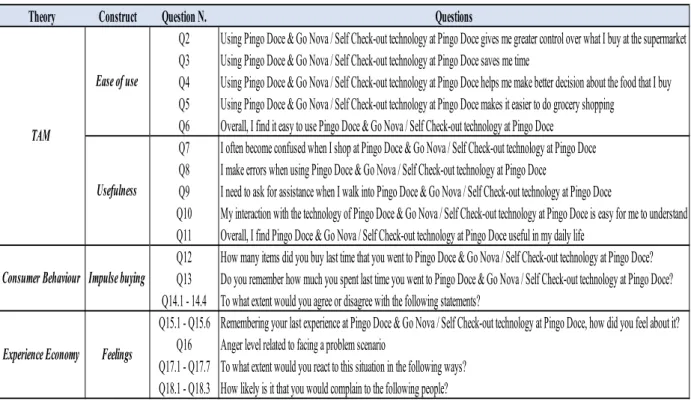
The following table summarizes the relationships between each hypothesis and each theoretical foundation analysed in this study, and to which items of the questionnaire they are related to. Table 1: How theory relates to each element of the questionnaire
Data Collection
The statistical methodology used for this research is the Independent – Samples T test analysis. This is because the goal of the research is to determine whether there is a significant difference in the average between the data collected with customers experiencing grocery shopping at Pingo Doce & Go Nova and at regular supermarkets. Therefore, whether the new innovative technology adopted in Pingo Doce & Go Nova is easier to use and more useful for customers in comparison to the more common technologies such as self-service check-out technology used in other traditional supermarkets.
The collection of the data for this study took place from the 7th of April until the 17th of April
Theory Construct Question N. Questions
Q2 Using Pingo Doce & Go Nova / Self Check-out technology at Pingo Doce gives me greater control over what I buy at the supermarket Q3 Using Pingo Doce & Go Nova / Self Check-out technology at Pingo Doce saves me time
Q4 Using Pingo Doce & Go Nova / Self Check-out technology at Pingo Doce helps me make better decision about the food that I buy Q5 Using Pingo Doce & Go Nova / Self Check-out technology at Pingo Doce makes it easier to do grocery shopping
Q6 Overall, I find it easy to use Pingo Doce & Go Nova / Self Check-out technology at Pingo Doce Q7 I often become confused when I shop at Pingo Doce & Go Nova / Self Check-out technology at Pingo Doce Q8 I make errors when using Pingo Doce & Go Nova / Self Check-out technology at Pingo Doce
Q9 I need to ask for assistance when I walk into Pingo Doce & Go Nova / Self Check-out technology at Pingo Doce
Q10 My interaction with the technology of Pingo Doce & Go Nova / Self Check-out technology at Pingo Doce is easy for me to understand Q11 Overall, I find Pingo Doce & Go Nova / Self Check-out technology at Pingo Doce useful in my daily life
Q12 How many items did you buy last time that you went to Pingo Doce & Go Nova / Self Check-out technology at Pingo Doce? Q13 Do you remember how much you spent last time you went to Pingo Doce & Go Nova / Self Check-out technology at Pingo Doce? Q14.1 - 14.4 To what extent would you agree or disagree with the following statements?
Q15.1 - Q15.6 Remembering your last experience at Pingo Doce & Go Nova / Self Check-out technology at Pingo Doce, how did you feel about it? Q16 Anger level related to facing a problem scenario
Q17.1 - Q17.7 To what extent would you react to this situation in the following ways? Q18.1 - Q18.3 How likely is it that you would complain to the following people? Consumer Behaviour Impulse buying
Experience Economy Feelings TAM
Ease of use
technology of Pingo Doce & Go Nova condition and the remaining 33 to the self-service check-out technology of regular supermarkets. To collect the responses an anonymous link has been shared with members of the Nova SBE community. The decision of selecting members of the Nova community was driven by the fact that there is great familiarity with technology (particularly with smartphones, essential elements for NFC technology), big cultural and generational diversity.
Once the Independent-Samples T Test had been conducted, it was possible to detect whether there was a significant difference in the mean of every variable. To meet the requirement of being significant, the variables had to score a p-value (Sig.(2-tailed)) lower than the a (equals to 0.05, assuming a confidence level of 95%). When this condition is met, it will allow to reject the null hypothesis (H0) and it would be possible to conclude that there is significant evidence to support the research hypotheses (H1, H2, H3.1 and H3.2).
Results and Analysis
As mentioned in the previous section, the analytical method adopted to perform the analysis was the Independent-Samples T Test, to explain the relationship between the customers and the adopted technologies in the two different retail scenarios. The results are shown in the tables below.
Table 3 below refers to H1 of this research, and it summarizes the concept of ease of use and usefulness from the TAM. The research focuses only on these two elements of the TAM, as assuming significant scores it is possible to determine their impacts in terms of customers attitude, intent and usage. In order to measure these variables, it is possible to notice two scores which are realized from averaging the scores of each of the five items reported in the questionnaire. To further confirm the reliability of the scale used, the Cronbach’s alpha is calculated to measure the internal consistency between the items of the scale, which have to be
greater than 0.7 in order to be acceptable. Reversing the codes for the variables in Q7, Q8 and Q9 (see Table 2 for questions in detail) was necessary, considering that they were negatively worded questions.
Table 2: Q7, Q8, Q9 in detail
The score for the Cronbach’s alpha for Ease of Use was 0.789 and for Usefulness 0.820 (see Appendix 2). Considering the p-value of 0.007 and 0.000 respectively, it is possible to assume that there is a significant evidence to support H1. More specifically, customers at Pingo Doce & Go Nova, interacting with a very simple and intuitive shopping experience, noted that the amount of time saved is much higher compared to in a retail shop with self-service check-out systems, and that, overall, they find it easier to use with less requirements of assistance from employees. The table below summarizes the scores that allow this study to accept H1. The two p-value reported in Table 3 are realized from averaging the scores of each p-value of the items related to ease of use and usefulness of the TAM.
Table 3: Summary of Hypothesis 1
As in the case of H1, the same interpretation has been adopted for H2. In the table below it is noted how the p-value of the questions related to impulse buying is lower than 0.05, supporting in this way the research hypothesis. The significant difference in the means between the two scenarios leads to understand that customers have a different approach, in terms of impulse buying, in doing grocery shopping in the two different environments. More specifically, they
environment (see Appendix 4). This aspect can be considered as evidence of impulsive purchases. In fact, there is a tendency that customers spend more on impulsive purchases when they are in a supermarket where technology is a dominant factor.
Table 4: Summary of Hypothesis 2
Table 5 provides the result related to H3.1. As the results in the p-value are significant it demonstrates a difference between how customers feel while grocery shopping, and how in most of the cases they preferred Pingo Doce & Go Nova over regular supermarkets with self-service check-out systems, considering that they tend to feel more excited and empowered, and less lonely or helpless.
Table 5: Summary Hypothesis H3.1
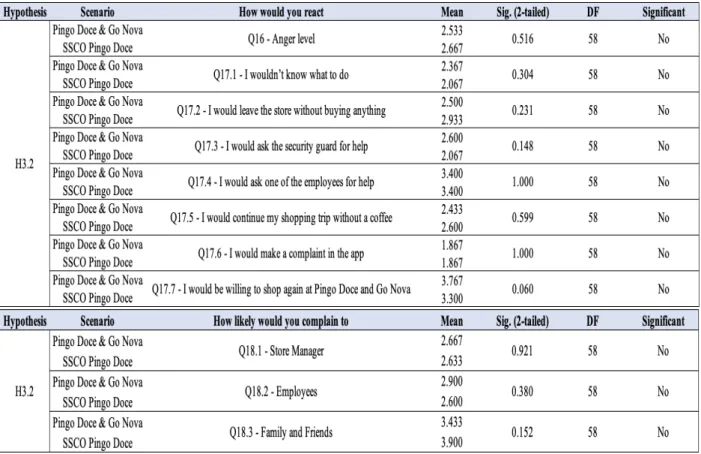
The hypothesis H3.2 has the goal of understanding how customers would react in a case where one of the most technological machines in the supermarket does not perform as it should. Table 6 below refers to the ‘facing a problem’ scenario (see Appendix 5) and how customers would react to it. Contrary to the previous hypothesis, the participants’ answers reveal that they do not support the research hypothesis, providing no significant difference between Pingo Doce & Go Nova and regular supermarkets. Obtaining p-value of 0.516, which measures whether the customers might be angrier in one store rather than the other (Appendix 6), reveals that there is
no significant difference in terms of anger levels among customers once they faced the scenario in both stores. The remaining questions further highlight that there is no significant difference regarding how customers feel at Pingo Doce & Go Nova or at a regular supermarket when there is a technological malfunction.
Table 6: Summary of Hypothesis 3.2
To summarize the overall findings obtained through the statistical computations, it is clear that H1, H2, H3.1 are supported by the results, proving a significant difference in terms of mean results among the two scenarios. This means that the mix of technologies used at Pingo Doce & Go Nova is accepted by the consumers, whom find it easier and more useful compared to the self-service check-out systems widely adopted by regular supermarkets (H1). Moreover, the results determined that consumers have different impulses while grocery shopping at the two different environments (H2) and that they feel differently when they find themselves in the stores (H3.1). The one aspect that does not have a significant difference is that of the ‘facing a
problem’ scenario (H3.2), where customers would react in similar ways regardless of the environment, which suggests the study to reject this particular research hypothesis.
Discussion
This study has explored the impact that technologies, such as NFC and computer vision, can have on customer behaviour and experience in a retail environment. In this part of the research the author will now discuss hypothesis by hypothesis the results of the experiment tested. H1 is related to the application of the TAM to the technologies adopted by Pingo Doce & Go Nova, and the way the technology is accepted by the customers shows how the model can be applied to different technologies in different fields, compared to past studies (Davies et al., 1992; Chuawatcharin and Gerdsri, 2019; Dutot, 2015). This demonstrates how applying the TAM to a novel technology can keep bringing new contributions across industries, that would similarly be adopted and accepted by customers such as in the retail sector, and in the case of this research in the supermarkets segment.
The manner in which respondents showed a positive response to NFC and computer vision at Pingo Doce & Go Nova, allows to assume that this kind of technology is accepted by a younger generation of customers in Portugal. Obtaining the theoretical confirmation that this technology can have a positive impact on the consumers perceptions, it is possible to assume that grocery stores such as Pingo Doce & Go Nova appears to be a great business opportunity for retail companies.
H2 is strongly correlated to H1. Through the responses of the questionnaire, elements such as ease of use and usefulness are understood to be crucial in conditioning the impulse buying of customers. This means that the technology adopted at Pingo Doce & Go Nova is so intuitive, easy and most importantly useful in daily life that customers cannot easily control their buying impulses as strongly as they could in a different retail environment. One of the reasons behind
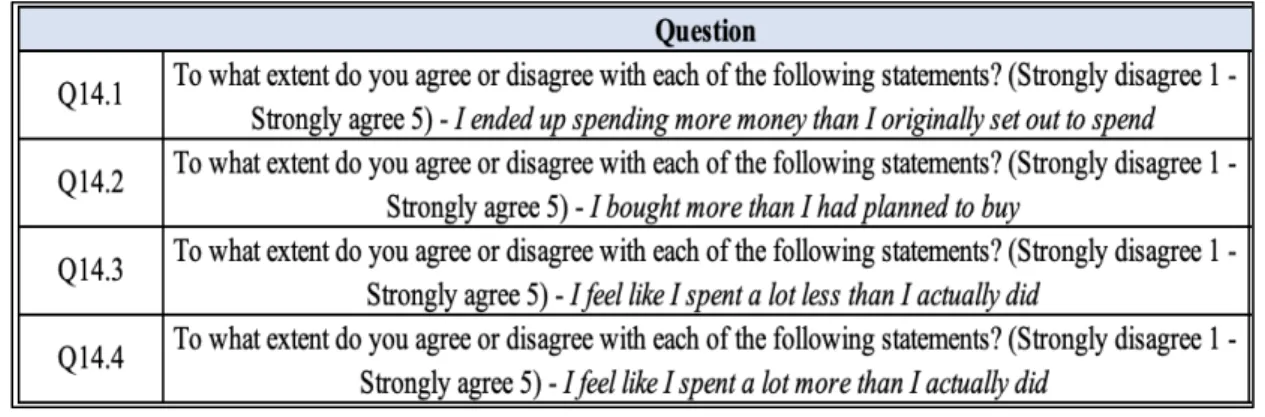
this assumption is the lack of the regular check-out process that customers are used to in supermarkets. Purchasing a good in such a simple and innovative way might not give the customers the perception of actually buying. In the case of H2 it is interesting to discuss the outcome of Q14, for which four different perceptions of the experience were proposed to the customers. The table below shows in detail each different proposed scenario.
Table 7: Details of Q14
In the “Results” section it has been possible to notice that there is significant difference, and in terms of mean values the score for spending more, buying more and having the perception of spending less is higher for Pingo Doce & Go Nova, rather than for the self-service check-out at Pingo Doce. Through this analysis it is deducted that in this scenario customers are more influenced by the technology adopted in Pingo Doce & Go Nova, compared to the self-service check-out used in regular supermarkets when they walk into the store and want to purchase goods. The way in which most customers believe that they spent more than originally set out to spend, bought more goods while having the perception of spending less, shows that their behaviour in terms of impulsive buying is more difficult to control in an environment where technology is dominant and where the decision making process is more simple. A similar outcome has been proved also in the research conducted by Michael et al., (2010); however, this research is contributing to deliver a new perception on impulse buying through a new technology and for a new customer segment. Considering the innovative way of check-out of
offered to the customer. The literature review emphasized that the value debit card users place on the ability to monitor finances and control spending is very important (Hayashi, 2012). Considering that in Pingo Doce & GO Nova the main allowed payment method occurs through the app, and not through self-service check-out systems, applying this concept into a different retail environment demonstrates how customers pay more attention when they actually have to perform the action of a payment through POS debit or credit card, rather than a simple tap on a smartphone. Given the study of Hayashi (2012), paying through the Pingo Doce app might be detrimental to customers who try to control their finances.
Regarding the third hypothesis (H3.1 and H3.2), Pine and Gilmore (1998) argued that in order to meet the standards of a successful experience, a business has to engage its’ customers by creating a memorable event. The way that customers are required to grocery shop at Pingo Doce & Go Nova is difficult to forget, due to the innovative way of getting in, the exclusive products provided, and the utmost interaction with technology that customers need to learn and get accustomed with to perform something as simple as grocery shopping. In H3.1 the difference in the mean was significant enough to prove that customers feel differently in the two environments. This can be linked to the fact that Pingo Doce & Go Nova is a unique store proposing a complete innovative and revolutionary way of grocery shopping. Customers need to interact with technology even before walking into the store and are immersed with the exciting technology right from the get-go.
One of the elements that does not provide significant difference is related to how customers feel ‘observed’ (Table 5) in the two stores. This is surprising as in Pingo Doce & Go Nova, in addition to having a security service employee walking around the aisles, facial recognition systems and motion sensors are installed in order to prevent customers from stealing. Moreover, this led the research to assume that younger customers might not be strongly concerned with privacy issues when interacting with this kind of technology.
In the case of H3.2, the customers were put into a situation of anger and the goal of the section was to measure how they would feel and react in such a case. In this circumstance, the p-value of the t-test does not provide significant difference in the mean analysis of the participants’ responses, giving the interpretation that when customers face a troubling situation, at Pingo Doce & Go Nova or at regular Pingo Doce, they would react in the same way and would know who to complain to.
On average customers are clear on how to behave in this kind of situation, and that in both cases they would ask help from employees, even if in Pingo Doce & Go Nova, considering the store concept and design, it is not frequent to see employees walking around. Even if this scenario might influence people not to shop anymore at that store, customers would be more willing to shop again at Pingo Doce & Go Nova, rather than at traditional supermarkets; one of the main arguments that could lead to this assumption is that the technology used at Pingo Doce & Go Nova is more attractive to the consumers, as they have the possibility of testing different kinds of hi-tech devices (such as orange juice machine and water refill machine) which are more rare to find in traditional retail environments.
As conclusion of the analysis of H3, the researcher noted that there is sufficient difference for understanding that consumers feel differently while grocery shopping at Pingo Doce & Go Nova (H3.1). The technology around them and the way that they have to expose themselves to it constitutes a critical aspect for letting them perceive grocery shopping in a completely different way as they were not used to beforehand. On the other hand, there is not a significant difference in terms of how customers would feel and would react in the scenario where a problem is faced in these two different retail environments (H3.2).
Implications
This research illustrates how the technologies adopted in modern retail environments can affect customer behaviour and customer experience, taking into consideration also the TAM variables from previous studies that can have strong influence on the adoption of technologies in the retail sector. This research is the first study that analyses the case of Pingo Doce & Go Nova and the reactions that customers have in terms of the technology and the usage, and it will help to create empirical studies in this field for similar technologies in similar realities. However, there are different opportunities to further develop the approach that customers can have with technologies. One of these is the topic of privacy, not discussed in this research, but representing a very interesting and crucial topic considering the digitalization process that the daily life is noticing in the retail sector.
According to the findings of this study, there are important guidelines for entrepreneurs and businesses of the retail sectors interested in investing in technologies like the ones used at Pingo Doce & Go Nova. Beside the positive perception that this technology has on customers in terms of ease of use and usefulness, the data show also that customers on average prefer grocery shopping at Pingo Doce & Go Nova. Retail stores will have to stress the fact that this kind of service will allow customers to save time and make their shopping experience easier and more enjoyable. Considering that a smartphone will be essential to get into the store, businesses might consider the possibility of targeting, through social media and viral marketing, customers highly familiar with technology and smartphones, and encouraging them to use their service.
Pingo Doce & Go Nova has been launched at Nova SBE campus in Lisbon. At the time of the planning of the launch, Jeronimo Martins took into consideration that this supermarket had to be located in an environment where people are familiar with smartphones and technology. For this reason, a similar store could be opened also in reality where technology is vastly
appreciated, such as in different hub cities, young and innovative workplaces and around other universities.
Limitations and future research
There are three possible limitations related to this study, mainly noticing that a field study at the points of purchase might result useful. Firstly, the sample selected for the surveys are part of the Nova SBE community. This allowed the researcher to confirm that technologies such as NFC have an impact in consumer behaviour and decision-making process in Portugal. However, the sample could be extended to more people with different backgrounds and ages, to be able to collect different opinions and evaluate whether there is the same perception of the technologies and the same effects on consumer behaviour and experience
Secondly, to prove the hypothesis, this study considered as examples Pingo Doce & Go Nova, which represents an innovative way of perceiving the retail sector and more specifically grocery shopping. Consequently, further studies could be conducted in order to analyse the impact of different technologies in the retail sector. An example could be a research about the perception of the ‘Just Walk Out Technology’, developed by Amazon in other countries (such as the UK), whether the American multinational might think to expand its technology. Conducting researches in different countries and with different demographic samples might lead to different responses in terms of perception of the TAM and the customer experience. Future researches might consider adopting the TAM for analysing different technologies in the retail sector. It would be interesting to focus the attention on Virtual and Augmented Reality, and how they could disrupt the industry, for instance wearing a pair of glasses and grocery shopping while sitting on a sofa at home and have your grocery delivered in the following hours.
could be conducted to further analyse the concept of privacy with technology in the retail sector, and notice if the measures of the TAM still apply and whether the customers might view the experience of grocery shopping in an innovative retail environment as a threat to their privacy rights.
Conclusions
This study is developed to comprehend how customers interact with new technologies in the retail sectors, considering the continuous digitalization process that is affecting, not only the industry, but also the daily life of each individual. It is not a coincidence that tech multinationals like Amazon are investing billions in these technologies. What Jeronimo Martins did with Pingo Doce & Go Nova was an early move in the European market. However, this move has attracted the curiosity of other players within the industry, who are now planning on investing in similar technologies for supermarkets, as they understood that NFC and computer vision represents a great business opportunity.
The results of this research show that young consumers are more than willing to accept and to live with this innovative concept of supermarkets, and that they actually prefer it to traditional environments. They shop there more often, find it easier to use and feel more excited to perform in a revolutionized way something so simple and routine-like such as buying groceries, which has been done in the same exact way for many years.
To conclude, the researcher hopes that this study will provide useful guidelines for future researches and consequentially future investments in the retail industry, specifically for the supermarkets sector in Europe.
References
- Amazon.com: Amazon Go. (n.d.). Retrieved from
https://www.amazon.com/b?node=16008589011
- Bhakat, R. and Muruganantham, G. (2013). “A Review of Impulse Buying Behavior”. International Journal of Marketing Studies, Vol. 5, pp.149
- Chuawatcharin, R. and Gerdsri, N. (2019). “Factors influencing the attitudes and behavioral intentions to use just walk out technology among Bangkok consumers”. Int. J. Public Sector Performance Management, Vol. 5, No. 2, pp.146–163
- Crowe, M., Rysman M. and Stavins J. (2010). “Mobile Payments at the Retail Point of Sale in the United States: Prospects for Adoption”. Review of Network Economics, Vol. 9, No. 4
- Demirci Orel, F. and Kara, A. (2014). “Supermarket self-checkout service quality, customer satisfaction, and loyalty: Empirical evidence from an emerging market”. Journal of Retailing and Consumer Services, Vol. 21, No. 2, pp.118-129
- Dutot, V. (2014). “Adoption of social media using technology acceptance model: The generational effect”. International Journal of Technology and Human Interaction, Vol. 10, No. 4, pp.18–35
- Dutot, V. (2015). “Factors influencing Near Field Communication (NFC) adoption: An extended TAM approach”. Journal of High Technology Management Research, Vol. 26, pp.45–57
- Fishbein, M. and Ajzen, J. (1975). “Belief, Attitude, Intention and Behavior: An Introduction to Theory and Research”. Addison-Wesley, Reading, MA
- Davis, F., Bagozzi, R. and Warshaw, P. (1989). “User Acceptance of Computer Technology: A Comparison of Two Theoretical Models”. Management Science, Vol.
- Ghosh, S. (2017). “The future of retail marketing as it adapts to always-on consumers”. Retrieved from http://www.campaignlive.co.uk/article/future-retail-marketing-adapts-always-on-consumers/1421014
- Hasan, A., and Mishra, S. (2015). “Key Drivers Influencing Shopping Behavior in Retail Store”. The IUP Journal of Marketing Management, Vol. 9, No. 3, pp. 7-36 - Hayashi, F. (2012). “Mobile payments: What’s in it for customers”. Federal Reserve of
Kansas City, Economic Review – First Quarter. pp. 37 – 66
- Lyua, F., Limb, H., and Choic, J. (2019). “Customer Acceptance of Self-service Technologies in Retail: A Case of Convenience Stores in China”. Asia Pacific Journal of Information Systems. Vol. 29 No. 3, pp. 428-447
- Michael, J. E., William, J. S. and Pandit, A. (2010). “Marketing”. New Delhi: Tata McGraw Hill
- Pingo Doce & Go Nova (n.d.), FAQ, Retrieved from Pingo Doce & Go Nova app. - Pingo Doce: Food Distribution. (n.d.). Retrieved from
https://www.jeronimomartins.com/en/about-us/what-we-do/food-distribution/pingo-doce/
- Piron, F. (1991). “Defining Impulse Purchasing. Advances in Consumer Research”, Vol. 18, pp. 509-514
- Portell, G., and Ghandi, S. (2019). “Retailers are ignoring consumer expectations around retail technology”. Retrieved from https://www.kearney.com/consumer-
retail/article/?/a/retailers-are-ignoring-consumer-expectations-around-retail-technology?utm_source=PRNewswire&utm_medium=pr&utm_term=CIRP&utm_ca mpaign=2019AmericasRetailTech&utm_content=
- Strange, L. (2019). “Trends and Disruption in the Supermarket Industry”. No. 2319-2019-4913
- Yakhlef, A. (2015). “Customer experience within retail environments an embodied spatial approach”. Marketing Theory, Vol. 15, No. 4, pp. 545-564
Appendix
Appendix 1
Questionnaire distributed to participants
Q. num. Q. text
Q1 How frequently do you visit Pingo Doce & Go Nova / Pingo Doce?
Q2
Using Pingo Doce & Go Nova / Self Check-out services at Pingo Doce gives me greater control over what I buy at the supermarket - Strongly disagree (1) - Strongly agree (5)
Q3
Using Pingo Doce & Go Nova Self Check-out services at Pingo Doce saves me time - Strongly disagree (1) - Strongly agree (5)
Q4
Using Pingo Doce & Go Nova Self Check-out services at Pingo Doce helps me make better decision about the food that I buy - Strongly disagree (1) - Strongly agree (5)
Q5
Using Pingo Doce & Go / Self Check-out services at Pingo Doce Nova makes it easier to do grocery shopping - Strongly disagree (1) - Strongly agree (5)
Q6
Overall, I find it easy to use Pingo Doce & Go Nova / Self Check-out services at Pingo Doce - Strongly disagree (1) - Strongly agree (5)
Q7
I often become confused when I shop at Pingo Doce & Go Nova / Self Check-out services at Pingo Doce - Strongly disagree (1) - Strongly agree (5)
Q8
I make errors when using Pingo Doce & Go Nova / Self Check-out services at Pingo Doce - Strongly disagree (1) - Strongly agree (5)
Q9
I need to ask for assistance when I walk into Pingo Doce & Go Nova / Self Check-out services at Pingo Doce - Strongly disagree (1) - Strongly agree (5)
Q10
My interaction with the technology of Pingo Doce & Go Nova / Self Check-out services at Pingo Doce is easy for me to understand - Strongly disagree (1) - Strongly agree (5)
Q11
Overall, I find Pingo Doce & Go Nova / Self Check-out services at Pingo Doce useful in my daily life - Strongly disagree (1) - Strongly agree (5)
Q12
How many items did you buy last time that you went to Pingo Doce & Go Nova / Pingo Doce?
Q13
Do you remember how much you spent last time you went to Pingo Doce & Go Nova / Pingo Doce?
Q14.1
To what extent do you agree or disagree with each of the following statements? (Strongly disagree 1 - Strongly agree 5) - I ended up spending more money than I originally set out to spend
Q14.2
To what extent do you agree or disagree with each of the following statements? (Strongly disagree 1 - Strongly agree 5) - I bought more than I had planned to buy Q14.3 To what extent do you agree or disagree with each of the following statements? (Strongly disagree 1 - Strongly agree 5) - I feel like I spent a lot less than I actually did Q14.4
To what extent do you agree or disagree with each of the following statements?
(Strongly disagree 1 - Strongly agree 5) - I feel like I spent a lot more than I actually did
Q15.1
Remembering your last experience at Pingo Doce & Go Nova / Pingo Doce, how did you feel about it? (Strongly disagree 1 - Strongly agree 5) - Good
Q15.2
Remembering your last experience at Pingo Doce & Go Nova / Pingo Doce, how did you feel about it? (Strongly disagree 1 - Strongly agree 5) - Excited
Q15.3
Remembering your last experience at Pingo Doce & Go Nova / Pingo Doce, how did you feel about it? (Strongly disagree 1 - Strongly agree 5) - Empowered
Q15.4
Remembering your last experience at Pingo Doce & Go Nova / Pingo Doce, how did you feel about it? (Strongly disagree 1 - Strongly agree 5) - Observed
Q15.5
Remembering your last experience at Pingo Doce & Go Nova / Pingo Doce, how did you feel about it? (Strongly disagree 1 - Strongly agree 5) - Lonely
Q15.6
Remembering your last experience at Pingo Doce & Go Nova / Pingo Doce, how did you feel about it? (Strongly disagree 1 - Strongly agree 5) - Helpless
Q16
On a scale from the least angry (annoyance) to the utmost angry (rage), how angry do you think you would feel in this situation? - Anger level
Q17.1
To what extent would you react to this situation in the following ways? (Very unlikely 1 - Very likely 5) - I wouldn’t know what to do
Q17.2 To what extent would you react to this situation in the following ways? (Very unlikely 1 - Very likely 5) - I would leave the store without buying anything Q17.3
To what extent would you react to this situation in the following ways? (Very unlikely 1 - Very likely 5) - I would ask the security guard for help
Q17.4 To what extent would you react to this situation in the following ways? (Very unlikely 1 - Very likely 5) - I would ask one of the employees for help Q17.5
To what extent would you react to this situation in the following ways? (Very unlikely 1 - Very likely 5) - I would continue my shopping trip without a coffee
Q17.6
To what extent would you react to this situation in the following ways? (Very unlikely 1 - Very likely 5) - I would make a complaint in the app
Q17.7
To what extent would you react to this situation in the following ways? (Very unlikely 1 - Very likely 5) - I would be willing to shop again at Pingo Doce and Go Nova
Q18.1
How likely is it that you would complain to the following people? (Very unlikely 1 - Very likely 5) - Store Manager
Q18.2
How likely is it that you would complain to the following people? (Very unlikely 1 - Very likely 5) - Employees
Q18.3
How likely is it that you would complain to the following people? (Very unlikely 1 - Very likely 5) - Family and friends
Q19 How old are you? Q20 What is your gender?
Appendix 2
Cronbach’s Alpha score for H1
Appendix 3
Appendix 4
Detailed overview of statistical results of Hypothesis 2
Appendix 5
‘Face a problem’ scenario: The only thing you really want right now is a strong coffee. You can’t wait to taste it, especially since you haven’t had one all day, and you’re dying for a cup of coffee. It’s your reward for studying so hard. You enter Pingo Doce & Go Nova, and walk to the coffee machine and you are so excited to finally get the coffee you’ve been dreaming of. You put your cup in the designated space and press the button. But nothing comes out. You press the button again, but again nothing comes out. The machine is broken!