Research on Relationship Resource Integration of Chinese
Construction Enterprises: Evolutionary Process and Balance
Mechanism
LUO Qinwen
Thesis submitted as partial requirement for the conferral of
Doctor of Management
Supervisor
Professor Jorge Lengler, Professor, ISCTE University Institute of Lisbon
Co-supervisor
Professor DU Yifei, Professor, University of Electronic Science and Technology of China, School of Management and Economics
- Spine –
Re se a rc h on Re lation sh ip Re sou rc e In te g rat ion of C h in ese Cons tr u ctio n E n te rp rises: E volu tiona ry Pr oc ess an d B alan ce M ec h an ism L UO Qi n we nResearch on Relationship Resource Integration of Chinese
Construction Enterprises: Evolutionary Process and Balance
Mechanism
LUO Qinwen
Thesis submitted as partial requirement for the conferral of
Doctor of Management
Supervisor
Professor Jorge Lengler, Professor, ISCTE University Institute of Lisbon
Co-supervisor
Professor DU Yifei, Professor, University of Electronic Science and Technology of China, School of Management and Economics
Abstract
For the Chinese constructive industry, the enterprise‘s ability in integrating the relationship resources is equally important to its strength in hardware techniques. Therefore, against the background of the globalization and the perfect competition market, it seems that the research on how Chinese construction enterprises integrate their relationship resources and thus achieve their development could be rather interesting and practical. Based on the resources from the CSMAR data base, official websites of enterprises and authorized media, this thesis has collected huge amount of data about two state-owned enterprises and two private enterprises. Besides, according to the questionnaires, this thesis also explored the evolution rule of the politic-bussiness relationship within the Chinese construction industry, the balance mechanism and the process of relationship resources integration.
The results demonstrate that: (1) the develop route of state-owned enterprises is ―political relationship-political relationship-bussiness relationship, while the route of private construction enterprises is ―bussiness relationship-political relationship- bussiness relationship‖ and both of their last stages are guided by bussiness-oriented relationship; (2) construction enterprises achieve their balance between the political and bussiness relationship resources by the mutual linking and mutual triggering between them; (3) the interaction characterizes the political relationship resource and the business relationship resource, which means that because of the permeation and integration between these two resources enterprises could continuously absorb external resources and develop themselves. This thesis also points out that even though political relationship plays an important role in this whole process, construction enterprises should pay more attention to the accumulation of internal resources and abilities and return to their commercial nature in terms of a long-term development.
This thesis reveals the evolution rules of political and business relationship resources of Chinese construction enterprises and balance mechanism within them, and it also illustrates the developing process of Chinese construction enterprises and expands theoretical boundaries of current research from an external perspective. Meanwhile, according to the current development of construction enterprises, this thesis has also provides suggestions from the perspective of both government and enterprises level, which could be constructive for strategy-making or policy-making.
Key words: Construction Enterprises; Political Relationship; Bussiness Relationship;
Integration; Evolution Process; Balance Mechanism.
Resumo
Para a industria de construção Chinesa, relações intra-empresariais, capacidade de integr ação de recursos e forte tecnologia de hardware são igualmente importantes. No que toca ao c ontexto de globalização e competitividade de mercado fomos estudar a melhor forma das emp resas de construção chinesas poderem optimizar o seu desempenho através da integração de re cursos. Este é um assunto bastante interessante e utilitário nos dias de hoje.Neste estudo, uma enorme quantidade de informação sobre duas empresas pertencentes ao estado e outras duas empresas privadas foi recolhido via questionário, através da base de dados ―CSMAR news‖, o website oficial das empresas e meios de comunicação social, com vista a explorar a relação entre a lei da evolução e o mecanismo de equilíbrio, bem como o processo de integração de recursos de relações políticas e relações de negócios entre empresas de construção chinesas.
A nossa pesquisa sugere o seguinte:(1)As empresas de construção pertencentes ao estado seguem e obedecem as relações políticas bem como ao desenvolvimento das tendê ncias de relações de negócios, empresas privadas seguem e obedecem ás tendências de relações comerciais - relações políticas - bem como ao desenvolvimento das tendências de relações de negócios, nas fases finais, estas foram dominadas pelas relações de negócios.(2) A empresa de construção compreende o equilíbrio necessário entre dos dois recursos relacionais através da ligação das relações políticas e comerciais, alavancagem, transformação mutua e ajustamento mutuo. (3)Os dois recursos relacionais de empresas de construção são interactivos. Atrav é s da penetração relacional e integração relacional e adquirindo constantemente recursos externos e absorvendo-os de forma a promover o crescimento das empresas. O estudo também constatou que, apesar da relação política ser bastante importante, as empresas de construção devem prestar mais atenção á acumulação de recursos e capacidades dentro da própria empresa se querem progredir e efectuar um desenvolvimento sustentado a longo prazo, recebendo gradualmente os dividendos da parte comercial da empresa.
Este estudo revela a lei da evolução entre as relações políticas e comerciais das empresas de construção chinesas e o mecanismo de equilíbrio necessário entre as mesmas, e baseado numa perspectiva de relações externas, o estudo revela o processo de crescimento das
empresas de construção chinesas e expande as fronteiras teoricamente existentes. Simultaneamente, dado o actual desenvolvimento das empresas de construção, algumas sugestões são lançadas respectivamente a nível nacional e a nível empresarial. Isto pode ser uma referência para o planeamento estratégico das empresas de construção e a elaboração de políticas dos departamentos governamentais.
Palavras Chave: empresas de construção; relações políticas; relações empresariais;
integração; processo de evolução; mecanismo de equilíbrio.
Acknowledgement
The accomplishment of this dissertation results from the help from all sorts, some of which really go beyond my words.
First and for the most, I am greatly indebted to my two supervisors, Professor DuYifei, from University of Electronic Science and Technology of China, and Professor Jorge Lengler, from ISCTE, who has managed to offer invaluable help in my research design and dissertation fulfillment. Without their strict guidance, enlightening suggestions and frank criticism, my work should never have come out in the present form. Here, I would like to show my greatest respects to both of them.
I am also grateful to UESTC and ISCTE for providing me a wonderful environment to study in. I also want to thank all the professors and teachers who have generously and patiently imparted knowledge related to the field of business management. Their commitments and enthusiasm have motivated me to further my study in this field in the future.
Many thanks also go to my classmates and friends, without t heir help and support, I could have not finished my dissertation.
Contents
Chapter 1: Introduction ... 1
1.1 Objective and significance of research ... 1
1.1.1 Objective of research ... 1
1.1.2 Significance of research ... 5
1.2 Description of research problem ... 7
1.3 Definition of related concepts ... 9
1.4 Research strategy ... 11
1.4.1 Research objects ... 11
1.4.2 Research methods ... 11
1.5 Frame structure and chapter arrangement ... 12
1.6 Contributions ... 14
1.7 Conclusion ... 15
Chapter 2: Literature Review ... 17
2.1 Resource Basic Theory ... 17
2.1.1 Development of Resource Based Theory ... 17
2.1.2 Content of the Resource Based Theory ... 17
2.1.3 Qualities of Network Resources and its Exploration to RBT ... 19
2.2 Resource Dependence Theory ... 22
2.2.1 The Development and Content of Resource Dependence Theory ... 22
2.2.2 The application of resource dependent theory during the development of enterprises ... 24
2.3 An Analysis of Network-Resource-Based Enterprise Development Mechanism ... 25
2.4 Relevant Studies on Resources Integration ... 28
2.5 The Development and Resources Integration of Construction Enterprises ... 30
2.6 Conclusion ... 32
Chapter 3: Research Design ... 35
3.1 Research strategy ... 35
3.2 Overview of the Research Method ... 37
3.2.1 Method of Qualitative Research ... 37
3.2.3 Process Analysis ... 38
3.2.4 Questionnaires ... 39
3.3 Selection of Cases ... 39
3.4 Data Collection ... 42
3.4.1 Data Source ... 42
3.4.2 Process of Data Collection ... 44
3.5 Data Analysis ... 47
3.5.1 Stage Division ... 47
3.5.2 Data Coding ... 49
3.5.3 Data Analysis ... 52
3.6 Conclusion ... 52
Chapter 4 : The Evolution Route and Balance Mechanism of Relationship Resources in Construction Enterprises ... 53
4.1 Introduction of Enterprises ... 53
4.2 Political Relationship Resources and Business Relationship Resources ... 56
4.2.1 Political Relationship Resources ... 56
4.2.2 Business Relationship Resources ... 59
4.3 The Evolution Rules of Construction Enterprises‘ Relationship Resources ... 61
4.3.1 Characteristics of Private Enterprises in Different Stages ... 61
4.3.2 Characteristics of state-owned enterprises in different stages ... 64
4.3.3 Questionnaires ... 66
4.4 Balance and Transfer mechanism of Integration of Political and Business Relationship Resources ... 68
4.4.1 Mutual Linking and Triggering ... 70
4.4.2 External-Resources-Based Adjustment ... 73
4.4.3 Inter-transformation of these Two Relationship Resources ... 74
4.5 Conclusions ... 75
Chapter 5: Process Analyses of Multiple Cases ... 77
5.1 Case Studies of Private Construction Enterprises ... 77
5.1.1 PCG ... 77
5.1.2 GCG ... 83
5.1.3 Analysis and Discussion of Comparison of these Two Private Construction Enterprises ... 88
5.2 Cases Study of State-owned Construction Enterprises ... 90
5.2.2Comparative Analysis and Discussion on CSCEC and CRCC ... 95
5.3 Discussion ... 97
5.3.1 Evolution Process and Balance mechanism of Relationship Resources of Chinese Construction Enterprises ... 97
5.3.2 A Framework of Relationship Resources Integration of Construction Enterprises 100 Chapter 6: Conclusion ... 103 6.1 Major Conclusions ... 104 6.2 Theoretical Contributions ... 107 6.3 Practical Implication ... 110 6.4 Limitations ... 113 Bibliography ... 117 Appendix ... 127
List of Tables
Table 3- 1 Basic information of these four enterprises ... 42
Table 3- 2 Data Screening Criteria ... 43
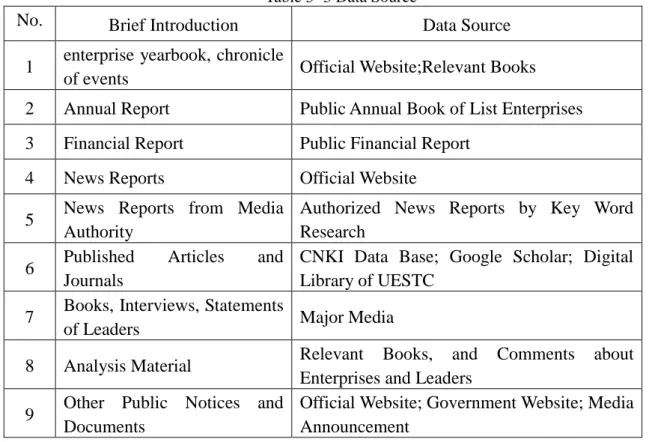
Table 3- 3 Data Source ... 44
Table 3- 4 CSMAR News Data Collection ... 45
Table 3- 5 Other Data Collections ... 45
Table 3- 6 Cases ... 46
Table 3- 7 Questionnaire Collection ... 47
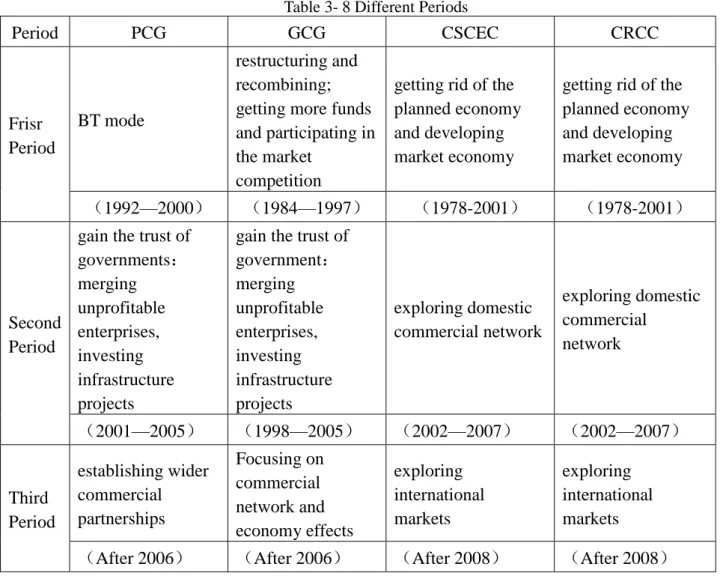
Table 3- 8 Different Periods ... 48
Table 3- 9 Coding ... 50
Table 4- 1 Periodical Features of Private Enterprises ... 62
Table 4- 2 Periodical Features of State-owned Enterprises ... 64
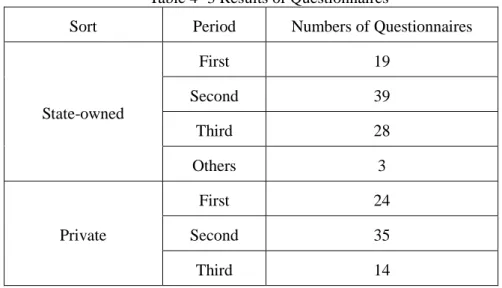
Table 4- 3 Results of Questionnaires ... 66
Table 4- 4 Survey Results of Different Periods of Private Construction Enterprises ... 67 Table 4- 5 Survey Results of Different Periods of State-owned Construction Enterprises68
List of Figures
Figure 1- 1 Frame structure of the paper ... 13
Figure 2- 1 The analysis framework of extended RBT ... 21
Figure 4- 1 Periodical Features of Private Enterprise ... 67
Figure 4- 2 Periodical Features of State-owned Enterprise ... 68
Figure 4- 3 From Political Relationship to Business Relationship ... 71
Figure 4- 4 From Business Relationship Resources to Political Relationship Resources 72 Figure 4- 5 Adjustment and Balance of External Resources ... 74
Figure 4- 6 Transmission Routes of Political and Business Resources Relationships ... 75
Figure 5- 1 Resources Framework of PCG and their Links ... 78
Figure 5- 2 Resources Composition and Relationships of PCG ... 81
Figure 5- 3 Resources Composition and Relationships of PCG ... 83
Figure 5- 4 Resources Composition and Relationship of GCG ... 84
Figure 5- 5 Resources Composition and Relationship of GCG ... 86
Figure 5- 6 Resources Composition and Relationship of GCG ... 88
Figure 5- 7 Relationship of Different Resources during the Development ... 90
Figure 5- 8 Resources Structure and Their Relationships of CSCEC and CRCC ... 91
Figure 5- 9 Resources Structure and Their Relationships of CSCEC and CRCC ... 93
Figure 5- 10 Resources Structure and their Relationship of CSCEC and CRCC ... 94
Figure 5- 11 Relationship of Different Resources During the Development ... 96 Figure 5- 12 Framework of Relationship Resources Integration of Enterprises Growth 101
Chapter 1: Introduction
1.1 Objective and significance of research
1.1.1 Objective of research
Since the adoption of the reform and opening policy, the Chinese government has played a supportive role in the construction industry, owing to which construction enterprises have developed rapidly in both scale and quantity, and became a great force in the national economy. It also makes great contribution to employment, technical innovation, the upgrading of the economy structure etc. According to the data from National Bureau of Statistics (NBS), in 2014, the total construction area in China stood at 12.5 billion square meters, which is an increase of 10.4%year on year. The national production value of the construction industry registered 17671.3 billion yuan, increased by 10.2% year on year, accounting for 27.76% of the GDP (at 63646.3 billion yuan). It seems that the construction industry acts as a vital role in China‘s economy. With the development of the economy, the construction industry in China has become a comprehensive industry, consisting of house building, installation, municipal construction, power supply, public transportation as well as post and telecommunication engineering. From the historical perspective, the rise of the construction industry is an inevitable stage during the national industrialization. At present, China is at the economic development stage of the industrialization growth, which could necessarily mean that China‘s construction industry is witnessing its moment and embracing its bright future and the great potential, which may benefit national economy in turn.
It is no doubt that the rapid development in the construction industry brings unprecedented opportunities to related enterprises, and which has been well-illustrated by the fact that the number of the construction enterprise has broken its record and still keep growing. According to the 2014‘s data of National Bureau of Statistic of People‘s Republic of China (NBS below), up to 2013, there have been 79,528 construction enterprises in China, employing 44.991 million people. According to data of NBS in 2013, the labor productive in construction industry was 324,842 yuan per person by the gross output, and 62,737.5 yuan per person by added value, both of which have been promoting compared with former years.
According to the economic data, unlike other economic entities, Chinese construction industry has been growing in the pace with GDP featuring high growing speed in recent years, but in terms of the internal and external environment and its developing trend, it is undeniable that this industry is confronted with serious challenges.
Firstly, the low threshold for entering the market allows the significant increase in the number of construction enterprises, and this phenomenon inevitably leads to the fierce competition within the industry. The industry data of NBS in 2010 shows that there were over 70,000 construction enterprises in China, while the situation of the scale of construction enterprises tends to be pyramid-shaped, namely scarce in large ones, few in middle ones and numerous in small ones. It seems that a completely competitive environment has fully controlled the construction market in China, and thus fierce competitions are inevitable. It is especially the case since entering the WTO. The domestic construction industry opens to the world gradually, which enables foreign capitals and advanced techniques to flows in, and thus the development pattern of enterprises has been diversified, which contributes to the formation of an amphitheater-shaped competition. A report on China‘s Project Constructing and Market Researching from 2014 to 2019 indicates that generally speaking, those enterprises who equipped with the advanced technology, outstanding management skills and qualified with top-grade certificates may have an edge over the others, and therefore they could occupy a larger market share; those large and medium-scaled construction enterprises which are located in the province that boosts in construction industry and belongs to well-developed area of China, also take up a certain amount of market and the projects they execute are mainly regional and large and medium-sized; and for those small enterprises, they mainly practice in labor subcontract, business subcontract and some small-scaled projects. Different from other industries, the construction industry bid on orders by competition, which sets extremely strict criterion on enterprises in terms of the grade of qualification, the techniques they own, the ability of cost-control, the skills in management and so on. As a result, for construction enterprises, especially those large ones, to improve their competitiveness is the core to their development.
On the other hand, because of the ―economic new normal‖, the national economy experiences a long-term development with a slower pace, consequently, the development of the construction industry has been slowed down. According to the data of NBS in 2014, the growth rate of GDP was 7.4%, decreased 0.3% on the last year (7.7%), and the prediction of Chinese Academy of Social Science shows that this rate would decrease to 6.9% in 2015. At
present, the overall situation is that the increase of the domestic economy is slowing down, and the income from the revenue the land transfer also shows a decrease trend, but meanwhile the expenditure of the local government increases and the pressure from the huge debt also exists. In this situation, it is hard to keep a high-level investment on infrastructure construction, while the investment of this kind took up 35.2% of the total output in the whole construction industry in 2014. Coupled with such economic background, the one-child policy which was executed all over the country in previous years, leads to the fact that the growth of China‘s population has almost reached its limit. The slowly-increasing population seems will negatively impact the domestic commercial housing market as the need is decreasing, and such recession could spread to the whole industry. Therefore, against this background, the sluggish increase in the construction industry would be the new trend.
To conclude, even though an unparalleled flourish has been taking place in the construction industry in China, the economic downturn may impose great pressure on its further development, and the domestic construction industry tends to be saturated. On the other hand, the boom of construction enterprises also intensifies the fierce competition. It is then safe to predict that in the coming years this industry will face a realignment, and those less competitive companies will be eliminated gradually.
To deal with the fierce competition, utilizing the current resources reasonably and effectively is an effective way to lower the cost and promote the competitiveness, which is calling for the resource integration. Besides, due to the resource restriction, it is somehow crucial for the construction enterprise to integrate resources efficiently, as such ability may determine its destiny. As the external pressure is increasing, to integrate the internal resource and to improve the technical capacity, management skills, the brand image and service quality are crucial to survive from the fierce competition. This is especially the truth for the construction enterprises, the factors, such as technical skills, management methods, advanced equipment, cost controlling, the enterprise‘s quality and its image, as well as the relationship with government, all of these are require the continuous study. It is considerably crucial for the enterprises to integrate both the external and the internal resources, and finally improve their own competitiveness to face the new challenge.
Because of the current depression market, domestic construction enterprises are promoting their competitiveness by integrating resources. The resources referred by the resource integration includes tangible resources and intangible ones. Tangible resources mainly refer to techniques and management, while the intangible resources include brand,
image, social responsibility, public relations and so on. According to the Annual Research and Consultation Report of Panorama survey and Investment strategy on China Industry, even though the amount of construction enterprises keeps increasing dramatically, serious homogenization and the low-price-based cut-throat competition lower the benefit rate. It seems that the high-speed growth in the past few years mainly depends on the benefits of the fixed-asset investment, and yet as the development in this industry has slowing down, then it may be the high time for the construction industry to consider how to transform in seeking further development. Since China has been a complete competitive market, what the enterprises facing is a comprehensive competition. The competition of this kind may possibly mean that only the overall strength rather than merely an advantage in a specific area can lead to the final win in the market. Owing to the hard work in recent years, the construction industry has achieved great improvement in integration of the tangible resources, such as the ability of techniques and management. Meanwhile, with the transition of the economic development, construction companies also increasingly value their ―soft power‖, namely the brand image, the social responsibilities, and the external relationship. Particularly, the external relationship, including political relationship resources and business relationship resources, seems act decisively in undertaking the contract, raising funds and getting qualifications. Therefore, since the gap of the hardware resources is narrowing down, the relationship-resource-based integration is more helpful in promoting the ―soft power‖, which will improve enterprises‘ competitiveness.
In conclusion, to address challenges in future, utilizing relationship resources integration to improve the competitiveness is an important strategic decision as well as an inevitable trend for construction enterprises. However, there are still some questions remain unsolved, for example, for the construction enterprise, how to carry out an effective integration? What are the process and mechanism during the relationship-integration? This dissertation will take typical construction enterprises in China as the study objects, and based on these examples to analyze the process and rules of the integration of relationship resources and thus revealing the regular patterns within such process. By doing this, the current problematic issues may be addressed and hopefully a theoretical guide in integrating relationship resources could be concluded, which may have some constructive direction for the major construction enterprises in China.
1.1.2 Significance of research
The development of enterprises contributes considerably to the stable performance of the national economy, and the construction industry as a fundamental industry is the major force for the development of national economy. During the process of the industrialization and the urbanization in China, the construction industry plays a significant role in attracting and accommodating the increased population and also in promoting the rate of employment (Yang and Ou, 2014). Have been firstly gone through the long period of the planned economy and then experienced the economic boom after the opening and reform, domestic construction enterprises always develop stably and smoothly, and just until recent years the fierce competition within this industry has breathed into life.
The ever-changed social environment requires enterprises to make the corresponding strategic adjustment. However, since domestic construction enterprises still belong to the later comers in the new-born market, they objectively lag far behind its counterparties in developed countries in terms of techniques, marketing, fund raising and so on. Under the background of the global competition, it would be an interesting and practical topic to study how Chinese construction enterprises avoid their inherent shortcomings and how to integrate relationship resources. The significances of this dissertation are as follows:
(1) To provide a guide for domestic construction enterprises in integrating their relationship resources and improve their competitiveness.
Recently, even though domestic enterprises have had a significant improvement in techniques and management, there is still an obvious gap between domestic enterprises and the foreign developed ones. As the result of the further globalization, it must be an inevitable challenge for domestic enterprises to compete with the foreign ones directly. Resources, especially those superior ones which have an edge over the others, as the core factor in winning the competition are also the foundation for enterprises‘ strategy execution. Therefore, only by optimizing and integrating the internal and the external resources, the competitiveness could be enhanced and the sustainable development could be thus achieved.
The systematic theories about tangible resources integration have existed and already applicable to some practical issues. However, the studies on intangible resources integration, especially the relationship resources integration, are still insufficient. Provided that the comprehensive competitive market has been formed as well as the fact that the political relationship resources and business relationship resources have been the decisive elements in
achieving sustainable development, it is then of great practical importance to study the approach that the domestic construction enterprise should adopt to integrate relationship resources efficiently. By analyzing the process and rules of such integration in the construction industry, this dissertation will estimate the current strategic direction. Besides, the research on the theories of relationship resources integration could clarify and solve the problematic issues facing by those enterprises. It seems that the rules derived from the evolution may be regard as good learning material and could be an asset in improving the competitiveness of domestic construction industry.
(2) To discover the evolution process and balance system of the political-business relationship resources, which may benefit the balanced development between these two relationships within the domestic construction industry.
Due to the fact that the overall investment from an enterprise to internal resources is limited, and therefore under the pressure of resources restriction, to keep the balance among different resources is the precondition for enterprises‘ sustainable development and also the very reason for the resources integration. The political relationship and business relationship connect to but still different with each other. They, like the capital and the labor, can benefit the development of enterprises, while they may also occupy other resources (they need respective investment). In the situation when enterprises were pursuing maximize the profits, to integrate resources may be the preferable alternative, which requires to balance and make wise decisions between these two relationships. However, it is still an absence of a unified framework to clarify the balance system and the decision-making criterion. This dissertation will analyze data from domestic major construction enterprises and then conclude the balance mechanism for the relationship resources integration. This system is expected to guide domestic construction enterprises to make full use of resources to launch political and business activities, and realize the balanced development between these two relationships.
(3) To improve the skill in strategic management and decision-making.
Entering the WTO, answering the globalization, brings about both the opportunities for development and the challenges from those big-names in the global construction industry. Since the enhance the competitiveness is the key to success, it requires domestic construction enterprises to improve their management skills. One American Company, Dunne Blast, has concluded six major reasons for the bankruptcy after a long-term research on American enterprises, and many of which are closely related to the strategy decisions. For example, do not have a clear strategic goal; have not fully invest their rivals; cannot make the best of their
own advantages; the manage board does not fully understand the external environment; stubborn in organizing and management; lack flexibility in strategy; and the resource allocated unevenly. To conclude, the strategic decisions have a direct impact on one company‘s fate. Therefore, during the process of decision-making, the manager of the construction enterprises should firstly analyze the developing trend and the environment of the domestic and overseas construction market, and secondly take advantage of the internal resources. By analyzing the process of the resources integration in construction enterprises, this dissertation is expected to discover the general rules and the behavior mechanism, and then improve the strategic level of construction enterprises in China.
It seems that as the situation of the market remain depressed the national economy somehow closely connected to the following issues: How do Chinese construction enterprises integrate their resources? What are the features during this process? How to keep the balance between political and business relationship resources? By studying the process of Chinese construction enterprises‘ resources integration and its balance system, this dissertation hopes to either vary relevant theories on construction industry resources integration, or lead the domestic enterprises‘ strategic practice.
1.2 Description of research problem
Enjoying the high-speed developed economy, China‘s construction enterprises, as the latecomers in the new-born market, has drawn attention from the strategic management scholars, both domestic and overseas, who have harvested some fruits about Chinese construction enterprises‘ resources integration and internationalization strategies. However, some loopholes still can be notified in these achievements. On the one hand, the current studies mainly focus on the tangible resource integration and they have been well-developed. On the other hand, with the boost of the economy and the progress made by these enterprises, the differences in techniques and management are narrowing. However, the economic transition may highlight the enterprises‘ ―soft power‖ when it comes to enhance the competitiveness, especially in utilizing the external resources which are extremely important in lowering costs, attracting projects and raising more funds.
Therefore, based on the above-mentioned opinions and the existing shortages, this dissertation tries to discuss the relationship resources integration process of Chinese construction enterprises and its balance system. The main research questions are as follows:
(1) Why should Chinese construction enterprises integrate their relationship resources? To achieve a further development, it is vital for Chinese construction enterprises to master relevant resources and information while enterprises‘ external relationship network is a quick and convenient access to these resources and information above at a low cost. (Jennifer A. Starr and Macmillan, 1990a) Simultaneously, it also cost a lot to maintain this external relationship network, especially for the complicated political and business network in major construction enterprises. Therefore, the relationship resources integration is meaningful for enterprises to widen resource and information access, to cut down the cost of operation and to improve the competitiveness and the comprehensive strength. By analyzing the cases of four construction enterprises, this dissertation will have a further research on the cases of relationship resource integration and prove its significance to the development of the construction enterprises.
(2) What are the features of the evolution process of Chinese construction enterprises‘ relationship resource integration?
Highly efficient relationship resource integration can not only help enterprises get the information, the access, and the admittance license, but also lower the relationship-maintaining costs. Integration of both political relationship resources and business relationship resources could encourage the mutual-trust and cooperation between enterprises and governments as well as those between enterprises. It also helps to strengthen their complementary advantages, lower costs and create a favorable condition for the development of Chinese construction enterprises and the improvement of their competitiveness. Therefore, it is quite important for construction enterprises to integrate their relationship resources. However, the current theories mainly focus on the integration of resources and abilities. By researching the process of relationship resource integration of four Chinese construction enterprises, this dissertation analyzes its process and mechanism and then provides a comprehensive route to integrate the relationship resources.
(3) How to maintain a balanced development between these two relationship resources? Integration of both political relationship resources and business relationship resources could encourage the trust and cooperation between enterprises and governments, and between different enterprises. It also helps to strengthen their complementary advantages, lower costs and create a favorable condition for the development of Chinese construction enterprises and the improvement of their competitiveness. However, in condition of the limited resource, domestic construction enterprises cannot develop political relationship and business
relationship at the same step. Limited resources force them to have different focuses in different periods. At the same time, after the opening and reform policy, China has been having a long-term reformation in both economy and system, which requires enterprises alert their strategies flexibly. As a result, it is meaningful for construction enterprises to maintain a balanced development in both political and business relationship resources. Based on case studies, this dissertation will explore the process of relationship resource integration and balance, discover its balance system, and then offer the theoretical guidance for other domestic construction enterprises.
(4) What are the essential features of relationship resources integration of Chinese construction enterprises?
Even though there exist huge differences between state-owned enterprises and private enterprises in ownership rights and management modes, they still share some similarities in resources accessing. With the development of enterprises, their relationship networks become larger and resources obtained from this network become more complicated and richer. However, both private enterprises and state-owned enterprises, they themselves are still the major elements to gain the external resources while the internal resources determine their natures. Therefore, it is an important direction to exploit the effects of internal resources on the external resources integration. This dissertation deepens the understanding of the nature of relationship resources integration and provides theoretical supplements for domestic construction enterprises to make strategic decisions.
1.3 Definition of related concepts
Main definitions are as follows: Construction Enterprise:
The Construction enterprise refers to an economic entity working on production and operation of construction productions. According to Yang and Ou (2014), the construction enterprise features: (1) having the certain objects of production and operation; (2) having a certain amount of fixed assets and working capitals; (3) having an institutional framework and administrators; (4) having a certain amount of qualified labors; (5) having fulfill the above-mentioned terms, also having legally registered and approved, opening a bank account and qualified as a legal person. The mission that the Chinese construction enterprise shouldered in the national economy is as following: under the instruction of the nation to
provide construction products and labor service; during its production, to realize the value surplus and thus increasing national income and providing resource for the nation and the enterprise. Besides, compared to the construction enterprise in the capitalist country, the Chinese ones have distinguished features in: (1) The various economic sectors coexist, while the enterprise with socialist public ownership is in the dominate status; (2) the production and the commodity exchange are well-planned; (3) the status of labor in the enterprise should equals to the master, and this should be guaranteed by every regulation of the enterprise; (4) the individual interests of the enterprise should comply with the overall interests of the national economy. The construction enterprises in this dissertation refer to such construction company that works on constructing, extending, reconstructing and dismantling buildings and structures (including construction projects, municipal public works, track remodeling, equipment installation and decoration works).
Political relationship resources
The political relationship resources of one enterprise mainly refer to a closed link between enterprises and government or its agency which is based on some commercial or non-commercial activities. With the acceleration of globalization, Epstein (1969) pointed out that ―enterprises have stepped into a politics-competition period‖. As a competition tool, the political relationship resources have been regard as a key factor for enterprises enlarge the external living environment. The political relationship resources also have some potential benefits, such as to help enterprises get more resources or to reduce some troubles which may be from governmental officials or other companies. (Wei et al., 2013a) In this dissertation, the political relationship resources refer to the applicable political relationship networks, governmental individuals or groups, governmental resources and abilities and so on. By establishing cooperative relationship with governments, enterprises can gain some administrative benefits.
Business relationship resources
Business relationship resources are formed in the process of economic trade and commercial cooperation. It provides external information and resources, which may enhance the competitiveness of enterprises. Business relationship resources of enterprises exists in social networks. Johanson and Mattsson (2015) pointed out that from the perspective of network, enterprises now stay in a network system consisting of suppliers, customers, competitors and other external enterprises. Gulati (1998a;1999b) points out that in the real world, enterprises are placed in a social, professional, mutual-related network with some other
organizing elements. This relationship is not just a simple binary relationship, but an interdependent, correlated network relationship and business ecosystem. By using the current business relationship resources, enterprises can get different kinds of resources and abilities. (Burt, 1992) The major role of the business relationship resources in this dissertation is to consider business relationship resources among different enterprises as one certain kind of resource, which would be used to seek some other potential resources and to improve the core competitiveness of enterprises. The business relationship network which can be utilized by the enterprise to seek the needed resources among the industry is the very network that this dissertation refers to.
1.4 Research strategy
1.4.1 Research objects
The researching objects in this dissertation mainly refer to the large and medium-sized construction enterprises in mainland China, including both state-owned enterprises and influential private enterprises. All these objects have been running for at least 8 years which can ensure a time-spanned data base. Four Chinese construction enterprises are chosen to be objects in this dissertation. They are Pacific Construction Group (short for PCG below), Guangsha Construction Group Co., Ltd. (short for GCG below), China State Construction Engineering Corporation (short for CSCEC below), and China Railway Construction Corporation Limited (short for CRCC below), all of which meet the requirements above.
1.4.2 Research methods
In order to study the process of Chinese construction enterprises‘ relationship resources integration and its balance system, this dissertation chooses qualitative-research-based method, and this research method may applicable to analyze the process and the rule of the relationship resource integration and also the balance mechanism within it. The methods are as follows:
Literature Review
Throughout the literature review, this dissertation can sift and conclude the relevant frameworks and models which could be helpful in guiding this research. Before this dissertation, the author has read plenty of papers on relationship network of Chinese construction enterprises, resources integration and dualities. In addition, both English and
Chinese documents have been classified and analyzed. These preliminary research helps to establish the theoretical basis of this dissertation. By collecting, reading, classifying and analyzing these documents, the core opinions has been extracts, and the current situation as well as the feature of Chinese construction enterprises‘ resource integration have been concluded respectively, and moreover those deficiencies of the existed authorities have also been identified, and finally this dissertation forms its own research questions and the main theoretical opinions. The literature review of this dissertation will also play an important role in Chapter 5 which will address the process of the relationship resources integration in Chinese construction enterprises in detail. Therefore, it is a significant method for theory deduction.
Case Studies
Case studies are a common method of qualitative research. This method uses typical case as objects, helping researchers find answers and solutions by staying in a real environment. Compared with experiments, questionnaires and some other methods, this method can help researchers get rid of research bounds. (Eisenhardt, 1989) This method also has significance in the establishment of new theories. This dissertation compares and analyzes cases of four Chinese construction enterprises, abstracts the rules and roles of relationship resources integration, and finally draws the conclusion.
1.5 Frame structure and chapter arrangement
The structure of this paper is as follows:
Chapter One, Introduction. By analyzing the current situation and issues of Chinese construction enterprises, this dissertation puts forward the background and research meanings, and points out the theme. At the same time, this chapter clarifies the relevant key terms and explains the research methods, innovation points, technique routes and the total design.
Chapter Two, Literature Review. This chapter illustrates all relevant basic theories, including Resources Basic Theory (RBT), Resources Dependence Theory (RDT), relevant theories about enterprises relationship networks and integration. These theories are the basis of this dissertation and provide a solid ground for its framework and analyses.
Chapter Three, Research Design. This chapter uses qualitative research to classify enterprises into different stages, code the data and analyze them accordingly. It also has an integral description of the research ideas, methods and process.
Chapter Four, Studies on the Process of Center Shifting of Relationship Resource Integration and its Balance System. Based on previous chapters, this chapter starts from RDT and the current theories and concludes a framework which is based on the rules of relationship resource integration process in construction industry and its balance system, and finally reveals its substantive features.
Chapter Five, a Study on the Process of Relationship Resources Integration of Construction Enterprises. Based on the existing documents, this chapter analyzes and compares the cases of four Chinese construction enterprises, and reveals the forming, gaining and developing process of Chinese construction enterprises‘ relationship resources.
Chapter Six, Conclusion and Outlook. This chapter mainly reviews the research process and draws the conclusion. Meanwhile, this dissertation also points out the existing disadvantages and the direction of the further exploration.
The structure of this dissertation can be illustrated below.
Chapter One: Introdution
Background, Issues, Methods and Routes, Innovations
Chapter Two: Literature Review Relevant Theories
Chapter Three: Research Design
Methods, Thoughts, Data Collecting, Process of Data Handling
Chapter Four: Studies on Evolution Rules of Relationship Resource and its Balance mechanism
Chapter Five: Relationship Resources Integration: Rules of Process and Balance System
Rules of Process, Balance System, Theoretical Framework, Substanstive Features
Chapter Six: Conclusion and Outlook Conclusion, Inspiration, Outlook
1.6 Contributions
Based on the existing achievements, this dissertation will further explore these three aspects in depth.
(1) The relationship resource integration of this study is based on ―the reality of China‘s situation‖, and reveals the process and rules of this integration.
From the perspective of RBT and RDT, this study considers the relationship resource integration of construction enterprises as the core of the research. By case-analyzing and comparative research, this dissertation studies features and rules of the process of Chinese construction enterprises‘ resource integration. This dissertation takes China‘s actual condition into consideration and with the descriptive case study, the research question of this dissertation has been well-explained, and thus a better understanding of this process could be rendered.
(2) Studies on Chinese construction enterprises‘ relationship resource integration may develop the current theories in this area.
In the past studies, even though they also highlight the importance of resource integration, these studies mainly refer to the internal resources rather than the external ones which are also vital for the development of enterprises. Taking both internal and external resources into consideration, and coupled with abilities as driving forces, this dissertation regards external relationship resource is equally important. This research focus on the evolution rules and balance system of relationship resource integration, and thus the conclusion could deepen the existing understand on relationship resource integration of Chinese construction enterprises, and also further argue its management behaviors in relationship resource integration, which may widen the edge of current relevant theories.
(3) Through the analysis of multiple cases, this dissertation provides a framework for Chinese construction enterprises to integrate relationship resources.
The existing theories highlight the internal resources and the abilities of enterprises, while for some enterprises, it is more important to use external resources. (Mathews, 2002, 2006) By studying different stages of external relationship resources, this dissertation provides a relationship resources integration framework which is based on the mutual exchanges between internal existing resources and external relationship resources. This framework efficiently reveals the nature of the relationship resources integration of Chinese
construction enterprises and provides theoretical guidance for relevant enterprises.
1.7 Conclusion
Based on the detailed analysis of current situation of Chinese construction enterprises, this chapter points out some issues impeding the development. Secondly, this chapter holds that in the fierce competition, the relationship resource integration can improve the competitiveness of Chinese construction enterprises. Therefore, how Chinese construction enterprises avoid its shortcomings by integrating relationship resource is an interesting and practical topic. Besides, this chapter also clarifies the relevant definition, introduces research ideas, research methods, and summarizes structure and innovation points.
Chapter 2: Literature Review
2.1 Resource Basic Theory
2.1.1 Development of Resource Based Theory
The Economic Landtax Theory put forward by Ricardo et al. (1819) is the origin of the Resource-Based View (RBV) (Peteraf,1993; Makadok,2001; Buettner,2015). Enterprise‘ core capabilities consisting of techniques, reputation, matchmaking and so on play an important role for their development (Hall, 1992). Penrose (1959) introduced this point into her exploration of firm internal growth and evolving economy. She believed that due to the expansion essence, firms are eager to maximize the utilization of the resource they occupied into larger scope and space. It is general believed that the RBV was pioneered by Penrose (1959) however researches on this view have caused no wide attention except for Rubin‘s (1973).
A Resource-Based View of the Firm published by Wernerfelt (1984) in the Strategic Management Magazine pointed out that the essence of a firm is an aggregate of resources. Enterprises apply different resources in various market segments according to features of these resources, which leads to differences among different firms and that some firms can maintain advantages for sustainable competition. Wernerfelt(1984) renders a solid foundation for later scholars, and act as the source for the isolating mechanisms put forward by Rumelt (1984). Overall, the core of the RBV lies that important resources occupied by enterprises with high-performance can be converted to those enterprises‘ sustainable advantages.
2.1.2 Content of the Resource Based Theory
The resource-based theory (RBT) mainly considers ―resources‖ as the starting point and the focal point for enterprises to make strategic decisions and through ―resources‖ enterprises edges and firm growth decisions can be connected. RBT is based on two hypotheses: (1) resources owned by enterprises themselves are heterogeneous. (2) these heterogeneous resources cannot mobile among different enterprises. Therefore, those rare, unique, and inimitable resources and abilities occupied by an enterprise are the very reason that
enterprises are different from each other in a considerable long time, and that enterprises who can control resources for a long time are more likely to obtain continuous super profits and sustainable competitive advantages. The core of RBT is to regard every enterprise as a unit to analyze so as to explore how distinctive resources and abilities help to accomplish continuous super profits and sustainable competitive advantages.
RBT has imposed shocking influences on strategic management. Resources, as very important elements, endow an enterprise with super profits and sustainable competitive advantages. After a profound study on competitive advantages, Barney (1991) argued that the competitive advantage refers to a situation where one enterprise‘s current competitor cannot carry out the value creation strategies adopted by the enterprise and the sustainable competitive advantage means that the competitor not only cannot follow the above-mentioned value creation strategies but also cannot duplicate or obtain profits from these value creation strategies. Many scholars have pointed out that even though the competitiveness can be improved in a short time by producing or purchasing resources, this kind of competitiveness cannot sustain due to convenient accessing to these resources and constant imitation from other enterprises. Barney (1991) pointed out that if one enterprise wants to obtain sustainable competitive advantages, it must have the heterogeneous resources that are not able to mobile, most of which are valuable, rare, inimitable and irreplaceable.
The core of RBT is to understand the internal resources and abilities of one enterprise by observing heterogeneous enterprises and its focuses are to identify, distinguish, allocate and expand unique resources and abilities of this enterprise that are in close relationship with the enterprise‘s competitive advantages and growth (Wegloop, 1995). The reason why different enterprises have different competitive statuses is that they occupy different resources. Furthermore, the ability to get the competitive advantages is based on the heterogeneous resources that occupied by one enterprise. The competing for advantageous status is in essence the competition for the access to heterogeneous resources. The key of the competition for heterogeneous resources is to occupy exclusive resources or breaking the monopoly situation where some enterprises have exclusive resources. Specifically, the maintenance of one enterprise‘s sustainable competitive advantages will always be transferred into the identification, control and utility of unique and rare resources. The RBT expands the concerns of traditional enterprises strategic theories through enriching the connotation of enterprise input from labor and capital to all resource occupied by the enterprises, including enterprise abilities, processes and information.
In spite of a dominant position of the RBT in the field of strategic management research, it is still given the cold shoulder with following manifestations: (1) Although the RBT has clarified that resources are the main source of sustainable competitive advantages, it does not elucidate how to manage enterprise resources to acquire sustainable competitive advantages. (2) The RBT makes the previous dynamic ―enterprise management‖ static and thinks that enterprises cannot sustain competitive advantages. Therefore value creation should be dynamic in essence. (3) The RBT has not taken the influence from the external environment into consideration, namely the external factors have been ignored according to the RBT. Based on these above-mentioned reasons, Sirmon and Hitt(2003), Sirmon et al.(2007) developed resource management theories through supplementing the RBT theory.
This dissertation argues that resources refer to all factors as long as they can impose impacts on enterprises‘ value creation in a potential way or in real sense. Resources contains far more than natural resources, material resources and human resources, they also contain invisible ones including knowledge (Gupta and Govindarajan, 2000), information and education resources (Lv, 2001). In addition, it is fair to say that resources owned and controlled by an enterprise are resources of this enterprise. However those external resources which are impossible or hard to be controlled by an enterprise also belong to the category of the enterprise‘s resource, for instance, relation network resource mentioned in this dissertation.
2.1.3 Qualities of Network Resources and its Exploration to RBT
As an important requisition to ―utilize and control resources‖, the relationship network of enterprises has raised the attention and interest of many scholars (Parkhe, 2006; Liu, 2007; Xu, 2008). A great number of authorities have realized that such network may have magnificent influence on the strategy and performance of enterprises (Burt, 1992; Nahapiet and Ghoshal, 1998; Podolny, 2005).
Here comes a further question: In what ways and mechanisms that this relationship network influences the enterprises growth? The author believes that this relation network contains various resources that an enterprise needs to grow from strength to strength. It seems that loads of resources attach to this relationship network, and these resources, such as political relationship resources and business relationship resources, such as political relation resource and business relation resource. Via the operation of relation network, these resources can be utilized by enterprises and possess features of sustainable competition advantage. To
some extent, they can also be considered as one reason for enterprises‘ success.
Marshell (1920) pointed out that the competitions and cooperation amongst enterprises can create the systematic effects (Wang, 2010), helping enterprises obtain growth ability. However the neoclassical economics assumed that the marketing trading are carried out in an anonymous way, therefore it s easy to ignore the systematic effects. Foss (1999) held that Marshell‘s systematic effects supplement the loophole the RBT cannot fully reveal how the network influences the competitive advantages of enterprises, and Foss defined the systematic effects as network capabilities. Dyer and Singh (1998) pointed out that specific connection between enterprises is a key resource for competition advantages, and resources can cross the boundaries between enterprises and be embedded into norms and processes between enterprises. Gulati (1999a) defined the interwoven connections among enterprises as inimitable network resources, which are inimitable. He also thought that these network resources include network structural resources, network membership resources, relation-chain form resources and network management ability resources. By revealing the cognitive differences between the RBT and the network theory, Wu (2005) argued that in most cases the analysis framework of the RBT does contain social cognition resources, other external resources and intangible resources, but these resources exerts prominent influences on the enterprises‘ behaviors and performances. Guo and Gao (2003) considered that current criteria to judge whether it is enterprises‘ resources is to see the ―controllability‖ or ―accessibility‖ of the resource, therefore this standard will necessarily ignore some resources that are unavailable or cannot be easily acquired by the enterprise, such as the social cognition resources and other external resources. Similarly, some enterprises set the input factor as the criteria to judge whether it is enterprises‘ resources, some valuable intangible resources that are produced after inputting may be neglected. Therefore, it is reasonable to define the resource in a wider idea and concentrated on outcomes. The new definition of resources is all factors that influence an enterprise to create values in a potential way or in real sense can be deemed as resources.
Rindova and Fombru (1999) emphasized the importance of resources to enterprises growth from the angle of human interpretations. This kind of resources has a broader connotation than that of RBT which believes that resources have to be owned or controlled by an enterprise. In the long run, these intangible resources rather than those tangible ones determine the competitive advantages of enterprises. In spite of being different terminologies, systematic effects, intangible resources and network resources and ability share the same
essence since they are formed connections and interactions among between nodes (namely enterprises) and are conducive to enhancing these nodes‘ (namely enterprises) resources and capability of competition advantages. In spite of being a key concept analyzing firm growth, they have not been taken into the analysis framework of RBT, and are neglected by most firm growth theories. Figure 2-1 is the analysis framework of extended RBT, provided by Rindova and Fombru (1999), which formulates theoretical support for this study.
Figure 2- 1 The analysis framework of extended RBT
Rindova and Fombru (1999) classified the source of competitive advantages from four dimensions: market, resource, macro-culture and micro-culture. The upper part of Figure 2-1 can be considered as the ―traditional resources‖ highlighted by the RBT and industrial structure theories, and the lower part takes the influences of social cognitive elements to enterprises competition advantages into consideration, namely interpretation of enterprises from individual and group perspectives. This part illustrates how cognitive elements, such as explanation, understanding, comprehension, attribution, deduction and prediction, impose impacts on the strategy interaction and then exert further influences on sustain competition advantages. Of course competition advantages also depend on reactions and rectification of external social cognisors towards competition conditions in an industry. The reason is that behaviours of an enterprise‘s external network entities can effect resource allocation, evaluation of success (namely the industry change). For example, key network entities and media can influence the paradigm development in one industry through their own explanations and resource allocation, and then affect the durability of one enterprise‘s
Threshold Density Difference Knowledge Belief Consensus Tangible Assets Online Fame Social Awareness Success Comments Market Resources Micro-culture Macro-culture
Industrial Enterprise Levels Levels of Enterprises
Internal Network Resource External Network Resource Economic Resource Cognitve Resources
competition edges (Rindova and Fombru, 1999). In fact, different from tradition resources, these extended and ―neo‖ resources are at the level of human interpretation to affect competition edges, and are a type of resources in the view of economic sociology (Guo and Gao, 2003). Although they exist objectively, they are not included into formal frameworks used to study resources. Different from traditional researches based on influences of internal resources to firm growth (Bloodgood, 1996; Anderson, Kheam, 1998; Westhead, 2001), they are known as ―network resources‖. Results of these resources that interact with other network entities for the long run are the ultimate demonstration of mutual dovetail relationship between enterprise internal and external societies.
To summarize, this may contribute to an opinion that highlights the process rather than the results. In other words, network is the trigger of resources. Moreover, the process of triggering resources depends on the continuous interaction of the participants under the embedding condition. As a result, all the types of resources which affect the enterprises‘ competitive advantages are incorporated into a neo and expanded resource framework. The enterprise network resource is a special type resource type used to apperceive and implement enterprise strategies(Barney, 1991). Meanwhile, Barney(1997) also pointed out that enterprise network resources refer to those resources ―which enterprises can use and control to implement their thoughts and strategic effects and to improve their performances, including all assets, capabilities, competitiveness, organizing procedure, information, knowledge and so on‖. Unlike the traditional resources within boundaries of enterprises, these network resources are more resemble to valuable information that can be converted to opportunities that one enterprise can acquire. This dissertation has brought the network resources into the analysis framework of the RBT when it comes to the study on the Chinese construction enterprises‘ relationship networks.
2.2 Resource Dependence Theory
2.2.1 The Development and Content of Resource Dependence Theory
Even though RBT has been a very important theory due to the systematisms put forward in this theory, it only focuses on the internal resources in one enterprise and ignores the vital influence of the external environment. On the contrary, the resource dependence theory (RDT) pays more attention to the influence of external surroundings to one enterprise and focuses on that different external surroundings can bring about enterprises‘ access to different resources.