UNIVERSIDADE DO ALGARVE
Faculdade de Ciências e Tecnologia
Bio-synthesis of nanosized
semiconductors using mine wastes as
material sources
João Miguel Martins Novaes Pinto da Costa
Doutoramento em Ciências do Mar, Terra e Ambiente
Ramo Ciências e Tecnologia do Ambiente
Área de Especialização: Química Ambiental
Faro
2013
―Bio-synthesis of nanosized semiconductors using mine wastes as material sources‖
Declaração de Autoria do Trabalho
Declaro ser o autor deste trabalho, que é original e inédito. Autores e trabalhos consultados estão devidamente citados no texto e constam da listagem de referências incluída.
João Miguel Martins Novaes Pinto da Costa
__________________________________________________
Copyright, João Miguel Martins Novaes Pinto da Costa.
A Universidade do Algarve tem o direito, perpétuo e sem limites geográficos, de arquivar e publicitar este trabalho através de exemplares impressos reproduzidos em papel ou de forma digital, ou por qualquer outro meio conhecido ou que venha a ser inventado, de o divulgar através de repositórios científicos e de admitir a sua cópia e distribuição com objetivos educacionais ou de investigação, não comerciais, desde que seja dado crédito ao autor e editor.
The present thesis was supported by Fundação para a Ciência e a Tecnologia through a PhD grant (SFRH/BD/43784/2008) and, partially, through project PTDC/AAG-TEC/2721/2012.
Acknowledgements
One of the inherent joys of completion is to look back over this past journey and remember all those whose help and support were invaluable along this fulfilling path. First, I would like to thank my supervisors, Professor Maria Clara Costa and Professor Tito Trindade. Their knowledge was invaluable, as well as their ideas, suggestions and valuable time. I would also like to thank Professor João Lourenço and Professor Olinda Monteiro, who were kind enough to help navigate what were uncharted waters for me. To Dr. Violeta Girão, I would like to express my most heartfelt gratitude. Not only for her breadth of knowledge, but, mostly, for her kindness and friendship. It is no exaggeration to state that, without her, this would have not been possible.
To my friends and colleagues at the Microbiology, Virology and Leukemia Molecular Biology Laboratories of the University of the Algarve, I wish to express my gratitude for sharing so many good times and for lending their ears when expressing my frustrations.
For the same reasons, I would like to thank my friends in and outside the academic circle.
To my family, thank you.
Thank you to the colleagues at the Nano Laboratory, at the University of Aveiro, and at the Faculty of Sciences and Technology, in Lisbon, who made me feel welcome and never hesitated in helping me whenever necessary.
To the anonymous and not-so-unknown reviewers who, throughout this process, helped in shaping and guiding this work with their instructive comments, thank you.
Abstract
This work describes the synthesis of nanosized metal sulfides and respective SiO2 and/or TiO2 composites in high yield via a straightforward process, under ambient conditions (temperature and pressure), by adding to aqueous metals a nutrient solution containing biologically generated sulfide from sulfate-reducing bacteria (SRB). The nanoparticles‘ (NPs) morphological properties were shown not to be markedly altered by the SRB growth media composition neither by the presence of bacterial cells.
We further extended the work carried out, using the effluent of a bioremediation system previously established. The process results in the synthesis of added value products obtained from metal rich effluents, such as Acid Mine Drainage (AMD), when associated with the bioremediation process.
Precipitation of metals using sulfide allows for the possibility of selective recovery, as different metal sulfides possess different solubilities. We have evaluated the selective precipitation of CuS, ZnS and FeS as nanosized metal sulfides. Again, we have also tested the precipitation of these metal sulfides in the presence of support structures, such as SiO2. Studies were carried out using both artificial and real solutions in a continuous bioremediation system. We found that this method allowed for a highly selective precipitation of copper and a lower selectivity in the precipitation of zinc and iron, though all metals were efficiently removed (>93% removal).
This research has also demonstrated the potential of ZnS-TiO2 nanocomposites as catalysts in the photodegradation of organic pollutants using the cationic dye, Safranin-T, as a model contaminant. The influence of the catalyst amount, initial pH and dye concentration were also evaluated. Finally, the efficiency of the precipitates as catalysts in sunlight mediated photodegradation was investigated, using different volumes of dye-contaminated water (150 mL and 10 L). This work demonstrates that all tested composites have the potential to be used as photocatalysts for the degradation of Safranin-T.
Resumo
O presente trabalho teve como principal objetivo a síntese de nano-materiais utilizando subprodutos de um processo de biorremediação para, seguidamente, testar a sua eficiência em aplicações ambientais, tais como a fotocatálise de poluentes orgânicos. Mais concretamente, procedeu-se à síntese de nanopartículas de sulfuretos metálicos (e.g., CuS, ZnS) e compósitos de TiO2 ou SiO2, utilizando o sulfureto produzido em excesso pelas bactérias sulfato-redutoras (SRB) num processo de biorremediação desenvolvido para o tratamento das águas ácidas de mina (AMD ou ARD) Portuguesas. Subsequentemente, a eficiência destas partículas enquanto catalisadores para a fotodegração de poluentes orgânicos (Safranina-T, um corante) foi testada em ambientes simulados e reais.
As AMD são um problema ambiental particularmente relevante, sendo que estas se formam, sobretudo, em minas abandonadas, nas quais os minérios explorados incluem sulfuretos. A exposição desses sulfuretos à água e oxigénio, bem como à atividade microbiana, resulta na formação de águas acídicas (pH<3) que, usualmente, são caracterizadas por elevadas concentrações de sulfato (>2g.L-1) e metais, nomeadamente, os comummente designados como ―metais pesados‖, entre os quais se destacam o ferro, o cobre e o zinco. O tratamento destas águas, com vista à minimização do seu efeito adverso no meio ambiente, consiste, habitualmente, na adição de agentes neutralizantes, como óxido de cálcio (cal), culminando na precipitação dos metais presentes como óxidos. No entanto, estes tratamentos geram grandes volumes de lamas, que, por sua vez, têm de ser devidamente acondicionados. De notar, igualmente, que estes métodos pouco ou nada fazem para eliminar o sulfato presente, não constituindo, assim, uma forma eficiente no tratamentos destas águas residuais.
As SRB utilizam o sulfato como aceitador final de eletrões durante o metabolismo da matéria orgânica, resultando na produção de sulfureto (H2S). Consequentemente, na presença de iões metálicos, este sulfureto biogerado pode ser utilizado na precipitação dos metais presentes na AMD. Assim, o tratamento biológico recorrendo a bactérias sulfato redutoras tem sido amplamente estudado, com inúmeros sistemas propostos ao longo de anos recentes. É de salientar, no entanto, que estes sistemas requerem, em geral, que as estirpes ou consórcios de bactérias utilizadas sejam resistentes aos metais presentes na AMD a tratar. Neste trabalho, utilizou-se um consórcio anteriormente descrito como resistente à AMD com elevadas concentrações de Fe, Cu e Zn e cuja
análise filogenética (determinada em estudos anteriores) revelou consistir, essencialmente, em SRB afiliadas ao género Desulfovibrio.
A síntese de nano-sulfuretos metálicos tem sido descrita utilizando uma numerosa variedade de técnicas, incluindo irradiação por micro-ondas, processos hidrotermais, reações sólido-líquido e síntese mediada por agentes quelantes, entre outras.
Tendo como base as considerações anteriores, reveste-se de particular importância a síntese de nano-sulfuretos metálicos recorrendo ao sulfureto gerado pelo crescimento das SRB num sistema de biorremediação, evitando, assim, a utilização de químicos adicionais, elevadas temperaturas e/ou pressões.
Apesar dos fenómenos físicos da formação de cristais estarem bem determinados, os processos moleculares e químicos envolvidos na transformação de espécies dissolvidas em materiais sólidos não é ainda percebido na sua totalidade. Consequentemente, após a otimização do processo de síntese, procederam-se a estudos com vista a esclarecer a potencial influência da composição do meio e da presença de partículas em suspensão nas características morfológicas das partículas sintetizadas. Utilizando meios de diferente composição para o crescimento das bactérias, bem como procedendo à síntese das nanopartículas utilizando meio filtrado e não filtrado, determinou-se que os semicondutores produzidos não apresentavam diferenças morfológicas significativas, nomeadamente, no que concerne à forma, tamanho e deposição nos suportes utilizados (TiO2 e SiO2).
Tendo demonstrado a exequibilidade do processo para a obtenção de nanopartículas e compósitos de CuS e ZnS, e considerando as diferentes solubilidades dos sulfuretos metálicos estudados, avaliou-se o potencial para recuperar seletivamente estes mesmos sulfuretos metálicos partindo de soluções artificiais e reais contaminadas com diversos metais. Apesar do procedimento estabelecido ter resultado numa recuperação que se pode considerar apenas parcialmente seletiva para zinco e ferro, o método desenvolvido revelou ser bastante seletivo na recuperação de cobre enquanto CuS. Mais, as partículas obtidas em todos os passos mostraram ser monodispersas e de tamanho idêntico ao obtido aquando da precipitação utilizando soluções contendo apenas um metal dissolvido. Estes resultados foram idênticos aos obtidos quando AMD real, proveniente da Mina de S. Domingos (Mértola), foi utilizada. É de realçar, no entanto, que, apesar da fraca seletividade do processo para a precipitação de ferro e zinco separadamente enquanto sulfuretos metálicos, o método desenvolvido permitiu a quase total remoção
(>93%) de todos os metais estudados presentes e as partículas obtidas, mesmo aquando da utilização de TiO2 enquanto suporte, nunca excederam os 30 nm.
Os corantes orgânicos estão entre os agentes poluidores mais persistentes no meio ambiente. Quando utilizados na indústria têxtil, estes corantes devem ser altamente estáveis e resistentes, não só à lavagem, mas também ao Sol e à atividade microbiana. Consequentemente, estes agentes não são facilmente removidos de efluentes por tratamentos químicos convencionais. Recentemente, os denominados processos avançados de oxidação (AOP) têm-se revelado como uma alternativa interessante em que não ocorre a formação de produtos policíclicos intermediários, igualmente perigosos. Nos AOP, um semicondutor – não tóxico – torna-se num poderoso agente oxidante, catalisando a formação de radicais livres, quando exposto a um comprimento de onda adequado, resultando habitualmente na conversão do poluente em água e dióxido de carbono. Ou seja, o semicondutor catalisa um processo que resulta na completa mineralização do poluente. Uma vez que o grau de modificação à superfície dos catalisadores pode afetar a eficiência do processo, os compósitos de ZnS-TiO2 foram preparados com diferentes razões entre o suporte e o sulfureto metálico. Após identificar o compósito com o melhor desempenho procedeu-se à realização de estudos em condições laboratoriais controladas, com vista a estudar os efeitos de diversos parâmetros, nomeadamente, quantidade do catalisador, concentração do corante e influência do pH. Nestas condições laboratoriais controladas, as partículas utilizadas mostraram ser altamente eficientes na degradação da Safranina-T. Mais, estas foram caracterizadas antes e após a sua utilização, sendo que os resultados mostraram que não se verificaram quaisquer alterações durante o processo de fotocatálise, demonstrando, assim, o seu elevado potencial de reutilização.
Depois de identificadas as condições mais favoráveis à fotodegradação do corante estudado, e tirando proveito das condições climatéricas privilegiadas da região Algarvia, procedeu-se, em seguida, à degradação da Safranina-T utilizando a luz solar. Após demonstrada, uma vez mais, a elevada eficiência dos compósitos quando aplicados em volumes pequenos (150 mL), estudou-se o comportamento destas partículas em volumes maiores (10 L), demonstrando, assim, a viabilidade do processo em escalas superiores.
Em suma, este trabalho demonstrou que é possível sintetizar produtos com valor e interesse comercial utilizando subprodutos de um processo de biorremediação. Numa altura em que a utilização racional da água é uma preocupação cada vez mais premente,
o resultado final é um processo integrado no qual, a partir de águas contaminadas, é possível obter água adequada à irrigação e nano-sulfuretos metálicos e compósitos com atividade fotocatalítica demonstrada e que estes, por sua vez, podem ser utilizados na descontaminação de águas poluídas com contaminantes orgânicos, como corantes. Os resultados alcançados não constituem, em si, o final do trabalho a desenvolver. Estabelecem, sim, um ponto de partida para trabalhos futuros, como o estudo da eficiência destes catalisadores na degradação de poluentes emergentes, como, por exemplo, antibióticos. Igualmente, os resultados obtidos oferecem uma ponte para a multidisciplinaridade, integrando nanotecnologia, tecnologias ambientais e biotecnologia com as subsequentes potencialidades que tal integração oferece.
Poderão ser utilizados organismos geneticamente modificados com vista à sua utilização na recuperação seletiva de metais, com grupos diferentes de microrganismos responsáveis pela recuperação de diferentes metais?
Poderá o processo de biorremediação sofrer alterações que permitam a sua aplicação noutro tipo de efluentes que não a AMD?
Será possível estabelecer processos que permitam um elevado controlo sobre as características morfológicas das partículas sintetizadas, como estrutura cristalina, dimensões e forma?
Poderão ser as partículas já obtidas utilizadas em outras aplicações, como a optoeletrónica?
Por fim, e tal como anteriormente referido, poderão ser estes catalisadores utilizados na degradação de outros compostos, como antibióticos?
Palavras-chave: Biorremediação, fotocatálise, nanocompósitos, sulfuretos metálicos.
*Texto convertido utilizando o conversor da Porto Editora, em conformidade com o
Anyone who believes in infinite growth on a physically finite planet,
is either mad or an economist.
Kenneth E. Boulding, 1966. Economist and Environmental Adviser to the President, J. F. Kennedy.
Table of Contents
Acknowledgements ... ix
Abstract ... xi
Resumo ... xi
Table of Contents ... xvii
Chapter 1 – Introduction ... 1
1.1 Metal Mining, AMD and Metal Sulfide Precipitation ... 1
1.1.1 Metal Mining ... 1
1.1.2 Acid Mine Drainage – Contamination, Prevention and Treatment ... 2
1.1.2.1 Prevention and Remediation ... 3
1.1.3 Metal Sulfide Precipitation ... 7
1.2 Synthesis of Nanosized Metal Sulfides ... 9
1.2.1 General Considerations ... 9
1.2.1.1 The Use of TiO2 and SiO2 ... 12
1.2.2 Chemical Synthesis ... 15
1.2.3 Biological Synthesis ... 18
1.2.3.1 General Outline... 18
1.2.3.2 Fungi and Yeasts ... 19
1.2.3.3 Virus, Plants and Algae ... 20
1.2.3.4 Bacteria ... 21
1.3 The Case for Sulfate-Reducing Bacteria (SRB) ... 23
1.4 A Brief Note on ―Heavy Metals‖ ... 24
1.5 Photocatalysis ... 27
1.5.1 The Dye Safranin-T ... 27
1.5.3 Kinetics and Factors Affecting the Photocatalytic Degradation Process ... 31
1.5.3.1 Kinetics ... 31
1.5.3.2 Factors Influencing the Photocatalytic Degradation Process ... 32
1.5.3.2.1 Effect of the Initial Concentration of Dye ... 32
1.5.3.2.2 Effect of the pH ... 32
1.5.3.2.3 Effect of Catalyst Loading ... 33
1.5.3.2.4 Effects of Dopants ... 34
1.5.3.2.5 Effects of Other Variables and Parameters... 35
References ... 39
Chapter 2 – Synthesis of Nanocrystalline ZnS Using Biologically Generated Sulfide.. 59
Abstract ... 60
2.1. Introduction ... 61
2.2. Materials and Methods ... 63
2.2.1 Bacterial Consortium and Growth Conditions ... 63
2.2.2 Zinc Sulfide Precipitation ... 63
2.2.3 Analytical Methods ... 64
2.3. Results and Discussion ... 66
2.4. Conclusions ... 74
Acknowledgements ... 75
References ... 76
Chapter 3 – Green Synthesis of Covellite Nanocrystals Using Biologically Generated Sulfide: Potential for Bioremediation Systems. ... 79
Abstract ... 80
3.1. Introduction ... 81
3.2.1. Bacterial Consortium and Growth Conditions ... 83
3.2.2. Bioremediation System and SRB Growth ... 83
3.2.3. Copper Sulfide Precipitation ... 84
3.2.4. Analytical Methods ... 85
3.3. Results and Discussion ... 86
3.4. Conclusions ... 93
Acknowledgements ... 94
References ... 95
Appendix A ... 97
Appendix B ... 98
Chapter 4 – Selective Precipitation of Biologically Generated Metal Sulfide Nanoparticles Using Artificial and Real Wastewaters ... 101
Abstract ... 102
4.1. Introduction ... 103
4.2. Experimental ... 105
4.2.1 Bioremediation System and SRB Growth ... 105
4.2.2 Metal Solutions and Metal Precipitation ... 105
4.2.2.1 Artificial Solutions ... 106
4.2.2.2 AMD ... 108
4.2.3 Analytical Methods ... 108
4.3. Results and Discussion ... 110
4.3.1. Simple Precipitation ... 110
4.3.1.1 Artificial Solutions ... 110
3.1.2 AMD ... 113
4.3.3.1 Artificial Solutions ... 114 4.3.3.2 AMD ... 116 4.4. Conclusions ... 118 Acknowledgements ... 118 References ... 119 Appendix A ... 122 Appendix B ... 123
Chapter 5 – Degradation of Safranin-T Using Biologically Produced ZnS-TiO2 photocatalysts: UV-Visible and Solar Studies... 127
Abstract ... 128
5.1. Introduction ... 129
5.2. Experimental ... 131
5.2.1 Chemicals ... 131
5.2.2 Studies in the Absence of Light ... 131
5.2.3 Photocatalysis ... 131
5.2.3.1 Photoreactor Experiments... 131
5.2.3.2 Solar Experiments ... 132
5.2.4 Analytical Methods ... 134
5.3. Results and Discussion ... 135
5.3.1. Nanocomposites‘ Characterization ... 135
5.3.2 Photoreactor Experiments ... 139
5.3.2.1 – Nanocomposites‘ Activity ... 139
5.3.2.2 Influence of the Amount of Catalyst ... 141
5.3.2.3 Influence of the pH ... 142
5.3.3 Solar Experiments ... 145
5.4 Conclusions ... 147
Acknowledgements ... 148
References ... 149
Supplementary Data – Appendix 5A ... 154
Supplementary Data – Appendix 5B ... 155
Supplementary Data – Appendix 5C ... 156
Chapter 6 – Concluding Remarks and Perspectives ... 157
Appendixes ... 160
Selected Publications by the Author ... 160
Peer-reviewed Science Periodicals ... 160
Chapter 1 – Introduction
1.1 Metal Mining, AMD and Metal Sulfide Precipitation
1.1.1 Metal Mining
Since ancient times, mining has been the form by which metals were extracted from nature (Gosar, 2004). In fact, the oldest mine dates from nearly 43,000 years ago and this was the place in which Paleolithic humans gathered hematite for the production of a red pigment ochre (N.T.C., 2012). However, mining and the processing of metal ores are important factors in environmental pollution, and the primarily concern in mining areas are related to the damage of the landscape and the formation of acid mine drainage (AMD) (Dudka and Adriano, 1997).
The current paucity of metals can be considered, to some extent, a paradox. Though metals constitute most of the Earth‘s crust (Gadd, 2010), they have become increasingly scarce, due to their extensive use in numerous industries and insufficient or inefficient recovery (Wernick and Themelis, 1998). Many have opinionated that the long-term demand will increase, pacing the global economy (Williamson, 1995), but also that their demand will decrease, due to the use of alternative materials and/or a more efficient use (Tilton, 1990; Williams et al., 1987). Volatility, more than anything else, will characterize the worldwide metal market in the foreseeable future, as global demand shifts, energy costs rise and economic instability persists (KPMG, 2012). Consensus exists, however, in the opinion that emerging markets will outperform the industrialized, as depicted for steel in Figures 1.1A and 1.1B.
Either way, this is a limited resource and should be managed as such (Cui and Forssberg, 2003; Sibley et al., 1995; Tuncuk et al., 2012).
Figure 1.1 – In A, the use of steel worldwide, divided by region (adapted from (Askerov, 2012)). In B, the industrial estimated production of steel for the different
world regions (adapted from (Ernst and Young, 2012)).
1.1.2 Acid Mine Drainage – Contamination, Prevention and Treatment
AMD, also sometimes referred to as ARD (Acid Rock Drainage) forms when mining wastes contain sulfide ores. The dissolution of such ores, when exposed to water, oxygen and microbial activity, results in the formation of acidic waters that contain high concentrations of metals and sulfates (Elliott et al., 1998; Evangelou and Zhang, 1995; Johnson and Hallberg, 2005; Natarajan, 2008; Sheoran and Sheoran, 2006). In the US alone, over 19,300 km of streams and rivers and approximately 73,000 hectares (approximately 180,500 acres) of lakes and reservoirs have been contaminated by AMD (Johnson and Hallberg, 2005; Kleinmann, 1989; Sheoran and Sheoran, 2006). The oxidative dissolution process of sulfide minerals, namely, the role of microorganisms, has been the subject of some debate (Fowler et al., 2001; Schippers and Sand, 1999), though there is an agreement on the process leading to the acidification of these waters. Sulfides may be divided into two groups: acid-soluble and acid-insoluble (Johnson, 2003). The former can be solubilized by bacteria that oxidize sulfur whilst producing hydrogen sulfide, as is the case of ZnS, as described in Equation 1.1. The hydrogen sulfide formed is oxidized by sulfur-oxidizing bacteria, thus regenerating the protons (Equation 1.2). In turn, acid-insoluble sulfides can be oxidized by ferric iron with subsequent solubilization (Equation 1.3) (Johnson, 2003).
S H Zn H ZnS 2 2 2 (1.1) 2 4 2 2S 2O 2H SO H (1.2) Fe H O Fe S O H FeS2 6 3 3 2 7 2 2 32 6 (1.3)
Ferrous iron can then be oxidized by iron-oxidizing bacteria, leading to the regeneration of ferric iron, the chemical oxidant. Particularly in the presence of this ion, thiosulfate is unstable, oxidizing to tetrathionate, which is then decomposed into, among other polythionates, sulfur and sulfate (Johnson, 2003; Schippers and Sand, 1999). These polythionates, commonly referred to as ―reduced inorganic sulfur compounds‖, or RISC, support the growth of other sulfur bacteria rather than iron-oxidizing.
1.1.2.1 Prevention and Remediation
Due to the high environmental risk that AMD waters present, numerous strategies have been evaluated for their minimization and/or prevention. Figure 1.2 schematizes such approaches.
Figure 1.2 – Strategies for the prevention or minimization of the generation of acid mine waters (adapted from (Johnson and Hallberg, 2005)).
Because the formation of AMD requires oxygen and water, by excluding either one or both of these, it will be possible to reduce or completely inhibit the formation of such contaminated waters. This is the rationale behind the flooding of underground mines and underwater storage of mine tailings. The former consists in flooding and sealing of deep mines, in which the dissolved oxygen is consumed by microorganisms present and its replenishment is blocked due to the sealing of the mine (Johnson and Hallberg, 2005). The latter process – underwater storage of mine tailings – is achieved by
covering the tailings with a layer of organic material or sediment. This will not only limit oxygen diffusion, but will also prevent the scattering of the mine tailings, due to rain and wind. Clay is a common material used for this purpose (Li et al., 1997). Land-based storages usually resort to clay as the sealing material, but it should be noted that in non-tempered zones, the use of such material may pose a risk, as high temperature amplitudes may result in the cracking of the clay (Swanson et al., 1997). The blending of acid-generating and acid-consuming materials, which culminate in the formation of inert compounds, has also been suggested for preventing the generation of acid mine waters (Mehling et al., 1997). Solidification of tailings is a variation of the previously described method. In this process, solid phosphates are added to pyrite containing wastes, precipitating ferric ion as ferric phosphate, diminishing its potential to act as an oxidizing agent (Evangelou, 1998; Johnson and Hallberg, 2005). Alternatively, soluble phosphates can be added, and, in the presence of hydrogen peroxide, pyrite is oxidized, producing ferric ion. This then reacts with the added phosphate, producing a surface ―coating‖ of ferric phosphate (Evangelou, 1998). Finally, because sulfur and iron-oxidizing bacteria play a pivotal role in the generation of acid mine drainage, the addition of biocides, such as anionic surfactants (namely, sodium dodecyl sulfate, or SDS) has been studied (Loos et al., 1989). However, this has proven to be a method with highly variable results, which, at best, only solve this problem in the short-term (Johnson and Hallberg, 2005).
Considering the difficulties in the prevention of the formation of AMD and the consequent contamination of the environment, but also the fact that many of these mines have been abandoned for many years (Costa and Duarte, 2005; Guo et al., 2009; Navarro et al., 2008; Tian et al., 2009), it is often feasible only to minimize the impact of these waters in the surrounding environment.
Remediation processes can be divided into abiotic and biological (Johnson and Hallberg, 2005). In turn, these can be either active or passive systems, as depicted in Figure 1.3. The latter refers to the use of ecosystems based on natural or constructed wetlands; the former commonly refers to systems that require the continuous addition of alkaline materials for the precipitation of metals and neutralization of the acidic mine water.
Figure 1.3 – Abiotic and biological strategies for the treatment of AMD.
The most frequently used remediation strategy for minimizing the effects of the acidic waters is the active addition of a chemical neutralizing agent, such as lime (Costa and Duarte, 2005; Coulton et al., 2003). This will result in an increase of the pH, causing many of the metals present to precipitate as carbonates and hydroxides (Johnson and Hallberg, 2005). The sludge obtained by this process is iron-rich, but it will also contain other metals. The composition of the sludge will vary, according to the unique chemistry of the water treated. Diverse neutralizing agents have been used, including lime (Labastida et al., 2012), calcium carbonate (Lee et al., 2007), cement dust (Mackie and Walsh, 2012) and magnesium oxide (Herrera et al., 2007). However, such treatments require high operating costs (Madzivire et al., 2011), do little to remove the sulfate present (Johnson and Hallberg, 2005) and generate high volumes of sludge, which, in turn, need to be disposed off (da Costa et al., 2012).
Anoxic limestone drains (ALD) are passive systems, in which the addition of alkalinity to the AMD is coupled to the maintenance of iron in its reduced form, avoiding the oxidation of ferrous iron and, thus, preventing the precipitation of ferric oxide on the limestone, a process known as armoring (Kleinmann, 1989). Within the drain, the partial pressure of carbon dioxide rises, which accelerates the dissolution of the limestone with subsequent increase in alkalinity (Matthies et al., 2010). Because such systems require minimum maintenance, they are referred to as passive (Johnson and Hallberg, 2005). There are, nevertheless, many limitations in these systems. If the AMD
contains high amounts of iron or aluminum, the long-term efficiency decreases significantly, as the hydroxides formed tend to clog the drains (Matthies et al., 2010). Also, because this process relies on the low partial pressure of oxygen, it is not adequate for the treatment of aerated waters, requiring these to pass through an anoxic pond prior to the ALD (Johnson and Hallberg, 2005). Finally, ferrous and manganese carbonate gels can form, causing an inadequate dissolution of the limestone (Evangelou, 1998). Most microbiological processes are reductive in nature. These include sulfate reduction (Hashim et al., 2011), methanogenesis (Koschorreck et al., 2008), denitrification (Shao
et al., 2009) and iron (Stemmler et al., 2004) or manganese reduction (Cerrato et al.,
2010). The activity of bacteria catalyzing the dissimilatory reduction of sulfate to sulfide results in an increase in alkalinity by transforming sulfuric acid (strong acid) into hydrogen sulfide (weak acid), as depicted in Equation 1.4. Also, because many metals form insoluble sulfides (such as zinc and copper), reduction of sulfate is an important system for removing metals from contaminated waters (Equation 1.5) (Johnson and Hallberg, 2005). 3 2 2 2 2 4 2CH O 2H H S 2H CO SO (1.4) H ZnS S H Zn2 2 2 (1.5)
Figure 1.3 highlights the point that most biological methods for the remediation of AMD consist of passive systems. Of these methods, only a few have been used, to this date, as full-scale systems (Battaglia-Brunet et al., 2002; Hallberg and Johnson, 2005; Macías et al., 2012; Whitehead and Prior, 2005). Passive remediation systems result in the accumulation of the solid products in the wetland sediments and have relatively low maintenance costs. Nonetheless, they often require a considerable initial investment (Cohen, 2006; Sheoran and Sheoran, 2006). In addition, they also require large areas and the performance is less predictable than that of chemical treatments (Johnson and Hallberg, 2002; Mitsch and Wise, 1998).
Offline sulfidogenic reactors are active, engineered systems that, despite their high maintenance costs, present three potential advantages when compared to passive treatments. These are i) predictability and performance control; ii) potential for selective recovery of the metals present in the AMD; and iii) significant decrease of the sulfate content (Amils, 1999; Lens et al., 2000). Like in compost bioreactors and permeable
reactive barriers (passive systems), offline sulfidogenic reactors rely on the production of sulfide for the precipitation of metals as sulfides. It should be noted that, however, such systems are optimized for the production of hydrogen sulfide (Johnson and Hallberg, 2005). These systems usually consist of two stages, one chemical and one biological or both biological, which operate independently. Two methods that make use of such systems have been described to this date: the Biosulfide (Bratty et al., 2006; Johnson, 2012; Ňancucheo and Johnson, 2012) and Sulfateq (AMOC, 2003; Boonstra
et al., 1999; Elkanzi, 2009) technologies. By carefully manipulating the pH and the
sulfide concentration, these systems present the possibility of achieving a selective separation of the metal sulfides. Also, sludge volumes obtained are smaller and easier to separate, as metal sulfides have lower solubilities than their oxide counterparts (Costa and Duarte, 2005).
1.1.3 Metal Sulfide Precipitation
Despite the previously described advantages of sulfide precipitation, hydroxide precipitation is still the preferred method for metal removal (Lewis, 2010). This is because dosing of the sulfide is considered difficult to control, due to the very low solubility of the metal sulfides and, consequently, the dosing sensitivity of the process. Also, there are concerns regarding the corrosiveness and toxicity of the excess sulfide (Veeken et al., 2003b). The thermodynamic equilibria of metal (M) sulfide precipitation can be expressed by Equations 1.6 – 1.9 (in 0.01 – 0.1 M, at 18ºC) (Lewis, 2010).
99 . 6 , ] [ ] ].[ [ , 1 2 1 2 1 pK S H H HS Kp H HS S H Kp (1.6) 4 . 17 , ] [ ] ].[ [ , 2 2 2 2 2 pK HS S H Kp H S HS Kp (1.7) ) ( 2 2 MS M S (1.8) H MS M HS 2 ( ) (1.9)
Sulfur speciation strongly depends on pH, as depicted in Figure 1.4. In Figure 1.5, the solubilities of various metal sulfides as a function of pH are illustrated.
Figure 1.4 – Concentration of sulfur species as a function of pH (adapted from (Lewis, 2010; Migdisov et al., 2002)).
Figure 1.5 – Solubilities of metal sulfides as a function of pH (adapted from (Lewis, 2010)).
Metal sulfide species can occur as i) nanoclusters, with a size ranging between 2 – 10 nm, exhibiting bulk-like crystal structure, but too small to show bulk-like electronic
wave functions; ii) colloids ranging between 1 nm – 1 m, formed from supersaturated solutions; and iii) metal sulfide complexes, which are truly dissolved species (Lewis, 2010; Sukola et al., 2005). Metal sulfides are of particular interest as nanocrystals due to their size dependent behavior (Liu et al., 2003; Patel et al., 2012), as well as surface coatings (Abdel Rafea et al., 2012; Wei et al., 2005), nano-switches (Canary et al., 2010; Xi et al., 2009), solar cell components (Bube, 2001; Maier et al., 2011), radiation absorbers (Akman et al., 2013; Su et al., 2011) and photocatalysts (da Costa et al., 2012; Franco et al., 2009). Other applications include gas sensors (Sagade and Sharma, 2008) and dielectric filters (Pawaskar et al., 2002).
Hence, considering the vast interest in metal sulfides in numerous applications, especially at the nanoscale, as well as the beneficial nature of metal sulfide precipitation in the removal of metals from contaminated effluents, there is a potential for integrating synthesis processes in well-established bioremediation systems, though this is an idea that only recently has been suggested (Castillo et al., 2012; da Costa et al., 2012).
1.2 Synthesis of Nanosized Metal Sulfides
1.2.1 General Considerations
The term ―nano‖, from the Greek νάνος (naa-nosh), means ―dwarf‖, and, when used as a prefix, denotes a factor of 10-9. For example, a flu virus particle is 100 nm and a DNA molecule is 2.5 nm wide (Thakkar et al., 2010). Particles are considered as nanoparticles when at least one dimension is less than 100 nm. Such particles are of great interest, as they ―bridge the gap‖ between atomic or molecular structures and bulk materials. The latter presents constant physical properties regardless of its size, which is not often the case for nano-sized materials. As particles get smaller, size-dependant properties change, such as surface plasmon resonance in some metallic particles or quantum confinement in semiconductors (Thakkar et al., 2010). These interesting and sometimes surprising properties are not always desirable. For example, ferroelectric nanoparticles smaller than 10 nm can invert their magnetization direction at room temperatures, rendering them useless for memory usage (Mehta, 2011). On the other hand, at approximately 50 nm, copper nanoparticles begin to exhibit super-hard features, loosing the bulk material‘s characteristic ductility and malleability (Mehta, 2011). It is also possible to create suspensions of nanoparticles because, unlike their
bulk material counterparts, these particles do not float or sink, due to the fact that they interact strongly enough with the solvent to overcome differences in density (Kokate et
al., 2012). Consequently, studies on the activity of such particles while in suspensions
can be performed and many have versed on the photocatalytic activity of nano-semiconductors (Chiou et al., 2008; da Costa et al., 2012; Franco et al., 2009; Gupta et
al., 2012b).
The synthesis of nanoparticles uses one of two approaches: the ―bottom-up‖ and the ―top-down‖ alternatives (Thakkar et al., 2010). The former concerns the construction of a structure atom-by-atom, molecule-by-molecule or cluster-by-cluster (Shimoda et al., 2012). Initially, the blocks are formed and, after, they self-assemble into the final product via biological or chemical procedures. The ―top-down‖ approach consists of reducing the size of a given material, either through physical or chemical means (Lin and Samia, 2006). Relative to the ―bottom-up‖ approach, the ―top-down‖ system results in uneven end-materials, often with surface imperfections, which may result in significant impacts in surface chemistry and physical properties (Lin and Samia, 2006; Thakkar et al., 2010).
Though the physics of nucleation and crystal growth have long been known (Markov, 2003; Pimpinelli and Villain, 1998; Wunderlich, 1976), the molecular or chemical processes that lead to the formation of solid products from simple dissolved species is not fully understood (Luther et al., 1999). Consequently, the focus of most fundamental studies on the precipitation of metal sulfides lies on the identification of the reduced sulfur species in aqueous solutions (Lewis, 2010).
Because zinc is commonly found in natural environments, but also because it has only one oxidation state (II), which facilitates the study of its chemistry, this metal is often chosen as a model for metal sulfide precipitation. A step-wise process for the formation of ZnS phases has been proposed (Luther et al., 1999), in which, initially, zinc (II) is present in solution as a hexaaquo ion (Zn(H2O)62+)). Then, zinc forms soluble complexes that, in turn, aggregate into soluble rings and clusters, such as Zn3S3 and Zn4S64-. The neutral clusters can undergo condensation reactions with other neutral or anionic clusters, which, ultimately, lead to the formation of the stable ZnS phases. The precipitation kinetics of zinc sulfide has also been studied using a Mixed Suspension Mixed Product Removal reactor (MSMPR) (Peters et al., 1984). It was found that the process of nucleation and growth could be expressed by Equation 1.10.
) ( 0 . G L e n n (1.10)
Where n is the population density distribution (number.m-3), a function of n0, the population density nuclei (number.m-3), the linear growth rate (G, m.s-1), crystal size (L, m) and residence time (τ). This analysis, however, assumes that nucleation and growth are the only processes taking place and that phenomena such as attrition and aggregation are negligible (Lewis, 2010). Using the same type of reactor (MSMPR), other authors (Al-Tarazi et al., 2004) have considered not only nucleation and growth processes, but also aggregation. Nonetheless, this system holds the drawback that it is not suitable for studying precipitation reactions that occur rapidly, as the assumption of perfect mixing does not stand. Other studies have been carried out, either using different systems, such as a Continuously Stirred Tank Reactor (CSTR) (Veeken et al., 2003a) or bubble reactors (Al-Tarazi et al., 2005), which showed that aggregation is, in fact, an important process that takes place during zinc sulfide precipitation. The same conclusions were drawn when using additional controlling mechanisms, such as the use of a sulfide electrode (Veeken et al., 2003b), for close monitoring of the added sulfide. On the other hand, copper is difficult to study, due to the fact that, in sulfidic conditions, it has the ability to reduce. Hence, it may form a wide range of sulfide, bi-sulfide and polysulfide complexes (Luther and Rickard, 2005). By measuring the solubility of
covellite (CuS) in bi-sulfide solutions, the formation of the following complexes has
been suggested (Shea and Helz, 1988): CuS(HS)22-, CuS(HS)33-, CuS(S5)23-, Cu(S4)(S5)23- and CuS(S5)2-, with the following equilibria (Equation 1.11):
3 2 , ) (HS n or CuS nHS CuS n n (1.11)
It has also been shown that, in solution, sulfide reduces Cu(II) to Cu(I) before precipitation (Luther et al., 2002; Theberge et al., 2000). It was inferred that Cu3S3 rings are formed in the solution and that these are the basis for the formation of aqueous CuS clusters. These complexes were also shown to be kinetically inert to dissociation and thermodynamically strong. This means that the structural elements of the CuS precipitate are pre-formed in solution and are determinant in the development of the solid (Lewis, 2010). The kinetics of precipitation of copper sulfide have been studied using bubble reactors (Al-Tarazi et al., 2005; Mokone et al., 2012) and fluidized bed
reactors (van Hille et al., 2005). Considering the lower solubility of CuS, when compared to that of ZnS, it would have been expected that Al-Tarazi and co-workers (Al-Tarazi et al., 2005) would have obtained smaller particles for CuS. However, the copper particles were found to be active at their surface and, consequently, formed aggregates between 10 – 15 m. Others, though not being able to successfully describe the nucleation and growth kinetics of copper sulfide, considered that supersaturation was the most influential factor (Mokone et al., 2012; Sampaio et al., 2009; van Hille et
al., 2005). Different authors, however, have proposed that the nucleation derivation
period (time necessary for nucleation from the component ions) can be correlated to the concentration of the precipitate-forming ions (Choi et al., 2006), as expressed in Equation 1.12. ) 1 ( 0 . p f KC t (1.12)
In Equation 1.12, tf is the nucleation derivation period (min), Co is the initial concentration of the precipitate-forming ion (mol.L-1), K is a constant and p is the nucleation reaction order. Crystal growth can then be expressed according to Equation 1.13: n S GS C C K dt C C d ) .( ) ( 0 (1.13)
Here, C0, C and CS are the initial concentration, the concentration at time t and the saturation concentration of the limiting ion, respectively (mol.L-1). The overall coefficient of crystal growth is expressed by KG (L.min-1), S is the available surface area for precipitation of a given particle and n is the crystal growth order.
1.2.1.1 The Use of TiO
2and SiO
2Titanium dioxide (CAS N. 13463-67-7, 79.87 g.mol-1) is the naturally occurring oxide of titanium. Commonly used as a pigment, it is sometimes referred to as ―titanium white‖ or ―pigment white 6‖ (Khataee and Kasiri, 2010). Most of this compound in industry is obtained from titanium mineral concentrates and is mainly in the anatase and rutile form (Kirk and Othmer, 1963). These are usually in the ratio of 3:1 and show an
average size of 25 nm (Ohno et al., 2001). The characteristics of these TiO2 crystal forms are shown in Figure 1.6 and Table 1.1. Besides being largely available, it‘s a non-toxic, cheap and chemically stable material (Gude et al., 2008). The photocatalytic properties of TiO2 were first described by Fujishima and Honda in 1972 (Fujishima and Honda, 1972). However, the photoefficiency, activity and response of TiO2 make this material inappropriate for direct use in environmental processes (Franco et al., 2009). This is because TiO2 absorbs mainly in the UV (Robert and Malato, 2002), due to the large band gap (ca. 3.2 eV) (Yawalkar et al., 2001). Hence, numerous efforts have been developed to overcome these limitations, such as the use of metal and non-metal dopants (Ji et al., 2010; Liu et al., 2009a; Zhang et al., 2008), co-catalyst loading (Arifin et al., 2013; Mizukoshi et al., 2010) and combinations with semiconductors, such as metal sulfides (Baker and Kamat, 2009; Balis et al., 2013; Tran. T et al., 2012).
Table 1.1 – Crystallographic properties of the anatase and rutile form of TiO2 (adapted from (Diebold, 2003)).
Crystal structure
Density
(g.cm-3) System Space group
Cell parameters
a b c
Anatase 3.830 Tetragonal D4a19 I41/amd 0.3758 - 0.9514
Rutile 4.240 Tetragonal D144h P42/mnm 0.4584 - 0.2953
Figure 1.6 – The crystal structure of anatase (A) and rutile (B). Light blue represents Titanium and red represents Oxygen (adapted from (Yang et al., 2009)).
Silicon dioxide, also known as silica (CAS N. 7631-86-9, 60.08 g.mol-1) is an oxide most commonly found in nature as quartz and sand, but also on the cell walls of diatoms (Iler, 1979). Industrially, silica is mostly used in the production of glass materials, such as windows, bottles and glasses. It is also used in the manufacture of optical fibers (Veronese et al., in press) and is the main component of diatomaceous earth, commonly used in filtration (Du et al., 2011), insect control (Kljajić et al., 2010) and in lithium ion batteries (Shen et al., 2012). Other applications of silica include DNA purification (Chiang et al., 2006) and microelectronics (Riordan, 2007). In most cases, the crystal structure of SiO2 shows tetrahedral coordination (Fig. 1.7A). Silica exhibits many crystalline forms (polymorphs) and most involve the tetrahedral basic unit shown in Fig. 1.7A (Wiberg, 2001). In amorphous silica, used in the experimental works herein described, it should be noted that, although there is a local order regarding the tetrahedral organization of the oxygen atoms around the silicon atom, no long range order exists (Fig. 1.7B).
Figure 1.7 – In A, the tetrahedral coordination of silica, basic unit of the vast majority of silicates, is shown. The lack of long-range order in amorphous silica is shown in B. Note that this is a 2D representation and that a forth oxygen atom is bonded to each Si
atom in front or behind of the plane represented (adapted from (Wiberg, 2001)).
Silica exhibits insulating properties and is transparent when subjected to radiations within the 300 – 800 nm range (Jankiewicz et al., 2012). Moreover, this material is resistant to coagulation (Liz-Marzan et al., 2001). Because the surface of unmodified SiO2 particles is covered with silanol groups (-Si-OH), it becomes negatively charged. Hence, to facilitate the interaction of these particles, modification of the SiO2 surface is
a strategy commonly used (Jankiewicz et al., 2012). Such structures are of special interest in colloidal stability and band structure engineering (Kim et al., 2003), biosensing (Kalele et al., 2006b), photovoltaic solar cells (Jankiewicz et al., 2012) and drug delivery (West and Halas, 2003), among others. Silica particles are, hence, used for the synthesis of many core-shell particles (Fig. 1.8), and, broadly, these can be fabricated by combining numerous types of dielectric materials, metals and semiconductors (Gutiérrez et al., 2011; Kalele et al., 2006a; Navarro et al., 1996; Okamoto et al., 2009; Yermakov et al., 1984).
Figure 1.8 – SEM images of SiO2 core-shell composites. In A, Au-SiO2 particles (adapted from (Choma et al., 2011)). In B, silver-silica spheres (adapted from (Choma
et al., 2012)). In C, the deposition of ZnS on the surface of SiO2 (adapted from (Franco
et al., 2009)). Finally, in D, TiO2-SiO2 composites (adapted from (Di Virgilio et al., 2013)).
1.2.2 Chemical Synthesis
The synthesis of both CuS and ZnS nanocrystals has been reported using a variety of methodologies and techniques. In the particular case of zinc, such techniques included high gravity (Chen et al., 2004), microwave irradiation (Vaidhyanathan et al., 1995), reverse micelles (Qi et al., 1996), chemical vapor deposition (Bessergenev et al., 1995), hydrothermal processes (Liu et al., 2009b), solid-liquid chemical reactions (She et al., 2010), single-molecule precursor decomposition (Monteiro et al., 2004) and in the
presence of chelating agents (Xin et al., 2008), amongst others. CuS nanoparticles have been synthesized using solvothermal methods (Li et al., 2010), sonochemistry (Wang et
al., 2002), pyrolosis (Nascu et al., 1997) or solid-state reactions (Parkin, 1996). Also,
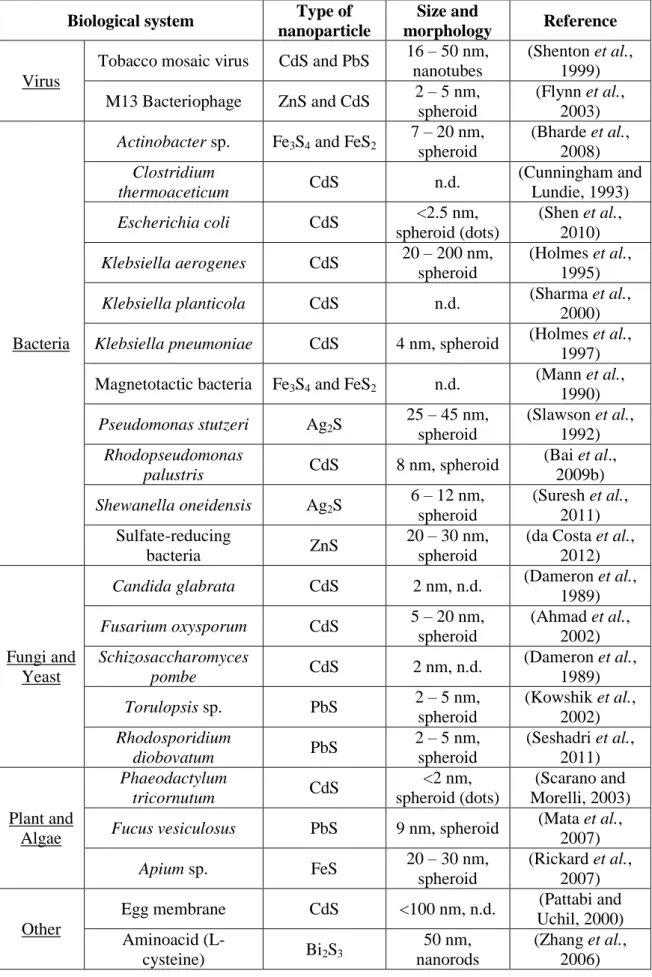
methods relying on the decomposition of organometallic precursors have been used (Talapin et al., 2001) which include surfactant-assisted routes (Wang and Yang, 2000) and microemulsions (Dong et al., 2002). A description of the synthesis methods for multiple nanosized metal sulfides is summarized in Table 1.2 and examples of the different end-products obtained are shown in Figure 1.9.
Figure 1.9 – Nanosized metal sulfides chemically synthesized. In A, TEM image of ZnS:Mn thin film obtained at 60ºC by a chemical deposition method (adapted from (Sahraei et al., 2013)). In B, TEM image showing CdS spheroid particles prepared by
γ-radiation (adapted from (Ge et al., 2002)). The SEM image of 10 – 20 nm CdS spheres prepared by thermolysis (inset) that constitute the building blocks of larger hollow spheres is shown in C (adapted from (Luo et al., 2012)). Finally, in D, HRTEM image
of CdS nanoparticles synthesized by microemulsion (adapted from (Upadhyay et al., 2012)).
Table 1.2 – Synthesis methods for obtaining different metal sulfides at the nano and/or near-nano scale. References are shown, as well as major findings.
Synthesis Method Type of
nanoparticle Size and morphology Reference
High gravity ZnS 15 – 30 nm, spheroid (Chen et al., 2004) Chemical bath ZnS:Mn 2 nm, thin films (Sahraei et al.,
2013) Irradiation – precipitation CdS 40 – 90 nm, spheroid and 40 – 100 nm (length) nanorods (Ge et al., 2002) Spray pyrolysis CuS 14 – 46 nm, spheroid (Isac et al., 2007)
Thermolysis CuS, ZnS and Bi2S3
10 – 20 nm, spheroid (Luo et al., 2012) Hydrothermal Sb2S3 100 – 400 nm (length), nanorods (Sheikhiabadi et al., 2012) Alkaline hydrolysis Bi2S3 20 nm (length), nanofibers (Neves et al., 2003) Surfactant/sulfurization CdS, ZnS and PbS 4 – 12 nm, spheroid (Patel et al., 2012) Micro-emulsion CdS 4 – 14 nm, spheroid (Upadhyay et al.,
2012) Pulsing electrolysis CuS 110 nm, spheroid (Nekouie et al.,
2013) Thermal decomposition ZnS, CdS and
PbS
4 – 18 nm, spheroid
and cubic (Yu et al., 2011) Solvent-mediated AgInS2 5 nm, spheroid (dots)
(Cheng et al., 2011) Bubble template CuS 4 – 10 nm, spheroid (Zhao et al.,
2012) Organic phase transfer Ag2S 15 – 21 nm, spheroid (Yeo et al., 2010)
Micelle-template CdS 5 nm, nanowires and nanotubes (Xiong et al., 2002) Heat/Precipitation ZnS, CdS and HgS 5 – 18 nm, spheroid and nanorods (Onwudiwe and Ajibade, 2011) Electrophoretic deposition ZnS 20 nm, spheroid (Vázquez et al.,
2011) Single source
(Langmuir-Blodgett deposition) CdS 4 nm, quantum dots
(Ferreira et al., 2001) Metal organic chemical
vapor deposition Cu2ZnSnS4 10 nm, spheroid
(Edler et al., 2012)
These methods, however, are mostly based on high-temperature and/or high pressure and on the use of toxic chemicals. Therefore, the production of functional nanomaterials using bacterial growth media solutions containing biologically produced sulfide, at room temperature and atmospheric pressure, avoiding the use of toxic and expensive chemicals, is an interesting alternative synthesis route. Their use presents obvious economic advantages and safety, as the sulfide is naturally produced in the growth media by sulfate-reducing bacteria enriched from environmental samples. Thus, the use of this excess sulfide – which, otherwise, would require treatment – to produce nanocrystalline materials is an important contribution not only for minimizing its impact on the environment, but also for the production of added value materials, such as nanocrystalline semiconductors. As semiconductors, the cristallinity of the nanosized metal sulfides is of the utmost importance, particularly when used in high precision industries, such as the construction of solar panels, as spatial separation of charges is of crucial importance in the design of efficient donor-acceptor heterojunctions (Bansal et
al., 2013; Friend et al., 2012). Though it is tempting to postulate that the biological and
biologically-mediated synthesis of nanosized semiconductors may not yield comparable nanostructures, regarding the cristallinity and size-dependent functionalities, some authors have already proven that this is not the case and that highly crystalline, monodisperse particles can be obtained and that there is the possibility to exert some control over size and, consequently, size-dependant functions (Bai et al., 2009a; Dameron et al., 1989; Gaware et al., 2012; Shankar et al., 2004; Song et al., 2010). Some of these biological and biologically-mediated synthesis processes are described in the following section.
1.2.3 Biological Synthesis
1.2.3.1 General Outline
Metal sulfide nanoparticles of different shapes and sizes have been obtained resorting to numerous organisms, such as Rhodopseudomonas palustris (Bai et al., 2009b),
Escherichia coli (Shen et al., 2010), Clostridium thermoaceticum (Cunningham and
Lundie, 1993), Tobacco mosaic virus (Shenton et al., 1999) and Phaeodactylum
tricornutum (Scarano and Morelli, 2003), among others. Table 1.3 provides a summary
and their respective characteristics, in terms of morphology and size. Considering the vast work carried out in this area of research, the summaries presented in Tables 1.2 and 1.3 could not but be invidious. Although extensive work has been carried out using certain methods in both biological and chemical syntheses (e.g., E. coli-mediated synthesis of nanosized metal sulfides (Jaiganesh et al., 2012; Kang et al., 2008; Mi et
al., 2011; Shen et al., 2010; Sweeney et al., 2004)), herein we have tried to give a broad
overview of the variety of systems that can be used for obtaining such nanostructures. In Figure 1.10, examples of the different nanostructures obtained using different organisms and biologically-mediated systems are shown.
The biosynthesis of metal sulfide nanoparticles presents numerous advantages. Such processes are characterized by occurring at neutral pH, atmospheric pressure and in a temperature range close to ambient temperature (Bai et al., 2009a; Castillo et al., 2012; da Costa et al., 2012; Thakkar et al., 2010).
1.2.3.2 Fungi and Yeasts
Fungi and yeasts are very efficient secretors of extracellular enzymes (Amore and Faraco, 2012; Kroukamp et al., 2013). These microorganisms have the potential to be used in large-scale production of enzymes that mediate the precipitation of metals in the media as metal sulfides (Sastry et al., 2003). Genetic manipulation of these organisms – aiming at the overexpression of the desired enzymes – presents additional challenges when compared to the genetic engineering of simpler organisms, such as bacteria, as post-translational modifications are sometimes required (Su et al., 2012). Fungi also show high tolerance to metals (Rajapaksha, 2011) and bioaccumulation abilities (Mishra and Malik, 2012). Consequently, syntheses using these microorganisms can be more easily scaled-up (Mukherjee et al., 2001). However, some of these organisms (such as
Fusarium oxysporum) are pathogenic to humans (O'Donnell et al., 2004) and plants
(Edel-Hermann et al., 2012), which would imply severe restrictions and the enforcement of strict control systems whenever used.
Seshadri and co-workers were able to synthesize PbS nanoparticles in the range of 2 – 5 nm using a lead-resistant yeast, Rhodosporidium diobovatum (Seshadri et al., 2011). The authors also found that these nanoparticles were capped by a sulfur-rich peptide. In the late 80‘s, Dameron and collaborators have described the synthesis of CdS quantum dots (2 nm) using the yeasts Candida glabrata and Schizosaccharomyces pombe
(Dameron et al., 1989), noting that the obtained nanoparticles were more monodisperse than those chemically produced. Identically, Ahmad et al. (Ahmad et al., 2002) have produced CdS nanocrystals (5 – 20 nm) using the ascomycete fungus Fusarium
oxysporum. The authors mentioned that this method can be extended to other systems
such as PbS, ZnS and MoS2 nanocrystals.
1.2.3.3 Virus, Plants and Algae
Protein engineering of viral cages for the synthesis of constrained nanomaterials has been the subject of several studies. Douglas and respective team (Douglas et al., 2002) have used the protein cage of the cowpea chlorotic mottle virus (CCMV) for the synthesis of iron oxide nanoparticles and Rong has reported the use of the protein cages of different viruses – namely, the M13 bacteriophage and the CCMV – in the synthesis of iron oxide nanoparticles of diverse architectures (Rong et al., 2011). Only a limited amount of work has been developed in the synthesis of metal sulfide nanoparticles using viruses. Shenton and co-workers (Shenton et al., 1999) used Tobacco mosaic virus to produce CdS nanotubes. Resorting to the viral capsid of the bacteriophage M13, Flynn and respective team (Flynn et al., 2003) were able to successfully synthesize ZnS and CdS nanoparticles. Moreover these authors have shown that the phage constructs were able to control the crystal size of the nanoparticles obtained. Using a similar approach, Iwahori and collaborators (Iwahori et al., 2011) have used the protein cage apoferritin to synthesize CuS nanocrystals.
Identically, few studies have been carried out using plants (or plant extracts) and algae in the synthesis of metal sulfides, though a few have reported the successful precipitation of elemental gold and silver. Armendariz and co-workers, for example, have used Avena sativa (oat) biomass to recover Au(III) from aqueous solutions as elemental gold nanoparticles (Armendariz et al., 2004) and Singaravelu and co-workers have used a type of brown algae (Sargassum wightii) to obtain monodisperse gold nanoparticles (Singaravelu et al., 2007). The precipitation of metal sulfides resorting to plants and/or algae has been feebly studied and, consequently, the synthesis of nanosized metal sulfides resorting to plants and algae is at this point poorly understood. However, 20 – 30 nm nanoparticles of FeS have been precipitated using Apium sp. (Rickard et al., 2007). There are intrinsic limitations to such processes because the synthesis takes place extracellularly. This is because the space between the cellulose
fibrils is approximately 5 nm wide (Thimm et al., 2000), and therefore there are physical constraints for the precipitation of the metal sulfides within the plant cell walls. Nonetheless, Mata and collaborators were able to use brown algae, Fucus vesiculosus, to precipitate PbS nanocrystals with an average size of 9 nm (Mata et al., 2007), while simultaneously removing Au(III).
1.2.3.4 Bacteria
The most investigated microorganisms for the precipitation of nanosized metal sulfides have been bacteria. These organisms are easier to manipulate and also show extreme resistance and bioaccumulation capabilities for heavy metals (Choudhary et al., 2012; Poirier et al., 2013; Zhang et al., 2012). Figure 1.10 and Table 1.3 contain some examples of the work carried out using numerous bacteria in the synthesis of metal sulfide nanoparticles.
Figure 1.10 – Nanosized metal sulfides synthesized using biological systems. In A, HRTEM images of ZnS crystals obtained using viral capsids (adapted from (Flynn et
al., 2003)). In B, ZnS spheroid particles (20 – 30 nm) synthesized using biologically
produced sulfide (adapted from (da Costa et al., 2012)). HRTEM of PbS nanocrystallites prepared using the yeast Torulopsis sp. is shown in C. In D, TEM image of a section of Apium sp. parenchyma cell, showing the direction of diffusion
Table 1.3 – Biological systems used for the synthesis of different nanosized metal sulfides. References are shown, as well as major findings.
Biological system Type of nanoparticle
Size and
morphology Reference
Virus
Tobacco mosaic virus CdS and PbS 16 – 50 nm, nanotubes (Shenton et al., 1999) M13 Bacteriophage ZnS and CdS 2 – 5 nm, spheroid (Flynn et al., 2003) Bacteria
Actinobacter sp. Fe3S4 and FeS2
7 – 20 nm, spheroid (Bharde et al., 2008) Clostridium thermoaceticum CdS n.d. (Cunningham and Lundie, 1993) Escherichia coli CdS <2.5 nm, spheroid (dots) (Shen et al., 2010) Klebsiella aerogenes CdS 20 – 200 nm, spheroid (Holmes et al., 1995)
Klebsiella planticola CdS n.d. (Sharma et al.,
2000)
Klebsiella pneumoniae CdS 4 nm, spheroid (Holmes et al.,
1997) Magnetotactic bacteria Fe3S4 and FeS2 n.d. (Mann et al.,
1990) Pseudomonas stutzeri Ag2S 25 – 45 nm, spheroid (Slawson et al., 1992) Rhodopseudomonas palustris CdS 8 nm, spheroid (Bai et al., 2009b) Shewanella oneidensis Ag2S 6 – 12 nm, spheroid (Suresh et al., 2011) Sulfate-reducing bacteria ZnS 20 – 30 nm, spheroid
(da Costa et al., 2012)
Fungi and Yeast
Candida glabrata CdS 2 nm, n.d. (Dameron et al.,
1989) Fusarium oxysporum CdS 5 – 20 nm, spheroid (Ahmad et al., 2002) Schizosaccharomyces pombe CdS 2 nm, n.d. (Dameron et al., 1989) Torulopsis sp. PbS 2 – 5 nm, spheroid (Kowshik et al., 2002) Rhodosporidium diobovatum PbS 2 – 5 nm, spheroid (Seshadri et al., 2011) Plant and Algae Phaeodactylum tricornutum CdS <2 nm, spheroid (dots) (Scarano and Morelli, 2003)
Fucus vesiculosus PbS 9 nm, spheroid (Mata et al.,
2007) Apium sp. FeS 20 – 30 nm, spheroid (Rickard et al., 2007) Other
Egg membrane CdS <100 nm, n.d. (Pattabi and Uchil, 2000) Aminoacid (L-cysteine) Bi2S3 50 nm, nanorods (Zhang et al., 2006)
1.3 The Case for Sulfate-Reducing Bacteria (SRB)
Consisting of a group of diverse morphology, dissimilatory sulfate- or sulfur- reducing bacteria (SRB) includes fourteen (14) gram-negative bacteria (Barton and
Hamilton, 2007; Bergey and Breed, 1957). SRB are amongst the oldest forms of life and can be traced back to 3.5 billion years ago (Barton and Fauque, 2009; Hohmann-Marriott and Blankenship, 2011; Tice and Lowe, 2004). The sulfate reduction process can occur by two distinct pathways: assimilatory and dissimilatory (Grein et al., 2012). In the assimilatory pathway, small amounts of sulfate are reduced for the synthesis of sulfur-containing cell components, such as proteins (Leustek et al., 2000). In contrast, in the dissimilatory pathway, large amounts of sulfate are reduced for obtaining energy and the excess sulfide is expelled (Barton, 1995; Muyzer and Stams, 2008). Both pathways are described in Figure 1.11. As an energy-yielding process, the dissimilatory metabolism is probably one of the earliest pathways sustaining life (Canfield and Raiswell, 1999; Canfield et al., 2006). Between the Promethean Period of the Hadean (4,000 million years ago) and the Archean (2,500 million years ago) Eons (Goldblatt et
al., 2010), Earth‘s anoxic atmosphere was rich in H2S and SO2, due to volcanic and hydrothermal sources (Grein et al., 2012). In turn, these compounds could undergo photolysis, generating elemental sulfur and sulfate (Farquhar et al., 2001; Pavlov and Kasting, 2002). These could then serve as an electron acceptor in the oxidation of H2. An alternative biological strategy could be the disproportionation of elemental sulfur and sulfur compounds of intermediate oxidation states, such as sulfite or thiosulfate (Grein et al., 2012). Such strategies have been reported in studies of sulfur isotopes and microfossil records (Philippot et al., 2007; Shen et al., 2001; Wacey et al., 2011). These organisms range between 0.4 – 3.0 µm in diameter and are strictly anaerobic (Bergey and Breed, 1957). Based on ribosomal RNA, they have been categorized in four sub-groups: gram-negative mesophilic SRB, gram-positive spore forming SRB, thermophilic bacterial SRB and thermophilic archaeal SRB (Castro et al., 2000).