UNIVERSIDADE DA BEIRA INTERIOR Faculdade de Ciências
Synthesis, characterization and anti-oxidant
activity of Thio-imidate N-oxides (TIO) sugars
Maria Augusta da Graça Domingues
Dissertação para obtenção do Grau de Mestre em
Bioquímica
(2º ciclo de estudos)
Orientador: Prof. Doutora Maria Isabel Guerreiro Costa Ismael
Co-orientador: Prof. Doutor Arnaud Tatibouët
iii
Dedicatória
Dedico este trabalho ao meu avô Jerónimo Pinheiro Dominguesv
Agradecimentos
Apenas foi possível realizar este trabalho graças a algumas pessoas devido à sua disponibilidade, generosidade, amizade e compreensão.
Em primeiro lugar quero agradecer à Professora Doutora Maria Isabel Ismael, presidente do Departamento de Química da Universidade da Beira Interior, que orientou este trabalho, que proporcionou o estágio ERASMUS, e que me deu o seu apoio científico, esteve sempre disponível.
Quero expressar o meu profundo reconhecimento ao Professor Doutor Arnaud Tatibouët do Instituto de Química Orgânica e Analítica (ICOA) da Universidade de Orléans pelo estágio profissional ERASMUS que orientou, pelo seu acolhimento e pela sua amizade. Quero ainda agradecer a toda a sua equipa bem como ao Professor Doutor Patrick Rollin.
Quero ainda agradecer a todos os meus amigos sem excepção, todo apoio, incentivo, compreensão e disponibilidade. Quero agradecer de forma especial à minha colega e amiga Marta Santos e ao Rafael Couto.
Expresso ainda a minha gratidão à Universidade da Beira Interior e ao ICOA por terem disponibilizado todo o material e por terem proporcionado a realização desta dissertação nas suas instalações.
Por último quero agradecer a toda a minha família, nomeadamente ao meu pai, mãe, avós, bisavó e irmã.
vii
Resumo
A função N-óxido de tio-imidato é uma função rara e original. O objectivo deste trabalho foi a síntese, caracterização e determinação da actividade antioxidante de um composto derivado da D-ribose, o N-óxido de tio-imidato, assim como de todos os compostos sintetizados.
A síntese do N-óxido de tioimidato 8, foi efectuada por duas sequências diferentes de reacções a partir da D-ribose. A primeira sequência de reacções iniciou-se com a protecção dos grupos hidroxilo das posições 2 e 3 da D-ribose utilizando o grupo isopropilideno como grupo protector. A redução, seguida de clivagem oxidativa permite obter a 2,3-O-isopropilideno-L-eritrose (2) com 58% de rendimento, que após tratamento com cloreto de hidroxilamina originou a aldoxima 3 com 73% de rendimento. A protecção do grupo hidroxilo da posição 4 com o grupo ter-butildimetilsililico foi efectuada por reacção da aldoxima 3 com cloreto de ter-butildimetilsililo, tendo-se obtido o éter sililico 4 com 19% de rendimento e o éter sililico 5 com 63% de rendimento. A introdução da função tio-hidroximato foi efectuada por reacção do composto 4 ou por reacção do composto 5 com etanotiol e tri-etilamina, originando o composto 6 com 63% e 18% de rendimento respectivamente. O grupo hidroxilo da posição 4 foi desprotegido por reacção com difluortrifenilsilicato de tetrabutilamónio (TBAT) dando origem ao composto 7, com 40% de rendimento. A ciclização foi efectuada por reacção de Mitsunobu, obtendo-se o N-óxido de tioimidato (8) com 50% de rendimento na forma de um sólido cristalino branco.
Iniciou-se a segunda sequência reaccional com a protecção dos grupos hidroxilo 1, 2 e 3 da D-ribose, com metanol e acetona respectivamente, em meio ácido. A substituição nucleófilica do grupo hidroxilo desprotegido (posição 4) foi realizada com trifenilfosfina, iodo e imidazol, originando o desoxi-iodo açúcar 10 com 71% de rendimento. Seguidamente efectuou-se a abertura do anel de açúcar com butil lítio a -78ºC, obtendo-se aldeído 11, que foi utilizado, sem ser isolado, para a reacção de obtenção do álcool 12, tendo este sido obtido com 70% de rendimento. Este composto foi protegido com cloreto de terbutildimetilsililo, originando o composto 13, com 70% de rendimento na forma de um líquido incolor.
Os compostos obtidos foram isolados e purificados por cromatografia em coluna. A análise da sua estrutura foi efectuada por espectroscopia de Infravermelho, de Ressonância Magnética Nuclear (RMN) de protão (1H RMN) e de carbono treze (13C RMN). Assim como por espectrometria de massa. Foram também determinados os pontos de fusão (dos compostos sólidos) e os poderes rotatórios específicos dos compostos isolados.
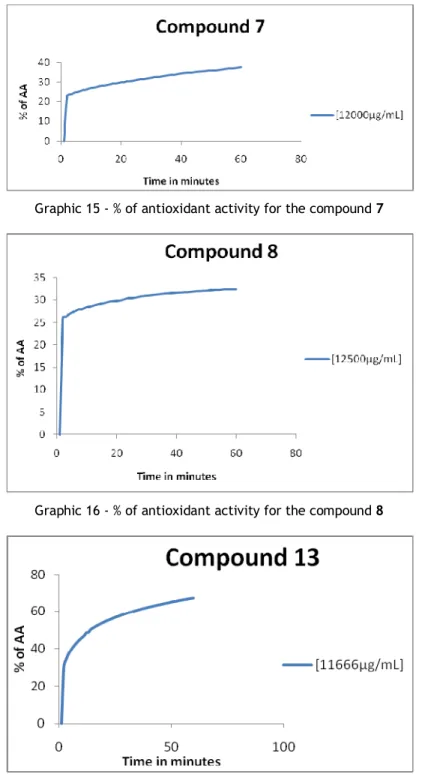
Foi realizada a determinação da actividade antioxidante para os compostos 3, 5, 6, 7, 8, 10 e
viii
que este radical tem em reagir com doadores de hidrogénio para conhecimento da sua actividade antioxidante, utilizando como referência o antioxidante sintético comercialmente conhecido como Trolox.
Dos compostos analisados a aldoxima 3, o desoxi-iodo-açúcar 10 e o éter sililico 13 apresentam actividade antioxidante. O composto 13 tem uma actividade antioxidante de 68%, seguido da aldoxima 3 com uma actividade antioxidante de 60% e por último o desoxi-iodo-açúcar 10 com uma actividade de 56%. Os restantes compostos analisados apresentam actividade antioxidante residual.
O dexosi-iodo-açúcar 10 apresenta uma concentração eficiente de 8084µg/mL para uma concentração inicial de 16500µg/mL e uma concentração eficiente de 8586µg/mL para uma concentração inicial de 12530µg/mL, o que demonstra ser um potencial antioxidante.
Foi possivel obter o N-óxido de tio-imidato pela primeira sequência de reacções, o seu ponto de fusão é 139-143 ºC, o seu poder rotatório é de 143 a sua actividade antioxidante é de 34%.
Palavras-chave
Hidratos de carbono, derivados de açúcar, N-óxidos de tio-imidate, desoxi-iodo-açúcares, actividade antioxidantes.
ix
Abstract
The thioimidate N-oxide function is a rare and original function. The objective of this work is the synthesis of heterocyclic rings linked to the sugar moiety by a C-C bond and the characterization of obtained compounds. Regio and stereoselective branched-chain construction starting from D-ribose which led to the synthesis of thio-imidate N-oxide sugar derivates.
The synthesis of compounds was made by several reactions, starting from D-ribose. The protection of D-ribose by isopropylidene group allows us to obtain the ribofuranose (1). The reduction and oxidative cleavage of the 2,3-O-isopropylidene-β-D-ribofuranose allows to obtain the 2,3-O-isopropylideno-L-erithrose (2), the ring opening with hydroxylamine hydrochloride lead to aldoxime 3. Protection of 3 with tert-butyldimethylsilyl group lead to compounds 4 and 5. The introduction of the thiohydroximate function was made with ethanethiol and triethyhamine. The thiohydroximate cyclized to generate efficiently the thio-imidate N-oxide by Mitsunobu reaction.
The protection of D-ribose by methyl group and isopropylidene group lead to compound 9. The ionic deoxygenation of the hydroxyl group in the compoud 9 allows obtaining the deosy-iodenesugar 10. The deosyiodine-sugar after reductive elimination leads to aldehyde 11. Compound 11 undergoes reduction to generate 12 which lead to compound 13.
The obtained compounds were isolated and purified by column chromatography. The characterization of compounds was made by NMR analysis (1H NMR, and 13C NMR), infrared spectrum and by mass spectroscopy. The anti-oxidant activities were also evaluated for some obtained compounds by DPPH method.
Determination of antioxidant activity of some compounds was made by the method of DPPH radical (2,2-diphenyl-1-picrylhydrazyl) based on the ability of this radical has to react with hydrogen donor for knowledge of their antioxidant activity, using as a reference commercially product known as Trolox.
Compounds 3, 10 and 13 show the antioxidant activities of 60%, 56% and 68% respectively. The remaining compounds just demonstrate residual antioxidant activity.
Keywords
Carbohydrates, sugar derivatives, thio-imidate N-oxides, deoxy-iodine-sugar, synthesis, anti-oxidant activities.
xi
Table of contents
Introduction ... 3
1. Protection of the Hydroxyl groups ... 3
1.1. Isopropylidene group ... 4
1.2. Tert-butyldimethylsilyl group ... 5
1.3. De-O-Silylation ... 7
2. Reduction ... 8
3. Chain-shortening reactions: oxidative cleavage of -diols... 9
4. Ring opening ... 9
5. Thiohydroximate function introduction ... 10
6. Thioimidate N-oxides ... 11
6.1. Mitsunobu reaction ... 11
7. Ionic deoxygenation ... 12
8. Reduction of deoxy-sugars: reductive elimination ... 13
9. Reactive oxygen species... 14
9.1. Free radicals ... 15
9.2. Lipid peroxidation ... 17
9.3. Oxidation of proteins ... 18
9.4. Oxidation of DNA... 18
10. Antioxidants ... 18
10.1. Method of laboratory determination of antioxidant activity: DPPH Method... 21
Results Discussion ... 25
1. Preparation of isopropylidene-β-D-ribofuranose ... 25
2. Preparation of 2,3-O-isopropylidene-L-Erythrosis ... 26
3. Preparation of 2,3-O-isopropylidene-L-oxime Erythrosis ... 27
4. Preparation of 4-O-tert-butyldimethylsilyl-2 ,3-O-isopropylidene-L-oxime Erythrosis ... 28
5. Preparation of N-[tert-butyl (dimethyl) silyl] oxy-1-[(4R, 5S) -5 - [[tert-butyl (dimethyl) silyl] oxymethyl] -2,2-dimethyl-1 ,3-dioxolan -4-yl] methanimine ... 30
6. Preparation of (Z)-4-O-tert-butyldimethylsilyl-2 ,3-O-isopropylidene-N-hydroxy-L-erythronimidothioate of s'ethyle ... 31
7. Preparation of (Z) -2,3-O-isopropylidene-N-hydroxy-L-erythronimidothioate of s'ethyle ... 32
8. Preparation of (3S, 4S) -2 - (erythylthio) -3,4-isopropylidenedioxy-3 ,4-dihydro-5H-pyrrole-1-Oxyde ... 33
xii 10. Preparation of methyl-5-deoxy-5-iodo-2,3-O-isopropylidene-β-D-ribofuranoside ... 36 11. Preparation of 4,5-dideoxy-2,3-O-isopropylidene-D-erythro-pent-4-enose ... 37 12. Preparation of 4,5-dideoxy-2,3-O-isopropylidene-D-erythro-pentitol ... 38 13. Preparation of tert-butyl-[[(4S,5R)-2,2-dimethyl-5-vinyl-1,3-dioxolan-4-yl]methoxy]-dimethyl-silane ... 39
14. Determination percentage of antioxidant activiy ... 40
Conclusion... 45 Experimental part ... 49 1. General methods ... 49 2. Compounds description ... 51 2,3-O-isopropylidene-β-D-ribofuranose (1) ... 51 2,3-O-isopropylidene-L-erythrose (2) ... 52 2,3-O-isopropylidene-L-erythrose oxime (3) ... 53 4-O-tert-butyldimethylsislyl-2,3-O-isopropylidene-L-erythrose oxime (4) ... 54 N-[tert-butyl(dimethyl)silyl]oxy-1-[(4R,5S)-5-[[tert-butyl(dimethyl)silyl]oxymethyl]-2,2-dimethyl-1,3-dioxolan-4-yl]methanimine (5) ... 56 (Z)-4-O-tert-butyldimethylsilyl-2,3-O-isopropylidene-N-hydroxy-L-erythronimidothioate de s’ethyle (6) ... 58 (Z)-2,3-O-isopropylidene-N-hydroxy-L-erythronimidothioate de s’ethyle (7) ... 60 (3S,4S)-2-(erythylthio)-3,4-isopropylidenedioxy-3,4-dihydro-5H-pyrrole-1-oxyde (8) ... 61 1-O-methyl-2,3-O-isopropylidene-β-D-ribofuranose (9) ... 62 Methyl-5-deoxy-5-iodo-2,3-O-isopropylidene-β-D-ribofuranoside (10)... 63 4,5-dideoxy-2,3-O-isopropylidene-D-erythro-pent-4-enose (11) ... 64 4,5-dideoxy-2,3-O-isopropylidene-D-erythro-pentitol (12) ... 65 Tert-butyl-[[(4S,5R)-2,2-dimethyl-5-vinyl-1,3-dioxolan-4-yl]methoxy]-dimethyl-silane (13)66 3. Determination of antioxidant activity ... 67
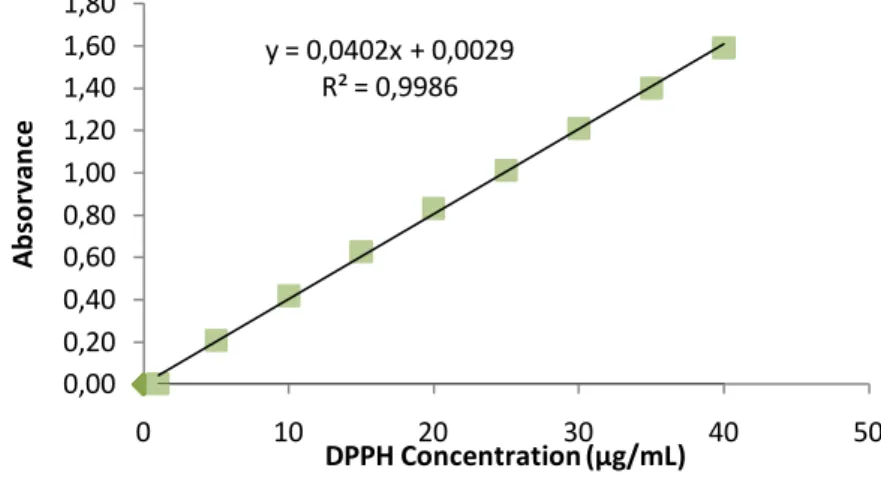
3.1 Construction of calibration curve ... 67
xiii
Picture list
Picture 1 - Acyclic form and cyclic form of the D-ribose ... 3
Picture 2 - Reactive oxygen species ... 15
Picture 3 - Function of SOD ... 19
Picture 4 - Function of gluathione peroxidase ... 20
xv
Table list
Table 1-Comparison of chemical deviation of the 1H-NMR spectrum of compound 2 and 3. ... 28
Table 2 - Comparison of chemical deviation of the 1H-NMR spectrum of compound 7 and 8. . 34
Table 3 - Comparison of chemical deviation of the 13C-NMR spectrum of compound 7 and 8. 34 Table 4 - Comparison of chemical deviation of the 1H-NMRspectrum ... 36
Table 5 - Maximum %AA obtaining for the posite control. ... 69
Table 6 - Efficient concentration for the positive control ... 71
Table 7 - Maximum %AA obtaining for the compound 10 ... 72
Table 8 - Efficient concentration for the compound 10 ... 73
xvii
Scheme list
Scheme 1- D-ribose protection withe isopropylidene group. ... 4
Scheme 2- D-ribose protection with isopropylidene goup and methyl group. ... 5
Scheme 3- Alcohol protection. ... 6
Scheme 4- Silylation of hydroxyl group in compound 3. ... 6
Scheme 5- Silylation of hydroxyl group in compound 3. ... 6
Scheme 6- Silylation of hydroxyl group in compound 12... 7
Scheme 7- De-o-Silylation. ... 7
Scheme 8- Unprotection of the silyl ether 6. ... 7
Scheme 9- Reduction of aldehydes to primary alcohols. ... 8
Scheme 10- Reduction of compound 1. ... 8
Scheme 11-Reduction of compound 11. ... 8
Scheme 12- Oxidative cleavage of -diols. ... 9
Scheme 13- Chain – shortening of an intermediate compound. ... 9
Scheme 14- Ring opening ... 10
Scheme 15- Introduction of a thiohydroximate function. ... 10
Scheme 16- Introduction of a thiohydroximate function. ... 11
Scheme 17- Mitsunobu reaction. ... 11
Scheme 18- Synthesis scheme of Mitsunobu reaction. ... 12
Scheme 19- Cyclization of compound 7. ... 12
Scheme 20- Method applied by Garegg Samuelsson. ... 13
Scheme 21- Ionic deoxygenation of compound 9. ... 13
Scheme 22- Reductive elimination of compound 10. ... 14
Scheme 23- Protection of D-ribose white isopropylidene group. ... 25
Scheme 24- Reduction and oxidative cleavage of -diols. ... 26
Scheme 25- Ring opening of compoud 2. ... 27
Scheme 26- Protection of compound 3 with the tert-butyldimethylsilyl group. ... 29
Scheme 27- Protection of compound 3 with tert-butyldimethylsilyl group. ... 30
Scheme 28- Thiohydroximate function introduction in compound 4. ... 31
Scheme 29 Thiohydroximate function introduction in compound 5. ... 32
Scheme 30- De-O-Silylation of compound 6. ... 33
Scheme 31- Cyclization of compound 7. ... 34
Scheme 32- Protection of D-ribose with the isopropylidene group and the methyl group. .... 35
Scheme 33 – Ionic deoxygenation ... 36
Scheme 34- Ionic deoxygenation of compound 10. ... 37
Scheme 35- Cleavage redutively ... 38
Scheme 36- Cleavage redutively ... 38
Scheme 37- Reduction of compound 11... 39
xix
Graphic list
Graphic 1 - Calibration curve ... 67
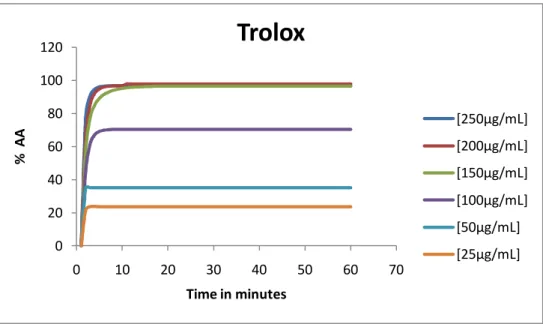
Graphic 2 - Antioxidant activity for the positive control ... 69
Graphic 3 - % of remaining DPPH for the positive control. ... 69
Graphic 4 - Efficient concentration for the positive control ... 70
Graphic 5 - Efficient concentration for the positive control ... 70
Graphic 6 - Efficient concentration for the positive control ... 71
Graphic 7 - Efficient concentration for the positive control ... 71
Graphic 8 - Percentage of antioxidant activity for the compound 10 ... 72
Graphic 9 - Remaining DPPH for the compound 10 ... 72
Graphic 10 - Efficient concentration for the compond 10. ... 73
Graphic 11 - Efficient concentration for the compound 10. ... 73
Graphic 12 - % of antioxidant activity for the compound 3 ... 74
Graphic 13 - % of antioxidant activity for the compound 5 ... 74
Graphic 14 - % of antioxidant activity for the compound 6 ... 74
Graphic 15 - % of antioxidant activity for the compound 7 ... 75
Graphic 16 - % of antioxidant activity for the compound 8 ... 75
xxi
Acronym list
EA Ethyl Acetate
PE Ether Petrole
COSY Spectroscopy Correlation
Éq Equivalent(s)
MeOH Methanol
EtOH Ethanol
NMR Nuclear Magnetic Resonnance
THF Tetrahydrofurane
UV Ultra-violet
Rf Retention factor
DMSO Dimethyl sulfoxide
BuOH Buthanol
DMF Dimethylformamide
NCS N-Cholorosuccinimide
TBAT Tetrabutylammonium triphenyldifluorosilicate
DEAD Diethyl azodicarboxylate
Molecular Sieve MS
Hz Hertz
M.S Mass spectroscopy
Wavelength
RNA Ribonucleic acid
ROS Reactive oxygen species
r.t Room temperature
Superoxide dismutase SOD Glutathione peroxidase GPx
Catalase Cat
1
3
Introduction
The term “carbohydrate” was originally introduced in the 19th century because the molecular formulae of the simpler carbohydrates were show to be of the form CnH2nOn or Cn(H2O)n –
hence “hydrate of carbon”. Many of these compounds were sweet, and the term “sugar” was also adopted. The carbohydrates are among the most constituents of plants and animals. These simple sugars or “monosaccharides” of known molecular weight were shown to be polyhydroxy-aldehydes or polyhydroxy-ketones, the interconversions are possible and are typical of the experiments carried out which provided evidence for these functionalities.1 Of the simple sugars, glucose and ribose are probably the most important. The former occurs as the monomeric unit in numerous polysaccharides (cellulose, starch and glycogen) but is also a common constituent of secondary metabolites. D-Ribose is key constituents of the essential ribonucleic acids (RNA).1
Picture 1 - Acyclic form and cyclic form of the D-ribose
Many natural products contain sugars in structurally modified forms. Those sugars have carboxylic acid groups while others have amino groups in place of specific hydroxyl groups or have undergone more substantial change in having branched instead of linear carbon chains in their structures. The combinations of these modifications produce compounds with specific properties. These modifications allow obtain planning antibiotics, anti-tumor compounds and anti-oxidant compounds.The synthesis and biosynthesis of these sugars are currently areas of active investigation.2
1. Protection of the Hydroxyl groups
Due to the multifunctional nature of the sugars, it becomes necessary to introduce protecting groups from hydroxyl functions when trying to perform a chemical reaction in a certain position of the molecule, thus preventing the remaining hydroxyl groups present in the molecule also react under the applied reaction conditions.3
The protection of hydroxyl groups has had a wide application in the chemistry of sugars, including nucleosides4, nucleotides and also in the chemistry of steroids.5
4
• Ease of introduction;
• Stability under the required reaction conditions; • Ease of removal;
It must be also taken into account other considerations such as cost and toxicity of reagents used in the reaction, choosing always the most appropriate for the situation in cause. It is also necessary to ensure that the released protecting groups are stable under the reaction conditions used in the following steps.3
The sugars can be protected by conversion of hydroxyl groups in acetals, ketals, esters or ether as there is a wide variety of protecting groups, with different selectivity, allowing the formation of unwanted compounds.3
The protecting groups commonly used in chemistry of the sugars are the isopropylidene group, benzyl group, the trityl group, methyl group and tert-butyldimethylsilyl group. In this dissertation we will only use the isopropylidene group, methyl group and tert-butyldimethylsilyl group for protecting hydroxyl groups.3
1.1.
Isopropylidene group
The most used acetal in protection of sugar is the one that results from the protection of two neighboring hydroxyl groups, and that is known as isopropylidene. Several reagents can be used for the formation of the isopropylidene group, such as acetone, pyridine, or methanol. The scheme 1 and 2 shows the protection of two neighboring hydroxyl groups.2,6
Acetone
1 H2SO4
5
9 MeOH
Acetone, H2SO4
Scheme 2- D-ribose protection with isopropylidene goup and methyl group.
The isopropylidene group can be selectively introduced (protecting specific pairs of hydroxyl groups). In both cases, as shown in scheme 1 and 2 we will protect the hydroxyl groups 2 and 3. In the second scheme we can also observe the protection of the hydroxyl group of the anomeric carbon. The placement of a methyl group is also a possible and an easy way to protect an alcohol group. This protection was made simultaneously with the protection of hydroxyl groups 2 and 3.6
Removal of the isopropylidene group can be done in a simple way by performing a hydrolysis with an aqueous solution of a weak acid at room temperature. Acid hydrolysis breaks the isopropylidene group regenerating again two hydroxyl groups previously protected.6
1.2.
Tert-butyldimethylsilyl group
The hydroxyl group can also be protected by converting it to a silylated ether group, the most widely used protective agent is tert-butyldimethylsily. The tert-butyldimethylsilyl group is ca. 104 times more hydrolytically stable and holds more promise for such applications. The tert-butyldimethylsilyl chloride was used as a silylation agent. The tert-tert-butyldimethylsilyl group can be added allowing the alcohol group to react with tert-butyldimethylsilyl in the presence of an aromatic amine (base) such as imidazole or pyridine according to the scheme 3. That procedure resulted in the conversion of various alcohols to tert-butyldimethylsilyl ethers in high yield.7
6
DMF, r.t
ROH +
Scheme 3- Alcohol protection.
4 3
Pyridine
Scheme 4- Silylation of hydroxyl group in compound 3.
5 3
Pyridine
7
12 13
Pyridine
Scheme 6- Silylation of hydroxyl group in compound 12.
The conversion of an alcohol to a silylated ether makes it much more volatile. Given this fact the tert-butyldimethylsilyl group is also labile to be used as a protective group in many reactions.8
1.3.
De-O-Silylation
The rapid cleavage of the silyl ethers to alcohols is given by treatment with tetra-n-butylammonium fluoride (TBAF) in THF at room temperature. Thus the tert-butyldimethylsilyl group can be removed according to the scheme 7. This is called the de-O-silylation.7
ROH THF, r.t Bu4NF Scheme 7- De-o-Silylation. TBAT 6 7 THF, r.t
8
2. Reduction
While the acid-base reactions can be characterized as proton transfer processes, reactions known as oxidation-reduction (or redox) are considered electron transfer reactions. A reaction involving the gain of electrons is called the reaction of reduction. The reduction is a chemical change that occurs where there is a decrease of oxidation number of a specific chemical species. When an element is oxidized, it acts as a reducing agent, since it donates electrons to another substance, causing its reduction. When, however, one element is reduced, it acts as an oxidizing agent because it accepts electrons, causing its oxidation.A simple way of reducing a compound is treating it with NaBH4 and MeOH at 0ºC or NaBH4 and
EtOH at 0ºC. The NaBH4 reduces aldehydes to primary alcohols. 9
H
+NaBH
4Scheme 9- Reduction of aldehydes to primary alcohols.
1 NaBH4 MeOH, 0ºC O H O O O H O H O H O H O O O
Scheme 10- Reduction of compound 1.
NaBH4
EtOH, 0ºC
11 12
9
3. Chain-shortening reactions: oxidative cleavage of -diols
Several methods for cleaving the carbon chains of monosaccharides and thus producing ‘lower’ sugars. Reaction of -diols with periodic acid H5IO6 or its salts (in this case with NaIO4)
gives rise to cyclic ester intermediates which cleave in a two-electron oxidation process to give two carbonyl products and iodate. This method was used to reduce the size of the carbon chain. The sodium periodate is often used in derivatives of carbohydrates. The proposed mechanism for oxidative cleavage is represented in Scheme 12.10
+ IO3- + IO4
-Scheme 12- Oxidative cleavage of -diols.
2 NaIO4
Scheme 13- Chain – shortening of an intermediate compound.
4. Ring opening
The ring opening is made using hydroxylamine hydrochloride, pyridine and activated molecular sieve. Thus we can transform the isopropylidene-L-Erythrosis in 2.3-O-isopropylidene-L-oxime Erythrosis. 11,12
10
2
Pyridina, MS
3
NH2OH.HCl
Scheme 14- Ring opening
5. Thiohydroximate function introduction
It is possible with relative ease the introduction of a thiohydroximate function, obtaining a good yield, a drawback of this procedure is the odour released during the addition of reagents, its easy propagation / dissipation and consequently its toxicity. Thus the thiohydroximate function can be introduced using NCS, DMF, ethanethiol and triethylamine.13,14
NCS, DMF
4 6
EtSH, Et3N
11 NCS, DMF
5 6
EtSH, Et3N
Scheme 16- Introduction of a thiohydroximate function.
6. Thioimidate N-oxides
The thioimidate N-oxide function is a rare and original function, of which little is known. The formation of thioimidate N-oxide can be controlled by avoiding direct attack to the electrophilic carbon. They chose to introduce the thiohydroximate function in one end of the chain and the activable group at the other end. There are two possibilites to convert thiohydroximate into a thioimidate N-oxide: halociclization using as activable group an alkenyl or a nucleophilic substitution under the conditions of the Mitsunobu reaction using as activable group an hydroxyl group.15
6.1. Mitsunobu reaction
The Mitsunobu Reaction (scheme 17) allows the conversion of primary and secondary alcohols to esters, phenyl ethers, thioethers and various other compounds. Inter and intramolecular nucleophilic displacement of alcohols with inversion by means of diethyl azodicarboxylate (DEAD)-triphenylphosphine and a nucleophile. The nucleophile employed should be acidic, since one of the reagents (DEAD) must be protonated during the course of the reaction to prevent from side reactions. We were involved in the synthesis of cyclic sugar analogues.15-23
Scheme 17- Mitsunobu reaction.
The triphenylphosphine combines with DEAD to generate a phosphonium intermediate that binds to the alcohol oxygen, activating it as a leaving group. Substitution by the carboxylate, mercaptyl, or other nucleophile completes the process. The reaction proceeds with clean inversion, which makes the Mitsunobu Reaction with secondary alcohols a powerful method
12
for the inversion of stereogenic centers in natural product synthesis. The thioimidate N-oxide obtained is a stable compound, a thiohydroximate type with a double bond to improve the stability of the compound. Those compounds were stable at room temperature.The thioimidate N-oxide (TIO) function is a rare and original function. Imidates and thioimidates are important building blocks in organic synthesis, especially for heterocyclic compounds.15-23
Scheme 18- Synthesis scheme of Mitsunobu reaction.
anydre THF, reflux
7 8
Ph3P, DEAD
Scheme 19- Cyclization of compound 7.
7. Ionic deoxygenation
The ion deoxygenation always involves the formation of a halogen-sugar. The deoxy-halogen-sugars are susceptible to nucleophilic attacks. The easiness of removability of a halide decreases in the order I> Br> Cl> F, in this work we will use the iodine.2
13 The method applied by Garegg Samuelsson consists essentially in a reaction between a free hydroxyl group and the triphenylphosphine / iodine / imidazole system using toluene as a solvent. The inversion of configuration occurs when there is replacement of the hydroxyl group by iodide ion. The same mechanism was proposed by the same researchers in 198024 which is presented in the scheme 20.24
Ph3P + I2 + 2 Ph3P+
+ R-OH Ph3P+ ORI- +
Ph3P + ORI- Ph3P=O + RI Ph3P+
Scheme 20- Method applied by Garegg Samuelsson.
The C-5 halogenation of the carbohydrate chain was carried out by this method resulting in a 5-iodo-deoxy-sugar.24-28
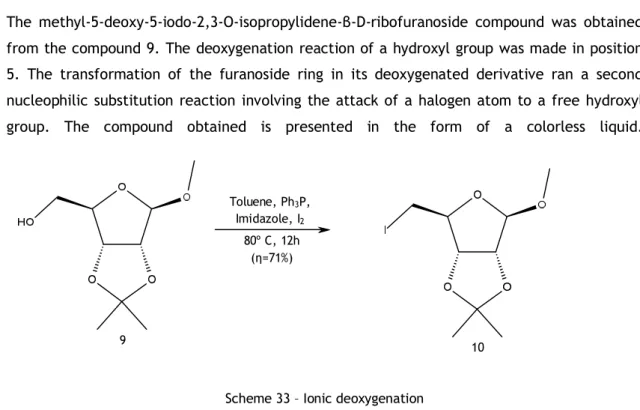
9 10
Toluene, Ph3P
Imidazole, I2
Scheme 21- Ionic deoxygenation of compound 9.
8. Reduction of deoxy-sugars: reductive elimination
As the name implies reductive elimination involves the elimination or expulsion of a molecule from a transition metal complex. In the process of this elimination, the metal center is reduced by two electrons. In the simplest example below the metal goes from the x+2 to the x oxidation state and a coordinately unsaturated metal center is obtained.25,29-31
14
Reductive elimination is formally the microscopic reverse of oxidative addition, and it is not surprising that a series of reactions involving an oxidative addition, a rearrangement and then a reductive elimination form the basis for a variety of industrially important catalytic cycles.25,29-31
10
BuLi
11 anydre THF, -78º C
Scheme 22- Reductive elimination of compound 10.
We tried to obtain the compound 11 by reacting compound 10 with zinc and methanol under reflux or zinc and anhydrous THF under reflux. In both cases it was possible to reach the desired aldehyde unsaured but the yield was so low that we chose to use the opening of the ring with butyllithium.32
9. Reactive oxygen species
Oxidation is a metabolic process that allows the cellular systems to convert potential energy of particles assimilate into usable energy and essential activities necessary for the cell. However, the metabolism of molecular oxygen in cells also causes the appearance of intermediates resulting from the partial reduction called by reactive oxygen species (ROS).33
15 Picture 2 - Reactive oxygen species
The imbalance between ROS production and detoxification mechanisms of these species in the human body, with a consequent increase in the concentration of free radicals in cells, leads to the development of a framework of oxidative stress34, ie, the imbalance between
oxidizing and anti-oxidants may result in the induction of cell damage by free radicals.35 Thus
the entropic control of biological processes at the cellular level requires a reducing environment that needs to be maintained with the use of numerous enzymatic anti-oxidants structures.34
9.1. Free radicals
Free radicals are produced naturally or by some biological dysfunction through oxidative and metabolic processes, and are often extremely useful, as in situations where there is need for activation of the immune system (macrophages use hydrogen peroxide to destroy bacteria and other foreign elements) in drug detoxification and relaxation36. The heightened production of
free radicals leads to important changes at the molecular level that are associated with damage of biological macromolecules such as lipids, proteins and DNA, causing tissue alterations that involve a number of pathological processes such as cancer, atherosclerosis, neurodegenerative diseases and inflammatory diseases, cardiovascular, diabetes, cirrhosis, rheumatoid arthritis, etc.37,38
Free radicals are generated both by endogenous and exogenous sources. Free radicals generated by endogenous sources originate from biological processes that normally occur in the organism: 39
reduction of flavins and thiols, as a result of the activity of oxidases, cyclooxygenase, lipoxygenases, peroxidases and dehydrogenases;
16
electron transport systems (mitochondria and endoplasmic reticulum membrane and plasma);
Intermediate during drug detox;
the synthesis of prostaglandins and during activation of leukocytes and platelets.
The exogenous sources that generate free radicals include tobacco, air pollution, organic solvents, toxins, alcohol, stress, anesthetics, pesticides, chemical additives, preservatives, hormones and radiation. 39
Most free radicals are derived from the metabolism of molecular oxygen (O2) used in the
respiratory chain, which occurs in the inner membrane of mitochondria to produce energy (ATP), so called reactive species of oxygen metabolism, being the main: 37
superoxide radical (O2‾), formed in the organism mainly through the electron transport
chain or by action of phagocytic cells (neutrophils, monocytes, macrophages, and eosinophils) in defense against invading microorganisms in the metabolic pathway catalyzed by NADPH oxidase40. The O
2‾ radical is formed by adding an electron in the O2
molecule in its ground state, which can generate greater reactivity of other species such as hydrogen peroxide, hydroxyl radical and peroxinitrile.37
hydroxyl radical (OH●) is the most reactive in biological systems, has a half-life 10-9 and
attacks molecules close to their place of training. Its formation in vivo may be related to the decomposition of peroxinitrile, hydrogen peroxide, and reactions catalyzed by transition metals, such as iron, the Fenton reaction, according to the scheme: 37
Fe2+ + H
202 Fe3+ + OH● + OH‾
Ions of transition metals can also catalyze the reaction between H2O2 and superoxide,
leading to the production of hydroxyl radical, called the Haber Weiss reaction:41
H2O2 + OH● H2O + O2‾ + H+
H2O2 + O2‾ O2 + OH‾ + OH●
Singlet oxygen (1O
2): is the excited state of the molecular oxygen and has no unpaired
electrons in the last layer. Can be produced by photochemical reactions or other radiation and reacts with a large number of biological molecules, including membrane lipids, initiating lipid peroxidation processes.42
Hydrogen peroxide (H2O2): although it is not a free radical, due to the absence of
unpaired electrons in the last layer, participates in the reaction that produces the radical OH● 34. Mitochondria are important sources of O2●‾ and the presence of this radical anion
17 superoxide can cause serious damage, it is converted enzymatically by the action of superoxide dismutase to H2O2, as the scheme:37
O2●‾ + O2●‾ + 2H+ O2 + H2O2
H2O2 can also be generated by spontaneous conversion of the resulting divalent reduction of
O2 in the third stage of respiration that occurs within the mitochondria, according to the
scheme: 40
O2 O2‾ H2O2
The initiation of oxidation by free radicals is not yet clarified, being the hydroxyl radical (OH●) and the peroxinitrile radical (NO
2●) the radical initiators. It is also assigned an
important role in anion superoxide radical (O2‾) due to the possibility of generating hydroxyl
radical (OH●).43-45
Once formed, the ROS goes to the microcirculation, and due to its high reactivity, they will perform at the level of different cellular structures (proteins and DNA) and also at the cell membrane (polyunsaturated fat).43-45
9.2. Lipid peroxidation
Lipid peroxidation has a great importance because it constitutes a process chain, ie, where the formation of a radical triggers the propagation of lipid peroxidative process. Lipid peroxidation is a reaction represented by the steps of initiation, propagation, and termination. These steps are presented below:43-45
Initiation: LH + OH• (or LO•) ———> L•+ H2O (ou LOH) Propagation: L• + O2 ———> LOO•
Propagation: LH + LOO• ———> L•+ LOOH Termination: LOO• + L. ———> LOOL
Termination: LOO• + LOO. ———> LOOL + O2
The above reaction begins with the kidnapping of hydrogen from the polyunsaturated fat acid (LH) of the cell membrane. This sequestration can be accomplished by OH• or LO• (alkoxyl radical), with consequent formation of L• (radical lipid). In the first equation of propagation, L• reacts rapidly with O2, resulting in LOO• (peroxyl radical), which, in turn, kidnaps a new
hydrogen from polyunsaturated fat acid, forming again in the second propagation equation, L•. The termination of lipid peroxidation occurs when the radicals (L• and LOO•) produced in the previous steps propagate to destroy themselves.43-45
18
The hydroxyl radical (OH•) is often recognized as the species and the most important initiator
of lipid peroxidation. However, studies indicate that iron also plays a decisive role in the initiation of this process. Lipid peroxidation can be catalyzed by iron ions, by conversion of lipid hydroperoxides (LOOH) into highly reactive radicals (alkoxyl, and peroxyl LO•, LOO•) which, in turn, begins a new chain of reactions, called branching. These reactions, which can be fast or slow, depend on the valence of iron.43-45
Lipid peroxidation produces various reactive products including radicals lipids and malonic aldehyde. These final products, in addition to acting directly on other components of the cell membrane, can seep into the bloodstream by increasing the levels in blood and plasma. This increase is indicative of damage to cell membranes of organs or tissues, which may be responsible for triggering various pathological processes.43-45
9.3. Oxidation of proteins
Changing the properties of proteins and the formation of peroxides in amino acids can lead to degradation of proteins by fragmentation and crosslinking (cross-linking), which can result in their polymerization and inactivation, specifically in proteins that contain sulphydryl groups (-SH) groups and aromatic. The oxidation of proteins causes further change in its tertiary structure leading to protein aggregation and formation of amyloid plaques. The amino acid oxidation by free radicals induced changes in enzyme activity, there is also an impairment of antioxidant potential of cells and tissues.43-45
9.4. Oxidation of DNA
The DNA damages are the most important processes resulting from the occurrence of peroxidative process in vivo. The change in DNA by oxidative damage is one of the main causes responsible for the onset of carcinogenesis, either by activating proto-oncogenes or by inactivation of tumor suppressor genes. Inhibition of cell death program, apoptosis, may also be associated with oncogenesis and changes in DNA and may arise as a result of the action of free radicals that lead to increased cytoplasmic calcium concentration.43-45
The continuous production of free radicals during the metabolic processes lead to the development of many antioxidant defense mechanisms to limit intracellular levels of these species and prevent the induction of cell damage.35
10. Antioxidants
The term antioxidant refers to any substance which, when present in low concentrations compared to the oxidizable substrate, delays or inhibits oxidation of this substrate effectively.37
19 The natural defense systems include a wide range of substances that act on three different levels of oxidation: (1) blocking the initiation step, because they prevent the generation of reactive species or kidnap them to prevent their interaction with targets cell, eg: antioxidant enzymes, tocopherols, bioflavonoids and carotenoids, (2) blocking the stage of progression of the kidnapping chain radical radical intermediates, eg: tocopherols (vitamin E), tocotrienols, flavonoids and synthetic antioxidants, and (3) repairing the injuries caused by ROS, this process is related to the removal of damaged DNA molecule and the reconstruction of damaged cell membranes.46-48
The two major antioxidant defenses in the body can be divided into two groups: enzymatic and non-enzymatic. The enzymatic antioxidant system is the first defense to attack by endogenous reactive oxygen species, preventing their formation or kidnapping them in order to prevent its interaction with cellular targets, ie, block the initiation step of radical chain. This system is formed mainly by the following antioxidant enzymes: superoxide dismutase (SOD), glutathione peroxidase (GPx) and catalase (Cat).49
The function of SOD is to catalyze the reaction of dismutation of anion superoxide radical, generating molecular oxygen and hydrogen peroxide. This is the main isoenzyme in extracellular fluids, but is also present in tissues.50
Picture 3 - Function of SOD
Glutathione peroxidase is a selenium-dependent enzyme, cooperates with the Cat in removing hydroperoxides (ROOH). The GPx catalyzes the reduction of hydrogen peroxide and other organic peroxides at the expense of conversion of reduced glutathione (GSH) to oxidized glutathione (GSSG). This enzyme is specific as the hydrogen donor (GSH), but can reduce various organic hydroperoxides, including lipid hydroperoxides 50. In addition to its
20
central role in the activity of glutathione peroxidase, glutathione it is involved in several other antioxidant pathways, including the kidnapping of free radicals, ascorbate metabolism and detoxification of xenobiotics via glutathione transferase. 51
Picture 4 - Function of gluathione peroxidase
The Cat is found mainly in cellular peroxisomes and to some extent in the cytosol, directly decomposing hydrogen peroxide into water and molecular oxygen, which results from the dismutation of superoxide anion radical 51,52.This enzyme is found in the blood,
bone marrow, mucous, kidney and liver. 34
These three enzymes are necessary for cell survival, even under normal conditions. They act through synergistic mechanisms to ensure the cell protection. However, this protection is achieved only when there is a feeling for maintaining a balance in their activity, which may be affected in the presence of ROS. 53
The non-enzymatic antioxidants, mostly need to be acquired by food. Fruits and vegetables are the main sources of these antioxidants. Non-enzymatic components of antioxidant defense include: trace elements (zinc, copper, selenium, etc.), vitamins (ascorbic acid, vitamin E, vitamin A, vitamin C, riboflavin), pyruvate, carotenoids (beta-carotene, lycopene and lutein), flavonoids and other compounds derived from plants. Some of the most important synthetic antioxidants include butyl hydroxyanisole (BHA) and butyl hydroxytoluene (BHT). 54
The importance to the performance of common antioxidant in vivo depends on the following factors: types of free radicals formed, where and how these radicals are generated and optimum doses for protection. Thus it is possible that an antioxidant acts as a protective antioxidant in a system, but that fails to protect or even increase-induced lesions in other tissues or systems. 55
21 Very recent studies indicate the existence of a metabolic specific signaling and regulation chain describing how oxidative stress is recognized within the system and translated into degeneration. This discovery gave a new impetus to research on substances or mixture of substances that allow the interruption of the cascade of metabolic reactions related to oxidative stress. 56
10.1. Method of laboratory determination of antioxidant activity: DPPH
Method
Various methods are used to determine the antioxidant activity of extracts and isolated chemical substances. One of the most frequently used methods is to evaluate the kidnapper free radical 2,2-diphenyl-1-hydrazine-picril (DPPH●) (picture 5) activity of purple coloration
which absorbs 515 nm in a solution of methanol.
Picture 5 - DPPH
By action of an antioxidant (AH) or a radical species (R●), the DPPH● (picture 5) is reduced
forming picril-diphenyl-hydrazine, in yellow, with consequent disappearance of the absorption, The same can be monitored by the decrease in absorbance. 57-59
DPPH● + AH
DPPH-H + A●DPPH● + R●
DPPH-RFrom the results obtained determines the percentage of antioxidant activity or the percentage free radical scavenging and / or percentage of DPPH remaining in the reaction medium. The percentage of antioxidant activity (% AA) is the amount of DPPH consumed by the antioxidant. 57-58
The quantity antioxidant needed to decrease the initial DPPH concentration by 50% is called effective concentration (EC50), also called by inhibitory concentration (IC50). The time
22
(TEC50). The higher the consumption of DPPH by a sample, the lower the EC50 and the higher
its antioxidant activity.57-58
This DPPH method is based, ultimately, in the ability of DPPH react with hydrogen donor substances.57-58
23
25
Results Discussion
The starting compound for the synthesis of all the heterocyclic compounds was the D-ribose transformed into 2,3-O-isopropylidene-β-D-ribofuranose and 1-O-methyl-2,3-O-isopropylidene-β-D-ribofuranose. These two compounds were used for the synthesis of its derivatives.
1. Preparation of isopropylidene-β-D-ribofuranose
Compound 1 was obtained as indicated in the scheme 23. The starting compound, ie, D-ribose has three free hydroxyl groups in position 1,2 and 3 of the furanosidic ring.
To make the protection of any hydroxyl group you should pick up a protective group that is easy to introduce and easy to handle. To protect the hydroxyl group of positions 2 and 3 we used the isopropylidene group. This process involves the activation of acetone by concentrated sulfuric acid followed by D-ribose nucleophilic attack to the activated acetone.
The hydroxyl groups 2 and 3 are the less reactive present in the D-ribose, thereby protecting the hydroxyl groups of these two neighbours we will get a more stable conformation. Thus we turn D-ribose into isopropylidene-β-D-ribofuranose with an income higher than that described in the literature. It was found that to obtain this income, which is close to 100%, it is necessary to flame the balloon to remove any remaining moisture. The product comes in the form of a colourless liquid.
1 H2SO4 , Acetone
r.t, 1h (η=98%)
Scheme 23- Protection of D-ribose white isopropylidene group.
By observing the thin layer chromatography it was concluded that it was not necessary to purify the obtained compound. We then performed the identification of the structure of compound 1 by the usual methods.
By 1H-NMR spectrum it can be observed two signals at 1.27 and at 1.43, that represents
two singlets, the integration curve of each singlet corresponds to three protons, that is, six protons in whole confirming the presence of the isopropylidene group.
26
By 13C-RMN spectrum it can be observed a signal at 112.3 corresponding to single quaternary carbon present in the compound 1, thus demonstrating the occurrence of reaction and the protection of hydroxyl groups 2 and 3 with the isopropylidene group.
By infrared spectrum it can be observed at 3374 a large band corresponding to the alcohol group. At 1063 it can be observed a band corresponding to cyclic ether. At 923 it can be observed a band corresponding to ketal (isopropylidene group).
2. Preparation of 2,3-O-isopropylidene-L-Erythrosis
The compound 2,3-O-isopropylidene-L-Erythrosis was obtained from compound 1 as indicated in the scheme 24, being the first step the reduction of the compound 1 with NaBH4/MeOH at
0°C, followed by oxidative cleavage of the diol involving the breaking of a carbon-carbon bond resulting in a carbonyl compound thus reducing the size of the carbon chain. The reagent most commonly used as an oxidizing agent in this type of process is the sodium periodate (NaIO4). The product comes in the form of a colorless liquid.
1
2 NaBH4, MeOH, 0º C, 1h
NaIO4, r.t, 12h
(η=58%)
Scheme 24- Reduction and oxidative cleavage of -diols.
By 1H-NMR spectrum it can be observed a signal at 4.24, represented by a broad singlet, the curve of integration is a proton. Across the spectrum of 13C-NMR, by exclusion, it can be confirm that this corresponds to the hydrogen of the alcohol group of the anomeric carbon.
By 13C-NMR spectrum it can be observed that there are three tertiary carbons, one quaternary carbon and a secondary carbon. Compound 1 has four tertiary carbons, the presence of three tertiary carbons in the compound 2 confirms the reduction of the carbon chain. It can be also observed a signal at 112,4 corresponding to the quaternary carbon of the isopropylidene group.
By infrared spectrum it can be observed at 3411 cm-1 a large band corresponding to the
alcohol group. At 1063 and at 906 cm-1 can be observed corresponding bands to cyclic ether.
27 The yield was lower than that described in the literature, perhaps due to loss of response during treatment or during purification of the obtained residue.
3. Preparation of 2,3-O-isopropylidene-L-oxime Erythrosis
Compound 2,3-O-isopropylidene-L-Erythrosis oxime was obtained from compound 2 as indicated in the scheme 25. In this procedure, the ring opening occurs through the use of hydroxylamine hydrochloride. The only drawback of this method is the smell released by pyridine. Pyridine is a toxic solvent that can damage the male reproductive system among other. Therefore you need the most attention, and wash all the material used by HCl to neutralize the odor of pyridine. Evaporate in the rotavapor, then you must verify if the product still shows traces of pyridine, if this odor is still present due to co-evaporate with toluene product. The product comes in the form of a pink/purple solid, and its melting point is between 46-51 ° C. The yield was slightly lower than that described in the literature.
Pyridine, NH2OH.HCl r.t, 48h (η=73%)
2 3
Scheme 25- Ring opening of compoud 2.
By observing the thin layer chromatography it was concluded that it was not necessary to purify the compound obtained. We then performed the identification of the structure of compound 3 by the usual methods.
By 1H-NMR spectrum it can be observed that the product is an isomer. Thus it shows characteristic signs of the Z and E isomer. The compound 3 has the same number of quaternary carbons, tertiary and secondary than the compound 2 which makes it more difficult to explain the formation of product 3.
28
Table 1-Comparison of chemical deviation of the 1H-NMR spectrum of compound 2 and 3.
Compound CH-1 CH-2 CH-3 CH2-4 C(CH3)2 OH 2 5.35 4.51 4.79 3.91-4.06 1.27 and 1.41 4.24 3 6.94(Z) and 7.44(E) 4.88(E) and 5.26(Z) 4.33-4.36(E) and 4.51-4.70(Z) 3.49-3.74 1.37 (Z) and 1.47(E) -
The CH2-4 compound 3 appears as a multiplet at 3.49-3.74 with an integration curve of 4
protons. At 4.33-4.36 it can be observed a multiplet corresponding to the CH-3 of the E-isomer and at 4.51-4.70 it can be also observed a multiplet corresponding to the CH-3 Z-isomer, both with an integration curve of 1 proton. At 4.88 it can be observed a triplet corresponding to the CH-2 and at 5.26 a large singlet corresponding to CH-2 Z-isomer. For the spectrum of compound 2 it can be observed that the signals corresponding to CH-3 appear soon after the CH2-4 and before the signals corresponding to CH-2. In the compound 3 it can
be observed that signals corresponding to CH-3 appear after the signals corresponding to CH-2 and before the signals corresponding to the CH2-4, the reversing order of appearance shows
that it was possible to obtain the compound 3.
By 13C-NMR spectrum it can be observed two quaternary carbons at 109.6 and at 110.1 corresponding to the isopropylidene group of E and Z isomers, it cannot be known which isomer corresponds to each signal.
By infrared spectrum it can be observed at 3209 cm-1 a large band corresponding to the
alcohol group. At 1438 cm-1 can be observed a band corresponding to C=N from the aldoxime.
At 1043 cm-1 can be observed a band corresponding to N-O from the aldoxime. At 957 cm-1 can
be observed a band corresponding to ketal (isopropylidene group).
In this case it is of great interest the mass spectrum as the compound 3 has the same number of carbons than compound 2. Thus it can be observed at 176.0 the expected mass value plus the value of a H+ at 198.0 it can be observed the expected mass value plus the value of the
Na+ ion, and at 214.0 the expected mass value plus the value of the K+ ion. In that way it can
be proved that the obtained product is in fact the 2,3-O-isopropylidene-L-erythrose oxime, that results from the furanosidic ring opening.
4.
Preparation
of
4-O-tert-butyldimethylsilyl-2
,3-O-isopropylidene-L-oxime Erythrosis
The compound 4-O-tert-butyldimethylsilyl-2 ,3-O-isopropylidene-L-Erythrosis oxime was obtained from compound 3. The alcohol function was protected with tert-butyldimethylsilyl
29 group with minor changes as described in the literature. The compound 4 is presented as a colorless liquid. The yield is low, but you can get the two isomers (E and Z).
r.t, 12h (η=19%)
4 3
Pyridine,
Scheme 26- Protection of compound 3 with the tert-butyldimethylsilyl group.
By 1H-RMN spectrum it can be observed a signal at 0.0, represented by a multiplet , with an
integration curve of 6 protons. At 0.82 it can be observed a singlet, with an integration curve of 9 protons. These 15 protons correspond to the tert-butyldimethylsilyl protective group of the E-isomer. In a similar way at 0.10 and at 0.82 it can be founded the protons corresponding to the tert-butyldimethylsilyl group of the Z-isomer. In that way it can be proved the protection of the hydroxyl group 4 with the tert-butyldimethylsilyl group.
By the 13C-RMN spectrum it can be observed 4 quaternary carbons, two of them corresponding
to the E-isomer and other two to the Z-isomer. At 27.2 it can be observed the quaternary carbon from the tert-butyldimethylsilyl group from the E-isomer and at 18.1 for the Z-isomer.
By infrared spectrum it can be observed at 3192 cm-1 as a large band corresponding to the
alcohol group. At 1374 cm-1 can be observed a band corresponding to tert-butyl. At 1046 cm-1
can be observed a band corresponding to N-O from the aldoxime. At 983 cm-1 can be observed
a band corresponding to ketal (isopropylidene group). At 838 cm-1 can be observed a band
corresponding to Si(CH3)2from the tert-butyldimthylsilyl group. At 791 cm-1 can be observed
bands corresponding to Si-C from the tert-butyldimthylsilyl group.
By making the compound 3 react with 1.2 equivalents of tert-butyldimethylsilyl.Cl in pyridine it was able to obtain the compounds 4 and 5. The compound 4 is obtained in a lower yield as the compund 5 (31.4%). The mono-silylated compound (4) is easily separated from the di-silyated compound (5) by silica gel column chromatography. The di-di-silyated compound is the first out of the column, and then the mono-silyated compound. The overall efficiency of this method is 50.4%.
30
5. Preparation of N[tertbutyl (dimethyl) silyl] oxy1[(4R, 5S)
-5 - [[tert-butyl (dimethyl) silyl] oxymethyl] -2,2-dimethyl-1
,3-dioxolan -4-yl] methanimine
The compound N-[tert-butyl (dimethyl) silyl] oxy-1-[(4R, 5S) -5 - [[tert-butyl (dimethyl) silyl] oxymethyl] -2,2-dimethyl-1 ,3-dioxolan -4-yl] methanimine was obtained from compound 3. In this situation the two alcohol functions present in the compound 3 are going to be protected with tert-butyldimethylsilyl group. By increasing the number of equivalents of 1.2 to 2.5 it will allow protection of both alcohol groups. The protection of both alcohol groups enhances the yield of the reaction towards the protection of a single alcohol group with tert-butyldimethylsilyl, thus increasing the yield for the triple. The compound obtained is presented in the form of a pink / violet liquid.
r.t, 12h (η=74%)
3
5 Pyridine,
Scheme 27- Protection of compound 3 with tert-butyldimethylsilyl group.
By 1H-NMR spectrum it can be observed a doublet at 0.04, with an integration curve of 12 protons. At 0.14 it can be observed a multiplet, with an integration curve of 12 protons. These 24 protons correspond to Si(CH3)2 from the mixture E+Z. At 0.88 and at 0.91 it can
be observed 2 dublets with an integration curve of 36 protons, corresponding to Si(CH3)3 from
the mixture E+Z. So the mixture E+Z have 60 protons in total, 30 for each isomer, demonstrating the formation of compound 5, ie, the protection of compound 3 with two tert-butyldimethylsilyl groups.
By the 13C-RMN spectrum it can be observed 3 quaternary carbons, at 18.4 it can be
observed the quaternary carbon corresponding to the isopropylidene group. At 109.3 and at 109.7 can be observed the quaternary carbons corresponding from the two tert-butyldimethylsilyl group, which corresponds to the di-silylated product.
31 By infrared spectrum it can be observed at 1251 cm-1 a band corresponding to Si-O-C from the silyl ether. At 834 cm-1 can be observed a band corresponding to 834 from the
ter-butyldimethylsilyl group.
By making the compound 3 to react with 2.5 equivalents of tert butyldimethylsilyl.Cl in pyridine we get only the compound 5, ie, the compound di-silylated. The yield is satisfactory and far superior to that obtained when using 1.2 equivalents of tert-butyldimethylsilyl.Cl.
6.
Preparation
of
(Z)-4-O-tert-butyldimethylsilyl-2
,3-O-isopropylidene-N-hydroxy-L-erythronimidothioate of s'ethyle
The ethylene- (Z)-4-O-tert-butyldimethylsilyl-2,3-O-isopropylidene-N-hydroxy-L-erythro imidothioate compound was obtained from compound 3 and 4. The introduction of the thiohydroximate function is a simple procedure to take. The major drawback of this procedure is the smell released by EtSH, the maximum attention was need since this compound is toxic.
When the residue is evaporated in Rotavapor it is needed to add Javel water to the collection balloon of solvents to neutralize the smell. Only in this way is possible to evaporate the residue.
As mentioned the compound 6 can be obtained from compound 4 and 5 by the same procedure. The yield that is going to be obtained will be different, being compound 4 the one where it can be obtained a higher yield. Thus we can say that it is more satisfatory to obtain the compound di-silylated (5) but for the following reaction is more satisfatory to use the mono-silylated compound (4). The compound obtained is presented in the form of a yellow liquid. 4 NCS, DMF, r.t, 4h EtSH, Et3N, r.t, 12h 6 (η=40%)
32 5 NCS, DMF, r.t, 4h EtSH, Et3N, r.t, 12h 6 (η=18%)
Scheme 29 Thiohydroximate function introduction in compound 5.
By 1H-NMR spectrum the signals at 0.05 and at 0.87 are related to protons of the tert-butyldimethylsilyl group, its integration curve corresponds to 15 protons in its entirety. At 1.29 it can be observed a triplet, whose integration curve corresponds to 3 protons, accross the spectrum of 13C-RMN it can be said that this signal is referring to SCH
2CH3. At 2.97-3.10
it can be observed a multiplet, its integration curve correspond to 2 protons, and accross the spectrum of 13C-RMN it can be said that this signal is referring to SCH
2CH3. Through these 2
peaks it can be conformed the introduction of the thiohydroximate function. At 9.09 it can be observed a large singlet, whose integration curve corresponds to 1 proton, which accross the 13C-RMN spectrum it can be said that it corresponds to the alcohol group present on the
compound 6.
By the 13C-RMN spectrum it can be observed 3 quaternary carbons at 18.6, 109.7 and at
149.8 that corresponds, respectively to C(CH3)3, C(CH3)2 and to C=N proving the introduction
of the thiohydroximate function by the raise of a quaternary carbon in the 13C-RMN spectrum.
By infrared spectrum it can be observed at 3288 a large band corresponding to the alcohol group. At 1601 it can be observed a band corresponding to C=N from the aldoxime. At 1078 it can be observed a strong band corresponding to Si-O-C from the silyl ether. At 835 it can be observed a band corresponding to Si(CH3)2 from the tert-butyldimthylsilyl group. At 667 it can
be observed a band corresponding to C-S from the thiohydroximate function.
7. Preparation of
(Z)
-2,3-O-isopropylidene-N-hydroxy-L-erythronimidothioate of s'ethyle
Compound ethyle-(Z)-2,3-O-isopropylidene-N-hydroxy-L-erythronimidothioate was obtained from compound 6. The unprotection of the hydroxyl group, ie, De-O-Silylation enables the
33 regeneration of the hydroxyl group by removing the protective group tert-butyldimethylsilyl. The compound obtained is presented in the form of a white solid, and its melting point is 88-94 º C.
6 7
TBAT, THF r.t, 12h (η= 41%)
Scheme 30- De-O-Silylation of compound 6.
By the 1H-RMN spectrum it can be observed a triplet at 1.33, with an integration curve of 3 protons, corresponding to SCH2CH3. At 1.40 it can be observed a multiplet, with an
integration curve of 2 protons, corresponding to SCH2CH3. By the 1C-RMN spectrum this
attribution can be validated.
By the 1C-RMN spectrum it can be observed the presence of 2 quaternary carbons, at 150.8 and at 158.0, corresponding to C(CH3)2 and to C=N respectively. The disappearance of one
quaternary carbon confirms the De-O-Silylation of compund 6.
By infrared spectrum it can be observed at 3479 a strong band corresponding to the alcohol group. At 1688 it can be observed a band corresponding to ketal (isopropylidene group). At 670 it can be observed a band corresponding to C-S from the thiohydroximate function.
8.
Preparation
of
(3S,
4S)
-2
-
(erythylthio)
-3,4-isopropylidenedioxy-3 ,4-dihydro-5H-pyrrole-1-Oxyde
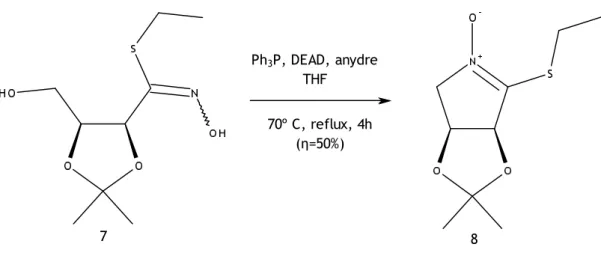
The compound (3S,4S)-2-(erythylthio)-3,4-isopropylidenedioxy-3,4-dihydro-5H-pyrrole-1-oxyde was obtained from the compound 7. When applying the conditions used in the Mitsunobu reaction it will origin the thioimidate N-oxides through a nucleophilic substitution of an alcohol-activated terminal. The compound obtained is presented in the form of a white solid, its melting point is 139-143 ° C. The yield is approximately half that described in the literature.
34 70º C, reflux, 4h (η=50%) 7 8 Ph3P, DEAD, anydre THF
Scheme 31- Cyclization of compound 7.
Table 2 - Comparison of chemical deviation of the 1H-NMR spectrum of compound 7 and 8.
Compound CH-2 CH-3 CH2-4 SCH2CH3 SCH2CH3 N-OH C(CH3)2
7 4.89 4.40 3.68 and 3.79 3.11 1.33 9.40 1.40 and 1.53
8 5.35 4.90 4.7 and 4.14 3.14 1.38 - 1.39 and 1.44
By the 1R-RMN spectrum it can be observed at 1.38 a large triplet, with an integration curve
of 3 protons, corresponding to SCH2CH3. At 1.39 and 1.44 it can be observed 2 singlets, with
an integration curve of 6 protons, corresponding to the isopropylidene group. At 3.14 it can be observed a quadroplet with an integration curve of 2 protons, corresponding to SCH2CH3.
It can be observed disappearance of the peak corresponding to the function alcohol in relation to the spectrum of compound 7. Thus proves the formation of the compound 8.
Table 3 - Comparison of chemical deviation of the 13C-NMR spectrum of compound 7 and 8.
Compound C-1 CH-2 CH-3 CH2-4 SCH2CH3 SCH2CH3 C(CH3)2 C(CH3)2
7 158.0 75.2 78.8 61.8 25.8 15.2 150.8 25.5 and 27.2
35 By the 1C-RMN spectrum it can be observed 2 quaternary carbons at 112.9 and at 144.0 corresponding to C(CH3)2 and to C-1 respectively.
By infrared spectrum it can be observed at 1570 a band corresponding to C=N from the thio-imidate N-oxides. At 948 it can be observed a band corresponding to ketal (isopropylidene group). At 663 it can be observed a band corresponding to C-S from the thiohydroximate function.
9.
Preparation
of
1-O-methyl-2,3-O-isopropylidene-β-D-ribofuranose
The compound 1-O-methyl-2,3-O-isopropylidene-β-ribofuranose was obtained from the D-ribose. By making D-ribose to react with MeOH/acetone/H2SO2 concentrated the hydroxyl 1
group will be protected with the methyl group at the same time that it will be protected the neighbour hydroxyl 2 and 3 groups with the isopropylidene group. The compound is presented in the form of a yellow liquid.
9 MeOH, actenone,
H2SO4
r.t, 48h (η=80%)
Scheme 32- Protection of D-ribose with the isopropylidene group and the methyl group.
By the 1H-RMN spectrum it can be observed at 1.28 a singlet, with an integration curve of 3
protons. At 1.44 it can be observed a singlet, with an integration curve of 3 protons. These two signals are referred to the protons from the isopropylidene group. At 3.39 it can be observed a singlet, with an integration curve of 3 protons corresponding to the metyl group. It can be also observed at 3.23 a dublet of a dublet corresponding to the only alcohol group existing in the compound 9.
By the 1C-RMN spectrum it can be observed a quaternary carbon at 112.2 corresponding to C(CH3)2, ie, to the quaternary carbon resulting from the protection of the hydroxil 2 and 3