PRESCHOOL OBSERVATION SUPPORTED BY SMARTPHONE
APPLICATIONS
Cristina Mesquita-Pires, Rui Pedro Lopes
Polytechnic Institute of Bragança (Portugal) [email protected], [email protected]
Abstract
In the field of early childhood education, some benchmarks to evaluate the quality of contexts has been developed. One of these benchmarks, developed in the scope of the Effective Early Learning Project, uses the Child Tracking Observation Schedule. The observer records his perception about the concentration, persistence, motivation, energy, satisfaction, complexity and creativity, reaction time and language, trying to establish how the child really feels and experiences the overall learning process. This is a complex process that requires several observations of different children, through the daily routine.
The observation results are, essentially, translated in a paper based table, summarizing the human perception in a condensed form. Many details persist only in the memory of the observer, although they are typically lost and it is not possible to pass them to another observer, to discuss results as well as to train new observers.
The flexibility of smartphones is well known by the general population, allowing their users to make phone calls, check e-mail, get directions, take photographs and many other operations. Our proposal, discussed in this paper, is to use smartphones to assist kindergarten teachers in quality control observa-tions. A custom made application, to allow observers to register observation details in the smartphone, is described. This application also allows them to record other type of material, such as video, photos and sound, thus making a complete record of each observation. This record will be used for assessment of the observation as well as to train new observers.
Keywords: Smartphone, observation form, preschool education.
1 INTRODUCTION
Adequate early childhood education is fundamental to ensure a sound basis for later life. In fact, some studies revealed that well-implemented preschool curriculum models had strong effects not only on children’s intellectual and academic performance but on also on criminal behavior, community activities and misconduct, as well as other parameters (Schweinhart & Weikart, 1997).
The diversity of childhood education settings, including funding, resources, staff and others, is immense. However, the importance that young children’s early learning has in their future life demands rigorous quality assurance mechanisms. These will further extend the expertize and skill of all of those involved in the education process (Belfield, Nores, Barnett, & Schweinhart, 2006).
Several initiatives and projects have been implemented aiming at evaluating and improving quality and effectiveness on early learning. A well known example is the Effective Early Learning (EEL) (Bertram & Pascal, 2004), known in Portugal under the designation Desenvolvendo Qualidade em Parceria – DQP (Bertram & Pascal, 2009). Under these initiatives, quality is evaluated by taking the partici-pants through a systematic and rigorous four stage process ofEvaluation and Development Framework (Pascal, Bertram, & Ramsden, 1997).
Evaluation process in EEL/DQP
The evaluation of quality of early learning in the scope of EEL/DQP requires obtaining a considerable amount of data through several techniques. Data is obtained through detailed observations of children and adults, performing interviews of parents, practitioners and children, documentary analysis and a number of questionnaires, which require that the teachers be well trained. This will contribute to minimize the subjectiveness of the procedure.
Data is gathered and systematically organized in research portfolios, that will be used in a cyclic process of thinking-do-thinking to research and create change (Mesquita-Pires, 2012). The process of change is constituted as a dynamic, interactive and open process that includes the following phases: (1) a flexible plan; (2) act; (3) reflect; (4) evaluate/validate, where data is described and analyzed, and decisions are evaluated and the effects observed; (5) dialog in order to share the view with other partners (colleagues, or others).
This process of quality assessment is enhanced by the utilization of observation techniques which mea-sure the effectiveness of the learning and teaching processes, such as the Child Involvement Scale, an observation technique which measures the level of a child’s involvement in an activity, the Adult Engage-ment Scale, to evaluate the interaction between the practitioner and the child (Laevers, 1994) or the Child Tracking Observation Schedule, to gain a snapshot of the child’s day and providing information of learning experiences (Bertram & Pascal, 2006).
The application of the procedure has a broad set of difficulties and challenges. Initially, it is necessary that the research group learn about participatory pedagogies and theoretical foundations of the EEL research techniques and the practicalities of their use. The application of interviews come soon after, which led the participants to reflect on the ethical issues involving its use. Learning to observe was an-other challenge, because the signs are not always evident and observers must be well trained to identify them. Besides, the observation process should be systematic requiring that kindergarten teachers find time in their daily routine to observe the children and understand how they are learning.
In particular, the EEL/DQP initiative defines a four phase/thirteen steps procedure, comprising:
• Evaluation
1. Initial preparation
2. Initial data gathering
3. Interviews
4. Child Tracking Observation Schedule
5. Child Involvement Scale
6. Adult Engagement Scale
7. Development of evaluation report
• Action planning
8. Development of the action plan
• Development
9. Document and support the implementation of the action plan
10. Child Involvement Scale, following the same procedure from 5
11. Adult Engagement Scale, following the same procedure from 6
• Reflection
12. Reflection on the impact of the plan in the future
13. Final report
Child Tracking Observation Schedule
The Child Tracking Observation Schedule has the main purpose of understanding the child’s daily rou-tine. This technique gives information about the learning experiences, the level of choice, his involve-ment, the group organization and interaction with adults.
In broad terms, this step starts by choosing a set of children, considering gender, ethnicity, age, and others. Each child (target) is observed twice, with each session in a different day. In other words, each child is observed four times, where each observation should not last longer than 2 minutes. The details are registered in a specific form – the observation form.
The form summarizes the observation details, and starts by identifying the institution and the observer name, the date, time, and the child’s name, sex and age. In addition it also records the number of children and adults present during the session. After presenting several activities to the child, it is also registered the child’s level of initiative, learning experiences, involvement and interaction.
There are four levels of child’s initiative:
Level 1: It is not given possibility of choice to the child that is performing the activity
Level 2: A limited number of possibilities of choice is offered to the child
Level 3: Some activities are not allowed to be chosen by the child
Level 4: The child has total freedom of choice
The predominant group situation is registered as follows: Large Group (GG), Small Group (PG), Pair (P), Individual (I). Learning experiences fall under: Personal and Social Education (FPS), Physical Ex-pression (EMot), Representation and Dramatical ExEx-pression (ED), Artistic ExEx-pression (EP), Musical Expression (EMus), Oral Language and Approach to Writing (LING), Mathematics (MAT), Knowledge of the World (CM).
Children involvement follows five levels:
Level 1: Absence of activity
Level 2: Activity frequently interrupted
Level 3: Activity almost continuous
Level 4: Activity with intense moments
Level 5: Maintained intense activity
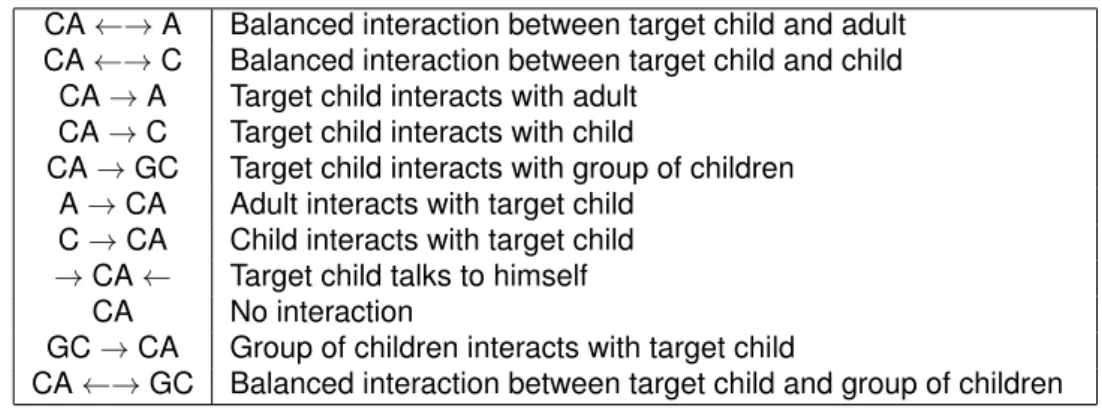
Finally, the interaction, either verbal or non-verbal is registered (Table 1).
Table 1 – Target child interaction.
CA←→A Balanced interaction between target child and adult CA←→C Balanced interaction between target child and child
CA→A Target child interacts with adult CA→C Target child interacts with child
CA→GC Target child interacts with group of children A→CA Adult interacts with target child
C→CA Child interacts with target child →CA← Target child talks to himself
CA No interaction
GC→CA Group of children interacts with target child
CA←→GC Balanced interaction between target child and group of children
the observer and on his sensitivity and training. It is very difficult to get consistent results if the observers diverge in the way they interpret the setting. Moreover, training the observers is also difficult, because it will be based on a written record and not directly associated with the actual observation experience.
We propose, in this paper, the design and development of a smartphone based application to allow registering the Child Tracking Observation Schedule directly in the device. This allows storing a portfolio of observations in a single device, as well as recording videos, photos and sounds together with written annotations.
2 ANALYSIS AND DESIGN
Smartphones present a set of restrictions that are necessary to consider when developing applications for these kind of devices. Although processing power, battery and memory are potentially limiting issues, the most important aspect to consider is, probably, the display size. It is used both to present information to the user and to collect input from him. This characteristic conditions the user interface, designed around sequences of pages, switched (or flipped) according to the context.
In the previous section we presented an overview of the process for quality enhancement in preschool education. One of the steps consists in gathering data from the daily routine of children through specific observation techniques. Several resulting parameters are recorded in a paper based form, filled by the observer.
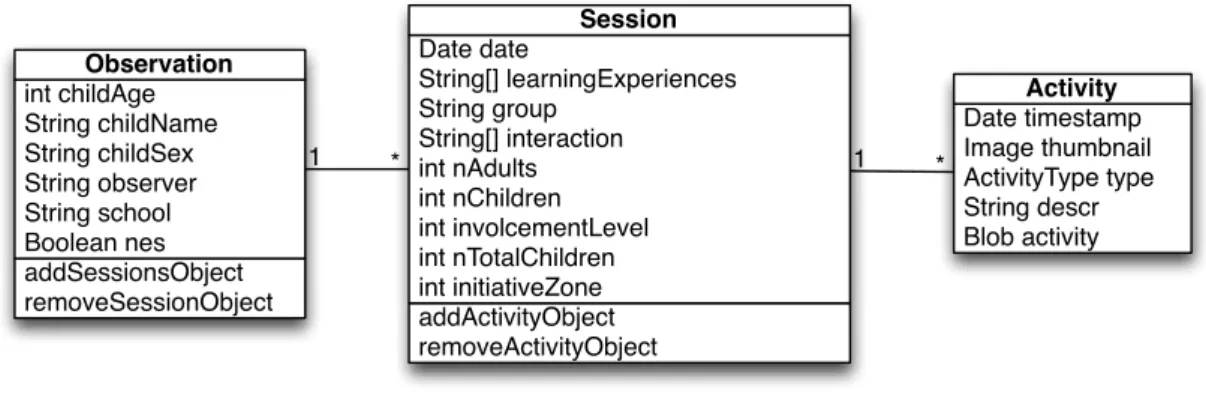
We started by structuring the information from this form in three entities, to be stored in the device database. TheObservation entity is placed at the highest level, for it is the most generic. Each ob-servation is characterized by several attributes. EachObservationhas manySessions(one-to-many relation). In turn, eachSessionrecords the child’s behavior acting on a set ofActivities(Fig. 1).
addSessionsObject removeSessionObject int childAge String childName String childSex String observer String school Boolean nes Observation addActivityObject removeActivityObject Date date String[] learningExperiences String group String[] interaction int nAdults int nChildren int involcementLevel int nTotalChildren int initiativeZone Session Date timestamp Image thumbnail ActivityType type String descr Blob activity Activity *
1 1 *
Fig. 1 – Entity diagram.
The Observation stores general information about each target child, namely, the institution’s name (school), the observer’s name (observer), the child’s name (childName), sex (childSex) and age (childAge). It also registers if the target child requires Special Education Needs (nes). Objects of this type are the umbrella to all the information about a single target child.
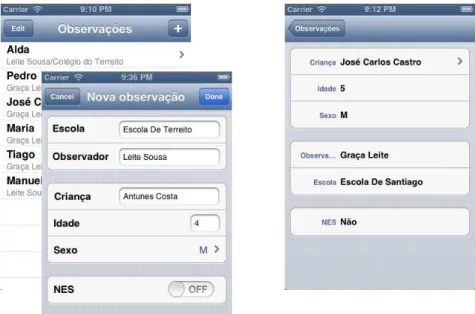
The user creates a child’s portfolio by defining a new object of this type. After touching the ‘+’ button, in the screen’s upper right corner, a new view is presented to allow entering the observation details (Fig. 2). This newObservationobject is presented in the main view list. Each entry in this list shows the child’s name, in bold, and, below it, the observer’s and institution+s name. Touching an element in this list, will push a new view, with the remaining details. Touching the child’s name, will advance to the sessions section.
Fig. 2 – Observation views: listing, adding and details.
Remember that:
• the child’s initiative level is a number in a 1 to 4 scale
• the predominant group can be one of GG, PG, P and I
• the involvement level is a number in a 1 to 5 scale
There are also three more controls where each of them may record a combination of values. The observer can select several options for learning experiences (FPS, EMot, ED, EP, EMus, LING, MAT and CM) as well as several options for target child interaction (CA←→A, CA←→C, CA→A, CA→ C, CA→GC, A→CA, C→CA,→CA←, CA, GC→CA, CA←→GC).
Just as in the previous case, the main view presents the list of sessions, identified by the date. Below the date, the number of children adults is shown (Fig. 3).
By touching the ‘+’ button, the user will be able to create new sessions. When selecting a session from the list, the view is replaced by the session details, to allow entering the related information. The initiative level, the predominant group and the involvement level is entered by selecting the corresponding button. The interactions and learning experiences will present a new view to the user where he will be able to select from a list of choices.
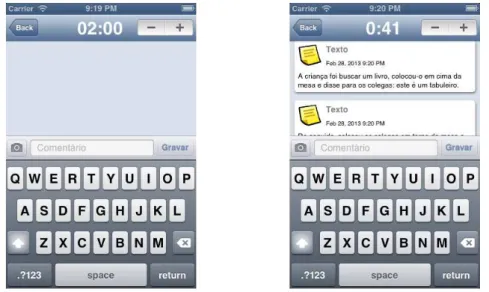
In the paper form, each activity is described textually by the observer. We tried to maintain the same approach although allowing the user to take pictures, make videos and record sounds from the obser-vation. This is performed in the activity view, pushed when the user selects “Actividades” (Fig. 4). The combination of photos, videos and text allow associating the observation to the opinion of the observer for latter assessment. It also can be used to train new observers.
Fig. 4 – Activities: listing, adding and removing.
This is the view that the observer will depend the most. During the observation session, the user will write in the smartphone, take pictures and, eventually, make videos of all or pieces of the session. All these information is associated to the session that, in turn, is under an observation, thus organizing the data in an easy to browse, top-down approach – from the more general information to the more specific.
An additional difficulty that was felt by the observers during sessions was to keep track of the time at the same time they were paying attention to the target child. We added a timer (countdown) that can be set between 1 and 5 minutes. It is always visible, thus allowing for better time and observation control.
3 RESULTS AND OPPORTUNITIES
The data collected through the Child Tracking Observation Schedule constitutes a challenge for kinder-garten teachers, because in this process, they assume cumulatively the roles of mediators of children’s learning and researchers of their practice. Data collection on the initiative, involvement and interactions will allow kindergarten teachers to innovate their practices, diversifying learning experiences that offer to children.
We believe, therefore, that the use of smartphones may be an interesting feature, because they are easily handled and they can be used whenever necessary to document an unexpected or previously learning experience. Also, because they allow reading the data from different sources of registration, the observation can be analyzed and systematized, collaboratively and more rigorously.
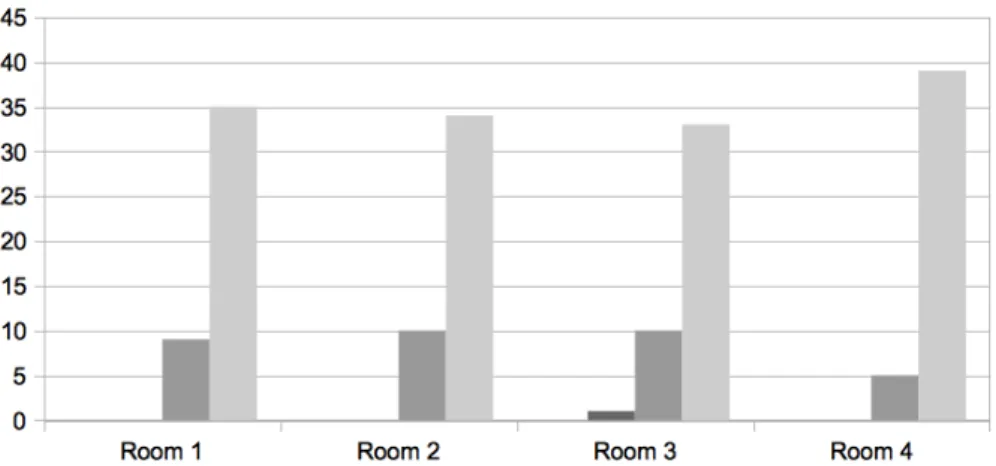
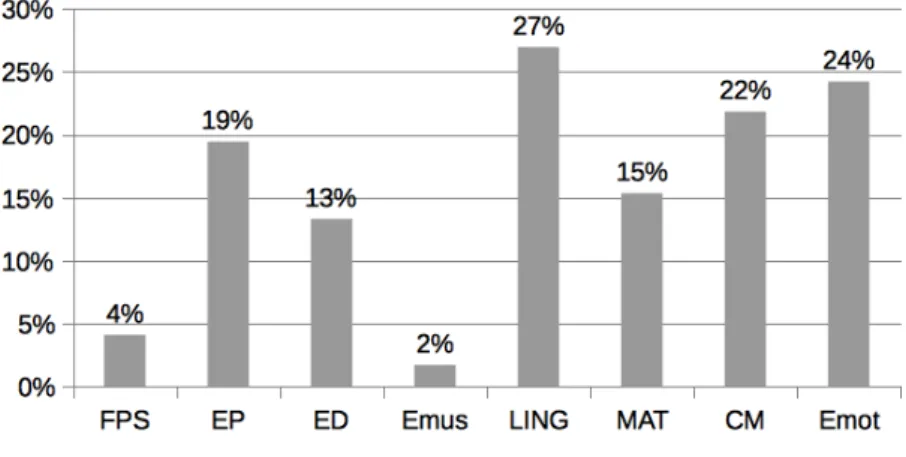
Results are obtained by analyzing data from all the performed observations. All of this information is collected during observations and stored in the device’s internal database. This data is then exported to be processed in other applications, such as a spreadsheet. Totals can be presented through bar charts, showing indicators such as the initiative level, learning experiences, interaction and involvement.
each initiative level (Fig. 5). The way data is presented in this chart, allows obtaining two different levels of information. First, considering each classroom individually, it is possible for the corresponding teacher to know which is the main interaction situation the target child gets more involved (GG, PG, P, I). This will further tell the teacher if the diversity of learning experiences is balanced. Second, looking at the results from all the classrooms, allows knowing the whole context of the institution, as well as to compare the educational intentionality of each teacher and to make them more conscientiously of their options.
Fig. 5 – Interaction level bar chart.
Similarly, it is also possible to summarize the initiative zone chart, as show in Fig. 6. The initiative zone is related to the freedom of choice in relation to the learning experiences available to them and associated levels of participation. By gathering information about all the classrooms, it is possible to compare the quality of the materials and environment of each classroom.
Fig. 6 – Initiative zone chart.
The collected data about learning experiences may help kindergarten teachers to realize how the cur-riculum is developed in their classrooms (Fig. 7). If the curricular integration values all areas of learning, children have the possibility to express themselves through a broad set of languages. This is particularly visible if the weight is balanced through all the areas.
Opportunities
Fig. 7 – Learning experiences bar chart.
small and light device, able of not only recording text but photos and videos as well, makes an opportunity for daily use in this context.
Preschool teachers are able, through such approach, to instantly grab the smartphone and start record-ing an observation, for latter analysis. Without the complexity of dealrecord-ing with several papers, this pro-cedure can become a daily routine, thus giving the possibility to increment the quality evaluation and improvement beyond the initial, more complex, process.
4 CONCLUSIONS
Quality evaluation and consequent improvement is of the utmost importance in several fields of human activity. Preschool education is not an exception. High quality levels at this level of education contributes to the well being of children as adults in several areas, from criminal behavior to family income.
Quality improvement is a complex process, involving all the actors, such as the institution, parents, teachers and children. It starts by an evaluation phase, followed by de definition and development of an action plan, with informed reflection. This results in the development of the overall education process as well as the teachers skills.
This paper describes an approach to record observation results in a smartphone custom made applica-tion, able of storing text, sounds, photos and videos in an electronic portfolio. This data is used by the actors to evaluate and assess education quality.
Since this kind of devices is starting to be familiar to users and, as such, easy to use, small and available at all times, it makes a additional opportunity for routine observations, thus making the quality evaluation and improvement a daily concern.
Considering the importance for daily reflection on quality issues, the application described above shows an interesting potential. It is permanently with the kindergarten teacher, always at hand for an observa-tion. The possibility of organizing all the information in a small package relieves the burden of dealing with several paper based forms and allows importing data directly to computer based analyzing tools.
References
Belfield, C. R., Nores, M., Barnett, W. S., & Schweinhart, L. (2006). The High/Scope Perry Preschool Program: Cost-Benefit Analysis Using Data from the Age-40 Followup. Journal of Human Re-sources, 41(1), 162–190. Retrieved fromhttp://jhr.uwpress.org/content/XLI/1/162.short
Bertram, T., & Pascal, C. (2004). Effective Early Learning ({EEL):} A handbook for evaluating, assuring and improving quality in settings for Three to Five Year Olds. Birmingham: Amber Publishing. Bertram, T., & Pascal, C. (2006). The baby effective early learning programme: Improving quality in
early childhood settings for children from birth to three years. Birmingham: Centre for Research in Early Childhood.
Bertram, T., & Pascal, C. (2009). Manual {DQP} - desenvolvendo a qualidade em parceria. Lisboa: Ministério da Educação.
Laevers, F. (1994). Adult Style Observation Schedule for Early Childhood Education ({ASOS-ECE)}. Lovaina: Centre for Experiential Education.
Mesquita-Pires, C. (2012, December). Children and professionals rights to participation: a case study. European Early Childhood Education Research Journal,20(4), 565–576. Retrieved fromhttp:// dx.doi.org/10.1080/1350293X.2012.737242 doi: 10.1080/1350293X.2012.737242
Pascal, C., Bertram, T., & Ramsden, F. (1997). The Effective Early Learning Research Project: Re-flections Upon The Action During Phase 1. Early Years, 17(2), 40–47. Retrieved fromhttp:// www.tandfonline.com/doi/abs/10.1080/0957514970170208 doi: 10.1080/0957514970170208 Schweinhart, L. J., & Weikart, D. P. (1997, January). The high/scope preschool curriculum comparison
study through age 23. Early Childhood Research Quarterly, 12(2), 117–143. Retrieved from