Carlos Pestana Barros & Nicolas Peypoch
A Comparative Analysis of Productivity Change in Italian and Portuguese Airports
WP 006/2007/DE _________________________________________________________
Elsa Cristina Vaz e Maria Paula Fontoura
International Competitiveness: is the reduction of wages a solution? An evaluation of the Portuguese case
WP 03/2013/DE/UECE _________________________________________________________
Department of Economics
W
ORKINGP
APERSISSN Nº 0874-4548
School of Economics and Management
TECHNICAL UNIVERSITY OF LISBONInternational Competitiveness: is the reduction of wages a solution? An evaluation of the Portuguese case1,2 Elsa Cristina Vaz – Economics Department of University of Évora and CEFAGE
Maria Paula Fontoura - ISEG - School of Economics and Management / Technical University of Lisbon, and UECE – Research Unit on Complexity and Economics
Abstract
The purpose of this paper is to analyse, for the case of Portugal, the effectiveness of wage reduction ‐ a current proposal since 2011 to help the country to reverse the high public and external debt - in promoting the efficiency and international competitiveness of the economy. A static multi‐sector and single‐country general equilibrium model is used and data is collected from the GTAP7 Database. The model allows the measurement of changes by sector. The simulations performed show that extending the reduction of wages already deployed by the government in the public sector to the private sector leads to a positive impact on employment (both skilled and unskilled labour), production and volume of exports in all sectors except those that are R&D intensive, the latter having a low weight in the Portuguese economy. However, it is possible that the positive results in terms of external competitiveness are not sustainable, as the impact on productivity is negative, albeit small, for most sectors. There are also reasons for concern regarding the observed deterioration of the trade balance of most sectors, the exception being the traditional labour intensive sectors, which show good prospects in this respect.
KEYWORDS: Competitiveness, wages, Stability and Growth Pact; General Equilibrium Model, Portugal.
1 The financial support received from Fundação para a Ciência e a Tecnologia (PEst‐
OE/EGE/UI0436/2011 program) is gratefully acknowledged.
2 The authors are grateful for the comments received from participants in the "EcoMod2012"
1. Introduction
To address huge macroeconomic imbalances, in the aftermath of the late‐ 2000s financial crisis, several EU economies had to implement Stability and Growth Programs (SGP) using very restrictive options of fiscal and other policies aiming for macroeconomic stability. Such plans are usually designated as austerity plans.
Portugal is one of the EU countries that suffered severe economic disruption and unsustainable fiscal and external debt and needed to sign a bail-out agreement with the European Union and the International Monetary Fund to reduce the excess debt levels. In April 2011, Portugal, following Greece and the Republic of Ireland, began receiving financial support from the European Union (totalling 78 billion euros) through the European Financial Stability Mechanism (EFSM) and the European Financial Stability Facility (EFSF). As a consequence, in the context of the Memorandum of Economic and Financial Policies signed with the Troika (European Commission, International Monetary Fund and European Central Bank), the country had to implement very restrictive SGP policies. Since then, the government has faced tough choices in its attempts to stimulate the economy, while struggling to reduce its public deficit to the EU average.
One of the most important discussions in countries involved in similar SGP programs is how to increase production in order to allow the economy to resume a path of economic growth in a context of harsh austerity measures. In the case of Portugal, which shows decreasing levels of consumption and investment, both domestic and foreign, hopes are focused on the growth of exports through gains in international competitiveness.
It is generally acknowledged that promotion of international competitiveness can be done through three distinct routes. The first is to reduce the costs of production factors, including labour costs, generating a decrease in the cost per unit of the final product. The second is based on increasing production without changing the resources used, which is an effective increase of productivity. The third is to increase product differentiation in order to reduce the market share of international competitors.
The two latter alternatives to increase competitiveness imply, respectively, a scale effect of the investment with increased employee motivation and the reorganization of business structures, and diversification of the varieties produced, either keeping the quality or introducing changes in production and management structures allowing quality to be up‐graded; in any case, they are not easy to implement in an economy facing a serious economic recession. Therefore, these paths to promote efficiency have been in practice disregarded in the short term by the majority of Portuguese political and economic actors.
The easiest solution, if viable, is naturally to reduce wages. Indeed, between 2009 and 2013, the cumulative reduction will reach a predicted value of more than 12.3 per cent. Contributing to this drop in earnings was cutting Christmas and holiday subsidies for civil servants at the end of 2011 and mid-2012, corresponding to the 13th and 14th months, i.e. approximately -14 per cent of the annual salary, and the wage adjustment occurring in the private sector, particularly due to increased unemployment (estimated to be over 15 per cent in 2012), in part fostered by a policy of promoting labour flexibility that forces workers to accept lower wages.
The purpose of this study is to analyse the impact of a wage reduction across all sectors in promoting positive impacts on production, employment, productivity and international trade. For that purpose we use a static multi-sector single-country general equilibrium model, using data from the GTAP7 Database for the base year of 2004.3 Labour is disaggregated into two levels of qualification. Section 2 presents the model and the results of the simulations are shown in Section 3. Section 4 concludes.
2. The model
In this model the productive sector is characterised by the existence of six profit maximiser sectors that produce six types of goods and supply, in accordance with a nested production function, using capital, labour (skilled and unskilled) and intermediate goods (also a composite good). At the first level, a Leontief
3 Note that this type of model is static as it takes into account the effect of the investment on the
adjustment of the economy in a very rudimentary way, by considering the investment goods and a bank that makes the allocation by sectors. In future developments of this analysis we intend to introduce dynamics in the model.
technology is employed, with the value added and intermediate goods as factors of production. At the second level, we have, on the one hand, the value added as a constant elasticity of substitution (CES) function with constant returns to scale, along with capital and labour as factors of production, and on the other hand, the intermediate goods as a Leontief technology function.
A representative family is used as a proxy for all consumers, owning all production factors.
The consumer’s optimal choice is determined by maximising the Stone‐Geary utility function (LES utility function), which is subject to the budgetary constraint that relates the income available for consumption with the value of expenses.
Unemployment is endogenised using a wage curve type of relationship between the rate of change in the real gross wage rate and the rate of change in the unemployment rate.
The demand for investment is included in the model by considering investment as investment goods valued at market prices (including taxes). An entity allocates savings across investment goods, in all sectors, in accordance with the Cobb‐Douglas utility function which is maximised, subject to the constraint of total savings.
Finally, the model is closed considering that public expenses are constant and revenues result from different fixed tax rates, assuming the small country condition applied to Portugal and assuming that flexible capital formation exists because all savings are valued in the national currency and that the investment corresponds to the sectorial allocation of savings using fixed proportions.
The hypothesis to simulate with the GTAP database, version 7, will be the administrative reduction of costs corresponding to the value of two salaries, as implemented by the government in the public sector.
We separate skilled and unskilled labour. For skilled and unskilled labour respectively, we have:
→ ,
where PLQ and PLU are respectively, wages for skilled and unskilled labour and
, and , are the parameters to discriminate the reduction of wages by
sector.
The equations of our model and the description of the variables 4 are in Tables
I and II in Appendix 1 respectively. Table III in Appendix 1 presents the sectoral aggregation and Table IV shows the structure of production and exports presented according to the sectoral aggregation used. Finally, the numerical results of the simulations are shown in Tables V to VIII in Appendix 2.
3. A simulation for the Portuguese economy
As a preliminary simulation, we have cut wages in all sectors and types of labour by the amount implemented by the Portuguese government in the case of civil servants at the end of 2011 and mid-2012: cancellation of two months’ salary, corresponding to the 13th and 14th months, i.e. approximately -14% of the annual salary.
Table 1 shows the impacts on employment by type of labour (skilled and unskilled) and on production. Table 1 – Impacts on employment and production (%) LQ LU VAB Res + + + Lab + + + Spe + + + Sca + + + Rd ‐ ‐ ‐ Non + + + Note: results in Table V in Appendix 2. We observe that this cost reduction would improve the value added as well as the use of both types of labour, reducing unemployment in all sectors except in the 4 For more details about the model, see Vaz, E. (2012).
R&D intensive sector, i.e. in a sector of little weight in the Portuguese economy (Table IV in Appendix 1). Note that the model precludes rigidity of the labour market since the proportion assumed for the wage cut is the same in all sectors.
An interesting result of the simulations is that in the longer term the market adjustment will produce a (small) positive variation in the wages of both skilled and unskilled labour, as a result of the positive impact of cutting wages on production, while the price of capital declines as a consequence of substituting capital for labour due to the reduction of labour costs (Table VI in Appendix 2).
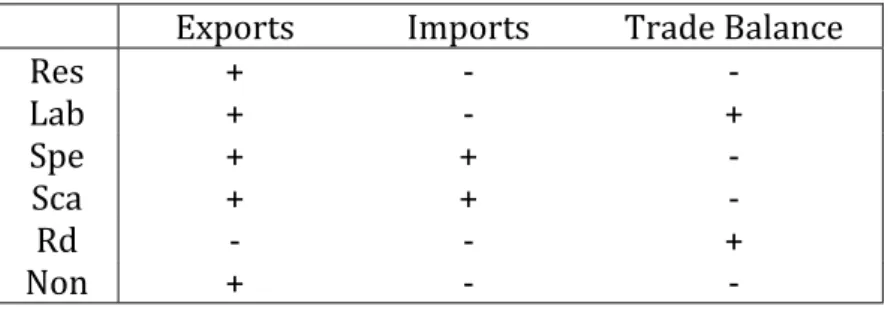
Turning now to the impacts on trade, Table 2 shows the results of the simulations for exports, imports and the trade balance by sector. Note that while exports and imports are measured in volume, the trade balance is measured in value5.
Table 2 – Impacts on trade
Exports Imports Trade Balance
Res + ‐ ‐ Lab + ‐ + Spe + + ‐ Sca + + ‐ Rd ‐ ‐ + Non + ‐ ‐ Note: results in Table VII in Appendix 2. We also observe that in all sectors but one, and once again the exception is the small R&D intensive sector, wage cuts produce a positive variation in the volume of exports. However, in some sectors (namely in the “Spe” sector, which includes electronic equipment and some machinery, and the “Sca” sector, which includes scale and capital intensive sectors, such as chemical products and motor vehicles) imports also record a positive variation, contributing to a negative impact on the 5 In the Armington condition the international price of exports ( , , r rr s pwe ) does not vary, but the export price in the national currency varies according to the expression:
, , , * , , 1 , , ," " , r rr s r rr r rr s r rr s r non r s
pe er pwe te p emg . This explains why there may be an increase in the volume of exports and a decrease in the volume of imports and simultaneously a negative trend in the trade balance.
trade balance of these sectors. Indeed, the only sector with relevance in production and exports for Portugal showing a positive trend in its trade balance is “Lab”, which includes labour intensive industries.
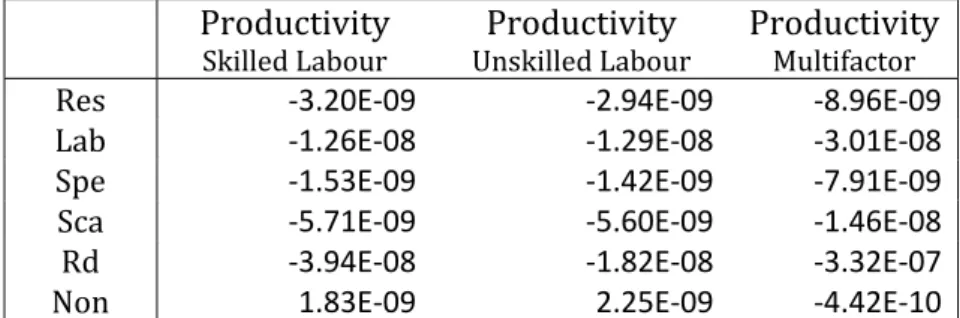
Finally, Table 3 shows the results for the indices of productivity. Increasing productivity has been incessantly advocated as the best solution to increase the international competitiveness of the Portuguese economy to the extent that it is the way to consistently reduce the high unit costs (see, for instance, IMF, 2010). However, the results of the simulations show negative impacts on the productivity of both skilled and unskilled labour except in the “Non” sector. Moreover, if we consider also the capital factor (in the multifactor column of Table 3), even the “Non” sector shows a negative productivity trend6.
Table 3 – Impacts on Productivity
Productivity Skilled Labour Unskilled LabourProductivity Productivity Multifactor
Res ‐ ‐ ‐ Lab ‐ ‐ ‐ Spe ‐ ‐ ‐ Sca ‐ ‐ ‐ Rd ‐ ‐ ‐ Non + + ‐ Note: results in Table VIII in Appendix 2.
A major contribution of this study is thus showing that reducing wages may decrease productivity, calling into question the sustainability of the external competitiveness apparently promoted using this (controversial) economic policy measure.
4. Concluding remarks
The simulations performed suggest that a wage reduction in the Portuguese case may induce a positive variation in employment (both of skilled and unskilled
6
Note that we use a Leontief production function for the primary inputs and therefore the factors are used in fixed proportions. If productivity increases for labour but decreases when we add the capital factor, the reason is that the capital employed increased at a higher rate than production.
labour), production and export volumes. The exception to these trends occurs in a sector that is not representative of the Portuguese economy.
However, there are reasons to suspect that the positive result for exports does not lead to a sustainable increase in trade competitiveness as the simulated impacts on productivity are negative (albeit small) for most sectors, for both types of labour. Besides, simulations point to a negative effect (albeit small) on the trade balance of most sectors, due in part to a positive variation in the value of imports (especially due to the price increase). In fact, only approximately one quarter of Portuguese exports record a positive trend for the trade balance, especially labour‐ intensive sectors (“Lab”).
This exercise reveals how important it is to ponder all the effects of an economic policy measure. This is especially true in a context of a deep crisis as is the case at the present time.
A possible additional step in this analysis could be to test whether the reduction of price / cost of goods in the non‐tradable sector (easier to implement in the short term and achieved especially by administrative means) improves the performance of the tradable sector. The main drawback of this type of exercise is accurate separation between both types of sectors. References Bento, V. (2011) – O nó cego da Economia, bnomics.
IMF (2010) – Portugal: Staff Report; Public Information Notice on the Executive Board Discussion; and Statement by the Executive Director for Portugal, IMF Country Report nº 10/18, January.
Vaz, E. (2012) – Sectoral Leadership in International Competitiveness: the Portuguese case, Applied Economics Letters, 19, 1319‐1330
Appendix 1 – Equations of the model and Sectorial Aggregation Table I: Equations of the model Production and trade:
, , , , , , , , , 1 , , , . , , . , , 1 1 1 . , , . , , 1 1 1 1 r s r s r s r s r s r s r s r s r s σF σF r s r s r s r s r r r s r s r s r r r s σF r s σF σF σF σF σF σF r s r r s r s r s r r s r s XD γFk K tk pk pi d γFk aF tk pk pi dtlq plq q γFq tlu plu u γFu
, , , , , , , , , 1 , , , . , , . , , 1 1 1 . , , . , , 1 1 1 1 r s r s r s r s r s r s r s r s r s σF σF r s r s r s r s r r r s r s r s r r s σF r s σF σF σF σF σF σF r s r r s r s r s r r s r s XD γFq LQ tk pk pi d γFk aF tlq plq qtlq plq q γFq tlu plu u γFu
, , , , , , , , , 1 , , , . , , . , , 1 1 1 . , , . , , 1 1 1 1 r s r s r s r s r s r s r s r s r s σF σF r s r s r s r s r r r s r s r s r r s σF r s σF σF σF σF σF σF r s r r s r s r s r r s r s XD γFu LU tk pk pi d γFk aF tlu plu utlq plq q γFq tlu plu u γFu
, , , , , , , , , , , , , , , , , , 1 1 1 1 1 r s r s r s r s r r r s r s r s r r s r s r r s r ss s r s r ss r ss s ss r s r s txd pd XD tk pk pi d K tlq plq q LQ tlu plu u LU io XD p tcf
, , , , , , , , , , , , 1 , , 1 1 , , , , , , 1 1 r s r s r s r s r s r s r s r rr s r rr s r s σT σT σT σT r rr s σT σT σT r s rr r s r rr s rr rr r s r s γT XD XDD γT pe γT pdd aT pdd
, , , , , , , , , , , , 1 1 1 , , , , , , , , , , 1 r s r s r s r s r s r s r s r rr s r rr s r s σT σT σT σT σT σT σT r s r rr s r rr s r rr s rr rr r s r rr s XD γT E γT pe γT pdd aT pe
, , , , , , , , r s r s r s r s r rr s r rr s rr pd XD pdd XDD
pe E
, , , , , , , , , , , , , 1 , , 1 1 , , , , , , 1 1 r s r s r s r s r s r s r s r rr s r rr s r rr s σA σA σA σA r rr sσA σA σA
r s rr r s r rr s rr rr r s r s γA X XDD γA pm γA pdd aA pdd
, , , , , , , , , , , , , 1 1 1 , , , , , , , , , 1 r s r s r s r s r s r s r s r rr s r rr s r rr s σA σA σA σAσA σA σA
r s r rr s r s r rr s rr rr r s r rr s X γA M γA pm γA pdd aA pm
, , , , , , , , r s r s r s r s r rr s r rr s rr p X pdd XDD
pm M , , , , r rr s rr r s M E
, , , * , , 1 , , ," " , r rr s r rr r rr s r rr s r non r s pe er pwe te p emg
, , 1 , , , * , , ," " , , r rr s r rr s r rr rr r s r non r rr s pm tm er pwe p mg
, , , , , , , , , r rr rr r s r rr s r rr s r rr s s SF
pwe M pwe M
, , , , , , ,
r r rr s r rr s r s r rr s rr s MARGB
mg M emg E Representative Household:
, , 1 , , , 1 , r r r r r r r r r r r s r s r s r s r s r s s sYH pk KS plq LQS UNEMPQ plu LUS UNEMPU
TRF plq q LQ plu u LU
r r r r r r SH mps YH ty YH TRF
r r r r r r CBUD YH ty YH TRF SH
, , , , , , , , , , 1 1 1 r s r s r s r s r s r s r s r r ss r ss r ss ss tc p C tc p μH αH CBUD tc p μH
Unemployment: 0 0 1 0 0 1 t t t t r r r r r r r r r plq pcindex UNEMPQ LQS elasU plq pcindex UNEMPQ LQS 0 0 1 0 0 1 t t t t r r r r r r r r rplu pcindex UNEMPU LUS
elasU
plu pcindex UNEMPU LUS
Government:
, , , , , , , , , , , , , , , , , , , , , , , , * , , , , r s r r r r r s r s r s r s r s r s s r ss s r ss s r ss r s r s r r s ss r s r r s r s r s r r s r s r rr s r rr rr r s r rr s TAXR ty YH TRF p tc C tcg CG tci I tcf io p XD tk pk K tlq plq q LQ tlu plu u LU tm er pwe M te
, , , , , , ,
, , , * r rr s r rr r rr s r rr s rr r s r s r s er pwe E txd pd XD
0 , , , 0 0 0 , , , 1 1 t t r s r s r s r s r s r s r s tc p C pcindex tc p C
r r r r r r r rTRF trep plq UNEMPQ plu UNEMPU TRO pcindex
1 ,
r s, , r r r r s r s r s SG GDPDEF TAXR
tcg CG p TRF
, , , , , , , , , , , , , , , , , , , 1 1 1 * * r s r r s r s r s r s r s r s r s r s r rr r rr s r rr s r rr rr r s r rr s rr GDPC p tc C p tcg CG p tci I er pwe E er pwe M
, , , , , , , , , , , , , , , , 0 0 0 0 0 0 0 , 0 0 0 0 , , 1 1 1 * * r r s r s r s r s r s r s r s r s r rr s r rr s rr r s r rr s t t r s s t t r rr r rr rr GDP p tc C p tcg CG p tci I er pwe E er pwe M
r r r GDPC GDPDEF GDP Investment:
, * ,
, ,
," " r r r r r rr r rr r s r r s r r non rr s S SH GDPDEF SG
er SF
d pi K MARGB p
, , , , 1 r s r s αIr s r s r s tci p pi αI
1 , , 1 , , r s r s r r s r s I αI S tci p General Equilibrium: , r r s r s LQ LQS UNEMPQ
, r r s r s LU LUS UNEMPU
, r r s s K KS
, , , , , , , r s r s r s r s r s ss r ss ss X C I
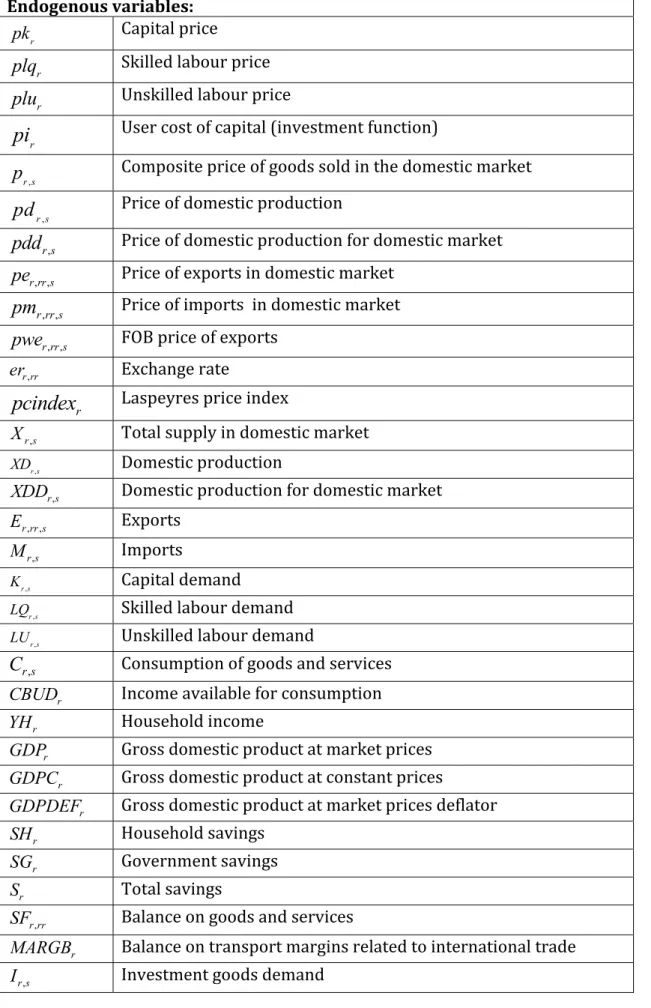
io XD CDTable II – Description of variables and parameters Endogenous variables: r pk Capital price r plq Skilled labour price r plu Unskilled labour price r
pi
User cost of capital (investment function) , r s p Composite price of goods sold in the domestic market , r spd
Price of domestic production , r spdd
Price of domestic production for domestic market , , r rr s pe Price of exports in domestic market , , r rr spm
Price of imports in domestic market , , r rr s pwe FOB price of exports , r rr er Exchange rate rpcindex
Laspeyres price index , r s X Total supply in domestic market , r s XD Domestic production , r s XDD Domestic production for domestic market , , r rr s E Exports , r s M Imports , r s K Capital demand , r s LQ Skilled labour demand , r s LU Unskilled labour demand , r s C Consumption of goods and services r CBUD Income available for consumption r YH Household income r GDP Gross domestic product at market prices r GDPC Gross domestic product at constant prices r GDPDEF Gross domestic product at market prices deflator r SH Household savings r SG Government savings r S Total savings , r rr SF Balance on goods and services r MARGB Balance on transport margins related to international trade , r s I Investment goods demandr UNEMPQ Skilled labour unemployment r UNEMPU Unskilled labour unemployment r TAXR Total tax revenues r TRF Total Government transfers Exogenous variables: r KS Capital supply r LQS Skilled labour supply r LUS Unskilled labour supply r TRO Other Government transfers , r s CG Government demand for goods and services Parameters: r ty Taxes on income , r s txd Taxes on production , r s tc Taxes on household consumption , , r ss s tcf Taxes on intermediate consumption , r s tci Taxes on investment consumption , r s tcg Taxes on government consumption . r s tk Taxes on the use of capital . r s tlq Taxes on the use of skilled Labour . r s tlu Taxes on the use of unskilled Labour , , r rr s tm Customs taxes , , r rr s te Taxes on exports , , r rr s mg Transport margins on imports , r s emg Transport margins on exports , r s d Depreciation rate of capital , r s aF Parameter efficiency of the production function , r s γFk Distribution parameter of capital , r s γFq Parameter distribution of skilled labour , r s γFu Parameter distribution of unskilled labour , r s σF Elasticity of substitution between production factors , r s aT Efficiency parameter of CET function , , r rr s γT Distribution parameter of exports , r s σT Transformation elasticity , r s aA Efficiency parameter of the Armington function , , r rr s γA Distribution parameter of total imports , r s σA Elasticity of substitution between domestic and imported goods
, r s αH Exponent of the Household utility function (LES) , r s αI Income elasticity of demand for goods and services for investment , r s μH Minimum consumption r mps Marginal propensity to save , , r ss s io Technical coefficients r trep Weight of unemployment benefits in average salary , r s u parameters to discriminate the reduction of unskilled labour wages , r s q parameters to discriminate the reduction of skilled labour wages r elasU Unemployment elasticity Table III– Description of Sectorial Aggregation Sectorial Aggregation Number Code Description
Resource intensive (res) 19 cmt Meat: cattle, sheep, goats, horses 20 omt Meat products nec 21 vol Vegetable oils and fats 22 mil Dairy products 23 pcr Processed rice 24 sgr Sugar 25 ofd Food products nec 26 b_t Beverages and tobacco products 30 lum Wood products 32 p_c Petroleum, coal products 34 nmm Mineral products nec 36 nfm Metals nec Labour intensive (lab) 27 tex Textiles 28 wap Clothing 29 lea Leather products 37 fmp Metal products 42 omf Manufactures nec Specialised suppliers (spe) 40 ele Electronic equipment 41 ome Machinery and equipment nec Scale and Capital intensive (sca) 31 ppp Paper products, publishing 33 crp Chemical, rubber, plastic prods 35 i_s Ferrous metals 38 mvh Motor vehicles and parts 48 otp Transport nec
Non industrial &non classified (non) 1 pdr Paddy rice 2 wht Wheat 3 gro Cereal grains nec 4 v_f Vegetables, fruit, nuts 5 osd Oil seeds 6 c_b Sugar cane, sugar beet 7 pfb Plant‐based fibers 8 ocr Crops nec 9 ctl Cattle, sheep, goats, horses 10 oap Animal products nec 11 rmk Raw milk 12 wol Wool, silk‐worm cocoons 13 frs Forestry 14 fsh Fishing 15 coa Coal 16 oil Oil 17 gas Gas 18 omn Minerals nec 43 ely Electricity 44 gdt Gas manufacture, distribution 45 wtr Water 46 cns Construction 47 trd Trade 49 wtp Sea transport 50 atp Air transport 51 cmn Communication 52 ofi Financial services nec 53 isr Insurance 54 obs Business services nec 55 ros Recreation and other services 56 osg Public Admin / Defence /Health / Education 57 dwe Dwellings Table IV – Sectoral structure of production and exports (2004) Production Exports Res 12.12 13.79 Lab 8.19 22.86 Spe 5.14 17.07 Sca 8.77 20.89 Rd 0.18 1.25 Non 65.60 24.14 Total 100.00 100.00
Appendix 2 – Numerical results of simulations
Table V – Impacts on employment and production (%)
LQ LU VAB
Res 7.31E‐09 7.05E‐09 3.81E‐09
Lab 2.75E‐08 2.78E‐08 1.00E‐08
Spe 3.42E‐08 3.41E‐08 3.29E‐08
Sca 1.90E‐08 1.88E‐08 1.21E‐08
Rd ‐3.33E‐06 ‐3.35E‐06 ‐3.43E‐06
Non 2.39E‐09 1.97E‐09 5.28E‐09
Table VI: Impacts on prices (%) Price of skilled Labour: 7.21E‐09 Price of unskilled labour: 7.24E‐09 Price of capital: ‐8.58E‐10 Table VII – Impacts on trade (%)
Exports Imports Trade Balance
Res 2.52E‐08 ‐4.57E‐09 ‐5.25E‐08
Lab 4.27E‐08 ‐7.05E‐09 1.78E‐07
Spe 5.51E‐08 1.94E‐09 ‐5.53E‐08
Sca 3.39E‐08 1.43E‐10 ‐3.93E‐08
Rd ‐3.29E‐06 ‐1.05E‐07 3.09E‐06
Non 2.33E‐08 ‐5.33E‐09 ‐1.46E‐07
Table VIII ‐ Impacts on productivity (%)
Productivity
Skilled Labour Unskilled LabourProductivity Productivity Multifactor
Res ‐3.20E‐09 ‐2.94E‐09 ‐8.96E‐09
Lab ‐1.26E‐08 ‐1.29E‐08 ‐3.01E‐08
Spe ‐1.53E‐09 ‐1.42E‐09 ‐7.91E‐09
Sca ‐5.71E‐09 ‐5.60E‐09 ‐1.46E‐08
Rd ‐3.94E‐08 ‐1.82E‐08 ‐3.32E‐07
Non 1.83E‐09 2.25E‐09 ‐4.42E‐10