VIRTUAL
TEAMS:
T
HE IMPACT OF VIRTUALITY ON FUNCTIONAL LEADERSHIP AND TEAM EFFECTIVENESS RELATIONSHIPSoraia Alexandra Gavino Mendes
Dissertation submitted as partial requirement for the conferral of
Master of Science in Human Resource Management and Organizational Consultancy
Supervisor:
PhD Ana Margarida Passos, Associate Professor, Department of Human Resources and Organizational Behavior, ISCTE Business School
i
Acknowledgments
The development of this dissertation was a roller-coaster journey, where the involvement of the right people was fundamental to achieve this big accomplishment in my life.
For this reason, I would like to first thank my work colleagues and my amazing team and bosses who have always shown genuine concern about my personal life and goals, giving me the flexibility that I needed to finish this dissertation. Also, to the teams of my former company, which promptly assisted me with the questionnaire fulfilment, offering me their precious time.
To my closest friends, who heard all my anguishes and gave me valuable motivation boosts to keep going through this phase, I hope to always reciprocate.
To my excellent supervisor, Professor Ana Passos, who has my full appreciation and admiration, not only for the amazing support she provided me but also for the highly intelligent and professional person she revealed to be. You taught me things beyond the scope of this investigation.
My very special thanks to Gonçalo Maia for all the encouragement, patience, and full support throughout this phase which he closely lived and felt with me. It means more to me than I can express in words.
Last but definitely not the least, I am eternally grateful to my parents who put all the effort to provide me with this high-level education, being one of the main drivers for me to accomplish this thesis. This achievement is ours.
ii
Resumo
A emergência de novas tecnologias revelou ser um derradeiro desafio de adaptação para as equipas dentro do contexto organizacional. À medida que as configurações e as contingências das equipas começaram a mudar e a reajustar-se a este novo mundo tecnológico, as equipas virtuais tornaram-se uma realidade na maioria dos contextos corporativos. Desta forma, é crucial entender como esse contexto virtual afeta relações e sistemas considerados sólidos. Neste estudo, o efeito de moderação da virtualidade entre a liderança funcional e a eficácia da equipa é empiricamente examinado. No entanto, a primeira etapa da presente pesquisa é verificar analiticamente o vínculo previsível entre as funções de liderança e a eficácia da equipa.
Para este fim, é utilizada uma amostra composta por 42 equipas, 154 indivíduos, de diferentes empresas de consultoria. A recolha de dados foi feita através de dois tipos de questionários, visando dois pontos de vista diferentes: a perspectiva dos líderes e a perspectiva dos membros da equipa. Os resultados confirmaram uma forte correlação positiva entre a liderança funcional e a eficácia da equipa, como seria teoricamente esperado. No entanto, contrariamente às hipóteses propostas, a virtualidade da equipa não se revelou moderadora da relação liderança funcional - eficácia da equipa. Contudo, essa falta de moderação poderia ser explicada pelo curto tamanho da amostra. Posteriormente, na fase final deste estudo, são fornecidas implicações e sugestões para futuras investigações sobre o tema equipas virtuais.
iii
Abstract
The emergence of new technologies revealed to be an ultimate adaptation challenge to teams within the organizational context. As teams’ settings and contingencies started to change and to readjust to this new technological world, virtual teams turned into a reality to most of the corporate contexts. Therefore, it is crucial to understand how this virtual context impacts the considered solid relationships and systems. In this study, the moderation effect of virtuality among functional leadership and team effectiveness is empirically examined. However, the first stage of the present research is to analytically verify the predictable link between leadership functions and team effectiveness.
For this purpose, a sample composed of 42 teams, 154 individuals, from different consultancy companies is used. The data collection was made through two types of surveys, aiming two different points of view: leaders’ perspective and team members’ perspective. The results supported a strong positive correlation between functional leadership and team effectiveness, as it was theoretically expected. However, contrary to the hypotheses proposed, the virtuality of the team did not prove to be a moderator of the relation functional leadership - team effectiveness. Implications and suggestions for future research regarding virtual teams’ subject are provided.
Key words: Teams; Virtual teams; Functional leadership; Team effectiveness. JEL Classification System-Numbers: D23 Organizational Behavior
Index
Acknowledgments ... i Resumo ... ii Abstract ... iii INTRODUCTION ... 2 I. LITERATURE REVIEW ... 41.1 Team and virtual team definition ... 4
1.2 Team Effectiveness model ... 5
IPO Model IMOI Model Team Processes 1.3 Team Leadership Literature ... 9
II. FUNCTIONAL LEADERSHIP, TEAM EFFECTIVENESS AND VIRTUALITY ... 12
III. METHOD ... 14
3.1 Sample ... 14
3.2 Procedure ... 14
3.3 Measures, scales and operationalization ... 15
IV. RESULTS ... 16
4.1 Aggregation ... 16
4.2 Hypotheses testing ... 17
V. DISCUSSION AND CONCLUSION ... 21
5.1 Implications ... 22
5.2 Limitations and future suggestions ... 23
REFERENCES ... 24
APPENDIX ... 28
2
INTRODUCTION
“You have no choice but to operate in a world shaped by globalization and the information revolution. There are two options: Adapt or die…“
-Andrew S. Grove, Intel Corporation
The growth of new communication technologies led people to new ways of being connected with each other. The Corporate world was also affected by this evolution, as the technological advancements made possible for individuals, who otherwise could not be linked to each other, to work together as a team (Gilson, Maynard, Young, Vartiainen, & Hakonen, 2015). Teamwork is seen as an efficient way for companies to achieve their organizational results (e.g Ranney & Deck, 1995), as a group of individuals working together as a team are more likely able to pursue achievements beyond the performance of a single person (Marks, Mathieu, & Zaccaro, 2001). As communication tools started to evolve, communication within teams also became more sophisticated to the point that physical presence was no longer needed. The concept of Globalisation was an inevitable practice and Virtual Teams (VTs) became not only a new reality within organisations but also a competitive need for corporation survival (Townsend, DeMarie, & Hendrickson, 1998). One can then state that virtual teams have two main dimensions: geographic dispersion of his team members and the predominant use of communication technology as the main interaction mediator (Gibson & Cohen, 2003). However, in this particular study we tend explore the VTs’ definition based on the second dimension proposed by these authors. According to a recent survey based on 1372 participants of 80 countries, 85% of those respondents work on virtual teams (RW3 CultureWizard, 2016). These statistics reinforce Gilson and Maynard’s (2015) statement that “VTs provide great promise to organizations” (p.1314) and given this increasing relevance of VT and their role in our work life, this topic is worthy of a major attention and focus, being virtual teams one of the targets of this research.
As virtual teams arose, leaders were faced with a new challenge: to build and to manage an efficient but non-present team. It is known that VTs face more difficulties than Face to Face (FtF) teams in areas such as communication, activities coordination and leadership (Radostina K. Purvanova, 2014). However, it is the role of the leaders to manage these obstacles as they are in charge for a big part of team effectiveness (Sivunen,
3 2006). That is why it is so important to acknowledge if the virtual context influences solid leadership functions and to examine closely the dynamic of this relationship. In order to contribute to this knowledge, this study aims to examine how virtuality, as a contextual variable of a team, impacts the effectiveness of leadership functions as the authors Morgeson, Derue, & Karam (2010) proposed for a future research.
Hereupon, the literature review of this dissertation is composed of three parts. The first part is a review of literature about teams and virtual teams in order to understand its evolution and the particular needs of a team in this context. Second, a clarification of team effectiveness definition and models is also provided, in order to understand how effectiveness will be conceptualized in the present research model to achieve a better understanding of the results. For the third part, and being Team Leadership a core element of this study, a detailed explanation of functional leadership is presented.
Therefore, the practical implications of this study are simple but relevant. Primarily it enhances the literature focused on virtual teams bringing the virtuality topic to a higher spotlight. VTs need to be studied in a constant and consistent time frame due to the great influence of technology which is always evolving. Furthermore, it can be a tool for anyone who is in a leadership position, not only because functional leadership topic is strongly explored, but also because this study brings some pertinent clues that leadership behaviours might be influenced by the virtuality contingency, therefore hindering team effectiveness. Consequently, this leads to a higher attention towards the necessity for these leadership functions within a team and that a special reinforcement of these functions might be needed in the context of virtuality.
4
I. LITERATURE REVIEW
1.1 Team and virtual team definition
Since the beginning of Humanity, people discovered that together is undoubtedly better: first the group form emerged based on the necessity for survival then it naturally evolved into a strategic method to achieve results. The “Team” topic has been a target of research for several years, as the relevance of teamwork has been increasing throughout time (Savelsbergh, Heijden & Poell, 2009). The conceptualization of teams itself evolved from more simple and static definitions to more complex and dynamic ones. Workgroups went from being defined as an agglomeration of interdependent individuals who have a shared responsibility towards a common goal inside of an organization (Sundstrom, De Meuse, & Futrell, 1990), to more holistic perspectives which see teams as complex and dynamic entities integrated in a multilevel system and having different cycles of work (Ilgen, Hollenbeck, Johnson, & Jundt, 2005; Kozlowski & Bell, 2003; Marks et al., 2001). The synergistic combination of intellectual knowledge and personal characteristics of different team members in order to achieve an outcome led us to what Salas, Rosen, Burke, & Goodwin, (2009) poetically portrayed as “wisdom of collectives” defined as “the increased capacity for performance of various types afforded by the interactions of team members” (p.39).
However, these types of interaction have been an object of evolution through time especially due to the influence of technology evolution. Consequently, virtuality became a topic of relevance and the concept of “Virtual Teams” emerged. Townsend et al., (1998) defined virtual teams as “groups of geographically and/or organizationally dispersed coworkers that are assembled using a combination of telecommunications and information technology to accomplish an organizational task” (p.18). Nevertheless, the same author boldly suggested that the lack of face-to-face meetings is one of the criteria to characterize a team as virtual, along with the predominant use of technology. The integration of both geographical dispersion and technological usage dimensions in the conceptualization of virtual teams is not as consensual among researchers. Whereas some authors preferably consider geographic distribution as a criteria for virtuality (e.g. O’Leary & Cummings, 2007; O’Leary & Mortensen, 2010) for other authors a relative amount of communication mediated by technology is enough to consider a team as virtual (e.g. Griffith, Sawyer, & Neale, 2003; Kirkman & Mathieu, 2004). However, even
5 recognizing VTs as a complex concept with the influence of multiple variables, in this study team virtuality is considered “the extent to which team members utilize different types of electronically-mediated communication technologies to execute team processes” according to Kirkman and Mathieu (2004:2) first dimension of VTs. This idea implies that even if a team works in the same building if the communication between the team members is mostly mediated by technology, the team will then be considered virtual.
Taken this extended definition into account, one can agree that at some point, virtuality can be part of an organizational team (Kirkman, Gibson, & Kim, 2012), as the use of technology can increase in certain work cycles of a team. This perspective strengthens the relevance of considering virtual context when studying teams as it might have a moderating impact on strong relationships of heavily explored variables (e.g. leadership and team effectiveness).
1.2 Team Effectiveness models
Teamwork conquered a solid place in modern organizations due to its direct relationship with performance and effectiveness improvement (Salas, Stagl, & Burke, 2004). Since two of the main concerns of corporations are profit and productivity, it is comprehensible that team effectiveness has been one of the most researched topics over the years.
The conceptualization of team effectiveness itself passed through a metamorphic process as it happened with most of the concepts we know. However, it is very important to emphasize its most relevant authors in order to understand the mains pillars that sustain team effectiveness nowadays, since a lot of new frameworks are simply better and more complex versions of previous ones (Mathieu, Maynard, Rapp, & Gilson, 2008). Consequently, an enhancement to McGrath (1964) study on team effectiveness is mandatory. Over 50 years ago, McGrath (1964) created for the first time a model that would be one of the greatest references and a starting point for those who study team effectiveness: the I-P-O Model. The I-P-O Model, as the name might suggest, is a model divided into three parts: Input-Process-Output. The inputs are described as a group of variables – Individual, Groups and Environmental - that may enable or constrain the processes. Processes serve as mediators that link inputs towards outputs. It is simply an
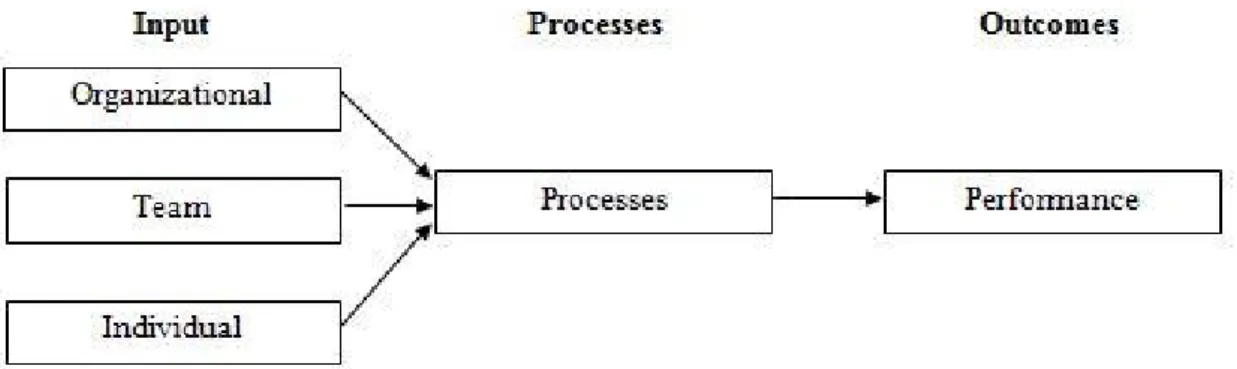
6 aggregation of activities that combines teams’ resources to tasks demands, resulting in an output or outcome. This last part is considered to be the effectiveness of a team as team effectiveness was called “Team Output” by McGrath, (1964). The model then presupposes a flow where inputs impact the processes and processes lead to results. Mathieu et al., (2008) illustrated the I-P-O model in a simple version, adapting the input factors, as Figure 1.1 shows.
Figure 1.1. Team effectiveness: Input-Process-Outcome (IPO) model – Mathieu, Maynard, Rapp, & Gilson (2008).
Hackman (1987) revealed to be another inevitable author within team effectiveness subject. It is also one of the main theories that sustain this research in terms of practical team effectiveness measurements, as it will be explained further in this paper. According to Hackman (1987), there are three criteria to define team effectiveness: performance, viability and satisfaction. The first is driven and influenced by productivity; the second is linked to the team members’ willingness to return to work in the same team; last but not least is the general satisfaction feeling among the team members. This perspective contributed to set a more complex definition of team effectiveness as it broadens the term once defined as a simple output. Summarizing, this perspective simply argues that even if a team achieves its goals it can fail in being an effective team.
The I-P-O model served as a rich guideline for plenty researchers over the years but it was also target of changes and extensions through time (Cohen & Bailey, 1997; Hackman & Morris, 1975; Ilgen et al., 2005; Salas, Dickinson, Converse, & Tannenbaum, 1992). Nevertheless, the I-P-O model was also a target of criticism. The model was largely criticized for its «static» representation of teamwork by describing it as a linear process ignoring the multiple types of processes and outputs (Mathieu et al., 2008). The Marks et
7 al., (2001) detailed study of team processes served as an impulsion to developed more complex and dynamic team effectiveness frameworks (e.g. Ilgen et al., 2005).
For this reason, Marks' et al., (2001) study is also considered a crucial research to explain the evolution of team effectiveness concept. The authors accused the previous definitions of team processes to be over simplistic, being a mere «feeling» of what team processes really mean. For more specific and clearer guidance regarding team processes, Marks et al., (2001) defined it as “members’ interdependent acts that convert inputs to outcomes through cognitive, verbal, and behavioural activities directed toward organizing taskwork to achieve collective goals” (p.357). This description fails to accept certain variables formerly considered as team processes such as “collective efficacy, potency, cohesion and situational awareness” (Marks et al., 2001:357) by putting them into the definition of emergent states. Emergent states are seen as representations of values, attitudes, cognitions and motivations, being considered as “top qualities” of a team. Marks et al., (2001) then provides a clarifying conceptualization of emergent states calling them “constructs that characterize properties of the team that are typically dynamic in nature and vary as a function of team context, inputs, processes, and outcomes” (p.357). Taking this into account, it is relevant to emphasize that emergent states can become inputs followed by process and outcomes, as they are considered products of experiences capable of influencing a team. The authors then disrupt the linear vision of the I-P-O model by asserting that “outcomes from initial episodes often become inputs for the next cycle” (Marks et al., 2001:360). This episodic approach is not only relevant for the construction of the next presented team effectiveness model but it is also a basis to explain the origin of the functional leadership approach that will be used as a variable in this study.
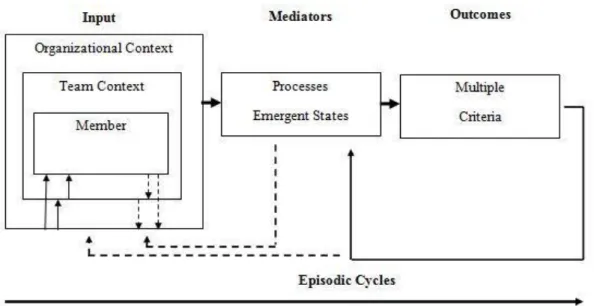
The IMOI (Input-Mediator-Output-Input) model developed by Ilgen et al., (2005) appeared as a more dynamic alternative to the I-P-O model. The M stands for Mediator and it substitutes the P of Process. This substitution represents a “broader range of variables that are important mediational influences with explanatory power for explaining variability in team performance and viability” (Ilgen et al., 2005:520). The extra “I” in the end means Input which closes the cycle and it integrates an idea of casual cyclical
8 feedback. Even the absence of the hyphen in IMOI signifies that the model is nonlinear and conditional.
Figure 1.2. Team effectiveness: Input-Mediator-Output-Input (IMOI) model – Mathieu, Maynard, Rapp, & Gilson (2008).
This model relates to Marks et al., (2001) paper because it embraces different phases of a cyclic episode of a team, considering that team members perform multiple tasks that vary in length. These tasks, also called “episodes” are “easily identified by goals and goal accomplishment periods” and often “the conclusion of one episode normally marks the initiation of another” (Marks et al., 2001:359). Researchers distinguish two different phases within an episode of a team: action and transition phase. The action stages happen when teams’ activities contribute directly to goal accomplishment while transition phases are, substantially, periods of planning and reflection to guide teams towards their goals. Marks et al., (2001) developed a conceptual framework which illustrates the temporal rhythm of team task accomplishment (Figure 1.3)
9 Figure 1.3. The Rhythm of Task Accomplishment - Marks et al., (2001)
These two distinguishable phases are fulfilled by different types of processes triggered by the moment needs. There are also interpersonal processes which are transversely relevant to both phases and may be triggered at any stage.
The introduction of these team processes by Marks et al., (2001) is a remarkable impulse to teams’ studies development that refined further research. The role of the processes was definitely enhanced by its relationship with team effectiveness.
1.3 Team Leadership Literature
Most of the team effectiveness theories recognize the crucial role of leadership within a team. In fact, team leadership represents a fundamental characteristic of effective team performance (Zaccaro, Rittman, & Marks, 2001). For this reason, “team leadership as a discipline appears to be on the cusp of some truly significant breakthroughs” (Day, Gronn, & Salas, 2006: 2011). As the relevance of leadership is undeniable it seems comprehensible the innumerous research around this theme. According to Yukl, (2012) “the essence of leadership in organizations is influencing and facilitating individual and collective efforts to accomplish shared objectives” (p.66). Despite the emergence of
10 several leadership theories throughout time, there is still no better or worst way to lead a team and the topic is not consensual. Due to the complexity of team settings and its diversified contexts, team leadership can never be considered an exact science.
Since the main goal of the present study is to examine the impact of virtuality in the relationship between functional team leadership and team effectiveness, it is necessary to explore more this theory. Back in 1962, McGrath suggested that the role of the leader in functional leadership is “to do, or get done, whatever is not being adequately handled for group needs” (p.5). Zaccaro et al., (2001) also brought insightful inputs to this theory, presenting why functional leadership differentiates among other studies. The authors suggest that functional leadership presupposes a tautological relationship, saying that “if the group is successful, then the leader can be defined as effective” (Zaccaro et al., 2001:454). Nevertheless, it is relevant to reinforce that team effectiveness is not entirely explained by team leadership. This being said, one can say that the pivotal assertion of functional leadership theory is that team conditions imply certain decisive leadership behaviors for success (Zaccaro et al., 2001). By saying that “leadership processes influence team effectiveness by their effects on four sets of team processes: cognitive, motivational, affective, and coordination” (Zaccaro et al., 2001:453), these researchers helped to break ground for processes calibration within functional leadership.
In 2010, Morgeson, DeRue and Karam presented a framework of functional leadership that integrates a full range of ways in which leadership can manifest itself within a team. However, in order to understand the nature of team performance context, it is relevant to acknowledge the specific team needs that may arise when individuals work together as a team. The leadership functions proposed by Morgeson et al., (2010) are the activities that the authors believe that can contribute for team needs satisfaction. Functional leadership is then considered the process which aims to satisfy team needs in the service of team effectiveness improvement. For this reason, this particular theory is largely based on the team functioning study presented by Marks et al., (2001), as Morgeson et al., (2010) also recognize the existence of team processes and focus on the action and transition phases of a team’s episode. Accordingly, Morgeson et al., (2010) defend that “as teams work across the transition and action phases they encounter numerous challenges that arise from the team, organization, and environmental contexts within which the team is operating” (p.7). Consequently, these different challenges generate distinctive needs
11 within teams that must be suppressed in order for them to be successful (Morgeson, Lindoerfer, & Loring, in press). This means that whoever assumes the responsibility for suppressing the team needs can be viewed as taking a leadership role. In this way, functional leadership does not focus on the leader itself but on the leadership processes. Hence, this particular theory gives anyone within a team the necessary guidelines to be a leader.
Morgeson et al., (2010) presuppose a shift on a view about leadership sources saying that “there are a number of potential sources of leadership that reflect who is attempting to satisfy a team’s needs” (p.8). The authors then conceptualized the sources of leadership by separate them in two dimensions: leadership locus and leadership formality. The first dimension indicates whether the leader is engaged in team’s tasks (internal leader) or whether the leader is not involved in the daily basis of the team (external leader). Leadership formality can be formal when the leader’s responsibility for team performance is recognized within the organization, or informal if there is no direct responsibility for team’s leadership. For the purposes of this study, only the formal type of leader was considered as the formal type of leadership is normally easier to identify.
Despite the leadership sources variations, “all sources are ultimately focused on satisfying team needs with the goal of enhancing team effectiveness” as “leadership is the vehicle through such needs are satisfied” (Morgeson et al., 2010:9). To better understand how to satisfy these needs, Morgeson et al., (2010) developed a framework of leadership functions and they also illustrated the specific behaviors for each function. This taxonomy is divided into transition and action phases, having seven functions associated with the first phase and eight functions in the second phase. Functions in the transition phases include (1) compose team; (2) define mission; (3) establish expectations and goals; (4) structure and plan; (5) train and develop team; (6) sense making; (7) provide feedback. For the action phase, functions are (1) monitor team; (2) manage team boundaries; (3) challenge team; (4) perform team task; (5) solve problems; (6) provide resources; (7) encourage team self-management; (8) support social climate.
Although the taxonomy provided by Morgeson et al., (2010) is very detailed and complete, in the present research these functions were analyzed on a macro level, considering only transition phase and action phase as the two main variables regarding
12 functional leadership. Besides of the relevant insights that the authors brought to functional leadership theory, one of the most important tools they provided was the Team Leadership questionnaire which came as a useful and practical way to measure each one of the leadership functions.
Primarily, the first goal is to reassure the direct relationship between of functional leadership and team effectiveness to empirically confirm the previous theories. In order to do so, functional leadership was distinguished into two variables: transition function and action function. Thus, the initial approach is to verify the predictable connection between each one of these two variables and team effectiveness. Hence, the first hypotheses are:
H1a: The leadership transition functions have a positive impact on team effectiveness. H1b: The leadership action functions have a positive impact on team effectiveness. Nevertheless, as Zaccaro et al., (2001) argued, the magnitude of this functional leadership effects can be moderated by environmental, organizational, and team characteristics variables. Taking this into account, and as virtual teams are increasing and becoming more complex through time, it is crucial to understand if virtuality can be an important environmental variable, affecting the relationship between functional leadership and team effectiveness.
II. FUNCTIONAL LEADERSHIP, TEAM EFFECTIVENESS AND VIRTUALITY
The present research aims to contribute to a better understanding of virtual teams and the impact that virtuality has on strong established relationships, in this case, functional leadership and team effectiveness. Within the virtual context, leadership can be even more challenging. However, it is especially in this context that leadership plays a fundamental role, as it influences and guides teams through challenges, helping them to adapt to new circumstances (Gilson et al., 2015). For a matter of fact, there is a general consensus among researchers that virtual teams are more difficult to lead than face-to-face teams (Bell & Kozlowski, 2002; Duarte & Snyder, 2001; Gibson & Cohen, 2003; Hinds & Kiesler, 2002; Lipnack & Stamps, 2000). Empirically it is proved that in order to virtual teams to have a similar functioning as face-to-face teams, team leaders must invest extra
13 time and effort to accomplish that equivalence (Purvanova & Bono, 2009). This shared idea was triggered by the large amount of research focused on the advantages and disadvantages of VTs regarding FtF teams, being the advantages (e.g. team composition, flexibility and cost savings) (Kirkman et al., 2012; Kirkman & Mathieu, 2005; Stanko & Gibson, 2009) slightly lighter than the disadvantages (e.g lower levels of team cohesion, work satisfaction, trust, cooperation and commitment) which have a considerable negative impact on team performance (Hoch & Kozlowski, 2014). Consequently, it became even more important to increase the attention towards virtual teams’ leadership to complement the existent studies (Charlier, Stewart, Greco, & Reeves, 2016; Hertel, Geister, & Konradt, 2005; Hill & Bartol, 2016; Hoch & Kozlowski, 2014; Joshi, Lazarova, & Liao, 2009; Konradt & Hoch, 2007; Liao, 2016; Schmidt, 2014; Sivunen, 2006; Ziek & Smulowitz, 2014).
The present research also aims to add empirical information about virtuality as a moderator as it has been done in previous studies. For example, Hoch and Kozlowski (2014) examined the impact of virtuality on structural supports, shared team leadership and traditional hierarchical leadership. Using a sample of 101 virtual teams, the authors were able to confirm that a high degree of virtuality in teams attenuated the relations between hierarchical leadership and team performance but reinforced the relationship between structural supports and team performance. Although, the same researchers also verified no significant impact of virtual teams within the shared team leadership and team performance relationship. Also, Andressen, Konradt, & Neck (2012) confirmed the moderation effect of virtuality on transformational and team performance. Similarly to Hoch and Kozlowski (2014) and Andressen et al., (2012), other researchers focused on projects related to virtuality as a moderator (e.g, González-Navarro, Orengo, Zornoza, Ripoll, & Peiró, 2010; Kirkman & Mathieu, 2004).
Adding to the disadvantages already presented, one of the major difficulties that virtual teams encounter is the lack of communication quality that can lead to misunderstandings, unclear directions or even poor communication in general. Since functional leadership largely relies on exchanging information in both transition and action phases, it seems logical to expect that any context that may affect communication will have an impact on leadership processes. For this reason and taking into account the previous studies about virtual teams, it is expected that team virtuality acts as a moderator between functional
14 leadership and team effectiveness, having a negative impact on both transition and action phases. Thus, the next three hypotheses are:
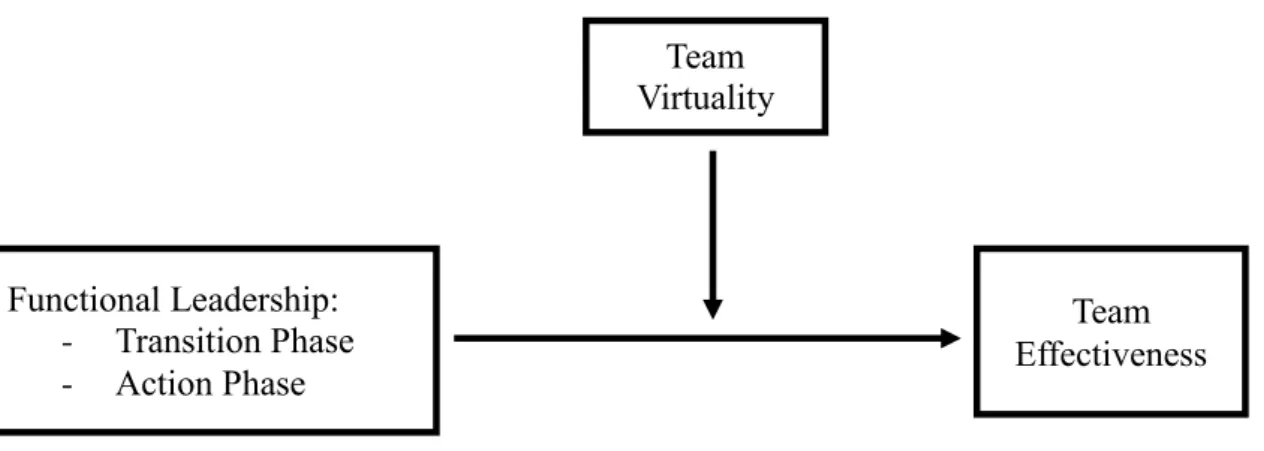
H2: Team virtuality moderates the relationship between functional leadership and team effectiveness.
H2a: The positive relationship between leadership transition functions and team effectiveness decreases as team virtuality increases.
H2b: The positive relationship between leadership action functions and team effectiveness decreases as team virtuality increases.
Figure 3.1. The model proposed for the study
III. METHOD 3.1 Sample
The study sample is composed of 42 teams (154 individuals) from different consultancy companies. Teams are constituted by consultants and their direct leaders, having in average 5.74 team members (SD=1.27). About 29.2% of the sample is male, while the other 70.8% is female. The average working time of these participants within the company is less than three years (SD=1.27) and their average age is 29 years old (SD=7.5). All teams had a certain degree of virtuality.
3.2 Procedure
This research occurred within the scope of ConsulTeam project which is an investigation project focused on teams and team effectiveness within various consulting companies.
Team Virtuality Functional Leadership: - Transition Phase - Action Phase Team Effectiveness
15 The choice of the project team fell on consultancy business which is a suitable industry to have a rich sample of virtual teams due to its high knowledge characteristics (Gilson et al., 2015).
Two types of questionnaires were distributed in printed format: a four pages survey targeted team members while the other two pages survey targeted their team leaders. By having these two targets, it is possible to have a broader perspective of the team itself. Also, a letter from the project coordinator was delivered to explain the project goal and to assure the confidentiality of the process and the documents.
3.3 Measures, scales and operationalization
Leadership Functions. Transition and action functions were assessed using 4 and 3 items for each variable respectively. The items were based on Morgeson et al., (2010) Team Leadership Questionnaire, using a seven-point Likert scale (1= totally disagree; 7= totally agree) reflecting the extent of their agreement with each statement. A Cronbach’s alpha was computed to measure the internal consistency of both variables: for leadership transition function the value was .88 and for leadership action function the value was .89, showing that both functions are reliable.
Team effectiveness. To measure team effectiveness within the team 2 adapted items of the effectiveness scale developed by González-Romá, Fortes-Ferreira, & Peiró (2009) were used. These items were based on effectiveness construct of Hackman (1987). To have a broader perception of team effectiveness, the two perspectives were taken into account: team’s perspective and leader’s perspective. Both questionnaires had exactly the same two questions about team effectiveness. Participants answered based on a seven-point Likert scale (1= totally disagree; 7= totally agree) reflecting the extent of their agreement with each statement. To test the variables’ viability, a Pearson’s correlation coefficient was computed in order to verify the existence of a correlation between both items in each survey. In the teams’ survey both items regarding team effectiveness presented a strong correlation (r = .77 p < .001) as well as the effectiveness related items on the leaders’ survey (r = .52 p < .001).
Team virtuality. The scale used to measure virtuality is aligned with the first dimension of virtuality proposed by Kirkman and Mathieu (2005), being that “the extent to which team members utilize virtual tools to coordinate and execute team processes while taking
16 into consideration the amount of informational value provided by such communication tools” (p. 702). Therefore, an adaptation of the scale proposed by Rapp, Ahearne, Mathieu and Rapp, (2010) was used. Participants were asked to allocate the percentage of communication that occurred via (1) face-to-face; (2) audio communication over the telephone or other devices via the internet; (3) visual communication via Skype or other online software; (4) e-mail, during their previous week. The sum of percentages could not be greater than 100%. For the purposes of this study, the team virtuality variable was created summing the percentages which refer only to virtual communication modalities (2, 3 and 4).
IV. RESULTS 4.1 Aggregation
As this study aims to have an analysis in terms of teams, all individuals’ responses were aggregated to the team level. In order to examine the within-group agreement, the rwg(j)
was computed. According to James, Demaree, and Wolf (1993) in order to have a good estimate of rwg(j), the mean value should be equal or above .70. However, this perspective
has been criticized by several scholars who say that to require these levels of rwg(j) is to
limit the statics richness of any mean value of agreement. For this reason, this research is aligned with Santos, Passos, Uitdewilligen and Nübold (2016) approach which analyses the degree of agreement into two levels: (1) the lack of agreement or weak agreement; (2) moderate, strong or very strong agreement. This means that, for the purpose of this study, every mean value of rwg(j) is considered for further analysis. Thus, for team effectiveness,
the rwg(j) mean value is .86, and 11.9% of the values represents lack of agreement or weak
agreement (ranging from .00 to .57), while 88.1% of the values indicates moderate, strong, or very strong agreement (ranging from .71 to 1.00). For leadership action function, the rwg(j) mean value is .81, being 16.7% of the values a representation of lack
of agreement or weak agreement while 83.3% of the values indicates moderate, strong, or very strong agreement. For leadership transition function, the rwg(j) mean value is .74,
and 23.8% of the values represents lack of agreement or weak agreement, while 76.2% of the values indicates moderate, strong, or very strong agreement. For the team virtuality, the rwg(j) mean value is .64, and 43.2% of the values represents lack of agreement or weak
agreement, while 56.8% of the values indicates moderate, strong, or very strong agreement. As Santos et al., (2016) empirically proved that the analysis without the teams
17 that demonstrated lack or weak agreement showed the same pattern of outputs as the analysis integrating those teams, this study will consider a mix of these high and low agreement groups, believing that it will not have a significant impact on this research results.
4.2 Hypotheses testing
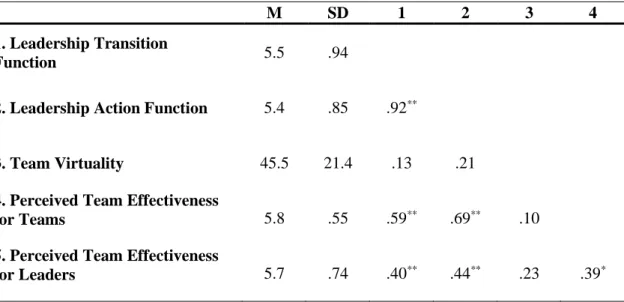
Correlations, means and standard deviations for the studied variables are provided in Table 4.1. Results show that the variable leadership transition function has a strong positive correlation with perceived team effectiveness for teams (r = .59, p < .001) and with perceived team effectiveness for leaders (r = .40, p = .001). The leadership action function variable also has a strong positive correlation with perceived team effectiveness for teams (r = .69, p < .001) and with perceived team effectiveness for leaders (r = .44, p < .001). The output also shows a slightly significant positive correlation between perceived team effectiveness for teams and perceived team effectiveness for leaders (r = .39 p < .01). These results support hypothesis 1a and hypothesis 1b, as both leadership functions presented a strong correlation with both team effectiveness perceptions.
Table 4.1. Means, standard deviations, and correlations among all team-level variables.
M SD 1 2 3 4
1. Leadership Transition
Function 5.5 .94
2. Leadership Action Function 5.4 .85 .92**
3. Team Virtuality 45.5 21.4 .13 .21
4. Perceived Team Effectiveness
for Teams 5.8 .55 .59** .69** .10
5. Perceived Team Effectiveness
for Leaders 5.7 .74 .40** .44** .23 .39*
**
Correlation is significant at the 0.01 level (2-tailed) *
Correlation is significant at the 0.05 level (2-tailed)
In order to analyze the hypotheses regarding the moderation effects of team virtuality in the relationship between functional leadership and team effectiveness, the command PROCESS Macro was computed (Hayes, 2013). The used model (Model 1) presupposes
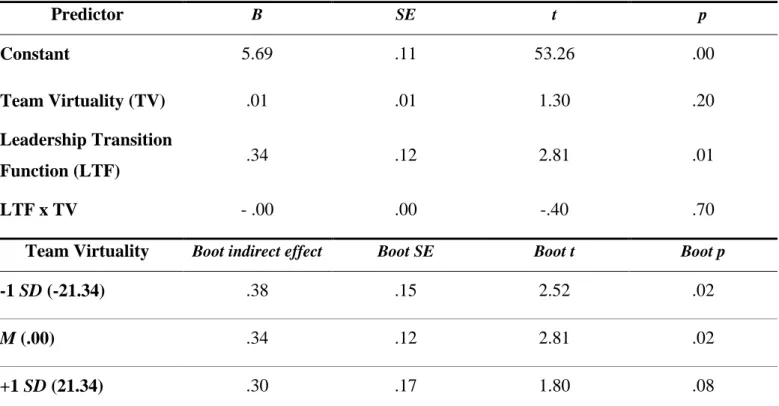
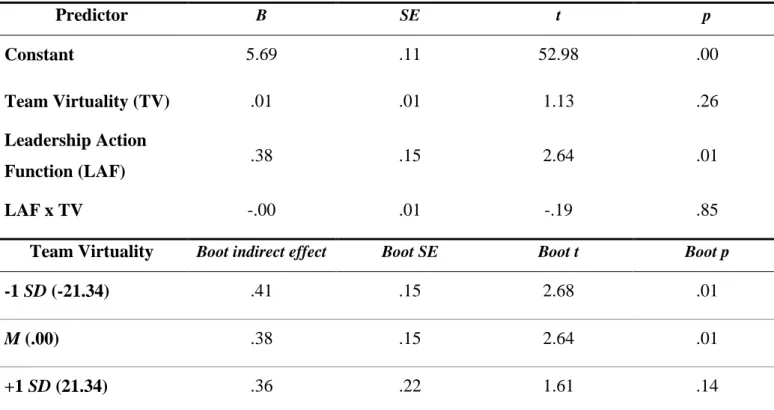
18 the interaction between three variables: X, M and Y. X represents the independent variable, M represents the moderator value and Y represents the outcome. In order to verify the existence of a moderation relationship caused by team virtuality between functional leadership and team effectiveness, four models were generated through the process described above (see Table 4.2, Table 4.3, Table 4.4 and Table 4.5) The first two tables (4.2 and 4.3) are related to the results of team virtuality moderation on the relationship between both leadership functions (transition and action) and team effectiveness perceived by the leader. The last two tables (4.4 and 4.5) are related to the outputs of team virtuality moderation on the relationship between both leadership functions (transition and action) and team effectiveness perceived by the team.
Table 4.2. Testing results for the hypotheses indirect effect
Predictor B SE t p Constant 5.69 .11 53.26 .00 Team Virtuality (TV) .01 .01 1.30 .20 Leadership Transition Function (LTF) .34 .12 2.81 .01 LTF x TV - .00 .00 -.40 .70
Team Virtuality Boot indirect effect Boot SE Boot t Boot p
-1 SD (-21.34) .38 .15 2.52 .02
M (.00) .34 .12 2.81 .02
+1 SD (21.34) .30 .17 1.80 .08
19 Table 4.3. Testing results for the hypotheses indirect effect
Predictor B SE t p Constant 5.69 .11 52.98 .00 Team Virtuality (TV) .01 .01 1.13 .26 Leadership Action Function (LAF) .38 .15 2.64 .01 LAF x TV -.00 .01 -.19 .85
Team Virtuality Boot indirect effect Boot SE Boot t Boot p
-1 SD (-21.34) .41 .15 2.68 .01
M (.00) .38 .15 2.64 .01
+1 SD (21.34) .36 .22 1.61 .14
Y = Perceived Team Effectiveness for Leaders; X = Leadership Action Function; M =Team Virtuality
Table 4.4. Testing results for the hypotheses indirect effect
Predictor B SE t p Constant 5.83 .07 80.31 .00 Team Virtuality (TV) -.00 .00 -.05 .96 Leadership Transition Function (LTF) .34 .08 4.22 .00 LTF x TV -.00 .00 -1.14 .26
Team Virtuality Boot indirect effect Boot SE Boot t Boot p
-1 SD (-21.43) .41 .10 4.30 .00
M (.00) .34 .08 4.22 .00
+1 SD (21.43) .26 .11 2.27 .03
20 Table 4.5. Testing results for the hypotheses indirect effect
Predictor B SE t p Constant 5.83 .07 87.69 .00 Team Virtuality (TV) -.00 .00 -.43 .67 Leadership Action Function (LAF) .44 .09 5.03 .00 LAF x TV -.00 .00 -.55 .59
Team Virtuality Boot indirect effect Boot SE Boot t Boot p
-1 SD (-21.43) .48 .09 5.50 .00
M (.00) .44 .09 5.03 .00
+1 SD (21.43) .40 .14 2.88 .01
Y = Perceived Team Effectiveness for Team; X = Leadership Action Function; M =Team Virtuality
Tables 4.2, 4.3, 4.4 and 4.5 provide the results for hypotheses 2, 2a and 2b. Regarding hypothesis 2, it was expected that team virtuality would moderate the direct positive relationship between functional leadership and team effectiveness. As Tables 4.2 and 4.3 show, the cross-product term between leadership transition function and team virtuality on perceived team effectiveness for leaders was not significant (B = -.00, t = -.40, p > .05), as well as between leadership action function and team virtuality on perceived team effectiveness for leaders (B = -.00, t = -.19, p > .05). Also, on Tables 4.4 and 4.5, the interactions between both leadership functions variables (transition and action) and team virtuality were not significant for perceived team effectiveness for teams (B = .00, t = -1.14, p > .05), (B = -.00, t = -.55, p > .05).
According to the provided results, there was no significant proof that virtuality has a moderation effect on the relationship between functional leadership and team effectiveness. Therefore, hypotheses 2, 2a and 2b were not supported.
21
V. DISCUSSION AND CONCLUSION
Primarily, this paper began to provide team and virtual team definitions and to emphasize the relevance of integrating the virtuality variable in present and future research about teams. Moreover, the team effectiveness topic was explored as well as its evolution throughout time. The team effectiveness models that are considered the greatest influencers among this field were presented, as well as the team processes proposed by Marks et al., (2001). Those team processes contribute to making a link to functional leadership theory, which is the central leadership theory studied in this research. The culmination of these three concepts leads us to a hypothetical triangle composed of virtuality, functional leadership and team effectiveness variables which we analytically examined.
Therefore, the present study aimed to accomplish different but relevant goals: first, to add theoretical knowledge to the existent literature regarding virtual teams, functional leadership and team effectiveness; second, to provide some empirical research relatively to the relationship between functional leadership and team effectiveness; last but not the least, to follow and to continue Morgeson et al., (2010) study regarding leadership functions within the virtual context.
In the current research, the results showed a strong positive correlation between functional leadership and team effectiveness which came as a reinforcement of the theories regarding this type of leadership. Thus, empirical proof that leadership functions lead to team effectiveness was added to previous studies regarding this relationship (Santos, Caetano, & Jesuíno, 2008; Santos, Caetano, & Tavares, 2015). Notwithstanding, having a more detailed look through the two items which compose functional leadership, the analysis revealed a stronger positive correlation between leadership action function and both team effectiveness variables than the correlation between leadership transition function and the same variables. This might be due to the young teams which compose the sample, having into consideration that usually younger teams are more action-oriented. Also, as the consultancy business is a fast paced environment which implies short deadlines, it is common that the major focus goes towards leadership action functions than to leadership transition functions.
However, virtuality did not reveal itself as a moderator of the relationship stated above. Consequently, the provided results inevitably lead to the conclusion that relatively
22 amount of communication mediated by technology does not have a significant impact on the leadership functions towards team performance in the consultancy business. Nevertheless, this study theoretically incites the idea that virtuality might not only have a considerable impact on strong established relations like leadership and team performance, but it can also have some influence on several other team processes if one considers the presented disadvantages of virtual teams comparing with FtF teams. For this reason, and despite the lack of empirical support regarding the impact of virtuality on functional leadership and team effectiveness link, we logically still have great consideration for the theoretical studies carried by great scholars who imply otherwise.
5.1 Implications
Implications regarding the present study must be taken very carefully. Due to the distinct sensibility of this study and especially taking into account the sample size of the investigation, any kind of generalization towards different realities and contexts is not advised. The results obtained regarding team virtuality as a moderator are not solid enough to assume it as truth and consequently, it is not enough to add relevant empirical knowledge to the existent literature. As others researchers with larger sample and different realities already proved, virtuality can have significant impact not only on the way leaders deal with their teams, but also in the way team members relate to each other (Charlier et al., 2016; Hoch & Kozlowski, 2014; Joshi et al., 2009; Liao, 2016; Ziek & Smulowitz, 2014). It would be somehow naive to promptly assume that team contexts and settings do have any significant impact on the way teams are managed, expecting that the same recipe for success of FtF teams, will also be successful for virtual teams (Fiol & O’Connor, 2005).
In the other hand, even within a small sample size, functional leadership revealed to be an effective way towards team performance. By empirically reinforce this relationship within a different context, with different team settings, researchers are able to move a step forward towards the certainty of leadership functions effectiveness. Thus, one more small-scale gap was fulfilled regarding functional leadership theories which imply that a well practical application of this leadership model can successfully lead team results.
23
5.2 Limitations and future suggestions
As it was mentioned before, the sample size revealed to be a limitation which might have been an obstacle to get more accurate and reliable results. Also, the questionnaire length was an issue to some participants who might not be able to answer the survey uninterruptedly, influencing their responses. There were also some discrepancies around the percentage of communication mediated by technology within the same team, due to different perspectives about team composition, for instance, team members who do not recognize other geographically dispersed team members as part of their team, even when sharing the same goal. However, these different perspectives about team composition could still be integrated into future research.
Furthermore, we recommend an investigation following a similar research model but with a larger sample and maybe integrating more team effectiveness items. A full application of Morgeson et al., (2010) Team Leadership Questionnaire is also recommended. For more complete and complex investigations, it would be interesting to understand which leadership functions proposed by the stated authors are more relevant to reinforce within a virtual team. A detailed vision over each function can help us to predict the most important behaviors within the virtual context, as Sivunen (2006b) already provided some of them.
To summarize, this study, with all its limitations, contributed to an empirical reinforcement between functional leadership and team effectiveness relationship, adding more certainty to this leadership model. Regarding virtuality influence, no significant effect was detected but it still instigates some provocative and mindful insights for further research.
24
REFERENCES
Andressen, P., Konradt, U., & Neck, C. P. (2012). The Relation Between Self-Leadership and Transformational Leadership: Competing Models and the Moderating Role of Virtuality. Journal of Leadership & Organizational Studies, 19(1), 68–82.
Bell, B. S., & Kozlowski, S. W. J. (2002). A typology of virtual teams: Implications for effective leadership. Group & Organization Management, 27(1), 14–49.
Charlier, S. D., Stewart, G. L., Greco, L. M., & Reeves, C. J. (2016). Emergent leadership in virtual teams: A multilevel investigation of individual communication and team dispersion antecedents. Leadership Quarterly, 27(5).
Cohen, S. G., & Bailey, D. E. (1997). What makes teams work: Group effectiveness research from the shop floor to the executive suite. Journal of Management, 23(3), 239–290.
Day, D. V., Gronn, P., & Salas, E. (2006). Leadership in team-based organizations: On the threshold of a new era. The Leadership Quarterly, 17(3), 211–216.
Duarte, D., & Snyder, N. (2001). Mastering virtual teams: strategies. Tools and Techniques That Succeed.
Fiol, C. . M., & O’Connor, E. J. (2005). Identification in Face-to-Face , Hybrid , and Pure Virtual Teams : Untangling the Contradictions. Organization Science, 16(1), 19–32.
Gibson, C. B., & Cohen, S. G. (2003). Virtual teams that work: creating conditions for virtual team effectiveness. Personnel Psychology (Vol. 57).
Gilson, L. L., Maynard, M. T., Young, N. C. J., Vartiainen, M., & Hakonen, M. (2015). Virtual Teams Research: 10 Years, 10 Themes, and 10 Opportunities. Journal of Management, 41(5), 1313–1337.
González-Navarro, P., Orengo, V., Zornoza, A., Ripoll, P., & Peiró, J. M. (2010). Group interaction styles in a virtual context: The effects on group outcomes. Computers in Human Behavior, 26, 1472–1480.
González-Romá, V., Fortes-Ferreira, L., & Peiró, J. M. (2009). Team climate, climate strength and team performance. A longitudinal study. Journal of Occupational and Organizational Psychology, 511–536.
Griffith, T. L., Sawyer, J. E., & Neale, M. A. (2003). Virtualness and knowledge in teams: managing the Love triangle of organizations, individuals, and information technology. MIS Quarterly, 27(2), 265–287.
Hackman, J. R. (1987). The design of work teams. Handbook of Organizational Behavior. Englewood Cliffs: Prentice-Hall.
Hackman, J. R., & Morris, C. G. (1975). Group tasks, group interaction process, and group performance effectiveness: a review and proposed integration1. Advances in Experimental Social Psychology, 8, 45–99.
25 Hayes, A. F. (2013). Introduction to mediation, moderation, and conditional process
analysis.
Hertel, G., Geister, S., & Konradt, U. (2005). Managing virtual teams: A review of current empirical research. Human Resource Management Review, 15(1), 69–95.
Hill, N. S., & Bartol, K. M. (2016). Empowering leadership and effective collaboration in geographically dispersed teams. Personnel Psychology, 69, 159–198.
Hinds, P., & Kiesler, S. (2002). Distributed work. MIT press.
Hoch, J. E., & Kozlowski, S. W. J. (2014). Leading virtual teams: Hierarchical leadership, structural supports, and shared team leadership. Journal of Applied Psychology, 99(3), 390–403.
Ilgen, D. R., Hollenbeck, J. R., Johnson, M., & Jundt, D. (2005). Teams in organizations: From input-process-output models to IMOI models. Annual Review of Psycholy, 56, 517–43.
James, L. R., Demaree, R. G., & Wolf, G. (1993). rwg: An assessment of within group interrater agreement. Journal of Applied Psychology, 78(2), 306–309.
Joshi, A., Lazarova, M. B., & Liao, H. (2009). Getting Everyone on Board: The Role of Inspirational Leadership in Geographically Dispersed Teams. Organization Science, 20(1), 240–252.
Kirkman, B. L., Gibson, C. B., & Kim, K. (2012). Across borders and technologies: advancements in virtual teams research. The Oxford Handbook of Organizational Psychology, 2.
Kirkman, B. L., & Mathieu, J. E. (2004). the Role of Virtuality in Work Team Effectiveness. Academy of Management Proceedings., 6(1), 1–6.
Kirkman, B. L., & Mathieu, J. E. (2005). The dimensions and antecedents of team virtuality. Journal of Management, 31(700), 701–718.
Konradt, U., & Hoch, J. E. (2007). A work roles and leadership functions of managers in virtual teams. International Journal of E - Collaboration, 3(2), 1–35.
Kozlowski, S. W. J., & Bell, B. S. (2003). Work groups and teams in organizations. Handbook of Psychology, 12, 333–375.
Liao, C. (2016). Leadership in virtual teams: A multilevel perspective. Human Resource Management Review.
Lipnack, J., & Stamps, J. (2000). Virtual teams. People working across boundaries with.
Marks, M. A., Mathieu, J. E., & Zaccaro, S. J. (2001). A temporally based framework and taxonomy of team processes (Vol. 26, pp. 356–376).
26 Mathieu, J., Maynard, M. T., Rapp, T., & Gilson, L. (2008). Team Effectiveness
1997-2007: A Review of Recent Advancements and a Glimpse Into the Future. Journal of Management, 34(3), 410–476.
McGrath, J. E. (1964). Social Psychology: A Brief Introduction - Joseph Edward McGrath - Google Livros. (R. & W. Holt, Ed.). New York.
Morgeson, F. P., Derue, D. S., & Karam, E. P. (2010). Leadership in teams: a functional approach to understanding leadership structures and processes. Journal of Management, 36, 5–39.
Morgeson, F. P., Lindoerfer, D., & Loring, D. J. (n.d.). Developing team leadership capability (3rd ed.). San Francisco: Jossey-Bass.
O’Leary, M. B., & Cummings, J. N. (2007). The spatial, temporal, and configurational characteristics of geographic dispersion in teams. Mis Quarterly, 31(3), 433–452.
O’Leary, M. B., & Mortensen, M. (2010). Go (con)figure: subgroups, imbalance, and isolates in geographically dispersed teams. Organization Science, 21(1), 115–131.
Purvanova, R. K. (2014). Face-to-face versus virtual teams: What have we really learned? The Psychologist-Manager Journal, 17(1).
Purvanova, R. K., & Bono, J. E. (2009). Transformational leadership in context: Face-to-face and virtual teams. The Leadership Quarterly, 20(3), 343–357.
Ranney, J., & Deck, M. (1995). Making Travis work: Lessons from the leaders in new product development. Planning Review, 23(4), 6–12.
Rapp, A., Ahearne, M., Mathieu, J., & Rapp, T. (2010). Managing sales teams in a virtual environment. International Journal of Research in Marketing, 27, 213–224.
RW3 CultureWizard. (2016). Trends in Global Virtual Teams.
Salas, E., Dickinson, T. L., Converse, S. A., & Tannenbaum, S. I. (1992). Toward an understanding of team performance and training. Teams: Their training and performance. Westport, CT: Ablex Publishing.
Salas, E., Rosen, M. A., Burke, C. S., & Goodwin, G. F. (2009). The wisdom of collectives: An update of the teamwork competencies. In Team Effectiveness in Complex Organizations (pp. 39–79). New York: Routledge.
Salas, E., Stagl, K. C., & Burke, C. S. (2004). 25 years of team effectiveness in organizations: research themes and emerging needs. International Review of Industrial and Organizational Psychology, 19.
Santos, C. M., Passos, A. M., Uitdewilligen, S., & Nübold, A. (2016). Shared temporal cognitions as substitute for temporal leadership: An analysis of their effects on temporal conflict and team performance. Leadership Quarterly, 27(4), 574–587.
Santos, J., Caetano, A., & Jesuíno, J. (2008). As competências funcionais dos líderes e a eficácia das equipas. Revista Portuguesa E Brasileira de Gestão, 22–33.
27 Santos, J. P., Caetano, A., & Tavares, S. M. (2015). Is training leaders in functional leadership a useful tool for improving the performance of leadership functions and team effectiveness? Leadership Quarterly, 26(3), 470–484.
Savelsbergh, Chantal M J H Heijden, Beatrice I J M van der Poell, R. F. (2009). The development and empirical validation of a multidimensionl measurement instrument for team learning behaviors. Small Group Research, 40(5), 578–607.
Schmidt, G. B. (2014). Virtual leadership: An important leadership context. Industrial and Organizational Psychology, 7(2).
Sivunen, A. (2006). Strengthening identification with the team in virtual teams: the leaders’ perspective. Group Decision and Negotiation, 15, 345–366.
Stanko, T., & Gibson, C. (2009). The role of cultural elements in virtual teams. Cambridge handbook of. Cambridge handbook of culture organizations and work. Sundstrom, E., De Meuse, K. E., & Futrell, D. (1990). Work teams: Applications and
effectiveness. American Psychologist, 45(2), 120–133.
Townsend, A. M., DeMarie, S. M., & Hendrickson, A. R. (1998). Virtual teams: Technology and the workplace of the future. Academy of Management Executive, 12(3).
Yukl, G. (2012). Effective leadership behavior: what we know and what questions need more attention. Academy Af Management Perspectives, (November), 66–85.
Zaccaro, S. J., Rittman, A. L., & Marks, M. A. (2001). Team leadership. The Leadership Quarterly, 451–483.
Ziek, P., & Smulowitz, S. (2014). The impact of emergent virtual leadership competencies on team effectiveness. Leadership & Organization Development Journal, 35(2), 106–120.
28
APPENDIX Appendix A – Questionnaire
À direção
Enquanto Coordenadora científica do Projecto “ConsulTeam”, gostaria de solicitar a vossa autorização para aplicar um questionário às equipas de consultores da vossa empresa e assim como aos responsáveis diretos dessas equipas. Trata-se de um projecto de investigação levado a cabo por um grupo de investigadores do ISCTE-Instituto Universitário de Lisboa, focado na eficácia do trabalho em equipa em contexto de empresas de consultoria. O principal objetivo deste projeto é identificar os fatores relacionados com trabalho em equipa que contribuem para a eficácia dos projetos realizados e para a satisfação quer dos clientes quer dos próprios consultores.
Os questionários são distribuídos em papel por um dos membros da equipa de investigação e demora sensivelmente 15 minutos a preencher. O questionário do líder, de muito menor dimensão, demora cerca de 2 minutos a preencher. Aproveito para salientar que o nome da vossa empresa não será mencionado em qualquer documento.
Comprometemo-nos a disponibilizar no final do ano letivo, após a conclusão do estudo, um documento com as principais conclusões a todas as empresas participantes.
Estou inteiramente ao dispor para responder a qualquer questão relacionada com este projecto e a aplicação dos questionários ([email protected]).
Com os melhores cumprimentos,
___________________________________________
Ana Margarida Passos
Professora no Departamento de Recursos Humanos
e Comportamento Organizacional
29 QUESTIONÁRIO AOS COLABORADORES
1. Este questionário insere-se num projeto de investigação levado a cabo por um grupo de investigadores do ISCTE-Instituto Universitário de Lisboa, focado na eficácia do trabalho em equipa em contexto de empresas de consultoria. O principal objetivo deste projeto é identificar os fatores relacionados com trabalho em equipa que contribuem para a eficácia dos projetos realizados e para a satisfação quer dos clientes quer dos próprios consultores.
2. Os dados recolhidos serão exclusivamente analisados pela equipa de investigação, estando garantido o anonimato. 3. As perguntas estão construídas de modo a que apenas tenha de assinalar a resposta que lhe parecer mais adequada.
Procure responder sem se deter demasiadamente em cada questão.
4. Não há respostas certas ou erradas. O que nos interessa é exclusivamente a sua opinião pessoal.
5. Para cada pergunta existe uma escala. Pode utilizar qualquer ponto da escala desde que o considere adequado. 6. Responda a todo o questionário de seguida, sem interrupções.
Para qualquer esclarecimento, ou para receber informação adicional sobre o estudo por favor contacte: Prof.ª Doutora Ana Margarida Passos ([email protected]).
Obrigado pela sua colaboração!
Para responder a este questionário pense no projeto de consultoria em que está atualmente envolvido e na equipa em que está a trabalhar
1.As questões que a seguir se apresentam procuram descrever os comportamentos da equipa. Indique em que medida concorda com cada uma delas utilizando a escala de resposta:
Discordo
Totalmente Discordo muito Discordo em parte Não concordo nem discordo Concordo em parte Concordo muito Totalmente Concordo
1 2 3 4 5 6 7
A nossa equipa é eficaz…
1. A levar a cabo ações criativas para resolver problemas para os quais não há respostas fáceis ou diretas
1 2 3 4 5 6 7
2. A encontrar formas inovadoras de lidar com situações inesperadas. 1 2 3 4 5 6 7 3. Em ajustar-se e lidar com situações imprevistas, mudando rapidamente de foco
e tomando medidas adequadas
1 2 3 4 5 6 7
4. A desenvolver planos de ação alternativos, num curto espaço de tempo, para lidar com imprevistos
1 2 3 4 5 6 7
5. Na procura e desenvolvimento de novas competências para dar resposta a situações/ problemas
1 2 3 4 5 6 7
6. A ajustar o estilo pessoal de cada membro ao da equipa como um todo 1 2 3 4 5 6 7 7. Na melhoria das relações interpessoais tendo em consideração as necessidades e
aspirações de cada membro
1 2 3 4 5 6 7
8. A manter o foco mesmo quando lida com várias situações e responsabilidade 1 2 3 4 5 6 7
2. As seguintes afirmações referem-se a sentimentos que algumas equipas têm em relação ao seu trabalho. Utilize, por favor, a mesma escala apresentada anteriormente.
30 1. Quando estamos a trabalhar sentimo-nos cheios de energia 1 2 3 4 5 6 7
2. Sentimo-nos com força e energia quando estamos a trabalhar 1 2 3 4 5 6 7 3. Estamos entusiasmados com este trabalho 1 2 3 4 5 6 7 4. Este trabalho inspira-nos 1 2 3 4 5 6 7 5. Durante o trabalho, temos vontade de participar nas diversas atividades 1 2 3 4 5 6 7 6. Somos felizes quando estamos envolvidos neste trabalho 1 2 3 4 5 6 7 7. Estamos orgulhosos com o nosso trabalho nesta consultora 1 2 3 4 5 6 7 8. Estamos imersos no trabalho desta consultora 1 2 3 4 5 6 7 9. “Deixamo-nos levar” pelas atividades deste trabalho 1 2 3 4 5 6 7
3. Indique a rotatividade da sua equipa desde o início do projeto em que estão atualmente envolvidos
0 elementos 1 elemento 2 elementos 3 elementos + 3 elementos Número de elementos que saíram da
equipa □ □ □ □ □
Número de elementos que entraram na
equipa □ □ □ □ □
4. Indique, por favor, a centralidade (importância) dos elementos que saíram para a realização do projeto:
Nada central 1 2 3 4 5 6 7 Muito central
5. As questões que se seguem dizem respeito à forma como a sua equipa funciona enquanto grupo. Indique, por favor, com que frequência cada uma destas situações se verifica na realização do vosso trabalho. Utilize, por favor, a seguinte escala:
Nunca Raramente Poucas vezes Às vezes Muitas vezes Quase sempre Sempre
1 2 3 4 5 6 7
1. Existem conflitos pessoais entre os membros da equipa 1 2 3 4 5 6 7 2. Existe atrito entre os membros da equipa 1 2 3 4 5 6 7 3. Existe conflito de ideias entre os membros da equipa 1 2 3 4 5 6 7 4. Existe desacordo entre os membros sobre a forma de distribuir o tempo
disponível na realização de tarefas 1 2 3 4 5 6 7 5. Existe confronto de opiniões sobre o trabalho 1 2 3 4 5 6 7 6. Existe desacordo na equipa em relação às ideias expressas por alguns membros 1 2 3 4 5 6 7 7. Existe desacordo entre os membros sobre o tempo que é necessário despender
para realizar as tarefas 1 2 3 4 5 6 7 8. Os conflitos pessoais são evidentes 1 2 3 4 5 6 7 9. Os membros da equipa estão em desacordo em relação à rapidez com que as
tarefas devem ser realizadas 1 2 3 4 5 6 7
6.As questões que se seguem dizem respeito à forma como a equipa gere o seu tempo Utilize, por favor, a seguinte escala:
Discordo
Totalmente Discordo muito Discordo em parte Não concordo nem discordo Concordo em parte Concordo muito Totalmente Concordo
1 2 3 4 5 6 7
1. Temos a mesma opinião sobre o cumprimento de prazos. 1 2 3 4 5 6 7 2. Pensamos de forma semelhante sobre a forma de usarmos o tempo no trabalho 1 2 3 4 5 6 7