EXPLORING INDIVIDUALS PERCEPTION OF
NON-SPONSORED BRANDED USER GENERATED CONTENT, THE
EFFECT ON ITS USE AND THE OUTCOME OF DIGITAL
ENGAGEMENT ON INSTAGRAM
Rita Ribeiro do Nascimento
Dissertation submitted as partial requirement for the conferral of Master in Marketing
Supervisor:
Prof. Nebojsa S. Davcik, Invited Assistant Professor, ISCTE Business School, Departamento de Marketing, Operações e Gestão Geral
Co-supervisor:
Prof. Daniela Langaro da Silva do Souto, Invited Assistant Professor, ISCTE Business School, Departamento de Marketing, Operações e Gestão Geral
ˇ
EX P LO R IN G IN D IV ID U A L S PE R C E P T IO N OF NON -SPO N S O R E D BR A N D E D US E R GE N E R AT E D CO N T E N T , TH E E FF E C T ON IT S US E AND TH E OU T C O M E OF DI GI T AL EN G A G E M EN T ON IN S T A G R A M RI T A RI B E IRO DO NAS CI M E N T OAn
tó
ni
o
Au
gu
st
o
da
S
il
va
“If we knew what it was we were doing, it would not be called research, would it?”
Acknowledgments
Starting, developing, writing and finishing this project has been an intensive workload unlike anything I could ever imagined. This project couldn’t have been completed without the help of extraordinary people. Therefore, I am and always will be incredibly thankful to my family, my friends, my supervisor and my co-supervisor.
First of all, I would like to thank my supervisor, Nebojsa S. Davcik, for accepting to be my research guide and for urging me to investigate more and more. Our meetings were always a source of tranquillity and knowledge sharing that was crucial to my work. His belief in me and my abilities allowed me to evolve and undertake a project like this.
Secondly, my co-supervisor, Daniela Langaro, for always welcoming me with the biggest smile and always being there for me whenever I needed. Professor Daniela’s compassion and patience made me a better “researcher” and improved the quality of this thesis. Thirdly, I must thank my boyfriend, Bruno Albuquerque, for constantly knowing what to say and when to say it. I may not always have believed him but, in the end, he was most likely right. He has always been my rock, my safe harbour and the one that could make me laugh when everything seemed wrong.
Fourthly, my mother, Adelaide Ribeiro, who supported me throughout this whole process. Her patience, her caring love and her desire to help me provided the right environment for this project to flourish.
Fifthly, I must thank my father, Manuel Nascimento, for always taking me out to lunch whenever I needed to take a break from research papers and marketing theories. His patience, affection and belief in me made me push harder and try to create something different. Our lunch conversations brought us closer together and gave me space to unwind.
Furthermore, I ought to thank my friend, Filipa Matos, for being in the same boat and for making me relax when I didn't think I could. My friend, Tiago Fachada, for always making a joke, even when it seemed inappropriate. My friend, Antonio Sollari, for always picking up the phone when I needed him. My friend, Inês Xavier, for being my little genius twin who can always make me laugh and feel at home wherever we are. My friend, Mariana Dias for always helping me. Everything I have ever accomplished she was right there by my side and I will never forget that. My friend, Catarina Peixoto, for being my oldest friend and not letting time get in the way of a 16-year-old friendship. Her free spirit and kindness have never failed me.
Finally, I would like to thank ISCTE Business School and its faculty, for teaching me what Marketing really is. This Masters allowed me to grow as a student and as an individual, it
made me realize how much I like Marketing and how much more to Marketing there really is. This recognition helped me define my future professional path but also my future life, since now, I know what I enjoy doing.
Resumo
Com a ascensão da importância das redes sociais veio o crescimento do utilizador e do seu papel no mercado. Os utilizadores tornam-se atores, conselheiros, críticos, defensores e revelam a sua verdadeira voz. Este estudo propõe examinar o papel do user generated content (UGC) e a sua influência na rede social, Instagram. Com base na literatura existente, esta pesquisa propõem uma conexão entre três dimensões, o valor, o uso o do user generated content e o seu compromisso digital na rede social, Instagram. Mais especificamente, o modelo proposto estabelece que dependendo do valor que cada indivíduo atribui ao conteúdo não patrocinado gerado pelos utilizadores (UGC) levará a diferentes tipos de utilização. Estas formas de utilização de conteúdo poderão levar a dois possíveis efeitos de compromisso digital no Instagram. Usando os dados das 402 respostas obtidas, o modelo foi testado usando PLS-SEM e conclusões foram retiradas. Todas as hipóteses testadas foram validadas e os resultados confirmam a existência de uma conexão positiva entre as três dimensões, valor, uso e compromisso digital. Consequentemente os resultados revelam, também, que as relações mais significativas ocorrem entre o valor social do UGC e a contribuição para esse conteúdo, seguido pelo o valor funcional do UGC e o subsequente consumo desse conteúdo. No final da pesquisa, é proposta uma justificação para os resultados alcançados e são deliberadas as possíveis futuras investigações neste assunto.
Palavras-chave: conteúdo gerado pelos usuários; social media; Instagram; valor do conteúdo
gerado pelos usuários; utilização do conteúdo gerado pelos usuários; compromisso digital; comunidade
JEL Classification System:
M3 – Marketing and Advertising M31 - Marketing
Abstract
With the rise of social media importance came the rise of the user and its role in the market. Users become actors, advisors, critiques, advocates and they reveal their non-sponsored branded voice. This study proposes an examination of the User Generated Content (UGC) and its influence on the social media platform Instagram. Regarding the existent literature, this research suggests a connection between three dimensions, value, use and digital engagement on social media platform, Instagram. More specifically, the proposed model established that depending on the value each individual attributes to non-sponsored branded UGC, it will lead to different types of usages. These types of use will then lead to two possible digital outcomes on Instagram. Using the data gathered from the 402 responses, the model was tested using PLS-SEM and conclusions were drawn. All the hypothesis tested were validated and results confirmed that there is a positive connection between all thee dimensions, UGC value, UGC use and digital engagement. Consequently, results also indicated that the most significant relationship is between the social value of non-sponsored branded UGC and UGC contribution, followed by the functional value of non-sponsored branded UGC and UGC consumption. In the end of the research, the meaning of the findings and the future possible research were deliberated.
Keywords: User generated content; Social Media; Instagram; UGC Value; UGC Use; Digital
Engagement; Community; Engagement
JEL Classification System:
M3 – Marketing and Advertising M31 - Marketing
Table of Contents
1. INTRODUCTION ...1
2. LITERATURE REVIEW ...2
2.1. USER GENERATED CONTENT ANTECEDENTS ...3
2.1.1. “Prosumption” ...3
2.1.2. Co-creation of experiences ...4
2.1.3. Working Consumers ...6
2.2. USER GENERATED CONTENT ...6
2.3. DIMENSIONS ...11
2.3.1. UGC Quality ...11
2.3.2. UGC Value ...12
2.3.3. UGC Use ...16
2.3.4. Digital Engagement ...20
3. SOCIAL MEDIA PLATFORM: INSTAGRAM ...24
4. INSTAGRAM COMMUNITY AND ENGAGEMENT ...25
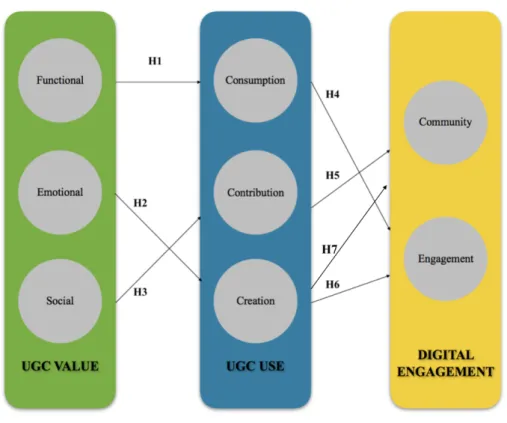
5. PROPOSED FRAMEWORK ...27 6. METHODOLOGY ...30 7. RESULTS ...38 7.1. SAMPLE PROFILE ...38 7.2. MEASUREMENT MODEL ...39 7.3. STRUCTURAL MODEL ...46 8. CONCLUSIONS ...50 8.1. MANAGERIAL IMPLICATIONS ...54
8.2. LIMITATIONS AND FUTURE RESEARCH ...55
9. BIBLIOGRAPHIC REFERENCES ...57
List of Tables
Table 1 - The outcomes of User Generated Content ... 7
Table 2 - Types of Value ... 13
Table 3 - Components of Digital Engagement ... 23
Table 4 - Overall view of the constructs and items ... 31
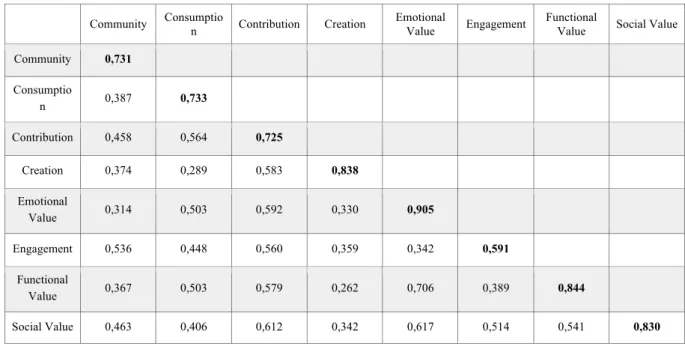
Table 5 - Measurement Results ... 40
Table 6 - Fornell-Larcker Results ... 45
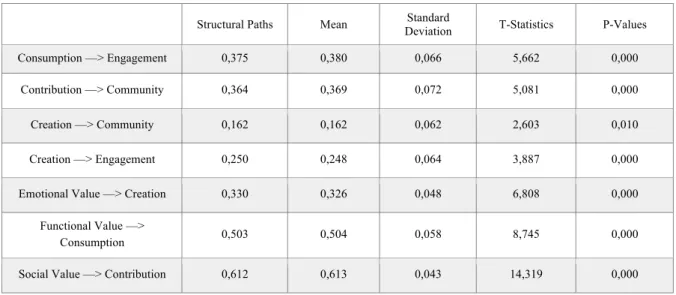
Table 7 - Final Results ... 48
Table 8 - Effect Size ... 49
Table 9 - Questionnaire Items ... 74
Table 10 - Construct Reliability and Validity Analysis ... 76
Table 11 - Heterotrait-Monotrait Ratio (HTMT) ... 76
Table 12 - Cross Loadings ... 77
List of Figures
Figure 1 - User perception of the quality, value, and utility of user-generated content research framework ...9Figure 2 – Initial Proposed Framework ...10
Figure 3 - UGC Quality influences UGC Value ...12
Figure 4 - Original Internet value-chain for User Generated Content ...15
Figure 5 - UGC Value influences UGC Use ...16
Figure 6 - UGC Use influences Digital Engagement ...20
Figure 7 - Proposed Framework ...27
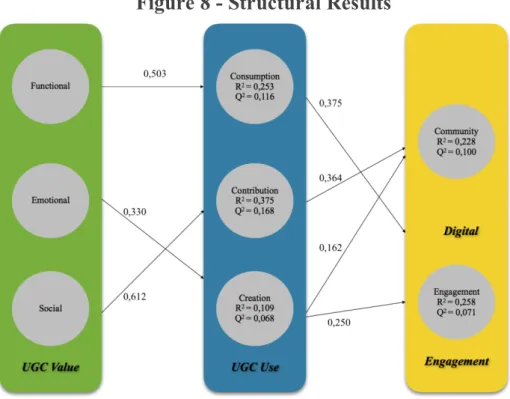
Figure 8 - Structural Results ...46
Figure 9 - Instagram Example of UGC ...52
Figure 10 - Instagram users in Portugal ...65
Figure 11 - Questionnaire ...66
Figure 12 – Results: Do you have an Instagram account? ...72
Figure 13 - Results: How often do you use Instagram? ...72
Figure 14 – Results: How many followers do you have? ...72
Figure 15 – Results: Have you ever encountered UGC on Instagram? ...73
Figure 16 - Results: Age ...73
1. Introduction
With the technological advances, social media became a constant feature in todays society. Nowadays it is impossible not to use Instagram or Facebook or even YouTube during the 24 hours in a day. All of these social media platforms allow users to communicate, share content, discover new products and it builds a habit relationship with them. Because of that, social media platforms become dissemination vehicles where everyone has a voice and a higher capacity to achieve a greater audience. As a result, the concept of user generated content (UGC) was born and started to be discussed.
In Marketing literature, UGC is just starting to be observed and explored. There is clear gap in the literature regarding the possible effects of UGC, its value perceptions and even a well-defined designation globally approved. These are relevant issues which need to be addressed since UGC is now perceived as a necessary notion to comprehend and to investigate. UGC can assume many shapes (images, video, comments) and have multiple meanings, therefore it can lead to significant consequences. It can be divided in two categories, sponsored-branded UGC and non-sponsored sponsored-branded UGC. Just like the names indicate, the first suggests a type of content that is created by individuals who are paid to do so and the second reflects a scenario where individuals don’t possess any incentive but they still create, consume and/or contribute to the content. This research will focus on the second category of UGC and will examine this type of content on the social media platform Instagram. Instagram is a rich UGC platform that praises itself on being community oriented and the creator of many UGC trends. Furthermore, this research starts by gathering and revising the existent literature and proposes three questions, “How is non-sponsored branded UGC valued on Instagram?”, “How does the value of non-sponsored branded UGC influence its use on Instagram?” and “How does the use of non-sponsored branded UGC affect digital engagement on Instagram?”. In order to successfully answer these questions a model was developed and seven hypotheses were tested.
The current research is divided in four parts. First, the literature review will present an introduction to the theme, reveal three possible UGC antecedents and provide a clear examination of each dimension and its specific constructs in order to explain how the model was formulated and the hypothesis created. Second, the methodology will demonstrate how the questionnaire was created and how the data was gathered and what procedures were used to analyse that data. Third, the results and their analysis will be exhibited. Fourth, the conclusions will be presented as well as the limitations encountered and the possible future direction of this research.
2. Literature Review
“The social Web represents a paradigm shift in marketing communications—indeed, communication as a whole” (Christodoulides et al., 2012: 53). The internet is a continuously growing substance that allows everyone to be instantly connected. When the Internet evolved from Web 1.0 to Web 2.0, it opened many doors for the emergence of opportunities related to business, creativity and engagement. Web 2.0 comprises elements of affordability, fastness, capability, dynamic gadgets and portability which allowed the expansion of the participatory culture. In the past, marketing activities reflected public relationships, reward programs and direct marketing which portrayed the consumer as mere receivers of those activities and the companies as the holders of the brand expansion mechanism. Nowadays, the process has changed. Consumers are now seen as co-creators of brand messages that can generate viral effects (Jahn & Kunz, 2012).
Kozinets (1999) referred to the rise of Internet platforms as e-tribes and underlined the importance of no boundaries regarding time and space as a main element to connecting different people in different places. Individuals are able to create, participate and share content as opposed to just consume what is developed by organisations. Admittedly, the growth of Web 2.0 led to the development of a user driven, participatory world in which millions of common individuals produce and publish their own content, creating a new phenomenon, the user-generated content. The Interactive Advertising Bureau in the United States (2008) describes it as “any material created and uploaded to the Internet by non-media professionals.” UGC can have many shapes, including audio, picture, video and text, which can be posted across a variety of media platforms, including social media. In fact, Kaplan and Haenlein (2010:61) described UGC as “the sum of all ways in which people make use of Social Media.” Throughout the years, social media platforms have increased their popularity as well as their importance. Nielsen (2016) reports that adults (18+) spend 25:07 hours on all media on a weekly basis. Nowadays, Facebook isn’t just a platform to find and reach your friends, YouTube isn’t just a space for funny cat videos and Instagram isn’t just used to apply pretty filters to newly captured photos. Each one of these virtual spaces has found its commercial and economic value.
Llodra –Riera et al. (2015) demonstrated that the various Internet platforms generate various effects on individuals. This has empowered a lot of new sources of information in many subjects. However, while organisations have increased their value and space in the online world, individuals have also become more active and with greater capacity to communicate with each
other, and with organisations. Prahalad & Ramaswamy (2004) propose that individuals and firms eliminate the firm-centric view of value creation and replace it with the co-creation perspective. It is possible to infer that Web 2.0 was able to shift the paradigm of power between consumers and organisations on account of being more accessible, user centred and active. Consequently, consumers became more empowered with such tool and developed a new facet, they became actors. Actors who question the policies of the organisations, its credibility, its values and if they are not happy with what they uncover, they move on to the next company (Vargo & Lusch, 2004). Furthermore, these elements led to the spread of user generated content or consumer created content and made it an everyday action.
The next section proposes three antecedent concepts of UGC, prosumption, co-creation of experiences and working consumers.
2.1. User Generated Content Antecedents
2.1.1.
“
Prosumption
”
The concept of UGC started to arise in 2005 and has since then been the focus of some research. Nevertheless, its origin goes back to 1980 when Alvin Toffler developed the idea of Prosumer. Toffler’s futuristic thinking allowed him to design a concept in which people generated their own goods and services, giving less attention to the marketplace. The author separates production and consumption into three waves described in history.
The First wave regards agriculture as the leading activity and the majority of the individuals are prosumers. The Second wave refers to the Industrial Revolution Era in which most work was made in factories, meaning that most individuals didn’t create anything by them and for them. This encouraged individuals to become more consumers than producers and the high job specialisation made them incapable to perform other tasks well. Lastly, the Third wave is where there is a clear shift into the producer-consumer paradigm and individualisation is relevant. The author presents six reasons for this transformation, namely, higher education, the increase in the cost of skilled labour (plumbers, painters, etc.), the need for physical activity (since most jobs are done sitting at a desk in front of a computer), the idea that the products available in the market are lacking quality, etc. The significance of this research is proven by today’s society where the “do it yourself” (DIY) philosophy is quite valued. Kotler’s (1986) take on “prosumption” is that it might reflect some Marketing challenges, since it can affect the 4 P’s of the Marketing Mix. Kotler predicted that consumers would be more involved in the
design and production stages, goods and services would have lower prices, retail would be dispersed and decentralised and promotion would have to be more individualised and segmented. Today, it is possible to observe most of these features since certain brands allow you to personalise and customise their products (ex: Nike). Given the big range of products in some sectors, prices are lower and certain markets are so segmented that they identify an individual’s problem and aim at solving it. Thesestreams of prosumption and the development of Web 2.0 have gathered the elements required to expand user generated content. Nowadays, fixing a plumbing problem can be taught on YouTube, learning can be done through the Internet with online courses, cooking can be improved by simple online tips, blog posts tell individuals what’s hot and what’s not, pictures express the beauty of different locations, etc. All this content can be created by users and directed to other users, thus showing the importance of this concept today.
“UGC is changing the character of open society by enabling the production, distribution, and sales of content, rebirthing users as “prosumers” who perform active roles in content production, and creating an era of one-person-media” (Kim et al., 2012: 306). The expansion of prosumption and Web 2.0 led to the development of the participatory culture as well as the participative web, since both concepts are interconnected and co-dependent.
Participatory culture can be defined as “a culture with relatively low barriers to artistic expression and civic engagement, strong support for creating and sharing one’s creations, and some type of informal mentorship whereby what is known by the most experienced is passed along to novices (…) is also one in which members believe their contributions matter, and feel some degree of social connection with one another” (Jenkins et al., 2006: 3). Whereas participative web is described as “based on an Internet increasingly influenced by intelligent web services that empower the user to contribute to developing, rating, collaborating on and distributing Internet content and customising Internet applications” (OECD, 2007: 4). These two notions not only provided an understanding of UGC, but also displayed the elements that shape it and the characteristics that drive it. Both authors focus on elements of sociability and connection with others, creativity exposure and digital enhancement.
2.1.2. Co-creation of experiences
In 2004, Prahalad and Ramaswamy delved into an emerging concept in the market, the firm-consumer interaction. They proposed a renovation of the traditional method of communication in which the market was separated from the value creation. This method was
being questioned by communities of linked, knowledgeable, legitimate and progressive individuals who had certain expectations for the market and the organisations that composed it. The authors introduce the notion of co-creating experiences whereby consumers and firms interact and produce value to the market. The idea is that the more engaged the individuals are, the more involved they become with the organisations and the more value can be extracted. This notion is structured around four imperative factors that enable the existence of co-experiences, the DART (Dialogue, access, risk-benefits and transparency). Dialogue is one step towards commitment, interactivity and joint decisions, however, it can’t be practised if there isn't a similar level of access and transparency for both parties. Traditionally, the organisations always had more information and were always very opaque. Nevertheless, the advent of Web 2.0 made it possible for individuals to be more connected and more informed, contributing to a bigger access to the organisation’s information and increasing their transparency. These factors
contribute to a greater understanding of the potential risks-benefits consumers might face and create a more informed and rational decision. In sum, the co-creation of experiences led to a regular dialogue between consumers and organisations as well as consumers to consumers, facilitating the creation of communities and re-shaping relationships.
The co-creation outcomes result from particular brand engagement platforms combined with a specific environment that will potentiate those experiences. These platforms are components of the brands capability ecosystem and they enhance value creation. Ramaswamy and Ozcan (2016) propose Nike as an illustrative example and display a thorough analysis on the matter. “Through a digitalized brand engagement platform, NikeID, the Nike enterprise has now opened up the creative design of the shoe to customers and enthusiasts” (Ramaswamy & Ozcan, 2016: 101). This initiative enhanced the engagement and the commitment to the brand as it allowed individuals to further personalise their shoes, from the colour to the style, to the fabric, etc. Nike has also developed other platforms that drive community interactivity, social media content sharing (partnership with Instagram for Nike PHOTOiD in 2013), accessible data connections and self-improvements, but more than that, it has empowered individuals to share their experiences with the products and the brand. This Nike example highlights Füller (2010) claims that the innovation of virtual co-creation is intensified by the individual’s ability to share their creativity and problem solving talents. The author develops his research based on the three elements that compose the concept of interaction such as, the content, the process and the people and connects it to the individual’s personal characteristics and their motives to produce. The basis of the co-creation argument is that, by interacting with each other, all the parties engaged
will gain a more profound knowledge of each side and facilitate the creation of more original and improved experiences (Ramaswamy & Gouillart, 2010).
2.1.3. Working Consumers
Within this line of research, Cova and Dalli (2009) introduced the idea of working consumers as the next step in marketing theory. Their work depicts consumers not entirely as producers because they don’t receive any profit from the market but as participants in the value creation process. “Working consumer concept as a way of describing both the sociocultural and the socioeconomic dimensions of contemporary consumers’ new role” (Cova and Dalli, 2009: 316). With the emergence of technology, the increasing will to participate and the individual’s creative skills, there is a clear convergence towards Generation C (the C stands for content) and the growth of user generated content. UGC develops into an equivalent competitor to traditional media, entertainment, news and craft. Moreover, many compare UGC to eWOM, however, research indicates that the concepts are different. In UGC, the content is produced, as opposed to eWOM in which the content is transmitted. UGC can relate more to entertainment and creativity, while eWOM generally refers more to recommendations and advices. Nonetheless, both of these practices reflect brands and consumers, have no commercial goals and are not regulated by companies (Cheong & Morrison, 2008; Schivinski & Dabrowski, 2016).
2.2. User Generated Content
Munar describes UGC as “the information that is digitalized, uploaded by the users and made available through the internet” (Munar, 2011: 292). UGC is considered a new form of consumer engagement and a new instrument in which consumers express their individuality to others, as well as, interact with each other. “It is what is produced in the moment of being social, as well as the object around which sociality occurs” (Smith et al., 2012). The creation of UGC content can be an individual work or a group work and UGC can be altered, shared and consumed by many. Due to the rise of Web 2.0, UGC has evolved faster and is now seen as a tool of consumer insights and brand dialogues. Despite its developments, it is still a rather new concept, therefore, there isn't an accepted universal definition (Christodoulides et al., 2012; Schivinski and Dabrowski, 2016; Malthouse et al., 2016).
In the UGC predicament, Burmann (2010) reveals that there are two main approaches: the sponsored vs. the non-sponsored branded UGC. UGC mostly refers to branded related content that can either be created because marketers and brand managers stimulated it (e.g.
contests, voting, games, etc.) or because individuals naturally and without any agenda decide to create content. Daughtery et al., (2008) revealed that individuals who engage with UGC are more prone to share opinions about brands and products and also to act as brand advocates. This can be well observed in social media, Instagram, Facebook and YouTube where there is an apparent line of sponsored vs. non-sponsored content. Christodoulides et al., (2012) characterise non-sponsored brand related UGC as a concept composed by co-creation, empowerment, community and self-concept. These four factors constitute an incentive to create and disseminate UGC. Their research involves connecting these components of UGC to the construct of involvement which will then relate to brand equity. Results show that the stronger the brand equity, the bigger and more positive are the effects of co-creation, empowerment and community. Nevertheless, its research and potential effects are rather small and demanding more investigation.
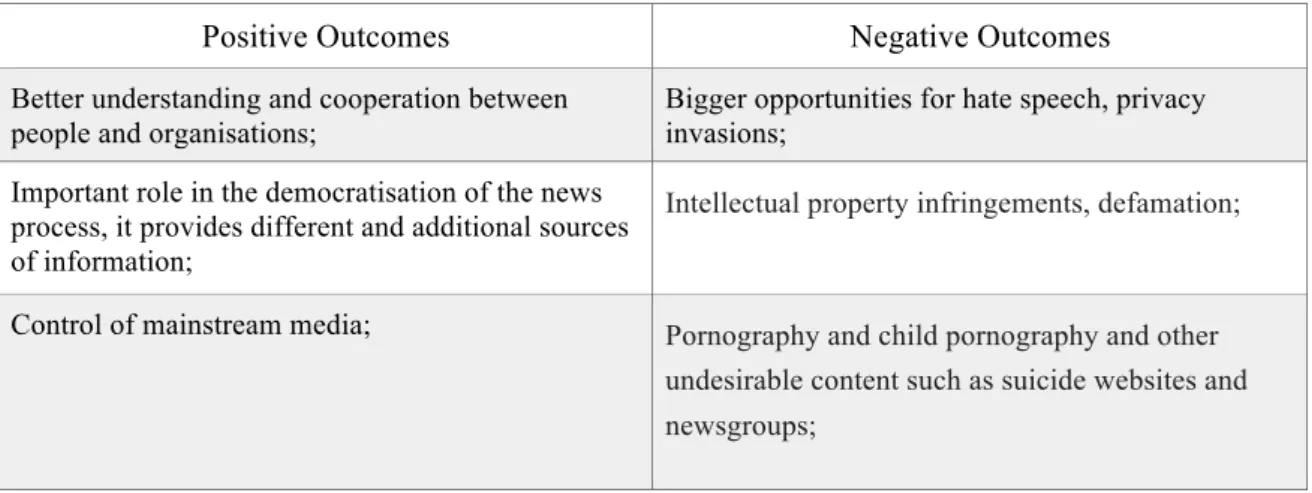
OECD (2007) classify UGC as the “rise of the amateur creator” and place the notion as one of the major elements in the participative web. The authors introduce three key concepts to define UGC, such as publication requirement, creative effort and creation outside of professional routines. It has four main drivers: the technological, social, economic and institutional/legal, which powers UGC and allows it to be stimulating, interesting and current. Stoeckl et al., (2007) also provided three main characteristics to describe UGC, which is the fact that consumers are now producers, the creation originates without immediate profit and it is mass media oriented. According to Valcke and Lenaerts (2010), because UGC involves using, participating and sharing, it has created a form of collective intelligence with positive and negative outcomes described in the table below.
Table 1 - The outcomes of User Generated Content
Positive Outcomes Negative Outcomes
Better understanding and cooperation between people and organisations;
Bigger opportunities for hate speech, privacy invasions;
Important role in the democratisation of the news process, it provides different and additional sources of information;
Intellectual property infringements, defamation;
Control of mainstream media; Pornography and child pornography and other undesirable content such as suicide websites and newsgroups;
Although it displays quite a bit of negative outcomes, the positive outcomes are also quite promising and beneficial. As a result, organisations are taking advantage of this new form of communication and using it in their favour, not only to promote products and services but also to communicate with their consumers by creating a dialogue (creating value together). Therefore, an extensive range of UGC forms has been originated and shared in diverse sites leading to its rapid increase. Research shows that given the fact that anyone can be a content creator, sometimes that content can be perceived as more trustworthy as opposed to the one manufactured by organisations (Kardon, 2007). Christodoulides et al., (2012) also found that UGC can be distinguished as more trustworthy than traditional media which makes it a worthy adversary. Papathanassis and Knolle (2011) offer a possible explanation for this situation, while marketing departments have the tendency to cover negative features, real people will give real and meaningful opinions and reviews. Schivinski and Dabrowski (2016) investigation showed that while UGC has the ability to positively influence brand equity and brand attitude, firm-created content can only positively affect brand attitude.
Ghose and Ipeirotis (2009) revealed that UGC has a great deal of economic value because it influences the organisations’ pricing power and it helps individuals deal with uncertainty avoidance. They indicate that while consumers might struggle with the perception of quality of a given product, UGC may help shape that perception and turn into a potential purchase. Their results even showed that UGC in the form of reviews with an indifferent connotation can boost sales within the group of risk averse consumers. The explanation goes along the lines that more “real” information is better than less information. Williams et al., (2010) corroborate the existence of negative UGC and describe it as necessary to assist individuals in their product choice and reveal its authenticity.
Bernoof and Li (2008) explain the UGC popularity rise by discussing the elements of “listening," “energising,” “talking," “supporting” and “managing” as opposed to “research” and “sales” inside organisations. They claim UGC as being infectious to both sides, users will want
Facilitates social networking; Websites encouraging eating disorders such as anorexia, violent or shocking images or insults to religious groups.
Benefits user autonomy; Encourages cultural diversity.
to keep doing it and companies will want/will have to keep dealing with it. The authors also detail fundamental advices to deal with UGC, like accepting the lack of control, internal challenges, focusing on the culture and values of the company and expanding objectives. As a consequence, UGC is increasingly being incorporated into organisations’ business and marketing plans since most companies have an online presence. Because of that, the quality of UGC has been growing in form and expectations (Valcke & Lenaerts, 2010).
Sun’s study (2010) demonstrated that system quality, service quality and information quality influence relationship quality which will reflect positively for the business, more specifically, customer commitment and retention. In addition, Li and Lin (2009) appealed to the significance of content quality by concluding that the higher the quality, the higher the value. UGC is seen as a new form of co-creating value between individuals and organisations which in turn establishes mutual benefits for both parties. Gangi and Wasko (2009) suggest a socio-technical theory to explain UGC attitude and involvement and denote that by using social communications and technical features together, it creates a positive experience that will generate engagement. The authors infer that the more UGC is used, the more value both sides convey to it and the more they acknowledge its benefits “The more users engage, the more valuable the UGC (…)” (Gangi & Wasko, 2009).
Taking into consideration these researches, Kim et al., (2012) proposed a model in which it connects the three main features of UGC, quality, value and use since there is a lack of research on the matter (Ghose & Ipeirotis, 2009; Shim & Lee, 2009; Williams et al., 2010). Given the fact that UGC is rapidly expanding as well as the possible platforms for its application, it is pertinent to comprehend such concept and verify its adaptability to different scenarios. The framework the authors propose is represented below:
Source: Kim et al., (2012)
Figure 1 - User perception of the quality, value, and utility of
user-generated content research framework
The research model tries to relate the three central concepts of UGC and establishes a positive connection. Namely, UGC quality will positively influence UGC value which will positively influence UGC usage. Each element incorporates an X number of components in order to better explain the concept. More specifically, UGC quality includes: content quality, design quality and technology quality, UGC value incorporates functional value, emotional value and social value and lastly, UGC usage encompasses utility. Based on this research model, this thesis proposes an extension and perhaps a complement to the actual model. By maintaining the two original constructs and adding a few extras, the model will represent a take on the individuals’ perceptions of non-sponsored brand-related UGC and its impact on engagement and community.
As seen above, UGC is a result of three essential phenomena: prosumption, co-creation of experiences and working consumers combined with the power and development of the new technologies. This combination has made UGC a new concept but also a natural one. Individuals are used to create content and share it with their family and friends, the Web 2.0 has only potentiated and augmented this transaction.
The next section will analyse the existing literature of each dimension, construct and further deepen the research context. In order to provide a greater understanding of the model, the constructs of UGC quality is still approached however it will not be included in the final framework.
2.3. Dimensions
2.3.1. UGC Quality
Nowadays it is difficult to imagine a world without a Facebook post or a YouTube product-review video, nevertheless, these are rather new media that have promptly become a part of our daily lives. According to Gangi and Wasko (2009), “UGC websites are online environments where users contribute, retrieve, and explore UGC from the organization and fellow users” (Gangi & Wasko, 2009: 1). This translates into an abundance of applications available, accessible social media platforms, increasing digital content contribution and expanding creativity hubs. All the content that is digitally created has three main components associated: content, design and technology. Since there is no doubt that UGC is a digital form of creating content that can be distributed in many formats and online spaces (OECD, 2007) it can be connected to the same components. In turn, these components show a probable connection with one another as well as a clear difference from each other. Generally speaking, content is different from design, design is different from technology and technology is different from content.
Huizingh (2000) introduces content as the knowledge and the elements displayed (commercial vs. non-commercial information, transaction and entertainment), while design is the framework in which the content appears (navigation structure, search function, protected content, quality, image and presentation style). Kim et al., (2012) view technology as the vehicle that supports content and design and place these three components as the main factors of UGC quality. To slightly deepen the matter of quality, there will be a short description of each component.
The content of UGC is composed by audio, video, text and images (Kim et al., 2012; Valcke & Lenaerts, 2010; OECD, 2007) and arises from two possible streams, creativity and information processing (Feijóo et al., 2007). For instance, Instagram allows users to take a pictures, customise the images and share it on the platform, “Amateur” videos are uploaded every day to YouTube and seen by millions, textual reviews of restaurants and/or hotels are published on different websites to help individuals narrow their choice (e.g. TripAdvisor, Zomato) and, today, creating audio and broadcasting is easier with UGC pages such as SoundCloud and podcasts. To sum up, creating, participating, sharing and interacting with the content that is accessible can add value to that content itself as well as increase the quality of UGC which will in turn increase its success and use (Hargittai & Walejko, 2008; Dye, 2011).
While the content can be seen as the “what” of UGC, design is the “how”. Design encompasses the structure in which the content is shaped and accessible to all the users. It also allows the consolidation and compatibility of the content components (audio, text, sound and images) (Huizingh, 2000; Kim et al., 2012). UGC design differs from one platform to another akin to the elements of each one. In 2012, Smith et al., (2012) conducted a research on brand related UGC and focused on understanding how UGC varies through the different platforms (Facebook, YouTube and Twitter). The research showed that both content and design were altered to the specifications and the purpose of the sites. To this conclusion, it can be added that the outcome of quality will depend on the chosen design (Huizingh, 2000; Kim et al., 2012; Ma et al., 2009).
To conclude, technology is the “where” of UGC, it is what embraces the formats of UGC and distributes it to everyone, everywhere. All of the digital, blogs, mobile photography, social media, wikis, etc., exist because of the development of technology (Bernoff & Li, 2008; Lai & Turban 2008). Consequently, UGC technologies help to enhance quality but also to create value towards UGC.
2.3.2. UGC Value
There is a vast theory behind the concept of value that can be applied in many scientific fields, such as Economics, Marketing, Philosophy, Politics, Sociology, etc. The concept of perceived value lies on the variation between the advantages and disadvantages of an offering. The offering can become better by adding extra layers of value such as, functional, emotional and social (Kotler & Keller, 2012). Furthermore, the type of value referred in this research
focuses on the importance individuals attribute to UGC and the understanding of that influence. This dimension supports three main constructs that will reflect its meaning. More specifically, these dimensions reflect how the majority of individuals’ value non-sponsored branded UGC on social media and if that value can lead to usability. In co-creation literature, value can enhance use (Vargo et al., 2008), this statement can also be made in everyday life, because when a person values a certain brand and/or product she/he will be more inclined to use it.
According to authors Sheth, Newman and Gross (1991) the concept of value can be subdivided into five types, functional, conditional, social, emotional and epistemic. A choice or/and an opinion might reflect one value alone or all the possible values together. “For example, a consumer may decide to purchase gold coins as an inflation hedge (functional value), and also realise a sense of security (emotional value) from the investment” (Sheth et al., 1991: 163). For the purpose of this research, only three values will be considered: the functional, emotional and social, following on Kim’s et al., (2012) analysis. The table below is meant to deliver an open view of each value, as well as the connection to UGC. This will provide a greater understanding of the constructs, as well as the dimension it is representing.
Table 2 - Types of Value
Types of Value (Sheth et al, 1991) Types of UGC Value (Kim et al., 2012)
Functional value is based on the scope of functionality, utilitarianism and physical performance;
UGC functional value is based on the fact that it is accessible, convenient and can enhance the quality of the product and/or service;
Emotional value is achieved when it arises feelings, affective states and satisfaction;
UGC emotional value is connected to the positive and/or negative feelings and level of satisfaction individuals get when they consume either a type of media or goods/services;
Social value is related to positive or negative demographic, social, economic and cultural-ethnic stereotypes. It is about reflecting the “correct” social image as well as the “correct” social ethics;
UGC social values outlooks individuals as social beings with eagerness to connect and maintain relationships but also to identify and demonstrate their social status;
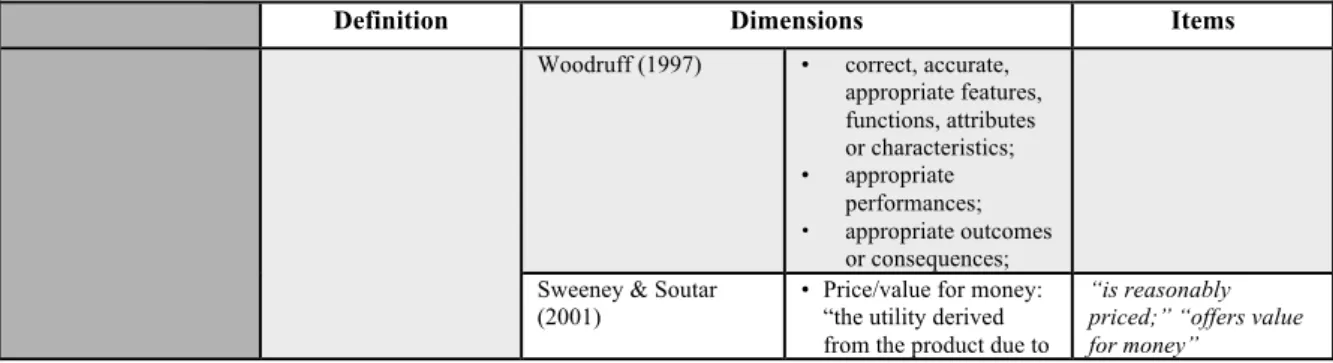
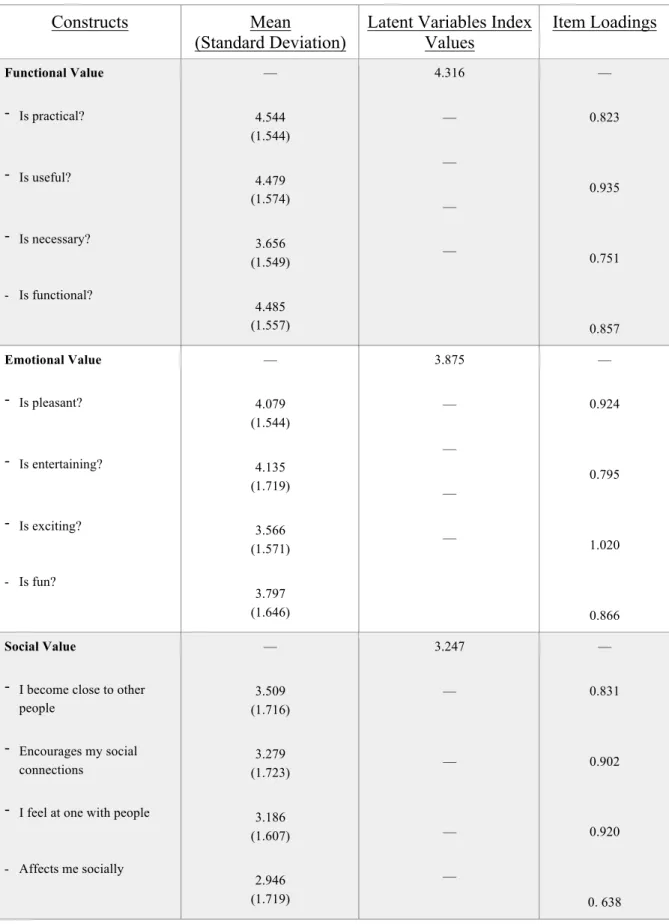
Functional value is defined as: “the perceived utility of an alternative resulting from its inherent and attribute-or characteristic-based ability to perform its functional, utilitarian, or physical purposes” (Smith & Colgate, 2007: 8). The functional constructs can have several elements associated that depend on the context. Woodruff (1997) propose three types of functional value, (a) functional value for aesthetics, quality, customisation or creativity, (b) reliability, performance quality, or service-support outcomes and (c) strategic value, effectiveness, operational benefits and environment benefits. Sweeney and Soutar (2001) suggested the creation of two sub dimensions to the functional construct, price/value for money and performance/quality. This was the product of the development of a 19-item measure (PERVAL) that can be used to understand the consumers’ idea of value. There is a significant amount of research on value in different types of scenarios, however, there is a common denominator, most of that research focuses on value resulting from the purchase and use of durable products (Smith and Colgate, 2007). Nonetheless, these streams of research help to shape the methodological path of each construct and dimension.
Regarding the emotional value, it can be stated that, “(...) represents the perceived utility acquired by an alternative as a result of its ability to arouse or perpetuate feelings or affective states, such as comfort, security, excitement, romance, passion, fear or guilt” (Smith & Colgate, 2007: 8). According to Sheth et al., (1991), Sweeney and Soutar (2001), the emotional element demonstrates the individual’s affective response to the service. This response changes according to the environment and the outlines presented acknowledging that it’s not just rationality and cognition in the mix. For example, entertainment and travel industries will more likely play with the feeling of fun, pleasure, enjoyment, humour and adventure (Smith & Colgate, 2007). The emotion captured and perceived demonstrates a more compelling and memorable idea and the satisfaction and/or delight help shape an emotional bond (Kotler & Keller, 2012). When it comes to creating content on the Web, the same type of outcomes can arise, since online content can be depicted as entertaining, informational, cultural, etc., which means that it can also trigger emotional feelings.
Lastly, the social value is described as “the perceived utility of an alternative resulting from its image and symbolism in association or disassociation with demographic, socioeconomic and cultural-ethnic referent groups” (Smith & Colgate, 2007: 8). This means that social value represents the utility obtained from the product’s capability to improve self-concept (Sweeney and Soutar, 2001). In other words, social value is about how an individual can be perceived but also about the social-relations it can develop. Many companies, toy brands,
service organisations and even business-to-business organisations rely on the social-relationship dynamic to create value (Smith & Colgate, 2007).
OECD (2007) adds a more detailed perspective on the value format and state particular stimulus factors for creating UGC which in turn develops its value. The factors go along the line of connecting with peers, notoriety/prestige, reaching a level of fame (all socially valuable), expressing one’s self (emotionally valuable) and lastly, financial reward (functionally valuable). The authors also infer on UGC’s value chain and compared it to the traditional media chain. As opposed to the traditional difficulties that creators have to deal with (meeting the right person at the right time), in user centric chain it is much easier to push the content throughout the channel. The process consists in accessing a device and software to create the digital content (video, audio, images or text), connect to the providers that will link to the designated UGC platform and then the consumer/user will reach the content. Such individuals can then rate the content, recommend to others and be inspired to also create and develop. Once again, this can be largely associated with the idea of prosumers as consumers are now assuming the role of producers and inserted into the chain of media development and diffusion (Stoeckl et al., 2007). The figure below exemplifies the UGC process.
Moreover, focusing specifically on content and UGC literature, the functional value lies on characteristics of flexibility of pushing the content to others, authenticity, security and privacy (Jensen et al., 2008), convenience, availability and ease of use (OECD, 2007, Ryu et al., 2010, Harrison 2010, Kim et al., 2012). De Vries and Carlson, J. (2014), refer to the content’s functional value as practical, useful, helpful and functional. The authors propose that if individuals value the content in those terms, then the functional aspect is confirmed and the usage will be higher. This logic reflects the research of Jahn and Kunz (2012) that identified a positive relationship between functional value and usage intensity. Emotional value regards to the feeling and emotion that a content can create. Watching an YouTube video can lead to
Source: OECD (2007: 22)
enjoyment and fun, reading an online review about a product can create expectations and a Facebook post can be deemed interesting (OECD, 2007; Shao, 2009; Kim et al., 2012). De Vries and Carlson, J. (2014) acknowledge this emotional value as a hedonic value and state that in order to satisfy it individuals need to find the content entertaining, fun and exciting. By valuing the content in an emotional way, individuals will use it more strongly and often (Jahn & Kunz, 2012). The social value reflects human behaviour in which one interacts with another to respond to social needs and to create and maintain a social status therefore it is often associated with communities and knowledge sharing (Nov, 2007; Christodoulides et al., 2012; Kim et al., 2012). Moreover, it has been discussed that the social value of new media can push for higher levels of adoption and usage (Hennig-Thurau et al., 2010).
The more UGC evolves, the more it will be utilised and shared, nonetheless, its value won’t depend on the quantity of creations but the quality of them (Nov & Ye, 2009). Additionally, such value will be reflected by use and eventful benefits that emerge from it.
2.3.3. UGC Use
Usage theories
UGC use can be seen as a new perspective in the spectrum of user generated content. This dimension focuses on dividing and explaining UGC into three possible constructs providing a more complex approach to the concept. The development of mass media and technologic instruments has led to the appearance of many new beliefs as well as new uses and purposes. Liang et al., (2007) address the issue by exploring three main theories (information
overload, user involvement and uses and gratifications theory) and connecting them to the creation of personalised content recommendation and user satisfaction.
Information overload is a consequence of today’s society and its exposure to too much data. The theory is based around the idea that because individuals are in contact with so many sources of info their capacity to acknowledge and understand it reduces. The authors argue that user satisfaction will be higher when information load decreases through precise personalised content recommendation.
Secondly, user involvement theory regards the fact that user’s satisfaction will be higher if the user has explicit involvement in the making.
Lastly, the uses and gratifications theory (U&G) submitted by Katz (1959) which has been seen as valuable to explain the pertinence of new media, such as, online communities, blogs, internet and social networking (Jahn & Kunz, 2012). The theory states that media audiences access information depending on their intentions and they are actively selective of the content and media they choose to access. The theory suggests an understanding to why individuals use a certain media (motivation/purpose of use), how individuals take advantage of the media to gratify their needs and the positive and negative outcomes of that media use (Katz et al., 1973). This research focus on the purpose of the media use and the outcomes that arise from it. According to Cutler and Danowski (1980), the theory can be divided into two dominant streams, content gratifications and process gratifications. Content gratifications regard the importance individuals assign to the information contained in the media message while process gratifications refer to the experience individuals gain from using certain media. Two of the most important prepositions of the U&G theory are that the individuals are active and they are goal oriented, which means they intentionally search for the most appropriate media to resolve their problem (Chen, 2011).
Ko (2000) denotes that because online communication functions differently from the conventional sender-receiver model, the uses and gratifications theory becomes more applicable and pertinent. Leung (2009) also examined the gratifications of generating content online in which it was based on the uses and gratification theory. His researched follow the line that the more users value and find UGC gratifying, the more they will engage with it. Chen (2011) justifies the use of the theory considering that it explains how individuals pursue a computer mediated medium to gratify a psychological need. The theory also advocates that individuals will select from a diverse choice of media use, which means that if they choose one specifically and stick with it, that media must be satisfying their needs. Thus the choice of media use will be based on what value the media can deliver to each individual (Kim et al., 2012).
This dimension is, therefore, conceptualised on the uses and gratification theory and it is meant to reflect the purpose of non-sponsored branded UGC on social media. Shao (2009) defends that individuals use UGC through UGM (user-generated media) in a variety of ways for diverse ends. Consequently, the author subdivides UGC use into three possible categories, consuming, participating and producing. Firstly, “Consuming refers to the individuals who only watch, read, or view but never participate” (Shao, 2009: 9). Thus, a consumer of UGC is a mere spectator of the media. Secondly, “Participating includes both to-user interaction and user-to-content interaction (…). It does not include one’s actual production” (Shao, 2009: 9). User-to-user interactions includes individuals communicating with each other through instant messaging, message boards, chat rooms, etc. User-to-content interactions happens when individuals rate certain contents, save to their favourites, post comments, share with others, etc. These interactions enhance cooperation between individuals as well as satisfy their social needs. In this line of thought, Van Dijk (2006) examined the contrast between traditional and online communications and came up with three main advantages to the latter:
1. users are able to offset the missing key elements in sounds, text, image or other; 2. users are able to aim their attention to the content more accurately;
3. users are able to engage in more casual dialogue and context.
Furthermore, it is important to reflect that in addition to developing social bonds, when individuals participate in UGC it might lead to the creation and conservation of virtual communities (Shao, 2009). Thirdly, “Producing encompasses creation and publication of one’s personal contents such as text, images, audio, and video” (Shao, 2009: 9). In 2016, over 1.8 billion photos were uploaded and shared by individuals on social media daily. Consequently, 350 million photos were uploaded daily just on Facebook, 80 million were posted on Instagram and 432,000 hours of video were shared on YouTube (Smith, 2016). There is a great deal of evidence that supports the premise that individuals are more and more using and taking advantage of UGC, nonetheless it is important to understand how they use it.
Having Shao’s (2009) research in mind, Muntiga et al., (2011) developed a typology for the different possible usages called, COBRA. This is a behavioural approach that exemplifies the three different levels of activity related to branded-content on social media platforms. The investigation examined the online activities of twenty individuals through the process of instant messaging (IM) interviews which the authors felt it was a good method to express real feelings due to its anonymity properties. The study proposed three activity constructs, individuals can use social media platforms by consuming, contributing and creating, and each construct reflects a higher degree of activity. Much like Shao’s (2009) concept,
consuming via COBRA typology, means having the lowest degree of online brand-related activity. Therefore, consumption implies watching, viewing, reading, downloading branded widgets, playing branded games and sending virtual gifts. Contributing represents the intermediate stage of the COBRA typology which indicates user-to-user communication and user-to-content interplay. Finally, creating represents the highest degree of brand activity in which individuals produce and publish branded-content on social media. Muntiga et al., (2011) provide a good example of these three degree of activities, “Watching brand-related videos on Absolut Vodka’s YouTube channel, talking about IKEA on Twitter and uploading pictures of their new Converse sneakers to Facebook are examples of consumers’ online brand-related activities (COBRAs)” (Muntiga et al., 2011: 14).
Despite Muntiga’s et al., (2011) extensive and innovative research, the authors didn’t formalise it, conceptualise it nor measure it therefore leaving room for improvement. Schivinski’s et al., (2016) research tries to fill this gap in the academic literature and suggests the following interpretation: “A set of brand-related online activities on the part of the consumer that vary in the degree to which the consumer interacts with social media and engages in the consumption, contribution, and creation of media content” (Schivinski’s et al., 2016: 66). The authors describe the constructs based on Muntiga’s et al., (2011) and Shao’s (2009) researches which means that consumption represents the lowest degree of engagement and represents those who don’t participate, nevertheless, it is the most common activity. Contribution comprehends participation in the media without the creation of brand-related content. Lately, this construct has been more investigated by researchers because it contains the act of “Liking” and “Sharing” on social media. Subsequently, the creation construct includes creating and online posting branded-content. It symbolises the highest degree of individual engagement.
To conclude, the three types of usage are explanatorily different however they can be interdependent. Despite not being a generic rule, usually individuals start their connection with UGC as consumers or lurkers, mostly absorbing content of entertainment or news. Subsequently, once they get comfortable with that reality they start participating by communicating with other users and interacting with the content. This contribution will then allow individuals to connect with others and form communities based on their shared interests. Lastly, individuals become relaxed enough and comfortable to start creating content themselves. Hence, these three usages are a course of gradual improvement that may or may not happen depending on the private features of each individual (Shao, 2009; Muntiga et al., 2011; Schivinski’s et al., 2016).
2.3.4. Digital Engagement
Up until this point, the literature has revised the meaning and the possible antecedents of user generated content. It has proven that there are links between UGC quality, value and use as well as that its usage might facilitate social interactions. As a next step in the research, there is the analysis of the concept of digital engagement. Since UGC is a digital form of content it is possible to interpret its creation and interaction as digital engagement. Despite being a rather new topic of research it is quite pertinent in today’s virtually connected world and even more relevant to organisations who invest on the digital field (Scheinbaum, 2016; Bolton, 2011). Therefore, digital engagement is approached as a dimension that encompasses two main constructs, community and engagement.
Scheinbaum (2016) revealed that prosperous branding demands engaging consumers on social media and digital settings. This engagement will then lead to community outcomes and individual’s participation and connection with others who share the same interests. “From a consumer-centric standpoint, digital engagement is an online behaviour resulting from a consumer's thoughts, emotional connection, and intrinsic motivation to interact and cooperate with a brand or its community members in a digital, mobile, or social media setting” (Scheinbaum, 2016: 342). This interpretation of digital engagement reinforces three main ideas, a community and motivation notion, a multifaceted interpretation and essential behaviour intention.
The community part is viewed by the important research of Algesheimer et al., (2005) who set out to explore how diverse conditions of the individuals’ relationship with the brand
community will display different behaviours and attitudes. The authors learned that brand communities can arise not only positive outcomes (e.g. engagement) but also negative ones like the pressure to obey the community rules (normative pressure) and reluctance. Today, the idea of community is not limited to a physical place as it can be formed virtually through the Internet (Muñiz & O’Guinn, 2001). This means that community reflects a group of people that share common interests and enjoy discussing it with others. Muñiz and O’Guinn (2001) revealed that brand communities are set on three pillars, shared consciousness, rituals and traditions and a sense of moral responsibility. Despite the fact that brand communities are not the particular focus of this research, it is still relevant to understand how these communities function since most of them are now digital communities.
In 2010, Kozinets et al., (2010) asked how communities responded to community-oriented WOM. This is relevant because UGC is often compared to eWOM or said to be an evolution of eWOM however they are different (Cheong & Morrison, 2008). Kozinets el al., (2010) review and synthesise WOM theory and acknowledge that its communities are moved by communal norms that will differ from size, interests, age, lifestyles, etc. The main conclusions are that communities are formed because of social interaction needs, economic stimulus and a demand to balance the basic commercial-communal concern. The authors identified four strategies of knowledge sharing, evolution, embracing, endorsement and explanation. These are methods in which individuals convert commercial information into cultural history. Von Hippel (2001) goes even further on the matter and discusses the concept of innovation communities in which individuals not only share their knowledge but also work together towards developing a new and innovative product. Despite appearing as a foolish idea, the incentives are real, for example, the cost of revealing an innovation are low (cost of diffusion and proprietary intellectual property), it allows the innovation to be exactly as consumers wish (“if you want something done right, do it yourself”) and the potential gains are huge. In line with this thought, Cova and Dalli (2009) argue that communities help cultivate consumer’s power and capability. This power and capability can be “transformed” into UGC engagement. A great example of this, is the research of Muñiz and Schau (2007) who explore the concept of vigilante marketing in a brand community based on a discontinued Apple product. Although the product no longer existed, consumers who really loved the Apple Newton Message Pad still got together online and shared their appreciation. They created user content ads, started conversations, helped any new or in need member, told stories about their experience with it and overall allowed the product to live and provided it with extra meaning.
In this research the focus of community doesn’t obey the typical brand community structures because it doesn't focus on a specific community, brand or product. The focus, however, is on the sense of community provided by a social media platform, Instagram. It refers to a community of individuals which are non-geographically bound that take advantage of UGC’s usability not for a specific brand or product context but for a panoply of circumstances. The concept doesn't encompass the three main pillars of Muñiz and O’Guinn (2001) discussed above, more specifically, there isn’t a shared consciousness nor rituals and traditions. Instagram allows individuals a freedom to think and act in whatever way they choose to, which may or may not coincide with another individual’s ideals but it isn’t a normative. The third pillar revolves around moral responsibility which lies on the concepts of duty and obligation towards something and someone. The platform allows individuals the possibility of having a strong voice and expanding it to every corner of the globe, with that they become truth tellers and honesty exposures because they are not connected to a specific brand and/or product. As a result, the content shared on Instagram starts being seen as more trustworthy and reliable than actual ads created by organisations, which in turn make the community grow.
The multifaceted interpretation is analysed through Brodie et al., (2011 & 2014) investigations where the authors infer on customer engagement dimensions. They state that nowadays, customer engagement is about co-creating customer experience and value, which is driven by the constant and increasing importance given by organisations and researchers. The 2011 research focuses on differentiating engagement from involvement and participation and in addition, the 2014 research centres on the conceptualisation of customer engagement and a scale development. Much like UGC, customer engagement is a dynamic concept that involves people, interaction and co-creations. Malthouse et al., (2016) suggest a parallelism between engagement and UGC, as one is connected to the other. Logic follows that the greater the involvement between the brand, its values and the consumers, the bigger will be the experiences they derive from it. Hence, since engaging with non-sponsored branded UGC implies a form of consuming, contributing and creating, it reflects experiences and therefore, engagement.
Lastly, the behavioural intentions portrayed in the definition above, are reflected by Bolton (2011), which comments on the opportunities and threats of consumer engagement (CE). “Although many organizations consider CE important, this term has different meanings for different people” (Bolton, 2011: 272). Furthermore, it demands action from both sides of the market, the consumers and the organisations.
So the term digital engagement integrates these three analysis reviewed above. In addition, Scheinbaum (2016) suggests an even more operationalised notion since it results from
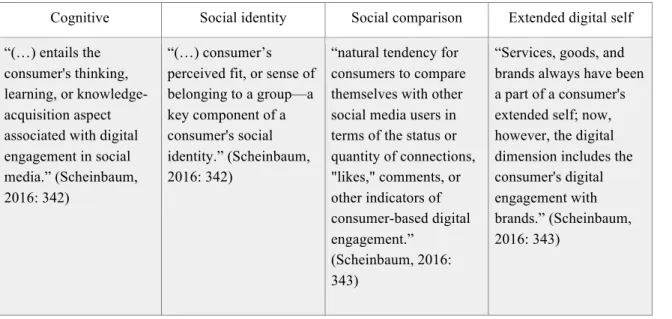
a subjective perspective of felt connection, observed as an online behaviour. The author states that digital engagement is composed by thoughts, emotional connections and/or consumer actions, for example, feedbacks, opinions, commentaries, likes, shares and clicks. The so called, consumer actions are the online action portrayed by individuals with certain apps, videos, sponsored content and advertisements. Digital engagement is important for both sides of the market since both can take advantage of its perks. This research focus on the consumer side and the authors distinguishes four relevant elements (seen on the table below).
Table 3 - Components of Digital Engagement
The pertinence of this concept lies on the fact that similar to UGC, it also allows individuals to have a bigger role in the dialogue between organisations and consumers and it helps individuals connect with others. Measuring digital engagement is now becoming an important activity for organisations as well as understanding how they can raise online engagement. Individual’s comments, reviews, shares, etc., may reflect an advice, an opinion or a reassessment of a given brand or location. This means that individuals become ambassadors of any cause with a tremendous influential power (Scheinbaum, 2016). The fact that UGC is a digital and online activity it may stimulate digital engagement and it can be characterised as a component of digital engagement or as a consequence of such. The table 8 in the annex provides an overall view of the constructs analysed in this research as well the related items.
Cognitive Social identity Social comparison Extended digital self “(…) entails the
consumer's thinking, learning, or knowledge-acquisition aspect associated with digital engagement in social media.” (Scheinbaum, 2016: 342)
“(…) consumer’s perceived fit, or sense of belonging to a group—a key component of a consumer's social identity.” (Scheinbaum, 2016: 342)
“natural tendency for consumers to compare themselves with other social media users in terms of the status or quantity of connections, "likes," comments, or other indicators of consumer-based digital engagement.” (Scheinbaum, 2016: 343)
“Services, goods, and brands always have been a part of a consumer's extended self; now, however, the digital dimension includes the consumer's digital engagement with brands.” (Scheinbaum, 2016: 343)
3. Social Media Platform: Instagram
Kaplan and Haenlein (2010: 61) defined Social Media as “a group of Internet-based applications that build on the ideological and technological foundations of Web 2.0, and that allow the creation and exchange of User Generated Content.” Undoubtedly, there is a link between UGC and social media, as one is a part of the other.
“Social media platforms have emerged as a dominant digital communication channel via which consumers learn about, share information on, and interact with brands they consider, purchase, and evaluate” (Hudson et al., 2016: 27). Consequently, individuals are taking more and more advantage of social media for brand and product information and consumer opinions because of its immediate connection and easy accessibility (Mangold & Faulds, 2009). These recent changes force marketers to adapt quickly to new trends and recognise the importance of social media to the progress. This research focuses its attention to social media platform, Instagram which is the fastest platform to expand today. It has reached 500 million users, it gets around 3.5 billion likes a day, has an average of 80 million photos shared every day and it’s usage has doubled over the last two years. Nevertheless, there is very little academic investigation since most researchers turn their attention to Facebook (Sheldon & Bryant, 2016).
Instagram was launched in 2010 by two Stanford college students with the goal to allow people to share photos with different types of filters. It can be described as “an online, mobile phone photo-sharing, video-sharing, and social network service (SNS) that enables its users to take pictures and videos, and then share them on other platforms” (Sheldon & Bryant, 2016: 89). Generally speaking, an individual as an account, that requires a mini biography (name, location, likes, dislikes, favourite quotes), then he/she sees something he/she likes, takes a picture with his/her mobile phone, adds the appropriate filter and posts it on his/hers feed. Normally, with each photo posted, individuals post a number of hashtags (#) according to the theme of the photo so that other users can see the photo. The “main” objective of each account (a part from posting photos) is to gain followers. Unlike Facebook, Instagram works on a foundation of following and being followed. Commonly, those who have better and more interesting photos will have a larger number of followers. Instagram describes itself as a “community built on the power of visual storytelling” (Business Instagram, 2016) and many users and brands have committed to this premise. Considering only the top 100 brands in the world, 90% have an Instagram account and the engagement with the brands is 10 times higher than Facebook, 54 higher than Pinterest and 84 higher than Twitter (Smith, 2016). Instagram’s