EURO AREA
INFLATION-LINKED BONDS MARKET:
ANALYSIS AND IMMUNIZATION ABILITIES
Cláudia Patrícia Gonçalves Simões
Thesis submitted as partial requirement for the conferral of MSc. in Finance
Orientador:
Prof. João Pedro Nunes, ISCTE Business School, Departamento de Finanças
Abstract
This thesis focuses on inflation-linked bonds. These bonds, although not as popular as other types of bonds, are not a new instrument. The first inflation-linked bond issue took place in the United States in the eighteenth century. In Europe, it would be only in the end of the twentieth century that inflation-linked bonds would be issued in a regular basis by European Monetary Union participant countries.
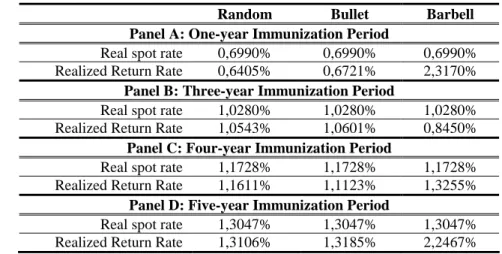
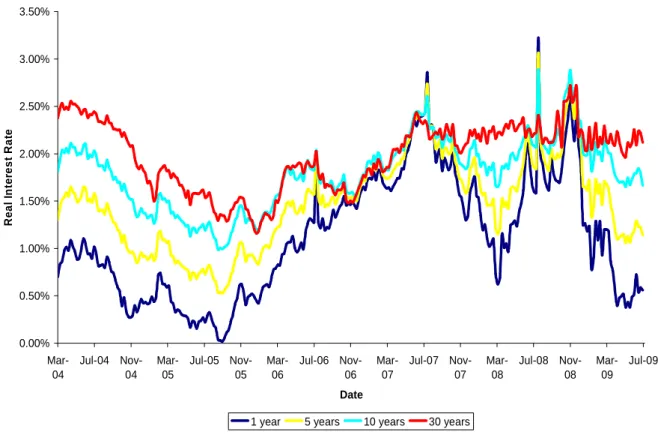
This thesis objective is twofold: to characterize this type of bonds and evaluate their immunization abilities. The first part of this study focuses in defining and describing thoroughly these bonds: their issuers, security design, indexation choice and applications. The second part is dedicated to investigating which portfolio strategies using inflation-linked bonds achieve better immunization results for single inflation-growing liabilities. Simulations were made for investment horizons between one and five years, with and without transaction costs. The results presented point to the superiority of bullet portfolios, over random and barbell portfolios, in terms of liability coverage. Bullet portfolios also prove to be less volatile. These aforementioned results hold in the presence of transaction costs. It is also visible that the portfolios’ return is very sensitive to the evolution of the real term structure of interest rates. As for the comparison between fixed rate bonds and inflation-linked bonds, the latter prove to be better suited to immunize the liabilities under analysis.
Keywords: Inflation-linked Bonds, Immunization, Duration, Real Interest Rates.
Resumo
A presente tese incide sobre obrigações indexadas à inflação. Apesar de não serem tão populares como outras obrigações, não são um novo activo. A primeira emissão de obrigações indexadas à inflação ocorreu no século XVIII nos Estados Unidos. Na Europa, apenas no final do século vinte estas obrigações passariam a ser emitidas com regularidade por países inseridos na União Económica e Monetária.
Este estudo tem dois objectivos: caracterizar as obrigações indexadas à inflação e avaliar a sua capacidade de imunização. A primeira parte do estudo consiste em definir e caracterizar exaustivamente estas obrigações: emitentes, estrutura, indexação e aplicações.
A segunda parte consiste em aferir que estratégias para carteiras de obrigações indexadas à inflação imunizam melhor responsabilidades únicas que crescem com a inflação. Foram efectuadas simulações para horizontes temporais entre um e cinco anos, com e sem custos de transacção. Quanto ao grau de cobertura de responsabilidades, os resultados alcançados mostram que as carteiras bullet obtêm uma performance superior às carteiras aleatórias e
barbell. As carteiras bullet são também menos voláteis. Estes resultados mantêm-se quando se
consideram custos de transacção. É também observável que a rentabilidade das carteiras é bastante sensível a variações na estrutura temporal de taxas de juro reais. Relativamente à comparação entre obrigações nominais de taxa fixa e obrigações indexadas à inflação, estas últimas são mais indicadas para imunizar este tipo de responsabilidade.
Palavras-chave: Obrigações indexadas à inflação, Imunização, Duração, Taxas de juro reais.
Sumário Executivo
A presente tese incide sobre obrigações indexadas à inflação. Este tipo de obrigações permite ao investidor proteger-se contra flutuações no nível de preços, garantindo assim o poder de compra dos seus cash flows futuros. Os cash flows deste tipo de obrigação têm duas componentes: uma componente fixa, associada ao retorno real, e uma componente variável, que varia com a taxa de inflação associada ao indexante escolhido. O investidor natural deste tipo de instrumentos é um investidor de longo prazo, que pretenda anular o risco associado ao nível de preços na sua carteira de activos ou que pretenda imunizar o seu balanço. Alguns exemplos de entidades tipicamente investidoras em obrigações indexadas à inflação são: fundos de pensões, seguradoras (que emitem Planos de Poupança Reforma) ou mesmo empresas cujas receitas (e custos) estejam fortemente associadas à evolução da inflação. As obrigações indexadas à inflação não são tão populares entre os investidores como as obrigações de taxa fixa ou as obrigações hipotecárias. Porém, não se trata de um novo tipo de activo. As primeiras emissões de obrigações indexadas à inflação remontam ao século dezoito, nos Estados Unidos. Este tipo de obrigações voltaria a ser emitido em alguns países após a Segunda Guerra Mundial, dado que esta era a única forma de os governos conseguirem emitir e colocar divida junto dos investidores, devido à conjuntura macroeconómica débil do pós-guerra e ao elevado nível de inflação (que contribuía para tornar este tipo de activo interessante face às alternativas). Na Europa, apenas no final do século vinte se viria a verificar a emissão sistemática de obrigações indexadas à inflação. A primeira obrigação foi emitida pela França em 1998 e, até à data, apenas quatro países da Zona Euro emitiram este tipo de activos. São eles a Alemanha, França, Grécia e Itália. Existem também diferentes tipos de indexantes para estas obrigações. Apesar da maioria das obrigações emitidas serem indexadas ao Índice Harmonizado de Preços no Consumidor da Zona Euro (excluído tabaco), a França também emitiu obrigações indexadas ao Índice de Preços no Consumidor local (excluindo tabaco).
Tendo em conta o carácter de investimento das obrigações indexadas à inflação, seria interessante explorar se (e como) é possível aplicar este instrumento na imunização de responsabilidades futuras que cresçam com a inflação. Assim, foram efectuadas simulações de imunização de responsabilidades únicas futuras cuja taxa de crescimento se encontra associada à variação do nível de preços, utilizando uma estratégia de imunização passiva,
através de igualdade das durações da responsabilidade e da carteira de activos. Foram considerados horizontes temporais de investimento entre um e cinco anos e estratégias de construção de carteiras de activos aleatórias, bullet e barbell. As simulações foram efectuadas com e sem custos de transacção e a valores reais. As carteiras consideradas seriam sempre auto-financiadas, ou seja, não existe nenhum tipo de injecção de capital nas carteiras de activos; os únicos cash flows investidos na carteira são provenientes de cupões recebidos ou capital associado a títulos que se venceram durante o horizonte temporal de investimento considerado.
Na ausência de custos de transacção, as carteiras bullet demonstram uma maior capacidade de cobertura de responsabilidades futuras face às carteiras aleatórias e barbell para todos os horizontes temporais considerados. Alem disso, são também as carteiras de activos que apresentam uma menor volatilidade e uma estrutura mais próxima à da responsabilidade que se pretende imunizar. Estes resultados continuam a verificar-se após a introdução de custos de transacção.
Relativamente à rentabilidade das carteiras simuladas, as carteiras barbell apresentam rentabilidades bastante atractivas para os horizontes temporais de um e cinco anos. Mas, quando se pretende montar uma estratégia de imunização, o mais importante é o grau de cobertura de responsabilidades que a carteira de activos atinge durante o horizonte temporal analisado, e não a rentabilidade absoluta dessa carteira. Assim, as carteiras barbell, tendo uma rentabilidade absoluta superior, são também mais arriscadas e, por isso, não garantem um grau de cobertura de responsabilidades tão elevado como as carteiras bullet. São também as carteiras cuja rentabilidade se encontra mais dependente da evolução da estrutura temporal de taxas de juro reais. No que concerne às carteiras aleatórias, a sua estrutura evolui para uma estratégia bullet ao longo dos horizontes temporais considerados, o que atesta bem a superioridade das carteiras bullet.
Foi também efectuada uma comparação entre este tipo de obrigações e as obrigações de taxa fixa, que são cotadas e avaliadas em termos nominais. Assim, através da evolução das taxas de juro nominais, e tendo presente a Equação de Fisher, também a rentabilidade e cash flows destas obrigações têm embutida uma expectativa de evolução da inflação futura. Deste modo, foi simulado se estas obrigações também seriam um bom activo para imunizar responsabilidades expressas em termos reais. A comparação foi efectuada somente para carteiras bullet, visto que esta é a melhor estratégia de imunização. Foi também expurgada a componente associada à inflação dos cash flows das obrigações de taxa fixa a fim de se tornar comparáveis as carteiras de activos de ambos os tipos de obrigações.
Após as simulações verificou-se que as carteiras de obrigações de taxa fixa são mais voláteis e não apresentam um grau de cobertura de responsabilidades futuras tão elevado como as carteiras de obrigações indexadas à inflação. Assim, para imunizar uma responsabilidade futura cuja taxa de crescimento se encontra relacionada com a inflação a melhor abordagem será constituir carteiras de activos com estrutura bullet, recorrendo somente a obrigações indexadas à inflação.
Acknowledgements
I would like to thank Professor João Pedro Nunes for his dedication, availability and guidance during the elaboration of this thesis.
I also acknowledge and thank my family, friends and all the people that, in any way, helped me and supported me during the elaboration of this thesis.
Contents
Abstract ... ii
Resumo...iii
Sumário Executivo ... iv
Acknowledgements ... vii
List of Tables and Figures ... ix
Chapter 1 – Introduction ... 1
Chapter 2 – Literature Review ... 2
Chapter 3 –The European inflation-linked bond market... 9
3.1. – What are inflation-linked Bonds? ... 9
3.2. – The inflation-linked bond Market: description and issuer countries... 9
3.2.1 –France ... 10
3.2.3 – Germany ... 13
3.2.3 – Greece... 14
3.2.4 – Italy... 15
3.3 – Inflation-linked bonds security design ... 16
3.3.1. – Cash Flow design ... 17
3.3.2. – Indexation choice and cash flow application ... 20
3.3.3. – Duration calculation ... 23
3.3.4. – Breakeven inflation calculation... 25
Chapter 4 – Immunization Procedures ... 27
4.1. – Term Structure of Interest Rates ... 27
4.2. – Liability definition and immunization strategies ... 28
4.3. – Asset portfolio structure assumptions ... 29
4.3.1. – Cash outlay... 29
4.3.2. – Eligible securities ... 29
4.3.3. – Investment Horizon ... 30
4.3.4. – Rebalancing frequency... 30
4.3.5. – Additional Constraints... 30
4.3. – Immunization using inflation-linked bonds ... 35
4.4. – Immunization using fixed rate bonds ... 40
Chapter 5 – Conclusion ... 45
Bibliography... 47
Annexes ... 50
Annex 1 – European HICPx Index... 51
Annex 2 – Capital Interest Bonds formulae ... 53
Annex 3 – Nominal duration calculation for inflation-linked bonds ... 56
Annex 4 – Long Term Issuer Rating Definitions ... 58
Annex 5 – Inflation-linked bonds’ immunization results without transaction costs... 60
Annex 6 – Inflation-linked bonds’ immunization results with transaction costs ... 64
Annex 7 – Fixed Rate Bonds disinflation process ... 68
List of Tables and Figures
Table 1 : Some examples of French indexed bond issues ... 11
Table 2 : French Inflation-linked bonds (OATis and OAT€is) ... 13
Table 3 : Germany Inflation-linked Bonds... 14
Table 4 : Greek inflation-linked bonds... 15
Table 5 : Italian inflation-linked-bond issues ... 16
Table 6 : Inflation-linked Bonds comparison: nominal vs. real estimation ... 32
Table 7 : Sovereign Issuer Ratings for inflation-linked bond issuers ... 33
Table 8 : Inflation-linked Bonds comparison: Country Spreads ... 34
Table 9 : Inflation-linked Bonds’ simulations structure... 34
Table 10 : Liability returns... 35
Table 11 : Asset Portfolios Realized Rate of Return vs. Spot Rate (without transaction costs) ... 35
Table 12 : Asset Portfolios Realized Rate of Return vs. Spot Rate (with transaction costs) .... ... 38
Table 13 : Bid-Offer Spreads: Inflation-linked bonds vs. Fixed rate bonds ... 40
Table 14 : Fixed Rate Bonds’ simulations structure ... 41
Table 15 : Inflation-linked bonds vs. fixed rate bonds (without transaction costs) ... 42
Table 16 : Inflation-linked bonds vs. fixed rate bonds (with transaction costs) ... 43
Table A.1 : Inflation-linked bonds’ immunization results without transaction costs ... 60
Table A.2 : Inflation-linked bonds’ immunization results with transaction costs ... 64
Table A.3 : Bullet Strategy Comparison: Inflation-linked bonds vs. fixed rate bonds ... 71
Chapter 1 – Introduction
Although inflation-linked bonds are not a new instrument, its issuance in the Euro Area is fairly new. The first government issue took place in 1998, and, until now, only four Euro Area countries decided to issue these bonds. They are France, Germany, Greece and Italy. With so few issuers, the number of bonds issued is also limited. Currently only twenty four bonds are alive, five of which are linked to the French Consumer Price Index ex-tobacco. The remaining nineteen are linked to the European Harmonized Consumer Price Index ex-tobacco.
Inflation-linked bonds are not as known and as popular between investors as fixed rate nominal bonds because they are not seen as a short term speculative investment. Usually these bonds’ natural investors are long term investors that wish to protect their future purchasing power, like pension funds, insurance companies and companies whose revenues grow with inflation.
This way, it would be interesting to access if (and how) they could be used to immunize future liabilities and if the results that would be achieved prove that, for liabilities that grow with inflation, these instruments are a better investment than fixed rate nominal bonds. That is the main driver for this study.
Chapter 2 – Literature Review
The literature available for European inflation-linked bonds and immunization is scarce. Hence, this section main focus will be to review the literature deemed relevant by dividing it in two main subjects: the inflation-linked bond market itself and the findings in immunization techniques.
As for the first theme, the available literature in inflation-linked bonds comprises not only the Euro Area market but also the British and American markets. Notwithstanding, many of the findings in these two markets can be transposed to the European market, since many of the features of this type of instrument are similar. Their main focus lies in pricing structures, trading strategies, inflation forecasting and macroeconomic agents’ considerations.
Bardong and Lehnert (2004) focus is driven to the price process of inflation-linked bonds, both in the United States and in Europe. To do this, they focus in two main subjects: the extent to which inflation information revealed today is reflected in the securities pricing (as a measure of efficiency) and how this information could be used to generate trading signals for investors. In order to investigate how the indexation lag can affect the securities pricing, they develop an econometric framework to estimate the break-even inflation1 inherent to the market prices and to derive inflation forecasts (as an alternative to break-even inflation), either for the short term and medium term, in order to have different inflation forecasts for the remaining maturity of the inflation-linked bonds. These estimates are then used to construct a model which aims to provide signals for trading strategies, based in the differential between break-even inflation and the inflation forecast as an indicator of the expected future change in the bond’s observed yield. The information value-added would then be tested by using long-short strategies to trade; this way, by evaluating the results from the trading strategies implemented by using these signals, the authors could assess the degree of efficiency in this market. They did this assessment for markets without restrictions and with restrictions (some of which were short-selling restrictions and trading costs). They found that investors that used a combination of trading strategies with inflation forecasting had better results than uninformed investors; although these results were very pronounced in markets without restrictions, they also hold in markets with restrictions. This way, the inefficiencies existent in the inflation-linked market are not related to the mispricing of the inflation term itself but
1 Break-even inflation is defined as a time-average consensus estimate of market participants as to the future
inflation rate and is derived from the market prices of inflation-linked bonds and nominal bonds with similar maturities.
to the time lag that exists between the reporting and incorporation of the inflation expectations in the securities price. This can happen due to market illiquidity problems and not due to information incorporation problems; if this were the case, the trading model should not work, since the inflation differential would provide erroneous trading signals. However, it seems break-even inflation can be estimated through the inflation forecasts derived from the econometric models; hence, this supports the quality of the trading signals derived and explains the strategies success. This illiquidity problem seems to be also the main driver to explain the reason why long-term strategies produce more favourable results than short-term strategies: these seem to be penalized by high transaction costs. Bardong and Lehnert (2004) used this framework to assess efficiency in the U.S., U.K. and French inflation-linked bond markets, and achieved similar results for the three regions. As for the forecasts’ horizon, the most useful horizon is between one and two years, which leads the authors to assume that break-even inflation seems to be a consensus estimate of the average inflation over this period. Nonetheless, they recognize that, to forecast inflation, seasonality patterns are an issue; when not accounted for, they could produce biased estimations and, consequently, make the models and findings invalid.
Ejsing, Garcia and Werner (2007) focus this issue by discussing the impact of seasonality in the term structure of Euro Area break-even inflation rates. They begin their analysis by estimating the term structure of real interest rates and break-even inflation rates, without taking into account the inflation seasonality and the indexation lag. The conventional estimation process for real interest rate term structure is straightforward; it can be derived from the double clean2 market quotes for the inflation-linked bonds; as for the nominal interest rate structure, it is derived from the transaction (or dirty) price of the inflation-linked bonds, i.e. the double clean price plus the interest accrual and the inflation accrual. However, the authors propose a term structure derived from constant maturity zero-coupon nominal and real interest rates as the proper way to estimate break-even inflation rates. The problem with this framework is how to estimate comparable real and nominal zero-coupon yield curves, namely for longer maturities. This was achieved by estimating real and nominal term structures using the parametrical yield curve approach by Nelson and Siegel3 instead of using the real and nominal yield to maturity of each security. The benefit of this framework is that it allows for the correction of the seasonality factor inherent to inflation-linked bonds. This is
2 Inflation-linked bond prices are referred to as double clean because they do not include the interest accrual nor
the inflation accrual, that is calculated for both principal and coupon payments.
3
done by adjusting the dirty prices of inflation-linked bonds for the seasonal factor and the indexation lag, and then used the adjusted priced to estimate the nominal term structure of interest rates. Hence, the break-even inflation term structure computed using these two interest rate structures is unbiased and provides more accurate information that the term structure estimated without taking into account the seasonal bias. This finding is cross-checked with the break-even inflation term structure derived from zero-coupon inflation swaps; by comparing these two term structures the authors conclude that their correlation is very strong when the break-even inflation term structure estimated with the Nelson and Siegel framework is adjusted for seasonality. Since inflation swap rates are annual and, therefore, unaffected by the intra-year seasonality effects, the strong correlation between both term structures allows for the use of the proposed framework to derive intra-year break-even inflation rates, that could be useful not only for market participants but also for other economic agents.
For central banks, inflation-linked bonds could also be useful as a monetary policy instrument. Garcia and Rixtel (2007) discuss how these securities could prove useful for the European Central Bank, as an aid to adequate monetary policy to the (then) 12 Euro Area country participants. Their aim is twofold: they begin discussing the pros and cons of inflation-linked bonds and then move onwards to discuss how these securities’ embedded inflation expectations can be used in the implementation of monetary policy. As for the issuance of inflation-linked bonds, some conceptual considerations are presented. On the issuers’ side, the argument is that the issuance of inflation-linked bonds allows a government to reduce its cost of financing, by paying a lower real interest rate along with the inflation compensation embodied in these instruments. The rationale is that if the total cost associated with these bonds is less than the cost associated with the nominal debt, there is a positive indirect effect on the cost of financing through a reduction of the inflation risk premium embodied on the nominal debt. For investors, the utility of inflation-linked bonds is straightforward: these instruments represent a hedge for inflation risk and allow for investment while preserving their purchasing power. On a social welfare perspective, these instruments can prove useful since they allow to hedge future liabilities whose rate of growth is closely correlated with inflation, like pension funds liabilities. These bonds can also prove useful for balance sheet immunization for companies whose revenues grow with inflation. As for the use of inflation-linked bonds as an instrument for monetary policy, Garcia and Rixtel’s (2007) findings state that by deriving break-even inflation rates from these instruments it is possible for central banks to gauge any change in the market participants expectations for
inflation and economic growth, aiding the implementation of monetary policy. The existence of these instruments is also beneficial for monetary policy credibility, since it is perceived that if countries are willing to issue inflation-linked bonds this reflects a strong commitment by their governments to keep inflation rates low. In this case, the fact that Euro Area countries are issuing inflation-linked bonds accounts for the credibility of the European Central Bank’s monetary policy.
For governments, the important issue is if inflation-linked bonds are a true alternative for their budget and if there is room for its issuance. The Dutch Working Group on the Budget in Real Terms (2005) discusses these aspects thoroughly in their reports. They summarize the reasons why a government should issue inflation-linked bonds in the following way: (1) credibility (as stated before, the issuance of inflation-linked bonds is seen as a reinforcement of an anti-inflation policy); (2) asset-liability management considerations (debt issuance as a way to stabilize the economy as a whole or to hedge the government’s balance sheet or budget); (3) expectations to achieve cost-effective debt financing; (4) market demand for these instruments and (5) the possibility to measure the inflationary expectations in these markets by analysing the break-even inflation rates of these securities. They also evaluate if the expected (ex-ante) benefit of inflation-linked bonds is consistent with the realised savings with the issuance of these instruments, using as a benchmark bonds issued by the U.K., Sweden and France. They arrive to a result stated as the ‘valuation puzzle’, that states that, from a government budget point of view, these securities are cheaper in theory but not in practice.
Siegel and Waring (2004) discuss the importance of the dual duration problem associated with the U.S. Treasury Inflation Protection Securities. Either inflation-linked bonds or nominal bonds have two durations, the inflation duration and the real-interest rate duration, and these two can be seen as the decomposition of a bond’s nominal duration. In the case of nominal bonds, the difference is not relevant because both durations are similar to each other and to the nominal duration. This way, by investing in nominal bonds, an investor is unable to bet separately on changes in real interest rates and in inflation. For inflation-linked bonds, the inflation duration is zero, so the nominal duration is only explained by the real-interest rate duration. Therefore, if the liabilities one wishes to hedge are affected by inflation, immunization through real-interest rate duration is the best way to achieve this. The authors suggest this type of immunization to pension funds and individual tax-deferred use. However, one must account for the indexation lag that exists in all inflation-linked bonds in order to make the formulae consistent with reality. Notwithstanding, these findings will hold since considering the indexation lag will make the inflation duration different from zero but very
close to zero. The major contribution of this working paper lies in addressing something that is quite important for the aim of this thesis: the duration measures of these two types of bonds are not directly comparable. This is an important issue when trying to compare the immunization results between nominal bonds and inflation-linked bonds. Although these findings are for the U.S. market, they can be transposed to the European market, because the inflation-linked bonds’ framework is similar in both.
Regarding immunization and duration, Bierwag (1977) proposes investment strategies based on the concept of duration to immunize a portfolio, protecting it from future unpredictable shifts in interest rates. The author shows that the optimal selection of an immunized portfolio depends on the term structure of interest rates observed when the immunization process begins. The immunization efficiency is also dependent on the type of securities used to hedge the portfolio. If one uses zero coupon bonds the result will be different from the one derived from nonzero coupon bonds due to uncertainty about the reinvestment yield for future payments. However, using multiple nonzero coupon bonds allows for a better fit to the term structure of interest rates relevant for the immunization period, allowing the investor to construct a more flexible immunization portfolio. Bierwag (1977) discusses all of these aspects applied to a set of different shifts of the term structure of interest rates that include additive and multiplicative shocks, either discrete or instantaneous. He concludes that the immunization strategy has to be fit not only to the actual interest rate term structure of interest rates but also to the investors’ expectations of future evolution of the term structure for the immunization horizon considered.
Ingersoll, Skelton and Weil (1978) analyse the duration concept theoretically, by exposing its uses and abilities. They refute the idea that Macaulay duration measure is a risk proxy, since it introduces bias regarding the impact of interest rate shifts on high and low coupon bonds. Previous literature states the existence of a straightforward positive relationship between interest rate volatility and maturity i.e., other things equal, the impact of a shift in interest rates will be greater in bonds with higher time to maturity. The authors prove that this does not apply for all types of bonds; for instance, a positive parallel interest rate shift will make the price of a low coupon bond vary more than the price of a high coupon bond. The opposite applies for a negative parallel interest rate shift. This way, duration will only be a good risk proxy for uniform infinitesimal interest rate shifts. For other interest rate shifts, duration will only be an approximate measure of the change in the bond’s value and this must be taken into account when setting up an immunization strategy. However this does not imply the uselessness of duration, it only draws the attention to a setback in this risk measure that can
impact the immunization process and thus force the investor to screen the immunization’s quality quite often. The authors present two ways to address this issue: by computing duration with a non-flat term structure of interest rates and with an autoregressive model that (1) accounts for the bias introduced by the diversity of bond coupons and (2) weighs the importance of the yield curve’s convexity as a complement measure of interest rate basis risk. Nonetheless, duration measures, along with convexity and dispersion measures were still used in empirical studies. Bierwag, Kaufman and Toevs (1983) address immunization strategies for multiple liabilities and multiple interest rate shocks. The authors state that, for an immunization strategy to be effective the asset portfolio and the liability portfolio must fulfil three conditions: (1) the asset portfolio and the liability portfolio must have the same present value; (2) both portfolio durations must be similar and (3) the difference between assets and liabilities must be minimal in the stable interest rate scenario. Under the multiple liability funding hypothesis, the authors extend the results further by proving that all the above conditions will be met if the asset portfolio can be divided in two sub-portfolios such that (1) the lowest duration portfolio has a duration lower than the first liability, (2) the highest duration portfolio has a duration higher than the last liability and (3) the duration of the overall asset portfolio matches the durations of the overall liability portfolio. This way, by applying these rules, one can use multiple bonds with different maturities to immunize a stream of predictable future liabilities.
Agca (2005) also addresses the immunization strategy issue by comparing the traditional duration and convexity measures and the single factor Heath-Jarrow-Morton (HJM) framework for multiple portfolio strategies and multiple immunization horizons. His findings can be divided in several propositions. Regarding the risk measures that serve as a base for the immunization strategy, Agca (2005) found that the traditional measures, such as Fisher-Weil duration and convexity, perform better than the HJM framework because the parameters of the latter have to be estimated. When considering the choice between a duration matching immunization strategy and a duration and convexity matching strategy, the author considers the second strategy superior when there are no transaction costs, for both short term and medium to long term immunization horizons. Yet, in the presence of this restriction, a duration matching strategy tends to produce better results since it implies less rebalancing than a duration and convexity strategy for medium to long term immunization horizons; for short term portfolios the duration and convexity matching strategy still achieves better immunization results. Concerning portfolio structures, the findings point for better immunization ability for bullet portfolios if the immunization period is short; however, for
medium to long term immunization periods, barbell portfolios attain superior immunization results. These results hold in the presence of transaction costs and are consistent with the immunization strategies chosen. Hence, an investor should adjust its portfolio structure accordingly to the results above while adjusting his immunization strategies for either immunization horizon or existence of transaction costs. These are, in Agca’s (2005) point of view, the most important aspects of an immunization framework, since the author results suggest that choosing the appropriate immunization strategy is more important for immunization performance than risk measures or interest rate term structure models.
Oliveira’s (2007) study addresses Agca’s (2005) findings within the HJM framework but with a deeper analysis by testing the HJM framework with multiple factors and applying it not only to the traditional duration measures but also by using stochastic duration. In this context, Oliveira (2007) shows that for duration matching strategies, and considering three-factor stochastic HJM duration models, immunization results are superior than those achieved using traditional risk measures such as Macaulay and Fisher-Weil. The main reason for this to happen lies in the fact that traditional risk measures are flawed as for their ability to capture adequately interest rate volatility, which makes the three-factor stochastic HJM duration model superior. These findings hold for three and five-year immunization periods (for one-year immunization period the stochastic duration measures do not present themselves as superior) and they remain consistent with and without transaction costs. Oliveira (2007) also concludes that not only the immunization strategy and risk measures are important to achieve a better immunization performance, but it should also be considered and studied how the evolution and shape of the term structure of interest rates during the immunization period can influence the immunization’s performance.
Chapter 3 –The European inflation-linked bond market
The aim of this section is to describe thoroughly this market, from its beginning until today. Firstly it is presented a definition of inflation-linked bonds; then follows a description of the market, the issuers and the calculus methodology for these instruments. This chapter concludes with the formulas for duration and breakeven inflation.
3.1. – What are inflation-linked Bonds?
There are several ways to define an instrument; hence two definitions from the literature were chosen in order to do so. Brynjolfsson (2002: 203) defines inflation-linked bonds as “bonds that are contractually guaranteed to protect and grow purchasing power”. A more broad definition to inflation-linked bonds is “securities (…) designed to help protect borrowers and investors alike from changes in the general level of prices in the real economy” (Deacon, Derry and Mirfendereski, 2004: 1). Apart from literature contributions, one can define inflation-linked bonds as bonds which allow for inflation risk protection, since they provide a fixed real interest rate return plus a floating return indexed to a broad inflation measure, in both coupon and principal payments. This way an investor that buys inflation-linked bonds will earn a return that is not only interest rate driven but also protects him from inflation fluctuations, thus not eroding his purchasing power through his investment horizon. For an issuer, inflation-linked bonds allow for bond issuance with a cost structure indexed to inflation, which can be useful since most issuers profits vary with inflation. This way both profit and cost structures are indexed and account for inflation variations and protect the issuer from inflation risk while ensuring more easily debt repayments over time, since both cost and revenue structures grow at the same inflation rate.
3.2. – The inflation-linked bond Market: description and issuer countries
Although not so popular as other types of financial instruments, inflation-linked bonds are not a new instrument. The first bond whose principal and coupon payments were linked to the price of a basked of goods was issued by the State of Massachusetts in 1780. However, it would pass about 200 years before these securities were issued again. In the post World War II inflation-linked bonds became popular again for several reasons. In some countries, this was the only affordable way to issue long term debt, due to the high and volatile inflationenvironment these economies experienced. Some examples are Chile (1956), Brazil (1964) and Argentina (1973). In the period of 1980-1990, some industrialised countries also started to issue indexed-debt, not because they had to but because the chose to do so. By then, the issuance of inflation-linked bonds was seen as a way to reduce borrowing costs by taking advantage of the high inflation expectations, which made these instruments very attractive when compared to other debt, while also accounting for the issuers’ government credibility to commit to control inflation in the future. Some issuers that belong to this group are United Kingdom (1981), Sweden (1994) and New Zealand (1995). More recently, the issue of inflation-linked bonds is associated not with inflation control policies but with social concerns; these securities were presented as a way to provide long-term hedge against inflation, useful namely for pension management. Some of the countries that shared this commitment were Canada (1991), the United States (1997), France (1998), Greece and Italy (2003) and Germany (2006)4.
However, the issuance of inflation-linked bonds in the Euro Area is fairly new. The first European government to issue bonds linked to a Euro Area consumer price index was France, in October 2001. At this moment, there are four European countries that issue these bonds; a brief description of the issuers is given below. Those descriptions are supported by Deacon, Derry and Mirfendereski, (2004), Bettiss, James and Sooben (2008) and also some information taken from the issuers websites.
3.2.1 –France
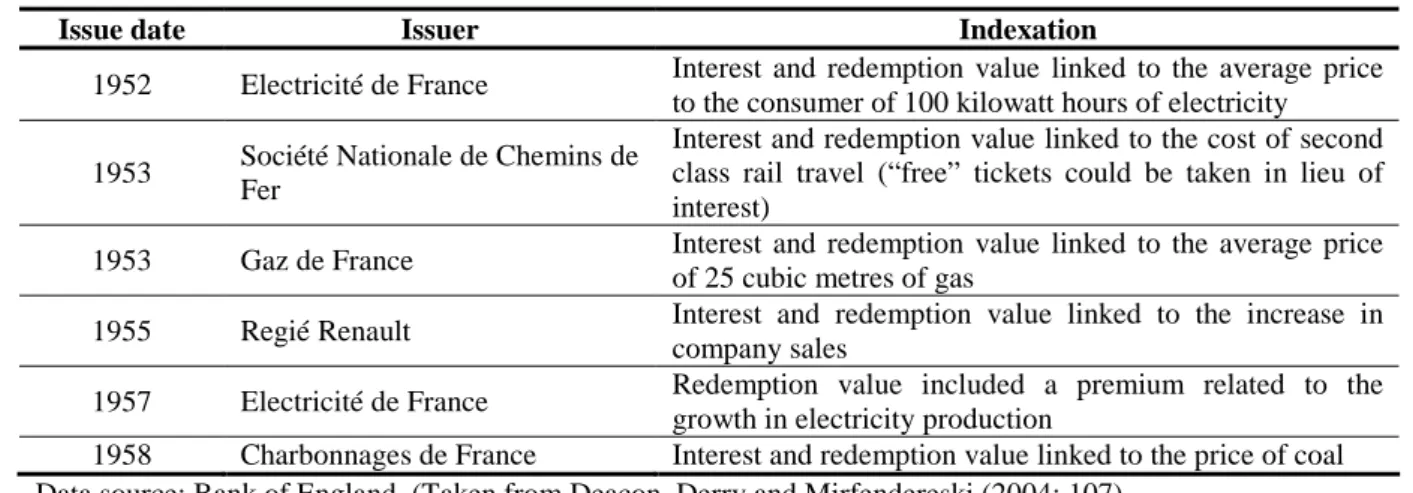
The use of indexed bonds in France is not recent. Since 1925 that these instruments have been issued, with several types of linkage; in the pre-Second World War the issues were linked to the exchange rate. However, after the war, normal debt issuance was very difficult due to the lack of confidence in the franc, associated with the poor condition of the French public finances. In the 1950s, government indexation issuance became more frequent, with quite a lot of different linkages, such as the Paris price of the 20-franc Napoleon gold coin (known as the Rentes Pinay bond), the main equity index or even the issuance of a state bond that paid interest of 5% plus 0,05% for each point by which industrial production were above the 1955 level. Along with the state issuance, other public corporations and nationalized industries issued indexed bonds whose indexes were mainly associated with the goods they sold. Some examples are in the table below.
4
Table 1 : Some examples of French indexed bond issues
Issue date Issuer Indexation
1952 Electricité de France Interest and redemption value linked to the average price to the consumer of 100 kilowatt hours of electricity 1953 Société Nationale de Chemins de
Fer
Interest and redemption value linked to the cost of second class rail travel (“free” tickets could be taken in lieu of interest)
1953 Gaz de France Interest and redemption value linked to the average price of 25 cubic metres of gas
1955 Regié Renault Interest and redemption value linked to the increase in company sales
1957 Electricité de France Redemption value included a premium related to the growth in electricity production
1958 Charbonnages de France Interest and redemption value linked to the price of coal Data source: Bank of England, (Taken from Deacon, Derry and Mirfendereski (2004: 107).
In 1958, due to the strong devaluation of the franc, indexed issuance was banned because the government feared that the proliferation of these bonds, associated with rising import prices resulting from devaluation, would lead to spiralling inflation. The general ban on indexation was lifted ten years later. Yet, issuance of public indexed debt would only resume in 1973 with a new issuance of the Rentes Pinay bond and an issue of a bond whose capital and interest were guaranteed to maintain a fixed relation between the gold content of the franc at the time of issue and that of the EEC Unit of Account used for the Common Agricultural Policy. However, the demise of the EEC Unit of Account in 1979 triggered a clause in the bond’s prospectus that stipulated that the bond’s cash flows would be linked to the price of gold henceforth; as a result the price of gold rose rapidly, making this bond trade at seven times its face value in 1980 (Deacon, Derry and Mirfendereski, 2004).
There would be no further public issuances of indexed bonds until 1997, when Agence France
Trésor (Trésor henceforth) announced that it was considering issuing index-linked debt, in the
form of OAT5 or BTAN6, to reduce borrowing costs. Inflation was chosen to be the linkage due to the perceived interest for both issuer and investors in this type of product: the issuer would achieve a more cost efficient debt framework and the investor would be able to purchase a bond that protected its’ investment purchasing power throughout the investment’s time horizon. The main problem with the setup for inflation-linked bonds was to choose which inflation index to use. There were two possible alternatives: the INSEE’s7 French
5
OAT stands for Obligations assimilables du Trésor, that are defined as fungible securities issued with maturities of seven to 50 years and a coupon paid annually (www.aft.gouv.fr).
6 BTAN stands for Bons à Taux Annuel Normalisés, that are fungible Treasury notes with maturities of two and five years and a coupon paid annually (www.aft.gouv.fr).
7
Consumer Price Index (CPI) and the Eurostat’s European Harmonized Index of Consumer Prices (HICP). The inflation index to use had to be a widely known measure and investors had to be aware of its purpose and how it was assembled and calculated. Although it was feared at the time that the French CPI would not be seen as a good proxy for European inflation and, consequently, limit the bond’s attractiveness to investors outside France, the European HICP was very recent, had no track record, and it was still to be determined how it would be calculated, namely regarding each country contribution to the index and the fear of revision risk. Hence, the Trésor’s choice was the French CPI because it was, at that time, a broader and better understood inflation measure than the European HICP; but, because under the French law all government contractual arrangements with a link to inflation must not include the price of tobacco, the French CPI ex-tobacco index was used in the end.
This way the Trésor issued its first inflation indexed bond (OATi hence forth) on the 15th September 1998, a 10-year bond maturing in 2009, through a syndication process. As mentioned above, the bond was linked to the French CPI ex-tobacco and was designed as a capital indexed bond8 with a three month indexation lag and paid annual interest. It also had a guarantee that, at redemption, the principal payment would not be less than the original par value, thus protecting the nominal value of the principal should deflation occur during the life of the bond (this guarantee applies only for principal; it does not apply for coupon payments). On the 21st September 1999, the Trésor issued the second OATi, a 30-year bond maturing in 2029, also through a syndication process and with a similar design.
On 2001, the Trésor reassessed the structure for the new inflation-linked bonds. By then, the main problems for the usage of the European HICP had ceased to exist: the coverage of the index was far more complete than previously expected and the measure itself became very well known to investors since the European Central Bank used it as the basis for its inflation target since the European currency was created in 1999. Notwithstanding, one problem remained with this measure: the revision risk. This problem was also an issue in the United States system: the inflation measure used in the U.S. was also subject to revisions; however, the U.S. Treasury decided during the course of 2000 to manage this issue by using the first value published for the index in each month and not considering possible future revisions in the Treasury Inflation-Protection Securities’ valuation. The Trésor also decided to do this and, in the 23rd October 2001, issued its first inflation-linked bond indexed to the European HICP ex-tobacco (OAT€i henceforth). The structure of OAT€is is equal to the former OATis; the
8
only difference lies in the inflation index. This even caused some substitution effect, since when the first two OAT€is were issued, in 2001 (OAT€i 2012) and 2002 (OAT€i 2032), many of the purchases in the primary market was done through the exchange from OATi 2009 and OATi 2029 to the newly issued bonds. From then on, the Trésor has been issuing bonds with both linkages, in an attempt to construct a benchmark real and inflation yield curves with both French and European inflation indexes. All inflation-linked bonds issued by the French Trésor until now can be found in the table below.
Table 2 : French Inflation-linked bonds (OATis and OAT€is)
Bond Issue date Maturity date Nominal Amount Outstanding (€ million)
3,00% OATi 2009 15-Sep-1998 25-Jul-2009 13.761
1,25% BTAN€i 2010 04-Oct-2006 25-Jul-2010 9.325
1,60% OATi 2011 06-Jul-2004 25-Jul-2011 15.313
3,00% OAT€i 2012 23-Oct-2001 25-Jul-2012 14.494
2,50% OATi 2013 24-Jan-2003 25-Jul-2013 15.718
1,60% OAT€i 2015 29-Oct-2004 25-Jul-2015 13.417
!,00% OATi 2017 02-Sep-2005 25-Jul-2017 18.485
2,25% OAT€i 2020 15-Jan-2004 25-Jul-2020 17.551
2,10% OATi 2023 13-Fev-2008 25-Jul-2023 6.077
3,40% OATi 2029 21-Sep-1999 25-Jul-2029 7.451
3,15% OAT€i 2032 23-Oct-2002 25-Jul-2032 9.369
1,80% OAT€i 2040 01-Mar-2007 25-Jul-2040 6.096
Data taken from Bloomberg and Agence France Trésor (24-Oct-2009).
For the purpose of this thesis only inflation-linked bonds indexed to the European HICP ex-tobacco (HICPx hereafter)9 will be used in the analysis, in order to avoid discrepancies arising from differences in the inflation index.
3.2.3 – Germany
Since the hyperinflation crisis experienced in the 1920s, Germany has been very averse to all types of debt indexation. The Federal Republic’s Constitution of 1949 enforced this prohibition on indexation, which was in force until Germany entered the European Monetary Union (EMU) in 1999. The first issues of inflation-linked bonds in Germany were done by regional banks. In 2002 the Landesbank Baden-Württemberg issued a 6-year euro denominated bond indexed to the European HICP and the Federal State of Saxony-Anhalt issued a 7-year euro denominated bond linked to the European HICPx; this state would, in 2003 issue another bond with the same design, but with only 5 years to maturity. The
9
intention of issuing euro HICP ex-tobacco linked bonds was announced to the market in 2004 by the German Finance Agency (Bundesrepublik Deutschland – Finanzagentur GmbH). The structure of these securities was equal to the one adopted by the French Trésor, with the same cash flow structure and inflation index linkage. The inaugural issue took place only in 2006, with the syndication of a 10-year bond maturing in 2016. The second issue was a 5-year bond maturing in 2013 and took place in October 2007, but through an auction process. In June 2009 took place another 10-year issue of these bonds. Notwithstanding, it is not clear yet if the German Finance Agency had any intention of constructing an inflation-linked bond benchmark curve with further issues of different maturities. Similarly to the French government, these bonds were named accordingly to their maturity and with similar names given to regular fixed rate bonds, but with the “€i” suffix in order to account for the indexation. Hence the 10-year bonds are knows as Federal Bonds or “Bunds” (Bund€i for inflation-linked bonds) and the 5-year notes are known as Federal Notes or “Bobls” (Obl€i for inflation-linked bonds).10 The table below summarizes all the issues done in Germany so far.
Table 3 : Germany Inflation-linked Bonds
Bond Issue date Maturity date Nominal Amount Outstanding (€ million)
2,25% Obl€i 2013 16-Oct-2007 15-Apr-2013 13.000
1,25% Bund€i 2016 07-Mar-2006 15-Apr-2016 9.000
1,75% Bund€i 2020 04-Jun-2009 15-Apr-2020 3.000
Data taken from Bloomberg and Bundesrepublik Deutschland – Finanzagentur GmbH (24-Oct-2009).
3.2.3 – Greece
The first inflation-linked bonds issued in Greece were referred to as State Bonds Index Linked (SBIL) and its issuance took place on the 19th May 1997. Two bonds were launched, with 5 and 10-year maturities. Both of them were designed to be real return bonds11 with annual interest payment with the addition of the deflation floor for the principal redemption. These bonds were linked to the Greek CPI, since, at that time, it was the most well known and widely accepted measure for inflation. On the 11th August of the same year the Greek Ministry of Finance issued two more SBILs with the same maturities. Since inflation started to fall in early 1999, these instruments stopped being appealing to investors and the State stopped its issuance and even started to accept these bonds as a means of payment for fixed
10http://www.deutsche-finanzagentur.de
11 Real return bonds are indexed bonds with a design similar to the capital indexed bonds but pay coupons
rate bond auctions. However, in March 2003, the Greek Public Debt Management Agency issued, via syndication, an inflation-linked bond maturing in 2025, with the design of a capital indexed bond linked to the European HICPx, just like the French bonds, that were used as a benchmark for this bond’s pricing in the syndication process. In 2007, Greece launched its second inflation-linked bond maturing in 2030 and also made a private placement for a 50-year bond linked to the European HICPx. Although having built both major issues to benchmark12 size, the Greek Public Debt Management Agency already made clear that it has no intention of building a benchmark curve for these bonds. In the table below are the details of the Greek inflation-linked bonds issued so far.
Table 4 : Greek inflation-linked bonds
Bond Issue date Maturity date Nominal Amount Outstanding (€ million)
2,90% GGB€i 2025 18-Mar-2003 25-Jul-2025 8.200
2,30% GGB€i 2030 03-Apr-2007 25-Jul-2030 7.500
Data taken from Bloomberg and the Greek Public Debt Management Agency (24-Oct-2009).
3.2.4 – Italy
The first time Italy considered issuing inflation-linked bonds was in 1981, with the threesome objectives of extending the maturity of the government debt, enhance monetary policy credibility and lower the cost of borrowing. The first issue was a 10-year bond with principal and interest linked to the GDP deflator at factor cost, made in 1983. Although the objectives proposed were achieved with this issue, it was not a successful issue because it was done very quickly and most investors were not well informed about its details and technicalities; it also came to the market at a real interest rate of only 2,5%, which was perceived to be very low when compared to market rates at that time. The fact that it was indexed to changes to a measure that was published only once a year, thus having an indexation lag that was very long and that was not broadly known, also explain its lack of popularity among investors. In the years thereafter, many issues were made by Italian financial institutions. Between 1982 and 1992, the Instituto Italiano di Credito Fondiario issued several long term inflation-linked bonds with a 15-year maturity and a partial indexation to changes to the Italian CPI of 75%. Other institutions also issued inflation-linked bonds during the 1990s and early 2000, like the commercial banks Monti dei Paschi di Siena and Banco Ambrosiano.
12
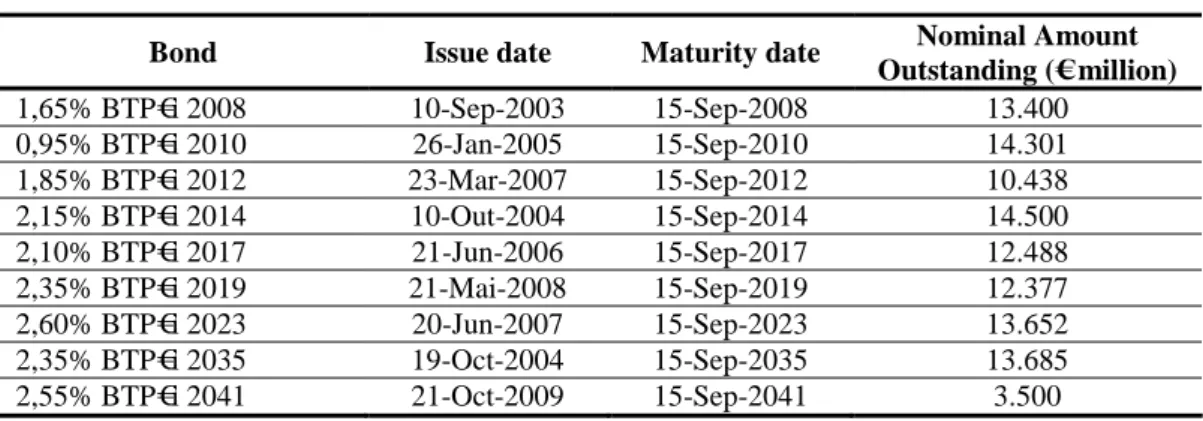
Nonetheless, the idea of issuing inflation-linked debt was not forgotten by the Italian Government, and in 2002, the Italian Dipartimento del Tesoro announced that was evaluating whether to launch an inflation-indexed bond program in addition to its fixed rate bond program (referred to as BTP).13 In September 2003, the Tesoro syndicated its first inflation-linked bond, a 5-year maturity BTP€i inflation-linked to the European HICPx. The design of the Italian inflation-linked bonds is very similar to the French bonds with the difference that Italian bonds pay semi-annual coupons. From 2004 onwards the Italian Tesoro started to build a benchmark curve with more issues of different maturities and, by 2005, Italy had surpassed France as the European country with the largest stock of debt issuance linked to the European HICPx. In the table below are listed all the BTP€i issued so far.
Table 5 : Italian inflation-linked-bond issues
Bond Issue date Maturity date Nominal Amount Outstanding (€ million)
1,65% BTP€i 2008 10-Sep-2003 15-Sep-2008 13.400
0,95% BTP€i 2010 26-Jan-2005 15-Sep-2010 14.301
1,85% BTP€i 2012 23-Mar-2007 15-Sep-2012 10.438
2,15% BTP€i 2014 10-Out-2004 15-Sep-2014 14.500
2,10% BTP€i 2017 21-Jun-2006 15-Sep-2017 12.488
2,35% BTP€i 2019 21-Mai-2008 15-Sep-2019 12.377
2,60% BTP€i 2023 20-Jun-2007 15-Sep-2023 13.652
2,35% BTP€i 2035 19-Oct-2004 15-Sep-2035 13.685
2,55% BTP€i 2041 21-Oct-2009 15-Sep-2041 3.500
Data taken from Bloomberg and Dipartimento del Tesoro(24-Oct-2009).
3.3 – Inflation-linked bonds security design
The security design of these bonds is very technical; this way this whole section is dedicated to a thorough description of all the minutiae related with inflation-linked bonds. The section begins with the description of the cash flows structures that can be adopted. Then it is presented the details associated with the indexation choice and how it is applied to the bond’s principal and coupon cash flows, followed by the market price and yield construction. The section concludes with the explanation on how to calculate these bonds’ duration and breakeven inflation considerations.
13 BTP stands for Buoni del Tesoro Poliennali and are medium and long term securities with fixed coupons
3.3.1. – Cash Flow design
The main objective of inflation-linked bonds is to protect investors against an erosion of his investments’ purchasing power caused by inflation. However, the design of these securities can take various forms. In this section five different design forms will be presented.14 The most common are the capital indexed bond (CIB henceforth) and the interest indexed bond (IIB henceforth), but there are three other types of design that are used and worth mentioning: current pay bonds, indexed annuity bonds and indexed zero-coupon bonds.
o Capital Indexed Bonds
This structure has a fixed real coupon rate and a nominal principal value and both rise with inflation. The nominal interest payments are computed as the real coupon rate multiplied by the compounded inflation rate since the bond was issued, as shown below
(3.1) where Ct is the nominal coupon payment at time t (%), r is the annual real coupon rate (%), c
is the number of coupons the bond pays per year, Pt is the value of the price index at time t
and P0 is the value of the price index when the bond is issued. The ratio o t P P
is known as the
Index Ratio and allows for the real coupon
c r
to be adjusted for inflation.
As for the principal repayment it is also adjusted for inflation. However, to prevent loss of value if deflation occurs, some securities (like the issued by France), have a deflation floor. This way the principal payment can be computed as follows
(3.2) (3.3)
where F is the principal payment, PT is the value of the price index at maturity and P0 is the
value of the price index when the bond is issued. This way the indexation allows for small adjustments in the coupon payments but only pays the inflation uplift in the principal
14
Taken from Deacon, Derry and Mirfendereski, (2004).
0 P P c r Ct = × t × = × = 0 0 100 , 100 max : 100 : P P F Floor Deflation With P P F Floor Deflation Without T T
repayment. Another important aspect of this design relates to the possibility of introducing a deflation floor: as only the principal payment is protected against deflation, if this occurs during the life of the bond, the coupon payments will reflect it, since they will be smaller than the real coupon rate at issuance.
This is the most widely used structure to design inflation-linked bonds. In some literature it is also referred to as the Canadian Model,15 because Canada was the first country to adopt this
design for inflation-linked bonds.
This structure is also known as real return bond structure when the coupon payments are semi-annual, like the Italian case. The design is the same; the only thing that changes is the models’ denomination. All the issuer countries referred in the previous section use this security design for their bonds, as well as the USA, the UK, Australia, Sweden and Canada, among others.
o Interest Indexed bonds
In this design, all the inflation adjustments come through with the coupon payments. So every time a coupon is paid, it is adjusted in order to reflect the coupon rate of the bond16 plus the periodic inflation rate, as follows
(3.4)
where Ct is the coupon payment at time t, r is the annual real coupon rate, Pt is the value of
the price index at time t and Pt-1 is the value of the price index at time t-1. The principal of the
bond is paid at par value (i.e. 100) without any further adjustments, like conventional fixed rate bonds. These bonds are seen as a form of inflation-protected floating rate bonds and do not provide purchasing power protection of all future cash flows because the principal repayment is not adjusted. This way, this structure provides a lower degree of inflation protection than CIBs, and this explains its lack of popularity among investors.
The only country that used this model to issue inflation-linked bonds was Australia in the 1980s, in parallel with the issuance of inflation-linked bonds under the CIB model. As the former issues proved to be less popular than the issues based in the CIB model, the issuance of inflation-linked bonds with this security design ceased in 1988.
15 James and Levy-Yeyati (2008: 8).
16 Only CIBs security design accounts for coupon payments more than once per year. Hence, all other types of
indexed bonds formulae will consider annual coupon payments only.
− × + = − 1 100 1 t t t P P r C
o Current Pay Bonds
Like the former model, in this security design the inflation adjustments are done in the coupon payments. However, in these bonds’ coupon, the adjustment is done on two ways: the coupon itself is inflation-adjusted but it is also summed up an indexation of the fixed principal, as shown below
(3.5) where Ct is the coupon payment at time t, r is the annual real coupon rate (%), Pt is the value
of the price index at time t a and Pt-1 is the value of the price index at time t-1. The principal
of the bond is paid at par value (i.e. 100) without any further adjustments, like conventional fixed rate bonds.
This structure was considered by the U.S. Treasury when the decision to issue inflation-linked bonds was taken; however they chose to design the securities according the CIB model. The only country that effectively issued securities based in this design was Turkey, between 1997 and 1999.
o Indexed Annuity Bonds
These bonds’ design is based on a fixed annuity payment plus a variable payment that compensates for inflation. The base annuity payment (B) is calculated using an annual pre-established real interest rate (r) and the face value of the bond (F) as follows
(3.6) Where an is the constant annuity formula for a bond where n stands for the number of years
the bond will be alive. Hence the coupon payment for this bond is simply calculated by multiplying the base amount by the Index Ratio of the bond.
(3.7) where Ct is the coupon payment at time t, Pt is the value of the price index at time t and P0 is
the value of the price index when the bond is issued.
Since there is an annuity payment in each coupon, there is no principal repayment at maturity; the investor only receives the last annuity multiplied by the Index Ratio derived from the
− × + × = − − 1 100 1 1 t t t t t P P P P r C
(
)
+ − = = n n n r r a a F B 1 1 1 1 : 0 P P B C t t = ×variation of inflation during the life of the bond. The issue of this type of securities was done in Australia by public corporations.
o Indexed Zero-Coupon Bond
As the name suggests, these bonds pay an inflation adjusted principal at maturity and pay no coupons. The principal repayment is simply the par value of the bond times the Index Ratio as the expression below shows
(3.8) where N is the final payment at maturity, PT is the value of the price index at maturity and P0
is the value of the price index when the bond is issued. This type of bonds has been issued in Poland, Iceland and Sweden.
3.3.2. – Indexation choice and cash flow application
As it has already been mentioned several times, the choice of the price index is of the upmost importance to make these bonds an appealing investment. Recalling Deacon, Derry and Mirfendereski, (2004), there are four characteristics the index chosen must have. The first one is matching both investors and issuers’ inflation hedging requirements. When using inflation-linked bonds, investors will be exposed to basis risk, i.e. the difference between the inflation measure associated with the liabilities to be hedged and the inflation measure to be used in the bond’s cash flows. The higher the mismatch between these two measures, the higher the basis risk and the lower the investors’ interest in using these bonds for liability hedging. Secondly, the index must be reliable. In order to be so, the calculation and revision rules for the index must be very explicit and clear and the bond’s prospectus must have a description of how an eventual revision, rebasing or other changes in the index will affect the investors. For instance, in the case of the country issuers presented above, revisions do not affect the value of the bond, since only the first number published is considered for the calculus of the Index Ratio; in the case of index rebasing, the Index Ratio will be converted to the new base when the rebasing occurs in order to prevent loss of value and make all past cash flows comparable with the new index base.17 If the is a delay in the index publication an average of the last 12 numbers published will be calculated and used to compute the Index Ratio. Thirdly, an integrity issue arises; the index provider must be independent from the bond issuer, in order to
17
The rebasing process is explained in Annex 1.
0 100 P P N T t = ×
safeguard the possibility of index manipulation. In the European case this is not a problem since the bonds are issued by country government agencies and the index is published by
Eurostat, which is under the jurisdiction of the European Commission and not any of the
issuer countries; hence, the possibility of index manipulation is residual. The index publication must also be disseminated as quickly and widely possible, in order to allow for the market prices to incorporate it as promptly as possible. Last but not least, index seasonality is also an aspect to take into account to value the bond’s cash flows, since it will affect not only the expected nominal size of the future cash flows by the seasonality pattern (accordingly to the time of the year when the interest payments are done) as well as market nominal yield calculations, because these entail a future inflation forecast that is not constant over time. This way, quoted nominal yields will fluctuate throughout the year with seasonality changes. The method to eliminate these problems would be correcting the seasonality patters in the index, but that would imply back month revision of the index, something that is not acceptable for the cash flows calculation. Although not being corrected in the cash flows valuation, the issuers and investors are aware of the seasonality patterns, since they are relatively stable over time and are a pure reflection of economic reality.
One thing that can also be considered is whether to fully index the security’s cash flows or to allow for partial indexation. Taking into account that if partial indexation is to be applied, then the bond will not reflect price changes in full, the truth is that in some cases partial indexation can make inflation-linked bonds more attractive to investors. One example of partial indexation is the introduction of a deflation floor at redemption for principal payment. This way, if deflation occurs during the life of the bond, it will not erode the principal’s real value, allowing for some extra return for investors. Although this represents a mismatch in the bond’s inflation hedging abilities, in this case it is considered benign, since it produces a higher return than the one reflected in the inflation-linked liability portfolios that the investor wanted to hedge.
Other important feature to be considered for the security design of these bonds is the indexation lag. One of the reasons why inflation-linked bonds were created was because they can allow investors to have a high degree of real value certainty in their future cash flows. Total real value certainty would be achieved if all cash flows were adjusted for inflation right up to the moment they are paid. However, this is not possible because it takes time to compile and publish price indices. One would also have to take into account the instantaneous inflation variation between the trade date and the settlement date for accrued interest calculation, and that is not possible as well. Notwithstanding, the longer the indexation lag,