Repositório ISCTE-IUL
Deposited in Repositório ISCTE-IUL:
2018-06-05Deposited version:
Post-printPeer-review status of attached file:
Peer-reviewedCitation for published item:
Ferreira, J. C., Martins, A. L. & Pereira, R. (2017). Goodspooling: an intelligent approach for urban logistics. In De Paz J. F., Villarrubia G., Marreiros G., Julian V., Novais P. (Ed.), Ambient Intelligence– Software and Applications – 8th International Symposium on Ambient Intelligence (ISAmI 2017). ISAmI 2017. Advances in Intelligent Systems and Computing. (pp. 55-62). Porto: Springer.
Further information on publisher's website:
10.1007/978-3-319-61118-1_8
Publisher's copyright statement:
This is the peer reviewed version of the following article: Ferreira, J. C., Martins, A. L. & Pereira, R. (2017). Goodspooling: an intelligent approach for urban logistics. In De Paz J. F., Villarrubia G., Marreiros G., Julian V., Novais P. (Ed.), Ambient Intelligence– Software and Applications – 8th
International Symposium on Ambient Intelligence (ISAmI 2017). ISAmI 2017. Advances in Intelligent Systems and Computing. (pp. 55-62). Porto: Springer., which has been published in final form at https://dx.doi.org/10.1007/978-3-319-61118-1_8. This article may be used for non-commercial purposes in accordance with the Publisher's Terms and Conditions for self-archiving.
Use policy
Creative Commons CC BY 4.0
The full-text may be used and/or reproduced, and given to third parties in any format or medium, without prior permission or charge, for personal research or study, educational, or not-for-profit purposes provided that:
• a full bibliographic reference is made to the original source • a link is made to the metadata record in the Repository • the full-text is not changed in any way
The full-text must not be sold in any format or medium without the formal permission of the copyright holders.
Serviços de Informação e Documentação, Instituto Universitário de Lisboa (ISCTE-IUL) Av. das Forças Armadas, Edifício II, 1649-026 Lisboa Portugal
Phone: +(351) 217 903 024 | e-mail: [email protected] https://repositorio.iscte-iul.pt
adfa, p. 1, 2011.
© Springer-Verlag Berlin Heidelberg 2011
GoodsPooling: an intelligent approach for urban logistics
Joao C. Ferreira1,3,Ana Lúcia Martins2, Rubén Pereira1
1 Instituto Universitário de Lisboa (ISCTE-IUL), Information Sciences, Technologies and
Architecture Research Center (ISTAR-IUL)
2 Instituto Universitário de Lisboa (ISCTE-IUL), Business Research Unit (BRU-IUL) 3 Centro ALGORITMI, University of Minho, 4800-058, Guimarães, Portugal
[email protected], [email protected], [email protected]
Abstract. . Models supported by ICT tools are developed to raise collaboration
and share of resources in urban logistics process, in a kind of "Logistics-as-uber" concept, which allows implementing operations such as “GoodsPooling” con-cept, equivalent to carpooling concept: daily use of home/work trips to pick and deliver goods on the way. This solution can also be integrated with the use of Taxis or even persons in a public transportation in a sharing solution of persons and goods transportation. This project aims to develop a conceptual model based on already existing city mobility alternatives to reduce dedicated transportation of goods.
Keywords: Collaboration, Logistics, Pooling, Sharing, Freight
1
Introduction
The number of persons living outside large cities (outskirts areas) is increasing due to low household costs and more space [1]. Public transportation offer outside large cities is usually limited and with inefficiencies [1], [2]. It is not unusual that persons who live far from where they work try to share trips to reduce expenses. This process of sharing a personal vehicle with one or several passengers is identified as carpooling [5]. The goal of this paper is to propose a conceptual model that uses the sharing concept for the transportation of Goods taking into account individual daily trips and the needs of goods transportation in the city. With this approach, drivers can increase their income using their regular mobility process. Simultaneously, this is an opportunity for faster and more efficient city logistics at reduced prices for senders and receivers of goods. This new class of logistics does not require specialized facilities or fleets of trucks and can be scaled quickly and cheaply, because it is based on sharing.
Cargo transportation causes a major impact [1] in large cities nowadays (traffic and road occupation during the load and unload of goods). Air pollution is also an immedi-ate consequence, and so is the increase in the consumption of fossil fuels. In fact, ac-cording to the European Commission [3], 8 to 15% of the traffic flow in urban areas derives from logistical operations involving the movement of goods. This highlights the possibility to reduce CO2 emissions and urban traffic if management is improved in at least part of the volume of goods needing to be moved.
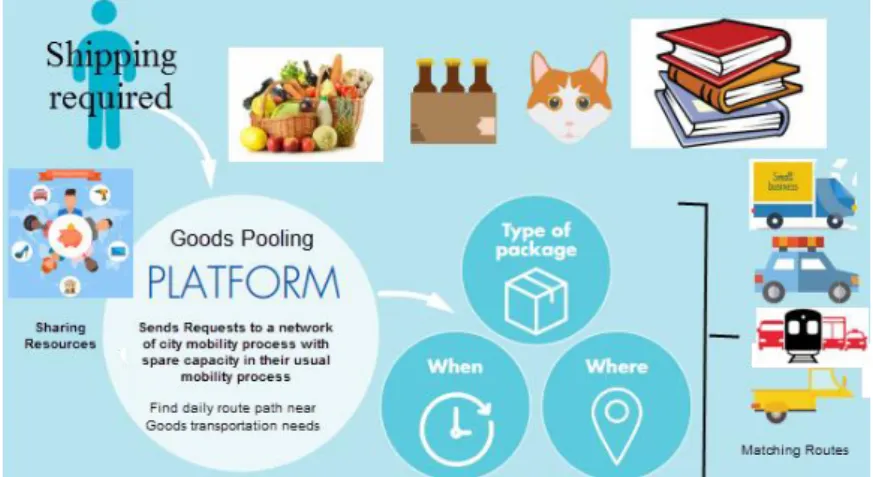
A GoodsPooling platform guidelines and principles are illustrated in Fig. 1 over-view. This platform registers drivers’ routes and times through GPS sensor available in the majority of mobile devices and when there is a need for moving goods identifies potential drivers passing nearby in their daily mobility process. Based on distance the platform defines prices and manages the meeting process for pickup and delivery. All these processes allow real time information integration on mobile device application and mobile device sensors, like accelerometers and GPS. In addition, mobile commu-nication allows users’ connectivity on a permanent basis at lower prices. This conjuga-tion of opportunities allows the possibility of dynamic Goodspooling with complemen-tary real time information from traffic.
Fig. 1. – Concept overview of proposed system for goodspooling
2
Sharing Approach
The sharing economy is an upcoming reality, linked to several meanings to describe economic and social activity involving online transactions or collaboration activity to-wards a common goal. These processes are supported by community-based online ser-vices and are an upcoming reality, with several success examples, as Uber. These pro-cesses were expanded to a diversity of activities, like Airbnb among others. Sharing resources in city logistics is related to three main issues: vehicle sharing, infrastructure sharing and route sharing (Goodspooling concept) [5]. Concerning vehicle sharing, the logistics organisation is similar to that of car or bike sharing or bike sharing systems for people transportation [4]. In this approach, there is no collaboration process during transportation, only a sharing of resources. In the second issue (infrastructure sharing) collaboration between users is not mandatory. The third, less studied, is logistics pool-ing.
Logistics pooling can be defined by analogy to carpooling [5]. In those transport and logistics schemes, the sender (or the receiver) contracts a company that organises all the transport and distribution related operations, involving other actors like transport operators and logistics providers. This company makes decisions and organises all the
distribution processes. The sender (or the receiver) are customers paying for a standard or personalised service. In logistics pooling approaches, the decisions are not made by a single stakeholder but by the group participating on the pooling operations.
As in carpooling [5], a goods transport pooling involves deliveries having a common trip chain in their overall path, and follows the same principles of multi-echelon transport with cross-docking [6]. As logistics pooling follows similar schemes as inte-grated supply chains, it is possible to envisage adapting methods from supply chain assessment to estimate the effects of this form of collaboration in a sustainable devel-opment viewpoint.
Related Approaches: There are already conceptual models for the development of collaborative platforms that allow the integration of parcels in urban spaces [7], how-ever there are no systems implemented due to the tendency of the market to function individually [7]. There is also the Uber approach Uber Rush [rush.uber.com]. This Uber approach lacks flexibility from the sender side to allow parcels joining already existing routes.
Information systems and communication networks are important factors for the de-velopment of collaborative relationships [8]. The degree of collaboration between part-ners can range from a simple exchange of information to the development of strategic alliances [9] [10]. The exchange of information online allows for faster coordination between partners or between autonomous players, enabling collaboration and mutual gains even in situations of previous commercial ignorance between the parties. This informational meeting point does not currently exist for goods, however its absence in the market causes that today parcels inside the cities end up being moved using ineffi-cient solutions. Urban goods transport has specific characteristics concerning urban lo-gistics: large number of operators, some of them very small, a large part of subcontract-ing. From an environmental point of view, there are several stakeholders and challenges about urban goods movement for public authorities as well as for private stakeholders [11]. The authors observed several projects dealing with urban logistics resource shar-ing in the last years, most of them beshar-ing still at a development phase [11]. Most of these projects aim to make in small scale demonstrators a shared approach for vehicles and platforms to reduce their logistics costs and the environmental troubles related to last mile distribution in urban dense zones. Although several urban logistics pooling pro-jects have been started in Europe, they remain at the conceptual level, and no experi-mentation or evaluation has already been made.
Attempting to fill the gaps left by the current models, the authors propose a new concept similar to carpooling, innovating by fostering the sharing between entities that require resources and entities that are in the market and offer these same resources, for the shipment of goods in a city but trying to match both sides of the relation: transpor-tation, in this case vehicle owner, which is the seller, and receiver. This proposal can be defined analogously to carpooling as the shared usage of logistics resources: material (vehicles, platforms), human (drivers, land operators) and immaterial (software tools, information).
3
Goods Pooling System
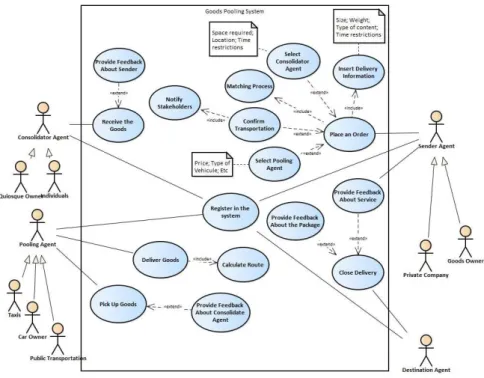
As previously stated, the authors developed a platform to materialize the GoodsPooling concept. This platform is the information system that contains and processes all the information needed to operationalize the GoodsPooling concept. The authors went through an exhaustive analysis phase in order to elicit the process(es), actor(s), and role(s) needed to build the platform. Fig. 2 shows an UML use case diagram with the most important interactions the actors may have among them and with the platform The transportation company is now represented by the pooling agent that allows the partic-ipation of different actors: 1) traditional transportation company; 2) taxis drivers; 3) persons who use public transportation in their mobility process; and 4) car drivers. However, this new concept can occasionally require a consolidation center, represented by the consolidation agent. Street shops identified as Kiosk or individuals can fill this role and receive money for their participation in this process. This consolidation agent is important to fit temporal and geographic matching between sender and receiver. Ac-tors define their restriction and participation rules based on their interests. For example, I as a driver reject picking up goods more than x Km away from my usual route, or that take more than x Hours, or that include a pick/deliver in a certain region, etc. I, as a Sender, do not want to pay more than X€ or to wait more than Y hours or have a delivery time window more than Z hours/days. Due to the diversity of options and the problem of matching them a consolidation agent is introduced.
Based on these new concepts a new platform was developed. This platform uses real time information integration, mobile device sensor manipulation and actions performed on mobile device towards the implementation of sharing daily trips to transport goods with two main applications associated: 1) Web Application; 2) Mobile application. In this case the authors developed an App for Android (Goods Pooling) in a similar ap-proach of dynamic carpooling problem. The main modules of this application are: 1) user interface for Goods transportation request, for drivers to advertise their availabil-ity, to perform a secure login and to receive traffic alerts based on GPS data manipula-tion from others users; 2) sensor data acquisimanipula-tion for mobility purposes; 3) real time matching process in the mobile application with low processing and storage capacity; and 4) tracing location, to help the meeting process of driver and sender; 5) Central Server or Cloud application is responsible to store the sensor data in Driver’s and Sender’s profile. When a user appears for the first time a registration process is per-formed. In this process the user defines login, email, password, cellular phone number, and role in the system (driver in the role of carrier or sender). The driver defines the driving distance to the picking point, travel time window to perform the transportation, space and weight available. He can also define the route starting and end point, with a time window or ask the system to fill this information automatically from the data col-lected by the sensor. The Matching Process is illustrated in Fig. 4 and is based on posi-tion and time. If both match the driver can pick goods at the sender and deliver to the receiver. If time windows do not match the system uses a consolidator agent. This pro-cess uses actors’ locations from GPS information available on mobile devices.
Fig. 2. –New transportation paradigm, use case diagram for Goods Pooling system.
Fig. 3. - Matching Process complexity based on position and time. Consolidator agent increases
matching probability by removing time complexity and helps also on position matching.
3.1 Matching Process
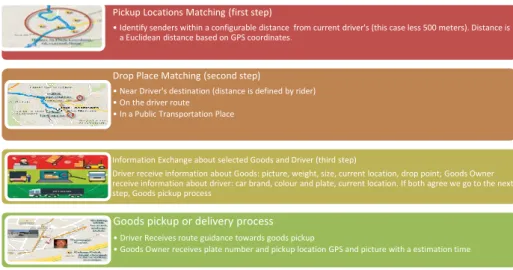
This is a light process performed at a mobile device application. Fig. 5 shows the main steps:
1. Pickup location matching. When the driver starts the trip there is a continuous lookup of goods transportation (Sender and Consolidator positions) in a pre-defined
cd Nav igation View
M atching Process
Time
Pooling Agent Position Sender/Receiv er
M atching Process
Position
Consolidator Agent
M atchi ng Process 1: Posi ti on and T i m e
M atchi ng Process 2: Posi ti on needs thi rd party (Consol i dator Agent)
«Del i ver»
radius from the current driving route. This distance is a parameter configured by the driver and based on google maps API is possible to define a circular radius with driver current position in the center of the circle. If there is not a match between position and time a consolidation center is suggested. The nearest position is chosen and information exchange to reach picking point starts (see point 3);
2. Drop Place Matching. After the sender is identified in step 1 the application based on the drop off preference tries to match it with driver’s destination place or route. The authors used previous defined algorithms from their work [12];
3. Information Exchange about selected Goods and Driver. The system selects the sender and informs the driver of the nature of the selected good, with location, di-mensions, weight and a photo (if available). As there is the possibility to use a con-solidation center (CS), the Sender location is replaced by the CS in these cases. If the driver agrees to perform the request, the sender is informed and the Goods pickup or delivery process starts;
4. Goods pickup or deliver process. The driver receives the sender photo and place to pick up with a route suggestion; the sender receives the car plate number, brand, color and indication towards pickup point;
Fig. 4. – Flexible process to match drivers’ route to sending and receiving locations.
3.2 Location Tracking and Statistics
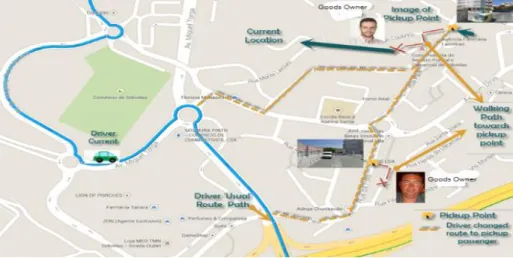
After the goods selection process the system sends the GPS coordinates, photo of the sender (if they agree to use a photo) and the pickup place to the driver application, with the possibility to use kiosks as consolidation centers (the system handles this pro-cess based on alerts). This is an exchange of GPS coordinates between the driver and sender APP through the server. Taking into account the current location the route advice process the system creates a route proposal between the driver current position and the pickup location and sends it to driver App, where it is represented through Google Maps API interaction. The Sender receives vehicle plate, model and color and the pickup
Pickup Locations Matching (first step)
• Identify senders within a configurable distance from current driver's (this case less 500 meters). Distance is
a Euclidean distance based on GPS coordinates.
Drop Place Matching (second step)
• Near Driver's destination (distance is defined by rider) • On the driver route
• In a Public Transportation Place
Information Exchange about selected Goods and Driver (third step)
Driver receive information about Goods: picture, weight, size, current location, drop point; Goods Owner receive information about driver: car brand, colour and plate, current location. If both agree we go to the next step, Goods pickup process
Goods pickup or delivery process
• Driver Receives route guidance towards goods pickup
place, as indicated in Fig. 5. During this pick up process the application looks for other goods using the matching process and the sender receives the driver’s current position updates.
Based on sensor data, number of goods, it is possible to calculated the distance trav-elled with sharing goods transportation (Km), amount of fuel saved (from shared trans-portation) and CO2 gas emission saved based standards patterns configurable (e.g
av-erage consumption of deliver van is considered as 8 liters per 100Km and 200g/Km of CO2). It is possible to account the number of requests, number of offers, and the number
of matches that have been done as well as other statistics in line with the ones presented for passengers/drivers. This process allows getting an overall monthly picture of how the system is being used and could be used as decision support.
Fig. 5. – Example of a matching process result based on previous driver route and sender
posi-tion
4
Conclusions
The authors define new goods transportation paradigms taking into account the power of ICT platforms (with good communication, mobile devices and cloud en-vironments) to raise collaboration towards the sharing of transportation resources. This is only a prototype that the authors intend to transform in a commercial solution. There is a progressive market penetration by these approaches and authors intend to create in 2017 a full-scale demonstration of this system in the city of Lisbon from their mobility 2020 project, a Portuguese research project performed in collaboration between ISCTE, TECMIC Company, EMEL with their connection to Lisbon Municipality and INOV, a research institute. In spite of this ICT approach, this type of collaboration system works well with a considerable numbers of users to increase matching possibilities. It is our intention to add an interface to include commercial delivery companies, to be used in the case of having a limited number of users present and no matching is possible. In addition, this approach can be used to fulfil this dedicated transportation.
References
1. Policy Study 337, (2005), Reason Foundation R. Poole and T. Balaker, Virtual Exclusive Busways: Improving Urban Transit While Relieving Congestion, Sep. 2005.
2. J. Scholliers, S. Joshi, M. Gemou, F. Hendriks, M. Ljung Aust, J. Luoma, M. Netto, J. Engström, S. L. Olsson, R. Kutzner, F. Tango, A. J. Amditis, J.-M. Blosseville, and E. Bekiaris, (2011), Development and application of an integrated evaluation framework for preventive safety applications, IEEE Trans. Intell. Transp. Syst., vol. 12, no. 1, pp. 211–220. 3. MDS Transmodal Limited (2012), DG MOVE, European Commission: Study on Urban
Freight Transport, Final Report.
4. João C. Ferreira, Vítor Monteiro, Jose Afonso and João L. Afonso, (2015), Mobile Cockpit System for Enhanced Electric Bicycle Use. IEEE Transactions on Industrial Informatics, Vol. 11: PP, Issue: 5, Pag. 1017-1027, DOI: 10.1109/TII.2015.2463754, ISSN :1551-3203. 5. João C. Ferreira, Paulo Trigo, Porfírio Filipe, (2009), Collaborative Car Pooling System in
proc. of the Int. Conf. on Sustainable Urban Transport and Environment, Paris, 24-26. 6. Jesus Gonzalez-Feliu (2012), Freight distribution systems with cross-docking: a
multidisci-plinary analysis. J. of the Transportation Research Forum, 51 (1), pp.93-109.
7. R. de Souza, M. Goh, H-C. Lau,.W-S. Ng, P-S.Tan, Collaborative Urban Logistics – Synchronizing the Last Mile: A Singapore Research Perspective, Procedia – Social and Behavioural Sciences, 125, 422-431, 2014.
8. K. Lynch, (2001), Collaborative logistics networks – breaking traditional performance barriers for shippers and carriers, White paper, Nistevo, Minnesota, USA. (http://www.idii.com/wp/col_logistics.pdf)
9. Audy, J., S. D’amours, N. Lehoux, and M. Rönnqvist, (2010), Coordination in collaborative logistics. Int. workshop on supply chain models for shared resource management, Brussels. 10. A. Harrison, R. van Hoek, H. Skipworth (2014), Logistics Management & Strategy –
Competing through the supply chain, 5ªEd, Pearson.
11. J. Gonzalez-Feliu, and J. Morana, (2011), Collaborative transportation sharing: from theory to practice via a case study from France. In Yearwood, J.L. and Stranieri, A. (Eds), Technologies for Supporting Reasoning Communities and Collaborative Decision Making: Cooperative Approaches, Hershey: Inf. Science Ref., pp. 252-271.
12. João Ferreira (2011), Green Route Planner. Nonlinear Maps and their Applications, Selected Contributions from the NOMA Int. Workshop. Series: Springer Proc. in Mathematics & Statistics, Vol. 57. Grácio, C.; Fournier-Prunaret, D.; Ueta, T.; Nishio, Y. (Eds.), ISBN 978-1-4614-9160-6, 2014.