A Framework for the Development of Social Media
Content Strategies for Higher Education Institutions
Luciana Gomes Oliveira
CEOS.PP& Politécnico do Porto
E-mail: [email protected]
Abstract Organizations have been creating and main-taining a social media presence without a clear content strategy that permits to measure the return and impact of their communica-tion investments. Social media audiences’ en-gagement indicators, such as the number of fans, followers, likes, comments, shares and retweets, among others, provide higher educa-tion institueduca-tions (HEI) with popularity insights that social media managers cannot translate into meaningful strategic value or return. In this paper we present a framework for the
de-velopment of social media content strategies forHEI, which is aligned with their mission towards society; the broad diversity of its or-ganizational stakeholders; the educational ser-vice’s peculiarities; the balance between or-ganisations’ institutional and transactional ne-eds to ensure competitiveness and financial survival; and the dialogical nature of social media environments. Seven content areas are presented and framed in the overall strategic management ofHEI, together with three broad social media approaches forHEI.
Keywords: framework; social media; content strategy; higher education; strategic communication.
Introduction
S
OCIALmedia has completely altered the way organizations communicate and in-teract with stakeholders and society at large, by providing social venues for per-manent and open conversations and participatory voices. In fact, two main aspects are consistently revealed throughout literature: the empowerment of social mediaData de submissão: 2018-11-10. Data de aprovação: 2020-04-27.
Revista Estudos em Comunicação é financiada por Fundos FEDER através do Programa Operacio-nal Factores de Competitividade – COMPETE e por Fundos Nacionais através da FCT – Fundação para a Ciência e a Tecnologia no âmbito do projeto LabCom – Comunicação e Artes, UIDB/00661/2020.
users as co-creators, active voices and active influencers, which organizations strug-gle to understand and engage with, and the fact that organizations are still “reluctant or unable to develop strategies and allocate resources to engage effectively” in these environments, thus ignoring or mismanaging “the opportunities and challenges pre-sented by creative consumers” (Kietzmann, Hermkens, McCarthy, & Silvestre, 2011, p. 242).
Social media and social networks have become essential strategic instruments for all types of organizations, including the Higher Education Sector (HES) that faces a growing competitive environment on a global scale. Several authors point out that organizations rush into social media, following the trend to create a social presence in multiple channels and/or to explore their potential, without previously defining a clear strategic approach, which should include, for instance, clear insights on their target audience and a strategic relevant content plan, in order to foster the achievement of the overall organizational objectives (Berthon, Pitt, Plangger, & Shapiro, 2012; Fournier, Avery, Fournier, & Avery, 2011; Gensler, Völckner, Liu-Thompkins, & Wiertz, 2013; Habibi, Laroche, & Richard, 2014; Hanna et al., 2011; Kaplan & Haenlein, 2010; Kirti¸s & Karahan, 2011).
Following the trend to join social media environments, aiming at mediatization (Ansgar Zerfass, Fink, & Linke, 2011), organizations are also lacking monitoring practices and benchmarking frameworks. As a result, a framework for the develop-ment of social media strategies was developed, to provide organizations with a set of overall strategic areas for content development, since the audience’s image on who the organization is and does is translated in every message that is published on social media.
Going back to the earliest and most influential communication model and re-capturing the “most famous single phrase in communication research” (McQuail & Windahl, 2015, p. 13), a convenient way to describe an act of communication is to answer the following questions: “Who says What in Which channel, to Whom, with What effect?” (Lasswell, 1948, p. 216). Despite being widely criticised model (see Braddock, 1958; Greenberg & Salwen, 1996; McQuail & Windahl, 2015; Shoema-ker, Tankard Jr, & Lasorsa, 2003), Lasswell’s communication model did establish the foundations for the essential elements of the communication process, though Brad-dock (1958) added two other essential elements: ‘purpose’ and ‘circumstances’.
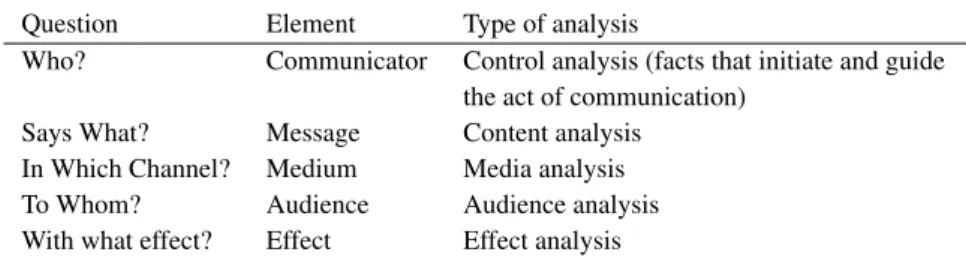
According to Lasswell (1948), the scientific study of the process of communica-tion tends to concentrate upon one or more of the above-mencommunica-tioned quescommunica-tions, which consists of subdivisions of the communication field of research leading to different types of analysis’ focus, as explained in Table 1.
Table 1. Elements of the act of communication (Lasswell, 1948) Question Element Type of analysis
Who? Communicator Control analysis (facts that initiate and guide the act of communication)
Says What? Message Content analysis In Which Channel? Medium Media analysis To Whom? Audience Audience analysis With what effect? Effect Effect analysis
When considering the social media content strategy, the focal element is the mes-sage. In other words: ‘what’ the organizations ‘says’. The content strategy establishes the organizational foundations for the creation, delivery and governance of content. It defines how the content meets the organizational goals, guides decisions about con-tent throughout its lifecycle and sets benchmarks to measure its success (Halvorson & Rach, 2012). Managing content and developing content strategies has emerged as a persistent challenge for journalists, public relations practitioners and marketing communicators (Asgnar Zerfass, Verˇciˇc, & Wiesenberg, 2016).
Overall, organizations struggle with two main aspects such as: goal definition, goal alignment, defining social media policies and content guidelines. The first one is essentially concerned to the communicational aspects of the strategy: the ability to uncover the social media goals for the organization and the ability to communicate them systematically through messages that reinforce them. The later one is concerned with the alignment between the social media goals (once defined) and the organizati-onal overall goals.
According to Hallahan (2015, p. 249) “goals are statements of outcomes an entity strives to achieve to fulfill its mission and vision and provide the basis for strategy”. In fact, strategic planning typically begins with a mission statement that defines the organization’s purpose, what it does and its reason for existing. The vision statement is typically aspirational and indicates what the organization wishes to accomplish and how it differentiates from is analogous organizations.
This process is also proposed by Kunsch (2003) as the very first stage of research and construction of the strategic diagnose, when developing a strategic communica-tion plan. The author considers the organizacommunica-tional mission, vision and values as focal guiding elements for strategic planning.
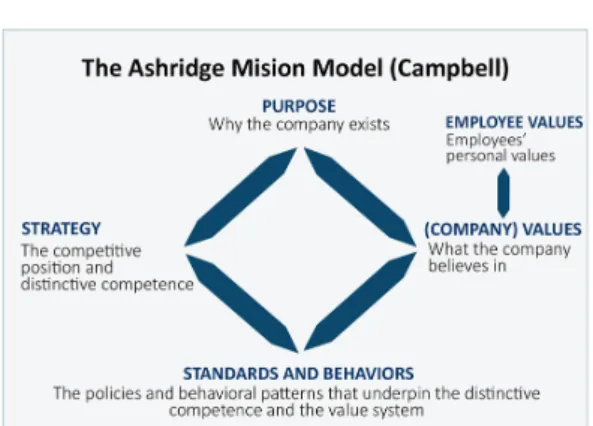
This perspective is consistent with the well-known Ashridge mission model dia-mond proposed by Campbell and Yeung (1991). The model is a result of an extensive research conducted by the Ashridge Strategic Management Centre and is aimed at providing a holist sense of purpose and identity for organizations and is used to create or analyze a mission, sense of mission and mission statement. It defines the internal and external functions of the organizational mission as:
— To inspire and motivate managers and employees to higher levels of perfor-mance (the sense of mission);
— To guide resource allocation in a consistent manner;
— To help to balance the competing and often conflicting interests of various organizational stakeholders;
— To provide a sense of direction;
— To promote shared values amongst employees; — To refocus an organization during crisis; — To improve corporate performance.
The diamond shaped framework (Figure 1) is composed of four main elements which should be linked together, resonating and reinforcing each other to create a strong mission:
— The organizational ‘purpose’ or reason for existing for its shareholders, sta-keholders and for the higher ideal;
— The ‘strategy or competitive position and distinctive competence, which links purpose to behavior in a commercial, rational way (the author uses the brain metaphor to place strategy as the rational left-brain)
— The ‘values’ (right-brain) consist of the beliefs and moral principles that sup-port the organizational culture. Values give meaning to the norms and beha-vioral standards of the organization and can act as strong motivators to act in the best interest of the purpose of the company. The sense of mission occurs when employees are able to align their personal values with the organizational values.
— The ‘standards and behaviors’, which consist on the action programs and behavior patterns that support the distinctive competences and the system of values.
Figure 1. Ashridge Model1
The framework frames corporate purpose as the corner stone and starting point of the organizational mission. It is a widely used tool for strategic planning because it combines strategic and cultural motivators to guide an organization, also aiding on the design of the its vision / desirable future state.
Management processes have also been struggling to keep up with the fast-paced technologic development on the field of social media. This is a worldwide concern because there is no ground formula that guarantees the individual success of each organization in social media. Some recommendations have been suggested by several authors (Fournier et al., 2011; Gensler et al., 2013; Hanna et al., 2011; Kaplan & Haenlein, 2010; Kaplan, Haenlein, Kaplan, & Haenlein, 2011; Kietzmann et al., 2011; Koegel & Clark, 2013; Solis, 2008; Weinberg, Pehlivan, Weinberg, & Pehlivan, 2011). Though it is not our aim to depict every recommendation, we believe it is relevant to refer to the to the key points suggested by Kaplan (2010) for organizations seeking to adopt social media, namely: (1) carefully select the appropriate social media channels, (2) decide whether to build a social network, (3) ensure the alignment of communication across all channels, (4) integrate social media in the corporate image and (5) ensure appropriate access the social media channels.
All in all, social media is still an emerging field on constant mutation where acade-mics (Effing & Spil, 2016) report on the scarcity of literature regarding social media strategies.
1. Social Media Strategy
In this section we distinguish social media strategy from social media marketing strategy, since they differ in scope, nature and comprehensiveness, being that the first is the most relevant to our research.
Effing and Spil (2016, p. 2) define social media strategy as “a goal-directed plan-ning process for creating user generated content, driven by a group of Internet ap-plications, to create a unique and valuable competitive position”, referring to an all-inclusive process that implicates de entire organization. In fact, social media allows organizations to move beyond the limitations of traditional marketing and customer service to a continuous mode of relationship-building with the publics, based on lis-tening to and engaging with individuals and communities in a more frequent and personalized manner (Jip & Lead, 2011; Parsons, 2011)
The fact is that social media has become a huge buzzword in the marketing circuit and marketing sources are abundant on the topic, trends, how-to, and tricks and tips. However, the vision of social media strategy we wish to build our research upon is based on a holistic view, such as the one proposed by Lardi (2013). The author states that the term ‘social media strategy’ is frequently mistaken with the term ‘social me-dia marketing strategy’ and that there are fundamental differences that can impact on the design of a social media strategy, depending on each. Social media is undoubtedly useful to marketing strategies, as a tool for targeting customers and promoting brands, products or services. However, a social media strategy in its true sense, “takes a more holistic view, looking across the business [or organization] value chain to identify areas where social media could contribute to business goals or address challenges”(p. 13).
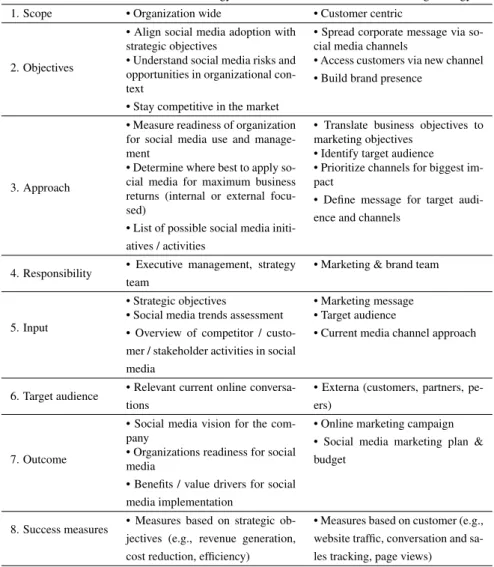
Differences between a social media strategy and a social media marketing strategy are found on their scope, their objectives, the followed approach, the level of respon-sibility, the inputs, the target audience, the outcomes and the success measures, as further explained in Table 2.
Table 2. Social media strategy Vs social media marketing strategy (Adapted from Lardi, 2013, p. 20)
Social Media Strategy Social Media Marketing Strategy 1. Scope • Organization wide • Customer centric
2. Objectives
• Align social media adoption with strategic objectives
• Understand social media risks and opportunities in organizational con-text
• Stay competitive in the market
• Spread corporate message via so-cial media channels
• Access customers via new channel • Build brand presence
3. Approach
• Measure readiness of organization for social media use and manage-ment
• Determine where best to apply so-cial media for maximum business returns (internal or external focu-sed)
• List of possible social media initi-atives / activities
• Translate business objectives to marketing objectives
• Identify target audience • Prioritize channels for biggest im-pact
• Define message for target audi-ence and channels
4. Responsibility • Executive management, strategy team
• Marketing & brand team
5. Input
• Strategic objectives
• Social media trends assessment • Overview of competitor / custo-mer / stakeholder activities in social media
• Marketing message • Target audience
• Current media channel approach
6. Target audience • Relevant current online conversa-tions
• Externa (customers, partners, pe-ers)
7. Outcome
• Social media vision for the com-pany
• Organizations readiness for social media
• Benefits / value drivers for social media implementation
• Online marketing campaign • Social media marketing plan & budget
8. Success measures • Measures based on strategic ob-jectives (e.g., revenue generation, cost reduction, efficiency)
• Measures based on customer (e.g., website traffic, conversation and sa-les tracking, page views)
Although we are establishing a distinction between social media strategy and so-cial media marketing strategy, this distinction should not lead to the misunderstanding that they are exclusive. This distinction is essentially aimed providing a clear unders-tanding that a social media strategy is not only about marketing the organization. No organization survives without marketing, but social media marketing should not
be all there is to it in the organizational social media strategy. This is to say that one or more social media marketing strategies could be embedded in a social media corporate strategy.
The social media strategy should address both corporate and business needs and be located at the corporate/enterprise level of decision-making, where public relati-ons professionals have been placed alongside senior management decision-makers (J. Grunig, 2013).
Considering the central role that the message plays on the development of social media content strategies, we organized this paper as follows: on section two we begin by explaining the four main principles underlying the framework for the development for content strategies forHEI. On section three we present the framework and detail the fundamentals and application of each of the seven content areas that compose it, how they relate to corporate management and how they can be framed in the social media content strategy of HEI. Finally, we present the main functions of the propo-sed framework, together with an overview of three main types of content strategies according to their configuration.
2. The framework’s underlying principles
According to (Hallahan, 2015) one of the most critical steps in the strategic com-munication planning process is clarifying organizational goals and the corresponding communication objectives. This activity is usually based on formative research ai-med at examining the organization and the circumstances in which it operates, its focal offering (products, services, ideas), the opinions of key constituents and oppor-tunities to communicate (past activities and potential media and channels). This is the starting point for the development of the proposed framework for communica-tion in social media, where a situacommunica-tion analysis leads to a synthesized coherent set of communication opportunities in key strategic areas, which we have included in the proposed framework.
It is our understanding that the development of a content strategy should be sup-ported by the definition of the most relevant content areas for the HES, which should be built upon a set of guiding principles. The guiding principles should address the education sector peculiarities, an appropriate handling of communication manage-ment and the most relevant challenges posed by social media to organizations, na-mely: theHEI’s mission towards society, the specificities of the educational service, a holistic approach to communication management and the dialogical nature of social media.
Concerning theHEI’s mission towards society, its role in society is much broa-der in terms of corporate social responsibility (CSR) when compared to traditional tertiary service providers. This is mainly due to the he designated “triple helix” inno-vation model initiated by (Etzkowitz, 2008; Ranga & Etzkowitz, 2013) which focus
on optimizing the relationship between three main stakeholders: academy, industry and government, allowing for the development of the designated “Knowledge-based economy”, released in 1996 under the OECD umbrella (OECD, 1996) and taken in 2000 by the European Union.
Concerning the specifics of the educational service, education, as a process, pre-supposes a service that is not provided or executed, but is co-produced together with the student. During this process, the student is a simultaneously a consumer and a producer of the educational product: knowledge (Harvey, 1996). In this context, Canterbury (2000) defends that, even though education is a tertiary service, the simi-larities between higher education and other tertiary services may not be sufficient to conclude that typical service marketing methods are easily transferable to theHES, thus turning it into a distinct context.
Education is intrinsically linked to the idea of a "free right accessible to all citi-zens"in several nations. Even though university students pay tuitions, society at large is affected by any governmental changes introduced in this area. It is also necessary to point out that few services can be considered as basic human rights and, as such, one would easily believe that it is a sector where competition is very low, since there is a permanent base of customers. This is not the case, however. The sector has been undergoing tremendous changes that have been leading to an increased level of com-petition among organizations. Reduced government funding, societal changes and changes in the labor market are some of the most important responsible factors, and the fact is that there has been a decrease in the number of students applying to higher education courses, which has been leading to the marketization of the sector.
Another distinctive characteristic of the educational service resides on its direct link to the construction of the notion of oneself as professional and as an individual, with a specific function and status on society. The higher education service, though much more accessible than ever (Barcan, 2016), is still regarded as a one life choice for personal and professional investment upon which students build their future pers-pectives for a career, family structure, lifestyle and even geographic settling.
There are several other sector-specific factors that turn education into a unique context, though these could be considered to be directly applicable to other servi-ces, namely: image, brand personality, external prestige, reputation, identification, commitment, trust and membership (Sung & Yang, 2008). These factors are further explained in section 3.4 since they relate to the Identity dimension of the proposed framework.
Concerning the holistic approach to communication management: as a process that runs through every level of the decision-making pyramid, the development and maintenance of the social media strategy and the corresponding content strategy ne-eds to be framed in a holistic communication management stream, bringing together
complimentary communication functions and combining multi-level management ar-ticulation.
This guiding principle builds on the integration of all functional communication areas, namely the ones proposed by Kunsch (2009), for the development and preser-vation of the social media strategy, so that a consistent and persistent content strategy may be created, in order to coherently reveal the organization. According to Moss (2011, p. 125) a “well-articulated communication strategy should provide a clear indication of the overall direction, purpose and intended outcome” of the communi-cation function, expressed “in terms of a unifying big idea that will run through and help integrate all communication activities”, and like all other functional strategies, it needs to be aligned with and to support the higher organizational strategic manage-ment. When the content strategy derives from such a comprehensive and integrated management/articulation, it becomes possible to address the organization’s mission and vision as well as the needs and expectations of all its internal and external sta-keholders.
Finally, the last principle underlying the proposed framework consists of the di-alogical nature of social media, which implies two-way symmetrical communication and embraces user-generated content (UGC). The development of a social media con-tent strategy should not be as naïve as to consider that social media channels will ultimately serve the organization by providing free of charge widespread of content. The access to large audiences on social media brings along the additional challenge to meet the audiences natural need for interaction, feedback, conversation and even the development of meaningful relationships.
The essential key performance indicators on social media are heavily based on the degree, frequency and quality of audiences’ interaction with content (types of inte-raction: like, share, comment, retweet, pin, etc.). Therefore, even if the organization does not plan on allocating human resources to manage and foster interactions on so-cial media, when reporting on performance there is no way to go around these metrics and, ultimately, the value of social media for the organization will be measured up to requisites that were never included in the social media strategy/policy. Therefore, the dialogical nature of social media should be considered as a guiding principle for content design.
The organization should also be aware of unexpectedUGCbeing spread on social networks and/or have the ability to promote audience behaviors which may lead to the development of favorableUGC. The first is intimately related to the ability to provide feedback or to handle negative content/attitudes towards the organization and is inti-mately related to crisis communication. For instance, creating decision trees based on possible future crisis can help organizations to foresee several threatening situations on social media and to decide on how to act. Such policies are extremely relevant for maintaining organizational consistency on handling threats and can be improved
over time, when new threats arise or when the planned actions need refinement, for instance.
3. The framework’s communication domains
The framework consists simultaneously on an empirical research input and out-put. Some of the proposed content areas result from literature review on several to-pics, such as theHEImission, strategic communication management and the adoption of social media. Other content areas result from direct analysis of current messages posted by organizations on social media and on its strategic value forHEI. This analy-sis was conducted on over fifteen thousand messages posted by more than forty-three
HEIon Facebook, during an entire school year (Oliveira & Figueira, 2015).
To address the previously mentioned principles, the proposed framework consists of seven content areas (depicted in Table 2) which we believe to be relevant for the development of a content strategy for HEI, and which can be used by organizations for planning, developing and assessing their content strategies.
The seven content areas are aimed at matching the vast and diversifiedHEI sta-keholder’s expectations in a broader societal multilevel intervention. Therefore, the range of organizational publics addressed in this model is very wide, including all external publics (people and organizations: such as former students, parents, vocati-onal trainers, psychologists, policymakers, high schools, enterprises, otherHEI) and internal publics (such as students and employees, both academic and administrative). This is to say that the proposed framework aims to offer a very wide perspective of content domains forHEI’s communication managers and practitioners, propelling a holistic strategic analysis and planning. However, what we believe to be the best outcome of this process is the possibility to balance the content areas that are key to each organization’s corporate strategy. Considering Mintzberg’s (1994) terminology, the proposed framework serves as a tool for strategic planning (analysis), which also requires strategic thinking (synthesis), when considering the key elements of the or-ganizations’ mission that social media will be nurturing. Therefore, this framework comprehends the existence of several optimal balances, regarding diversity and inten-sity of content areas.
Another important aspect of the framework is that it should not be understood as a scattered mix of unarticulated communication domains. It is of the utmost relevance to understand that the proposed content areas are distinct dimensions with reciprocal links and interactions and that there is a relation of complementarity among them. For example, when elaborating a message aimed at promoting an internal event where stu-dent’s projects are showcased, several content areas are articulated: depending on the tone of the message, it may foster conversation about the participants (Relationship), it may reveal the organization’s specialization domains (Research) and make implicit or explicit references about the course that the students are enrolled in, promoting
it (Education). Also, ultimately, all content areas contribute directly or indirectly to brand awareness, fostering organizational identity. The message themes proposed under each of the content areas consist of a diversified set of organizational functions that might be undertaken on social media and that could be framed into a social media content strategy.
Table 3. Content areas of the proposed framework
Education
- Promotes higher education courses (educational offer) - Promotes complementary training (internal or external) Research
- Informs on and/or calls for participation in congresses, seminars and other scien-tific meetings
- Promotes/informs on internal and external research results/awards
- Promotes/informs on internal and external publications (papers, articles, books, proceedings, research projects, etc.)
Society
- Promotes/informs on organizational partnerships and contracts and patents - Promotes employability, streaming placement offers and career opportunities - Promotes/informs on knowledge/technology transfer
- Promotes other organizations’ initiatives/performance (partners and other relevant stakeholders)
- Promotes demonstrations, exhibitions, and showcases, conducted by students or faculty (emphasis on competencies and societal integration)
Identity
- Institutional events (celebrations, awards and tributes, graduation ceremonies, etc.) - Students, faculty and staff honorable mentions
- Institutional promotion, advertising (identity, image, reputation) - Corporate Social Responsibility initiatives
- Institutional clipping
- Participation/representation in fairs and exhibitions Administration
- Informs on deadlines and administrative processes - Informs on procedures and admissions
- Promotes and informs on support services (goals, contacts, working hours, etc.) Relationship
- Fosters conversation - Requires opinions
- Introduces current internal, external, societal or academic issues propelling audi-ence involvement
- Boosts emotional connection between organization and publics (greetings, humor, sympathy, motivation, etc.)
Information
- Streams external relevant information, news and regulations related to academic areas, political and societal issues (economic and social impact)
- Informs on recreational and cultural initiates with no particular connection to scho-ols’ scientific areas (concerts, sports events, etc.)
Consequently, the design of a content strategy should be as balanced as possible, though aimed at the specific publics of each of the social media channels the organi-zation chooses to engage in. Though literature refers potential students, current stu-dents, and alumni as the main social media publics for theHEI(Qi & Mackie, 2014), multiple communication approaches, within the same organizational communication plan, may be necessary in order to address other publics’ profiles.
The proposed editorial model can be used by organizations that are at different so-cial media maturity stages: planning to adopt, experimenting without a plan, integra-ting/trying to strategically integrate social media, etc. Our intent is that the editorial model serves both emergent and deliberate social media strategies, that is: strate-gies that are entirely pre-planned and deliberate paths or stratestrate-gies that emerge from unexpected opportunistic developments or by trial and error.
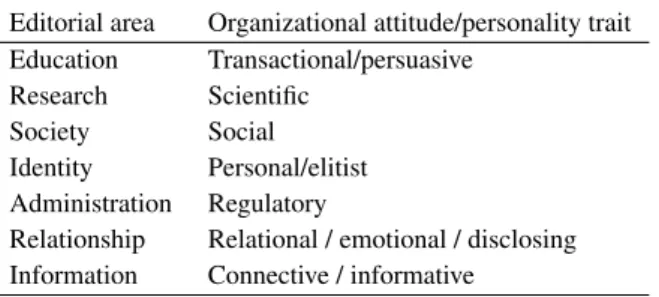
The content areas included in the proposed framework consist also on a matrix of organizational behaviors and attitudes which the organization may use to support its vision and content strategy. Even though organizational messages may have its own tone of voice and style to match the organizational personality, each of the content areas refers to an organizational specific personality trait, as detailed in Table 4.
Table 4. Organizational attitudes/personality traits in the editorial model Editorial area Organizational attitude/personality trait Education Transactional/persuasive
Research Scientific Society Social Identity Personal/elitist Administration Regulatory
Relationship Relational / emotional / disclosing Information Connective / informative
The attitudes, which may become brand personality traits over time, also refer to the main functions of each content area, which we further explain in the following sections.
3.1. Education
Education consists of the primary service provided byHEIand is the core of their mission. The messages included in this content area are mainly related to providing information and/or promoting the core educational service, that is, higher education courses that provide an academic degree. The content area also comprises the com-plementary educational offer, provided by faculty and experts or other educational professionals or organizations, from which the organization obtains any kind reve-nue.
Revenue is the main purpose of this content area, thus the design of this type of messages is essentially transactional. Given the increased competition on theHES, marketing courses and additional training is increasingly an essential financial sustai-nability measure.
On social media, this is a core area forHEIsince it provides wide access to diver-sified audiences for advertising the educational offer. Depending on the relationship previously established with the audience, the organization may benefit from large-scale online word-of-mouth and sustain its strategy. Alumni, for instance, can play a very relevant role in this dimension.
The messages related to the educational offer in a content strategy tend to be per-suasive and to use marketing techniques, such as sales promotions, interactive mar-keting, merchandising, etc. and are mainly aimed at students, prospective students, parents and vocational trainers. Organizations tend to advertise de course curricula, the faculty associated to that course/offer, the potential professional outlets, and the available resources and infrastructure (such as technology) to make the offering more appealing.
3.2. Research
Research is the second fundamental element ofHEImission, considering that the educational service as the primary reason for existing. Research is the key element to assure that the educational service is provided by competent scholars and that the educational offer is up-to-date, cutting-edge and sometimes visionary, thus any evi-dence on research conducted by faculty or students is an indicator of the quality of the educational service.
Research is also a fundamental piece in faculty assessment and a very heavy com-ponent of this professional profile. Assuming sometimes a form of a “service duty”, scholars and higher education students are propelled to be involved in individual or group research activities, to initiate and/or to integrate national and international re-search projects, to integrate and disseminate rere-search centers, to develop networks of purposeful research contacts and to provide evidence on results obtained, which are then evaluated by their peers.
This organizational encouragement for scientific development and performance are also linked to the designated “third mission” ofHEI(Albulescu, Litra, & Neagu, 2014), because of the vital growing role that public sector research plays in innovation systems and entrepreneurial activities. This characteristic is deeply related to the knowledge transfer ability of organizations, which we further discuss on the next section since it is closely linked to the university-society relationship.
Research also has a high impact on the organizational reputation. Research capi-tal is also linked to the organizational potential to establish national and international partnerships with organizations and research centers, thus research amount, diversity and quality are key negotiable aspects in such relationships. Again, in this case, repu-tation is an important factor that is built on the organizational scientific capital. The main stakeholders, in this case, are otherHEI, research centers, faculty, enterprises, associations, etc.
In social media, as illustrated in Table 2, messages related to this editorial area comprise:
— Opportunities to participate in research activities, for faculty, students and partners, about congresses, seminars and other scientific meetings. Organi-zations doing so will translate as being aware and actively interested in the research community in general and in monitoring the filed specific opportuni-ties;
— Internal research results and awards, obtained by internal research centers, fa-culty or students. This type of content may have a direct impact on the organi-zation’s reputation and it is of interest for the academic/scientific community as well as for students and prospective students, vocational trainers, parents and other stakeholders which may grow their interest in the organization. — Promote external research results, publications and awards are also a strategic
way to develop external partnerships, identify potential partners and generate empathy. Valuing existing and potential partners’ outcomes requires organi-zations to clearly define their research fields and their interest in a group of strategic partnerships and to foster them through social media.
Contents developed in this dimension may also consist of a form of relationship and appreciation/recognition for internal and external stakeholders, such the ones pre-viously mentioned (faculty, students, research centers and organizations). Such type of content may help in strengthening bonds with these stakeholders and to build a commonly shared sense of success, that benefits both the organizational and indivi-dual reputation in the scientific domain.
3.3. Society
This content area builds upon the designated “triple helix” innovation model Etz-kowitz (2008); (Ranga & EtzEtz-kowitz, 2013) which focus on optimizing the
relati-onship betweenHEIand three main stakeholders: academy, industry and government. The model addresses the three sub-systems of relationships in order to allow for the development of the designated “Knowledge-based economy”, as mentioned, in 1996, byOECD(OECD, 1996) and taken in 2000 by the European Union as a concept for generating wealth in industry, novelty production based on science and technology and governance of interactions among these two by defining policies (Albulescu et al., 2014).
Rodrigues and Melo (2012) state that universities are expected to play a pro-minent role in helping their regions to mitigate or even reverse the economic crisis situation, participating in local efforts to face economic crisis with the provision of skills, training and employee development, innovation, knowledge transfer, promo-tion of academic entrepreneurship and access to funding. Larédo and Mustar (2004) refer to the needs of reforming systems, in which new actors and new societal ne-eds call for globalization. The authors refer to patenting and university spin-offs as a consequence of the institutionalization of the third mission – society. (Benner & Sandström, 2000).
Content developed in this editorial area is aimed at promoting, informing and generating interaction in:
— The promotion/information spread of organizational local and regional part-nerships, contracts and registered patents;
— The promotion of employability, streaming placement offers and career op-portunities, and facilitating the integration of experts in the industry;
— The promotion/information about knowledge transfer and its effects on indus-try and society;
— The promotion/information about a partner or potential partner organizational initiatives and performance (or other research-society-industry relevant sta-keholders), fostering existing or future partnerships.
This content area is aimed at messages that somehow reinforce the organizational role in society and industry, portraying the organization as an active regional and international social actor.
The main audiences of this editorial area might not be essentially students, though this information might be relevant for prospective students because it has impacts on organization reputation. The main audiences, in this case, consist of organizational partners (including competitors), local industry, local, national and international bo-dies and agencies which can foster and fund research and knowledge transfer. 3.4. Identity
The corporate identity reflects and projects the authentic personality of the orga-nization. It is a tangible manifestation and a self-portrait of the organization, a sum of all its attributes, its communication and its expressions (Kunsch, 2003).
Corpo-rate identity and corpoCorpo-rate image are distinct concepts. The latter concerns to the set of meanings through which people connect, describe, remember and relate to the organization. It is the result of interactions, ideas, feelings and expressions about an object or person (Van Riel, 2009). While image consists of what is on the audience mind, identity consists of what the organization is, does and says (Kunsch, 2003). The corporate identity is a tangible manifestation of the organization’s personality in terms of behavior, communication symbols and perceptions (Van Riel, 1995).
After gaining a profound knowledge of who the organization is and what it does, it is possible to develop a content strategy that helps to build that image on audiences’ minds, through consistency in messages and attitudes. This is also a very personal activity because it consists of revealing the organization for its main attributes through tangible actions. It is also an activity related to disclosure since it builds on the amount of information that it is selected and provided about the organization.
The exercise of building a strong identity and reputational management through social media messages is a great challenge for practitioners, since it relies on the sub-jective ability of the audience to deduct and make inferences about the organizational identity.
According to the proposed framework, messages fostering the persistent cons-truction of an organizational coherent identity include:
— Reference to institutional events, such as celebrations, awards, tributes and graduation ceremonies, which allow audiences to perceive the “host” of such ceremonies and how individual organizational members’ achievements are important to the organizational culture and image;
— Students, faculty and staff honorable mentions, since the notion of shared accomplishment helps audiences to better relate to the organizational identity; — Institutional promotion and advertising, which consists of providing direct information about the organization’s identity through stories or events that reinforce the organizational main attributes;
— Information and promotion of corporate responsibility initiatives, which con-sists of providing audiences with contexts and attitudes of citizenship per-formed by the organization. As a social entity, the organization is expected to have a social role and to act on social issues. This might be a potential opportunity to generate interaction and empathy with audiences;
— Institutional clipping diffused on social media, which consists of dissemina-ting how the organization is portrayed in the media and expanding its influ-ence through all the available channels. According to the audiinflu-ence of each channel, the organization benefits from the opportunity of mainstreaming its attributes and achievements.
— Participation/representation in fairs and exhibitions, when disseminated on social media acquire the potential to gain on its influence and on the number of
visitors/supporters, either on social media or by the ability to drag audiences to the event locations to support the organization.
This content area is closely related to brand management and to revealing the organization as a person with a set of skills and a distinct personality. Identity, in this sector, is also closely linked to the organizational reputation, which can be built through a persistent set of messages about organizational accomplishments. The more consistent and distinct the organizational identity is, the easier it is to build messages around it, to nurture the envisioned image on audiences’ perception.
3.5. Administration
Within the set of proposed content areas, the "Administration"is the one with the most functional role. It allows organizations to take advantage of the social media im-mediacy and constant presence in students, faculty and staff, to provide information on deadlines, administrative processes, procedures, admissions, available support ser-vices (regarding goals, contacts, working hours, etc.) and last-minute alterations or novelties.
Messages in this editorial are mainly aimed at expediting the administration of internal and external processes and may assume one or both forms:
— Informative messages about the above-mentioned themes, which are spread in a unidirectional communication process: informing the audience and/or redirecting it to the organization website where more information is available. — Integrating the administrative services active participation in the social media channels, providing audiences with direct access to the service and issues handling through social media.
Deciding on how the administration is integrated into organizational social media channels/networks consists of one of the key elements of designing the social media strategy. It will determine who/which administrative services will have access to the official social media channels, how they will use them, which issues can be handled in social media without compromising people and processes privacy, etc. Therefore, the content strategy must be adjusted to what has been previously defined on the social media strategy and policy. In any case, messages related to organizational adminis-tration require, at least, interdepartmental articulation of information, for message formulation and publishing.
3.6. Relationship
J. E. Grunig and Huang (2000) state that public relations contribute to the orga-nizational effectiveness when they help to reconcile the organization’s goals with the expectations of its strategic constituents. They provide a monetary value contribu-tion that implies the development of quality, long-term relacontribu-tionships. The authors
propose a set of maintenance strategies for symmetrical relationships, such as: dis-closure (openness), accuracy of legitimacy, participation in mutual networks, shared tasks (help solve problems of interest to the other party), interactive negotiation, coo-peration and collaboration, be unconditionally constructive, win-win or no deal (J. E. Grunig & Huang, 2000).
Smith (2012) refers to the importance of dialogue, interactivity, communicated commitment and conversational human voice in online relationships, with the intent of obtaining mutual benefits both for organizations and stakeholders. Outcomes of such relationships would consist of trust, commitment, mutual influence, and satis-faction.
On an alternative and more profound note on relationships, Kent refers that “Pu-blic relations professionals need to put a stop to the practice of using stakeholders and publics to satisfy their organizational ends” (Kent, 2013, p. 342). It is not that public relations professional should cease to try to match organizational and stakeholders’ needs and expectations, but according to what the author designates as democratic model for public relations, it encourages organizations and practitioners to be genui-nely social and to create richer and more inclusive interactions focused primarily on stakeholders needs, before thinking about the organizational needs.
As stated by Moreno, Navarro, Tench, and Zerfass (2014), in the conversation age, organizations need to listen to and engage with a wider range of stakeholders in order to be successful. Success on social media in the content area ‘Relationship’ is profoundly rooted in the ability to generate conversation, developing bonds, empathy, enthusiasm, motivation and emotional connection beyond the organization’s needs. The development of social media content strategy should not only reside in revealing the organization’s mission and vision, but also on the construction of a corporate social persona with (at least apparently) no hidden organizational or transactional agenda, to whom the audiences can meaningfully relate to.
Therefore, the main content themes proposed for this dimension reside on: foste-ring conversation, requifoste-ring opinions, introducing current internal, external, social or academic issues to propel audience involvement and boosting the audience’s emotio-nal connection to those themes.
This the content area is the most prone to what a strategist would label as messa-ges without a purpose, and which can consist on greeting the audience in the morning, recalling special dates and occasions, picking up on social controversial current topics and foster discussion, using humor (such as jokes about the organizational culture), etc. Practitioners embracing this editorial area need to act as the corporate social person in terms of institutional representation.
Ultimately, according to each message tone of voice, any message from the other editorial areas may have the potential to foster a relationship with the audiences. However, the aim of such messages would not be the relationship in itself. For
practi-tioners including this editorial are in their content strategy there are increased oppor-tunities to open discussion on actions and initiatives with the main intent of genera-ting interaction amongst the audience and between the audience and the organization, again, without a hidden marketing agenda.
3.7. Information
Developing new content on a permanent basis is a full-time job that requires crea-tivity, writing skills, and a broad knowledge about everything that is happening inside and outside the organization. Therefore, one of the main purposes of this content area is to accommodate content repurposing, that is, meaningful content developed by third-party users or organizations, which may consist of information, recreational ac-tivities (concerts, sports events, etc.), news and regulations related to the educational sector as well as political, societal, economic and environmental issues of broader interest.
Regarding content repurposing, there are several issues that the organization must consider: the quality of the content, the quality of the sources, avoiding repurposing content that may create misjudgments or alter the desired organizational image, avoid content that may contain prejudice, etc. These, are issues that should be clarified in the organization’s social media policy, and content revision must always be ensured before repurpose.
This editorial area has also two additional functions: encourageHEIto be connec-tive and to be acconnec-tive social agents, both being education-based functions. Connecti-vity can be fostered by repurposing content from academic, governmental and social relevant sources, disseminating it and educating audiences through content and pro-pelling them to connect to these sources. By acting as connective agents, organizati-ons are simultaneously performing the role of cooperative social agents by educating society at large on the topics of the repurposed content. In this role, organizations become secondary channels for information diffusion and may aid/participate in the discussions around those topics.
The proposed framework serves as a basis for the definition of communication ob-jectives and content design and their alignment with organizational goals, targeting and framing social media communication efforts in broad strategic areas of interven-tion in theHES. Thus, the framework is not aimed at standardizing nor narrowing the social media content strategy of HEI, nor it is an end in itself. The identification of the strategic areas of intervention results from a wide-scope analysis of the fundamen-tal principles of the HEImission, the needs resulting from an increased competitive environment where identity and reputation are key distinctive factors, and the oppor-tunities which we believe to have the most potential for these organizations in terms of engaging with audiences and repurposing content.
It is therefore not a prescriptive framework since every organizational social me-dia content strategy is (and should be) a unique articulation of the communication objectives that serve, reinforce and translate a distinctive set of organizational goals. For this reason, the proposed communication areas of the framework are not prioriti-zed nor ordered in any specific level of relevance, so that organizations can select and arrange their unique content balance.
However, defining the key communication areas for content development will expedite internal content development processes across all management levels and organizational functions, by clarifying the key areas of intervention and reuniting interdepartmental expertise in order to better reveal the organization.
In the following section, we present the key main functions that the framework may play on the interdepartmental coordination for social media adoption and content development.
4. The framework’s functions
Along with its core purpose, the proposed framework plays additional beneficial functions with mutual inputs that favor the organizational climate.
4.1. Awareness raising and integration
By defining a diversified and broad range of areas of communication for content development, the framework provides organizations with a tool to captures their es-sence, facilitating its dissemination inside the organization and leveraging the active participation of all communication and strategic management functions for the design of the content strategy.
Therefore, the proposed framework consists of an awareness instrument for all
HEIcommunication practitioners, at all levels of decision-making, namely: those at the top levels of the pyramid where deliberate (prescriptive) strategies are expected to be designed and are often formulated; and the practitioners on the bottom of the pyramid, which are typically expected to operationalize/execute the medium/short term objectives framed in the overall strategic direction. It aims at facilitating the top-down communication of social media communication objectives and the bottom-up reporting, informing and integration of data, information and research to sbottom-upport and/or revise the overall organizational strategic direction.
In this function, the framework acts as an informative instrument which, by the di-versity of areas it consists of, fosters experts from distinct organizational departments to have a broader view of the organizational sense of purpose and to look outside their own specific needs. This organization-wide view supports the integration and active participation of such diversified background of experts and internal actors on content
planning processes with common purposes, ultimately benefiting the organization as a whole.
4.2. Design, review and evaluation
In general terms, organizations have been adopting social media at a fast pace, in the sense that they create/launch pages or profiles on several social networking platforms. However, this doesn’t necessarily mean that the pace is the same for all organizations, neither it signifies that the organization is, in fact, running a cohesive and strategically relevant content strategy, or a content strategy at all. Therefore, one of the framework’s main function is the ability to provide organizations with an informed tool for content strategy, whether on early stages of social media adoption, when using social media for trial-and-error learning or whether conducting a long-term content strategy.
The framework can be used as the primary tool for designing the content strategy, as a support tool for content strategy review and optimization and as an alternative tool for experimenting new content to interact with existing or new audiences. There-fore, it is a tool that can immediately foster opportunities for discussion on which are the organizational mission’s ground pillars, and which are the social media functions used to attain the organizational goals.
4.3. Deliberate or emergent strategic planning
Strategic planning is, a priori, a deliberate process, which precedes the articula-tion and implementaarticula-tion of a strategy. When organizaarticula-tions are encouraged to look at their mission and vision statements as the first step to develop a communication strategy, they enter a premeditated process of linking all communication and content activities to attain organizational goals, so that they are mutually reinforced. The proposed framework is a product of such a process and, thus, a deliberate guide for content development. It isn’t, however, a static tool, since it is broad enough to consi-der the inclusion of additional themes that can optimize each of the content areas and the addition of other areas. Organizations, society, technology, and audiences evolve through time and according to local and global circumstances, hence providing the ability to be permeable to change is a necessary condition for organizations.
In fact, any strategic development process (managerial, communicational, etc.) may result from the detection of patterns of activities from which organizations gain hindsight that may be recognized as the emergence of a more or less coherent stra-tegy. Moss and DeSanto (2011, p. 174) designate this process as “uncovering the embedded communicationDNAwithin the pattern of activities that have been taking place”. This characteristic of the model builds heavily on the concept of emergence
that is intrinsically linked to strategic communication, according to which the parti-cipation of internal and external stakeholders is emphasized on the development of emergent strategies (Holtzhausen & Zerfass, 2015).
ForHEI that have entered the social media arena without any content strategy, the framework may be used as an emergent strategy detection tool, since it allows organizations to discover which has been the pattern of contents they have been pu-blishing on social media. This may aid organizations without a content strategy to look closely to any emergent strategy formation and to take action, either in the sense of recognizing it and fostering it or in the sense of rejecting it and learning from other organization’s strategies.
In this scenario, the strategic value of internal and external two-way communica-tion is of particular relevance, since it may conduct the organizacommunica-tion to instinctively respond to internal and (mainly) external audience’s needs and expectations. It is, therefore, a participatory process in which the audience has a relevant role in content strategy design, which may be detected at operational levels and serve as a strategic input for tactical and strategic levels of decision-making.
4.4. Strategic positioning definition and monitoring
Cornelissen (2014) states that the content of a strategy “starts from an organi-zation-wide assessment of how the organization is seen by different stakeholders (image) in the light of the organization’s vision” in a specific point in time, and that the strategic intent “is translated into themed messages that are designed to change or reinforce perceptions in line with the vision of how the organization wants to be known” (p. 96). Strategic messages (or strategic content) are those which themes are in line with the organization’s vision and are the vehicle to deliver the organiza-tional strategic intent and to “claim the aspired reputaorganiza-tional position in the minds of stakeholders” (Cornelissen, 2014, p. 96).
What Cornelissen defines as themed messages are, in fact, "strategic content", since it translates organizational abilities or aspirations that are fragments of the or-ganizational capital. Since the proposed framework captures the essence ofHEI mis-sion, bringing forward seven content areas with several content themes framed in those areas, it may aid practitioners to read beyond the message itself and to relate it to at a higher-level strategic intent. The reverse process is also applicable: when loo-king at establishing a strong positioning as, for instance, the leading organization in a specific research field, the practitioner may look at the “Research” content area to find several message themes which can be used to foster that positioning on stakeholder’s minds.
Another positioning concept must be referred to as a function of the proposed framework, which consists of the performance position. The performance position is a result of the intensity (amount) of messages an organization has on social media
re-garding a specific theme or set of themes (content areas) and the amount of interaction that those messages were able to generate among audiences, which can be measured through key performance indicators, such as likes, shares, comments, retweets, pins, etc. This process allows organizations to benchmark against each other on several editorial areas and to look closely at aspects such as message formulation. Message formulation (tone of voice, style, attitude, etc.) may be one of the key aspects to tell apart two similar content strategies whit very distinct performance position.
5. Previous results on the application of the framework: types of approaches The proposed framework has served as a tool to capture and analyze the con-tent strategies of more than forty public HEI and, together with the corresponding social media engagement indicators (likes, shares, comments), it has allowed to iden-tify emerging strategies being implemented by those organizations and to benchmark them in terms of performance among their audiences and among competitors (Oli-veira & Figueira, 2015). From the set of analyzed organizations, authors identified centralized, hybrid and decentralized content strategies that can be characterized ac-cording to the following: in centralized strategies HEI’s messages on social media tend to focus on a single content area of the proposed framework, mainly on “Educa-tion”, “Identity” or “Society”; on hybrid strategies, theHEIinvest disproportionally in more than one content area, with very high investments in two or three areas and low investments in the remaining ones; finally, in decentralized strategiesHEItend to focus on several content areas with approximate amounts of investment in each one. Conclusion
In this paper, we have presented a framework for the development of content strategies for HEI. We believe that the framework includes the key strategic areas of communication to be nurtured among organizations and its audiences, to generate conversation and to enhance the understanding on which is the mission of these orga-nizations on social media. Naturally, according to each organization’s vision, some content areas might be more relevant than others on the design of the social media content strategy, which will result in the identification of several optimal balances of content areas in strategy formulation amongHEI.
The proposed framework might also be a relevant strategic tool for internal adhe-sion to the main construct of the ideal of the organization and may also aid on the dissemination of its vision and envisioned future accomplishments. It consists of a multidisciplinary and interdepartmental tool which requires the integration of all communication functions, as well as other functional areas of the organization, pro-vidingHEIwith a strategic view of their communication investments on social media and of the strategic value of audiences’ engagement with the organization.
References
Albulescu, V.; Litra, M. & Neagu, C. (2014). The “third mission” of universities and some implications. UPB Science Bulletin, Series D, 76(2): 301-312.
Barcan, R. (2016). Academic life and labour in the new university: Hope and other choices. Routledge.
Benner, M. & Sandström, U. (2000). Institutionalizing the triple helix: research fun-ding and norms in the academic system. Research policy, 29(2): 291-301. Berthon, P.; Pitt, L.; Plangger, K. & Shapiro, D. (2012). Marketing meets Web 2.0,
social media, and creative consumers: Implications for international marketing strategy. Business Horizons, 55(3): 261-271. Doi: 10.1016/j.bushor.2012.01.0 07.
Braddock, R. (1958). An extension of the “Lasswell Formula”. Journal of communi-cation, 8(2): 88-93.
Campbell, A. & Yeung, S. (1991). Creating a sense of mission. Long Range Plan-ning, 24(4): 10-20. Doi: 10.1016/0024-6301(91)90002-6.
Canterbury, R. (2000). Higher education marketing: A challenge. Journal of Marke-ting for Higher Education, 9(3), 15-24.
Cornelissen, J. (2014). Corporate communication: A guide to theory and practice. Sage Publications.
Effing, R. & Spil, T. (2016). The social strategy cone: Towards a framework for evaluating social media strategies. International Journal of Information Mana-gement, 36(1): 1-8. Doi: 10.1016/j.ijinfomgt.2015.07.009.
Etzkowitz, H. (2008). University-Industry-Government Innovation in Action. Rou-tledge New York.
Fournier, S.; Avery, J.; Fournier, S. & Avery, J. (2011). The uninvited brand. Business Horizons, 54(3): 193-207. Doi: 10.1016/j.bushor.2011.01.001.
Gensler, S.; Völckner, F.; Liu-Thompkins, Y. & Wiertz, C. (2013). Managing Brands in the Social Media Environment. Journal of Interactive Marketing, 27(4): 242-256.
Greenberg, B. & Salwen, M. (1996). Mass communication theory and research: Con-cepts and models. MB Salwen & DW Stacks, An integrated approach to commu-nication theory and research: 63-78.
Grunig, J. (2013). Excellence in public relations and communication management. Routledge.
Grunig, J. & Huang, Y.-H. (2000). From organizational effectiveness to relationship indicators: Antecedents of relationships, public relations strategies, and relati-onship outcomes. Public relations as relatirelati-onship management: A relational approach to the study and practice of public relations: 23-53.
Habibi, M.; Laroche, M. & Richard, M.-O. (2014). Brand communities based in social media: How unique are they? Evidence from two exemplary brand com-munities. International Journal of Information Management, 34(2): 123-132. Doi: 10.1016/j.ijinfomgt.2013.11.010.
Hallahan, K. (2015). Organizational Goals and Communication Objectives in Strate-gic Communication. The Routledge handbook of strateStrate-gic communication: 244. Halvorson, K. & Rach, M. (2012). Content strategy for the web. New Riders. Hanna, R.; Rohm, A.; Crittenden, V.; Hanna, R.; Rohm, A. & Crittenden, V. (2011).
We’re all connected: The power of the social media ecosystem. Business Hori-zons, 54(3): 265-273. Doi: 10.1016/j.bushor.2011.01.007.
Harvey, J. A. (1996). Marketing schools and consumer choice. International Journal of Educational Management, 10(4): 26-32.
Holtzhausen, D. & Zerfass, A. (2015). Strategic communication: Opportunities and challenges of the research area. The Routledge handbook of strategic communi-cation: 3-17.
Jip, K. & Lead, A. (2011). Social Media Strategy.
Kaplan, A. & Haenlein, M. (2010). Users of the world, unite! The challenges and opportunities of Social Media. Business Horizons, 53(1): 59-68. Doi: 10.1016/j.bushor.2009.09.003.
Kaplan, A.; Haenlein, M.; Kaplan, A. & Haenlein, M. (2011). Two hearts in three-quarter time: How to waltz the social media/viral marketing dance. Business Horizons, 54(3): 253-263. Doi: 10.1016/j.bushor.2011.01.006.
Kent, M. (2013). Using social media dialogically: Public relations role in reviving de-mocracy. Public Relations Review, 39(4): 337-345. Doi: 10.1016/j.pubrev.2013. 07.024.
Kietzmann, J.; Hermkens, K.; McCarthy, I. & Silvestre, B. (2011). Social media? Get serious! Understanding the functional building blocks of social media. Business Horizons, 54(3): 241-251. Doi: 10.1016/j.bushor.2011.01.005.
Kirti¸s, A. & Karahan, F. (2011). To be or not to be in Social Media arena as the most cost-efficient marketing strategy after the global recession. Procedia-Social and Behavioral Sciences, 24: 260-268.
Koegel, K. & Clark, M. (2013). Social Strategies for 2014 - How Top Brands Manage, Measure and Budget for Success. Retrieved from www.wildfireapp.com/resourc es/reports/social-strategies-for-2014.
Kunsch, M. (2003). Planejamento de relações públicas na comunicação integrada. Summus editorial.
Kunsch, M. (2009). Gestão estratégica em comunicação organizacional e relações públicas. Difusão.
Lardi, K. (2013). The Social Media Strategy Framework. In K. Lardi & R. Fuchs (eds.), Social Media Strategy: Step-by-step guide to building your social busi-ness(pp. 17-23). Zurique: Zurich: vdf Hochschulvlg, 1sted.
Larédo, P. & Mustar, P. (2004). Public sector research: a growing role in innovation systems. Minerva, 42(1): 11-27.
Lasswell, H. (1948). The structure and function of communication in society. The communication of ideas, 37: 215-228.
McQuail, D. & Windahl, S. (2015). Communication models for the study of mass communications. Routledge.
Mintzberg, H. (1994). The fall and rise of strategic planning. Harvard business review, 72(1): 107-114.
Moreno, A.; Navarro, C.; Tench, R. & Zerfass, A. (2014). Does social media usage matter? An analysis of online practices and digital media perceptions of commu-nication practitioners in Europe. Public Relations Review, (0). Doi: 10.1016/j.p ubrev.2014.12.006.
Moss, D. (2011). Strategy-Making and Planning in the Communications Context Public Relations: A Managerial Perspective: 111-142. Sage Publications. Moss, D. & DeSanto, B. (2011). Public relations: a managerial perspective. Sage.
OECD. (1996). The Knowledge-Based Economy. Paris: OECD. Retrieved from www.oecd.org/sti/sci-tech/1913021.pdf.
Oliveira, L. & Figueira. (2015). Benchmarking Analysis of Social Media Strate-gies in the Higher Education Sector. Paper presented at the Procedia Computer Science.
Parsons, A. (2011). Social media from a corporate perspective: A content analysis of official Facebook pages. Paper presented at the Allied Academies International Conference. Academy of Marketing Studies. Proceedings.
Qi, B. & Mackie, L. (2014). Utilising Social Media Technology to Raise Brand Awa-reness in Higher Education. Paper presented at the WEBIST 10th International Conference on Web Information Systens and Technologies.
Ranga, M. & Etzkowitz, H. (2013). Triple Helix systems: an analytical framework for innovation policy and practice in the Knowledge Society. Industry and Higher Education, 27(4): 237-262.
Rodrigues, C. & Melo, A. (2012). The triple helix model as an instrument of local response to the economic crisis. European Planning Studies, 20(9): 1483-1496.
Shoemaker, P.; Tankard Jr., J. & Lasorsa, D. (2003). How to build social science theories. Sage publications.
Smith, B. (2012). Public relations identity and the stakeholder–organization relati-onship: A revised theoretical position for public relations scholarship. Public Relations Review, 38(5): 838-845.
Solis, B. (2008). The essential guide to social media. Publication read, 20. Available in url www.scribd.com/doc/3283966/The-Essential-Guide-to-Social-Media. Sung, M. & Yang, S.-U. (2008). Toward the model of university image: The
influ-ence of brand personality, external prestige, and reputation. Journal of Public Relations Research, 20(4): 357-376.
Van Riel, C. (1995). Principles of corporate communication. Hemel Hempstead. Prentice-Hall.
Van Riel, C. (2009). Corporate communication. Hans Reitzel.
Weinberg, B.; Pehlivan, E.; Weinberg, B. & Pehlivan, E. (2011). Social spending: Managing the social media mix. Business Horizons, 54(3): 275-282. Doi: 10.1016/j.bushor.2011.01.008.
Zerfass, A.; Fink, S. & Linke, A. (2011). Social media governance: Regulatory fra-meworks as drivers of success in online communications. Paper presented at the 14th International Public Relations Research Conference Proceedings. Miami, USA.
Zerfass, A.; Verˇciˇc, D. & Wiesenberg, M. (2016). The dawn of a new golden age for media relations?: How PR professionals interact with the mass media and use new collaboration practices. Public Relations Review.